layer2

4.5M views
25,592 Discussing
LTC 8
·
--
Article
How Rollup Layer-2s Turn Ethereum Into a HighwayI've been watching the daily price swings of $BTC at $73,723 and $ETH at $2,059 and wondering how those numbers could move faster without choking the network. The answer lives in rollup layer-2s, a clever way to push most of the work off the main chain while still keeping the security guarantees we all rely on. Why Rollups Matter Think of the base layer as a single-lane bridge that every car must cross. When traffic piles up, you get a jam and higher fees. A rollup builds a parallel overpass: it bundles many transactions into one package, posts a tiny proof back to the main chain, and lets the bridge stay clear. The result is lower fees and higher throughput, while the main chain still validates the final state. How It Works, The Two Main Types Optimistic Rollups assume transactions are valid unless challenged. If someone spots a mistake, they can submit a fraud proof within a set window, and the rollup reverts the bad batch. This model is simple and works well for many DeFi apps. Zero-Knowledge Rollups, on the other hand, generate a cryptographic proof (a SNARK) that the bundled transactions are correct, and post that proof on-chain. The proof is tiny, so verification is cheap and instant, but creating it is more computationally heavy. Security Guarantees Both designs inherit the security of the underlying chain because the final proof or fraud-challenge lands on the base layer. That's why you still see $BNB trading at $680.48 and SOL at $83.00, users trust the same security model across different ecosystems, even when they use rollups. Real-World Impact When the Fear & Greed Index reads 29 (Fear), investors often look for cheaper ways to move capital. Rollups provide that by cutting transaction costs, which can be especially helpful during volatile periods like the recent 24-hour dip of $ETH by -2.18%. Projects that adopt rollups often see higher activity; you might have noticed INIT gaining +12.48% as a side effect of lower fees on its rollup-based DEX. What to Watch Next Rollups are still evolving. Optimistic solutions are adding faster challenge windows, while zero-knowledge tech is becoming more efficient. As the ecosystem matures, we'll likely see more mainstream apps moving onto these layers, which could smooth out the price swings we see on the main chain. Do you think rollups will become the default way we transact on Ethereum, or will another scaling method take the lead? Not financial advice Tech decoded. 🛠️ #Blockchain #Layer2 #CryptoTech #Ethereum

How Rollup Layer-2s Turn Ethereum Into a Highway

I've been watching the daily price swings of $BTC at $73,723 and $ETH at $2,059 and wondering how those numbers could move faster without choking the network. The answer lives in rollup layer-2s, a clever way to push most of the work off the main chain while still keeping the security guarantees we all rely on.
Why Rollups Matter
Think of the base layer as a single-lane bridge that every car must cross. When traffic piles up, you get a jam and higher fees. A rollup builds a parallel overpass: it bundles many transactions into one package, posts a tiny proof back to the main chain, and lets the bridge stay clear. The result is lower fees and higher throughput, while the main chain still validates the final state.
How It Works, The Two Main Types
Optimistic Rollups assume transactions are valid unless challenged. If someone spots a mistake, they can submit a fraud proof within a set window, and the rollup reverts the bad batch. This model is simple and works well for many DeFi apps.
Zero-Knowledge Rollups, on the other hand, generate a cryptographic proof (a SNARK) that the bundled transactions are correct, and post that proof on-chain. The proof is tiny, so verification is cheap and instant, but creating it is more computationally heavy.
Security Guarantees
Both designs inherit the security of the underlying chain because the final proof or fraud-challenge lands on the base layer. That's why you still see $BNB trading at $680.48 and SOL at $83.00, users trust the same security model across different ecosystems, even when they use rollups.
Real-World Impact
When the Fear & Greed Index reads 29 (Fear), investors often look for cheaper ways to move capital. Rollups provide that by cutting transaction costs, which can be especially helpful during volatile periods like the recent 24-hour dip of $ETH by -2.18%. Projects that adopt rollups often see higher activity; you might have noticed INIT gaining +12.48% as a side effect of lower fees on its rollup-based DEX.
What to Watch Next
Rollups are still evolving. Optimistic solutions are adding faster challenge windows, while zero-knowledge tech is becoming more efficient. As the ecosystem matures, we'll likely see more mainstream apps moving onto these layers, which could smooth out the price swings we see on the main chain.
Do you think rollups will become the default way we transact on Ethereum, or will another scaling method take the lead?
Not financial advice
Tech decoded. 🛠️
#Blockchain #Layer2 #CryptoTech #Ethereum
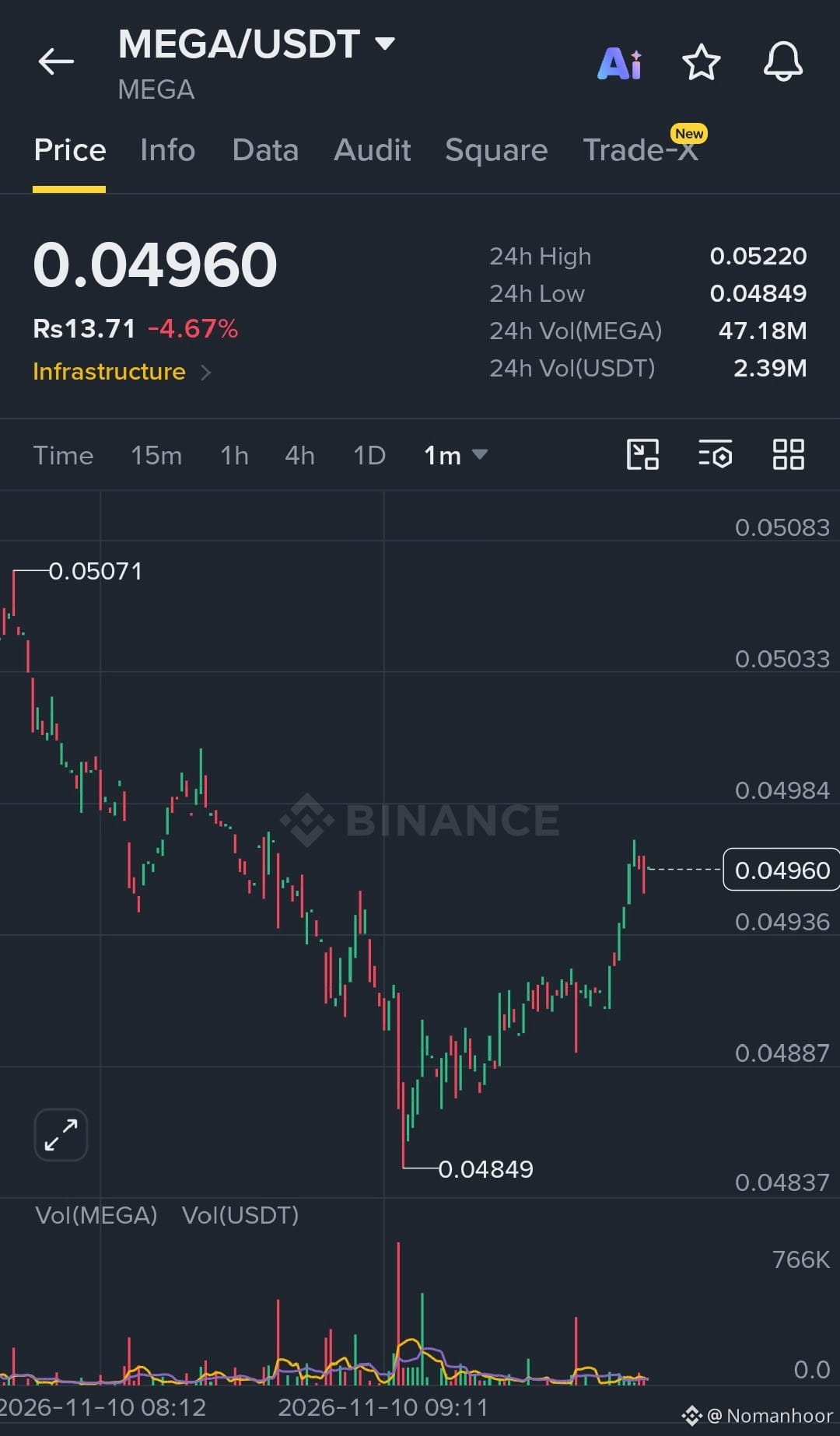
MegaETH ($MEGA ) trades at $0.0478, displaying heavy institutional technical accumulation after outperforming the broader smart contract sector with a strong 15% weekly rally. The real-time Layer 2 powerhouse continues to fortify its macro structural base. From a high-frequency trading perspective, volatility is tightly wound around the $0.0450 support cluster. Demand is heavily anchored by the project's strategic shift toward first-party "$MEGA " applications and the highly anticipated launch of its Proximity Markets protocol, allowing network participants to lock up tokens to buy ultra-low latency sequencer seats. This creates a powerful usage-based supply sink. Over half of the fixed 10 billion total supply remains securely locked under KPI-based emission structures, effectively eliminating sudden unlock fatigue. Trader Action Plan: Implement strict risk parameters. Defend immediate long positions with tight stop-losses set beneath the critical $0.0410 macro baseline. Target short-term upside breakout objectives toward structural overhead resistance capping momentum at $0.0525. #MegaETH #MEGA #cryptotradingpro #TechnicalAnalysis #Layer2
MegaETH ($MEGA ) trades at $0.0478, displaying heavy institutional technical accumulation after outperforming the broader smart contract sector with a strong 15% weekly rally. The real-time Layer 2 powerhouse continues to fortify its macro structural base.
From a high-frequency trading perspective, volatility is tightly wound around the $0.0450 support cluster. Demand is heavily anchored by the project's strategic shift toward first-party "$MEGA " applications and the highly anticipated launch of its Proximity Markets protocol, allowing network participants to lock up tokens to buy ultra-low latency sequencer seats. This creates a powerful usage-based supply sink. Over half of the fixed 10 billion total supply remains securely locked under KPI-based emission structures, effectively eliminating sudden unlock fatigue.
Trader Action Plan: Implement strict risk parameters. Defend immediate long positions with tight stop-losses set beneath the critical $0.0410 macro baseline. Target short-term upside breakout objectives toward structural overhead resistance capping momentum at $0.0525.

#MegaETH #MEGA #cryptotradingpro #TechnicalAnalysis #Layer2
Scroll just proposed to stop being a permissionless Layer 2. On November 4 it published a plan to become a permissioned network for privacy-focused AI apps, with SCR moving to Ethereum mainnet. Supply stays at 1B. $SCR trades around $0.0176, more than 98% below its 2024 high. If the chain becomes permissioned, what is the token for? The proposal says governance, staking, and governing USX. The DAO vote will answer that. Which would change your view: fees, staking demand, or USX usage? Not financial advice. DYOR. $SCR {future}(SCRUSDT) #SCR #Layer2 #SolanaDiva
Scroll just proposed to stop being a permissionless Layer 2.

On November 4 it published a plan to become a permissioned network for privacy-focused AI apps, with SCR moving to Ethereum mainnet. Supply stays at 1B.

$SCR trades around $0.0176, more than 98% below its 2024 high.

If the chain becomes permissioned, what is the token for? The proposal says governance, staking, and governing USX.

The DAO vote will answer that.

Which would change your view: fees, staking demand, or USX usage?

Not financial advice. DYOR.

$SCR

#SCR #Layer2 #SolanaDiva
Verified
Robinhood Chain, built on Arbitrum technology, passed $1.07B in TVL on November 4. $ARB trades around $0.17. TVL tells you where assets sit. It doesn't tell you who gets paid. So does a chain built on Arbitrum's stack create demand for ARB itself? Also on the calendar: 93.14M ARB (0.93% of max supply) unlocks in mid-November. Which matters more for holders: TVL on chains using the tech, or revenue that reaches the DAO? Not financial advice. DYOR. $ARB {future}(ARBUSDT) #ARB #Layer2 #SolanaDiva
Robinhood Chain, built on Arbitrum technology, passed $1.07B in TVL on November 4.

$ARB trades around $0.17.

TVL tells you where assets sit. It doesn't tell you who gets paid.

So does a chain built on Arbitrum's stack create demand for ARB itself?

Also on the calendar: 93.14M ARB (0.93% of max supply) unlocks in mid-November.

Which matters more for holders: TVL on chains using the tech, or revenue that reaches the DAO?

Not financial advice. DYOR.

$ARB

#ARB #Layer2 #SolanaDiva
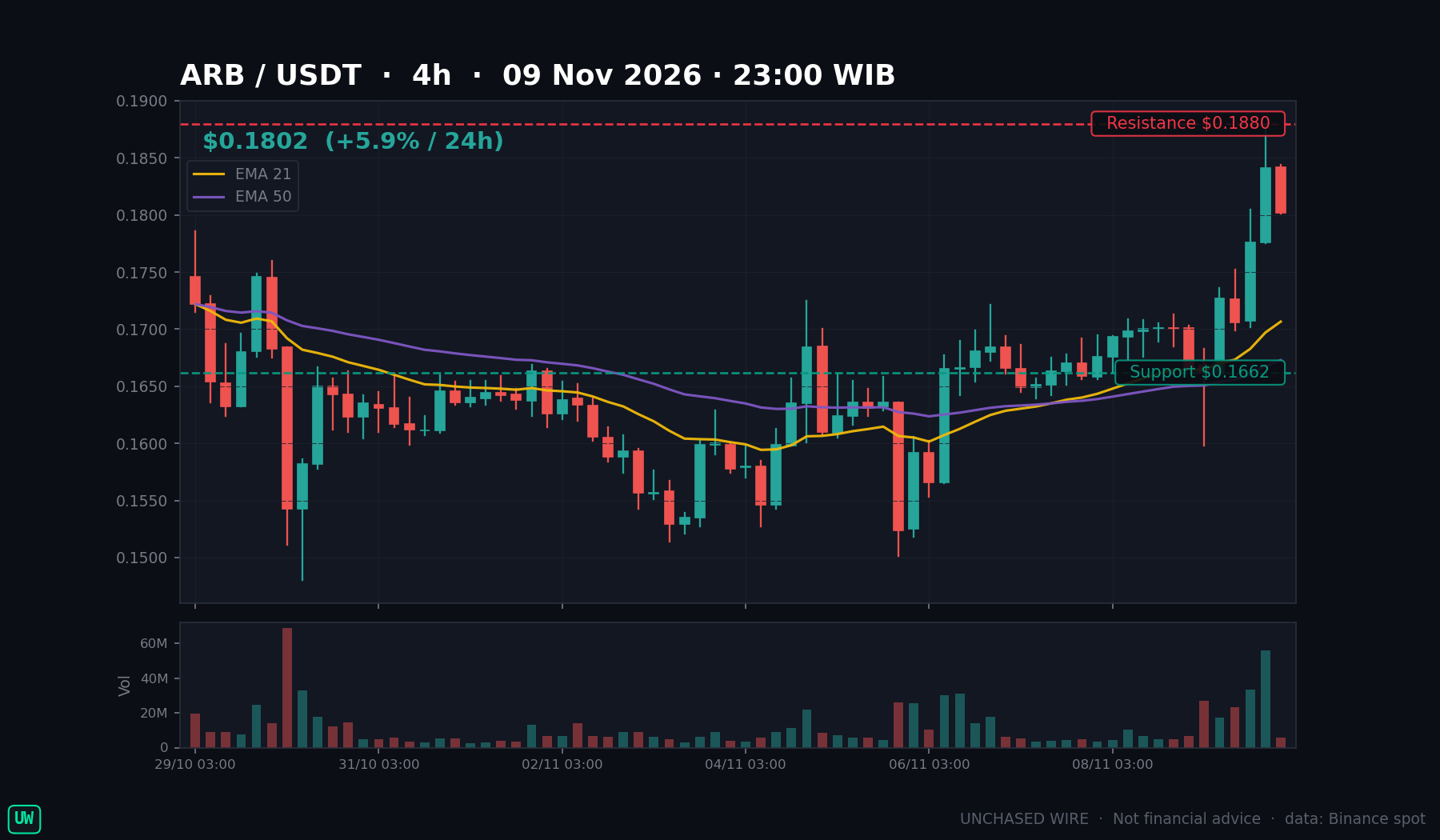
What does a Layer 2 have to do to go green when the majors all bled? Q: Did something happen on Arbitrum? A: I've looked — no single catalyst. Bridge inflows led major chains last week, private transfers went live today. The tape did the talking: ARB $0.180, up 7% while BTC fell 1% and ETH 4.3%. Volume is already 2.2x yesterday's, and price broke the November 4 high at $0.1725. Q: So why isn't this free money? A: Because the move is flow, not a protocol change. A ~92.6M ARB unlock lands next week — about $16M to team and investors, monthly to March 2027. ARB is still ~92% below its all-time high. Q: What settles it? A: Whether $0.1662 holds as the floor. The levels I'm watching: support $0.1662, then $0.1624; resistance $0.188, then $0.19. Does $0.1662 hold into the unlock, or does ARB hand the move back? NFA, DYOR. $ARB #Ethereum #Arbitrum #Layer2
What does a Layer 2 have to do to go green when the majors all bled?

Q: Did something happen on Arbitrum?
A: I've looked — no single catalyst. Bridge inflows led major chains last week, private transfers went live today. The tape did the talking: ARB $0.180, up 7% while BTC fell 1% and ETH 4.3%. Volume is already 2.2x yesterday's, and price broke the November 4 high at $0.1725.

Q: So why isn't this free money?
A: Because the move is flow, not a protocol change. A ~92.6M ARB unlock lands next week — about $16M to team and investors, monthly to March 2027. ARB is still ~92% below its all-time high.

Q: What settles it?
A: Whether $0.1662 holds as the floor. The levels I'm watching: support $0.1662, then $0.1624; resistance $0.188, then $0.19.

Does $0.1662 hold into the unlock, or does ARB hand the move back?

NFA, DYOR.

$ARB #Ethereum #Arbitrum #Layer2
The MegaETH Foundation is rebranding as MEGA and putting $30 million from its existing treasury toward building a new product suite. Its first move targets an AI inference services marketplace launching in December. Three things to watch: 1. All new products will be deployed on MegaETH. In effect, the project is funding real-world use cases and on-chain demand for its own L2 out of pocket. The narrative is shifting from “competing on scaling performance” to “delivering on ecosystem adoption.” 2. The inference marketplace aims to let developers switch freely between different inference providers, using price competition to lower AI compute costs and directly address vendor lock-in and high inference fees. However, the supported models, provider list, and specific operating rules won’t be revealed until launch. 3. The funding comes from the existing treasury, not new fundraising, and the role of the MEGA token in the inference marketplace has not yet been disclosed. How the token’s utility expands will directly affect how substantial this transformation proves to be. Competition in the L2 space has long since moved beyond comparing only TPS and gas fees. The projects that can get applications running for real and keep users and capital on-chain are the ones that will earn a ticket to the next round. This December debut is worth watching closely. #MegaETH #Layer2 #AI Crypto
The MegaETH Foundation is rebranding as MEGA and putting $30 million from its existing treasury toward building a new product suite. Its first move targets an AI inference services marketplace launching in December.

Three things to watch:

1. All new products will be deployed on MegaETH. In effect, the project is funding real-world use cases and on-chain demand for its own L2 out of pocket. The narrative is shifting from “competing on scaling performance” to “delivering on ecosystem adoption.”

2. The inference marketplace aims to let developers switch freely between different inference providers, using price competition to lower AI compute costs and directly address vendor lock-in and high inference fees. However, the supported models, provider list, and specific operating rules won’t be revealed until launch.

3. The funding comes from the existing treasury, not new fundraising, and the role of the MEGA token in the inference marketplace has not yet been disclosed. How the token’s utility expands will directly affect how substantial this transformation proves to be.

Competition in the L2 space has long since moved beyond comparing only TPS and gas fees. The projects that can get applications running for real and keep users and capital on-chain are the ones that will earn a ticket to the next round. This December debut is worth watching closely.

#MegaETH #Layer2 #AI Crypto
A public-chain team stepping in to build applications is a move worth examining. The MegaETH Foundation has officially rebranded as MEGA and allocated $30 million from its existing treasury to develop new products. Its first product is an AI inference services marketplace slated to launch in December. The approach is straightforward: make it easy for developers to switch between different inference providers, using freedom of choice to drive price competition among providers. A few key observations: 1. All new products will run on MegaETH. The idea is to lock in transaction volume for the Layer 2 network through real-world applications, rather than relying solely on ecosystem narratives; 2. The marketplace’s operating model, supported models, and list of providers will all be announced at launch. This suggests partnership negotiations are still underway, and future announcements could provide ongoing catalysts; 3. MEGA’s token has been explicitly identified as needing broader utility, but it remains unclear whether it will be used for payments, staking, or governance in the inference marketplace. This will directly determine the long-term demand underpinning the token. For developers, having another inference portal where they can compare prices and switch providers freely is a good thing. For the industry, this is another real-world example of AI inference being combined with on-chain settlement. We’ll find out in December whether it works. #MegaETH #AI推理 #Layer2
A public-chain team stepping in to build applications is a move worth examining.

The MegaETH Foundation has officially rebranded as MEGA and allocated $30 million from its existing treasury to develop new products. Its first product is an AI inference services marketplace slated to launch in December. The approach is straightforward: make it easy for developers to switch between different inference providers, using freedom of choice to drive price competition among providers.

A few key observations:

1. All new products will run on MegaETH. The idea is to lock in transaction volume for the Layer 2 network through real-world applications, rather than relying solely on ecosystem narratives;

2. The marketplace’s operating model, supported models, and list of providers will all be announced at launch. This suggests partnership negotiations are still underway, and future announcements could provide ongoing catalysts;

3. MEGA’s token has been explicitly identified as needing broader utility, but it remains unclear whether it will be used for payments, staking, or governance in the inference marketplace. This will directly determine the long-term demand underpinning the token.

For developers, having another inference portal where they can compare prices and switch providers freely is a good thing. For the industry, this is another real-world example of AI inference being combined with on-chain settlement. We’ll find out in December whether it works.

#MegaETH #AI推理 #Layer2
Optimism just lost the $0.10 mark: $OP hovering around $0.098, down about 5.6% in 24 hours. Paradoxically, the Superchain ecosystem continues to expand, while OP has fallen 25% in a month, nearly 98% below its $4.85 peak. Binance reopened OP withdrawals earlier this month after an incident, but inflows have yet to return. Could $0.10 become OP’s new ceiling? #Optimism #Layer2 #Crypto
Optimism just lost the $0.10 mark: $OP hovering around $0.098, down about 5.6% in 24 hours. Paradoxically, the Superchain ecosystem continues to expand, while OP has fallen 25% in a month, nearly 98% below its $4.85 peak. Binance reopened OP withdrawals earlier this month after an incident, but inflows have yet to return. Could $0.10 become OP’s new ceiling?
#Optimism #Layer2 #Crypto
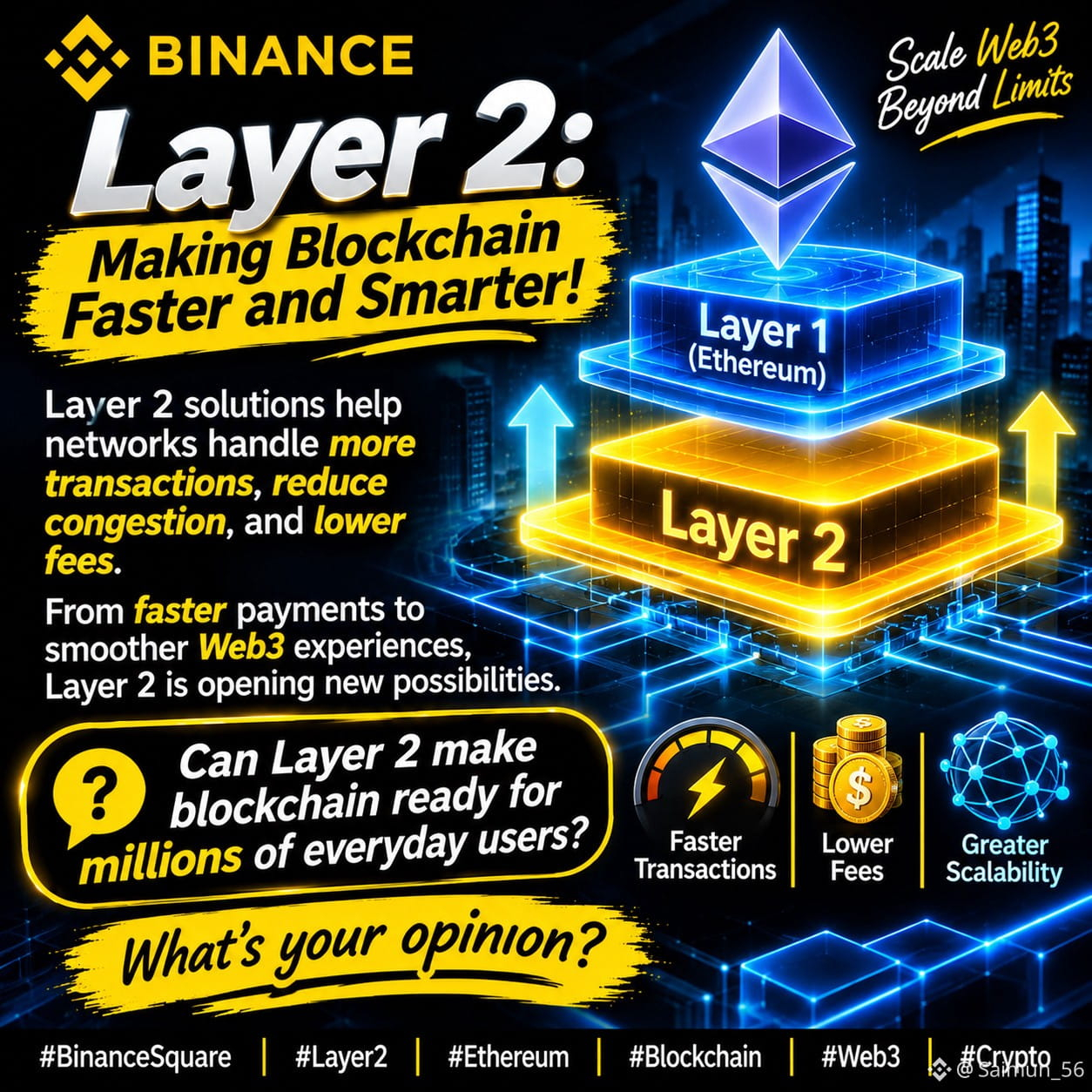
{spot}(ETHUSDT) ⚡ Layer 2: Making Blockchain Faster and Smarter! Blockchain technology is evolving, and Layer 2 solutions are playing a major role. They help networks handle more transactions, reduce congestion, and potentially lower transaction fees. From faster payments to smoother Web3 experiences, Layer 2 is opening new possibilities. 🚀 The big question: Can Layer 2 make blockchain ready for millions of everyday users? What’s your opinion? #BinanceSquare #Layer2 #Ethereum #blockchain #Web3 #Crypto $ETH
⚡ Layer 2: Making Blockchain Faster and Smarter!

Blockchain technology is evolving, and Layer 2 solutions are playing a major role. They help networks handle more transactions, reduce congestion, and potentially lower transaction fees.

From faster payments to smoother Web3 experiences, Layer 2 is opening new possibilities.

🚀 The big question: Can Layer 2 make blockchain ready for millions of everyday users?

What’s your opinion?

#BinanceSquare #Layer2 #Ethereum #blockchain #Web3 #Crypto $ETH
Ethereum Up or Down on November 9?

Ethereum Up or Down on November 9?

1%Up99%Down
Volume $39,686.15
🚀 Starknet (STRK): Building for the Future of Ethereum! Starknet is an interesting project in the Ethereum ecosystem, focusing on scalability and improving transaction efficiency through ZK-Rollup technology. 🔥 📊 What makes STRK worth watching? - Strong focus on Ethereum scalability. - Zero-Knowledge technology. - Growing Layer-2 ecosystem. - Long-term development potential. The crypto market remains unpredictable, so always do your own research and manage risk wisely. 📈 💡 Patience, research, and smart decisions matter in crypto. What is your outlook on STRK? Bullish or bearish? 👀 #strk {spot}(STRKUSDT) #STARKNET #Crypto #Ethereum #Layer2
🚀 Starknet (STRK): Building for the Future of Ethereum!

Starknet is an interesting project in the Ethereum ecosystem, focusing on scalability and improving transaction efficiency through ZK-Rollup technology. 🔥

📊 What makes STRK worth watching?

- Strong focus on Ethereum scalability.
- Zero-Knowledge technology.
- Growing Layer-2 ecosystem.
- Long-term development potential.

The crypto market remains unpredictable, so always do your own research and manage risk wisely. 📈

💡 Patience, research, and smart decisions matter in crypto.

What is your outlook on STRK? Bullish or bearish? 👀

#strk
#STARKNET #Crypto #Ethereum #Layer2
Ethereum Layer-2 — the scaling battleground. L2 networks process transactions off-chain while inheriting security from Ethereum: ⚡ Fees are a fraction of mainnet costs ⚡ Faster finality ⚡ Ethereum-level security Prices are down during the correction, but development isn’t. Bear markets are the season for building infrastructure — the teams shipping now will become the leaders of the next cycle. Track: L2 TVL, active addresses, real transactions — not just price. #Ethereum #Layer2 #Scaling #DeFi
Ethereum Layer-2 — the scaling battleground.

L2 networks process transactions off-chain while inheriting security from Ethereum:

⚡ Fees are a fraction of mainnet costs
⚡ Faster finality
⚡ Ethereum-level security

Prices are down during the correction, but development isn’t. Bear markets are the season for building infrastructure — the teams shipping now will become the leaders of the next cycle.

Track: L2 TVL, active addresses, real transactions — not just price.

#Ethereum #Layer2 #Scaling #DeFi
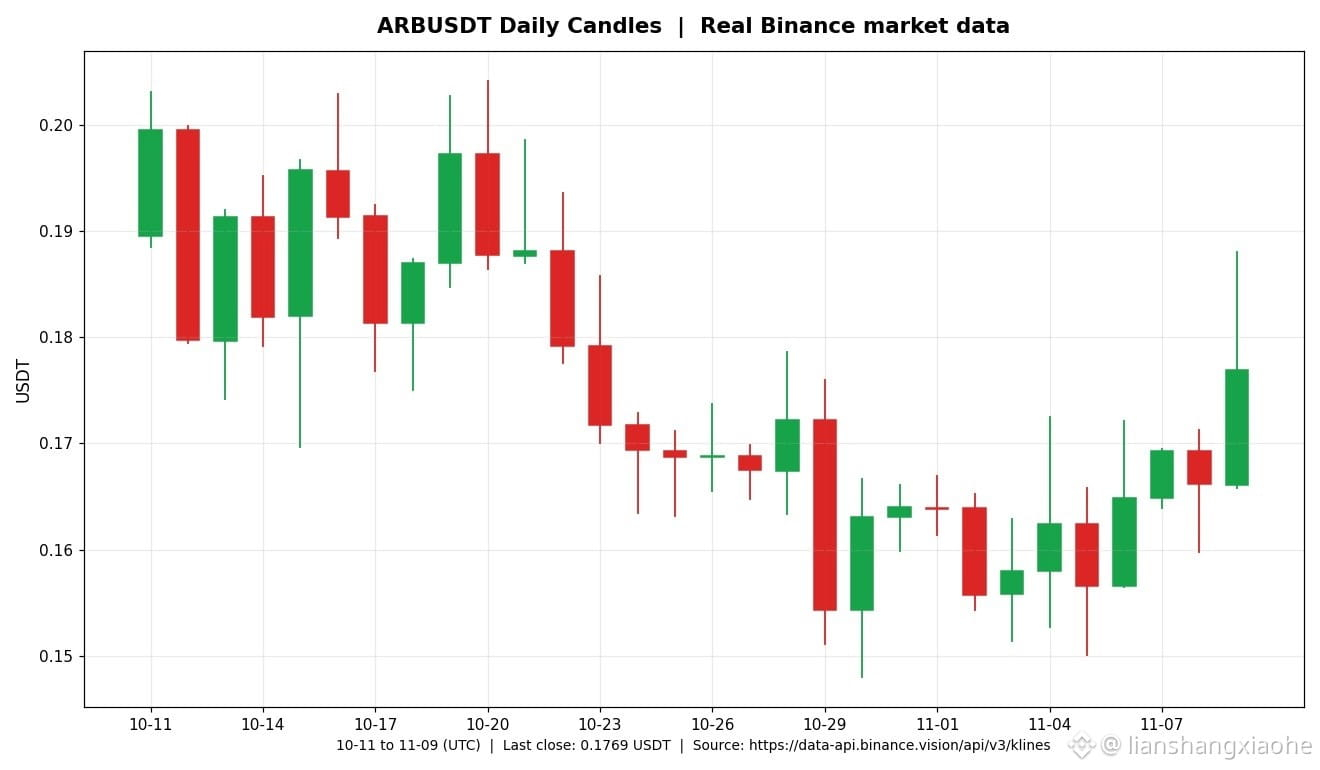
With the broader market still playing dead at $74,000, $ARB surged 8% today, climbing back to $0.18. Its 24-hour high was $0.1877, and it’s up 15% over the past 7 days—the strongest performer in the top 50 today. There are reasons on-chain: stablecoin market cap on Arbitrum grew by a net $43.6 million in 24 hours, the biggest increase among all public blockchains. A new perpetuals market launched on November 8, and today it also rolled out NullMaskio, a private transfer feature. Let’s do the math: Buy 10,000 U at yesterday’s close of $0.1662, and it’s worth about 10,630 U now. If you’d bought at yesterday’s low of $0.1598, it would have been worth about 11,760 U when the price surged to $0.188 intraday. Those who thought it was too expensive yesterday are asking today whether it’s still worth chasing. A word of caution: this rally wasn’t triggered by any single catalyst, and an unlock is coming on November 16. With a market cap of about $1.24 billion—still 92% below its all-time high of $2.39—there’s only a fine line between chasing the rally and buying the dip here. #Arbitrum #Layer2
With the broader market still playing dead at $74,000, $ARB surged 8% today, climbing back to $0.18. Its 24-hour high was $0.1877, and it’s up 15% over the past 7 days—the strongest performer in the top 50 today.

There are reasons on-chain: stablecoin market cap on Arbitrum grew by a net $43.6 million in 24 hours, the biggest increase among all public blockchains. A new perpetuals market launched on November 8, and today it also rolled out NullMaskio, a private transfer feature.

Let’s do the math: Buy 10,000 U at yesterday’s close of $0.1662, and it’s worth about 10,630 U now. If you’d bought at yesterday’s low of $0.1598, it would have been worth about 11,760 U when the price surged to $0.188 intraday. Those who thought it was too expensive yesterday are asking today whether it’s still worth chasing.

A word of caution: this rally wasn’t triggered by any single catalyst, and an unlock is coming on November 16. With a market cap of about $1.24 billion—still 92% below its all-time high of $2.39—there’s only a fine line between chasing the rally and buying the dip here. #Arbitrum #Layer2
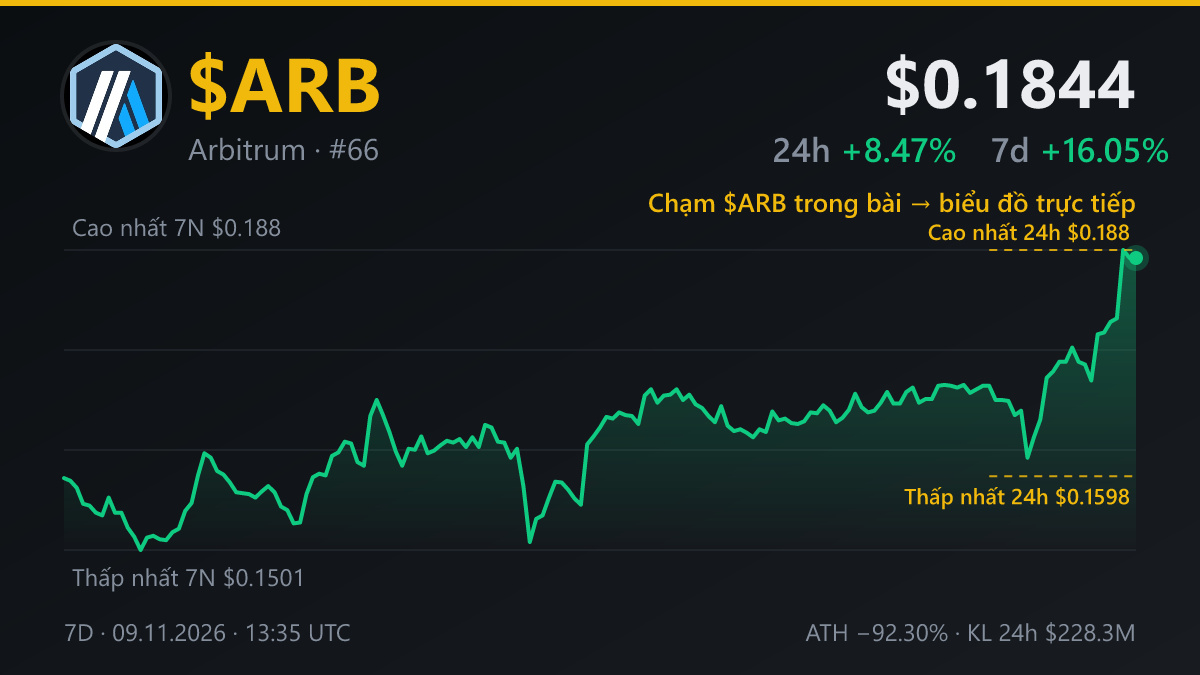
$ARB is clearly outperforming other Layer 2 rivals. 🚀 While the entire market is down 5.57% and $BTC has slipped 1.78% to around $74,691, the Rollup sector is showing a stark divergence. Put $ARB side by side with $OP, and the difference is clear in every metric: • $ARB surged +8.47% in 24 hours and gained +16.05% in 7 days. Trading volume reached $228.3M, pushing the price close to its 24-hour high of $0.188, up from a low of $0.1598. • Meanwhile, $OP edged up just +0.49% in 24 hours and is still down 10.76% over 7 days, with relatively modest liquidity of $32.95M. Although ARB is still -92.3% below its ATH, money seems to be clearly favoring this asset, which has set a new weekly high at $0.188. In my view, its technical momentum and superior liquidity give ARB a clear advantage over the subdued OP at the moment. ⚡ Tap $ARB to compare this price action directly with the broader market today. 📊 Do you think this breakout has enough momentum to lift the entire Layer 2 sector? 🤔 Not financial advice. DYOR. #ARB #Layer2 #Crypto
$ARB is clearly outperforming other Layer 2 rivals. 🚀

While the entire market is down 5.57% and $BTC has slipped 1.78% to around $74,691, the Rollup sector is showing a stark divergence.

Put $ARB side by side with $OP , and the difference is clear in every metric:
• $ARB surged +8.47% in 24 hours and gained +16.05% in 7 days. Trading volume reached $228.3M, pushing the price close to its 24-hour high of $0.188, up from a low of $0.1598.
• Meanwhile, $OP edged up just +0.49% in 24 hours and is still down 10.76% over 7 days, with relatively modest liquidity of $32.95M.

Although ARB is still -92.3% below its ATH, money seems to be clearly favoring this asset, which has set a new weekly high at $0.188. In my view, its technical momentum and superior liquidity give ARB a clear advantage over the subdued OP at the moment. ⚡

Tap $ARB to compare this price action directly with the broader market today. 📊

Do you think this breakout has enough momentum to lift the entire Layer 2 sector? 🤔

Not financial advice. DYOR.
#ARB #Layer2 #Crypto
Zilliqa’s strategic pivot is worth taking seriously: it is abandoning its own L1 and shifting fully to Ethereum L2, with compliant institutional users as its target customers. In the short term, this is a painful adjustment. Ecosystem liquidity and on-chain activity will both have to be reshuffled, and price pressure is almost inevitable. The current price is around $0.00165, with 24-hour trading volume of about $4.24 million and a market cap near $34 million, indicating that the market is still digesting this shift. But take a longer view, and the rationale becomes clearer: 1. The room for independent L1s to survive keeps shrinking. Connecting to the Ethereum ecosystem offers shared security and liquidity, rather than going it alone. 2. Institutional clients care most about compliance and stability. Focusing on this niche gives Zilliqa a clearer identity than fighting it out in the crowded retail public-chain market. 3. $ZIL does not need to be migrated or exchanged for now, and its value anchor remains in place. Token holders need not panic and make rash moves because of short-term price action. Transformation is never free, and the growing pains will be reflected in the price. But if its positioning as an institutional L2 takes hold, Zilliqa may be able to carve out a differentiated niche. Going forward, tracking ecosystem metrics and progress on institutional partnerships will be more meaningful than fixating on short-term volatility. #Zilliqa #Layer2 #CryptoWatch
Zilliqa’s strategic pivot is worth taking seriously: it is abandoning its own L1 and shifting fully to Ethereum L2, with compliant institutional users as its target customers.

In the short term, this is a painful adjustment. Ecosystem liquidity and on-chain activity will both have to be reshuffled, and price pressure is almost inevitable. The current price is around $0.00165, with 24-hour trading volume of about $4.24 million and a market cap near $34 million, indicating that the market is still digesting this shift.

But take a longer view, and the rationale becomes clearer:

1. The room for independent L1s to survive keeps shrinking. Connecting to the Ethereum ecosystem offers shared security and liquidity, rather than going it alone.

2. Institutional clients care most about compliance and stability. Focusing on this niche gives Zilliqa a clearer identity than fighting it out in the crowded retail public-chain market.

3. $ZIL does not need to be migrated or exchanged for now, and its value anchor remains in place. Token holders need not panic and make rash moves because of short-term price action.

Transformation is never free, and the growing pains will be reflected in the price. But if its positioning as an institutional L2 takes hold, Zilliqa may be able to carve out a differentiated niche. Going forward, tracking ecosystem metrics and progress on institutional partnerships will be more meaningful than fixating on short-term volatility.

#Zilliqa #Layer2 #CryptoWatch
Zilliqa is undergoing a fundamental strategic shift that deserves a closer look. The project has abandoned its homegrown L1, which it spent years building, and is fully pivoting to an Ethereum L2 strategy, with compliant institutional users as its target customers. This means it is no longer chasing the traffic-driven narrative of public-chain ecosystems; instead, it is transforming into an institutional-grade infrastructure provider. The dynamics of the playing field have changed completely. The short-term costs are very real: liquidity and ecosystem activity on the old chain need to be re-integrated, and uncertainty around the transition will continue to weigh on $ZIL 's market performance. It currently trades at around $0.00165, with a market cap of just over $34 million and 24-hour trading volume of about $4.24 million. Liquidity is thin, making it easy for sentiment swings to be amplified, and chasing a rally carries considerable risk. But over a longer time horizon, the outlook is not necessarily bleak. First, Ethereum L2s benefit from shared security and a mature ecosystem, while development and customer acquisition costs are lower than those of an independent public chain. Second, the compliant institutional market has high barriers to entry and strong customer retention; once the project gains traction, its revenue structure could be far more stable than a retail-driven narrative. Third, the token model has not yet undergone major changes, so ZIL still retains a value anchor and faces no immediate, zero-bound sell pressure. My take: this is a classic transition with a “short-term bearish, long-term bullish” profile. Funding conditions may remain under pressure in the near term, so there is no need to rush into buying the dip. In the long run, keep a close eye on three concrete indicators—the number of institutional client contracts signed, progress toward the L2 launch, and the recovery in on-chain activity. Use the data to assess how well the transition is going rather than holding on faith. #Zilliqa #Layer2 #InstitutionalCompliance
Zilliqa is undergoing a fundamental strategic shift that deserves a closer look.

The project has abandoned its homegrown L1, which it spent years building, and is fully pivoting to an Ethereum L2 strategy, with compliant institutional users as its target customers. This means it is no longer chasing the traffic-driven narrative of public-chain ecosystems; instead, it is transforming into an institutional-grade infrastructure provider. The dynamics of the playing field have changed completely.

The short-term costs are very real: liquidity and ecosystem activity on the old chain need to be re-integrated, and uncertainty around the transition will continue to weigh on $ZIL 's market performance. It currently trades at around $0.00165, with a market cap of just over $34 million and 24-hour trading volume of about $4.24 million. Liquidity is thin, making it easy for sentiment swings to be amplified, and chasing a rally carries considerable risk.

But over a longer time horizon, the outlook is not necessarily bleak. First, Ethereum L2s benefit from shared security and a mature ecosystem, while development and customer acquisition costs are lower than those of an independent public chain. Second, the compliant institutional market has high barriers to entry and strong customer retention; once the project gains traction, its revenue structure could be far more stable than a retail-driven narrative. Third, the token model has not yet undergone major changes, so ZIL still retains a value anchor and faces no immediate, zero-bound sell pressure.

My take: this is a classic transition with a “short-term bearish, long-term bullish” profile. Funding conditions may remain under pressure in the near term, so there is no need to rush into buying the dip. In the long run, keep a close eye on three concrete indicators—the number of institutional client contracts signed, progress toward the L2 launch, and the recovery in on-chain activity. Use the data to assess how well the transition is going rather than holding on faith.

#Zilliqa #Layer2 #InstitutionalCompliance
$ZIL This transformation is worth examining calmly as a holder. Zilliqa has officially abandoned building its own L1 and shifted to Ethereum L2, targeting compliant institutional users. This is not an ordinary technical upgrade, but a complete overhaul of its roadmap: liquidity and on-chain activity in the old ecosystem will inevitably undergo a round of restructuring, so short-term price pressure was to be expected. But two key points are easily obscured by emotion: First, a transformation does not mean the token goes to zero. $ZIL does not need to be migrated or exchanged for now, and its value anchor remains in place. The project has preserved the fundamental interests of its holders. Second, an institution-grade compliant L2 is a differentiated market. Rather than continuing to burn resources in the crowded public-chain space, the project can package years of accumulated technical expertise into a compliant solution that institutions genuinely need. The long-term rationale is actually clearer than before. The data is also worth noting: the current price is around $0.00165, the market cap is about $34 million, and 24-hour trading volume is only around $4.24 million. Thin liquidity means volatility can easily be amplified, so chasing a rally or panic-selling could both prove costly. My take: this is a bet that trades short-term growing pains for a long-term foothold. Those who can tolerate the uncertainty of the restructuring period can track ecosystem progress with a small position; those with a low risk tolerance should at least recognize that this is not currently a short-term play. #Zilliqa #Layer2 #InstitutionalCompliance
$ZIL This transformation is worth examining calmly as a holder.

Zilliqa has officially abandoned building its own L1 and shifted to Ethereum L2, targeting compliant institutional users. This is not an ordinary technical upgrade, but a complete overhaul of its roadmap: liquidity and on-chain activity in the old ecosystem will inevitably undergo a round of restructuring, so short-term price pressure was to be expected.

But two key points are easily obscured by emotion:

First, a transformation does not mean the token goes to zero. $ZIL does not need to be migrated or exchanged for now, and its value anchor remains in place. The project has preserved the fundamental interests of its holders.

Second, an institution-grade compliant L2 is a differentiated market. Rather than continuing to burn resources in the crowded public-chain space, the project can package years of accumulated technical expertise into a compliant solution that institutions genuinely need. The long-term rationale is actually clearer than before.

The data is also worth noting: the current price is around $0.00165, the market cap is about $34 million, and 24-hour trading volume is only around $4.24 million. Thin liquidity means volatility can easily be amplified, so chasing a rally or panic-selling could both prove costly.

My take: this is a bet that trades short-term growing pains for a long-term foothold. Those who can tolerate the uncertainty of the restructuring period can track ecosystem progress with a small position; those with a low risk tolerance should at least recognize that this is not currently a short-term play.

#Zilliqa #Layer2 #InstitutionalCompliance
Zilliqa is undergoing a major strategic transformation. The project is abandoning the old path of building its own L1 and pivoting fully to Ethereum L2, with compliant institutional users as its target customers. This means the liquidity and ecosystem activity built around its independent blockchain will have to be rebuilt from scratch, ushering in a period of restructuring. It’s no surprise that the price may face pressure in the short term. But viewed from another angle, rather than continuing to burn resources in the crowded L1 space, Zilliqa can use Ethereum’s security and institutional reach to carve out a new position. For holders of $ZIL , one key signal is that the token does not currently need to be migrated or swapped. Its value anchor remains in place, at least avoiding the worst kind of uncertainty for holders. ZIL is currently priced at around $0.00165, with a market cap of about $34 million and just $4.24 million in 24-hour trading volume. Liquidity is thin, so volatility can easily be amplified. Whether the transformation delivers will depend above all on tangible progress in bringing institutional customers on board—not on the white paper narrative. In the short term, sentiment matters; in the long term, execution does. There’s no easy path for an established blockchain to reinvent itself, but staying in the game is what makes a comeback possible. #Zilliqa #Layer2 #InstitutionalAdoption
Zilliqa is undergoing a major strategic transformation.

The project is abandoning the old path of building its own L1 and pivoting fully to Ethereum L2, with compliant institutional users as its target customers. This means the liquidity and ecosystem activity built around its independent blockchain will have to be rebuilt from scratch, ushering in a period of restructuring. It’s no surprise that the price may face pressure in the short term.

But viewed from another angle, rather than continuing to burn resources in the crowded L1 space, Zilliqa can use Ethereum’s security and institutional reach to carve out a new position. For holders of $ZIL , one key signal is that the token does not currently need to be migrated or swapped. Its value anchor remains in place, at least avoiding the worst kind of uncertainty for holders.

ZIL is currently priced at around $0.00165, with a market cap of about $34 million and just $4.24 million in 24-hour trading volume. Liquidity is thin, so volatility can easily be amplified. Whether the transformation delivers will depend above all on tangible progress in bringing institutional customers on board—not on the white paper narrative.

In the short term, sentiment matters; in the long term, execution does. There’s no easy path for an established blockchain to reinvent itself, but staying in the game is what makes a comeback possible.

#Zilliqa #Layer2 #InstitutionalAdoption
$ZIL is undergoing a sweeping strategic shift: abandoning its own L1 and pivoting fully to Ethereum L2, while targeting compliant institutional users. In the short term, this means reshuffling existing on-chain liquidity and ecosystem activity, so price pressure is hardly unexpected. The current price is around $0.00165, with approximately $4.24 million in 24-hour trading volume and a market cap of about $34.03 million. Small-cap assets are inherently highly sensitive to shifts in sentiment. But from a longer-term perspective, this path is actually more pragmatic. Competition among public blockchains is already intense, and independently maintaining an L1’s security and ecosystem comes at an extremely high cost. Building an institutional-grade L2 on Ethereum’s security and targeting niche use cases in compliant payments and asset tokenization is a sensible way to differentiate and survive. More importantly, during the transition, there are no additional selling-pressure measures planned for the ZIL token. Its value anchor remains in place, so this is not a “vaporware-style transformation.” Holders need not panic over short-term volatility. Conclusion: This is a classic case of short-term growing pains in exchange for a long-term bet. Aggressive investors can keep tracking ecosystem deployment and progress with institutional clients; more cautious investors can wait until on-chain data shows tangible results before reassessing. #Zilliqa #Layer2 #Institutional adoption
$ZIL is undergoing a sweeping strategic shift: abandoning its own L1 and pivoting fully to Ethereum L2, while targeting compliant institutional users.

In the short term, this means reshuffling existing on-chain liquidity and ecosystem activity, so price pressure is hardly unexpected. The current price is around $0.00165, with approximately $4.24 million in 24-hour trading volume and a market cap of about $34.03 million. Small-cap assets are inherently highly sensitive to shifts in sentiment.

But from a longer-term perspective, this path is actually more pragmatic. Competition among public blockchains is already intense, and independently maintaining an L1’s security and ecosystem comes at an extremely high cost. Building an institutional-grade L2 on Ethereum’s security and targeting niche use cases in compliant payments and asset tokenization is a sensible way to differentiate and survive.

More importantly, during the transition, there are no additional selling-pressure measures planned for the ZIL token. Its value anchor remains in place, so this is not a “vaporware-style transformation.” Holders need not panic over short-term volatility.

Conclusion: This is a classic case of short-term growing pains in exchange for a long-term bet. Aggressive investors can keep tracking ecosystem deployment and progress with institutional clients; more cautious investors can wait until on-chain data shows tangible results before reassessing.

#Zilliqa #Layer2 #Institutional adoption
·
--
🎯 Altcoins are getting slaughtered, but ARB is up 4% 📰 Bitcoin fell 1.6% to $74.6K, and ETH dropped 5% to $2,125. Only about a dozen of the top 250 coins are still rising, with ARB bucking the trend and gaining 3.8%. 💬 Altcoins that hold strong in a falling market are often being quietly accumulated. Don’t rush to chase—first see whether it can withstand the next bearish candle. Only then is it a genuine sign of unusual strength. 🏷️ #ARB #山寨异动 #Layer2 #StrengthAgainstTheTrend
🎯 Altcoins are getting slaughtered, but ARB is up 4%

📰 Bitcoin fell 1.6% to $74.6K, and ETH dropped 5% to $2,125. Only about a dozen of the top 250 coins are still rising, with ARB bucking the trend and gaining 3.8%.

💬 Altcoins that hold strong in a falling market are often being quietly accumulated. Don’t rush to chase—first see whether it can withstand the next bearish candle. Only then is it a genuine sign of unusual strength.

🏷️ #ARB #山寨异动 #Layer2 #StrengthAgainstTheTrend
Log in to explore more content
Join global crypto users on Binance Square
⚡️ Get latest and useful information about crypto.
💬 Trusted by the world’s largest crypto exchange.
👍 Discover real insights from verified creators.
Email / Phone number