
-丁甲-
68 Posts

-丁甲-
人弃我捡 人争我予
Frequent Trader
5 Years
130 Following
6.0K+ Followers
1.0K+ Liked
Posts
If viewed from the perspective of cycles, this TGE would be more interesting. @Fabric Foundation chose to go live when market sentiment was not extremely euphoric, and $ROBO has stabilized at $0.042, indicating that current trading is more rational rather than purely driven by emotions.
Many projects are hyped to high levels immediately upon launch, only to fall back, leaving behind only volatility. On the contrary, this relatively stable start gives projects time to prove themselves. The narrative of robots is indeed a long-term trend, but what the capital market truly recognizes is the frequency of use and cash flow logic. If scenarios of machines taking orders, automatic settlements, and continuous token consumption really emerge on-chain in the future, then $ROBO will form endogenous demand, rather than relying on narratives for support.
In other words, the key now is not whether it will rise, but whether it can be used. When the pace of technology implementation keeps up with the narrative tempo, the value of the token will gradually be realized. This current stage is more like a window period for observing fundamentals, rather than making endgame judgments. #robo $ROBO
Many projects are hyped to high levels immediately upon launch, only to fall back, leaving behind only volatility. On the contrary, this relatively stable start gives projects time to prove themselves. The narrative of robots is indeed a long-term trend, but what the capital market truly recognizes is the frequency of use and cash flow logic. If scenarios of machines taking orders, automatic settlements, and continuous token consumption really emerge on-chain in the future, then $ROBO will form endogenous demand, rather than relying on narratives for support.
In other words, the key now is not whether it will rise, but whether it can be used. When the pace of technology implementation keeps up with the narrative tempo, the value of the token will gradually be realized. This current stage is more like a window period for observing fundamentals, rather than making endgame judgments. #robo $ROBO

This time, the TGE of @Fabric Foundation is more like a market test. This position cannot be considered hot, but it precisely indicates that the project is still in the early stages of competition, rather than at an emotional peak.
From another perspective, the key to $ROBO is not in the short-term fluctuations, but whether it can become a passport in the robot network. If a large number of robots in the future require on-chain identity, task settlement, and value transfer, then the frequency of the underlying protocol's use will be the core variable. The more people use it, the more real demand there is for the token; if only narratives are presented without use cases, it will be difficult for the price to stabilize in the long term.
The imaginative space of the robot track is indeed vast, but the projects that can truly emerge must advance both technical implementation and ecological expansion simultaneously. For $ROBO , it feels more like the starting line now, rather than the finish line. The key is not just the opportunity, but the execution capability. #robo $ROBO
From another perspective, the key to $ROBO is not in the short-term fluctuations, but whether it can become a passport in the robot network. If a large number of robots in the future require on-chain identity, task settlement, and value transfer, then the frequency of the underlying protocol's use will be the core variable. The more people use it, the more real demand there is for the token; if only narratives are presented without use cases, it will be difficult for the price to stabilize in the long term.
The imaginative space of the robot track is indeed vast, but the projects that can truly emerge must advance both technical implementation and ecological expansion simultaneously. For $ROBO , it feels more like the starting line now, rather than the finish line. The key is not just the opportunity, but the execution capability. #robo $ROBO
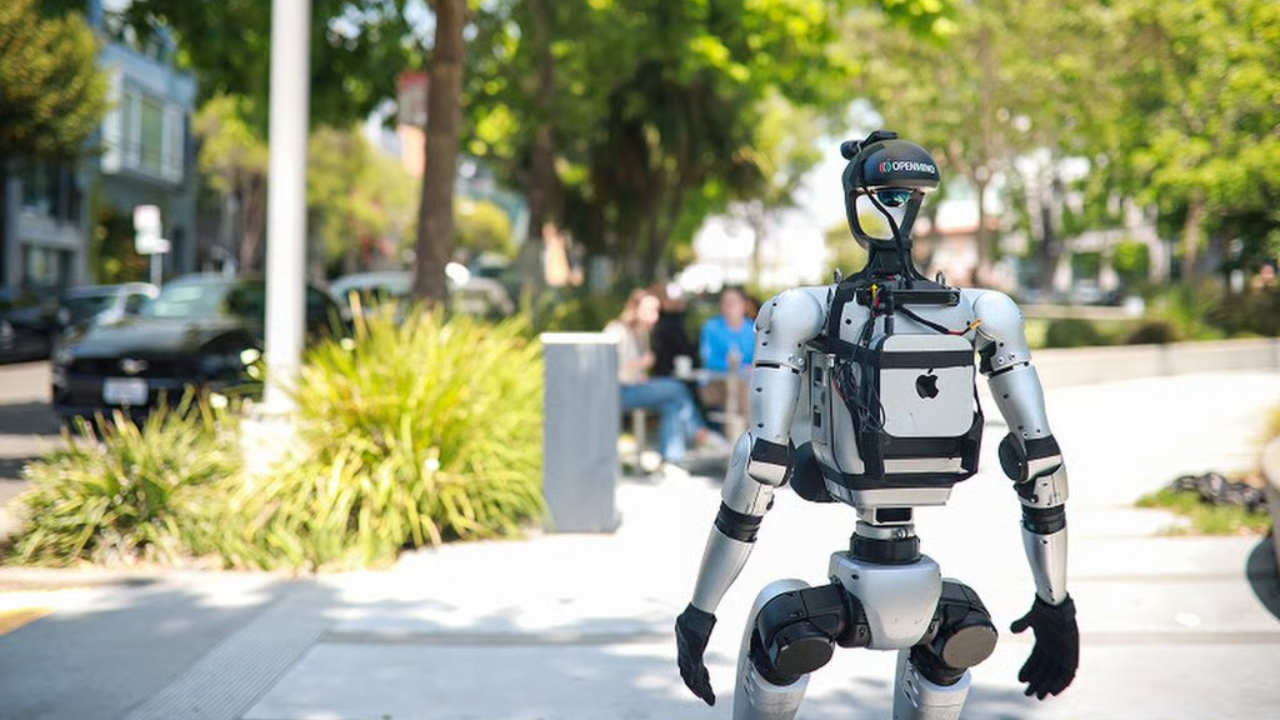
The current robots and AI mostly rely on platforms. Data is on the platform, accounts are on the platform, and settlements are on the platform. Once the platform stops or the rules change, all connected machines will be affected. @Fabric Foundation What we want to do is to extract these key capabilities and turn them into public infrastructure, rather than corporate assets.
It builds a basic framework around modules such as machine identity, automatic settlement, task allocation, and machine communication. The focus is not on multiple intelligences, but on verifiability. What the machine has done, whether it has followed the rules, and how the money flows can all be recorded and traced. This transparency is a problem that must be solved before machines can enter the real world on a large scale.
Another point worth noting is that it does not emphasize giving machines legal status, but rather emphasizes the participation of machines in the economy within the rules. In other words, machines can take on tasks and receive rewards, but the premise is that their actions are observable and the processes are auditable.
In the long run, Fabric Foundation bets that a machine society will become a foundational reality rather than just a concept. If that day really comes, then establishing standards and protocols now may be more important than creating smarter models.
#robo $ROBO
It builds a basic framework around modules such as machine identity, automatic settlement, task allocation, and machine communication. The focus is not on multiple intelligences, but on verifiability. What the machine has done, whether it has followed the rules, and how the money flows can all be recorded and traced. This transparency is a problem that must be solved before machines can enter the real world on a large scale.
Another point worth noting is that it does not emphasize giving machines legal status, but rather emphasizes the participation of machines in the economy within the rules. In other words, machines can take on tasks and receive rewards, but the premise is that their actions are observable and the processes are auditable.
In the long run, Fabric Foundation bets that a machine society will become a foundational reality rather than just a concept. If that day really comes, then establishing standards and protocols now may be more important than creating smarter models.
#robo $ROBO
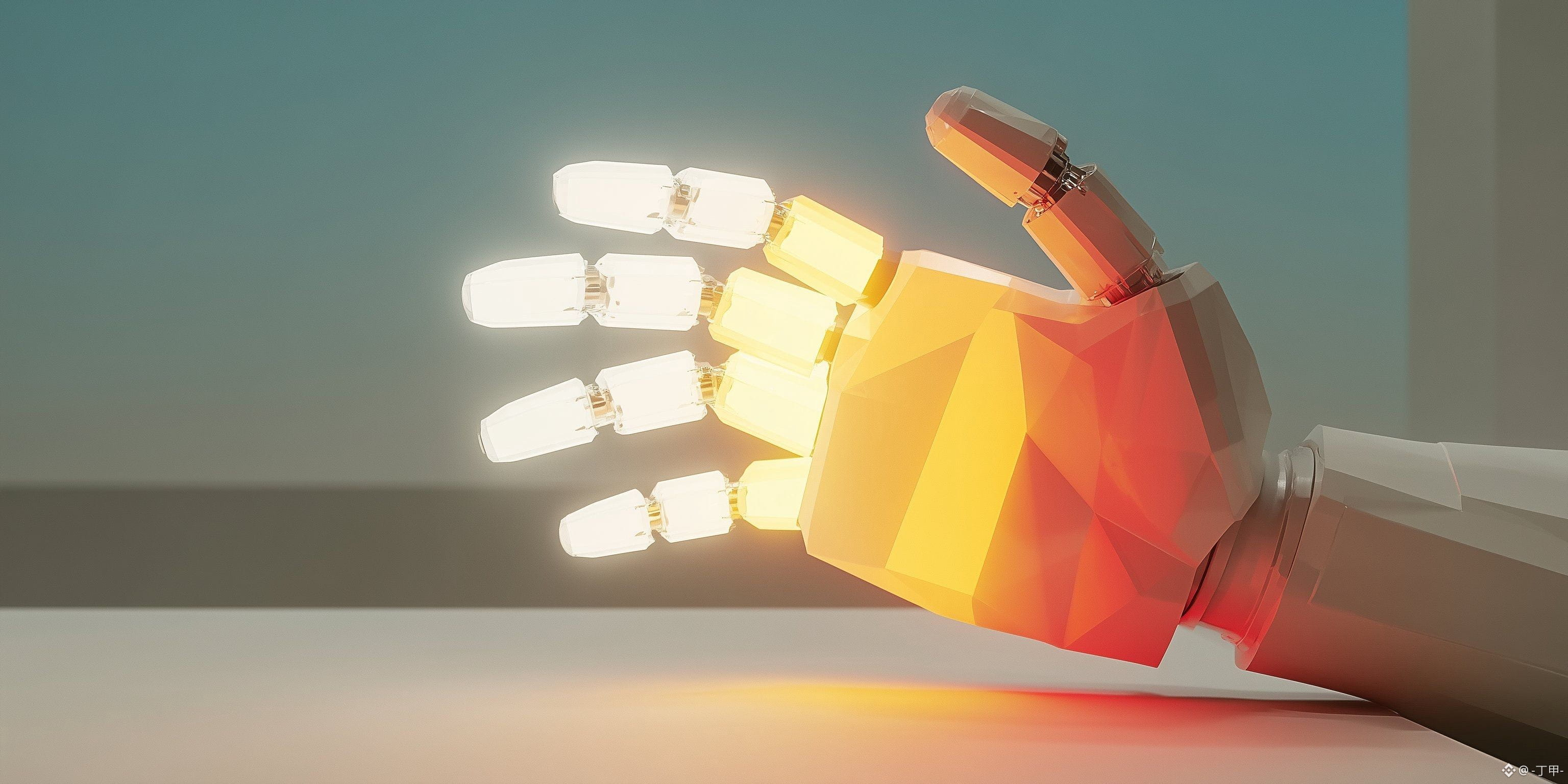

The entire network is sharing airdrop @Fabric Foundation , let's talk about Fabrc today.
Fabrc is a non-profit organization that has been dedicated to building an open-source robot and general artificial intelligence ecosystem. Around the Fabric protocol, it attempts to establish a sustainable underlying framework for machines, allowing devices and agents to have decentralized identities, complete payment settlements, and collaborate efficiently in an open network.
In terms of vision, the Fabric Foundation does not focus on granting machines so-called legal personality, but rather on enabling machines to act as economic participants, undertaking tasks and exchanging value under clear rules. To this end, the foundation supports various infrastructure research and development, including machine identity systems, task allocation networks, location-based payment mechanisms, and communication protocols between machines, with the goal of closing the complete loop of perception—decision-making—execution—settlement.
At the same time, the foundation also values governance and coordination. Through research funding, public technical standard formulation, and multi-party cooperation, it hopes to connect developers, businesses, academic institutions, and public organizations to promote global participation. Its core idea is that when machines enter the real world on a large scale, their behavior must be predictable, processes observable, and as consistent as possible with human long-term values.
In the context of the gradually forming machine economy, the Fabric Foundation is more like a bridge, connecting one end to technological innovation and the other end to real societal needs, attempting to lay a solid and open foundation for human-machine collaboration.
#robo $ROBO
Fabrc is a non-profit organization that has been dedicated to building an open-source robot and general artificial intelligence ecosystem. Around the Fabric protocol, it attempts to establish a sustainable underlying framework for machines, allowing devices and agents to have decentralized identities, complete payment settlements, and collaborate efficiently in an open network.
In terms of vision, the Fabric Foundation does not focus on granting machines so-called legal personality, but rather on enabling machines to act as economic participants, undertaking tasks and exchanging value under clear rules. To this end, the foundation supports various infrastructure research and development, including machine identity systems, task allocation networks, location-based payment mechanisms, and communication protocols between machines, with the goal of closing the complete loop of perception—decision-making—execution—settlement.
At the same time, the foundation also values governance and coordination. Through research funding, public technical standard formulation, and multi-party cooperation, it hopes to connect developers, businesses, academic institutions, and public organizations to promote global participation. Its core idea is that when machines enter the real world on a large scale, their behavior must be predictable, processes observable, and as consistent as possible with human long-term values.
In the context of the gradually forming machine economy, the Fabric Foundation is more like a bridge, connecting one end to technological innovation and the other end to real societal needs, attempting to lay a solid and open foundation for human-machine collaboration.
#robo $ROBO
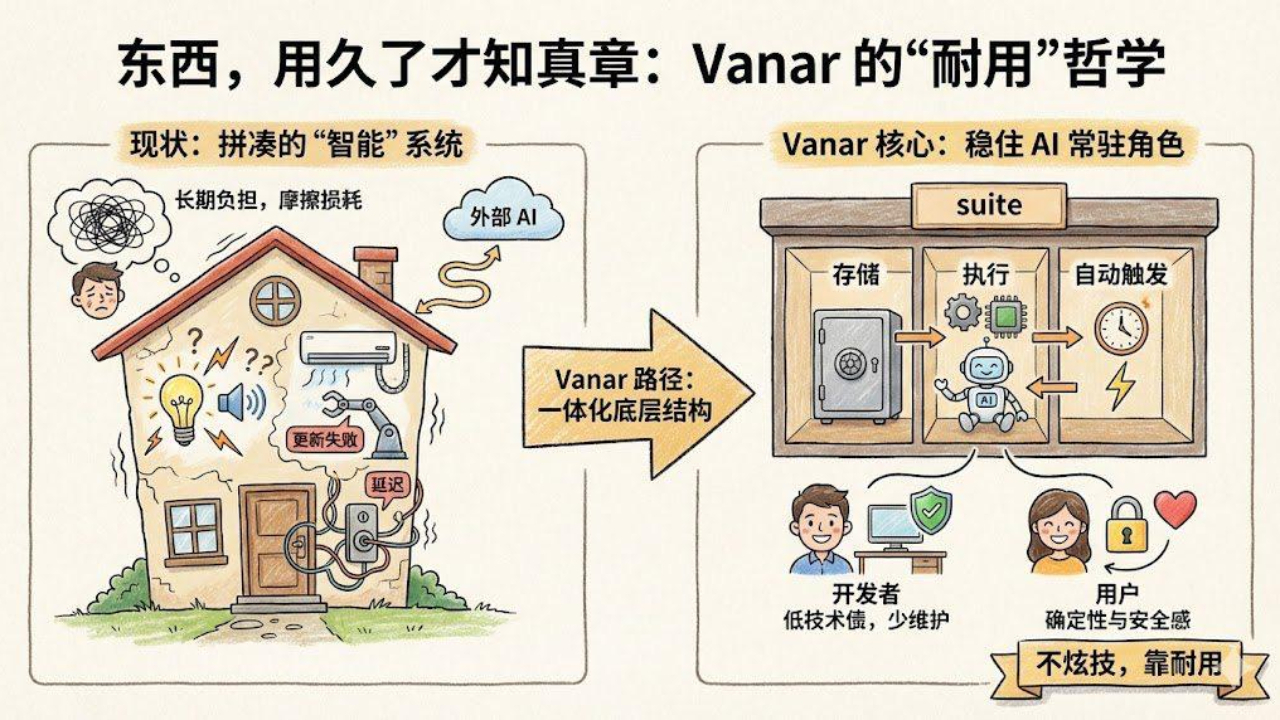
Using a mobile phone for a long time often slows it down, and it's usually not because the components are broken, but because the system has accumulated too much junk and is too burdened to operate.
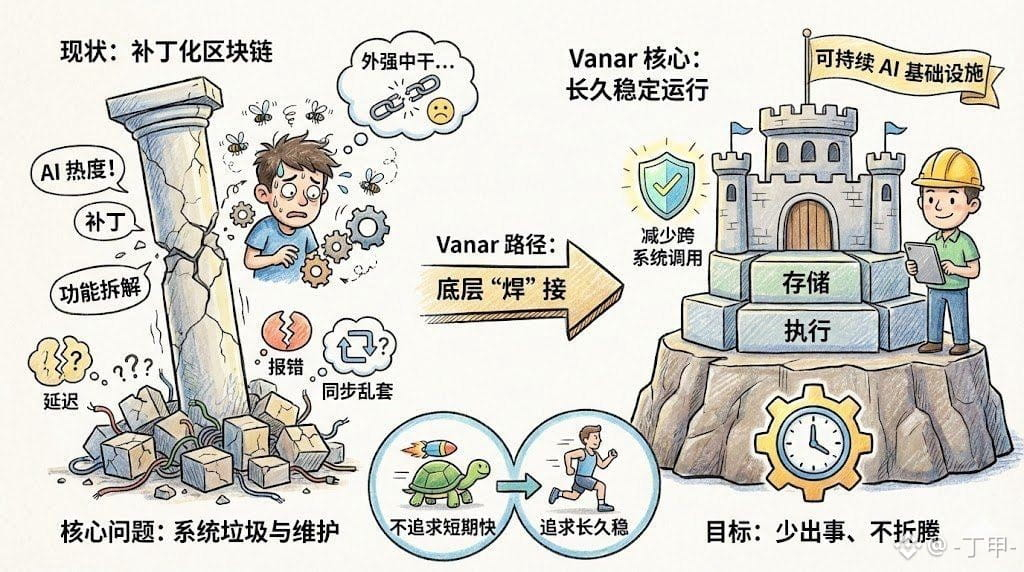
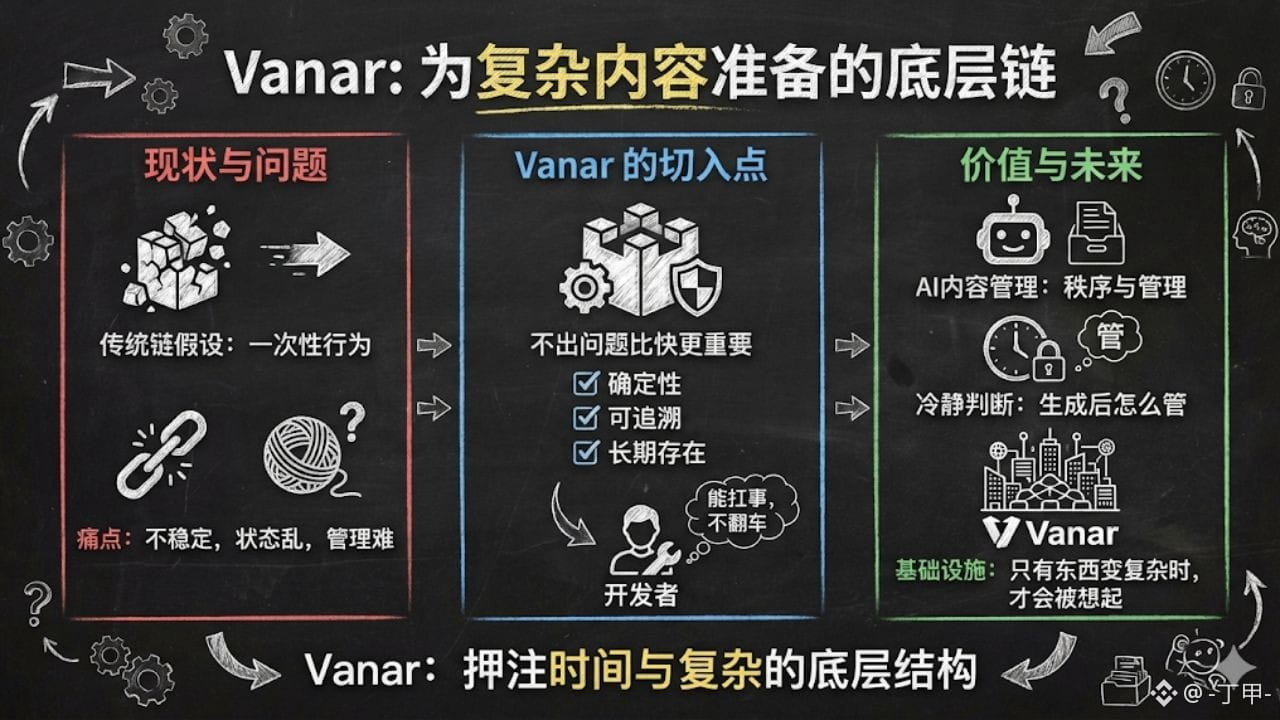
Blockchain is quite similar. Many chains are currently patching things up to ride the AI wave, breaking functions into a disjointed mess. In the short term, it looks impressive, but over time, delays, errors, and synchronization issues become apparent. It's like adding luxurious furniture to a leaking house—strong on the outside but weak on the inside.
@Vanar 's approach is more pragmatic. It doesn't play around with abstract concepts but instead directly integrates storage and execution into the underlying structure. AI no longer needs to repeatedly make cross-system calls, significantly reducing the probability of errors.
Its goal is simple: it does not pursue short-term speed but rather long-term stability. For developers and users, this kind of reliability, which minimizes issues and avoids unnecessary complications, is actually more valuable than just speed.
After all, in a future where AI becomes the norm, being stable means being able to keep running. Vanar's logic is very clear: don't rely on flashy skills, rely on durability.
#vanar $VANRY
Blockchain is quite similar. Many chains are currently patching things up to ride the AI wave, breaking functions into a disjointed mess. In the short term, it looks impressive, but over time, delays, errors, and synchronization issues become apparent. It's like adding luxurious furniture to a leaking house—strong on the outside but weak on the inside.
@Vanar 's approach is more pragmatic. It doesn't play around with abstract concepts but instead directly integrates storage and execution into the underlying structure. AI no longer needs to repeatedly make cross-system calls, significantly reducing the probability of errors.
Its goal is simple: it does not pursue short-term speed but rather long-term stability. For developers and users, this kind of reliability, which minimizes issues and avoids unnecessary complications, is actually more valuable than just speed.
After all, in a future where AI becomes the norm, being stable means being able to keep running. Vanar's logic is very clear: don't rely on flashy skills, rely on durability.
#vanar $VANRY
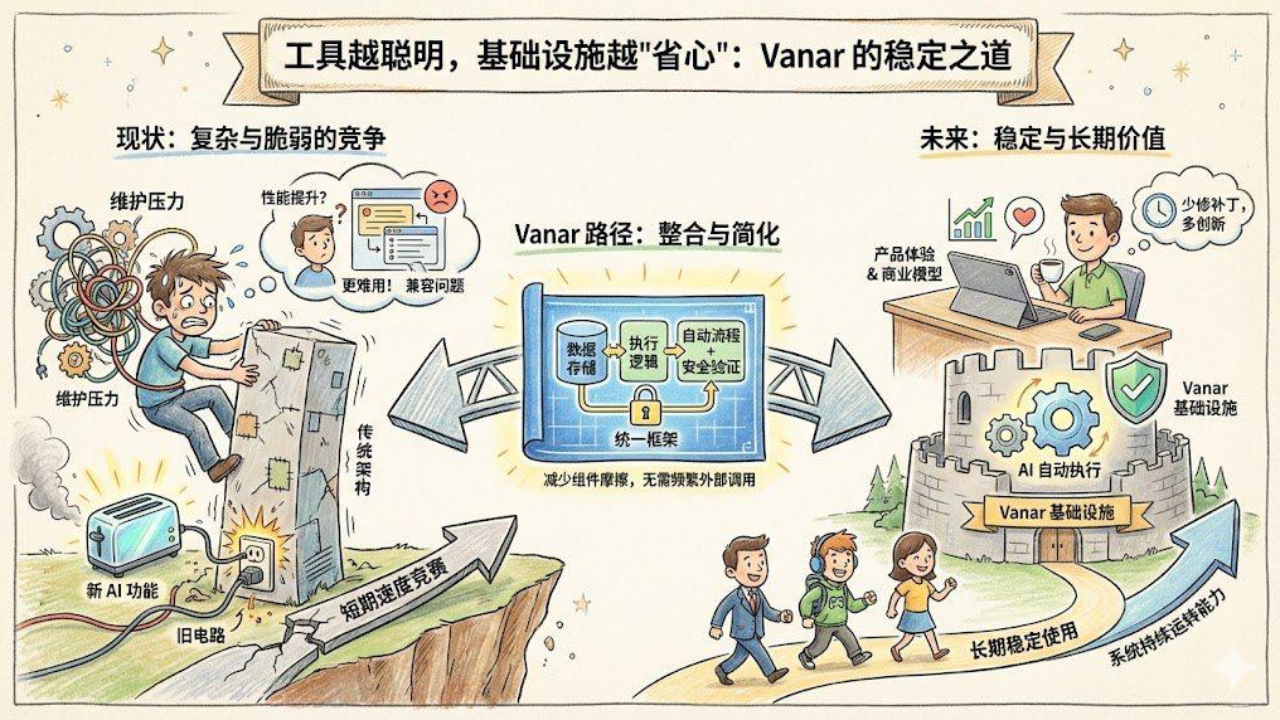
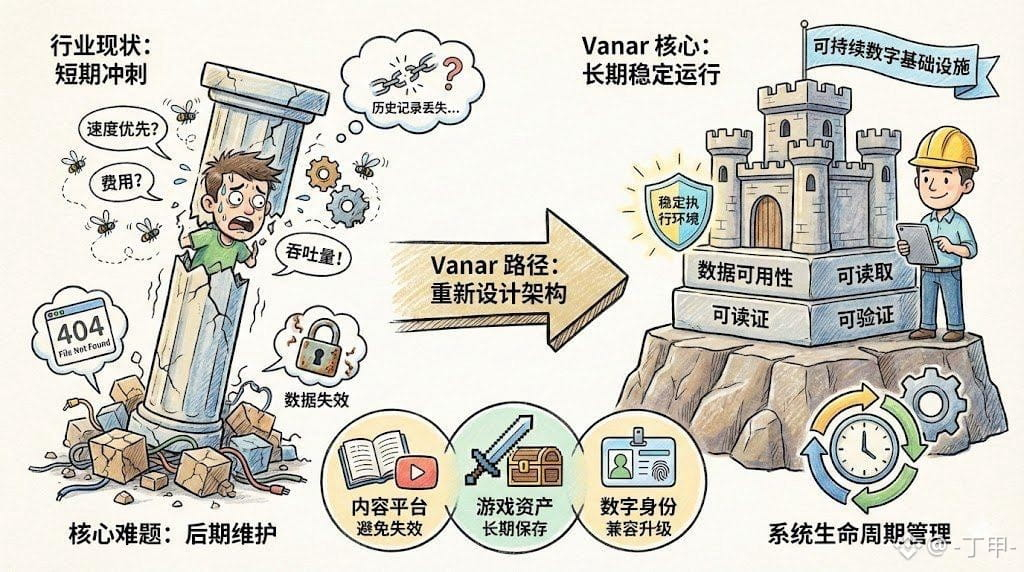
Most blockchain projects focus more on performance metrics, such as speed, cost, or throughput, but what truly troubles developers in reality are often the maintenance issues after the system is running. After the application goes live, how to preserve data long-term, how to prevent content from becoming obsolete, and whether protocol upgrades will affect historical records are the core challenges many projects face in the later stages.
Vanar chooses to redesign the underlying architecture from the perspective of long-term stable operation. Instead of just emphasizing transaction processing capabilities, it pays more attention to whether data will still be available, readable, and verifiable in the future. This thinking allows blockchain to be not just a tool for recording transactions, but gradually transforms it into a sustainable digital infrastructure.
This design is especially important for scenarios such as content platforms, gaming assets, and digital identities. Many on-chain projects run well in their early stages, but as time goes on, issues such as data fragmentation, rising storage costs, or compatibility problems gradually emerge. Vanar attempts to reduce these potential risks through a unified data structure and a stable execution environment, enabling applications to maintain normal operation for a longer time.
From this perspective, @Vanar is not merely pursuing short-term performance advantages, but rather focusing on system lifecycle management. If future on-chain applications become increasingly complex, infrastructure capable of reducing maintenance difficulty may become a more needed capability in the industry.
#vanar $VANRY
Vanar chooses to redesign the underlying architecture from the perspective of long-term stable operation. Instead of just emphasizing transaction processing capabilities, it pays more attention to whether data will still be available, readable, and verifiable in the future. This thinking allows blockchain to be not just a tool for recording transactions, but gradually transforms it into a sustainable digital infrastructure.
This design is especially important for scenarios such as content platforms, gaming assets, and digital identities. Many on-chain projects run well in their early stages, but as time goes on, issues such as data fragmentation, rising storage costs, or compatibility problems gradually emerge. Vanar attempts to reduce these potential risks through a unified data structure and a stable execution environment, enabling applications to maintain normal operation for a longer time.
From this perspective, @Vanar is not merely pursuing short-term performance advantages, but rather focusing on system lifecycle management. If future on-chain applications become increasingly complex, infrastructure capable of reducing maintenance difficulty may become a more needed capability in the industry.
#vanar $VANRY
While most blockchains are still debating performance and cost, @Vanar chose a less discussed but more real issue: who truly owns the creative outcomes in the digital world?
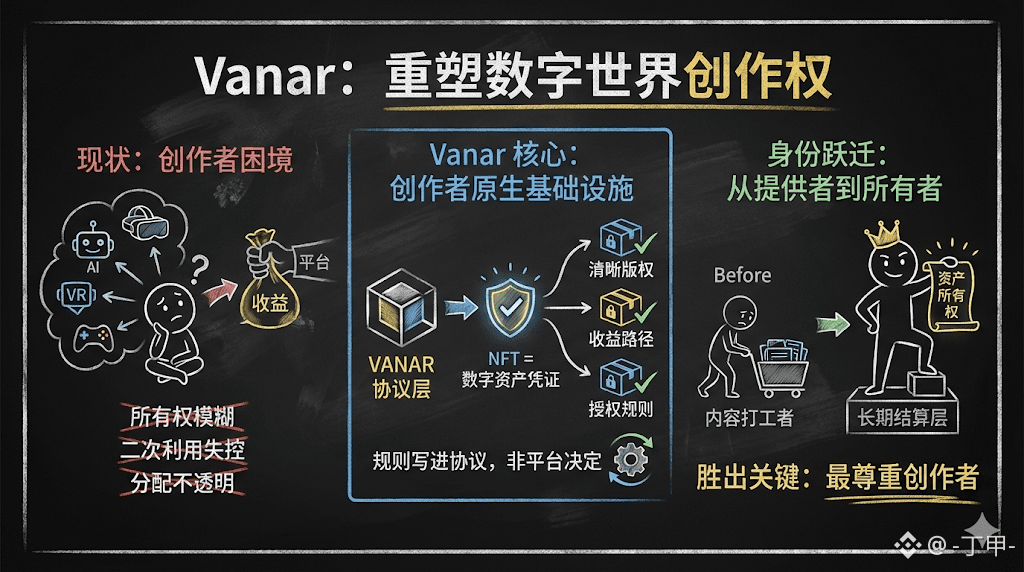
In the current rapid expansion of AI-generated content, virtual worlds, and gaming economies, creators are facing an invisible dilemma—works are spreading faster, but ownership is becoming increasingly ambiguous. Platform cuts, content being reused, and opaque profit distribution have almost become the norm. Vanar's entry point is to attempt to solve this structural problem from the ground up.
Vanar does not define itself as a faster chain, but positions itself as the native infrastructure for creators. In its design, NFTs are no longer just commodities but are “digital asset certificates” with clear copyright logic and revenue paths. Whether it is game materials, virtual characters, or AI-generated world modules, creators can clearly label ownership, licensing methods, and revenue-sharing rules on the chain.
More critically, Vanar writes these rules into the protocol instead of leaving them to be decided by platforms. This means that the future virtual world will no longer rely on centralized markets to “settle creativity,” but rather the chain itself will take on the roles of trust and distribution. For creators, this is a leap from being a “content provider” to an “asset owner.”
From this perspective, Vanar's value lies not in short-term narratives but in whether it can become the long-term settlement layer of the creative economy. If the digital world is truly to scale, perhaps the ultimate victor will not be the fastest chain but the one that respects creators the most.
#vanar $VANRY
In the current rapid expansion of AI-generated content, virtual worlds, and gaming economies, creators are facing an invisible dilemma—works are spreading faster, but ownership is becoming increasingly ambiguous. Platform cuts, content being reused, and opaque profit distribution have almost become the norm. Vanar's entry point is to attempt to solve this structural problem from the ground up.
Vanar does not define itself as a faster chain, but positions itself as the native infrastructure for creators. In its design, NFTs are no longer just commodities but are “digital asset certificates” with clear copyright logic and revenue paths. Whether it is game materials, virtual characters, or AI-generated world modules, creators can clearly label ownership, licensing methods, and revenue-sharing rules on the chain.
More critically, Vanar writes these rules into the protocol instead of leaving them to be decided by platforms. This means that the future virtual world will no longer rely on centralized markets to “settle creativity,” but rather the chain itself will take on the roles of trust and distribution. For creators, this is a leap from being a “content provider” to an “asset owner.”
From this perspective, Vanar's value lies not in short-term narratives but in whether it can become the long-term settlement layer of the creative economy. If the digital world is truly to scale, perhaps the ultimate victor will not be the fastest chain but the one that respects creators the most.
#vanar $VANRY
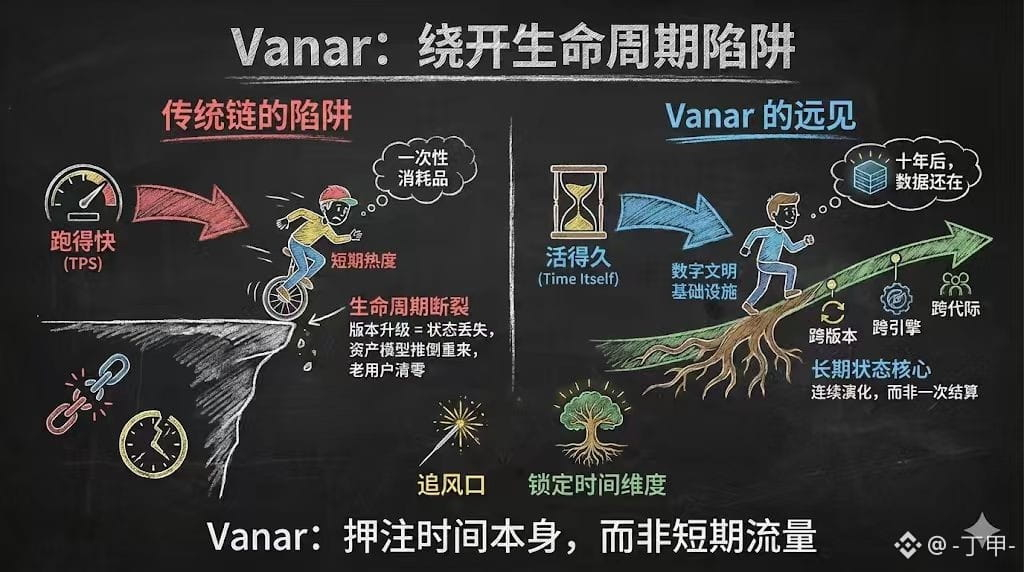
Vanar's true challenge is not the performance bottleneck, but the lifecycle trap.
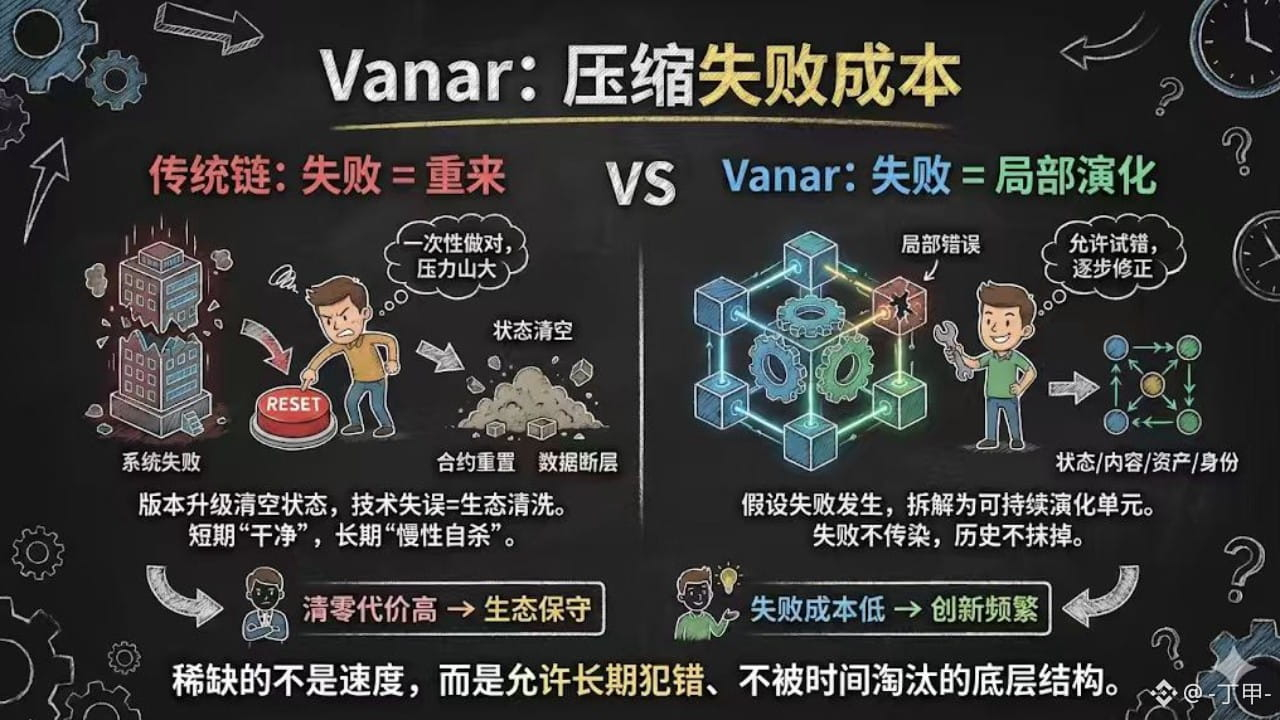
Many chains focus on whether they can run fast, but @Vanar cares more about whether they can last long. These are two completely different questions.
The reality is that a large number of on-chain applications do not fail due to insufficient TPS, but rather due to a break in their lifecycle: version upgrades leading to state loss, asset models being redesigned from scratch, and a complete reset of the worldview, resulting in the old users being wiped out. No matter how strong the performance is, it is just a disposable item.
From the very beginning, Vanar has treated long-term status as a core issue. It is not optimizing for transactions; it is designing the underlying logic for the existence of content itself. World state, asset relationships, and user behavior are not one-time settlements but continuous evolutions. The requirements for the underlying architecture are far greater than those for ordinary financial chains.
This is also why Vanar does not seem to be chasing trends. AI, gaming, and XR are just the surface layer; what is truly locked in is the time dimension—whether content can exist across versions, engines, and generations.
From this perspective, Vanar resembles a kind of infrastructure for digital civilization rather than a traffic tool.
While most projects are still asking how to attract users, Vanar is already asking: In ten years, will this data still exist?
This is one of the few systems that is not afraid of being slow. Because what it bets on has never been short-term popularity, but time itself.
#vanar $VANRY
Many chains focus on whether they can run fast, but @Vanar cares more about whether they can last long. These are two completely different questions.
The reality is that a large number of on-chain applications do not fail due to insufficient TPS, but rather due to a break in their lifecycle: version upgrades leading to state loss, asset models being redesigned from scratch, and a complete reset of the worldview, resulting in the old users being wiped out. No matter how strong the performance is, it is just a disposable item.
From the very beginning, Vanar has treated long-term status as a core issue. It is not optimizing for transactions; it is designing the underlying logic for the existence of content itself. World state, asset relationships, and user behavior are not one-time settlements but continuous evolutions. The requirements for the underlying architecture are far greater than those for ordinary financial chains.
This is also why Vanar does not seem to be chasing trends. AI, gaming, and XR are just the surface layer; what is truly locked in is the time dimension—whether content can exist across versions, engines, and generations.
From this perspective, Vanar resembles a kind of infrastructure for digital civilization rather than a traffic tool.
While most projects are still asking how to attract users, Vanar is already asking: In ten years, will this data still exist?
This is one of the few systems that is not afraid of being slow. Because what it bets on has never been short-term popularity, but time itself.
#vanar $VANRY
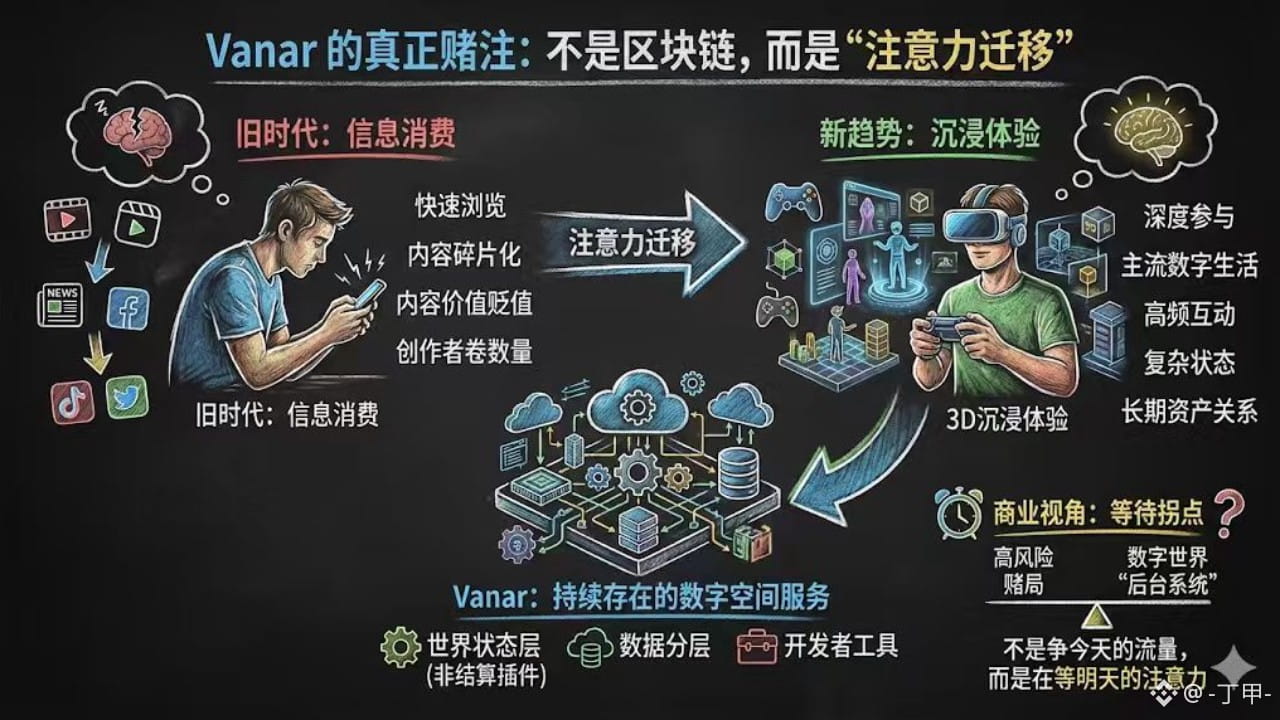
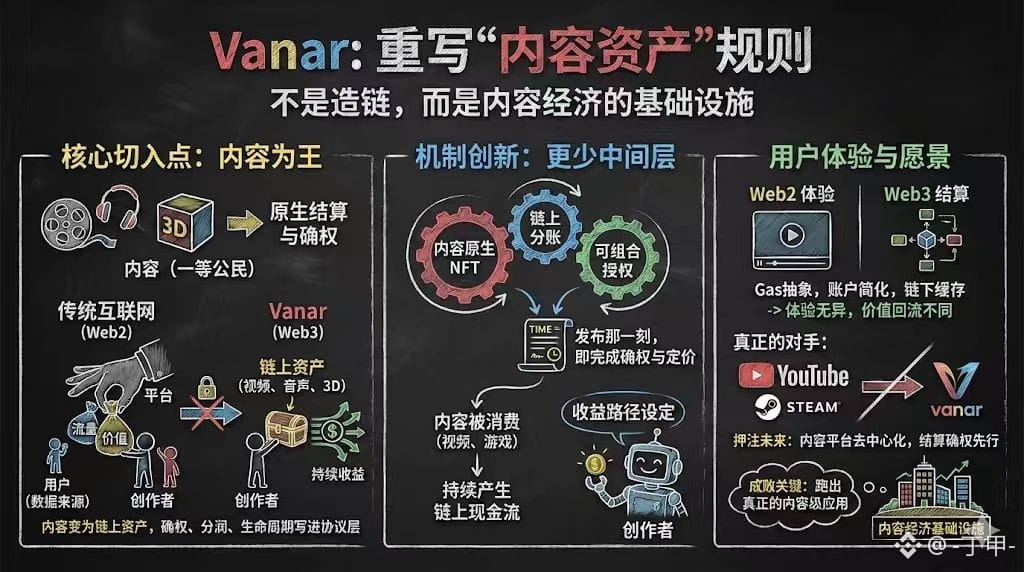
Most public chains discuss performance, TPS, and the number of ecosystems, but @Vanar 's perspective is entirely different: it treats content as a first-class citizen rather than a secondary asset on the chain. In other words, Vanar is not serving DeFi or speculators; it is building a native settlement and rights confirmation system for the next generation of digital content.
In the traditional internet, the value of content is exploited by platforms. Creators contribute traffic, platforms control distribution, pricing, and monetization paths; users are merely sources of data. Vanar's core idea is to transform content from platform assets into on-chain assets. Videos, audios, 3D materials, and game assets inherently possess copyrights, profit-sharing, and lifecycles, and Vanar writes these attributes into the protocol layer, rather than leaving it to applications to implement voluntarily.
The key to Vanar is not a faster chain, but fewer intermediaries. It enables creators to establish rights confirmation, pricing, and revenue paths at the moment of publication through native content NFTs, on-chain revenue sharing, and composable authorizations. Consuming content is no longer a one-time action but continuously generates on-chain cash flow. This is something Web2 cannot achieve and Web3 rarely realizes.
More importantly, Vanar does not attempt to persuade ordinary users to understand blockchain. Gas abstraction, simplified accounts, and off-chain caching are all aimed at one goal: to make the content consumption experience indistinguishable from Web2, but the value return logic is entirely different. What users see are videos and games, while creators receive on-chain settlements.
From this perspective, Vanar's competitors are not Ethereum or Solana, but YouTube, Steam, and Roblox. It bets on a judgment: future content platforms will decentralize, but settlement and rights confirmation must evolve first.
The key to Vanar's success or failure lies not in technology, but in whether it can deliver truly content-level applications. Once established, it is not just another chain, but the infrastructure of the content economy.
#vanar $VANRY
In the traditional internet, the value of content is exploited by platforms. Creators contribute traffic, platforms control distribution, pricing, and monetization paths; users are merely sources of data. Vanar's core idea is to transform content from platform assets into on-chain assets. Videos, audios, 3D materials, and game assets inherently possess copyrights, profit-sharing, and lifecycles, and Vanar writes these attributes into the protocol layer, rather than leaving it to applications to implement voluntarily.
The key to Vanar is not a faster chain, but fewer intermediaries. It enables creators to establish rights confirmation, pricing, and revenue paths at the moment of publication through native content NFTs, on-chain revenue sharing, and composable authorizations. Consuming content is no longer a one-time action but continuously generates on-chain cash flow. This is something Web2 cannot achieve and Web3 rarely realizes.
More importantly, Vanar does not attempt to persuade ordinary users to understand blockchain. Gas abstraction, simplified accounts, and off-chain caching are all aimed at one goal: to make the content consumption experience indistinguishable from Web2, but the value return logic is entirely different. What users see are videos and games, while creators receive on-chain settlements.
From this perspective, Vanar's competitors are not Ethereum or Solana, but YouTube, Steam, and Roblox. It bets on a judgment: future content platforms will decentralize, but settlement and rights confirmation must evolve first.
The key to Vanar's success or failure lies not in technology, but in whether it can deliver truly content-level applications. Once established, it is not just another chain, but the infrastructure of the content economy.
#vanar $VANRY
Log in to explore more content