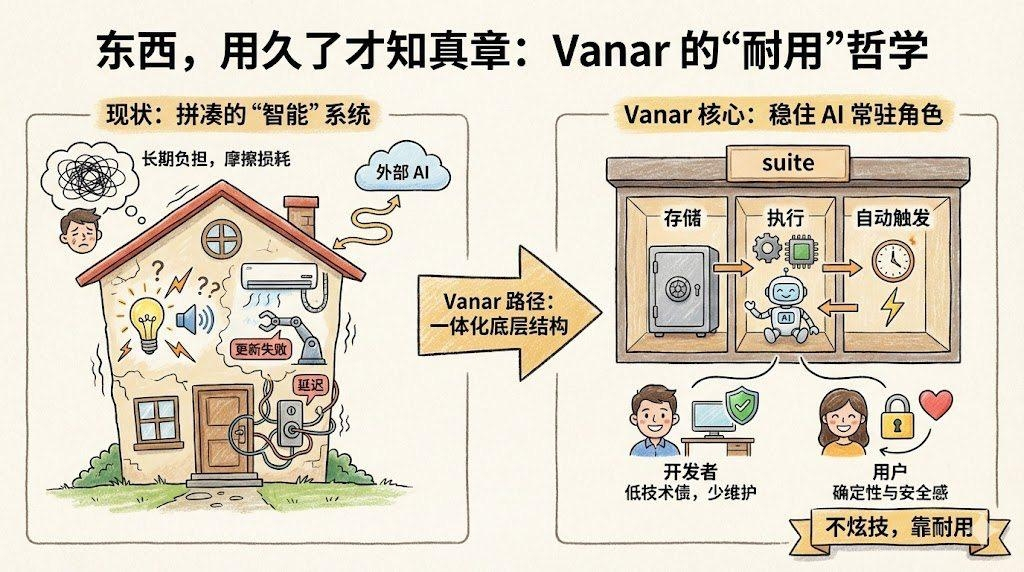
This feeling is very common in life. For example, when you just move into a fully furnished smart apartment, at first you feel like there's high-tech everywhere: light sensors, voice-activated air conditioning, automatic door locks. But after living there for half a year, you'll find that this so-called smart system is actually quite exhausting. The smart lights occasionally conflict with the speaker, and after updating the air conditioning plugin, the sensor malfunctions. In the end, you realize that to maintain this automation, you actually end up doing more manual labor. This friction of each doing their own thing and shifting blame is the burden that accumulates over time in the system.
Actually, the blockchain industry is currently facing a similar awkward phase when it comes to AI.
Everyone's scrambling to pile on features to the chain, adding an Agent today and tearing down a module tomorrow. In the short term, this 'puzzle-piece' development logic seems very flexible, adapting to whatever's hot. But if we take a longer view, this underlying structure hasn't truly considered the needs of AI as a long-term resident.
The common practice now is to treat AI like a contractor: complex logic is computed off-chain, massive data is stored externally, and the chain only handles final accounting and logging. This logic may be quick and cost-effective during the experimental phase, but once AI becomes a normalized role — needing to continuously read on-chain states, make judgments, and even frequently trigger automated tasks — this external/internal separation starts to fall apart.
As long as the logic of AI and its execution on-chain aren't on the same wavelength, delays, sync errors, and permission chaos will follow. It's like your smart door lock needing to send a request to the cloud, which then relays it to your phone, and only after confirmation does it go back to the lock. The more steps involved, the greater the uncertainty. Often, the system isn't slow; it's just really 'tired,' and with the slightest misstep, the entire process can freeze up.
@Vanar gives me the impression that it approaches the angle in a very pragmatic and even somewhat coolly restrained manner.
The focus isn’t on what flashy tricks AI can pull off, but rather if 'when AI becomes a permanent fixture, can the system hold steady?' In Vanar's design logic, it strongly dislikes patchwork solutions. It chooses to lock storage, execution, and automated trigger logic directly within the same foundational structure.
What's the benefit of this approach? It reduces friction losses from cross-system calls. In many chains, for AI to perform an action, it has to go to an external database for data, then return to the chain to validate permissions, and only then execute. With Vanar, AI feels like it’s moved into a suite; walking through the door leads to the kitchen, turning around brings you to the study, with all states and rules within easy reach.
This design sounds unambitious, even a bit conservative, but it proves to be very durable in complex systems. It's more like a tech health check: rather than waiting for the system to get so complex that no one dares to touch it, patching it up every day, it’s better to clearly define high-load scenarios from the outset.
From a developer's perspective, this structure can save a lot of hidden costs. Nowadays, many teams fear not writing new code but maintaining old code. When a system has too many external dependencies, each upgrade feels like defusing a bomb; you never know which sensor might fail if you tweak this line. Vanar tightens the structure, making logic centralized and states clear. This low-tech debt architecture is what gives a project the stamina to keep running long-term.
For us regular users, this change may not be immediately apparent in the short term. You might not feel it’s significantly faster than others, but you’ll notice it doesn’t drop the ball. Data won’t mysteriously shift, and preset automated tasks won’t suddenly go on strike. This certainty, amidst a sea of black boxes and randomness in the AI era, is actually more precious than any flashy tricks.
Many truly good products that stick around and are used long-term often rely not on first impressions but on that reliable feel that makes everything easy to use.
Vanar essentially bets on an industry judgment: as AI gradually shifts from a gimmick to infrastructure, the burden on the chain will increase geometrically. At this point, who runs fastest may not matter; what matters is who can keep running without getting bogged down by complex collaborative logic — that's the real winner.
This heavy-structure, light-narrative approach may not seem flashy in a bullish market, but it truly sees through the essence of complex systems. Solidifying the foundation, defining the boundaries, and letting AI operate efficiently within the rules. This logic might not be eye-catching, but in the long haul of tech iterations, such 'durable' things are often the most valuable.
After all, whether it's housing or systems, what we ultimately seek is that feeling of security where, once the door is closed, everything is under control, right? #Vanar $VANRY