While most blockchains are still debating performance and cost, @Vanar chose a less discussed but more real issue: who truly owns the creative outcomes in the digital world?
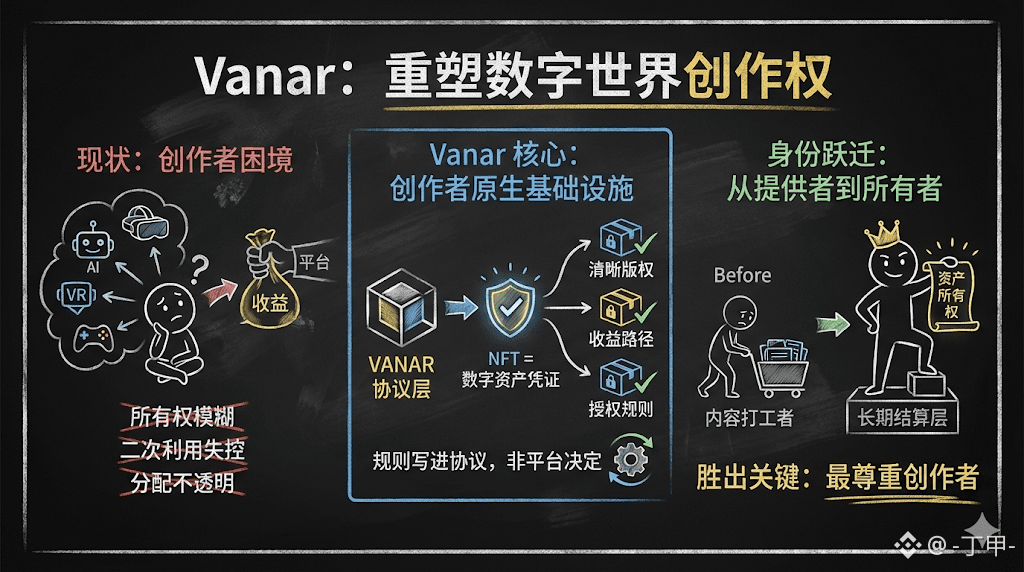
In the current rapid expansion of AI-generated content, virtual worlds, and gaming economies, creators are facing an invisible dilemma—works are spreading faster, but ownership is becoming increasingly ambiguous. Platform cuts, content being reused, and opaque profit distribution have almost become the norm. Vanar's entry point is to attempt to solve this structural problem from the ground up.
Vanar does not define itself as a faster chain, but positions itself as the native infrastructure for creators. In its design, NFTs are no longer just commodities but are “digital asset certificates” with clear copyright logic and revenue paths. Whether it is game materials, virtual characters, or AI-generated world modules, creators can clearly label ownership, licensing methods, and revenue-sharing rules on the chain.
More critically, Vanar writes these rules into the protocol instead of leaving them to be decided by platforms. This means that the future virtual world will no longer rely on centralized markets to “settle creativity,” but rather the chain itself will take on the roles of trust and distribution. For creators, this is a leap from being a “content provider” to an “asset owner.”
From this perspective, Vanar's value lies not in short-term narratives but in whether it can become the long-term settlement layer of the creative economy. If the digital world is truly to scale, perhaps the ultimate victor will not be the fastest chain but the one that respects creators the most.
#vanar $VANRY
In the current rapid expansion of AI-generated content, virtual worlds, and gaming economies, creators are facing an invisible dilemma—works are spreading faster, but ownership is becoming increasingly ambiguous. Platform cuts, content being reused, and opaque profit distribution have almost become the norm. Vanar's entry point is to attempt to solve this structural problem from the ground up.
Vanar does not define itself as a faster chain, but positions itself as the native infrastructure for creators. In its design, NFTs are no longer just commodities but are “digital asset certificates” with clear copyright logic and revenue paths. Whether it is game materials, virtual characters, or AI-generated world modules, creators can clearly label ownership, licensing methods, and revenue-sharing rules on the chain.
More critically, Vanar writes these rules into the protocol instead of leaving them to be decided by platforms. This means that the future virtual world will no longer rely on centralized markets to “settle creativity,” but rather the chain itself will take on the roles of trust and distribution. For creators, this is a leap from being a “content provider” to an “asset owner.”
From this perspective, Vanar's value lies not in short-term narratives but in whether it can become the long-term settlement layer of the creative economy. If the digital world is truly to scale, perhaps the ultimate victor will not be the fastest chain but the one that respects creators the most.
#vanar $VANRY