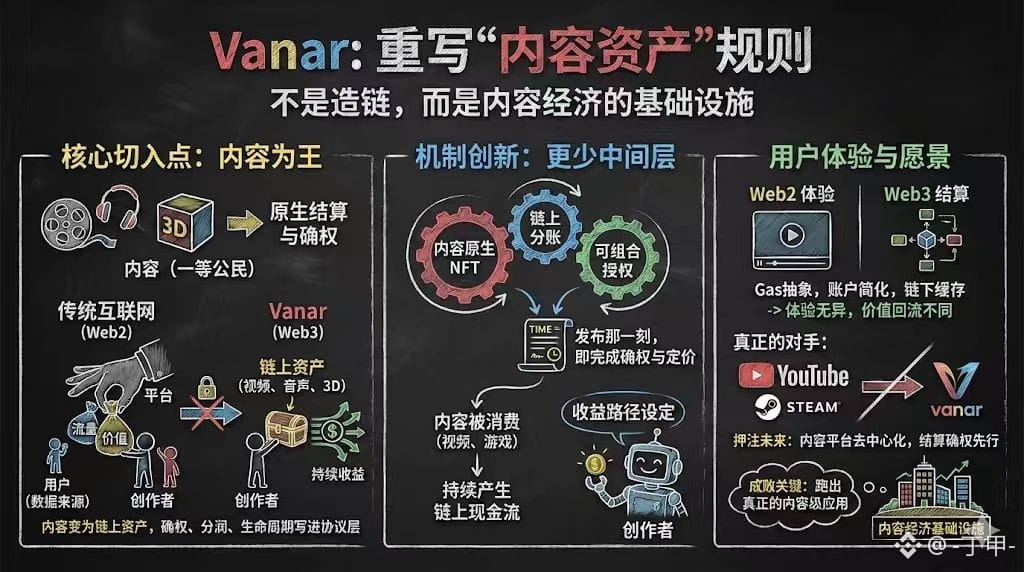
Most public chains discuss performance, TPS, and the number of ecosystems, but @Vanar 's perspective is entirely different: it treats content as a first-class citizen rather than a secondary asset on the chain. In other words, Vanar is not serving DeFi or speculators; it is building a native settlement and rights confirmation system for the next generation of digital content.
In the traditional internet, the value of content is exploited by platforms. Creators contribute traffic, platforms control distribution, pricing, and monetization paths; users are merely sources of data. Vanar's core idea is to transform content from platform assets into on-chain assets. Videos, audios, 3D materials, and game assets inherently possess copyrights, profit-sharing, and lifecycles, and Vanar writes these attributes into the protocol layer, rather than leaving it to applications to implement voluntarily.
The key to Vanar is not a faster chain, but fewer intermediaries. It enables creators to establish rights confirmation, pricing, and revenue paths at the moment of publication through native content NFTs, on-chain revenue sharing, and composable authorizations. Consuming content is no longer a one-time action but continuously generates on-chain cash flow. This is something Web2 cannot achieve and Web3 rarely realizes.
More importantly, Vanar does not attempt to persuade ordinary users to understand blockchain. Gas abstraction, simplified accounts, and off-chain caching are all aimed at one goal: to make the content consumption experience indistinguishable from Web2, but the value return logic is entirely different. What users see are videos and games, while creators receive on-chain settlements.
From this perspective, Vanar's competitors are not Ethereum or Solana, but YouTube, Steam, and Roblox. It bets on a judgment: future content platforms will decentralize, but settlement and rights confirmation must evolve first.
The key to Vanar's success or failure lies not in technology, but in whether it can deliver truly content-level applications. Once established, it is not just another chain, but the infrastructure of the content economy.
#vanar $VANRY
In the traditional internet, the value of content is exploited by platforms. Creators contribute traffic, platforms control distribution, pricing, and monetization paths; users are merely sources of data. Vanar's core idea is to transform content from platform assets into on-chain assets. Videos, audios, 3D materials, and game assets inherently possess copyrights, profit-sharing, and lifecycles, and Vanar writes these attributes into the protocol layer, rather than leaving it to applications to implement voluntarily.
The key to Vanar is not a faster chain, but fewer intermediaries. It enables creators to establish rights confirmation, pricing, and revenue paths at the moment of publication through native content NFTs, on-chain revenue sharing, and composable authorizations. Consuming content is no longer a one-time action but continuously generates on-chain cash flow. This is something Web2 cannot achieve and Web3 rarely realizes.
More importantly, Vanar does not attempt to persuade ordinary users to understand blockchain. Gas abstraction, simplified accounts, and off-chain caching are all aimed at one goal: to make the content consumption experience indistinguishable from Web2, but the value return logic is entirely different. What users see are videos and games, while creators receive on-chain settlements.
From this perspective, Vanar's competitors are not Ethereum or Solana, but YouTube, Steam, and Roblox. It bets on a judgment: future content platforms will decentralize, but settlement and rights confirmation must evolve first.
The key to Vanar's success or failure lies not in technology, but in whether it can deliver truly content-level applications. Once established, it is not just another chain, but the infrastructure of the content economy.
#vanar $VANRY