Talking about Vanar, if you are still focused on public chain performance Web3 content platforms, you are already falling behind.
Vanar's core judgment is not a technical route dispute, but a bet on a more fundamental change.
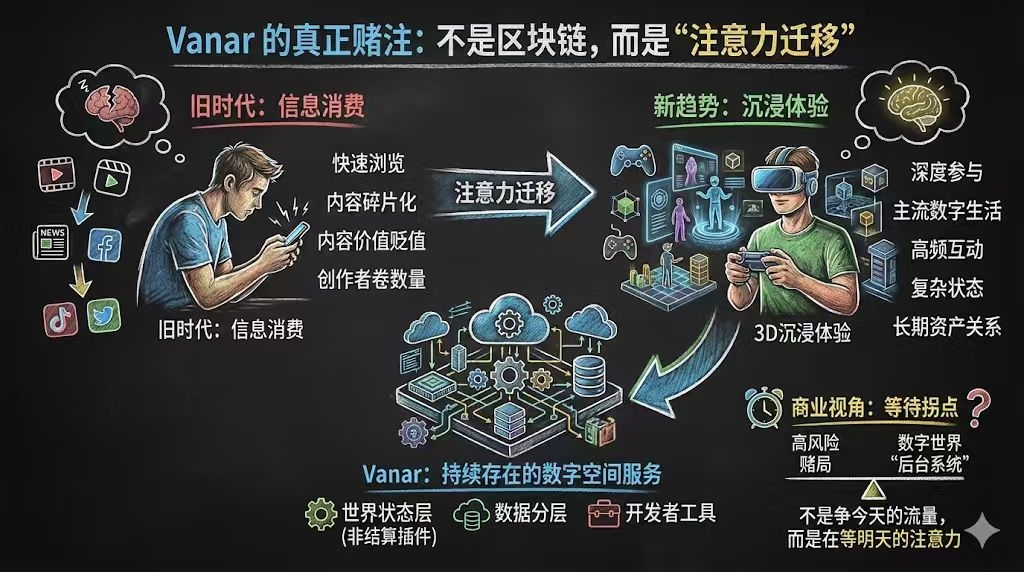
Attention is shifting from information consumption to immersive experiences.
In the past decade, the growth logic of the Internet has been built on information density: short videos, algorithm recommendations, and infinite scrolling. Users have been trained to browse quickly and forget quickly. The ceiling of this model is already very clear - attention has been extremely fragmented, content value continues to depreciate, and creators are forced to compete in quantity rather than quality.
Vanar is betting on another curve: as hardware, rendering, and real-time computing capabilities mature, user attention will refocus on deep engagement. Games, virtual worlds, and interactive content will no longer be niche entertainment but rather a mainstream digital lifestyle. This is not a trend of Web3 but rather a structural shift of the entire internet.
The problem is: existing blockchains are not suitable for carrying such content. They are more like financial ledgers rather than the underlying systems of a real-time world. Vanar's design philosophy is essentially to serve high-frequency interactions, complex states, and long-term asset relationships in a continuously existing digital space, rather than isolated transactions.
This also explains why @Vanar places extreme emphasis on content engines, data layering, and developer tools rather than the DeFi ecosystem. It hopes that developers will treat the chain as a world state layer rather than a settlement plugin. Assets, identities, and behavior records will naturally arise around content experiences, rather than being deliberately placed on-chain.
From a business perspective, Vanar does not pursue explosive user growth. It is more like waiting for a turning point: when traditional platforms can no longer support complex interactive content, developers will be forced to seek new infrastructure. At that time, Vanar's advantage will not be affordability, but rather its timely usability.
Of course, this is a high-risk gamble. The speed of immersive content adoption, hardware costs, and development thresholds—any change in these variables will affect the rhythm of Vanar. But if the judgment holds, Vanar may not be the next popular public chain, but rather become the backend system of the digital world.#vanar $VANRY