

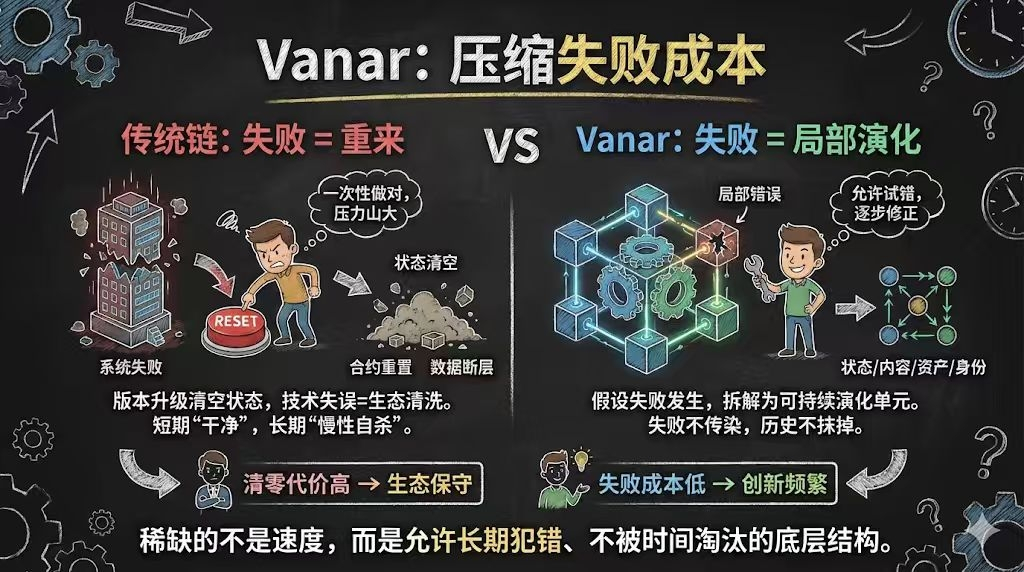
Most chains have only one design goal: how fast they can run under ideal conditions.
What Vanar cares about is another matter: how high the cost is when an error occurs.
Systems in reality are not always smooth sailing. AI models may deviate, content may become invalid, assets may be forgotten, and the state of the world may expand. What truly determines whether a system can operate in the long term is not peak performance, but the recovery radius in the event of failure.
The design logic of Vanar essentially compresses the cost of failure.
On many chains, failure means starting over:
Version upgrade clears the state, contract replacement resets logic, and data migration accompanies gaps. A single technical judgment error is equivalent to an ecological cleansing. In the short term, it looks very 'clean', but in the long term, it is a slow suicide.
@Vanar In reverse.
It assumes that failure will inevitably occur, thus breaking down status, content, assets, and identity into units that can evolve sustainably. Models can change, execution can vary, but history will not be erased. Failure only affects the local area and will not infect the entire system.
This directly changes the behavior patterns of applications.
Developers do not need to get everything right at once; they can continuously experiment and learn.
Content does not need to bet on a single engine; it can continue across different forms;
AI does not need to be perfectly tamed but should be allowed to gradually correct itself.
This is not technological romanticism, but economic rationality.
Innovation occurs frequently when the cost of failure is low;
When the cost of clearing is high enough, the ecosystem will choose to be conservative.
The advantages of Vanar are not reflected in the data from the release conference, but in the times when no one is discussing it.
The system gradually accumulates status in the background, content continues without perception, and the world has not been restarted repeatedly.
This is also why Vanar is not in a hurry to prove how strong it is.
It is more concerned with which systems remain standing when the next wave of narratives collapses.
What is truly scarce has never been speed.
Instead, it is a foundational structure that allows for long-term mistakes without being eliminated by time.
#vanar $VANRY