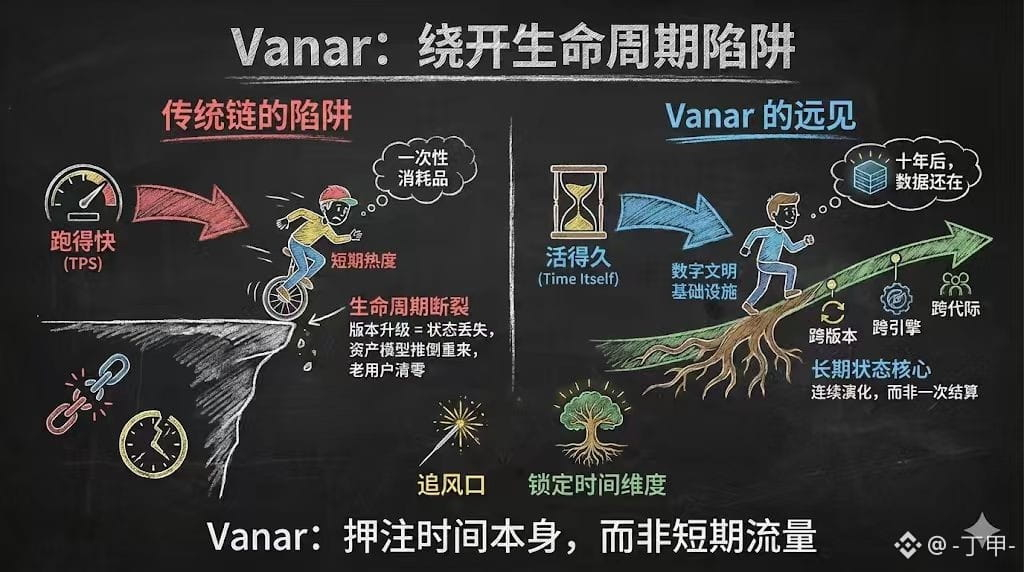
Vanar's true challenge is not the performance bottleneck, but the lifecycle trap.
Many chains focus on whether they can run fast, but @Vanar cares more about whether they can last long. These are two completely different questions.
The reality is that a large number of on-chain applications do not fail due to insufficient TPS, but rather due to a break in their lifecycle: version upgrades leading to state loss, asset models being redesigned from scratch, and a complete reset of the worldview, resulting in the old users being wiped out. No matter how strong the performance is, it is just a disposable item.
From the very beginning, Vanar has treated long-term status as a core issue. It is not optimizing for transactions; it is designing the underlying logic for the existence of content itself. World state, asset relationships, and user behavior are not one-time settlements but continuous evolutions. The requirements for the underlying architecture are far greater than those for ordinary financial chains.
This is also why Vanar does not seem to be chasing trends. AI, gaming, and XR are just the surface layer; what is truly locked in is the time dimension—whether content can exist across versions, engines, and generations.
From this perspective, Vanar resembles a kind of infrastructure for digital civilization rather than a traffic tool.
While most projects are still asking how to attract users, Vanar is already asking: In ten years, will this data still exist?
This is one of the few systems that is not afraid of being slow. Because what it bets on has never been short-term popularity, but time itself.
#vanar $VANRY
Many chains focus on whether they can run fast, but @Vanar cares more about whether they can last long. These are two completely different questions.
The reality is that a large number of on-chain applications do not fail due to insufficient TPS, but rather due to a break in their lifecycle: version upgrades leading to state loss, asset models being redesigned from scratch, and a complete reset of the worldview, resulting in the old users being wiped out. No matter how strong the performance is, it is just a disposable item.
From the very beginning, Vanar has treated long-term status as a core issue. It is not optimizing for transactions; it is designing the underlying logic for the existence of content itself. World state, asset relationships, and user behavior are not one-time settlements but continuous evolutions. The requirements for the underlying architecture are far greater than those for ordinary financial chains.
This is also why Vanar does not seem to be chasing trends. AI, gaming, and XR are just the surface layer; what is truly locked in is the time dimension—whether content can exist across versions, engines, and generations.
From this perspective, Vanar resembles a kind of infrastructure for digital civilization rather than a traffic tool.
While most projects are still asking how to attract users, Vanar is already asking: In ten years, will this data still exist?
This is one of the few systems that is not afraid of being slow. Because what it bets on has never been short-term popularity, but time itself.
#vanar $VANRY