

#blockchain
blockchain
34.7M views
162,711 Discussing
Hot
Latest

·
--
See translation
Selective Disclosure ExplainedInstitutional blockchain adoption creates a difficult tension. Organizations need to prove that a transaction is authorized and policy compliant, but they may also need to protect counterparties, treasury routes, trading strategies, commercial terms and internal risk rules.
Publishing everything is not the same as being accountable.
Selective disclosure provides a more precise approach. Instead of exposing a complete identity record or full transaction history, a user or institution proves a narrow fact required for a specific decision. That fact might be that a participant passed an approved verification process, is permitted to use a service, meets a jurisdictional condition or holds the correct signing authority.
Zero knowledge proofs can support this model, but the proof system is only one component. A production deployment also needs trustworthy credential issuance. It needs revocation when a credential is compromised or no longer valid. It needs policy versioning so an auditor can determine which rules applied at the time. It needs secure signers, metadata controls and an explicit process for exceptional disclosure.
The current launch of Ethereum’s zkAPI makes the core idea easy to see. The system can verify that a user has enough prepaid credit for an API request without attaching a durable billing identity to every use. The proof answers the required payment question while withholding unrelated information.
Institutional systems can apply the same principle more broadly. A treasury does not always need to reveal its full route to prove that an action was approved. A participant does not always need to reveal a complete file to prove eligibility. A counterparty does not always need broad data access to verify one policy fact.
The goal is not secrecy without recourse. It is privacy by default, with disclosure controlled by policy, due process and recorded authority. That creates a stronger balance between operational confidentiality and accountable participation.
Read the complete TokenToolHub guide:
https://tokentoolhub.com/selective-disclosure-privacy/
#crypto #blockchain #Web3 #ZeroKnowledge #fintech
Selective Disclosure Explained
Institutional blockchain adoption creates a difficult tension. Organizations need to prove that a transaction is authorized and policy compliant, but they may also need to protect counterparties, treasury routes, trading strategies, commercial terms and internal risk rules.
Publishing everything is not the same as being accountable.
Selective disclosure provides a more precise approach. Instead of exposing a complete identity record or full transaction history, a user or institution proves a narrow fact required for a specific decision. That fact might be that a participant passed an approved verification process, is permitted to use a service, meets a jurisdictional condition or holds the correct signing authority.
Zero knowledge proofs can support this model, but the proof system is only one component. A production deployment also needs trustworthy credential issuance. It needs revocation when a credential is compromised or no longer valid. It needs policy versioning so an auditor can determine which rules applied at the time. It needs secure signers, metadata controls and an explicit process for exceptional disclosure.
The current launch of Ethereum’s zkAPI makes the core idea easy to see. The system can verify that a user has enough prepaid credit for an API request without attaching a durable billing identity to every use. The proof answers the required payment question while withholding unrelated information.
Institutional systems can apply the same principle more broadly. A treasury does not always need to reveal its full route to prove that an action was approved. A participant does not always need to reveal a complete file to prove eligibility. A counterparty does not always need broad data access to verify one policy fact.
The goal is not secrecy without recourse. It is privacy by default, with disclosure controlled by policy, due process and recorded authority. That creates a stronger balance between operational confidentiality and accountable participation.
Read the complete TokenToolHub guide:
https://tokentoolhub.com/selective-disclosure-privacy/
#crypto #blockchain #Web3 #ZeroKnowledge #fintech
Publishing everything is not the same as being accountable.
Selective disclosure provides a more precise approach. Instead of exposing a complete identity record or full transaction history, a user or institution proves a narrow fact required for a specific decision. That fact might be that a participant passed an approved verification process, is permitted to use a service, meets a jurisdictional condition or holds the correct signing authority.
Zero knowledge proofs can support this model, but the proof system is only one component. A production deployment also needs trustworthy credential issuance. It needs revocation when a credential is compromised or no longer valid. It needs policy versioning so an auditor can determine which rules applied at the time. It needs secure signers, metadata controls and an explicit process for exceptional disclosure.
The current launch of Ethereum’s zkAPI makes the core idea easy to see. The system can verify that a user has enough prepaid credit for an API request without attaching a durable billing identity to every use. The proof answers the required payment question while withholding unrelated information.
Institutional systems can apply the same principle more broadly. A treasury does not always need to reveal its full route to prove that an action was approved. A participant does not always need to reveal a complete file to prove eligibility. A counterparty does not always need broad data access to verify one policy fact.
The goal is not secrecy without recourse. It is privacy by default, with disclosure controlled by policy, due process and recorded authority. That creates a stronger balance between operational confidentiality and accountable participation.
Read the complete TokenToolHub guide:
https://tokentoolhub.com/selective-disclosure-privacy/
#crypto #blockchain #Web3 #ZeroKnowledge #fintech
78

·
--
See translation
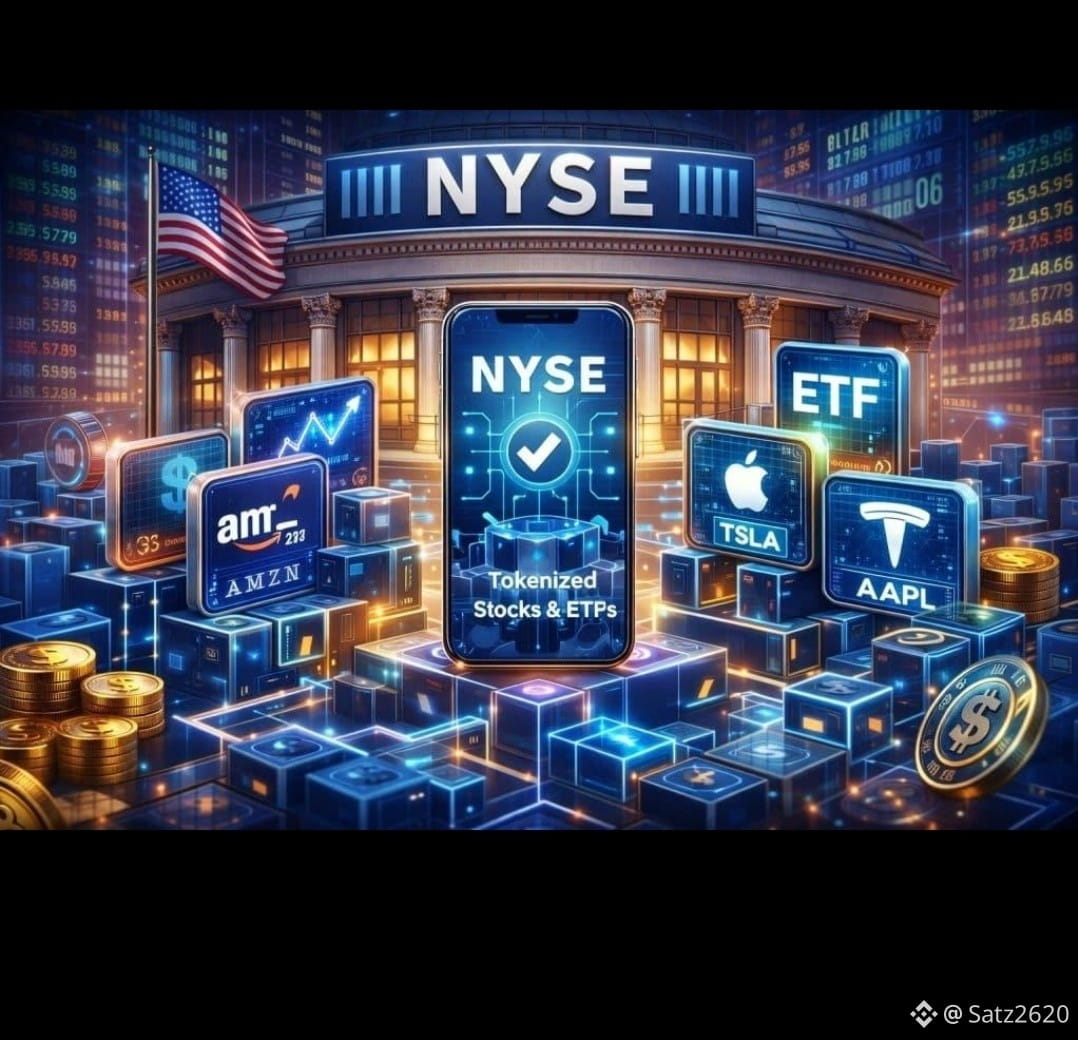
NYSE and Blockchain.com announced plans to explore tokenized U.S. stocks. This could connect conventional securities with blockchain-based trading and settlement
#blockchain
NYSE and Blockchain.com announced plans to explore tokenized U.S. stocks. This could connect conventional securities with blockchain-based trading and settlement
#blockchain
#blockchain
1
1
107


·
--
See translation
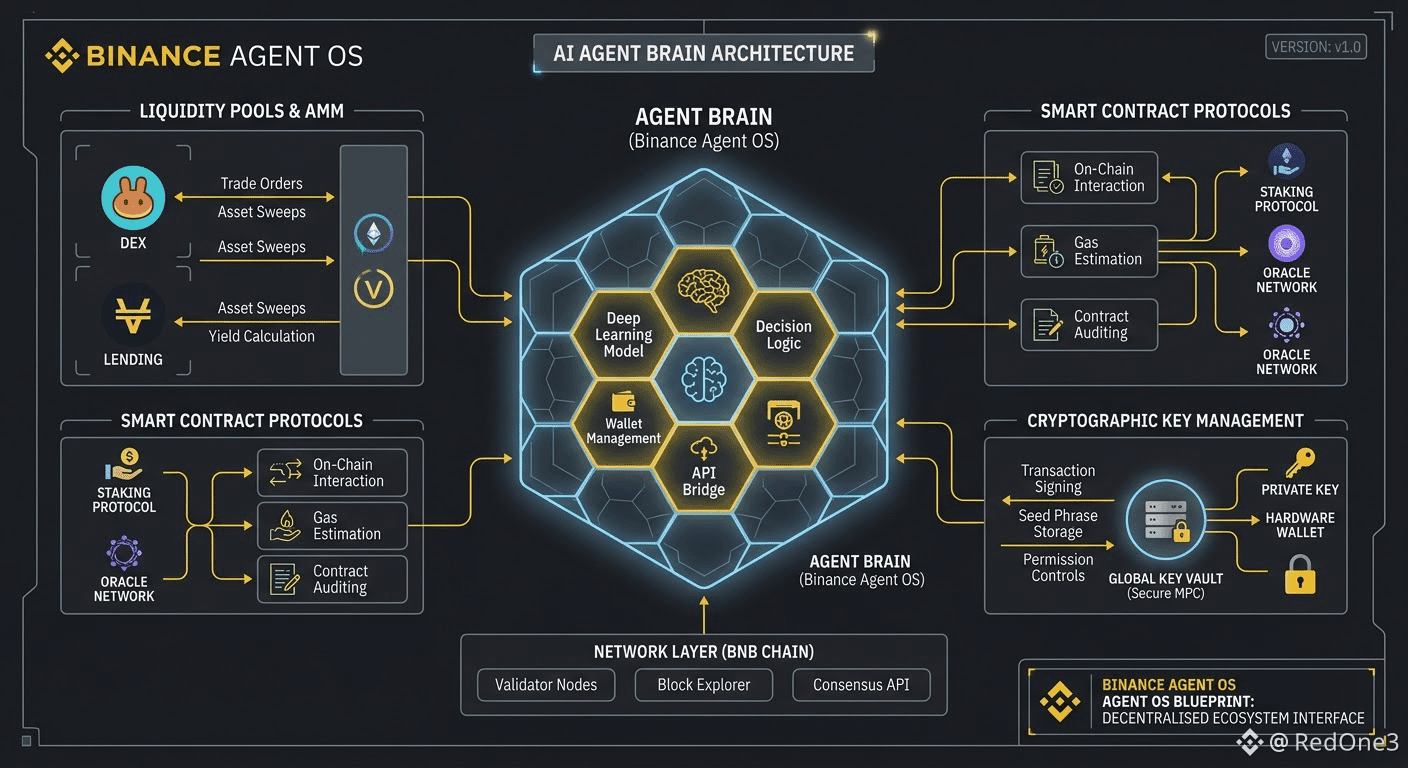
How On-Chain AI Agents Work 🤔
Understanding the inner mechanics of autonomous AI agents is essential as they begin running complex operations across blockchain ecosystems.
How Do Autonomous Agents Function On-Chain?🤔
Core Architectural Components: 🧠 Context Parsing & Reasoning: Models evaluate market inputs and user intents before making financial choices. ⚡ Standardized Tool Calling: Protocols like MCP allow agents to query live market data and trigger smart contract functions securely. 🔐 Non-Custodial Key Execution: Cryptographic key delegation lets agents execute transactions without holding full master control.
The Real Advantage Unlike human traders who sleep or emotional bots that execute rigid rules, AI agents adapt dynamically to volatile market conditions in real time.
Are you ready to let an autonomous agent manage part of your portfolio?
#AgentOS #AIAgents #Blockchain .
How On-Chain AI Agents Work 🤔
Understanding the inner mechanics of autonomous AI agents is essential as they begin running complex operations across blockchain ecosystems.
How Do Autonomous Agents Function On-Chain?🤔
Core Architectural Components: 🧠 Context Parsing & Reasoning: Models evaluate market inputs and user intents before making financial choices. ⚡ Standardized Tool Calling: Protocols like MCP allow agents to query live market data and trigger smart contract functions securely. 🔐 Non-Custodial Key Execution: Cryptographic key delegation lets agents execute transactions without holding full master control.
The Real Advantage Unlike human traders who sleep or emotional bots that execute rigid rules, AI agents adapt dynamically to volatile market conditions in real time.
Are you ready to let an autonomous agent manage part of your portfolio?
#AgentOS #AIAgents #Blockchain .
Understanding the inner mechanics of autonomous AI agents is essential as they begin running complex operations across blockchain ecosystems.
How Do Autonomous Agents Function On-Chain?🤔
Core Architectural Components: 🧠 Context Parsing & Reasoning: Models evaluate market inputs and user intents before making financial choices. ⚡ Standardized Tool Calling: Protocols like MCP allow agents to query live market data and trigger smart contract functions securely. 🔐 Non-Custodial Key Execution: Cryptographic key delegation lets agents execute transactions without holding full master control.
The Real Advantage Unlike human traders who sleep or emotional bots that execute rigid rules, AI agents adapt dynamically to volatile market conditions in real time.
Are you ready to let an autonomous agent manage part of your portfolio?
#AgentOS #AIAgents #Blockchain .
1
118

See translation
ARK ($ARK ): A Blockchain Project to Watch! 🔥
Are you exploring new cryptocurrency projects? 👀
ARK ($ARK) is a blockchain project focused on making blockchain technology more accessible and enabling interoperability between different blockchain networks.
🌟 Why Keep an Eye on ARK? 🔹 Blockchain Innovation: Focuses on accessible blockchain solutions. 🔹 Interoperability: Aims to connect different blockchain ecosystems. 🔹 Community: Open-source development and community participation. 🔹 Long-Term Potential: Its future depends on adoption, development and real-world utility.
📊 Investment Perspective
ARK may be worth researching if you're interested in blockchain technology and emerging crypto projects. However, its price can be highly volatile, and there is no guarantee of future growth.
💡 Do Your Own Research (DYOR) before making any investment decisions. Consider your financial situation and risk tolerance, and never invest more than you can afford to lose.
🔥 What do you think about ARK? Is it on your crypto watchlist? 👇
{spot}(ARKUSDT)
#ARK #ARKCoin #Crypto #Blockchain #BinanceSquare
ARK ($ARK ): A Blockchain Project to Watch! 🔥
Are you exploring new cryptocurrency projects? 👀
ARK ($ARK ) is a blockchain project focused on making blockchain technology more accessible and enabling interoperability between different blockchain networks.
🌟 Why Keep an Eye on ARK? 🔹 Blockchain Innovation: Focuses on accessible blockchain solutions. 🔹 Interoperability: Aims to connect different blockchain ecosystems. 🔹 Community: Open-source development and community participation. 🔹 Long-Term Potential: Its future depends on adoption, development and real-world utility.
📊 Investment Perspective
ARK may be worth researching if you're interested in blockchain technology and emerging crypto projects. However, its price can be highly volatile, and there is no guarantee of future growth.
💡 Do Your Own Research (DYOR) before making any investment decisions. Consider your financial situation and risk tolerance, and never invest more than you can afford to lose.
🔥 What do you think about ARK? Is it on your crypto watchlist? 👇
#ARK #ARKCoin #Crypto #Blockchain #BinanceSquare
Are you exploring new cryptocurrency projects? 👀
ARK ($ARK ) is a blockchain project focused on making blockchain technology more accessible and enabling interoperability between different blockchain networks.
🌟 Why Keep an Eye on ARK? 🔹 Blockchain Innovation: Focuses on accessible blockchain solutions. 🔹 Interoperability: Aims to connect different blockchain ecosystems. 🔹 Community: Open-source development and community participation. 🔹 Long-Term Potential: Its future depends on adoption, development and real-world utility.
📊 Investment Perspective
ARK may be worth researching if you're interested in blockchain technology and emerging crypto projects. However, its price can be highly volatile, and there is no guarantee of future growth.
💡 Do Your Own Research (DYOR) before making any investment decisions. Consider your financial situation and risk tolerance, and never invest more than you can afford to lose.
🔥 What do you think about ARK? Is it on your crypto watchlist? 👇
#ARK #ARKCoin #Crypto #Blockchain #BinanceSquare
1
104
·
--
See translation
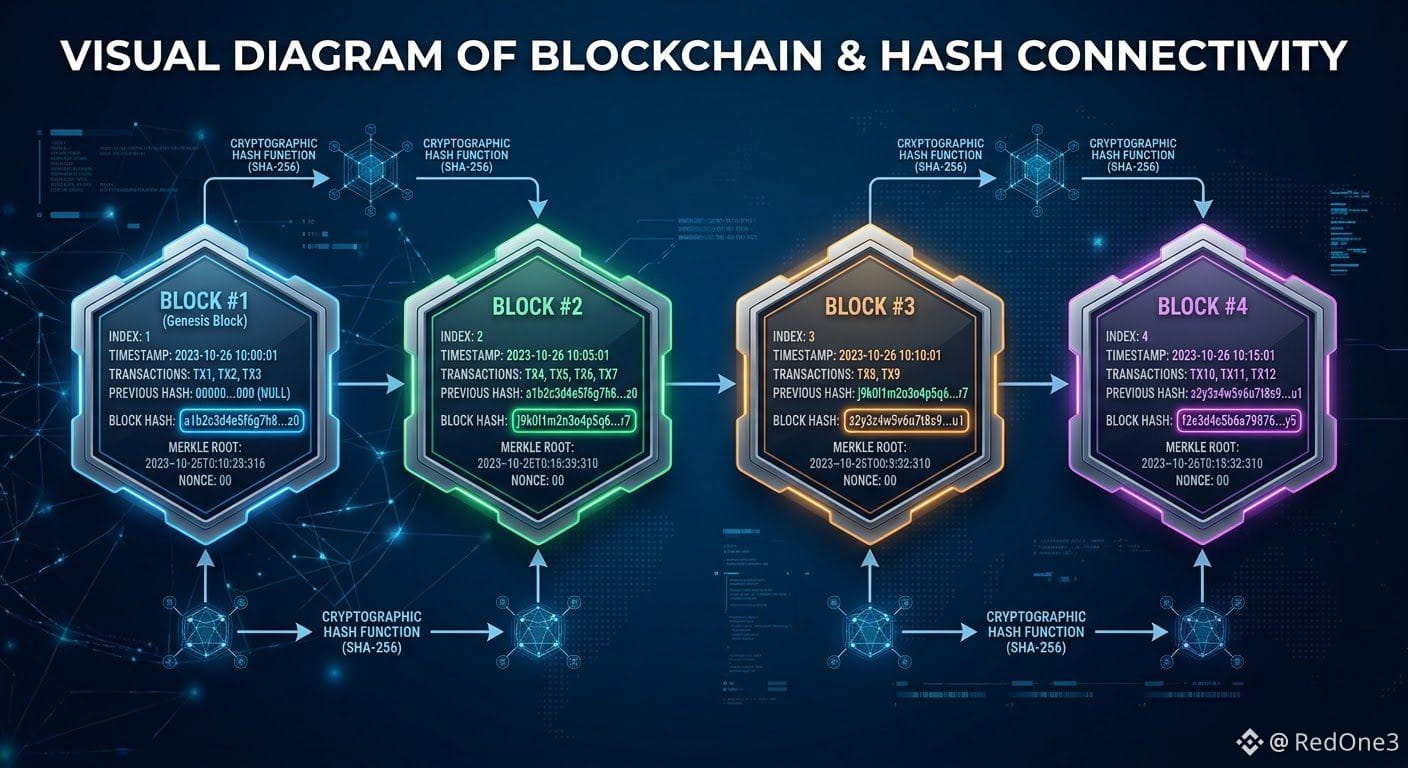
Blockchain is a decentralized ledger that records transactions in blocks 📦 Each block contains a cryptographic hash of the previous block, creating an immutable chain ⛓️ This is why altering past data is nearly impossible without consensus from the network 🔐
#Blockchain #Web3Basics .
Blockchain is a decentralized ledger that records transactions in blocks 📦 Each block contains a cryptographic hash of the previous block, creating an immutable chain ⛓️ This is why altering past data is nearly impossible without consensus from the network 🔐
#Blockchain #Web3Basics .
#Blockchain #Web3Basics .
1
129
·
--
Bullish
See translation
Sunday afternoon.
Most traditional cross-border banking infrastructure isn’t built to settle like it’s a Tuesday morning.
But $750,000 just moved between Lloyds and Visa using USDC — and the funds arrived in less than an hour. ⚡💵
The seven-day pilot deliberately ran transactions outside normal banking hours, including the weekend.
Lloyds bought the USDC through UK-regulated Archax, then used it to settle real payment obligations with Visa in the U.S. 🌍
No waiting for the next banking window.
No “come back Monday.”
Just blockchain-based settlement operating around the clock. ⏱️
And that may be the bigger story here:
Stablecoins aren't only being tested as something people hold.
They're being tested as financial infrastructure for institutions. 🏦
$USDC $ETH $BTC
#Stablecoins #Crypto #Blockchain #Visa #Bitcoin
Sunday afternoon.
Most traditional cross-border banking infrastructure isn’t built to settle like it’s a Tuesday morning.
But $750,000 just moved between Lloyds and Visa using USDC — and the funds arrived in less than an hour. ⚡💵
The seven-day pilot deliberately ran transactions outside normal banking hours, including the weekend.
Lloyds bought the USDC through UK-regulated Archax, then used it to settle real payment obligations with Visa in the U.S. 🌍
No waiting for the next banking window.
No “come back Monday.”
Just blockchain-based settlement operating around the clock. ⏱️
And that may be the bigger story here:
Stablecoins aren't only being tested as something people hold.
They're being tested as financial infrastructure for institutions. 🏦
$USDC $ETH $BTC
#Stablecoins #Crypto #Blockchain #Visa #Bitcoin
Most traditional cross-border banking infrastructure isn’t built to settle like it’s a Tuesday morning.
But $750,000 just moved between Lloyds and Visa using USDC — and the funds arrived in less than an hour. ⚡💵
The seven-day pilot deliberately ran transactions outside normal banking hours, including the weekend.
Lloyds bought the USDC through UK-regulated Archax, then used it to settle real payment obligations with Visa in the U.S. 🌍
No waiting for the next banking window.
No “come back Monday.”
Just blockchain-based settlement operating around the clock. ⏱️
And that may be the bigger story here:
Stablecoins aren't only being tested as something people hold.
They're being tested as financial infrastructure for institutions. 🏦
$USDC $ETH $BTC
#Stablecoins #Crypto #Blockchain #Visa #Bitcoin
90

See translation
JAPAN PLANS BLOCKCHAIN INFRASTRUCTURE FOR INSTANT SETTLEMENT BY 2027 SPURRING $BMT 🚨 💥
Institutional market structure is preparing for a massive shift as Japan moves to settle legacy equity and bond transactions on-chain by 2027. 🏦 Eliminating the standard T+2 clearing delay compresses liquidity risk and allows capital to flow across global venues with zero friction.
Smart money recognizes that reducing counterparty settlement risk opens the floodgates for real-world asset tokenization and enterprise utility infrastructure. 📊 Projects powering cross-border settlement pathways like $BMT and $UTK could see sustained structural demand as institutional rails mature. 💡
Skeptics point to regulatory friction, but institutional infrastructure upgrades rarely reverse once momentum builds. 💬 Do you expect institutional adoption in Asia to accelerate ahead of 2027? 👇
⚠️ Not financial advice. Always manage your risk. 🛡️
🏷️ #BMT #UTK #Blockchain #Institutional #Crypto
⚡ 🎯
JAPAN PLANS BLOCKCHAIN INFRASTRUCTURE FOR INSTANT SETTLEMENT BY 2027 SPURRING $BMT 🚨 💥
Institutional market structure is preparing for a massive shift as Japan moves to settle legacy equity and bond transactions on-chain by 2027. 🏦 Eliminating the standard T+2 clearing delay compresses liquidity risk and allows capital to flow across global venues with zero friction.
Smart money recognizes that reducing counterparty settlement risk opens the floodgates for real-world asset tokenization and enterprise utility infrastructure. 📊 Projects powering cross-border settlement pathways like $BMT and $UTK could see sustained structural demand as institutional rails mature. 💡
Skeptics point to regulatory friction, but institutional infrastructure upgrades rarely reverse once momentum builds. 💬 Do you expect institutional adoption in Asia to accelerate ahead of 2027? 👇
⚠️ Not financial advice. Always manage your risk. 🛡️
🏷️ #BMT #UTK #Blockchain #Institutional #Crypto
⚡ 🎯
Institutional market structure is preparing for a massive shift as Japan moves to settle legacy equity and bond transactions on-chain by 2027. 🏦 Eliminating the standard T+2 clearing delay compresses liquidity risk and allows capital to flow across global venues with zero friction.
Smart money recognizes that reducing counterparty settlement risk opens the floodgates for real-world asset tokenization and enterprise utility infrastructure. 📊 Projects powering cross-border settlement pathways like $BMT and $UTK could see sustained structural demand as institutional rails mature. 💡
Skeptics point to regulatory friction, but institutional infrastructure upgrades rarely reverse once momentum builds. 💬 Do you expect institutional adoption in Asia to accelerate ahead of 2027? 👇
⚠️ Not financial advice. Always manage your risk. 🛡️
🏷️ #BMT #UTK #Blockchain #Institutional #Crypto
⚡ 🎯

112

See translation
🔗 Blockchain Explained: The Technology Behind Cryptocurrency
Have you ever wondered how cryptocurrency transactions work without a traditional bank?
The answer lies in blockchain technology.
A blockchain is a distributed digital ledger that records transactions in connected blocks. Each block contains information linked to the previous one, making historical records difficult to alter.
Here are 4 key features:
🔹 Decentralization: Many blockchain networks operate across multiple independent participants rather than relying on a single central authority.
🔹 Transparency: Public blockchains allow users to inspect transaction records.
🔹 Security: Cryptographic techniques help protect transaction data and verify ownership.
🔹 Traceability: Transactions can be followed through the blockchain's public record.
However, blockchain technology is not completely risk-free. Network congestion, smart contract vulnerabilities, and user mistakes can still create problems.
💡 Key takeaway: Cryptocurrency is one application of blockchain technology, but blockchain has uses beyond digital currencies.
Do you think blockchain will become more important in everyday life? Share your thoughts below! 👇
#Blockchain #bitcoin #web3空投 #BinanceSquare
🔗 Blockchain Explained: The Technology Behind Cryptocurrency
Have you ever wondered how cryptocurrency transactions work without a traditional bank?
The answer lies in blockchain technology.
A blockchain is a distributed digital ledger that records transactions in connected blocks. Each block contains information linked to the previous one, making historical records difficult to alter.
Here are 4 key features:
🔹 Decentralization: Many blockchain networks operate across multiple independent participants rather than relying on a single central authority.
🔹 Transparency: Public blockchains allow users to inspect transaction records.
🔹 Security: Cryptographic techniques help protect transaction data and verify ownership.
🔹 Traceability: Transactions can be followed through the blockchain's public record.
However, blockchain technology is not completely risk-free. Network congestion, smart contract vulnerabilities, and user mistakes can still create problems.
💡 Key takeaway: Cryptocurrency is one application of blockchain technology, but blockchain has uses beyond digital currencies.
Do you think blockchain will become more important in everyday life? Share your thoughts below! 👇
#Blockchain #bitcoin #web3空投 #BinanceSquare
Have you ever wondered how cryptocurrency transactions work without a traditional bank?
The answer lies in blockchain technology.
A blockchain is a distributed digital ledger that records transactions in connected blocks. Each block contains information linked to the previous one, making historical records difficult to alter.
Here are 4 key features:
🔹 Decentralization: Many blockchain networks operate across multiple independent participants rather than relying on a single central authority.
🔹 Transparency: Public blockchains allow users to inspect transaction records.
🔹 Security: Cryptographic techniques help protect transaction data and verify ownership.
🔹 Traceability: Transactions can be followed through the blockchain's public record.
However, blockchain technology is not completely risk-free. Network congestion, smart contract vulnerabilities, and user mistakes can still create problems.
💡 Key takeaway: Cryptocurrency is one application of blockchain technology, but blockchain has uses beyond digital currencies.
Do you think blockchain will become more important in everyday life? Share your thoughts below! 👇
#Blockchain #bitcoin #web3空投 #BinanceSquare
70

·
--
See translation
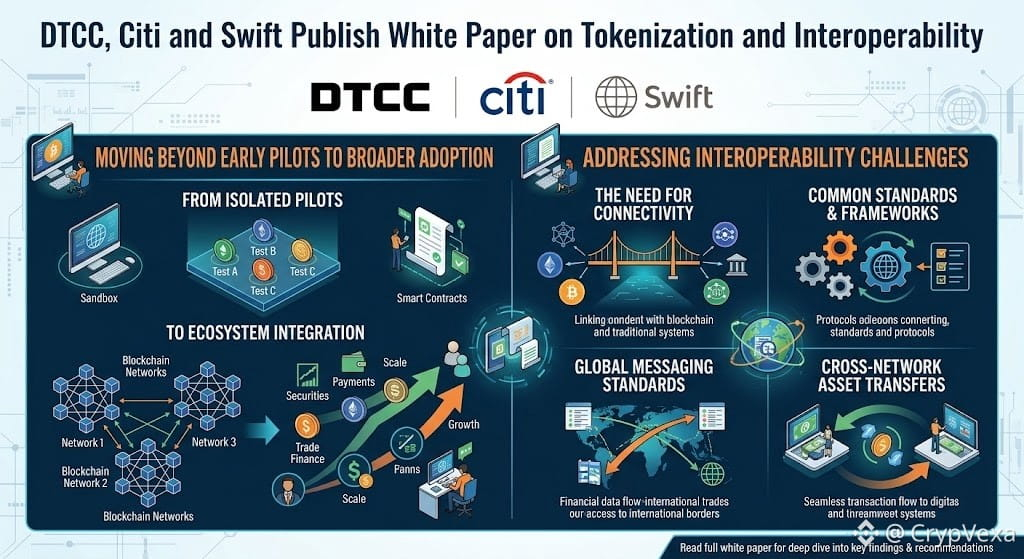
🔥 DTCC, Citi & Swift Push Tokenization Forward
🏦 DTCC, Citi and Swift have released a new white paper focused on tokenization and interoperability across digital financial networks.
🔗 The big focus: connecting traditional finance, private networks and public blockchains.
⚡ Tokenization may be moving from isolated pilots toward institutional-scale infrastructure.
👀 Could interoperability be the key to unlocking tokenized markets?
#Tokenization #RWA #Blockchain #CryptoNews
🔥 DTCC, Citi & Swift Push Tokenization Forward
🏦 DTCC, Citi and Swift have released a new white paper focused on tokenization and interoperability across digital financial networks.
🔗 The big focus: connecting traditional finance, private networks and public blockchains.
⚡ Tokenization may be moving from isolated pilots toward institutional-scale infrastructure.
👀 Could interoperability be the key to unlocking tokenized markets?
#Tokenization #RWA #Blockchain #CryptoNews
🏦 DTCC, Citi and Swift have released a new white paper focused on tokenization and interoperability across digital financial networks.
🔗 The big focus: connecting traditional finance, private networks and public blockchains.
⚡ Tokenization may be moving from isolated pilots toward institutional-scale infrastructure.
👀 Could interoperability be the key to unlocking tokenized markets?
#Tokenization #RWA #Blockchain #CryptoNews
1
74

See translation
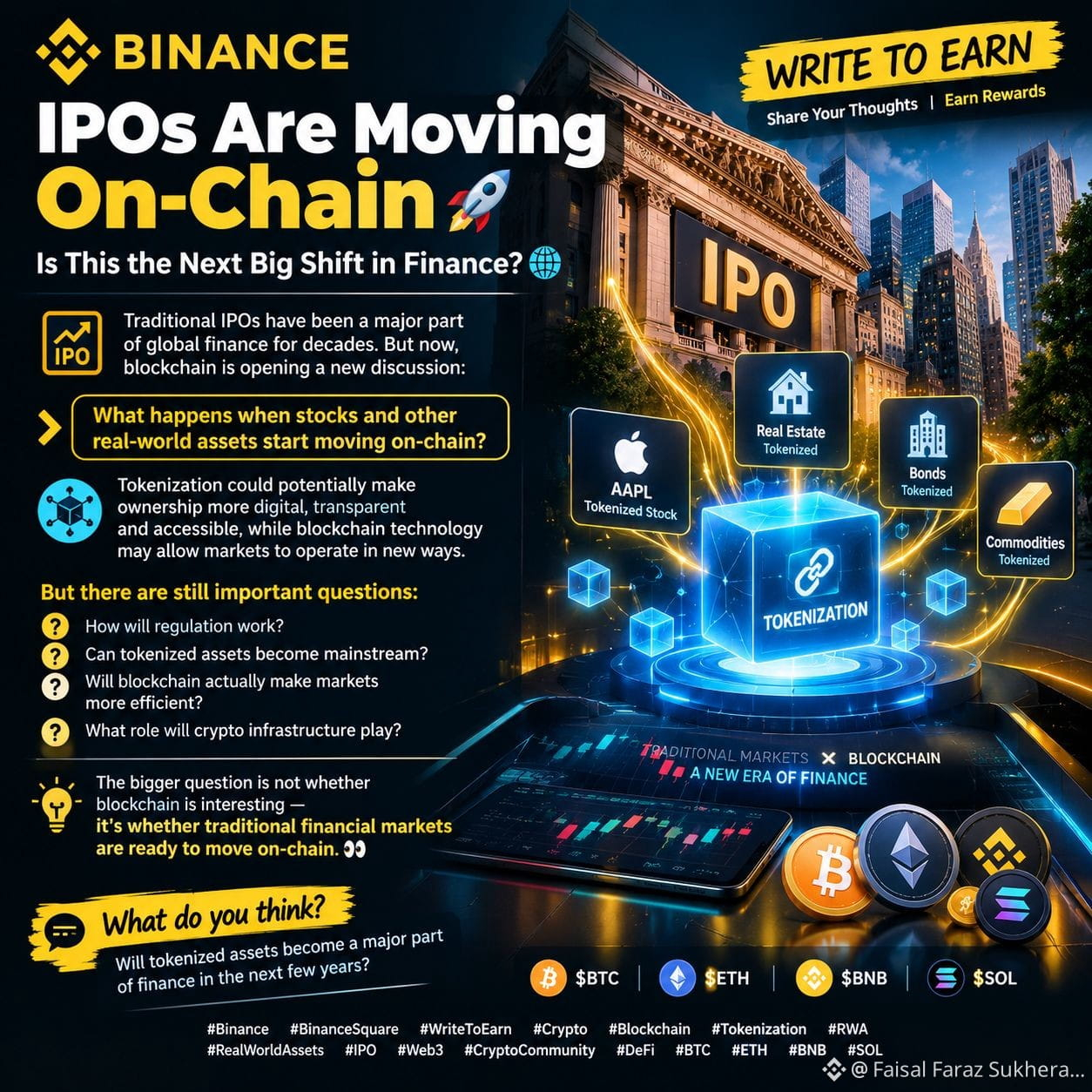
🚨 IPOs Are Moving On-Chain — Is This the Next Big Shift in Finance? 🌐
Traditional IPOs have been a major part of global finance for decades. But now, blockchain is opening a new discussion:
👉 What happens when stocks and other real-world assets start moving on-chain?
Tokenization could potentially make ownership more digital, transparent and accessible, while blockchain technology may allow markets to operate in new ways.
But there are still important questions: 🔹 How will regulation work? 🔹 Can tokenized assets become mainstream? 🔹 Will blockchain actually make markets more efficient? 🔹 What role will crypto infrastructure play?
The bigger question is not whether blockchain is interesting — it's whether traditional financial markets are ready to move on-chain. 👀
💬 What do you think? Will tokenized assets become a major part of finance in the next few years?
$BTC $ETH $BNB $SOL
#Binance #BinanceSquare #WriteToEarn #Crypto #blockchain #Tokenization #RWA #RealWorldAssets #IPO #Web3 #CryptoCommunity #DeFi #BTC #ETH #BNB #SOL
🚨 IPOs Are Moving On-Chain — Is This the Next Big Shift in Finance? 🌐
Traditional IPOs have been a major part of global finance for decades. But now, blockchain is opening a new discussion:
👉 What happens when stocks and other real-world assets start moving on-chain?
Tokenization could potentially make ownership more digital, transparent and accessible, while blockchain technology may allow markets to operate in new ways.
But there are still important questions: 🔹 How will regulation work? 🔹 Can tokenized assets become mainstream? 🔹 Will blockchain actually make markets more efficient? 🔹 What role will crypto infrastructure play?
The bigger question is not whether blockchain is interesting — it's whether traditional financial markets are ready to move on-chain. 👀
💬 What do you think? Will tokenized assets become a major part of finance in the next few years?
$BTC $ETH $BNB $SOL
#Binance #BinanceSquare #WriteToEarn #Crypto #blockchain #Tokenization #RWA #RealWorldAssets #IPO #Web3 #CryptoCommunity #DeFi #BTC #ETH #BNB #SOL
Traditional IPOs have been a major part of global finance for decades. But now, blockchain is opening a new discussion:
👉 What happens when stocks and other real-world assets start moving on-chain?
Tokenization could potentially make ownership more digital, transparent and accessible, while blockchain technology may allow markets to operate in new ways.
But there are still important questions: 🔹 How will regulation work? 🔹 Can tokenized assets become mainstream? 🔹 Will blockchain actually make markets more efficient? 🔹 What role will crypto infrastructure play?
The bigger question is not whether blockchain is interesting — it's whether traditional financial markets are ready to move on-chain. 👀
💬 What do you think? Will tokenized assets become a major part of finance in the next few years?
$BTC $ETH $BNB $SOL
#Binance #BinanceSquare #WriteToEarn #Crypto #blockchain #Tokenization #RWA #RealWorldAssets #IPO #Web3 #CryptoCommunity #DeFi #BTC #ETH #BNB #SOL
112

·
--
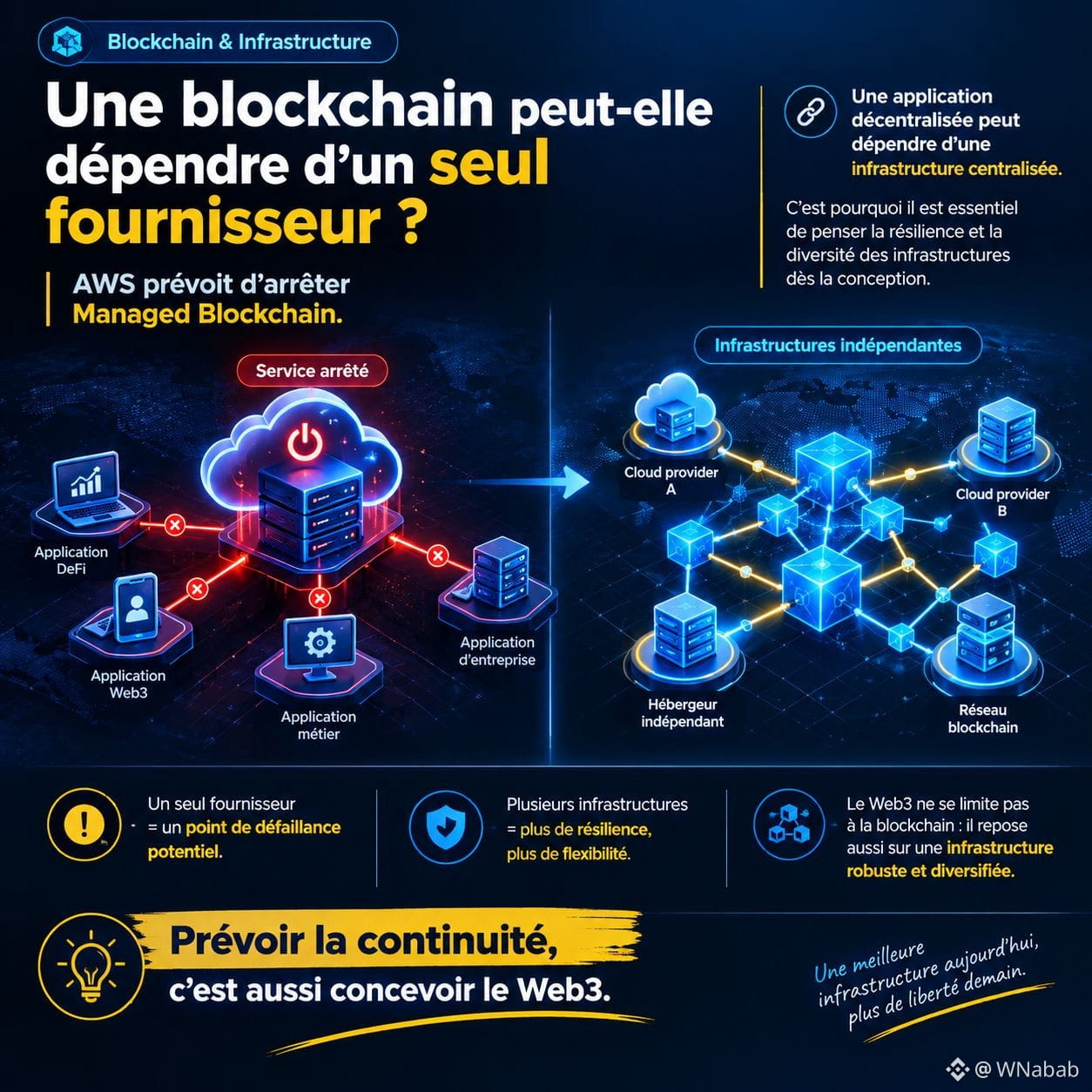
Building on the blockchain also means choosing your infrastructure.
Amazon Web Services plans to shut down its Managed Blockchain service: new sign-ups must stop on October 29, 2026, and the existing service must end in September 2027.
This brings to mind a reality that is often overlooked: an application said to be decentralized can still depend on a centralized provider for part of its operation.
The real question is: what happens if the infrastructure on which a project depends disappears?
#Blockchain #Web3 #Infrastructure
$BTC $USDT
Building on the blockchain also means choosing your infrastructure.
Amazon Web Services plans to shut down its Managed Blockchain service: new sign-ups must stop on October 29, 2026, and the existing service must end in September 2027.
This brings to mind a reality that is often overlooked: an application said to be decentralized can still depend on a centralized provider for part of its operation.
The real question is: what happens if the infrastructure on which a project depends disappears?
#Blockchain #Web3 #Infrastructure
$BTC $USDT
Amazon Web Services plans to shut down its Managed Blockchain service: new sign-ups must stop on October 29, 2026, and the existing service must end in September 2027.
This brings to mind a reality that is often overlooked: an application said to be decentralized can still depend on a centralized provider for part of its operation.
The real question is: what happens if the infrastructure on which a project depends disappears?
#Blockchain #Web3 #Infrastructure
$BTC $USDT
1
283

·
--
The Role of Smart Contracts in 3 Ethereun Ethereum is one of the most important blockchain networks, not only because of the ETH currency, but also because of its ability to run smart contracts and decentralized applications. Smart contracts enable digital transactions to be executed according to predefined conditions without the need for a traditional intermediary in certain use cases. As the 3Web sector expands, understanding the fundamentals of Ethereum and smart contracts has become an essential part of comprehending the developments taking place in the world of digital assets.
The Role of Smart Contracts in 3 Ethereun
Ethereum is one of the most important blockchain networks, not only because of the ETH currency, but also because of its ability to run smart contracts and decentralized applications. Smart contracts enable digital transactions to be executed according to predefined conditions without the need for a traditional intermediary in certain use cases. As the 3Web sector expands, understanding the fundamentals of Ethereum and smart contracts has become an essential part of comprehending the developments taking place in the world of digital assets.
1
73

·
--
🔥 Something that seemed very far away is accelerating right in front of us
Tokenization is starting to squeeze into the stock market.
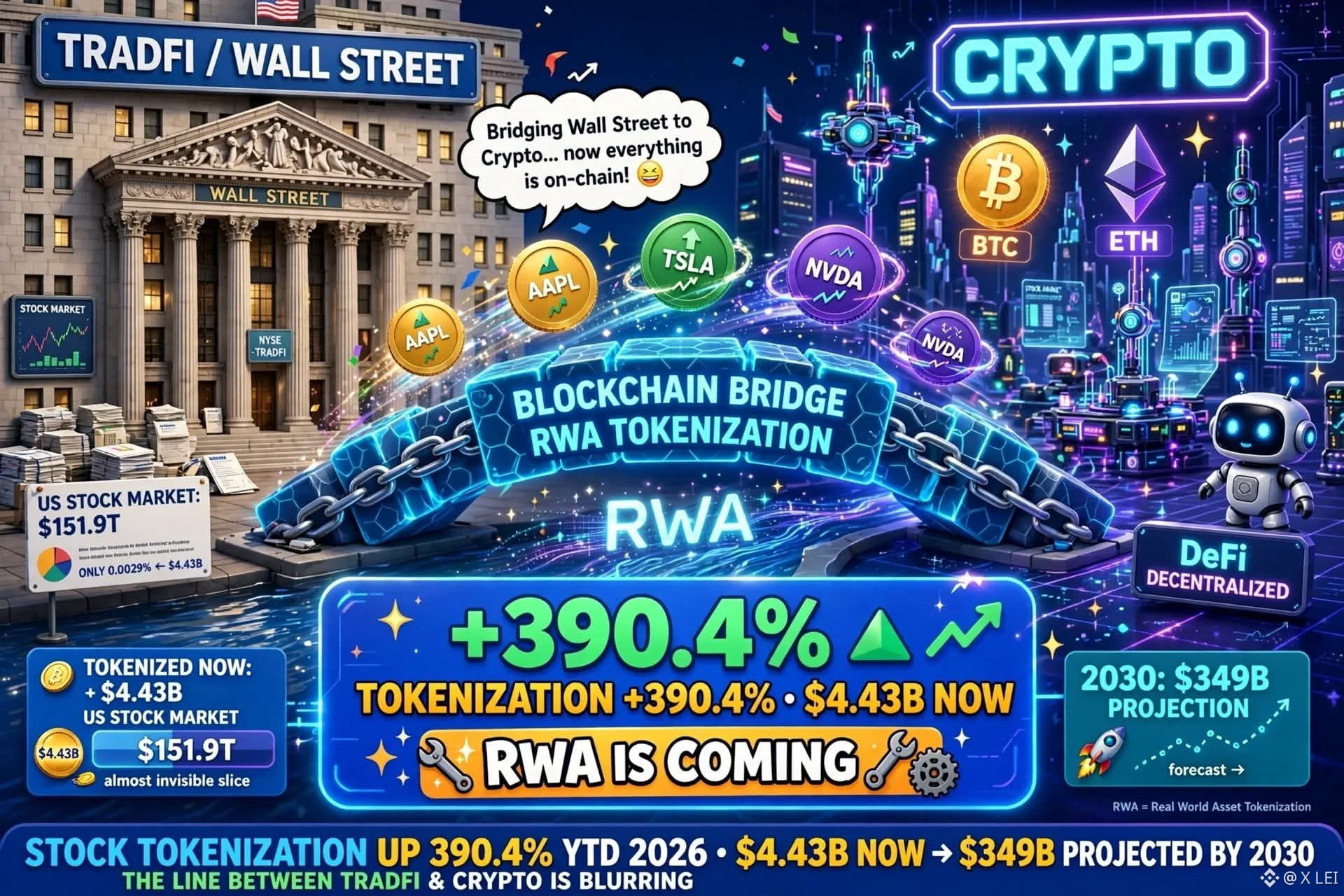
According to Binance Research, the value of tokenized stocks has surged by up to 390.4% since the beginning of 2026, and now stands at about $4.43 billion.
Hearing $4.43 billion sounds enormous, but compared with the listed U.S. stock market worth around $151.9 trillion, this figure is only 0.0029%.
And here’s where it gets interesting 👀
Binance Research’s base case forecasts that the tokenized stock market could reach approximately $349 billion by 2030.
So the story isn’t just about putting stocks on the blockchain.
If this trend continues, the boundary between TradFi and crypto may grow increasingly blurry.
$RWA probably is finally starting to get real “screen time.”
#Tokenization #RWA #Crypto #Blockchain #BinanceSquare
🔥 Something that seemed very far away is accelerating right in front of us
Tokenization is starting to squeeze into the stock market.
According to Binance Research, the value of tokenized stocks has surged by up to 390.4% since the beginning of 2026, and now stands at about $4.43 billion.
Hearing $4.43 billion sounds enormous, but compared with the listed U.S. stock market worth around $151.9 trillion, this figure is only 0.0029%.
And here’s where it gets interesting 👀
Binance Research’s base case forecasts that the tokenized stock market could reach approximately $349 billion by 2030.
So the story isn’t just about putting stocks on the blockchain.
If this trend continues, the boundary between TradFi and crypto may grow increasingly blurry.
$RWA probably is finally starting to get real “screen time.”
#Tokenization #RWA #Crypto #Blockchain #BinanceSquare
Tokenization is starting to squeeze into the stock market.
According to Binance Research, the value of tokenized stocks has surged by up to 390.4% since the beginning of 2026, and now stands at about $4.43 billion.
Hearing $4.43 billion sounds enormous, but compared with the listed U.S. stock market worth around $151.9 trillion, this figure is only 0.0029%.
And here’s where it gets interesting 👀
Binance Research’s base case forecasts that the tokenized stock market could reach approximately $349 billion by 2030.
So the story isn’t just about putting stocks on the blockchain.
If this trend continues, the boundary between TradFi and crypto may grow increasingly blurry.
$RWA probably is finally starting to get real “screen time.”
#Tokenization #RWA #Crypto #Blockchain #BinanceSquare
11

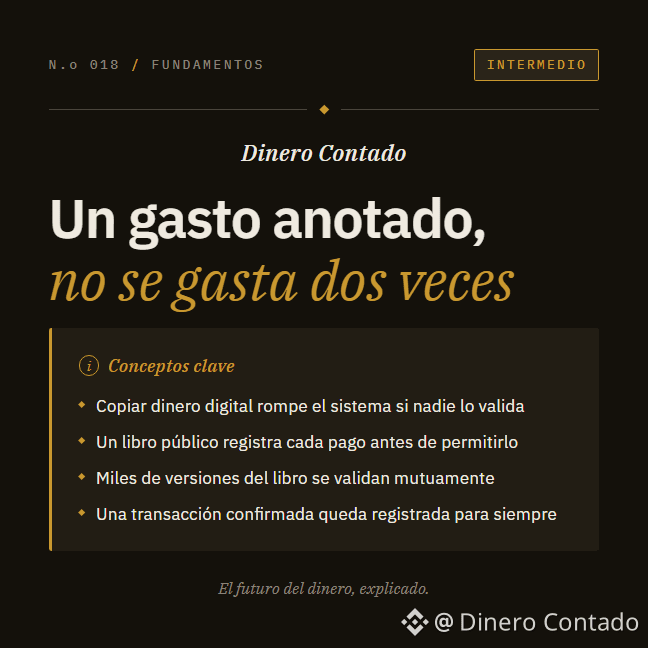
Copying a digital file is free. Copying digital money shouldn’t be, and that clash nearly killed the idea of a currency that lives only on the internet.
Think of a document. You copy it, send it to ten friends, and all eleven have the same thing. No one loses anything. Now swap the document for 100 dollars: each friend would spend "their" 100 thinking they’re the owner, and the entire system breaks.
Before Bitcoin, no one had closed that gap without putting a bank in the middle: someone had to keep the account and make sure that coin hadn’t already been spent. Banks, credit cards, and payment platforms exist, in part, for that.
Bitcoin closed it without an arbiter. Every payment is recorded in a public ledger, and before accepting a new one, the network checks whether that money has already been spent. If it has, it’s rejected. There’s no manager approving things: there are thousands of copies of the same ledger comparing against each other.
That’s double spending: using the same digital money twice. Solving it is the reason consensus exists. Then came networks like $SOL’s, which tackle the same problem with a different verification method and far greater speed.
KEY CONCEPTS
- Digital money isn’t copied like a file: each move is validated against the history before it’s accepted.
- The ledger is public, not secret. That openness is what makes it possible to detect duplicate spending.
- A confirmed transaction is recorded forever. Fast doesn’t mean invisible.
- Reusing the same address doesn’t break that protection, but it exposes your activity to anyone who looks at the ledger.
Each confirmation resolves in seconds a problem that had been stuck for decades.
Transparency: Binance may pay us a commission if you trade after clicking an asset symbol or a price link from this publication.
#Bitcoin #Blockchain #DobleGasto #EarningsSeason #FundamentosCripto
Copying a digital file is free. Copying digital money shouldn’t be, and that clash nearly killed the idea of a currency that lives only on the internet.
Think of a document. You copy it, send it to ten friends, and all eleven have the same thing. No one loses anything. Now swap the document for 100 dollars: each friend would spend "their" 100 thinking they’re the owner, and the entire system breaks.
Before Bitcoin, no one had closed that gap without putting a bank in the middle: someone had to keep the account and make sure that coin hadn’t already been spent. Banks, credit cards, and payment platforms exist, in part, for that.
Bitcoin closed it without an arbiter. Every payment is recorded in a public ledger, and before accepting a new one, the network checks whether that money has already been spent. If it has, it’s rejected. There’s no manager approving things: there are thousands of copies of the same ledger comparing against each other.
That’s double spending: using the same digital money twice. Solving it is the reason consensus exists. Then came networks like $SOL ’s, which tackle the same problem with a different verification method and far greater speed.
KEY CONCEPTS
- Digital money isn’t copied like a file: each move is validated against the history before it’s accepted.
- The ledger is public, not secret. That openness is what makes it possible to detect duplicate spending.
- A confirmed transaction is recorded forever. Fast doesn’t mean invisible.
- Reusing the same address doesn’t break that protection, but it exposes your activity to anyone who looks at the ledger.
Each confirmation resolves in seconds a problem that had been stuck for decades.
Transparency: Binance may pay us a commission if you trade after clicking an asset symbol or a price link from this publication.
#Bitcoin #Blockchain #DobleGasto #EarningsSeason #FundamentosCripto
Think of a document. You copy it, send it to ten friends, and all eleven have the same thing. No one loses anything. Now swap the document for 100 dollars: each friend would spend "their" 100 thinking they’re the owner, and the entire system breaks.
Before Bitcoin, no one had closed that gap without putting a bank in the middle: someone had to keep the account and make sure that coin hadn’t already been spent. Banks, credit cards, and payment platforms exist, in part, for that.
Bitcoin closed it without an arbiter. Every payment is recorded in a public ledger, and before accepting a new one, the network checks whether that money has already been spent. If it has, it’s rejected. There’s no manager approving things: there are thousands of copies of the same ledger comparing against each other.
That’s double spending: using the same digital money twice. Solving it is the reason consensus exists. Then came networks like $SOL ’s, which tackle the same problem with a different verification method and far greater speed.
KEY CONCEPTS
- Digital money isn’t copied like a file: each move is validated against the history before it’s accepted.
- The ledger is public, not secret. That openness is what makes it possible to detect duplicate spending.
- A confirmed transaction is recorded forever. Fast doesn’t mean invisible.
- Reusing the same address doesn’t break that protection, but it exposes your activity to anyone who looks at the ledger.
Each confirmation resolves in seconds a problem that had been stuck for decades.
Transparency: Binance may pay us a commission if you trade after clicking an asset symbol or a price link from this publication.
#Bitcoin #Blockchain #DobleGasto #EarningsSeason #FundamentosCripto
1
2
805
·
--
See translation
⚡ SEC Chair Paul Atkins Wants U.S. Stock Markets to Move On-Chain
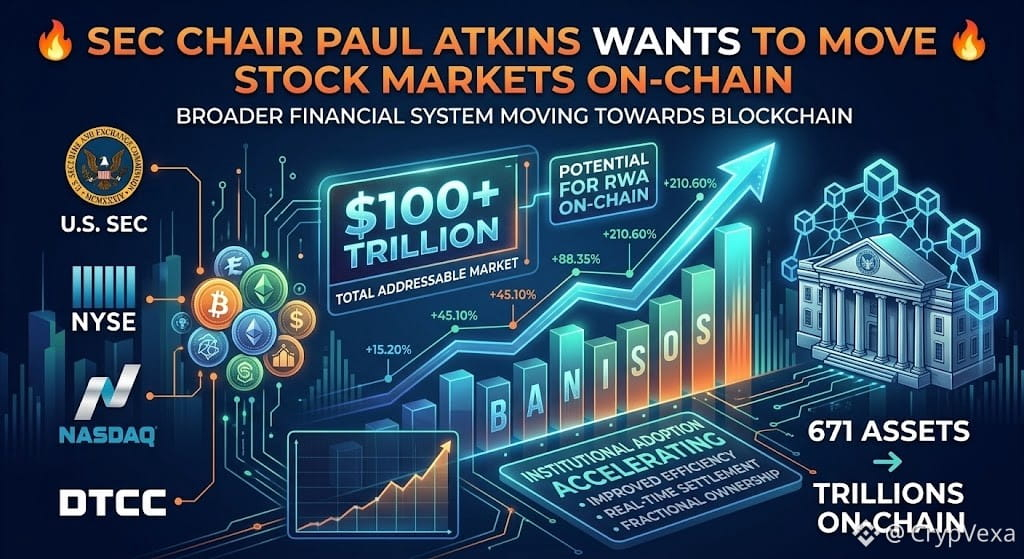
🇺🇸 SEC Chair Paul Atkins has said the goal of the SEC’s “Project Crypto” is to modernize U.S. financial markets and enable them to move on-chain.
📈 The SEC has already taken a concrete step by allowing certain tokenized U.S. stocks to trade on approved on-chain venues under a temporary, conditional exemption.
🔗 What could change?
• 24/7-style trading infrastructure
• Faster settlement and transfers
• Tokenized ownership of traditional assets
• Greater integration between traditional finance and blockchain
⚠️ The current framework is limited and temporary, so a broader shift would depend on future regulation and market adoption.
👀 Could on-chain markets become a major part of traditional finance?
#Tokenization #Blockchain #SEC #CryptoNews
⚡ SEC Chair Paul Atkins Wants U.S. Stock Markets to Move On-Chain
🇺🇸 SEC Chair Paul Atkins has said the goal of the SEC’s “Project Crypto” is to modernize U.S. financial markets and enable them to move on-chain.
📈 The SEC has already taken a concrete step by allowing certain tokenized U.S. stocks to trade on approved on-chain venues under a temporary, conditional exemption.
🔗 What could change?
• 24/7-style trading infrastructure
• Faster settlement and transfers
• Tokenized ownership of traditional assets
• Greater integration between traditional finance and blockchain
⚠️ The current framework is limited and temporary, so a broader shift would depend on future regulation and market adoption.
👀 Could on-chain markets become a major part of traditional finance?
#Tokenization #Blockchain #SEC #CryptoNews
🇺🇸 SEC Chair Paul Atkins has said the goal of the SEC’s “Project Crypto” is to modernize U.S. financial markets and enable them to move on-chain.
📈 The SEC has already taken a concrete step by allowing certain tokenized U.S. stocks to trade on approved on-chain venues under a temporary, conditional exemption.
🔗 What could change?
• 24/7-style trading infrastructure
• Faster settlement and transfers
• Tokenized ownership of traditional assets
• Greater integration between traditional finance and blockchain
⚠️ The current framework is limited and temporary, so a broader shift would depend on future regulation and market adoption.
👀 Could on-chain markets become a major part of traditional finance?
#Tokenization #Blockchain #SEC #CryptoNews
1
74
·
--
See translation
🔥 Tokenized Market Reaches $332 Billion
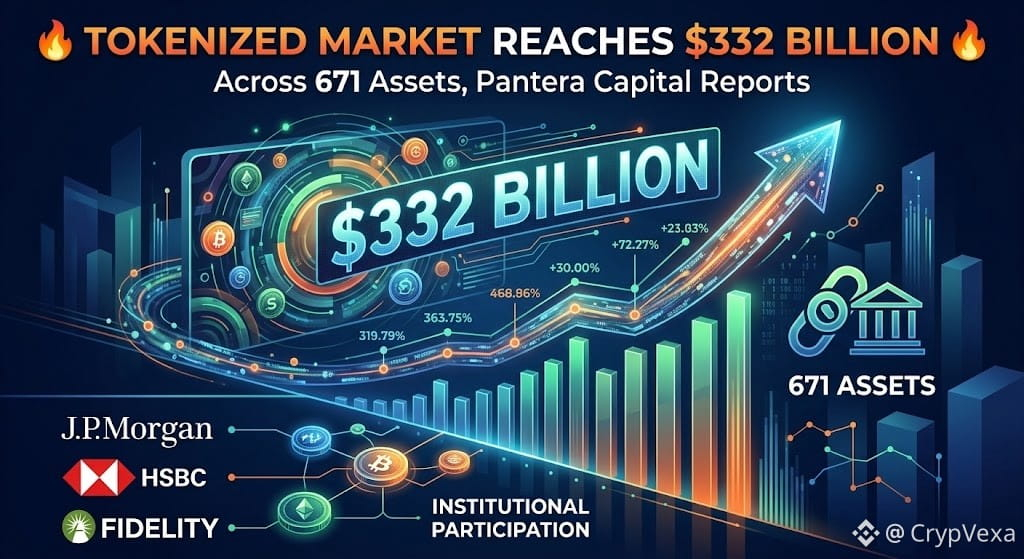
Pantera Capital’s latest report says the tokenized market it tracks has grown to $332 billion across 671 assets. 🌐💰
🏦 Institutional involvement is also expanding, with major financial names including JPMorgan, HSBC, and Fidelity exploring tokenized assets and blockchain-based infrastructure.
📈 Why it matters:
• More real-world assets are moving on-chain
• Traditional finance is increasingly testing tokenization
• Institutional participation could accelerate blockchain adoption
👀 Is tokenization becoming a major bridge between traditional finance and crypto?
#Tokenization #RWA #Blockchain #CryptoNews
🔥 Tokenized Market Reaches $332 Billion
Pantera Capital’s latest report says the tokenized market it tracks has grown to $332 billion across 671 assets. 🌐💰
🏦 Institutional involvement is also expanding, with major financial names including JPMorgan, HSBC, and Fidelity exploring tokenized assets and blockchain-based infrastructure.
📈 Why it matters:
• More real-world assets are moving on-chain
• Traditional finance is increasingly testing tokenization
• Institutional participation could accelerate blockchain adoption
👀 Is tokenization becoming a major bridge between traditional finance and crypto?
#Tokenization #RWA #Blockchain #CryptoNews
Pantera Capital’s latest report says the tokenized market it tracks has grown to $332 billion across 671 assets. 🌐💰
🏦 Institutional involvement is also expanding, with major financial names including JPMorgan, HSBC, and Fidelity exploring tokenized assets and blockchain-based infrastructure.
📈 Why it matters:
• More real-world assets are moving on-chain
• Traditional finance is increasingly testing tokenization
• Institutional participation could accelerate blockchain adoption
👀 Is tokenization becoming a major bridge between traditional finance and crypto?
#Tokenization #RWA #Blockchain #CryptoNews
1
76

See translation
🚨 MUMBAI PREPARES FOR INDIA BLOCKCHAIN WEEK 2026 AHEAD OF DEVCON WITH $ETH PIONEERS! 💥
Smart money is already scouting positioning ahead of Devcon as Mumbai locks in India Blockchain Week 2026. 🦈 Institutional heavyweights and TradFi leaders are converging at the Fairmont to construct dedicated forums around tokenization and AI-driven assets. 💡
With over 3,500 market architects and founders backing ecosystems like $ETH , $POL , and $APT assembling under one roof, this catalyst signals expanding regional liquidity. 📊 When high-conviction capital meets regulatory decision-makers, explosive ecosystem momentum follows. ⚡
💬 Which narrative do you see dominating the market during this institutional summit: tokenized RWA or AI digital assets? 👇
⚠️ Not financial advice. Always manage your risk. 🛡️
🏷️ #ETH #Web3 #Crypto #Tokenization #Blockchain
🔥 ⚡
🚨 MUMBAI PREPARES FOR INDIA BLOCKCHAIN WEEK 2026 AHEAD OF DEVCON WITH $ETH PIONEERS! 💥
Smart money is already scouting positioning ahead of Devcon as Mumbai locks in India Blockchain Week 2026. 🦈 Institutional heavyweights and TradFi leaders are converging at the Fairmont to construct dedicated forums around tokenization and AI-driven assets. 💡
With over 3,500 market architects and founders backing ecosystems like $ETH , $POL , and $APT assembling under one roof, this catalyst signals expanding regional liquidity. 📊 When high-conviction capital meets regulatory decision-makers, explosive ecosystem momentum follows. ⚡
💬 Which narrative do you see dominating the market during this institutional summit: tokenized RWA or AI digital assets? 👇
⚠️ Not financial advice. Always manage your risk. 🛡️
🏷️ #ETH #Web3 #Crypto #Tokenization #Blockchain
🔥 ⚡
Smart money is already scouting positioning ahead of Devcon as Mumbai locks in India Blockchain Week 2026. 🦈 Institutional heavyweights and TradFi leaders are converging at the Fairmont to construct dedicated forums around tokenization and AI-driven assets. 💡
With over 3,500 market architects and founders backing ecosystems like $ETH , $POL , and $APT assembling under one roof, this catalyst signals expanding regional liquidity. 📊 When high-conviction capital meets regulatory decision-makers, explosive ecosystem momentum follows. ⚡
💬 Which narrative do you see dominating the market during this institutional summit: tokenized RWA or AI digital assets? 👇
⚠️ Not financial advice. Always manage your risk. 🛡️
🏷️ #ETH #Web3 #Crypto #Tokenization #Blockchain
🔥 ⚡

374

How does Blockchain work? 🤔
Simply put, it’s a distributed ledger where transaction information is stored across multiple parts of the network.
To understand Crypto, it’s very important to first understand the basic concept of Blockchain. 📚
#blockchain #cryptoeducation #Binance
How does Blockchain work? 🤔
Simply put, it’s a distributed ledger where transaction information is stored across multiple parts of the network.
To understand Crypto, it’s very important to first understand the basic concept of Blockchain. 📚
#blockchain #cryptoeducation #Binance
Simply put, it’s a distributed ledger where transaction information is stored across multiple parts of the network.
To understand Crypto, it’s very important to first understand the basic concept of Blockchain. 📚
#blockchain #cryptoeducation #Binance
77
·
--
Bullish
See translation
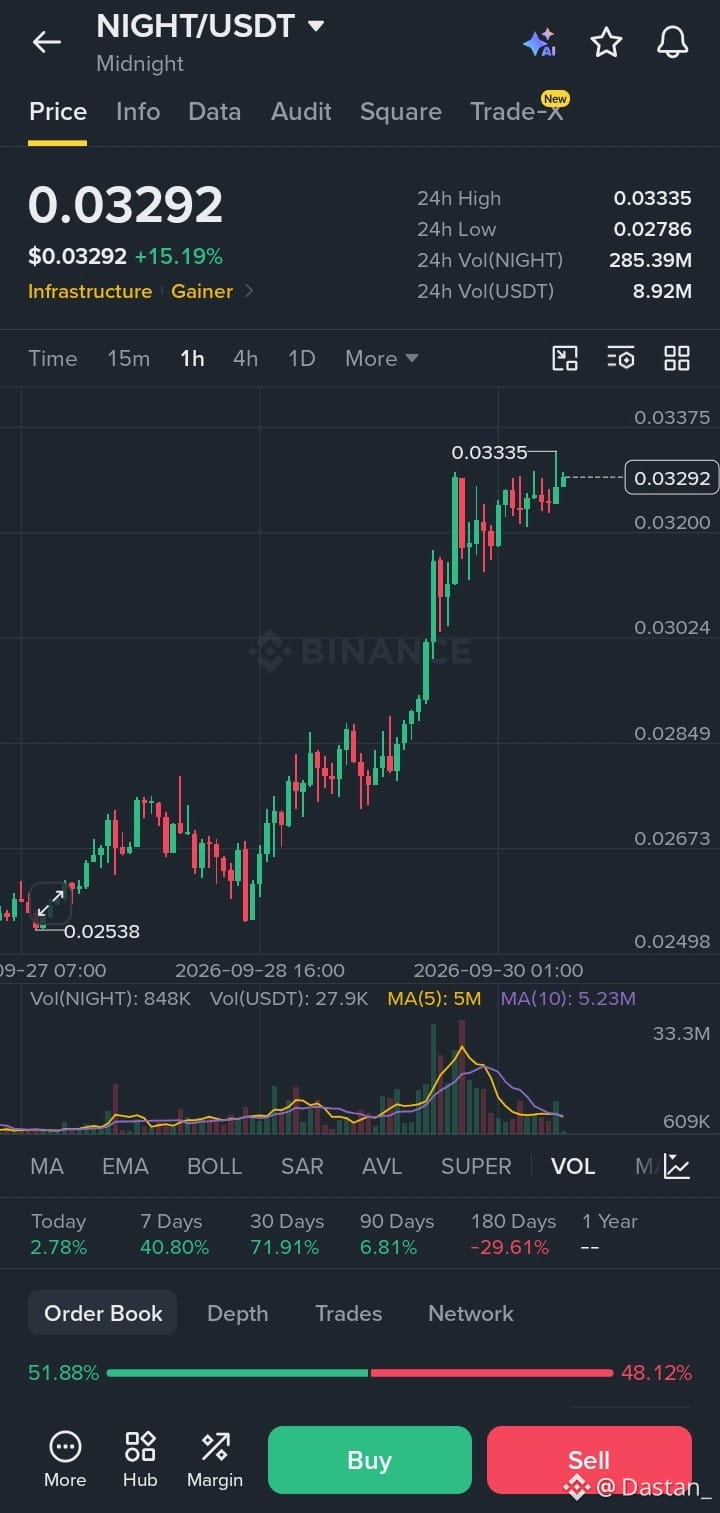
$NIGHT ..
Midnight is building a Privacy-focused blockchain using zero-knowledge technology, with NIGHT powering the ecosystem through #DUST ..
#night #blockchain #trading
{future}(NIGHTUSDT)
$NIGHT ..
Midnight is building a Privacy-focused blockchain using zero-knowledge technology, with NIGHT powering the ecosystem through #DUST ..
#night #blockchain #trading
Midnight is building a Privacy-focused blockchain using zero-knowledge technology, with NIGHT powering the ecosystem through #DUST ..
#night #blockchain #trading
1
239

·
--
See translation
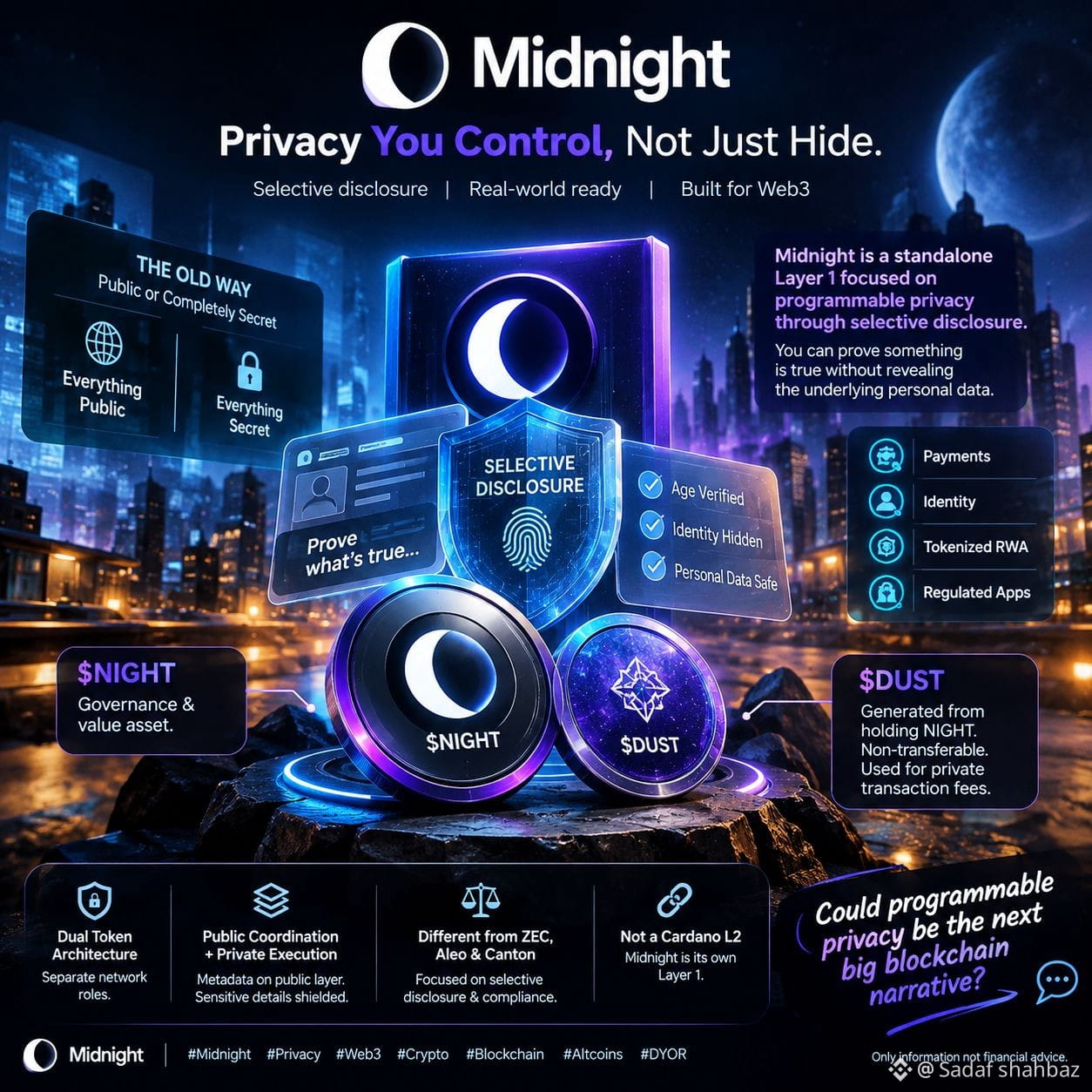
Midnight is taking a different path in blockchain privacy.
Instead of making everything public or completely hidden, Midnight enables selective disclosure — allowing users to prove specific facts without exposing unnecessary personal data.
Its dual-token model is also unique:
🔹 $NIGHT powers governance and network value
🔹 $DUST is generated from holding NIGHT and is used for private transaction fees
As Web3 grows, privacy may no longer be about hiding everything — it could be about revealing only what matters.
Could programmable privacy become the next major blockchain narrative? 👀
$NIGHT #Web3 #blockchain #Privacy #dyor
Midnight is taking a different path in blockchain privacy.
Instead of making everything public or completely hidden, Midnight enables selective disclosure — allowing users to prove specific facts without exposing unnecessary personal data.
Its dual-token model is also unique:
🔹 $NIGHT powers governance and network value
🔹 $DUST is generated from holding NIGHT and is used for private transaction fees
As Web3 grows, privacy may no longer be about hiding everything — it could be about revealing only what matters.
Could programmable privacy become the next major blockchain narrative? 👀
$NIGHT #Web3 #blockchain #Privacy #dyor
Instead of making everything public or completely hidden, Midnight enables selective disclosure — allowing users to prove specific facts without exposing unnecessary personal data.
Its dual-token model is also unique:
🔹 $NIGHT powers governance and network value
🔹 $DUST is generated from holding NIGHT and is used for private transaction fees
As Web3 grows, privacy may no longer be about hiding everything — it could be about revealing only what matters.
Could programmable privacy become the next major blockchain narrative? 👀
$NIGHT #Web3 #blockchain #Privacy #dyor
177
Log in to explore more content
Join global crypto users on Binance Square
⚡️ Get latest and useful information about crypto.
💬 Trusted by the world’s largest crypto exchange.
👍 Discover real insights from verified creators.
Email / Phone number
Trending Topics
1
#NFPWatch
10.5M views
17,879 Discussing
2
#BitcoinFundingRateTriplesTo10%
6,400 views
204 Discussing
3
#BitcoinSurpasses$86KUp2.99%
2,483 views
35 Discussing
4
#ZcashFalls21%FromSeptemberPeak
12,822 views
261 Discussing
5
#USSeptemberPayrollsAdd29KUnemploymentRises4.2%
4,379 views
112 Discussing
6
#XRPPostsFirstThreeGreenMonthsInQ3
13,654 views
321 Discussing
7
#BNBChainTokenizedStocksTop$1BAt30%Share
136 views
23 Discussing
8
#BitcoinRisesToward$85K
54,580 views
120 Discussing
9
#AmazonPlansToSell$8BNvidiaChips
5,939 views
78 Discussing
10
#NEARFallsToAround$4.70Down14%
40,414 views
105 Discussing