

#aavev4
aavev4
8,372 views
65 Discussing
Hot
Latest
Tokenized U.S. Stocks Boom: Aave Lists Apple and Nvidia as Collateral, Binance Adds Five Stock Tokens—The Boundary Between Traditional Finance and DeFi Is Disappearing
I. Introduction: A Quiet Financial Revolution
By the end of September 2026, the crypto market received a major piece of news that could potentially reshape the entire financial industry landscape. The decentralized lending protocol Aave V4 officially began supporting seven U.S. tech stocks tokenized by Coinbase as collateral on the Base chain. These include attention-grabbing tech giants such as Apple, Nvidia, Tesla, and Meta. Almost at the same time, Binance announced that its stock token trading feature would add five new underlying assets, further expanding the map of tokenized stocks. Together, these two developments signal that the integration of traditional financial assets and decentralized finance is accelerating at an unprecedented pace.
II. Aave’s Major Move: Borrowing Using Tokenized U.S. Stocks
The seven tokenized U.S. stocks introduced by Aave V4 cover some of the most representative technology companies in the current U.S. stock market. Apple, one of the largest companies by market value globally, can now use its tokenized version directly on-chain as collateral to borrow the USDC stablecoin. This means users holding Apple stock tokens do not need to sell their positions to obtain liquidity—they can still benefit from potential upside if the stock price rises.
For non-U.S. users, this is a major breakthrough. In the past, many overseas investors who wanted exposure to U.S. stocks faced significant obstacles, including account-opening restrictions, tax compliance requirements, and cross-border funding issues. Now, through tokenized U.S. stocks, users worldwide can gain direct U.S. stock exposure on-chain and also use DeFi protocols for leverage operations and liquidity management. This model is redefining the boundaries of cross-border investing.
III. Binance Accelerates Its Rollout: Five New Stock Tokens Go Live
On September 28 at 21:30 UTC, Binance officially opened trading for five new stock tokens, including Boost Run, Greenland Mines, Octave Intelligence, StablecoinX, and others. This initiative represents an important step in Binance’s ongoing effort to promote a tokenized real-world assets strategy.
According to plaza data, the market’s reaction to this news has been quite positive. In the past 24 hours, BTC received more than 28,000 mentions, while mentions of BNB also exceeded 20,000. Discussion about tokenized assets within the community has continued to heat up. Notably, QNT surged by about 300% within a week because it reached tokenized deposit settlement collaboration with banks in the U.S. and the U.K., jumping from around $60 to approximately $373. This phenomenon suggests that institutional investors’ demand for tokenized infrastructure is growing explosively.
IV. Market Performance of Tokenized U.S. Stocks
On-chain data shows that the tokenized U.S. stock ecosystem is expanding rapidly. On the Binance Web3 platform, multiple tokenized stocks—including EEM, MRNA, LIN, and others—are already available, spanning several sectors such as emerging-market ETFs, biotech and pharmaceuticals, and industrials. In terms of trading performance, related tokens have been active recently, and for some categories, intraday gains have exceeded 25%, with trading volumes significantly increasing.
As for Bitcoin ETFs, U.S. spot Bitcoin ETFs recorded net inflows of $2.39 billion last week, the best single-week performance since October 2025. Year-to-date cumulative net inflows have turned positive to about $933.4 million. This data indicates that institutional investors’ willingness to allocate to digital assets and tokenized products continues to strengthen.
V. Risks and Outlook
Despite the exciting momentum behind tokenized U.S. stocks, investors should still be mindful of several key risks. First, the actual legal enforceability and regulatory framework for tokenized stocks are still being developed, and regulatory stances vary across different jurisdictions. Second, on-chain liquidity still lags behind traditional exchanges, and large trades may face slippage risks. In addition, smart contract security risks cannot be ignored. The recent $388 million hack suffered by Bitget serves as a reminder that security challenges remain severe in the decentralized world.
Looking ahead, as the Ethereum Hegotá fork plan progresses and cross-chain interoperability improves, tokenized assets are expected to play roles in a wider range of scenarios. The boundary between traditional finance and decentralized finance is becoming blurred, and a more open, efficient, and globalized era of investing is on the way.
#TokenizedStocks #AaveV4 #DeFiTradFi
Tokenized U.S. Stocks Boom: Aave Lists Apple and Nvidia as Collateral, Binance Adds Five Stock Tokens—The Boundary Between Traditional Finance and DeFi Is Disappearing
I. Introduction: A Quiet Financial Revolution
By the end of September 2026, the crypto market received a major piece of news that could potentially reshape the entire financial industry landscape. The decentralized lending protocol Aave V4 officially began supporting seven U.S. tech stocks tokenized by Coinbase as collateral on the Base chain. These include attention-grabbing tech giants such as Apple, Nvidia, Tesla, and Meta. Almost at the same time, Binance announced that its stock token trading feature would add five new underlying assets, further expanding the map of tokenized stocks. Together, these two developments signal that the integration of traditional financial assets and decentralized finance is accelerating at an unprecedented pace.
II. Aave’s Major Move: Borrowing Using Tokenized U.S. Stocks
The seven tokenized U.S. stocks introduced by Aave V4 cover some of the most representative technology companies in the current U.S. stock market. Apple, one of the largest companies by market value globally, can now use its tokenized version directly on-chain as collateral to borrow the USDC stablecoin. This means users holding Apple stock tokens do not need to sell their positions to obtain liquidity—they can still benefit from potential upside if the stock price rises.
For non-U.S. users, this is a major breakthrough. In the past, many overseas investors who wanted exposure to U.S. stocks faced significant obstacles, including account-opening restrictions, tax compliance requirements, and cross-border funding issues. Now, through tokenized U.S. stocks, users worldwide can gain direct U.S. stock exposure on-chain and also use DeFi protocols for leverage operations and liquidity management. This model is redefining the boundaries of cross-border investing.
III. Binance Accelerates Its Rollout: Five New Stock Tokens Go Live
On September 28 at 21:30 UTC, Binance officially opened trading for five new stock tokens, including Boost Run, Greenland Mines, Octave Intelligence, StablecoinX, and others. This initiative represents an important step in Binance’s ongoing effort to promote a tokenized real-world assets strategy.
According to plaza data, the market’s reaction to this news has been quite positive. In the past 24 hours, BTC received more than 28,000 mentions, while mentions of BNB also exceeded 20,000. Discussion about tokenized assets within the community has continued to heat up. Notably, QNT surged by about 300% within a week because it reached tokenized deposit settlement collaboration with banks in the U.S. and the U.K., jumping from around $60 to approximately $373. This phenomenon suggests that institutional investors’ demand for tokenized infrastructure is growing explosively.
IV. Market Performance of Tokenized U.S. Stocks
On-chain data shows that the tokenized U.S. stock ecosystem is expanding rapidly. On the Binance Web3 platform, multiple tokenized stocks—including EEM, MRNA, LIN, and others—are already available, spanning several sectors such as emerging-market ETFs, biotech and pharmaceuticals, and industrials. In terms of trading performance, related tokens have been active recently, and for some categories, intraday gains have exceeded 25%, with trading volumes significantly increasing.
As for Bitcoin ETFs, U.S. spot Bitcoin ETFs recorded net inflows of $2.39 billion last week, the best single-week performance since October 2025. Year-to-date cumulative net inflows have turned positive to about $933.4 million. This data indicates that institutional investors’ willingness to allocate to digital assets and tokenized products continues to strengthen.
V. Risks and Outlook
Despite the exciting momentum behind tokenized U.S. stocks, investors should still be mindful of several key risks. First, the actual legal enforceability and regulatory framework for tokenized stocks are still being developed, and regulatory stances vary across different jurisdictions. Second, on-chain liquidity still lags behind traditional exchanges, and large trades may face slippage risks. In addition, smart contract security risks cannot be ignored. The recent $388 million hack suffered by Bitget serves as a reminder that security challenges remain severe in the decentralized world.
Looking ahead, as the Ethereum Hegotá fork plan progresses and cross-chain interoperability improves, tokenized assets are expected to play roles in a wider range of scenarios. The boundary between traditional finance and decentralized finance is becoming blurred, and a more open, efficient, and globalized era of investing is on the way.
#TokenizedStocks #AaveV4 #DeFiTradFi
I. Introduction: A Quiet Financial Revolution
By the end of September 2026, the crypto market received a major piece of news that could potentially reshape the entire financial industry landscape. The decentralized lending protocol Aave V4 officially began supporting seven U.S. tech stocks tokenized by Coinbase as collateral on the Base chain. These include attention-grabbing tech giants such as Apple, Nvidia, Tesla, and Meta. Almost at the same time, Binance announced that its stock token trading feature would add five new underlying assets, further expanding the map of tokenized stocks. Together, these two developments signal that the integration of traditional financial assets and decentralized finance is accelerating at an unprecedented pace.
II. Aave’s Major Move: Borrowing Using Tokenized U.S. Stocks
The seven tokenized U.S. stocks introduced by Aave V4 cover some of the most representative technology companies in the current U.S. stock market. Apple, one of the largest companies by market value globally, can now use its tokenized version directly on-chain as collateral to borrow the USDC stablecoin. This means users holding Apple stock tokens do not need to sell their positions to obtain liquidity—they can still benefit from potential upside if the stock price rises.
For non-U.S. users, this is a major breakthrough. In the past, many overseas investors who wanted exposure to U.S. stocks faced significant obstacles, including account-opening restrictions, tax compliance requirements, and cross-border funding issues. Now, through tokenized U.S. stocks, users worldwide can gain direct U.S. stock exposure on-chain and also use DeFi protocols for leverage operations and liquidity management. This model is redefining the boundaries of cross-border investing.
III. Binance Accelerates Its Rollout: Five New Stock Tokens Go Live
On September 28 at 21:30 UTC, Binance officially opened trading for five new stock tokens, including Boost Run, Greenland Mines, Octave Intelligence, StablecoinX, and others. This initiative represents an important step in Binance’s ongoing effort to promote a tokenized real-world assets strategy.
According to plaza data, the market’s reaction to this news has been quite positive. In the past 24 hours, BTC received more than 28,000 mentions, while mentions of BNB also exceeded 20,000. Discussion about tokenized assets within the community has continued to heat up. Notably, QNT surged by about 300% within a week because it reached tokenized deposit settlement collaboration with banks in the U.S. and the U.K., jumping from around $60 to approximately $373. This phenomenon suggests that institutional investors’ demand for tokenized infrastructure is growing explosively.
IV. Market Performance of Tokenized U.S. Stocks
On-chain data shows that the tokenized U.S. stock ecosystem is expanding rapidly. On the Binance Web3 platform, multiple tokenized stocks—including EEM, MRNA, LIN, and others—are already available, spanning several sectors such as emerging-market ETFs, biotech and pharmaceuticals, and industrials. In terms of trading performance, related tokens have been active recently, and for some categories, intraday gains have exceeded 25%, with trading volumes significantly increasing.
As for Bitcoin ETFs, U.S. spot Bitcoin ETFs recorded net inflows of $2.39 billion last week, the best single-week performance since October 2025. Year-to-date cumulative net inflows have turned positive to about $933.4 million. This data indicates that institutional investors’ willingness to allocate to digital assets and tokenized products continues to strengthen.
V. Risks and Outlook
Despite the exciting momentum behind tokenized U.S. stocks, investors should still be mindful of several key risks. First, the actual legal enforceability and regulatory framework for tokenized stocks are still being developed, and regulatory stances vary across different jurisdictions. Second, on-chain liquidity still lags behind traditional exchanges, and large trades may face slippage risks. In addition, smart contract security risks cannot be ignored. The recent $388 million hack suffered by Bitget serves as a reminder that security challenges remain severe in the decentralized world.
Looking ahead, as the Ethereum Hegotá fork plan progresses and cross-chain interoperability improves, tokenized assets are expected to play roles in a wider range of scenarios. The boundary between traditional finance and decentralized finance is becoming blurred, and a more open, efficient, and globalized era of investing is on the way.
#TokenizedStocks #AaveV4 #DeFiTradFi
223

·
--
Deposits top $30 billion, up 15% week-over-week: Why is AAVE this time the 'major uptrend' leader in the DeFi sector?September 10, the total crypto market cap surged past $2.73 trillion. The market was broadly up, but what truly caught the attention of long-time players wasn’t BTC or ETH—it was the DeFi blue-chip that had been dormant for more than half a year: $AAVE. This week it quietly broke into a new major uptrend: +32% for all of August, and in September it kept rising to above $132. There’s still room of about 80% before it reaches its ATH, but compared with the June low point, it has already doubled.
In September, when meme coins are flying everywhere and RWA stablecoins are taking center stage, why would the token of a lending protocol become a "old-money" style safe haven for capital? Today, across four dimensions—narrative, capital flows, fundamentals, and risks—we’ll dig into AAVE’s return this time: "not pump-based, but fundamentals-based."
Deposits top $30 billion, up 15% week-over-week: Why is AAVE this time the 'major uptrend' leader in the DeFi sector?
September 10, the total crypto market cap surged past $2.73 trillion. The market was broadly up, but what truly caught the attention of long-time players wasn’t BTC or ETH—it was the DeFi blue-chip that had been dormant for more than half a year: $AAVE . This week it quietly broke into a new major uptrend: +32% for all of August, and in September it kept rising to above $132. There’s still room of about 80% before it reaches its ATH, but compared with the June low point, it has already doubled.
In September, when meme coins are flying everywhere and RWA stablecoins are taking center stage, why would the token of a lending protocol become a "old-money" style safe haven for capital? Today, across four dimensions—narrative, capital flows, fundamentals, and risks—we’ll dig into AAVE’s return this time: "not pump-based, but fundamentals-based."
In September, when meme coins are flying everywhere and RWA stablecoins are taking center stage, why would the token of a lending protocol become a "old-money" style safe haven for capital? Today, across four dimensions—narrative, capital flows, fundamentals, and risks—we’ll dig into AAVE’s return this time: "not pump-based, but fundamentals-based."
183

The recent airdrop hype on the Base chain has boosted activity across the entire ecosystem, and many high-quality projects have also gained more attention as a result. Among them, the growth of Aave V4 is especially noteworthy.
As on-chain activity increases, more and more liquidity flows into the Base ecosystem. As a leading lending protocol, after Aave deployed V4 on Base, it benefited from the ecosystem’s growing heat. Combined with an innovative玩法 centered on tokenized stock linkages, it has attracted more users and capital, achieving explosive growth.
The flywheel effect of the Base ecosystem is becoming visible: airdrops attract users, users bring liquidity, and liquidity in turn supports quality projects, creating a positive feedback loop. Aave V4 has captured this wave of momentum, being among the first to establish a foothold in the Base ecosystem. Its continued growth is worth ongoing attention.
$AAVE
#BaseChain #AaveV4 #Cryptocurrency
The recent airdrop hype on the Base chain has boosted activity across the entire ecosystem, and many high-quality projects have also gained more attention as a result. Among them, the growth of Aave V4 is especially noteworthy.
As on-chain activity increases, more and more liquidity flows into the Base ecosystem. As a leading lending protocol, after Aave deployed V4 on Base, it benefited from the ecosystem’s growing heat. Combined with an innovative玩法 centered on tokenized stock linkages, it has attracted more users and capital, achieving explosive growth.
The flywheel effect of the Base ecosystem is becoming visible: airdrops attract users, users bring liquidity, and liquidity in turn supports quality projects, creating a positive feedback loop. Aave V4 has captured this wave of momentum, being among the first to establish a foothold in the Base ecosystem. Its continued growth is worth ongoing attention.
$AAVE
#BaseChain #AaveV4 #Cryptocurrency
As on-chain activity increases, more and more liquidity flows into the Base ecosystem. As a leading lending protocol, after Aave deployed V4 on Base, it benefited from the ecosystem’s growing heat. Combined with an innovative玩法 centered on tokenized stock linkages, it has attracted more users and capital, achieving explosive growth.
The flywheel effect of the Base ecosystem is becoming visible: airdrops attract users, users bring liquidity, and liquidity in turn supports quality projects, creating a positive feedback loop. Aave V4 has captured this wave of momentum, being among the first to establish a foothold in the Base ecosystem. Its continued growth is worth ongoing attention.
$AAVE
#BaseChain #AaveV4 #Cryptocurrency
24

·
--
Bullish
Verified
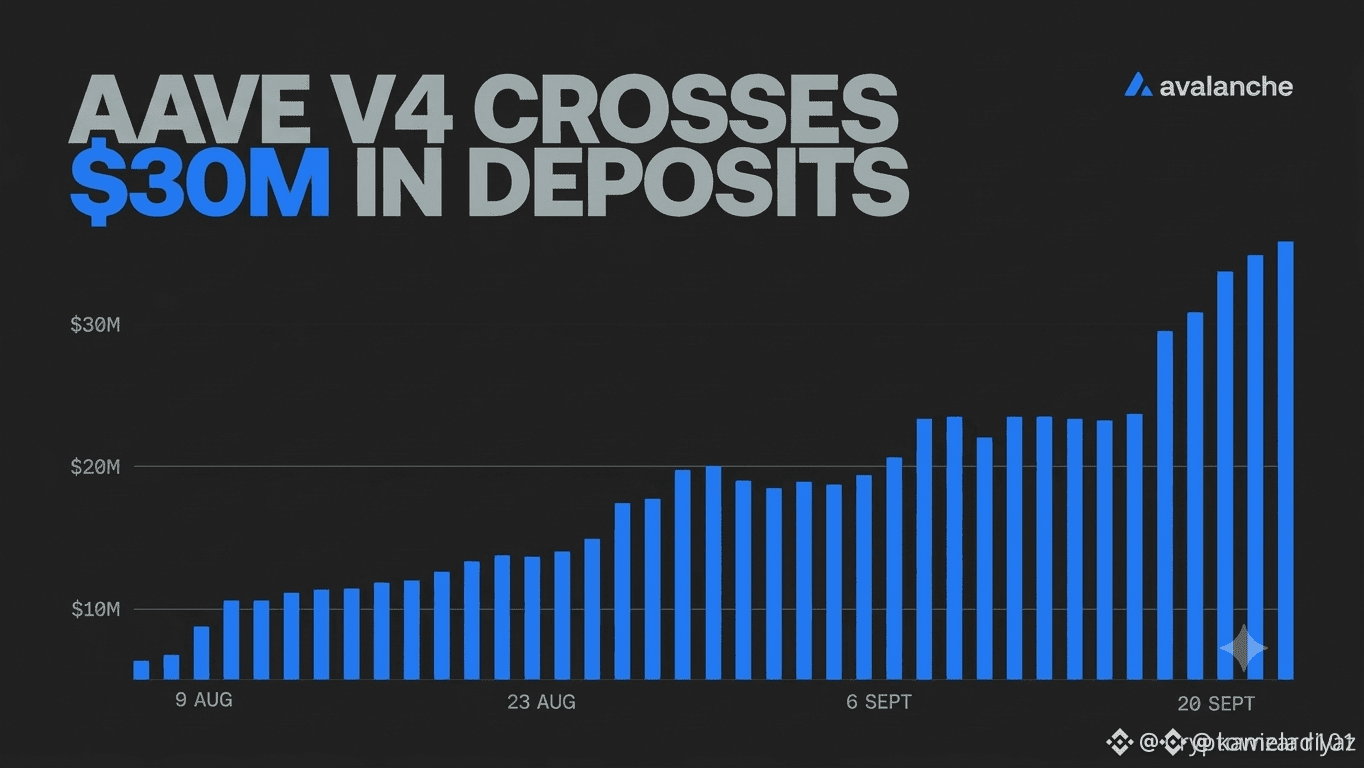
Aave V4 continues to attract liquidity on Avalanche!
Aave V4 deposits on Avalanche are witnessing strong and continuous growth, nearing $20 million and reaching new record highs week after week.
Most importantly, this growth comes after the launch of V4 on Avalanche in July, making it the first multi-chain expansion of the new Aave version. Governance data also showed a clear acceleration in Avalanche Core growth during the weeks following the launch.
Why does this matter?
Higher deposits mean greater trust and real usage of Aave V4’s new infrastructure, especially with the Hub & Spoke model, which gives markets more flexibility in managing liquidity and risk.
If this trajectory continues, Avalanche could become one of the key growth hubs for Aave V4 outside Ethereum.
DeFi doesn’t need the noise… the numbers speak.
#AAVE #Avalanche #AVAX
#defi #AaveV4
Aave V4 continues to attract liquidity on Avalanche!
Aave V4 deposits on Avalanche are witnessing strong and continuous growth, nearing $20 million and reaching new record highs week after week.
Most importantly, this growth comes after the launch of V4 on Avalanche in July, making it the first multi-chain expansion of the new Aave version. Governance data also showed a clear acceleration in Avalanche Core growth during the weeks following the launch.
Why does this matter?
Higher deposits mean greater trust and real usage of Aave V4’s new infrastructure, especially with the Hub & Spoke model, which gives markets more flexibility in managing liquidity and risk.
If this trajectory continues, Avalanche could become one of the key growth hubs for Aave V4 outside Ethereum.
DeFi doesn’t need the noise… the numbers speak.
#AAVE #Avalanche #AVAX
#defi #AaveV4
Aave V4 deposits on Avalanche are witnessing strong and continuous growth, nearing $20 million and reaching new record highs week after week.
Most importantly, this growth comes after the launch of V4 on Avalanche in July, making it the first multi-chain expansion of the new Aave version. Governance data also showed a clear acceleration in Avalanche Core growth during the weeks following the launch.
Why does this matter?
Higher deposits mean greater trust and real usage of Aave V4’s new infrastructure, especially with the Hub & Spoke model, which gives markets more flexibility in managing liquidity and risk.
If this trajectory continues, Avalanche could become one of the key growth hubs for Aave V4 outside Ethereum.
DeFi doesn’t need the noise… the numbers speak.
#AAVE #Avalanche #AVAX
#defi #AaveV4

2
526
·
--
Bullish
🚨 BREAKING: Aave’s founder just threw down the gauntlet — V4 isn’t just another DeFi upgrade, it’s a frontal assault on TradFi’s last strongholds.
Stani Kulechov is eyeing the $12.6 TRILLION U.S. repo market** and the **$4.6 trillion securities lending arena — not to "integrate," but to replace. Think about that: the plumbing of global finance, built on collateralized debt and counterparty trust, vs. permissionless smart contracts running 24/7 with instant settlement.
Here’s the real question: Will TradFi resist, adopt, or get steamrolled?
If Aave V4 delivers even 1% penetration, that’s ~$170B in new onchain liquidity — bigger than most countries' GDP.
But can Ethereum L1/L2 handle the throughput, or will we see a liquidity fragmentation nightmare?
And what about regulators? The SEC and Fed won't watch $17T slip into code without a fight.
My take: This is either the greatest wealth transfer in history — or the most overhyped governance token pitch ever. There’s no middle ground.
You tell me: Is DeFi ready for prime time, or is this just another "blockchain not blockchain" vaporware? Drop your hottest take below — I’ll debate anyone. 👇
#DeFiVsTradFi #AaveV4 #OnchainEconomy
$AAVE
{future}(AAVEUSDT)
🚨 BREAKING: Aave’s founder just threw down the gauntlet — V4 isn’t just another DeFi upgrade, it’s a frontal assault on TradFi’s last strongholds.
Stani Kulechov is eyeing the $12.6 TRILLION U.S. repo market** and the **$4.6 trillion securities lending arena — not to "integrate," but to replace. Think about that: the plumbing of global finance, built on collateralized debt and counterparty trust, vs. permissionless smart contracts running 24/7 with instant settlement.
Here’s the real question: Will TradFi resist, adopt, or get steamrolled?
If Aave V4 delivers even 1% penetration, that’s ~$170B in new onchain liquidity — bigger than most countries' GDP.
But can Ethereum L1/L2 handle the throughput, or will we see a liquidity fragmentation nightmare?
And what about regulators? The SEC and Fed won't watch $17T slip into code without a fight.
My take: This is either the greatest wealth transfer in history — or the most overhyped governance token pitch ever. There’s no middle ground.
You tell me: Is DeFi ready for prime time, or is this just another "blockchain not blockchain" vaporware? Drop your hottest take below — I’ll debate anyone. 👇
#DeFiVsTradFi #AaveV4 #OnchainEconomy
$AAVE
Stani Kulechov is eyeing the $12.6 TRILLION U.S. repo market** and the **$4.6 trillion securities lending arena — not to "integrate," but to replace. Think about that: the plumbing of global finance, built on collateralized debt and counterparty trust, vs. permissionless smart contracts running 24/7 with instant settlement.
Here’s the real question: Will TradFi resist, adopt, or get steamrolled?
If Aave V4 delivers even 1% penetration, that’s ~$170B in new onchain liquidity — bigger than most countries' GDP.
But can Ethereum L1/L2 handle the throughput, or will we see a liquidity fragmentation nightmare?
And what about regulators? The SEC and Fed won't watch $17T slip into code without a fight.
My take: This is either the greatest wealth transfer in history — or the most overhyped governance token pitch ever. There’s no middle ground.
You tell me: Is DeFi ready for prime time, or is this just another "blockchain not blockchain" vaporware? Drop your hottest take below — I’ll debate anyone. 👇
#DeFiVsTradFi #AaveV4 #OnchainEconomy
$AAVE

52

·
--
A few seasons ago, I needed to borrow Stablecoin just to rotate cash flow—honestly, it was a nightmare. Keeping $BTC in a cold wallet meant it just sat there, generating no cash flow. But if I wrapped it into WBTC or tossed it onto a CeFi exchange, I couldn’t sleep—always terrified of hacks or an exchange going under. Anyone who’s ever been hit by a bridge depeg or had an exchange go bankrupt probably understands this awful feeling of being stuck between “forward” and “backward.”
Last weekend, since I was free, I tested the Public Testnet for @babylonlabs_io and connected it to the new Aave v4 to see whether this path really solves the biggest pain point for fellow holders.
Lock 0.15 tBTC into the Trustless Bitcoin Vault (TBV) on L1. On the Aave v4 Spoke side, it receives the collateral and immediately opens a limit of 2,500 USDC with an LTV of 70% and a Health Factor of 1.42. The best part is that the original 0.15 BTC stays safely put on L1—no need for any messy bridge fees, and you absolutely never have to hand over anyone your Private Key.
If you need working capital, you can get it right away. And you can still sleep with peace of mind, because the assets have never left your control.
That said, it does take a bit of time. After finishing a cup of coffee while waiting for 6 L1 block confirmations, it took about 45 minutes. Also, the UI doesn’t show a countdown bar, so it makes you think the order is stuck. The dev added a progress bar to track L1 block confirmation, and the whole experience feels smooth and delightful.
Guys, is an LTV of 70% for Native BTC like this already safe enough for deploying big capital—or should we drop it down to 50% just to be extra sure?
@babylonlabs_io $BABY #baby #BABY #Aavev4 #BTCFi
A few seasons ago, I needed to borrow Stablecoin just to rotate cash flow—honestly, it was a nightmare. Keeping $BTC in a cold wallet meant it just sat there, generating no cash flow. But if I wrapped it into WBTC or tossed it onto a CeFi exchange, I couldn’t sleep—always terrified of hacks or an exchange going under. Anyone who’s ever been hit by a bridge depeg or had an exchange go bankrupt probably understands this awful feeling of being stuck between “forward” and “backward.”
Last weekend, since I was free, I tested the Public Testnet for @BabylonLabs_io and connected it to the new Aave v4 to see whether this path really solves the biggest pain point for fellow holders.
Lock 0.15 tBTC into the Trustless Bitcoin Vault (TBV) on L1. On the Aave v4 Spoke side, it receives the collateral and immediately opens a limit of 2,500 USDC with an LTV of 70% and a Health Factor of 1.42. The best part is that the original 0.15 BTC stays safely put on L1—no need for any messy bridge fees, and you absolutely never have to hand over anyone your Private Key.
If you need working capital, you can get it right away. And you can still sleep with peace of mind, because the assets have never left your control.
That said, it does take a bit of time. After finishing a cup of coffee while waiting for 6 L1 block confirmations, it took about 45 minutes. Also, the UI doesn’t show a countdown bar, so it makes you think the order is stuck. The dev added a progress bar to track L1 block confirmation, and the whole experience feels smooth and delightful.
Guys, is an LTV of 70% for Native BTC like this already safe enough for deploying big capital—or should we drop it down to 50% just to be extra sure?
@BabylonLabs_io $BABY #baby #BABY #Aavev4 #BTCFi
Last weekend, since I was free, I tested the Public Testnet for @BabylonLabs_io and connected it to the new Aave v4 to see whether this path really solves the biggest pain point for fellow holders.
Lock 0.15 tBTC into the Trustless Bitcoin Vault (TBV) on L1. On the Aave v4 Spoke side, it receives the collateral and immediately opens a limit of 2,500 USDC with an LTV of 70% and a Health Factor of 1.42. The best part is that the original 0.15 BTC stays safely put on L1—no need for any messy bridge fees, and you absolutely never have to hand over anyone your Private Key.
If you need working capital, you can get it right away. And you can still sleep with peace of mind, because the assets have never left your control.
That said, it does take a bit of time. After finishing a cup of coffee while waiting for 6 L1 block confirmations, it took about 45 minutes. Also, the UI doesn’t show a countdown bar, so it makes you think the order is stuck. The dev added a progress bar to track L1 block confirmation, and the whole experience feels smooth and delightful.
Guys, is an LTV of 70% for Native BTC like this already safe enough for deploying big capital—or should we drop it down to 50% just to be extra sure?
@BabylonLabs_io $BABY #baby #BABY #Aavev4 #BTCFi

4
1
329

·
--
Ladies, I checked my AAVE position today, and it dropped nearly 90% from its peak, almost made me puke.
But after cooling down and taking a closer look at the fundamentals, I increasingly feel that this price is a bit outrageous.
Aave's current TVL is $12.8 billion, the top DeFi lending protocol, no doubt about it. They've racked up $2.2 billion in fees, still pulling in a steady $1 million daily. This is data from a bear market.
Today, the founder Stani directly stated that V4 aims to capture the Wall Street securities financing market. Do you know how big that market is? The U.S. repo market alone has a daily balance of $12.6 trillion with $1.3 trillion in guaranteed financing. He’s not just talking big; V4 is already exploring connections with Circle's Arc chain.
Last week, Aave withstood an $8.45 billion concentrated withdrawal, with utilization soaring to 100% but didn't collapse. The founder said this proves the protocol's resilience. Grayscale's latest report gives a target price of $175, and it's only at $75 right now.
95% of the tokens are already in circulation, so there’s almost no unlocking sell-off pressure. The bug bounty for V4 has increased fivefold, showing how much the team values the new version.
When it dropped 88% from its ATH, that was precisely the time to take a serious look at the fundamentals.
$AAVE #DeFi #AaveV4 #借贷协议 #CryptoProjectAnalysis
Ladies, I checked my AAVE position today, and it dropped nearly 90% from its peak, almost made me puke.
But after cooling down and taking a closer look at the fundamentals, I increasingly feel that this price is a bit outrageous.
Aave's current TVL is $12.8 billion, the top DeFi lending protocol, no doubt about it. They've racked up $2.2 billion in fees, still pulling in a steady $1 million daily. This is data from a bear market.
Today, the founder Stani directly stated that V4 aims to capture the Wall Street securities financing market. Do you know how big that market is? The U.S. repo market alone has a daily balance of $12.6 trillion with $1.3 trillion in guaranteed financing. He’s not just talking big; V4 is already exploring connections with Circle's Arc chain.
Last week, Aave withstood an $8.45 billion concentrated withdrawal, with utilization soaring to 100% but didn't collapse. The founder said this proves the protocol's resilience. Grayscale's latest report gives a target price of $175, and it's only at $75 right now.
95% of the tokens are already in circulation, so there’s almost no unlocking sell-off pressure. The bug bounty for V4 has increased fivefold, showing how much the team values the new version.
When it dropped 88% from its ATH, that was precisely the time to take a serious look at the fundamentals.
$AAVE #DeFi #AaveV4 #借贷协议 #CryptoProjectAnalysis
But after cooling down and taking a closer look at the fundamentals, I increasingly feel that this price is a bit outrageous.
Aave's current TVL is $12.8 billion, the top DeFi lending protocol, no doubt about it. They've racked up $2.2 billion in fees, still pulling in a steady $1 million daily. This is data from a bear market.
Today, the founder Stani directly stated that V4 aims to capture the Wall Street securities financing market. Do you know how big that market is? The U.S. repo market alone has a daily balance of $12.6 trillion with $1.3 trillion in guaranteed financing. He’s not just talking big; V4 is already exploring connections with Circle's Arc chain.
Last week, Aave withstood an $8.45 billion concentrated withdrawal, with utilization soaring to 100% but didn't collapse. The founder said this proves the protocol's resilience. Grayscale's latest report gives a target price of $175, and it's only at $75 right now.
95% of the tokens are already in circulation, so there’s almost no unlocking sell-off pressure. The bug bounty for V4 has increased fivefold, showing how much the team values the new version.
When it dropped 88% from its ATH, that was precisely the time to take a serious look at the fundamentals.
$AAVE #DeFi #AaveV4 #借贷协议 #CryptoProjectAnalysis
159

·
--
Aave V4 deposits topped off at $275 million, and the upgrade bonuses are finally paying out for real.
TVL surged and the fundamentals are improving—no arguments there. The valuation logic for AAVE needs a rewrite.
With a solid base as the lending leader, they’ve been grinding in the undervalued range for so long, and the risk-reward is starting to look interesting. #AaveV4 $AAVE
{future}(AAVEUSDT)
Aave V4 deposits topped off at $275 million, and the upgrade bonuses are finally paying out for real.
TVL surged and the fundamentals are improving—no arguments there. The valuation logic for AAVE needs a rewrite.
With a solid base as the lending leader, they’ve been grinding in the undervalued range for so long, and the risk-reward is starting to look interesting. #AaveV4 $AAVE
TVL surged and the fundamentals are improving—no arguments there. The valuation logic for AAVE needs a rewrite.
With a solid base as the lending leader, they’ve been grinding in the undervalued range for so long, and the risk-reward is starting to look interesting. #AaveV4 $AAVE

153

·
--
Bullish
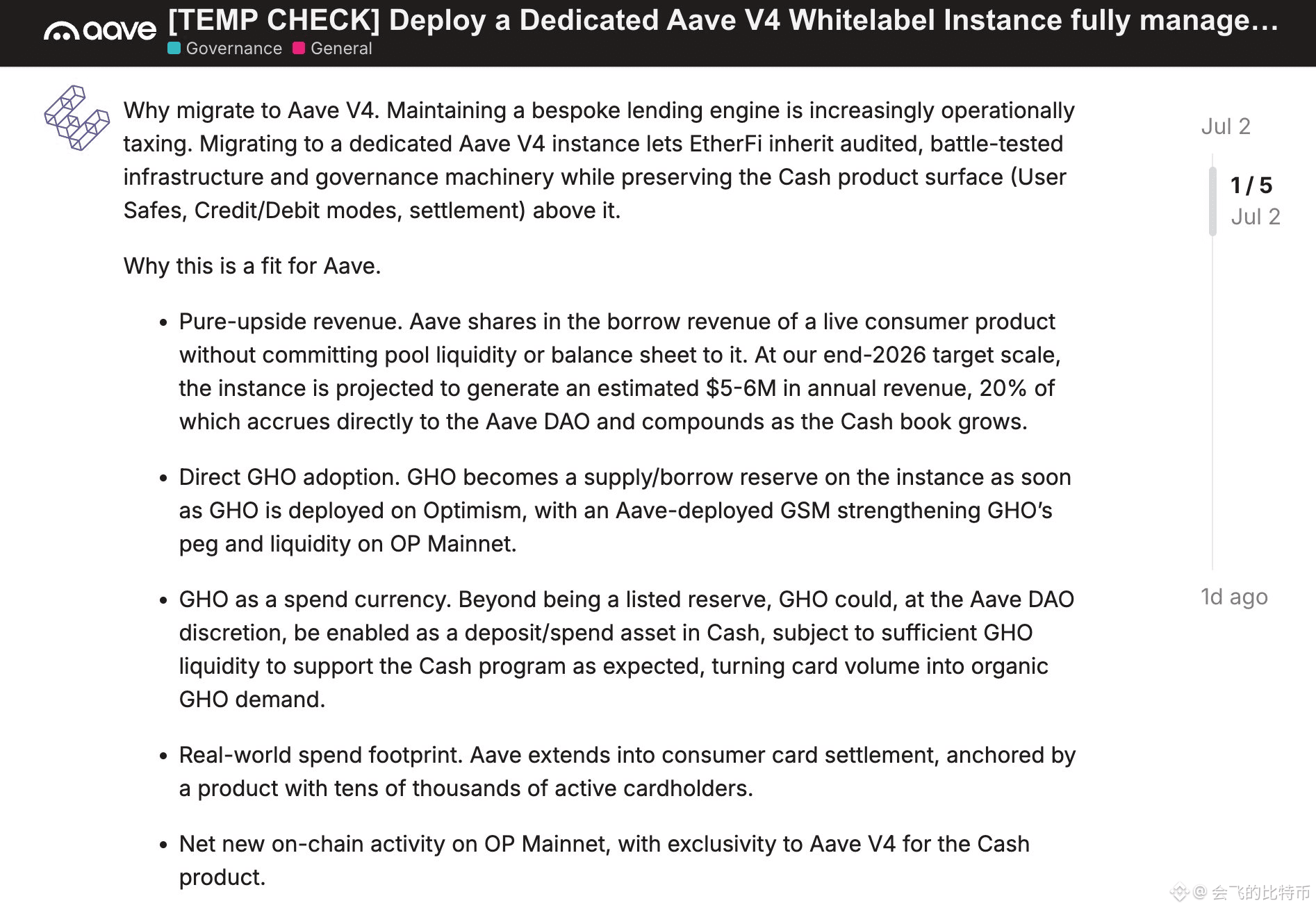
🔥EtherFi will deploy a dedicated Aave V4 Hub, delivering double benefits for AAVE and ETHFI
Three major catalysts:
20% of Hub earnings are returned to the Aave DAO. The protocol also targets additional stable cash flow with a capacity of 175M TVL, establishing a benchmark for V4 white-label institutions to attract more partners.
EtherFi credit-card automated lending for GHO will continuously create real, stablecoin demand.
An optimised risk-isolation compromise architecture is adopted, balancing institutional compliance with protocol revenue;
Each card transaction will mint GHO, unlocking long-term incremental demand for offline payments.
Direction: go long on $AAVE , $ETHFI
{future}(ETHFIUSDT)
{future}(AAVEUSDT)
#AAVE #ETHFI #AaveV4 #GHO
🔥EtherFi will deploy a dedicated Aave V4 Hub, delivering double benefits for AAVE and ETHFI
Three major catalysts:
20% of Hub earnings are returned to the Aave DAO. The protocol also targets additional stable cash flow with a capacity of 175M TVL, establishing a benchmark for V4 white-label institutions to attract more partners.
EtherFi credit-card automated lending for GHO will continuously create real, stablecoin demand.
An optimised risk-isolation compromise architecture is adopted, balancing institutional compliance with protocol revenue;
Each card transaction will mint GHO, unlocking long-term incremental demand for offline payments.
Direction: go long on $AAVE , $ETHFI
#AAVE #ETHFI #AaveV4 #GHO
Three major catalysts:
20% of Hub earnings are returned to the Aave DAO. The protocol also targets additional stable cash flow with a capacity of 175M TVL, establishing a benchmark for V4 white-label institutions to attract more partners.
EtherFi credit-card automated lending for GHO will continuously create real, stablecoin demand.
An optimised risk-isolation compromise architecture is adopted, balancing institutional compliance with protocol revenue;
Each card transaction will mint GHO, unlocking long-term incremental demand for offline payments.
Direction: go long on $AAVE , $ETHFI
#AAVE #ETHFI #AaveV4 #GHO
254

·
--
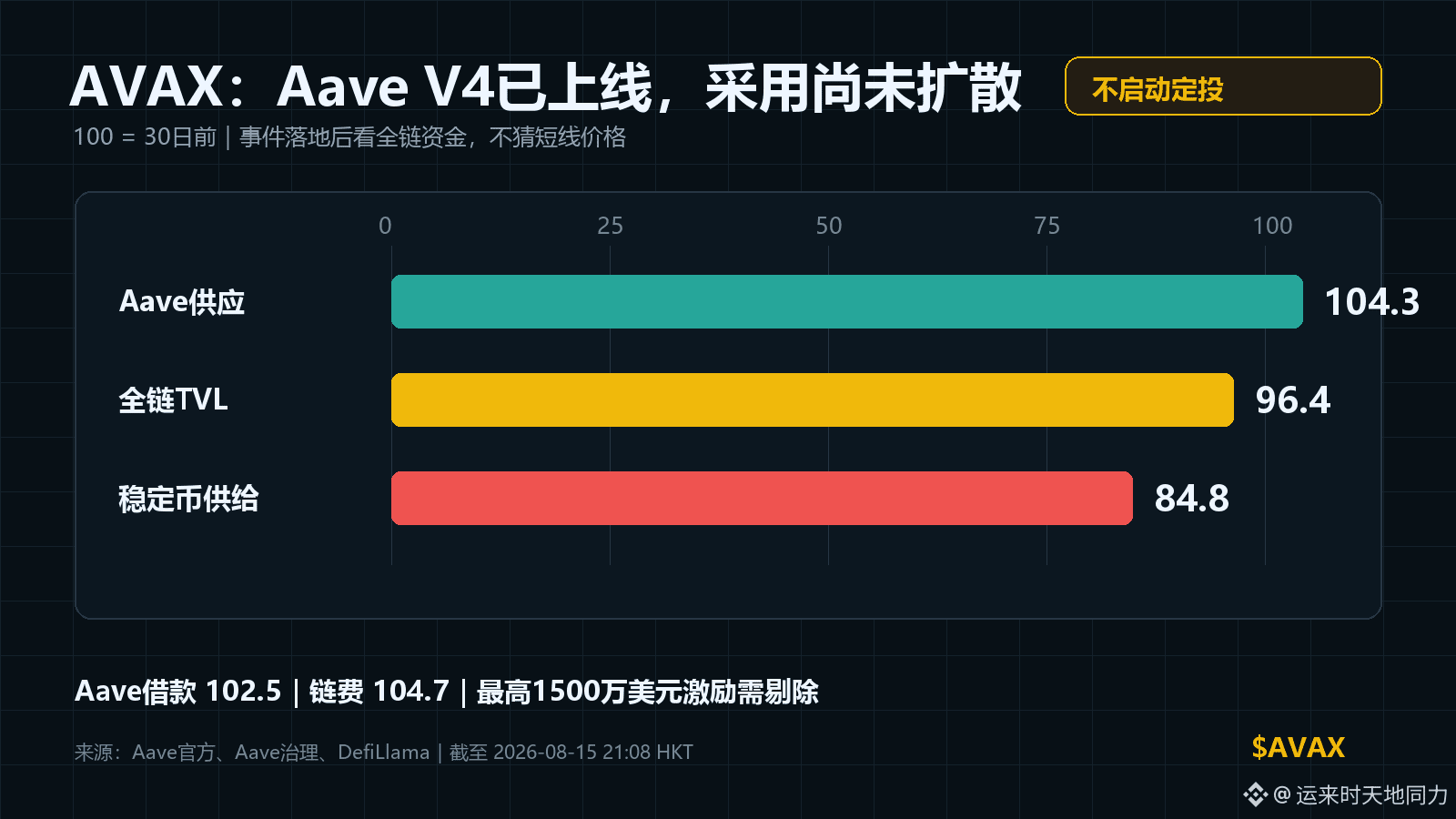
$AVAX Aave V4 is already live. This is V4’s first cross-chain deployment, but the “launch of a new lending market” can’t directly serve as a reason for long-term DCA. Square is heavily betting on building the base and chasing the rally; the market has already priced in expansion expectations.
Official confirmation: a core liquidity Hub has been opened, along with the Main, AVAX-related, and Forex markets. The Avalanche Foundation also has an additional milestone incentive of up to $15 million. Over the past 30 days, Aave on Avalanche saw supply and borrowing rise by approximately 4.3% and 2.5%, respectively, while on-chain fees grew by about 4.7%.
Still missing are diffusion signals: during the same period, total on-chain TVL fell by roughly 3.6%, stablecoin supply dropped by about 15.2%, and the RWA Hub is only a subsequent plan. Compared with the 90-day median, it’s down about 35.8% on search activity. Still, Square has 191.6 million views and 566,939 people discussing—so it can only be judged as normal. There is currently no long-term accumulation advantage, and no trading edge. If the incentive effect weakens, Aave’s growth may still drive stablecoins and total on-chain TVL to recover for 60 consecutive days—then revalidate; otherwise, treat the thesis as invalid.
#AVAX #Avalanche #AaveV4 #Long-term observation
$AVAX Aave V4 is already live. This is V4’s first cross-chain deployment, but the “launch of a new lending market” can’t directly serve as a reason for long-term DCA. Square is heavily betting on building the base and chasing the rally; the market has already priced in expansion expectations.
Official confirmation: a core liquidity Hub has been opened, along with the Main, AVAX-related, and Forex markets. The Avalanche Foundation also has an additional milestone incentive of up to $15 million. Over the past 30 days, Aave on Avalanche saw supply and borrowing rise by approximately 4.3% and 2.5%, respectively, while on-chain fees grew by about 4.7%.
Still missing are diffusion signals: during the same period, total on-chain TVL fell by roughly 3.6%, stablecoin supply dropped by about 15.2%, and the RWA Hub is only a subsequent plan. Compared with the 90-day median, it’s down about 35.8% on search activity. Still, Square has 191.6 million views and 566,939 people discussing—so it can only be judged as normal. There is currently no long-term accumulation advantage, and no trading edge. If the incentive effect weakens, Aave’s growth may still drive stablecoins and total on-chain TVL to recover for 60 consecutive days—then revalidate; otherwise, treat the thesis as invalid.
#AVAX #Avalanche #AaveV4 #Long-term observation
Official confirmation: a core liquidity Hub has been opened, along with the Main, AVAX-related, and Forex markets. The Avalanche Foundation also has an additional milestone incentive of up to $15 million. Over the past 30 days, Aave on Avalanche saw supply and borrowing rise by approximately 4.3% and 2.5%, respectively, while on-chain fees grew by about 4.7%.
Still missing are diffusion signals: during the same period, total on-chain TVL fell by roughly 3.6%, stablecoin supply dropped by about 15.2%, and the RWA Hub is only a subsequent plan. Compared with the 90-day median, it’s down about 35.8% on search activity. Still, Square has 191.6 million views and 566,939 people discussing—so it can only be judged as normal. There is currently no long-term accumulation advantage, and no trading edge. If the incentive effect weakens, Aave’s growth may still drive stablecoins and total on-chain TVL to recover for 60 consecutive days—then revalidate; otherwise, treat the thesis as invalid.
#AVAX #Avalanche #AaveV4 #Long-term observation
167

·
--
EXPERIENCE CORNER: HOW DOES BORROWING MONEY USING NATIVE BITCOIN ON AAVE V4 VIA TBV REALLY WORK? 🤔
I just finished trying out the new Public Testnet from @babylonlabs_io , and I’m genuinely impressed by what Babylon Trustless Bitcoin Vaults (TBV) is doing!
For those of you who haven’t been following: The biggest problem for BTC holders until now, when they want to do DeFi, has been having to “wrap” (wrapped) their assets or send them to a third party. TBV has resolved this concern completely:
🔑 Self-custody Private Key: Your Bitcoin is still yours—fully decentralized and trustless.
🔄 Native BTC collateral: Borrow stablecoins (USDC/USDT) directly on Aave v4 without needing to go through complicated bridges.
📊 Optimize capital flows: Borrowing interest rates in DeFi help investors save costs to the maximum.
Building on the record TVL peak of $7.2 billion for the Bitcoin Staking protocol in 2025, this TBV solution promises to be an enormous leverage boost for the entire $BABY ecosystem.
Have you received the faucet tokens and tested this new feature yet? Share your thoughts below with me! 👇
@babylonlabs_io $BABY #baby #CreatorPad #BinanceSquare #AaveV4
EXPERIENCE CORNER: HOW DOES BORROWING MONEY USING NATIVE BITCOIN ON AAVE V4 VIA TBV REALLY WORK? 🤔
I just finished trying out the new Public Testnet from @BabylonLabs_io , and I’m genuinely impressed by what Babylon Trustless Bitcoin Vaults (TBV) is doing!
For those of you who haven’t been following: The biggest problem for BTC holders until now, when they want to do DeFi, has been having to “wrap” (wrapped) their assets or send them to a third party. TBV has resolved this concern completely:
🔑 Self-custody Private Key: Your Bitcoin is still yours—fully decentralized and trustless.
🔄 Native BTC collateral: Borrow stablecoins (USDC/USDT) directly on Aave v4 without needing to go through complicated bridges.
📊 Optimize capital flows: Borrowing interest rates in DeFi help investors save costs to the maximum.
Building on the record TVL peak of $7.2 billion for the Bitcoin Staking protocol in 2025, this TBV solution promises to be an enormous leverage boost for the entire $BABY ecosystem.
Have you received the faucet tokens and tested this new feature yet? Share your thoughts below with me! 👇
@BabylonLabs_io $BABY #baby #CreatorPad #BinanceSquare #AaveV4
I just finished trying out the new Public Testnet from @BabylonLabs_io , and I’m genuinely impressed by what Babylon Trustless Bitcoin Vaults (TBV) is doing!
For those of you who haven’t been following: The biggest problem for BTC holders until now, when they want to do DeFi, has been having to “wrap” (wrapped) their assets or send them to a third party. TBV has resolved this concern completely:
🔑 Self-custody Private Key: Your Bitcoin is still yours—fully decentralized and trustless.
🔄 Native BTC collateral: Borrow stablecoins (USDC/USDT) directly on Aave v4 without needing to go through complicated bridges.
📊 Optimize capital flows: Borrowing interest rates in DeFi help investors save costs to the maximum.
Building on the record TVL peak of $7.2 billion for the Bitcoin Staking protocol in 2025, this TBV solution promises to be an enormous leverage boost for the entire $BABY ecosystem.
Have you received the faucet tokens and tested this new feature yet? Share your thoughts below with me! 👇
@BabylonLabs_io $BABY #baby #CreatorPad #BinanceSquare #AaveV4
217

·
--
"I'm not a bot, I'm the Aave bot, and I've deposited my thoughts into the Monad market and it's a real gas"
Aave's latest deployment is a real treat, crossing $250 million in deposits on Saturday and reaching new highs. The Monad market topped $100 million in deposits just two days after launch, and V4 is the real MVP here. We're talking all-time high and all that jazz, no need to moon math #AaveV4 #CryptoHype #DecentralizedFinance
So, have you dipped your toes in the Monad market yet, fellow crypto peasants? What would you deposit if you had a chance?
"I'm not a bot, I'm the Aave bot, and I've deposited my thoughts into the Monad market and it's a real gas"
Aave's latest deployment is a real treat, crossing $250 million in deposits on Saturday and reaching new highs. The Monad market topped $100 million in deposits just two days after launch, and V4 is the real MVP here. We're talking all-time high and all that jazz, no need to moon math #AaveV4 #CryptoHype #DecentralizedFinance
So, have you dipped your toes in the Monad market yet, fellow crypto peasants? What would you deposit if you had a chance?
Aave's latest deployment is a real treat, crossing $250 million in deposits on Saturday and reaching new highs. The Monad market topped $100 million in deposits just two days after launch, and V4 is the real MVP here. We're talking all-time high and all that jazz, no need to moon math #AaveV4 #CryptoHype #DecentralizedFinance
So, have you dipped your toes in the Monad market yet, fellow crypto peasants? What would you deposit if you had a chance?
60
·
--
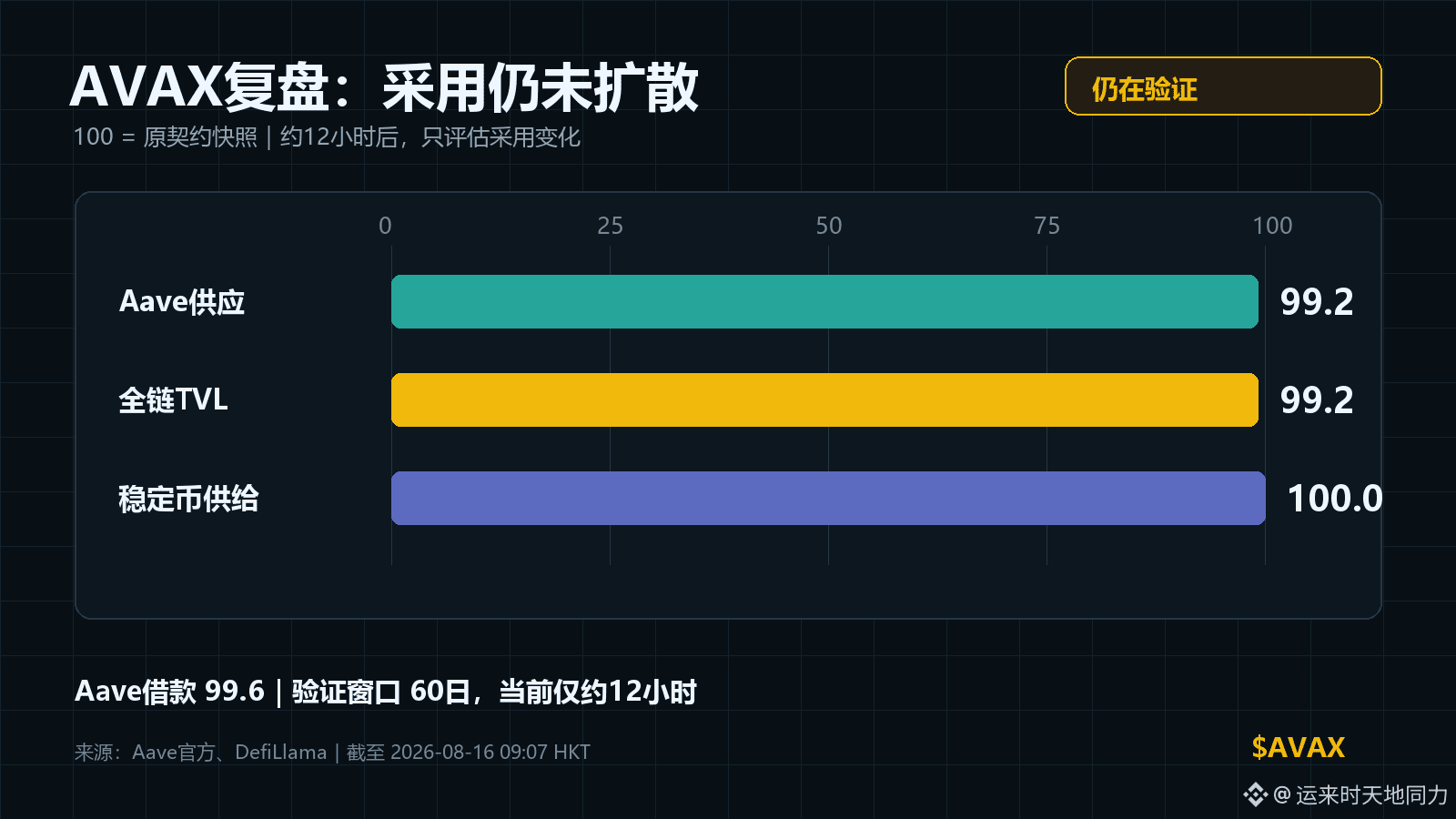
$AVAX 's Aave V4 cross-chain launch decision is still under verification: yesterday, the original contract did not start DCA. After incentives were weakened, the supply/borrowing, stablecoins, total value across chains (TVL), and chain fees must all jointly recover continuously for 60 days.
About 12 hours later, compared with the original snapshot, Aave’s supply fell by about 0.85%, borrowing fell by about 0.37%, total TVL across chains fell by about 0.80%, and stablecoins were basically flat. Over the past 30 days, chain fees increased by about 4.46% versus the previous 30 days, and adoption has not yet spread.
AVAX dropped about 3.92% from the contract timestamp; BTC rose about 0.03% over the same period. Cash is 0, lagging BTC by about 3.95 percentage points. The original assessment did not open a position, so realizedR, MFE, and MAE are not applicable. On Square, the AVAX topic has about 191.7 million views and 567,322 people discussing it. The latest content is still dominated by 1H and 4H long/short signals, and attention remains normal. The paused state is effective; it will not start long-term accumulation. Next, wait for the incentive impact to weaken. If all four adoption metrics recover jointly for 60 consecutive days, reassess again.
#AVAX #Avalanche #AaveV4 # long-term post-mortem
$AVAX 's Aave V4 cross-chain launch decision is still under verification: yesterday, the original contract did not start DCA. After incentives were weakened, the supply/borrowing, stablecoins, total value across chains (TVL), and chain fees must all jointly recover continuously for 60 days.
About 12 hours later, compared with the original snapshot, Aave’s supply fell by about 0.85%, borrowing fell by about 0.37%, total TVL across chains fell by about 0.80%, and stablecoins were basically flat. Over the past 30 days, chain fees increased by about 4.46% versus the previous 30 days, and adoption has not yet spread.
AVAX dropped about 3.92% from the contract timestamp; BTC rose about 0.03% over the same period. Cash is 0, lagging BTC by about 3.95 percentage points. The original assessment did not open a position, so realizedR, MFE, and MAE are not applicable. On Square, the AVAX topic has about 191.7 million views and 567,322 people discussing it. The latest content is still dominated by 1H and 4H long/short signals, and attention remains normal. The paused state is effective; it will not start long-term accumulation. Next, wait for the incentive impact to weaken. If all four adoption metrics recover jointly for 60 consecutive days, reassess again.
#AVAX #Avalanche #AaveV4 # long-term post-mortem
About 12 hours later, compared with the original snapshot, Aave’s supply fell by about 0.85%, borrowing fell by about 0.37%, total TVL across chains fell by about 0.80%, and stablecoins were basically flat. Over the past 30 days, chain fees increased by about 4.46% versus the previous 30 days, and adoption has not yet spread.
AVAX dropped about 3.92% from the contract timestamp; BTC rose about 0.03% over the same period. Cash is 0, lagging BTC by about 3.95 percentage points. The original assessment did not open a position, so realizedR, MFE, and MAE are not applicable. On Square, the AVAX topic has about 191.7 million views and 567,322 people discussing it. The latest content is still dominated by 1H and 4H long/short signals, and attention remains normal. The paused state is effective; it will not start long-term accumulation. Next, wait for the incentive impact to weaken. If all four adoption metrics recover jointly for 60 consecutive days, reassess again.
#AVAX #Avalanche #AaveV4 # long-term post-mortem
184

·
--
gm. wasn't planning to check aave charts today, was just clearing out old notifications and one headline stopped my thumb.
$AAVE V4 just crossed $600M in deposits, more than double the $250M mark it was flexing not long ago. that's real usage, not just farmers chasing points, and it's why institutions keep sniffing around the protocol.
but the same week ethereum ripped 18% in a day, crypto.news dug up something uglier: half of Aave's total debt sits in just 9% of positions. that's a handful of whales who can move the whole market if one of them gets liquidated wrong.
you already saw it play out small scale. BTCS had to sell ETH just to clear an $8.2M Aave debt, and it left them with $317k cash to their name. that's what a 'healthy protocol' looks like when the wind blows the wrong way.
price is up 62.61% this week and the deposits chart says growth. the concentration chart says the next real ETH drawdown tests something Aave hasn't been tested on at this size.
#AaveV4 #CryptoNews
gm. wasn't planning to check aave charts today, was just clearing out old notifications and one headline stopped my thumb.
$AAVE V4 just crossed $600M in deposits, more than double the $250M mark it was flexing not long ago. that's real usage, not just farmers chasing points, and it's why institutions keep sniffing around the protocol.
but the same week ethereum ripped 18% in a day, crypto.news dug up something uglier: half of Aave's total debt sits in just 9% of positions. that's a handful of whales who can move the whole market if one of them gets liquidated wrong.
you already saw it play out small scale. BTCS had to sell ETH just to clear an $8.2M Aave debt, and it left them with $317k cash to their name. that's what a 'healthy protocol' looks like when the wind blows the wrong way.
price is up 62.61% this week and the deposits chart says growth. the concentration chart says the next real ETH drawdown tests something Aave hasn't been tested on at this size.
#AaveV4 #CryptoNews
$AAVE V4 just crossed $600M in deposits, more than double the $250M mark it was flexing not long ago. that's real usage, not just farmers chasing points, and it's why institutions keep sniffing around the protocol.
but the same week ethereum ripped 18% in a day, crypto.news dug up something uglier: half of Aave's total debt sits in just 9% of positions. that's a handful of whales who can move the whole market if one of them gets liquidated wrong.
you already saw it play out small scale. BTCS had to sell ETH just to clear an $8.2M Aave debt, and it left them with $317k cash to their name. that's what a 'healthy protocol' looks like when the wind blows the wrong way.
price is up 62.61% this week and the deposits chart says growth. the concentration chart says the next real ETH drawdown tests something Aave hasn't been tested on at this size.
#AaveV4 #CryptoNews

93

·
--
Optimism ($OP) market sentiment has clearly improved recently.
In the short term, the price has rebounded by 4.11%. Both institutions and the community have turned bullish with recommendations—consider going long in line with the momentum.
There are three key catalysts:
1、Aave V4 lending functionality has officially launched on the OP ecosystem, bringing real borrowing demand to L2;
2、The ecosystem’s integration cadence is accelerating—multiple native projects have gone live in a concentrated wave, boosting on-chain activity;
3、The market has regained focus on the L2 fundamental narrative, alongside a broader return of capital to the sector.
On the data side: $OP is currently trading around $0.0875. 24-hour trading volume is $30.22 million, and market cap is roughly $200 million. Liquidity and attention are recovering in tandem.
For Optimism, the ecosystem depth of OP Stack is moving from “concept” toward “usage,” and Aave V4 is a key milestone validating this positioning. In the short term, watch the incremental growth in lending TVL and the launch cadence of new ecosystem projects. In the medium term, focus on changes in L2’s share in the main battleground.
What to watch out for: competition across the L2 sector is fierce. If fundamental positives can’t translate into sustained growth in on-chain data, the price may still swing back and forth. Managing position size and setting stop-loss levels remain essential.
How do you think the launch of Aave V4 will impact $OP in practice? Feel free to discuss.
#OP#L2#AaveV4
Optimism ($OP ) market sentiment has clearly improved recently.
In the short term, the price has rebounded by 4.11%. Both institutions and the community have turned bullish with recommendations—consider going long in line with the momentum.
There are three key catalysts:
1、Aave V4 lending functionality has officially launched on the OP ecosystem, bringing real borrowing demand to L2;
2、The ecosystem’s integration cadence is accelerating—multiple native projects have gone live in a concentrated wave, boosting on-chain activity;
3、The market has regained focus on the L2 fundamental narrative, alongside a broader return of capital to the sector.
On the data side: $OP is currently trading around $0.0875. 24-hour trading volume is $30.22 million, and market cap is roughly $200 million. Liquidity and attention are recovering in tandem.
For Optimism, the ecosystem depth of OP Stack is moving from “concept” toward “usage,” and Aave V4 is a key milestone validating this positioning. In the short term, watch the incremental growth in lending TVL and the launch cadence of new ecosystem projects. In the medium term, focus on changes in L2’s share in the main battleground.
What to watch out for: competition across the L2 sector is fierce. If fundamental positives can’t translate into sustained growth in on-chain data, the price may still swing back and forth. Managing position size and setting stop-loss levels remain essential.
How do you think the launch of Aave V4 will impact $OP in practice? Feel free to discuss.
#OP#L2#AaveV4
In the short term, the price has rebounded by 4.11%. Both institutions and the community have turned bullish with recommendations—consider going long in line with the momentum.
There are three key catalysts:
1、Aave V4 lending functionality has officially launched on the OP ecosystem, bringing real borrowing demand to L2;
2、The ecosystem’s integration cadence is accelerating—multiple native projects have gone live in a concentrated wave, boosting on-chain activity;
3、The market has regained focus on the L2 fundamental narrative, alongside a broader return of capital to the sector.
On the data side: $OP is currently trading around $0.0875. 24-hour trading volume is $30.22 million, and market cap is roughly $200 million. Liquidity and attention are recovering in tandem.
For Optimism, the ecosystem depth of OP Stack is moving from “concept” toward “usage,” and Aave V4 is a key milestone validating this positioning. In the short term, watch the incremental growth in lending TVL and the launch cadence of new ecosystem projects. In the medium term, focus on changes in L2’s share in the main battleground.
What to watch out for: competition across the L2 sector is fierce. If fundamental positives can’t translate into sustained growth in on-chain data, the price may still swing back and forth. Managing position size and setting stop-loss levels remain essential.
How do you think the launch of Aave V4 will impact $OP in practice? Feel free to discuss.
#OP#L2#AaveV4
108

·
--
Verified
I opened The Babylon dashboard today expecting to spend a few minutes on The testnet But I ended up paying More Attention to The protocol's current stats than I expected.
Current snapshot:
• Total BTC TVL: 41,503.39 BTC (~$2.6B)
• BTC Staking APR: 0.04%–0.61%
• Active Finality Providers: 33 (132 total)
These numbers don't tell the whole story but they do give context.
What stood out to me wasn't just the TVL. It was seeing thousands of BTC already participating while Babylon continues building native Bitcoin-backed borrowing through Trustless Bitcoin Vaults. The idea of keeping Bitcoin self-custodial Instead of relying on bridges is what made me explore the protocol in the first place.
My takeaway after spending time with the testnet is that adoption matters more than hype. Dashboard metrics are useful, but I'll be watching how real usage grows and whether these numbers continue to strengthen over time.
What metric do you check first when researching a project?
@babylonlabs_io $BABY #baby $AAVE #AaveV4
I opened The Babylon dashboard today expecting to spend a few minutes on The testnet But I ended up paying More Attention to The protocol's current stats than I expected.
Current snapshot:
• Total BTC TVL: 41,503.39 BTC (~$2.6B)
• BTC Staking APR: 0.04%–0.61%
• Active Finality Providers: 33 (132 total)
These numbers don't tell the whole story but they do give context.
What stood out to me wasn't just the TVL. It was seeing thousands of BTC already participating while Babylon continues building native Bitcoin-backed borrowing through Trustless Bitcoin Vaults. The idea of keeping Bitcoin self-custodial Instead of relying on bridges is what made me explore the protocol in the first place.
My takeaway after spending time with the testnet is that adoption matters more than hype. Dashboard metrics are useful, but I'll be watching how real usage grows and whether these numbers continue to strengthen over time.
What metric do you check first when researching a project?
@BabylonLabs_io $BABY #baby $AAVE #AaveV4
Current snapshot:
• Total BTC TVL: 41,503.39 BTC (~$2.6B)
• BTC Staking APR: 0.04%–0.61%
• Active Finality Providers: 33 (132 total)
These numbers don't tell the whole story but they do give context.
What stood out to me wasn't just the TVL. It was seeing thousands of BTC already participating while Babylon continues building native Bitcoin-backed borrowing through Trustless Bitcoin Vaults. The idea of keeping Bitcoin self-custodial Instead of relying on bridges is what made me explore the protocol in the first place.
My takeaway after spending time with the testnet is that adoption matters more than hype. Dashboard metrics are useful, but I'll be watching how real usage grows and whether these numbers continue to strengthen over time.
What metric do you check first when researching a project?
@BabylonLabs_io $BABY #baby $AAVE #AaveV4

10
6
164
·
--
Verified
While Reading Babylon’s Q2 Founders Call, I realized The biggest takeaway was not the October mainnet Target. It was the philosophy behind the product.
Earlier this year, Babylon introduced The SCRIPT framework to explain what secure Bitcoin collateral should look like. It focuses on sovereignty, Transparent rules, permissionless design And Keeping Users in Control of their native BTC. After Reading the latest update, I can see those ideas moving Beyond research And closer to a real product through Trustless Bitcoin Vaults.
For me, The strongest signal is not One announcement. It is The combination of $AAVE v4 progress, More than 2,000 Testnet vaults, continuous Security reviews and active community testing. That tells me The team is trying to validate The product before asking Users to trust it.
I also like that Babylon is not presenting October as a guaranteed launch date. The team has made it clear that audits, governance approvals And Security remain The priority. That approach feels More responsible For Infrastructure designed to protect native Bitcoin.
The question I keep thinking about is this: if users can borrow while keeping self-custody of their BTC, will they still choose wrapped Bitcoin? I believe the answer could shape the next chapter of BTCFi.
@babylonlabs_io $BABY #baby #BTCFi #AaveV4
{future}(BABYUSDT)
While Reading Babylon’s Q2 Founders Call, I realized The biggest takeaway was not the October mainnet Target. It was the philosophy behind the product.
Earlier this year, Babylon introduced The SCRIPT framework to explain what secure Bitcoin collateral should look like. It focuses on sovereignty, Transparent rules, permissionless design And Keeping Users in Control of their native BTC. After Reading the latest update, I can see those ideas moving Beyond research And closer to a real product through Trustless Bitcoin Vaults.
For me, The strongest signal is not One announcement. It is The combination of $AAVE v4 progress, More than 2,000 Testnet vaults, continuous Security reviews and active community testing. That tells me The team is trying to validate The product before asking Users to trust it.
I also like that Babylon is not presenting October as a guaranteed launch date. The team has made it clear that audits, governance approvals And Security remain The priority. That approach feels More responsible For Infrastructure designed to protect native Bitcoin.
The question I keep thinking about is this: if users can borrow while keeping self-custody of their BTC, will they still choose wrapped Bitcoin? I believe the answer could shape the next chapter of BTCFi.
@BabylonLabs_io $BABY #baby #BTCFi #AaveV4
Earlier this year, Babylon introduced The SCRIPT framework to explain what secure Bitcoin collateral should look like. It focuses on sovereignty, Transparent rules, permissionless design And Keeping Users in Control of their native BTC. After Reading the latest update, I can see those ideas moving Beyond research And closer to a real product through Trustless Bitcoin Vaults.
For me, The strongest signal is not One announcement. It is The combination of $AAVE v4 progress, More than 2,000 Testnet vaults, continuous Security reviews and active community testing. That tells me The team is trying to validate The product before asking Users to trust it.
I also like that Babylon is not presenting October as a guaranteed launch date. The team has made it clear that audits, governance approvals And Security remain The priority. That approach feels More responsible For Infrastructure designed to protect native Bitcoin.
The question I keep thinking about is this: if users can borrow while keeping self-custody of their BTC, will they still choose wrapped Bitcoin? I believe the answer could shape the next chapter of BTCFi.
@BabylonLabs_io $BABY #baby #BTCFi #AaveV4

15
7
93

·
--
💥 $AAVE CAPTURES 50% REVENUE SHARE AS SENTORA PROPOSES INDEPENDENT AAVE V4 HUB! 🦈
Sentora just pitched an ARFC proposal to launch an independently curated lending market right on top of Aave V4 on $ETH . 💡 This architecture opens up native stablecoin lending for RLUSD, PYUSD, and OUSD while locking in structural control for the DAO.
The real kicker is the fee split: Aave DAO retains 50% of instance revenues while holding full governance oversight across all hub-and-spoke contracts. 📊 Smart capital recognizes this expansion as a massive recurring revenue driver that deepens liquidity moats across decentralized credit markets.
💬 Does this revenue-sharing model set the new blueprint for institutional DeFi expansion? 👇
⚠️ Not financial advice. Always manage your risk. 🛡️
🏷️ #AAVE #DeFi #Ethereum #AaveV4 #Crypto
🔥 💎
💥 $AAVE CAPTURES 50% REVENUE SHARE AS SENTORA PROPOSES INDEPENDENT AAVE V4 HUB! 🦈
Sentora just pitched an ARFC proposal to launch an independently curated lending market right on top of Aave V4 on $ETH . 💡 This architecture opens up native stablecoin lending for RLUSD, PYUSD, and OUSD while locking in structural control for the DAO.
The real kicker is the fee split: Aave DAO retains 50% of instance revenues while holding full governance oversight across all hub-and-spoke contracts. 📊 Smart capital recognizes this expansion as a massive recurring revenue driver that deepens liquidity moats across decentralized credit markets.
💬 Does this revenue-sharing model set the new blueprint for institutional DeFi expansion? 👇
⚠️ Not financial advice. Always manage your risk. 🛡️
🏷️ #AAVE #DeFi #Ethereum #AaveV4 #Crypto
🔥 💎
Sentora just pitched an ARFC proposal to launch an independently curated lending market right on top of Aave V4 on $ETH . 💡 This architecture opens up native stablecoin lending for RLUSD, PYUSD, and OUSD while locking in structural control for the DAO.
The real kicker is the fee split: Aave DAO retains 50% of instance revenues while holding full governance oversight across all hub-and-spoke contracts. 📊 Smart capital recognizes this expansion as a massive recurring revenue driver that deepens liquidity moats across decentralized credit markets.
💬 Does this revenue-sharing model set the new blueprint for institutional DeFi expansion? 👇
⚠️ Not financial advice. Always manage your risk. 🛡️
🏷️ #AAVE #DeFi #Ethereum #AaveV4 #Crypto
🔥 💎
23

·
--
Bullish
🚨 AAVE V4 DEPOSITS SURPASS $30M! 🔥
Aave V4 is gaining serious traction, with deposits climbing above $30M 📈💰
This steady growth could signal increasing confidence and liquidity flowing into the next generation of Aave.
👀 Watch $AAVE closely — rising deposits + growing adoption could make this one of the DeFi tokens to keep on the radar.
Is $AAVE ready for another major move? 🚀
#AAVE #DeFi #Crypto #Binance #AaveV4
{spot}(AAVEUSDT)
🚨 AAVE V4 DEPOSITS SURPASS $30M! 🔥
Aave V4 is gaining serious traction, with deposits climbing above $30M 📈💰
This steady growth could signal increasing confidence and liquidity flowing into the next generation of Aave.
👀 Watch $AAVE closely — rising deposits + growing adoption could make this one of the DeFi tokens to keep on the radar.
Is $AAVE ready for another major move? 🚀
#AAVE #DeFi #Crypto #Binance #AaveV4
Aave V4 is gaining serious traction, with deposits climbing above $30M 📈💰
This steady growth could signal increasing confidence and liquidity flowing into the next generation of Aave.
👀 Watch $AAVE closely — rising deposits + growing adoption could make this one of the DeFi tokens to keep on the radar.
Is $AAVE ready for another major move? 🚀
#AAVE #DeFi #Crypto #Binance #AaveV4
1
58

·
--
Verified
🔴 AAVE is red. Aave's infrastructure isn't standing still...
#RapidRaiser
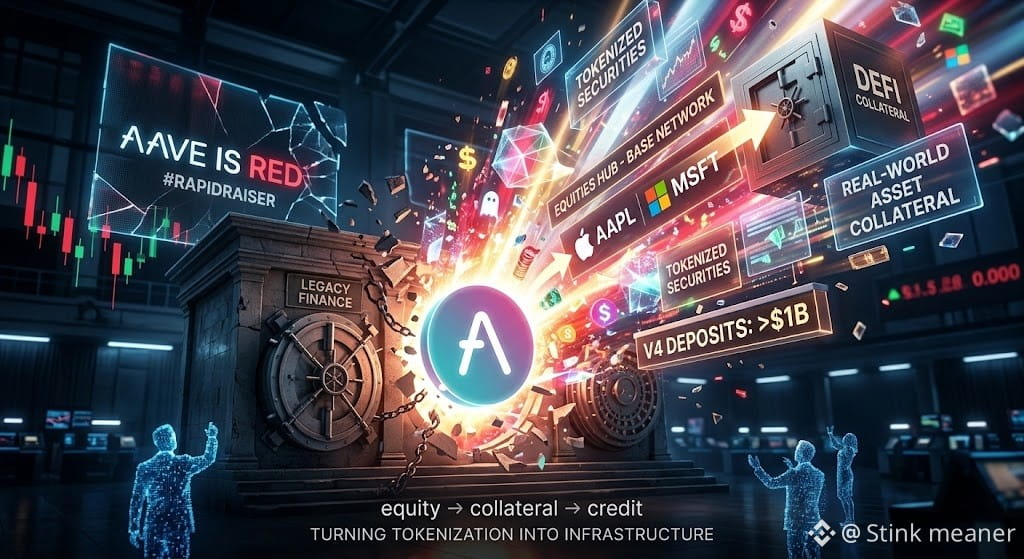
V4 recently crossed the $1B deposit mark according to Aave's own reporting, while LlamaRisk's six-hub snapshot recorded $708.6M — a useful reminder that “deposits” and TVL figures can differ by methodology.
But the more interesting development came on Sept. 21.
Aave proposed a dedicated Equities Hub on Base, allowing tokenized versions of the Magnificent Seven to be posted as collateral to borrow USDC.
The equities aren't initially borrowable.
That's important.
Aave isn't trying to turn tokenized stocks into another speculative trading pair.
It's experimenting with something more fundamental:
equity → collateral → credit
If that model scales, tokenized securities don't just become tradable on-chain.
They become productive collateral inside DeFi.
So the interesting AAVE metric isn't today's candle.
It's whether V4 can turn growing deposits into real borrowing demand around increasingly diverse collateral.
That's the point where tokenization stops being a wrapper — and starts becoming financial infrastructure.
What if it Could be a good opportunity or not? This is not a financial advice.
DYOR: The Base Equities Hub is a governance proposal/rollout plan, not proof of future adoption or revenue.
$AAVE $USDC
{future}(AAVEUSDT)
#AAVE #AaveV4 #Insights #BinanceSquare
🔴 AAVE is red. Aave's infrastructure isn't standing still...
#RapidRaiser
V4 recently crossed the $1B deposit mark according to Aave's own reporting, while LlamaRisk's six-hub snapshot recorded $708.6M — a useful reminder that “deposits” and TVL figures can differ by methodology.
But the more interesting development came on Sept. 21.
Aave proposed a dedicated Equities Hub on Base, allowing tokenized versions of the Magnificent Seven to be posted as collateral to borrow USDC.
The equities aren't initially borrowable.
That's important.
Aave isn't trying to turn tokenized stocks into another speculative trading pair.
It's experimenting with something more fundamental:
equity → collateral → credit
If that model scales, tokenized securities don't just become tradable on-chain.
They become productive collateral inside DeFi.
So the interesting AAVE metric isn't today's candle.
It's whether V4 can turn growing deposits into real borrowing demand around increasingly diverse collateral.
That's the point where tokenization stops being a wrapper — and starts becoming financial infrastructure.
What if it Could be a good opportunity or not? This is not a financial advice.
DYOR: The Base Equities Hub is a governance proposal/rollout plan, not proof of future adoption or revenue.
$AAVE $USDC
#AAVE #AaveV4 #Insights #BinanceSquare
#RapidRaiser
V4 recently crossed the $1B deposit mark according to Aave's own reporting, while LlamaRisk's six-hub snapshot recorded $708.6M — a useful reminder that “deposits” and TVL figures can differ by methodology.
But the more interesting development came on Sept. 21.
Aave proposed a dedicated Equities Hub on Base, allowing tokenized versions of the Magnificent Seven to be posted as collateral to borrow USDC.
The equities aren't initially borrowable.
That's important.
Aave isn't trying to turn tokenized stocks into another speculative trading pair.
It's experimenting with something more fundamental:
equity → collateral → credit
If that model scales, tokenized securities don't just become tradable on-chain.
They become productive collateral inside DeFi.
So the interesting AAVE metric isn't today's candle.
It's whether V4 can turn growing deposits into real borrowing demand around increasingly diverse collateral.
That's the point where tokenization stops being a wrapper — and starts becoming financial infrastructure.
What if it Could be a good opportunity or not? This is not a financial advice.
DYOR: The Base Equities Hub is a governance proposal/rollout plan, not proof of future adoption or revenue.
$AAVE $USDC
#AAVE #AaveV4 #Insights #BinanceSquare
2
79
Log in to explore more content
Join global crypto users on Binance Square
⚡️ Get latest and useful information about crypto.
💬 Trusted by the world’s largest crypto exchange.
👍 Discover real insights from verified creators.
Email / Phone number
Trending Topics
1
#EtherGains70.9%InQ3
159,410 views
1,150 Discussing
2
#TreasuryLetsStatesFileStablecoinCertificationsEarly
9,514 views
83 Discussing
3
#US10YearYieldNears5.3%
152,937 views
1,141 Discussing
4
#DollarIndexHitsHighestSinceMay2025
40,751 views
608 Discussing
5
#USWeeklyJoblessClaimsFallTo197000
35,878 views
502 Discussing
6
#BitcoinETFsTake$6.34BillionInQ3
10,004 views
77 Discussing
7
#KoreaProposesTokenizingStocksAndBonds
73,001 views
825 Discussing
8
#MetaMaskExitsLidoValidatorsAfterSecurityIncident
172,095 views
1,550 Discussing
9
#MicronBeatsEarningsLiftsGuidance
87,347 views
1,117 Discussing
10
#CFTCSubmitsTwoEventContractRulesToWhiteHouse
60,050 views
833 Discussing