

Yoshi Invest
728 Posts

Yoshi Invest
Report
Block User
Chia sẻ góc nhìn đầu tư Crypto, phân tích xu hướng và quản trị rủi ro. Kiên nhẫn - Kỷ luật - Lợi nhuận bền vững. Kênh thông tin không phải lời khuyên tài chính.

BTC Holder
Occasional Trader
2.5 Years
32 Following
628 Followers
477 Liked
Posts
All
Quotes
Videos
·
--
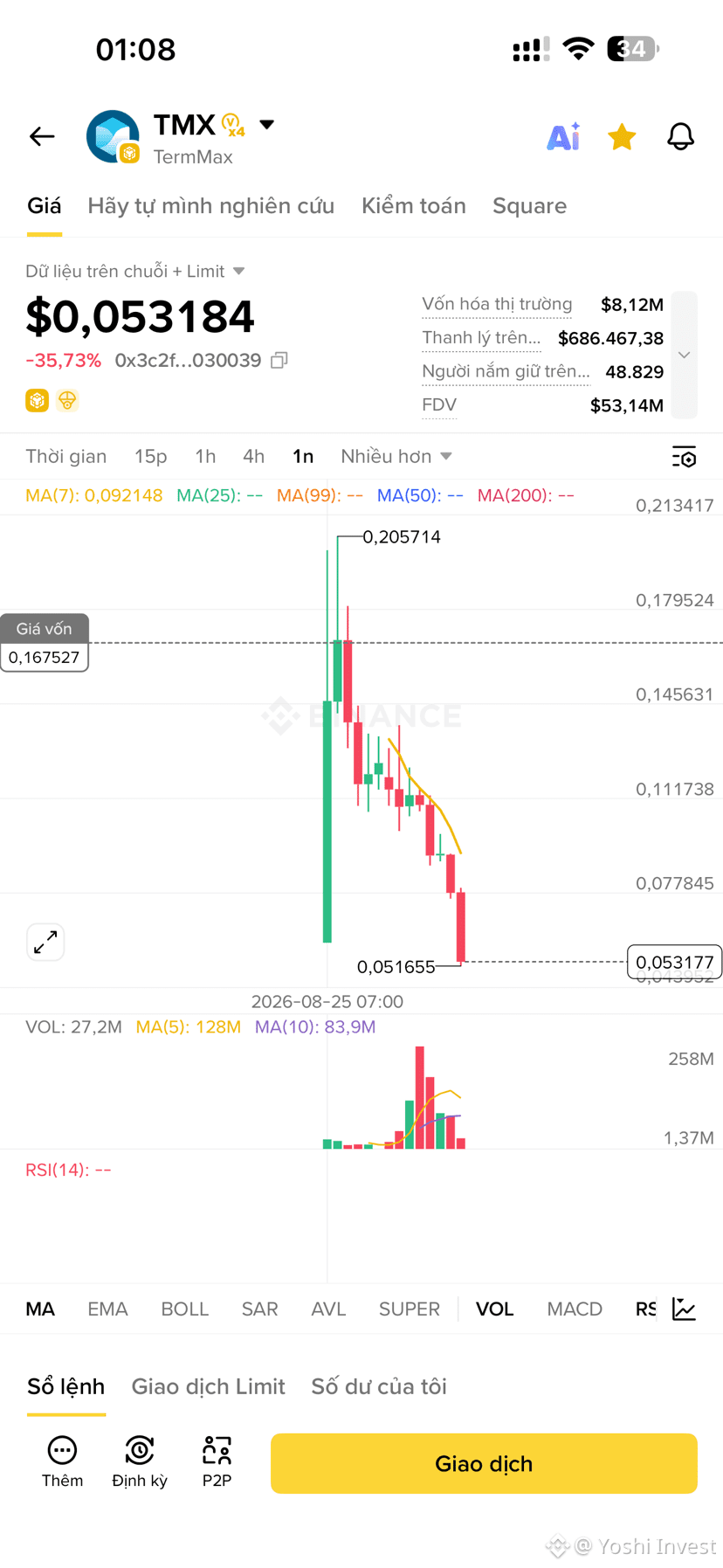
What scam called $TMX đ divided into 4 after 1 week list
What scam called $TMX đ divided into 4 after 1 week list
918
·
--
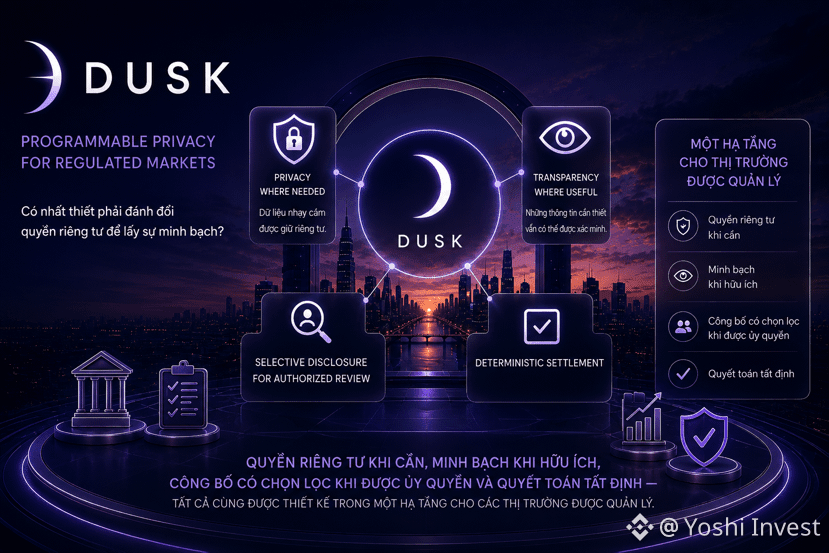
In finance, is it necessary to trade privacy for transparency?
The more private a market is, the harder it is to verify. The more transparent it is, the more sensitive information is exposed.
But with a regulated market, perhaps the problem isn’t choosing one over the other.
It’s rather: who gets to see what, who is allowed to check, and how the final transaction is confirmed?
This is where Dusk becomes interesting.
Dusk is aiming for a model where sensitive data can be kept private, while the necessary information can still be verified.
Instead of forcing all data to be publicly disclosed or completely hidden, selective disclosure allows authorized parties to inspect only the information that is necessary without having to open up all the data to the market.
But information security isn’t enough on its own. A market needs to know what state the final transaction is in. Deterministic settlement makes settlement outcomes provable and verifiable, rather than leaving the final state as an uncertainty.
When these mechanisms are designed directly into the infrastructure, privacy is no longer just a security feature.
It becomes programmable privacy.
What makes Dusk especially unique is that privacy doesn’t stand alone as a security layer; it becomes part of how the market verifies and settles transactions.
Privacy when needed, transparency when useful, selective disclosure when authorized, and deterministic settlement— all designed together in infrastructure for regulated markets.
@Dusk_Foundation #dusk $DUSK #DUSK
In finance, is it necessary to trade privacy for transparency?
The more private a market is, the harder it is to verify. The more transparent it is, the more sensitive information is exposed.
But with a regulated market, perhaps the problem isn’t choosing one over the other.
It’s rather: who gets to see what, who is allowed to check, and how the final transaction is confirmed?
This is where Dusk becomes interesting.
Dusk is aiming for a model where sensitive data can be kept private, while the necessary information can still be verified.
Instead of forcing all data to be publicly disclosed or completely hidden, selective disclosure allows authorized parties to inspect only the information that is necessary without having to open up all the data to the market.
But information security isn’t enough on its own. A market needs to know what state the final transaction is in. Deterministic settlement makes settlement outcomes provable and verifiable, rather than leaving the final state as an uncertainty.
When these mechanisms are designed directly into the infrastructure, privacy is no longer just a security feature.
It becomes programmable privacy.
What makes Dusk especially unique is that privacy doesn’t stand alone as a security layer; it becomes part of how the market verifies and settles transactions.
Privacy when needed, transparency when useful, selective disclosure when authorized, and deterministic settlement— all designed together in infrastructure for regulated markets.
@Dusk #dusk $DUSK #DUSK
The more private a market is, the harder it is to verify. The more transparent it is, the more sensitive information is exposed.
But with a regulated market, perhaps the problem isn’t choosing one over the other.
It’s rather: who gets to see what, who is allowed to check, and how the final transaction is confirmed?
This is where Dusk becomes interesting.
Dusk is aiming for a model where sensitive data can be kept private, while the necessary information can still be verified.
Instead of forcing all data to be publicly disclosed or completely hidden, selective disclosure allows authorized parties to inspect only the information that is necessary without having to open up all the data to the market.
But information security isn’t enough on its own. A market needs to know what state the final transaction is in. Deterministic settlement makes settlement outcomes provable and verifiable, rather than leaving the final state as an uncertainty.
When these mechanisms are designed directly into the infrastructure, privacy is no longer just a security feature.
It becomes programmable privacy.
What makes Dusk especially unique is that privacy doesn’t stand alone as a security layer; it becomes part of how the market verifies and settles transactions.
Privacy when needed, transparency when useful, selective disclosure when authorized, and deterministic settlement— all designed together in infrastructure for regulated markets.
@Dusk #dusk $DUSK #DUSK
249
·
--
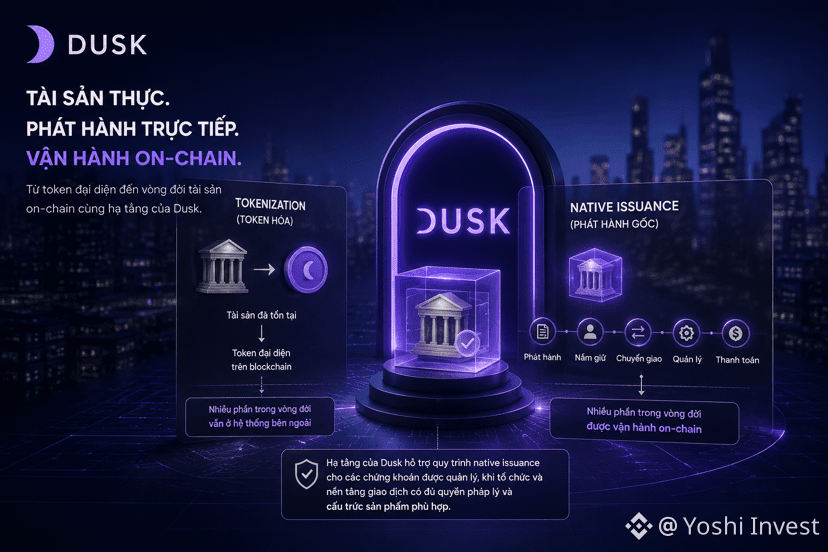
Tokenization does not necessarily put an asset on the blockchain. It may only put a representation of the asset on the blockchain.
An existing asset can be tokenized into a representative token and traded on-chain. But a token that is on-chain does not mean the asset’s own lifecycle is also on-chain.
An asset may still have issuance, ownership, transfer, management, and settlement. If those parts continue to rely on external systems, then the blockchain only changes the way the asset is represented.
So what changes if the asset itself is issued and managed on-chain from the beginning?
In that case, the blockchain is no longer just a place to host a representative token. It can become an environment in which more parts of the asset’s lifecycle are operated.
This is where Dusk becomes noteworthy.
Dusk provides infrastructure that can support native issuance processes for managed securities, when the issuing entity and trading platform have the necessary legal authority and the appropriate product structure.
The key point is that native issuance is not just creating an additional token. It puts the asset issuance on-chain from the start, which enables more steps in the asset’s own lifecycle to take place within the same on-chain environment.
Then, the RWA story is no longer just about putting a representative token for an asset on the blockchain, but about how much of the asset’s actual lifecycle can truly be operated on-chain.
@Dusk_Foundation #dusk #DUSK $DUSK $BTC $BNB
Tokenization does not necessarily put an asset on the blockchain. It may only put a representation of the asset on the blockchain.
An existing asset can be tokenized into a representative token and traded on-chain. But a token that is on-chain does not mean the asset’s own lifecycle is also on-chain.
An asset may still have issuance, ownership, transfer, management, and settlement. If those parts continue to rely on external systems, then the blockchain only changes the way the asset is represented.
So what changes if the asset itself is issued and managed on-chain from the beginning?
In that case, the blockchain is no longer just a place to host a representative token. It can become an environment in which more parts of the asset’s lifecycle are operated.
This is where Dusk becomes noteworthy.
Dusk provides infrastructure that can support native issuance processes for managed securities, when the issuing entity and trading platform have the necessary legal authority and the appropriate product structure.
The key point is that native issuance is not just creating an additional token. It puts the asset issuance on-chain from the start, which enables more steps in the asset’s own lifecycle to take place within the same on-chain environment.
Then, the RWA story is no longer just about putting a representative token for an asset on the blockchain, but about how much of the asset’s actual lifecycle can truly be operated on-chain.
@Dusk #dusk #DUSK $DUSK $BTC $BNB
An existing asset can be tokenized into a representative token and traded on-chain. But a token that is on-chain does not mean the asset’s own lifecycle is also on-chain.
An asset may still have issuance, ownership, transfer, management, and settlement. If those parts continue to rely on external systems, then the blockchain only changes the way the asset is represented.
So what changes if the asset itself is issued and managed on-chain from the beginning?
In that case, the blockchain is no longer just a place to host a representative token. It can become an environment in which more parts of the asset’s lifecycle are operated.
This is where Dusk becomes noteworthy.
Dusk provides infrastructure that can support native issuance processes for managed securities, when the issuing entity and trading platform have the necessary legal authority and the appropriate product structure.
The key point is that native issuance is not just creating an additional token. It puts the asset issuance on-chain from the start, which enables more steps in the asset’s own lifecycle to take place within the same on-chain environment.
Then, the RWA story is no longer just about putting a representative token for an asset on the blockchain, but about how much of the asset’s actual lifecycle can truly be operated on-chain.
@Dusk #dusk #DUSK $DUSK $BTC $BNB
166
·
--
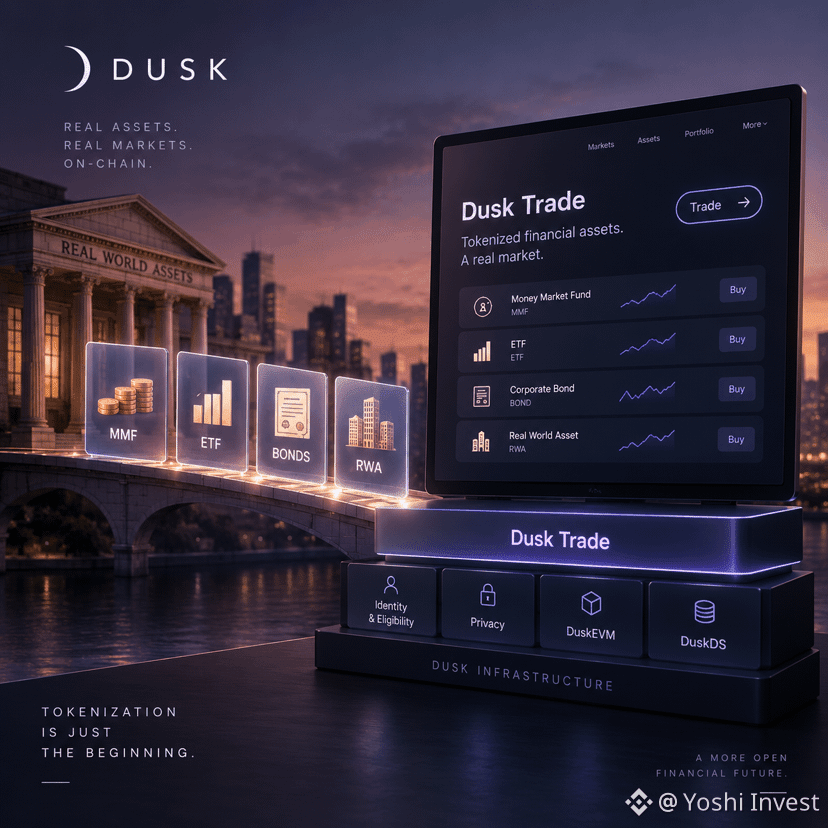
I used to think tokenizing a financial asset meant putting it on the blockchain. An ETF has tokens representing it and a place where it can be bought and sold—so the asset has already entered the on-chain market.
But when I look at Dusk Trade, I see MMF, ETF, bonds, and RWA all falling under the category of tokenized financial assets that Trade is aiming for. I wonder: if these assets have already been tokenized, why do we still need a separate application layer?
Dusk Trade combines the right pieces of infrastructure from Dusk and turns them into a product layer that users can actually use to access and trade tokenized financial assets.
I began to realize it. Tokenizing an asset that doesn’t yet have a financial market doesn’t automatically create one.
Maybe this is only the first step in the design. I need to observe more as Dusk operates in real life to see whether it can become a sufficiently complete financial infrastructure for tokenized assets. @Dusk_Foundation #dusk $DUSK $BTC
I used to think tokenizing a financial asset meant putting it on the blockchain. An ETF has tokens representing it and a place where it can be bought and sold—so the asset has already entered the on-chain market.
But when I look at Dusk Trade, I see MMF, ETF, bonds, and RWA all falling under the category of tokenized financial assets that Trade is aiming for. I wonder: if these assets have already been tokenized, why do we still need a separate application layer?
Dusk Trade combines the right pieces of infrastructure from Dusk and turns them into a product layer that users can actually use to access and trade tokenized financial assets.
I began to realize it. Tokenizing an asset that doesn’t yet have a financial market doesn’t automatically create one.
Maybe this is only the first step in the design. I need to observe more as Dusk operates in real life to see whether it can become a sufficiently complete financial infrastructure for tokenized assets. @Dusk #dusk $DUSK $BTC
But when I look at Dusk Trade, I see MMF, ETF, bonds, and RWA all falling under the category of tokenized financial assets that Trade is aiming for. I wonder: if these assets have already been tokenized, why do we still need a separate application layer?
Dusk Trade combines the right pieces of infrastructure from Dusk and turns them into a product layer that users can actually use to access and trade tokenized financial assets.
I began to realize it. Tokenizing an asset that doesn’t yet have a financial market doesn’t automatically create one.
Maybe this is only the first step in the design. I need to observe more as Dusk operates in real life to see whether it can become a sufficiently complete financial infrastructure for tokenized assets. @Dusk #dusk $DUSK $BTC
357
·
--
I used to think that taking a RWA (tokenized asset) and putting it on a blockchain is just like USDC: you can use it as collateral, borrow against it with a fixed interest rate, and then when you need to, sell it to repay the loan.
But after looking into TermMax, I realized there’s an important difference. With USDC, the protocol can rely more on market liquidity when it needs to handle collateral. For RWA, liquidity isn’t always available just because the asset has been tokenized.
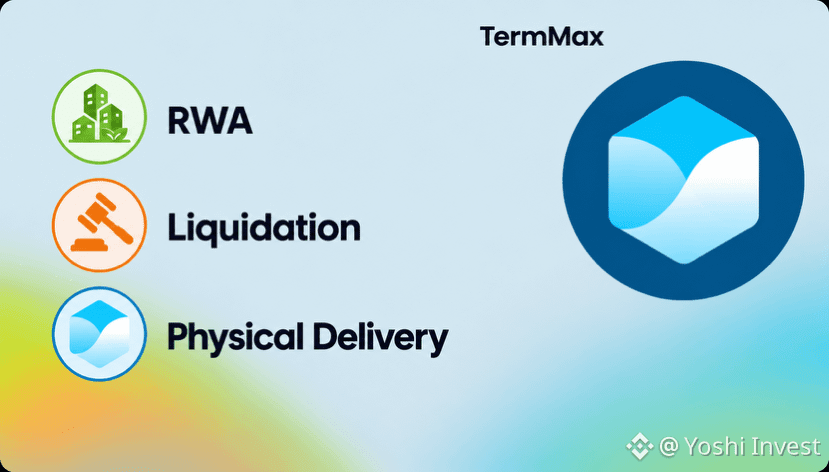
This is what drew my attention to Physical Delivery. If the liquidation period ends but the loan hasn’t been repaid or has only been partially settled, an FT holder can swap ownership rights to receive the portion of the underlying asset and the corresponding collateral based on their ownership share.
That’s when I understood the issue isn’t only whether an RWA can become collateral. When market liquidity can’t be assumed, the protocol must also account for another way to handle collateral when liquidation isn’t completed.
This made me see TermMax-RWA differently. They aren’t just adding another type of asset to the lending market—they’re building credit infrastructure for collateral assets with characteristics different from crypto-native assets.
What I want to track next is how, when RWA is put into real-world use, TermMax will handle the interplay between the asset’s liquidity, ownership rights, and on-chain transparency. @termmax #termmax #TermMax $BNB #TermMaxV2
I used to think that taking a RWA (tokenized asset) and putting it on a blockchain is just like USDC: you can use it as collateral, borrow against it with a fixed interest rate, and then when you need to, sell it to repay the loan.
But after looking into TermMax, I realized there’s an important difference. With USDC, the protocol can rely more on market liquidity when it needs to handle collateral. For RWA, liquidity isn’t always available just because the asset has been tokenized.
This is what drew my attention to Physical Delivery. If the liquidation period ends but the loan hasn’t been repaid or has only been partially settled, an FT holder can swap ownership rights to receive the portion of the underlying asset and the corresponding collateral based on their ownership share.
That’s when I understood the issue isn’t only whether an RWA can become collateral. When market liquidity can’t be assumed, the protocol must also account for another way to handle collateral when liquidation isn’t completed.
This made me see TermMax-RWA differently. They aren’t just adding another type of asset to the lending market—they’re building credit infrastructure for collateral assets with characteristics different from crypto-native assets.
What I want to track next is how, when RWA is put into real-world use, TermMax will handle the interplay between the asset’s liquidity, ownership rights, and on-chain transparency. @TermMax #termmax #TermMax $BNB #TermMaxV2
But after looking into TermMax, I realized there’s an important difference. With USDC, the protocol can rely more on market liquidity when it needs to handle collateral. For RWA, liquidity isn’t always available just because the asset has been tokenized.
This is what drew my attention to Physical Delivery. If the liquidation period ends but the loan hasn’t been repaid or has only been partially settled, an FT holder can swap ownership rights to receive the portion of the underlying asset and the corresponding collateral based on their ownership share.
That’s when I understood the issue isn’t only whether an RWA can become collateral. When market liquidity can’t be assumed, the protocol must also account for another way to handle collateral when liquidation isn’t completed.
This made me see TermMax-RWA differently. They aren’t just adding another type of asset to the lending market—they’re building credit infrastructure for collateral assets with characteristics different from crypto-native assets.
What I want to track next is how, when RWA is put into real-world use, TermMax will handle the interplay between the asset’s liquidity, ownership rights, and on-chain transparency. @TermMax #termmax #TermMax $BNB #TermMaxV2
291
·
--
I once thought that an EVM workflow for finance would have to choose between two things: keeping the familiar environment, or accepting privacy by moving to a different stack.
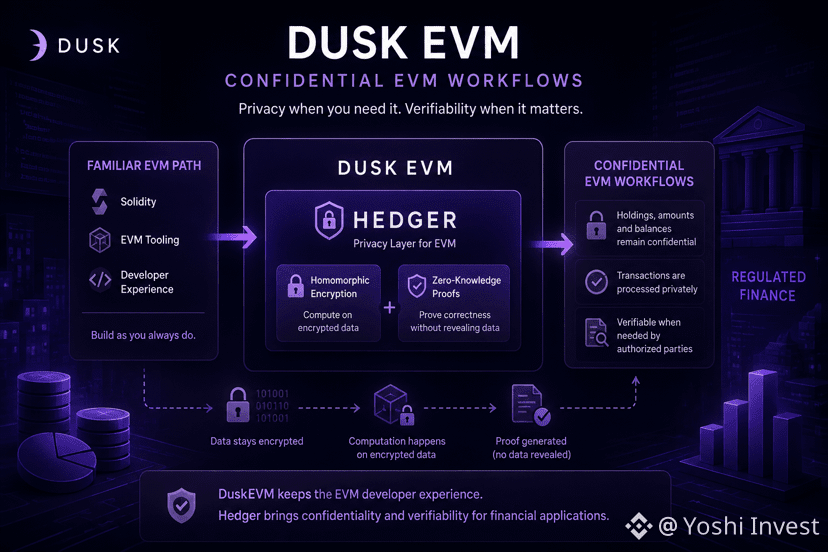
When I looked into DuskEVM, I found that the familiar parts are still there. Solidity, EVM tooling, and the build approach that developers already know. But I got stuck on a different question: if a financial application can’t expose everything, how does the EVM handle that?
What caught my attention is that privacy doesn’t have to mean leaving the EVM path. Hedger was built for DuskEVM, combining homomorphic encryption and zero-knowledge proofs.
In simple terms, data can be computed while it’s still encrypted, and the ZK proof helps prove the computation is correct without revealing the input data.
This is what I realized is the hard part of privacy in finance.
Keeping data confidential is one thing. Keeping data confidential but still being able to verify that transactions are processed correctly is another.
And Hedger is designed around exactly that: holdings, amounts, and balances can be kept secret, but when needed, it can provide proofs to enable verification.
Only then did I start to see DuskEVM differently.
It’s not about EVM versus privacy.
It’s about a familiar EVM path, with a way to add confidential workflows when a financial application truly needs privacy.
Perhaps what’s worth noting isn’t that Dusk brings privacy into the EVM.
It’s that they’re trying to make privacy part of the financial workflow itself, rather than a reason for developers to leave the EVM.
@Dusk_Foundation #dusk $DUSK
I once thought that an EVM workflow for finance would have to choose between two things: keeping the familiar environment, or accepting privacy by moving to a different stack.
When I looked into DuskEVM, I found that the familiar parts are still there. Solidity, EVM tooling, and the build approach that developers already know. But I got stuck on a different question: if a financial application can’t expose everything, how does the EVM handle that?
What caught my attention is that privacy doesn’t have to mean leaving the EVM path. Hedger was built for DuskEVM, combining homomorphic encryption and zero-knowledge proofs.
In simple terms, data can be computed while it’s still encrypted, and the ZK proof helps prove the computation is correct without revealing the input data.
This is what I realized is the hard part of privacy in finance.
Keeping data confidential is one thing. Keeping data confidential but still being able to verify that transactions are processed correctly is another.
And Hedger is designed around exactly that: holdings, amounts, and balances can be kept secret, but when needed, it can provide proofs to enable verification.
Only then did I start to see DuskEVM differently.
It’s not about EVM versus privacy.
It’s about a familiar EVM path, with a way to add confidential workflows when a financial application truly needs privacy.
Perhaps what’s worth noting isn’t that Dusk brings privacy into the EVM.
It’s that they’re trying to make privacy part of the financial workflow itself, rather than a reason for developers to leave the EVM.
@Dusk #dusk $DUSK
When I looked into DuskEVM, I found that the familiar parts are still there. Solidity, EVM tooling, and the build approach that developers already know. But I got stuck on a different question: if a financial application can’t expose everything, how does the EVM handle that?
What caught my attention is that privacy doesn’t have to mean leaving the EVM path. Hedger was built for DuskEVM, combining homomorphic encryption and zero-knowledge proofs.
In simple terms, data can be computed while it’s still encrypted, and the ZK proof helps prove the computation is correct without revealing the input data.
This is what I realized is the hard part of privacy in finance.
Keeping data confidential is one thing. Keeping data confidential but still being able to verify that transactions are processed correctly is another.
And Hedger is designed around exactly that: holdings, amounts, and balances can be kept secret, but when needed, it can provide proofs to enable verification.
Only then did I start to see DuskEVM differently.
It’s not about EVM versus privacy.
It’s about a familiar EVM path, with a way to add confidential workflows when a financial application truly needs privacy.
Perhaps what’s worth noting isn’t that Dusk brings privacy into the EVM.
It’s that they’re trying to make privacy part of the financial workflow itself, rather than a reason for developers to leave the EVM.
@Dusk #dusk $DUSK
155
·
--
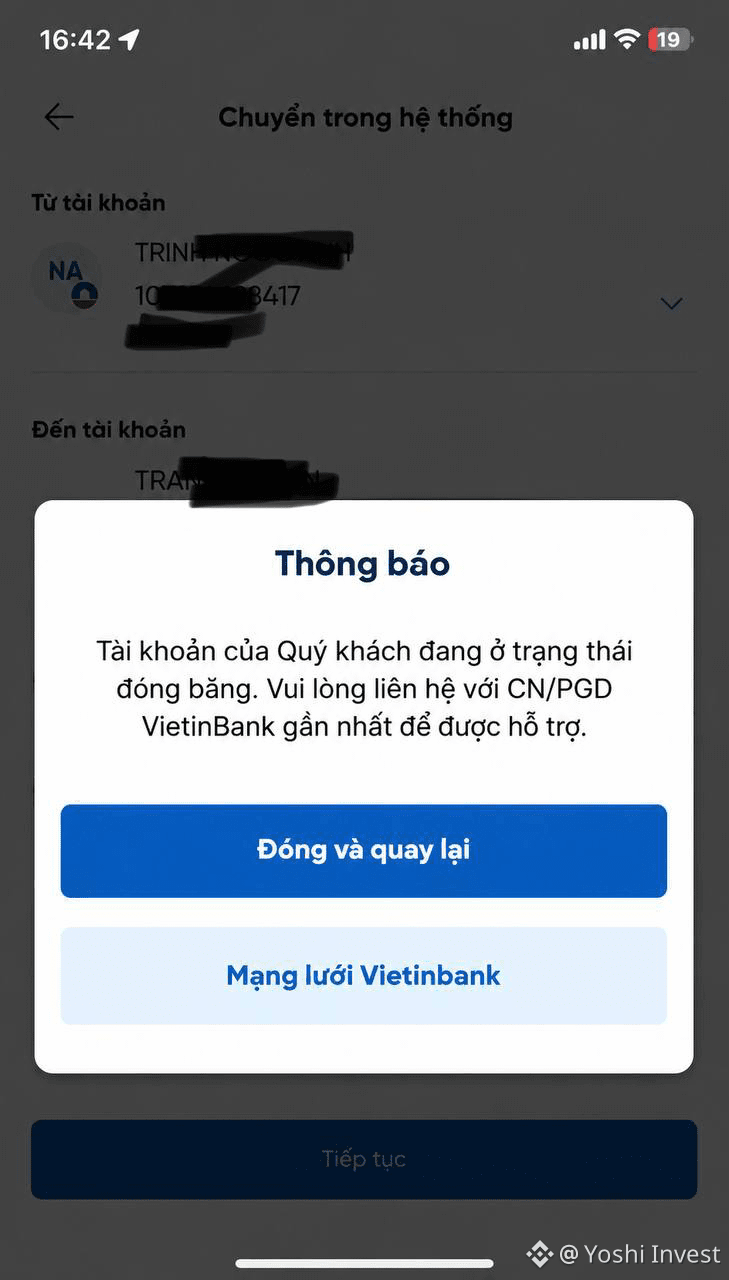
Recently, the Vietnamese crypto community has been buzzing again about cases where a bank locks users’ accounts after they cash out via P2P. This isn’t new, but every time it comes up, it leaves many brothers and sisters feeling uneasy.
I’ve read many cases where banks locked accounts for P2P transactions.
The most common reason is that the bank suspects the money flow the users receive from counterparties is related to scams, money laundering, or shows unusual signs.
If, unfortunately, your account gets locked, just bring your ID documents plus proof of the transaction directly to the bank to explain.
Binance has also provided a safe P2P trading process and very detailed warnings.
With so much information, people may forget, but they can’t ignore the rules:
Choose reputable traders.
Payment details must match the order details.
Don’t trade outside the platform.
Save all transaction evidence.
If there’s a problem, report it to Binance.
I often use a separate bank account only for P2P trading, and I always follow the correct process. I do this to better control the flow of funds and reduce risks when trading P2P.
Wishing everyone safe P2P trading.
@Binance_Vietnam #BinanceP2PAnToan #P2PScam #p2p
Recently, the Vietnamese crypto community has been buzzing again about cases where a bank locks users’ accounts after they cash out via P2P. This isn’t new, but every time it comes up, it leaves many brothers and sisters feeling uneasy.
I’ve read many cases where banks locked accounts for P2P transactions.
The most common reason is that the bank suspects the money flow the users receive from counterparties is related to scams, money laundering, or shows unusual signs.
If, unfortunately, your account gets locked, just bring your ID documents plus proof of the transaction directly to the bank to explain.
Binance has also provided a safe P2P trading process and very detailed warnings.
With so much information, people may forget, but they can’t ignore the rules:
Choose reputable traders.
Payment details must match the order details.
Don’t trade outside the platform.
Save all transaction evidence.
If there’s a problem, report it to Binance.
I often use a separate bank account only for P2P trading, and I always follow the correct process. I do this to better control the flow of funds and reduce risks when trading P2P.
Wishing everyone safe P2P trading.
@Binance Vietnam #BinanceP2PAnToan #P2PScam #p2p
I’ve read many cases where banks locked accounts for P2P transactions.
The most common reason is that the bank suspects the money flow the users receive from counterparties is related to scams, money laundering, or shows unusual signs.
If, unfortunately, your account gets locked, just bring your ID documents plus proof of the transaction directly to the bank to explain.
Binance has also provided a safe P2P trading process and very detailed warnings.
With so much information, people may forget, but they can’t ignore the rules:
Choose reputable traders.
Payment details must match the order details.
Don’t trade outside the platform.
Save all transaction evidence.
If there’s a problem, report it to Binance.
I often use a separate bank account only for P2P trading, and I always follow the correct process. I do this to better control the flow of funds and reduce risks when trading P2P.
Wishing everyone safe P2P trading.
@Binance Vietnam #BinanceP2PAnToan #P2PScam #p2p
222
·
--
I used to think that a blockchain for finance just needed to be fast enough. I kept thinking that if I tokenized a $100 asset, the faster the transactions run, the sooner I receive the asset, and the faster the seller receives the money. That sounded great.
Then I became curious: for a financial transaction, when exactly does @Dusk_Foundation really consider it “done”? I went into the transaction lifecycle to find out.
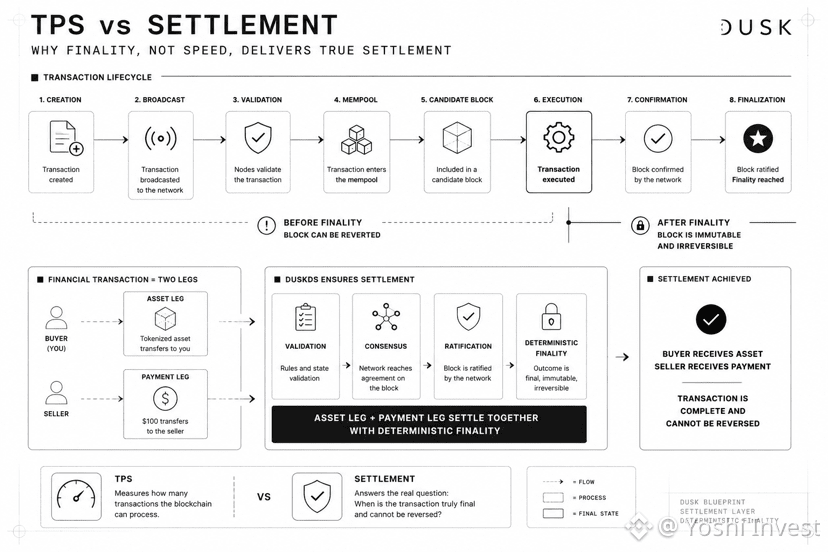
Once the transaction had been executed, I thought everything was over. But it wasn’t. The block containing it had not yet reached finality, and before finality, the block could still be reverted.
Turns out that a transaction completing doesn’t necessarily mean the financial transaction has truly settled.
For a tokenized asset, at least two things have to reach their final state together:
Asset leg
→ the asset is transferred to me.
Payment leg
→ $100 is transferred to the seller.
I started to understand that Dusk doesn’t treat settlement as just the matter of a transaction being processed.
DuskDS is where that’s ensured: a block isn’t considered finalized as soon as it’s created, but must go through a series of checks and consensus steps. Only when the block is ratified does the outcome achieve deterministic finality.
Only then did I start to interpret the word “fast” differently.
TPS tells me how many transactions the blockchain can process.
But settlement answers a more important question:
“When can I be certain that the asset has been transferred to me, the money has been transferred to the seller, and this transaction can no longer be reversed?”
Maybe for finance, fast transactions are just the starting point. You still have to know exactly when the transaction has truly ended.
@Dusk_Foundation #dusk $DUSK
I used to think that a blockchain for finance just needed to be fast enough. I kept thinking that if I tokenized a $100 asset, the faster the transactions run, the sooner I receive the asset, and the faster the seller receives the money. That sounded great.
Then I became curious: for a financial transaction, when exactly does @Dusk really consider it “done”? I went into the transaction lifecycle to find out.
Once the transaction had been executed, I thought everything was over. But it wasn’t. The block containing it had not yet reached finality, and before finality, the block could still be reverted.
Turns out that a transaction completing doesn’t necessarily mean the financial transaction has truly settled.
For a tokenized asset, at least two things have to reach their final state together:
Asset leg
→ the asset is transferred to me.
Payment leg
→ $100 is transferred to the seller.
I started to understand that Dusk doesn’t treat settlement as just the matter of a transaction being processed.
DuskDS is where that’s ensured: a block isn’t considered finalized as soon as it’s created, but must go through a series of checks and consensus steps. Only when the block is ratified does the outcome achieve deterministic finality.
Only then did I start to interpret the word “fast” differently.
TPS tells me how many transactions the blockchain can process.
But settlement answers a more important question:
“When can I be certain that the asset has been transferred to me, the money has been transferred to the seller, and this transaction can no longer be reversed?”
Maybe for finance, fast transactions are just the starting point. You still have to know exactly when the transaction has truly ended.
@Dusk #dusk $DUSK
Then I became curious: for a financial transaction, when exactly does @Dusk really consider it “done”? I went into the transaction lifecycle to find out.
Once the transaction had been executed, I thought everything was over. But it wasn’t. The block containing it had not yet reached finality, and before finality, the block could still be reverted.
Turns out that a transaction completing doesn’t necessarily mean the financial transaction has truly settled.
For a tokenized asset, at least two things have to reach their final state together:
Asset leg
→ the asset is transferred to me.
Payment leg
→ $100 is transferred to the seller.
I started to understand that Dusk doesn’t treat settlement as just the matter of a transaction being processed.
DuskDS is where that’s ensured: a block isn’t considered finalized as soon as it’s created, but must go through a series of checks and consensus steps. Only when the block is ratified does the outcome achieve deterministic finality.
Only then did I start to interpret the word “fast” differently.
TPS tells me how many transactions the blockchain can process.
But settlement answers a more important question:
“When can I be certain that the asset has been transferred to me, the money has been transferred to the seller, and this transaction can no longer be reversed?”
Maybe for finance, fast transactions are just the starting point. You still have to know exactly when the transaction has truly ended.
@Dusk #dusk $DUSK
199
·
--
Oh wow, does the P2P trading session also include asking for “lucky money” tips now, huh guys =)))
When poor people go to trade but it feels like we’re doing charity for the rich, I just can’t 😭
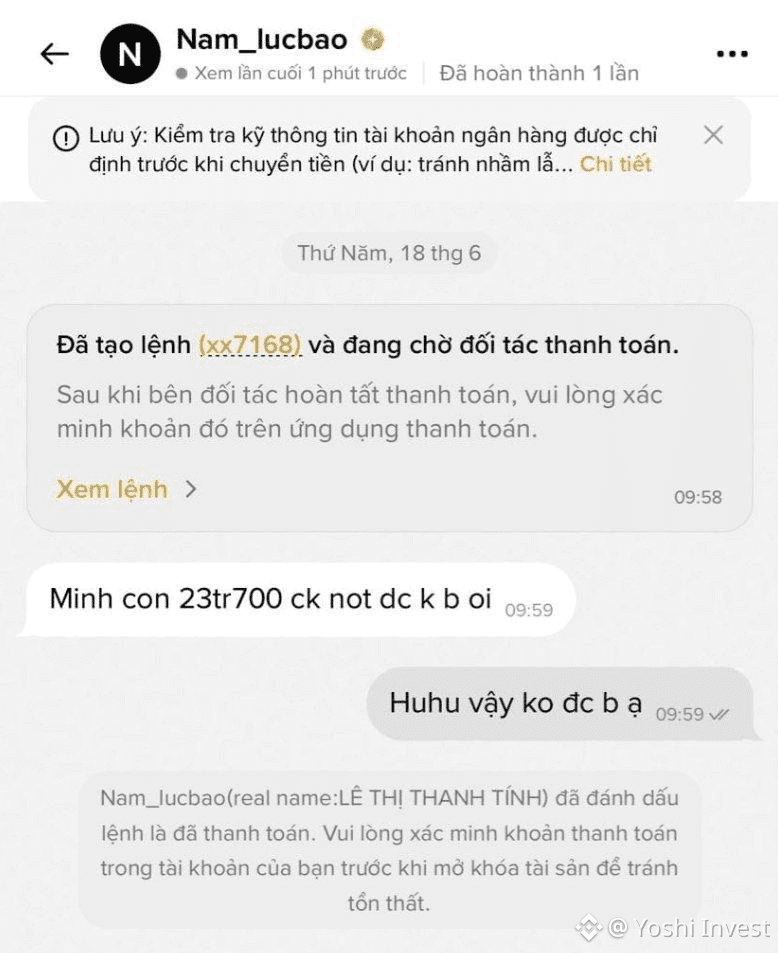
So here’s what happened: today I had a sell order for over 23,780,000 VND on P2P.
The trade was normal—everything was fine—until the merchant messaged one sentence:
“Just left me only 23tr700.”
Huh???
It’s 23 million 780 thousand, not 23 million 700, guys =))))
Suddenly when I’m selling USDT, I get an extra “mission”:
“Will you get lucky money for me this Tet?” 😭
Honestly, if the trade is going well and people joke around a few lines, it’s fine.
But if you’re in the middle of a transaction and the merchant asks for an extra deduction / transfers short compared to the amount on the Order, then I think you guys should just follow the rules.
Order how much → pay exactly that amount.
No chuyện like:
“Transfer 80k less for me, okay.”
“Can I have some tea money.”
“Give me some lucky money, just a little.”
“Service fee for me, a bit.”
If each person asks for a few tens of thousands, a few hundreds of thousands, then for a merchant who processes so many orders every day, when you add it all up, it’s definitely not a small number, guys 😅
We don’t need to argue back and forth either.
If you don’t agree, just request a trade done exactly according to the Order.
If the counterpart deliberately makes things difficult or refuses to process it, keep the chat history and you can report/Appeal to get support.
P2P is for buying and selling, not a program where you “get lucky money” for the merchant =)))
Have you guys ever encountered a merchant asking for change, asking for tea money, or asking for lucky money before? Tell me—let’s see how countless and creative it can get 😂
@Binance_Vietnam #p2p #BinanceP2PAnToan #antoan
Oh wow, does the P2P trading session also include asking for “lucky money” tips now, huh guys =)))
When poor people go to trade but it feels like we’re doing charity for the rich, I just can’t 😭
So here’s what happened: today I had a sell order for over 23,780,000 VND on P2P.
The trade was normal—everything was fine—until the merchant messaged one sentence:
“Just left me only 23tr700.”
Huh???
It’s 23 million 780 thousand, not 23 million 700, guys =))))
Suddenly when I’m selling USDT, I get an extra “mission”:
“Will you get lucky money for me this Tet?” 😭
Honestly, if the trade is going well and people joke around a few lines, it’s fine.
But if you’re in the middle of a transaction and the merchant asks for an extra deduction / transfers short compared to the amount on the Order, then I think you guys should just follow the rules.
Order how much → pay exactly that amount.
No chuyện like:
“Transfer 80k less for me, okay.”
“Can I have some tea money.”
“Give me some lucky money, just a little.”
“Service fee for me, a bit.”
If each person asks for a few tens of thousands, a few hundreds of thousands, then for a merchant who processes so many orders every day, when you add it all up, it’s definitely not a small number, guys 😅
We don’t need to argue back and forth either.
If you don’t agree, just request a trade done exactly according to the Order.
If the counterpart deliberately makes things difficult or refuses to process it, keep the chat history and you can report/Appeal to get support.
P2P is for buying and selling, not a program where you “get lucky money” for the merchant =)))
Have you guys ever encountered a merchant asking for change, asking for tea money, or asking for lucky money before? Tell me—let’s see how countless and creative it can get 😂
@Binance Vietnam #p2p #BinanceP2PAnToan #antoan
When poor people go to trade but it feels like we’re doing charity for the rich, I just can’t 😭
So here’s what happened: today I had a sell order for over 23,780,000 VND on P2P.
The trade was normal—everything was fine—until the merchant messaged one sentence:
“Just left me only 23tr700.”
Huh???
It’s 23 million 780 thousand, not 23 million 700, guys =))))
Suddenly when I’m selling USDT, I get an extra “mission”:
“Will you get lucky money for me this Tet?” 😭
Honestly, if the trade is going well and people joke around a few lines, it’s fine.
But if you’re in the middle of a transaction and the merchant asks for an extra deduction / transfers short compared to the amount on the Order, then I think you guys should just follow the rules.
Order how much → pay exactly that amount.
No chuyện like:
“Transfer 80k less for me, okay.”
“Can I have some tea money.”
“Give me some lucky money, just a little.”
“Service fee for me, a bit.”
If each person asks for a few tens of thousands, a few hundreds of thousands, then for a merchant who processes so many orders every day, when you add it all up, it’s definitely not a small number, guys 😅
We don’t need to argue back and forth either.
If you don’t agree, just request a trade done exactly according to the Order.
If the counterpart deliberately makes things difficult or refuses to process it, keep the chat history and you can report/Appeal to get support.
P2P is for buying and selling, not a program where you “get lucky money” for the merchant =)))
Have you guys ever encountered a merchant asking for change, asking for tea money, or asking for lucky money before? Tell me—let’s see how countless and creative it can get 😂
@Binance Vietnam #p2p #BinanceP2PAnToan #antoan
115
·
--
I used to think that if a Finance L1 wanted its own capabilities, it would have to pay a price: the developer would have to leave the familiar EVM stack.
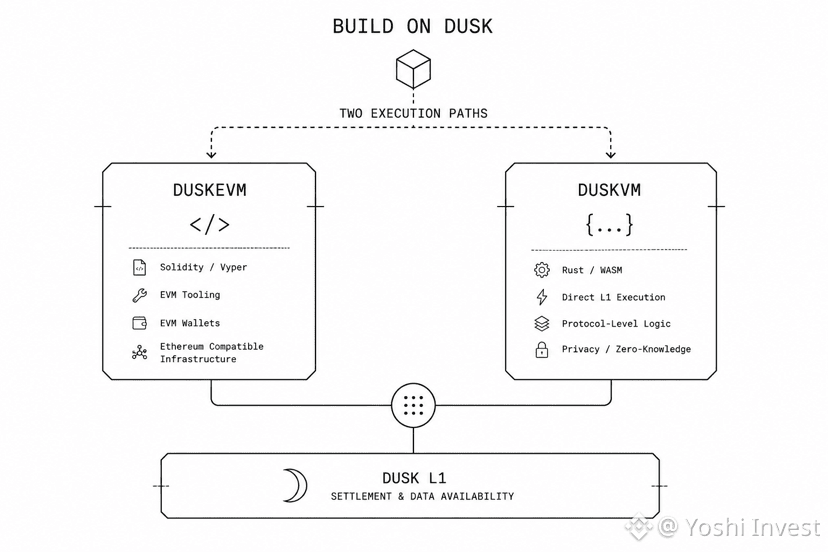
When I was researching how to build on @Dusk_Foundation , I kept thinking that if I wanted to touch the specific traits of a Finance L1, I’d have to get used to a whole new stack. But the more I read, the more it felt familiar: Solidity, Vyper, and the EVM tooling I already knew were all there on DuskEVM. I even wondered: so where exactly does Dusk differ?
I kept reading and came across the DuskVM. Rust/WASM, running directly on L1. At that point, I thought: if you really want to go deep into Dusk’s native layer, you’d still have to learn yet another stack.
That’s when it clicked: maybe I had equated specialization with having to start from scratch.
Not necessarily.
I can start with what I’m already comfortable with. And when the application needs native execution, privacy, or zero-knowledge at the L1 level, there’s still another path.
Now I’m starting to see EVM + native privacy differently.
EVM preserves what I already know. Specialization gives me an additional option when an application needs to go deeper into L1.
Maybe a Finance L1 doesn’t need to make developers pay the UX price just to become specialized.
@Dusk_Foundation #dusk $DUSK
I used to think that if a Finance L1 wanted its own capabilities, it would have to pay a price: the developer would have to leave the familiar EVM stack.
When I was researching how to build on @Dusk , I kept thinking that if I wanted to touch the specific traits of a Finance L1, I’d have to get used to a whole new stack. But the more I read, the more it felt familiar: Solidity, Vyper, and the EVM tooling I already knew were all there on DuskEVM. I even wondered: so where exactly does Dusk differ?
I kept reading and came across the DuskVM. Rust/WASM, running directly on L1. At that point, I thought: if you really want to go deep into Dusk’s native layer, you’d still have to learn yet another stack.
That’s when it clicked: maybe I had equated specialization with having to start from scratch.
Not necessarily.
I can start with what I’m already comfortable with. And when the application needs native execution, privacy, or zero-knowledge at the L1 level, there’s still another path.
Now I’m starting to see EVM + native privacy differently.
EVM preserves what I already know. Specialization gives me an additional option when an application needs to go deeper into L1.
Maybe a Finance L1 doesn’t need to make developers pay the UX price just to become specialized.
@Dusk #dusk $DUSK
When I was researching how to build on @Dusk , I kept thinking that if I wanted to touch the specific traits of a Finance L1, I’d have to get used to a whole new stack. But the more I read, the more it felt familiar: Solidity, Vyper, and the EVM tooling I already knew were all there on DuskEVM. I even wondered: so where exactly does Dusk differ?
I kept reading and came across the DuskVM. Rust/WASM, running directly on L1. At that point, I thought: if you really want to go deep into Dusk’s native layer, you’d still have to learn yet another stack.
That’s when it clicked: maybe I had equated specialization with having to start from scratch.
Not necessarily.
I can start with what I’m already comfortable with. And when the application needs native execution, privacy, or zero-knowledge at the L1 level, there’s still another path.
Now I’m starting to see EVM + native privacy differently.
EVM preserves what I already know. Specialization gives me an additional option when an application needs to go deeper into L1.
Maybe a Finance L1 doesn’t need to make developers pay the UX price just to become specialized.
@Dusk #dusk $DUSK
80
·
--
I almost got psychologically manipulated, guys. P2P trading right now is really creepy.
Last night I opened a BTC position on Binance, and since I was holding a losing trade, I clicked on the P2P “Buy” section for 1,500 USDT to hedge.
After creating the order, I checked that everything was matched, and then I paid the counterparty.
Once it was all done, I waited 2–3 minutes but didn’t see the USDT arrive. I messaged them asking to complete the unlock of the transaction.
At that point they replied:
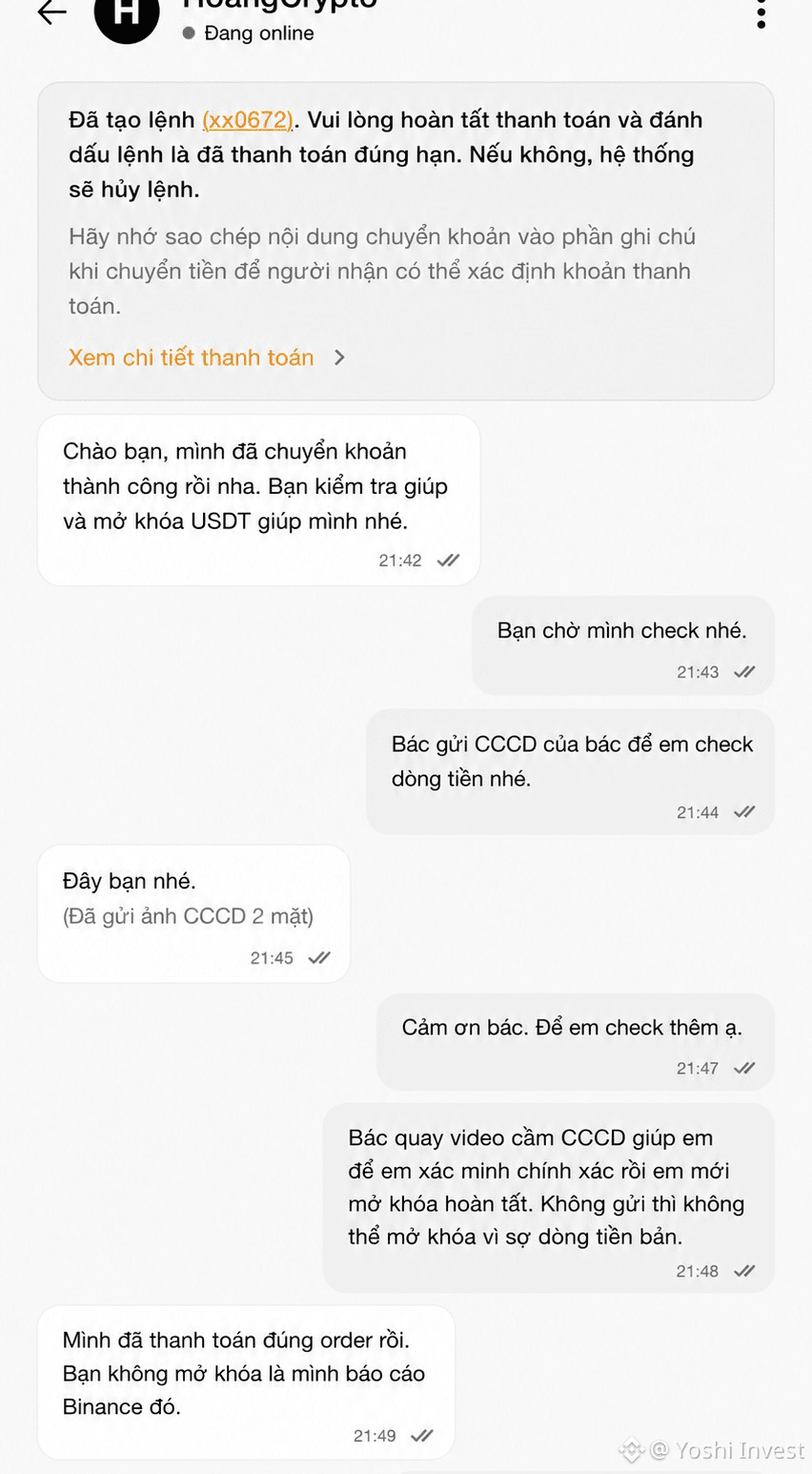
“Send your ID card (CCCD) so I can check the source of funds.”
At first I thought, lately there’s been a lot of talk about payment fund sources, and since I was already holding the position, I sent it right away to be quick.
After I sent it, they asked me to send a video holding the ID card. Only then would they verify it correctly and unlock the transaction. If I didn’t send it, they wouldn’t unlock it because they were afraid the funds were “dirty.”
I could smell something fishy here. I replied:
“If you don’t complete it, I’ll report you to Binance.”
Unexpectedly, after about 2 minutes, the USDT was credited to my account.
When you run into cases like this, stay calm and remember the rules:
👉Pay exactly according to the order.
👉Don’t arbitrarily agree to the counterparty’s random requests.
👉Save the Order ID and chat evidence.
👉Report/Appeal to Binance immediately if anything looks abnormal.
Quick P2P trading is necessary, but safe P2P is more important.
@Binance_Vietnam #BinanceP2PAnToan #p2p #AnToanP2P
I almost got psychologically manipulated, guys. P2P trading right now is really creepy.
Last night I opened a BTC position on Binance, and since I was holding a losing trade, I clicked on the P2P “Buy” section for 1,500 USDT to hedge.
After creating the order, I checked that everything was matched, and then I paid the counterparty.
Once it was all done, I waited 2–3 minutes but didn’t see the USDT arrive. I messaged them asking to complete the unlock of the transaction.
At that point they replied:
“Send your ID card (CCCD) so I can check the source of funds.”
At first I thought, lately there’s been a lot of talk about payment fund sources, and since I was already holding the position, I sent it right away to be quick.
After I sent it, they asked me to send a video holding the ID card. Only then would they verify it correctly and unlock the transaction. If I didn’t send it, they wouldn’t unlock it because they were afraid the funds were “dirty.”
I could smell something fishy here. I replied:
“If you don’t complete it, I’ll report you to Binance.”
Unexpectedly, after about 2 minutes, the USDT was credited to my account.
When you run into cases like this, stay calm and remember the rules:
👉Pay exactly according to the order.
👉Don’t arbitrarily agree to the counterparty’s random requests.
👉Save the Order ID and chat evidence.
👉Report/Appeal to Binance immediately if anything looks abnormal.
Quick P2P trading is necessary, but safe P2P is more important.
@Binance Vietnam #BinanceP2PAnToan #p2p #AnToanP2P
Last night I opened a BTC position on Binance, and since I was holding a losing trade, I clicked on the P2P “Buy” section for 1,500 USDT to hedge.
After creating the order, I checked that everything was matched, and then I paid the counterparty.
Once it was all done, I waited 2–3 minutes but didn’t see the USDT arrive. I messaged them asking to complete the unlock of the transaction.
At that point they replied:
“Send your ID card (CCCD) so I can check the source of funds.”
At first I thought, lately there’s been a lot of talk about payment fund sources, and since I was already holding the position, I sent it right away to be quick.
After I sent it, they asked me to send a video holding the ID card. Only then would they verify it correctly and unlock the transaction. If I didn’t send it, they wouldn’t unlock it because they were afraid the funds were “dirty.”
I could smell something fishy here. I replied:
“If you don’t complete it, I’ll report you to Binance.”
Unexpectedly, after about 2 minutes, the USDT was credited to my account.
When you run into cases like this, stay calm and remember the rules:
👉Pay exactly according to the order.
👉Don’t arbitrarily agree to the counterparty’s random requests.
👉Save the Order ID and chat evidence.
👉Report/Appeal to Binance immediately if anything looks abnormal.
Quick P2P trading is necessary, but safe P2P is more important.
@Binance Vietnam #BinanceP2PAnToan #p2p #AnToanP2P
1
182
·
--
I’ve looked at quite a few lending protocols, so when I first saw TermMax, I also thought: another lending protocol—probably just another Aave.
Honestly, last night I spent nearly 2 hours carefully studying how @termmax puts fixed-rate capital on-chain, and it made me start looking at other lending differently.
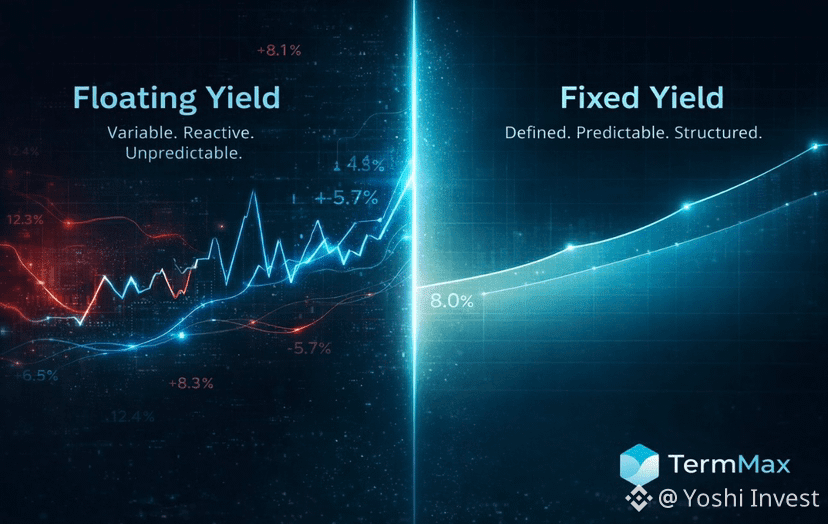
In most DeFi lending, interest rates fluctuate with the market. Today you borrow at one rate; tomorrow it could be a different rate.
TermMax splits this problem into positions with clearly defined terms. In Aegis’s sjUSD market, users can borrow up to 500K USDC with a fixed rate, while sjUSD still generates around 4.68% APY.
FT represents the right to receive a fixed amount of an asset at maturity. XT separates the yield from the principal.
Taken individually, each piece seems complicated.
And when you put these two side by side, TermMax isn’t only tokenizing a loan. It’s tokenizing the entire structure of a term loan.
That’s a major difference.
A mature capital market doesn’t just need to know “how much you can borrow,” but also:
what the cost of capital is, how long the term is, and how much yield there is.
TermMax is bringing all of that into DeFi.
And if fixed-rate capital truly becomes an important primitive of on-chain finance, I think TermMax is in a very noteworthy position.
@termmax #TermMax
I’ve looked at quite a few lending protocols, so when I first saw TermMax, I also thought: another lending protocol—probably just another Aave.
Honestly, last night I spent nearly 2 hours carefully studying how @TermMax puts fixed-rate capital on-chain, and it made me start looking at other lending differently.
In most DeFi lending, interest rates fluctuate with the market. Today you borrow at one rate; tomorrow it could be a different rate.
TermMax splits this problem into positions with clearly defined terms. In Aegis’s sjUSD market, users can borrow up to 500K USDC with a fixed rate, while sjUSD still generates around 4.68% APY.
FT represents the right to receive a fixed amount of an asset at maturity. XT separates the yield from the principal.
Taken individually, each piece seems complicated.
And when you put these two side by side, TermMax isn’t only tokenizing a loan. It’s tokenizing the entire structure of a term loan.
That’s a major difference.
A mature capital market doesn’t just need to know “how much you can borrow,” but also:
what the cost of capital is, how long the term is, and how much yield there is.
TermMax is bringing all of that into DeFi.
And if fixed-rate capital truly becomes an important primitive of on-chain finance, I think TermMax is in a very noteworthy position.
@TermMax #TermMax
Honestly, last night I spent nearly 2 hours carefully studying how @TermMax puts fixed-rate capital on-chain, and it made me start looking at other lending differently.
In most DeFi lending, interest rates fluctuate with the market. Today you borrow at one rate; tomorrow it could be a different rate.
TermMax splits this problem into positions with clearly defined terms. In Aegis’s sjUSD market, users can borrow up to 500K USDC with a fixed rate, while sjUSD still generates around 4.68% APY.
FT represents the right to receive a fixed amount of an asset at maturity. XT separates the yield from the principal.
Taken individually, each piece seems complicated.
And when you put these two side by side, TermMax isn’t only tokenizing a loan. It’s tokenizing the entire structure of a term loan.
That’s a major difference.
A mature capital market doesn’t just need to know “how much you can borrow,” but also:
what the cost of capital is, how long the term is, and how much yield there is.
TermMax is bringing all of that into DeFi.
And if fixed-rate capital truly becomes an important primitive of on-chain finance, I think TermMax is in a very noteworthy position.
@TermMax #TermMax
161
·
--
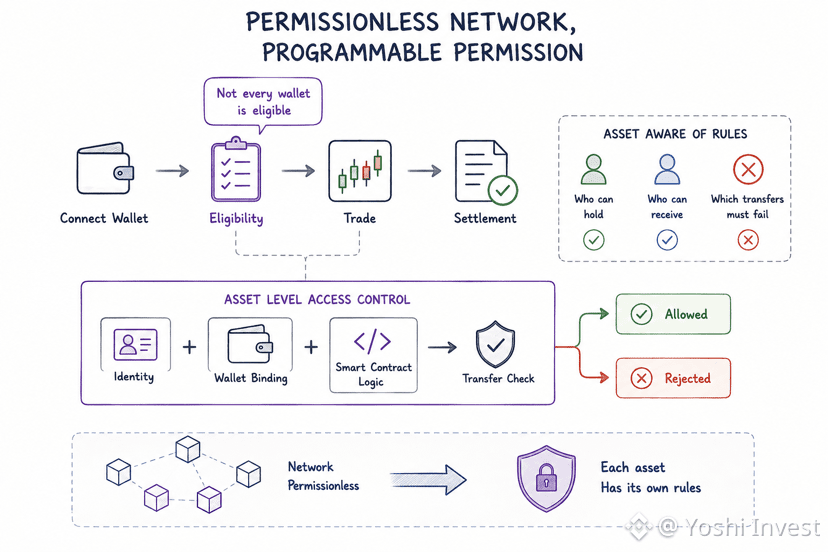
I used to think that permissionless was the most compelling part of blockchain: connecting a wallet, choosing assets, making transactions. No one stands in between, and no one decides whether I’m allowed or not.
Last night I looked into Dusk Trade and noticed a detail in the flow: after wallet connection, there is investor onboarding and eligibility before you even get to buying or selling. I reread this part because it seemed quite strange. If blockchain is inherently permissionless, why isn’t connecting a wallet alone enough to enter a regulated asset?
I dug deeper and realized that eligibility is only one part. For regulated assets, Dusk also poses three very specific questions: who is allowed to hold, who is allowed to receive, and which transfers must fail. Transfers can even be checked or simulated before submission.
At this point, I started to see that the issue isn’t simply permissionless versus permissioned.
It’s about where the permission lives.
At @Dusk_Foundation , a market workflow exists where eligibility, wallet binding, and transfer controls are all wrapped around the asset itself, rather than keeping those rules separate from the blockchain.
This made me see permissionless differently.
The network can still be open, but each asset can carry its own rules.
Maybe regulated finance doesn’t need a closed blockchain.
It needs permissions to be programmed into the asset itself.
For me, when these regulated assets are truly traded, the question is how smoothly these rules will operate. But Dusk has made me start thinking about permissionless in a different way.
@Dusk_Foundation #dusk $DUSK
I used to think that permissionless was the most compelling part of blockchain: connecting a wallet, choosing assets, making transactions. No one stands in between, and no one decides whether I’m allowed or not.
Last night I looked into Dusk Trade and noticed a detail in the flow: after wallet connection, there is investor onboarding and eligibility before you even get to buying or selling. I reread this part because it seemed quite strange. If blockchain is inherently permissionless, why isn’t connecting a wallet alone enough to enter a regulated asset?
I dug deeper and realized that eligibility is only one part. For regulated assets, Dusk also poses three very specific questions: who is allowed to hold, who is allowed to receive, and which transfers must fail. Transfers can even be checked or simulated before submission.
At this point, I started to see that the issue isn’t simply permissionless versus permissioned.
It’s about where the permission lives.
At @Dusk , a market workflow exists where eligibility, wallet binding, and transfer controls are all wrapped around the asset itself, rather than keeping those rules separate from the blockchain.
This made me see permissionless differently.
The network can still be open, but each asset can carry its own rules.
Maybe regulated finance doesn’t need a closed blockchain.
It needs permissions to be programmed into the asset itself.
For me, when these regulated assets are truly traded, the question is how smoothly these rules will operate. But Dusk has made me start thinking about permissionless in a different way.
@Dusk #dusk $DUSK
Last night I looked into Dusk Trade and noticed a detail in the flow: after wallet connection, there is investor onboarding and eligibility before you even get to buying or selling. I reread this part because it seemed quite strange. If blockchain is inherently permissionless, why isn’t connecting a wallet alone enough to enter a regulated asset?
I dug deeper and realized that eligibility is only one part. For regulated assets, Dusk also poses three very specific questions: who is allowed to hold, who is allowed to receive, and which transfers must fail. Transfers can even be checked or simulated before submission.
At this point, I started to see that the issue isn’t simply permissionless versus permissioned.
It’s about where the permission lives.
At @Dusk , a market workflow exists where eligibility, wallet binding, and transfer controls are all wrapped around the asset itself, rather than keeping those rules separate from the blockchain.
This made me see permissionless differently.
The network can still be open, but each asset can carry its own rules.
Maybe regulated finance doesn’t need a closed blockchain.
It needs permissions to be programmed into the asset itself.
For me, when these regulated assets are truly traded, the question is how smoothly these rules will operate. But Dusk has made me start thinking about permissionless in a different way.
@Dusk #dusk $DUSK
106
·
--
Lately, we haven’t been doing anything but still want to eat—we’ve moved to p2p too much. Bro, be careful with trading, okay. Yesterday I withdrew 2 million VND and I almost lost it.
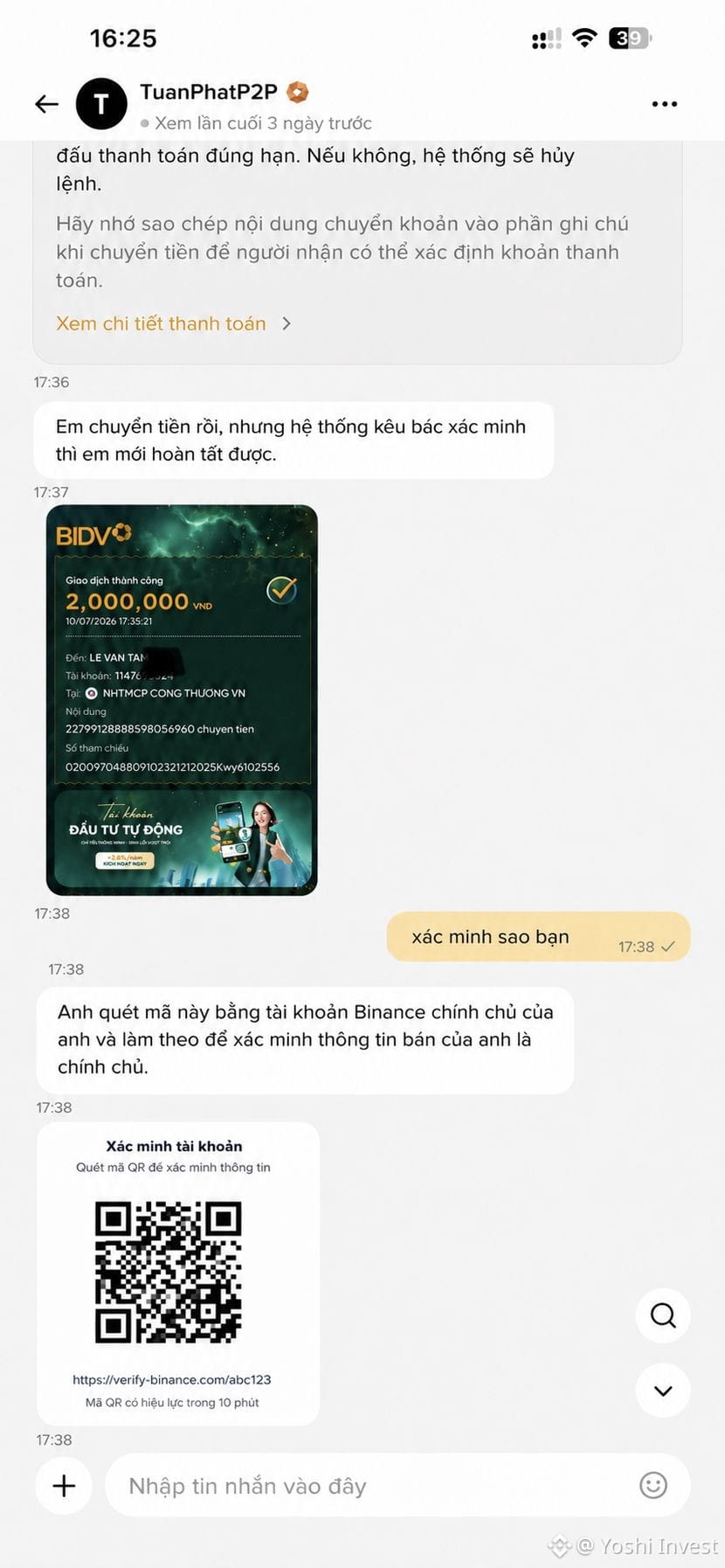
Just like every time I sell p2p on Binance before, I created a sell order for 2,000,000 VND (75 USDT). Two minutes later, a chat message popped up saying: “I’ve transferred the money already, but the system asked you to verify, so I only completed it after verification” — along with a screenshot of a successful payment. When I checked my bank account, the money still wasn’t there.
At first, I thought maybe Binance would confirm again to ensure safety, so I asked: “Verification, how?” Immediately, the other side sent a QR and said: “You scan this code with your Binance account and follow the steps to verify the information for my sell order—that it’s really mine.”
I didn’t expect that, everyone. At that moment, I started to suspect there was some kind of scam going on here. So I didn’t follow through.
If anyone has encountered something like this, remember Binance’s warnings:
👉 Don’t verify when the money hasn’t actually arrived in your account.
👉 Don’t scan the QR or click links according to the partner’s instructions.
👉 If there are unusual requests, stop the trade, save all chats, the Order ID, and trading proof on the platform.
Don’t think 2 million is a lot or a little—the safest thing is always the top priority. What they want to do might be to get your entire assets in your Binance account.
Everyone, stay alert for any unusual situation, follow the proper process, and read Binance’s warnings to trade p2p safely, everyone—this is terrifying, so scary.
@Binance_Vietnam #BinanceP2PAnToan #p2p #AnToanP2P
Lately, we haven’t been doing anything but still want to eat—we’ve moved to p2p too much. Bro, be careful with trading, okay. Yesterday I withdrew 2 million VND and I almost lost it.
Just like every time I sell p2p on Binance before, I created a sell order for 2,000,000 VND (75 USDT). Two minutes later, a chat message popped up saying: “I’ve transferred the money already, but the system asked you to verify, so I only completed it after verification” — along with a screenshot of a successful payment. When I checked my bank account, the money still wasn’t there.
At first, I thought maybe Binance would confirm again to ensure safety, so I asked: “Verification, how?” Immediately, the other side sent a QR and said: “You scan this code with your Binance account and follow the steps to verify the information for my sell order—that it’s really mine.”
I didn’t expect that, everyone. At that moment, I started to suspect there was some kind of scam going on here. So I didn’t follow through.
If anyone has encountered something like this, remember Binance’s warnings:
👉 Don’t verify when the money hasn’t actually arrived in your account.
👉 Don’t scan the QR or click links according to the partner’s instructions.
👉 If there are unusual requests, stop the trade, save all chats, the Order ID, and trading proof on the platform.
Don’t think 2 million is a lot or a little—the safest thing is always the top priority. What they want to do might be to get your entire assets in your Binance account.
Everyone, stay alert for any unusual situation, follow the proper process, and read Binance’s warnings to trade p2p safely, everyone—this is terrifying, so scary.
@Binance Vietnam #BinanceP2PAnToan #p2p #AnToanP2P
Just like every time I sell p2p on Binance before, I created a sell order for 2,000,000 VND (75 USDT). Two minutes later, a chat message popped up saying: “I’ve transferred the money already, but the system asked you to verify, so I only completed it after verification” — along with a screenshot of a successful payment. When I checked my bank account, the money still wasn’t there.
At first, I thought maybe Binance would confirm again to ensure safety, so I asked: “Verification, how?” Immediately, the other side sent a QR and said: “You scan this code with your Binance account and follow the steps to verify the information for my sell order—that it’s really mine.”
I didn’t expect that, everyone. At that moment, I started to suspect there was some kind of scam going on here. So I didn’t follow through.
If anyone has encountered something like this, remember Binance’s warnings:
👉 Don’t verify when the money hasn’t actually arrived in your account.
👉 Don’t scan the QR or click links according to the partner’s instructions.
👉 If there are unusual requests, stop the trade, save all chats, the Order ID, and trading proof on the platform.
Don’t think 2 million is a lot or a little—the safest thing is always the top priority. What they want to do might be to get your entire assets in your Binance account.
Everyone, stay alert for any unusual situation, follow the proper process, and read Binance’s warnings to trade p2p safely, everyone—this is terrifying, so scary.
@Binance Vietnam #BinanceP2PAnToan #p2p #AnToanP2P
152
·
--
11 p.m., I lay on my bed and carefully reread SpaceX’s $25 billion bond issuance from June 2026. Honestly, not everyone can buy it. The offering is for qualified institutional buyers and certain non-U.S. investors under Regulation S.
At first, I thought this was pretty normal. For a managed asset, the issuer has to check whether the buyers are eligible.
And I wondered: how much do they really need to know about me? Funny.
If the goal is only to confirm that I belong to an allowed investment group, why disclose additional information that’s unrelated?
While I was just chilling, I remembered I hadn’t written creatorpad Dusk yet, so I went in to look up @Dusk_Foundation . And what a surprise—Dusk is actually solving this exact problem.
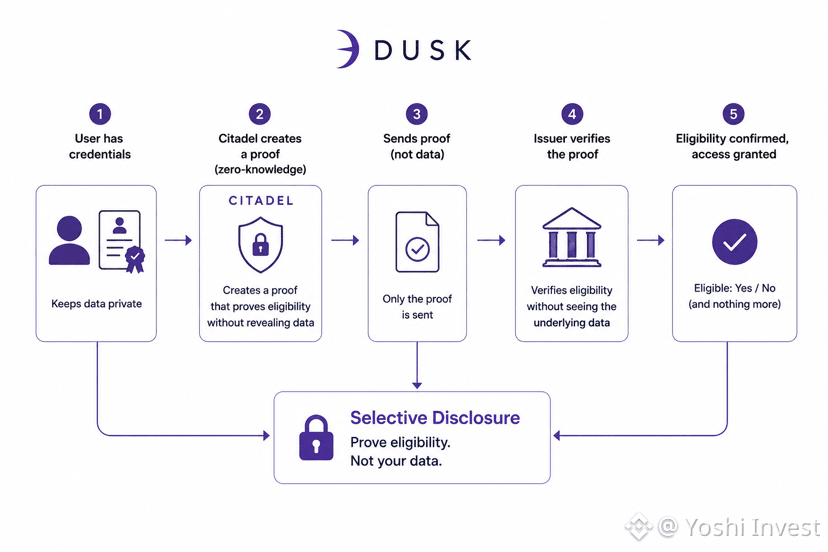
With Citadel, users can use credentials and zero-knowledge proofs to prove that a necessary attribute holds, without putting all personal data on-chain. Dusk calls this approach selective disclosure.
Turns out, compliance doesn’t necessarily mean collecting as much data as possible.
Sometimes all you need to know is:
“Is this person eligible?”
Not:
“Show me everything about this person.”
Maybe privacy and compliance aren’t opposites.
Compliance needs the right evidence—doesn’t necessarily require all the data.
@Dusk_Foundation #dusk $DUSK
11 p.m., I lay on my bed and carefully reread SpaceX’s $25 billion bond issuance from June 2026. Honestly, not everyone can buy it. The offering is for qualified institutional buyers and certain non-U.S. investors under Regulation S.
At first, I thought this was pretty normal. For a managed asset, the issuer has to check whether the buyers are eligible.
And I wondered: how much do they really need to know about me? Funny.
If the goal is only to confirm that I belong to an allowed investment group, why disclose additional information that’s unrelated?
While I was just chilling, I remembered I hadn’t written creatorpad Dusk yet, so I went in to look up @Dusk . And what a surprise—Dusk is actually solving this exact problem.
With Citadel, users can use credentials and zero-knowledge proofs to prove that a necessary attribute holds, without putting all personal data on-chain. Dusk calls this approach selective disclosure.
Turns out, compliance doesn’t necessarily mean collecting as much data as possible.
Sometimes all you need to know is:
“Is this person eligible?”
Not:
“Show me everything about this person.”
Maybe privacy and compliance aren’t opposites.
Compliance needs the right evidence—doesn’t necessarily require all the data.
@Dusk #dusk $DUSK
At first, I thought this was pretty normal. For a managed asset, the issuer has to check whether the buyers are eligible.
And I wondered: how much do they really need to know about me? Funny.
If the goal is only to confirm that I belong to an allowed investment group, why disclose additional information that’s unrelated?
While I was just chilling, I remembered I hadn’t written creatorpad Dusk yet, so I went in to look up @Dusk . And what a surprise—Dusk is actually solving this exact problem.
With Citadel, users can use credentials and zero-knowledge proofs to prove that a necessary attribute holds, without putting all personal data on-chain. Dusk calls this approach selective disclosure.
Turns out, compliance doesn’t necessarily mean collecting as much data as possible.
Sometimes all you need to know is:
“Is this person eligible?”
Not:
“Show me everything about this person.”
Maybe privacy and compliance aren’t opposites.
Compliance needs the right evidence—doesn’t necessarily require all the data.
@Dusk #dusk $DUSK
2
1
144
·
--
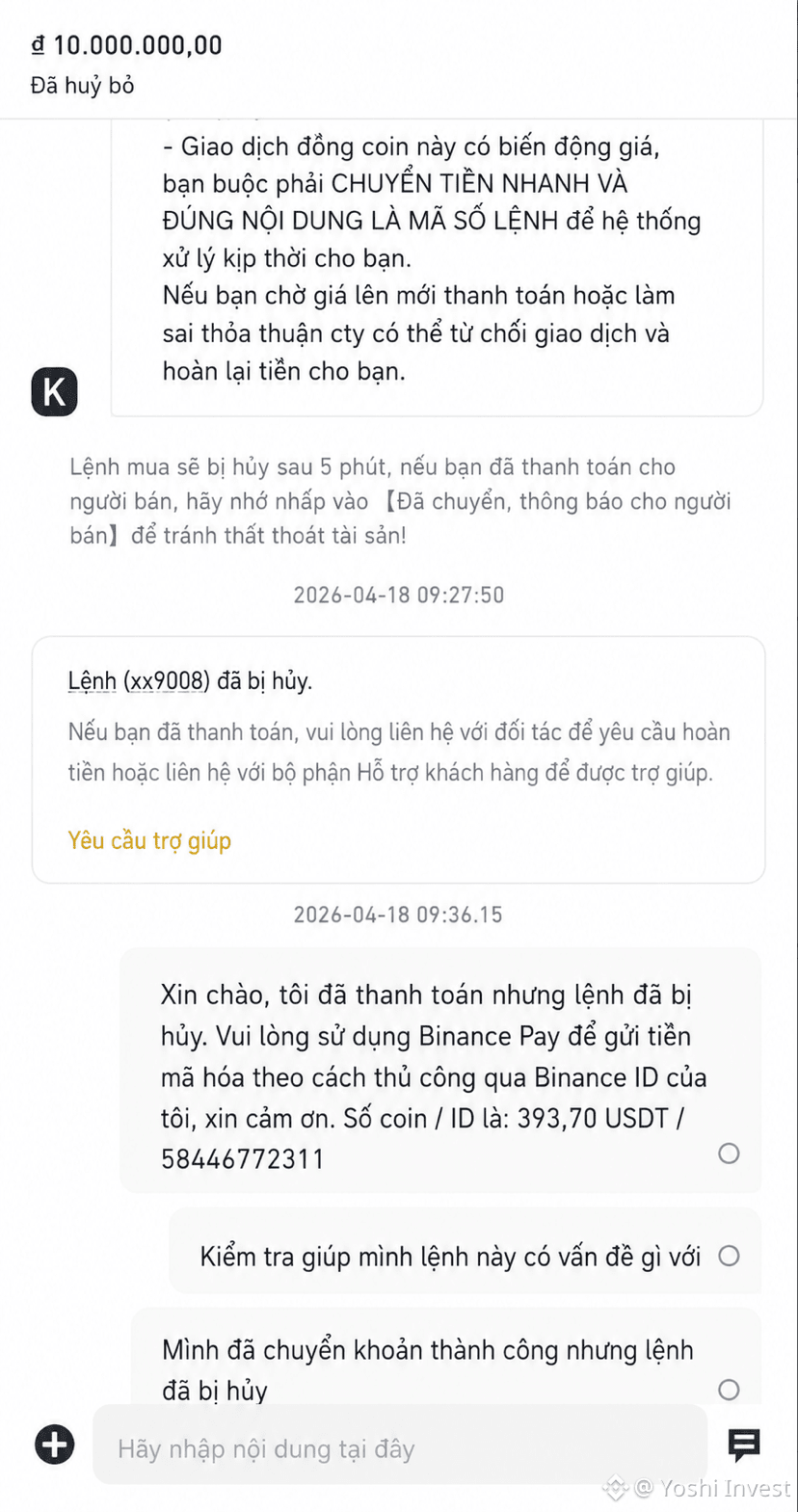
I once lost VND 10 million when trading P2P on Binance.
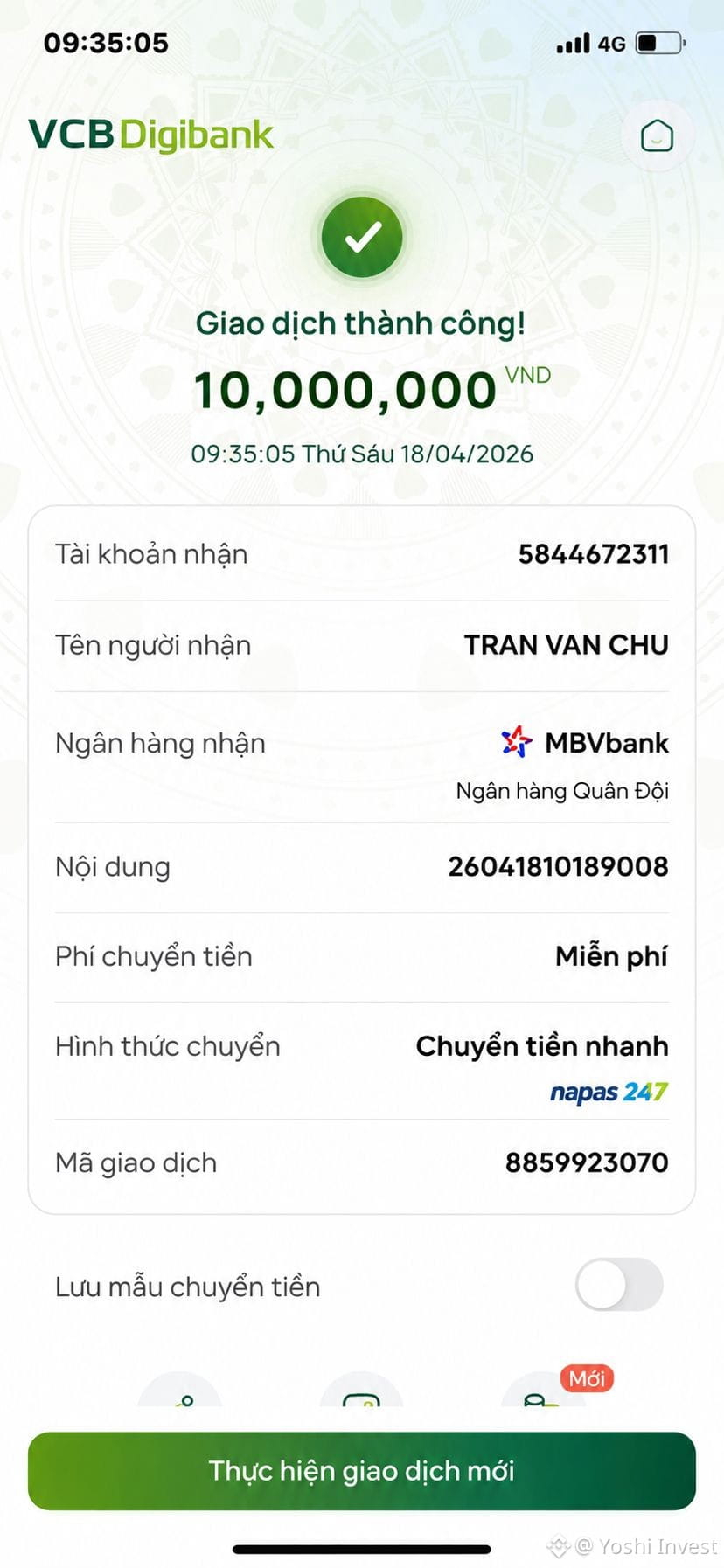
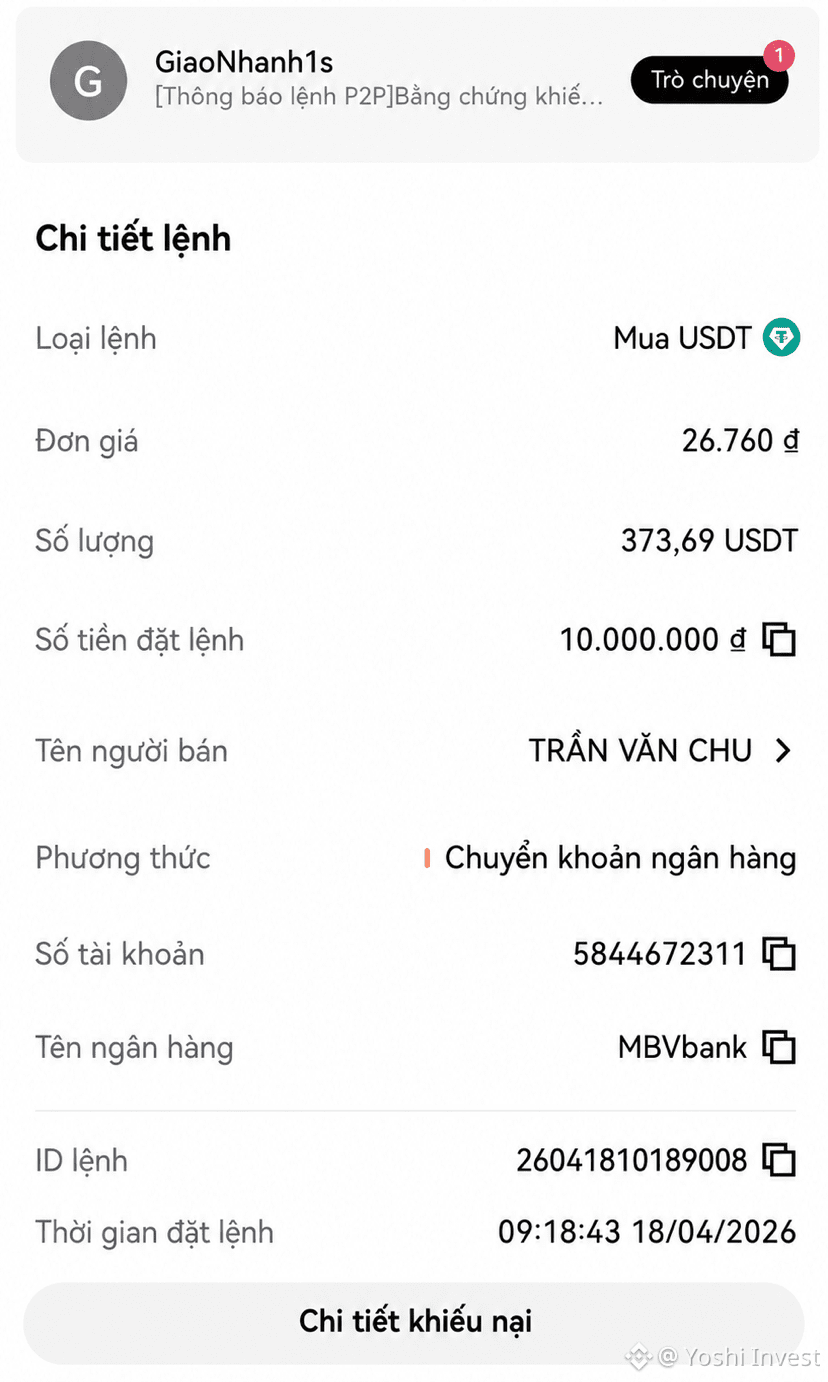
After selecting an advertisement and checking the P2P trader’s information, I placed a buy order for 373.69 USDT (VND 10 million). While I was checking the order details, I saw a few message notifications appear in the chat. By habit, I opened it to read through the seller’s long messages, then used the order information and transferred the money successfully.
After waiting a few minutes and realizing the USDT hadn’t been credited yet, I messaged the seller and requested payment in USDT, but I received no reply.
My heart was pounding; I was extremely anxious. All I could think about was that VND 10 million—how it could be a whole month’s salary, and not a small amount at all. Honestly, it felt like everything collapsed in that moment.
I checked again and saw that nothing was wrong, then reported it to Binance support. I sent the transaction evidence to support and received this response: the order had been canceled after the trading time expired.
Support also said they would try to handle it within 72 hours and asked me to keep monitoring, and if possible to coordinate with the partner and report back. In the end, after 3 days it still wasn’t resolved, and the money was lost.
I write this here not to chase likes or views, but to share the situation I went through so that others don’t lose money like I did.
Trade P2P safely:
Check the advertisement details.
Always monitor the order time and status before making a payment.
Pay according to the correct order.
Save all transaction evidence.
Ask Binance to provide support immediately.
Read the P2P trading process carefully before placing an order.
For me, this was a lifelong loss. I let the trading time pass without paying attention to the order status; by the time I made the transfer, everything was already too late.
@Binance_Vietnam #BinanceP2PAnToan #p2p #AnToanP2P
I once lost VND 10 million when trading P2P on Binance.
After selecting an advertisement and checking the P2P trader’s information, I placed a buy order for 373.69 USDT (VND 10 million). While I was checking the order details, I saw a few message notifications appear in the chat. By habit, I opened it to read through the seller’s long messages, then used the order information and transferred the money successfully.
After waiting a few minutes and realizing the USDT hadn’t been credited yet, I messaged the seller and requested payment in USDT, but I received no reply.
My heart was pounding; I was extremely anxious. All I could think about was that VND 10 million—how it could be a whole month’s salary, and not a small amount at all. Honestly, it felt like everything collapsed in that moment.
I checked again and saw that nothing was wrong, then reported it to Binance support. I sent the transaction evidence to support and received this response: the order had been canceled after the trading time expired.
Support also said they would try to handle it within 72 hours and asked me to keep monitoring, and if possible to coordinate with the partner and report back. In the end, after 3 days it still wasn’t resolved, and the money was lost.
I write this here not to chase likes or views, but to share the situation I went through so that others don’t lose money like I did.
Trade P2P safely:
Check the advertisement details.
Always monitor the order time and status before making a payment.
Pay according to the correct order.
Save all transaction evidence.
Ask Binance to provide support immediately.
Read the P2P trading process carefully before placing an order.
For me, this was a lifelong loss. I let the trading time pass without paying attention to the order status; by the time I made the transfer, everything was already too late.
@Binance Vietnam #BinanceP2PAnToan #p2p #AnToanP2P
After selecting an advertisement and checking the P2P trader’s information, I placed a buy order for 373.69 USDT (VND 10 million). While I was checking the order details, I saw a few message notifications appear in the chat. By habit, I opened it to read through the seller’s long messages, then used the order information and transferred the money successfully.
After waiting a few minutes and realizing the USDT hadn’t been credited yet, I messaged the seller and requested payment in USDT, but I received no reply.
My heart was pounding; I was extremely anxious. All I could think about was that VND 10 million—how it could be a whole month’s salary, and not a small amount at all. Honestly, it felt like everything collapsed in that moment.
I checked again and saw that nothing was wrong, then reported it to Binance support. I sent the transaction evidence to support and received this response: the order had been canceled after the trading time expired.
Support also said they would try to handle it within 72 hours and asked me to keep monitoring, and if possible to coordinate with the partner and report back. In the end, after 3 days it still wasn’t resolved, and the money was lost.
I write this here not to chase likes or views, but to share the situation I went through so that others don’t lose money like I did.
Trade P2P safely:
Check the advertisement details.
Always monitor the order time and status before making a payment.
Pay according to the correct order.
Save all transaction evidence.
Ask Binance to provide support immediately.
Read the P2P trading process carefully before placing an order.
For me, this was a lifelong loss. I let the trading time pass without paying attention to the order status; by the time I made the transfer, everything was already too late.
@Binance Vietnam #BinanceP2PAnToan #p2p #AnToanP2P
192
·
--
@Dusk_Foundation #dusk $DUSK
At first, I thought tokenizing an asset sounded fairly simple: put ownership on-chain, then whoever holds the token owns the asset.
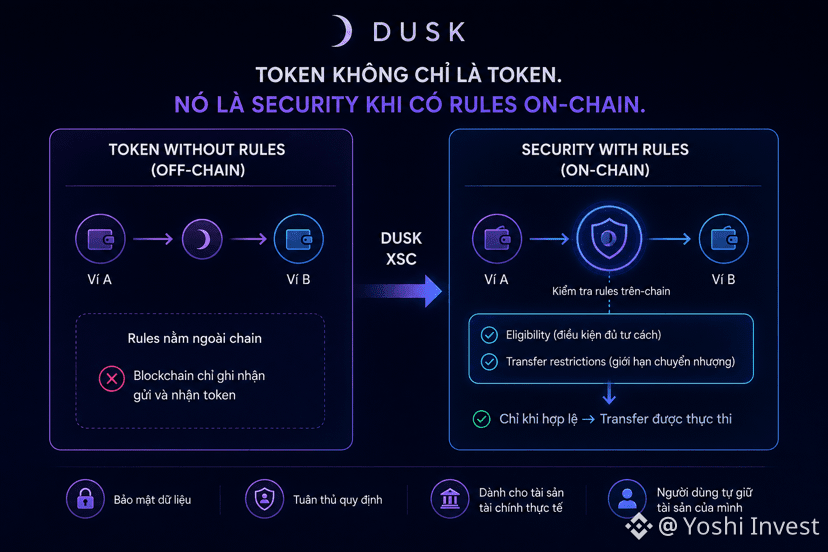
A real-world security (security) isn’t only about “who holds it.” It also comes with rules: who is allowed to buy, who is allowed to receive it, whether the token can be transferred to another wallet, and under what circumstances trades are restricted.
If the blockchain only records sending and receiving tokens, but those rules still have to be checked by an external system, then the blockchain is only recording ownership. The part that governs turning it into a managed financial asset remains outside the chain.
At @Dusk_Foundation , the Confidential Security Contract (XSC) enables rules such as eligibility (qualification requirements) and transfer restrictions to become part of the smart contract, rather than merely residing in external processes outside the blockchain.
Now I finally see what tokenization really is: having a token exist on-chain is not enough,
It needs to know who is allowed to own it, how it can be transferred, and which conditions must be satisfied.
Maybe real tokenization isn’t just bringing an asset on-chain.
It’s bringing the asset’s rules on-chain too.
@Dusk #dusk $DUSK
At first, I thought tokenizing an asset sounded fairly simple: put ownership on-chain, then whoever holds the token owns the asset.
A real-world security (security) isn’t only about “who holds it.” It also comes with rules: who is allowed to buy, who is allowed to receive it, whether the token can be transferred to another wallet, and under what circumstances trades are restricted.
If the blockchain only records sending and receiving tokens, but those rules still have to be checked by an external system, then the blockchain is only recording ownership. The part that governs turning it into a managed financial asset remains outside the chain.
At @Dusk , the Confidential Security Contract (XSC) enables rules such as eligibility (qualification requirements) and transfer restrictions to become part of the smart contract, rather than merely residing in external processes outside the blockchain.
Now I finally see what tokenization really is: having a token exist on-chain is not enough,
It needs to know who is allowed to own it, how it can be transferred, and which conditions must be satisfied.
Maybe real tokenization isn’t just bringing an asset on-chain.
It’s bringing the asset’s rules on-chain too.
At first, I thought tokenizing an asset sounded fairly simple: put ownership on-chain, then whoever holds the token owns the asset.
A real-world security (security) isn’t only about “who holds it.” It also comes with rules: who is allowed to buy, who is allowed to receive it, whether the token can be transferred to another wallet, and under what circumstances trades are restricted.
If the blockchain only records sending and receiving tokens, but those rules still have to be checked by an external system, then the blockchain is only recording ownership. The part that governs turning it into a managed financial asset remains outside the chain.
At @Dusk , the Confidential Security Contract (XSC) enables rules such as eligibility (qualification requirements) and transfer restrictions to become part of the smart contract, rather than merely residing in external processes outside the blockchain.
Now I finally see what tokenization really is: having a token exist on-chain is not enough,
It needs to know who is allowed to own it, how it can be transferred, and which conditions must be satisfied.
Maybe real tokenization isn’t just bringing an asset on-chain.
It’s bringing the asset’s rules on-chain too.
1
138
·
--
#BinanceP2PAnToan
At first, I thought that selling/buying P2P on Binance was safe only if it involved a bank transfer.
I remember one time my bank account ran into an issue. Before I could go to the bank to fix it, I needed to top up more than 11 million VND (400 USDT) via P2P to buy coins.
I went into P2P on Binance, filtered the ads by the payment method Viettel Money, chose a suitable price, checked the counterparty’s profile, selected the payment method, and then clicked the buy button.
As soon as I placed the order, my heart was pounding. Not because anything had happened to me, but because this was my first P2P transaction using a payment method other than a bank.
I planned to wait for the order to expire, cancel it, go back to the bank to redo my account, and then trade later. But the favorable position of the coin kept urging me.
I re-read the P2P trading process with the Viettel Money payment method very carefully.
Oh, so the payment method doesn’t determine whether a P2P transaction is safe. It only determines the way of payment that Binance flexibly integrates for users—just like bank transfers or other methods. I paid the counterparty using Viettel Money, and the order was completed.
Maybe that’s when I understood that safe Binance P2P doesn’t necessarily depend on a fixed method. It’s about how Binance combines flexibility with safety in P2P.
Important:
Check the counterparty’s profile.
Do not trade outside the platform.
Transaction information must match the order.
Save proof of the transaction and hit Appeal if any problem arises.
That’s also the thing I like most about Binance P2P.
@Binance_Vietnam #BinanceP2PAnToan #CreatorPad #p2p #safe
#BinanceP2PAnToan
At first, I thought that selling/buying P2P on Binance was safe only if it involved a bank transfer.
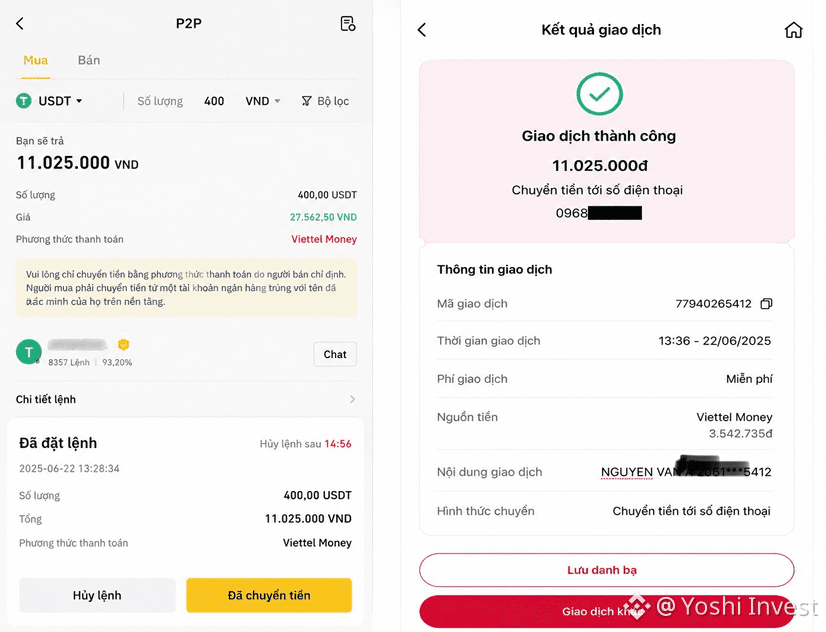
I remember one time my bank account ran into an issue. Before I could go to the bank to fix it, I needed to top up more than 11 million VND (400 USDT) via P2P to buy coins.
I went into P2P on Binance, filtered the ads by the payment method Viettel Money, chose a suitable price, checked the counterparty’s profile, selected the payment method, and then clicked the buy button.
As soon as I placed the order, my heart was pounding. Not because anything had happened to me, but because this was my first P2P transaction using a payment method other than a bank.
I planned to wait for the order to expire, cancel it, go back to the bank to redo my account, and then trade later. But the favorable position of the coin kept urging me.
I re-read the P2P trading process with the Viettel Money payment method very carefully.
Oh, so the payment method doesn’t determine whether a P2P transaction is safe. It only determines the way of payment that Binance flexibly integrates for users—just like bank transfers or other methods. I paid the counterparty using Viettel Money, and the order was completed.
Maybe that’s when I understood that safe Binance P2P doesn’t necessarily depend on a fixed method. It’s about how Binance combines flexibility with safety in P2P.
Important:
Check the counterparty’s profile.
Do not trade outside the platform.
Transaction information must match the order.
Save proof of the transaction and hit Appeal if any problem arises.
That’s also the thing I like most about Binance P2P.
@Binance Vietnam #BinanceP2PAnToan #CreatorPad #p2p #safe
At first, I thought that selling/buying P2P on Binance was safe only if it involved a bank transfer.
I remember one time my bank account ran into an issue. Before I could go to the bank to fix it, I needed to top up more than 11 million VND (400 USDT) via P2P to buy coins.
I went into P2P on Binance, filtered the ads by the payment method Viettel Money, chose a suitable price, checked the counterparty’s profile, selected the payment method, and then clicked the buy button.
As soon as I placed the order, my heart was pounding. Not because anything had happened to me, but because this was my first P2P transaction using a payment method other than a bank.
I planned to wait for the order to expire, cancel it, go back to the bank to redo my account, and then trade later. But the favorable position of the coin kept urging me.
I re-read the P2P trading process with the Viettel Money payment method very carefully.
Oh, so the payment method doesn’t determine whether a P2P transaction is safe. It only determines the way of payment that Binance flexibly integrates for users—just like bank transfers or other methods. I paid the counterparty using Viettel Money, and the order was completed.
Maybe that’s when I understood that safe Binance P2P doesn’t necessarily depend on a fixed method. It’s about how Binance combines flexibility with safety in P2P.
Important:
Check the counterparty’s profile.
Do not trade outside the platform.
Transaction information must match the order.
Save proof of the transaction and hit Appeal if any problem arises.
That’s also the thing I like most about Binance P2P.
@Binance Vietnam #BinanceP2PAnToan #CreatorPad #p2p #safe
1
122
·
--
At first, I thought the more transparent the blockchain is, the more suitable it is for finance. Every transaction is recorded, and anyone can verify it—this lack of anything being hidden is precisely the essence of blockchain.
When I looked into @Dusk_Foundation , I began to put myself in the shoes of an organization building a trading position on the blockchain. Transaction size, balances, or counterparty information can all become data for the market to track. If everything is default public, transparency can turn into a drawback: competitors know too much about activities they don’t need to know.
So does blockchain truly need everything to be public?
Dusk builds Layer-1 for regulated finance with a different approach. In DuskDS, Moonlight publicly reveals the sender, recipient, and amount; Phoenix uses zero-knowledge proofs to hide this information in shielded transactions. The two models coexist on a single blockchain, rather than forcing every financial activity to have the same level of visibility.
And I realized I had conflated two different things: seeing and verifying.
A transaction doesn’t necessarily need to be visible to everyone for the blockchain to still be able to prove that it’s valid.
Maybe financial markets don’t need maximum visibility.
They need maximum verifiability.
@Dusk_Foundation #dusk $DUSK
At first, I thought the more transparent the blockchain is, the more suitable it is for finance. Every transaction is recorded, and anyone can verify it—this lack of anything being hidden is precisely the essence of blockchain.
When I looked into @Dusk , I began to put myself in the shoes of an organization building a trading position on the blockchain. Transaction size, balances, or counterparty information can all become data for the market to track. If everything is default public, transparency can turn into a drawback: competitors know too much about activities they don’t need to know.
So does blockchain truly need everything to be public?
Dusk builds Layer-1 for regulated finance with a different approach. In DuskDS, Moonlight publicly reveals the sender, recipient, and amount; Phoenix uses zero-knowledge proofs to hide this information in shielded transactions. The two models coexist on a single blockchain, rather than forcing every financial activity to have the same level of visibility.
And I realized I had conflated two different things: seeing and verifying.
A transaction doesn’t necessarily need to be visible to everyone for the blockchain to still be able to prove that it’s valid.
Maybe financial markets don’t need maximum visibility.
They need maximum verifiability.
@Dusk #dusk $DUSK
When I looked into @Dusk , I began to put myself in the shoes of an organization building a trading position on the blockchain. Transaction size, balances, or counterparty information can all become data for the market to track. If everything is default public, transparency can turn into a drawback: competitors know too much about activities they don’t need to know.
So does blockchain truly need everything to be public?
Dusk builds Layer-1 for regulated finance with a different approach. In DuskDS, Moonlight publicly reveals the sender, recipient, and amount; Phoenix uses zero-knowledge proofs to hide this information in shielded transactions. The two models coexist on a single blockchain, rather than forcing every financial activity to have the same level of visibility.
And I realized I had conflated two different things: seeing and verifying.
A transaction doesn’t necessarily need to be visible to everyone for the blockchain to still be able to prove that it’s valid.
Maybe financial markets don’t need maximum visibility.
They need maximum verifiability.
@Dusk #dusk $DUSK
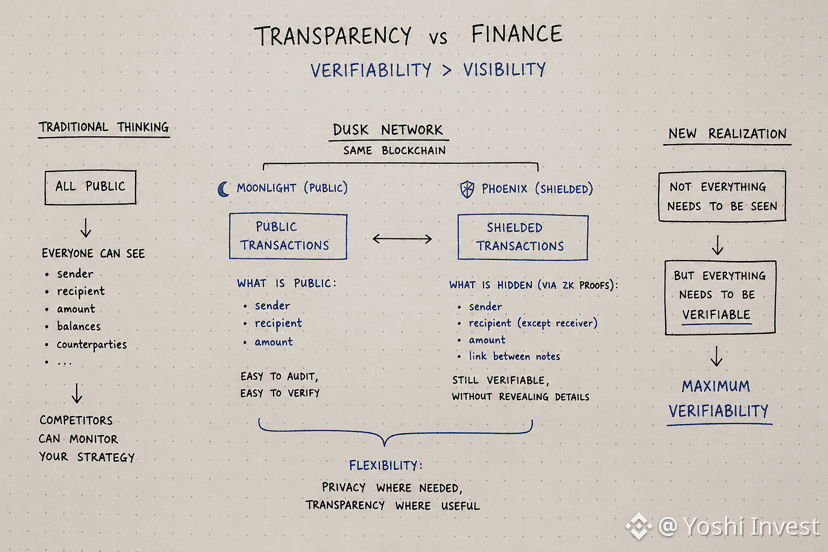
1
1
73
·
--
I’m a newbie. At first, I thought that when selling P2P, if the buyer transfers a little extra, it’s not a big deal—if more money lands in my account, then I benefit more.
I remember my very first time selling 14,575,000 VND. About 550 USDT came into my bank account via P2P on Binance. I scrolled up and down a few times to find a suitable buyer, then placed the order and waited for the payment to come through.
Five minutes later, the banking app notified me that the money had been received, so I opened it to check. The buyer and the payment method were exactly as in the order, but the amount received was higher by 35,000 VND.
Honestly, at that moment I thought I’d somehow gotten a free cup of coffee. I was smiling to myself… and then I suddenly snapped out of it—not because I found anything suspicious, but because my older brother came up behind me to scare me.
I turned to him and said, “Today I’m treating you to coffee. I just sold P2P on Binance, and the customer transferred me an extra 35,000 VND.”
My brother just stood there for 5 seconds, then said: “Nothing is free—rainwater even has sediment. P2P transactions have to be exact to the ordered amount, okay? Binance has a warning in #BinanceP2PAnToan —check it again.”
I thought about it for a few minutes: Binance’s warning about “the correct amount.” And I didn’t confirm. I contacted the buyer and Binance support to request a refund and cancel the order. The order was cancelled, and the money was refunded according to Binance’s instructions.
I understand P2P safety better now: having the money arrive in your account from the right person and using the right payment method is still not enough—the amount also has to match the order. That extra 35,000 VND, which I thought was a free cup of coffee, turned out to be a sign I shouldn’t ignore.
Maybe after that transaction, I started paying closer attention to even the smallest Binance warning details about P2P safety.
@Binance_Vietnam #BinanceP2PAnToan #p2p #antoan #P2P
I’m a newbie. At first, I thought that when selling P2P, if the buyer transfers a little extra, it’s not a big deal—if more money lands in my account, then I benefit more.
I remember my very first time selling 14,575,000 VND. About 550 USDT came into my bank account via P2P on Binance. I scrolled up and down a few times to find a suitable buyer, then placed the order and waited for the payment to come through.
Five minutes later, the banking app notified me that the money had been received, so I opened it to check. The buyer and the payment method were exactly as in the order, but the amount received was higher by 35,000 VND.
Honestly, at that moment I thought I’d somehow gotten a free cup of coffee. I was smiling to myself… and then I suddenly snapped out of it—not because I found anything suspicious, but because my older brother came up behind me to scare me.
I turned to him and said, “Today I’m treating you to coffee. I just sold P2P on Binance, and the customer transferred me an extra 35,000 VND.”
My brother just stood there for 5 seconds, then said: “Nothing is free—rainwater even has sediment. P2P transactions have to be exact to the ordered amount, okay? Binance has a warning in #BinanceP2PAnToan —check it again.”
I thought about it for a few minutes: Binance’s warning about “the correct amount.” And I didn’t confirm. I contacted the buyer and Binance support to request a refund and cancel the order. The order was cancelled, and the money was refunded according to Binance’s instructions.
I understand P2P safety better now: having the money arrive in your account from the right person and using the right payment method is still not enough—the amount also has to match the order. That extra 35,000 VND, which I thought was a free cup of coffee, turned out to be a sign I shouldn’t ignore.
Maybe after that transaction, I started paying closer attention to even the smallest Binance warning details about P2P safety.
@Binance Vietnam #BinanceP2PAnToan #p2p #antoan #P2P
I remember my very first time selling 14,575,000 VND. About 550 USDT came into my bank account via P2P on Binance. I scrolled up and down a few times to find a suitable buyer, then placed the order and waited for the payment to come through.
Five minutes later, the banking app notified me that the money had been received, so I opened it to check. The buyer and the payment method were exactly as in the order, but the amount received was higher by 35,000 VND.
Honestly, at that moment I thought I’d somehow gotten a free cup of coffee. I was smiling to myself… and then I suddenly snapped out of it—not because I found anything suspicious, but because my older brother came up behind me to scare me.
I turned to him and said, “Today I’m treating you to coffee. I just sold P2P on Binance, and the customer transferred me an extra 35,000 VND.”
My brother just stood there for 5 seconds, then said: “Nothing is free—rainwater even has sediment. P2P transactions have to be exact to the ordered amount, okay? Binance has a warning in #BinanceP2PAnToan —check it again.”
I thought about it for a few minutes: Binance’s warning about “the correct amount.” And I didn’t confirm. I contacted the buyer and Binance support to request a refund and cancel the order. The order was cancelled, and the money was refunded according to Binance’s instructions.
I understand P2P safety better now: having the money arrive in your account from the right person and using the right payment method is still not enough—the amount also has to match the order. That extra 35,000 VND, which I thought was a free cup of coffee, turned out to be a sign I shouldn’t ignore.
Maybe after that transaction, I started paying closer attention to even the smallest Binance warning details about P2P safety.
@Binance Vietnam #BinanceP2PAnToan #p2p #antoan #P2P
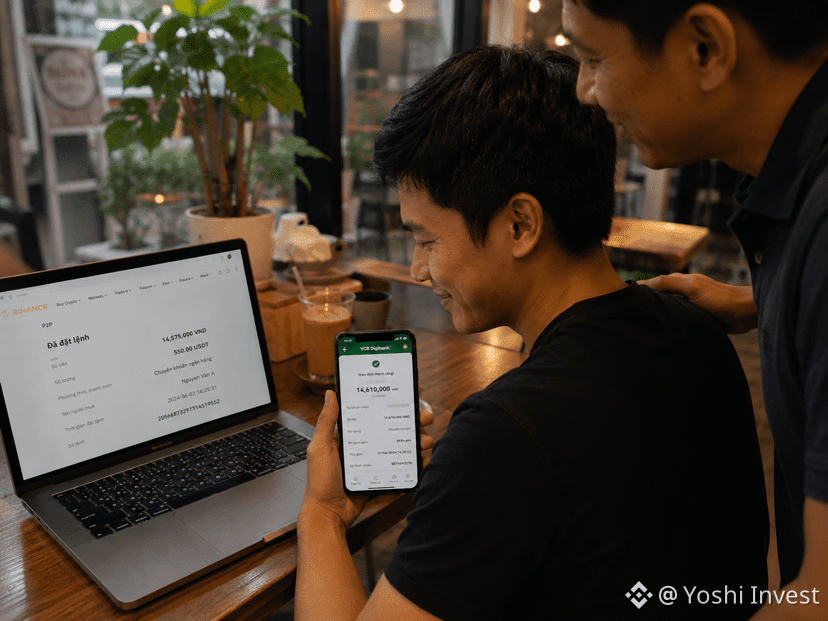
1
2
217
Log in to explore more content
Join global crypto users on Binance Square
⚡️ Get latest and useful information about crypto.
💬 Trusted by the world’s largest crypto exchange.
👍 Discover real insights from verified creators.
Email / Phone number
Trending Topics
BinancePick
2.7M views
143,694 Discussing
Join #EarningsSeason: Predict Earnings on Binance Pick, Share Your Take on Binance Square!
Binance Square Official
·402 Likes
·339.2k views
EarningsSeason
5M views
24,648 Discussing
SouthKoreaReportedlyWeighsFourthCryptoTaxDelay
2,343 views
107 Discussing