

#metamaskexitslidovalidatorsaftersecurityincident
metamaskexitslidovalidatorsaftersecurityincident
Hot
Latest

·
--
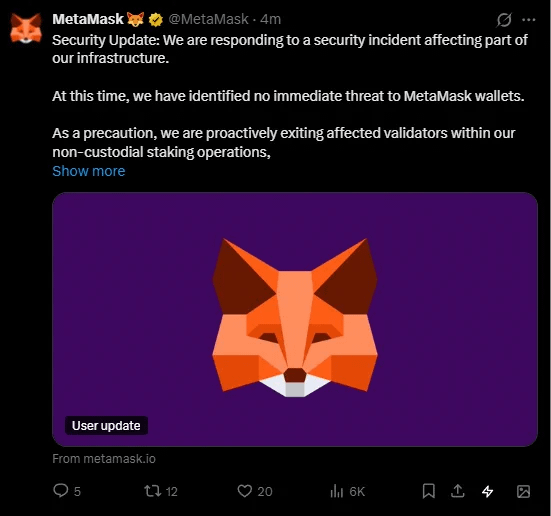
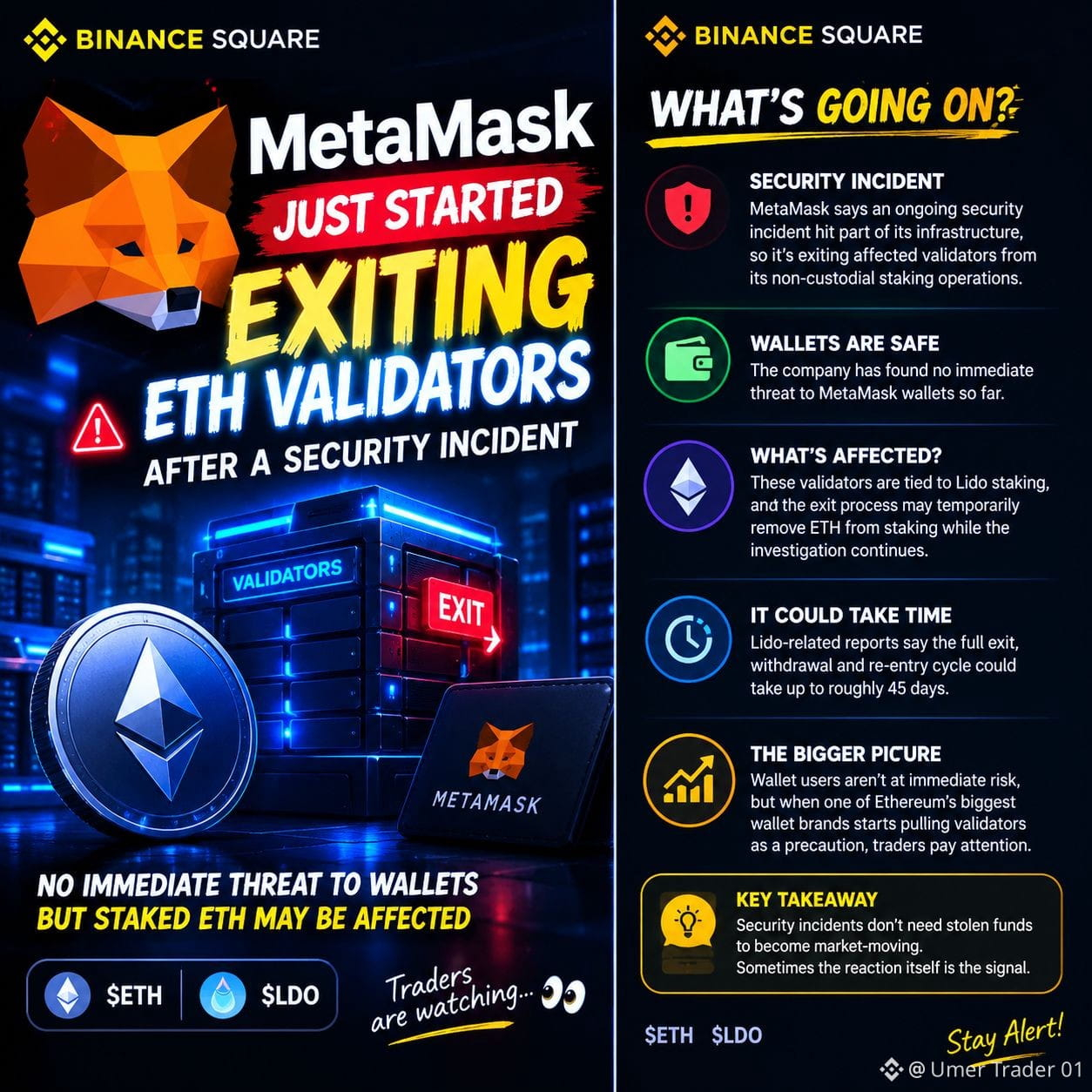
🚨 METAMASK JUST STARTED EXITING ETH VALIDATORS AFTER A SECURITY INCIDENT.
MetaMask says an ongoing security incident hit part of its infrastructure, forcing it to proactively exit affected validators from its non-custodial staking operations. The company says it has found no immediate threat to MetaMask wallets so far.
The key detail?
These validators are tied to Lido staking, and the exit process may temporarily remove ETH from staking while the investigation continues. Lido-related reports say the full exit, withdrawal and re-entry cycle could take up to roughly 45 days.
That means the market should separate two things:
Wallet users are not currently being told they’re at immediate risk.
But validator infrastructure clearly was serious enough to trigger an emergency exit.
And when one of Ethereum’s biggest wallet brands starts pulling validators as a precaution, traders pay attention.
Security incidents don’t need stolen funds to become market-moving.
Sometimes the reaction itself is the signal. 👀
$ETH $LDO
#metamaskexitslidovalidatorsaftersecurityincident
🚨 METAMASK JUST STARTED EXITING ETH VALIDATORS AFTER A SECURITY INCIDENT.
MetaMask says an ongoing security incident hit part of its infrastructure, forcing it to proactively exit affected validators from its non-custodial staking operations. The company says it has found no immediate threat to MetaMask wallets so far.
The key detail?
These validators are tied to Lido staking, and the exit process may temporarily remove ETH from staking while the investigation continues. Lido-related reports say the full exit, withdrawal and re-entry cycle could take up to roughly 45 days.
That means the market should separate two things:
Wallet users are not currently being told they’re at immediate risk.
But validator infrastructure clearly was serious enough to trigger an emergency exit.
And when one of Ethereum’s biggest wallet brands starts pulling validators as a precaution, traders pay attention.
Security incidents don’t need stolen funds to become market-moving.
Sometimes the reaction itself is the signal. 👀
$ETH $LDO
#metamaskexitslidovalidatorsaftersecurityincident
MetaMask says an ongoing security incident hit part of its infrastructure, forcing it to proactively exit affected validators from its non-custodial staking operations. The company says it has found no immediate threat to MetaMask wallets so far.
The key detail?
These validators are tied to Lido staking, and the exit process may temporarily remove ETH from staking while the investigation continues. Lido-related reports say the full exit, withdrawal and re-entry cycle could take up to roughly 45 days.
That means the market should separate two things:
Wallet users are not currently being told they’re at immediate risk.
But validator infrastructure clearly was serious enough to trigger an emergency exit.
And when one of Ethereum’s biggest wallet brands starts pulling validators as a precaution, traders pay attention.
Security incidents don’t need stolen funds to become market-moving.
Sometimes the reaction itself is the signal. 👀
$ETH $LDO
#metamaskexitslidovalidatorsaftersecurityincident
2.4k

·
--
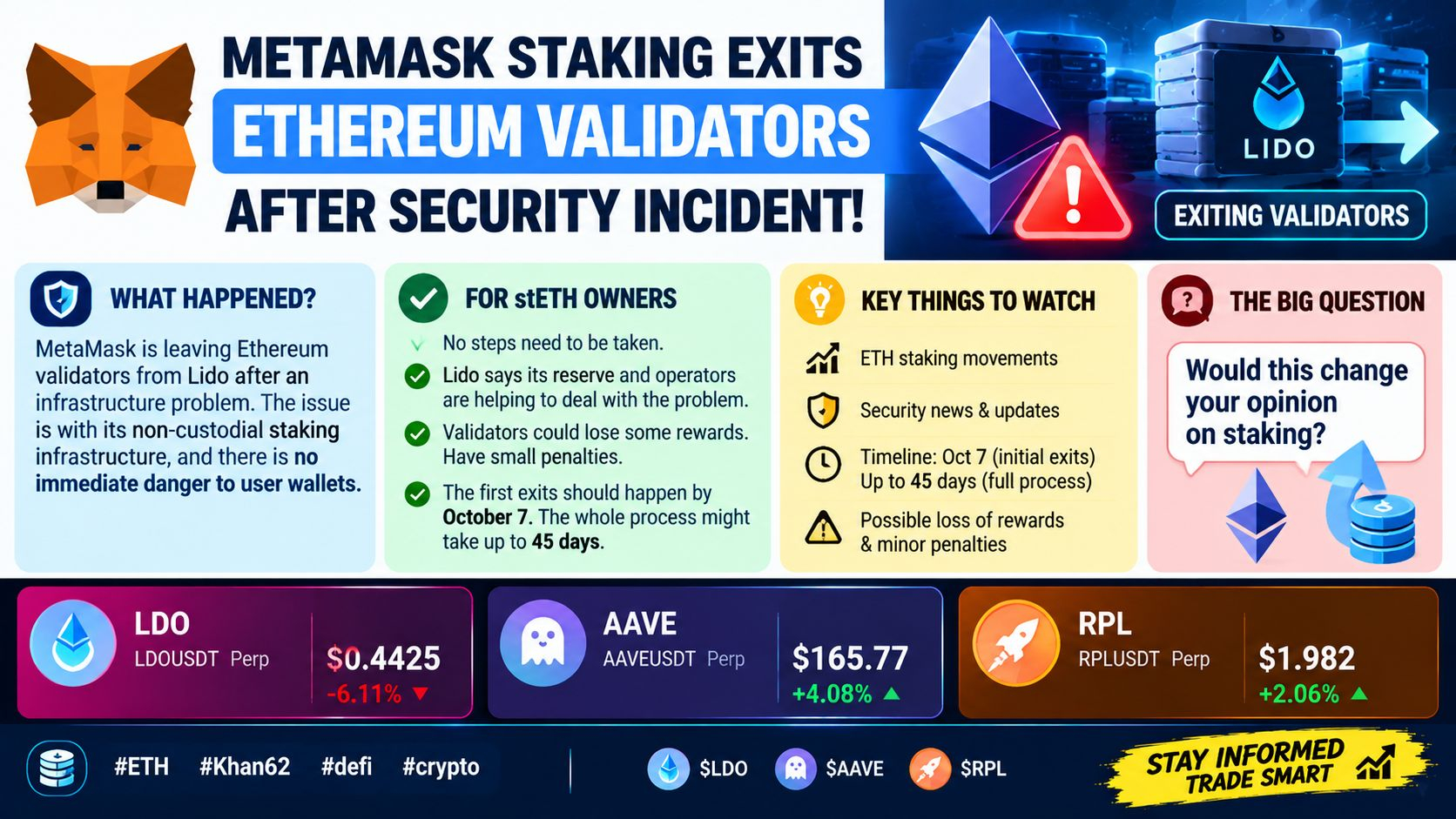
#metamaskexitslidovalidatorsaftersecurityincident 🚨 METAMASK STAKING EXITS ETHEREUM VALIDATORS AFTER SECURITY INCIDENT!
MetaMask is leaving Ethereum validators from Lido after an infrastructure problem. MetaMask says the problem is with its non-custodial staking infrastructure and there is no immediate danger to user wallets.
For stETH owners:
🔹 No steps need to be taken.
🔹 Lido says its reserve and operators are helping to deal with the problem.
🔹 Validators could lose some rewards. Have small penalties.
🔹 The first exits should happen by October 7. The whole process might take, up to 45 days.
Traders need to pay attention to ETH staking movements and security news.
Would this change your opinion on staking?
#ETH #Khan62 #defi #crypto
· $LDO · $AAVE · $RPL ·
{future}(LDOUSDT)
{future}(AAVEUSDT)
{future}(RPLUSDT)
#metamaskexitslidovalidatorsaftersecurityincident 🚨 METAMASK STAKING EXITS ETHEREUM VALIDATORS AFTER SECURITY INCIDENT!
MetaMask is leaving Ethereum validators from Lido after an infrastructure problem. MetaMask says the problem is with its non-custodial staking infrastructure and there is no immediate danger to user wallets.
For stETH owners:
🔹 No steps need to be taken.
🔹 Lido says its reserve and operators are helping to deal with the problem.
🔹 Validators could lose some rewards. Have small penalties.
🔹 The first exits should happen by October 7. The whole process might take, up to 45 days.
Traders need to pay attention to ETH staking movements and security news.
Would this change your opinion on staking?
#ETH #Khan62 #defi #crypto
· $LDO · $AAVE · $RPL ·
MetaMask is leaving Ethereum validators from Lido after an infrastructure problem. MetaMask says the problem is with its non-custodial staking infrastructure and there is no immediate danger to user wallets.
For stETH owners:
🔹 No steps need to be taken.
🔹 Lido says its reserve and operators are helping to deal with the problem.
🔹 Validators could lose some rewards. Have small penalties.
🔹 The first exits should happen by October 7. The whole process might take, up to 45 days.
Traders need to pay attention to ETH staking movements and security news.
Would this change your opinion on staking?
#ETH #Khan62 #defi #crypto
· $LDO · $AAVE · $RPL ·
1
2.5k

·
--
🚨 MetaMask Security Incident Response 📊⚡
MetaMask responds to security incident affecting infrastructure components with no immediate threat to wallets identified. As precaution, exiting affected Ethereum validators in non-custodial staking operations with process coordinated with partners and completion expected by October 7. $MOVR $AGT $CAP
#MetaMaskExitsLidoValidatorsAfterSecurityIncident
🚨 MetaMask Security Incident Response 📊⚡
MetaMask responds to security incident affecting infrastructure components with no immediate threat to wallets identified. As precaution, exiting affected Ethereum validators in non-custodial staking operations with process coordinated with partners and completion expected by October 7. $MOVR $AGT $CAP
#MetaMaskExitsLidoValidatorsAfterSecurityIncident
MetaMask responds to security incident affecting infrastructure components with no immediate threat to wallets identified. As precaution, exiting affected Ethereum validators in non-custodial staking operations with process coordinated with partners and completion expected by October 7. $MOVR $AGT $CAP
#MetaMaskExitsLidoValidatorsAfterSecurityIncident

1
356


#MetaMaskExitsLidoValidatorsAfterSecurityIncident
What’s happening with MetaMask and Lido?
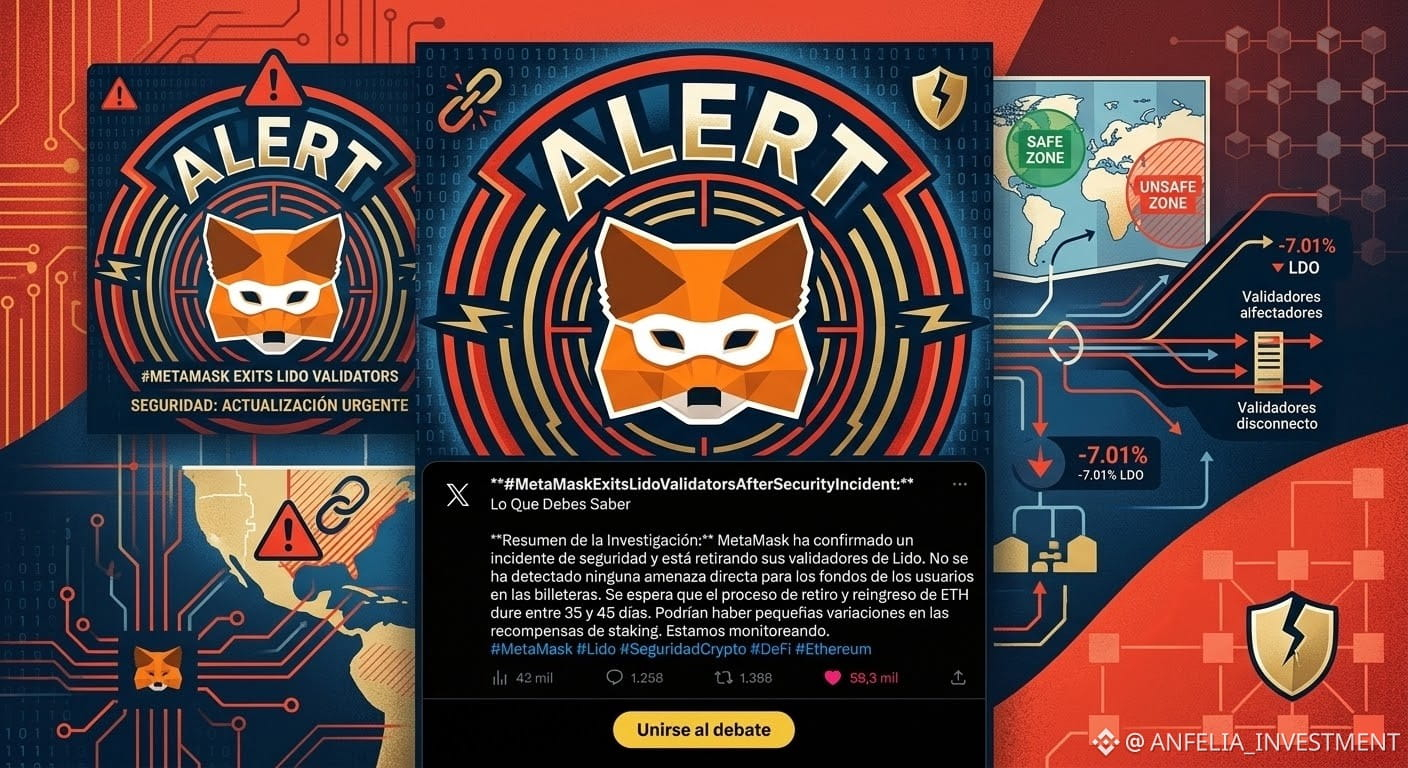
The incident: MetaMask detected a security incident in part of its infrastructure and, as a preventive measure, is proactively removing (exiting) its Ethereum validators from within the Lido staking protocol.
User security: MetaMask clarified that no threat or immediate risk has been detected for users’ wallets.
Technical impact and timing:
The affected validators will complete their exit process by October 7.
The withdrawn ETH will gradually return to the Lido protocol. The full process of exit, withdrawal, and re-entry of those funds may take between 35 and 45 days.
Lido warned that these preventive exits could cause brief periods of inactivity or temporary losses in staking rewards generated during the transition.
🚨 LATEST BREAKING NEWS IN CRYPTO & DEFI 🚨
MetaMask has begun proactively withdrawing its Ethereum validators from Lido after detecting a security incident in part of its infrastructure.
Here’s the most important information you should know if you stake or use MetaMask 👇
1️⃣ Are your funds/funds at risk in the wallet? No. MetaMask confirmed that there is NO threat or direct risk to users’ wallets. The measure is purely preventive and focused on the infrastructure of its validators.
2️⃣ What happens to the ETH involved? The validators’ exit process will end around October 7. After that, the ETH will leave progressively and return to the Lido protocol. The entire technical reconfiguration process can take between 35 and 45 days.
3️⃣ Side effects Lido noted that this temporary validator disconnect may show up as small performance variations or brief pauses in the generation of staking rewards for the affected pool while the migration concludes.
Keep your private keys secure and don’t fall for suspicious links or messages that take advantage of the temporary panic.
#MetaMaskExitsLidoValidatorsAfterSecurityIncident
What’s happening with MetaMask and Lido?
The incident: MetaMask detected a security incident in part of its infrastructure and, as a preventive measure, is proactively removing (exiting) its Ethereum validators from within the Lido staking protocol.
User security: MetaMask clarified that no threat or immediate risk has been detected for users’ wallets.
Technical impact and timing:
The affected validators will complete their exit process by October 7.
The withdrawn ETH will gradually return to the Lido protocol. The full process of exit, withdrawal, and re-entry of those funds may take between 35 and 45 days.
Lido warned that these preventive exits could cause brief periods of inactivity or temporary losses in staking rewards generated during the transition.
🚨 LATEST BREAKING NEWS IN CRYPTO & DEFI 🚨
MetaMask has begun proactively withdrawing its Ethereum validators from Lido after detecting a security incident in part of its infrastructure.
Here’s the most important information you should know if you stake or use MetaMask 👇
1️⃣ Are your funds/funds at risk in the wallet? No. MetaMask confirmed that there is NO threat or direct risk to users’ wallets. The measure is purely preventive and focused on the infrastructure of its validators.
2️⃣ What happens to the ETH involved? The validators’ exit process will end around October 7. After that, the ETH will leave progressively and return to the Lido protocol. The entire technical reconfiguration process can take between 35 and 45 days.
3️⃣ Side effects Lido noted that this temporary validator disconnect may show up as small performance variations or brief pauses in the generation of staking rewards for the affected pool while the migration concludes.
Keep your private keys secure and don’t fall for suspicious links or messages that take advantage of the temporary panic.
What’s happening with MetaMask and Lido?
The incident: MetaMask detected a security incident in part of its infrastructure and, as a preventive measure, is proactively removing (exiting) its Ethereum validators from within the Lido staking protocol.
User security: MetaMask clarified that no threat or immediate risk has been detected for users’ wallets.
Technical impact and timing:
The affected validators will complete their exit process by October 7.
The withdrawn ETH will gradually return to the Lido protocol. The full process of exit, withdrawal, and re-entry of those funds may take between 35 and 45 days.
Lido warned that these preventive exits could cause brief periods of inactivity or temporary losses in staking rewards generated during the transition.
🚨 LATEST BREAKING NEWS IN CRYPTO & DEFI 🚨
MetaMask has begun proactively withdrawing its Ethereum validators from Lido after detecting a security incident in part of its infrastructure.
Here’s the most important information you should know if you stake or use MetaMask 👇
1️⃣ Are your funds/funds at risk in the wallet? No. MetaMask confirmed that there is NO threat or direct risk to users’ wallets. The measure is purely preventive and focused on the infrastructure of its validators.
2️⃣ What happens to the ETH involved? The validators’ exit process will end around October 7. After that, the ETH will leave progressively and return to the Lido protocol. The entire technical reconfiguration process can take between 35 and 45 days.
3️⃣ Side effects Lido noted that this temporary validator disconnect may show up as small performance variations or brief pauses in the generation of staking rewards for the affected pool while the migration concludes.
Keep your private keys secure and don’t fall for suspicious links or messages that take advantage of the temporary panic.
1
175

·
--
Bullish
#metamaskexitslidovalidatorsaftersecurityincident
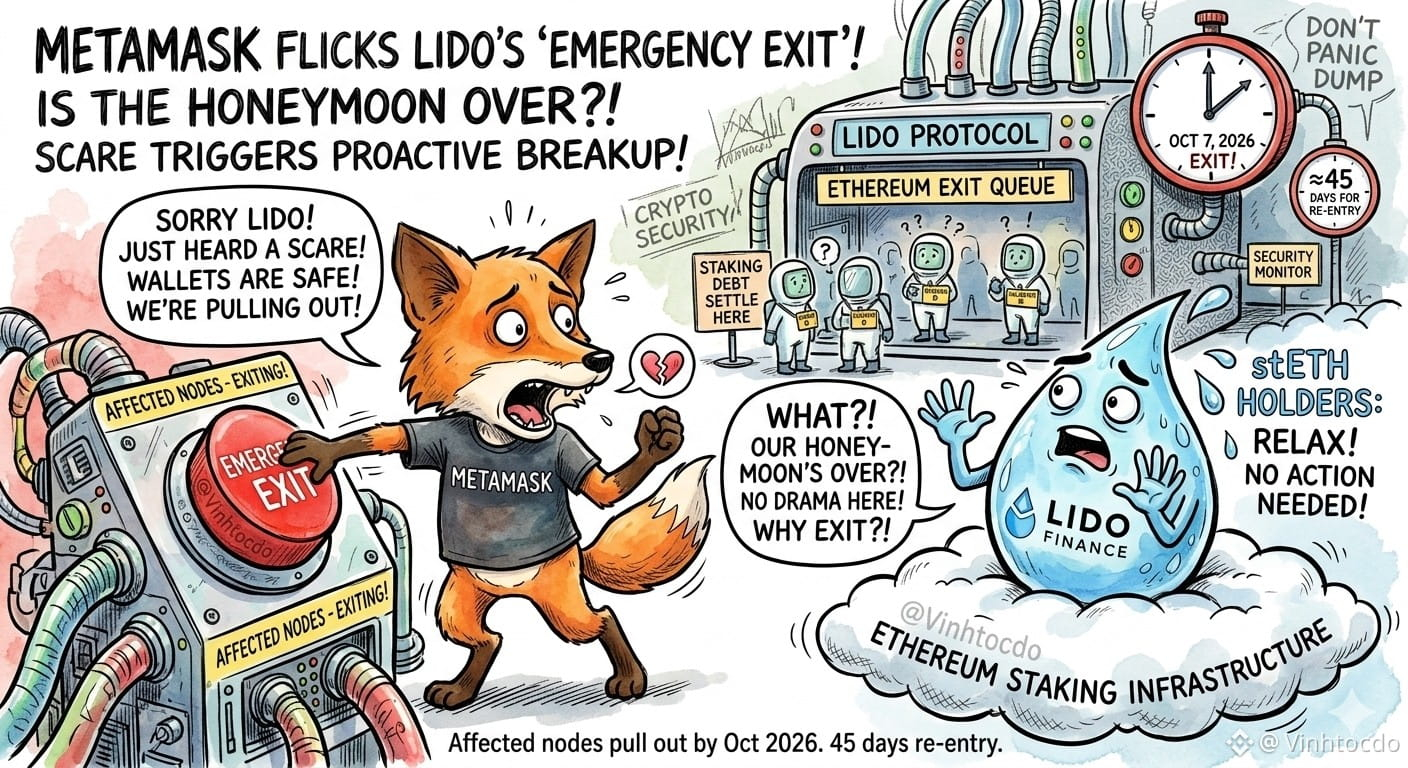
🦊 MetaMask & Lido: Is the honeymoon officially over?! 💔
MetaMask just hit the "Emergency Exit" button on its Lido Ethereum validators after a security scare! 😱 While MetaMask assures everyone that wallet funds are totally safe, they aren't taking any chances with their non-custodial staking infrastructure.
🔮 What happened to Lido?
No drama on Lido's side, but MetaMask is proactively pulling its affected nodes out of the Lido protocol. The validators are exiting by October 7, 2026, and the full re-entry process could take around 45 days. Good news? If you hold stETH, you can relax—no action is needed! 🛡️
🧠 What should traders do?
Don't panic-dump your bags. Keep your funds secure, double-check your staking setups, and always monitor security updates!
Not financial advice.
Support me by using code VINHTOCDO or link: [https://www.binance.com/register?ref=VINHTOCDO](https://www.binance.com/register?ref=VINHTOCDO)
👇 Click trade below to support me:
$BTC
{future}(BTCUSDT)
$ETH
{future}(ETHUSDT)
$LDO
{future}(LDOUSDT)
#MetaMask #LidoFinance #CryptoSecurity #EthereumStaking #CryptoNews #VINHTOCDO
#metamaskexitslidovalidatorsaftersecurityincident
🦊 MetaMask & Lido: Is the honeymoon officially over?! 💔
MetaMask just hit the "Emergency Exit" button on its Lido Ethereum validators after a security scare! 😱 While MetaMask assures everyone that wallet funds are totally safe, they aren't taking any chances with their non-custodial staking infrastructure.
🔮 What happened to Lido?
No drama on Lido's side, but MetaMask is proactively pulling its affected nodes out of the Lido protocol. The validators are exiting by October 7, 2026, and the full re-entry process could take around 45 days. Good news? If you hold stETH, you can relax—no action is needed! 🛡️
🧠 What should traders do?
Don't panic-dump your bags. Keep your funds secure, double-check your staking setups, and always monitor security updates!
Not financial advice.
Support me by using code VINHTOCDO or link: https://www.binance.com/register?ref=VINHTOCDO
👇 Click trade below to support me:
$BTC
$ETH
$LDO
#MetaMask #LidoFinance #CryptoSecurity #EthereumStaking #CryptoNews #VINHTOCDO
🦊 MetaMask & Lido: Is the honeymoon officially over?! 💔
MetaMask just hit the "Emergency Exit" button on its Lido Ethereum validators after a security scare! 😱 While MetaMask assures everyone that wallet funds are totally safe, they aren't taking any chances with their non-custodial staking infrastructure.
🔮 What happened to Lido?
No drama on Lido's side, but MetaMask is proactively pulling its affected nodes out of the Lido protocol. The validators are exiting by October 7, 2026, and the full re-entry process could take around 45 days. Good news? If you hold stETH, you can relax—no action is needed! 🛡️
🧠 What should traders do?
Don't panic-dump your bags. Keep your funds secure, double-check your staking setups, and always monitor security updates!
Not financial advice.
Support me by using code VINHTOCDO or link: https://www.binance.com/register?ref=VINHTOCDO
👇 Click trade below to support me:
$BTC
$ETH
$LDO
#MetaMask #LidoFinance #CryptoSecurity #EthereumStaking #CryptoNews #VINHTOCDO
2
283

·
--
#MetaMaskExitsLidoValidatorsAfterSecurityIncident Are your funds in Staking at risk?
The DeFi ecosystem is shaken up. ConsenSys has urgently withdrawn its validators after a major security incident at Lido. The debate about centralization risks in liquid staking protocols flares up again strongly over the future of LDO and the ETH network—are we really sure?
Meanwhile, regulation is speeding up to try to control the ecosystem. On one hand, #SECToClarifyOnChainFundraisingRules is aiming to impose strict rules on fundraisings directly on-chain (on-chain). Will this be the end of ICOs and free pre-sales? On the other, in the UK, a spark of hope appears after the announcement of #UKFCAOpensCryptoFirmAuthorization , which officially opens the doors for crypto businesses under a clear legal framework.
Security and laws are changing the game this week. Don’t stay out of the conversation.
💬 Do you have funds invested in Lido or doing staking in some DeFi? Do you think the new SEC rules will protect users or just slow down innovation?
Leave your opinion below, share to alert others, and let’s discuss in the comments! 👇
{future}(ETHUSDT)
#Ethereum✅ #defi
#MetaMaskExitsLidoValidatorsAfterSecurityIncident Are your funds in Staking at risk?
The DeFi ecosystem is shaken up. ConsenSys has urgently withdrawn its validators after a major security incident at Lido. The debate about centralization risks in liquid staking protocols flares up again strongly over the future of LDO and the ETH network—are we really sure?
Meanwhile, regulation is speeding up to try to control the ecosystem. On one hand, #SECToClarifyOnChainFundraisingRules is aiming to impose strict rules on fundraisings directly on-chain (on-chain). Will this be the end of ICOs and free pre-sales? On the other, in the UK, a spark of hope appears after the announcement of #UKFCAOpensCryptoFirmAuthorization , which officially opens the doors for crypto businesses under a clear legal framework.
Security and laws are changing the game this week. Don’t stay out of the conversation.
💬 Do you have funds invested in Lido or doing staking in some DeFi? Do you think the new SEC rules will protect users or just slow down innovation?
Leave your opinion below, share to alert others, and let’s discuss in the comments! 👇
#Ethereum✅ #defi
The DeFi ecosystem is shaken up. ConsenSys has urgently withdrawn its validators after a major security incident at Lido. The debate about centralization risks in liquid staking protocols flares up again strongly over the future of LDO and the ETH network—are we really sure?
Meanwhile, regulation is speeding up to try to control the ecosystem. On one hand, #SECToClarifyOnChainFundraisingRules is aiming to impose strict rules on fundraisings directly on-chain (on-chain). Will this be the end of ICOs and free pre-sales? On the other, in the UK, a spark of hope appears after the announcement of #UKFCAOpensCryptoFirmAuthorization , which officially opens the doors for crypto businesses under a clear legal framework.
Security and laws are changing the game this week. Don’t stay out of the conversation.
💬 Do you have funds invested in Lido or doing staking in some DeFi? Do you think the new SEC rules will protect users or just slow down innovation?
Leave your opinion below, share to alert others, and let’s discuss in the comments! 👇
#Ethereum✅ #defi
2
178

🚨 META MASK × ETH ALERT 🚨
MetaMask is reportedly exiting affected ETH validators after a security incident.
No immediate wallet threat has been reported, but the validator exit could temporarily reduce ETH staking activity.
ETH traders are watching this closely.⚠️
$ETH $LDO
#MetaMaskExitsLidoValidatorsAfterSecurityIncident
🚨 META MASK × ETH ALERT 🚨
MetaMask is reportedly exiting affected ETH validators after a security incident.
No immediate wallet threat has been reported, but the validator exit could temporarily reduce ETH staking activity.
ETH traders are watching this closely.⚠️
$ETH $LDO
#MetaMaskExitsLidoValidatorsAfterSecurityIncident
MetaMask is reportedly exiting affected ETH validators after a security incident.
No immediate wallet threat has been reported, but the validator exit could temporarily reduce ETH staking activity.
ETH traders are watching this closely.⚠️
$ETH $LDO
#MetaMaskExitsLidoValidatorsAfterSecurityIncident
8

·
--
#metamaskexitslidovalidatorsaftersecurityincident
🚨 DeFi Security Alert: MetaMask Exits Lido Validators After Security Incident!
The Market Update: Decentralized staking infrastructure is experiencing a major realignment as MetaMask officially initiates the exit of its validators from Lido following a critical security incident review. As tracked by the risk and compliance dashboard, protocol teams are aggressively mitigating counterparty and smart contract risks, leading to a substantial re-allocation of staked capital across alternative validator architectures. 📊
What This Means for Traders: Security incidents involving dominant liquid staking protocols trigger immediate liquidity shifts and adjustments in staking yields. Market participants are closely monitoring unstaking queues, validator distribution metrics, and alternative staking tokens as capital rotates to hedge against smart contract vulnerabilities.
Highlighted Tradeable Coins to Watch (Staking & Ecosystem Core):
$LDO (Lido DAO): The primary asset affected by validator exits; tracking governance sentiment, protocol fee adjustments, and total value locked (TVL) fluctuations.
$ETH (Ethereum): The underlying layer-1 staking asset; monitoring validator queue times, exit volumes, and overall network staking participation rates.
$SOL (Solana): High-throughput alternative staking benchmark; observing capital inflows into alternative proof-of-stake ecosystems amidst liquid staking security updates.
(Disclaimer: While requested alongside tech/hardware sector focus, coins tied directly to liquid staking and layer-1 security are highlighted above alongside core market anchors.)
How do you think this high-profile validator exit will impact the decentralization and distribution of liquid staking assets across DeFi protocols? Let's discuss your strategy in the comments below! 👇
{spot}(LDOUSDT)
{spot}(ETHUSDT)
{spot}(SOLUSDT)
#MetaMask #Ethereum #CryptoNew
#metamaskexitslidovalidatorsaftersecurityincident
🚨 DeFi Security Alert: MetaMask Exits Lido Validators After Security Incident!
The Market Update: Decentralized staking infrastructure is experiencing a major realignment as MetaMask officially initiates the exit of its validators from Lido following a critical security incident review. As tracked by the risk and compliance dashboard, protocol teams are aggressively mitigating counterparty and smart contract risks, leading to a substantial re-allocation of staked capital across alternative validator architectures. 📊
What This Means for Traders: Security incidents involving dominant liquid staking protocols trigger immediate liquidity shifts and adjustments in staking yields. Market participants are closely monitoring unstaking queues, validator distribution metrics, and alternative staking tokens as capital rotates to hedge against smart contract vulnerabilities.
Highlighted Tradeable Coins to Watch (Staking & Ecosystem Core):
$LDO (Lido DAO): The primary asset affected by validator exits; tracking governance sentiment, protocol fee adjustments, and total value locked (TVL) fluctuations.
$ETH (Ethereum): The underlying layer-1 staking asset; monitoring validator queue times, exit volumes, and overall network staking participation rates.
$SOL (Solana): High-throughput alternative staking benchmark; observing capital inflows into alternative proof-of-stake ecosystems amidst liquid staking security updates.
(Disclaimer: While requested alongside tech/hardware sector focus, coins tied directly to liquid staking and layer-1 security are highlighted above alongside core market anchors.)
How do you think this high-profile validator exit will impact the decentralization and distribution of liquid staking assets across DeFi protocols? Let's discuss your strategy in the comments below! 👇
#MetaMask #Ethereum #CryptoNew
🚨 DeFi Security Alert: MetaMask Exits Lido Validators After Security Incident!
The Market Update: Decentralized staking infrastructure is experiencing a major realignment as MetaMask officially initiates the exit of its validators from Lido following a critical security incident review. As tracked by the risk and compliance dashboard, protocol teams are aggressively mitigating counterparty and smart contract risks, leading to a substantial re-allocation of staked capital across alternative validator architectures. 📊
What This Means for Traders: Security incidents involving dominant liquid staking protocols trigger immediate liquidity shifts and adjustments in staking yields. Market participants are closely monitoring unstaking queues, validator distribution metrics, and alternative staking tokens as capital rotates to hedge against smart contract vulnerabilities.
Highlighted Tradeable Coins to Watch (Staking & Ecosystem Core):
$LDO (Lido DAO): The primary asset affected by validator exits; tracking governance sentiment, protocol fee adjustments, and total value locked (TVL) fluctuations.
$ETH (Ethereum): The underlying layer-1 staking asset; monitoring validator queue times, exit volumes, and overall network staking participation rates.
$SOL (Solana): High-throughput alternative staking benchmark; observing capital inflows into alternative proof-of-stake ecosystems amidst liquid staking security updates.
(Disclaimer: While requested alongside tech/hardware sector focus, coins tied directly to liquid staking and layer-1 security are highlighted above alongside core market anchors.)
How do you think this high-profile validator exit will impact the decentralization and distribution of liquid staking assets across DeFi protocols? Let's discuss your strategy in the comments below! 👇
#MetaMask #Ethereum #CryptoNew

28

·
--
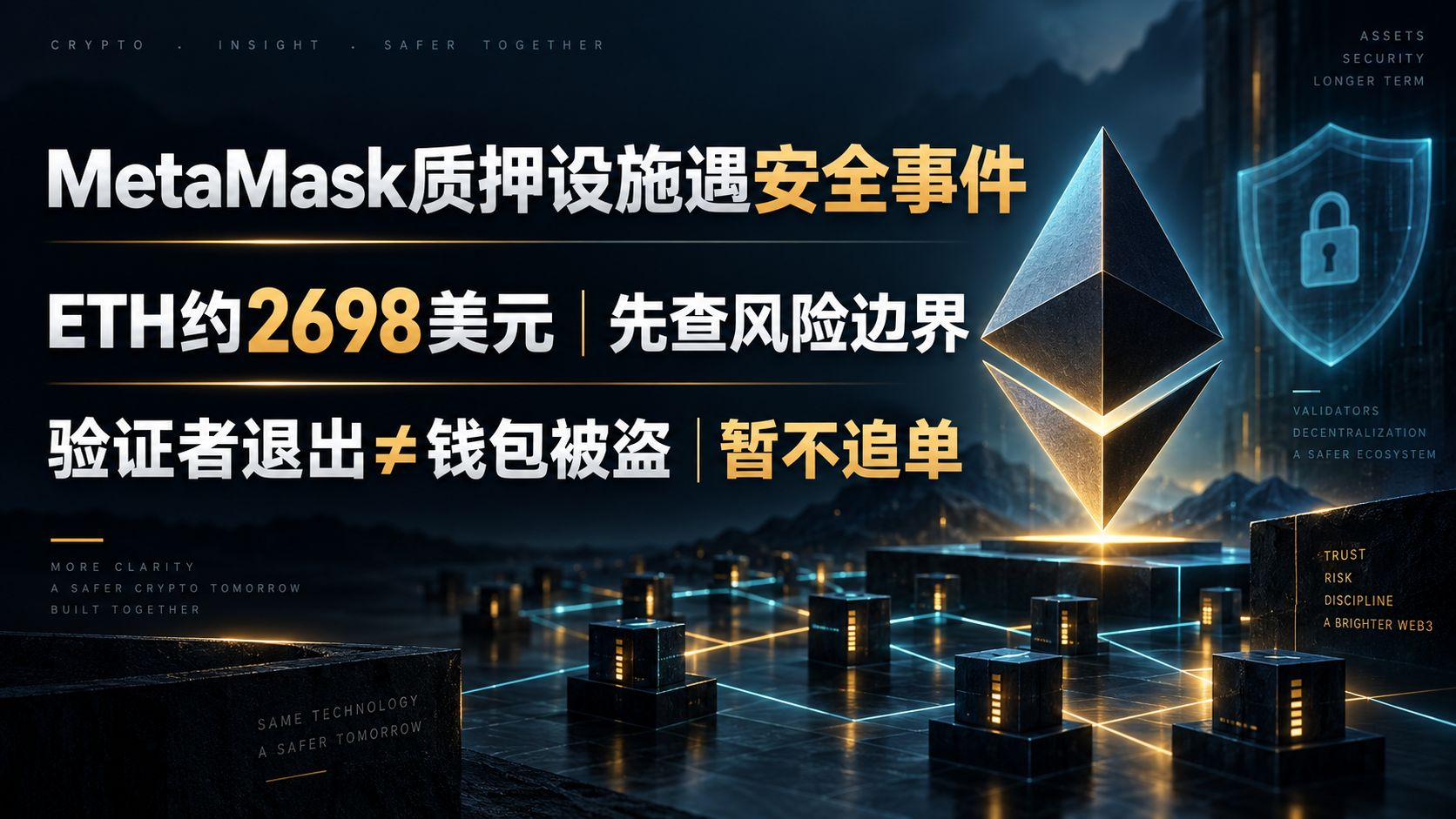
MetaMask discloses an infrastructure security incident|Preventive exits for stakers|ETH around $2,698—I’ll first look at the risk boundaries
My stance is to observe cautiously, not to directly translate “validator exit” into “wallets were hacked,” nor conclude that “ETH must inevitably fall.” The Binance Square hot list shows #MetaMaskExitsLidoValidatorsAfterSecurityIncident, and the discussion is indeed related to the Ethereum staking ecosystem, but the hot-list headline is not an incident investigation report. On September 30, MetaMask confirmed on its official website that some infrastructure components are being affected by a security incident. The company said it is coordinating with external partners and security advisors to handle the situation and has proactively exited validators affected by the impacted non-custodial staking business. It also clearly stated that, at present, it has not found any immediate threat to MetaMask wallets, and the platform does not hold (or control) the staking withdrawal keys for customer assets.
Here, it’s essential to distinguish what has been verified versus what has not. What the official statement confirms is the infrastructure incident and the preventive exit; it does not mean the Ethereum consensus layer has been compromised, nor that the Lido protocol itself has been breached. It also cannot be used to infer that all MetaMask wallets have suffered asset losses. Regarding the number of Lido-related validators, their exit timing, and the magnitude of losses, I’m still waiting for announcements that can be directly verified. For those holding stETH, first check official updates, the withdrawal queue, and secondary-market exchange quotes—and do not click any so-called “emergency authorization migration” links from strangers.
Mechanically, validator exits must run according to on-chain queues, which may reduce staking rewards during the process. But exiting does not automatically mean spot ETH flows into exchanges and gets sold immediately. What really needs watching is the scope of the incident disclosed afterward, whether there are any abnormal withdrawals, and whether the stETH discount relative to ETH can keep widening. If these risks do not spread, the market sentiment disturbance may not turn into sustained sell pressure. If there are on-chain anomalies or the official impact scope expands, I will first reduce my risk exposure and not bet against the news.
The price reaction must also be attributed carefully. I checked Binance US for the ETH/USDT rate around $2,698, up about 0.88% over 24 hours, with a range of $2,658 to $2,738. This only indicates that, as of the observation time, the market has not shown one-way panic; it does not prove the incident is over, nor can the entire day’s volatility be attributed to this news. My short-term observation levels are $2,658 and $2,738: if price breaks below the former and the subsequent bounce lacks strength, risk appetite may keep shrinking. Only after it reclaims the latter and there is trade confirmation should we treat it as stronger evidence that the market has digested the news. Without confirmation on both ends, chasing or selling in the middle has no edge.
If I were trading this myself, I would not open any new directional positions based on the hot-list news. Spot ETH is already maintained according to my original plan, and my additional position is 0%. If official updates later confirm that the impact does not spread, and ETH reclaims $2,738 and holds it on a retest, I would consider going long spot in batches using 2% of my total account equity. My first target would be 2,780; near the target I would cut the position by half. If it falls back below 2,700, I would stop adding. If it breaks below $2,658, I would close all positions. If $2,658 is lost first, I would not immediately open a short; instead, I would wait for the failed retest and reassess. If the official confirms that user assets are damaged or the staking discount significantly widens, the above long setup would be invalidated—I would prioritize closing the test position and waiting for new facts. No matter what, I wouldn’t use high leverage.
Source of facts: MetaMask official website User update on September 30; Binance US ETH/USDT 24-hour market data, checked around 12:00 (Beijing time) on October 1.#MetaMaskExitsLidoValidatorsAfterSecurityIncident #ETH
The above is only my personal market observation and does not constitute investment advice.
MetaMask discloses an infrastructure security incident|Preventive exits for stakers|ETH around $2,698—I’ll first look at the risk boundaries
My stance is to observe cautiously, not to directly translate “validator exit” into “wallets were hacked,” nor conclude that “ETH must inevitably fall.” The Binance Square hot list shows #MetaMaskExitsLidoValidatorsAfterSecurityIncident, and the discussion is indeed related to the Ethereum staking ecosystem, but the hot-list headline is not an incident investigation report. On September 30, MetaMask confirmed on its official website that some infrastructure components are being affected by a security incident. The company said it is coordinating with external partners and security advisors to handle the situation and has proactively exited validators affected by the impacted non-custodial staking business. It also clearly stated that, at present, it has not found any immediate threat to MetaMask wallets, and the platform does not hold (or control) the staking withdrawal keys for customer assets.
Here, it’s essential to distinguish what has been verified versus what has not. What the official statement confirms is the infrastructure incident and the preventive exit; it does not mean the Ethereum consensus layer has been compromised, nor that the Lido protocol itself has been breached. It also cannot be used to infer that all MetaMask wallets have suffered asset losses. Regarding the number of Lido-related validators, their exit timing, and the magnitude of losses, I’m still waiting for announcements that can be directly verified. For those holding stETH, first check official updates, the withdrawal queue, and secondary-market exchange quotes—and do not click any so-called “emergency authorization migration” links from strangers.
Mechanically, validator exits must run according to on-chain queues, which may reduce staking rewards during the process. But exiting does not automatically mean spot ETH flows into exchanges and gets sold immediately. What really needs watching is the scope of the incident disclosed afterward, whether there are any abnormal withdrawals, and whether the stETH discount relative to ETH can keep widening. If these risks do not spread, the market sentiment disturbance may not turn into sustained sell pressure. If there are on-chain anomalies or the official impact scope expands, I will first reduce my risk exposure and not bet against the news.
The price reaction must also be attributed carefully. I checked Binance US for the ETH/USDT rate around $2,698, up about 0.88% over 24 hours, with a range of $2,658 to $2,738. This only indicates that, as of the observation time, the market has not shown one-way panic; it does not prove the incident is over, nor can the entire day’s volatility be attributed to this news. My short-term observation levels are $2,658 and $2,738: if price breaks below the former and the subsequent bounce lacks strength, risk appetite may keep shrinking. Only after it reclaims the latter and there is trade confirmation should we treat it as stronger evidence that the market has digested the news. Without confirmation on both ends, chasing or selling in the middle has no edge.
If I were trading this myself, I would not open any new directional positions based on the hot-list news. Spot ETH is already maintained according to my original plan, and my additional position is 0%. If official updates later confirm that the impact does not spread, and ETH reclaims $2,738 and holds it on a retest, I would consider going long spot in batches using 2% of my total account equity. My first target would be 2,780; near the target I would cut the position by half. If it falls back below 2,700, I would stop adding. If it breaks below $2,658, I would close all positions. If $2,658 is lost first, I would not immediately open a short; instead, I would wait for the failed retest and reassess. If the official confirms that user assets are damaged or the staking discount significantly widens, the above long setup would be invalidated—I would prioritize closing the test position and waiting for new facts. No matter what, I wouldn’t use high leverage.
Source of facts: MetaMask official website User update on September 30; Binance US ETH/USDT 24-hour market data, checked around 12:00 (Beijing time) on October 1.#MetaMaskExitsLidoValidatorsAfterSecurityIncident #ETH
The above is only my personal market observation and does not constitute investment advice.
My stance is to observe cautiously, not to directly translate “validator exit” into “wallets were hacked,” nor conclude that “ETH must inevitably fall.” The Binance Square hot list shows #MetaMaskExitsLidoValidatorsAfterSecurityIncident, and the discussion is indeed related to the Ethereum staking ecosystem, but the hot-list headline is not an incident investigation report. On September 30, MetaMask confirmed on its official website that some infrastructure components are being affected by a security incident. The company said it is coordinating with external partners and security advisors to handle the situation and has proactively exited validators affected by the impacted non-custodial staking business. It also clearly stated that, at present, it has not found any immediate threat to MetaMask wallets, and the platform does not hold (or control) the staking withdrawal keys for customer assets.
Here, it’s essential to distinguish what has been verified versus what has not. What the official statement confirms is the infrastructure incident and the preventive exit; it does not mean the Ethereum consensus layer has been compromised, nor that the Lido protocol itself has been breached. It also cannot be used to infer that all MetaMask wallets have suffered asset losses. Regarding the number of Lido-related validators, their exit timing, and the magnitude of losses, I’m still waiting for announcements that can be directly verified. For those holding stETH, first check official updates, the withdrawal queue, and secondary-market exchange quotes—and do not click any so-called “emergency authorization migration” links from strangers.
Mechanically, validator exits must run according to on-chain queues, which may reduce staking rewards during the process. But exiting does not automatically mean spot ETH flows into exchanges and gets sold immediately. What really needs watching is the scope of the incident disclosed afterward, whether there are any abnormal withdrawals, and whether the stETH discount relative to ETH can keep widening. If these risks do not spread, the market sentiment disturbance may not turn into sustained sell pressure. If there are on-chain anomalies or the official impact scope expands, I will first reduce my risk exposure and not bet against the news.
The price reaction must also be attributed carefully. I checked Binance US for the ETH/USDT rate around $2,698, up about 0.88% over 24 hours, with a range of $2,658 to $2,738. This only indicates that, as of the observation time, the market has not shown one-way panic; it does not prove the incident is over, nor can the entire day’s volatility be attributed to this news. My short-term observation levels are $2,658 and $2,738: if price breaks below the former and the subsequent bounce lacks strength, risk appetite may keep shrinking. Only after it reclaims the latter and there is trade confirmation should we treat it as stronger evidence that the market has digested the news. Without confirmation on both ends, chasing or selling in the middle has no edge.
If I were trading this myself, I would not open any new directional positions based on the hot-list news. Spot ETH is already maintained according to my original plan, and my additional position is 0%. If official updates later confirm that the impact does not spread, and ETH reclaims $2,738 and holds it on a retest, I would consider going long spot in batches using 2% of my total account equity. My first target would be 2,780; near the target I would cut the position by half. If it falls back below 2,700, I would stop adding. If it breaks below $2,658, I would close all positions. If $2,658 is lost first, I would not immediately open a short; instead, I would wait for the failed retest and reassess. If the official confirms that user assets are damaged or the staking discount significantly widens, the above long setup would be invalidated—I would prioritize closing the test position and waiting for new facts. No matter what, I wouldn’t use high leverage.
Source of facts: MetaMask official website User update on September 30; Binance US ETH/USDT 24-hour market data, checked around 12:00 (Beijing time) on October 1.#MetaMaskExitsLidoValidatorsAfterSecurityIncident #ETH
The above is only my personal market observation and does not constitute investment advice.
28

·
--
#metamaskexitslidovalidatorsaftersecurityincident 🚨
MetaMask Staking Incident
+ $356M ETH Transfer
MetaMask is dealing with a
security incident
affecting part of its staking infrastructure, while a wallet linked to Ethereum co-founder Joseph Lubin has moved a significant amount of ETH.
• MetaMask
security incident
: The team is investigating a security issue affecting part of its infrastructure.
• User wallets reportedly unaffected: MetaMask says it has not identified any direct threat to users’ MetaMask wallets so far.
• Validators being exited: As a precaution, MetaMask is proactively exiting affected validators from its non-custodial staking service in coordination with customers, partners, and security advisors.
• Large ETH movement: Around the same time, Lookonchain reported that a wallet linked to Joseph Lubin transferred 133,298 ETH, worth approximately $356.2M, to a new wallet.
• Important context: The ETH transfer is a separate on-chain movement. There is currently no indication from the information above that the transfer is connected to the MetaMask security incident.
MetaMask says it will provide more details as its investigation progresses.$LIT $WLD $ENA
#metamaskexitslidovalidatorsaftersecurityincident 🚨
MetaMask Staking Incident
+ $356M ETH Transfer
MetaMask is dealing with a
security incident
affecting part of its staking infrastructure, while a wallet linked to Ethereum co-founder Joseph Lubin has moved a significant amount of ETH.
• MetaMask
security incident
: The team is investigating a security issue affecting part of its infrastructure.
• User wallets reportedly unaffected: MetaMask says it has not identified any direct threat to users’ MetaMask wallets so far.
• Validators being exited: As a precaution, MetaMask is proactively exiting affected validators from its non-custodial staking service in coordination with customers, partners, and security advisors.
• Large ETH movement: Around the same time, Lookonchain reported that a wallet linked to Joseph Lubin transferred 133,298 ETH, worth approximately $356.2M, to a new wallet.
• Important context: The ETH transfer is a separate on-chain movement. There is currently no indication from the information above that the transfer is connected to the MetaMask security incident.
MetaMask says it will provide more details as its investigation progresses.$LIT $WLD $ENA
MetaMask Staking Incident
+ $356M ETH Transfer
MetaMask is dealing with a
security incident
affecting part of its staking infrastructure, while a wallet linked to Ethereum co-founder Joseph Lubin has moved a significant amount of ETH.
• MetaMask
security incident
: The team is investigating a security issue affecting part of its infrastructure.
• User wallets reportedly unaffected: MetaMask says it has not identified any direct threat to users’ MetaMask wallets so far.
• Validators being exited: As a precaution, MetaMask is proactively exiting affected validators from its non-custodial staking service in coordination with customers, partners, and security advisors.
• Large ETH movement: Around the same time, Lookonchain reported that a wallet linked to Joseph Lubin transferred 133,298 ETH, worth approximately $356.2M, to a new wallet.
• Important context: The ETH transfer is a separate on-chain movement. There is currently no indication from the information above that the transfer is connected to the MetaMask security incident.
MetaMask says it will provide more details as its investigation progresses.$LIT $WLD $ENA
9
·
--
#metamaskexitslidovalidatorsaftersecurityincident MetaMask Staking incident response is ongoing. Consensys seems removed 400 unused validator keys from Lido’s registry—not 400 funded validator exits or slashings. The incident link remains unconfirmed.$DUSK $REZ $GTC
#metamaskexitslidovalidatorsaftersecurityincident MetaMask Staking incident response is ongoing. Consensys seems removed 400 unused validator keys from Lido’s registry—not 400 funded validator exits or slashings. The incident link remains unconfirmed.$DUSK $REZ $GTC
96
·
--
#metamaskexitslidovalidatorsaftersecurityincident JUST IN: MetaMask exits Ethereum validators amid an undisclosed security incident; investigation ongoing with no immediate threat found to wallets. Could raise near-term caution around hot wallets and validator exposure for ecosystem.$NOM $MOVR $US
#metamaskexitslidovalidatorsaftersecurityincident JUST IN: MetaMask exits Ethereum validators amid an undisclosed security incident; investigation ongoing with no immediate threat found to wallets. Could raise near-term caution around hot wallets and validator exposure for ecosystem.$NOM $MOVR $US

9
·
--
#metamaskexitslidovalidatorsaftersecurityincident 🚨
A security incident just hit #MetaMask
infrastructure.
The wallet giant says user funds face no immediate threat, but it is exiting affected
validators across its staking operations as a precaution.$CAP $SAFE $RED
#metamaskexitslidovalidatorsaftersecurityincident 🚨
A security incident just hit #MetaMask
infrastructure.
The wallet giant says user funds face no immediate threat, but it is exiting affected
validators across its staking operations as a precaution.$CAP $SAFE $RED
A security incident just hit #MetaMask
infrastructure.
The wallet giant says user funds face no immediate threat, but it is exiting affected
validators across its staking operations as a precaution.$CAP $SAFE $RED

61
·
--
#metamaskexitslidovalidatorsaftersecurityincident THE BLOCK: MetaMask said it has identified a security incident
affecting part of its infrastructure. Wallets are not at risk, it added.
MetaMask is "proactively exiting" affected
validators within its non-custodial staking operations as a precaution.$MOVR $US $AGT
#metamaskexitslidovalidatorsaftersecurityincident THE BLOCK: MetaMask said it has identified a security incident
affecting part of its infrastructure. Wallets are not at risk, it added.
MetaMask is "proactively exiting" affected
validators within its non-custodial staking operations as a precaution.$MOVR $US $AGT
affecting part of its infrastructure. Wallets are not at risk, it added.
MetaMask is "proactively exiting" affected
validators within its non-custodial staking operations as a precaution.$MOVR $US $AGT
170

·
--
MetaMask announces it is exiting the Lido validator, citing a security vulnerability discovered that affects roughly 2% of staked assets. This incident caused user losses of about $3 million, and Lido’s staking share dropped from 92% to 89%. MetaMask said it will pause its collaboration with Lido until the issue is fully resolved. The decision impacts more than 250,000 users.#MetaMaskExitsLidoValidatorsAfterSecurityIncident $ETH
#ETH
MetaMask announces it is exiting the Lido validator, citing a security vulnerability discovered that affects roughly 2% of staked assets. This incident caused user losses of about $3 million, and Lido’s staking share dropped from 92% to 89%. MetaMask said it will pause its collaboration with Lido until the issue is fully resolved. The decision impacts more than 250,000 users.#MetaMaskExitsLidoValidatorsAfterSecurityIncident $ETH
#ETH
#ETH
140

·
--
#MetaMask Staking Infrastructure Security Update 🚨🦊
MetaMask detected an infrastructure issue on 30 September 2026 in its staking system. Regular wallets remain completely safe, and user keys are untouched. 🔐💼
MetaMask is exiting its affected Lido staking nodes by 7 October 2026. Stakers do not need to rush to unstake, as funds stay protected under your own keys. ⚙️🛡️
#MetaMaskExitsLidoValidatorsAfterSecurityIncident
#MetaMask Staking Infrastructure Security Update 🚨🦊
MetaMask detected an infrastructure issue on 30 September 2026 in its staking system. Regular wallets remain completely safe, and user keys are untouched. 🔐💼
MetaMask is exiting its affected Lido staking nodes by 7 October 2026. Stakers do not need to rush to unstake, as funds stay protected under your own keys. ⚙️🛡️
#MetaMaskExitsLidoValidatorsAfterSecurityIncident
MetaMask detected an infrastructure issue on 30 September 2026 in its staking system. Regular wallets remain completely safe, and user keys are untouched. 🔐💼
MetaMask is exiting its affected Lido staking nodes by 7 October 2026. Stakers do not need to rush to unstake, as funds stay protected under your own keys. ⚙️🛡️
#MetaMaskExitsLidoValidatorsAfterSecurityIncident

1
35

·
--
🚨 MetaMask Exits Lido Validators After Security Incident
MetaMask has confirmed that it is responding to a security incident affecting part of its infrastructure and has begun proactively exiting affected Ethereum validators operated through its non-custodial staking service. MetaMask says it has identified no immediate threat to MetaMask wallets and is working with external security partners to investigate and remediate the issue.
🔥 What Happened?
🛡️ MetaMask is exiting affected Ethereum validators as a precaution.
🏦 The validators were operated through MetaMask Staking within the Lido protocol.
🔍 MetaMask has not disclosed the exact nature or scope of the security incident.
💰 MetaMask says there is currently no identified immediate threat to its wallets.
⏳ Lido expects the affected validators to complete their exits by October 7, 2026.
⚠️ What About Lido & stETH?
Lido says the ETH from MetaMask-operated validators will return to the protocol gradually as validators complete the exit, withdrawal and re-entry process. Because of Ethereum's current validator entry queue, the full cycle could take up to around 45 days. The exits may also mean foregone staking rewards and potential downtime penalties for affected validators.
The important distinction is that this is currently being reported as a precautionary response to a security incident, not as confirmation that Lido or MetaMask wallets have suffered a user-fund loss. The investigation is ongoing.
#MetaMask #Lido #ETH
#metamaskexitslidovalidatorsaftersecurityincident
$ETH
{future}(ETHUSDT)
🚨 MetaMask Exits Lido Validators After Security Incident
MetaMask has confirmed that it is responding to a security incident affecting part of its infrastructure and has begun proactively exiting affected Ethereum validators operated through its non-custodial staking service. MetaMask says it has identified no immediate threat to MetaMask wallets and is working with external security partners to investigate and remediate the issue.
🔥 What Happened?
🛡️ MetaMask is exiting affected Ethereum validators as a precaution.
🏦 The validators were operated through MetaMask Staking within the Lido protocol.
🔍 MetaMask has not disclosed the exact nature or scope of the security incident.
💰 MetaMask says there is currently no identified immediate threat to its wallets.
⏳ Lido expects the affected validators to complete their exits by October 7, 2026.
⚠️ What About Lido & stETH?
Lido says the ETH from MetaMask-operated validators will return to the protocol gradually as validators complete the exit, withdrawal and re-entry process. Because of Ethereum's current validator entry queue, the full cycle could take up to around 45 days. The exits may also mean foregone staking rewards and potential downtime penalties for affected validators.
The important distinction is that this is currently being reported as a precautionary response to a security incident, not as confirmation that Lido or MetaMask wallets have suffered a user-fund loss. The investigation is ongoing.
#MetaMask #Lido #ETH
#metamaskexitslidovalidatorsaftersecurityincident
$ETH
MetaMask has confirmed that it is responding to a security incident affecting part of its infrastructure and has begun proactively exiting affected Ethereum validators operated through its non-custodial staking service. MetaMask says it has identified no immediate threat to MetaMask wallets and is working with external security partners to investigate and remediate the issue.
🔥 What Happened?
🛡️ MetaMask is exiting affected Ethereum validators as a precaution.
🏦 The validators were operated through MetaMask Staking within the Lido protocol.
🔍 MetaMask has not disclosed the exact nature or scope of the security incident.
💰 MetaMask says there is currently no identified immediate threat to its wallets.
⏳ Lido expects the affected validators to complete their exits by October 7, 2026.
⚠️ What About Lido & stETH?
Lido says the ETH from MetaMask-operated validators will return to the protocol gradually as validators complete the exit, withdrawal and re-entry process. Because of Ethereum's current validator entry queue, the full cycle could take up to around 45 days. The exits may also mean foregone staking rewards and potential downtime penalties for affected validators.
The important distinction is that this is currently being reported as a precautionary response to a security incident, not as confirmation that Lido or MetaMask wallets have suffered a user-fund loss. The investigation is ongoing.
#MetaMask #Lido #ETH
#metamaskexitslidovalidatorsaftersecurityincident
$ETH

57
·
--
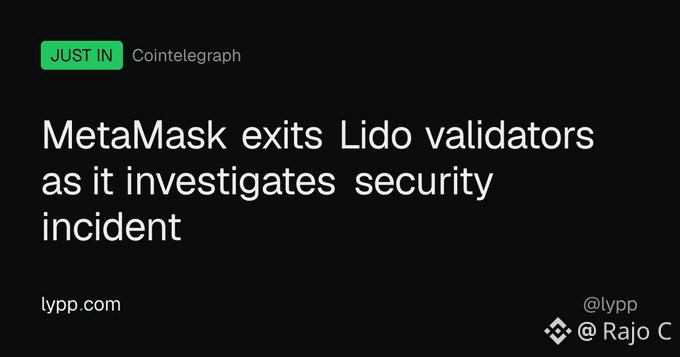
#metamaskexitslidovalidatorsaftersecurityincident JUST IN: MetaMask is exiting its Lido validators while it investigates a security incident, saying it has found no immediate threat to wallets.
Lido warns the precautionary exits could mean lost rewards and downtime penalties, with the full cycle taking up to 45 days.$PLUME $SOON $KAIA
#metamaskexitslidovalidatorsaftersecurityincident JUST IN: MetaMask is exiting its Lido validators while it investigates a security incident, saying it has found no immediate threat to wallets.
Lido warns the precautionary exits could mean lost rewards and downtime penalties, with the full cycle taking up to 45 days.$PLUME $SOON $KAIA
Lido warns the precautionary exits could mean lost rewards and downtime penalties, with the full cycle taking up to 45 days.$PLUME $SOON $KAIA
46

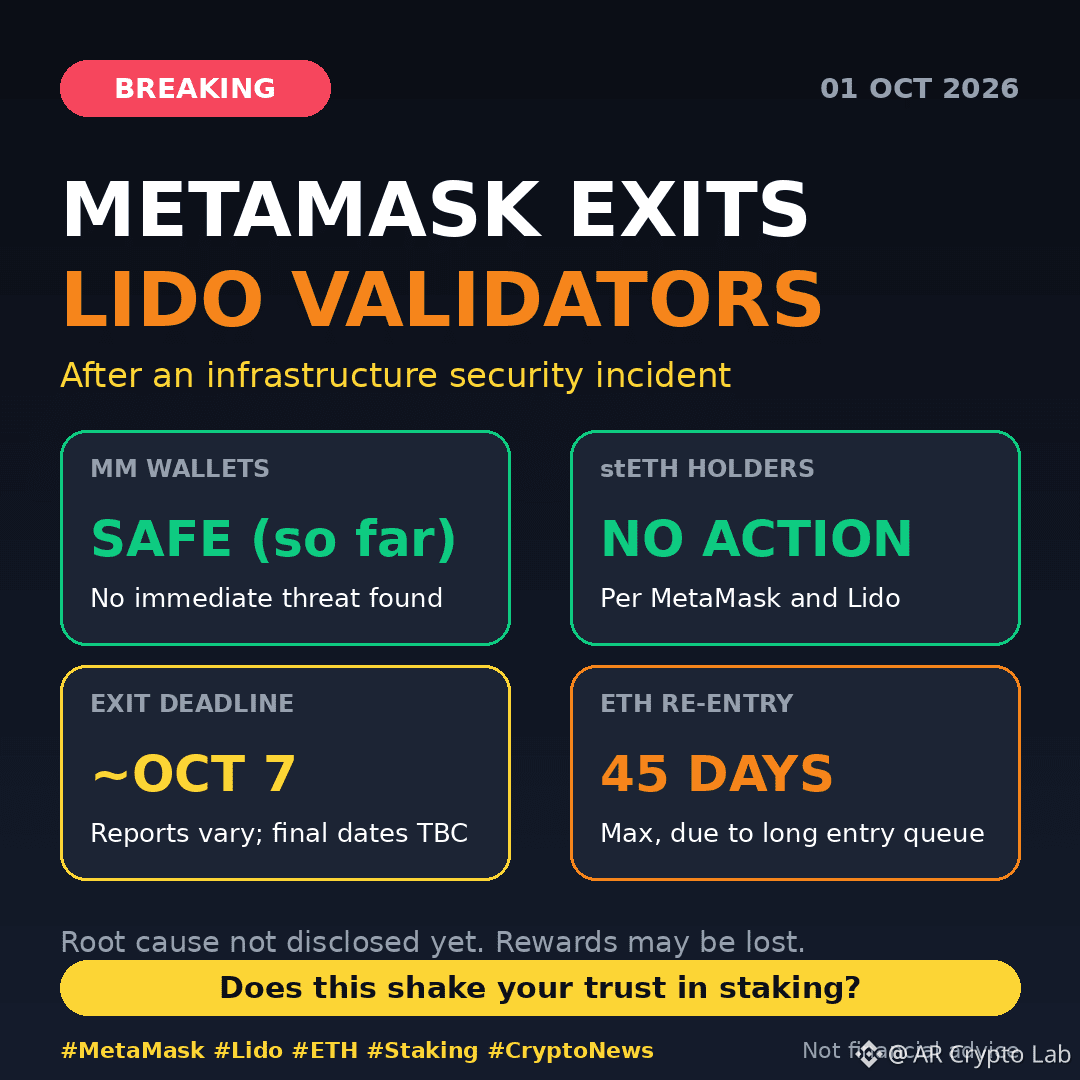
MetaMask just pulled its validators out of Lido, and the reason is a security incident. Here's what's actually confirmed so far 👇
What happened: MetaMask Staking (the old Consensys Staking) found a compromise in part of its infrastructure and started exiting its Ethereum validators on Lido as a precaution. It began on Wednesday.
What MetaMask and Lido say:
• No immediate threat to MetaMask wallets has been found
• stETH holders don't need to do anything
• Exits may mean lost rewards and some downtime penalties
• The ETH comes back to the protocol gradually, which could take up to about 45 days because the validator entry queue is long
What we still don't know: what the incident actually was, how many validators are affected, and how much ETH is involved. MetaMask hasn't said. Reports also differ on the final exit date (Oct 7 vs later in October).
My take: pulling validators early is the right call if there's any doubt. It's also a reminder that staking isn't just "set and forget", because you're trusting the operators behind it. Lido spreads stake across many operators, which is exactly why one exit shouldn't break things. I'll update when more details come out.
Does this change how you feel about liquid staking? 👇
#MetaMaskExitsLidoValidatorsAfterSecurityIncident #MetaMask #Lido #ETH #Staking
MetaMask just pulled its validators out of Lido, and the reason is a security incident. Here's what's actually confirmed so far 👇
What happened: MetaMask Staking (the old Consensys Staking) found a compromise in part of its infrastructure and started exiting its Ethereum validators on Lido as a precaution. It began on Wednesday.
What MetaMask and Lido say:
• No immediate threat to MetaMask wallets has been found
• stETH holders don't need to do anything
• Exits may mean lost rewards and some downtime penalties
• The ETH comes back to the protocol gradually, which could take up to about 45 days because the validator entry queue is long
What we still don't know: what the incident actually was, how many validators are affected, and how much ETH is involved. MetaMask hasn't said. Reports also differ on the final exit date (Oct 7 vs later in October).
My take: pulling validators early is the right call if there's any doubt. It's also a reminder that staking isn't just "set and forget", because you're trusting the operators behind it. Lido spreads stake across many operators, which is exactly why one exit shouldn't break things. I'll update when more details come out.
Does this change how you feel about liquid staking? 👇
#MetaMaskExitsLidoValidatorsAfterSecurityIncident #MetaMask #Lido #ETH #Staking
What happened: MetaMask Staking (the old Consensys Staking) found a compromise in part of its infrastructure and started exiting its Ethereum validators on Lido as a precaution. It began on Wednesday.
What MetaMask and Lido say:
• No immediate threat to MetaMask wallets has been found
• stETH holders don't need to do anything
• Exits may mean lost rewards and some downtime penalties
• The ETH comes back to the protocol gradually, which could take up to about 45 days because the validator entry queue is long
What we still don't know: what the incident actually was, how many validators are affected, and how much ETH is involved. MetaMask hasn't said. Reports also differ on the final exit date (Oct 7 vs later in October).
My take: pulling validators early is the right call if there's any doubt. It's also a reminder that staking isn't just "set and forget", because you're trusting the operators behind it. Lido spreads stake across many operators, which is exactly why one exit shouldn't break things. I'll update when more details come out.
Does this change how you feel about liquid staking? 👇
#MetaMaskExitsLidoValidatorsAfterSecurityIncident #MetaMask #Lido #ETH #Staking
1
45

#MetaMaskExitsLidoValidatorsAfterSecurityIncident
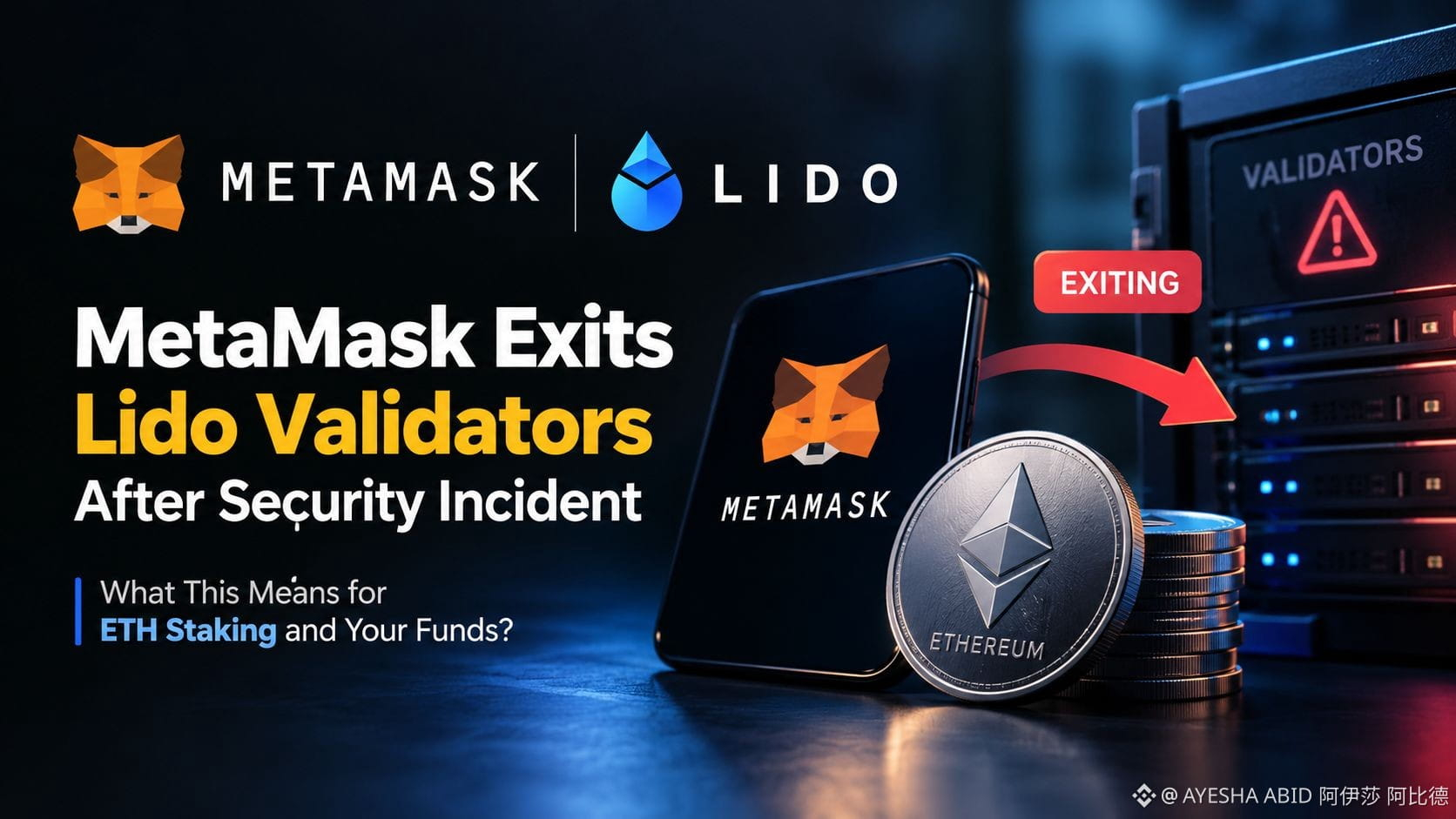
MetaMask’s latest move raises an important question: how safe is crypto staking when security risks emerge?
MetaMask is exiting affected Ethereum validators operating through Lido after identifying a security incident affecting part of its infrastructure. The company says it has found no immediate threat to MetaMask wallets and is working with external security experts. The investigation is ongoing, and the exact cause has not been disclosed.
Lido expects the affected validators to complete their exit by October 7. The withdrawn ETH will return gradually, with the full exit and re-entry process potentially taking up to 45 days. The transition may also mean missed staking rewards and possible downtime penalties.
My Take: This is a reminder that staking involves more than earning passive income. Validator security, operational risks, and withdrawal timelines matter just as much. For ETH holders, the key is to separate a precautionary validator exit from a confirmed loss of user funds.
I’ll be watching for updates on the investigation, the validator exit, and any impact on Lido’s staking activity. Security transparency matters across the entire DeFi ecosystem.
$LDO $ETH
{future}(ETHUSDT)
{future}(LDOUSDT)
Do you think incidents like this will change how users choose ETH staking providers?
#MetaMask #Lido #Ethereum #CryptoSecurity
#MetaMaskExitsLidoValidatorsAfterSecurityIncident
MetaMask’s latest move raises an important question: how safe is crypto staking when security risks emerge?
MetaMask is exiting affected Ethereum validators operating through Lido after identifying a security incident affecting part of its infrastructure. The company says it has found no immediate threat to MetaMask wallets and is working with external security experts. The investigation is ongoing, and the exact cause has not been disclosed.
Lido expects the affected validators to complete their exit by October 7. The withdrawn ETH will return gradually, with the full exit and re-entry process potentially taking up to 45 days. The transition may also mean missed staking rewards and possible downtime penalties.
My Take: This is a reminder that staking involves more than earning passive income. Validator security, operational risks, and withdrawal timelines matter just as much. For ETH holders, the key is to separate a precautionary validator exit from a confirmed loss of user funds.
I’ll be watching for updates on the investigation, the validator exit, and any impact on Lido’s staking activity. Security transparency matters across the entire DeFi ecosystem.
$LDO $ETH
Do you think incidents like this will change how users choose ETH staking providers?
#MetaMask #Lido #Ethereum #CryptoSecurity
MetaMask’s latest move raises an important question: how safe is crypto staking when security risks emerge?
MetaMask is exiting affected Ethereum validators operating through Lido after identifying a security incident affecting part of its infrastructure. The company says it has found no immediate threat to MetaMask wallets and is working with external security experts. The investigation is ongoing, and the exact cause has not been disclosed.
Lido expects the affected validators to complete their exit by October 7. The withdrawn ETH will return gradually, with the full exit and re-entry process potentially taking up to 45 days. The transition may also mean missed staking rewards and possible downtime penalties.
My Take: This is a reminder that staking involves more than earning passive income. Validator security, operational risks, and withdrawal timelines matter just as much. For ETH holders, the key is to separate a precautionary validator exit from a confirmed loss of user funds.
I’ll be watching for updates on the investigation, the validator exit, and any impact on Lido’s staking activity. Security transparency matters across the entire DeFi ecosystem.
$LDO $ETH
Do you think incidents like this will change how users choose ETH staking providers?
#MetaMask #Lido #Ethereum #CryptoSecurity
2
147
Log in to explore more content
Join global crypto users on Binance Square
⚡️ Get latest and useful information about crypto.
💬 Trusted by the world’s largest crypto exchange.
👍 Discover real insights from verified creators.
Email / Phone number
Trending Topics
1
#MetaMaskExitsLidoValidatorsAfterSecurityIncident
7,477 views
265 Discussing
2
#MicronBeatsEarningsLiftsGuidance
9,068 views
254 Discussing
3
#CFTCSubmitsTwoEventContractRulesToWhiteHouse
9,094 views
245 Discussing
4
#BitcoinClears$85200
26,765 views
289 Discussing
5
#AltcoinSeasonIndexHoldsAbove60For5Days
132,564 views
1,709 Discussing
6
#USADPAdds90000JobsInSeptember
59,088 views
983 Discussing
7
#USCorePCEEasesTo3%InAugust
41,850 views
686 Discussing
8
#KospiPostsWorstQuarterSince2020
24,251 views
583 Discussing
9
#SECToClarifyOnChainFundraisingRules
60,920 views
779 Discussing
10
#UKFCAOpensCryptoFirmAuthorization
56,789 views
641 Discussing