

#coinbase
coinbase
2.5M views
8,350 Discussing
Hot
Latest

·
--
Three addresses, one day: HYPE moved a hefty stack to Coinbase.
According to on-chain monitors such as Lookonchain, three wallets possibly controlled by the same whale deposited around 494,310 HYPE to Coinbase in roughly one day, worth about $37.83 million in total. Large deposits to an exchange are often interpreted as preparation to sell, but other uses—such as market making, moving collateral for lending, or hedging on the exchange—should also be considered.
How to read it: transferring tokens to a CEX ≠ immediately selling them at market, but it often raises expectations of near-term selling pressure. Holders should pay closer attention to whether more tokens are transferred in, whether spot market depth and funding rates heat up in tandem, and whether there are unusual movements involving unlock- or airdrop-related addresses. Treating whale deposits to exchanges as a volatility warning is more prudent than viewing them as a one-way “top signal.”
#HYPE #巨鲸 #Coinbase #OnchainMonitoring
Three addresses, one day: HYPE moved a hefty stack to Coinbase.
According to on-chain monitors such as Lookonchain, three wallets possibly controlled by the same whale deposited around 494,310 HYPE to Coinbase in roughly one day, worth about $37.83 million in total. Large deposits to an exchange are often interpreted as preparation to sell, but other uses—such as market making, moving collateral for lending, or hedging on the exchange—should also be considered.
How to read it: transferring tokens to a CEX ≠ immediately selling them at market, but it often raises expectations of near-term selling pressure. Holders should pay closer attention to whether more tokens are transferred in, whether spot market depth and funding rates heat up in tandem, and whether there are unusual movements involving unlock- or airdrop-related addresses. Treating whale deposits to exchanges as a volatility warning is more prudent than viewing them as a one-way “top signal.”
#HYPE #巨鲸 #Coinbase #OnchainMonitoring
According to on-chain monitors such as Lookonchain, three wallets possibly controlled by the same whale deposited around 494,310 HYPE to Coinbase in roughly one day, worth about $37.83 million in total. Large deposits to an exchange are often interpreted as preparation to sell, but other uses—such as market making, moving collateral for lending, or hedging on the exchange—should also be considered.
How to read it: transferring tokens to a CEX ≠ immediately selling them at market, but it often raises expectations of near-term selling pressure. Holders should pay closer attention to whether more tokens are transferred in, whether spot market depth and funding rates heat up in tandem, and whether there are unusual movements involving unlock- or airdrop-related addresses. Treating whale deposits to exchanges as a volatility warning is more prudent than viewing them as a one-way “top signal.”
#HYPE #巨鲸 #Coinbase #OnchainMonitoring
68

·
--
Coinbase reports earnings on October 29: Revenue has missed expectations for three consecutive quarters. Can it turn things around this time? 📊
According to 24/7 Wall St’s earnings preview:
👉 The consensus expects a loss, but the bar has been lowered significantly
👉 Coinbase’s share of crypto trading volume has risen to a record high of 10.3%
👉 Adjusted EBITDA last quarter was $207.8 million, remaining positive
👉 BTC is up about 26.8% over the past 90 days, but down about 3.9% over the past month, and is currently trading near $80,000
My take:
✅ Earnings aren’t just about revenue—we should also watch trading volume, stablecoin revenue, and changes in treasury buying
⚠️ BTC briefly fell to $79,280 over the weekend, and ETFs saw $635 million in net outflows on 10/22, suggesting cautious sentiment
📌 With earnings and the 10/28 FOMC meeting both this week, volatility could pick up. $80,000 and $77,600 are key BTC levels to watch
Do you think COIN will miss expectations for a fourth time, or finally beat them? Share your thoughts in the comments 👇
$BTC $ETH #Coinbase #加密市场 #Earnings
Personal opinion only; not investment advice
Coinbase reports earnings on October 29: Revenue has missed expectations for three consecutive quarters. Can it turn things around this time? 📊
According to 24/7 Wall St’s earnings preview:
👉 The consensus expects a loss, but the bar has been lowered significantly
👉 Coinbase’s share of crypto trading volume has risen to a record high of 10.3%
👉 Adjusted EBITDA last quarter was $207.8 million, remaining positive
👉 BTC is up about 26.8% over the past 90 days, but down about 3.9% over the past month, and is currently trading near $80,000
My take:
✅ Earnings aren’t just about revenue—we should also watch trading volume, stablecoin revenue, and changes in treasury buying
⚠️ BTC briefly fell to $79,280 over the weekend, and ETFs saw $635 million in net outflows on 10/22, suggesting cautious sentiment
📌 With earnings and the 10/28 FOMC meeting both this week, volatility could pick up. $80,000 and $77,600 are key BTC levels to watch
Do you think COIN will miss expectations for a fourth time, or finally beat them? Share your thoughts in the comments 👇
$BTC $ETH #Coinbase #加密市场 #Earnings
Personal opinion only; not investment advice
According to 24/7 Wall St’s earnings preview:
👉 The consensus expects a loss, but the bar has been lowered significantly
👉 Coinbase’s share of crypto trading volume has risen to a record high of 10.3%
👉 Adjusted EBITDA last quarter was $207.8 million, remaining positive
👉 BTC is up about 26.8% over the past 90 days, but down about 3.9% over the past month, and is currently trading near $80,000
My take:
✅ Earnings aren’t just about revenue—we should also watch trading volume, stablecoin revenue, and changes in treasury buying
⚠️ BTC briefly fell to $79,280 over the weekend, and ETFs saw $635 million in net outflows on 10/22, suggesting cautious sentiment
📌 With earnings and the 10/28 FOMC meeting both this week, volatility could pick up. $80,000 and $77,600 are key BTC levels to watch
Do you think COIN will miss expectations for a fourth time, or finally beat them? Share your thoughts in the comments 👇
$BTC $ETH #Coinbase #加密市场 #Earnings
Personal opinion only; not investment advice

1

·
--
Coinbase bets big on 15-minute crypto predictions: Bet on BTC going up or down—what is the order book saying?
According to Odaily and Bloomingbit, Coinbase announced on X on 10/25 that its crypto price prediction market is now live, allowing users to bet on short-term price moves for BTC, ETH, and SOL, with durations ranging from 15 minutes to one day.
A 10/17 comparison by DeFi Rate shows that these contracts on Coinbase and Robinhood draw on Kalshi’s order book. They settle based on the 60-second average of the real-time CF Benchmarks index, with each correct contract paying $1.
A snapshot of Coinbase’s prediction page: the odds of “BTC falling below $77,500 at some point in October” are about 34%, and the odds of falling below $75,000 are about 13%; the odds of “returning to $100,000 before 2027” are about 22%. BTC is currently around $80,300 (Yahoo Finance).
【Take】Exchanges are turning “guess whether prices go up or down” into a standardized product, essentially competing for short-term retail trading activity. For the market, this adds a public sentiment gauge: the order book puts only about a 30% chance on BTC falling below $77,500 in October, suggesting the market sees a move below $80,000 as consolidation rather than a crash. But 15-minute contracts are closer to a coin toss, and fees and spreads will steadily eat into your chances of winning.
【Opportunities/Risks】
1. Watch the odds at $77,500 and $75,000; a rapid rise could serve as an early warning of panic.
2. See whether prediction-market trading volume and BTC implied volatility both rise around the 10/28 FOMC meeting.
3. Lawsuits against Kalshi in multiple states are still ongoing, and some markets could be restricted.
Risk: Frequent short-term betting can be addictive. Don’t use it as a substitute for sound risk management in spot or futures trading.
Would you use prediction-market probabilities as a trading reference, or treat them as noise?
#预测市场 #Coinbase #比特币 #FOMC
$BTC $ETH
For reference only; not investment advice.
Coinbase bets big on 15-minute crypto predictions: Bet on BTC going up or down—what is the order book saying?
According to Odaily and Bloomingbit, Coinbase announced on X on 10/25 that its crypto price prediction market is now live, allowing users to bet on short-term price moves for BTC, ETH, and SOL, with durations ranging from 15 minutes to one day.
A 10/17 comparison by DeFi Rate shows that these contracts on Coinbase and Robinhood draw on Kalshi’s order book. They settle based on the 60-second average of the real-time CF Benchmarks index, with each correct contract paying $1.
A snapshot of Coinbase’s prediction page: the odds of “BTC falling below $77,500 at some point in October” are about 34%, and the odds of falling below $75,000 are about 13%; the odds of “returning to $100,000 before 2027” are about 22%. BTC is currently around $80,300 (Yahoo Finance).
【Take】Exchanges are turning “guess whether prices go up or down” into a standardized product, essentially competing for short-term retail trading activity. For the market, this adds a public sentiment gauge: the order book puts only about a 30% chance on BTC falling below $77,500 in October, suggesting the market sees a move below $80,000 as consolidation rather than a crash. But 15-minute contracts are closer to a coin toss, and fees and spreads will steadily eat into your chances of winning.
【Opportunities/Risks】
1. Watch the odds at $77,500 and $75,000; a rapid rise could serve as an early warning of panic.
2. See whether prediction-market trading volume and BTC implied volatility both rise around the 10/28 FOMC meeting.
3. Lawsuits against Kalshi in multiple states are still ongoing, and some markets could be restricted.
Risk: Frequent short-term betting can be addictive. Don’t use it as a substitute for sound risk management in spot or futures trading.
Would you use prediction-market probabilities as a trading reference, or treat them as noise?
#预测市场 #Coinbase #比特币 #FOMC
$BTC $ETH
For reference only; not investment advice.
According to Odaily and Bloomingbit, Coinbase announced on X on 10/25 that its crypto price prediction market is now live, allowing users to bet on short-term price moves for BTC, ETH, and SOL, with durations ranging from 15 minutes to one day.
A 10/17 comparison by DeFi Rate shows that these contracts on Coinbase and Robinhood draw on Kalshi’s order book. They settle based on the 60-second average of the real-time CF Benchmarks index, with each correct contract paying $1.
A snapshot of Coinbase’s prediction page: the odds of “BTC falling below $77,500 at some point in October” are about 34%, and the odds of falling below $75,000 are about 13%; the odds of “returning to $100,000 before 2027” are about 22%. BTC is currently around $80,300 (Yahoo Finance).
【Take】Exchanges are turning “guess whether prices go up or down” into a standardized product, essentially competing for short-term retail trading activity. For the market, this adds a public sentiment gauge: the order book puts only about a 30% chance on BTC falling below $77,500 in October, suggesting the market sees a move below $80,000 as consolidation rather than a crash. But 15-minute contracts are closer to a coin toss, and fees and spreads will steadily eat into your chances of winning.
【Opportunities/Risks】
1. Watch the odds at $77,500 and $75,000; a rapid rise could serve as an early warning of panic.
2. See whether prediction-market trading volume and BTC implied volatility both rise around the 10/28 FOMC meeting.
3. Lawsuits against Kalshi in multiple states are still ongoing, and some markets could be restricted.
Risk: Frequent short-term betting can be addictive. Don’t use it as a substitute for sound risk management in spot or futures trading.
Would you use prediction-market probabilities as a trading reference, or treat them as noise?
#预测市场 #Coinbase #比特币 #FOMC
$BTC $ETH
For reference only; not investment advice.
225

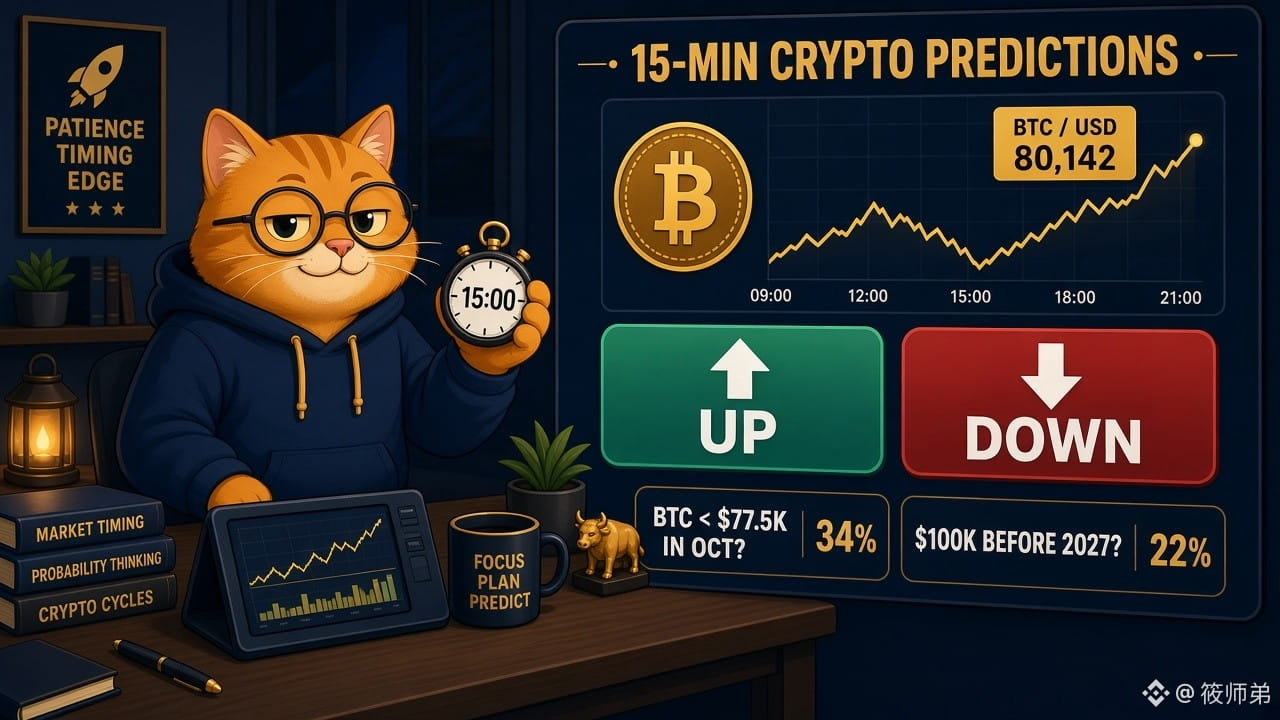
I watched Coinbase’s new ad three times, and the more I watched it, the more I felt it was telling the blunt truth.
Original: Texting your group chat 'it's so over' is a prediction. Now there's a button for it.
BTC, ETH, and SOL price prediction markets are live, with timeframes ranging from 15 minutes to a day.
In plain English: The second you start cursing in the group chat, the exchange wants to turn it into an order.
What can you predict in a 15-minute window? That’s not analysis—it’s emotion, it’s noise. The other day, weekly trading volume for crypto contracts on Kalshi hit a record, with the bulk of it coming from 15-minute BTC up-or-down bets. Now Coinbase is jumping in to grab a piece of that pie. What does that tell you? That it’s a great business. For the platform.
Who’s guaranteed to make money? The one matching the trades. Who’s paying tuition? You, itching to trade on a weekend after seeing green candles and scrolling through the group chat.
Someone in the replies made a good point: 15-minute SOL markets will soon be bot territory. People can’t keep up with every window, but machines can. You think you’re going head-to-head with your friends in the group chat, but the other side might be a script.
I’m not against prediction markets themselves. They can be useful for hedging and pricing events. But turning “it's so over” into a button makes it painfully obvious who they’re marketing to.
When your emotions are running high, the most useful button is the one that closes the app.
#Coinbase #PredictionMarkets
I watched Coinbase’s new ad three times, and the more I watched it, the more I felt it was telling the blunt truth.
Original: Texting your group chat 'it's so over' is a prediction. Now there's a button for it.
BTC, ETH, and SOL price prediction markets are live, with timeframes ranging from 15 minutes to a day.
In plain English: The second you start cursing in the group chat, the exchange wants to turn it into an order.
What can you predict in a 15-minute window? That’s not analysis—it’s emotion, it’s noise. The other day, weekly trading volume for crypto contracts on Kalshi hit a record, with the bulk of it coming from 15-minute BTC up-or-down bets. Now Coinbase is jumping in to grab a piece of that pie. What does that tell you? That it’s a great business. For the platform.
Who’s guaranteed to make money? The one matching the trades. Who’s paying tuition? You, itching to trade on a weekend after seeing green candles and scrolling through the group chat.
Someone in the replies made a good point: 15-minute SOL markets will soon be bot territory. People can’t keep up with every window, but machines can. You think you’re going head-to-head with your friends in the group chat, but the other side might be a script.
I’m not against prediction markets themselves. They can be useful for hedging and pricing events. But turning “it's so over” into a button makes it painfully obvious who they’re marketing to.
When your emotions are running high, the most useful button is the one that closes the app.
#Coinbase #PredictionMarkets
Original: Texting your group chat 'it's so over' is a prediction. Now there's a button for it.
BTC, ETH, and SOL price prediction markets are live, with timeframes ranging from 15 minutes to a day.
In plain English: The second you start cursing in the group chat, the exchange wants to turn it into an order.
What can you predict in a 15-minute window? That’s not analysis—it’s emotion, it’s noise. The other day, weekly trading volume for crypto contracts on Kalshi hit a record, with the bulk of it coming from 15-minute BTC up-or-down bets. Now Coinbase is jumping in to grab a piece of that pie. What does that tell you? That it’s a great business. For the platform.
Who’s guaranteed to make money? The one matching the trades. Who’s paying tuition? You, itching to trade on a weekend after seeing green candles and scrolling through the group chat.
Someone in the replies made a good point: 15-minute SOL markets will soon be bot territory. People can’t keep up with every window, but machines can. You think you’re going head-to-head with your friends in the group chat, but the other side might be a script.
I’m not against prediction markets themselves. They can be useful for hedging and pricing events. But turning “it's so over” into a button makes it painfully obvious who they’re marketing to.
When your emotions are running high, the most useful button is the one that closes the app.
#Coinbase #PredictionMarkets
1

·
--
The Central Bank of Ireland fined Coinbase’s Irish entity $3.6 million for failures in oversight and safeguarding customer assets. The bank disclosed that Coinbase Ireland agreed to the relevant facts, and the fine and sanction will take effect once approved by the High Court.
This is a regulatory enforcement penalty, with its specific impact limited to the entity’s compliance record. The source does not say whether any customer assets were lost. The next step is clear: approval by the High Court.
#Coinbase
The Central Bank of Ireland fined Coinbase’s Irish entity $3.6 million for failures in oversight and safeguarding customer assets. The bank disclosed that Coinbase Ireland agreed to the relevant facts, and the fine and sanction will take effect once approved by the High Court.
This is a regulatory enforcement penalty, with its specific impact limited to the entity’s compliance record. The source does not say whether any customer assets were lost. The next step is clear: approval by the High Court.
#Coinbase
This is a regulatory enforcement penalty, with its specific impact limited to the entity’s compliance record. The source does not say whether any customer assets were lost. The next step is clear: approval by the High Court.
#Coinbase

4

·
--
Came across Coinbase: crypto price prediction markets are now live.
Key details: You can trade on the short-term price direction of $BTC, $ETH, and $SOL , with contracts ranging from 15 minutes to daily. The company says markets open in real time. You can find them under Predictions on Coinbase, so there’s no need to switch to another prediction market app.
The exchange is turning short-term price direction into tradable contracts itself. It feels like they’ve productized “I’m bullish” or “I’m bearish”—a different approach from event markets like the Kalshi integration elsewhere.
$BTC $ETH $SOL #Coinbase #PredictionMarkets
Came across Coinbase: crypto price prediction markets are now live.
Key details: You can trade on the short-term price direction of $BTC , $ETH , and $SOL , with contracts ranging from 15 minutes to daily. The company says markets open in real time. You can find them under Predictions on Coinbase, so there’s no need to switch to another prediction market app.
The exchange is turning short-term price direction into tradable contracts itself. It feels like they’ve productized “I’m bullish” or “I’m bearish”—a different approach from event markets like the Kalshi integration elsewhere.
$BTC $ETH $SOL #Coinbase #PredictionMarkets
Key details: You can trade on the short-term price direction of $BTC , $ETH , and $SOL , with contracts ranging from 15 minutes to daily. The company says markets open in real time. You can find them under Predictions on Coinbase, so there’s no need to switch to another prediction market app.
The exchange is turning short-term price direction into tradable contracts itself. It feels like they’ve productized “I’m bullish” or “I’m bearish”—a different approach from event markets like the Kalshi integration elsewhere.
$BTC $ETH $SOL #Coinbase #PredictionMarkets
339


·
--
Verified
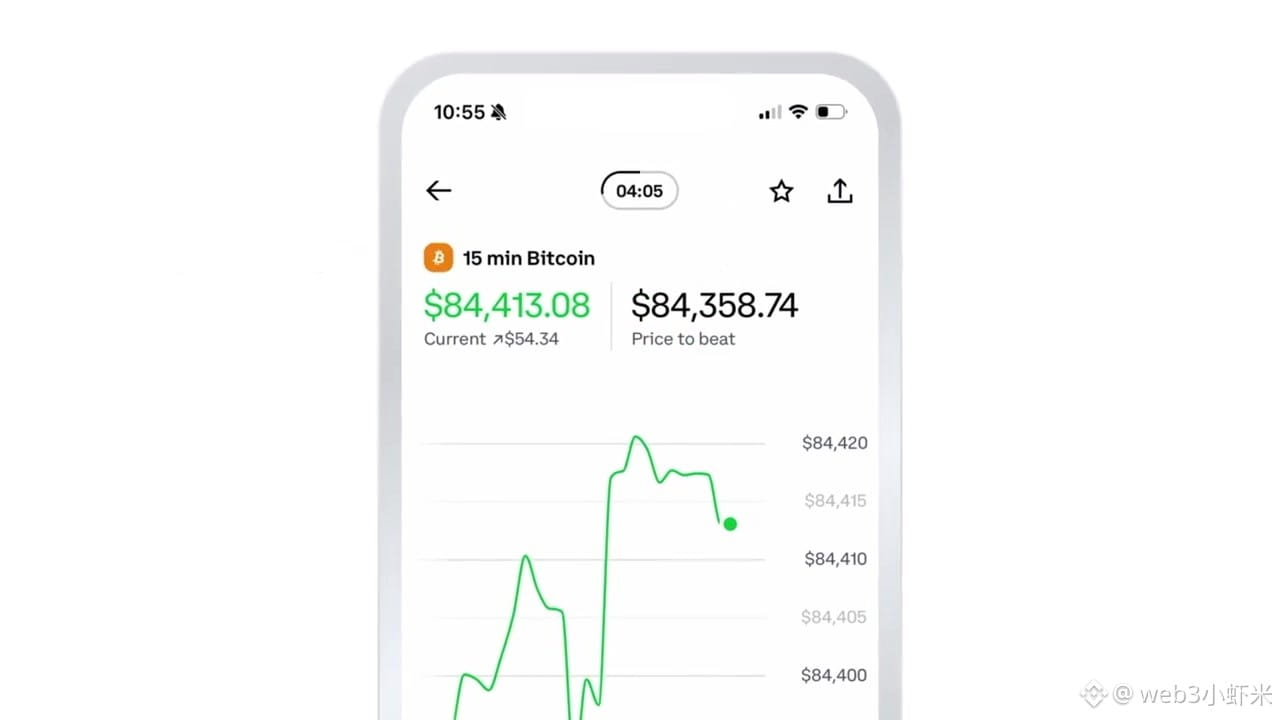
Coinbase turned group-chat trash talk into buttons
Live crypto price markets
Prediction markets for BTC, ETH, and SOL prices, from 15-minute to daily intervals
Includes CFTC and NFA compliance disclosures
Unavailable in some regions
Used to talk trash at candlestick charts
Now there’s a row of buttons
Just take a look from a product perspective
Don’t treat them as trading signals
$BTC $ETH $SOL
#Coinbase #预测市场 #BTC #ETH #SOL
Coinbase turned group-chat trash talk into buttons
Live crypto price markets
Prediction markets for BTC, ETH, and SOL prices, from 15-minute to daily intervals
Includes CFTC and NFA compliance disclosures
Unavailable in some regions
Used to talk trash at candlestick charts
Now there’s a row of buttons
Just take a look from a product perspective
Don’t treat them as trading signals
$BTC $ETH $SOL
#Coinbase #预测市场 #BTC #ETH #SOL
Live crypto price markets
Prediction markets for BTC, ETH, and SOL prices, from 15-minute to daily intervals
Includes CFTC and NFA compliance disclosures
Unavailable in some regions
Used to talk trash at candlestick charts
Now there’s a row of buttons
Just take a look from a product perspective
Don’t treat them as trading signals
$BTC $ETH $SOL
#Coinbase #预测市场 #BTC #ETH #SOL

6
917
·
--
🎰 Coinbase has turned “price predictions” into a button: BTC/ETH/SOL contracts ranging from 15 minutes to daily are now live!
📌 Coinbase’s official account: “Posting ‘it’s over, it’s over’ in the group chat is a kind of prediction. Now there’s a button for it.”
📌 Timeframes range from 15 minutes to 1 day, with contracts provided by Kalshi
📌 Bloomberg cited Dune data: Notional trading volume for crypto contracts on Kalshi + Polymarket hit a record $2.7 billion last week, second only to sports
🔍 My take:
As spot trading volumes shrink, exchanges are turning to prediction markets and derivatives to attract activity. Retail traders are shifting from “buying coins” to “betting on the next 15 minutes,” which could amplify short-term noise.
BTC is currently at $80,855 (24h -0.05%), ETH at $2,364, SOL at $102, and the Fear & Greed Index is at 54.
⚠️ Betting on 15-minute moves is a bet on random volatility. Success depends on position management, not gut feelings.
👉 Would you trade 15-minute predictions or stick with spot? Let’s chat in the comments 👇
$BTC $ETH $SOL
#Coinbase #预测市场 #CryptoMarket
Personal opinion only; not investment advice
🎰 Coinbase has turned “price predictions” into a button: BTC/ETH/SOL contracts ranging from 15 minutes to daily are now live!
📌 Coinbase’s official account: “Posting ‘it’s over, it’s over’ in the group chat is a kind of prediction. Now there’s a button for it.”
📌 Timeframes range from 15 minutes to 1 day, with contracts provided by Kalshi
📌 Bloomberg cited Dune data: Notional trading volume for crypto contracts on Kalshi + Polymarket hit a record $2.7 billion last week, second only to sports
🔍 My take:
As spot trading volumes shrink, exchanges are turning to prediction markets and derivatives to attract activity. Retail traders are shifting from “buying coins” to “betting on the next 15 minutes,” which could amplify short-term noise.
BTC is currently at $80,855 (24h -0.05%), ETH at $2,364, SOL at $102, and the Fear & Greed Index is at 54.
⚠️ Betting on 15-minute moves is a bet on random volatility. Success depends on position management, not gut feelings.
👉 Would you trade 15-minute predictions or stick with spot? Let’s chat in the comments 👇
$BTC $ETH $SOL
#Coinbase #预测市场 #CryptoMarket
Personal opinion only; not investment advice
📌 Coinbase’s official account: “Posting ‘it’s over, it’s over’ in the group chat is a kind of prediction. Now there’s a button for it.”
📌 Timeframes range from 15 minutes to 1 day, with contracts provided by Kalshi
📌 Bloomberg cited Dune data: Notional trading volume for crypto contracts on Kalshi + Polymarket hit a record $2.7 billion last week, second only to sports
🔍 My take:
As spot trading volumes shrink, exchanges are turning to prediction markets and derivatives to attract activity. Retail traders are shifting from “buying coins” to “betting on the next 15 minutes,” which could amplify short-term noise.
BTC is currently at $80,855 (24h -0.05%), ETH at $2,364, SOL at $102, and the Fear & Greed Index is at 54.
⚠️ Betting on 15-minute moves is a bet on random volatility. Success depends on position management, not gut feelings.
👉 Would you trade 15-minute predictions or stick with spot? Let’s chat in the comments 👇
$BTC $ETH $SOL
#Coinbase #预测市场 #CryptoMarket
Personal opinion only; not investment advice
8

·
--
🪙 On the eve of Coinbase’s earnings: Trading is shrinking—can “collecting rent” make up the difference?$BTC After retreating from around $86,000 in early October to $80,600 at the close on 10/24, Coinbase (COIN) has fallen for four straight weeks, closing at $164.45 last Friday. Its Q3 earnings report is due after the market closes on 10/29 (early morning on 10/30 Malaysia time). This earnings report is really a test: Is Coinbase still a “BTC trading volume” stock?
🏦 How does it make money?
• Transaction revenue: Fees from retail and institutional customers buying and selling cryptocurrency, highly correlated with crypto prices and volatility
• Subscription and services revenue: USDC stablecoin revenue share, staking rewards, interest, and Coinbase One memberships. Relatively stable, like “collecting rent”
🪙 On the eve of Coinbase’s earnings: Trading is shrinking—can “collecting rent” make up the difference?
$BTC After retreating from around $86,000 in early October to $80,600 at the close on 10/24, Coinbase (COIN) has fallen for four straight weeks, closing at $164.45 last Friday. Its Q3 earnings report is due after the market closes on 10/29 (early morning on 10/30 Malaysia time). This earnings report is really a test: Is Coinbase still a “BTC trading volume” stock?
🏦 How does it make money?
• Transaction revenue: Fees from retail and institutional customers buying and selling cryptocurrency, highly correlated with crypto prices and volatility
• Subscription and services revenue: USDC stablecoin revenue share, staking rewards, interest, and Coinbase One memberships. Relatively stable, like “collecting rent”
🏦 How does it make money?
• Transaction revenue: Fees from retail and institutional customers buying and selling cryptocurrency, highly correlated with crypto prices and volatility
• Subscription and services revenue: USDC stablecoin revenue share, staking rewards, interest, and Coinbase One memberships. Relatively stable, like “collecting rent”
1
176

Coinbase finally got it: instead of reviewing token listings one by one, why not just take the door off its hinges? Announced on October 24, the move lets 100 million users trade every token on Solana directly in the app. SOL assets are now on equal footing with $BTC and $ETH—not second-class citizens anymore. Around the same time at Breakpoint, Ellipsis Labs also launched Phoenix, a Solana-native perpetuals DEX promising zero gas fees and instant account creation.
The irony? Just as the doors swung open, $SOL itself took a tumble: on October 24, it was trading at $102.31 on Binance spot, with the 7-, 20- and 50-day moving averages all looming overhead, and the $100 level wobbling just beneath it. The product launch gets more fanfare, but the price isn’t playing along—is this an adoption milestone, or an exchange officially surrendering to the shitcoin horde?
Pick a side in the comments: A. A hundred million people are coming in; SOL will hit new highs sooner or later. B. Opening the door is the gateway to a wave of tokens going to zero; the faster you run, the faster you die.
$BTC $ETH $SOL
#Coinbase #Solana #DEX
Coinbase finally got it: instead of reviewing token listings one by one, why not just take the door off its hinges? Announced on October 24, the move lets 100 million users trade every token on Solana directly in the app. SOL assets are now on equal footing with $BTC and $ETH —not second-class citizens anymore. Around the same time at Breakpoint, Ellipsis Labs also launched Phoenix, a Solana-native perpetuals DEX promising zero gas fees and instant account creation.
The irony? Just as the doors swung open, $SOL itself took a tumble: on October 24, it was trading at $102.31 on Binance spot, with the 7-, 20- and 50-day moving averages all looming overhead, and the $100 level wobbling just beneath it. The product launch gets more fanfare, but the price isn’t playing along—is this an adoption milestone, or an exchange officially surrendering to the shitcoin horde?
Pick a side in the comments: A. A hundred million people are coming in; SOL will hit new highs sooner or later. B. Opening the door is the gateway to a wave of tokens going to zero; the faster you run, the faster you die.
$BTC $ETH $SOL
#Coinbase #Solana #DEX
The irony? Just as the doors swung open, $SOL itself took a tumble: on October 24, it was trading at $102.31 on Binance spot, with the 7-, 20- and 50-day moving averages all looming overhead, and the $100 level wobbling just beneath it. The product launch gets more fanfare, but the price isn’t playing along—is this an adoption milestone, or an exchange officially surrendering to the shitcoin horde?
Pick a side in the comments: A. A hundred million people are coming in; SOL will hit new highs sooner or later. B. Opening the door is the gateway to a wave of tokens going to zero; the faster you run, the faster you die.
$BTC $ETH $SOL
#Coinbase #Solana #DEX
18

·
--
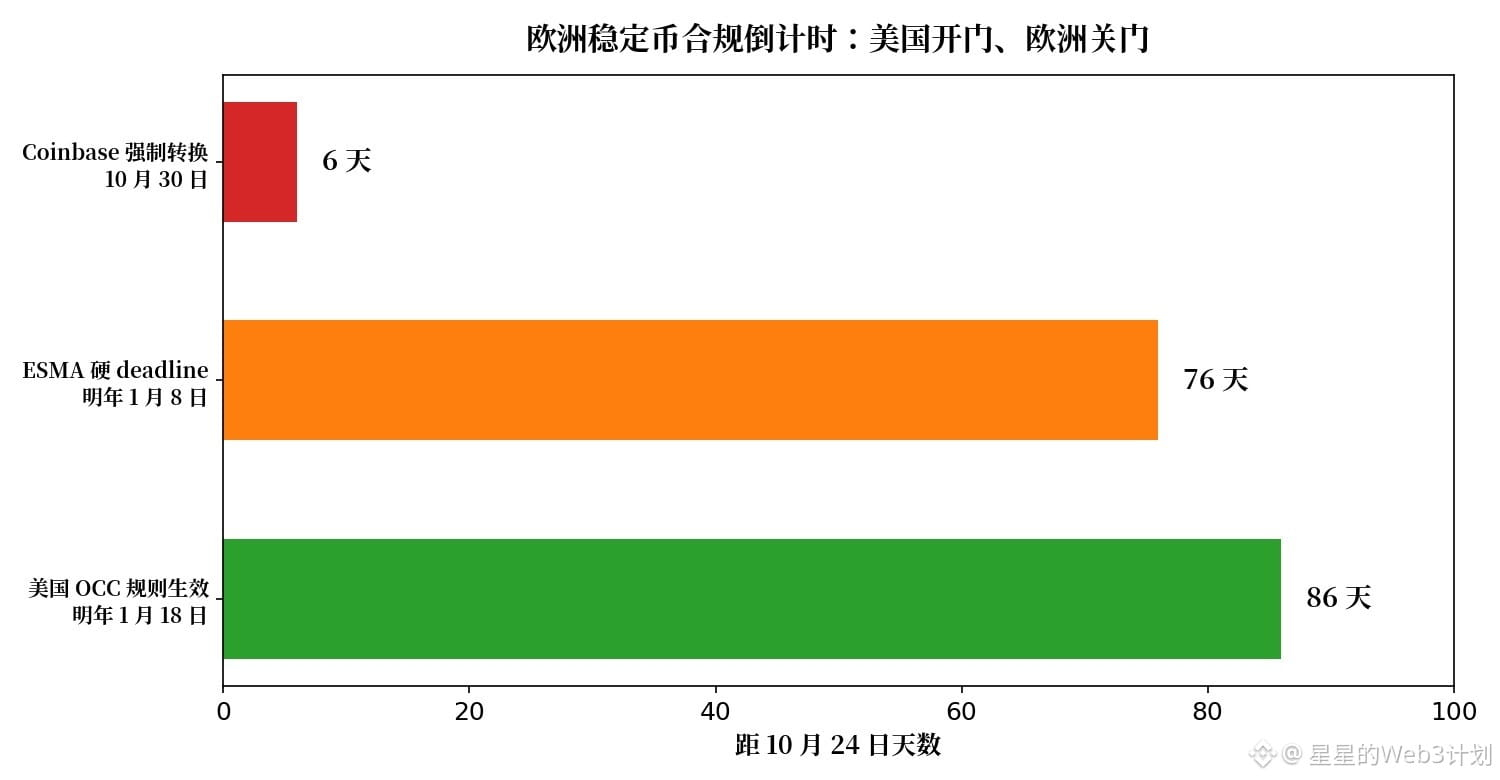
14 stablecoins, forced conversion in Europe in 6 days.
Coinbase has set October 30 as the deadline: USDT, DAI, PYUSD, and 11 other non-compliant stablecoins held by customers in the European Economic Area will be converted to USDC at market rates if they aren't withdrawn by then. Any further deposits will simply not be credited.
Buying, selling, and swapping have already been halted. Withdrawal is now the only option. Behind this is ESMA's October 8 opinion: MiCA-licensed platforms must clean up their exposure to non-compliant stablecoins as soon as possible, with a hard deadline of January 8 next year. Coinbase has simply moved its own deadline up by 70 days.
The interesting contrast is on the other side of the Atlantic: the U.S. OCC has just set January 18 next year as the effective date for the final GENIUS stablecoin rules. The U.S. is opening its doors while Europe is closing them—the same coins are being treated in opposite ways on either side.
I don't think this is an existential moment for USDT, but rather a customer-acquisition window for USDC in Europe: compliance licenses are becoming market share. Watching, not chasing.
Invalidation: If Coinbase extends the deadline after October 30, or ESMA relaxes the January 8 deadline, this thesis is void.
Do you think European users forced to convert their coins will obediently switch to USDC, or simply withdraw and leave?
$USDT $USDC
#稳定币 #Coinbase
This is not investment advice. DYOR; trading involves risk.
14 stablecoins, forced conversion in Europe in 6 days.
Coinbase has set October 30 as the deadline: USDT, DAI, PYUSD, and 11 other non-compliant stablecoins held by customers in the European Economic Area will be converted to USDC at market rates if they aren't withdrawn by then. Any further deposits will simply not be credited.
Buying, selling, and swapping have already been halted. Withdrawal is now the only option. Behind this is ESMA's October 8 opinion: MiCA-licensed platforms must clean up their exposure to non-compliant stablecoins as soon as possible, with a hard deadline of January 8 next year. Coinbase has simply moved its own deadline up by 70 days.
The interesting contrast is on the other side of the Atlantic: the U.S. OCC has just set January 18 next year as the effective date for the final GENIUS stablecoin rules. The U.S. is opening its doors while Europe is closing them—the same coins are being treated in opposite ways on either side.
I don't think this is an existential moment for USDT, but rather a customer-acquisition window for USDC in Europe: compliance licenses are becoming market share. Watching, not chasing.
Invalidation: If Coinbase extends the deadline after October 30, or ESMA relaxes the January 8 deadline, this thesis is void.
Do you think European users forced to convert their coins will obediently switch to USDC, or simply withdraw and leave?
$USDT $USDC
#稳定币 #Coinbase
This is not investment advice. DYOR; trading involves risk.
Coinbase has set October 30 as the deadline: USDT, DAI, PYUSD, and 11 other non-compliant stablecoins held by customers in the European Economic Area will be converted to USDC at market rates if they aren't withdrawn by then. Any further deposits will simply not be credited.
Buying, selling, and swapping have already been halted. Withdrawal is now the only option. Behind this is ESMA's October 8 opinion: MiCA-licensed platforms must clean up their exposure to non-compliant stablecoins as soon as possible, with a hard deadline of January 8 next year. Coinbase has simply moved its own deadline up by 70 days.
The interesting contrast is on the other side of the Atlantic: the U.S. OCC has just set January 18 next year as the effective date for the final GENIUS stablecoin rules. The U.S. is opening its doors while Europe is closing them—the same coins are being treated in opposite ways on either side.
I don't think this is an existential moment for USDT, but rather a customer-acquisition window for USDC in Europe: compliance licenses are becoming market share. Watching, not chasing.
Invalidation: If Coinbase extends the deadline after October 30, or ESMA relaxes the January 8 deadline, this thesis is void.
Do you think European users forced to convert their coins will obediently switch to USDC, or simply withdraw and leave?
$USDT $USDC
#稳定币 #Coinbase
This is not investment advice. DYOR; trading involves risk.
1

·
--
Coinbase will shut its derivatives platform for nine hours this Saturday.
The exchange announced scheduled maintenance on October 24, during which trading futures and perpetual futures on Coinbase Financial Markets will be unavailable.
Account access will remain unchanged, and users are advised to follow updates on Coinbase’s official X account and the derivatives status page.
Coinbase also confirmed it will delist the Ampleforth Governance Token (FORTH) on November 23; FORTH funds will stay accessible and withdrawals will continue.
The token dropped about 15% after the notice.
Recent regulatory actions have limited Coinbase’s reach: Taiwan blocked access ahead of the November 28 election, and a Kazakh court ordered restrictions on Coinbase and five other platforms.
How do you think these temporary service interruptions will affect active traders on the platform?
#Coinbase #Crypto #Derivatives #FinTech #Regulation
Coinbase will shut its derivatives platform for nine hours this Saturday.
The exchange announced scheduled maintenance on October 24, during which trading futures and perpetual futures on Coinbase Financial Markets will be unavailable.
Account access will remain unchanged, and users are advised to follow updates on Coinbase’s official X account and the derivatives status page.
Coinbase also confirmed it will delist the Ampleforth Governance Token (FORTH) on November 23; FORTH funds will stay accessible and withdrawals will continue.
The token dropped about 15% after the notice.
Recent regulatory actions have limited Coinbase’s reach: Taiwan blocked access ahead of the November 28 election, and a Kazakh court ordered restrictions on Coinbase and five other platforms.
How do you think these temporary service interruptions will affect active traders on the platform?
#Coinbase #Crypto #Derivatives #FinTech #Regulation
The exchange announced scheduled maintenance on October 24, during which trading futures and perpetual futures on Coinbase Financial Markets will be unavailable.
Account access will remain unchanged, and users are advised to follow updates on Coinbase’s official X account and the derivatives status page.
Coinbase also confirmed it will delist the Ampleforth Governance Token (FORTH) on November 23; FORTH funds will stay accessible and withdrawals will continue.
The token dropped about 15% after the notice.
Recent regulatory actions have limited Coinbase’s reach: Taiwan blocked access ahead of the November 28 election, and a Kazakh court ordered restrictions on Coinbase and five other platforms.
How do you think these temporary service interruptions will affect active traders on the platform?
#Coinbase #Crypto #Derivatives #FinTech #Regulation
1
41
Think keeping your $BTC on an exchange is safest? The Central Bank of Ireland just slapped Coinbase hard.
Here are the numbers: a €3.25 million fine (about $3.6 million); violations spanning five full years, from 2020 to 2025; a software bug meant customer segregated accounts were underfunded by 0.54% each day, for at least 18 months; dollars belonging to 30 institutional clients were allegedly deposited into the account of Coinbase’s U.S. parent company and mixed with funds from other entities’ clients—for 19 months without being separated. The original fine was €4.65 million, reduced by 30% after Coinbase admitted the violations and settled.
The most ironic part: this is Coinbase Ireland’s second fine in a year. Last year’s €21.4 million anti-money-laundering fine was more than six times as large. Coinbase’s response: we reported the issue ourselves, and no customers lost money.
Of course, reporting it yourself looks better than getting caught. But think about it: the world’s most compliant exchange spent five years failing to calculate how much customer money it needed to keep segregated.
Pick a side in the comments: A) Exchanges are banks 2.0, and one will blow up spectacularly sooner or later. Withdraw your coins. B) Self-reporting and accepting the fine show accountability. Keep your money there.
$ETH #Coinbase #Exchange
Think keeping your $BTC on an exchange is safest? The Central Bank of Ireland just slapped Coinbase hard.
Here are the numbers: a €3.25 million fine (about $3.6 million); violations spanning five full years, from 2020 to 2025; a software bug meant customer segregated accounts were underfunded by 0.54% each day, for at least 18 months; dollars belonging to 30 institutional clients were allegedly deposited into the account of Coinbase’s U.S. parent company and mixed with funds from other entities’ clients—for 19 months without being separated. The original fine was €4.65 million, reduced by 30% after Coinbase admitted the violations and settled.
The most ironic part: this is Coinbase Ireland’s second fine in a year. Last year’s €21.4 million anti-money-laundering fine was more than six times as large. Coinbase’s response: we reported the issue ourselves, and no customers lost money.
Of course, reporting it yourself looks better than getting caught. But think about it: the world’s most compliant exchange spent five years failing to calculate how much customer money it needed to keep segregated.
Pick a side in the comments: A) Exchanges are banks 2.0, and one will blow up spectacularly sooner or later. Withdraw your coins. B) Self-reporting and accepting the fine show accountability. Keep your money there.
$ETH #Coinbase #Exchange
Here are the numbers: a €3.25 million fine (about $3.6 million); violations spanning five full years, from 2020 to 2025; a software bug meant customer segregated accounts were underfunded by 0.54% each day, for at least 18 months; dollars belonging to 30 institutional clients were allegedly deposited into the account of Coinbase’s U.S. parent company and mixed with funds from other entities’ clients—for 19 months without being separated. The original fine was €4.65 million, reduced by 30% after Coinbase admitted the violations and settled.
The most ironic part: this is Coinbase Ireland’s second fine in a year. Last year’s €21.4 million anti-money-laundering fine was more than six times as large. Coinbase’s response: we reported the issue ourselves, and no customers lost money.
Of course, reporting it yourself looks better than getting caught. But think about it: the world’s most compliant exchange spent five years failing to calculate how much customer money it needed to keep segregated.
Pick a side in the comments: A) Exchanges are banks 2.0, and one will blow up spectacularly sooner or later. Withdraw your coins. B) Self-reporting and accepting the fine show accountability. Keep your money there.
$ETH #Coinbase #Exchange
183

·
--
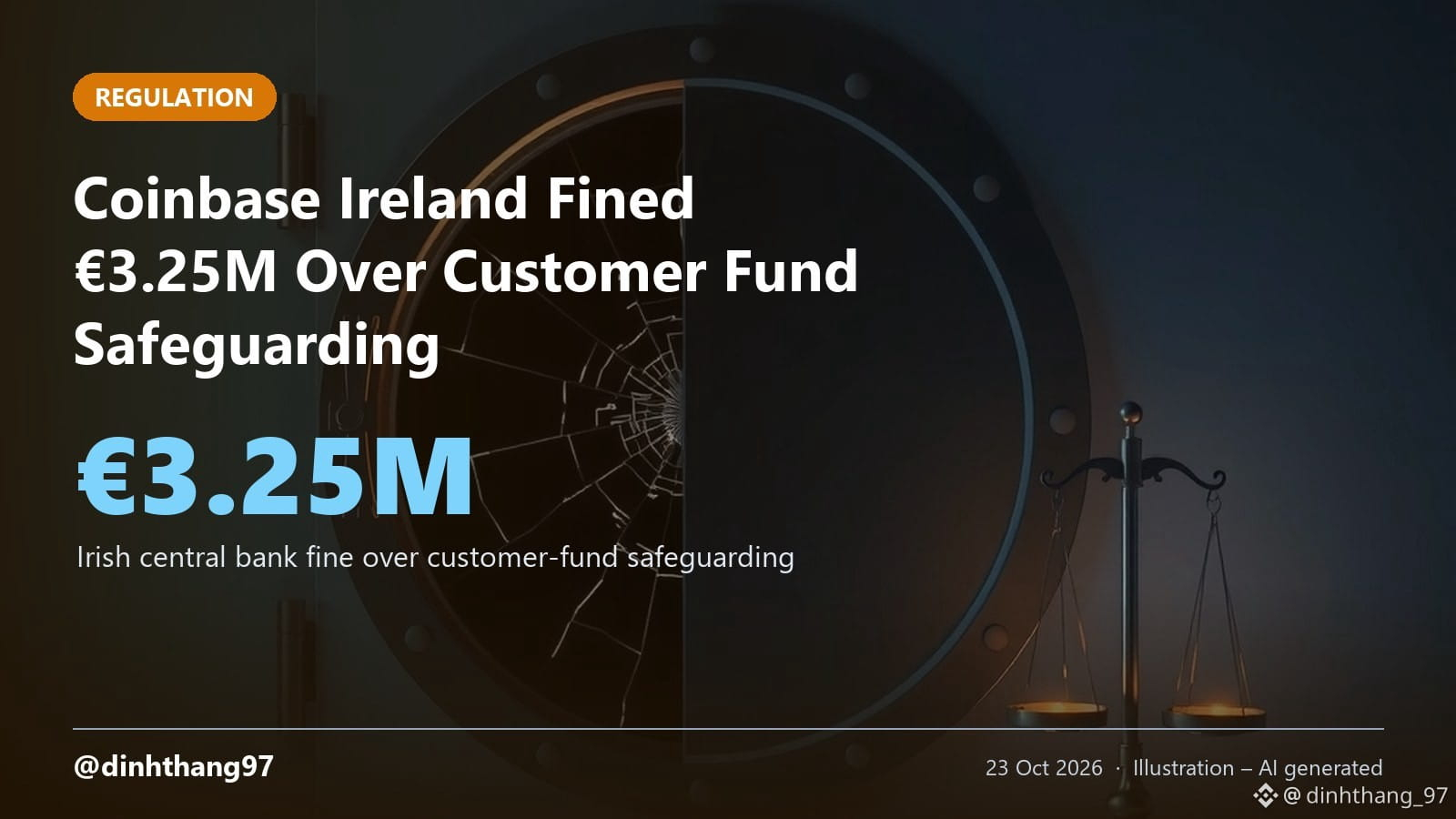
Coinbase Ireland Fined €3.25M Over Customer Fund Safeguarding
• Central Bank of Ireland fined Coinbase Ireland €3.25M (~$3.6M) on Oct. 22 over safeguarding and outsourcing failures
• Around the 2023 Silvergate collapse, funds of 30 customers sat in an account shared with another Coinbase entity's clients; coding errors left the safeguarding account 0.54% underfunded on average
• Coinbase says no customer lost money or access
This is the second Irish penalty after a €21.4M AML fine in 2025, a reminder that custody controls matter as much as product launches. Not financial advice, DYOR.
#Coinbase #Regulation
Coinbase Ireland Fined €3.25M Over Customer Fund Safeguarding
• Central Bank of Ireland fined Coinbase Ireland €3.25M (~$3.6M) on Oct. 22 over safeguarding and outsourcing failures
• Around the 2023 Silvergate collapse, funds of 30 customers sat in an account shared with another Coinbase entity's clients; coding errors left the safeguarding account 0.54% underfunded on average
• Coinbase says no customer lost money or access
This is the second Irish penalty after a €21.4M AML fine in 2025, a reminder that custody controls matter as much as product launches. Not financial advice, DYOR.
#Coinbase #Regulation
• Central Bank of Ireland fined Coinbase Ireland €3.25M (~$3.6M) on Oct. 22 over safeguarding and outsourcing failures
• Around the 2023 Silvergate collapse, funds of 30 customers sat in an account shared with another Coinbase entity's clients; coding errors left the safeguarding account 0.54% underfunded on average
• Coinbase says no customer lost money or access
This is the second Irish penalty after a €21.4M AML fine in 2025, a reminder that custody controls matter as much as product launches. Not financial advice, DYOR.
#Coinbase #Regulation
84

Ireland’s central bank takes action: Coinbase’s Irish subsidiary was fined €3.25 million (down from €4.65 million, a 30% settlement discount) for outsourcing and customer-funds custody violations between November 2020 and August 2025. Regulators alleged that it outsourced custody processes excessively to its US parent, that custody accounts were underfunded for extended periods, and that customer funds were commingled. Coinbase said it had voluntarily self-reported in January 2024 and that no customers were harmed. This is the Central Bank of Ireland’s second fine against Coinbase in a year—the company was hit with a €21.46 million anti-money laundering fine last November. Compliance costs are becoming a fixed expense for exchanges. #Coinbase #合规 #Regulation
Ireland’s central bank takes action: Coinbase’s Irish subsidiary was fined €3.25 million (down from €4.65 million, a 30% settlement discount) for outsourcing and customer-funds custody violations between November 2020 and August 2025. Regulators alleged that it outsourced custody processes excessively to its US parent, that custody accounts were underfunded for extended periods, and that customer funds were commingled. Coinbase said it had voluntarily self-reported in January 2024 and that no customers were harmed. This is the Central Bank of Ireland’s second fine against Coinbase in a year—the company was hit with a €21.46 million anti-money laundering fine last November. Compliance costs are becoming a fixed expense for exchanges. #Coinbase #合规 #Regulation

35
Ireland’s Central Bank fines Coinbase again: €3.25 million for breaching customer fund segregation rules (down from €4.65 million after a 30% settlement discount).
From November 2020 to August 2025, the violations lasted nearly five years. Segregated accounts were once short by €5.2 million, and US dollars belonging to 30 institutional clients were deposited in the US parent company’s account.
Coinbase was fined €21.46 million last year for AML violations—two fines in one year. Customers suffered no losses, but the regulatory line is clear: zero tolerance.
#Coinbase #监管 #CryptoCompliance
Ireland’s Central Bank fines Coinbase again: €3.25 million for breaching customer fund segregation rules (down from €4.65 million after a 30% settlement discount).
From November 2020 to August 2025, the violations lasted nearly five years. Segregated accounts were once short by €5.2 million, and US dollars belonging to 30 institutional clients were deposited in the US parent company’s account.
Coinbase was fined €21.46 million last year for AML violations—two fines in one year. Customers suffered no losses, but the regulatory line is clear: zero tolerance.
#Coinbase #监管 #CryptoCompliance
From November 2020 to August 2025, the violations lasted nearly five years. Segregated accounts were once short by €5.2 million, and US dollars belonging to 30 institutional clients were deposited in the US parent company’s account.
Coinbase was fined €21.46 million last year for AML violations—two fines in one year. Customers suffered no losses, but the regulatory line is clear: zero tolerance.
#Coinbase #监管 #CryptoCompliance

57
Coinbase’s Irish entity has been fined: the Central Bank of Ireland issued a €3.25 million (about $3.65 million) penalty, citing breaches of customer-funds protection and outsourcing obligations between 2020 and 2025. Customer funds were mixed with those of other entities, and fund controls relied too heavily on the US parent company. Coinbase said it reported the issues itself and that customers lost no money. Here’s the key point: last year, the same central bank fined it €21.5 million for anti-money-laundering violations. That brings the total over two years to €24.8 million—EU regulators are treating Coinbase like an ATM. Having a MiCA license won’t save you from fines, either. Compliance costs are so high that small exchanges simply can’t afford to compete. #Coinbase #Regulation
Coinbase’s Irish entity has been fined: the Central Bank of Ireland issued a €3.25 million (about $3.65 million) penalty, citing breaches of customer-funds protection and outsourcing obligations between 2020 and 2025. Customer funds were mixed with those of other entities, and fund controls relied too heavily on the US parent company. Coinbase said it reported the issues itself and that customers lost no money. Here’s the key point: last year, the same central bank fined it €21.5 million for anti-money-laundering violations. That brings the total over two years to €24.8 million—EU regulators are treating Coinbase like an ATM. Having a MiCA license won’t save you from fines, either. Compliance costs are so high that small exchanges simply can’t afford to compete. #Coinbase #Regulation

34

Article
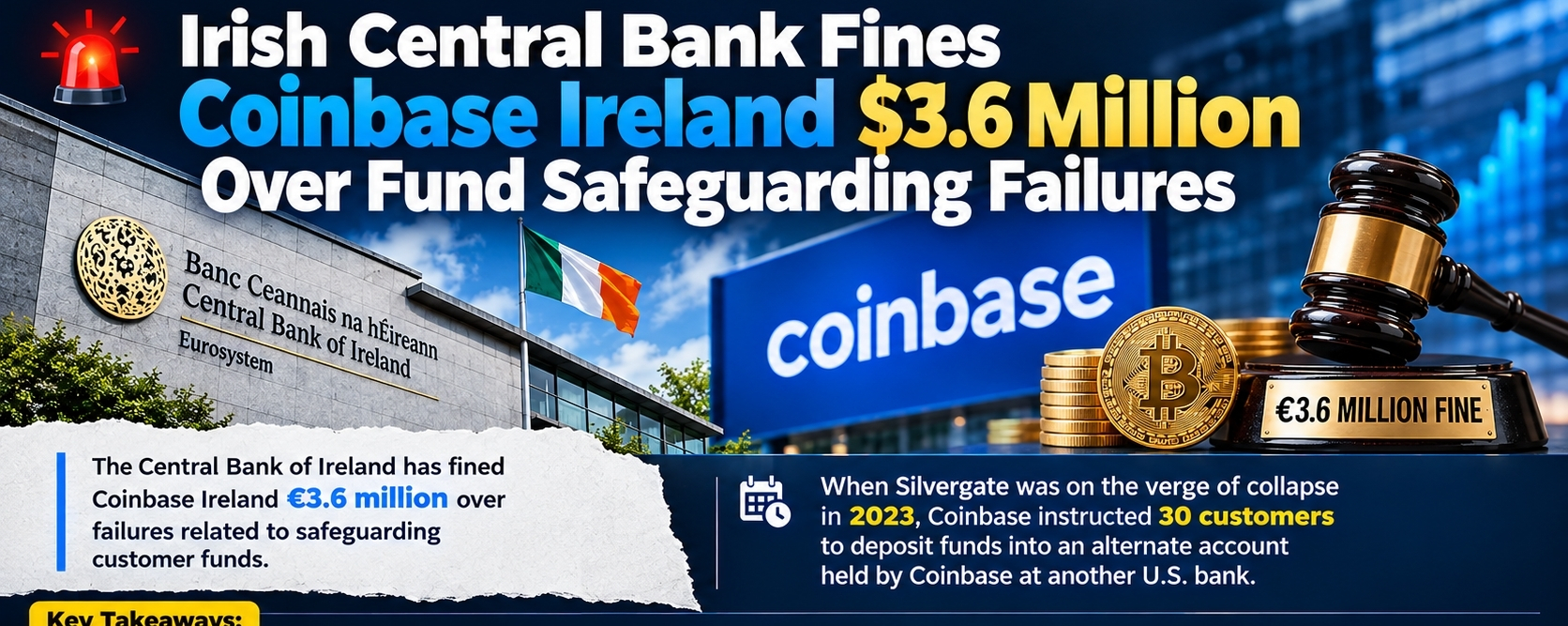
🚨 Irish Central Bank Fines Coinbase Ireland $3.6 Million Over Fund Safeguarding Failures🚨 Irish Central Bank Fines Coinbase Ireland $3.6 Million Over Fund Safeguarding Failures
The Central Bank of Ireland has fined Coinbase Ireland €3.6 million over failures related to safeguarding customer funds.
The case highlights concerns about how customer funds were handled during a critical period in 2023, when Silvergate Bank was on the verge of collapse. During that time, Coinbase reportedly instructed 30 customers to deposit their funds into an alternative account held by Coinbase at another U.S. bank.
This incident raises important questions about customer fund protection, internal controls, and compliance standards in the crypto industry.
🔎 Key Takeaways:
• Regulatory compliance remains a major challenge for crypto companies.
• Proper safeguarding of customer funds is essential for investor confidence.
• Crypto exchanges continue to face increasing scrutiny from financial regulators.
• Strong risk management and transparent operations are crucial for the long-term growth of the crypto industry.
As crypto adoption continues to grow, regulatory oversight and customer protection will remain key issues for exchanges worldwide.
💬 What do you think? Are crypto exchanges doing enough to protect customer funds?
#Coinbase #CryptoNews #CryptoRegulation #Bitcoin #Blockchain #BinanceSquare #Cryptocurrency
🚨 Irish Central Bank Fines Coinbase Ireland $3.6 Million Over Fund Safeguarding Failures
🚨 Irish Central Bank Fines Coinbase Ireland $3.6 Million Over Fund Safeguarding Failures
The Central Bank of Ireland has fined Coinbase Ireland €3.6 million over failures related to safeguarding customer funds.
The case highlights concerns about how customer funds were handled during a critical period in 2023, when Silvergate Bank was on the verge of collapse. During that time, Coinbase reportedly instructed 30 customers to deposit their funds into an alternative account held by Coinbase at another U.S. bank.
This incident raises important questions about customer fund protection, internal controls, and compliance standards in the crypto industry.
🔎 Key Takeaways:
• Regulatory compliance remains a major challenge for crypto companies.
• Proper safeguarding of customer funds is essential for investor confidence.
• Crypto exchanges continue to face increasing scrutiny from financial regulators.
• Strong risk management and transparent operations are crucial for the long-term growth of the crypto industry.
As crypto adoption continues to grow, regulatory oversight and customer protection will remain key issues for exchanges worldwide.
💬 What do you think? Are crypto exchanges doing enough to protect customer funds?
#Coinbase #CryptoNews #CryptoRegulation #Bitcoin #Blockchain #BinanceSquare #Cryptocurrency
The Central Bank of Ireland has fined Coinbase Ireland €3.6 million over failures related to safeguarding customer funds.
The case highlights concerns about how customer funds were handled during a critical period in 2023, when Silvergate Bank was on the verge of collapse. During that time, Coinbase reportedly instructed 30 customers to deposit their funds into an alternative account held by Coinbase at another U.S. bank.
This incident raises important questions about customer fund protection, internal controls, and compliance standards in the crypto industry.
🔎 Key Takeaways:
• Regulatory compliance remains a major challenge for crypto companies.
• Proper safeguarding of customer funds is essential for investor confidence.
• Crypto exchanges continue to face increasing scrutiny from financial regulators.
• Strong risk management and transparent operations are crucial for the long-term growth of the crypto industry.
As crypto adoption continues to grow, regulatory oversight and customer protection will remain key issues for exchanges worldwide.
💬 What do you think? Are crypto exchanges doing enough to protect customer funds?
#Coinbase #CryptoNews #CryptoRegulation #Bitcoin #Blockchain #BinanceSquare #Cryptocurrency
47

·
--
🏛️ $470 Million in Seized BTC Quietly Moves to Coinbase? Strategic Reserve Controversy Resurfaces
On-chain data shows that the U.S. government recently transferred seized crypto assets worth approximately $470 million to an address believed to be linked to Coinbase Prime.
Why is this so sensitive? Because Trump had previously stated clearly that the U.S. would keep a national strategic Bitcoin reserve. This large-scale transfer happened after that statement—and the market immediately questioned: Wasn’t the plan “in only, never out”? Why is it moving again?
Although federal officials deny that there was a secret sale, “seized assets flowing to an exchange” naturally invites speculation: Is the government cashing out, or simply changing custodians?
$BTC #比特币 #战略储备 #Coinbase
🏛️ $470 Million in Seized BTC Quietly Moves to Coinbase? Strategic Reserve Controversy Resurfaces
On-chain data shows that the U.S. government recently transferred seized crypto assets worth approximately $470 million to an address believed to be linked to Coinbase Prime.
Why is this so sensitive? Because Trump had previously stated clearly that the U.S. would keep a national strategic Bitcoin reserve. This large-scale transfer happened after that statement—and the market immediately questioned: Wasn’t the plan “in only, never out”? Why is it moving again?
Although federal officials deny that there was a secret sale, “seized assets flowing to an exchange” naturally invites speculation: Is the government cashing out, or simply changing custodians?
$BTC #比特币 #战略储备 #Coinbase
On-chain data shows that the U.S. government recently transferred seized crypto assets worth approximately $470 million to an address believed to be linked to Coinbase Prime.
Why is this so sensitive? Because Trump had previously stated clearly that the U.S. would keep a national strategic Bitcoin reserve. This large-scale transfer happened after that statement—and the market immediately questioned: Wasn’t the plan “in only, never out”? Why is it moving again?
Although federal officials deny that there was a secret sale, “seized assets flowing to an exchange” naturally invites speculation: Is the government cashing out, or simply changing custodians?
$BTC #比特币 #战略储备 #Coinbase
48

·
--
Central Bank of Ireland Fines Coinbase $3.6 Million, Exposing Compliance Gaps
According to Cointelegraph, the Central Bank of Ireland has fined Coinbase Ireland $3.6 million over failures in its oversight and safeguards. Coinbase Ireland has agreed to the facts underlying the enforcement action.
The fine is relatively small compared with Coinbase’s overall size, but its significance as a signal is worth noting: European regulators are beginning to scrutinize crypto platforms’ internal risk controls and user-asset protection processes more closely, rather than focusing solely on licensing.
For $COIN, the direct impact may be limited, as the fine itself is unlikely to significantly affect earnings. More worth watching is the possibility that enforcement actions of this kind could raise compliance costs for its European operations and affect some users’ perceptions of the safety of funds held on the platform. If more similar cases emerge, the market may reassess the marginal cost of Coinbase’s expansion in Europe.
On the other hand, a $3.6 million fine is not enough to pose a systemic risk, and Coinbase has cooperated in acknowledging the facts, so the short-term share-price reaction may be relatively subdued. We should avoid interpreting a single fine as evidence of a broad tightening of regulation across Europe.
Two things to watch next: first, whether the Central Bank of Ireland follows up with other crypto platforms; and second, whether $COIN’s user growth and compliance spending in the European market show any significant changes. From a trading perspective, if $COIN fails to quickly absorb the news, watch whether it can hold its recent support range rather than rushing to chase a rally.
$COIN #Coinbase #CryptoRegulation
The above is an informational summary and personal analysis, and does not constitute investment advice.
I will continue to provide updates as further policy details become clear.
Central Bank of Ireland Fines Coinbase $3.6 Million, Exposing Compliance Gaps
According to Cointelegraph, the Central Bank of Ireland has fined Coinbase Ireland $3.6 million over failures in its oversight and safeguards. Coinbase Ireland has agreed to the facts underlying the enforcement action.
The fine is relatively small compared with Coinbase’s overall size, but its significance as a signal is worth noting: European regulators are beginning to scrutinize crypto platforms’ internal risk controls and user-asset protection processes more closely, rather than focusing solely on licensing.
For $COIN , the direct impact may be limited, as the fine itself is unlikely to significantly affect earnings. More worth watching is the possibility that enforcement actions of this kind could raise compliance costs for its European operations and affect some users’ perceptions of the safety of funds held on the platform. If more similar cases emerge, the market may reassess the marginal cost of Coinbase’s expansion in Europe.
On the other hand, a $3.6 million fine is not enough to pose a systemic risk, and Coinbase has cooperated in acknowledging the facts, so the short-term share-price reaction may be relatively subdued. We should avoid interpreting a single fine as evidence of a broad tightening of regulation across Europe.
Two things to watch next: first, whether the Central Bank of Ireland follows up with other crypto platforms; and second, whether $COIN ’s user growth and compliance spending in the European market show any significant changes. From a trading perspective, if $COIN fails to quickly absorb the news, watch whether it can hold its recent support range rather than rushing to chase a rally.
$COIN #Coinbase #CryptoRegulation
The above is an informational summary and personal analysis, and does not constitute investment advice.
I will continue to provide updates as further policy details become clear.
According to Cointelegraph, the Central Bank of Ireland has fined Coinbase Ireland $3.6 million over failures in its oversight and safeguards. Coinbase Ireland has agreed to the facts underlying the enforcement action.
The fine is relatively small compared with Coinbase’s overall size, but its significance as a signal is worth noting: European regulators are beginning to scrutinize crypto platforms’ internal risk controls and user-asset protection processes more closely, rather than focusing solely on licensing.
For $COIN , the direct impact may be limited, as the fine itself is unlikely to significantly affect earnings. More worth watching is the possibility that enforcement actions of this kind could raise compliance costs for its European operations and affect some users’ perceptions of the safety of funds held on the platform. If more similar cases emerge, the market may reassess the marginal cost of Coinbase’s expansion in Europe.
On the other hand, a $3.6 million fine is not enough to pose a systemic risk, and Coinbase has cooperated in acknowledging the facts, so the short-term share-price reaction may be relatively subdued. We should avoid interpreting a single fine as evidence of a broad tightening of regulation across Europe.
Two things to watch next: first, whether the Central Bank of Ireland follows up with other crypto platforms; and second, whether $COIN ’s user growth and compliance spending in the European market show any significant changes. From a trading perspective, if $COIN fails to quickly absorb the news, watch whether it can hold its recent support range rather than rushing to chase a rally.
$COIN #Coinbase #CryptoRegulation
The above is an informational summary and personal analysis, and does not constitute investment advice.
I will continue to provide updates as further policy details become clear.
44
Log in to explore more content
Join global crypto users on Binance Square
⚡️ Get latest and useful information about crypto.
💬 Trusted by the world’s largest crypto exchange.
👍 Discover real insights from verified creators.
Email / Phone number
Trending Topics
1
#BinancePick
2.6M views
138,898 Discussing
2
#EarningsSeason
5M views
24,021 Discussing
3
#ElectrumWalletBugLetRogueServersStealFunds
3,821 views
171 Discussing
4
#ArgentineCourtDismissesLIBRACaseAgainstMilei
11,557 views
241 Discussing
5
#SKHynixReportedlyPlansSpecialDividendFromKioxiaStakeSale
2,377 views
41 Discussing
6
#KeystoneWebsiteBreachExposesBuyersShippingAddresses
1,387 views
32 Discussing
7
#USQ3GDPAndSeptemberPCEDueNextWeek
85,709 views
1,051 Discussing
8
#SouthKoreaDelaysCryptoIncomeTax
157,556 views
1,097 Discussing
9
#ElectrumFixesHighRiskExploitInVersionsBefore4.8.3
68,762 views
787 Discussing
10
#SouthKoreaPlansToRegulateStablecoinsUnderFXLaw
67,236 views
703 Discussing