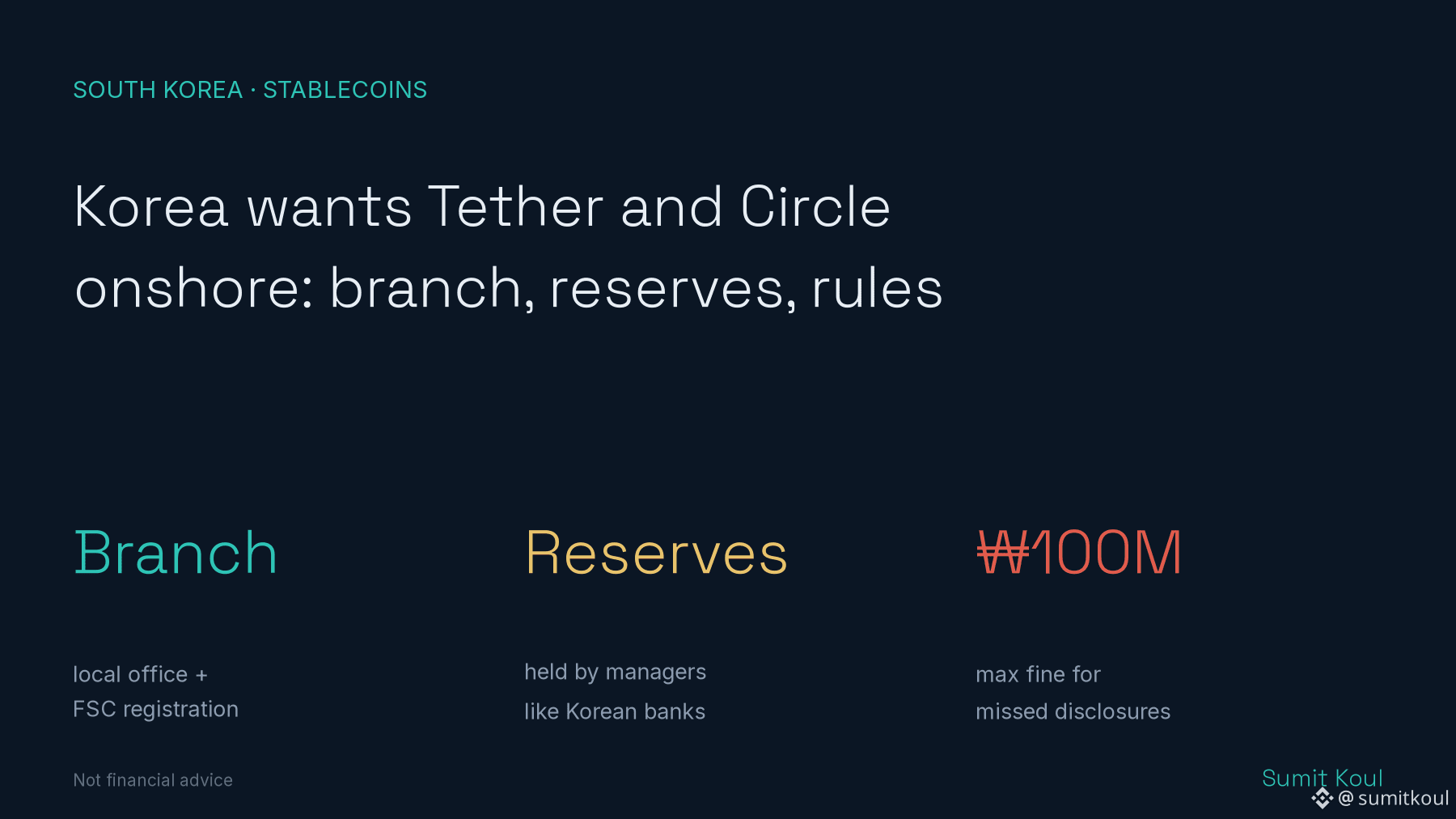
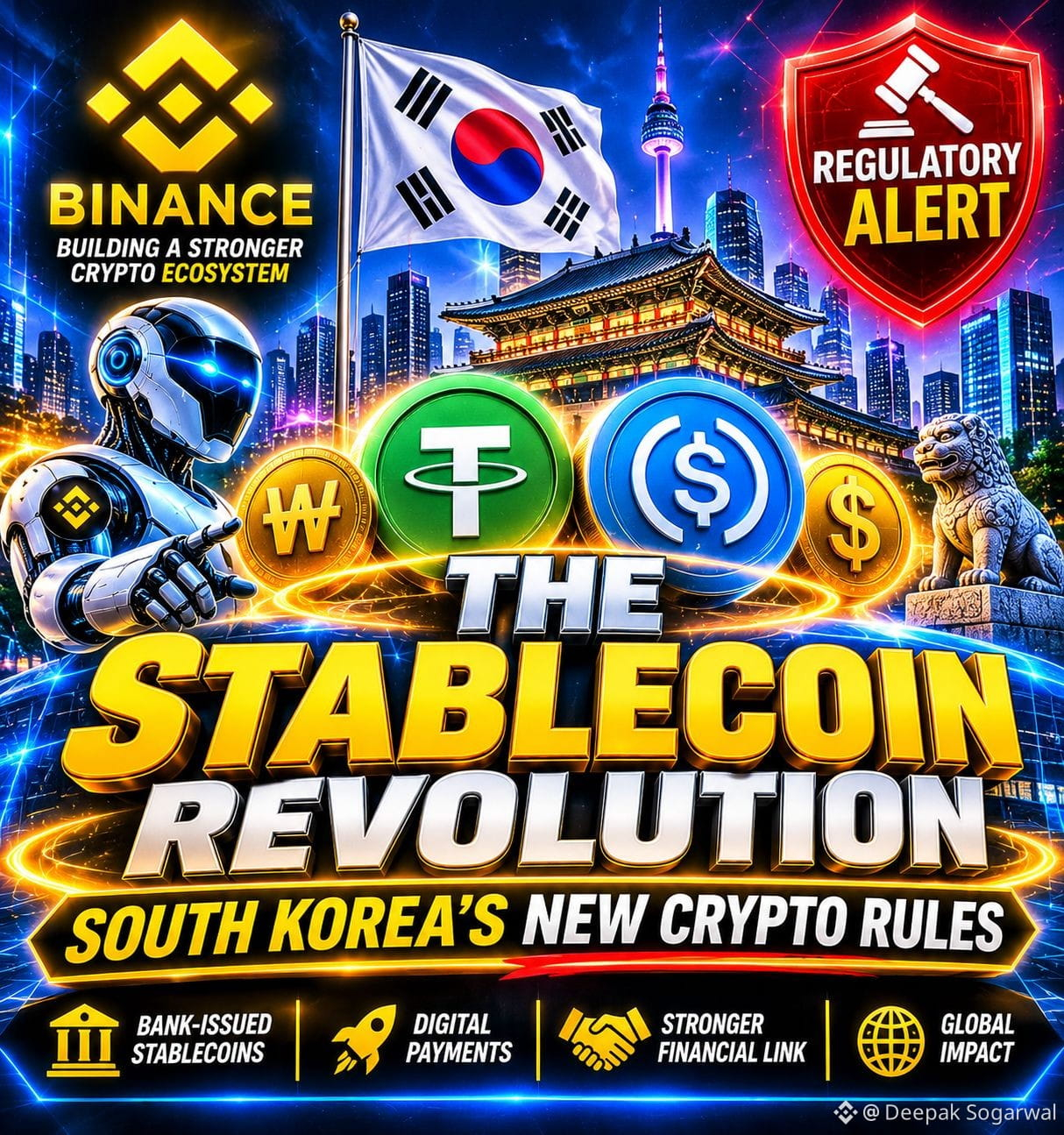
South Korea just told Tether and Circle what it would take to keep serving Koreans. The short version: open an office here, and park the money here too.
That is the headline from a new draft of the Digital Asset Industry Innovation and User Protection Act, proposed by the Financial Services Commission (FSC) and reported this morning by Odaily and PANews. It is still a draft, not law. But it tells you a lot about where one of the most active retail crypto markets in the world is heading, and it lands in the same week Korea's central bank raised rates to 3.25%.
Here is what is in it, what it could mean, and what I am watching.
## Foreign stablecoin issuers would need a Korean branch
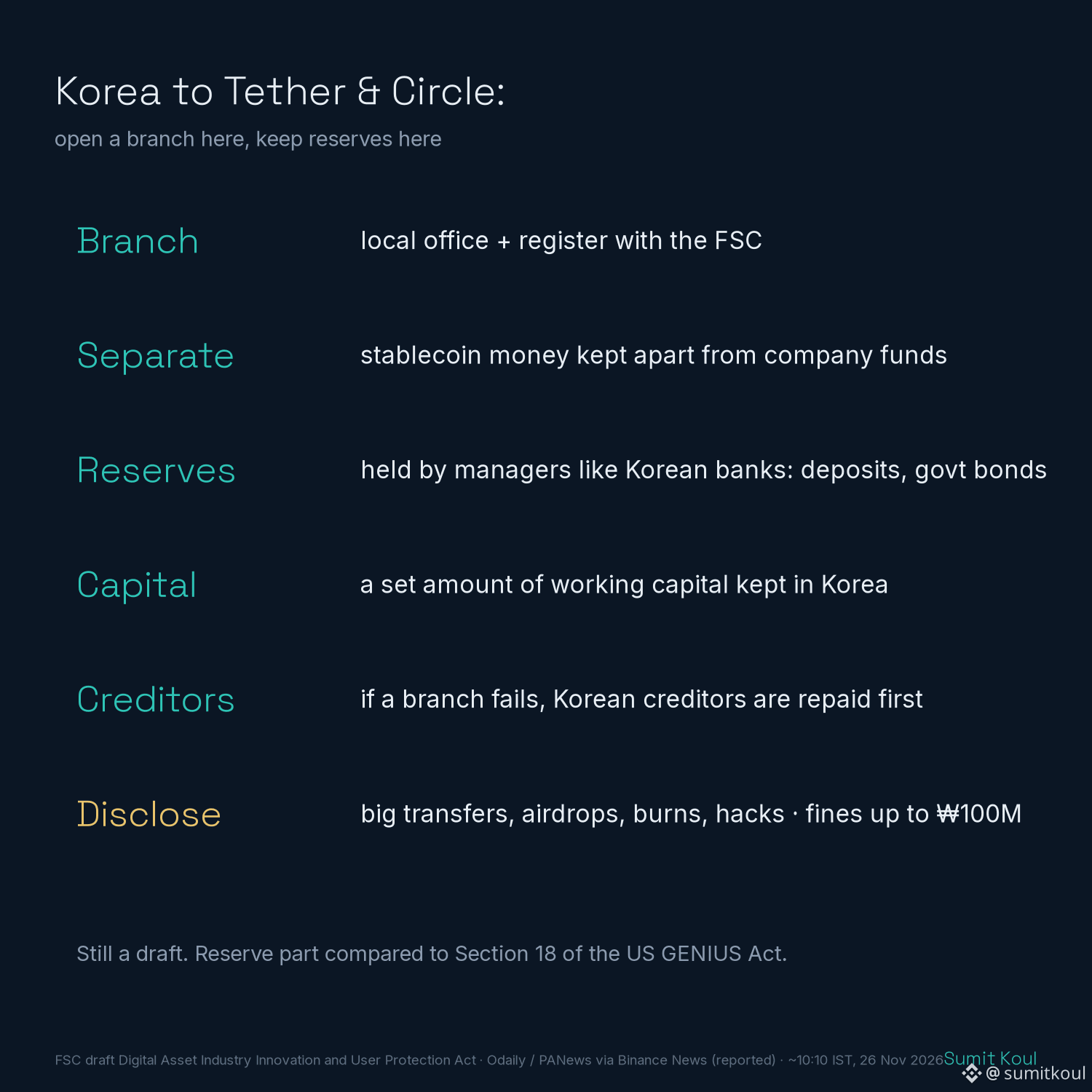
Under the draft, any overseas issuer that lets South Korean residents mint or redeem its stablecoin would have to:
• set up a local branch or place of business,
• register with the FSC,
• keep the money it collects from issuing stablecoins separate from its own assets,
• hand those funds to approved reserve managers, such as Korean banks,
• keep a set level of working capital inside South Korea.
The reserve managers would invest only in permitted assets, such as bank deposits and government bonds. How much would have to sit in Korea would depend on two things: how the issuer is regulated at home, and how much of its stablecoin is held and circulating in Korea.
There is one more clause that matters a lot if things go wrong. If a Korean branch is liquidated or goes insolvent, its domestic assets would be used to repay Korean creditors first.
Reports compare the reserve part to Section 18 of the US GENIUS Act. In other words, Korea is not inventing a new model. It is copying the "if you want to serve our users, you play by our reserve rules" approach the US already wrote down.
## Token issuers would have to disclose big moves, or pay
A second part of the same draft, reported by PANews, covers disclosure. Issuers that file a white paper with the FSC, and the exchanges that list those tokens, would have to disclose events that materially change circulating supply. That includes:
• large transactions,
• airdrops,
• token burns,
• hacks or system failures,
• changes to core technology like the ledger itself,
• anything else that could materially affect users' trading decisions.
Breaking the rule could cost a fine of up to 100 million won.
If you have ever watched a token dump on an unannounced unlock, you can see why a regulator wants this. It goes straight at the information gap between insiders and everyone else.
## Put together, the direction is clear
Earlier this week a draft was reported that would let ICOs come back to Korea after the 2017 ban. Today's pieces fill in the other side: tighter control over the dollar stablecoins that flow in, and more disclosure from the tokens that get listed.
My read is that Korea wants a bigger, more open crypto market, but on its own terms. It does not want Korean money sitting with offshore issuers it cannot reach if something breaks.
## What it could mean for traders
I want to be careful here, because the draft can still change and nobody has said how big the local reserve requirement would be. But a few things follow from the text.
• Stablecoin issuers face a choice. Building a Korean branch, finding a Korean bank as reserve manager and holding working capital onshore all cost money. A large issuer can probably absorb that. A smaller one might decide Korea is not worth it.
• Korean bank deposits and government bonds could get a new buyer. If the rules pass in this form, part of the reserves behind the dollar stablecoins Koreans use would sit in Korean deposits and bonds.
• Listings could get noisier, but fairer. Mandatory disclosure of burns, airdrops and big transfers means more announcements. More announcements mean more volatility around them, but fewer surprises.
None of this is a reason to buy or sell anything today. It is a reason to keep an eye on Korean flows, because they have moved altcoins before.
## Where the market is while this lands
As of about 10:10 IST on Binance USD-M:
•
$BTC around 60,985, after a 05:30 IST daily close at 60,430
•
$ETH around 1,703
• 73.4% of Binance BTC futures accounts are net long
• The Fear & Greed Index is at 11, extreme fear
## What I am watching next
1. Whether the FSC publishes a number for the local reserve share or the working-capital requirement.
2. Whether Tether or Circle respond publicly.
3. Whether the disclosure rule comes with a clear definition of a "large transaction". Without one, it will be hard to enforce.
4. How this lines up with the ICO draft. If both move together, Korea is building a full rulebook, not patching holes.
I will post an update when any of these move.
What would you do if you were Tether: open a Korean branch, or step back from Korean users? Tell me in the comments.
If you want regulation explained in plain language, without the hype, follow me. I post this kind of breakdown most days.
#SouthKorea #Stablecoins #USDT
Sources: FSC draft as reported by Odaily and PANews via Binance News (26 Nov 2026); Bank of Korea decision via Jin10/Bloomberg; market data from the Binance public API and alternative.me, about 10:10 IST. Not financial advice.