cryptoeducation

3.8M views
25,495 Discussing
btw_mubashir
·
--
🚀 WHY DOESN'T SOLANA RISE WHEN MILLIONS OF PEOPLE ARE BUYING?#Have you ever wondered why millions of people can be interested in buying a cryptocurrency, but its price still doesn't increase? This is one of the most interesting concepts in the crypto market. Let's understand it! 1. Every Trade Has Two Sides Whenever a trade is completed, there is always: - One buyer. - One seller. A completed transaction requires both sides. That's why counting buyers and sellers alone doesn't tell us which direction the price will move. 2. What Actually Moves the Price? The price is influenced by supply and demand, available liquidity, and the prices at which people are willing to trade. For example: Imagine SOL is trading at $100. Some buyers are willing to pay $100, while others are willing to pay $102. If buyers start accepting higher asking prices, the market can move upward. But if sellers keep accepting lower bids, the price can move downward. 3. Understanding the Order Book An order book displays pending buy and sell orders. 🟢 Bids: Prices buyers are willing to pay. 🔴 Asks: Prices sellers want to receive. The order book helps us understand market depth and available liquidity. However, pending orders can change or disappear, so they cannot guarantee future price movements. 4. Why Do Big Orders Matter? Imagine one trader wants to buy a large quantity of SOL. If there aren't enough sellers near the current price, that order may need to match with sellers at higher prices. This can create price impact. The same principle works in reverse when large sell orders meet limited buying interest. 5. The Biggest Lesson Remember these three things: - Number of buyers doesn't equal buying pressure. - Trading volume doesn't guarantee a price increase. - Market depth helps explain how easily prices can move. Understanding these concepts is an important step toward understanding cryptocurrency markets. FINAL THOUGHTS 🧠 The crypto market isn't controlled by one person. Prices emerge from millions of individual decisions, orders, and transactions across different markets. "Don't just count the buyers. Understand the demand behind their orders." 💬 QUESTION FOR THE COMMUNITY: What do you think has a bigger influence on crypto prices: trading volume or market liquidity? Share your thoughts below! $SOL $BTC $ETH #CryptoEducation #Solana #SOL #OrderBook #Blockchain #CryptoMarket

🚀 WHY DOESN'T SOLANA RISE WHEN MILLIONS OF PEOPLE ARE BUYING?

#Have you ever wondered why millions of people can be interested in buying a cryptocurrency, but its price still doesn't increase?
This is one of the most interesting concepts in the crypto market.
Let's understand it!
1. Every Trade Has Two Sides
Whenever a trade is completed, there is always:
- One buyer.
- One seller.
A completed transaction requires both sides.
That's why counting buyers and sellers alone doesn't tell us which direction the price will move.
2. What Actually Moves the Price?
The price is influenced by supply and demand, available liquidity, and the prices at which people are willing to trade.
For example:
Imagine SOL is trading at $100.
Some buyers are willing to pay $100, while others are willing to pay $102.
If buyers start accepting higher asking prices, the market can move upward.
But if sellers keep accepting lower bids, the price can move downward.
3. Understanding the Order Book
An order book displays pending buy and sell orders.
🟢 Bids: Prices buyers are willing to pay.
🔴 Asks: Prices sellers want to receive.
The order book helps us understand market depth and available liquidity.
However, pending orders can change or disappear, so they cannot guarantee future price movements.
4. Why Do Big Orders Matter?
Imagine one trader wants to buy a large quantity of SOL.
If there aren't enough sellers near the current price, that order may need to match with sellers at higher prices.
This can create price impact.
The same principle works in reverse when large sell orders meet limited buying interest.
5. The Biggest Lesson
Remember these three things:
- Number of buyers doesn't equal buying pressure.
- Trading volume doesn't guarantee a price increase.
- Market depth helps explain how easily prices can move.
Understanding these concepts is an important step toward understanding cryptocurrency markets.
FINAL THOUGHTS 🧠
The crypto market isn't controlled by one person.
Prices emerge from millions of individual decisions, orders, and transactions across different markets.
"Don't just count the buyers. Understand the demand behind their orders."
💬 QUESTION FOR THE COMMUNITY:
What do you think has a bigger influence on crypto prices: trading volume or market liquidity?
Share your thoughts below!
$SOL $BTC $ETH
#CryptoEducation #Solana #SOL #OrderBook #Blockchain #CryptoMarket
BlockchainPrincess:
Great research! This deserves more attention. 💎
Article
New to Crypto? 7 Essential Lessons Every Beginner Should Know 🚀Getting started in crypto can be exciting, but learning the basics before making financial decisions is essential. Whether you're exploring Bitcoin, Ethereum, or other digital assets, understanding the market, protecting your account, and managing risk can help you make more informed decisions. 1. Understand What You're Buying Every crypto project is different. Before investing, research its purpose, technology, utility, token supply, and potential risks. Popularity alone does not determine a project's long-term value. 2. Understand Market Volatility Cryptocurrency prices can rise or fall significantly in a short period. A price increase does not guarantee further gains, and a market decline does not guarantee a recovery. Avoid making decisions based only on short-term price movements. 3. Learn Spot Trading Before Exploring Complex Products Spot trading involves buying and selling assets at current market prices. However, prices can fall after you buy, resulting in losses. Futures and leveraged products involve additional risks and can lead to substantial losses. Understand how these products work before considering them. 4. Make Security a Priority 🔐 Protect your account with a strong, unique password and two-factor authentication (2FA). Never share verification codes, private keys, or wallet recovery phrases. Avoid suspicious links and remember that legitimate support should never need your password or recovery phrase. 5. Never Risk Money You Cannot Afford to Lose Crypto investments can lose significant value. Avoid borrowing money to invest, and never let fear of missing out (FOMO) pressure you into rushed decisions. Set clear limits and consider your financial situation before taking any risk. 6. Research Beyond Social Media Hype Online opinions, trending coins, and influencer predictions are not guarantees of success. Check official project documentation, understand the risks, and verify important claims using reliable sources before making a decision. 7. Focus on Learning Before Chasing Profits Start by understanding basic crypto terminology, trading fees, market charts, and order types. Take time to learn how different market conditions work instead of feeling pressured to trade every opportunity. Final Thoughts 💡 You don't need to master everything in one day. Consistent learning, careful research, and responsible risk management are more valuable than chasing quick profits. Learn first. Research carefully. Protect your assets. Make informed decisions. 💬 Question for the community: What was the most confusing thing about crypto when you first started learning? #CryptoEducation #CryptoBeginners #Write2Earn #Binance #BinanceSquareTalks Disclaimer: This article is for educational purposes only and does not constitute financial advice. Cryptocurrency investments involve risk, and you should conduct your own research before making making financial decisions. “If you enjoyed this, follow me for more!” 👍

New to Crypto? 7 Essential Lessons Every Beginner Should Know 🚀

Getting started in crypto can be exciting, but learning the basics before making financial decisions is essential.
Whether you're exploring Bitcoin, Ethereum, or other digital assets, understanding the market, protecting your account, and managing risk can help you make more informed decisions.
1. Understand What You're Buying
Every crypto project is different. Before investing, research its purpose, technology, utility, token supply, and potential risks. Popularity alone does not determine a project's long-term value.
2. Understand Market Volatility
Cryptocurrency prices can rise or fall significantly in a short period. A price increase does not guarantee further gains, and a market decline does not guarantee a recovery. Avoid making decisions based only on short-term price movements.
3. Learn Spot Trading Before Exploring Complex Products
Spot trading involves buying and selling assets at current market prices. However, prices can fall after you buy, resulting in losses. Futures and leveraged products involve additional risks and can lead to substantial losses. Understand how these products work before considering them.
4. Make Security a Priority 🔐
Protect your account with a strong, unique password and two-factor authentication (2FA). Never share verification codes, private keys, or wallet recovery phrases. Avoid suspicious links and remember that legitimate support should never need your password or recovery phrase.
5. Never Risk Money You Cannot Afford to Lose
Crypto investments can lose significant value. Avoid borrowing money to invest, and never let fear of missing out (FOMO) pressure you into rushed decisions. Set clear limits and consider your financial situation before taking any risk.
6. Research Beyond Social Media Hype
Online opinions, trending coins, and influencer predictions are not guarantees of success. Check official project documentation, understand the risks, and verify important claims using reliable sources before making a decision.
7. Focus on Learning Before Chasing Profits
Start by understanding basic crypto terminology, trading fees, market charts, and order types. Take time to learn how different market conditions work instead of feeling pressured to trade every opportunity.
Final Thoughts 💡
You don't need to master everything in one day. Consistent learning, careful research, and responsible risk management are more valuable than chasing quick profits.
Learn first. Research carefully. Protect your assets. Make informed decisions.
💬 Question for the community: What was the most confusing thing about crypto when you first started learning?
#CryptoEducation #CryptoBeginners #Write2Earn #Binance #BinanceSquareTalks
Disclaimer: This article is for educational purposes only and does not constitute financial advice. Cryptocurrency investments involve risk, and you should conduct your own research before making making financial decisions.
“If you enjoyed this, follow me for more!” 👍
🚨 $BTC {spot}(BTCUSDT) BITCOIN: Is the Market Preparing for Its Next Big Move? Bitcoin is more than just a price chart. It is a market driven by investor sentiment, liquidity, adoption, and global economic conditions. Here are 3 things every crypto investor should watch: 📊 1. Market Structure Is BTC making higher highs and higher lows, or is the market losing momentum? The answer can help investors understand the current trend. 💰 2. Trading Volume A price breakout with strong volume can be more meaningful than a move with weak participation. Always look for confirmation. 🌍 3. Market Sentiment Interest rates, institutional demand, and global economic news can influence Bitcoin's direction. ⚠️ The Risk: Bitcoin can move sharply in either direction. A bullish chart does not guarantee a rally, and a bearish chart does not guarantee a crash. The smartest approach is to understand the market before making a decision. 💬 What do you think? Is Bitcoin preparing for another major rally, or could we see more consolidation first? Share your analysis in the comments. Let's learn from each other! ₿ Follow Digital Finance World for more crypto education and market insights. #Bitcoin❗ #BTC☀️ #CryptoAnalysis #BinanceSquare #CryptoEducation #DigitalFinanceWorld Educational content only. Not financial advice. Always DYOR.
🚨 $BTC
BITCOIN: Is the Market Preparing for Its Next Big Move?

Bitcoin is more than just a price chart. It is a market driven by investor sentiment, liquidity, adoption, and global economic conditions.

Here are 3 things every crypto investor should watch:

📊 1. Market Structure
Is BTC making higher highs and higher lows, or is the market losing momentum? The answer can help investors understand the current trend.

💰 2. Trading Volume
A price breakout with strong volume can be more meaningful than a move with weak participation. Always look for confirmation.

🌍 3. Market Sentiment
Interest rates, institutional demand, and global economic news can influence Bitcoin's direction.

⚠️ The Risk:
Bitcoin can move sharply in either direction. A bullish chart does not guarantee a rally, and a bearish chart does not guarantee a crash.

The smartest approach is to understand the market before making a decision.

💬 What do you think?
Is Bitcoin preparing for another major rally, or could we see more consolidation first?

Share your analysis in the comments. Let's learn from each other!

₿ Follow Digital Finance World for more crypto education and market insights.

#Bitcoin❗ #BTC☀️ #CryptoAnalysis #BinanceSquare #CryptoEducation #DigitalFinanceWorld

Educational content only. Not financial advice. Always DYOR.
WHAT IS BITCOIN HALVING? Bitcoin halving is an event that reduces the amount of new Bitcoin issued as mining rewards. It happens approximately every four years, based on Bitcoin's block production. Halving is an important part of Bitcoin's monetary design. However, it does not guarantee that Bitcoin's price will increase. #BitcoinHalving #BTC #CryptoEducation
WHAT IS BITCOIN HALVING?
Bitcoin halving is an event that reduces the amount of new Bitcoin issued as mining rewards.
It happens approximately every four years, based on Bitcoin's block production.
Halving is an important part of Bitcoin's monetary design.
However, it does not guarantee that Bitcoin's price will increase.
#BitcoinHalving #BTC #CryptoEducation
#CanMarketsReboundAfterThanksgiving? 5 Crypto Trading Mistakes That Can Destroy Your Investment! Many beginners enter the crypto market hoping to make quick money. Unfortunately, simple mistakes can lead to serious losses. Here are five mistakes every crypto investor should avoid. 1. Buying Because of Hype Never buy a coin just because everyone is talking about it. 2. Investing Without Research Understand a project's purpose, technology, tokenomics and risks. 3. Using Too Much Leverage Leverage can increase losses as well as profits. Beginners should be especially careful. 4. Ignoring Security Never share your passwords, private keys or verification codes. 5. Panic Buying and Selling Emotional decisions often lead to poor trading results. Remember These Coins $BTC – Bitcoin $ETH – Ethereum $BNB – BNB These are different crypto assets with different use cases and risks. Research each one independently. My Question: What is the biggest mistake you have seen beginners make in crypto trading? Let's learn together! #CryptoEducation #Bitcoin #Ethereum #BNB #RiskManagement
#CanMarketsReboundAfterThanksgiving?

5 Crypto Trading Mistakes That Can Destroy Your Investment!

Many beginners enter the crypto market hoping to make quick money. Unfortunately, simple mistakes can lead to serious losses.

Here are five mistakes every crypto investor should avoid.

1. Buying Because of Hype

Never buy a coin just because everyone is talking about it.

2. Investing Without Research

Understand a project's purpose, technology, tokenomics and risks.

3. Using Too Much Leverage

Leverage can increase losses as well as profits. Beginners should be especially careful.

4. Ignoring Security

Never share your passwords, private keys or verification codes.

5. Panic Buying and Selling

Emotional decisions often lead to poor trading results.

Remember These Coins

$BTC – Bitcoin
$ETH – Ethereum
$BNB – BNB

These are different crypto assets with different use cases and risks. Research each one independently.

My Question: What is the biggest mistake you have seen beginners make in crypto trading?

Let's learn together!

#CryptoEducation #Bitcoin #Ethereum #BNB #RiskManagement
·
--
Bearish
🚀 Bitcoin: The Future of Digital Finance? Bitcoin is more than just a cryptocurrency. It represents a new way of thinking about money, technology, and financial freedom. Here are 3 important things every beginner should know: 1. Bitcoin operates on blockchain technology. 2. Its total supply is limited to 21 million coins. 3. Cryptocurrency markets are volatile, so learning and research are essential. 💡 Knowledge is the best investment before entering the crypto market. #Bitcoin #BTC #Binance #CryptoEducation 2026$BTC {spot}(BTCUSDT)
🚀 Bitcoin: The Future of Digital Finance?

Bitcoin is more than just a cryptocurrency. It represents a new way of thinking about money, technology, and financial freedom.

Here are 3 important things every beginner should know:

1. Bitcoin operates on blockchain technology.
2. Its total supply is limited to 21 million coins.
3. Cryptocurrency markets are volatile, so learning and research are essential.

💡 Knowledge is the best investment before entering the crypto market.

#Bitcoin #BTC #Binance #CryptoEducation
2026$BTC
·
--
WHAT ARE BLOCKCHAIN ORACLES? HOW DO SMART CONTRACTS GET REAL-WORLD INFORMATION? Imagine a smart contract that needs to know the current price of Bitcoin before it can execute a transaction. But how can a blockchain access information from outside its own network? 🤔 The answer is a Blockchain Oracle! Let's understand it in simple words. 📌 1. What Is a Blockchain Oracle? A blockchain oracle is a service that provides external information to smart contracts. It acts like a bridge between blockchain networks and the real world. 📌 2. Why Do Blockchains Need Oracles? Blockchains generally cannot directly access external websites, databases or real-world information. Oracles help provide information such as: 🔹 Cryptocurrency prices. 🔹 Weather conditions. 🔹 Sports results. 🔹 Financial market data. 📌 3. How Does an Oracle Work? 1️⃣ A smart contract requests external information. 2️⃣ An oracle retrieves the requested data from an external source. 3️⃣ The oracle delivers the information to the blockchain. 4️⃣ The smart contract uses that information to perform its programmed action. 📌 4. Where Are Blockchain Oracles Used? 🔹 DeFi lending and borrowing. 🔹 Decentralized insurance. 🔹 Prediction markets. 🔹 Blockchain-based financial applications. 📌 5. Are Blockchain Oracles Always Reliable? No! Oracles can provide incorrect, outdated or manipulated information. That's why projects use security measures such as multiple data sources, verification systems and decentralized oracle networks. 💡 INTERESTING FACT: A decentralized oracle network can combine information from multiple independent sources to reduce reliance on a single data provider. 🎯 QUICK QUIZ: What is the main purpose of a blockchain oracle? A) To mine new Bitcoin. B) To provide external information to smart contracts. C) To increase cryptocurrency prices. 👇 Comment your answer! Remember: Smart contracts can be powerful, but the quality of their external information matters too. #CryptoEducation #BlockchainOracle
WHAT ARE BLOCKCHAIN ORACLES? HOW DO SMART CONTRACTS GET REAL-WORLD INFORMATION?

Imagine a smart contract that needs to know the current price of Bitcoin before it can execute a transaction.

But how can a blockchain access information from outside its own network? 🤔

The answer is a Blockchain Oracle!

Let's understand it in simple words.

📌 1. What Is a Blockchain Oracle?

A blockchain oracle is a service that provides external information to smart contracts.

It acts like a bridge between blockchain networks and the real world.

📌 2. Why Do Blockchains Need Oracles?

Blockchains generally cannot directly access external websites, databases or real-world information.

Oracles help provide information such as:

🔹 Cryptocurrency prices.
🔹 Weather conditions.
🔹 Sports results.
🔹 Financial market data.

📌 3. How Does an Oracle Work?

1️⃣ A smart contract requests external information.

2️⃣ An oracle retrieves the requested data from an external source.

3️⃣ The oracle delivers the information to the blockchain.

4️⃣ The smart contract uses that information to perform its programmed action.

📌 4. Where Are Blockchain Oracles Used?

🔹 DeFi lending and borrowing.
🔹 Decentralized insurance.
🔹 Prediction markets.
🔹 Blockchain-based financial applications.

📌 5. Are Blockchain Oracles Always Reliable?

No! Oracles can provide incorrect, outdated or manipulated information.

That's why projects use security measures such as multiple data sources, verification systems and decentralized oracle networks.

💡 INTERESTING FACT:

A decentralized oracle network can combine information from multiple independent sources to reduce reliance on a single data provider.

🎯 QUICK QUIZ:

What is the main purpose of a blockchain oracle?

A) To mine new Bitcoin.

B) To provide external information to smart contracts.

C) To increase cryptocurrency prices.

👇 Comment your answer!

Remember: Smart contracts can be powerful, but the quality of their external information matters too.

#CryptoEducation #BlockchainOracle
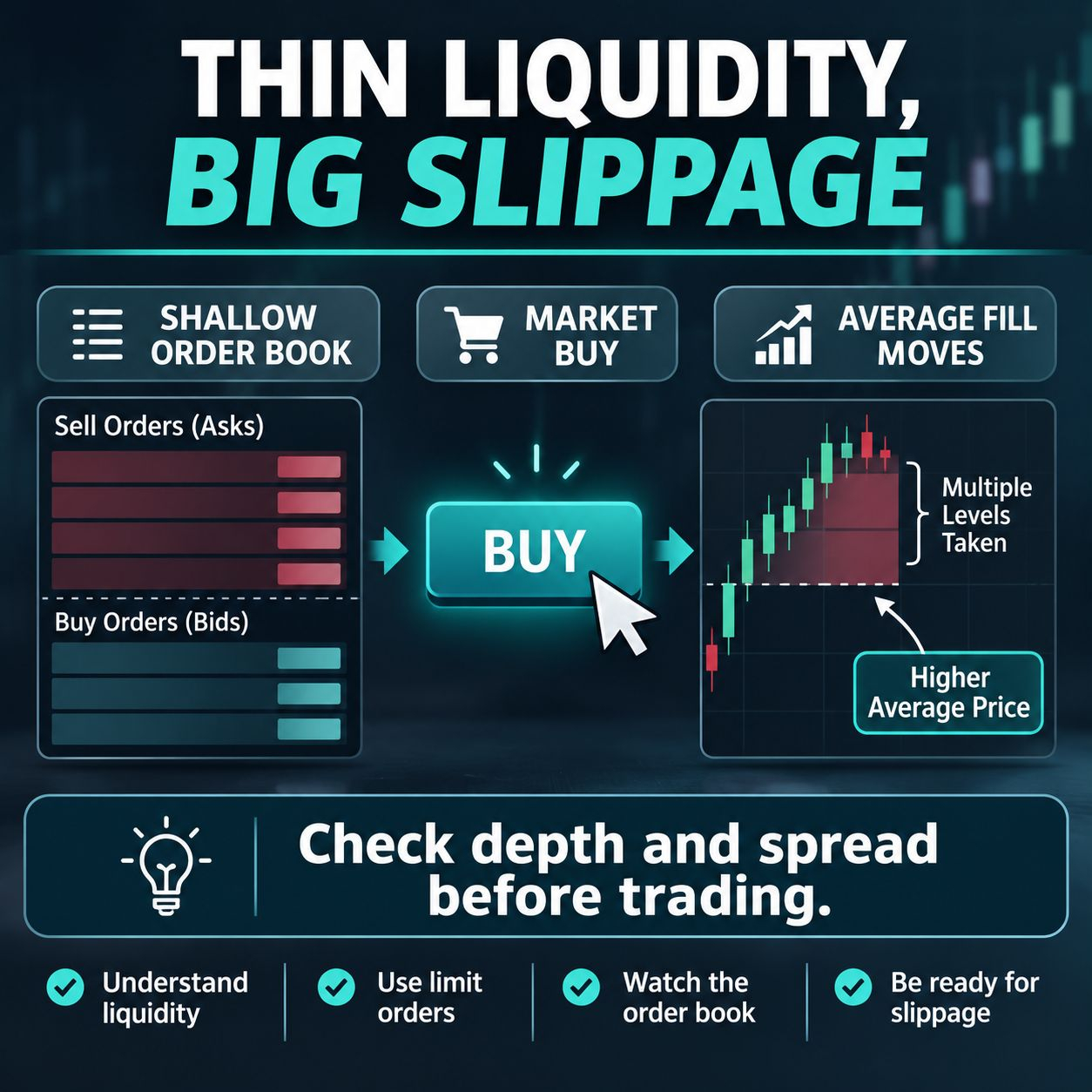
⚠️ THIN LIQUIDITY, BIG SLIPPAGE! Ever bought a coin at one price but received it at a much higher average price? Or sold it for less than expected? 👀 This is called SLIPPAGE. 📌 WHAT IS SLIPPAGE? Slippage is the difference between the price you expect when placing an order and the actual average execution price. WHY DOES IT HAPPEN? Imagine you place a market buy order for a small-cap token. There are not enough sellers at the current price, so your order consumes available sell orders at higher prices. Result? You receive your tokens at a higher average price! 💡 UNDERSTAND THESE 3 TERMS: 🔹 LIQUIDITY: How easily an asset can be bought or sold without significantly affecting its price. 🔹 ORDER BOOK DEPTH: How much buying and selling quantity is available at different price levels. 🔹 SPREAD: The difference between the highest buyer's bid and the lowest seller's ask. 🚨 HOW TO PROTECT YOURSELF: 1️⃣ Check order book depth before placing large orders. 2️⃣ Compare bid-ask spreads across trading pairs. 3️⃣ Consider limit orders when price control matters. Remember, they may not fill. 4️⃣ Be extra careful with low-liquidity tokens and volatile markets. 💡Remember: High trading volume alone does not guarantee deep liquidity! A market order takes available liquidity. If there aren't enough sellers at the best price, the remaining order gets filled at higher price levels. 📚 Knowledge is your first line of defence. Trade smart, not blindly! 🔐 #CryptoEducation #Liquidity #TradingTips #CryptoTrading #LearnCrypto $POP $APR $BNB
⚠️ THIN LIQUIDITY, BIG SLIPPAGE!

Ever bought a coin at one price but received it at a much higher average price?
Or sold it for less than expected? 👀

This is called SLIPPAGE.

📌 WHAT IS SLIPPAGE?

Slippage is the difference between the price you expect when placing an order and the actual average execution price.

WHY DOES IT HAPPEN?

Imagine you place a market buy order for a small-cap token.
There are not enough sellers at the current price, so your order consumes available sell orders at higher prices.
Result?
You receive your tokens at a higher average price!

💡 UNDERSTAND THESE 3 TERMS:

🔹 LIQUIDITY:
How easily an asset can be bought or sold without significantly affecting its price.

🔹 ORDER BOOK DEPTH:
How much buying and selling quantity is available at different price levels.

🔹 SPREAD:
The difference between the highest buyer's bid and the lowest seller's ask.

🚨 HOW TO PROTECT YOURSELF:

1️⃣ Check order book depth before placing large orders.

2️⃣ Compare bid-ask spreads across trading pairs.

3️⃣ Consider limit orders when price control matters. Remember, they may not fill.

4️⃣ Be extra careful with low-liquidity tokens and volatile markets.

💡Remember:
High trading volume alone does not guarantee deep liquidity!

A market order takes available liquidity.
If there aren't enough sellers at the best price, the remaining order gets filled at higher price levels.

📚 Knowledge is your first line of defence.
Trade smart, not blindly! 🔐

#CryptoEducation #Liquidity #TradingTips #CryptoTrading #LearnCrypto $POP $APR $BNB
THE 5 GOLDEN RULES OF CRYPTO THAT MOST BEGINNERS LEARN TOO LATE 🧠 Everyone enters crypto hoping to make money. But very few enter with a plan to protect it. If you're new to crypto, remember these 5 rules: Never invest money you cannot afford to lose. Crypto is unpredictable. Your rent, emergency savings, and borrowed money should never be part of your trading capital. Stop chasing green candles. When a coin suddenly pumps, FOMO makes you think you're missing an opportunity. Sometimes, the best decision is to stay out. Learn before you leverage. Leverage can multiply your profits, but it can also liquidate your position in seconds. If you don't understand liquidation, avoid futures. Protect your capital first. You don't need to win every trade. You need to survive long enough to learn, improve, and make better decisions. Patience is a strategy. The market rewards discipline more than excitement. Not every movement deserves your money. The goal isn't to become rich overnight. The goal is to become smart enough not to lose everything overnight. In crypto, knowledge protects your money before profit grows it. What's the most important lesson crypto has taught you so far? 👇 #Crypto #Binance #Trading #Bitcoin #CryptoEducation
THE 5 GOLDEN RULES OF CRYPTO THAT MOST BEGINNERS LEARN TOO LATE 🧠

Everyone enters crypto hoping to make money.

But very few enter with a plan to protect it.

If you're new to crypto, remember these 5 rules:

Never invest money you cannot afford to lose. Crypto is unpredictable. Your rent, emergency savings, and borrowed money should never be part of your trading capital.

Stop chasing green candles. When a coin suddenly pumps, FOMO makes you think you're missing an opportunity. Sometimes, the best decision is to stay out.

Learn before you leverage. Leverage can multiply your profits, but it can also liquidate your position in seconds. If you don't understand liquidation, avoid futures.

Protect your capital first. You don't need to win every trade. You need to survive long enough to learn, improve, and make better decisions.

Patience is a strategy. The market rewards discipline more than excitement. Not every movement deserves your money.

The goal isn't to become rich overnight.

The goal is to become smart enough not to lose everything overnight.

In crypto, knowledge protects your money before profit grows it.

What's the most important lesson crypto has taught you so far? 👇

#Crypto #Binance #Trading #Bitcoin #CryptoEducation
Demystifying Market Depth: How Order Books Shape Crypto Price ActionWhen observing cryptocurrency markets, most market participants focus primarily on line charts or candlestick patterns to forecast future price movements. While historical price action offers valuable context, it tells only half the story. The underlying mechanics of price movement are driven by an essential structural component of exchange architecture: market depth. Understanding market depth allows intermediate traders and market enthusiasts to peer beneath the surface of immediate ticker prices. It provides insight into available supply and demand across various price levels, revealing how easily an asset can absorb large orders without experiencing extreme price swings. This article explores the architecture of order books, the mechanics of market depth, practical concepts like slippage and liquidity walls, and the inherent risks and limitations of relying solely on depth metrics. --- ### 1. What Is Market Depth? Market depth refers to a market’s capacity to sustain relatively large market orders without significantly impacting the asset's price. It is directly tied to the overall liquidity present within an exchange's central limit order book (CLOB). In any functional order book, market participants submit two primary types of orders: 1. **Maker Orders (Limit Orders):** Orders placed at a specific target price that do not execute immediately. These orders sit on the order book, adding liquidity and creating market depth. 2. **Taker Orders (Market Orders):** Orders set to execute immediately at the best available current market price. These orders consume liquidity and reduce market depth. Market depth visualizes the accumulated volume of pending limit buy orders (bids) and limit sell orders (asks) at varying price points surrounding the current spot price. When a market possesses deep liquidity, large buy or sell orders can be absorbed with minimal price displacement. Conversely, in shallow markets, even modest buy or sell orders can trigger significant volatility. --- ### 2. Anatomy of the Central Limit Order Book To read market depth effectively, one must understand how an order book organizes incoming data. The order book is divided into two distinct sides around a midpoint: * **The Bid Side (Buyers):** Represents market participants willing to purchase the asset at specific prices below the current market price. Bids are sorted in descending order, with the highest bid sitting at the top of the bid list. * **The Ask Side (Sellers):** Represents market participants willing to sell the asset at specific prices above the current market price. Asks are sorted in ascending order, with the lowest ask sitting at the top of the ask list. * **The Bid-Ask Spread:** The numerical difference between the highest bid price and the lowest ask price. A narrow spread typically indicates high market efficiency and deep liquidity, whereas a wide spread indicates lower liquidity or heightened market uncertainty. #### Visualizing Market Depth: The Depth Chart Exchanges often convert raw numerical order books into a visual "Depth Chart." This graphic plots cumulative order volumes along the horizontal axis (price) and vertical axis (total quantity). * **Green Slopes (Bid Depth):** Show the cumulative amount of an asset buyers are willing to purchase as price drops. * **Red Slopes (Ask Depth):** Show the cumulative amount of an asset sellers are willing to offload as price rises. Steep vertical cliffs on a depth chart represent large concentrations of limit orders at specific price points, commonly referred to as "buy walls" or "sell walls." --- ### 3. Practical Example: Slippage and Price Impact To illustrate how market depth directly influences trade execution, let us examine a hypothetical order execution scenario. Imagine an asset trading at a current mid-market price of $1,000. A trader decides to execute a **market buy order** for 100 units of this asset. If the order book looks like this on the Ask side: * **Ask Level 1:** 20 units available at $1,000 * **Ask Level 2:** 30 units available at $1,005 * **Ask Level 3:** 50 units available at $1,015 Because a market order executes sequentially through available limit orders until filled, the execution breaks down as follows: 1. The first 20 units fill at $1,000 (Cost: $20,000) 2. The next 30 units fill at $1,005 (Cost: $30,150) 3. The remaining 50 units fill at $1,015 (Cost: $50,750) * Total Expenditure: $100,900 * Average Execution Price: $1,009 per unit Even though the trader initiated the transaction when the market price appeared to be $1,000, shallow depth caused the final average price to be $1,009. This disparity between expected price and actual execution price is known as **slippage**. In deeper markets—where thousands of units might be stacked at $1,000.10 or $1,000.20—the price impact for the same trade size would be substantially lower. --- ### 4. Advanced Order Book Dynamics: Walls, Spoofing, and Hidden Orders While order book depth provides valuable real-time data, interpreting it requires an understanding of structural market behaviors that can mislead casual observers. #### Buy and Sell Walls A buy wall occurs when an exceptionally large limit bid is placed at a specific price level. Market participants often interpret large buy walls as strong support, assuming the price cannot easily fall below that level without consuming all available buy orders. Conversely, a large sell wall acts as overhead resistance. However, order book walls are not permanent commitments. Because limit orders can be canceled at any time prior to execution without penalty, walls can disappear in a fraction of a second. #### Spoofing and Phantom Liquidity Spoofing is an illegal practice in regulated traditional finance and a recognized form of market manipulation across crypto markets. It involves placing large, non-bona fide limit orders (walls) with the explicit intention of canceling them before they execute. The goal of spoofing is to create a false impression of market sentiment: * Placing a massive buy wall to trick other traders into buying, driving the price up short-term. * Canceling the buy wall once smaller market participants buy in, allowing the manipulator to sell into the artificial demand at a higher price. #### Iceberg Orders Institutional participants trading large volumes of major assets like Bitcoin or Ethereum often seek to minimize their price footprint. To avoid alerting the market to their intentions, they use **iceberg orders**. An iceberg order splits a massive order into smaller visible limit orders. Once one small tranche is filled, another automatically populates the book. As a result, an order book may appear shallow at a certain price level even though a vast reserve of hidden liquidity sits behind it. --- ### 5. Limitations and Risks of Relying on Market Depth While analyzing order books enhances market comprehension, traders must account for several structural limitations: 1. **Fragmentation Across Exchanges:** Unlike traditional stock markets with centralized national exchanges, crypto liquidity is fragmented across dozens of centralized and decentralized venues. Looking at market depth on a single exchange provides only an isolated view of total global liquidity. 2. **Off-Book and OTC Trades:** Large institutional transactions often take place over-the-counter (OTC) or via institutional dark pools to prevent market impact. Consequently, major structural shifts in asset ownership frequently bypass publicly visible order books entirely. 3. **High-Frequency Trading (HFT) Latency:** Algorithms update limit orders thousands of times per minute. Human traders viewing visual depth charts are often reacting to delayed representations of order book states. During periods of sudden volatility, algorithms may withdraw liquidity instantly, causing depth to evaporate precisely when it is needed most. 4. **Decentralized Exchanges (DEXs):** Automated Market Maker (AMM) protocols operate without traditional order books, relying instead on liquidity pools governed by mathematical formulas (e.g., constant product formulas). Applying central limit order book depth analysis to decentralized liquidity pools requires fundamentally different analytical metrics. --- ### Summary and Key Takeaways Market depth is a foundational concept in market structure analysis. By moving beyond basic price charts to evaluate the distribution of limit bids and asks, market participants gain a deeper appreciation for how market impact, slippage, and execution quality operate. * **High Depth:** Indicates deep liquidity, lower slippage risk, and greater resilience against large trades. * **Low Depth:** Indicates shallow markets susceptible to elevated price impact and sharp volatility spikes. * **Critical Thinking:** Order books are dynamic, fast-changing environments subject to algorithmic adjustments, cancellations, and hidden orders. Understanding order book mechanics equips intermediate readers with a more objective toolset for reading market mechanics, evaluating execution risks, and navigating the nuances of digital asset trading environments. #CryptoEducation #MarketLiquidity #TradingConcepts

Demystifying Market Depth: How Order Books Shape Crypto Price Action

When observing cryptocurrency markets, most market participants focus primarily on line charts or candlestick patterns to forecast future price movements. While historical price action offers valuable context, it tells only half the story. The underlying mechanics of price movement are driven by an essential structural component of exchange architecture: market depth.
Understanding market depth allows intermediate traders and market enthusiasts to peer beneath the surface of immediate ticker prices. It provides insight into available supply and demand across various price levels, revealing how easily an asset can absorb large orders without experiencing extreme price swings. This article explores the architecture of order books, the mechanics of market depth, practical concepts like slippage and liquidity walls, and the inherent risks and limitations of relying solely on depth metrics.
---
### 1. What Is Market Depth?
Market depth refers to a market’s capacity to sustain relatively large market orders without significantly impacting the asset's price. It is directly tied to the overall liquidity present within an exchange's central limit order book (CLOB).
In any functional order book, market participants submit two primary types of orders:
1. **Maker Orders (Limit Orders):** Orders placed at a specific target price that do not execute immediately. These orders sit on the order book, adding liquidity and creating market depth.
2. **Taker Orders (Market Orders):** Orders set to execute immediately at the best available current market price. These orders consume liquidity and reduce market depth.
Market depth visualizes the accumulated volume of pending limit buy orders (bids) and limit sell orders (asks) at varying price points surrounding the current spot price. When a market possesses deep liquidity, large buy or sell orders can be absorbed with minimal price displacement. Conversely, in shallow markets, even modest buy or sell orders can trigger significant volatility.
---
### 2. Anatomy of the Central Limit Order Book
To read market depth effectively, one must understand how an order book organizes incoming data. The order book is divided into two distinct sides around a midpoint:
* **The Bid Side (Buyers):** Represents market participants willing to purchase the asset at specific prices below the current market price. Bids are sorted in descending order, with the highest bid sitting at the top of the bid list.
* **The Ask Side (Sellers):** Represents market participants willing to sell the asset at specific prices above the current market price. Asks are sorted in ascending order, with the lowest ask sitting at the top of the ask list.
* **The Bid-Ask Spread:** The numerical difference between the highest bid price and the lowest ask price. A narrow spread typically indicates high market efficiency and deep liquidity, whereas a wide spread indicates lower liquidity or heightened market uncertainty.
#### Visualizing Market Depth: The Depth Chart
Exchanges often convert raw numerical order books into a visual "Depth Chart." This graphic plots cumulative order volumes along the horizontal axis (price) and vertical axis (total quantity).
* **Green Slopes (Bid Depth):** Show the cumulative amount of an asset buyers are willing to purchase as price drops.
* **Red Slopes (Ask Depth):** Show the cumulative amount of an asset sellers are willing to offload as price rises.
Steep vertical cliffs on a depth chart represent large concentrations of limit orders at specific price points, commonly referred to as "buy walls" or "sell walls."
---
### 3. Practical Example: Slippage and Price Impact
To illustrate how market depth directly influences trade execution, let us examine a hypothetical order execution scenario.
Imagine an asset trading at a current mid-market price of $1,000. A trader decides to execute a **market buy order** for 100 units of this asset.
If the order book looks like this on the Ask side:
* **Ask Level 1:** 20 units available at $1,000
* **Ask Level 2:** 30 units available at $1,005
* **Ask Level 3:** 50 units available at $1,015
Because a market order executes sequentially through available limit orders until filled, the execution breaks down as follows:
1. The first 20 units fill at $1,000 (Cost: $20,000)
2. The next 30 units fill at $1,005 (Cost: $30,150)
3. The remaining 50 units fill at $1,015 (Cost: $50,750)
* Total Expenditure: $100,900
* Average Execution Price: $1,009 per unit
Even though the trader initiated the transaction when the market price appeared to be $1,000, shallow depth caused the final average price to be $1,009. This disparity between expected price and actual execution price is known as **slippage**.
In deeper markets—where thousands of units might be stacked at $1,000.10 or $1,000.20—the price impact for the same trade size would be substantially lower.
---
### 4. Advanced Order Book Dynamics: Walls, Spoofing, and Hidden Orders
While order book depth provides valuable real-time data, interpreting it requires an understanding of structural market behaviors that can mislead casual observers.
#### Buy and Sell Walls
A buy wall occurs when an exceptionally large limit bid is placed at a specific price level. Market participants often interpret large buy walls as strong support, assuming the price cannot easily fall below that level without consuming all available buy orders. Conversely, a large sell wall acts as overhead resistance.
However, order book walls are not permanent commitments. Because limit orders can be canceled at any time prior to execution without penalty, walls can disappear in a fraction of a second.
#### Spoofing and Phantom Liquidity
Spoofing is an illegal practice in regulated traditional finance and a recognized form of market manipulation across crypto markets. It involves placing large, non-bona fide limit orders (walls) with the explicit intention of canceling them before they execute.
The goal of spoofing is to create a false impression of market sentiment:
* Placing a massive buy wall to trick other traders into buying, driving the price up short-term.
* Canceling the buy wall once smaller market participants buy in, allowing the manipulator to sell into the artificial demand at a higher price.
#### Iceberg Orders
Institutional participants trading large volumes of major assets like Bitcoin or Ethereum often seek to minimize their price footprint. To avoid alerting the market to their intentions, they use **iceberg orders**.
An iceberg order splits a massive order into smaller visible limit orders. Once one small tranche is filled, another automatically populates the book. As a result, an order book may appear shallow at a certain price level even though a vast reserve of hidden liquidity sits behind it.
---
### 5. Limitations and Risks of Relying on Market Depth
While analyzing order books enhances market comprehension, traders must account for several structural limitations:
1. **Fragmentation Across Exchanges:** Unlike traditional stock markets with centralized national exchanges, crypto liquidity is fragmented across dozens of centralized and decentralized venues. Looking at market depth on a single exchange provides only an isolated view of total global liquidity.
2. **Off-Book and OTC Trades:** Large institutional transactions often take place over-the-counter (OTC) or via institutional dark pools to prevent market impact. Consequently, major structural shifts in asset ownership frequently bypass publicly visible order books entirely.
3. **High-Frequency Trading (HFT) Latency:** Algorithms update limit orders thousands of times per minute. Human traders viewing visual depth charts are often reacting to delayed representations of order book states. During periods of sudden volatility, algorithms may withdraw liquidity instantly, causing depth to evaporate precisely when it is needed most.
4. **Decentralized Exchanges (DEXs):** Automated Market Maker (AMM) protocols operate without traditional order books, relying instead on liquidity pools governed by mathematical formulas (e.g., constant product formulas). Applying central limit order book depth analysis to decentralized liquidity pools requires fundamentally different analytical metrics.
---
### Summary and Key Takeaways
Market depth is a foundational concept in market structure analysis. By moving beyond basic price charts to evaluate the distribution of limit bids and asks, market participants gain a deeper appreciation for how market impact, slippage, and execution quality operate.
* **High Depth:** Indicates deep liquidity, lower slippage risk, and greater resilience against large trades.
* **Low Depth:** Indicates shallow markets susceptible to elevated price impact and sharp volatility spikes.
* **Critical Thinking:** Order books are dynamic, fast-changing environments subject to algorithmic adjustments, cancellations, and hidden orders.
Understanding order book mechanics equips intermediate readers with a more objective toolset for reading market mechanics, evaluating execution risks, and navigating the nuances of digital asset trading environments.
#CryptoEducation #MarketLiquidity #TradingConcepts
📊 Smart Traders Focus on Risk, Not Just Profit! In crypto, making money is important, but protecting your capital is even more important. 💡 3 simple rules every trader should follow: 1️⃣ Never invest more than you can afford to lose. 2️⃣ Don't chase green candles or panic during red candles. 3️⃣ Always have a clear entry, exit, and risk management plan. Remember: Survival comes before profits. 🧠 What matters more to you — BIG PROFITS or SMART RISK MANAGEMENT? 👇 #Crypto #Binance #TradingTips #RiskManagement #cryptoeducation
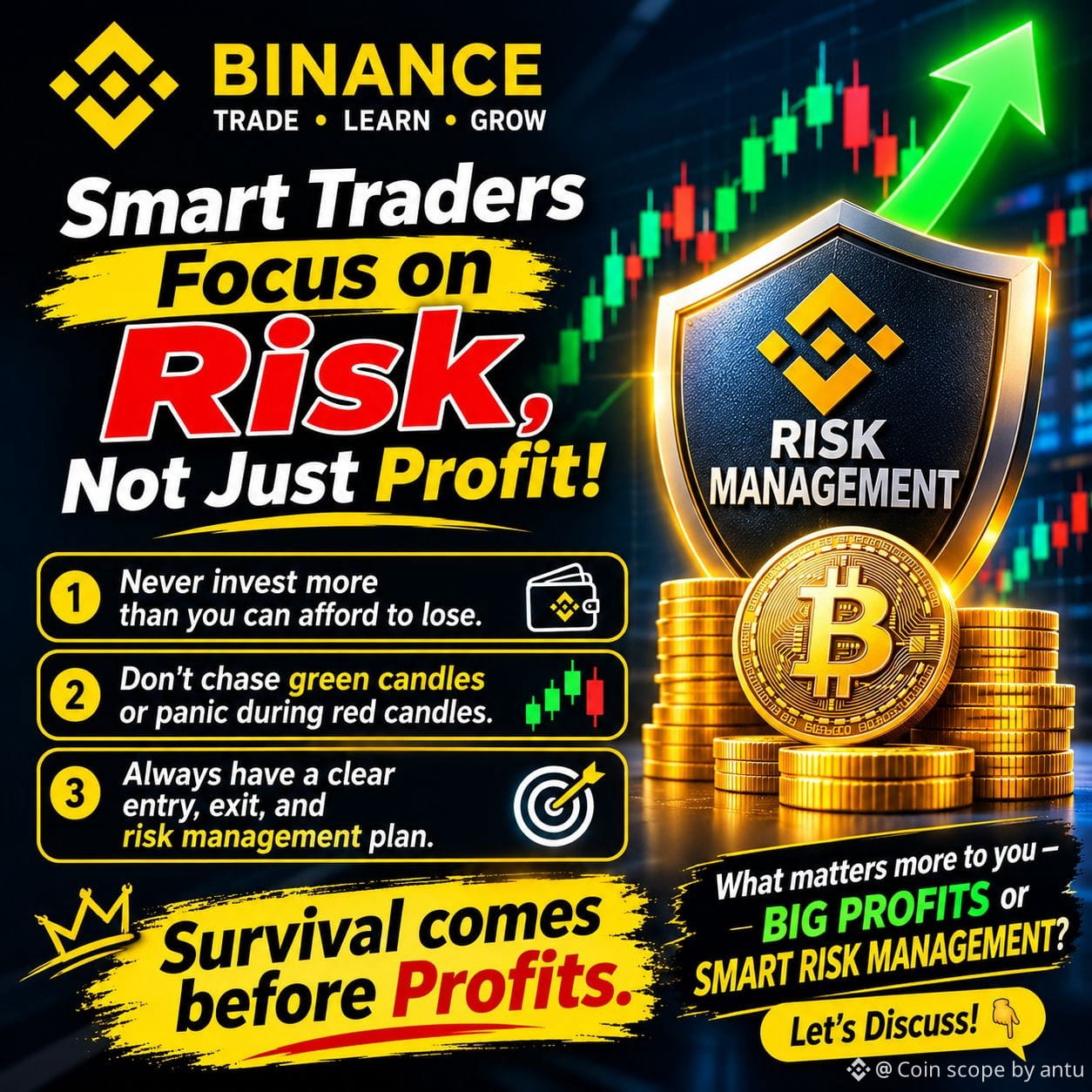
📊 Smart Traders Focus on Risk, Not Just Profit!

In crypto, making money is important, but protecting your capital is even more important.

💡 3 simple rules every trader should follow:

1️⃣ Never invest more than you can afford to lose.
2️⃣ Don't chase green candles or panic during red candles.
3️⃣ Always have a clear entry, exit, and risk management plan.

Remember: Survival comes before profits. 🧠

What matters more to you — BIG PROFITS or SMART RISK MANAGEMENT? 👇

#Crypto #Binance #TradingTips #RiskManagement #cryptoeducation
📚 Crypto Education — RSI ⚡ RSI measures momentum. 🟢 Above 70: strong momentum / potentially overextended 🟡 Around 50: balanced momentum 🔴 Below 30: weak momentum / potentially oversold 📊 RSI should not be used alone. 🔎 Price structure, volume and trend can provide confirmation. 👀 Context matters. 🤔 Do you combine RSI with another indicator? #CryptoEducation #Binance #RSI #TechnicalAnalysis
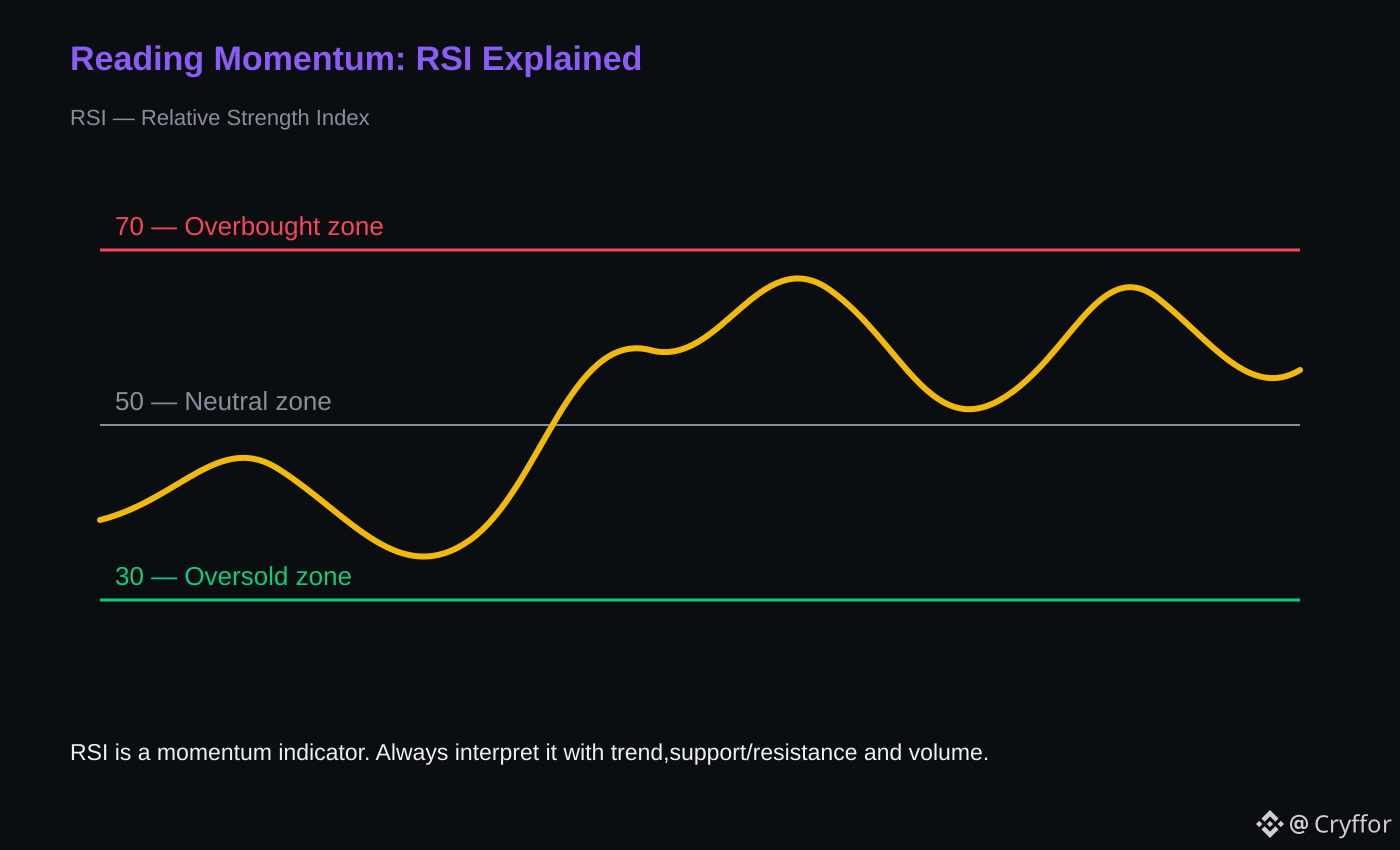
📚 Crypto Education — RSI

⚡ RSI measures momentum.

🟢 Above 70: strong momentum / potentially overextended
🟡 Around 50: balanced momentum
🔴 Below 30: weak momentum / potentially oversold

📊 RSI should not be used alone.

🔎 Price structure, volume and trend can provide confirmation.

👀 Context matters.

🤔 Do you combine RSI with another indicator?

#CryptoEducation #Binance #RSI #TechnicalAnalysis
·
--
🔐 Your Crypto Security Is Your Responsibility! In crypto, protecting your assets is just as important as making profits. 💰 Remember these 5 golden rules: ✅ Enable 2FA authentication ✅ Never share your seed phrase or OTP ✅ Use a strong, unique password ✅ Double-check wallet addresses before sending ✅ Beware of fake links, giveaways, and scams 🚨 Remember: No legitimate support team will ever ask for your seed phrase. Protect your assets. Stay alert. Trade smart! 🛡️ #Binance #CryptoSecurity #Bitcoin #CryptoEducation
🔐 Your Crypto Security Is Your Responsibility!

In crypto, protecting your assets is just as important as making profits. 💰

Remember these 5 golden rules:

✅ Enable 2FA authentication
✅ Never share your seed phrase or OTP
✅ Use a strong, unique password
✅ Double-check wallet addresses before sending
✅ Beware of fake links, giveaways, and scams

🚨 Remember: No legitimate support team will ever ask for your seed phrase.

Protect your assets. Stay alert. Trade smart! 🛡️

#Binance #CryptoSecurity #Bitcoin #CryptoEducation
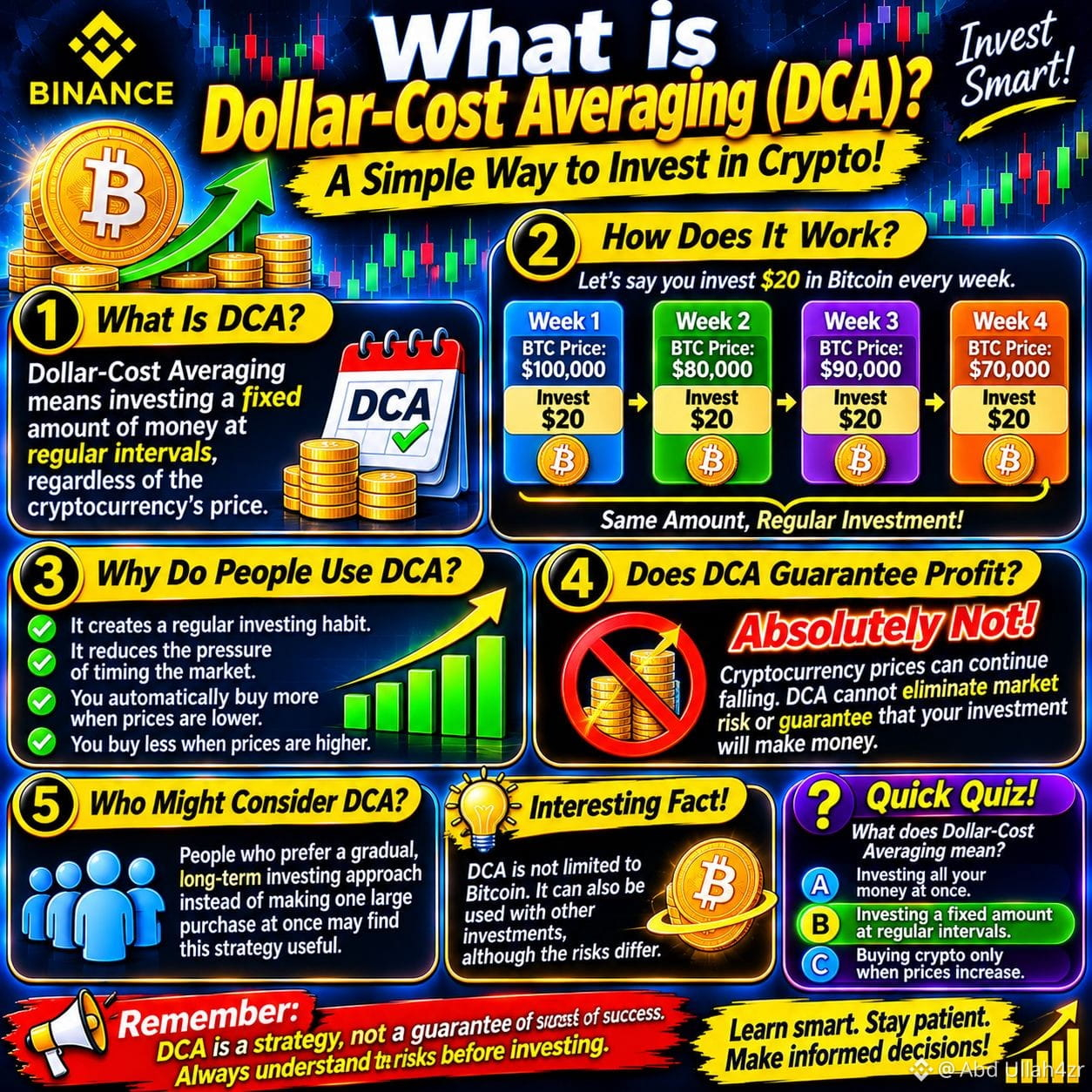
📈 WHAT IS DOLLAR-COST AVERAGING (DCA)? HOW DOES IT WORK IN CRYPTO? Imagine you want to buy Bitcoin, but you don't know whether today's price is too high or too low. What can you do? 🤔 One strategy some investors use is called Dollar-Cost Averaging (DCA). Let's understand it in simple words! 📌 1. What Is DCA? Dollar-Cost Averaging means investing a fixed amount of money at regular intervals, regardless of the cryptocurrency's price. 📌 2. How Does It Work? Imagine you decide to invest $20 in Bitcoin every week. - Week 1: Bitcoin is $100,000. - Week 2: Bitcoin is $80,000. - Week 3: Bitcoin is $90,000. - Week 4: Bitcoin is $70,000. You invest the same $20 each week instead of trying to predict the perfect buying moment. 📌 3. Why Do People Use DCA? 🔹 It creates a regular investing habit. 🔹 It reduces the pressure of timing the market. 🔹 You automatically buy more when prices are lower. 🔹 You buy less when prices are higher. 📌 4. Does DCA Guarantee Profit? Absolutely not! Cryptocurrency prices can continue falling. DCA cannot eliminate market risk or guarantee that your investment will make money. 📌 5. Who Might Consider DCA? People who prefer a gradual, long-term investing approach instead of making one large purchase at once may find this strategy useful. 💡 INTERESTING FACT: DCA is not limited to Bitcoin. It can also be used with other investments, although the risks differ. 🎯 QUICK QUIZ: What does Dollar-Cost Averaging mean? A) Investing all your money at once. B) Investing a fixed amount at regular intervals. C) Buying crypto only when prices increase. 👇 Comment your answer! Remember: DCA is a strategy, not a guarantee of success. Always understand the risks before investing. Learn smart. Stay patient. Make informed decisions! #CryptoEducation #DCA #Bitcoin #CryptoInvesting #InvestmentStrategy
📈 WHAT IS DOLLAR-COST AVERAGING (DCA)? HOW DOES IT WORK IN CRYPTO?

Imagine you want to buy Bitcoin, but you don't know whether today's price is too high or too low. What can you do? 🤔

One strategy some investors use is called Dollar-Cost Averaging (DCA).

Let's understand it in simple words!

📌 1. What Is DCA?

Dollar-Cost Averaging means investing a fixed amount of money at regular intervals, regardless of the cryptocurrency's price.

📌 2. How Does It Work?

Imagine you decide to invest $20 in Bitcoin every week.

- Week 1: Bitcoin is $100,000.
- Week 2: Bitcoin is $80,000.
- Week 3: Bitcoin is $90,000.
- Week 4: Bitcoin is $70,000.

You invest the same $20 each week instead of trying to predict the perfect buying moment.

📌 3. Why Do People Use DCA?

🔹 It creates a regular investing habit.
🔹 It reduces the pressure of timing the market.
🔹 You automatically buy more when prices are lower.
🔹 You buy less when prices are higher.

📌 4. Does DCA Guarantee Profit?

Absolutely not!

Cryptocurrency prices can continue falling. DCA cannot eliminate market risk or guarantee that your investment will make money.

📌 5. Who Might Consider DCA?

People who prefer a gradual, long-term investing approach instead of making one large purchase at once may find this strategy useful.

💡 INTERESTING FACT:

DCA is not limited to Bitcoin. It can also be used with other investments, although the risks differ.

🎯 QUICK QUIZ:

What does Dollar-Cost Averaging mean?

A) Investing all your money at once.

B) Investing a fixed amount at regular intervals.

C) Buying crypto only when prices increase.

👇 Comment your answer!

Remember: DCA is a strategy, not a guarantee of success. Always understand the risks before investing.

Learn smart. Stay patient. Make informed decisions!

#CryptoEducation #DCA #Bitcoin #CryptoInvesting #InvestmentStrategy
Your Crypto Journey Starts With Knowledge! Many beginners enter the crypto market dreaming of quick profits, but they forget one important thing: LEARNING COMES FIRST. Here are 5 golden rules every crypto trader should follow: 1️⃣ Never trade without a plan. 2️⃣ Always use Stop Loss. 3️⃣ Understand market structure. 4️⃣ Control your emotions. 5️⃣ Protect your capital before chasing profits. Remember: Successful traders don't win every trade. They manage risk, stay disciplined, and keep learning. What is your biggest challenge in crypto trading? A) Finding good entries B) Managing risk C) Controlling emotions D) Understanding charts 👇 Share your answer in the comments! Follow @takashikotegawa005 for daily crypto insights and trading education. Let's learn, trade smart, and grow together! #Crypto #Bitcoin #Trading #BinanceSquare re #cryptoeducation
Your Crypto Journey Starts With Knowledge!

Many beginners enter the crypto market dreaming of quick profits, but they forget one important thing: LEARNING COMES FIRST.

Here are 5 golden rules every crypto trader should follow:

1️⃣ Never trade without a plan.
2️⃣ Always use Stop Loss.
3️⃣ Understand market structure.
4️⃣ Control your emotions.
5️⃣ Protect your capital before chasing profits.

Remember: Successful traders don't win every trade. They manage risk, stay disciplined, and keep learning.

What is your biggest challenge in crypto trading?

A) Finding good entries
B) Managing risk
C) Controlling emotions
D) Understanding charts

👇 Share your answer in the comments!

Follow @AhmadAwan551 for daily crypto insights and trading education.

Let's learn, trade smart, and grow together!

#Crypto #Bitcoin #Trading #BinanceSquare re #cryptoeducation
🧠 5 CRYPTO RULES EVERY SMART INVESTOR SHOULD FOLLOW! The crypto market can change direction very quickly. That's why knowledge and discipline matter! Here are 5 important rules: 1️⃣ NEVER FOLLOW FOMO Don't buy a coin just because everyone is talking about it. 2️⃣ DO YOUR OWN RESEARCH Understand the project's technology, tokenomics and risks. 3️⃣ PROTECT YOUR CAPITAL Never invest money you cannot afford to lose. 4️⃣ AVOID EMOTIONAL TRADING Fear and greed can lead to poor decisions. 5️⃣ THINK LONG TERM Focus on learning instead of chasing quick profits. 💬 A question for the crypto community: What's the MOST important rule for surviving in the crypto market? A) Research B) Risk Management C) Patience D) Discipline Comment your answer! 👇 #CryptoEducation #Bitcoin #Ethereum #TradingTips #BinanceSquare $BTC $ETH $BNB {future}(BNBUSDT) {future}(ETHUSDT) {future}(BTCUSDT)
🧠 5 CRYPTO RULES EVERY SMART INVESTOR SHOULD FOLLOW!

The crypto market can change direction very quickly. That's why knowledge and discipline matter!

Here are 5 important rules:

1️⃣ NEVER FOLLOW FOMO
Don't buy a coin just because everyone is talking about it.

2️⃣ DO YOUR OWN RESEARCH
Understand the project's technology, tokenomics and risks.

3️⃣ PROTECT YOUR CAPITAL
Never invest money you cannot afford to lose.

4️⃣ AVOID EMOTIONAL TRADING
Fear and greed can lead to poor decisions.

5️⃣ THINK LONG TERM
Focus on learning instead of chasing quick profits.

💬 A question for the crypto community:

What's the MOST important rule for surviving in the crypto market?

A) Research
B) Risk Management
C) Patience
D) Discipline

Comment your answer! 👇

#CryptoEducation #Bitcoin #Ethereum #TradingTips #BinanceSquare $BTC $ETH $BNB

Imadghaloum:
Yes, long-term! 🚀
🎓 CRYPTO LEARNING CORNER 💡 TODAY'S LESSON: SMART RISK MANAGEMENT Stop-loss orders can help manage risk, but execution at the exact requested price is not guaranteed. 🔥 REMEMBER: Discipline and patience are important parts of responsible trading. Learn first. Research carefully. Never risk money you cannot afford to lose. #CryptoEducation #RiskManagement #TradingTips #LearnCrypto
🎓 CRYPTO LEARNING CORNER

💡 TODAY'S LESSON: SMART RISK MANAGEMENT

Stop-loss orders can help manage risk, but execution at the exact requested price is not guaranteed.

🔥 REMEMBER:

Discipline and patience are important parts of responsible trading.

Learn first. Research carefully. Never risk money you cannot afford to lose.

#CryptoEducation #RiskManagement #TradingTips #LearnCrypto
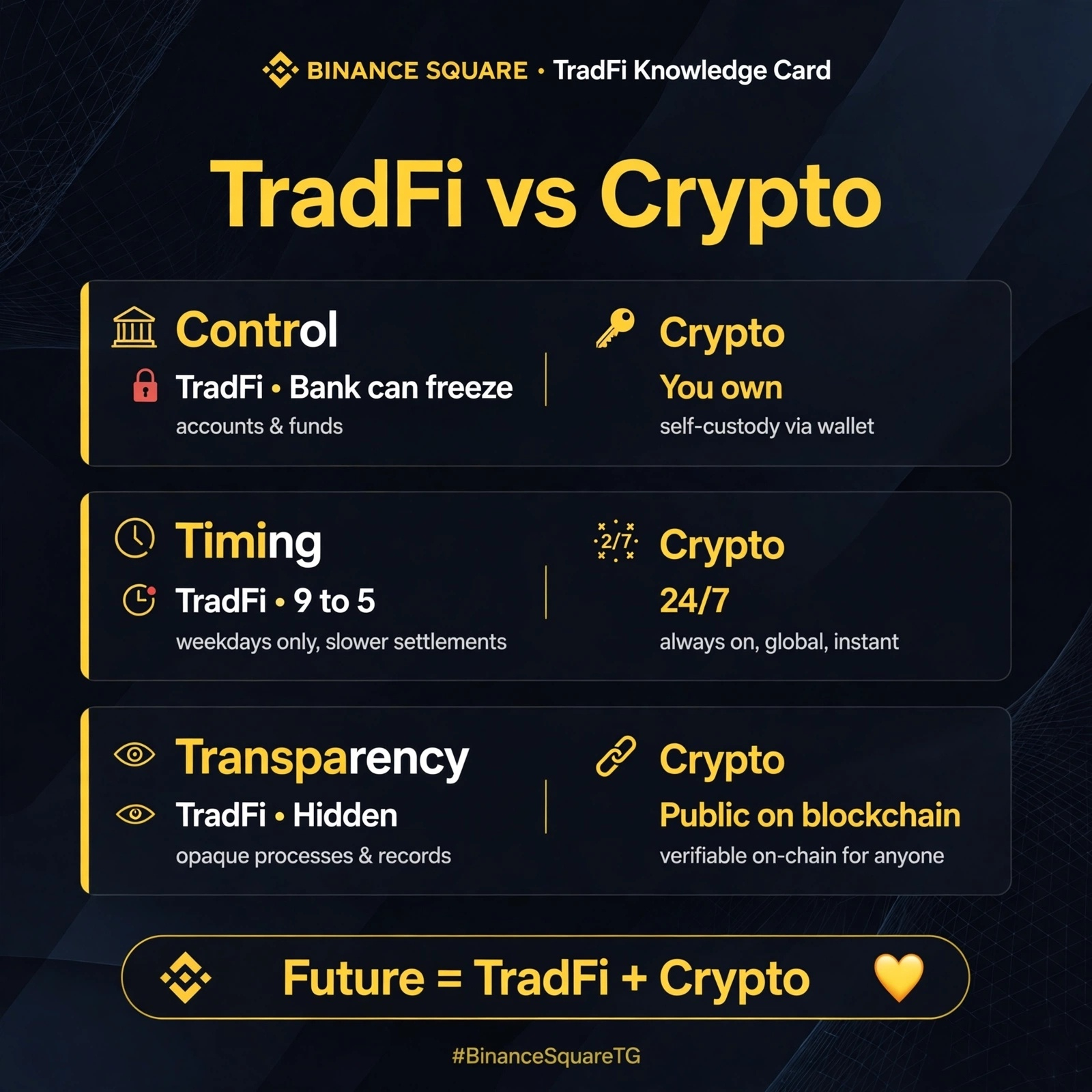
💛 #BinanceSquareTG TradFi vs Crypto: What is TradFi? Let's Break It Down! 📚 TradFi = Traditional Finance. Banks, Stock Market, Bonds, Central Banks - this is all TradFi. In Crypto we say "Be Your Own Bank", but in TradFi the Bank controls everything. 3 Big Differences: 1. Control: In TradFi, a Bank can freeze your money. In Crypto, you are the real owner. 2. Timing: TradFi Market opens 9 to 5. Crypto is open 24/7. 3. Transparency: In TradFi, you don't know where your money went. In Crypto, every transaction is public on the blockchain. But the truth is: The future is a mix of TradFi + Crypto. That's why a coin like $BNB is so strong, because it is connecting both worlds. TradFi is not ending, it is upgrading. What do you think? Will Banks stay in the future or will everything shift to Crypto? Tell me in the comments 👇 $BNB #BinanceSquareTG #TradFi #CryptoEducation {future}(BNBUSDT)
💛 #BinanceSquareTG

TradFi vs Crypto: What is TradFi? Let's Break It Down! 📚

TradFi = Traditional Finance. Banks, Stock Market, Bonds, Central Banks - this is all TradFi.

In Crypto we say "Be Your Own Bank", but in TradFi the Bank controls everything.

3 Big Differences:

1. Control: In TradFi, a Bank can freeze your money. In Crypto, you are the real owner.
2. Timing: TradFi Market opens 9 to 5. Crypto is open 24/7.
3. Transparency: In TradFi, you don't know where your money went. In Crypto, every transaction is public on the blockchain.

But the truth is: The future is a mix of TradFi + Crypto. That's why a coin like $BNB is so strong, because it is connecting both worlds.

TradFi is not ending, it is upgrading.

What do you think? Will Banks stay in the future or will everything shift to Crypto? Tell me in the comments 👇

$BNB
#BinanceSquareTG #TradFi #CryptoEducation
🔷 ETHEREUM ($ETH ): MORE THAN JUST A CRYPTOCURRENCY! Ethereum is one of the most important blockchain networks in the digital economy. 📌 Key Facts: 🔹 Name: Ethereum 🔹 Symbol: $ETH 🔹 Founder: Vitalik Buterin 🔹 Launch Year: 2015 🔹 Network: Ethereum Blockchain 🔹 Consensus: Proof of Stake (PoS) 🔹 Maximum Supply: No fixed maximum supply 🚀 Why Is Ethereum Important? ✅ Powers smart contracts. ✅ Supports decentralized applications (dApps). ✅ Provides infrastructure for DeFi and NFTs. ✅ ETH is used to pay network transaction fees. ✅ Supports a large blockchain developer ecosystem. 💡 My Insight: Ethereum's biggest strength is its ecosystem. It provides the infrastructure for developers to build applications without relying entirely on traditional centralized systems. 💬 Question: What do you think is Ethereum's biggest strength — Smart Contracts, DeFi, or NFTs? #ETH #blockchain #cryptoeducation #defi #Web3 Educational content only — not financial advice. {spot}(ETHUSDT)
🔷 ETHEREUM ($ETH ): MORE THAN JUST A CRYPTOCURRENCY!

Ethereum is one of the most important blockchain networks in the digital economy.

📌 Key Facts: 🔹 Name: Ethereum 🔹 Symbol: $ETH 🔹 Founder: Vitalik Buterin 🔹 Launch Year: 2015 🔹 Network: Ethereum Blockchain 🔹 Consensus: Proof of Stake (PoS) 🔹 Maximum Supply: No fixed maximum supply

🚀 Why Is Ethereum Important?

✅ Powers smart contracts. ✅ Supports decentralized applications (dApps). ✅ Provides infrastructure for DeFi and NFTs. ✅ ETH is used to pay network transaction fees. ✅ Supports a large blockchain developer ecosystem.

💡 My Insight: Ethereum's biggest strength is its ecosystem. It provides the infrastructure for developers to build applications without relying entirely on traditional centralized systems.

💬 Question: What do you think is Ethereum's biggest strength — Smart Contracts, DeFi, or NFTs?

#ETH #blockchain #cryptoeducation #defi #Web3

Educational content only — not financial advice.
Ethereum Up or Down - November 25, 7AM ET

Ethereum Up or Down - November 25, 7AM ET

99%Up1%Down
Volume $35,536.99
Log in to explore more content
Join global crypto users on Binance Square
⚡️ Get latest and useful information about crypto.
💬 Trusted by the world’s largest crypto exchange.
👍 Discover real insights from verified creators.
Email / Phone number