
#cryptowallets
cryptowallets
86,902 views
301 Discussing
Hot
Latest

·
--
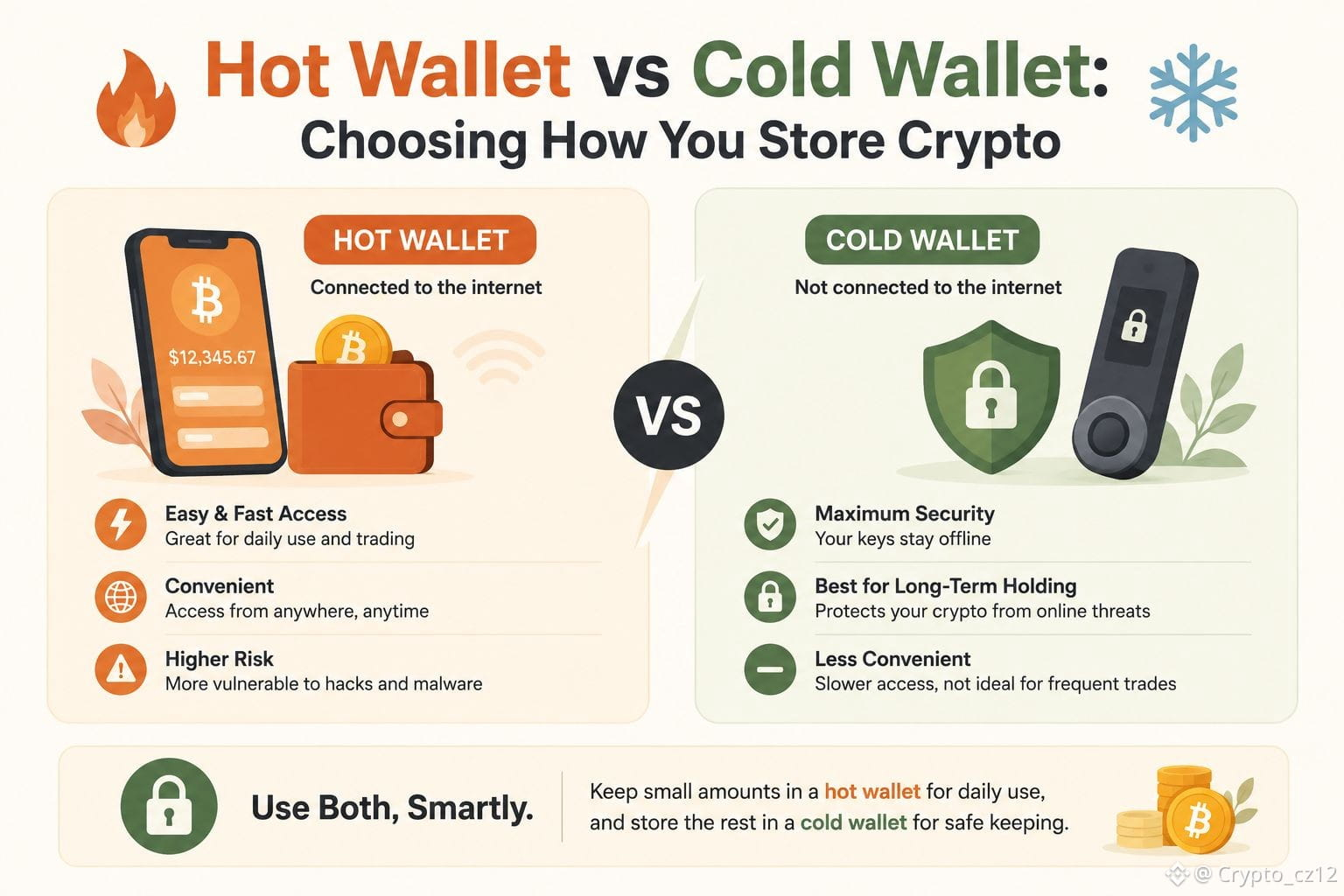
Hot Wallet vs Cold Wallet: Choosing How You Store Crypto
Hot = convenient, more exposed; cold = offline hardware, safer for long-term holding; match tool to use case
#CryptoWallet #cryptowallets
$NVDAB
$AAPLB
{spot}(AAPLBUSDT)
Hot Wallet vs Cold Wallet: Choosing How You Store Crypto
Hot = convenient, more exposed; cold = offline hardware, safer for long-term holding; match tool to use case
#CryptoWallet #cryptowallets
$NVDAB
$AAPLB
Hot = convenient, more exposed; cold = offline hardware, safer for long-term holding; match tool to use case
#CryptoWallet #cryptowallets
$NVDAB
$AAPLB
70

·
--
🌐 What is a Crypto Wallet in Simple Terms?
If you are new to the crypto world, one of the first terms you will hear is a "crypto wallet." But unlike a leather wallet in your pocket, it doesn't actually store physical coins.
Think of it more like a digital keyholder:
Public Key (Your Address): Like your email address. People can use it to send funds to you safely.
Private Key / Seed Phrase (Your Password): Like your private password. Never share this with anyone, because it controls your actual funds.
Understanding this one basic concept makes exploring Web3 a lot safer. What topic should we look at next? Drop it in the comments below! 👇
#CryptoEducation #CryptoWallets #Beginners #Web3
$BTC
{future}(BTCUSDT)
🌐 What is a Crypto Wallet in Simple Terms?
If you are new to the crypto world, one of the first terms you will hear is a "crypto wallet." But unlike a leather wallet in your pocket, it doesn't actually store physical coins.
Think of it more like a digital keyholder:
Public Key (Your Address): Like your email address. People can use it to send funds to you safely.
Private Key / Seed Phrase (Your Password): Like your private password. Never share this with anyone, because it controls your actual funds.
Understanding this one basic concept makes exploring Web3 a lot safer. What topic should we look at next? Drop it in the comments below! 👇
#CryptoEducation #CryptoWallets #Beginners #Web3
$BTC
If you are new to the crypto world, one of the first terms you will hear is a "crypto wallet." But unlike a leather wallet in your pocket, it doesn't actually store physical coins.
Think of it more like a digital keyholder:
Public Key (Your Address): Like your email address. People can use it to send funds to you safely.
Private Key / Seed Phrase (Your Password): Like your private password. Never share this with anyone, because it controls your actual funds.
Understanding this one basic concept makes exploring Web3 a lot safer. What topic should we look at next? Drop it in the comments below! 👇
#CryptoEducation #CryptoWallets #Beginners #Web3
$BTC
5

🎓 Cold Wallets vs Hot Wallets: Where to Store Your Crypto Safely
On June 25, 2026, with total market cap at $2.20T, protecting your digital assets has never been more important. Understanding wallet types is the first step.
Hot Wallets (connected to the internet):
- Examples: MetaMask, Trust Wallet, Binance App.
- Pros: Free, instant access, easy to use for trading.
- Cons: Connected to internet = vulnerable to hacks.
- Best for: Small amounts for daily trading, DeFi interaction.
Cold Wallets (offline storage):
- Examples: Ledger, Trezor, paper wallets.
- Pros: Extremely secure — private keys never touch the internet.
- Cons: Costs money, less convenient for frequent trading.
- Best for: Long-term holdings, large amounts.
Best practice: Use a hot wallet for active trading (like the $45B $BTC daily volume), and store long-term holdings in a cold wallet. Never keep more on exchanges than you need for active trading.
📌 Key Takeaway:
Hot wallets for trading (MetaMask, Trust Wallet), cold wallets for storing (Ledger, Trezor) — with $2.20T in crypto value, security isn't optional.
#CryptoWallets #Security
#BinanceAlphaAlert
🎓 Cold Wallets vs Hot Wallets: Where to Store Your Crypto Safely
On June 25, 2026, with total market cap at $2.20T, protecting your digital assets has never been more important. Understanding wallet types is the first step.
Hot Wallets (connected to the internet):
- Examples: MetaMask, Trust Wallet, Binance App.
- Pros: Free, instant access, easy to use for trading.
- Cons: Connected to internet = vulnerable to hacks.
- Best for: Small amounts for daily trading, DeFi interaction.
Cold Wallets (offline storage):
- Examples: Ledger, Trezor, paper wallets.
- Pros: Extremely secure — private keys never touch the internet.
- Cons: Costs money, less convenient for frequent trading.
- Best for: Long-term holdings, large amounts.
Best practice: Use a hot wallet for active trading (like the $45B $BTC daily volume), and store long-term holdings in a cold wallet. Never keep more on exchanges than you need for active trading.
📌 Key Takeaway:
Hot wallets for trading (MetaMask, Trust Wallet), cold wallets for storing (Ledger, Trezor) — with $2.20T in crypto value, security isn't optional.
#CryptoWallets #Security
#BinanceAlphaAlert
On June 25, 2026, with total market cap at $2.20T, protecting your digital assets has never been more important. Understanding wallet types is the first step.
Hot Wallets (connected to the internet):
- Examples: MetaMask, Trust Wallet, Binance App.
- Pros: Free, instant access, easy to use for trading.
- Cons: Connected to internet = vulnerable to hacks.
- Best for: Small amounts for daily trading, DeFi interaction.
Cold Wallets (offline storage):
- Examples: Ledger, Trezor, paper wallets.
- Pros: Extremely secure — private keys never touch the internet.
- Cons: Costs money, less convenient for frequent trading.
- Best for: Long-term holdings, large amounts.
Best practice: Use a hot wallet for active trading (like the $45B $BTC daily volume), and store long-term holdings in a cold wallet. Never keep more on exchanges than you need for active trading.
📌 Key Takeaway:
Hot wallets for trading (MetaMask, Trust Wallet), cold wallets for storing (Ledger, Trezor) — with $2.20T in crypto value, security isn't optional.
#CryptoWallets #Security
#BinanceAlphaAlert
26
🛡️ Hardware Wallets vs Software Wallets: Choosing the Right Storage for Your Crypto
On July 23, 2026, choosing the right wallet type is one of the most important decisions for crypto holders. Software wallets (mobile, desktop, or browser extensions) are convenient for frequent transactions but store private keys on internet-connected devices.
Hardware wallets are physical devices that keep private keys offline, signing transactions only when connected and confirmed by button press. They protect against online threats like malware and phishing but require upfront cost and careful physical storage.
A common best practice is to use hardware wallets for long-term holdings and software wallets for active trading amounts.
📌 Key Takeaway:
Hardware wallets store keys offline for maximum security, while software wallets offer convenience for daily use — choose based on your holding strategy.
#CryptoWallets #HardwareWallet #Educational
#BinanceAlphaAlert
🛡️ Hardware Wallets vs Software Wallets: Choosing the Right Storage for Your Crypto
On July 23, 2026, choosing the right wallet type is one of the most important decisions for crypto holders. Software wallets (mobile, desktop, or browser extensions) are convenient for frequent transactions but store private keys on internet-connected devices.
Hardware wallets are physical devices that keep private keys offline, signing transactions only when connected and confirmed by button press. They protect against online threats like malware and phishing but require upfront cost and careful physical storage.
A common best practice is to use hardware wallets for long-term holdings and software wallets for active trading amounts.
📌 Key Takeaway:
Hardware wallets store keys offline for maximum security, while software wallets offer convenience for daily use — choose based on your holding strategy.
#CryptoWallets #HardwareWallet #Educational
#BinanceAlphaAlert
On July 23, 2026, choosing the right wallet type is one of the most important decisions for crypto holders. Software wallets (mobile, desktop, or browser extensions) are convenient for frequent transactions but store private keys on internet-connected devices.
Hardware wallets are physical devices that keep private keys offline, signing transactions only when connected and confirmed by button press. They protect against online threats like malware and phishing but require upfront cost and careful physical storage.
A common best practice is to use hardware wallets for long-term holdings and software wallets for active trading amounts.
📌 Key Takeaway:
Hardware wallets store keys offline for maximum security, while software wallets offer convenience for daily use — choose based on your holding strategy.
#CryptoWallets #HardwareWallet #Educational
#BinanceAlphaAlert
11
🛡️ Hot Wallets vs Cold Storage — Which Should You Use?: Choosing the right wallet for your crypto needs
On July 21, 2026, with the crypto ecosystem growing more complex and valuable, choosing the right wallet type is essential. Hot wallets connect to the internet and offer convenience, while cold storage prioritizes maximum security.
Hot wallets like mobile apps and browser extensions are ideal for active trading and everyday transactions. Cold storage options like hardware wallets are specifically designed for long-term holdings and large amounts.
A widely recommended best practice is to use hot wallets for smaller amounts used regularly and cold storage for significant long-term holdings. Never keep more than necessary on exchanges.
📌 Key Takeaway:
Your wallet choice should directly match your specific use case — hot wallets for active access, cold storage for long-term security. Never keep funds you cannot afford to lose on exchange platforms.
#CryptoWallets #ColdStorage #SelfCustody #CryptoEducation
#BinanceAlphaAlert
🛡️ Hot Wallets vs Cold Storage — Which Should You Use?: Choosing the right wallet for your crypto needs
On July 21, 2026, with the crypto ecosystem growing more complex and valuable, choosing the right wallet type is essential. Hot wallets connect to the internet and offer convenience, while cold storage prioritizes maximum security.
Hot wallets like mobile apps and browser extensions are ideal for active trading and everyday transactions. Cold storage options like hardware wallets are specifically designed for long-term holdings and large amounts.
A widely recommended best practice is to use hot wallets for smaller amounts used regularly and cold storage for significant long-term holdings. Never keep more than necessary on exchanges.
📌 Key Takeaway:
Your wallet choice should directly match your specific use case — hot wallets for active access, cold storage for long-term security. Never keep funds you cannot afford to lose on exchange platforms.
#CryptoWallets #ColdStorage #SelfCustody #CryptoEducation
#BinanceAlphaAlert
On July 21, 2026, with the crypto ecosystem growing more complex and valuable, choosing the right wallet type is essential. Hot wallets connect to the internet and offer convenience, while cold storage prioritizes maximum security.
Hot wallets like mobile apps and browser extensions are ideal for active trading and everyday transactions. Cold storage options like hardware wallets are specifically designed for long-term holdings and large amounts.
A widely recommended best practice is to use hot wallets for smaller amounts used regularly and cold storage for significant long-term holdings. Never keep more than necessary on exchanges.
📌 Key Takeaway:
Your wallet choice should directly match your specific use case — hot wallets for active access, cold storage for long-term security. Never keep funds you cannot afford to lose on exchange platforms.
#CryptoWallets #ColdStorage #SelfCustody #CryptoEducation
#BinanceAlphaAlert
15

·
--
Crypto wallets evolve into full financial hubs. Neobank features arrive on-chain.
Non-custodial wallets now integrate fiat on-ramps, peer-to-peer payments, biometric authentication, and multi-chain asset management in a single interface. Users can swap tokens, bridge assets across EVM chains, and manage portfolios without switching platforms. Transaction batching reduces gas costs by up to 40% on Ethereum mainnet while smart contract wallets enable social recovery and spending limits.
Top wallet providers report 60% year-over-year growth in daily active users, with over 120 million unique addresses now holding assets. Institutional adoption accelerates as compliance tools mature—KYC integrations, taxable event tracking, and multi-sig governance become standard. Discretionary spending via crypto debit cards exceeds $18B monthly volume globally, up from $7B in 2025.
Price alerts, portfolio analytics, and DeFi yield farming dashboards replace traditional banking apps for crypto-native users. Integration with Web2 identity systems enables credit scoring based on on-chain history. Cross-chain messaging protocols allow seamless communication between wallets and dApps.
This convergence signals a fundamental shift: wallets won't just store assets—they'll become the primary banking interface for the next billion users entering the crypto economy. Traditional neobanks face a choice: integrate blockchain rails or cede ground to self-custody first-movers.
Will traditional neobanks adapt with on-chain features or face obsolescence as wallet providers capture the next wave of fintech innovation? Drop your take below 👇
#CryptoWallets #NeobankCompetition #SelfCustody
Crypto wallets evolve into full financial hubs. Neobank features arrive on-chain.
Non-custodial wallets now integrate fiat on-ramps, peer-to-peer payments, biometric authentication, and multi-chain asset management in a single interface. Users can swap tokens, bridge assets across EVM chains, and manage portfolios without switching platforms. Transaction batching reduces gas costs by up to 40% on Ethereum mainnet while smart contract wallets enable social recovery and spending limits.
Top wallet providers report 60% year-over-year growth in daily active users, with over 120 million unique addresses now holding assets. Institutional adoption accelerates as compliance tools mature—KYC integrations, taxable event tracking, and multi-sig governance become standard. Discretionary spending via crypto debit cards exceeds $18B monthly volume globally, up from $7B in 2025.
Price alerts, portfolio analytics, and DeFi yield farming dashboards replace traditional banking apps for crypto-native users. Integration with Web2 identity systems enables credit scoring based on on-chain history. Cross-chain messaging protocols allow seamless communication between wallets and dApps.
This convergence signals a fundamental shift: wallets won't just store assets—they'll become the primary banking interface for the next billion users entering the crypto economy. Traditional neobanks face a choice: integrate blockchain rails or cede ground to self-custody first-movers.
Will traditional neobanks adapt with on-chain features or face obsolescence as wallet providers capture the next wave of fintech innovation? Drop your take below 👇
#CryptoWallets #NeobankCompetition #SelfCustody
Non-custodial wallets now integrate fiat on-ramps, peer-to-peer payments, biometric authentication, and multi-chain asset management in a single interface. Users can swap tokens, bridge assets across EVM chains, and manage portfolios without switching platforms. Transaction batching reduces gas costs by up to 40% on Ethereum mainnet while smart contract wallets enable social recovery and spending limits.
Top wallet providers report 60% year-over-year growth in daily active users, with over 120 million unique addresses now holding assets. Institutional adoption accelerates as compliance tools mature—KYC integrations, taxable event tracking, and multi-sig governance become standard. Discretionary spending via crypto debit cards exceeds $18B monthly volume globally, up from $7B in 2025.
Price alerts, portfolio analytics, and DeFi yield farming dashboards replace traditional banking apps for crypto-native users. Integration with Web2 identity systems enables credit scoring based on on-chain history. Cross-chain messaging protocols allow seamless communication between wallets and dApps.
This convergence signals a fundamental shift: wallets won't just store assets—they'll become the primary banking interface for the next billion users entering the crypto economy. Traditional neobanks face a choice: integrate blockchain rails or cede ground to self-custody first-movers.
Will traditional neobanks adapt with on-chain features or face obsolescence as wallet providers capture the next wave of fintech innovation? Drop your take below 👇
#CryptoWallets #NeobankCompetition #SelfCustody
1
9
📚 Hot Wallets vs Cold Wallets: Understanding Crypto Storage Options
On July 10, 2026, choosing between hot and cold wallets is essential knowledge for any crypto user. Hot wallets are connected to the internet — convenient but more vulnerable to attacks.
Cold wallets are offline storage like hardware devices. They are significantly more secure but less convenient for frequent trading. Most users benefit from a combination of both approaches.
With total market cap of $2.28T and daily volume of $63.69B, securing your assets should be the top priority for any crypto participant.
📌 Key Takeaway:
Hot wallets offer convenience but less security. Cold wallets offer maximum security for long-term storage. Use both for a balanced approach.
#CryptoWallets #CryptoSecurity
#BinanceAlphaAlert
📚 Hot Wallets vs Cold Wallets: Understanding Crypto Storage Options
On July 10, 2026, choosing between hot and cold wallets is essential knowledge for any crypto user. Hot wallets are connected to the internet — convenient but more vulnerable to attacks.
Cold wallets are offline storage like hardware devices. They are significantly more secure but less convenient for frequent trading. Most users benefit from a combination of both approaches.
With total market cap of $2.28T and daily volume of $63.69B, securing your assets should be the top priority for any crypto participant.
📌 Key Takeaway:
Hot wallets offer convenience but less security. Cold wallets offer maximum security for long-term storage. Use both for a balanced approach.
#CryptoWallets #CryptoSecurity
#BinanceAlphaAlert
On July 10, 2026, choosing between hot and cold wallets is essential knowledge for any crypto user. Hot wallets are connected to the internet — convenient but more vulnerable to attacks.
Cold wallets are offline storage like hardware devices. They are significantly more secure but less convenient for frequent trading. Most users benefit from a combination of both approaches.
With total market cap of $2.28T and daily volume of $63.69B, securing your assets should be the top priority for any crypto participant.
📌 Key Takeaway:
Hot wallets offer convenience but less security. Cold wallets offer maximum security for long-term storage. Use both for a balanced approach.
#CryptoWallets #CryptoSecurity
#BinanceAlphaAlert
27

·
--
Here’s what happened when wallet infrastructure became the quiet part of crypto instead of the scary part.
Most users do not lose money because they hate crypto; they lose it because seed phrases, wrong networks, gas setup, and bad signing habits turn one simple transaction into five chances to mess up. Traders feel this most when an entry is moving and the wallet becomes the bottleneck.
The “100% ready for you” wallet-infra idea is basically a response to that pain. Instead of asking users to build their own safety stack, the promise is that custody flows, signing, network support, and recovery rails are already prepared before the user shows up. In a market where speed matters, that can be the difference between catching a $BNB move and watching it run without you.
We’ve seen this pattern before. Early $ETH wallets made self-custody possible, but they also normalized seed-phrase anxiety. Newer smart wallet models around $SAFE pushed the market toward smoother recovery and better permission controls, showing that wallet UX can be security infrastructure, not just a login screen.
The lesson is simple: the next wave of adoption may not come from louder narratives, but from removing the small frictions that make people hesitate. If the wallet is already 100% ready, the user can focus on the decision, not the plumbing.
Where do you think wallet infrastructure goes from here?
#CryptoWallets #Web3 #Blockchain
Here’s what happened when wallet infrastructure became the quiet part of crypto instead of the scary part.
Most users do not lose money because they hate crypto; they lose it because seed phrases, wrong networks, gas setup, and bad signing habits turn one simple transaction into five chances to mess up. Traders feel this most when an entry is moving and the wallet becomes the bottleneck.
The “100% ready for you” wallet-infra idea is basically a response to that pain. Instead of asking users to build their own safety stack, the promise is that custody flows, signing, network support, and recovery rails are already prepared before the user shows up. In a market where speed matters, that can be the difference between catching a $BNB move and watching it run without you.
We’ve seen this pattern before. Early $ETH wallets made self-custody possible, but they also normalized seed-phrase anxiety. Newer smart wallet models around $SAFE pushed the market toward smoother recovery and better permission controls, showing that wallet UX can be security infrastructure, not just a login screen.
The lesson is simple: the next wave of adoption may not come from louder narratives, but from removing the small frictions that make people hesitate. If the wallet is already 100% ready, the user can focus on the decision, not the plumbing.
Where do you think wallet infrastructure goes from here?
#CryptoWallets #Web3 #Blockchain
Most users do not lose money because they hate crypto; they lose it because seed phrases, wrong networks, gas setup, and bad signing habits turn one simple transaction into five chances to mess up. Traders feel this most when an entry is moving and the wallet becomes the bottleneck.
The “100% ready for you” wallet-infra idea is basically a response to that pain. Instead of asking users to build their own safety stack, the promise is that custody flows, signing, network support, and recovery rails are already prepared before the user shows up. In a market where speed matters, that can be the difference between catching a $BNB move and watching it run without you.
We’ve seen this pattern before. Early $ETH wallets made self-custody possible, but they also normalized seed-phrase anxiety. Newer smart wallet models around $SAFE pushed the market toward smoother recovery and better permission controls, showing that wallet UX can be security infrastructure, not just a login screen.
The lesson is simple: the next wave of adoption may not come from louder narratives, but from removing the small frictions that make people hesitate. If the wallet is already 100% ready, the user can focus on the decision, not the plumbing.
Where do you think wallet infrastructure goes from here?
#CryptoWallets #Web3 #Blockchain
102

·
--
EIP-7906 Outcome AssertionsSimulation predicts a transaction outcome. EIP-7906 proposes a way to constrain the outcome that actually occurs.
The draft introduces transaction-diff introspection and trailing POST_TX assertion frames. Assertion logic could inspect net ETH balances, storage changes, code hashes, deployments and event data after the transaction body has run.
If a required assertion fails:
• The execution body reverts
• The transaction can still remain block-valid with failed status
• Gas remains paid for the work performed
• Validation-prefix state is not rolled back
Assertions are transaction-local. They do not create a wallet connection, allowance, session key or reusable permission.
The major security risk is incomplete coverage. A transaction can satisfy a narrow condition while making another harmful change the assertion never inspected. Wallets must also ensure the required final assertion cannot be omitted, replaced, upgraded unexpectedly or deprived of enough gas to perform its check.
Full guide:
https://tokentoolhub.com/eip-7906-transaction-assertions/
#Ethereum #SmartContracts #Web3Security #cryptowallets #blockchain
EIP-7906 Outcome Assertions
Simulation predicts a transaction outcome. EIP-7906 proposes a way to constrain the outcome that actually occurs.
The draft introduces transaction-diff introspection and trailing POST_TX assertion frames. Assertion logic could inspect net ETH balances, storage changes, code hashes, deployments and event data after the transaction body has run.
If a required assertion fails:
• The execution body reverts
• The transaction can still remain block-valid with failed status
• Gas remains paid for the work performed
• Validation-prefix state is not rolled back
Assertions are transaction-local. They do not create a wallet connection, allowance, session key or reusable permission.
The major security risk is incomplete coverage. A transaction can satisfy a narrow condition while making another harmful change the assertion never inspected. Wallets must also ensure the required final assertion cannot be omitted, replaced, upgraded unexpectedly or deprived of enough gas to perform its check.
Full guide:
https://tokentoolhub.com/eip-7906-transaction-assertions/
#Ethereum #SmartContracts #Web3Security #cryptowallets #blockchain
The draft introduces transaction-diff introspection and trailing POST_TX assertion frames. Assertion logic could inspect net ETH balances, storage changes, code hashes, deployments and event data after the transaction body has run.
If a required assertion fails:
• The execution body reverts
• The transaction can still remain block-valid with failed status
• Gas remains paid for the work performed
• Validation-prefix state is not rolled back
Assertions are transaction-local. They do not create a wallet connection, allowance, session key or reusable permission.
The major security risk is incomplete coverage. A transaction can satisfy a narrow condition while making another harmful change the assertion never inspected. Wallets must also ensure the required final assertion cannot be omitted, replaced, upgraded unexpectedly or deprived of enough gas to perform its check.
Full guide:
https://tokentoolhub.com/eip-7906-transaction-assertions/
#Ethereum #SmartContracts #Web3Security #cryptowallets #blockchain
9
·
--
ERC-7846 Wallet Privacy RiskOne wallet connection can reveal more than one address.
ERC-7846 proposes wallet_connect, a method that can connect one or more accounts while negotiating optional capabilities such as Sign-In with Ethereum.
Connection itself is not a token approval or unrestricted spending permission. The main risks depend on what the wallet exposes and which capability is actually granted.
If multiple accounts are returned together, the DApp can correlate their public histories. Addresses kept separate for trading, savings, public identity or business activity may become linked through the same application session.
When SIWE is bundled into the connection, verify the real domain, fresh nonce, correct account, intended chain, issued time, expiry and server-side signature handling.
Disconnecting should end wallet connection access and connection-granted capabilities, but it does not erase addresses already disclosed, independently revoke token approvals or automatically invalidate every server session.
Full guide:
https://tokentoolhub.com/erc-7846-wallet-connect-explained-capability-negotiation-multi-account-exposure/
#Ethereum #Web3Security #cryptowallets #blockchain #CryptoPrivacy
ERC-7846 Wallet Privacy Risk
One wallet connection can reveal more than one address.
ERC-7846 proposes wallet_connect, a method that can connect one or more accounts while negotiating optional capabilities such as Sign-In with Ethereum.
Connection itself is not a token approval or unrestricted spending permission. The main risks depend on what the wallet exposes and which capability is actually granted.
If multiple accounts are returned together, the DApp can correlate their public histories. Addresses kept separate for trading, savings, public identity or business activity may become linked through the same application session.
When SIWE is bundled into the connection, verify the real domain, fresh nonce, correct account, intended chain, issued time, expiry and server-side signature handling.
Disconnecting should end wallet connection access and connection-granted capabilities, but it does not erase addresses already disclosed, independently revoke token approvals or automatically invalidate every server session.
Full guide:
https://tokentoolhub.com/erc-7846-wallet-connect-explained-capability-negotiation-multi-account-exposure/
#Ethereum #Web3Security #cryptowallets #blockchain #CryptoPrivacy
ERC-7846 proposes wallet_connect, a method that can connect one or more accounts while negotiating optional capabilities such as Sign-In with Ethereum.
Connection itself is not a token approval or unrestricted spending permission. The main risks depend on what the wallet exposes and which capability is actually granted.
If multiple accounts are returned together, the DApp can correlate their public histories. Addresses kept separate for trading, savings, public identity or business activity may become linked through the same application session.
When SIWE is bundled into the connection, verify the real domain, fresh nonce, correct account, intended chain, issued time, expiry and server-side signature handling.
Disconnecting should end wallet connection access and connection-granted capabilities, but it does not erase addresses already disclosed, independently revoke token approvals or automatically invalidate every server session.
Full guide:
https://tokentoolhub.com/erc-7846-wallet-connect-explained-capability-negotiation-multi-account-exposure/
#Ethereum #Web3Security #cryptowallets #blockchain #CryptoPrivacy
42
·
--
ERC-7715 Wallet AuthorityWallet permissions are moving beyond one prompt for one transaction.
ERC-7715 lets an application request bounded execution authority that may be exercised later through a DApp session account. This can reduce repeated signing for subscriptions, automated strategies, games and limit orders, but it also means authorization can survive beyond the moment a user clicks approve.
Before granting a permission, review the complete authority envelope:
• Correct chain and wallet account
• DApp session account receiving authority
• Allowed assets, contracts, methods and amounts
• Permission lifetime and enforced expiry
• Accessible revocation path
• Ability to create separate token approvals
The wallet’s final returned permission can differ from the original request. The effective grant, not the button label or initial request, is authoritative.
Disconnecting a website should not be assumed to revoke a reusable execution permission or an ERC-20 allowance. Each authorization surface needs its own lifecycle check.
Full guide:
https://tokentoolhub.com/erc-7715-wallet-execution-permissions-scoped-authority-expiry-and-revocation/
#Ethereum #Web3Security #cryptowallets #SmartAccounts #blockchain
ERC-7715 Wallet Authority
Wallet permissions are moving beyond one prompt for one transaction.
ERC-7715 lets an application request bounded execution authority that may be exercised later through a DApp session account. This can reduce repeated signing for subscriptions, automated strategies, games and limit orders, but it also means authorization can survive beyond the moment a user clicks approve.
Before granting a permission, review the complete authority envelope:
• Correct chain and wallet account
• DApp session account receiving authority
• Allowed assets, contracts, methods and amounts
• Permission lifetime and enforced expiry
• Accessible revocation path
• Ability to create separate token approvals
The wallet’s final returned permission can differ from the original request. The effective grant, not the button label or initial request, is authoritative.
Disconnecting a website should not be assumed to revoke a reusable execution permission or an ERC-20 allowance. Each authorization surface needs its own lifecycle check.
Full guide:
https://tokentoolhub.com/erc-7715-wallet-execution-permissions-scoped-authority-expiry-and-revocation/
#Ethereum #Web3Security #cryptowallets #SmartAccounts #blockchain
ERC-7715 lets an application request bounded execution authority that may be exercised later through a DApp session account. This can reduce repeated signing for subscriptions, automated strategies, games and limit orders, but it also means authorization can survive beyond the moment a user clicks approve.
Before granting a permission, review the complete authority envelope:
• Correct chain and wallet account
• DApp session account receiving authority
• Allowed assets, contracts, methods and amounts
• Permission lifetime and enforced expiry
• Accessible revocation path
• Ability to create separate token approvals
The wallet’s final returned permission can differ from the original request. The effective grant, not the button label or initial request, is authoritative.
Disconnecting a website should not be assumed to revoke a reusable execution permission or an ERC-20 allowance. Each authorization surface needs its own lifecycle check.
Full guide:
https://tokentoolhub.com/erc-7715-wallet-execution-permissions-scoped-authority-expiry-and-revocation/
#Ethereum #Web3Security #cryptowallets #SmartAccounts #blockchain
60

🛡️ Ledger support for Zcash shielded transactions boosts privacy
Ledger hardware wallet has announced support for privacy-protected Zcash (ZEC) transactions. This update allows Zcash users to manage and store their coins more securely while benefiting from the data-hiding features of shielded transactions. This move is believed to help broaden the use of this feature among ZEC holders.
━━━━━━━━━━━━━━
📊 Impact: 📈 High
🏷️ ALTCOIN
#Zcash #Ledger #Privacy #CryptoWallets #Blockchain
📰 Source: cryptobriefing.com
🛡️ Ledger support for Zcash shielded transactions boosts privacy
Ledger hardware wallet has announced support for privacy-protected Zcash (ZEC) transactions. This update allows Zcash users to manage and store their coins more securely while benefiting from the data-hiding features of shielded transactions. This move is believed to help broaden the use of this feature among ZEC holders.
━━━━━━━━━━━━━━
📊 Impact: 📈 High
🏷️ ALTCOIN
#Zcash #Ledger #Privacy #CryptoWallets #Blockchain
📰 Source: cryptobriefing.com
Ledger hardware wallet has announced support for privacy-protected Zcash (ZEC) transactions. This update allows Zcash users to manage and store their coins more securely while benefiting from the data-hiding features of shielded transactions. This move is believed to help broaden the use of this feature among ZEC holders.
━━━━━━━━━━━━━━
📊 Impact: 📈 High
🏷️ ALTCOIN
#Zcash #Ledger #Privacy #CryptoWallets #Blockchain
📰 Source: cryptobriefing.com
102
⚠️ Security warning: Malicious software packages target cryptocurrency wallet custodians through websites
Cybersecurity researchers discovered 13 malicious Composer packages on the Packagist platform, designed to inject harmful code into movie streaming and comic sites. These attacks target unpatched iPhones in order to steal cryptocurrency wallet recovery keys from users, highlighting the importance of continuously updating systems.
━━━━━━━━━━━━━━
📊 Impact: 📈 High
🏷️ OTHER
#Cybersecurity #CryptoWallets #SecurityAlert #InformationSecurity #BlockchainSecurity
📰 Source: thehackernews.com
⚠️ Security warning: Malicious software packages target cryptocurrency wallet custodians through websites
Cybersecurity researchers discovered 13 malicious Composer packages on the Packagist platform, designed to inject harmful code into movie streaming and comic sites. These attacks target unpatched iPhones in order to steal cryptocurrency wallet recovery keys from users, highlighting the importance of continuously updating systems.
━━━━━━━━━━━━━━
📊 Impact: 📈 High
🏷️ OTHER
#Cybersecurity #CryptoWallets #SecurityAlert #InformationSecurity #BlockchainSecurity
📰 Source: thehackernews.com
Cybersecurity researchers discovered 13 malicious Composer packages on the Packagist platform, designed to inject harmful code into movie streaming and comic sites. These attacks target unpatched iPhones in order to steal cryptocurrency wallet recovery keys from users, highlighting the importance of continuously updating systems.
━━━━━━━━━━━━━━
📊 Impact: 📈 High
🏷️ OTHER
#Cybersecurity #CryptoWallets #SecurityAlert #InformationSecurity #BlockchainSecurity
📰 Source: thehackernews.com
18

·
--
💰 THE REAL CRYPTO FINAL BOSS ISN'T THE CHART — IT'S THE BANK ACCOUNT 🏦
The market caps grew. The wallet swelled. The dreams got louder. Then he hit "withdraw" — and the silent nightmare began.
Bank risk control, proof of funds, transaction records, tax explanations, frozen cards. This is the hidden battlefield no trader charts. 💡 The blockchain pays out — but the real world audits every step of the way. 📋
Most retail traders obsess over entries and exits. The top 1% obsess over the off-ramp. 🧠 Converting digital gains into spendable, defensible reality is a skill of its own — one that can erase your profits faster than any liquidation. 💥
💬 Have you stress-tested your own exit strategy — or are you trading your future without a landing plan? 👇
⚠️ Not financial advice. Always manage your risk. 🛡️
🏷️ #Crypto #RiskManagement #OffRamp #Blockchain #CryptoWallets
💰 🔒
💰 THE REAL CRYPTO FINAL BOSS ISN'T THE CHART — IT'S THE BANK ACCOUNT 🏦
The market caps grew. The wallet swelled. The dreams got louder. Then he hit "withdraw" — and the silent nightmare began.
Bank risk control, proof of funds, transaction records, tax explanations, frozen cards. This is the hidden battlefield no trader charts. 💡 The blockchain pays out — but the real world audits every step of the way. 📋
Most retail traders obsess over entries and exits. The top 1% obsess over the off-ramp. 🧠 Converting digital gains into spendable, defensible reality is a skill of its own — one that can erase your profits faster than any liquidation. 💥
💬 Have you stress-tested your own exit strategy — or are you trading your future without a landing plan? 👇
⚠️ Not financial advice. Always manage your risk. 🛡️
🏷️ #Crypto #RiskManagement #OffRamp #Blockchain #CryptoWallets
💰 🔒
The market caps grew. The wallet swelled. The dreams got louder. Then he hit "withdraw" — and the silent nightmare began.
Bank risk control, proof of funds, transaction records, tax explanations, frozen cards. This is the hidden battlefield no trader charts. 💡 The blockchain pays out — but the real world audits every step of the way. 📋
Most retail traders obsess over entries and exits. The top 1% obsess over the off-ramp. 🧠 Converting digital gains into spendable, defensible reality is a skill of its own — one that can erase your profits faster than any liquidation. 💥
💬 Have you stress-tested your own exit strategy — or are you trading your future without a landing plan? 👇
⚠️ Not financial advice. Always manage your risk. 🛡️
🏷️ #Crypto #RiskManagement #OffRamp #Blockchain #CryptoWallets
💰 🔒
16
🔒 The Air-Gapped Bitcoin Wallet: Protection Off the Internet and New Security Challenges
Air-gapped wallets are among the most prominent solutions for storing private Bitcoin keys away from the internet, reducing the risk of hacking. However, recent developments indicate that these wallets are not completely immune to all threats, sparking a discussion about the evolving security strategies needed to protect digital assets.
━━━━━━━━━━━━━━
📊 Impact: 📈 High
🏷️ BITCOIN
#Bitcoin #Security #ColdStorage #CryptoWallets #Cybersecurity
📰 Source: decrypt.co
🔒 The Air-Gapped Bitcoin Wallet: Protection Off the Internet and New Security Challenges
Air-gapped wallets are among the most prominent solutions for storing private Bitcoin keys away from the internet, reducing the risk of hacking. However, recent developments indicate that these wallets are not completely immune to all threats, sparking a discussion about the evolving security strategies needed to protect digital assets.
━━━━━━━━━━━━━━
📊 Impact: 📈 High
🏷️ BITCOIN
#Bitcoin #Security #ColdStorage #CryptoWallets #Cybersecurity
📰 Source: decrypt.co
Air-gapped wallets are among the most prominent solutions for storing private Bitcoin keys away from the internet, reducing the risk of hacking. However, recent developments indicate that these wallets are not completely immune to all threats, sparking a discussion about the evolving security strategies needed to protect digital assets.
━━━━━━━━━━━━━━
📊 Impact: 📈 High
🏷️ BITCOIN
#Bitcoin #Security #ColdStorage #CryptoWallets #Cybersecurity
📰 Source: decrypt.co
21
🚀 Stacks surpasses 1.6 million wallets as Bitcoin DeFi ambitions expand
The Stacks network has seen remarkable growth, reaching a total of 1.6 million wallets, driven by major developments such as the upcoming launch of stBTC for liquid staking, the PoX-5 upgrade, and its integration with Fireblocks. These developments point to rising interest and activity in the decentralized finance (DeFi) sector on the Bitcoin network.
━━━━━━━━━━━━━━
📊 Impact: 📈 High
🏷️ DEFI
#Stacks #BitcoinDeFi #CryptoWallets #Web3 #LiquidStaking
🔗 Source: https://cryptobriefing.com/stacks-1-6-million-wallets-bitcoin-defi/
🚀 Stacks surpasses 1.6 million wallets as Bitcoin DeFi ambitions expand
The Stacks network has seen remarkable growth, reaching a total of 1.6 million wallets, driven by major developments such as the upcoming launch of stBTC for liquid staking, the PoX-5 upgrade, and its integration with Fireblocks. These developments point to rising interest and activity in the decentralized finance (DeFi) sector on the Bitcoin network.
━━━━━━━━━━━━━━
📊 Impact: 📈 High
🏷️ DEFI
#Stacks #BitcoinDeFi #CryptoWallets #Web3 #LiquidStaking
🔗 Source: https://cryptobriefing.com/stacks-1-6-million-wallets-bitcoin-defi/
The Stacks network has seen remarkable growth, reaching a total of 1.6 million wallets, driven by major developments such as the upcoming launch of stBTC for liquid staking, the PoX-5 upgrade, and its integration with Fireblocks. These developments point to rising interest and activity in the decentralized finance (DeFi) sector on the Bitcoin network.
━━━━━━━━━━━━━━
📊 Impact: 📈 High
🏷️ DEFI
#Stacks #BitcoinDeFi #CryptoWallets #Web3 #LiquidStaking
🔗 Source: https://cryptobriefing.com/stacks-1-6-million-wallets-bitcoin-defi/
34
⚠️ Beware! CrashStealer malware targets crypto wallets and passwords on macOS
Jamf Threat Labs has discovered new malicious software known as CrashStealer, which targets users of Mac devices, bypassing Gatekeeper protection. The malware is designed to steal data from 80 add-ons for crypto wallets and 14 password managers, posing a serious threat to the security of crypto assets and sensitive information.
━━━━━━━━━━━━━━
📊 Impact: 🔥 Very High
🏷️ OTHER
#MacOS #Cybersecurity #Malware #CryptoWallets #DataSecurity
🔗 Source: https://cryptobriefing.com/crashstealer-mac-malware-crypto-wallets/
⚠️ Beware! CrashStealer malware targets crypto wallets and passwords on macOS
Jamf Threat Labs has discovered new malicious software known as CrashStealer, which targets users of Mac devices, bypassing Gatekeeper protection. The malware is designed to steal data from 80 add-ons for crypto wallets and 14 password managers, posing a serious threat to the security of crypto assets and sensitive information.
━━━━━━━━━━━━━━
📊 Impact: 🔥 Very High
🏷️ OTHER
#MacOS #Cybersecurity #Malware #CryptoWallets #DataSecurity
🔗 Source: https://cryptobriefing.com/crashstealer-mac-malware-crypto-wallets/
Jamf Threat Labs has discovered new malicious software known as CrashStealer, which targets users of Mac devices, bypassing Gatekeeper protection. The malware is designed to steal data from 80 add-ons for crypto wallets and 14 password managers, posing a serious threat to the security of crypto assets and sensitive information.
━━━━━━━━━━━━━━
📊 Impact: 🔥 Very High
🏷️ OTHER
#MacOS #Cybersecurity #Malware #CryptoWallets #DataSecurity
🔗 Source: https://cryptobriefing.com/crashstealer-mac-malware-crypto-wallets/
23
⚠️ A previous security vulnerability discovered in Coldcard wallets causing significant losses
Researchers have uncovered a software flaw in Coldcard wallets dating back to 2021, which led to the generation of predictable wallet seeds. This vulnerability was exploited to withdraw more than 1,367 bitcoins from thousands of affected wallets, highlighting the importance of regular security updates to reduce potential risks.
━━━━━━━━━━━━━━
📊 Impact: 🔥 Very high
🏷️ OTHER
#Coldcard #Security #Bitcoin #Exploit #CryptoWallets
📰 Source: dailyhodl.com
⚠️ A previous security vulnerability discovered in Coldcard wallets causing significant losses
Researchers have uncovered a software flaw in Coldcard wallets dating back to 2021, which led to the generation of predictable wallet seeds. This vulnerability was exploited to withdraw more than 1,367 bitcoins from thousands of affected wallets, highlighting the importance of regular security updates to reduce potential risks.
━━━━━━━━━━━━━━
📊 Impact: 🔥 Very high
🏷️ OTHER
#Coldcard #Security #Bitcoin #Exploit #CryptoWallets
📰 Source: dailyhodl.com
Researchers have uncovered a software flaw in Coldcard wallets dating back to 2021, which led to the generation of predictable wallet seeds. This vulnerability was exploited to withdraw more than 1,367 bitcoins from thousands of affected wallets, highlighting the importance of regular security updates to reduce potential risks.
━━━━━━━━━━━━━━
📊 Impact: 🔥 Very high
🏷️ OTHER
#Coldcard #Security #Bitcoin #Exploit #CryptoWallets
📰 Source: dailyhodl.com
14
⚠️ Warning: Potential losses for Coldcard wallet users are approaching $114 million
Reports suggest there is a risk that Coldcard wallets could be subjected to unauthorized withdrawals, with amounts potentially reaching approximately $114 million USD. Pending transactions appear as replacements with higher fees (replace-by-fee), giving users who notice their addresses in the queue the chance to pay higher fees and move their funds first before the withdrawal is confirmed.
━━━━━━━━━━━━━━
📊 Impact: 🔥 Very high
🏷️ OTHER
#Coldcard #Security #CryptoWallets #Blockchain #Cybersecurity
📰 Source: biztoc.com
⚠️ Warning: Potential losses for Coldcard wallet users are approaching $114 million
Reports suggest there is a risk that Coldcard wallets could be subjected to unauthorized withdrawals, with amounts potentially reaching approximately $114 million USD. Pending transactions appear as replacements with higher fees (replace-by-fee), giving users who notice their addresses in the queue the chance to pay higher fees and move their funds first before the withdrawal is confirmed.
━━━━━━━━━━━━━━
📊 Impact: 🔥 Very high
🏷️ OTHER
#Coldcard #Security #CryptoWallets #Blockchain #Cybersecurity
📰 Source: biztoc.com
Reports suggest there is a risk that Coldcard wallets could be subjected to unauthorized withdrawals, with amounts potentially reaching approximately $114 million USD. Pending transactions appear as replacements with higher fees (replace-by-fee), giving users who notice their addresses in the queue the chance to pay higher fees and move their funds first before the withdrawal is confirmed.
━━━━━━━━━━━━━━
📊 Impact: 🔥 Very high
🏷️ OTHER
#Coldcard #Security #CryptoWallets #Blockchain #Cybersecurity
📰 Source: biztoc.com
5
⚠️ Beware: CrashStealer malware targets crypto wallets on Mac devices
New malicious software known as 'CrashStealer' targets macOS users. This malware exploits documented software tools (Werkbit) and uses system-matching interfaces to trick users into stealing Keychain data and browser passwords, as well as cryptocurrency wallets.
━━━━━━━━━━━━━━
📊 Impact: 📈 High
🏷️ OTHER
#Malware #MacOS #Cybersecurity #CryptoWallets #DataBreach
🔗 Source: https://www.foxnews.com/tech/crashstealer-mac-malware-steals-passwords-wallets
⚠️ Beware: CrashStealer malware targets crypto wallets on Mac devices
New malicious software known as 'CrashStealer' targets macOS users. This malware exploits documented software tools (Werkbit) and uses system-matching interfaces to trick users into stealing Keychain data and browser passwords, as well as cryptocurrency wallets.
━━━━━━━━━━━━━━
📊 Impact: 📈 High
🏷️ OTHER
#Malware #MacOS #Cybersecurity #CryptoWallets #DataBreach
🔗 Source: https://www.foxnews.com/tech/crashstealer-mac-malware-steals-passwords-wallets
New malicious software known as 'CrashStealer' targets macOS users. This malware exploits documented software tools (Werkbit) and uses system-matching interfaces to trick users into stealing Keychain data and browser passwords, as well as cryptocurrency wallets.
━━━━━━━━━━━━━━
📊 Impact: 📈 High
🏷️ OTHER
#Malware #MacOS #Cybersecurity #CryptoWallets #DataBreach
🔗 Source: https://www.foxnews.com/tech/crashstealer-mac-malware-steals-passwords-wallets
25
Log in to explore more content
Join global crypto users on Binance Square
⚡️ Get latest and useful information about crypto.
💬 Trusted by the world’s largest crypto exchange.
👍 Discover real insights from verified creators.
Email / Phone number
Trending Topics
1
#AnthropicCEOCallsForAISlowdown
56,618 views
749 Discussing
2
#BitcoinThirdSingleBlockReorgInFourWeeks
11 views
17 Discussing
3
#LSKSurgesOver515%In24Hours
11 views
15 Discussing
4
#ZcashNU7VoteEndsSeptember14
4 views
10 Discussing
5
#AnthropicChoosesNasdaqForPotentialIPO
26,890 views
337 Discussing
6
#SECReceivesGrayscaleLitecoinTrustETFFiling
186,863 views
2,087 Discussing
7
#ClarityActFacesProceduralVoteSept15
352,480 views
2,970 Discussing
8
#US10YearTreasuryYieldNears5%
131,899 views
1,675 Discussing
9
#CryptoLiquidations$674MIn24H
31,816 views
241 Discussing
10
#TokenizedStockHoldersUp619.1%
92,674 views
1,322 Discussing