

BlackMenn
18 Posts

BlackMenn
Report
Block User
3 Following
1 Followers
6 Liked
Posts
·
--
bStocks for beginners: what is it in simple words? 👇
Everyone knows BTC and ETH. But what if you want exposure to the traditional stock market without leaving the crypto ecosystem?
That’s where bStocks come in.
In simple terms, these are tokenized stocks that let you access certain traditional assets in a crypto format.
But it’s important: before buying, you should understand exactly what a specific token represents, its terms, and its risks.
My main point: bStocks are not a replacement for crypto, but another tool for portfolio diversification.
BTC for crypto exposure.
bStocks — for exposure to TradFi.
And perhaps this is how the future of finance will gradually look — different assets in one digital environment.
#bstock #TradFi #Crypto
bStocks for beginners: what is it in simple words? 👇
Everyone knows BTC and ETH. But what if you want exposure to the traditional stock market without leaving the crypto ecosystem?
That’s where bStocks come in.
In simple terms, these are tokenized stocks that let you access certain traditional assets in a crypto format.
But it’s important: before buying, you should understand exactly what a specific token represents, its terms, and its risks.
My main point: bStocks are not a replacement for crypto, but another tool for portfolio diversification.
BTC for crypto exposure.
bStocks — for exposure to TradFi.
And perhaps this is how the future of finance will gradually look — different assets in one digital environment.
#bstock #TradFi #Crypto
Everyone knows BTC and ETH. But what if you want exposure to the traditional stock market without leaving the crypto ecosystem?
That’s where bStocks come in.
In simple terms, these are tokenized stocks that let you access certain traditional assets in a crypto format.
But it’s important: before buying, you should understand exactly what a specific token represents, its terms, and its risks.
My main point: bStocks are not a replacement for crypto, but another tool for portfolio diversification.
BTC for crypto exposure.
bStocks — for exposure to TradFi.
And perhaps this is how the future of finance will gradually look — different assets in one digital environment.
#bstock #TradFi #Crypto
96
·
--
Bullish
Stocks are starting to live by crypto rules 👀
Not long ago, the stock market and crypto were two separate worlds.
Stocks — only during exchange business hours.
Crypto — 24/7.
But now the situation is changing.
One of the most interesting trends of 2026 is the tokenization of traditional assets (RWA). The market for tokenized stocks has already hit record levels, and major financial players are increasingly looking toward blockchain.
Against this backdrop, bStocks seems quite logical.
Tokenized stocks can be traded on Binance 24/7, and the bStocks themselves are backed by the corresponding stocks on a 1:1 basis.
And here’s what interests me most.
Crypto isn’t just adding new assets. It’s gradually changing how access to old ones works.
Before, you had to go to a broker.
Now a traditional asset can exist in a format that’s understandable to a crypto user.
Of course, this doesn’t mean the risks are gone. bStocks are not direct ownership of stocks, and availability depends on jurisdiction.
But the trend itself seems very strong to me.
TradFi is gradually moving on-chain.
The question isn’t whether tokenization will happen anymore.
The question is how big it will become.
#BStocks #RWA #TradFi #crypto
Stocks are starting to live by crypto rules 👀
Not long ago, the stock market and crypto were two separate worlds.
Stocks — only during exchange business hours.
Crypto — 24/7.
But now the situation is changing.
One of the most interesting trends of 2026 is the tokenization of traditional assets (RWA). The market for tokenized stocks has already hit record levels, and major financial players are increasingly looking toward blockchain.
Against this backdrop, bStocks seems quite logical.
Tokenized stocks can be traded on Binance 24/7, and the bStocks themselves are backed by the corresponding stocks on a 1:1 basis.
And here’s what interests me most.
Crypto isn’t just adding new assets. It’s gradually changing how access to old ones works.
Before, you had to go to a broker.
Now a traditional asset can exist in a format that’s understandable to a crypto user.
Of course, this doesn’t mean the risks are gone. bStocks are not direct ownership of stocks, and availability depends on jurisdiction.
But the trend itself seems very strong to me.
TradFi is gradually moving on-chain.
The question isn’t whether tokenization will happen anymore.
The question is how big it will become.
#BStocks #RWA #TradFi #crypto
Not long ago, the stock market and crypto were two separate worlds.
Stocks — only during exchange business hours.
Crypto — 24/7.
But now the situation is changing.
One of the most interesting trends of 2026 is the tokenization of traditional assets (RWA). The market for tokenized stocks has already hit record levels, and major financial players are increasingly looking toward blockchain.
Against this backdrop, bStocks seems quite logical.
Tokenized stocks can be traded on Binance 24/7, and the bStocks themselves are backed by the corresponding stocks on a 1:1 basis.
And here’s what interests me most.
Crypto isn’t just adding new assets. It’s gradually changing how access to old ones works.
Before, you had to go to a broker.
Now a traditional asset can exist in a format that’s understandable to a crypto user.
Of course, this doesn’t mean the risks are gone. bStocks are not direct ownership of stocks, and availability depends on jurisdiction.
But the trend itself seems very strong to me.
TradFi is gradually moving on-chain.
The question isn’t whether tokenization will happen anymore.
The question is how big it will become.
#BStocks #RWA #TradFi #crypto
86
·
--
Wall Street is moving into crypto. And it’s no longer just about BTC. 👀
Right now, I’m more interested not in which coin will do 10x, but in something else:
what happens if traditional assets move massively onto the blockchain?
That’s where the RWA trend becomes interesting.
Stocks, bonds, and other assets are getting a tokenized form, and bStocks is one of the examples of this direction.
Before, everything was simple:
BTC → crypto exchange
Stocks → broker
Now the line between these two worlds is gradually blurring.
For me, the main value of bStocks isn’t that it’s a “new way to make money,” but in the idea itself: crypto infrastructure becomes a bridge to TradFi.
But tokenization doesn’t remove risks. Price fluctuations remain, as well as liquidity, issuer risks, and regulatory nuances.
So I’m looking at bStocks not as a magic profit button, but as part of a bigger trend.
Maybe in a few years the question won’t be “crypto or the stock market?” but “why even separate them?”
What do you think: is RWA the future of finance or just another hype?
#BStocks #TradFi #RWA
Wall Street is moving into crypto. And it’s no longer just about BTC. 👀
Right now, I’m more interested not in which coin will do 10x, but in something else:
what happens if traditional assets move massively onto the blockchain?
That’s where the RWA trend becomes interesting.
Stocks, bonds, and other assets are getting a tokenized form, and bStocks is one of the examples of this direction.
Before, everything was simple:
BTC → crypto exchange
Stocks → broker
Now the line between these two worlds is gradually blurring.
For me, the main value of bStocks isn’t that it’s a “new way to make money,” but in the idea itself: crypto infrastructure becomes a bridge to TradFi.
But tokenization doesn’t remove risks. Price fluctuations remain, as well as liquidity, issuer risks, and regulatory nuances.
So I’m looking at bStocks not as a magic profit button, but as part of a bigger trend.
Maybe in a few years the question won’t be “crypto or the stock market?” but “why even separate them?”
What do you think: is RWA the future of finance or just another hype?
#BStocks #TradFi #RWA
Right now, I’m more interested not in which coin will do 10x, but in something else:
what happens if traditional assets move massively onto the blockchain?
That’s where the RWA trend becomes interesting.
Stocks, bonds, and other assets are getting a tokenized form, and bStocks is one of the examples of this direction.
Before, everything was simple:
BTC → crypto exchange
Stocks → broker
Now the line between these two worlds is gradually blurring.
For me, the main value of bStocks isn’t that it’s a “new way to make money,” but in the idea itself: crypto infrastructure becomes a bridge to TradFi.
But tokenization doesn’t remove risks. Price fluctuations remain, as well as liquidity, issuer risks, and regulatory nuances.
So I’m looking at bStocks not as a magic profit button, but as part of a bigger trend.
Maybe in a few years the question won’t be “crypto or the stock market?” but “why even separate them?”
What do you think: is RWA the future of finance or just another hype?
#BStocks #TradFi #RWA
85
·
--
The DeFi Problem Nobody Is Talking About 👀DeFi has spent years teaching us to chase APY.
But I think the next step is learning to value something else:
Predictability.
Think about what happens with a typical variable-rate lending market.
You deposit an asset.
You see an attractive APY.
Then market conditions change.
Liquidity moves.
Borrowing demand increases.
The rate changes.
Suddenly, the strategy you planned yesterday looks completely different today.
That’s not necessarily bad — variable rates create opportunities and help markets react to supply and demand.
But they also make planning harder.
And this is where fixed-rate DeFi becomes interesting.
@termmax is building around a simple idea:
know your rate before you commit.
With TermMax, lending and borrowing markets are structured around fixed rates and defined maturities. Lenders can know their expected return upfront, while borrowers can know their borrowing cost for the agreed term.
Why does this matter?
🔹 For lenders
Instead of constantly monitoring a floating APY, a fixed-rate position gives you a clearer expectation of what the position can return over its term.
🔹 For borrowers
You don't have to worry about your interest rate suddenly increasing halfway through the strategy.
The cost is agreed when the position is created.
🔹 For strategy builders
Predictable rates make it easier to calculate whether a strategy actually makes sense.
You can compare expected yield, borrowing costs, duration and risk before entering the position.
And there is another part I find particularly interesting:
TermMax isn't trying to build just another single-chain lending market.
Its infrastructure is designed to operate across multiple networks, including Ethereum, Arbitrum, BNB Chain, Berachain and Base.
It also goes beyond basic lending and borrowing with curator-managed vaults, leverage products and structured products.
That makes the bigger vision more interesting.
Maybe the future of DeFi isn't simply:
“Find the highest APY.”
Maybe it becomes:
“Find the best risk-adjusted opportunity, and know what you're getting into.”
That's a much more mature way to think about on-chain finance.
Of course, fixed rates don't remove risk.
Smart contracts can have vulnerabilities.
Collateral can lose value.
Liquidity and maturity still matter.
And every DeFi user should do their own research before depositing capital.
But I think the concept itself deserves more attention.
If DeFi wants to attract larger and more sophisticated capital, predictability could become just as important as yield.
So here's the question:
Would you choose a lower fixed yield you can plan around, or a higher variable APY with more uncertainty?
I'm genuinely curious where the community stands.
@termmax
#TermMax #DeFi #Crypto #Web3 #Yield
The DeFi Problem Nobody Is Talking About 👀
DeFi has spent years teaching us to chase APY.
But I think the next step is learning to value something else:
Predictability.
Think about what happens with a typical variable-rate lending market.
You deposit an asset.
You see an attractive APY.
Then market conditions change.
Liquidity moves.
Borrowing demand increases.
The rate changes.
Suddenly, the strategy you planned yesterday looks completely different today.
That’s not necessarily bad — variable rates create opportunities and help markets react to supply and demand.
But they also make planning harder.
And this is where fixed-rate DeFi becomes interesting.
@TermMax is building around a simple idea:
know your rate before you commit.
With TermMax, lending and borrowing markets are structured around fixed rates and defined maturities. Lenders can know their expected return upfront, while borrowers can know their borrowing cost for the agreed term.
Why does this matter?
🔹 For lenders
Instead of constantly monitoring a floating APY, a fixed-rate position gives you a clearer expectation of what the position can return over its term.
🔹 For borrowers
You don't have to worry about your interest rate suddenly increasing halfway through the strategy.
The cost is agreed when the position is created.
🔹 For strategy builders
Predictable rates make it easier to calculate whether a strategy actually makes sense.
You can compare expected yield, borrowing costs, duration and risk before entering the position.
And there is another part I find particularly interesting:
TermMax isn't trying to build just another single-chain lending market.
Its infrastructure is designed to operate across multiple networks, including Ethereum, Arbitrum, BNB Chain, Berachain and Base.
It also goes beyond basic lending and borrowing with curator-managed vaults, leverage products and structured products.
That makes the bigger vision more interesting.
Maybe the future of DeFi isn't simply:
“Find the highest APY.”
Maybe it becomes:
“Find the best risk-adjusted opportunity, and know what you're getting into.”
That's a much more mature way to think about on-chain finance.
Of course, fixed rates don't remove risk.
Smart contracts can have vulnerabilities.
Collateral can lose value.
Liquidity and maturity still matter.
And every DeFi user should do their own research before depositing capital.
But I think the concept itself deserves more attention.
If DeFi wants to attract larger and more sophisticated capital, predictability could become just as important as yield.
So here's the question:
Would you choose a lower fixed yield you can plan around, or a higher variable APY with more uncertainty?
I'm genuinely curious where the community stands.
@TermMax
#TermMax #DeFi #Crypto #Web3 #Yield
But I think the next step is learning to value something else:
Predictability.
Think about what happens with a typical variable-rate lending market.
You deposit an asset.
You see an attractive APY.
Then market conditions change.
Liquidity moves.
Borrowing demand increases.
The rate changes.
Suddenly, the strategy you planned yesterday looks completely different today.
That’s not necessarily bad — variable rates create opportunities and help markets react to supply and demand.
But they also make planning harder.
And this is where fixed-rate DeFi becomes interesting.
@TermMax is building around a simple idea:
know your rate before you commit.
With TermMax, lending and borrowing markets are structured around fixed rates and defined maturities. Lenders can know their expected return upfront, while borrowers can know their borrowing cost for the agreed term.
Why does this matter?
🔹 For lenders
Instead of constantly monitoring a floating APY, a fixed-rate position gives you a clearer expectation of what the position can return over its term.
🔹 For borrowers
You don't have to worry about your interest rate suddenly increasing halfway through the strategy.
The cost is agreed when the position is created.
🔹 For strategy builders
Predictable rates make it easier to calculate whether a strategy actually makes sense.
You can compare expected yield, borrowing costs, duration and risk before entering the position.
And there is another part I find particularly interesting:
TermMax isn't trying to build just another single-chain lending market.
Its infrastructure is designed to operate across multiple networks, including Ethereum, Arbitrum, BNB Chain, Berachain and Base.
It also goes beyond basic lending and borrowing with curator-managed vaults, leverage products and structured products.
That makes the bigger vision more interesting.
Maybe the future of DeFi isn't simply:
“Find the highest APY.”
Maybe it becomes:
“Find the best risk-adjusted opportunity, and know what you're getting into.”
That's a much more mature way to think about on-chain finance.
Of course, fixed rates don't remove risk.
Smart contracts can have vulnerabilities.
Collateral can lose value.
Liquidity and maturity still matter.
And every DeFi user should do their own research before depositing capital.
But I think the concept itself deserves more attention.
If DeFi wants to attract larger and more sophisticated capital, predictability could become just as important as yield.
So here's the question:
Would you choose a lower fixed yield you can plan around, or a higher variable APY with more uncertainty?
I'm genuinely curious where the community stands.
@TermMax
#TermMax #DeFi #Crypto #Web3 #Yield
1
68
·
--
Most people think DeFi is all about chasing the highest APY.
But there’s another question that matters just as much:
How predictable is that yield? 👀
In traditional finance, fixed-rate markets have existed for decades because investors and borrowers need something simple — the ability to plan.
DeFi has mostly operated differently.
Rates can change quickly depending on liquidity, demand and market conditions.
That creates opportunities, but it also creates uncertainty.
This is where I find the idea behind @TermMax interesting.
Fixed-rate lending and borrowing can bring a different layer of predictability to DeFi.
🔹 For lenders:
You can know the rate and maturity of your position instead of constantly watching a floating APY.
🔹 For borrowers:
You can know your borrowing cost in advance, making it easier to plan a strategy.
🔹 For DeFi protocols:
Predictable rates can become a building block for more structured financial products.
And the bigger picture is even more interesting.
If DeFi wants to attract more serious capital, it may need more than high yields.
It needs better risk management, clearer expectations and financial tools that people can actually plan around.
That’s why I think fixed-rate markets deserve more attention.
The question isn’t:
“Where can I get the highest APY?”
Maybe the better question is:
“Can I predict what my capital will do?”
That’s the part of DeFi I’ll be watching closely. 🔍
What do you think — will fixed-rate markets become a major part of DeFi?
@termmax
#TermMax #DeFi #Crypto #Web3
Most people think DeFi is all about chasing the highest APY.
But there’s another question that matters just as much:
How predictable is that yield? 👀
In traditional finance, fixed-rate markets have existed for decades because investors and borrowers need something simple — the ability to plan.
DeFi has mostly operated differently.
Rates can change quickly depending on liquidity, demand and market conditions.
That creates opportunities, but it also creates uncertainty.
This is where I find the idea behind @TermMax interesting.
Fixed-rate lending and borrowing can bring a different layer of predictability to DeFi.
🔹 For lenders:
You can know the rate and maturity of your position instead of constantly watching a floating APY.
🔹 For borrowers:
You can know your borrowing cost in advance, making it easier to plan a strategy.
🔹 For DeFi protocols:
Predictable rates can become a building block for more structured financial products.
And the bigger picture is even more interesting.
If DeFi wants to attract more serious capital, it may need more than high yields.
It needs better risk management, clearer expectations and financial tools that people can actually plan around.
That’s why I think fixed-rate markets deserve more attention.
The question isn’t:
“Where can I get the highest APY?”
Maybe the better question is:
“Can I predict what my capital will do?”
That’s the part of DeFi I’ll be watching closely. 🔍
What do you think — will fixed-rate markets become a major part of DeFi?
@TermMax
#TermMax #DeFi #Crypto #Web3
But there’s another question that matters just as much:
How predictable is that yield? 👀
In traditional finance, fixed-rate markets have existed for decades because investors and borrowers need something simple — the ability to plan.
DeFi has mostly operated differently.
Rates can change quickly depending on liquidity, demand and market conditions.
That creates opportunities, but it also creates uncertainty.
This is where I find the idea behind @TermMax interesting.
Fixed-rate lending and borrowing can bring a different layer of predictability to DeFi.
🔹 For lenders:
You can know the rate and maturity of your position instead of constantly watching a floating APY.
🔹 For borrowers:
You can know your borrowing cost in advance, making it easier to plan a strategy.
🔹 For DeFi protocols:
Predictable rates can become a building block for more structured financial products.
And the bigger picture is even more interesting.
If DeFi wants to attract more serious capital, it may need more than high yields.
It needs better risk management, clearer expectations and financial tools that people can actually plan around.
That’s why I think fixed-rate markets deserve more attention.
The question isn’t:
“Where can I get the highest APY?”
Maybe the better question is:
“Can I predict what my capital will do?”
That’s the part of DeFi I’ll be watching closely. 🔍
What do you think — will fixed-rate markets become a major part of DeFi?
@TermMax
#TermMax #DeFi #Crypto #Web3
1
77
·
--
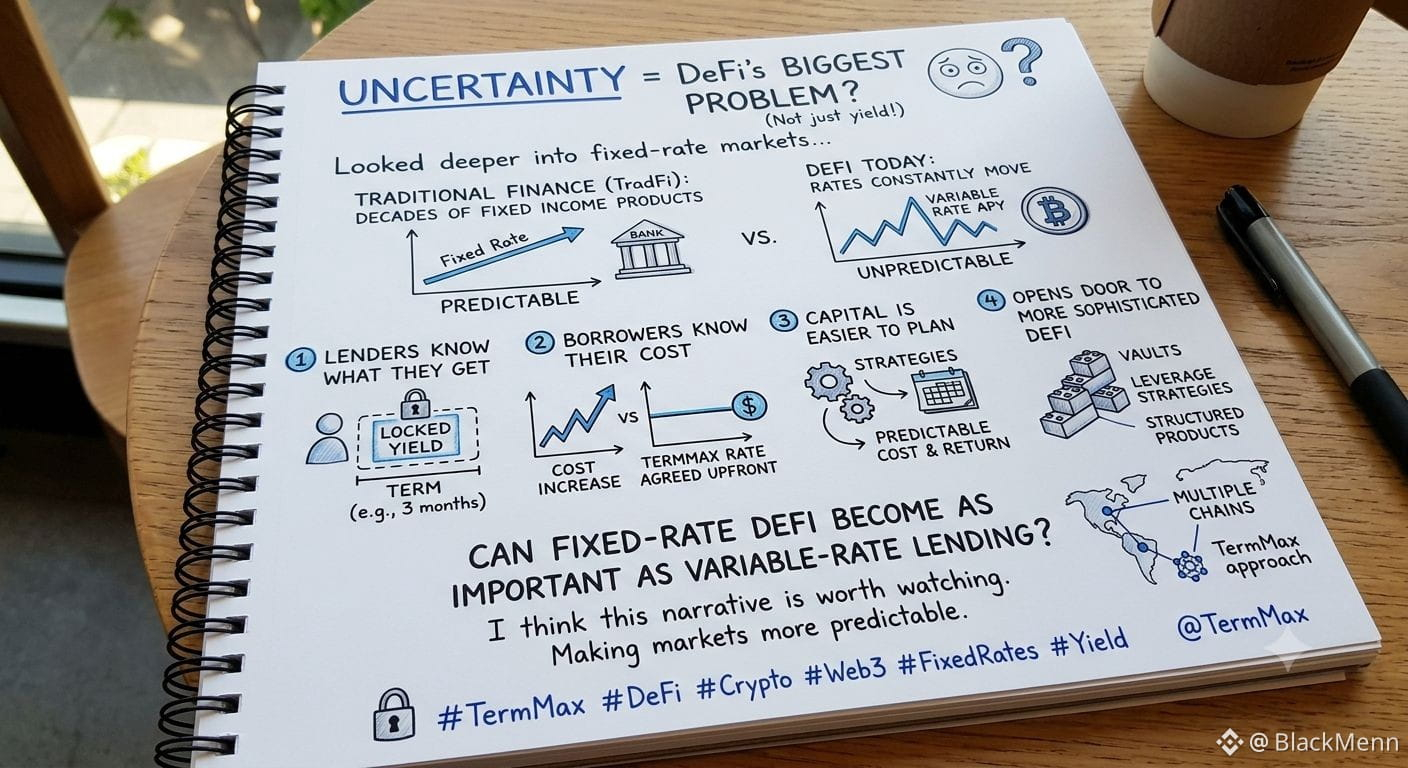
The biggest problem in DeFi might not be yield.
It might be uncertainty. 👀
I started looking deeper into how fixed-rate markets could change the way people use DeFi, and one thing stood out:
Traditional finance has had fixed-income products for decades. DeFi, meanwhile, has mostly been built around rates that constantly move.
So what happens when you bring the predictability of fixed rates on-chain?
1️⃣ Lenders know what they are getting
Instead of watching an APY change every few hours, a fixed-rate market can lock the expected yield for a defined term.
2️⃣ Borrowers know their cost
With variable-rate borrowing, your cost can increase while you're holding a position.
With TermMax, the rate is agreed upfront for the term — so you know the borrowing cost from the beginning.
3️⃣ Capital becomes easier to plan
This is the part I find most interesting.
When the cost and return are predictable, it becomes much easier to build strategies around your capital instead of constantly reacting to the market.
4️⃣ It opens the door to more sophisticated DeFi
Fixed-rate markets can be used as building blocks for vaults, leverage strategies, structured products and other financial primitives.
And TermMax is taking this approach across multiple chains, rather than limiting fixed-rate markets to a single ecosystem.
But there is an important question:
Can fixed-rate DeFi become as important as variable-rate lending?
I think this is one of the narratives worth watching.
DeFi has already proven that financial markets can move on-chain.
The next step may be making those markets more predictable. 🔒
@termmax
#TermMax
The biggest problem in DeFi might not be yield.
It might be uncertainty. 👀
I started looking deeper into how fixed-rate markets could change the way people use DeFi, and one thing stood out:
Traditional finance has had fixed-income products for decades. DeFi, meanwhile, has mostly been built around rates that constantly move.
So what happens when you bring the predictability of fixed rates on-chain?
1️⃣ Lenders know what they are getting
Instead of watching an APY change every few hours, a fixed-rate market can lock the expected yield for a defined term.
2️⃣ Borrowers know their cost
With variable-rate borrowing, your cost can increase while you're holding a position.
With TermMax, the rate is agreed upfront for the term — so you know the borrowing cost from the beginning.
3️⃣ Capital becomes easier to plan
This is the part I find most interesting.
When the cost and return are predictable, it becomes much easier to build strategies around your capital instead of constantly reacting to the market.
4️⃣ It opens the door to more sophisticated DeFi
Fixed-rate markets can be used as building blocks for vaults, leverage strategies, structured products and other financial primitives.
And TermMax is taking this approach across multiple chains, rather than limiting fixed-rate markets to a single ecosystem.
But there is an important question:
Can fixed-rate DeFi become as important as variable-rate lending?
I think this is one of the narratives worth watching.
DeFi has already proven that financial markets can move on-chain.
The next step may be making those markets more predictable. 🔒
@TermMax
#TermMax
It might be uncertainty. 👀
I started looking deeper into how fixed-rate markets could change the way people use DeFi, and one thing stood out:
Traditional finance has had fixed-income products for decades. DeFi, meanwhile, has mostly been built around rates that constantly move.
So what happens when you bring the predictability of fixed rates on-chain?
1️⃣ Lenders know what they are getting
Instead of watching an APY change every few hours, a fixed-rate market can lock the expected yield for a defined term.
2️⃣ Borrowers know their cost
With variable-rate borrowing, your cost can increase while you're holding a position.
With TermMax, the rate is agreed upfront for the term — so you know the borrowing cost from the beginning.
3️⃣ Capital becomes easier to plan
This is the part I find most interesting.
When the cost and return are predictable, it becomes much easier to build strategies around your capital instead of constantly reacting to the market.
4️⃣ It opens the door to more sophisticated DeFi
Fixed-rate markets can be used as building blocks for vaults, leverage strategies, structured products and other financial primitives.
And TermMax is taking this approach across multiple chains, rather than limiting fixed-rate markets to a single ecosystem.
But there is an important question:
Can fixed-rate DeFi become as important as variable-rate lending?
I think this is one of the narratives worth watching.
DeFi has already proven that financial markets can move on-chain.
The next step may be making those markets more predictable. 🔒
@TermMax
#TermMax
1
81
·
--
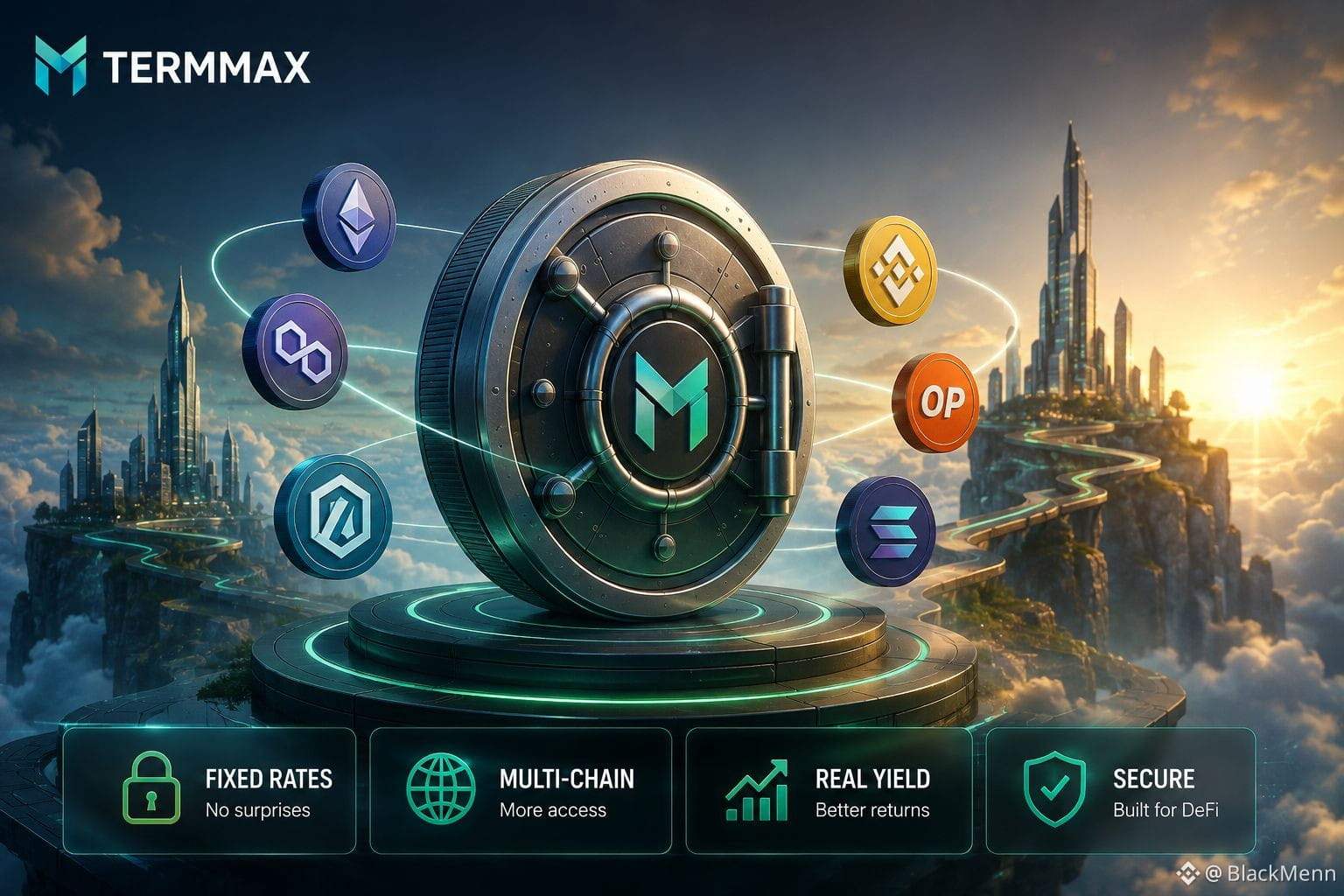
What if DeFi didn’t have to feel like a guessing game? 👀
Rates move. Markets change. Opportunities disappear.
@termmax takes a different approach with fixed-rate lending and borrowing — giving users more predictability while still accessing opportunities across multiple chains.
That combination could be a big deal as DeFi matures.
The real question is:
Will fixed-rate DeFi become the next major narrative? 🔥
I’m watching TermMax closely.
#TermMax #DeFi
What if DeFi didn’t have to feel like a guessing game? 👀
Rates move. Markets change. Opportunities disappear.
@TermMax takes a different approach with fixed-rate lending and borrowing — giving users more predictability while still accessing opportunities across multiple chains.
That combination could be a big deal as DeFi matures.
The real question is:
Will fixed-rate DeFi become the next major narrative? 🔥
I’m watching TermMax closely.
#TermMax #DeFi
Rates move. Markets change. Opportunities disappear.
@TermMax takes a different approach with fixed-rate lending and borrowing — giving users more predictability while still accessing opportunities across multiple chains.
That combination could be a big deal as DeFi matures.
The real question is:
Will fixed-rate DeFi become the next major narrative? 🔥
I’m watching TermMax closely.
#TermMax #DeFi
1
66
·
--
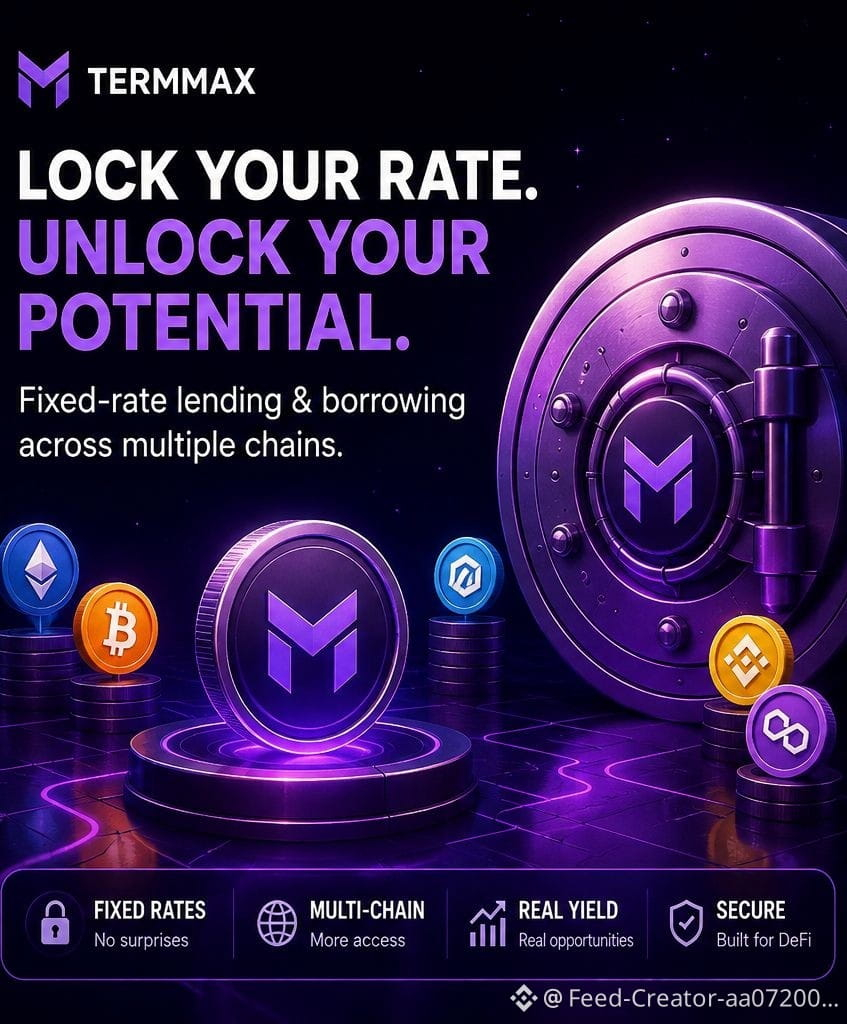
Fixed rates. More control. Less guessing.
DeFi moves fast, but your strategy doesn’t have to change every time rates do.
@termmax is bringing fixed-rate lending and borrowing across multiple chains — giving users a more predictable way to put their capital to work.
More markets. More flexibility. More opportunities. 🔥
Could fixed-rate DeFi become the next big trend?
#termmax
Fixed rates. More control. Less guessing.
DeFi moves fast, but your strategy doesn’t have to change every time rates do.
@TermMax is bringing fixed-rate lending and borrowing across multiple chains — giving users a more predictable way to put their capital to work.
More markets. More flexibility. More opportunities. 🔥
Could fixed-rate DeFi become the next big trend?
#termmax
DeFi moves fast, but your strategy doesn’t have to change every time rates do.
@TermMax is bringing fixed-rate lending and borrowing across multiple chains — giving users a more predictable way to put their capital to work.
More markets. More flexibility. More opportunities. 🔥
Could fixed-rate DeFi become the next big trend?
#termmax
1
83
·
--
DeFi shouldn’t be about guessing what happens next.
That’s why I’m watching @termmax closely. Fixed-rate lending and borrowing gives users something DeFi often lacks: predictability.
With multiple chains, real yield opportunities and new markets constantly expanding, TermMax is building infrastructure for a more mature DeFi ecosystem.
The interesting part? We may still be early. 👀
What do you think will be the biggest catalyst for TermMax next?
#TermMax
DeFi shouldn’t be about guessing what happens next.
That’s why I’m watching @TermMax closely. Fixed-rate lending and borrowing gives users something DeFi often lacks: predictability.
With multiple chains, real yield opportunities and new markets constantly expanding, TermMax is building infrastructure for a more mature DeFi ecosystem.
The interesting part? We may still be early. 👀
What do you think will be the biggest catalyst for TermMax next?
#TermMax
That’s why I’m watching @TermMax closely. Fixed-rate lending and borrowing gives users something DeFi often lacks: predictability.
With multiple chains, real yield opportunities and new markets constantly expanding, TermMax is building infrastructure for a more mature DeFi ecosystem.
The interesting part? We may still be early. 👀
What do you think will be the biggest catalyst for TermMax next?
#TermMax
86
·
--
I've been following the development of @grvt_io and I'm impressed by their approach to combining self-custody with a professional trading experience. Building a hybrid exchange model that offers transparency, security, and efficient trading could be an important step for the future of digital asset markets. Looking forward to seeing how the ecosystem grows and what new features the team introduces next. #grvt
I've been following the development of @grvt_io and I'm impressed by their approach to combining self-custody with a professional trading experience. Building a hybrid exchange model that offers transparency, security, and efficient trading could be an important step for the future of digital asset markets. Looking forward to seeing how the ecosystem grows and what new features the team introduces next. #grvt
81
·
--
Most crypto traders have to choose between the convenience of centralized exchanges and the security of self-custody. What makes @grvt_io interesting is its attempt to bridge that gap by creating a trading environment where users can keep greater control over their assets while still accessing advanced trading features. If this model continues to evolve successfully, it could become an important example of how the next generation of crypto exchanges is built. #grvt
Most crypto traders have to choose between the convenience of centralized exchanges and the security of self-custody. What makes @grvt_io interesting is its attempt to bridge that gap by creating a trading environment where users can keep greater control over their assets while still accessing advanced trading features. If this model continues to evolve successfully, it could become an important example of how the next generation of crypto exchanges is built. #grvt
82
Log in to explore more content
Join global crypto users on Binance Square
⚡️ Get latest and useful information about crypto.
💬 Trusted by the world’s largest crypto exchange.
👍 Discover real insights from verified creators.
Email / Phone number
Trending Topics
BinanceLaunchesBinanceIntelligence
707,925 views
4,454 Discussing
#binancelaunchesbinanceintelligence 🚨 WHAT IF THE NEXT BIG EXCHANGE BATTLE ISN’T ABOUT FEES? 👀
Binance just made a bigger move than adding another AI chatbot.
With Binance Intelligence, AI is moving deeper into the exchange — from understanding market data to building trading workflows. 🤖⚡
The real question is:
Who has the best liquidity?
Or who has the smartest AI layer?
If users can research, test ideas and manage trading workflows without switching between different tools, the exchange itself could become a financial assistant.
That could be a much bigger shift than it looks today.
If Binance Intelligence drives more users, more strategies and more trading activity, $BNB could become one of the tokens to watch. 👀
Is Binance building the future of AI-powered finance?
$BNB
#binancelaunchesbinanceintelligence #BinanceAI #CryptoAI #AITrading
Suleman Khan Haqqani
·18 Likes
·22.9k views
BTCFallsBelow$84K
24,621 views
91 Discussing
DubaiVARAIssuesReserveAssetAuditCircular
4,527 views
308 Discussing