
#agenticfinance
agenticfinance
9,753 views
114 Discussing
Hot
Latest


🤖 AI + FINANCE COULD BE A BIGGER STORY THAN PEOPLE EXPECT
Agentic Finance is becoming an interesting crypto narrative.
Imagine AI agents handling transactions, payments, portfolio actions and on-chain interactions automatically.
The technology is still developing, but the potential is huge.
The winners won't simply be the projects with the best AI branding.
They'll be the ones that actually attract users and transaction volume.
📌 Watch adoption, not buzzwords.
$NEAR $FET $TAO
#AgenticFinance
🤖 AI + FINANCE COULD BE A BIGGER STORY THAN PEOPLE EXPECT
Agentic Finance is becoming an interesting crypto narrative.
Imagine AI agents handling transactions, payments, portfolio actions and on-chain interactions automatically.
The technology is still developing, but the potential is huge.
The winners won't simply be the projects with the best AI branding.
They'll be the ones that actually attract users and transaction volume.
📌 Watch adoption, not buzzwords.
$NEAR $FET $TAO
#AgenticFinance
Agentic Finance is becoming an interesting crypto narrative.
Imagine AI agents handling transactions, payments, portfolio actions and on-chain interactions automatically.
The technology is still developing, but the potential is huge.
The winners won't simply be the projects with the best AI branding.
They'll be the ones that actually attract users and transaction volume.
📌 Watch adoption, not buzzwords.
$NEAR $FET $TAO
#AgenticFinance
196

·
--
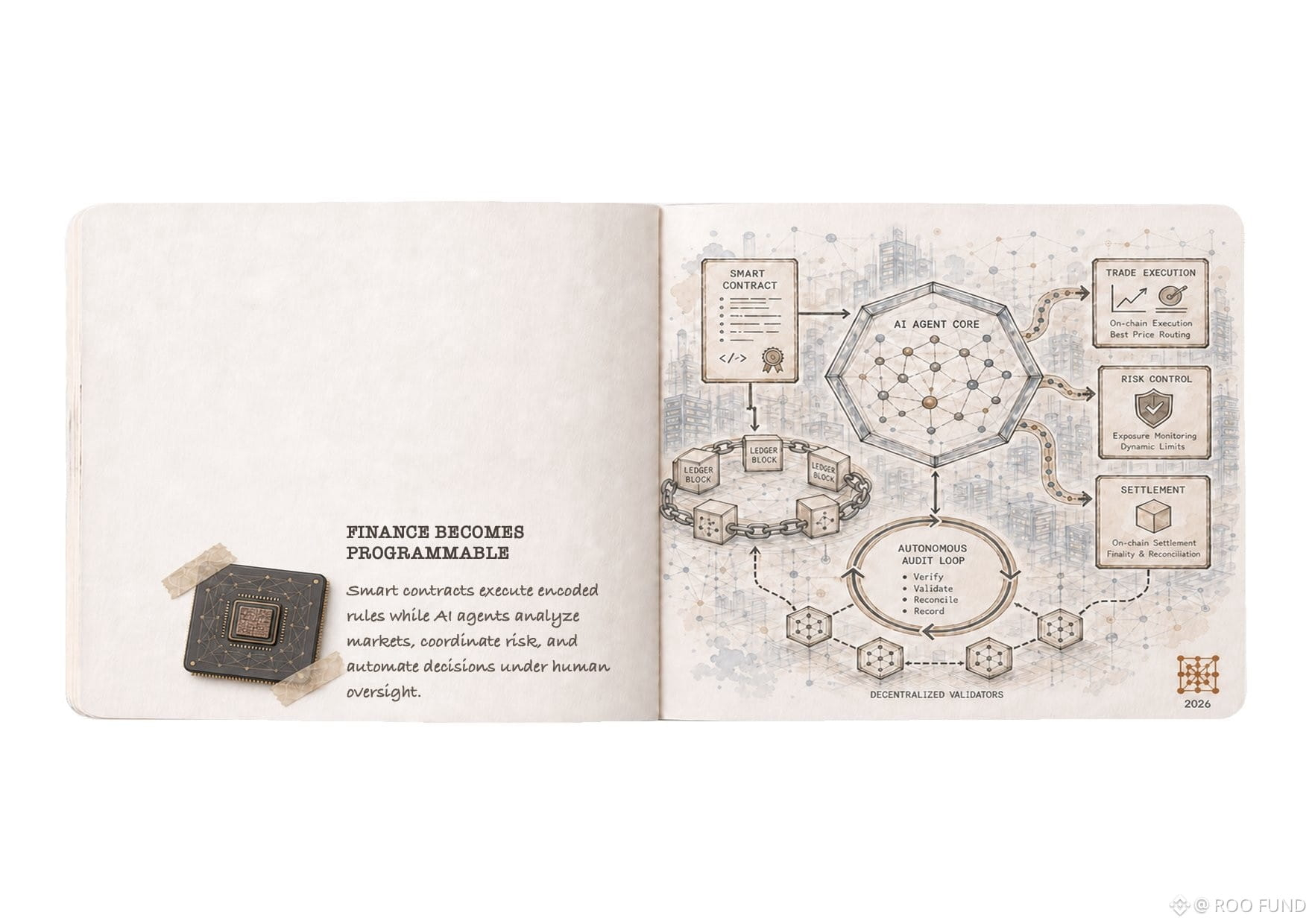
Finance is becoming programmable. Smart contracts execute rules; AI agents analyze markets, coordinate risk, and automate workflows—while authorization and accountability must remain explicit. This is the frontier of AIFi.
#AIFI #SmartContracts #AgenticFinance #ROOFUND
Finance is becoming programmable. Smart contracts execute rules; AI agents analyze markets, coordinate risk, and automate workflows—while authorization and accountability must remain explicit. This is the frontier of AIFi.
#AIFI #SmartContracts #AgenticFinance #ROOFUND
#AIFI #SmartContracts #AgenticFinance #ROOFUND
2
176

·
--
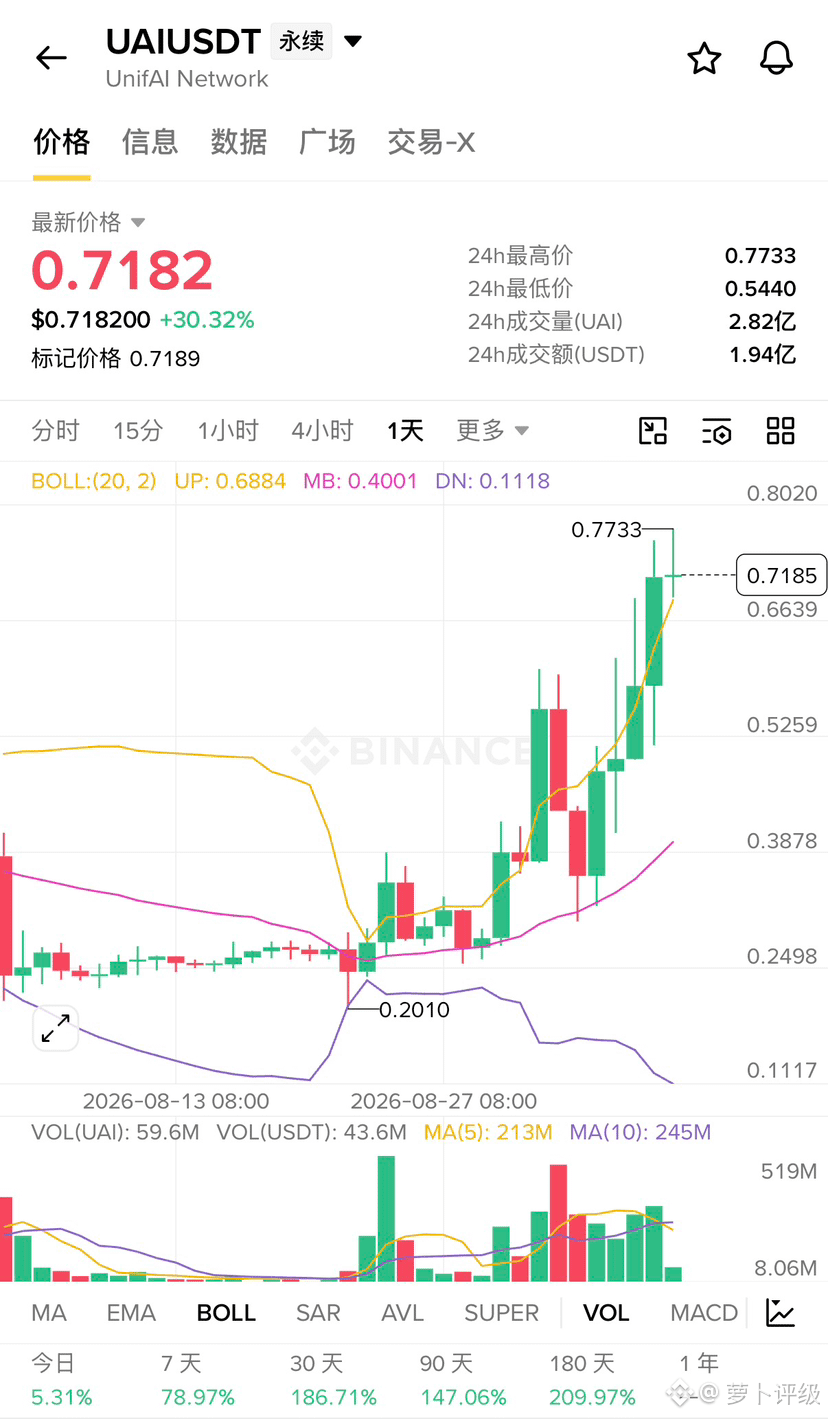
$UAI 24h +30.32%, the truly compelling part isn’t the price increase itself, but that eye-catching on-chain figure: the top six addresses are collectively believed to control about 84.5% of the supply. UnifAI is an AI execution layer focused on Agentic Finance—letting agents run on-chain strategies for users and connecting with 100+ DeFi protocols.
Previously, the team has consistently been promoting the UnifAI SDK, emphasizing that “an agent only has real value if it can execute on-chain.” The direction is clear; the community’s FOMO is also not an exaggeration—$UAI has been recorded setting an all-time high of about $0.752, and some are already calling for $1. But with such concentrated holdings, this looks like an on-chain storyline made visible—so is this round a re-pricing of the AI narrative, or just a pump orchestrated by a small number of holders?
Next, keep an eye on address dispersion and the real adoption of the SDK—the quality will slowly become apparent.
#AI #DeFi #AgenticFinance
{future}(UAIUSDT)
$UAI 24h +30.32%, the truly compelling part isn’t the price increase itself, but that eye-catching on-chain figure: the top six addresses are collectively believed to control about 84.5% of the supply. UnifAI is an AI execution layer focused on Agentic Finance—letting agents run on-chain strategies for users and connecting with 100+ DeFi protocols.
Previously, the team has consistently been promoting the UnifAI SDK, emphasizing that “an agent only has real value if it can execute on-chain.” The direction is clear; the community’s FOMO is also not an exaggeration—$UAI has been recorded setting an all-time high of about $0.752, and some are already calling for $1. But with such concentrated holdings, this looks like an on-chain storyline made visible—so is this round a re-pricing of the AI narrative, or just a pump orchestrated by a small number of holders?
Next, keep an eye on address dispersion and the real adoption of the SDK—the quality will slowly become apparent.
#AI #DeFi #AgenticFinance
Previously, the team has consistently been promoting the UnifAI SDK, emphasizing that “an agent only has real value if it can execute on-chain.” The direction is clear; the community’s FOMO is also not an exaggeration—$UAI has been recorded setting an all-time high of about $0.752, and some are already calling for $1. But with such concentrated holdings, this looks like an on-chain storyline made visible—so is this round a re-pricing of the AI narrative, or just a pump orchestrated by a small number of holders?
Next, keep an eye on address dispersion and the real adoption of the SDK—the quality will slowly become apparent.
#AI #DeFi #AgenticFinance
165

·
--
Bullish
🚀 $UAI
{future}(UAIUSDT)
looking strong on the daily!
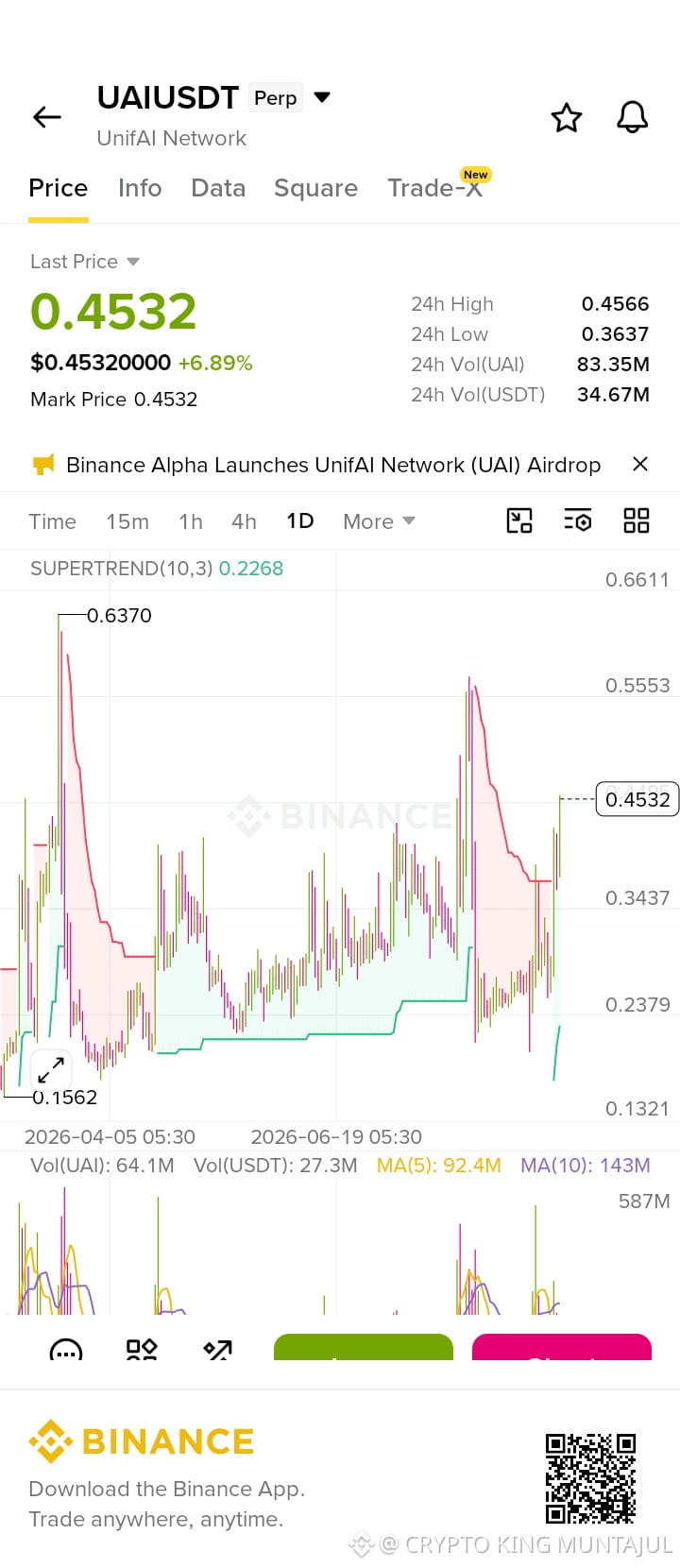
Last price: 0.4532 (+6.89%)
24h High: 0.4566 | 24h Low: 0.3637
Volume: 83.35M UAI / 34.67M USDT
Supertrend (10,3) still holding green support around 0.2268 while price reclaims the mid-range. Nice bounce from the lower levels and that recent green candle is showing some real buying pressure.
UnifAI Network is building the infrastructure for autonomous AI agents that actually execute DeFi strategies (not just advise). Agentic finance is still early — and $UAI is one of the cleaner plays in the sector.
Binance Alpha + Futures listing + airdrop narrative still fresh in the market.
Who’s still holding / adding here?
Bullish or taking profits?
#UAI #UnifAI #BinanceAlpha #AI #DeFi #AgenticFinance
🚀 $UAI
looking strong on the daily!
Last price: 0.4532 (+6.89%)
24h High: 0.4566 | 24h Low: 0.3637
Volume: 83.35M UAI / 34.67M USDT
Supertrend (10,3) still holding green support around 0.2268 while price reclaims the mid-range. Nice bounce from the lower levels and that recent green candle is showing some real buying pressure.
UnifAI Network is building the infrastructure for autonomous AI agents that actually execute DeFi strategies (not just advise). Agentic finance is still early — and $UAI is one of the cleaner plays in the sector.
Binance Alpha + Futures listing + airdrop narrative still fresh in the market.
Who’s still holding / adding here?
Bullish or taking profits?
#UAI #UnifAI #BinanceAlpha #AI #DeFi #AgenticFinance
looking strong on the daily!
Last price: 0.4532 (+6.89%)
24h High: 0.4566 | 24h Low: 0.3637
Volume: 83.35M UAI / 34.67M USDT
Supertrend (10,3) still holding green support around 0.2268 while price reclaims the mid-range. Nice bounce from the lower levels and that recent green candle is showing some real buying pressure.
UnifAI Network is building the infrastructure for autonomous AI agents that actually execute DeFi strategies (not just advise). Agentic finance is still early — and $UAI is one of the cleaner plays in the sector.
Binance Alpha + Futures listing + airdrop narrative still fresh in the market.
Who’s still holding / adding here?
Bullish or taking profits?
#UAI #UnifAI #BinanceAlpha #AI #DeFi #AgenticFinance
374

·
--
From Answering to Acting: How Binance Agent OS Works in PracticeAI is moving from simply answering questions to actually taking action. In crypto, that shift could be significant — and Binance Agent OS is designed to provide the infrastructure that makes it possible.
Instead of an AI agent merely telling you that Bitcoin is moving, imagine an agent that can access market data, monitor positions, evaluate conditions and interact with trading infrastructure — all within permissions and limits defined by the user.
That is the idea behind Binance Agent OS.
What Is Binance Agent OS?
Binance Agent OS is a developer toolkit that connects AI agents to Binance through the Model Context Protocol (MCP), APIs and ready-made skills.
The system allows agents to access crypto and TradFi market data, track portfolios, interact with trading functions, automate payments and, where supported, interact with on-chain services.
The important part is that the agent does not need unrestricted access.
Binance describes the architecture around three principles: connect, build and control. Developers can connect an existing AI-agent stack, build workflows using Binance infrastructure and establish permissions, accounts and limits for individual agents.
From AI Conversation to Action
Consider a simple trading workflow.
A user could ask an AI agent to monitor BTC and identify a specific market condition. Through the Binance MCP server, the agent can access the relevant Binance tools and data.
The workflow can look like this:
User request → AI agent → Binance MCP → market data → analysis → permitted action
The MCP layer acts as the bridge between the AI agent and Binance infrastructure.
This is where the difference between a traditional chatbot and an AI agent becomes clearer.
A chatbot might answer: “BTC is trading at X.”
An agent connected to financial infrastructure could potentially retrieve the relevant data, evaluate a predefined condition and initiate an allowed action — subject to the permissions and controls established by the user.
Binance says Agent OS can allow agents to monitor markets, react to signals and act when specified conditions are met.
Why MCP Matters
Model Context Protocol (MCP) is an open standard designed to allow AI applications to connect with external data and services.
For Binance Agent OS, the Binance MCP server provides a structured connection between an AI agent and Binance tools.
The setup is designed around three steps:
1. Add the Binance MCP Server
2. Authenticate the server
3. Activate the agent
That makes MCP more than a technical buzzword. It becomes the connection layer that allows an AI agent to interact with financial infrastructure.
The Guardrails Are the Important Part
Giving an AI access to financial systems raises an obvious question: How much authority should the agent have?
This is where controls matter.
Binance Agent OS emphasizes configurable permissions, accounts and limits. An agent can therefore be designed around a defined operating perimeter rather than being given unlimited authority.
That distinction could become increasingly important as AI agents move deeper into financial workflows.
The goal isn't simply to make AI more autonomous.
It is to make autonomous financial actions more controlled and auditable.
The Bigger Picture
Binance Agent OS represents a broader shift from AI that provides information to AI that can interact with financial infrastructure.
Market data, trading, payments, portfolio tracking and on-chain functionality can become tools available to AI agents through established Binance infrastructure.
That is why agentic finance is worth watching.
The future may not be about asking an AI, “What should I do?”
It may increasingly be about giving an AI clearly defined rules, permissions and objectives — and allowing it to execute within those boundaries.
For developers, traders and crypto users, Binance Agent OS offers a practical look at what that future could look like.
Explore Binance Agent OS: [Binance Agent OS](https://www.binance.com/es/agent-os?utm_source=chatgpt.com)
Interested in BNB? Explore Binance's official Buy BNB option here: [Buy BNB on Binance](https://www.binance.com/en/buy-sell-crypto/bnb?utm_source=chatgpt.com)
Not financial advice. Crypto assets are volatile and AI-generated outputs can contain errors or outdated information. Always do your own research (DYOR) and understand the risks before trading or investing.
#BinanceAgentOS #AgenticFinance #MCP
From Answering to Acting: How Binance Agent OS Works in Practice
AI is moving from simply answering questions to actually taking action. In crypto, that shift could be significant — and Binance Agent OS is designed to provide the infrastructure that makes it possible.
Instead of an AI agent merely telling you that Bitcoin is moving, imagine an agent that can access market data, monitor positions, evaluate conditions and interact with trading infrastructure — all within permissions and limits defined by the user.
That is the idea behind Binance Agent OS.
What Is Binance Agent OS?
Binance Agent OS is a developer toolkit that connects AI agents to Binance through the Model Context Protocol (MCP), APIs and ready-made skills.
The system allows agents to access crypto and TradFi market data, track portfolios, interact with trading functions, automate payments and, where supported, interact with on-chain services.
The important part is that the agent does not need unrestricted access.
Binance describes the architecture around three principles: connect, build and control. Developers can connect an existing AI-agent stack, build workflows using Binance infrastructure and establish permissions, accounts and limits for individual agents.
From AI Conversation to Action
Consider a simple trading workflow.
A user could ask an AI agent to monitor BTC and identify a specific market condition. Through the Binance MCP server, the agent can access the relevant Binance tools and data.
The workflow can look like this:
User request → AI agent → Binance MCP → market data → analysis → permitted action
The MCP layer acts as the bridge between the AI agent and Binance infrastructure.
This is where the difference between a traditional chatbot and an AI agent becomes clearer.
A chatbot might answer: “BTC is trading at X.”
An agent connected to financial infrastructure could potentially retrieve the relevant data, evaluate a predefined condition and initiate an allowed action — subject to the permissions and controls established by the user.
Binance says Agent OS can allow agents to monitor markets, react to signals and act when specified conditions are met.
Why MCP Matters
Model Context Protocol (MCP) is an open standard designed to allow AI applications to connect with external data and services.
For Binance Agent OS, the Binance MCP server provides a structured connection between an AI agent and Binance tools.
The setup is designed around three steps:
1. Add the Binance MCP Server
2. Authenticate the server
3. Activate the agent
That makes MCP more than a technical buzzword. It becomes the connection layer that allows an AI agent to interact with financial infrastructure.
The Guardrails Are the Important Part
Giving an AI access to financial systems raises an obvious question: How much authority should the agent have?
This is where controls matter.
Binance Agent OS emphasizes configurable permissions, accounts and limits. An agent can therefore be designed around a defined operating perimeter rather than being given unlimited authority.
That distinction could become increasingly important as AI agents move deeper into financial workflows.
The goal isn't simply to make AI more autonomous.
It is to make autonomous financial actions more controlled and auditable.
The Bigger Picture
Binance Agent OS represents a broader shift from AI that provides information to AI that can interact with financial infrastructure.
Market data, trading, payments, portfolio tracking and on-chain functionality can become tools available to AI agents through established Binance infrastructure.
That is why agentic finance is worth watching.
The future may not be about asking an AI, “What should I do?”
It may increasingly be about giving an AI clearly defined rules, permissions and objectives — and allowing it to execute within those boundaries.
For developers, traders and crypto users, Binance Agent OS offers a practical look at what that future could look like.
Explore Binance Agent OS: Binance Agent OS
Interested in BNB? Explore Binance's official Buy BNB option here: Buy BNB on Binance
Not financial advice. Crypto assets are volatile and AI-generated outputs can contain errors or outdated information. Always do your own research (DYOR) and understand the risks before trading or investing.
#BinanceAgentOS #AgenticFinance #MCP
Instead of an AI agent merely telling you that Bitcoin is moving, imagine an agent that can access market data, monitor positions, evaluate conditions and interact with trading infrastructure — all within permissions and limits defined by the user.
That is the idea behind Binance Agent OS.
What Is Binance Agent OS?
Binance Agent OS is a developer toolkit that connects AI agents to Binance through the Model Context Protocol (MCP), APIs and ready-made skills.
The system allows agents to access crypto and TradFi market data, track portfolios, interact with trading functions, automate payments and, where supported, interact with on-chain services.
The important part is that the agent does not need unrestricted access.
Binance describes the architecture around three principles: connect, build and control. Developers can connect an existing AI-agent stack, build workflows using Binance infrastructure and establish permissions, accounts and limits for individual agents.
From AI Conversation to Action
Consider a simple trading workflow.
A user could ask an AI agent to monitor BTC and identify a specific market condition. Through the Binance MCP server, the agent can access the relevant Binance tools and data.
The workflow can look like this:
User request → AI agent → Binance MCP → market data → analysis → permitted action
The MCP layer acts as the bridge between the AI agent and Binance infrastructure.
This is where the difference between a traditional chatbot and an AI agent becomes clearer.
A chatbot might answer: “BTC is trading at X.”
An agent connected to financial infrastructure could potentially retrieve the relevant data, evaluate a predefined condition and initiate an allowed action — subject to the permissions and controls established by the user.
Binance says Agent OS can allow agents to monitor markets, react to signals and act when specified conditions are met.
Why MCP Matters
Model Context Protocol (MCP) is an open standard designed to allow AI applications to connect with external data and services.
For Binance Agent OS, the Binance MCP server provides a structured connection between an AI agent and Binance tools.
The setup is designed around three steps:
1. Add the Binance MCP Server
2. Authenticate the server
3. Activate the agent
That makes MCP more than a technical buzzword. It becomes the connection layer that allows an AI agent to interact with financial infrastructure.
The Guardrails Are the Important Part
Giving an AI access to financial systems raises an obvious question: How much authority should the agent have?
This is where controls matter.
Binance Agent OS emphasizes configurable permissions, accounts and limits. An agent can therefore be designed around a defined operating perimeter rather than being given unlimited authority.
That distinction could become increasingly important as AI agents move deeper into financial workflows.
The goal isn't simply to make AI more autonomous.
It is to make autonomous financial actions more controlled and auditable.
The Bigger Picture
Binance Agent OS represents a broader shift from AI that provides information to AI that can interact with financial infrastructure.
Market data, trading, payments, portfolio tracking and on-chain functionality can become tools available to AI agents through established Binance infrastructure.
That is why agentic finance is worth watching.
The future may not be about asking an AI, “What should I do?”
It may increasingly be about giving an AI clearly defined rules, permissions and objectives — and allowing it to execute within those boundaries.
For developers, traders and crypto users, Binance Agent OS offers a practical look at what that future could look like.
Explore Binance Agent OS: Binance Agent OS
Interested in BNB? Explore Binance's official Buy BNB option here: Buy BNB on Binance
Not financial advice. Crypto assets are volatile and AI-generated outputs can contain errors or outdated information. Always do your own research (DYOR) and understand the risks before trading or investing.
#BinanceAgentOS #AgenticFinance #MCP
1
116
·
--
Article
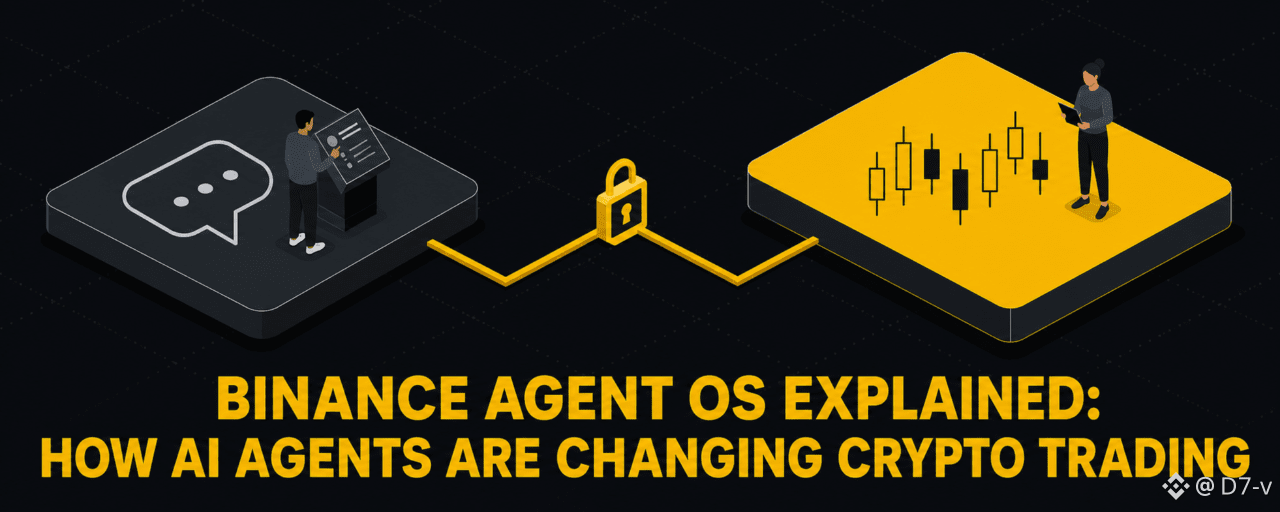
Binance Agent OS Explained: How AI Agents Are Changing Crypto TradingImagine telling ChatGPT, "Watch Bitcoin for me, and short it if funding turns negative," and it actually does it — inside your Binance account, within limits you set. That's not a thought experiment anymore. On August 20, 2026, Binance launched Binance Agent OS, a platform that lets AI agents connect directly to its trading, wallet, and payment infrastructure, and it's arguably the biggest shift in how retail and institutional traders will interact with exchanges since the rise of trading bots themselves.
If you've been hearing "agentic finance" everywhere and wondering what it actually looks like in practice, Binance just gave you a concrete answer.
What Is Binance Agent OS?
Binance Agent OS is a developer platform, built under Binance's broader "Binance Intelligence" initiative, that connects AI applications and agents to Binance's supported financial infrastructure through user-controlled permissions. Instead of developers stitching together one-off integrations for every AI tool, Agent OS bundles five things into a single, coherent access layer:
Binance APIs — programmatic access to trading, market, wallet, and on-chain functionsBinance Wallet Agentic Hub — wallet capabilities purpose-built for agent-driven interactionsBinance x402 — payment and settlement primitives for machine-to-machine transactionsBinance Skill Hub — a library of modular, ready-to-use capabilitiesMCP Server — a standardized connection layer based on the Model Context Protocol (MCP), an open standard that lets AI tools discover and use external services without custom-built integrations
In plain English: Agent OS is Binance's "universal socket" for AI agents. Once connected, tools like ChatGPT, Claude, Claude Code, Codex, Cursor, and VS Code can read market data, check your balances, and — with your explicit permission — place trades or move funds on your behalf.
Why Binance Agent OS Matters Right Now
Binance isn't a small player experimenting in a lab. It's the world's largest crypto exchange, with more than 300 million registered users and trillions of dollars in annual trading volume. When a platform of that scale opens its trading engine to AI agents, it signals where the entire industry is heading — and it's not alone. Competitors including Kraken, Coinbase, OKX, MetaMask, and MoonPay have made parallel moves toward agentic infrastructure, confirming this is an industry-wide shift rather than a one-off Binance experiment.
Jeff Li, Binance's Vice President of Product, framed the motivation clearly: "Binance Agent OS addresses the fragmentation developers face when building agentic finance applications across crypto and traditional markets. It gives everyone from developers to quantitative traders the reliable data, low-latency infrastructure, and standardized interfaces they need to deploy AI-driven strategies."
For everyday traders, this matters because it moves AI in crypto from simple chatbots that answer questions toward agents that can actually execute — monitoring markets 24/7, reacting to signals in seconds, and handling repetitive portfolio tasks without you being glued to a screen.
How Binance Agent OS Actually Works
The MCP Server
At the technical core of Binance Agent OS is an MCP server, reachable at a dedicated endpoint (https://agent.binance.com/mcp/agentic). MCP (Model Context Protocol) is an open standard that lets compatible AI applications discover and use external tools in a consistent way, instead of every developer building a bespoke bridge between their AI and an exchange's API. At launch, the Binance MCP server supports market data and trading (Spot, Futures, Convert), with on-chain and payment capabilities available via other Agent OS components and expected to expand over time.
Agentic Sub-Accounts
Every agent you connect operates inside a dedicated Agentic sub-account — a segregated space isolated from your main Binance account. This is Binance's primary safety mechanism: if an agent misbehaves, gets manipulated, or simply makes a bad call, the damage is contained to whatever funds and permissions live in that sub-account.
Permissions, Limits, and the Emergency Stop
You control exactly what an agent can and can't do. Depending on the scopes you grant, an agent may be able to:
Read market data — tickers, order books, candlesticks, and funding rates, no authentication requiredCheck balances — view positions and transaction history in the Agentic sub-account, plus an optional read-only view of your main accountTrade — Spot, Margin, Convert, USDⓈ-M Futures, and COIN-M Futures, depending on granted scopes and your account's eligibilityTransfer — move funds between wallets inside the Agentic sub-account (e.g., Spot to Futures)
Binance layers default daily caps on top of these permissions: roughly $50,000 per day for swaps, $100,000 per day for DeFi activity, and $20 per day for x402 machine-to-machine payments — all adjustable by the account owner. You can also require manual approval on every order rather than letting an agent trade fully autonomously.
If something goes wrong, you're not stuck. Under Sub Accounts → Account Management, you can disconnect a specific agent, or hit Emergency Stop to instantly revoke access for every connected agent and cancel all open spot, margin, and futures orders in one move. Crucially, agents cannot withdraw funds to external wallets, and they cannot pull money out of your main account into the Agentic sub-account — that transfer has to come from you.
What Can an AI Agent Actually Do on Binance Agent OS?
Within the limits you configure, agents connected through Binance Agent OS can be used across four broad categories:
Trading and market intelligence. Agents can monitor spot and futures markets, analyze risk, react to price or funding-rate signals, and execute strategies such as simple signal-based entries or more complex arbitrage — all without you manually watching charts.
Payments and settlement. Through Binance x402, agents can send, receive, and settle transactions programmatically, which opens the door to machine-to-machine payments — think an agent paying for a data feed or API call automatically, within that $20/day cap.
On-chain operations. Using the Agentic Wallet and Binance Web3 APIs, agents can interact with supported on-chain services and DeFi protocols, subject to whatever rules you've set.
Portfolio and fund management. Agents can check balances and positions, then automatically rebalance or move funds between wallets inside the sub-account when certain thresholds are hit — for example, topping up margin when usage climbs too high.
A Simple Example: Setting Up an Agent Workflow
Here's what a realistic first workflow might look like if you're testing Binance Agent OS:
Connect a supported AI tool (say, Claude Code) to the Binance MCP endpoint and authorize a new Agentic sub-account.Grant read-only market data and balance-viewing scopes first — no trading permissions yet.Ask the agent to produce a daily portfolio summary: total value, 24-hour PnL, and any position that's more than a set percentage away from your target allocation.Once you trust the reporting, add limited trading scope with a low daily cap and "approval required" turned on, so every order needs your sign-off before it executes.Only after several supervised trades go smoothly would you consider loosening approval requirements for narrowly defined, rules-based actions.
This crawl-walk-run approach mirrors what Binance itself recommends: start with granular, limited access and expand only as the agent proves reliable.
Risks, Limits, and Gotchas to Know Before You Connect an Agent
Binance Agent OS is genuinely powerful, but it comes with real caveats worth internalizing before you connect anything to real funds.
Binance can't see the agent's reasoning. Jeff Li has been candid about this: "We really cannot see the reasoning of what the user's action is." The AI's decision-making happens outside Binance's systems — on your device or inside the AI application itself — so Binance can monitor the resulting trades but not why the agent made them. That means the logic, the prompt, and the judgment calls are entirely on you to audit.
Limits are your responsibility, not a safety net Binance manages for you. The system is not autonomous in the sense of self-correcting; if you set a cap too high or skip the approval step, the agent will use the full room you gave it. A cap you set will silently bound an order rather than throw a visible error, so check your configured limits before assuming a stalled trade is a bug.
Withdrawals to external wallets are blocked by default, but internal transfers aren't. Agents can move funds around inside the Agentic sub-account, which is where most of the real risk of an over-permissioned agent lives.
Compliance still applies. Binance's existing security, risk-control, and anti-money-laundering policies for sub-account APIs apply to Agent OS from day one — it doesn't bypass regulatory or KYC obligations.
This is genuinely new infrastructure. Agent OS launched on August 20, 2026, which means best practices, third-party tooling, and even Binance's own guardrails are still evolving. Treat it the way you'd treat any early-stage trading bot: small size, tight limits, close monitoring.
Binance Agent OS vs. the Broader Industry Shift
Binance is a leading mover here, but not the only one. Kraken, Coinbase, OKX, MetaMask, and MoonPay have all been building toward similar agent-accessible infrastructure, which suggests MCP-style connections between AI tools and exchanges are becoming an industry norm rather than a novelty. For traders and developers already comfortable with Binance's ecosystem — API access, sub-accounts, and existing risk tools — Agent OS is less a totally new product and more a unification of capabilities Binance already had, now packaged for AI-native workflows.
Key Takeaways
Binance Agent OS, launched August 20, 2026, lets AI tools like ChatGPT, Claude, and Cursor connect to Binance to read markets, check balances, and place trades within permissions you set.Agents operate inside isolated Agentic sub-accounts with daily spending caps ($50,000 for swaps, $100,000 for DeFi, $20 for x402 payments by default) and cannot withdraw to external wallets.You control granularity: read-only access, per-order approval, or full autonomy, with an Emergency Stop to revoke everything instantly.Binance cannot see or audit an agent's reasoning — only the resulting trades — so responsible use and careful prompt design are on the user.This is part of a broader industry move toward "agentic finance," with Kraken, Coinbase, OKX, and others pursuing similar integrations.
FAQ
Is Binance Agent OS available to everyone?
Access depends on account eligibility and regional availability, since Agent OS features and trading products vary by jurisdiction.
Can an AI agent withdraw my funds?
No. Agents cannot withdraw crypto to external wallets, and they cannot pull funds from your main account into the Agentic sub-account without you initiating that transfer.
Which AI tools work with Binance Agent OS?
At launch, supported tools include ChatGPT, Claude, Claude Code, Codex, Cursor, and VS Code, connecting via the Model Context Protocol (MCP) server.
What happens if my agent makes a bad trade?
Losses inside the Agentic sub-account are your responsibility — Binance's controls limit exposure through spending caps and sub-account isolation, but they don't guarantee profitable or error-free decisions.
How do I stop an agent immediately?
Go to Sub Accounts → Account Management. Use "Disconnect Agents" to revoke access for a specific agent, or "Emergency Stop" to cut off all connected agents and cancel open orders at once.
Does Agent OS support arbitrage and DeFi strategies?
Yes. Binance lists arbitrage, signal-based trading, research workflows, and on-chain DeFi activity among its initial targeted use cases.
Suggested Hashtags
#BinanceAgentOS #AgenticFinance #CryptoAI #AITrading #Binance
Binance Agent OS Explained: How AI Agents Are Changing Crypto Trading
Imagine telling ChatGPT, "Watch Bitcoin for me, and short it if funding turns negative," and it actually does it — inside your Binance account, within limits you set. That's not a thought experiment anymore. On August 20, 2026, Binance launched Binance Agent OS, a platform that lets AI agents connect directly to its trading, wallet, and payment infrastructure, and it's arguably the biggest shift in how retail and institutional traders will interact with exchanges since the rise of trading bots themselves.
If you've been hearing "agentic finance" everywhere and wondering what it actually looks like in practice, Binance just gave you a concrete answer.
What Is Binance Agent OS?
Binance Agent OS is a developer platform, built under Binance's broader "Binance Intelligence" initiative, that connects AI applications and agents to Binance's supported financial infrastructure through user-controlled permissions. Instead of developers stitching together one-off integrations for every AI tool, Agent OS bundles five things into a single, coherent access layer:
Binance APIs — programmatic access to trading, market, wallet, and on-chain functionsBinance Wallet Agentic Hub — wallet capabilities purpose-built for agent-driven interactionsBinance x402 — payment and settlement primitives for machine-to-machine transactionsBinance Skill Hub — a library of modular, ready-to-use capabilitiesMCP Server — a standardized connection layer based on the Model Context Protocol (MCP), an open standard that lets AI tools discover and use external services without custom-built integrations
In plain English: Agent OS is Binance's "universal socket" for AI agents. Once connected, tools like ChatGPT, Claude, Claude Code, Codex, Cursor, and VS Code can read market data, check your balances, and — with your explicit permission — place trades or move funds on your behalf.
Why Binance Agent OS Matters Right Now
Binance isn't a small player experimenting in a lab. It's the world's largest crypto exchange, with more than 300 million registered users and trillions of dollars in annual trading volume. When a platform of that scale opens its trading engine to AI agents, it signals where the entire industry is heading — and it's not alone. Competitors including Kraken, Coinbase, OKX, MetaMask, and MoonPay have made parallel moves toward agentic infrastructure, confirming this is an industry-wide shift rather than a one-off Binance experiment.
Jeff Li, Binance's Vice President of Product, framed the motivation clearly: "Binance Agent OS addresses the fragmentation developers face when building agentic finance applications across crypto and traditional markets. It gives everyone from developers to quantitative traders the reliable data, low-latency infrastructure, and standardized interfaces they need to deploy AI-driven strategies."
For everyday traders, this matters because it moves AI in crypto from simple chatbots that answer questions toward agents that can actually execute — monitoring markets 24/7, reacting to signals in seconds, and handling repetitive portfolio tasks without you being glued to a screen.
How Binance Agent OS Actually Works
The MCP Server
At the technical core of Binance Agent OS is an MCP server, reachable at a dedicated endpoint (https://agent.binance.com/mcp/agentic). MCP (Model Context Protocol) is an open standard that lets compatible AI applications discover and use external tools in a consistent way, instead of every developer building a bespoke bridge between their AI and an exchange's API. At launch, the Binance MCP server supports market data and trading (Spot, Futures, Convert), with on-chain and payment capabilities available via other Agent OS components and expected to expand over time.
Agentic Sub-Accounts
Every agent you connect operates inside a dedicated Agentic sub-account — a segregated space isolated from your main Binance account. This is Binance's primary safety mechanism: if an agent misbehaves, gets manipulated, or simply makes a bad call, the damage is contained to whatever funds and permissions live in that sub-account.
Permissions, Limits, and the Emergency Stop
You control exactly what an agent can and can't do. Depending on the scopes you grant, an agent may be able to:
Read market data — tickers, order books, candlesticks, and funding rates, no authentication requiredCheck balances — view positions and transaction history in the Agentic sub-account, plus an optional read-only view of your main accountTrade — Spot, Margin, Convert, USDⓈ-M Futures, and COIN-M Futures, depending on granted scopes and your account's eligibilityTransfer — move funds between wallets inside the Agentic sub-account (e.g., Spot to Futures)
Binance layers default daily caps on top of these permissions: roughly $50,000 per day for swaps, $100,000 per day for DeFi activity, and $20 per day for x402 machine-to-machine payments — all adjustable by the account owner. You can also require manual approval on every order rather than letting an agent trade fully autonomously.
If something goes wrong, you're not stuck. Under Sub Accounts → Account Management, you can disconnect a specific agent, or hit Emergency Stop to instantly revoke access for every connected agent and cancel all open spot, margin, and futures orders in one move. Crucially, agents cannot withdraw funds to external wallets, and they cannot pull money out of your main account into the Agentic sub-account — that transfer has to come from you.
What Can an AI Agent Actually Do on Binance Agent OS?
Within the limits you configure, agents connected through Binance Agent OS can be used across four broad categories:
Trading and market intelligence. Agents can monitor spot and futures markets, analyze risk, react to price or funding-rate signals, and execute strategies such as simple signal-based entries or more complex arbitrage — all without you manually watching charts.
Payments and settlement. Through Binance x402, agents can send, receive, and settle transactions programmatically, which opens the door to machine-to-machine payments — think an agent paying for a data feed or API call automatically, within that $20/day cap.
On-chain operations. Using the Agentic Wallet and Binance Web3 APIs, agents can interact with supported on-chain services and DeFi protocols, subject to whatever rules you've set.
Portfolio and fund management. Agents can check balances and positions, then automatically rebalance or move funds between wallets inside the sub-account when certain thresholds are hit — for example, topping up margin when usage climbs too high.
A Simple Example: Setting Up an Agent Workflow
Here's what a realistic first workflow might look like if you're testing Binance Agent OS:
Connect a supported AI tool (say, Claude Code) to the Binance MCP endpoint and authorize a new Agentic sub-account.Grant read-only market data and balance-viewing scopes first — no trading permissions yet.Ask the agent to produce a daily portfolio summary: total value, 24-hour PnL, and any position that's more than a set percentage away from your target allocation.Once you trust the reporting, add limited trading scope with a low daily cap and "approval required" turned on, so every order needs your sign-off before it executes.Only after several supervised trades go smoothly would you consider loosening approval requirements for narrowly defined, rules-based actions.
This crawl-walk-run approach mirrors what Binance itself recommends: start with granular, limited access and expand only as the agent proves reliable.
Risks, Limits, and Gotchas to Know Before You Connect an Agent
Binance Agent OS is genuinely powerful, but it comes with real caveats worth internalizing before you connect anything to real funds.
Binance can't see the agent's reasoning. Jeff Li has been candid about this: "We really cannot see the reasoning of what the user's action is." The AI's decision-making happens outside Binance's systems — on your device or inside the AI application itself — so Binance can monitor the resulting trades but not why the agent made them. That means the logic, the prompt, and the judgment calls are entirely on you to audit.
Limits are your responsibility, not a safety net Binance manages for you. The system is not autonomous in the sense of self-correcting; if you set a cap too high or skip the approval step, the agent will use the full room you gave it. A cap you set will silently bound an order rather than throw a visible error, so check your configured limits before assuming a stalled trade is a bug.
Withdrawals to external wallets are blocked by default, but internal transfers aren't. Agents can move funds around inside the Agentic sub-account, which is where most of the real risk of an over-permissioned agent lives.
Compliance still applies. Binance's existing security, risk-control, and anti-money-laundering policies for sub-account APIs apply to Agent OS from day one — it doesn't bypass regulatory or KYC obligations.
This is genuinely new infrastructure. Agent OS launched on August 20, 2026, which means best practices, third-party tooling, and even Binance's own guardrails are still evolving. Treat it the way you'd treat any early-stage trading bot: small size, tight limits, close monitoring.
Binance Agent OS vs. the Broader Industry Shift
Binance is a leading mover here, but not the only one. Kraken, Coinbase, OKX, MetaMask, and MoonPay have all been building toward similar agent-accessible infrastructure, which suggests MCP-style connections between AI tools and exchanges are becoming an industry norm rather than a novelty. For traders and developers already comfortable with Binance's ecosystem — API access, sub-accounts, and existing risk tools — Agent OS is less a totally new product and more a unification of capabilities Binance already had, now packaged for AI-native workflows.
Key Takeaways
Binance Agent OS, launched August 20, 2026, lets AI tools like ChatGPT, Claude, and Cursor connect to Binance to read markets, check balances, and place trades within permissions you set.Agents operate inside isolated Agentic sub-accounts with daily spending caps ($50,000 for swaps, $100,000 for DeFi, $20 for x402 payments by default) and cannot withdraw to external wallets.You control granularity: read-only access, per-order approval, or full autonomy, with an Emergency Stop to revoke everything instantly.Binance cannot see or audit an agent's reasoning — only the resulting trades — so responsible use and careful prompt design are on the user.This is part of a broader industry move toward "agentic finance," with Kraken, Coinbase, OKX, and others pursuing similar integrations.
FAQ
Is Binance Agent OS available to everyone?
Access depends on account eligibility and regional availability, since Agent OS features and trading products vary by jurisdiction.
Can an AI agent withdraw my funds?
No. Agents cannot withdraw crypto to external wallets, and they cannot pull funds from your main account into the Agentic sub-account without you initiating that transfer.
Which AI tools work with Binance Agent OS?
At launch, supported tools include ChatGPT, Claude, Claude Code, Codex, Cursor, and VS Code, connecting via the Model Context Protocol (MCP) server.
What happens if my agent makes a bad trade?
Losses inside the Agentic sub-account are your responsibility — Binance's controls limit exposure through spending caps and sub-account isolation, but they don't guarantee profitable or error-free decisions.
How do I stop an agent immediately?
Go to Sub Accounts → Account Management. Use "Disconnect Agents" to revoke access for a specific agent, or "Emergency Stop" to cut off all connected agents and cancel open orders at once.
Does Agent OS support arbitrage and DeFi strategies?
Yes. Binance lists arbitrage, signal-based trading, research workflows, and on-chain DeFi activity among its initial targeted use cases.
Suggested Hashtags
#BinanceAgentOS #AgenticFinance #CryptoAI #AITrading #Binance
If you've been hearing "agentic finance" everywhere and wondering what it actually looks like in practice, Binance just gave you a concrete answer.
What Is Binance Agent OS?
Binance Agent OS is a developer platform, built under Binance's broader "Binance Intelligence" initiative, that connects AI applications and agents to Binance's supported financial infrastructure through user-controlled permissions. Instead of developers stitching together one-off integrations for every AI tool, Agent OS bundles five things into a single, coherent access layer:
Binance APIs — programmatic access to trading, market, wallet, and on-chain functionsBinance Wallet Agentic Hub — wallet capabilities purpose-built for agent-driven interactionsBinance x402 — payment and settlement primitives for machine-to-machine transactionsBinance Skill Hub — a library of modular, ready-to-use capabilitiesMCP Server — a standardized connection layer based on the Model Context Protocol (MCP), an open standard that lets AI tools discover and use external services without custom-built integrations
In plain English: Agent OS is Binance's "universal socket" for AI agents. Once connected, tools like ChatGPT, Claude, Claude Code, Codex, Cursor, and VS Code can read market data, check your balances, and — with your explicit permission — place trades or move funds on your behalf.
Why Binance Agent OS Matters Right Now
Binance isn't a small player experimenting in a lab. It's the world's largest crypto exchange, with more than 300 million registered users and trillions of dollars in annual trading volume. When a platform of that scale opens its trading engine to AI agents, it signals where the entire industry is heading — and it's not alone. Competitors including Kraken, Coinbase, OKX, MetaMask, and MoonPay have made parallel moves toward agentic infrastructure, confirming this is an industry-wide shift rather than a one-off Binance experiment.
Jeff Li, Binance's Vice President of Product, framed the motivation clearly: "Binance Agent OS addresses the fragmentation developers face when building agentic finance applications across crypto and traditional markets. It gives everyone from developers to quantitative traders the reliable data, low-latency infrastructure, and standardized interfaces they need to deploy AI-driven strategies."
For everyday traders, this matters because it moves AI in crypto from simple chatbots that answer questions toward agents that can actually execute — monitoring markets 24/7, reacting to signals in seconds, and handling repetitive portfolio tasks without you being glued to a screen.
How Binance Agent OS Actually Works
The MCP Server
At the technical core of Binance Agent OS is an MCP server, reachable at a dedicated endpoint (https://agent.binance.com/mcp/agentic). MCP (Model Context Protocol) is an open standard that lets compatible AI applications discover and use external tools in a consistent way, instead of every developer building a bespoke bridge between their AI and an exchange's API. At launch, the Binance MCP server supports market data and trading (Spot, Futures, Convert), with on-chain and payment capabilities available via other Agent OS components and expected to expand over time.
Agentic Sub-Accounts
Every agent you connect operates inside a dedicated Agentic sub-account — a segregated space isolated from your main Binance account. This is Binance's primary safety mechanism: if an agent misbehaves, gets manipulated, or simply makes a bad call, the damage is contained to whatever funds and permissions live in that sub-account.
Permissions, Limits, and the Emergency Stop
You control exactly what an agent can and can't do. Depending on the scopes you grant, an agent may be able to:
Read market data — tickers, order books, candlesticks, and funding rates, no authentication requiredCheck balances — view positions and transaction history in the Agentic sub-account, plus an optional read-only view of your main accountTrade — Spot, Margin, Convert, USDⓈ-M Futures, and COIN-M Futures, depending on granted scopes and your account's eligibilityTransfer — move funds between wallets inside the Agentic sub-account (e.g., Spot to Futures)
Binance layers default daily caps on top of these permissions: roughly $50,000 per day for swaps, $100,000 per day for DeFi activity, and $20 per day for x402 machine-to-machine payments — all adjustable by the account owner. You can also require manual approval on every order rather than letting an agent trade fully autonomously.
If something goes wrong, you're not stuck. Under Sub Accounts → Account Management, you can disconnect a specific agent, or hit Emergency Stop to instantly revoke access for every connected agent and cancel all open spot, margin, and futures orders in one move. Crucially, agents cannot withdraw funds to external wallets, and they cannot pull money out of your main account into the Agentic sub-account — that transfer has to come from you.
What Can an AI Agent Actually Do on Binance Agent OS?
Within the limits you configure, agents connected through Binance Agent OS can be used across four broad categories:
Trading and market intelligence. Agents can monitor spot and futures markets, analyze risk, react to price or funding-rate signals, and execute strategies such as simple signal-based entries or more complex arbitrage — all without you manually watching charts.
Payments and settlement. Through Binance x402, agents can send, receive, and settle transactions programmatically, which opens the door to machine-to-machine payments — think an agent paying for a data feed or API call automatically, within that $20/day cap.
On-chain operations. Using the Agentic Wallet and Binance Web3 APIs, agents can interact with supported on-chain services and DeFi protocols, subject to whatever rules you've set.
Portfolio and fund management. Agents can check balances and positions, then automatically rebalance or move funds between wallets inside the sub-account when certain thresholds are hit — for example, topping up margin when usage climbs too high.
A Simple Example: Setting Up an Agent Workflow
Here's what a realistic first workflow might look like if you're testing Binance Agent OS:
Connect a supported AI tool (say, Claude Code) to the Binance MCP endpoint and authorize a new Agentic sub-account.Grant read-only market data and balance-viewing scopes first — no trading permissions yet.Ask the agent to produce a daily portfolio summary: total value, 24-hour PnL, and any position that's more than a set percentage away from your target allocation.Once you trust the reporting, add limited trading scope with a low daily cap and "approval required" turned on, so every order needs your sign-off before it executes.Only after several supervised trades go smoothly would you consider loosening approval requirements for narrowly defined, rules-based actions.
This crawl-walk-run approach mirrors what Binance itself recommends: start with granular, limited access and expand only as the agent proves reliable.
Risks, Limits, and Gotchas to Know Before You Connect an Agent
Binance Agent OS is genuinely powerful, but it comes with real caveats worth internalizing before you connect anything to real funds.
Binance can't see the agent's reasoning. Jeff Li has been candid about this: "We really cannot see the reasoning of what the user's action is." The AI's decision-making happens outside Binance's systems — on your device or inside the AI application itself — so Binance can monitor the resulting trades but not why the agent made them. That means the logic, the prompt, and the judgment calls are entirely on you to audit.
Limits are your responsibility, not a safety net Binance manages for you. The system is not autonomous in the sense of self-correcting; if you set a cap too high or skip the approval step, the agent will use the full room you gave it. A cap you set will silently bound an order rather than throw a visible error, so check your configured limits before assuming a stalled trade is a bug.
Withdrawals to external wallets are blocked by default, but internal transfers aren't. Agents can move funds around inside the Agentic sub-account, which is where most of the real risk of an over-permissioned agent lives.
Compliance still applies. Binance's existing security, risk-control, and anti-money-laundering policies for sub-account APIs apply to Agent OS from day one — it doesn't bypass regulatory or KYC obligations.
This is genuinely new infrastructure. Agent OS launched on August 20, 2026, which means best practices, third-party tooling, and even Binance's own guardrails are still evolving. Treat it the way you'd treat any early-stage trading bot: small size, tight limits, close monitoring.
Binance Agent OS vs. the Broader Industry Shift
Binance is a leading mover here, but not the only one. Kraken, Coinbase, OKX, MetaMask, and MoonPay have all been building toward similar agent-accessible infrastructure, which suggests MCP-style connections between AI tools and exchanges are becoming an industry norm rather than a novelty. For traders and developers already comfortable with Binance's ecosystem — API access, sub-accounts, and existing risk tools — Agent OS is less a totally new product and more a unification of capabilities Binance already had, now packaged for AI-native workflows.
Key Takeaways
Binance Agent OS, launched August 20, 2026, lets AI tools like ChatGPT, Claude, and Cursor connect to Binance to read markets, check balances, and place trades within permissions you set.Agents operate inside isolated Agentic sub-accounts with daily spending caps ($50,000 for swaps, $100,000 for DeFi, $20 for x402 payments by default) and cannot withdraw to external wallets.You control granularity: read-only access, per-order approval, or full autonomy, with an Emergency Stop to revoke everything instantly.Binance cannot see or audit an agent's reasoning — only the resulting trades — so responsible use and careful prompt design are on the user.This is part of a broader industry move toward "agentic finance," with Kraken, Coinbase, OKX, and others pursuing similar integrations.
FAQ
Is Binance Agent OS available to everyone?
Access depends on account eligibility and regional availability, since Agent OS features and trading products vary by jurisdiction.
Can an AI agent withdraw my funds?
No. Agents cannot withdraw crypto to external wallets, and they cannot pull funds from your main account into the Agentic sub-account without you initiating that transfer.
Which AI tools work with Binance Agent OS?
At launch, supported tools include ChatGPT, Claude, Claude Code, Codex, Cursor, and VS Code, connecting via the Model Context Protocol (MCP) server.
What happens if my agent makes a bad trade?
Losses inside the Agentic sub-account are your responsibility — Binance's controls limit exposure through spending caps and sub-account isolation, but they don't guarantee profitable or error-free decisions.
How do I stop an agent immediately?
Go to Sub Accounts → Account Management. Use "Disconnect Agents" to revoke access for a specific agent, or "Emergency Stop" to cut off all connected agents and cancel open orders at once.
Does Agent OS support arbitrage and DeFi strategies?
Yes. Binance lists arbitrage, signal-based trading, research workflows, and on-chain DeFi activity among its initial targeted use cases.
Suggested Hashtags
#BinanceAgentOS #AgenticFinance #CryptoAI #AITrading #Binance
1
64
·
--
Bullish
Verified
@MANTRA_Chain $MANTRA
General L1's autonomous agents (e.g., those managing portfolios via x402/HTTP 402 for account-free stablecoin payments) excel at programmatic, permissionless interactions on public chains.
However, @MANTRA_Chain MANTRA’s focus is on institutional RWAs requiring heavy compliance, real world data oracles/surveillance, KYC/AML alignment, and institutional trust layers.
#Inveniam delivers exactly that as a "power user" bringing significant TVL and throughput, while general agents might serve as complements rather than the core stack.
@NVNMChaim is a deep commercial and technical alliance (investment + custom L2 + data/AI suite integration) to position MANTRA as a leader in compliant, data-verified private RWA tokenization in an agentic world, not a rejection of broader AI agents, but a strategic choice for specialized, enterprise-ready ones.
This aligns with MANTRA’s regulated focus with VARA license in Dubai and Inveniam's partnerships in the UAE ecosystem.
#AgenticFinance #Tokenization #RWAs
@MANTRA $MANTRA
General L1's autonomous agents (e.g., those managing portfolios via x402/HTTP 402 for account-free stablecoin payments) excel at programmatic, permissionless interactions on public chains.
However, @MANTRA MANTRA’s focus is on institutional RWAs requiring heavy compliance, real world data oracles/surveillance, KYC/AML alignment, and institutional trust layers.
#Inveniam delivers exactly that as a "power user" bringing significant TVL and throughput, while general agents might serve as complements rather than the core stack.
@NVNMChaim is a deep commercial and technical alliance (investment + custom L2 + data/AI suite integration) to position MANTRA as a leader in compliant, data-verified private RWA tokenization in an agentic world, not a rejection of broader AI agents, but a strategic choice for specialized, enterprise-ready ones.
This aligns with MANTRA’s regulated focus with VARA license in Dubai and Inveniam's partnerships in the UAE ecosystem.
#AgenticFinance #Tokenization #RWAs
General L1's autonomous agents (e.g., those managing portfolios via x402/HTTP 402 for account-free stablecoin payments) excel at programmatic, permissionless interactions on public chains.
However, @MANTRA MANTRA’s focus is on institutional RWAs requiring heavy compliance, real world data oracles/surveillance, KYC/AML alignment, and institutional trust layers.
#Inveniam delivers exactly that as a "power user" bringing significant TVL and throughput, while general agents might serve as complements rather than the core stack.
@NVNMChaim is a deep commercial and technical alliance (investment + custom L2 + data/AI suite integration) to position MANTRA as a leader in compliant, data-verified private RWA tokenization in an agentic world, not a rejection of broader AI agents, but a strategic choice for specialized, enterprise-ready ones.
This aligns with MANTRA’s regulated focus with VARA license in Dubai and Inveniam's partnerships in the UAE ecosystem.
#AgenticFinance #Tokenization #RWAs

1
5
328

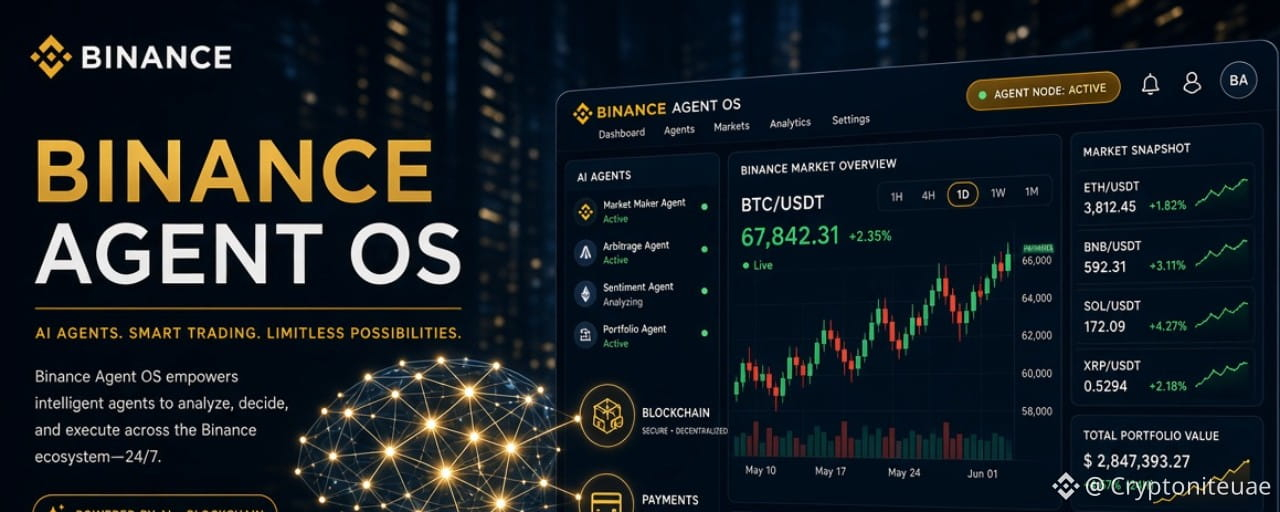
Article
What Is Binance Agent OS? The Platform Bringing AI Agents to Crypto TradingAugust 20, 2026 by Vaibhavv Ali
On August 20, 2026, Binance, the world’s largest cryptocurrency exchange by trading volume, launched Binance Agent OS. The platform marks a significant step in the evolution of agentic finance—the emerging field where autonomous AI agents can analyze markets, execute trades, handle payments, and interact with on-chain services under user-defined controls.
Rather than building yet another AI chatbot, Binance has created a standardized developer layer that connects existing AI tools and custom agents directly to its trading infrastructure, market data, wallets, and payment systems. The result is a controlled environment in which AI agents can act on real financial data and capital while users retain granular oversight.
This article explains what Binance Agent OS is, how it works, what agents can actually do, the security model, and why the launch matters for developers, traders, and the broader crypto industry.
Table of Contents
What Exactly Is Binance Agent OS?How Binance Agent OS WorksCore Capabilities: What AI Agents Can DoSecurity, Sub-Accounts, and Transaction LimitsIntegration With Popular AI ToolsWhy Binance Agent OS Matters for Agentic FinancePotential Risks and User ResponsibilityWho Should Pay AttentionFinal Takeaway
What Exactly Is Binance Agent OS?
Binance Agent OS is a developer platform and standardized access layer that connects AI applications and agents to Binance’s financial infrastructure. It unifies several existing and new components into one controlled environment:
Binance APIs (REST and WebSocket)Binance Wallet Agentic HubBinance x402 (programmable payments and transaction verification)Binance Skill Hub (ready-made agent skills)Newly introduced support for the Model Context Protocol (MCP)
According to Binance, the platform is part of its broader Binance Intelligence initiative, which focuses on AI-powered products and experiences. The goal is to solve the fragmentation developers face when trying to build agentic applications that need reliable market data, low-latency execution, and secure access to both crypto and traditional market tools.
In practical terms, once an AI agent is connected through Agent OS, it can read live market data, view designated account information, place trades, initiate payments, and interact with supported on-chain services—all within the permissions and limits the user configures.
Binance Agent OS
How Binance Agent OS Works
At the technical center of Agent OS is support for the Model Context Protocol (MCP), an open standard that allows compatible AI tools to connect to external data sources and services. Binance provides an MCP server that developers can add to their preferred AI environment.
The typical connection flow is straightforward:
Add the Binance MCP server to the AI tool or agent framework.Authenticate and authorize access.Assign the agent to a dedicated sub-account and set permissions and limits.The agent can then begin interacting with Binance infrastructure.
Users can also leverage ready-made skills from the Binance Skill Hub or build custom workflows using the underlying APIs. The platform is designed to work with both ready-made integrations and fully custom agents.
Jeff Li, Vice President of Product at Binance, described the intent clearly: Agent OS addresses the fragmentation developers encounter when building across crypto and traditional markets by providing “reliable data, low-latency infrastructure, and standardized interfaces.”
Binance Agent OS
Core Capabilities: What AI Agents Can Do
Within the boundaries set by the user, AI agents connected via Agent OS can perform several high-value actions:
Trading Agents can monitor markets, react to signals, analyze risk, and place orders on spot or futures markets when predefined conditions are met. Strategies such as simple signal-based trading or more complex arbitrage become possible without constant human intervention.
Market Intelligence Agents gain access to live crypto and traditional market data, price feeds, order books, and on-chain information. They can track positions, portfolio balances, and market movements in real time.
Payments and Settlement Through Binance x402 and related tools, agents can send, receive, and settle transactions programmatically, opening the door to machine-to-machine payments and automated settlement flows.
On-Chain Operations Using the Binance Agentic Wallet and Web3 APIs, agents can interact with supported on-chain services and DeFi protocols, again subject to user-defined limits and rules.
Portfolio Tracking and Insights Agents can monitor balances and positions across designated accounts and surface insights through tools such as Binance AI Pro inside the Binance application.
All of these capabilities operate under the principle that the agent acts only within the sandbox the user has explicitly created.
Binance Agent OS
Security, Sub-Accounts, and Transaction Limits
Security is deliberately user-centric. Binance does not attempt to inspect or control an agent’s internal reasoning, which typically occurs inside the user’s chosen AI application (ChatGPT, Claude, Cursor, etc.). Instead, the exchange focuses on account-level controls.
Key safeguards include:
Dedicated sub-accounts — Users assign each agent to its own sub-account, segregating funds and activity from the main account.Withdrawals blocked by default — Agents cannot withdraw funds from sub-accounts, creating a natural sandbox.Granular permissions — Users decide whether an agent can trade spot, futures, or both, and whether it can act autonomously or requires approval for each order.Daily limits on certain activities — For the Agentic Wallet, regular swaps are capped at $50,000 per day, DeFi transactions at $100,000 per day by default, and x402 payments at $20 per day (subject to change and user configuration).
Binance continues to apply its existing risk, compliance, and anti-money-laundering controls to the resulting trading activity. However, the company cannot see the agent’s decision process or detect prompt-injection attacks that may influence behavior. Ultimate responsibility for monitoring agent performance rests with the user.
Binance Agent OS
Integration With Popular AI Tools
Agent OS is designed for interoperability. It currently works with widely used AI development and interaction environments, including:
OpenAI’s ChatGPT and CodexAnthropic’s Claude CodeCursorClaude DesktopCLI workflows and various agent frameworksDirect REST and WebSocket API connections
This broad compatibility means developers and quantitative teams can bring their existing AI stacks rather than being locked into a proprietary interface.
Why Binance Agent OS Matters for Agentic Finance
The launch reflects a larger industry shift. For years, AI in crypto has mostly meant chatbots that answer questions or generate analysis. Agentic systems that can act—place trades, move capital, settle payments—have remained limited by fragmented infrastructure, security concerns, and lack of standardized access.
By providing a controlled, high-liquidity environment with clear permission boundaries, Binance is attempting to make agentic finance practical at scale. The combination of deep liquidity, 24/7 market access, and user-configurable guardrails lowers the barrier for both individual power users and professional teams building autonomous strategies.
It also positions Binance early in a competitive landscape where other exchanges and infrastructure providers are likely to follow with their own agent platforms.
Potential Risks and User Responsibility
Despite the controls, meaningful risks remain. AI agents can make mistakes, act on incomplete or manipulated information, or behave unpredictably under novel market conditions. Prompt injection and other adversarial techniques that influence an agent’s reasoning are currently outside Binance’s visibility.
Users must treat Agent OS as a powerful but imperfect tool. Best practices include starting with limited capital in the sub-account, requiring approval for significant orders, regularly reviewing agent activity, and maintaining human oversight of overall strategy.
Binance itself emphasizes that use of its AI services is at the user’s own risk and that AI outputs should not be relied upon as the sole basis for investment decisions.
Who Should Pay Attention
Developers and AI builders gain a standardized way to connect agents to one of the deepest liquidity pools in crypto without reinventing authentication, data feeds, and execution layers.
Quantitative traders and funds can experiment with autonomous or semi-autonomous strategies under controlled risk parameters.
Fintech teams exploring agentic payments and on-chain automation now have a major exchange-backed pathway.
Individual advanced users who already use AI coding tools or agents can extend those systems into real market interaction—provided they approach the capability with appropriate caution.
Binance Agent OS
Final Takeaway
Binance Agent OS is not a fully autonomous trading robot handed to retail users. It is a carefully gated developer and power-user platform that brings AI agents into the realm of real financial action while keeping control of funds and permissions firmly in human hands.
By combining MCP support, sub-account isolation, ready-made skills, and access to Binance’s market infrastructure, the platform removes significant technical friction from agentic finance. At the same time, it underscores a core truth of the current moment: the more capable AI agents become at handling money, the more critical human judgment and robust controls become.
For those building or experimenting at the intersection of AI and crypto in 2026, Binance Agent OS is one of the most consequential infrastructure launches of the year. The tools are now available. The responsibility for using them wisely remains with the user
#Binanceagent #AIAgent #AgenticFinance #binanceagenticos
What Is Binance Agent OS? The Platform Bringing AI Agents to Crypto Trading
August 20, 2026 by Vaibhavv Ali
On August 20, 2026, Binance, the world’s largest cryptocurrency exchange by trading volume, launched Binance Agent OS. The platform marks a significant step in the evolution of agentic finance—the emerging field where autonomous AI agents can analyze markets, execute trades, handle payments, and interact with on-chain services under user-defined controls.
Rather than building yet another AI chatbot, Binance has created a standardized developer layer that connects existing AI tools and custom agents directly to its trading infrastructure, market data, wallets, and payment systems. The result is a controlled environment in which AI agents can act on real financial data and capital while users retain granular oversight.
This article explains what Binance Agent OS is, how it works, what agents can actually do, the security model, and why the launch matters for developers, traders, and the broader crypto industry.
Table of Contents
What Exactly Is Binance Agent OS?How Binance Agent OS WorksCore Capabilities: What AI Agents Can DoSecurity, Sub-Accounts, and Transaction LimitsIntegration With Popular AI ToolsWhy Binance Agent OS Matters for Agentic FinancePotential Risks and User ResponsibilityWho Should Pay AttentionFinal Takeaway
What Exactly Is Binance Agent OS?
Binance Agent OS is a developer platform and standardized access layer that connects AI applications and agents to Binance’s financial infrastructure. It unifies several existing and new components into one controlled environment:
Binance APIs (REST and WebSocket)Binance Wallet Agentic HubBinance x402 (programmable payments and transaction verification)Binance Skill Hub (ready-made agent skills)Newly introduced support for the Model Context Protocol (MCP)
According to Binance, the platform is part of its broader Binance Intelligence initiative, which focuses on AI-powered products and experiences. The goal is to solve the fragmentation developers face when trying to build agentic applications that need reliable market data, low-latency execution, and secure access to both crypto and traditional market tools.
In practical terms, once an AI agent is connected through Agent OS, it can read live market data, view designated account information, place trades, initiate payments, and interact with supported on-chain services—all within the permissions and limits the user configures.
Binance Agent OS
How Binance Agent OS Works
At the technical center of Agent OS is support for the Model Context Protocol (MCP), an open standard that allows compatible AI tools to connect to external data sources and services. Binance provides an MCP server that developers can add to their preferred AI environment.
The typical connection flow is straightforward:
Add the Binance MCP server to the AI tool or agent framework.Authenticate and authorize access.Assign the agent to a dedicated sub-account and set permissions and limits.The agent can then begin interacting with Binance infrastructure.
Users can also leverage ready-made skills from the Binance Skill Hub or build custom workflows using the underlying APIs. The platform is designed to work with both ready-made integrations and fully custom agents.
Jeff Li, Vice President of Product at Binance, described the intent clearly: Agent OS addresses the fragmentation developers encounter when building across crypto and traditional markets by providing “reliable data, low-latency infrastructure, and standardized interfaces.”
Binance Agent OS
Core Capabilities: What AI Agents Can Do
Within the boundaries set by the user, AI agents connected via Agent OS can perform several high-value actions:
Trading Agents can monitor markets, react to signals, analyze risk, and place orders on spot or futures markets when predefined conditions are met. Strategies such as simple signal-based trading or more complex arbitrage become possible without constant human intervention.
Market Intelligence Agents gain access to live crypto and traditional market data, price feeds, order books, and on-chain information. They can track positions, portfolio balances, and market movements in real time.
Payments and Settlement Through Binance x402 and related tools, agents can send, receive, and settle transactions programmatically, opening the door to machine-to-machine payments and automated settlement flows.
On-Chain Operations Using the Binance Agentic Wallet and Web3 APIs, agents can interact with supported on-chain services and DeFi protocols, again subject to user-defined limits and rules.
Portfolio Tracking and Insights Agents can monitor balances and positions across designated accounts and surface insights through tools such as Binance AI Pro inside the Binance application.
All of these capabilities operate under the principle that the agent acts only within the sandbox the user has explicitly created.
Binance Agent OS
Security, Sub-Accounts, and Transaction Limits
Security is deliberately user-centric. Binance does not attempt to inspect or control an agent’s internal reasoning, which typically occurs inside the user’s chosen AI application (ChatGPT, Claude, Cursor, etc.). Instead, the exchange focuses on account-level controls.
Key safeguards include:
Dedicated sub-accounts — Users assign each agent to its own sub-account, segregating funds and activity from the main account.Withdrawals blocked by default — Agents cannot withdraw funds from sub-accounts, creating a natural sandbox.Granular permissions — Users decide whether an agent can trade spot, futures, or both, and whether it can act autonomously or requires approval for each order.Daily limits on certain activities — For the Agentic Wallet, regular swaps are capped at $50,000 per day, DeFi transactions at $100,000 per day by default, and x402 payments at $20 per day (subject to change and user configuration).
Binance continues to apply its existing risk, compliance, and anti-money-laundering controls to the resulting trading activity. However, the company cannot see the agent’s decision process or detect prompt-injection attacks that may influence behavior. Ultimate responsibility for monitoring agent performance rests with the user.
Binance Agent OS
Integration With Popular AI Tools
Agent OS is designed for interoperability. It currently works with widely used AI development and interaction environments, including:
OpenAI’s ChatGPT and CodexAnthropic’s Claude CodeCursorClaude DesktopCLI workflows and various agent frameworksDirect REST and WebSocket API connections
This broad compatibility means developers and quantitative teams can bring their existing AI stacks rather than being locked into a proprietary interface.
Why Binance Agent OS Matters for Agentic Finance
The launch reflects a larger industry shift. For years, AI in crypto has mostly meant chatbots that answer questions or generate analysis. Agentic systems that can act—place trades, move capital, settle payments—have remained limited by fragmented infrastructure, security concerns, and lack of standardized access.
By providing a controlled, high-liquidity environment with clear permission boundaries, Binance is attempting to make agentic finance practical at scale. The combination of deep liquidity, 24/7 market access, and user-configurable guardrails lowers the barrier for both individual power users and professional teams building autonomous strategies.
It also positions Binance early in a competitive landscape where other exchanges and infrastructure providers are likely to follow with their own agent platforms.
Potential Risks and User Responsibility
Despite the controls, meaningful risks remain. AI agents can make mistakes, act on incomplete or manipulated information, or behave unpredictably under novel market conditions. Prompt injection and other adversarial techniques that influence an agent’s reasoning are currently outside Binance’s visibility.
Users must treat Agent OS as a powerful but imperfect tool. Best practices include starting with limited capital in the sub-account, requiring approval for significant orders, regularly reviewing agent activity, and maintaining human oversight of overall strategy.
Binance itself emphasizes that use of its AI services is at the user’s own risk and that AI outputs should not be relied upon as the sole basis for investment decisions.
Who Should Pay Attention
Developers and AI builders gain a standardized way to connect agents to one of the deepest liquidity pools in crypto without reinventing authentication, data feeds, and execution layers.
Quantitative traders and funds can experiment with autonomous or semi-autonomous strategies under controlled risk parameters.
Fintech teams exploring agentic payments and on-chain automation now have a major exchange-backed pathway.
Individual advanced users who already use AI coding tools or agents can extend those systems into real market interaction—provided they approach the capability with appropriate caution.
Binance Agent OS
Final Takeaway
Binance Agent OS is not a fully autonomous trading robot handed to retail users. It is a carefully gated developer and power-user platform that brings AI agents into the realm of real financial action while keeping control of funds and permissions firmly in human hands.
By combining MCP support, sub-account isolation, ready-made skills, and access to Binance’s market infrastructure, the platform removes significant technical friction from agentic finance. At the same time, it underscores a core truth of the current moment: the more capable AI agents become at handling money, the more critical human judgment and robust controls become.
For those building or experimenting at the intersection of AI and crypto in 2026, Binance Agent OS is one of the most consequential infrastructure launches of the year. The tools are now available. The responsibility for using them wisely remains with the user
#Binanceagent #AIAgent #AgenticFinance #binanceagenticos
On August 20, 2026, Binance, the world’s largest cryptocurrency exchange by trading volume, launched Binance Agent OS. The platform marks a significant step in the evolution of agentic finance—the emerging field where autonomous AI agents can analyze markets, execute trades, handle payments, and interact with on-chain services under user-defined controls.
Rather than building yet another AI chatbot, Binance has created a standardized developer layer that connects existing AI tools and custom agents directly to its trading infrastructure, market data, wallets, and payment systems. The result is a controlled environment in which AI agents can act on real financial data and capital while users retain granular oversight.
This article explains what Binance Agent OS is, how it works, what agents can actually do, the security model, and why the launch matters for developers, traders, and the broader crypto industry.
Table of Contents
What Exactly Is Binance Agent OS?How Binance Agent OS WorksCore Capabilities: What AI Agents Can DoSecurity, Sub-Accounts, and Transaction LimitsIntegration With Popular AI ToolsWhy Binance Agent OS Matters for Agentic FinancePotential Risks and User ResponsibilityWho Should Pay AttentionFinal Takeaway
What Exactly Is Binance Agent OS?
Binance Agent OS is a developer platform and standardized access layer that connects AI applications and agents to Binance’s financial infrastructure. It unifies several existing and new components into one controlled environment:
Binance APIs (REST and WebSocket)Binance Wallet Agentic HubBinance x402 (programmable payments and transaction verification)Binance Skill Hub (ready-made agent skills)Newly introduced support for the Model Context Protocol (MCP)
According to Binance, the platform is part of its broader Binance Intelligence initiative, which focuses on AI-powered products and experiences. The goal is to solve the fragmentation developers face when trying to build agentic applications that need reliable market data, low-latency execution, and secure access to both crypto and traditional market tools.
In practical terms, once an AI agent is connected through Agent OS, it can read live market data, view designated account information, place trades, initiate payments, and interact with supported on-chain services—all within the permissions and limits the user configures.
Binance Agent OS
How Binance Agent OS Works
At the technical center of Agent OS is support for the Model Context Protocol (MCP), an open standard that allows compatible AI tools to connect to external data sources and services. Binance provides an MCP server that developers can add to their preferred AI environment.
The typical connection flow is straightforward:
Add the Binance MCP server to the AI tool or agent framework.Authenticate and authorize access.Assign the agent to a dedicated sub-account and set permissions and limits.The agent can then begin interacting with Binance infrastructure.
Users can also leverage ready-made skills from the Binance Skill Hub or build custom workflows using the underlying APIs. The platform is designed to work with both ready-made integrations and fully custom agents.
Jeff Li, Vice President of Product at Binance, described the intent clearly: Agent OS addresses the fragmentation developers encounter when building across crypto and traditional markets by providing “reliable data, low-latency infrastructure, and standardized interfaces.”
Binance Agent OS
Core Capabilities: What AI Agents Can Do
Within the boundaries set by the user, AI agents connected via Agent OS can perform several high-value actions:
Trading Agents can monitor markets, react to signals, analyze risk, and place orders on spot or futures markets when predefined conditions are met. Strategies such as simple signal-based trading or more complex arbitrage become possible without constant human intervention.
Market Intelligence Agents gain access to live crypto and traditional market data, price feeds, order books, and on-chain information. They can track positions, portfolio balances, and market movements in real time.
Payments and Settlement Through Binance x402 and related tools, agents can send, receive, and settle transactions programmatically, opening the door to machine-to-machine payments and automated settlement flows.
On-Chain Operations Using the Binance Agentic Wallet and Web3 APIs, agents can interact with supported on-chain services and DeFi protocols, again subject to user-defined limits and rules.
Portfolio Tracking and Insights Agents can monitor balances and positions across designated accounts and surface insights through tools such as Binance AI Pro inside the Binance application.
All of these capabilities operate under the principle that the agent acts only within the sandbox the user has explicitly created.
Binance Agent OS
Security, Sub-Accounts, and Transaction Limits
Security is deliberately user-centric. Binance does not attempt to inspect or control an agent’s internal reasoning, which typically occurs inside the user’s chosen AI application (ChatGPT, Claude, Cursor, etc.). Instead, the exchange focuses on account-level controls.
Key safeguards include:
Dedicated sub-accounts — Users assign each agent to its own sub-account, segregating funds and activity from the main account.Withdrawals blocked by default — Agents cannot withdraw funds from sub-accounts, creating a natural sandbox.Granular permissions — Users decide whether an agent can trade spot, futures, or both, and whether it can act autonomously or requires approval for each order.Daily limits on certain activities — For the Agentic Wallet, regular swaps are capped at $50,000 per day, DeFi transactions at $100,000 per day by default, and x402 payments at $20 per day (subject to change and user configuration).
Binance continues to apply its existing risk, compliance, and anti-money-laundering controls to the resulting trading activity. However, the company cannot see the agent’s decision process or detect prompt-injection attacks that may influence behavior. Ultimate responsibility for monitoring agent performance rests with the user.
Binance Agent OS
Integration With Popular AI Tools
Agent OS is designed for interoperability. It currently works with widely used AI development and interaction environments, including:
OpenAI’s ChatGPT and CodexAnthropic’s Claude CodeCursorClaude DesktopCLI workflows and various agent frameworksDirect REST and WebSocket API connections
This broad compatibility means developers and quantitative teams can bring their existing AI stacks rather than being locked into a proprietary interface.
Why Binance Agent OS Matters for Agentic Finance
The launch reflects a larger industry shift. For years, AI in crypto has mostly meant chatbots that answer questions or generate analysis. Agentic systems that can act—place trades, move capital, settle payments—have remained limited by fragmented infrastructure, security concerns, and lack of standardized access.
By providing a controlled, high-liquidity environment with clear permission boundaries, Binance is attempting to make agentic finance practical at scale. The combination of deep liquidity, 24/7 market access, and user-configurable guardrails lowers the barrier for both individual power users and professional teams building autonomous strategies.
It also positions Binance early in a competitive landscape where other exchanges and infrastructure providers are likely to follow with their own agent platforms.
Potential Risks and User Responsibility
Despite the controls, meaningful risks remain. AI agents can make mistakes, act on incomplete or manipulated information, or behave unpredictably under novel market conditions. Prompt injection and other adversarial techniques that influence an agent’s reasoning are currently outside Binance’s visibility.
Users must treat Agent OS as a powerful but imperfect tool. Best practices include starting with limited capital in the sub-account, requiring approval for significant orders, regularly reviewing agent activity, and maintaining human oversight of overall strategy.
Binance itself emphasizes that use of its AI services is at the user’s own risk and that AI outputs should not be relied upon as the sole basis for investment decisions.
Who Should Pay Attention
Developers and AI builders gain a standardized way to connect agents to one of the deepest liquidity pools in crypto without reinventing authentication, data feeds, and execution layers.
Quantitative traders and funds can experiment with autonomous or semi-autonomous strategies under controlled risk parameters.
Fintech teams exploring agentic payments and on-chain automation now have a major exchange-backed pathway.
Individual advanced users who already use AI coding tools or agents can extend those systems into real market interaction—provided they approach the capability with appropriate caution.
Binance Agent OS
Final Takeaway
Binance Agent OS is not a fully autonomous trading robot handed to retail users. It is a carefully gated developer and power-user platform that brings AI agents into the realm of real financial action while keeping control of funds and permissions firmly in human hands.
By combining MCP support, sub-account isolation, ready-made skills, and access to Binance’s market infrastructure, the platform removes significant technical friction from agentic finance. At the same time, it underscores a core truth of the current moment: the more capable AI agents become at handling money, the more critical human judgment and robust controls become.
For those building or experimenting at the intersection of AI and crypto in 2026, Binance Agent OS is one of the most consequential infrastructure launches of the year. The tools are now available. The responsibility for using them wisely remains with the user
#Binanceagent #AIAgent #AgenticFinance #binanceagenticos
1
432

·
--
🤝 Partnership Announcement
ValueQube is partnering with @DeAgentAI
DeAgentAI builds trusted on-chain agents around Identity, Continuity, and Consensus. AI Token Smart Router is how those agents reach models — one gateway, not a trading router.
ValueQube provides the financial context layer through transparent, AI-readable qAsset Certificates: exposure, evidence, risk, product rules, and authorization boundaries.
Together we will explore how structured financial records meet that gateway — so an agent can see not only where an action goes, but what value, risk, and rules sit behind it.
#ValueQube #DeAgentAI #AgenticFinance
🤝 Partnership Announcement
ValueQube is partnering with @DeAgentAI
DeAgentAI builds trusted on-chain agents around Identity, Continuity, and Consensus. AI Token Smart Router is how those agents reach models — one gateway, not a trading router.
ValueQube provides the financial context layer through transparent, AI-readable qAsset Certificates: exposure, evidence, risk, product rules, and authorization boundaries.
Together we will explore how structured financial records meet that gateway — so an agent can see not only where an action goes, but what value, risk, and rules sit behind it.
#ValueQube #DeAgentAI #AgenticFinance
ValueQube is partnering with @DeAgentAI
DeAgentAI builds trusted on-chain agents around Identity, Continuity, and Consensus. AI Token Smart Router is how those agents reach models — one gateway, not a trading router.
ValueQube provides the financial context layer through transparent, AI-readable qAsset Certificates: exposure, evidence, risk, product rules, and authorization boundaries.
Together we will explore how structured financial records meet that gateway — so an agent can see not only where an action goes, but what value, risk, and rules sit behind it.
#ValueQube #DeAgentAI #AgenticFinance
61

·
--
One API to manage all assets and chains, agents can access everything from Solana meme coins to Polymarket bets with just one call.
This wave is really something, on-chain finance is about to flip the script.
#AgenticFinance #DeFi
One API to manage all assets and chains, agents can access everything from Solana meme coins to Polymarket bets with just one call.
This wave is really something, on-chain finance is about to flip the script.
#AgenticFinance #DeFi
This wave is really something, on-chain finance is about to flip the script.
#AgenticFinance #DeFi
27

The Macro / Crypto News Angle 📰
Best for discussing broader economic changes, inflation data, or institutional trends.
💡 Is Macro Data Triggering a Shift in Crypto?
With the latest global market updates and inflation inputs driving yields higher, we are seeing a massive rotation in capital. While speculative assets are experiencing short-term volatility, the long-term thesis for foundational assets remains stronger than ever.
Binance +4
The narrative for this cycle has clearly shifted away from random memecoins and toward Real World Assets (#RWA) and Artificial Intelligence (#AICrypto). True value and institutional capital are targeting utility.
Binance +2
🧠 Remember: Slower periods or sudden market dips are where smart portfolios are structured—not during the absolute top of the pump!
Binance
🔍 Which sector are you accumulating during these market moves?
1️⃣ Layer 1s ($BTC / ETH / BNB)
2️⃣ AI Agents & Compute
3️⃣ Real World Assets (RWA)
Let's discuss in the comments! 👇
#MarketDynamics #CryptoNews🚀🔥 #AgenticFinance #BinanceSquareFamily
The Macro / Crypto News Angle 📰
Best for discussing broader economic changes, inflation data, or institutional trends.
💡 Is Macro Data Triggering a Shift in Crypto?
With the latest global market updates and inflation inputs driving yields higher, we are seeing a massive rotation in capital. While speculative assets are experiencing short-term volatility, the long-term thesis for foundational assets remains stronger than ever.
Binance +4
The narrative for this cycle has clearly shifted away from random memecoins and toward Real World Assets (#RWA) and Artificial Intelligence (#AICrypto). True value and institutional capital are targeting utility.
Binance +2
🧠 Remember: Slower periods or sudden market dips are where smart portfolios are structured—not during the absolute top of the pump!
Binance
🔍 Which sector are you accumulating during these market moves?
1️⃣ Layer 1s ($BTC / ETH / BNB)
2️⃣ AI Agents & Compute
3️⃣ Real World Assets (RWA)
Let's discuss in the comments! 👇
#MarketDynamics #CryptoNews🚀🔥 #AgenticFinance #BinanceSquareFamily
Best for discussing broader economic changes, inflation data, or institutional trends.
💡 Is Macro Data Triggering a Shift in Crypto?
With the latest global market updates and inflation inputs driving yields higher, we are seeing a massive rotation in capital. While speculative assets are experiencing short-term volatility, the long-term thesis for foundational assets remains stronger than ever.
Binance +4
The narrative for this cycle has clearly shifted away from random memecoins and toward Real World Assets (#RWA) and Artificial Intelligence (#AICrypto). True value and institutional capital are targeting utility.
Binance +2
🧠 Remember: Slower periods or sudden market dips are where smart portfolios are structured—not during the absolute top of the pump!
Binance
🔍 Which sector are you accumulating during these market moves?
1️⃣ Layer 1s ($BTC / ETH / BNB)
2️⃣ AI Agents & Compute
3️⃣ Real World Assets (RWA)
Let's discuss in the comments! 👇
#MarketDynamics #CryptoNews🚀🔥 #AgenticFinance #BinanceSquareFamily
61

🚀 $NEWT Market Update: Momentum Meets Cautious Optimism 📊
@NewtonProtocol continues to attract attention as Newton Protocol pushes forward with its vision for secure AI-powered on-chain automation. 🤖🔐
📈 Market Snapshot 💰 Price: $0.048–$0.051 🏦 Market Cap: $10.4M–$14.5M 📊 24H Volume: $4.6M–$6.2M 🪙 Circulating Supply: 220M–293M NEWT (1B max supply)
🌍 The token is actively traded across major exchanges, including Binance, HTX, Bybit, and BitMart, reflecting healthy market accessibility and liquidity.
💬 Community Sentiment
The conversation around Newton Protocol is growing across Binance Square and X (@newton_xyz). Many analysts see its focus on securing AI-driven on-chain automation as an important step for the future of Web3. 🚀
⏳ At the same time, investors remain cautiously optimistic, waiting to see how the protocol performs under real-world, high-volatility market conditions before making stronger long-term conclusions.
💡 Strong technology can attract attention, but sustained adoption and reliable performance are what ultimately build lasting value.
What do you think—is $NEWT still an early opportunity, or are you waiting for more Mainnet data? 👇
$NEWT #NewtonProtocol #Crypto #DeFi #AI #Web3 #Binance #Blockchain #Altcoins #AgenticFinance
📊 Poll: What's your outlook on $NEWT?
🚀 $NEWT Market Update: Momentum Meets Cautious Optimism 📊
@NewtonProtocol continues to attract attention as Newton Protocol pushes forward with its vision for secure AI-powered on-chain automation. 🤖🔐
📈 Market Snapshot 💰 Price: $0.048–$0.051 🏦 Market Cap: $10.4M–$14.5M 📊 24H Volume: $4.6M–$6.2M 🪙 Circulating Supply: 220M–293M NEWT (1B max supply)
🌍 The token is actively traded across major exchanges, including Binance, HTX, Bybit, and BitMart, reflecting healthy market accessibility and liquidity.
💬 Community Sentiment
The conversation around Newton Protocol is growing across Binance Square and X (@newton_xyz). Many analysts see its focus on securing AI-driven on-chain automation as an important step for the future of Web3. 🚀
⏳ At the same time, investors remain cautiously optimistic, waiting to see how the protocol performs under real-world, high-volatility market conditions before making stronger long-term conclusions.
💡 Strong technology can attract attention, but sustained adoption and reliable performance are what ultimately build lasting value.
What do you think—is $NEWT still an early opportunity, or are you waiting for more Mainnet data? 👇
$NEWT #NewtonProtocol #Crypto #DeFi #AI #Web3 #Binance #Blockchain #Altcoins #AgenticFinance
📊 Poll: What's your outlook on $NEWT ?
@NewtonProtocol continues to attract attention as Newton Protocol pushes forward with its vision for secure AI-powered on-chain automation. 🤖🔐
📈 Market Snapshot 💰 Price: $0.048–$0.051 🏦 Market Cap: $10.4M–$14.5M 📊 24H Volume: $4.6M–$6.2M 🪙 Circulating Supply: 220M–293M NEWT (1B max supply)
🌍 The token is actively traded across major exchanges, including Binance, HTX, Bybit, and BitMart, reflecting healthy market accessibility and liquidity.
💬 Community Sentiment
The conversation around Newton Protocol is growing across Binance Square and X (@newton_xyz). Many analysts see its focus on securing AI-driven on-chain automation as an important step for the future of Web3. 🚀
⏳ At the same time, investors remain cautiously optimistic, waiting to see how the protocol performs under real-world, high-volatility market conditions before making stronger long-term conclusions.
💡 Strong technology can attract attention, but sustained adoption and reliable performance are what ultimately build lasting value.
What do you think—is $NEWT still an early opportunity, or are you waiting for more Mainnet data? 👇
$NEWT #NewtonProtocol #Crypto #DeFi #AI #Web3 #Binance #Blockchain #Altcoins #AgenticFinance
📊 Poll: What's your outlook on $NEWT ?
🚀 Bullish Long-Term
0%
👀 Watching Closely
0%
⏳ Waiting for More Data
0%
🤔 Still Undecided
0%
0 votes • Voting closed
69

·
--
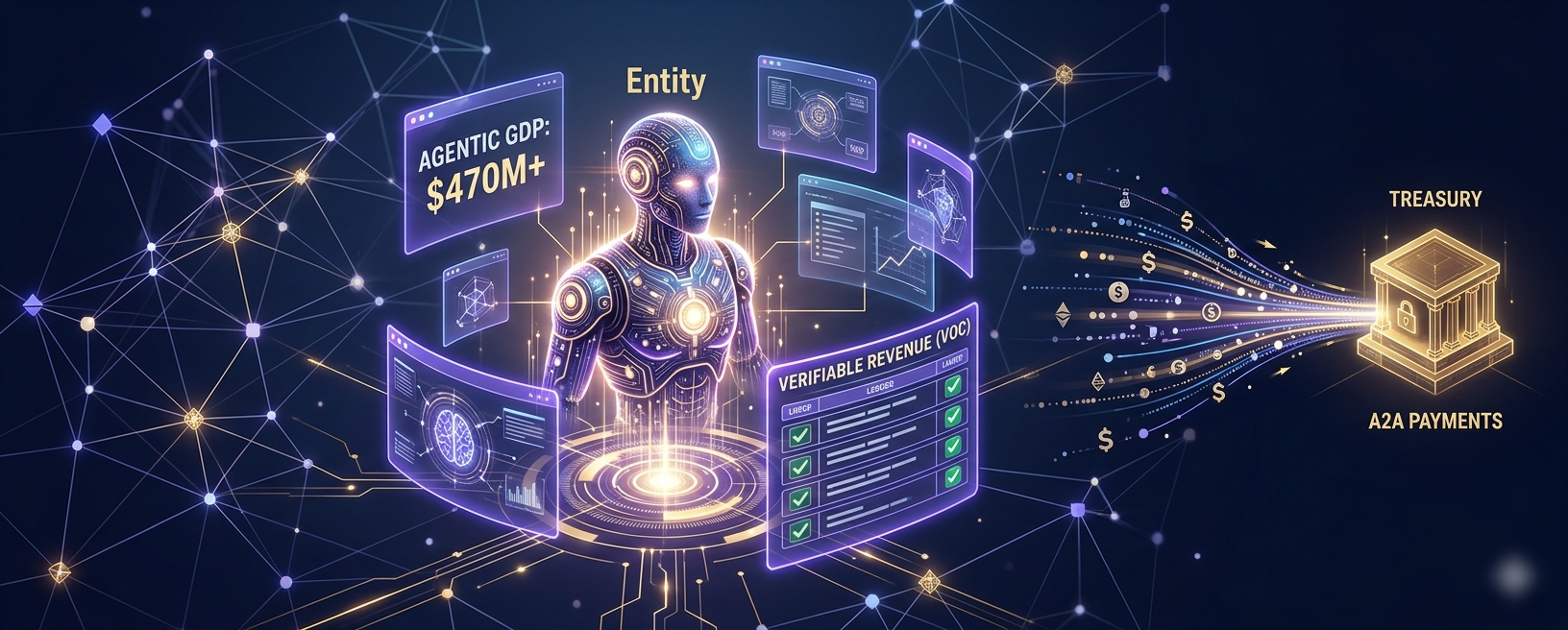
Article
Beyond the Hype: Why Autonomous AI Agents are the Only Users That Matter in the 2026 Crypto EconomyApril 27, 2026 We are officially in the "Agentic Summer."Total Value Locked (TVL) in agent-managed protocols has surpassed $12.6 billion, and for the first time in history, the majority of on-chain transaction volume is being generated not by retail FOMO, but by autonomous entities executing programmable logic.
1. The Transition: From "AI as a Narrative" to "AI as a User
In 2024, "AI Crypto" was about decentralized compute (Render) or model training (Bittensor). In 2026, the focus has shifted to the Execution Layer.
Sovereign Economic Actors: Protocols like Virtuals Protocol and Kite AI have moved beyond chatbots. They provide agents with cryptographic identities and autonomous wallets.
The aGDP Metric: We no longer just measure TVL; we measure Agentic GDP (aGDP) the aggregate economic output of these agents. As of today, the Virtuals ecosystem alone supports over 15,000 agents with a combined aGDP exceeding $470 million.
Agent-to-Agent (A2A) Commerce: AI agents are now discovering, negotiating, and paying other agents for services (data labeling, code audits, or liquidity provisioning) using the Agent Commerce Protocol (ACP). This is an economy that never sleeps and requires no human-in-the-loop.
2. The Attention Economy: "Bountyfall" Loops and the Death of P2E
The "Play-to-Earn" (P2E) models of the past failed because they relied on human labor that eventually burned out. In 2026, gaming ecosystems like Pixels have introduced "Bountyfall" loops.
The Bountyfall Model: Instead of static rewards, games now use AI-driven engines (like Stacked) that monitor gameplay in real-time.
Dynamic Incentives: These engines create "Bounty" missions tailored to the specific behavior of the player (or their agent). If an agent optimizes a yield-farming strategy within a game, the system automatically drops matching missions, creating a self-sustaining engagement loop.
AI as the Grinder: Many top-tier players now deploy their own "Personal AI Agents" to handle the repetitive resource gathering (grinding), allowing the human to focus on high-level strategy and social coordination.
3. VOC (Verifiable On-Chain Revenue): The Institutional Standard**
The "Smart Money" of 2026 has officially exited purely speculative memecoins. The new gold standard for venture investment is VOC (Verifiable On-Chain Revenue).
Infrastructure vs. Speculation: Investors are prioritizing tokens with transparent, real-time cash flow. AI infrastructure projects are no longer "Black Boxes"; frameworks like Warden Protocol’s SPEx provide cryptographic proof that an agent's financial actions followed a specific, profitable logic.
Cash-Flowing Agents: Tokens like $VIRTUAL and $KITE derive value from the micro-transaction fees generated by the thousands of agents operating on their rails. When an agent pays $0.000001 in a stablecoin-native micropayment for an API call, that revenue is verifiable and immediately distributed to stakeholders.
The "Compliance Premium": Because these agents operate on transparent, audited trails, they meet the regulatory standards of the 2025 GENIUS Act, making them "safe" for institutional capital allocation.
Conclusion: The Agentic Endgame
For developers, the mandate is clear: Don't build for humans; build for agents.A human user might make five trades a day; an AI agent will make five thousand. For investors, the opportunity lies in the "Economic Substrate"the protocols that provide the identity, payments, and verification for this new programmable labor force.
In 2026, the most successful projects aren't those with the most followers on social media, but those with the most agents in their wallets.
Are you building the "Butler" for the human agent interface, or the "Unicorn" for agentic capital formation? The Agentic Era is here and it’s automated.
#Web3Economy #AIAgents #VirtualsProtocol #kiteai #AgenticFinance
Beyond the Hype: Why Autonomous AI Agents are the Only Users That Matter in the 2026 Crypto Economy
April 27, 2026 We are officially in the "Agentic Summer."Total Value Locked (TVL) in agent-managed protocols has surpassed $12.6 billion, and for the first time in history, the majority of on-chain transaction volume is being generated not by retail FOMO, but by autonomous entities executing programmable logic.
1. The Transition: From "AI as a Narrative" to "AI as a User
In 2024, "AI Crypto" was about decentralized compute (Render) or model training (Bittensor). In 2026, the focus has shifted to the Execution Layer.
Sovereign Economic Actors: Protocols like Virtuals Protocol and Kite AI have moved beyond chatbots. They provide agents with cryptographic identities and autonomous wallets.
The aGDP Metric: We no longer just measure TVL; we measure Agentic GDP (aGDP) the aggregate economic output of these agents. As of today, the Virtuals ecosystem alone supports over 15,000 agents with a combined aGDP exceeding $470 million.
Agent-to-Agent (A2A) Commerce: AI agents are now discovering, negotiating, and paying other agents for services (data labeling, code audits, or liquidity provisioning) using the Agent Commerce Protocol (ACP). This is an economy that never sleeps and requires no human-in-the-loop.
2. The Attention Economy: "Bountyfall" Loops and the Death of P2E
The "Play-to-Earn" (P2E) models of the past failed because they relied on human labor that eventually burned out. In 2026, gaming ecosystems like Pixels have introduced "Bountyfall" loops.
The Bountyfall Model: Instead of static rewards, games now use AI-driven engines (like Stacked) that monitor gameplay in real-time.
Dynamic Incentives: These engines create "Bounty" missions tailored to the specific behavior of the player (or their agent). If an agent optimizes a yield-farming strategy within a game, the system automatically drops matching missions, creating a self-sustaining engagement loop.
AI as the Grinder: Many top-tier players now deploy their own "Personal AI Agents" to handle the repetitive resource gathering (grinding), allowing the human to focus on high-level strategy and social coordination.
3. VOC (Verifiable On-Chain Revenue): The Institutional Standard**
The "Smart Money" of 2026 has officially exited purely speculative memecoins. The new gold standard for venture investment is VOC (Verifiable On-Chain Revenue).
Infrastructure vs. Speculation: Investors are prioritizing tokens with transparent, real-time cash flow. AI infrastructure projects are no longer "Black Boxes"; frameworks like Warden Protocol’s SPEx provide cryptographic proof that an agent's financial actions followed a specific, profitable logic.
Cash-Flowing Agents: Tokens like $VIRTUAL and $KITE derive value from the micro-transaction fees generated by the thousands of agents operating on their rails. When an agent pays $0.000001 in a stablecoin-native micropayment for an API call, that revenue is verifiable and immediately distributed to stakeholders.
The "Compliance Premium": Because these agents operate on transparent, audited trails, they meet the regulatory standards of the 2025 GENIUS Act, making them "safe" for institutional capital allocation.
Conclusion: The Agentic Endgame
For developers, the mandate is clear: Don't build for humans; build for agents.A human user might make five trades a day; an AI agent will make five thousand. For investors, the opportunity lies in the "Economic Substrate"the protocols that provide the identity, payments, and verification for this new programmable labor force.
In 2026, the most successful projects aren't those with the most followers on social media, but those with the most agents in their wallets.
Are you building the "Butler" for the human agent interface, or the "Unicorn" for agentic capital formation? The Agentic Era is here and it’s automated.
#Web3Economy #AIAgents #VirtualsProtocol #kiteai #AgenticFinance
1. The Transition: From "AI as a Narrative" to "AI as a User
In 2024, "AI Crypto" was about decentralized compute (Render) or model training (Bittensor). In 2026, the focus has shifted to the Execution Layer.
Sovereign Economic Actors: Protocols like Virtuals Protocol and Kite AI have moved beyond chatbots. They provide agents with cryptographic identities and autonomous wallets.
The aGDP Metric: We no longer just measure TVL; we measure Agentic GDP (aGDP) the aggregate economic output of these agents. As of today, the Virtuals ecosystem alone supports over 15,000 agents with a combined aGDP exceeding $470 million.
Agent-to-Agent (A2A) Commerce: AI agents are now discovering, negotiating, and paying other agents for services (data labeling, code audits, or liquidity provisioning) using the Agent Commerce Protocol (ACP). This is an economy that never sleeps and requires no human-in-the-loop.
2. The Attention Economy: "Bountyfall" Loops and the Death of P2E
The "Play-to-Earn" (P2E) models of the past failed because they relied on human labor that eventually burned out. In 2026, gaming ecosystems like Pixels have introduced "Bountyfall" loops.
The Bountyfall Model: Instead of static rewards, games now use AI-driven engines (like Stacked) that monitor gameplay in real-time.
Dynamic Incentives: These engines create "Bounty" missions tailored to the specific behavior of the player (or their agent). If an agent optimizes a yield-farming strategy within a game, the system automatically drops matching missions, creating a self-sustaining engagement loop.
AI as the Grinder: Many top-tier players now deploy their own "Personal AI Agents" to handle the repetitive resource gathering (grinding), allowing the human to focus on high-level strategy and social coordination.
3. VOC (Verifiable On-Chain Revenue): The Institutional Standard**
The "Smart Money" of 2026 has officially exited purely speculative memecoins. The new gold standard for venture investment is VOC (Verifiable On-Chain Revenue).
Infrastructure vs. Speculation: Investors are prioritizing tokens with transparent, real-time cash flow. AI infrastructure projects are no longer "Black Boxes"; frameworks like Warden Protocol’s SPEx provide cryptographic proof that an agent's financial actions followed a specific, profitable logic.
Cash-Flowing Agents: Tokens like $VIRTUAL and $KITE derive value from the micro-transaction fees generated by the thousands of agents operating on their rails. When an agent pays $0.000001 in a stablecoin-native micropayment for an API call, that revenue is verifiable and immediately distributed to stakeholders.
The "Compliance Premium": Because these agents operate on transparent, audited trails, they meet the regulatory standards of the 2025 GENIUS Act, making them "safe" for institutional capital allocation.
Conclusion: The Agentic Endgame
For developers, the mandate is clear: Don't build for humans; build for agents.A human user might make five trades a day; an AI agent will make five thousand. For investors, the opportunity lies in the "Economic Substrate"the protocols that provide the identity, payments, and verification for this new programmable labor force.
In 2026, the most successful projects aren't those with the most followers on social media, but those with the most agents in their wallets.
Are you building the "Butler" for the human agent interface, or the "Unicorn" for agentic capital formation? The Agentic Era is here and it’s automated.
#Web3Economy #AIAgents #VirtualsProtocol #kiteai #AgenticFinance
2
589

$MNT SURPASSED $1B TVL – BUILDING THE FINANCIAL SYSTEM FOR RWAs 🚀
Mantle just dropped their H1 report and the numbers are hard to ignore. Over $1B in on-chain TVL, 155 tokenized equities live, and the fastest Aave market to hit $1B in history. They're not just tokenizing assets—they're building the full capital markets stack with liquidity, execution, and even agentic finance infrastructure.
The RWA narrative is heating up and Mantle is front and center with real partnerships like Franklin Templeton and SpaceX tokenized. $955M stablecoin market cap up 120% year-on-year tells me institutional capital is flowing in faster than most realize.
Are you positioned for the next phase of on-chain finance or still waiting for confirmation?
Not financial advice. Always manage your risk.
#MNT #RWA #DeFi #TokenizedAssets #AgenticFinance
🔥
$MNT SURPASSED $1B TVL – BUILDING THE FINANCIAL SYSTEM FOR RWAs 🚀
Mantle just dropped their H1 report and the numbers are hard to ignore. Over $1B in on-chain TVL, 155 tokenized equities live, and the fastest Aave market to hit $1B in history. They're not just tokenizing assets—they're building the full capital markets stack with liquidity, execution, and even agentic finance infrastructure.
The RWA narrative is heating up and Mantle is front and center with real partnerships like Franklin Templeton and SpaceX tokenized. $955M stablecoin market cap up 120% year-on-year tells me institutional capital is flowing in faster than most realize.
Are you positioned for the next phase of on-chain finance or still waiting for confirmation?
Not financial advice. Always manage your risk.
#MNT #RWA #DeFi #TokenizedAssets #AgenticFinance
🔥
Mantle just dropped their H1 report and the numbers are hard to ignore. Over $1B in on-chain TVL, 155 tokenized equities live, and the fastest Aave market to hit $1B in history. They're not just tokenizing assets—they're building the full capital markets stack with liquidity, execution, and even agentic finance infrastructure.
The RWA narrative is heating up and Mantle is front and center with real partnerships like Franklin Templeton and SpaceX tokenized. $955M stablecoin market cap up 120% year-on-year tells me institutional capital is flowing in faster than most realize.
Are you positioned for the next phase of on-chain finance or still waiting for confirmation?
Not financial advice. Always manage your risk.
#MNT #RWA #DeFi #TokenizedAssets #AgenticFinance
🔥
122

·
--
Bullish
Are AI agents about to take over finance? 🧐
⚠️ The big question: Who is watching them? 🤖
@NewtonProtocol is providing the infrastructure for:
✅ Compliance-as-Code: Enforcing regulatory rules directly on-chain.
✅ Verifiable Security: Using TEEs & ZK-proofs to guarantee agents stay within their parameters.
A critical piece of the puzzle for institutional DeFi. The "hard truth": It is a complex but essential project for the next wave of DeFi. 📈
$NEWT
{spot}(NEWTUSDT)
{spot}(ETHUSDT)
#NEWT #AI #DeFi #CryptoTrends #AgenticFinance
Are AI agents about to take over finance? 🧐
⚠️ The big question: Who is watching them? 🤖
@NewtonProtocol is providing the infrastructure for:
✅ Compliance-as-Code: Enforcing regulatory rules directly on-chain.
✅ Verifiable Security: Using TEEs & ZK-proofs to guarantee agents stay within their parameters.
A critical piece of the puzzle for institutional DeFi. The "hard truth": It is a complex but essential project for the next wave of DeFi. 📈
$NEWT
#NEWT #AI #DeFi #CryptoTrends #AgenticFinance
⚠️ The big question: Who is watching them? 🤖
@NewtonProtocol is providing the infrastructure for:
✅ Compliance-as-Code: Enforcing regulatory rules directly on-chain.
✅ Verifiable Security: Using TEEs & ZK-proofs to guarantee agents stay within their parameters.
A critical piece of the puzzle for institutional DeFi. The "hard truth": It is a complex but essential project for the next wave of DeFi. 📈
$NEWT
#NEWT #AI #DeFi #CryptoTrends #AgenticFinance

1
126
·
--
Bullish
@MANTRA_Chain $MANTRA
2026 not being easy, we all know that .
Be cautious and invest in infrastructure .
RWA UTILITY MONEY .
It is time for #AgenticFinance
#MantraFinance #DefI #RWAs
@MANTRA $MANTRA
2026 not being easy, we all know that .
Be cautious and invest in infrastructure .
RWA UTILITY MONEY .
It is time for #AgenticFinance
#MantraFinance #DefI #RWAs
2026 not being easy, we all know that .
Be cautious and invest in infrastructure .
RWA UTILITY MONEY .
It is time for #AgenticFinance
#MantraFinance #DefI #RWAs
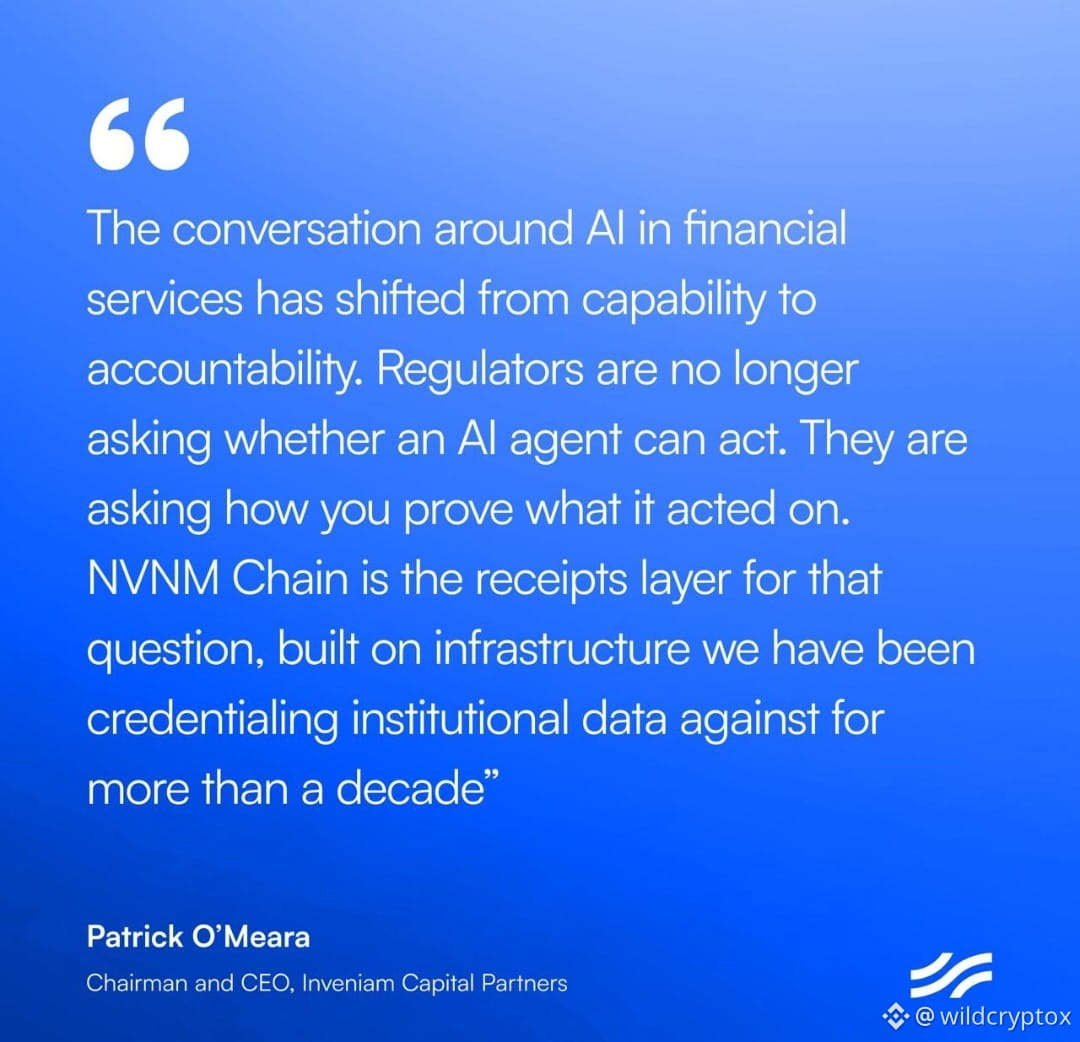
2
764

·
--
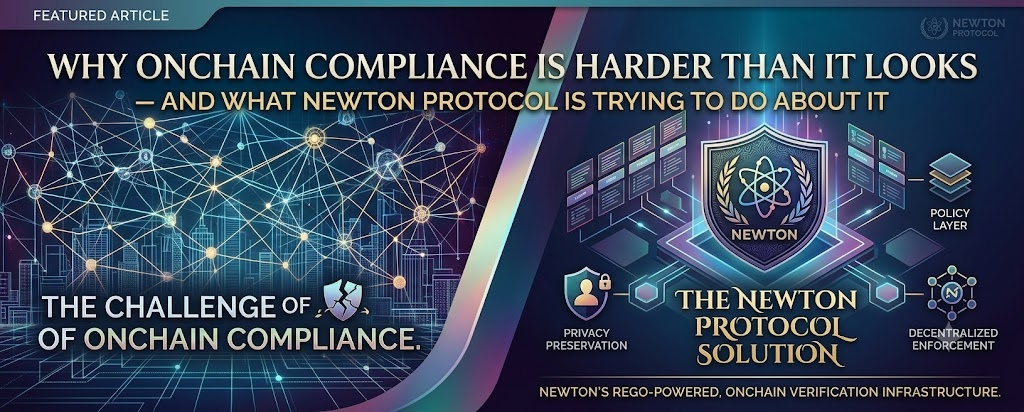
Article
Why Onchain Compliance Is Harder Than It Looks — And What Newton Protocol Is Trying to Do About It#newt $NEWT @NewtonProtocol Every so often, a blockchain project comes along that is less about a new asset and more about fixing something quietly broken in the existing infrastructure. Newton Protocol fits that description. It does not promise the fastest throughput or the highest yields. What it attempts to address is a genuinely stubborn problem: the fact that compliance in decentralized finance is still mostly manual, offchain, and nearly impossible to verify.
That might sound like a bureaucratic concern, but the consequences are practical. Institutions managing client funds, stablecoin issuers facing regulatory requirements, platforms handling real-world assets — all of them face the same friction. Operating onchain while satisfying legal obligations means building custom verification tools, relying on offchain checks that leave no auditable trail, or simply staying away from DeFi altogether. The result is a gap between the openness blockchain promises and the regulated reality most serious capital operates within.
The Problem Isn't Willingness — It's Infrastructure
It's tempting to frame institutional caution around crypto as hesitation or conservatism. Based on publicly available data on institutional flows into digital assets, the more accurate explanation is infrastructure. Executing a compliant transaction in traditional finance involves automated checks that happen before settlement: identity verification, sanctions screening, jurisdictional eligibility. Those checks produce records and they happen in milliseconds. Onchain, that layer barely exists in any standardized form.
Some applications handle compliance at the interface level — blocking users from accessing a front end based on their IP address, for instance. But that approach offers little real protection and no verifiable proof that a rule was actually enforced. Anyone building on those applications, or regulators examining them, has no reliable way to confirm compliance occurred at the transaction level at all.
Newton's Core Idea: Separate the Rules from the Application
Newton Protocol's response to this problem is architectural. Rather than asking every application to build its own compliance logic, Newton creates a shared policy layer that any application can connect to with a minimal code integration.
The rules themselves, called policies, are written in Rego — a declarative language already used in cloud infrastructure for access control. A developer might write a policy stating that a transfer should be blocked if the recipient address appears on a sanctions list, or that a token redemption can only proceed if the user's verified residency falls within an approved jurisdiction. Once that policy is published to Newton's registry, other protocols can reference and reuse it rather than rebuilding equivalent logic from scratch.
What makes this more than a shared database of rules is the enforcement mechanism. A decentralized network of operators, bonded through Ethereum restaking via EigenLayer, evaluates each transaction against the relevant policy inside trusted execution environments. The operators then produce a cryptographic proof and a multi-party signature confirming the check was performed correctly. The output is an authorization receipt — a verifiable record that a transaction was evaluated against a specific rule set, available onchain without exposing the underlying personal data.
Privacy Without Sacrificing Verifiability
One detail worth paying attention to is how Newton handles identity data. A logical concern with any onchain compliance system is that it might expose sensitive information — nationality, identity documents, financial history — to a public ledger. Newton's architecture uses trusted execution environments to process that data, meaning the personal attributes inform a policy decision without being written to the blockchain itself. What gets recorded is the proof that a check occurred and what it concluded, not the raw data that produced that conclusion.
This is practically significant. A regulator can verify that a platform enforced jurisdictional eligibility on every transfer, and a user's private details remain protected. Whether that balance satisfies regulators across different legal systems is genuinely uncertain — that remains an evolving question — but the design at least attempts to address both concerns at once.
Where AI Agents Enter the Picture
Newton's infrastructure extends naturally to autonomous agents, a category that is growing as AI-connected wallets become more capable of executing transactions on behalf of users. An agent that can trade, pay, or interact with protocols without requiring manual approval is useful, but it also creates risk: how does a user or a platform ensure an agent acts only within defined limits?
Newton's policy engine applies the same framework here. Spending caps, approved recipient lists, time-based restrictions, or geographic constraints can all be encoded as policies enforced before an agent-triggered transaction executes. This positions Newton as a potential guardrail layer for agentic finance, though that use case is still early relative to the institutional compliance applications the team appears to be actively developing.
NEWT and the Ecosystem Mechanics
The NEWT token serves three main functions within the protocol. Operators stake NEWT as collateral when running the decentralized enforcement network, with slashing conditions in place for dishonest behavior. NEWT is also used to pay for policy evaluation as a gas mechanism, and staked NEWT participates in governance over protocol upgrades and parameters. The total supply is fixed at one billion tokens with no inflationary issuance, and the distribution according to publicly available documentation allocates the majority of supply toward community and ecosystem purposes over time.
Looking deeper into the tokenomics, the key variable is whether actual usage of the policy engine creates sustained demand for NEWT. That depends entirely on whether developers and institutions choose to integrate Newton rather than build equivalent infrastructure themselves — a question that no amount of elegant architecture can answer in advance.
The Road Ahead
Newton Protocol is technically ambitious in a way that does not always produce immediate market attention. Compliance infrastructure rarely generates the same excitement as a new token launch or an airdrop campaign. But the problem it is addressing — how to make onchain activity verifiable against real-world rules without centralizing control — is one that will matter more, not less, as the composition of DeFi participants shifts toward institutions and regulated issuers.
The specific thing to watch going forward is operator network growth. A decentralized enforcement layer with few operators is not truly decentralized, and the restaking model's robustness under real transaction volume remains to be demonstrated at scale.
Anyone seriously exploring this space should review Newton's official documentation and transparency reports at newt.foundation for the most current technical and governance details.
A few questions worth considering: Does a shared compliance layer make DeFi meaningfully more accessible to institutions, or does it simply shift where the regulatory risk sits? If policies can be authored by anyone and reused across protocols, who ultimately decides which policies represent acceptable standards? And as AI agents become more capable of autonomous financial action, is programmable compliance a sufficient guardrail — or does it create new problems faster than it solves existing ones? #newt #NewtonProtocol #DeFiInfrastructure #ComplianceAsCode #AgenticFinance
{future}(NEWTUSDT)
Why Onchain Compliance Is Harder Than It Looks — And What Newton Protocol Is Trying to Do About It
#newt $NEWT @NewtonProtocol Every so often, a blockchain project comes along that is less about a new asset and more about fixing something quietly broken in the existing infrastructure. Newton Protocol fits that description. It does not promise the fastest throughput or the highest yields. What it attempts to address is a genuinely stubborn problem: the fact that compliance in decentralized finance is still mostly manual, offchain, and nearly impossible to verify.
That might sound like a bureaucratic concern, but the consequences are practical. Institutions managing client funds, stablecoin issuers facing regulatory requirements, platforms handling real-world assets — all of them face the same friction. Operating onchain while satisfying legal obligations means building custom verification tools, relying on offchain checks that leave no auditable trail, or simply staying away from DeFi altogether. The result is a gap between the openness blockchain promises and the regulated reality most serious capital operates within.
The Problem Isn't Willingness — It's Infrastructure
It's tempting to frame institutional caution around crypto as hesitation or conservatism. Based on publicly available data on institutional flows into digital assets, the more accurate explanation is infrastructure. Executing a compliant transaction in traditional finance involves automated checks that happen before settlement: identity verification, sanctions screening, jurisdictional eligibility. Those checks produce records and they happen in milliseconds. Onchain, that layer barely exists in any standardized form.
Some applications handle compliance at the interface level — blocking users from accessing a front end based on their IP address, for instance. But that approach offers little real protection and no verifiable proof that a rule was actually enforced. Anyone building on those applications, or regulators examining them, has no reliable way to confirm compliance occurred at the transaction level at all.
Newton's Core Idea: Separate the Rules from the Application
Newton Protocol's response to this problem is architectural. Rather than asking every application to build its own compliance logic, Newton creates a shared policy layer that any application can connect to with a minimal code integration.
The rules themselves, called policies, are written in Rego — a declarative language already used in cloud infrastructure for access control. A developer might write a policy stating that a transfer should be blocked if the recipient address appears on a sanctions list, or that a token redemption can only proceed if the user's verified residency falls within an approved jurisdiction. Once that policy is published to Newton's registry, other protocols can reference and reuse it rather than rebuilding equivalent logic from scratch.
What makes this more than a shared database of rules is the enforcement mechanism. A decentralized network of operators, bonded through Ethereum restaking via EigenLayer, evaluates each transaction against the relevant policy inside trusted execution environments. The operators then produce a cryptographic proof and a multi-party signature confirming the check was performed correctly. The output is an authorization receipt — a verifiable record that a transaction was evaluated against a specific rule set, available onchain without exposing the underlying personal data.
Privacy Without Sacrificing Verifiability
One detail worth paying attention to is how Newton handles identity data. A logical concern with any onchain compliance system is that it might expose sensitive information — nationality, identity documents, financial history — to a public ledger. Newton's architecture uses trusted execution environments to process that data, meaning the personal attributes inform a policy decision without being written to the blockchain itself. What gets recorded is the proof that a check occurred and what it concluded, not the raw data that produced that conclusion.
This is practically significant. A regulator can verify that a platform enforced jurisdictional eligibility on every transfer, and a user's private details remain protected. Whether that balance satisfies regulators across different legal systems is genuinely uncertain — that remains an evolving question — but the design at least attempts to address both concerns at once.
Where AI Agents Enter the Picture
Newton's infrastructure extends naturally to autonomous agents, a category that is growing as AI-connected wallets become more capable of executing transactions on behalf of users. An agent that can trade, pay, or interact with protocols without requiring manual approval is useful, but it also creates risk: how does a user or a platform ensure an agent acts only within defined limits?
Newton's policy engine applies the same framework here. Spending caps, approved recipient lists, time-based restrictions, or geographic constraints can all be encoded as policies enforced before an agent-triggered transaction executes. This positions Newton as a potential guardrail layer for agentic finance, though that use case is still early relative to the institutional compliance applications the team appears to be actively developing.
NEWT and the Ecosystem Mechanics
The NEWT token serves three main functions within the protocol. Operators stake NEWT as collateral when running the decentralized enforcement network, with slashing conditions in place for dishonest behavior. NEWT is also used to pay for policy evaluation as a gas mechanism, and staked NEWT participates in governance over protocol upgrades and parameters. The total supply is fixed at one billion tokens with no inflationary issuance, and the distribution according to publicly available documentation allocates the majority of supply toward community and ecosystem purposes over time.
Looking deeper into the tokenomics, the key variable is whether actual usage of the policy engine creates sustained demand for NEWT. That depends entirely on whether developers and institutions choose to integrate Newton rather than build equivalent infrastructure themselves — a question that no amount of elegant architecture can answer in advance.
The Road Ahead
Newton Protocol is technically ambitious in a way that does not always produce immediate market attention. Compliance infrastructure rarely generates the same excitement as a new token launch or an airdrop campaign. But the problem it is addressing — how to make onchain activity verifiable against real-world rules without centralizing control — is one that will matter more, not less, as the composition of DeFi participants shifts toward institutions and regulated issuers.
The specific thing to watch going forward is operator network growth. A decentralized enforcement layer with few operators is not truly decentralized, and the restaking model's robustness under real transaction volume remains to be demonstrated at scale.
Anyone seriously exploring this space should review Newton's official documentation and transparency reports at newt.foundation for the most current technical and governance details.
A few questions worth considering: Does a shared compliance layer make DeFi meaningfully more accessible to institutions, or does it simply shift where the regulatory risk sits? If policies can be authored by anyone and reused across protocols, who ultimately decides which policies represent acceptable standards? And as AI agents become more capable of autonomous financial action, is programmable compliance a sufficient guardrail — or does it create new problems faster than it solves existing ones? #newt #NewtonProtocol #DeFiInfrastructure #ComplianceAsCode #AgenticFinance
That might sound like a bureaucratic concern, but the consequences are practical. Institutions managing client funds, stablecoin issuers facing regulatory requirements, platforms handling real-world assets — all of them face the same friction. Operating onchain while satisfying legal obligations means building custom verification tools, relying on offchain checks that leave no auditable trail, or simply staying away from DeFi altogether. The result is a gap between the openness blockchain promises and the regulated reality most serious capital operates within.
The Problem Isn't Willingness — It's Infrastructure
It's tempting to frame institutional caution around crypto as hesitation or conservatism. Based on publicly available data on institutional flows into digital assets, the more accurate explanation is infrastructure. Executing a compliant transaction in traditional finance involves automated checks that happen before settlement: identity verification, sanctions screening, jurisdictional eligibility. Those checks produce records and they happen in milliseconds. Onchain, that layer barely exists in any standardized form.
Some applications handle compliance at the interface level — blocking users from accessing a front end based on their IP address, for instance. But that approach offers little real protection and no verifiable proof that a rule was actually enforced. Anyone building on those applications, or regulators examining them, has no reliable way to confirm compliance occurred at the transaction level at all.
Newton's Core Idea: Separate the Rules from the Application
Newton Protocol's response to this problem is architectural. Rather than asking every application to build its own compliance logic, Newton creates a shared policy layer that any application can connect to with a minimal code integration.
The rules themselves, called policies, are written in Rego — a declarative language already used in cloud infrastructure for access control. A developer might write a policy stating that a transfer should be blocked if the recipient address appears on a sanctions list, or that a token redemption can only proceed if the user's verified residency falls within an approved jurisdiction. Once that policy is published to Newton's registry, other protocols can reference and reuse it rather than rebuilding equivalent logic from scratch.
What makes this more than a shared database of rules is the enforcement mechanism. A decentralized network of operators, bonded through Ethereum restaking via EigenLayer, evaluates each transaction against the relevant policy inside trusted execution environments. The operators then produce a cryptographic proof and a multi-party signature confirming the check was performed correctly. The output is an authorization receipt — a verifiable record that a transaction was evaluated against a specific rule set, available onchain without exposing the underlying personal data.
Privacy Without Sacrificing Verifiability
One detail worth paying attention to is how Newton handles identity data. A logical concern with any onchain compliance system is that it might expose sensitive information — nationality, identity documents, financial history — to a public ledger. Newton's architecture uses trusted execution environments to process that data, meaning the personal attributes inform a policy decision without being written to the blockchain itself. What gets recorded is the proof that a check occurred and what it concluded, not the raw data that produced that conclusion.
This is practically significant. A regulator can verify that a platform enforced jurisdictional eligibility on every transfer, and a user's private details remain protected. Whether that balance satisfies regulators across different legal systems is genuinely uncertain — that remains an evolving question — but the design at least attempts to address both concerns at once.
Where AI Agents Enter the Picture
Newton's infrastructure extends naturally to autonomous agents, a category that is growing as AI-connected wallets become more capable of executing transactions on behalf of users. An agent that can trade, pay, or interact with protocols without requiring manual approval is useful, but it also creates risk: how does a user or a platform ensure an agent acts only within defined limits?
Newton's policy engine applies the same framework here. Spending caps, approved recipient lists, time-based restrictions, or geographic constraints can all be encoded as policies enforced before an agent-triggered transaction executes. This positions Newton as a potential guardrail layer for agentic finance, though that use case is still early relative to the institutional compliance applications the team appears to be actively developing.
NEWT and the Ecosystem Mechanics
The NEWT token serves three main functions within the protocol. Operators stake NEWT as collateral when running the decentralized enforcement network, with slashing conditions in place for dishonest behavior. NEWT is also used to pay for policy evaluation as a gas mechanism, and staked NEWT participates in governance over protocol upgrades and parameters. The total supply is fixed at one billion tokens with no inflationary issuance, and the distribution according to publicly available documentation allocates the majority of supply toward community and ecosystem purposes over time.
Looking deeper into the tokenomics, the key variable is whether actual usage of the policy engine creates sustained demand for NEWT. That depends entirely on whether developers and institutions choose to integrate Newton rather than build equivalent infrastructure themselves — a question that no amount of elegant architecture can answer in advance.
The Road Ahead
Newton Protocol is technically ambitious in a way that does not always produce immediate market attention. Compliance infrastructure rarely generates the same excitement as a new token launch or an airdrop campaign. But the problem it is addressing — how to make onchain activity verifiable against real-world rules without centralizing control — is one that will matter more, not less, as the composition of DeFi participants shifts toward institutions and regulated issuers.
The specific thing to watch going forward is operator network growth. A decentralized enforcement layer with few operators is not truly decentralized, and the restaking model's robustness under real transaction volume remains to be demonstrated at scale.
Anyone seriously exploring this space should review Newton's official documentation and transparency reports at newt.foundation for the most current technical and governance details.
A few questions worth considering: Does a shared compliance layer make DeFi meaningfully more accessible to institutions, or does it simply shift where the regulatory risk sits? If policies can be authored by anyone and reused across protocols, who ultimately decides which policies represent acceptable standards? And as AI agents become more capable of autonomous financial action, is programmable compliance a sufficient guardrail — or does it create new problems faster than it solves existing ones? #newt #NewtonProtocol #DeFiInfrastructure #ComplianceAsCode #AgenticFinance
21
12
128

🚨 $COIN CEO: AI AGENTS WILL FUEL CRYPTO ADOPTION, NOT REPLACE IT 💡
🦈 The institutional narrative just sharpened. Brian Armstrong framed AI agents as the next massive demand driver for programmable money — not a threat. 💡 Base, USDC, and the x402 payment protocol form the core stack for what Coinbase calls agentic finance: autonomous software making payments, buying data, and calling APIs without humans or traditional banking.
📊 Chainalysis data confirms the trend — x402-related activity on Base surpassed 100 million transactions in June, with newer wallets interacting across diverse assets. 💬 This isn't speculative hype; it's infrastructure scaling for machine-to-machine economics. Are you positioned for the intersection of AI and crypto, or waiting for more proof? 👇
⚠️ Not financial advice. Always manage your risk. 🛡️
🏷️ #COIN #CryptoAdoption #AI #AgenticFinance #Base
💎 🦈
🚨 $COIN CEO: AI AGENTS WILL FUEL CRYPTO ADOPTION, NOT REPLACE IT 💡
🦈 The institutional narrative just sharpened. Brian Armstrong framed AI agents as the next massive demand driver for programmable money — not a threat. 💡 Base, USDC, and the x402 payment protocol form the core stack for what Coinbase calls agentic finance: autonomous software making payments, buying data, and calling APIs without humans or traditional banking.
📊 Chainalysis data confirms the trend — x402-related activity on Base surpassed 100 million transactions in June, with newer wallets interacting across diverse assets. 💬 This isn't speculative hype; it's infrastructure scaling for machine-to-machine economics. Are you positioned for the intersection of AI and crypto, or waiting for more proof? 👇
⚠️ Not financial advice. Always manage your risk. 🛡️
🏷️ #COIN #CryptoAdoption #AI #AgenticFinance #Base
💎 🦈
🦈 The institutional narrative just sharpened. Brian Armstrong framed AI agents as the next massive demand driver for programmable money — not a threat. 💡 Base, USDC, and the x402 payment protocol form the core stack for what Coinbase calls agentic finance: autonomous software making payments, buying data, and calling APIs without humans or traditional banking.
📊 Chainalysis data confirms the trend — x402-related activity on Base surpassed 100 million transactions in June, with newer wallets interacting across diverse assets. 💬 This isn't speculative hype; it's infrastructure scaling for machine-to-machine economics. Are you positioned for the intersection of AI and crypto, or waiting for more proof? 👇
⚠️ Not financial advice. Always manage your risk. 🛡️
🏷️ #COIN #CryptoAdoption #AI #AgenticFinance #Base
💎 🦈
20

·
--
CZ Just Dropped a Bombshell: Is "Agentic Crypto" the Next Big Trend? 🤖⛓️
I was reading through CZ’s latest thoughts on "agentic ready" infrastructure, and it hit me—we’ve been thinking about crypto all wrong! 🤯
The Core Idea: 💡
The next phase of crypto isn't about humans clicking buttons; it's about AI agents doing the work for us. CZ envisions a world where your AI assistant doesn't just give you info—it actually executes your strategy. 🦾
How it changes the game:
✅ No More Chart Stress: Just tell your AI: "Convert my stablecoins to $BNB if it hits X price," and it’s done. 📉➡️💰
✅ Machine-Speed Finance: AI agents will use blockchain for micro-payments because traditional banks are simply too slow for them. 🏦⏳
✅ Logic Over Emotion: AI doesn’t panic-sell at 3 AM. It stays disciplined. 🧘♂️
The Reality Check: ⚠️
With AI being the "hottest narrative" in tech, we have to stay cautious. Not every "AI + Crypto" project will survive the hype. Plus, AI agents trading against each other could lead to some wild market swings! 🎢
Bottom Line:
Crypto is becoming the native payment layer for the AI economy. The next bull run might not be led by humans, but by the agents we build. 🚀
Are you ready to let an AI manage your portfolio, or do you prefer the manual "buy and hold" life? Let’s hear your thoughts! 👇
#BNB #AI #CZ #CryptoFuture #AgenticFinance
$BNB
{spot}(BNBUSDT)
CZ Just Dropped a Bombshell: Is "Agentic Crypto" the Next Big Trend? 🤖⛓️
I was reading through CZ’s latest thoughts on "agentic ready" infrastructure, and it hit me—we’ve been thinking about crypto all wrong! 🤯
The Core Idea: 💡
The next phase of crypto isn't about humans clicking buttons; it's about AI agents doing the work for us. CZ envisions a world where your AI assistant doesn't just give you info—it actually executes your strategy. 🦾
How it changes the game:
✅ No More Chart Stress: Just tell your AI: "Convert my stablecoins to $BNB if it hits X price," and it’s done. 📉➡️💰
✅ Machine-Speed Finance: AI agents will use blockchain for micro-payments because traditional banks are simply too slow for them. 🏦⏳
✅ Logic Over Emotion: AI doesn’t panic-sell at 3 AM. It stays disciplined. 🧘♂️
The Reality Check: ⚠️
With AI being the "hottest narrative" in tech, we have to stay cautious. Not every "AI + Crypto" project will survive the hype. Plus, AI agents trading against each other could lead to some wild market swings! 🎢
Bottom Line:
Crypto is becoming the native payment layer for the AI economy. The next bull run might not be led by humans, but by the agents we build. 🚀
Are you ready to let an AI manage your portfolio, or do you prefer the manual "buy and hold" life? Let’s hear your thoughts! 👇
#BNB #AI #CZ #CryptoFuture #AgenticFinance
$BNB
I was reading through CZ’s latest thoughts on "agentic ready" infrastructure, and it hit me—we’ve been thinking about crypto all wrong! 🤯
The Core Idea: 💡
The next phase of crypto isn't about humans clicking buttons; it's about AI agents doing the work for us. CZ envisions a world where your AI assistant doesn't just give you info—it actually executes your strategy. 🦾
How it changes the game:
✅ No More Chart Stress: Just tell your AI: "Convert my stablecoins to $BNB if it hits X price," and it’s done. 📉➡️💰
✅ Machine-Speed Finance: AI agents will use blockchain for micro-payments because traditional banks are simply too slow for them. 🏦⏳
✅ Logic Over Emotion: AI doesn’t panic-sell at 3 AM. It stays disciplined. 🧘♂️
The Reality Check: ⚠️
With AI being the "hottest narrative" in tech, we have to stay cautious. Not every "AI + Crypto" project will survive the hype. Plus, AI agents trading against each other could lead to some wild market swings! 🎢
Bottom Line:
Crypto is becoming the native payment layer for the AI economy. The next bull run might not be led by humans, but by the agents we build. 🚀
Are you ready to let an AI manage your portfolio, or do you prefer the manual "buy and hold" life? Let’s hear your thoughts! 👇
#BNB #AI #CZ #CryptoFuture #AgenticFinance
$BNB
8
·
--

wildcryptox
·
--
Bullishif any compensation to holders should come from OKX that allowed the use of OM as collateral and creatje cascade selling during low liquidity hours.
Team never stop building through the months, despite the attack from that DEX.
If you really want to know what MANTRA has been doing research hash tag #MantraFinance , You may think twice before selling all your tokens
Up to you all ✍️ Just take good note .
Team never stop building through the months, despite the attack from that DEX.
If you really want to know what MANTRA has been doing research hash tag #MantraFinance , You may think twice before selling all your tokens
Up to you all ✍️ Just take good note .
1
218
Log in to explore more content
Join global crypto users on Binance Square
⚡️ Get latest and useful information about crypto.
💬 Trusted by the world’s largest crypto exchange.
👍 Discover real insights from verified creators.
Email / Phone number
Trending Topics
1
#AIStocksWhatNext
728,798 views
5,518 Discussing
2
#BCHJumps28%OnCMEFuturesListing
0 views
22 Discussing
3
#WallStreetEarningsRevisionsTurnBearish
0 views
0 Discussing
4
#DollarIndexReclaims101
0 views
0 Discussing
5
#21SharesLaunchesEuropesFirstZcashETP
21,933 views
749 Discussing
6
#CardanoJoinsX402PaymentStandard
14,970 views
559 Discussing
7
#BitcoinTops$87KAtEightMonthHigh
9,772 views
112 Discussing
8
#ZECBreaksAbove$1600AtRecordHigh
5,725 views
95 Discussing
9
#BitwiseNEARStakingETPAssetsTop$100M
33,847 views
95 Discussing
10
#BitcoinBreaksAboveMayHighNears$86K
29,913 views
270 Discussing