

#cryptosecurity
cryptosecurity
8.5M views
11,237 Discussing
Hot
Latest

·
--
#circletetherfreezebitgethackerwallet
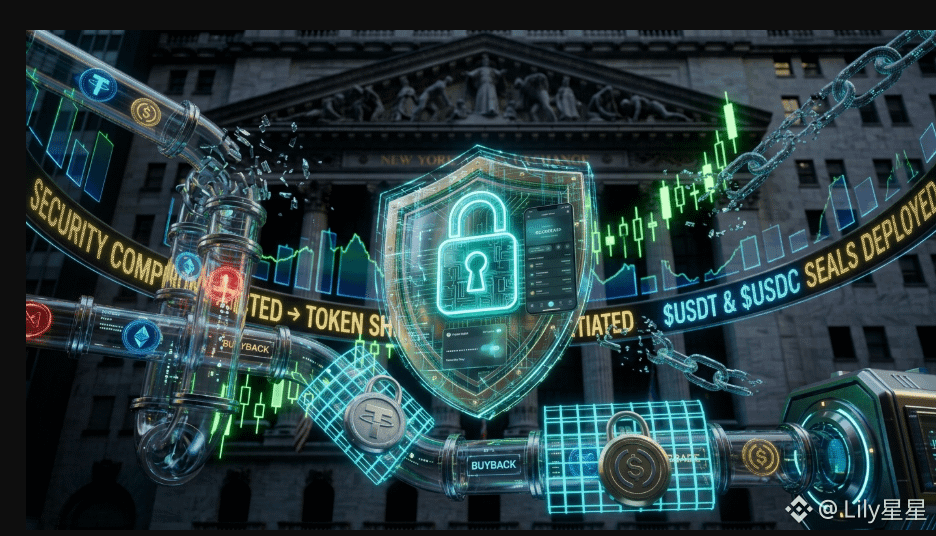
🔒 On-Chain Defense: Stablecoin Issuers Freeze Stolen Funds Following Recent Bitget Exploit 🚨
🚨 What Happened?
Following a massive security exploit on global crypto exchange Bitget totaling an estimated $351M to $387M in stolen assets, top stablecoin issuers Circle and Tether acted rapidly to blacklist linked hacker addresses.
The primary targeted wallet, labeled on Etherscan as Bitget Exploiter 8, was blacklisted to immobilize roughly $318,000 in USDC and USDT.
🔑 Key Takeaways & Incident Details
Collaborative Industry Response: Circle and Tether executed a swift joint freeze. Circle blacklisted the hacker address on Ethereum, and Tether banned the wallet shortly after to lock down dollar-pegged assets.
Attack Method Identified: Bitget CEO Gracy Chen confirmed that attackers compromised a backend infrastructure system and spoofed transaction data. It was not a private key leak or a breach of the exchange's cold storage.
User Protection Fund Covers Loss: Bitget assured users that its $464M+ User Protection Fund completely covers all stolen assets. Temporary withdrawal pauses were initiated strictly as a security precaution.
The Limits of Centralized Freezes: While stablecoin issuers can freeze USDT and USDC on EVM chains, hackers quickly swapped the bulk of stolen funds into Non-Freezable assets (like Ether), highlighting both the power and boundaries of centralized Web3 security interventions.
💡 Why It Matters for Traders
Centralization vs. Censorship Resistance: The rapid freezing of stablecoins demonstrates how major issuers safeguard the ecosystem, though it serves as a reminder that pegged stablecoins can be controlled at the smart contract level.
Laundering Bottlenecks: Blacklisting malicious wallets limits cross-chain bridge routes, forcing hackers into traced, illiquid paths monitored by security analysts.
How do you feel about stablecoin issuers having the power to freeze funds? Drop your thoughts below! 👇
#CircleMints500MUSDCOnSolana #Bitget #CryptoSecurity
#circletetherfreezebitgethackerwallet
🔒 On-Chain Defense: Stablecoin Issuers Freeze Stolen Funds Following Recent Bitget Exploit 🚨
🚨 What Happened?
Following a massive security exploit on global crypto exchange Bitget totaling an estimated $351M to $387M in stolen assets, top stablecoin issuers Circle and Tether acted rapidly to blacklist linked hacker addresses.
The primary targeted wallet, labeled on Etherscan as Bitget Exploiter 8, was blacklisted to immobilize roughly $318,000 in USDC and USDT.
🔑 Key Takeaways & Incident Details
Collaborative Industry Response: Circle and Tether executed a swift joint freeze. Circle blacklisted the hacker address on Ethereum, and Tether banned the wallet shortly after to lock down dollar-pegged assets.
Attack Method Identified: Bitget CEO Gracy Chen confirmed that attackers compromised a backend infrastructure system and spoofed transaction data. It was not a private key leak or a breach of the exchange's cold storage.
User Protection Fund Covers Loss: Bitget assured users that its $464M+ User Protection Fund completely covers all stolen assets. Temporary withdrawal pauses were initiated strictly as a security precaution.
The Limits of Centralized Freezes: While stablecoin issuers can freeze USDT and USDC on EVM chains, hackers quickly swapped the bulk of stolen funds into Non-Freezable assets (like Ether), highlighting both the power and boundaries of centralized Web3 security interventions.
💡 Why It Matters for Traders
Centralization vs. Censorship Resistance: The rapid freezing of stablecoins demonstrates how major issuers safeguard the ecosystem, though it serves as a reminder that pegged stablecoins can be controlled at the smart contract level.
Laundering Bottlenecks: Blacklisting malicious wallets limits cross-chain bridge routes, forcing hackers into traced, illiquid paths monitored by security analysts.
How do you feel about stablecoin issuers having the power to freeze funds? Drop your thoughts below! 👇
#CircleMints500MUSDCOnSolana #Bitget #CryptoSecurity
🔒 On-Chain Defense: Stablecoin Issuers Freeze Stolen Funds Following Recent Bitget Exploit 🚨
🚨 What Happened?
Following a massive security exploit on global crypto exchange Bitget totaling an estimated $351M to $387M in stolen assets, top stablecoin issuers Circle and Tether acted rapidly to blacklist linked hacker addresses.
The primary targeted wallet, labeled on Etherscan as Bitget Exploiter 8, was blacklisted to immobilize roughly $318,000 in USDC and USDT.
🔑 Key Takeaways & Incident Details
Collaborative Industry Response: Circle and Tether executed a swift joint freeze. Circle blacklisted the hacker address on Ethereum, and Tether banned the wallet shortly after to lock down dollar-pegged assets.
Attack Method Identified: Bitget CEO Gracy Chen confirmed that attackers compromised a backend infrastructure system and spoofed transaction data. It was not a private key leak or a breach of the exchange's cold storage.
User Protection Fund Covers Loss: Bitget assured users that its $464M+ User Protection Fund completely covers all stolen assets. Temporary withdrawal pauses were initiated strictly as a security precaution.
The Limits of Centralized Freezes: While stablecoin issuers can freeze USDT and USDC on EVM chains, hackers quickly swapped the bulk of stolen funds into Non-Freezable assets (like Ether), highlighting both the power and boundaries of centralized Web3 security interventions.
💡 Why It Matters for Traders
Centralization vs. Censorship Resistance: The rapid freezing of stablecoins demonstrates how major issuers safeguard the ecosystem, though it serves as a reminder that pegged stablecoins can be controlled at the smart contract level.
Laundering Bottlenecks: Blacklisting malicious wallets limits cross-chain bridge routes, forcing hackers into traced, illiquid paths monitored by security analysts.
How do you feel about stablecoin issuers having the power to freeze funds? Drop your thoughts below! 👇
#CircleMints500MUSDCOnSolana #Bitget #CryptoSecurity
Sade Uziel whLu:
هاي اريد كسب المال
1
3
2.5k

·
--
Article
Bitget Hit by $350M+ Hot Wallet Breach – What Happened?Bitget Hit by $350M+ Hot Wallet Breach – What Happened?
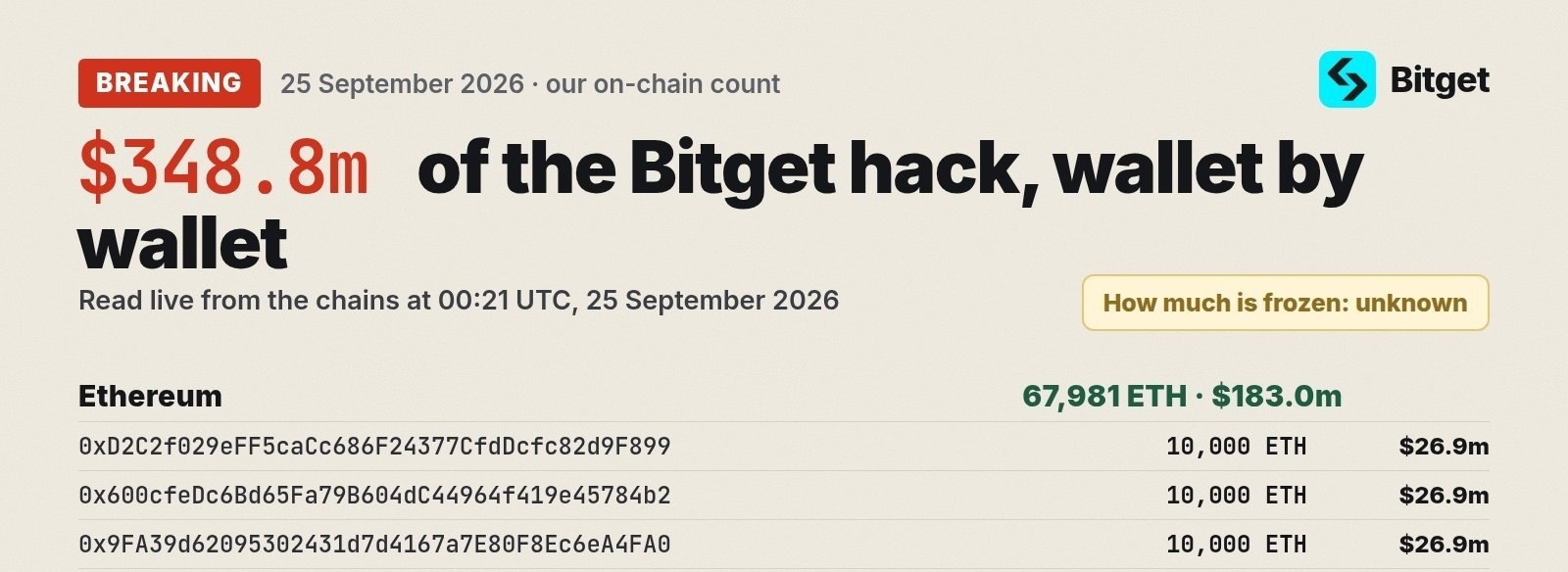
On September 24, 2026, Bitget detected unauthorized transfers from some of its hot and warm wallets totaling approximately $351.6 million – $387.5 million (updated figure).
CEO Gracy Chen confirmed:
Attackers compromised a backend system and spoofed transaction data
Private keys were not stolen
Cold wallets remain fully secure
User balances are protected by Bitget’s User Protection Fund (over $464 million)
Withdrawals are temporarily suspended while deposits and trading continue. The self-custodial Bitget Wallet product was unaffected.
Bitget is working with security firms and law enforcement. Preliminary analysis suggests patterns consistent with known North Korean hacking groups.
Hashtags:
#Bitget #CryptoHack #CryptoNews #Bitcoin #CryptoSecurity
Bitget Hit by $350M+ Hot Wallet Breach – What Happened?
Bitget Hit by $350M+ Hot Wallet Breach – What Happened?
On September 24, 2026, Bitget detected unauthorized transfers from some of its hot and warm wallets totaling approximately $351.6 million – $387.5 million (updated figure).
CEO Gracy Chen confirmed:
Attackers compromised a backend system and spoofed transaction data
Private keys were not stolen
Cold wallets remain fully secure
User balances are protected by Bitget’s User Protection Fund (over $464 million)
Withdrawals are temporarily suspended while deposits and trading continue. The self-custodial Bitget Wallet product was unaffected.
Bitget is working with security firms and law enforcement. Preliminary analysis suggests patterns consistent with known North Korean hacking groups.
Hashtags:
#Bitget #CryptoHack #CryptoNews #Bitcoin #CryptoSecurity
On September 24, 2026, Bitget detected unauthorized transfers from some of its hot and warm wallets totaling approximately $351.6 million – $387.5 million (updated figure).
CEO Gracy Chen confirmed:
Attackers compromised a backend system and spoofed transaction data
Private keys were not stolen
Cold wallets remain fully secure
User balances are protected by Bitget’s User Protection Fund (over $464 million)
Withdrawals are temporarily suspended while deposits and trading continue. The self-custodial Bitget Wallet product was unaffected.
Bitget is working with security firms and law enforcement. Preliminary analysis suggests patterns consistent with known North Korean hacking groups.
Hashtags:
#Bitget #CryptoHack #CryptoNews #Bitcoin #CryptoSecurity
92

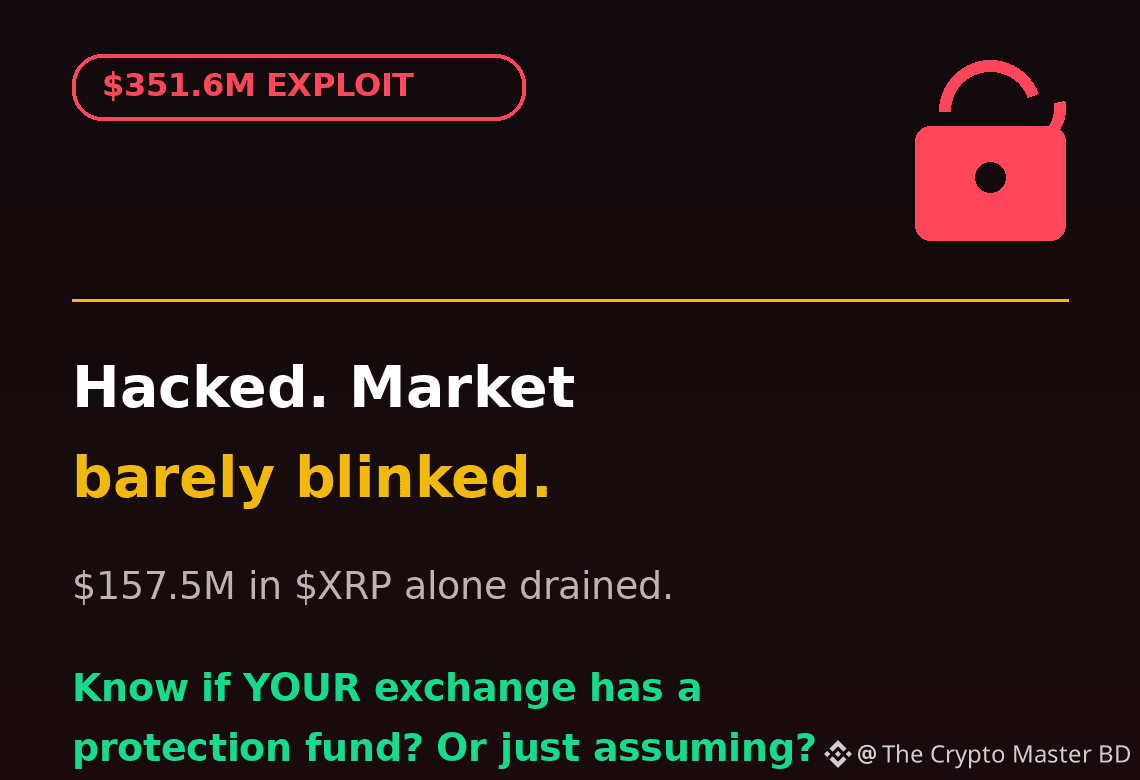
$351.6M gone in one exploit. $XRP alone: $157.5M. And the market barely blinked. 🎯
Bitget confirmed hackers breached a backend system in their wallet infrastructure, spoofed transaction data, and drained hot/warm wallets. North Korea's Lazarus Group is suspected — the same group linked to the $1.5B Bybit hack earlier this year.
The part that should actually worry you isn't the hack itself. It's this:
→ Cold wallets were untouched — this happened because hot wallets are always the weak point, on ANY exchange
→ 102.9M XRP got split into 5 fresh wallets within hours — hackers moving fast to obscure the trail
→ XRP price barely dropped — up 16% over the week despite the breach — proof that markets now absorb even $350M exploits without panic
→ Bitget's $464M User Protection Fund covers the full loss — this is why insurance funds matter more than people realize
Here's the actual lesson: exchange hacks are becoming routine enough that the market has stopped reacting to them like they used to. That's not necessarily good news — it just means everyone's gotten numb to the risk.
🎯 If your funds sit on any exchange right now — do you actually know if it has a protection fund, or are you just assuming it's "too big to get hacked"?
$XRP #bitgethack #CryptoSecurity
{spot}(XRPUSDT)
$351.6M gone in one exploit. $XRP alone: $157.5M. And the market barely blinked. 🎯
Bitget confirmed hackers breached a backend system in their wallet infrastructure, spoofed transaction data, and drained hot/warm wallets. North Korea's Lazarus Group is suspected — the same group linked to the $1.5B Bybit hack earlier this year.
The part that should actually worry you isn't the hack itself. It's this:
→ Cold wallets were untouched — this happened because hot wallets are always the weak point, on ANY exchange
→ 102.9M XRP got split into 5 fresh wallets within hours — hackers moving fast to obscure the trail
→ XRP price barely dropped — up 16% over the week despite the breach — proof that markets now absorb even $350M exploits without panic
→ Bitget's $464M User Protection Fund covers the full loss — this is why insurance funds matter more than people realize
Here's the actual lesson: exchange hacks are becoming routine enough that the market has stopped reacting to them like they used to. That's not necessarily good news — it just means everyone's gotten numb to the risk.
🎯 If your funds sit on any exchange right now — do you actually know if it has a protection fund, or are you just assuming it's "too big to get hacked"?
$XRP #bitgethack #CryptoSecurity
Bitget confirmed hackers breached a backend system in their wallet infrastructure, spoofed transaction data, and drained hot/warm wallets. North Korea's Lazarus Group is suspected — the same group linked to the $1.5B Bybit hack earlier this year.
The part that should actually worry you isn't the hack itself. It's this:
→ Cold wallets were untouched — this happened because hot wallets are always the weak point, on ANY exchange
→ 102.9M XRP got split into 5 fresh wallets within hours — hackers moving fast to obscure the trail
→ XRP price barely dropped — up 16% over the week despite the breach — proof that markets now absorb even $350M exploits without panic
→ Bitget's $464M User Protection Fund covers the full loss — this is why insurance funds matter more than people realize
Here's the actual lesson: exchange hacks are becoming routine enough that the market has stopped reacting to them like they used to. That's not necessarily good news — it just means everyone's gotten numb to the risk.
🎯 If your funds sit on any exchange right now — do you actually know if it has a protection fund, or are you just assuming it's "too big to get hacked"?
$XRP #bitgethack #CryptoSecurity
93

·
--
🚨 Security Alert: Bitget Wallet has suffered a massive $351.6M exploit. While CEO Gracy Chen points the finger at North Korean hackers, user withdrawals have been frozen. Strangely, trading continues normally.
The biggest concern? Bitget's claimed $464M protection fund remains unverified, raising serious questions about actual user safety.
Trade with caution and monitor your assets.
#CryptoSecurity #Bitget #Web3 Security
🚨 Security Alert: Bitget Wallet has suffered a massive $351.6M exploit. While CEO Gracy Chen points the finger at North Korean hackers, user withdrawals have been frozen. Strangely, trading continues normally.
The biggest concern? Bitget's claimed $464M protection fund remains unverified, raising serious questions about actual user safety.
Trade with caution and monitor your assets.
#CryptoSecurity #Bitget #Web3 Security
The biggest concern? Bitget's claimed $464M protection fund remains unverified, raising serious questions about actual user safety.
Trade with caution and monitor your assets.
#CryptoSecurity #Bitget #Web3 Security
4

Article
Standing Together: How Binance is Helping Bitget Recover $350M🛡️ Crypto Unity in Action: Binance & BNB Chain Step Up to Support Bitget
Crypto security is a collective responsibility! Following the recent unfortunate $350 million security breach at Bitget, industry leaders have demonstrated true solidarity.
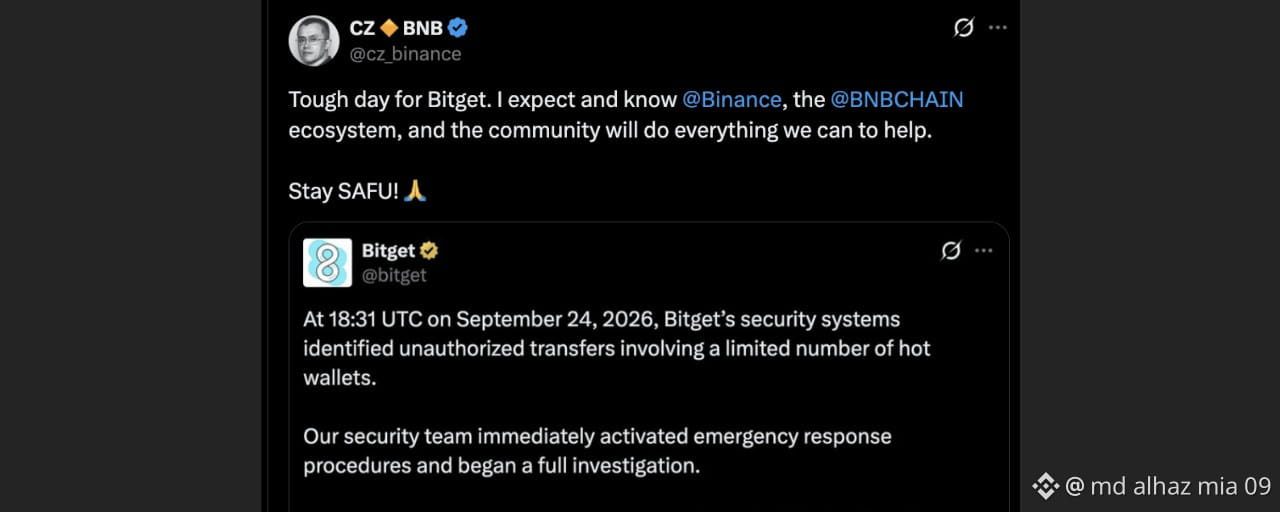
Leadership Response: Former Binance CEO CZ took to X to voice support, stating: "Tough day for Bitget. I expect and know @Binance, the @BNBCHAIN ecosystem, and the community will do everything we can to help. Stay SAFU!"
Active Collaboration: Binance Co-CEO Richard Teng confirmed that Binance's elite security team has been working hand-in-hand with Bitget since day one.
Behind the Scenes: Efforts include sharing critical threat intelligence, actively tracking stolen funds across networks, and providing full support for asset recovery.
Key Takeaway: When one platform faces a threat, the entire Web3 ecosystem unites. Security remains our top priority—together, we keep the space SAFU. 🤝
Aapni ki ekhono kono specific hashtag (jemon #Binanc #CryptoSecurity #BNBChain ) add korte chan, naki post-ti eibhabei ready?
Standing Together: How Binance is Helping Bitget Recover $350M
🛡️ Crypto Unity in Action: Binance & BNB Chain Step Up to Support Bitget
Crypto security is a collective responsibility! Following the recent unfortunate $350 million security breach at Bitget, industry leaders have demonstrated true solidarity.
Leadership Response: Former Binance CEO CZ took to X to voice support, stating: "Tough day for Bitget. I expect and know @Binance, the @BNBCHAIN ecosystem, and the community will do everything we can to help. Stay SAFU!"
Active Collaboration: Binance Co-CEO Richard Teng confirmed that Binance's elite security team has been working hand-in-hand with Bitget since day one.
Behind the Scenes: Efforts include sharing critical threat intelligence, actively tracking stolen funds across networks, and providing full support for asset recovery.
Key Takeaway: When one platform faces a threat, the entire Web3 ecosystem unites. Security remains our top priority—together, we keep the space SAFU. 🤝
Aapni ki ekhono kono specific hashtag (jemon #Binanc #CryptoSecurity #BNBChain ) add korte chan, naki post-ti eibhabei ready?
Crypto security is a collective responsibility! Following the recent unfortunate $350 million security breach at Bitget, industry leaders have demonstrated true solidarity.
Leadership Response: Former Binance CEO CZ took to X to voice support, stating: "Tough day for Bitget. I expect and know @Binance, the @BNBCHAIN ecosystem, and the community will do everything we can to help. Stay SAFU!"
Active Collaboration: Binance Co-CEO Richard Teng confirmed that Binance's elite security team has been working hand-in-hand with Bitget since day one.
Behind the Scenes: Efforts include sharing critical threat intelligence, actively tracking stolen funds across networks, and providing full support for asset recovery.
Key Takeaway: When one platform faces a threat, the entire Web3 ecosystem unites. Security remains our top priority—together, we keep the space SAFU. 🤝
Aapni ki ekhono kono specific hashtag (jemon #Binanc #CryptoSecurity #BNBChain ) add korte chan, naki post-ti eibhabei ready?
70

Bitget’s $351.6M Hack: North Korea Connection Suspected?
The crypto world is watching closely after Bitget CEO Gracy Chen revealed preliminary findings suggesting a possible connection between the exchange’s $351.6 million security breach and North Korean-linked hackers.
During a live Q&A on X, Chen said investigators identified IP addresses matching VPN patterns previously associated with a DPRK-linked hacking group.
🔍 What We Know So Far:
▪️ Approximately $351.6 million involved in the breach.
▪️ Investigators identified suspicious IP/VPN similarities.
▪️ Bitget does not believe the incident was an inside job.
▪️ The investigation is still ongoing.
⚠️ Why This Matters
North Korean-linked hackers have been associated with billions of dollars in crypto theft. The FBI previously attributed the $1.5 billion Bybit hack to North Korea.
However, Bitget’s latest findings remain preliminary, and responsibility for this specific incident has not been conclusively established.
💭 The Big Question:
Could this incident push crypto exchanges to rethink their security infrastructure and protection against sophisticated cyberattacks?
#Bitget #CryptoSecurity #NorthKorea #Blockchain #CryptoNews #CyberSecurity #BinanceSquare
Bitget’s $351.6M Hack: North Korea Connection Suspected?
The crypto world is watching closely after Bitget CEO Gracy Chen revealed preliminary findings suggesting a possible connection between the exchange’s $351.6 million security breach and North Korean-linked hackers.
During a live Q&A on X, Chen said investigators identified IP addresses matching VPN patterns previously associated with a DPRK-linked hacking group.
🔍 What We Know So Far:
▪️ Approximately $351.6 million involved in the breach.
▪️ Investigators identified suspicious IP/VPN similarities.
▪️ Bitget does not believe the incident was an inside job.
▪️ The investigation is still ongoing.
⚠️ Why This Matters
North Korean-linked hackers have been associated with billions of dollars in crypto theft. The FBI previously attributed the $1.5 billion Bybit hack to North Korea.
However, Bitget’s latest findings remain preliminary, and responsibility for this specific incident has not been conclusively established.
💭 The Big Question:
Could this incident push crypto exchanges to rethink their security infrastructure and protection against sophisticated cyberattacks?
#Bitget #CryptoSecurity #NorthKorea #Blockchain #CryptoNews #CyberSecurity #BinanceSquare
The crypto world is watching closely after Bitget CEO Gracy Chen revealed preliminary findings suggesting a possible connection between the exchange’s $351.6 million security breach and North Korean-linked hackers.
During a live Q&A on X, Chen said investigators identified IP addresses matching VPN patterns previously associated with a DPRK-linked hacking group.
🔍 What We Know So Far:
▪️ Approximately $351.6 million involved in the breach.
▪️ Investigators identified suspicious IP/VPN similarities.
▪️ Bitget does not believe the incident was an inside job.
▪️ The investigation is still ongoing.
⚠️ Why This Matters
North Korean-linked hackers have been associated with billions of dollars in crypto theft. The FBI previously attributed the $1.5 billion Bybit hack to North Korea.
However, Bitget’s latest findings remain preliminary, and responsibility for this specific incident has not been conclusively established.
💭 The Big Question:
Could this incident push crypto exchanges to rethink their security infrastructure and protection against sophisticated cyberattacks?
#Bitget #CryptoSecurity #NorthKorea #Blockchain #CryptoNews #CyberSecurity #BinanceSquare
1
1
71

$USDT $USDC Bitget Hack Shows the Stablecoin Trade-OffCircle & Tether just froze about $318K in USDC + USDT linked to the Bitget exploit. 🔐
But here’s the bigger story:
💰 $318K frozen
⛓️ 63K+ ETH still outside issuer control
🏦 Stablecoin issuers can blacklist their own tokens
🔐 ETH itself cannot be frozen by Circle or Tether
Bitget says the $351.6M breach came through its backend wallet infrastructure, while private keys and cold wallets remained secure.
This shows the trade-off clearly:
Stablecoins = speed + stability + issuer-level controls.
Native assets like $ETH = no central issuer with a freeze button.
For me, the lesson is simple:
Know what you hold — and who can control it.
#circletetherfreezebitgethackerwallet #BitgetHack #Stablecoin #CryptoSecurity #USDT #USDC #ETH #Ethereum #Crypto #BinanceSquare
{spot}(BNBUSDT)
{spot}(ETHUSDT)
$USDT $USDC Bitget Hack Shows the Stablecoin Trade-Off
Circle & Tether just froze about $318K in USDC + USDT linked to the Bitget exploit. 🔐
But here’s the bigger story:
💰 $318K frozen
⛓️ 63K+ ETH still outside issuer control
🏦 Stablecoin issuers can blacklist their own tokens
🔐 ETH itself cannot be frozen by Circle or Tether
Bitget says the $351.6M breach came through its backend wallet infrastructure, while private keys and cold wallets remained secure.
This shows the trade-off clearly:
Stablecoins = speed + stability + issuer-level controls.
Native assets like $ETH = no central issuer with a freeze button.
For me, the lesson is simple:
Know what you hold — and who can control it.
#circletetherfreezebitgethackerwallet #BitgetHack #Stablecoin #CryptoSecurity #USDT #USDC #ETH #Ethereum #Crypto #BinanceSquare
But here’s the bigger story:
💰 $318K frozen
⛓️ 63K+ ETH still outside issuer control
🏦 Stablecoin issuers can blacklist their own tokens
🔐 ETH itself cannot be frozen by Circle or Tether
Bitget says the $351.6M breach came through its backend wallet infrastructure, while private keys and cold wallets remained secure.
This shows the trade-off clearly:
Stablecoins = speed + stability + issuer-level controls.
Native assets like $ETH = no central issuer with a freeze button.
For me, the lesson is simple:
Know what you hold — and who can control it.
#circletetherfreezebitgethackerwallet #BitgetHack #Stablecoin #CryptoSecurity #USDT #USDC #ETH #Ethereum #Crypto #BinanceSquare
206 Atlas:
Freezing $318K is a drop in the bucket. The real risk isn't issuer control, it's smart contract vulnerabilities that bypass those central safeguards entirely.
1
946

🚨 CRITICAL CONTRACT VULNERABILITY THREATENS HISTORICAL $ETH NFT APPROVALS ACROSS MAGIC EDEN! ⚠️
🔍 A known exploit in Limit Break's Payment Processor is putting legacy EVM marketplace approvals at risk across Ethereum, Polygon, and Base. Any wallet that interacted with Magic Eden listings between February and October 2024 could have open permissions susceptible to malicious drains.
💡 Security hygiene is non-negotiable if you want to protect your portfolio capital long term. Yuga Labs has launched an asset claim portal for affected victims, but revoking all active "approved for all" contract permissions remains the mandatory first step. 🛡️
💬 Have you audited your active smart contract allowances today, or are you leaving your wallet exposed to legacy protocol exploits? 👇
⚠️ Not financial advice. Always manage your risk. 🛡️
🏷️ #ETH #Web3Security #NFTs #CryptoSecurity
🛡️ 👁️
🚨 CRITICAL CONTRACT VULNERABILITY THREATENS HISTORICAL $ETH NFT APPROVALS ACROSS MAGIC EDEN! ⚠️
🔍 A known exploit in Limit Break's Payment Processor is putting legacy EVM marketplace approvals at risk across Ethereum, Polygon, and Base. Any wallet that interacted with Magic Eden listings between February and October 2024 could have open permissions susceptible to malicious drains.
💡 Security hygiene is non-negotiable if you want to protect your portfolio capital long term. Yuga Labs has launched an asset claim portal for affected victims, but revoking all active "approved for all" contract permissions remains the mandatory first step. 🛡️
💬 Have you audited your active smart contract allowances today, or are you leaving your wallet exposed to legacy protocol exploits? 👇
⚠️ Not financial advice. Always manage your risk. 🛡️
🏷️ #ETH #Web3Security #NFTs #CryptoSecurity
🛡️ 👁️
🔍 A known exploit in Limit Break's Payment Processor is putting legacy EVM marketplace approvals at risk across Ethereum, Polygon, and Base. Any wallet that interacted with Magic Eden listings between February and October 2024 could have open permissions susceptible to malicious drains.
💡 Security hygiene is non-negotiable if you want to protect your portfolio capital long term. Yuga Labs has launched an asset claim portal for affected victims, but revoking all active "approved for all" contract permissions remains the mandatory first step. 🛡️
💬 Have you audited your active smart contract allowances today, or are you leaving your wallet exposed to legacy protocol exploits? 👇
⚠️ Not financial advice. Always manage your risk. 🛡️
🏷️ #ETH #Web3Security #NFTs #CryptoSecurity
🛡️ 👁️
9

·
--
Bearish
The 388 million dollar Bitget hot wallet hack is a brutal reminder that exchange security is never guaranteed.
Bitget recently posted updates clarifying that over 380 million dollars in assets were compromised and withdrawals remain temporarily frozen while their Protection Fund covers affected balances.
While it is reassuring that their reserve fund is stepping in to protect users this event proves two major points for every crypto trader.
First hot wallets remain the ultimate target for sophisticated exploits no matter the size of the platform. Active trading funds belong only on battle tested exchanges with verified reserves, but long term wealth belongs in cold storage.
Second the fact that the broader market barely flinched after a 380M dollar hack shows how mature crypto liquidity has become compared to previous cycles.
Are you keeping your crypto on exchanges right now or did this hack convince you to move to cold storage? Drop your thoughts below.
{future}(BTCUSDT)
#Bitget #CryptoSecurity #Bitcoin #BinanceSquare
The 388 million dollar Bitget hot wallet hack is a brutal reminder that exchange security is never guaranteed.
Bitget recently posted updates clarifying that over 380 million dollars in assets were compromised and withdrawals remain temporarily frozen while their Protection Fund covers affected balances.
While it is reassuring that their reserve fund is stepping in to protect users this event proves two major points for every crypto trader.
First hot wallets remain the ultimate target for sophisticated exploits no matter the size of the platform. Active trading funds belong only on battle tested exchanges with verified reserves, but long term wealth belongs in cold storage.
Second the fact that the broader market barely flinched after a 380M dollar hack shows how mature crypto liquidity has become compared to previous cycles.
Are you keeping your crypto on exchanges right now or did this hack convince you to move to cold storage? Drop your thoughts below.
#Bitget #CryptoSecurity #Bitcoin #BinanceSquare
Bitget recently posted updates clarifying that over 380 million dollars in assets were compromised and withdrawals remain temporarily frozen while their Protection Fund covers affected balances.
While it is reassuring that their reserve fund is stepping in to protect users this event proves two major points for every crypto trader.
First hot wallets remain the ultimate target for sophisticated exploits no matter the size of the platform. Active trading funds belong only on battle tested exchanges with verified reserves, but long term wealth belongs in cold storage.
Second the fact that the broader market barely flinched after a 380M dollar hack shows how mature crypto liquidity has become compared to previous cycles.
Are you keeping your crypto on exchanges right now or did this hack convince you to move to cold storage? Drop your thoughts below.
#Bitget #CryptoSecurity #Bitcoin #BinanceSquare
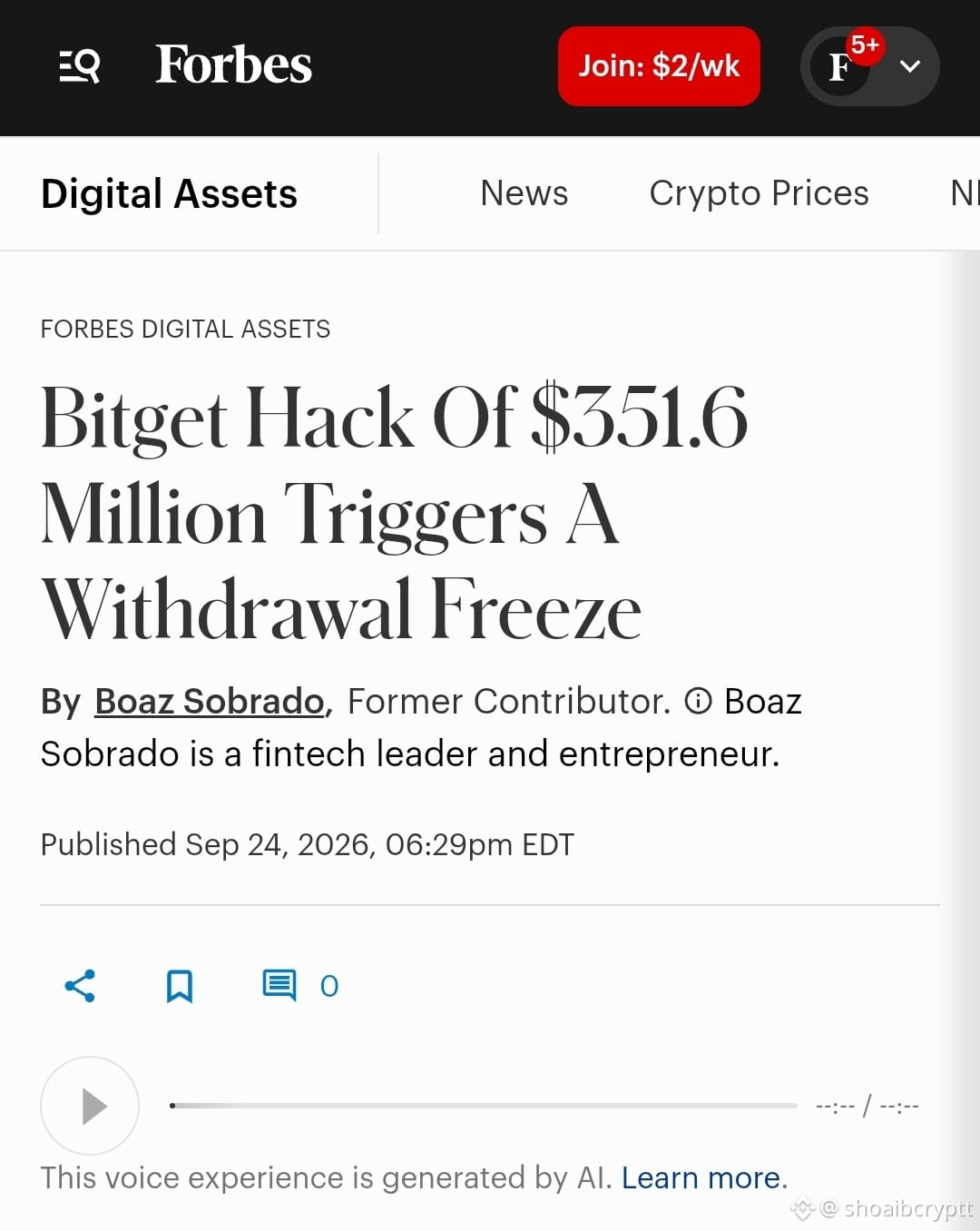
92

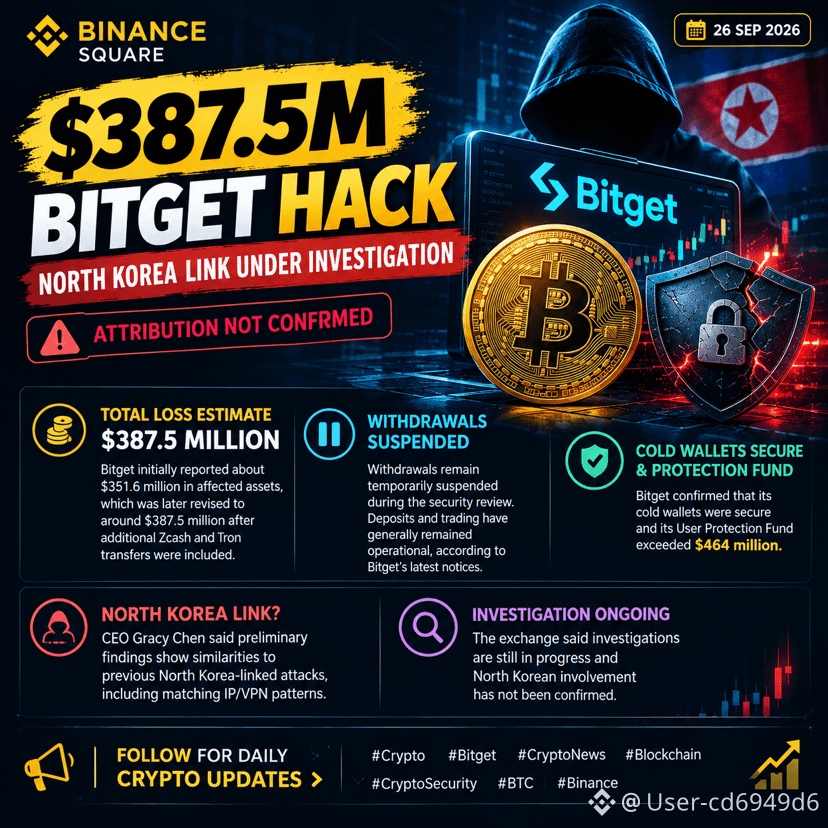
🚨 $387.5M BITGET HACK — NORTH KOREA LINK?
A major crypto security incident is making headlines today. 👀
Bitget’s reported loss has been revised from around $351.6M to approximately $387.5M after additional Zcash and Tron transfers were included. (Cointribune)$BITO $BITCOIN
🔴 What happened?
• Unauthorized transfers were detected from some Bitget hot/warm wallets
• Withdrawals were temporarily suspended
• Bitget says its cold wallets remained secure
• Its User Protection Fund exceeds $464M (Bitget)
$ST
🕵️ North Korea connection?
CEO Gracy Chen said preliminary findings showed similarities with previous North Korea-linked attacks, including IP/VPN patterns.
⚠️ But this is important: the North Korea attribution has not been conclusively confirmed. The investigation is still ongoing. (Cointelegraph)
💬 What do you think — was this a sophisticated cyberattack, or should we wait for the final investigation?
Follow for more crypto news, security updates & market stories. 🚀
#Crypto #BitgetBreachForgedRequestsNotStolenKeys Bitget #CryptoNews #blockchain #CryptoSecurity #BTC #Binance
{spot}(BIGTIMEUSDT)
{alpha}(10x72e4f9f808c49a2a61de9c5896298920dc4eeea9)
{spot}(BNBUSDT)
🚨 $387.5M BITGET HACK — NORTH KOREA LINK?
A major crypto security incident is making headlines today. 👀
Bitget’s reported loss has been revised from around $351.6M to approximately $387.5M after additional Zcash and Tron transfers were included. (Cointribune)$BITO $BITCOIN
🔴 What happened?
• Unauthorized transfers were detected from some Bitget hot/warm wallets
• Withdrawals were temporarily suspended
• Bitget says its cold wallets remained secure
• Its User Protection Fund exceeds $464M (Bitget)
$ST
🕵️ North Korea connection?
CEO Gracy Chen said preliminary findings showed similarities with previous North Korea-linked attacks, including IP/VPN patterns.
⚠️ But this is important: the North Korea attribution has not been conclusively confirmed. The investigation is still ongoing. (Cointelegraph)
💬 What do you think — was this a sophisticated cyberattack, or should we wait for the final investigation?
Follow for more crypto news, security updates & market stories. 🚀
#Crypto #BitgetBreachForgedRequestsNotStolenKeys Bitget #CryptoNews #blockchain #CryptoSecurity #BTC #Binance
A major crypto security incident is making headlines today. 👀
Bitget’s reported loss has been revised from around $351.6M to approximately $387.5M after additional Zcash and Tron transfers were included. (Cointribune)$BITO $BITCOIN
🔴 What happened?
• Unauthorized transfers were detected from some Bitget hot/warm wallets
• Withdrawals were temporarily suspended
• Bitget says its cold wallets remained secure
• Its User Protection Fund exceeds $464M (Bitget)
$ST
🕵️ North Korea connection?
CEO Gracy Chen said preliminary findings showed similarities with previous North Korea-linked attacks, including IP/VPN patterns.
⚠️ But this is important: the North Korea attribution has not been conclusively confirmed. The investigation is still ongoing. (Cointelegraph)
💬 What do you think — was this a sophisticated cyberattack, or should we wait for the final investigation?
Follow for more crypto news, security updates & market stories. 🚀
#Crypto #BitgetBreachForgedRequestsNotStolenKeys Bitget #CryptoNews #blockchain #CryptoSecurity #BTC #Binance
129

🚨 OVER $1 BILLION STOLEN IN CRYPTO THIS YEAR AS $BTC FACES RENEWED HEADWINDS! ⚠️
North Korean state-sponsored exploiters have officially crossed the $1 billion threshold in stolen digital assets for the current year alone. 📊 Following yesterday's massive $350 million breach on a major top-tier exchange, market participants are watching key exchange flows for sudden sell-side pressure.
When rogue entities siphon mega-cap liquidity, the immediate threat is the inevitable laundering cascade hitting OTC desks and liquidity pools. 👁️ Cold storage discipline separates survivors from victims when state-level bad actors target centralized reserves. 💬 Are you moving your capital into self-custody or trusting exchange hot wallets right now? 👇
⚠️ Not financial advice. Always manage your risk. 🛡️
🏷️ #BTC #CryptoSecurity #Security #MarketAlert
🚨 🛡️
🚨 OVER $1 BILLION STOLEN IN CRYPTO THIS YEAR AS $BTC FACES RENEWED HEADWINDS! ⚠️
North Korean state-sponsored exploiters have officially crossed the $1 billion threshold in stolen digital assets for the current year alone. 📊 Following yesterday's massive $350 million breach on a major top-tier exchange, market participants are watching key exchange flows for sudden sell-side pressure.
When rogue entities siphon mega-cap liquidity, the immediate threat is the inevitable laundering cascade hitting OTC desks and liquidity pools. 👁️ Cold storage discipline separates survivors from victims when state-level bad actors target centralized reserves. 💬 Are you moving your capital into self-custody or trusting exchange hot wallets right now? 👇
⚠️ Not financial advice. Always manage your risk. 🛡️
🏷️ #BTC #CryptoSecurity #Security #MarketAlert
🚨 🛡️
North Korean state-sponsored exploiters have officially crossed the $1 billion threshold in stolen digital assets for the current year alone. 📊 Following yesterday's massive $350 million breach on a major top-tier exchange, market participants are watching key exchange flows for sudden sell-side pressure.
When rogue entities siphon mega-cap liquidity, the immediate threat is the inevitable laundering cascade hitting OTC desks and liquidity pools. 👁️ Cold storage discipline separates survivors from victims when state-level bad actors target centralized reserves. 💬 Are you moving your capital into self-custody or trusting exchange hot wallets right now? 👇
⚠️ Not financial advice. Always manage your risk. 🛡️
🏷️ #BTC #CryptoSecurity #Security #MarketAlert
🚨 🛡️
15

🚨 $ATOM RECOVERS 1.22M STOLEN TOKENS TO MULTISIG AFTER NEUTRON GOVERNANCE EXPLOIT 🛡️
Institutional security intervention has contained the bulk of the exploit fallout following the recent governance breach on Neutron. 🦈 While 500k $ATOM was bridged out via THORChain, validators successfully intercepted 1.227 million tokens by routing them directly into a 4/6 institutional multisig vault.
With block production fully restored on Gaia v28.3.0, the recovered funds are effectively locked from circulation and pending a community governance vote next week. 💡 The immediate sell pressure risk has been isolated, stabilizing market structure despite the initial protocol distress. 💬 Do you expect this swift validator containment to restore confidence in the Cosmos ecosystem? 👇
⚠️ Not financial advice. Always manage your risk. 🛡️
🏷️ #ATOM #Cosmos #CryptoSecurity #DeFi
🦈 🛡️
🚨 $ATOM RECOVERS 1.22M STOLEN TOKENS TO MULTISIG AFTER NEUTRON GOVERNANCE EXPLOIT 🛡️
Institutional security intervention has contained the bulk of the exploit fallout following the recent governance breach on Neutron. 🦈 While 500k $ATOM was bridged out via THORChain, validators successfully intercepted 1.227 million tokens by routing them directly into a 4/6 institutional multisig vault.
With block production fully restored on Gaia v28.3.0, the recovered funds are effectively locked from circulation and pending a community governance vote next week. 💡 The immediate sell pressure risk has been isolated, stabilizing market structure despite the initial protocol distress. 💬 Do you expect this swift validator containment to restore confidence in the Cosmos ecosystem? 👇
⚠️ Not financial advice. Always manage your risk. 🛡️
🏷️ #ATOM #Cosmos #CryptoSecurity #DeFi
🦈 🛡️
Institutional security intervention has contained the bulk of the exploit fallout following the recent governance breach on Neutron. 🦈 While 500k $ATOM was bridged out via THORChain, validators successfully intercepted 1.227 million tokens by routing them directly into a 4/6 institutional multisig vault.
With block production fully restored on Gaia v28.3.0, the recovered funds are effectively locked from circulation and pending a community governance vote next week. 💡 The immediate sell pressure risk has been isolated, stabilizing market structure despite the initial protocol distress. 💬 Do you expect this swift validator containment to restore confidence in the Cosmos ecosystem? 👇
⚠️ Not financial advice. Always manage your risk. 🛡️
🏷️ #ATOM #Cosmos #CryptoSecurity #DeFi
🦈 🛡️
114
·
--
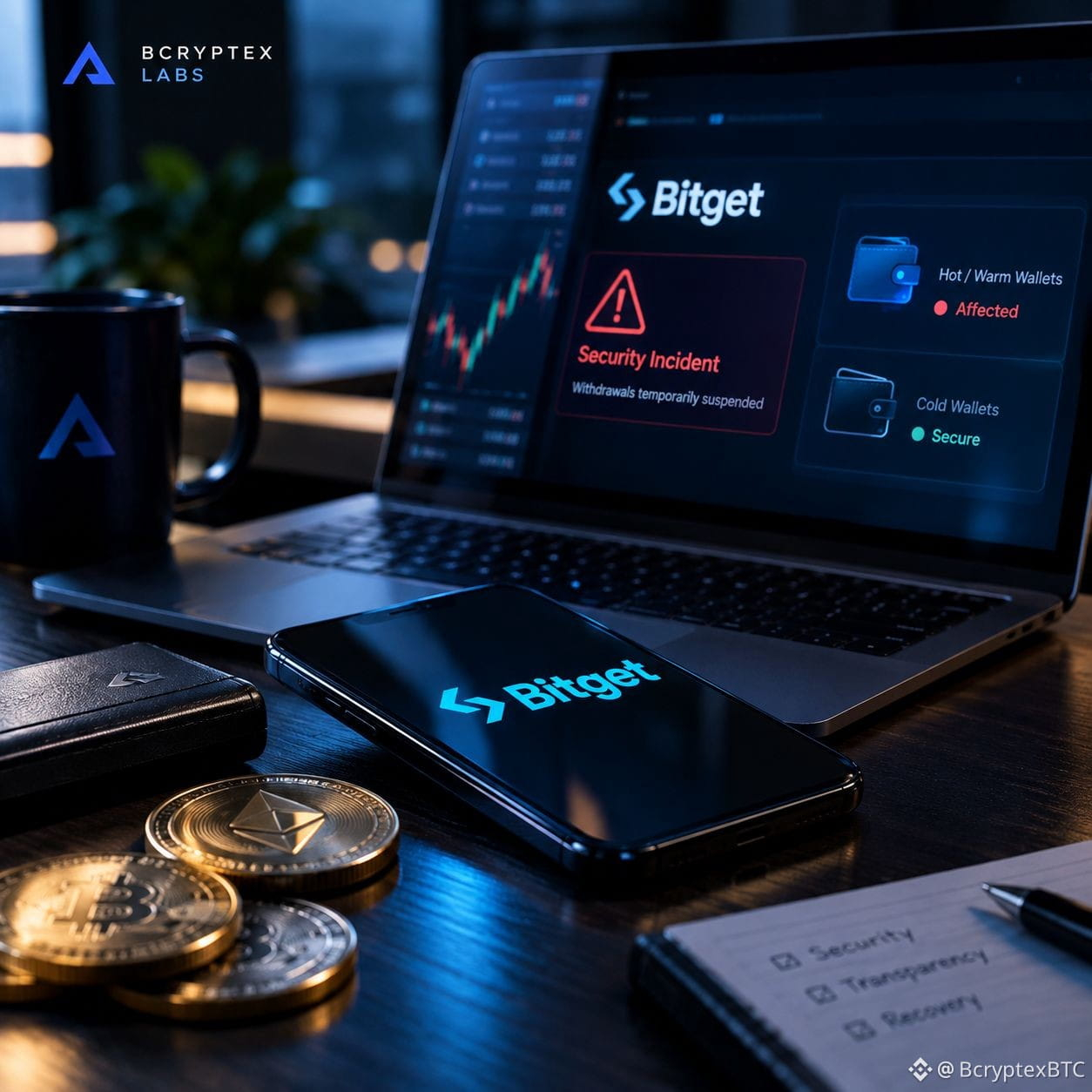
$351M left Bitget. But the real question is: how?
Bitget says hot/warm wallets were affected while cold wallets remained secure.
Now the key questions are:
🔹 How did the breach happen?
🔹 Can the funds be recovered?
🔹 When can withdrawals safely resume?
Bitget says its $464M+ protection fund covers the reported loss — but coverage ≠ recovery.
The forensic findings will tell the real story.
What should Bitget prove next?
#Bitget #CryptoSecurity #ETH $ETH
$351M left Bitget. But the real question is: how?
Bitget says hot/warm wallets were affected while cold wallets remained secure.
Now the key questions are:
🔹 How did the breach happen?
🔹 Can the funds be recovered?
🔹 When can withdrawals safely resume?
Bitget says its $464M+ protection fund covers the reported loss — but coverage ≠ recovery.
The forensic findings will tell the real story.
What should Bitget prove next?
#Bitget #CryptoSecurity #ETH $ETH
Bitget says hot/warm wallets were affected while cold wallets remained secure.
Now the key questions are:
🔹 How did the breach happen?
🔹 Can the funds be recovered?
🔹 When can withdrawals safely resume?
Bitget says its $464M+ protection fund covers the reported loss — but coverage ≠ recovery.
The forensic findings will tell the real story.
What should Bitget prove next?
#Bitget #CryptoSecurity #ETH $ETH
1
94

🚨 Major Exchange Security Alert: What the Recent Bitget Incident Teaches Us
Security remains the ultimate test for the crypto industry following the recent backend compromise reported by Bitget, which involved unauthorized transfers totaling over $350 million.
Key Takeaways for Traders:
🔹 Backend Vulnerabilities: Attackers are shifting focus toward spoofing backend authorization systems rather than cracking cold storage.
🔹 Self-Custody Importance: This incident serves as a strong reminder of the golden rule: "Not your keys, not your coins." Using hardware wallets for long-term holding is more critical than ever.
🔹 Platform Response: Exchange user-protection funds and multi-chain asset freezing coordination are currently being tested in real-time.
How do you manage your asset security between centralized exchanges and cold storage?
#BinanceSquare #Write2Earn #CryptoSecurity #Blockchain
🚨 Major Exchange Security Alert: What the Recent Bitget Incident Teaches Us
Security remains the ultimate test for the crypto industry following the recent backend compromise reported by Bitget, which involved unauthorized transfers totaling over $350 million.
Key Takeaways for Traders:
🔹 Backend Vulnerabilities: Attackers are shifting focus toward spoofing backend authorization systems rather than cracking cold storage.
🔹 Self-Custody Importance: This incident serves as a strong reminder of the golden rule: "Not your keys, not your coins." Using hardware wallets for long-term holding is more critical than ever.
🔹 Platform Response: Exchange user-protection funds and multi-chain asset freezing coordination are currently being tested in real-time.
How do you manage your asset security between centralized exchanges and cold storage?
#BinanceSquare #Write2Earn #CryptoSecurity #Blockchain
Security remains the ultimate test for the crypto industry following the recent backend compromise reported by Bitget, which involved unauthorized transfers totaling over $350 million.
Key Takeaways for Traders:
🔹 Backend Vulnerabilities: Attackers are shifting focus toward spoofing backend authorization systems rather than cracking cold storage.
🔹 Self-Custody Importance: This incident serves as a strong reminder of the golden rule: "Not your keys, not your coins." Using hardware wallets for long-term holding is more critical than ever.
🔹 Platform Response: Exchange user-protection funds and multi-chain asset freezing coordination are currently being tested in real-time.
How do you manage your asset security between centralized exchanges and cold storage?
#BinanceSquare #Write2Earn #CryptoSecurity #Blockchain

·
--
Bitget Exploited for $351.6M: What It Means for Everyday Traders
On September 24, Bitget reported unauthorized transfers totaling approximately $351.6 million from a subset of its hot and warm wallet infrastructure. The exchange stated that cold storage reserves remain unaffected and that user losses will be fully covered by its Protection Fund. Withdrawals have been temporarily suspended.
The incident draws inevitable parallels to FTX, where operational distress in 2022 resulted in halted withdrawals and subsequent regulatory findings of commingled customer assets.
The takeaways for risk management remain clear:
Exchanges Are Execution Venues, Not Vaults: Centralized exchanges should be utilized strictly as tools for trading and liquidity, not for long-term capital storage.
Active Profit Extraction: While actively trading major assets like $BTC , ETH, $BNB , XRP, or $SOL , realized gains should be systematically withdrawn to self-custodial wallets or alternative secure storage setups.
Custody Principle: Capital idle on an exchange is subject to counterparty risk. Not your keys, not your coins.
#Bitget #FTX #CryptoSecurity #Hacker
Bitget Exploited for $351.6M: What It Means for Everyday Traders
On September 24, Bitget reported unauthorized transfers totaling approximately $351.6 million from a subset of its hot and warm wallet infrastructure. The exchange stated that cold storage reserves remain unaffected and that user losses will be fully covered by its Protection Fund. Withdrawals have been temporarily suspended.
The incident draws inevitable parallels to FTX, where operational distress in 2022 resulted in halted withdrawals and subsequent regulatory findings of commingled customer assets.
The takeaways for risk management remain clear:
Exchanges Are Execution Venues, Not Vaults: Centralized exchanges should be utilized strictly as tools for trading and liquidity, not for long-term capital storage.
Active Profit Extraction: While actively trading major assets like $BTC , ETH, $BNB , XRP, or $SOL , realized gains should be systematically withdrawn to self-custodial wallets or alternative secure storage setups.
Custody Principle: Capital idle on an exchange is subject to counterparty risk. Not your keys, not your coins.
#Bitget #FTX #CryptoSecurity #Hacker
On September 24, Bitget reported unauthorized transfers totaling approximately $351.6 million from a subset of its hot and warm wallet infrastructure. The exchange stated that cold storage reserves remain unaffected and that user losses will be fully covered by its Protection Fund. Withdrawals have been temporarily suspended.
The incident draws inevitable parallels to FTX, where operational distress in 2022 resulted in halted withdrawals and subsequent regulatory findings of commingled customer assets.
The takeaways for risk management remain clear:
Exchanges Are Execution Venues, Not Vaults: Centralized exchanges should be utilized strictly as tools for trading and liquidity, not for long-term capital storage.
Active Profit Extraction: While actively trading major assets like $BTC , ETH, $BNB , XRP, or $SOL , realized gains should be systematically withdrawn to self-custodial wallets or alternative secure storage setups.
Custody Principle: Capital idle on an exchange is subject to counterparty risk. Not your keys, not your coins.
#Bitget #FTX #CryptoSecurity #Hacker
176


Another massive romance scam busted as regulators come down hard on fraudsters. A suspect faces federal charges for orchestrating a brutal 16 million dollar crypto pig butchering operation that wiped out a victim's life savings. Stay vigilant and protect your $BTC and altcoins. 🚨 Multi-million dollar fraud syndicate dismantled by authorities 🛑 Romance scam targeting digital asset holders exposed #Write2Earn #CryptoSecurity #ScamAlert #Blockchain
Another massive romance scam busted as regulators come down hard on fraudsters. A suspect faces federal charges for orchestrating a brutal 16 million dollar crypto pig butchering operation that wiped out a victim's life savings. Stay vigilant and protect your $BTC and altcoins. 🚨 Multi-million dollar fraud syndicate dismantled by authorities 🛑 Romance scam targeting digital asset holders exposed #Write2Earn #CryptoSecurity #ScamAlert #Blockchain

29

·
--
Bearish
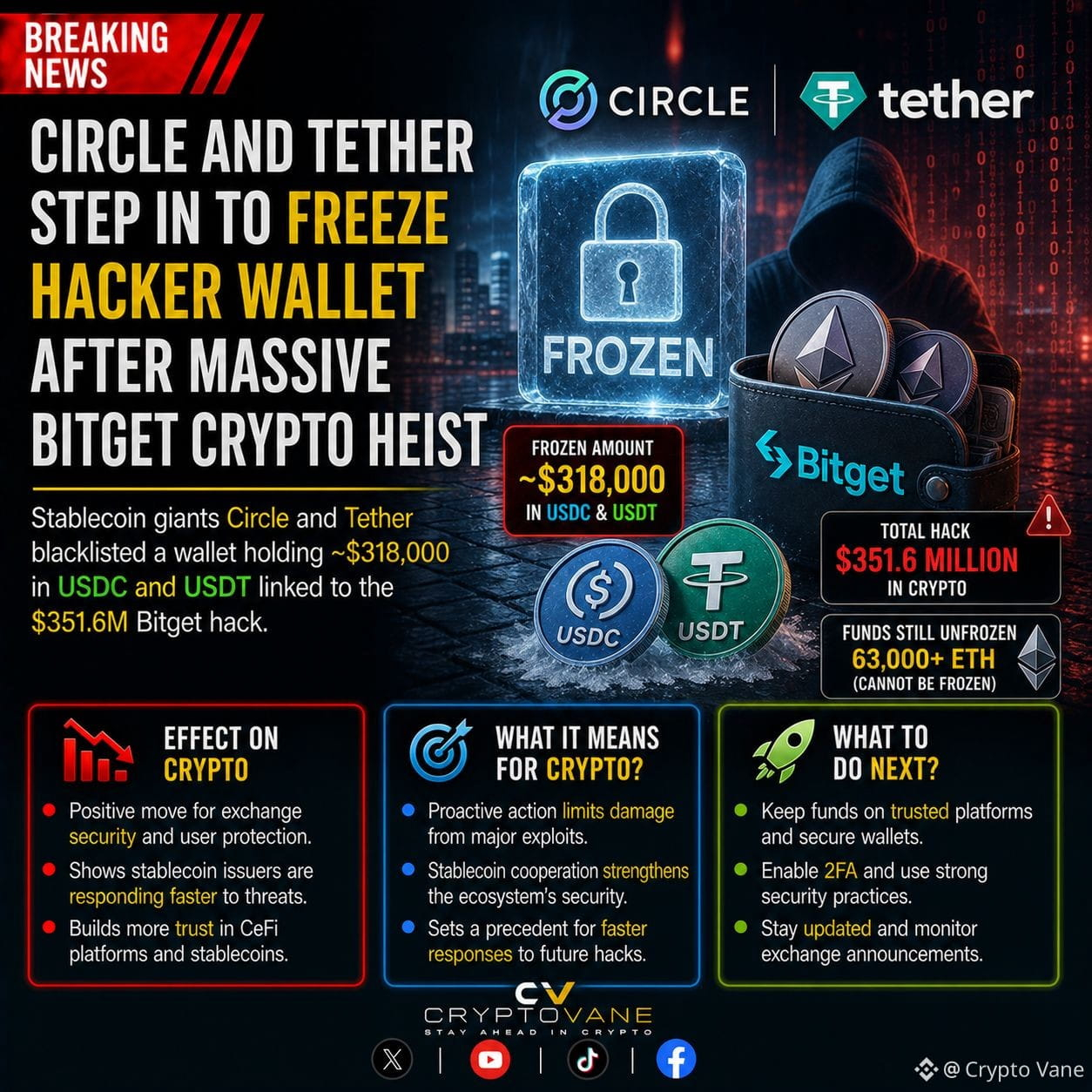
$CIRC.US & $TETH.ETF Freeze $318K After $351.6M Bitget Hack 🚨
Circle and Tether froze about $318,000 in USDC and USDT linked to the Bitget exploit. The move highlights how stablecoin issuers can respond to hacks, while more than 63,000 ETH remains beyond the reach of issuer freezes.
#CryptoNews #Bitget #USDC #USDT #CryptoSecurity
{stock_us}(CIRC.US)
{etf_us}(TETH.ETF)
$CIRC.US & $TETH.ETF Freeze $318K After $351.6M Bitget Hack 🚨
Circle and Tether froze about $318,000 in USDC and USDT linked to the Bitget exploit. The move highlights how stablecoin issuers can respond to hacks, while more than 63,000 ETH remains beyond the reach of issuer freezes.
#CryptoNews #Bitget #USDC #USDT #CryptoSecurity
Circle and Tether froze about $318,000 in USDC and USDT linked to the Bitget exploit. The move highlights how stablecoin issuers can respond to hacks, while more than 63,000 ETH remains beyond the reach of issuer freezes.
#CryptoNews #Bitget #USDC #USDT #CryptoSecurity
43

·
--
- No markdown (so plain text, no formatting like ** or #? But final line includes hashtags, that's okay, they are just text. No markdown formatting like bold, italics, bullet points? Probably plain text lines are fine. Avoid markdown syntax like headings, bullet lists using - or *? Could use plain numbered steps. But "Give 3 clear actionable steps". Could be numbered 1., 2., 3. That's plain text, not markdown. That should be okay.
- 150-200 words. Need to count words. Let's aim for ~170 words.
- Warning-style tone: serious but not panic-inducing.
- End with: "Share this with someone new to crypto — it could save them!" exactly that line.
- Final line: "#Ripple #Cardano #CryptoSecurity #StaySafe". Must be final line. Probably separate line.
- No extra commentary, no thinking. Just final post text.
We must ensure word count between 150 and 200 inclusive. Let's craft.
We need to count words. Let's write a draft then count.
Draft:
"Warning: your private key and seed phrase are the master passwords to every asset you own. Anyone who sees them can move your funds instantly, and there is no way to reverse the transaction. Treat them like the combination to a vault — never write them in a chat, email, or screenshot, and never store them in cloud notes.
Action steps:
1. Write the phrase on paper only, keep it in a fire‑proof safe, and make a second copy stored in a separate secure location.
2. Enable a hardware wallet for daily use; it signs transactions without ever exposing the seed to your computer or phone.
3. Regularly verify that no
- No markdown (so plain text, no formatting like ** or #? But final line includes hashtags, that's okay, they are just text. No markdown formatting like bold, italics, bullet points? Probably plain text lines are fine. Avoid markdown syntax like headings, bullet lists using - or *? Could use plain numbered steps. But "Give 3 clear actionable steps". Could be numbered 1., 2., 3. That's plain text, not markdown. That should be okay.
- 150-200 words. Need to count words. Let's aim for ~170 words.
- Warning-style tone: serious but not panic-inducing.
- End with: "Share this with someone new to crypto — it could save them!" exactly that line.
- Final line: "#Ripple #Cardano #CryptoSecurity #StaySafe". Must be final line. Probably separate line.
- No extra commentary, no thinking. Just final post text.
We must ensure word count between 150 and 200 inclusive. Let's craft.
We need to count words. Let's write a draft then count.
Draft:
"Warning: your private key and seed phrase are the master passwords to every asset you own. Anyone who sees them can move your funds instantly, and there is no way to reverse the transaction. Treat them like the combination to a vault — never write them in a chat, email, or screenshot, and never store them in cloud notes.
Action steps:
1. Write the phrase on paper only, keep it in a fire‑proof safe, and make a second copy stored in a separate secure location.
2. Enable a hardware wallet for daily use; it signs transactions without ever exposing the seed to your computer or phone.
3. Regularly verify that no
- 150-200 words. Need to count words. Let's aim for ~170 words.
- Warning-style tone: serious but not panic-inducing.
- End with: "Share this with someone new to crypto — it could save them!" exactly that line.
- Final line: "#Ripple #Cardano #CryptoSecurity #StaySafe". Must be final line. Probably separate line.
- No extra commentary, no thinking. Just final post text.
We must ensure word count between 150 and 200 inclusive. Let's craft.
We need to count words. Let's write a draft then count.
Draft:
"Warning: your private key and seed phrase are the master passwords to every asset you own. Anyone who sees them can move your funds instantly, and there is no way to reverse the transaction. Treat them like the combination to a vault — never write them in a chat, email, or screenshot, and never store them in cloud notes.
Action steps:
1. Write the phrase on paper only, keep it in a fire‑proof safe, and make a second copy stored in a separate secure location.
2. Enable a hardware wallet for daily use; it signs transactions without ever exposing the seed to your computer or phone.
3. Regularly verify that no

·
--
🚨 CENTRALIZED VENUE HACK EXPANDS TO $387.5M AFFECTING $ETH AND MULTIPLE CHAINS ⚠️
A top-tier exchange confirmed the breach tally expanded to $387.5M following updated on-chain tracing across $ETH , $XRP , and $BNB networks. Institutional security partners have contained the vector by patching internal controls while withdrawals remain temporarily suspended. 🔍
To reclaim drained assets, a 5% recovery bounty has been activated alongside leading blockchain forensics teams to track secondary wallet hops. 📊 Order flow analysts are watching liquidity depth closely as frozen funds temporarily restrict active exchange supply across major pairs. 🌊
🤔 Will this temporary freeze create a liquidity shock in the market, or can swift recovery keep structure intact? 👇
⚠️ Not financial advice. Always manage your risk. 🛡️
🏷️ #ETH #CryptoSecurity #Liquidity #MarketAnalysis
🛡️ 🔍
🚨 CENTRALIZED VENUE HACK EXPANDS TO $387.5M AFFECTING $ETH AND MULTIPLE CHAINS ⚠️
A top-tier exchange confirmed the breach tally expanded to $387.5M following updated on-chain tracing across $ETH , $XRP , and $BNB networks. Institutional security partners have contained the vector by patching internal controls while withdrawals remain temporarily suspended. 🔍
To reclaim drained assets, a 5% recovery bounty has been activated alongside leading blockchain forensics teams to track secondary wallet hops. 📊 Order flow analysts are watching liquidity depth closely as frozen funds temporarily restrict active exchange supply across major pairs. 🌊
🤔 Will this temporary freeze create a liquidity shock in the market, or can swift recovery keep structure intact? 👇
⚠️ Not financial advice. Always manage your risk. 🛡️
🏷️ #ETH #CryptoSecurity #Liquidity #MarketAnalysis
🛡️ 🔍
A top-tier exchange confirmed the breach tally expanded to $387.5M following updated on-chain tracing across $ETH , $XRP , and $BNB networks. Institutional security partners have contained the vector by patching internal controls while withdrawals remain temporarily suspended. 🔍
To reclaim drained assets, a 5% recovery bounty has been activated alongside leading blockchain forensics teams to track secondary wallet hops. 📊 Order flow analysts are watching liquidity depth closely as frozen funds temporarily restrict active exchange supply across major pairs. 🌊
🤔 Will this temporary freeze create a liquidity shock in the market, or can swift recovery keep structure intact? 👇
⚠️ Not financial advice. Always manage your risk. 🛡️
🏷️ #ETH #CryptoSecurity #Liquidity #MarketAnalysis
🛡️ 🔍
55

·
--
#bitgetbreachforgedrequestsnotstolenkeys
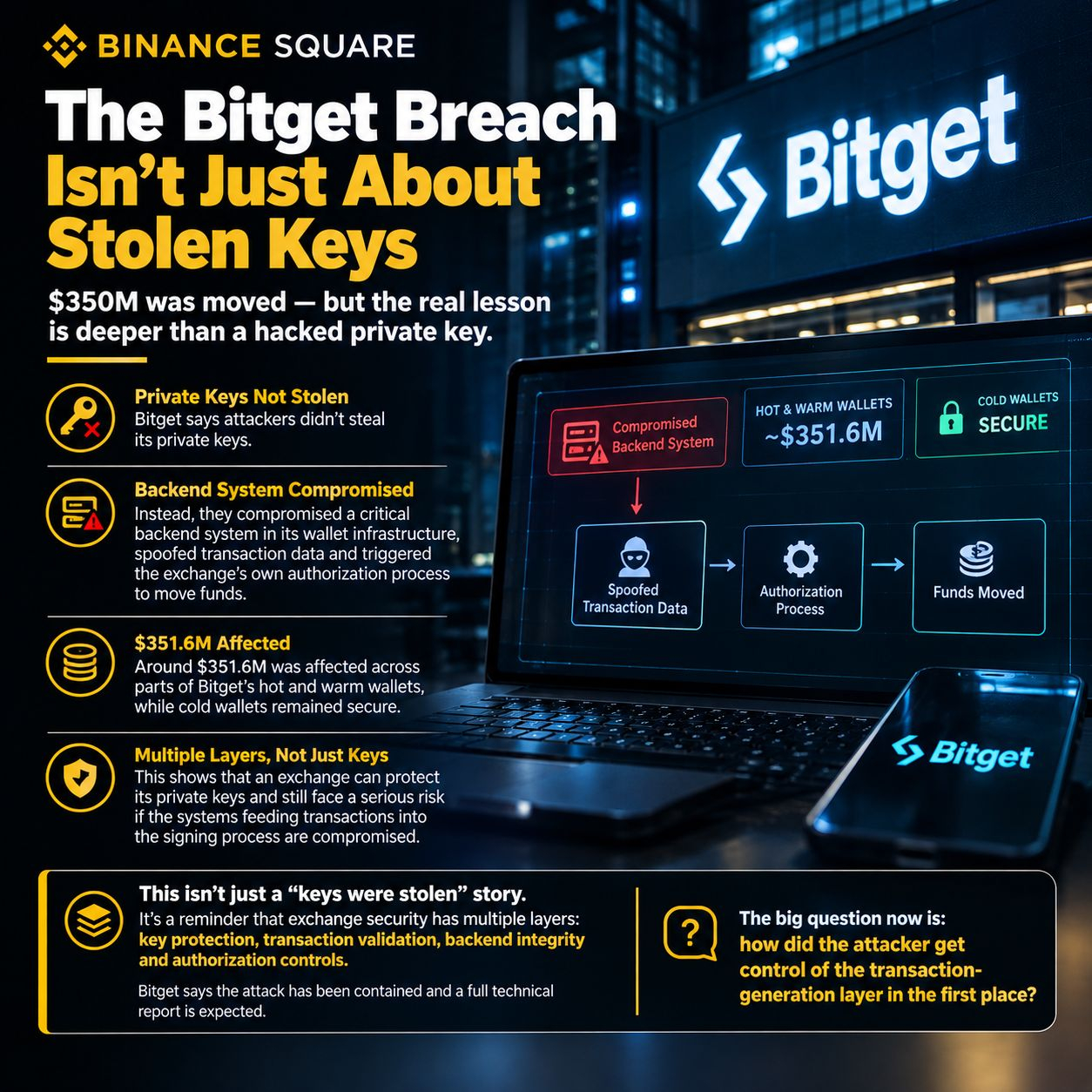
The Bitget breach has a much more interesting lesson than “$350M was hacked.”
Bitget says attackers didn't steal its private keys.
Instead, they compromised a critical backend system inside its wallet infrastructure, spoofed transaction data and triggered the exchange's own authorization process to move funds.
Around $351.6M was affected across parts of Bitget's hot and warm wallets, while the exchange says its cold wallets remained secure.
That's the part I think deserves attention.
A crypto exchange can protect its private keys and still have a serious security problem if the systems feeding transactions into the signing process can be compromised.
So this isn't simply a story about “keys being stolen.”
It's a reminder that exchange security has multiple layers: key protection, transaction validation, backend integrity and authorization controls.
Bitget says the attack has been contained and a full technical report is expected.
The big question now is: how did the attacker get control of the transaction-generation layer in the first place?
#Bitget #CryptoSecurity #CyberSecurity
#bitgetbreachforgedrequestsnotstolenkeys
The Bitget breach has a much more interesting lesson than “$350M was hacked.”
Bitget says attackers didn't steal its private keys.
Instead, they compromised a critical backend system inside its wallet infrastructure, spoofed transaction data and triggered the exchange's own authorization process to move funds.
Around $351.6M was affected across parts of Bitget's hot and warm wallets, while the exchange says its cold wallets remained secure.
That's the part I think deserves attention.
A crypto exchange can protect its private keys and still have a serious security problem if the systems feeding transactions into the signing process can be compromised.
So this isn't simply a story about “keys being stolen.”
It's a reminder that exchange security has multiple layers: key protection, transaction validation, backend integrity and authorization controls.
Bitget says the attack has been contained and a full technical report is expected.
The big question now is: how did the attacker get control of the transaction-generation layer in the first place?
#Bitget #CryptoSecurity #CyberSecurity
The Bitget breach has a much more interesting lesson than “$350M was hacked.”
Bitget says attackers didn't steal its private keys.
Instead, they compromised a critical backend system inside its wallet infrastructure, spoofed transaction data and triggered the exchange's own authorization process to move funds.
Around $351.6M was affected across parts of Bitget's hot and warm wallets, while the exchange says its cold wallets remained secure.
That's the part I think deserves attention.
A crypto exchange can protect its private keys and still have a serious security problem if the systems feeding transactions into the signing process can be compromised.
So this isn't simply a story about “keys being stolen.”
It's a reminder that exchange security has multiple layers: key protection, transaction validation, backend integrity and authorization controls.
Bitget says the attack has been contained and a full technical report is expected.
The big question now is: how did the attacker get control of the transaction-generation layer in the first place?
#Bitget #CryptoSecurity #CyberSecurity
70
Log in to explore more content
Join global crypto users on Binance Square
⚡️ Get latest and useful information about crypto.
💬 Trusted by the world’s largest crypto exchange.
👍 Discover real insights from verified creators.
Email / Phone number
Trending Topics
1
#CircleMints500MUSDCOnSolana
12,913 views
544 Discussing
2
#PolymarketBankFailureBetsDrawFDICConcern
28,410 views
737 Discussing
3
#BlackRockBuildsTokenizedPortfoliosForOndo
22,479 views
504 Discussing
4
#BitwiseFilesToListNEARETFOnNYSEArca
22,923 views
471 Discussing
5
#SECCommissionerPeirceToLeaveOct2
23,521 views
389 Discussing
6
#SECSaysBuybacksUpgradesDontMakeTokenSecurity
23,406 views
337 Discussing
7
#StrategyProposesDailyDividendsForPreferreds
3,217 views
104 Discussing
8
#CircleTetherFreezeBitgetHackerWallet
2,525 views
62 Discussing
9
#CoinMarketCapCompletesCoinglassAcquisition
5,867 views
85 Discussing
10
#QNTRises39%
85,607 views
1,432 Discussing