
Nevo_o
104 Beiträge

Nevo_o
Melden
Nutzer blockieren
crypto enthusiast
24 Following
28 Follower
158 Like gegeben
Beiträge
·
--
FOREX KOMMT ZU TRADFI FUTURES BINANCE. UND DER ERSTE KONTRAKT IST GENAU SO AUFSCHLUSSREICH, WIE ES KLINGT
Am 21. September bringt Binance USDBRLUSDT an den Start — ein Perpetual auf den USD-zu-Brasilianischer-Real-Kurs.
Doch das Setup ist interessanter, als nur „USD/BRL-Handel“.
Der Basiswert ist das Währungspaar USD/BRL.
Die Abrechnung erfolgt in USDT.
Handel — 24/7.
Funding — alle 8 Stunden.
Maximales Leverage — bis zu 100x.
Und hier taucht wieder derselbe, für TradFi Perpetuals bekannte Knackpunkt auf.
Der eigentliche Devisenmarkt hat nämlich seine eigenen Handelssitzungen.
In normalen Stunden wird der Price Index USDBRLUSDT auf Basis externer Kursquellen gebildet.
Und an Wochenenden, wenn der traditionelle FX-Markt geschlossen ist, wechselt Binance auf Orderbook EWMA.
Das heißt: Der Kontrakt wird weitergehandelt.
Aber die Mechanik zur Bestimmung des Indexpreises ändert sich.
Für mich ist das die wichtigste Regel aller 24/7-TradFi-Produkte:
Die Verfügbarkeit des Kontrakts 24/7 bedeutet nicht, dass auch der zugrunde liegende traditionelle Markt ebenfalls 24/7 funktioniert.
Gerade mit dem Leverage sollte man das VERSTEHEN, bevor man eine Position eröffnet.
#CreateWithBinance #ShareMyTradFi #TradFi
FOREX KOMMT ZU TRADFI FUTURES BINANCE. UND DER ERSTE KONTRAKT IST GENAU SO AUFSCHLUSSREICH, WIE ES KLINGT
Am 21. September bringt Binance USDBRLUSDT an den Start — ein Perpetual auf den USD-zu-Brasilianischer-Real-Kurs.
Doch das Setup ist interessanter, als nur „USD/BRL-Handel“.
Der Basiswert ist das Währungspaar USD/BRL.
Die Abrechnung erfolgt in USDT.
Handel — 24/7.
Funding — alle 8 Stunden.
Maximales Leverage — bis zu 100x.
Und hier taucht wieder derselbe, für TradFi Perpetuals bekannte Knackpunkt auf.
Der eigentliche Devisenmarkt hat nämlich seine eigenen Handelssitzungen.
In normalen Stunden wird der Price Index USDBRLUSDT auf Basis externer Kursquellen gebildet.
Und an Wochenenden, wenn der traditionelle FX-Markt geschlossen ist, wechselt Binance auf Orderbook EWMA.
Das heißt: Der Kontrakt wird weitergehandelt.
Aber die Mechanik zur Bestimmung des Indexpreises ändert sich.
Für mich ist das die wichtigste Regel aller 24/7-TradFi-Produkte:
Die Verfügbarkeit des Kontrakts 24/7 bedeutet nicht, dass auch der zugrunde liegende traditionelle Markt ebenfalls 24/7 funktioniert.
Gerade mit dem Leverage sollte man das VERSTEHEN, bevor man eine Position eröffnet.
#CreateWithBinance #ShareMyTradFi #TradFi
Am 21. September bringt Binance USDBRLUSDT an den Start — ein Perpetual auf den USD-zu-Brasilianischer-Real-Kurs.
Doch das Setup ist interessanter, als nur „USD/BRL-Handel“.
Der Basiswert ist das Währungspaar USD/BRL.
Die Abrechnung erfolgt in USDT.
Handel — 24/7.
Funding — alle 8 Stunden.
Maximales Leverage — bis zu 100x.
Und hier taucht wieder derselbe, für TradFi Perpetuals bekannte Knackpunkt auf.
Der eigentliche Devisenmarkt hat nämlich seine eigenen Handelssitzungen.
In normalen Stunden wird der Price Index USDBRLUSDT auf Basis externer Kursquellen gebildet.
Und an Wochenenden, wenn der traditionelle FX-Markt geschlossen ist, wechselt Binance auf Orderbook EWMA.
Das heißt: Der Kontrakt wird weitergehandelt.
Aber die Mechanik zur Bestimmung des Indexpreises ändert sich.
Für mich ist das die wichtigste Regel aller 24/7-TradFi-Produkte:
Die Verfügbarkeit des Kontrakts 24/7 bedeutet nicht, dass auch der zugrunde liegende traditionelle Markt ebenfalls 24/7 funktioniert.
Gerade mit dem Leverage sollte man das VERSTEHEN, bevor man eine Position eröffnet.
#CreateWithBinance #ShareMyTradFi #TradFi
104
·
--
GOLD WIRD AUF BINANCE GEHANDELT – UND AUCH AM WOCHENENDE. ABER DER PREIS WIRD IN DIESEM MOMENT ANDERS BERECHNET
Seit dem 15. September hat Binance den Modus für commodity-basierte TradFi-Perpetuals aktualisiert.
Dazu gehören XAUUSDT, XAGUSDT, COPPERUSDT, CLUSDT, NATGASUSDT und weitere.
Am interessantesten ist für mich nicht der Chart selbst, sondern das, was mit dem Price Index passiert.
Während einer normalen Handelssitzung, von Sonntag 18:00 ET bis Freitag 17:00 ET, wird der Standardmodus verwendet:
Der Index wird jede Sekunde aktualisiert, basierend auf Preisen von externen Datenanbietern.
Und an Wochenenden und Feiertagen ändert sich die Mechanik zu Orderbook EWMA.
Das heißt, ein und derselbe XAUUSDT kann weiterhin zum Handel verfügbar sein, aber die Quelle für die Index-Preisbildung hängt davon ab, ob der zugrunde liegende TradFi-Markt geöffnet ist.
Für mich ist das ein gutes Beispiel dafür, warum „24/7-Verfügbarkeit“ nicht „24/7-der gleiche Markt“ bedeutet.
Vor einem Trade ist es wichtig zu wissen, nicht nur welchen Preis.
Wichtig ist zu verstehen, woher er gerade kommt.
#CreateWithBinance #ShareMyTradFi #TradFi
GOLD WIRD AUF BINANCE GEHANDELT – UND AUCH AM WOCHENENDE. ABER DER PREIS WIRD IN DIESEM MOMENT ANDERS BERECHNET
Seit dem 15. September hat Binance den Modus für commodity-basierte TradFi-Perpetuals aktualisiert.
Dazu gehören XAUUSDT, XAGUSDT, COPPERUSDT, CLUSDT, NATGASUSDT und weitere.
Am interessantesten ist für mich nicht der Chart selbst, sondern das, was mit dem Price Index passiert.
Während einer normalen Handelssitzung, von Sonntag 18:00 ET bis Freitag 17:00 ET, wird der Standardmodus verwendet:
Der Index wird jede Sekunde aktualisiert, basierend auf Preisen von externen Datenanbietern.
Und an Wochenenden und Feiertagen ändert sich die Mechanik zu Orderbook EWMA.
Das heißt, ein und derselbe XAUUSDT kann weiterhin zum Handel verfügbar sein, aber die Quelle für die Index-Preisbildung hängt davon ab, ob der zugrunde liegende TradFi-Markt geöffnet ist.
Für mich ist das ein gutes Beispiel dafür, warum „24/7-Verfügbarkeit“ nicht „24/7-der gleiche Markt“ bedeutet.
Vor einem Trade ist es wichtig zu wissen, nicht nur welchen Preis.
Wichtig ist zu verstehen, woher er gerade kommt.
#CreateWithBinance #ShareMyTradFi #TradFi
Seit dem 15. September hat Binance den Modus für commodity-basierte TradFi-Perpetuals aktualisiert.
Dazu gehören XAUUSDT, XAGUSDT, COPPERUSDT, CLUSDT, NATGASUSDT und weitere.
Am interessantesten ist für mich nicht der Chart selbst, sondern das, was mit dem Price Index passiert.
Während einer normalen Handelssitzung, von Sonntag 18:00 ET bis Freitag 17:00 ET, wird der Standardmodus verwendet:
Der Index wird jede Sekunde aktualisiert, basierend auf Preisen von externen Datenanbietern.
Und an Wochenenden und Feiertagen ändert sich die Mechanik zu Orderbook EWMA.
Das heißt, ein und derselbe XAUUSDT kann weiterhin zum Handel verfügbar sein, aber die Quelle für die Index-Preisbildung hängt davon ab, ob der zugrunde liegende TradFi-Markt geöffnet ist.
Für mich ist das ein gutes Beispiel dafür, warum „24/7-Verfügbarkeit“ nicht „24/7-der gleiche Markt“ bedeutet.
Vor einem Trade ist es wichtig zu wissen, nicht nur welchen Preis.
Wichtig ist zu verstehen, woher er gerade kommt.
#CreateWithBinance #ShareMyTradFi #TradFi
195
·
--
Bullisch
WAS IST ÜBERHAUPT „DER KURS“ EINER AKTIE, DER AUF DER BÖRSE NICHT EXISTIERT?
Genau das macht Pre-IPO Perpetuals interessant und zugleich deutlich komplexer als gewöhnliche TradFi-Kontrakte.
Vor dem IPO wird die Aktie noch nicht an einer öffentlichen Börse gehandelt.
Daher gibt es keinen normalen Price Index, den man einfach vom Markt übernehmen könnte.
In dieser Phase wird der Mark Price für den Pre-IPO-Kontrakt von Binance anhand der Handelsaktivität innerhalb des Binance-Markts berechnet.
Es gibt auch zusätzliche Einschränkungen:
maximales Leverage - 5x;
Funding bis zum IPO ist pro Intervall auf 0,005 % fest festgelegt;
Änderungen des Mark Price werden begrenzt, um starke Kursbewegungen zu bremsen.
Und das Spannendste passiert erst nach dem IPO.
Der Kontrakt wird nicht in derselben Sekunde zu einem normalen TradFi Perpetual, wenn die Aktie an die Börse kommt.
Binance muss zunächst einen hinreichend stabilen externen Index erhalten, bevor die Preisbildungsmechanik schrittweise auf das Standardmodell umgestellt wird.
Deshalb ist Pre-IPO Perp für mich nicht einfach „Handel mit einer Aktie, bevor es alle anderen tun“.
Das ist ein eigener Markt mit einem eigenen Ansatz für price discovery.
Und das Risiko beginnt hier bereits, bevor du überhaupt long oder short gehst.
#CreateWithBinance #ShareMyTradFi #TradFi
WAS IST ÜBERHAUPT „DER KURS“ EINER AKTIE, DER AUF DER BÖRSE NICHT EXISTIERT?
Genau das macht Pre-IPO Perpetuals interessant und zugleich deutlich komplexer als gewöhnliche TradFi-Kontrakte.
Vor dem IPO wird die Aktie noch nicht an einer öffentlichen Börse gehandelt.
Daher gibt es keinen normalen Price Index, den man einfach vom Markt übernehmen könnte.
In dieser Phase wird der Mark Price für den Pre-IPO-Kontrakt von Binance anhand der Handelsaktivität innerhalb des Binance-Markts berechnet.
Es gibt auch zusätzliche Einschränkungen:
maximales Leverage - 5x;
Funding bis zum IPO ist pro Intervall auf 0,005 % fest festgelegt;
Änderungen des Mark Price werden begrenzt, um starke Kursbewegungen zu bremsen.
Und das Spannendste passiert erst nach dem IPO.
Der Kontrakt wird nicht in derselben Sekunde zu einem normalen TradFi Perpetual, wenn die Aktie an die Börse kommt.
Binance muss zunächst einen hinreichend stabilen externen Index erhalten, bevor die Preisbildungsmechanik schrittweise auf das Standardmodell umgestellt wird.
Deshalb ist Pre-IPO Perp für mich nicht einfach „Handel mit einer Aktie, bevor es alle anderen tun“.
Das ist ein eigener Markt mit einem eigenen Ansatz für price discovery.
Und das Risiko beginnt hier bereits, bevor du überhaupt long oder short gehst.
#CreateWithBinance #ShareMyTradFi #TradFi
Genau das macht Pre-IPO Perpetuals interessant und zugleich deutlich komplexer als gewöhnliche TradFi-Kontrakte.
Vor dem IPO wird die Aktie noch nicht an einer öffentlichen Börse gehandelt.
Daher gibt es keinen normalen Price Index, den man einfach vom Markt übernehmen könnte.
In dieser Phase wird der Mark Price für den Pre-IPO-Kontrakt von Binance anhand der Handelsaktivität innerhalb des Binance-Markts berechnet.
Es gibt auch zusätzliche Einschränkungen:
maximales Leverage - 5x;
Funding bis zum IPO ist pro Intervall auf 0,005 % fest festgelegt;
Änderungen des Mark Price werden begrenzt, um starke Kursbewegungen zu bremsen.
Und das Spannendste passiert erst nach dem IPO.
Der Kontrakt wird nicht in derselben Sekunde zu einem normalen TradFi Perpetual, wenn die Aktie an die Börse kommt.
Binance muss zunächst einen hinreichend stabilen externen Index erhalten, bevor die Preisbildungsmechanik schrittweise auf das Standardmodell umgestellt wird.
Deshalb ist Pre-IPO Perp für mich nicht einfach „Handel mit einer Aktie, bevor es alle anderen tun“.
Das ist ein eigener Markt mit einem eigenen Ansatz für price discovery.
Und das Risiko beginnt hier bereits, bevor du überhaupt long oder short gehst.
#CreateWithBinance #ShareMyTradFi #TradFi
95
·
--
FUNDING ALLE 4 STUNDEN – DAS IST NICHT NUR EINE TECHNISCHE KLEINIGKEIT
Seit dem 10. September hat Binance das Funding-Intervall für mehrere TradFi-Perpetual-Kontrakte von 8 auf 4 Stunden geändert.
Dazu gehören unter anderem TENCENTUSDT, MEITUANUSDT, KUAISHOUUSDT und weitere.
Auf den ersten Blick nichts Besonderes.
Aber wenn die Position lange offen ist, wird Funding Teil ihrer Wirtschaftlichkeit.
Perpetuals haben kein Verfallsdatum, deshalb trägt gerade Funding dazu bei, den Kontraktpreis näher am Basismarkt zu halten.
Und hier ist es wichtig zu verstehen:
positives Funding kann bedeuten, dass eine Seite des Marktes an die andere zahlt;
negatives – umgekehrt;
ein kürzeres Intervall bedeutet, dass die Abrechnung häufiger erfolgt.
Deshalb schaue ich vor einer langen Position nicht nur auf:
den Einstiegspunkt;
den Hebel;
die Liquidation.
Noch eine Frage:
Welches Funding und wie viele Abrechnungen können stattfinden, bevor ich die Position halte?
Bei einem kurzen Trade kann das fast nicht auffallen.
Bei einem langen ist es bereits Teil des Ergebnisses.
#CreateWithBinance #ShareMyTradFi #TradFi
FUNDING ALLE 4 STUNDEN – DAS IST NICHT NUR EINE TECHNISCHE KLEINIGKEIT
Seit dem 10. September hat Binance das Funding-Intervall für mehrere TradFi-Perpetual-Kontrakte von 8 auf 4 Stunden geändert.
Dazu gehören unter anderem TENCENTUSDT, MEITUANUSDT, KUAISHOUUSDT und weitere.
Auf den ersten Blick nichts Besonderes.
Aber wenn die Position lange offen ist, wird Funding Teil ihrer Wirtschaftlichkeit.
Perpetuals haben kein Verfallsdatum, deshalb trägt gerade Funding dazu bei, den Kontraktpreis näher am Basismarkt zu halten.
Und hier ist es wichtig zu verstehen:
positives Funding kann bedeuten, dass eine Seite des Marktes an die andere zahlt;
negatives – umgekehrt;
ein kürzeres Intervall bedeutet, dass die Abrechnung häufiger erfolgt.
Deshalb schaue ich vor einer langen Position nicht nur auf:
den Einstiegspunkt;
den Hebel;
die Liquidation.
Noch eine Frage:
Welches Funding und wie viele Abrechnungen können stattfinden, bevor ich die Position halte?
Bei einem kurzen Trade kann das fast nicht auffallen.
Bei einem langen ist es bereits Teil des Ergebnisses.
#CreateWithBinance #ShareMyTradFi #TradFi
Seit dem 10. September hat Binance das Funding-Intervall für mehrere TradFi-Perpetual-Kontrakte von 8 auf 4 Stunden geändert.
Dazu gehören unter anderem TENCENTUSDT, MEITUANUSDT, KUAISHOUUSDT und weitere.
Auf den ersten Blick nichts Besonderes.
Aber wenn die Position lange offen ist, wird Funding Teil ihrer Wirtschaftlichkeit.
Perpetuals haben kein Verfallsdatum, deshalb trägt gerade Funding dazu bei, den Kontraktpreis näher am Basismarkt zu halten.
Und hier ist es wichtig zu verstehen:
positives Funding kann bedeuten, dass eine Seite des Marktes an die andere zahlt;
negatives – umgekehrt;
ein kürzeres Intervall bedeutet, dass die Abrechnung häufiger erfolgt.
Deshalb schaue ich vor einer langen Position nicht nur auf:
den Einstiegspunkt;
den Hebel;
die Liquidation.
Noch eine Frage:
Welches Funding und wie viele Abrechnungen können stattfinden, bevor ich die Position halte?
Bei einem kurzen Trade kann das fast nicht auffallen.
Bei einem langen ist es bereits Teil des Ergebnisses.
#CreateWithBinance #ShareMyTradFi #TradFi
1
106
·
--
Bullisch
DIVIDENDE BEI bSTOCKS KOMMEN NICHT ALS GEWÖHNLICHE BARGELDZAHUNG AUF DEM KONTO AN
Heute gibt es ein gutes, lebendiges Beispiel mit $NVDAB.
Für Inhaber von NVIDIA bStock wurde ein Snapshot zur Ausschüttung der Dividende festgelegt.
Aber hier unterscheidet sich die Mechanik von der klassischen Aktie.
Nach Steuern, Gebühren und anderen Abzügen wird die Dividendensumme wieder in zusätzliche Einheiten oder Anteile von $NVDAB reinvestiert.
Das heißt vereinfacht:
es gab 0.10 NVDAB;
das Unternehmen hat eine Dividende ausgeschüttet;
nach den Abzügen erhältst du nicht eine separate USDT-Zahlung, sondern eine etwas größere Menge NVDAB.
Für On-Chain-Inhaber erfolgt die Ausschüttung durch Anpassung des Multiplier.
Das ist ein wichtiger Punkt, denn manchmal begegnet man der These, dass bStocks „keine Dividenden haben“.
Genauer gesagt anders: Die Dividendenmechanik gibt es hier, sie kopiert nur nicht eins zu eins das Broker-Modell.
Solche Nuancen würde ich prüfen, bevor ich ein tokenisiertes Asset mit einer normalen Aktie vergleiche.
#CreateWithBinance #ShareMyTradFi #bStocks #NVDAB
DIVIDENDE BEI bSTOCKS KOMMEN NICHT ALS GEWÖHNLICHE BARGELDZAHUNG AUF DEM KONTO AN
Heute gibt es ein gutes, lebendiges Beispiel mit $NVDAB.
Für Inhaber von NVIDIA bStock wurde ein Snapshot zur Ausschüttung der Dividende festgelegt.
Aber hier unterscheidet sich die Mechanik von der klassischen Aktie.
Nach Steuern, Gebühren und anderen Abzügen wird die Dividendensumme wieder in zusätzliche Einheiten oder Anteile von $NVDAB reinvestiert.
Das heißt vereinfacht:
es gab 0.10 NVDAB;
das Unternehmen hat eine Dividende ausgeschüttet;
nach den Abzügen erhältst du nicht eine separate USDT-Zahlung, sondern eine etwas größere Menge NVDAB.
Für On-Chain-Inhaber erfolgt die Ausschüttung durch Anpassung des Multiplier.
Das ist ein wichtiger Punkt, denn manchmal begegnet man der These, dass bStocks „keine Dividenden haben“.
Genauer gesagt anders: Die Dividendenmechanik gibt es hier, sie kopiert nur nicht eins zu eins das Broker-Modell.
Solche Nuancen würde ich prüfen, bevor ich ein tokenisiertes Asset mit einer normalen Aktie vergleiche.
#CreateWithBinance #ShareMyTradFi #bStocks #NVDAB
Heute gibt es ein gutes, lebendiges Beispiel mit $NVDAB.
Für Inhaber von NVIDIA bStock wurde ein Snapshot zur Ausschüttung der Dividende festgelegt.
Aber hier unterscheidet sich die Mechanik von der klassischen Aktie.
Nach Steuern, Gebühren und anderen Abzügen wird die Dividendensumme wieder in zusätzliche Einheiten oder Anteile von $NVDAB reinvestiert.
Das heißt vereinfacht:
es gab 0.10 NVDAB;
das Unternehmen hat eine Dividende ausgeschüttet;
nach den Abzügen erhältst du nicht eine separate USDT-Zahlung, sondern eine etwas größere Menge NVDAB.
Für On-Chain-Inhaber erfolgt die Ausschüttung durch Anpassung des Multiplier.
Das ist ein wichtiger Punkt, denn manchmal begegnet man der These, dass bStocks „keine Dividenden haben“.
Genauer gesagt anders: Die Dividendenmechanik gibt es hier, sie kopiert nur nicht eins zu eins das Broker-Modell.
Solche Nuancen würde ich prüfen, bevor ich ein tokenisiertes Asset mit einer normalen Aktie vergleiche.
#CreateWithBinance #ShareMyTradFi #bStocks #NVDAB
1
341
·
--
Bullisch
1:1 SORGFALT—DAS MACHT bSTOCK NICHT ZU EINER GEWÖHNLICHEN AKTIE
Wahrscheinlich wäre das das Erste, was ich vor dem Kauf von bStocks prüfen würde.
Die Formulierung „1:1 backed“ lässt sich leicht als „das ist einfach eine Aktie auf der Blockchain“ lesen.
Nicht ganz.
Hinter jedem bStock steht eine entsprechende Basisaktie bei einem regulierten Verwahrer. Aber der Inhaber des Tokens wird nicht direkt Aktionär des Unternehmens.
Für mich ist der Unterschied entscheidend.
Ich erhalte eine Kurs-Exposition gegenüber einem traditionellen Vermögenswert, die Möglichkeit, ihn 24/7 zu handeln, und die Möglichkeit, mit einer Bruchteilposition ab einem kleinen Betrag zu arbeiten.
Aber die rechtliche Konstruktion ist anders.
Daher stelle ich mir vor jedem RWA jetzt drei Fragen:
Was genau besichert den Token?
Wer hält den Basiswert?
Welche Rechte gibt mir der Token – und welche nicht?
„1:1“ beantwortet nur die erste Frage.
Und genau deshalb ist es manchmal wichtiger, die Produktstruktur zu lesen, als auf ein vertrautes NVIDIA- oder Tesla-Logo zu schauen.
#CreateWithBinance #ShareMyTradFi #bStocks
1:1 SORGFALT—DAS MACHT bSTOCK NICHT ZU EINER GEWÖHNLICHEN AKTIE
Wahrscheinlich wäre das das Erste, was ich vor dem Kauf von bStocks prüfen würde.
Die Formulierung „1:1 backed“ lässt sich leicht als „das ist einfach eine Aktie auf der Blockchain“ lesen.
Nicht ganz.
Hinter jedem bStock steht eine entsprechende Basisaktie bei einem regulierten Verwahrer. Aber der Inhaber des Tokens wird nicht direkt Aktionär des Unternehmens.
Für mich ist der Unterschied entscheidend.
Ich erhalte eine Kurs-Exposition gegenüber einem traditionellen Vermögenswert, die Möglichkeit, ihn 24/7 zu handeln, und die Möglichkeit, mit einer Bruchteilposition ab einem kleinen Betrag zu arbeiten.
Aber die rechtliche Konstruktion ist anders.
Daher stelle ich mir vor jedem RWA jetzt drei Fragen:
Was genau besichert den Token?
Wer hält den Basiswert?
Welche Rechte gibt mir der Token – und welche nicht?
„1:1“ beantwortet nur die erste Frage.
Und genau deshalb ist es manchmal wichtiger, die Produktstruktur zu lesen, als auf ein vertrautes NVIDIA- oder Tesla-Logo zu schauen.
#CreateWithBinance #ShareMyTradFi #bStocks
Wahrscheinlich wäre das das Erste, was ich vor dem Kauf von bStocks prüfen würde.
Die Formulierung „1:1 backed“ lässt sich leicht als „das ist einfach eine Aktie auf der Blockchain“ lesen.
Nicht ganz.
Hinter jedem bStock steht eine entsprechende Basisaktie bei einem regulierten Verwahrer. Aber der Inhaber des Tokens wird nicht direkt Aktionär des Unternehmens.
Für mich ist der Unterschied entscheidend.
Ich erhalte eine Kurs-Exposition gegenüber einem traditionellen Vermögenswert, die Möglichkeit, ihn 24/7 zu handeln, und die Möglichkeit, mit einer Bruchteilposition ab einem kleinen Betrag zu arbeiten.
Aber die rechtliche Konstruktion ist anders.
Daher stelle ich mir vor jedem RWA jetzt drei Fragen:
Was genau besichert den Token?
Wer hält den Basiswert?
Welche Rechte gibt mir der Token – und welche nicht?
„1:1“ beantwortet nur die erste Frage.
Und genau deshalb ist es manchmal wichtiger, die Produktstruktur zu lesen, als auf ein vertrautes NVIDIA- oder Tesla-Logo zu schauen.
#CreateWithBinance #ShareMyTradFi #bStocks
1
68
·
--
Bullisch
Diese langen TermMax-Marktnamen sahen aus wie Tickersalat, also habe ich anfangs nur das Datum am Ende gelesen. Das war ein Fehler.
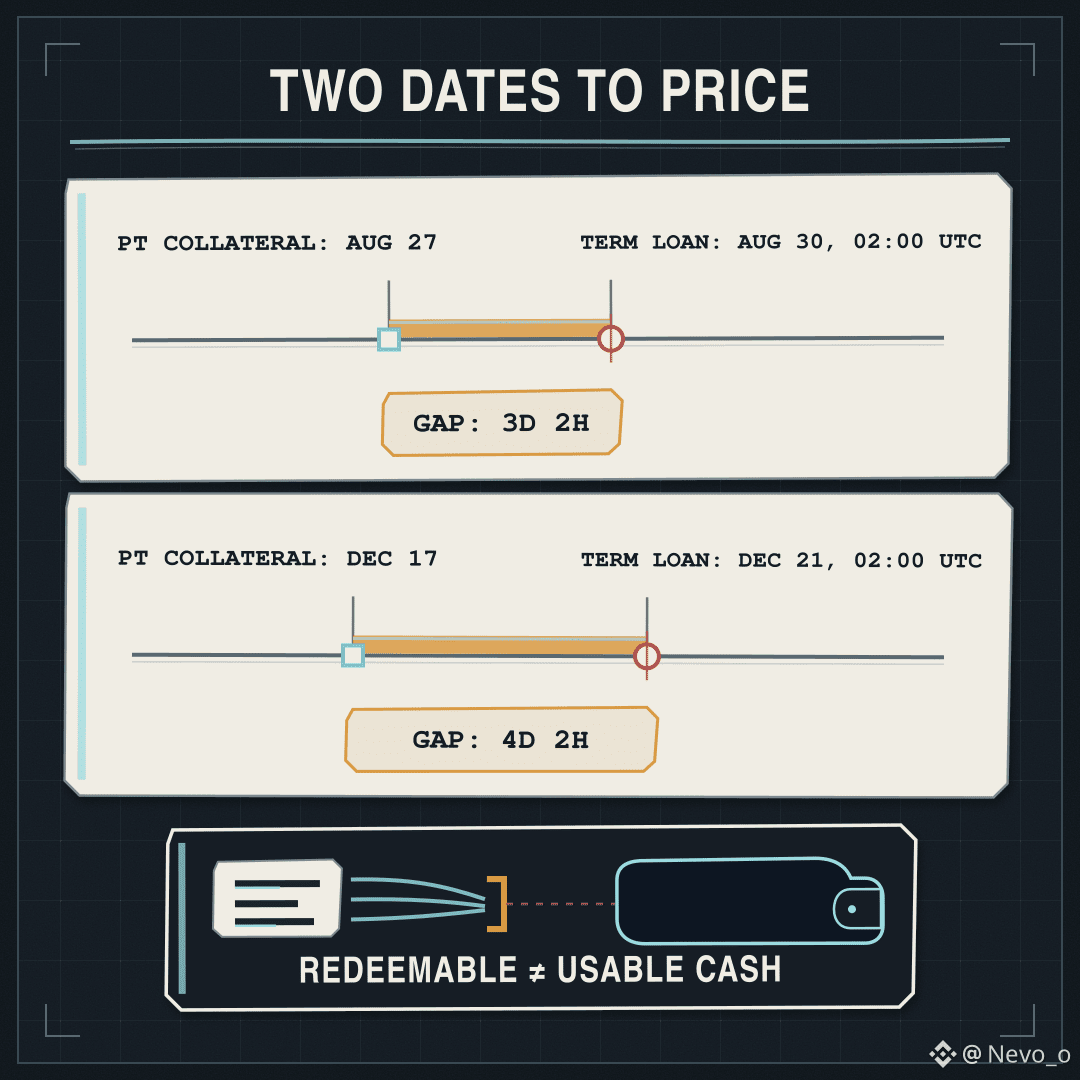
Im App-Snapshot vom 21. Aug zeigte USDC/PT-USDat-27AUG2026@30AUG2026 ungefähr 1 Mio. US-Dollar TVL, während die Version PT-srUSDat etwa 317.000 US-Dollar hatte.
Hier ist der Detailpunkt, den ich fast übersehen hätte: Beide Sicherheiten-Token werden am 27. Aug fällig, aber die TermMax-Kredite am 30. Aug um 02:00 UTC. Die neueren Dezember-PT-Märkte wiederholen dasselbe Muster mit einer Lücke von ungefähr 3 bis 4 Tagen.
Das bedeutet: „Sicherheit ist fällig“ und „die Schuld ist fällig“ sind zwei getrennte Ereignisse.
Mein Eindruck ist, dass diese Lücke dem PT Zeit gibt, sein Rückkaufs-Asset zu erreichen, bevor der Kredit ausläuft. Aber das ist kein automatisch risikofreier Puffer. Einige dieser Beschreibungen der Sicherheiten erwähnen noch immer Limits für die Pool-Liquidität, Rückkaufgebühren oder Cooldowns.
Ich würde daher zwei Fragen verfolgen, nicht nur eine:
Wann wird die Sicherheit rücktauschbar?
Und kann sie tatsächlich als nutzbares Cash dienen, bevor die Schuld fällig ist?
Die Reifezeit, die am Ende des Marktnamens gedruckt ist, beantwortet nur die Hälfte davon.
@termmax #TermMax
Diese langen TermMax-Marktnamen sahen aus wie Tickersalat, also habe ich anfangs nur das Datum am Ende gelesen. Das war ein Fehler.
Im App-Snapshot vom 21. Aug zeigte USDC/PT-USDat-27AUG2026@30AUG2026 ungefähr 1 Mio. US-Dollar TVL, während die Version PT-srUSDat etwa 317.000 US-Dollar hatte.
Hier ist der Detailpunkt, den ich fast übersehen hätte: Beide Sicherheiten-Token werden am 27. Aug fällig, aber die TermMax-Kredite am 30. Aug um 02:00 UTC. Die neueren Dezember-PT-Märkte wiederholen dasselbe Muster mit einer Lücke von ungefähr 3 bis 4 Tagen.
Das bedeutet: „Sicherheit ist fällig“ und „die Schuld ist fällig“ sind zwei getrennte Ereignisse.
Mein Eindruck ist, dass diese Lücke dem PT Zeit gibt, sein Rückkaufs-Asset zu erreichen, bevor der Kredit ausläuft. Aber das ist kein automatisch risikofreier Puffer. Einige dieser Beschreibungen der Sicherheiten erwähnen noch immer Limits für die Pool-Liquidität, Rückkaufgebühren oder Cooldowns.
Ich würde daher zwei Fragen verfolgen, nicht nur eine:
Wann wird die Sicherheit rücktauschbar?
Und kann sie tatsächlich als nutzbares Cash dienen, bevor die Schuld fällig ist?
Die Reifezeit, die am Ende des Marktnamens gedruckt ist, beantwortet nur die Hälfte davon.
@TermMax #TermMax
Im App-Snapshot vom 21. Aug zeigte USDC/PT-USDat-27AUG2026@30AUG2026 ungefähr 1 Mio. US-Dollar TVL, während die Version PT-srUSDat etwa 317.000 US-Dollar hatte.
Hier ist der Detailpunkt, den ich fast übersehen hätte: Beide Sicherheiten-Token werden am 27. Aug fällig, aber die TermMax-Kredite am 30. Aug um 02:00 UTC. Die neueren Dezember-PT-Märkte wiederholen dasselbe Muster mit einer Lücke von ungefähr 3 bis 4 Tagen.
Das bedeutet: „Sicherheit ist fällig“ und „die Schuld ist fällig“ sind zwei getrennte Ereignisse.
Mein Eindruck ist, dass diese Lücke dem PT Zeit gibt, sein Rückkaufs-Asset zu erreichen, bevor der Kredit ausläuft. Aber das ist kein automatisch risikofreier Puffer. Einige dieser Beschreibungen der Sicherheiten erwähnen noch immer Limits für die Pool-Liquidität, Rückkaufgebühren oder Cooldowns.
Ich würde daher zwei Fragen verfolgen, nicht nur eine:
Wann wird die Sicherheit rücktauschbar?
Und kann sie tatsächlich als nutzbares Cash dienen, bevor die Schuld fällig ist?
Die Reifezeit, die am Ende des Marktnamens gedruckt ist, beantwortet nur die Hälfte davon.
@TermMax #TermMax
1
136
·
--
Bullisch
Ich hatte Smart-Contract-Audits als Abschlusslinie für die TermMax-Sicherheit behandelt. Das war zu ordentlich.
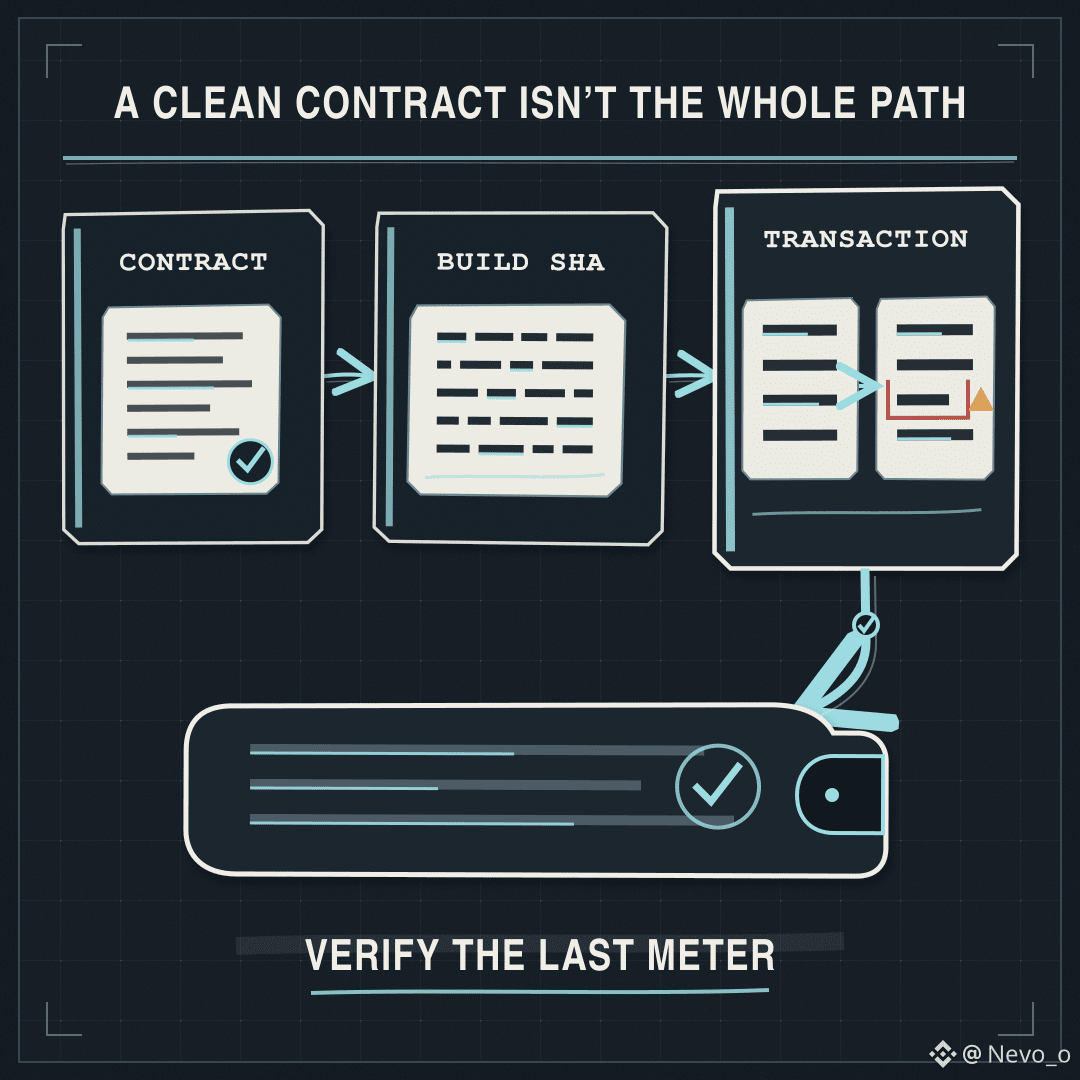
Ein sauberer Vertrag hilft nicht, wenn die Seite davor die Vertragsadresse austauscht oder die Transaktionsparameter ändert, bevor ich unterschreibe. Der letzte Kilometer zwischen der App und meiner Wallet gehört ebenfalls zum Protokoll.
Die Sicherheitsdokumentation von TermMax sagt, dass bei jeder Frontend-Veröffentlichung ein eindeutiger Build-SHA vergeben wird, die aktuelle SHA in der App angezeigt wird und automatische Prüfungen den bereitgestellten Build mit dem erwarteten abgleichen. Jede Abweichung soll einen Alarm auslösen. Außerdem beschreiben sie Container-Image-Scans und eine restriktive Content-Security-Policy.
Was es weniger nach einer Checkliste wirken ließ, war das Timing. Die TermMax-App V2 wurde am 17. August in den Immunefi-Umfang aufgenommen. Dieser Umfang behandelt böswillige Änderungen an den Transaktionsparametern einer verbundenen Wallet, Vertragsaustausch oder böswillige Transaktionsübermittlung ausdrücklich als kritische Auswirkungen.
Das gefällt mir, weil es die Sache testet, die die Nutzer tatsächlich anfassen – nicht nur die Verträge im Hintergrund.
Es gibt aber noch eine Frage, die ich stellen würde. Die Doku sagt, dass die maßgebliche SHA-Referenz intern gepflegt wird. Ein Hash, der innerhalb der App angezeigt wird, wird viel nützlicher, wenn Nutzer ihn mit einer unabhängig veröffentlichten Referenz vergleichen können.
Meine Sicherheitsprüfung besteht jetzt aus zwei Zeilen: Ist der Vertrag vertrauenswürdig, und bedient die Oberfläche den Build, von dem ich glaube, dass sie ihn liefert?
@termmax #TermMax
Ich hatte Smart-Contract-Audits als Abschlusslinie für die TermMax-Sicherheit behandelt. Das war zu ordentlich.
Ein sauberer Vertrag hilft nicht, wenn die Seite davor die Vertragsadresse austauscht oder die Transaktionsparameter ändert, bevor ich unterschreibe. Der letzte Kilometer zwischen der App und meiner Wallet gehört ebenfalls zum Protokoll.
Die Sicherheitsdokumentation von TermMax sagt, dass bei jeder Frontend-Veröffentlichung ein eindeutiger Build-SHA vergeben wird, die aktuelle SHA in der App angezeigt wird und automatische Prüfungen den bereitgestellten Build mit dem erwarteten abgleichen. Jede Abweichung soll einen Alarm auslösen. Außerdem beschreiben sie Container-Image-Scans und eine restriktive Content-Security-Policy.
Was es weniger nach einer Checkliste wirken ließ, war das Timing. Die TermMax-App V2 wurde am 17. August in den Immunefi-Umfang aufgenommen. Dieser Umfang behandelt böswillige Änderungen an den Transaktionsparametern einer verbundenen Wallet, Vertragsaustausch oder böswillige Transaktionsübermittlung ausdrücklich als kritische Auswirkungen.
Das gefällt mir, weil es die Sache testet, die die Nutzer tatsächlich anfassen – nicht nur die Verträge im Hintergrund.
Es gibt aber noch eine Frage, die ich stellen würde. Die Doku sagt, dass die maßgebliche SHA-Referenz intern gepflegt wird. Ein Hash, der innerhalb der App angezeigt wird, wird viel nützlicher, wenn Nutzer ihn mit einer unabhängig veröffentlichten Referenz vergleichen können.
Meine Sicherheitsprüfung besteht jetzt aus zwei Zeilen: Ist der Vertrag vertrauenswürdig, und bedient die Oberfläche den Build, von dem ich glaube, dass sie ihn liefert?
@TermMax #TermMax
Ein sauberer Vertrag hilft nicht, wenn die Seite davor die Vertragsadresse austauscht oder die Transaktionsparameter ändert, bevor ich unterschreibe. Der letzte Kilometer zwischen der App und meiner Wallet gehört ebenfalls zum Protokoll.
Die Sicherheitsdokumentation von TermMax sagt, dass bei jeder Frontend-Veröffentlichung ein eindeutiger Build-SHA vergeben wird, die aktuelle SHA in der App angezeigt wird und automatische Prüfungen den bereitgestellten Build mit dem erwarteten abgleichen. Jede Abweichung soll einen Alarm auslösen. Außerdem beschreiben sie Container-Image-Scans und eine restriktive Content-Security-Policy.
Was es weniger nach einer Checkliste wirken ließ, war das Timing. Die TermMax-App V2 wurde am 17. August in den Immunefi-Umfang aufgenommen. Dieser Umfang behandelt böswillige Änderungen an den Transaktionsparametern einer verbundenen Wallet, Vertragsaustausch oder böswillige Transaktionsübermittlung ausdrücklich als kritische Auswirkungen.
Das gefällt mir, weil es die Sache testet, die die Nutzer tatsächlich anfassen – nicht nur die Verträge im Hintergrund.
Es gibt aber noch eine Frage, die ich stellen würde. Die Doku sagt, dass die maßgebliche SHA-Referenz intern gepflegt wird. Ein Hash, der innerhalb der App angezeigt wird, wird viel nützlicher, wenn Nutzer ihn mit einer unabhängig veröffentlichten Referenz vergleichen können.
Meine Sicherheitsprüfung besteht jetzt aus zwei Zeilen: Ist der Vertrag vertrauenswürdig, und bedient die Oberfläche den Build, von dem ich glaube, dass sie ihn liefert?
@TermMax #TermMax
1
86
·
--
Bullisch
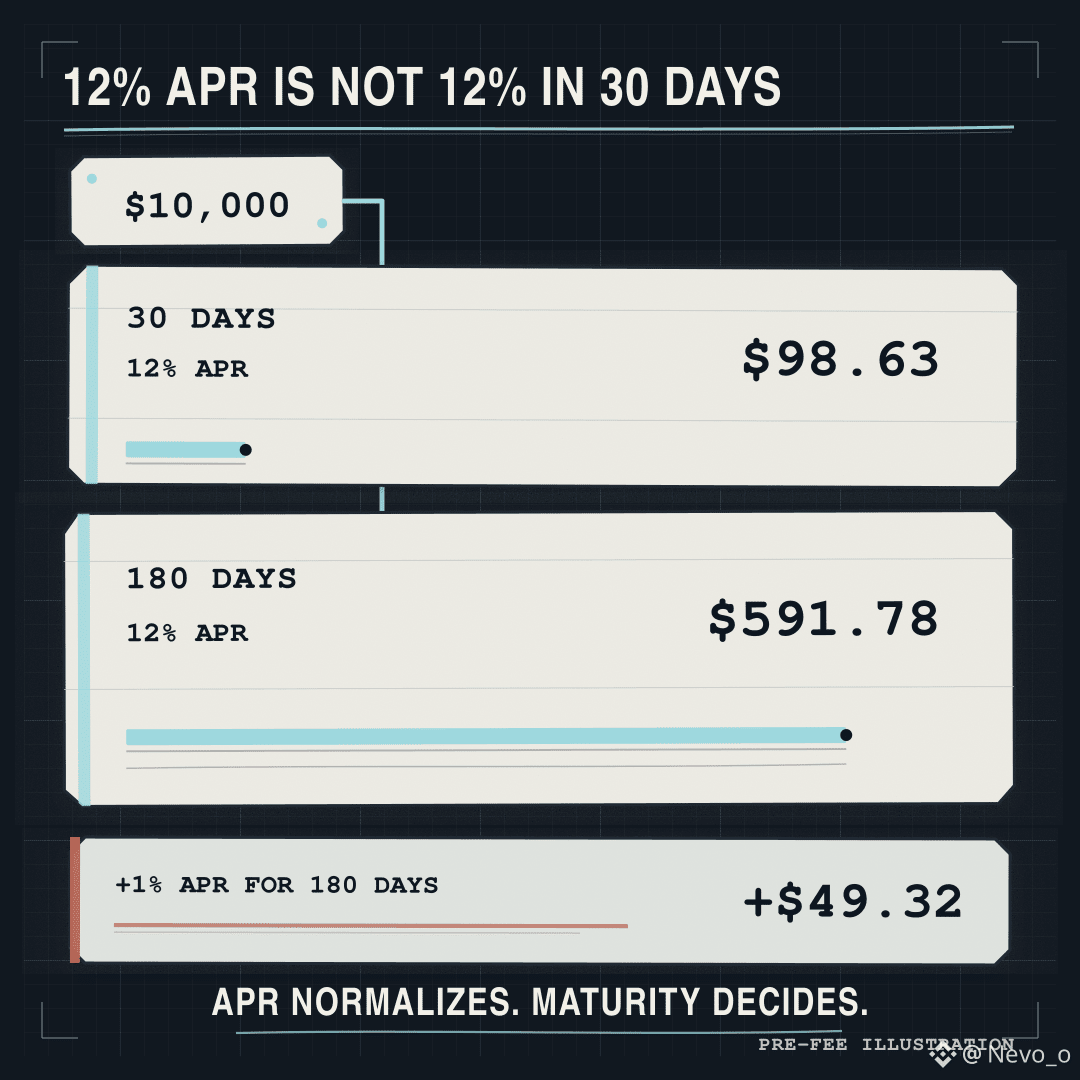
12% APR ist keine 12% Rendite für eine 30-Tage-Position.
Offensichtlich, vielleicht. Dennoch lassen jährliche Bezeichnungen zwei TermMax-Märkte ähnlicher wirken, als sie es sind.
Bei 10.000 US-Dollar, anhand eines einfachen Vergleichs vor Gebühren:
30 Tage bei 12% APR = etwa 98,63 US-Dollar
180 Tage bei 12% APR = etwa 591,78 US-Dollar
Die zweite Zahl ist ungefähr sechs Mal so groß, weil die Exponierung ungefähr sechs Mal länger läuft, wenn man bis zur Fälligkeit hält. Das ist kein besserer Zinssatz. Es ist eine längere Laufzeit.
Sehen wir uns nun ein 180-Tage-Angebot an, das von 12% auf 13% steigt. Dieser komplette zusätzliche Prozentpunkt bringt über die Laufzeit nur etwa 49,32 US-Dollar mehr auf 10.000 US-Dollar. Ich würde fragen, ob das eine dünnere Marktliquidität, riskantere Sicherheiten oder einen schwierigeren Ausstieg ausgleicht.
Daher würde ich TermMax-Märkte nicht allein nach dem APR einordnen. Ich würde reale Dollarbeträge bis zur Fälligkeit vergleichen, Markt-Tiefe, Qualität der Sicherheiten und die Kosten eines frühen Ausstiegs.
Ein fixer Zinssatz nimmt eine Unbekannte weg. Die Fälligkeit sagt mir, für wie lange die Entscheidung bepreist ist.
@termmax #TermMax
12% APR ist keine 12% Rendite für eine 30-Tage-Position.
Offensichtlich, vielleicht. Dennoch lassen jährliche Bezeichnungen zwei TermMax-Märkte ähnlicher wirken, als sie es sind.
Bei 10.000 US-Dollar, anhand eines einfachen Vergleichs vor Gebühren:
30 Tage bei 12% APR = etwa 98,63 US-Dollar
180 Tage bei 12% APR = etwa 591,78 US-Dollar
Die zweite Zahl ist ungefähr sechs Mal so groß, weil die Exponierung ungefähr sechs Mal länger läuft, wenn man bis zur Fälligkeit hält. Das ist kein besserer Zinssatz. Es ist eine längere Laufzeit.
Sehen wir uns nun ein 180-Tage-Angebot an, das von 12% auf 13% steigt. Dieser komplette zusätzliche Prozentpunkt bringt über die Laufzeit nur etwa 49,32 US-Dollar mehr auf 10.000 US-Dollar. Ich würde fragen, ob das eine dünnere Marktliquidität, riskantere Sicherheiten oder einen schwierigeren Ausstieg ausgleicht.
Daher würde ich TermMax-Märkte nicht allein nach dem APR einordnen. Ich würde reale Dollarbeträge bis zur Fälligkeit vergleichen, Markt-Tiefe, Qualität der Sicherheiten und die Kosten eines frühen Ausstiegs.
Ein fixer Zinssatz nimmt eine Unbekannte weg. Die Fälligkeit sagt mir, für wie lange die Entscheidung bepreist ist.
@TermMax #TermMax
Offensichtlich, vielleicht. Dennoch lassen jährliche Bezeichnungen zwei TermMax-Märkte ähnlicher wirken, als sie es sind.
Bei 10.000 US-Dollar, anhand eines einfachen Vergleichs vor Gebühren:
30 Tage bei 12% APR = etwa 98,63 US-Dollar
180 Tage bei 12% APR = etwa 591,78 US-Dollar
Die zweite Zahl ist ungefähr sechs Mal so groß, weil die Exponierung ungefähr sechs Mal länger läuft, wenn man bis zur Fälligkeit hält. Das ist kein besserer Zinssatz. Es ist eine längere Laufzeit.
Sehen wir uns nun ein 180-Tage-Angebot an, das von 12% auf 13% steigt. Dieser komplette zusätzliche Prozentpunkt bringt über die Laufzeit nur etwa 49,32 US-Dollar mehr auf 10.000 US-Dollar. Ich würde fragen, ob das eine dünnere Marktliquidität, riskantere Sicherheiten oder einen schwierigeren Ausstieg ausgleicht.
Daher würde ich TermMax-Märkte nicht allein nach dem APR einordnen. Ich würde reale Dollarbeträge bis zur Fälligkeit vergleichen, Markt-Tiefe, Qualität der Sicherheiten und die Kosten eines frühen Ausstiegs.
Ein fixer Zinssatz nimmt eine Unbekannte weg. Die Fälligkeit sagt mir, für wie lange die Entscheidung bepreist ist.
@TermMax #TermMax
1
97
·
--
Bullisch
Oracle-Risiko lässt sich auf Protokollebene leichter diskutieren als auf Marktebene zu messen. Ich habe die aktuelle Ethereum-Oracle-Tabelle von TermMax geprüft und eine hilfreiche Gegenüberstellung gefunden.
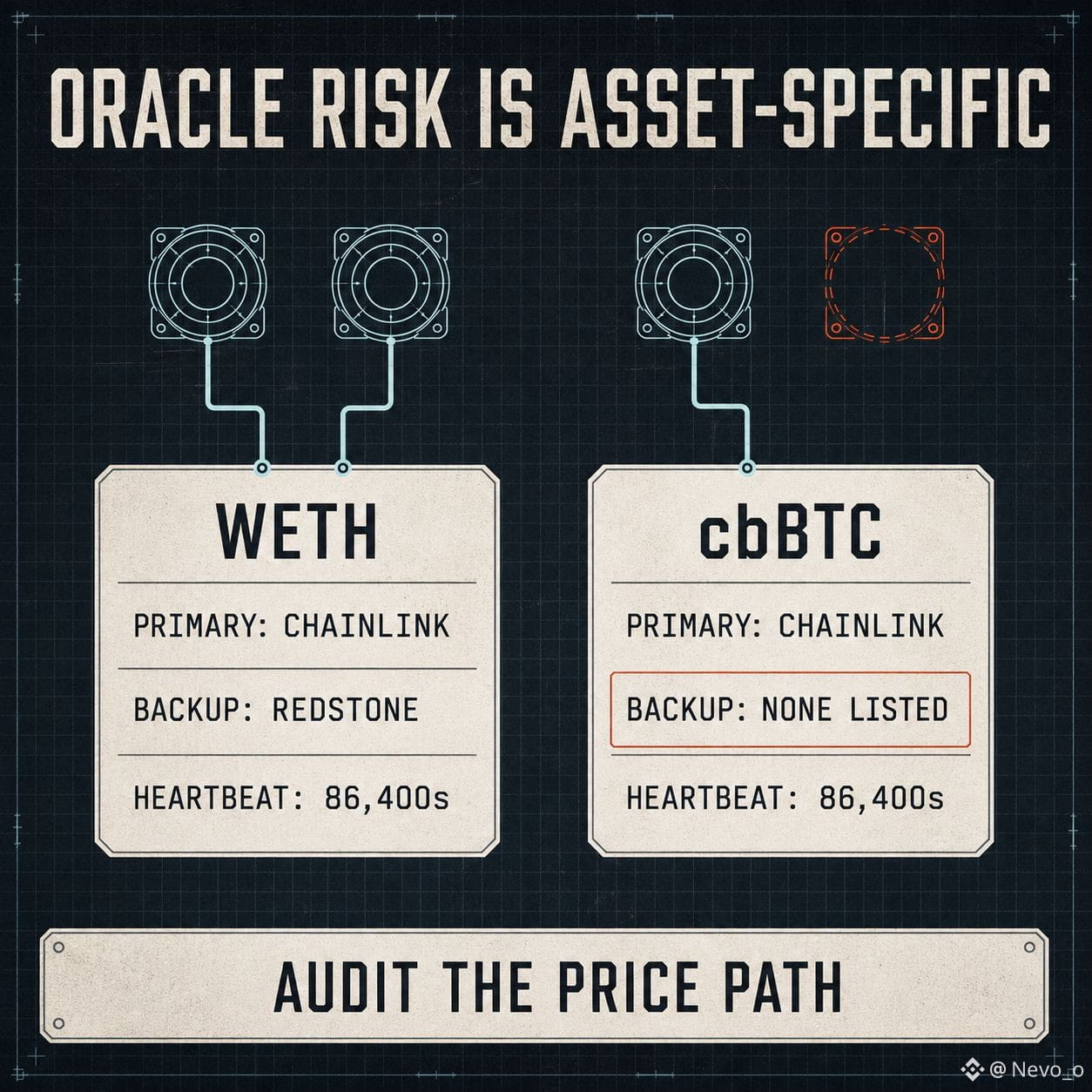
WETH führt Chainlink als primären Feed, RedStone als Backup und eine 86.400-Sekunden-Heartbeat-Intervallzeit. cbBTC führt einen Chainlink-Feed auf, denselben Heartbeat, aber keinen Backup-Feed.
Das macht cbBTC nicht unsicher. Es bedeutet jedoch, dass „Dual-Oracle“ nicht als pauschale Eigenschaft für jeden Markt behandelt werden sollte. Bevor ich eine beliebige Kollateralposition bemesse, würde ich vier Dinge abbilden: primäre Quelle, Backup-Quelle, Heartbeat und ob der Preis aus mehreren Feeds aufgebaut ist.
Das Risiko steckt im tatsächlichen Preis-Pfad, nicht im stärksten Beispiel aus dem Protokoll.
@termmax #TermMax
Oracle-Risiko lässt sich auf Protokollebene leichter diskutieren als auf Marktebene zu messen. Ich habe die aktuelle Ethereum-Oracle-Tabelle von TermMax geprüft und eine hilfreiche Gegenüberstellung gefunden.
WETH führt Chainlink als primären Feed, RedStone als Backup und eine 86.400-Sekunden-Heartbeat-Intervallzeit. cbBTC führt einen Chainlink-Feed auf, denselben Heartbeat, aber keinen Backup-Feed.
Das macht cbBTC nicht unsicher. Es bedeutet jedoch, dass „Dual-Oracle“ nicht als pauschale Eigenschaft für jeden Markt behandelt werden sollte. Bevor ich eine beliebige Kollateralposition bemesse, würde ich vier Dinge abbilden: primäre Quelle, Backup-Quelle, Heartbeat und ob der Preis aus mehreren Feeds aufgebaut ist.
Das Risiko steckt im tatsächlichen Preis-Pfad, nicht im stärksten Beispiel aus dem Protokoll.
@TermMax #TermMax
WETH führt Chainlink als primären Feed, RedStone als Backup und eine 86.400-Sekunden-Heartbeat-Intervallzeit. cbBTC führt einen Chainlink-Feed auf, denselben Heartbeat, aber keinen Backup-Feed.
Das macht cbBTC nicht unsicher. Es bedeutet jedoch, dass „Dual-Oracle“ nicht als pauschale Eigenschaft für jeden Markt behandelt werden sollte. Bevor ich eine beliebige Kollateralposition bemesse, würde ich vier Dinge abbilden: primäre Quelle, Backup-Quelle, Heartbeat und ob der Preis aus mehreren Feeds aufgebaut ist.
Das Risiko steckt im tatsächlichen Preis-Pfad, nicht im stärksten Beispiel aus dem Protokoll.
@TermMax #TermMax
1
87
·
--
Bullisch
#bStocksCIS @BinanceCIS $SPCXB
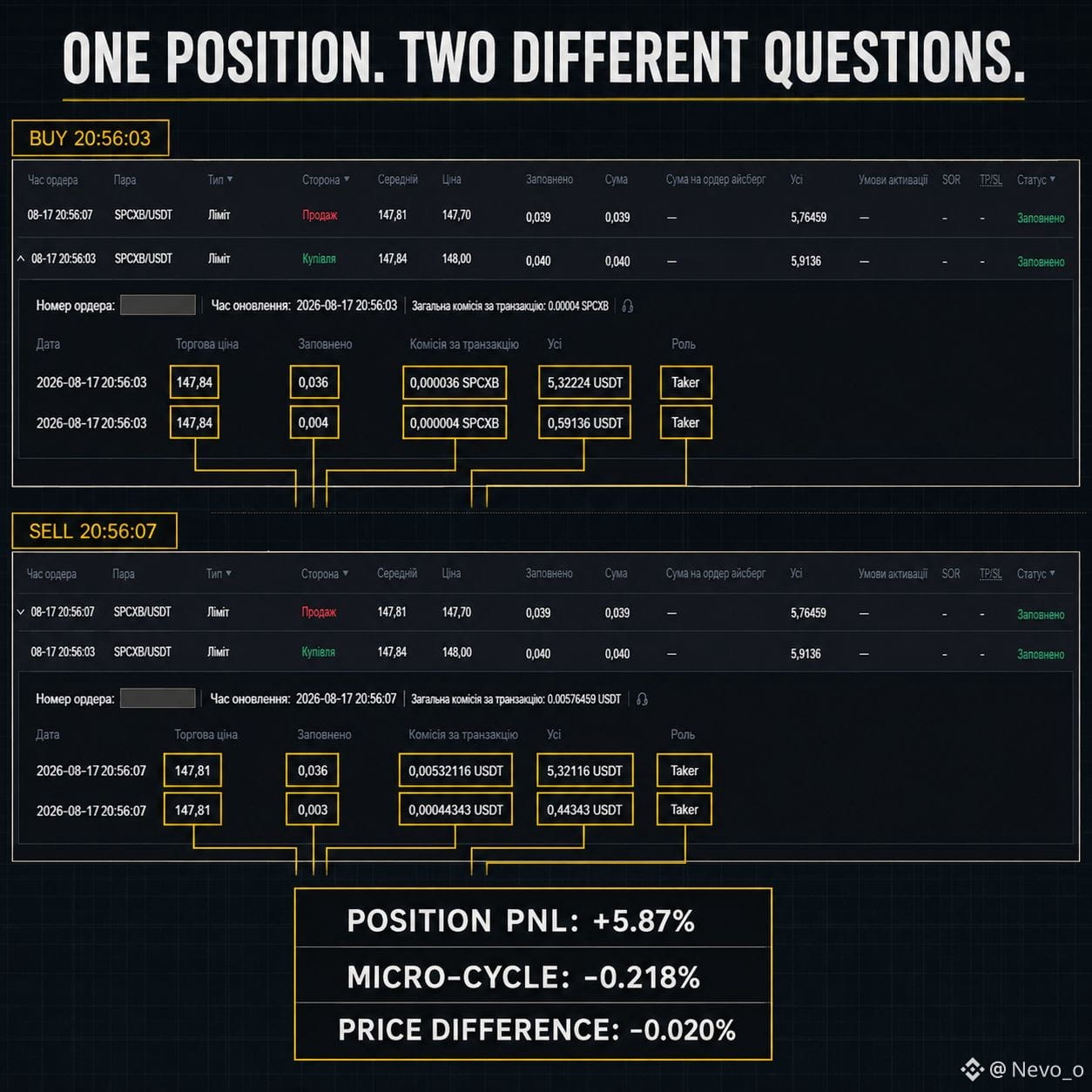
EINE GRÜNE PNL-KARTE IST KEIN AUSFÜHRUNGSBERICHT.
Meine aktuelle Positionskarte für $SPCXB zeigt kumulierten PnL von +35,72 USDT bzw. +5,87 %.
Das ist ein positionsbezogenes Ergebnis, das sich über seine gesamte Historie aufsummiert. Ich wollte wissen, was genau eine winzige Ausführungsrunde tatsächlich gekostet hat, also öffnete ich die einzelnen Fills ab dem 17. August.
20:56:03
Limit Buy: 0,040 SPCXB
Durchschnittlicher Fill: 147,84
Bruttokosten: 5,9136 USDT
Gebühr: 0,00004 SPCXB
Netto erhalten: 0,03996 SPCXB
20:56:07
Limit Sell: 0,039 SPCXB
Durchschnittlicher Fill: 147,81
Bruttoerlöse: 5,76459 USDT
Gebühr: 0,00576459 USDT
Nettoerlöse: 5,75882541 USDT
Beide Orders wurden in zwei Fills aufgeteilt, und jeder Fill wurde als Taker markiert.
Ich hielt nach dem Verkauf noch 0,00096 SPCXB. Wenn ich diesen Rest zum Verkaufspreis bewerte, ergibt sich ein Gesamtendwert von 5,90072301 USDT.
Geschätztes Ergebnis der Vier-Sekunden-Mikro-Zyklus:
5,90072301 - 5,9136 = -0,01287699 USDT
Das entspricht ungefähr -0,218 % der ursprünglichen Einzahlung. Gleichzeitig unterschieden sich die beiden durchschnittlichen Ausführungspreise nur um 0,020 %.
Die grüne Positionskarte ist nicht falsch, und auch der negative Mikro-Zyklus nicht. Sie beantworten unterschiedliche Fragen.
Positions-PnL fragt, ob die breitere Haltedauer Geld eingebracht hat.
Fill-Historie fragt, was genau eine bestimmte Entscheidung nach Preisbewegung und Gebühren gekostet hat.
Für bStocks möchte ich beides sehen, bevor ich das Ergebnis beurteile.
#bStocksCIS @BinanceCIS $SPCXB
EINE GRÜNE PNL-KARTE IST KEIN AUSFÜHRUNGSBERICHT.
Meine aktuelle Positionskarte für $SPCXB zeigt kumulierten PnL von +35,72 USDT bzw. +5,87 %.
Das ist ein positionsbezogenes Ergebnis, das sich über seine gesamte Historie aufsummiert. Ich wollte wissen, was genau eine winzige Ausführungsrunde tatsächlich gekostet hat, also öffnete ich die einzelnen Fills ab dem 17. August.
20:56:03
Limit Buy: 0,040 SPCXB
Durchschnittlicher Fill: 147,84
Bruttokosten: 5,9136 USDT
Gebühr: 0,00004 SPCXB
Netto erhalten: 0,03996 SPCXB
20:56:07
Limit Sell: 0,039 SPCXB
Durchschnittlicher Fill: 147,81
Bruttoerlöse: 5,76459 USDT
Gebühr: 0,00576459 USDT
Nettoerlöse: 5,75882541 USDT
Beide Orders wurden in zwei Fills aufgeteilt, und jeder Fill wurde als Taker markiert.
Ich hielt nach dem Verkauf noch 0,00096 SPCXB. Wenn ich diesen Rest zum Verkaufspreis bewerte, ergibt sich ein Gesamtendwert von 5,90072301 USDT.
Geschätztes Ergebnis der Vier-Sekunden-Mikro-Zyklus:
5,90072301 - 5,9136 = -0,01287699 USDT
Das entspricht ungefähr -0,218 % der ursprünglichen Einzahlung. Gleichzeitig unterschieden sich die beiden durchschnittlichen Ausführungspreise nur um 0,020 %.
Die grüne Positionskarte ist nicht falsch, und auch der negative Mikro-Zyklus nicht. Sie beantworten unterschiedliche Fragen.
Positions-PnL fragt, ob die breitere Haltedauer Geld eingebracht hat.
Fill-Historie fragt, was genau eine bestimmte Entscheidung nach Preisbewegung und Gebühren gekostet hat.
Für bStocks möchte ich beides sehen, bevor ich das Ergebnis beurteile.
EINE GRÜNE PNL-KARTE IST KEIN AUSFÜHRUNGSBERICHT.
Meine aktuelle Positionskarte für $SPCXB zeigt kumulierten PnL von +35,72 USDT bzw. +5,87 %.
Das ist ein positionsbezogenes Ergebnis, das sich über seine gesamte Historie aufsummiert. Ich wollte wissen, was genau eine winzige Ausführungsrunde tatsächlich gekostet hat, also öffnete ich die einzelnen Fills ab dem 17. August.
20:56:03
Limit Buy: 0,040 SPCXB
Durchschnittlicher Fill: 147,84
Bruttokosten: 5,9136 USDT
Gebühr: 0,00004 SPCXB
Netto erhalten: 0,03996 SPCXB
20:56:07
Limit Sell: 0,039 SPCXB
Durchschnittlicher Fill: 147,81
Bruttoerlöse: 5,76459 USDT
Gebühr: 0,00576459 USDT
Nettoerlöse: 5,75882541 USDT
Beide Orders wurden in zwei Fills aufgeteilt, und jeder Fill wurde als Taker markiert.
Ich hielt nach dem Verkauf noch 0,00096 SPCXB. Wenn ich diesen Rest zum Verkaufspreis bewerte, ergibt sich ein Gesamtendwert von 5,90072301 USDT.
Geschätztes Ergebnis der Vier-Sekunden-Mikro-Zyklus:
5,90072301 - 5,9136 = -0,01287699 USDT
Das entspricht ungefähr -0,218 % der ursprünglichen Einzahlung. Gleichzeitig unterschieden sich die beiden durchschnittlichen Ausführungspreise nur um 0,020 %.
Die grüne Positionskarte ist nicht falsch, und auch der negative Mikro-Zyklus nicht. Sie beantworten unterschiedliche Fragen.
Positions-PnL fragt, ob die breitere Haltedauer Geld eingebracht hat.
Fill-Historie fragt, was genau eine bestimmte Entscheidung nach Preisbewegung und Gebühren gekostet hat.
Für bStocks möchte ich beides sehen, bevor ich das Ergebnis beurteile.
4
4
124
·
--
Bullisch
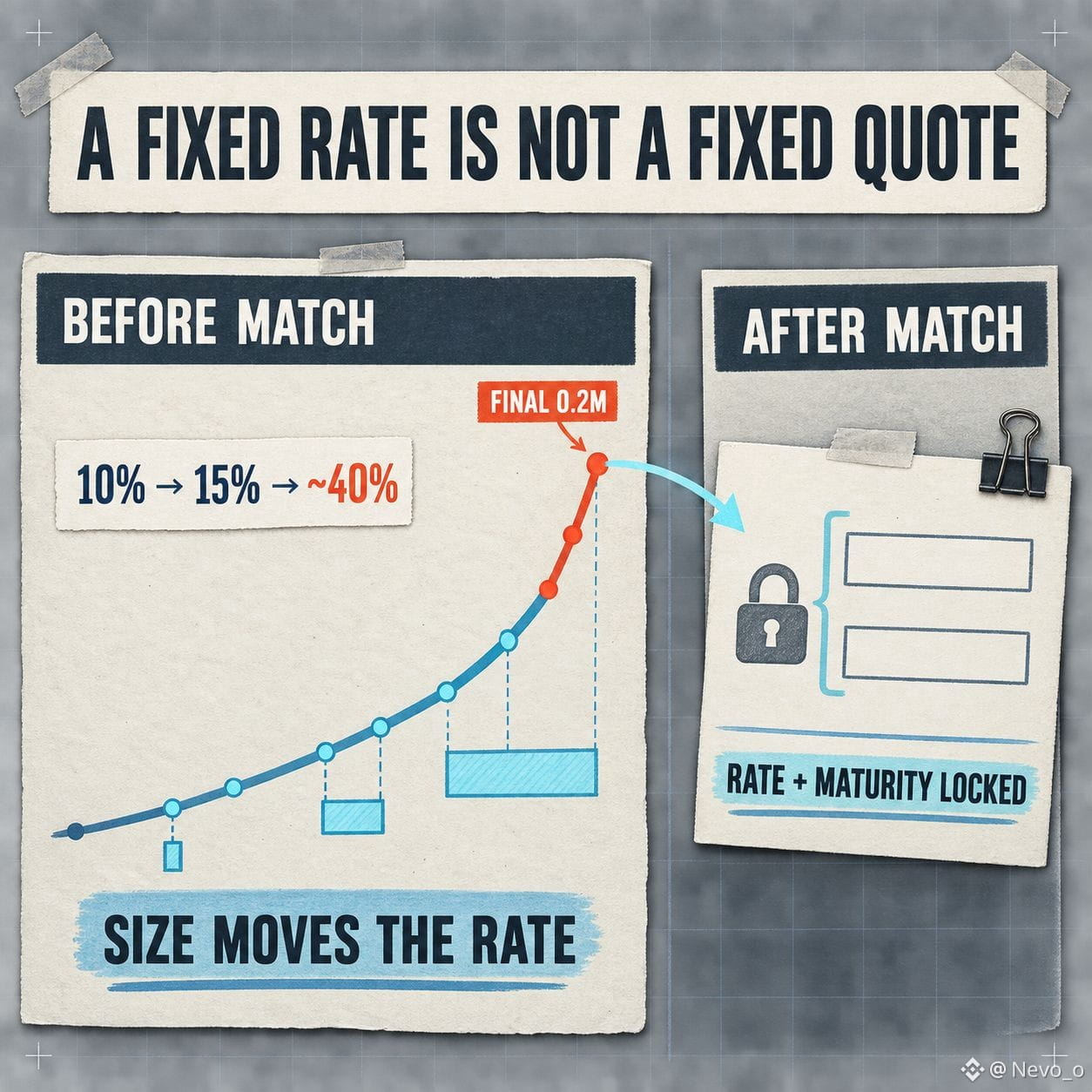
Ein fester Zinssatz ist nicht dasselbe wie ein fester Kurs.
Ich habe fast 10% APR auf einer TermMax-Kurve so behandelt, als wäre es ein Preisschild. Das ist es nicht. Bevor ein Trade ausgeführt wird, hängt der Kurs weiterhin davon ab, wie viel Liquidität der Auftrag verbraucht.
TermMax Range Orders bepreisen Liquidität in Segmenten. In einer dokumentierten Lending-Kurve bewegt sich der Großteil der Reserve von 10% in Richtung etwa 15%. Das letzte 0,2-Millionen-Segment steigt von 15% in Richtung etwa 40%. Ein kleiner Test und eine viel größere Kreditaufnahme können daher mit unterschiedlichen effektiven Sätzen durchlaufen, selbst innerhalb desselben Marktes und derselben Laufzeit.
Sobald der Trade ausgeführt ist, driften der Zinssatz und die Laufzeit für diese Position nicht weiter. Vor der Ausführung spielen jedoch weiterhin Tiefe und Slippage eine Rolle.
Wenn ich also zwei TermMax-Märkte vergleiche, spare ich nicht nur den Schlagzeilen-APR ein. Ich erfasse das Debt-Asset, die Sicherheiten, die Laufzeit, die Ordergröße und den finalen, ausgeführten Zinssatz. Andernfalls vergleiche ich möglicherweise den ersten Punkt auf einer Kurve mit dem teuren Ende einer anderen.
„Fix“ beschreibt die Finanzierung nach der Ausführung. Es macht die Liquidität vor dem Trade nicht flach.
@termmax #TermMax
Ein fester Zinssatz ist nicht dasselbe wie ein fester Kurs.
Ich habe fast 10% APR auf einer TermMax-Kurve so behandelt, als wäre es ein Preisschild. Das ist es nicht. Bevor ein Trade ausgeführt wird, hängt der Kurs weiterhin davon ab, wie viel Liquidität der Auftrag verbraucht.
TermMax Range Orders bepreisen Liquidität in Segmenten. In einer dokumentierten Lending-Kurve bewegt sich der Großteil der Reserve von 10% in Richtung etwa 15%. Das letzte 0,2-Millionen-Segment steigt von 15% in Richtung etwa 40%. Ein kleiner Test und eine viel größere Kreditaufnahme können daher mit unterschiedlichen effektiven Sätzen durchlaufen, selbst innerhalb desselben Marktes und derselben Laufzeit.
Sobald der Trade ausgeführt ist, driften der Zinssatz und die Laufzeit für diese Position nicht weiter. Vor der Ausführung spielen jedoch weiterhin Tiefe und Slippage eine Rolle.
Wenn ich also zwei TermMax-Märkte vergleiche, spare ich nicht nur den Schlagzeilen-APR ein. Ich erfasse das Debt-Asset, die Sicherheiten, die Laufzeit, die Ordergröße und den finalen, ausgeführten Zinssatz. Andernfalls vergleiche ich möglicherweise den ersten Punkt auf einer Kurve mit dem teuren Ende einer anderen.
„Fix“ beschreibt die Finanzierung nach der Ausführung. Es macht die Liquidität vor dem Trade nicht flach.
@TermMax #TermMax
Ich habe fast 10% APR auf einer TermMax-Kurve so behandelt, als wäre es ein Preisschild. Das ist es nicht. Bevor ein Trade ausgeführt wird, hängt der Kurs weiterhin davon ab, wie viel Liquidität der Auftrag verbraucht.
TermMax Range Orders bepreisen Liquidität in Segmenten. In einer dokumentierten Lending-Kurve bewegt sich der Großteil der Reserve von 10% in Richtung etwa 15%. Das letzte 0,2-Millionen-Segment steigt von 15% in Richtung etwa 40%. Ein kleiner Test und eine viel größere Kreditaufnahme können daher mit unterschiedlichen effektiven Sätzen durchlaufen, selbst innerhalb desselben Marktes und derselben Laufzeit.
Sobald der Trade ausgeführt ist, driften der Zinssatz und die Laufzeit für diese Position nicht weiter. Vor der Ausführung spielen jedoch weiterhin Tiefe und Slippage eine Rolle.
Wenn ich also zwei TermMax-Märkte vergleiche, spare ich nicht nur den Schlagzeilen-APR ein. Ich erfasse das Debt-Asset, die Sicherheiten, die Laufzeit, die Ordergröße und den finalen, ausgeführten Zinssatz. Andernfalls vergleiche ich möglicherweise den ersten Punkt auf einer Kurve mit dem teuren Ende einer anderen.
„Fix“ beschreibt die Finanzierung nach der Ausführung. Es macht die Liquidität vor dem Trade nicht flach.
@TermMax #TermMax
1
60
·
--
Bullisch
#bStocksCIS @BinanceCIS
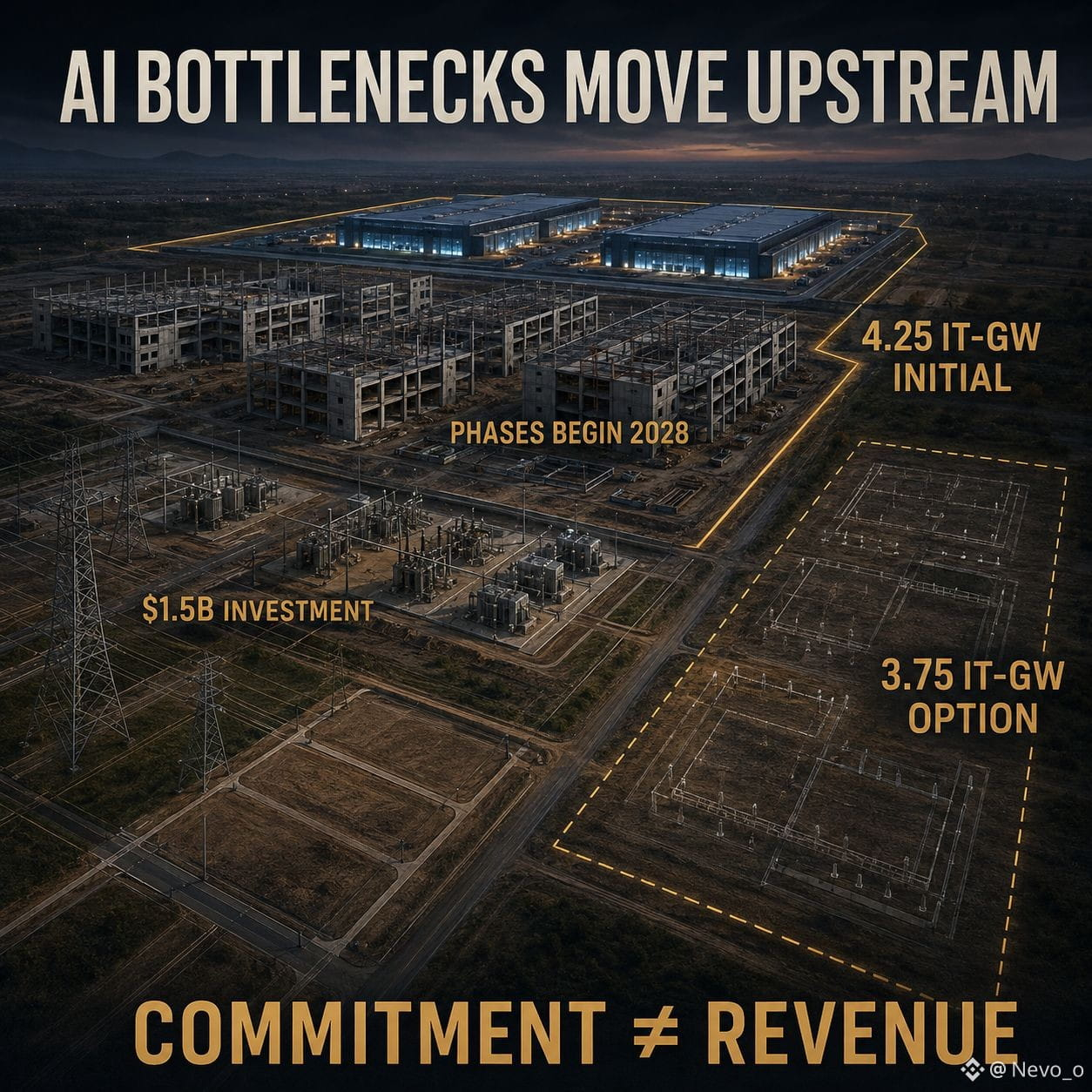
NVIDIAs neuestes KI-Deal geht nicht in erster Linie um eine neue GPU. Es geht darum, die Engpässe zu reservieren, die anfallen, bevor überhaupt eine GPU installiert werden kann: Land, Strom und ein fertiggestellter Rechenzentrums-„Shell“.
Am 17. August sagte NVIDIA, es werde Kreditsupport für die ersten 4,25 IT-GW im PORTS-Pike-Campus von SB Energy in Ohio bereitstellen, mit einer Option für die restlichen 3,75 IT-GW. OpenAI wird voraussichtlich alle 8 IT-GW nutzen. SB Energy wird den Standort unter einem 20-Jahres-Lease an OpenAI bauen, besitzen und betreiben, während NVIDIA 1,5 Milliarden US-Dollar in SB Energy investiert.
Das verändert, wie ich $NVDAB lese.
Die positive Interpretation lautet: NVIDIA sichert sich eine langfristige Route für seinen gesamten KI-Stack in eine sehr große Kundenbereitstellung. Exklusivität verstärkt dieses Nachfragesignal.
Aber diese Zahlen liegen nicht in der Nähe von Umsätzen aus Chips in der kurzfristigen Perspektive. Kreditsupport ist keine Bestellung für eine GPU. Eine Option ist keine feste Zusage. Die Kapazität ist geplant, in Etappen ab 2028 anzukommen, sodass Strombereitstellung, Bau, Finanzierung und die Konzentration auf den Kundenbereich noch zwischen der heutigen Ankündigung und künftigen Compute-Verkäufen liegen.
Die strategische Verschiebung ist für mich am wichtigsten: NVIDIA wartet nicht länger darauf, dass Rechenzentren bereit werden. NVIDIA hilft dabei, sie finanzierbar zu machen.
Rechtfertigt eine bessere Nachfrage-Sichtbarkeit, mehr Kapital und Kreditsupport an Infrastruktur zu binden – Jahre, bevor daraus Umsätze entstehen?
{spot}(NVDABUSDT)
#bStocksCIS @BinanceCIS
NVIDIAs neuestes KI-Deal geht nicht in erster Linie um eine neue GPU. Es geht darum, die Engpässe zu reservieren, die anfallen, bevor überhaupt eine GPU installiert werden kann: Land, Strom und ein fertiggestellter Rechenzentrums-„Shell“.
Am 17. August sagte NVIDIA, es werde Kreditsupport für die ersten 4,25 IT-GW im PORTS-Pike-Campus von SB Energy in Ohio bereitstellen, mit einer Option für die restlichen 3,75 IT-GW. OpenAI wird voraussichtlich alle 8 IT-GW nutzen. SB Energy wird den Standort unter einem 20-Jahres-Lease an OpenAI bauen, besitzen und betreiben, während NVIDIA 1,5 Milliarden US-Dollar in SB Energy investiert.
Das verändert, wie ich $NVDAB lese.
Die positive Interpretation lautet: NVIDIA sichert sich eine langfristige Route für seinen gesamten KI-Stack in eine sehr große Kundenbereitstellung. Exklusivität verstärkt dieses Nachfragesignal.
Aber diese Zahlen liegen nicht in der Nähe von Umsätzen aus Chips in der kurzfristigen Perspektive. Kreditsupport ist keine Bestellung für eine GPU. Eine Option ist keine feste Zusage. Die Kapazität ist geplant, in Etappen ab 2028 anzukommen, sodass Strombereitstellung, Bau, Finanzierung und die Konzentration auf den Kundenbereich noch zwischen der heutigen Ankündigung und künftigen Compute-Verkäufen liegen.
Die strategische Verschiebung ist für mich am wichtigsten: NVIDIA wartet nicht länger darauf, dass Rechenzentren bereit werden. NVIDIA hilft dabei, sie finanzierbar zu machen.
Rechtfertigt eine bessere Nachfrage-Sichtbarkeit, mehr Kapital und Kreditsupport an Infrastruktur zu binden – Jahre, bevor daraus Umsätze entstehen?
NVIDIAs neuestes KI-Deal geht nicht in erster Linie um eine neue GPU. Es geht darum, die Engpässe zu reservieren, die anfallen, bevor überhaupt eine GPU installiert werden kann: Land, Strom und ein fertiggestellter Rechenzentrums-„Shell“.
Am 17. August sagte NVIDIA, es werde Kreditsupport für die ersten 4,25 IT-GW im PORTS-Pike-Campus von SB Energy in Ohio bereitstellen, mit einer Option für die restlichen 3,75 IT-GW. OpenAI wird voraussichtlich alle 8 IT-GW nutzen. SB Energy wird den Standort unter einem 20-Jahres-Lease an OpenAI bauen, besitzen und betreiben, während NVIDIA 1,5 Milliarden US-Dollar in SB Energy investiert.
Das verändert, wie ich $NVDAB lese.
Die positive Interpretation lautet: NVIDIA sichert sich eine langfristige Route für seinen gesamten KI-Stack in eine sehr große Kundenbereitstellung. Exklusivität verstärkt dieses Nachfragesignal.
Aber diese Zahlen liegen nicht in der Nähe von Umsätzen aus Chips in der kurzfristigen Perspektive. Kreditsupport ist keine Bestellung für eine GPU. Eine Option ist keine feste Zusage. Die Kapazität ist geplant, in Etappen ab 2028 anzukommen, sodass Strombereitstellung, Bau, Finanzierung und die Konzentration auf den Kundenbereich noch zwischen der heutigen Ankündigung und künftigen Compute-Verkäufen liegen.
Die strategische Verschiebung ist für mich am wichtigsten: NVIDIA wartet nicht länger darauf, dass Rechenzentren bereit werden. NVIDIA hilft dabei, sie finanzierbar zu machen.
Rechtfertigt eine bessere Nachfrage-Sichtbarkeit, mehr Kapital und Kreditsupport an Infrastruktur zu binden – Jahre, bevor daraus Umsätze entstehen?
1
2
96
·
--
Bullisch
Verifiziert
#bStocksCIS @BinanceCIS
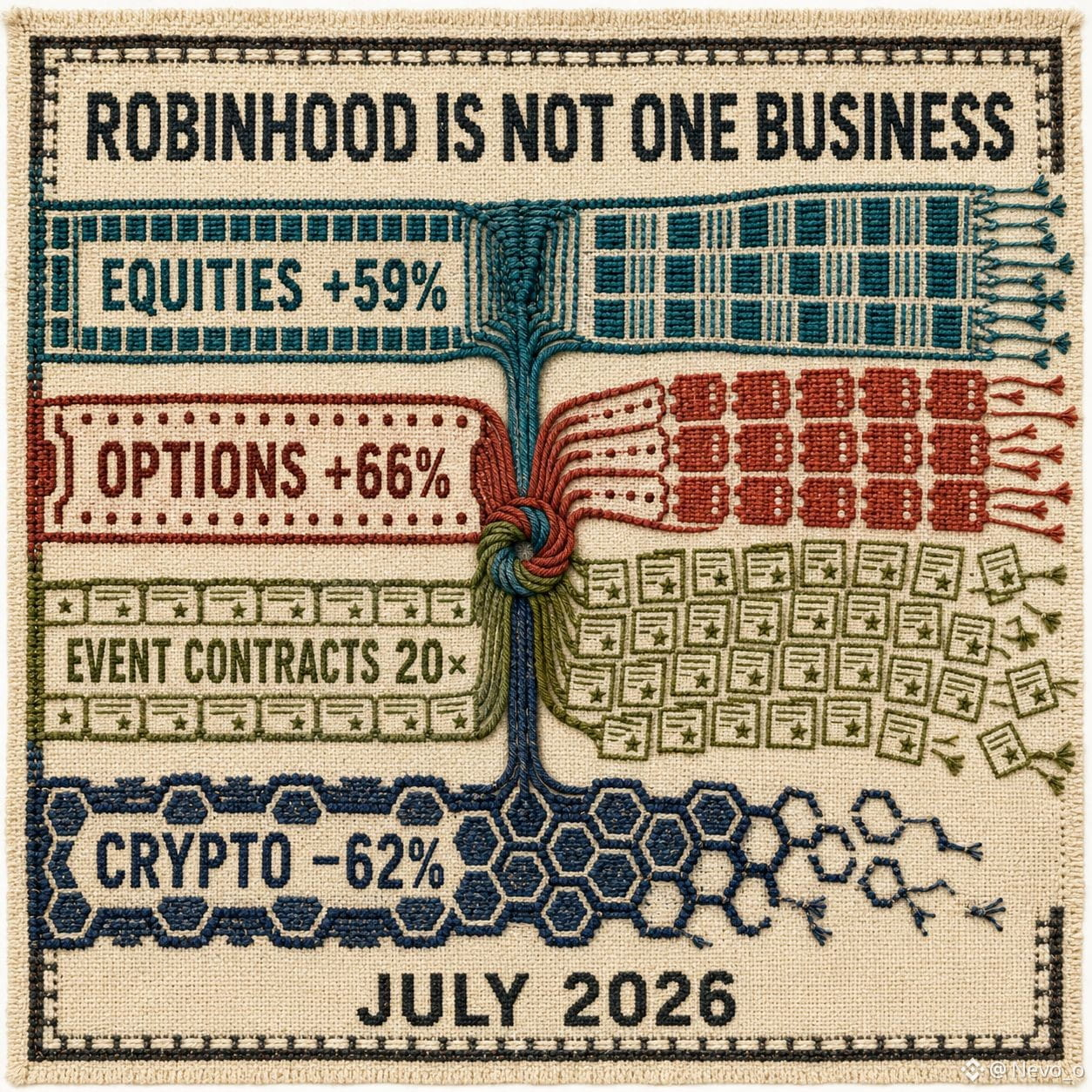
Robinhoods Juli-Dashboard hat mich den üblichen Shortcut hinterfragen lassen:
$HOODB = ein Crypto-Proxy.
Die Linien bewegen sich in entgegengesetzte Richtungen.
Das Notional-Equity-Volumen lag bei 333 Mrd. USD, ein Plus von 59 % gegenüber dem Vorjahr. Optionskontrakte waren 324 Mio., ein Plus von 66 %. Event-Kontrakte erreichten 6,1 Mrd., das 20-Fache des Vorjahres.
Das Crypto-Volumen lag bei 10,9 Mrd. USD, ein Minus von 62 % gegenüber dem Vorjahr. Darunter sank das Crypto-Volumen in der Robinhood-App um 74 %, während das Volumen von Bitstamp um 45 % fiel.
Unterdessen waren die finanzierten Kunden 28,5 Mio. und die gesamten Plattform-Assets 355 Mrd. USD, ein Plus von 19 % gegenüber dem Vorjahr – obwohl die Assets im Juni um 4 % gefallen sind.
Mein Fazit ist weder bullisch noch bärisch. Es ist, dass ein einziges Label das Geschäft nicht mehr erklärt. Wenn ich Robinhood nur als Crypto-Beta bewerte, ignoriere ich die Teile, die derzeit am schnellsten wachsen. Wenn ich mich nur auf Event-Kontrakte konzentriere, könnte ich ein junges Produkt mit enormem prozentualem Wachstum überinterpretieren.
Welche Linie würdest du zuerst beobachten: Assets, Equity und Optionen, Crypto oder Event-Kontrakte?
{spot}(HOODBUSDT)
#bStocksCIS @BinanceCIS
Robinhoods Juli-Dashboard hat mich den üblichen Shortcut hinterfragen lassen:
$HOODB = ein Crypto-Proxy.
Die Linien bewegen sich in entgegengesetzte Richtungen.
Das Notional-Equity-Volumen lag bei 333 Mrd. USD, ein Plus von 59 % gegenüber dem Vorjahr. Optionskontrakte waren 324 Mio., ein Plus von 66 %. Event-Kontrakte erreichten 6,1 Mrd., das 20-Fache des Vorjahres.
Das Crypto-Volumen lag bei 10,9 Mrd. USD, ein Minus von 62 % gegenüber dem Vorjahr. Darunter sank das Crypto-Volumen in der Robinhood-App um 74 %, während das Volumen von Bitstamp um 45 % fiel.
Unterdessen waren die finanzierten Kunden 28,5 Mio. und die gesamten Plattform-Assets 355 Mrd. USD, ein Plus von 19 % gegenüber dem Vorjahr – obwohl die Assets im Juni um 4 % gefallen sind.
Mein Fazit ist weder bullisch noch bärisch. Es ist, dass ein einziges Label das Geschäft nicht mehr erklärt. Wenn ich Robinhood nur als Crypto-Beta bewerte, ignoriere ich die Teile, die derzeit am schnellsten wachsen. Wenn ich mich nur auf Event-Kontrakte konzentriere, könnte ich ein junges Produkt mit enormem prozentualem Wachstum überinterpretieren.
Welche Linie würdest du zuerst beobachten: Assets, Equity und Optionen, Crypto oder Event-Kontrakte?
Robinhoods Juli-Dashboard hat mich den üblichen Shortcut hinterfragen lassen:
$HOODB = ein Crypto-Proxy.
Die Linien bewegen sich in entgegengesetzte Richtungen.
Das Notional-Equity-Volumen lag bei 333 Mrd. USD, ein Plus von 59 % gegenüber dem Vorjahr. Optionskontrakte waren 324 Mio., ein Plus von 66 %. Event-Kontrakte erreichten 6,1 Mrd., das 20-Fache des Vorjahres.
Das Crypto-Volumen lag bei 10,9 Mrd. USD, ein Minus von 62 % gegenüber dem Vorjahr. Darunter sank das Crypto-Volumen in der Robinhood-App um 74 %, während das Volumen von Bitstamp um 45 % fiel.
Unterdessen waren die finanzierten Kunden 28,5 Mio. und die gesamten Plattform-Assets 355 Mrd. USD, ein Plus von 19 % gegenüber dem Vorjahr – obwohl die Assets im Juni um 4 % gefallen sind.
Mein Fazit ist weder bullisch noch bärisch. Es ist, dass ein einziges Label das Geschäft nicht mehr erklärt. Wenn ich Robinhood nur als Crypto-Beta bewerte, ignoriere ich die Teile, die derzeit am schnellsten wachsen. Wenn ich mich nur auf Event-Kontrakte konzentriere, könnte ich ein junges Produkt mit enormem prozentualem Wachstum überinterpretieren.
Welche Linie würdest du zuerst beobachten: Assets, Equity und Optionen, Crypto oder Event-Kontrakte?
5
6
100
·
--
Bullisch
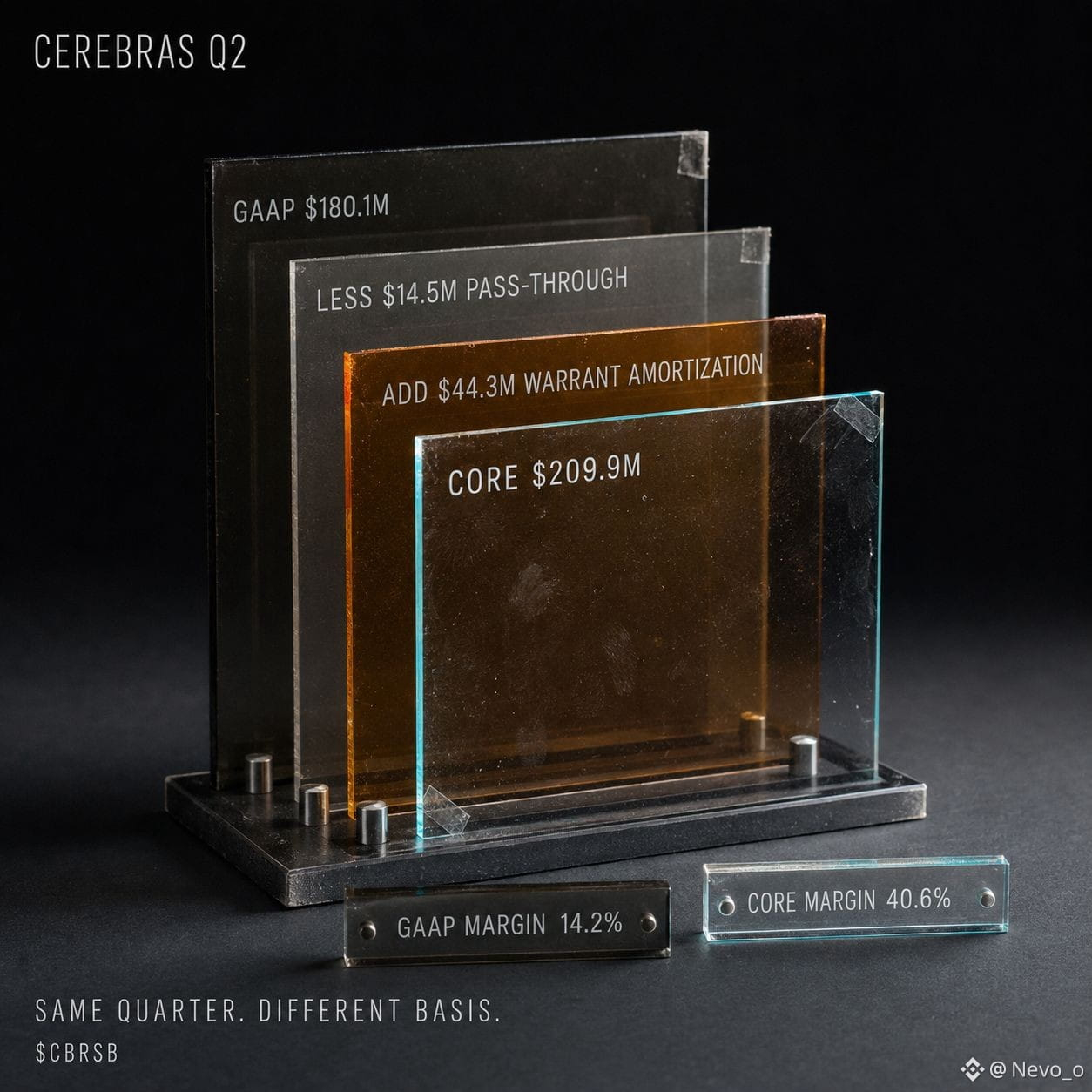
#bStocksCIS Cerebras meldete für dasselbe Quartal zwei Umsatzkennzahlen: 180,1 Mio. US-Dollar nach GAAP und 209,9 Mio. US-Dollar „Core“. Für einen Moment dachte ich, ich hätte zwei Berichtszeiträume durcheinandergebracht.
Die Überleitung hat das geklärt. Der Core-Umsatz entfernt 14,5 Mio. US-Dollar an Durchlauf-/Weiterleitungsumsätzen und fügt 44,3 Mio. US-Dollar an Kunden-Warrant-Amortisation wieder hinzu. Die Lücke erreicht damit auch die Bruttomarge: 14,2 % nach GAAP und 40,6 % auf Basis des „Core“-Konzepts des Unternehmens.
Beide Sichtweisen können nützlich sein. Was ich nicht tun sollte, ist sie zu vermischen. Wenn ich das 103%-Wachstum beim Core-Umsatz verwende, sollten die Marge und der Verlust daneben ebenfalls „Core“ sein. Wenn ich mit dem GAAP-Umsatz beginne, sollte der Rest des Vergleichs ebenfalls GAAP bleiben.
Wenn ich jetzt $CBRSB auf @BinanceCIS prüfe, schreibe ich „GAAP“ oder „core“ neben jede Kennzahl, bevor ich Quartale vergleiche. Das dauert zehn Sekunden und hält eine Differenz von nahezu 30 Mio. US-Dollar sichtbar. Welche Zahl würdet ihr zuerst prüfen?
{spot}(CBRSBUSDT)
#bStocksCIS Cerebras meldete für dasselbe Quartal zwei Umsatzkennzahlen: 180,1 Mio. US-Dollar nach GAAP und 209,9 Mio. US-Dollar „Core“. Für einen Moment dachte ich, ich hätte zwei Berichtszeiträume durcheinandergebracht.
Die Überleitung hat das geklärt. Der Core-Umsatz entfernt 14,5 Mio. US-Dollar an Durchlauf-/Weiterleitungsumsätzen und fügt 44,3 Mio. US-Dollar an Kunden-Warrant-Amortisation wieder hinzu. Die Lücke erreicht damit auch die Bruttomarge: 14,2 % nach GAAP und 40,6 % auf Basis des „Core“-Konzepts des Unternehmens.
Beide Sichtweisen können nützlich sein. Was ich nicht tun sollte, ist sie zu vermischen. Wenn ich das 103%-Wachstum beim Core-Umsatz verwende, sollten die Marge und der Verlust daneben ebenfalls „Core“ sein. Wenn ich mit dem GAAP-Umsatz beginne, sollte der Rest des Vergleichs ebenfalls GAAP bleiben.
Wenn ich jetzt $CBRSB auf @BinanceCIS prüfe, schreibe ich „GAAP“ oder „core“ neben jede Kennzahl, bevor ich Quartale vergleiche. Das dauert zehn Sekunden und hält eine Differenz von nahezu 30 Mio. US-Dollar sichtbar. Welche Zahl würdet ihr zuerst prüfen?
Die Überleitung hat das geklärt. Der Core-Umsatz entfernt 14,5 Mio. US-Dollar an Durchlauf-/Weiterleitungsumsätzen und fügt 44,3 Mio. US-Dollar an Kunden-Warrant-Amortisation wieder hinzu. Die Lücke erreicht damit auch die Bruttomarge: 14,2 % nach GAAP und 40,6 % auf Basis des „Core“-Konzepts des Unternehmens.
Beide Sichtweisen können nützlich sein. Was ich nicht tun sollte, ist sie zu vermischen. Wenn ich das 103%-Wachstum beim Core-Umsatz verwende, sollten die Marge und der Verlust daneben ebenfalls „Core“ sein. Wenn ich mit dem GAAP-Umsatz beginne, sollte der Rest des Vergleichs ebenfalls GAAP bleiben.
Wenn ich jetzt $CBRSB auf @BinanceCIS prüfe, schreibe ich „GAAP“ oder „core“ neben jede Kennzahl, bevor ich Quartale vergleiche. Das dauert zehn Sekunden und hält eine Differenz von nahezu 30 Mio. US-Dollar sichtbar. Welche Zahl würdet ihr zuerst prüfen?
6
4
96
·
--
Bullisch
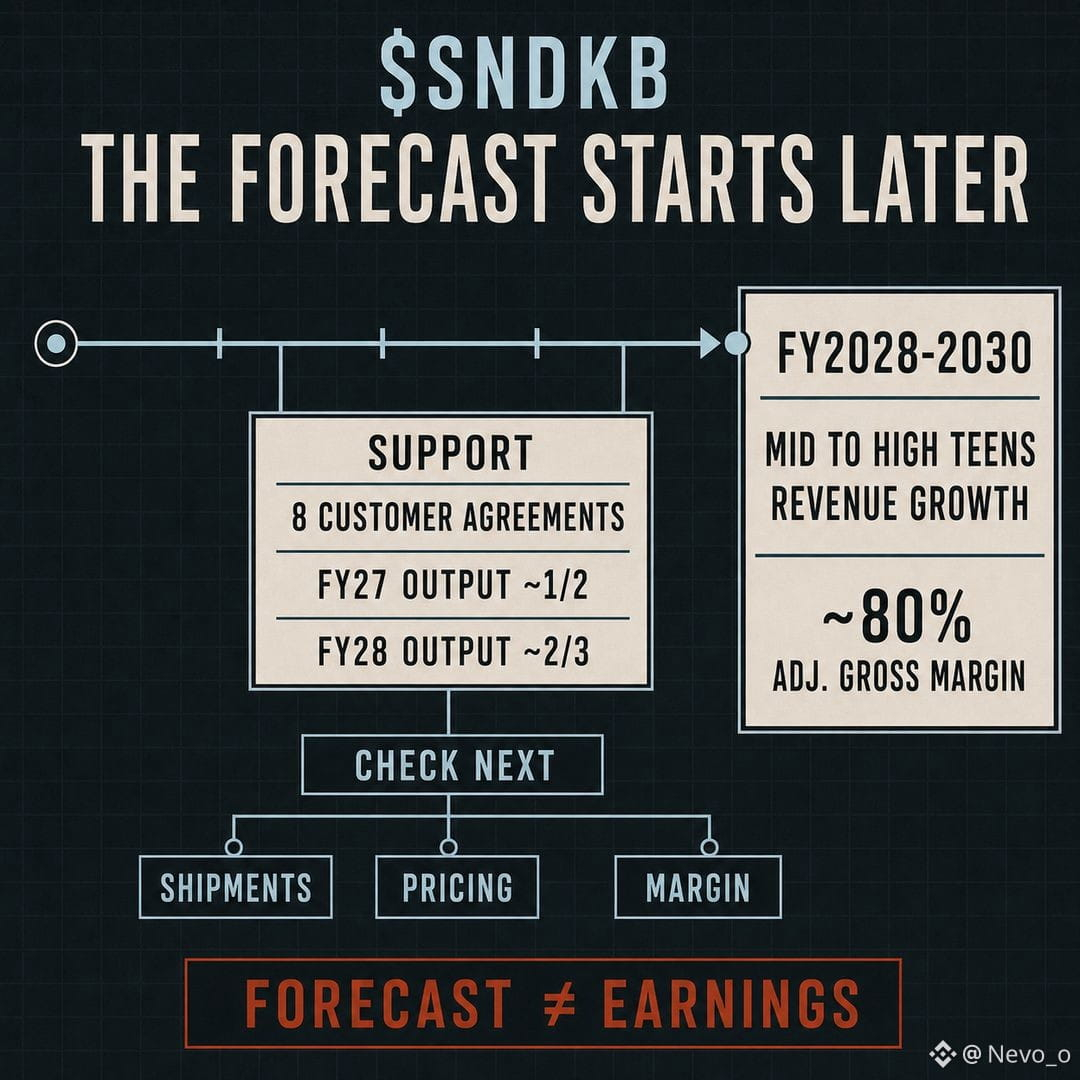
#bStocksCIS Sandisk-Aktien sind nach dem Investor Day um mehr als 15% gestiegen. Die Schlagzeile hinter $SNDKB ist eindrucksvoll: Umsatzwachstum im mittleren bis hohen einstelligen Bereich von Geschäftsjahr 2028 bis 2030, mit einer bereinigten Bruttomarge von rund 80%.
Doch die Termine sind entscheidend. Das ist ein langfristiger Rahmen, kein Ergebnis, das bereits in den heutigen Konten steckt.
Dafür gibt es echte Unterstützung. Sandisk sagt, dass acht Kundenvereinbarungen etwa die Hälfte der Produktion von Geschäftsjahr 2027 und zwei Drittel der Produktion von Geschäftsjahr 2028 abdecken. Das senkt ein Risiko: Käufer zu finden.
Es beseitigt aber die anderen Risiken nicht: das Volumen zu produzieren, den Preis zu halten, die Marge zu erreichen und die Lieferung rechtzeitig zu liefern.
Diese Unterscheidung ist wichtig, wenn $SNDKB rund um die Uhr auf @BinanceCIS handelt. Eine schnelle Bewegung kann eine künftige Prognose wie aktuelle Ergebnisse wirken lassen. Ich trenne beides.
Meine nächsten Prüfungen sind einfach:
Wie viel der abgedeckten Produktion wird tatsächlich versandt?
Hält die Preisgestaltung stand, während das Angebot wächst?
Bleibt der Margenpfad nahe am Rahmen des Investor Day?
Die Prognose hat Aufmerksamkeit erhalten. Die Umsetzung muss aber die Bewertung erst verdienen.
{spot}(SNDKBUSDT)
#bStocksCIS Sandisk-Aktien sind nach dem Investor Day um mehr als 15% gestiegen. Die Schlagzeile hinter $SNDKB ist eindrucksvoll: Umsatzwachstum im mittleren bis hohen einstelligen Bereich von Geschäftsjahr 2028 bis 2030, mit einer bereinigten Bruttomarge von rund 80%.
Doch die Termine sind entscheidend. Das ist ein langfristiger Rahmen, kein Ergebnis, das bereits in den heutigen Konten steckt.
Dafür gibt es echte Unterstützung. Sandisk sagt, dass acht Kundenvereinbarungen etwa die Hälfte der Produktion von Geschäftsjahr 2027 und zwei Drittel der Produktion von Geschäftsjahr 2028 abdecken. Das senkt ein Risiko: Käufer zu finden.
Es beseitigt aber die anderen Risiken nicht: das Volumen zu produzieren, den Preis zu halten, die Marge zu erreichen und die Lieferung rechtzeitig zu liefern.
Diese Unterscheidung ist wichtig, wenn $SNDKB rund um die Uhr auf @BinanceCIS handelt. Eine schnelle Bewegung kann eine künftige Prognose wie aktuelle Ergebnisse wirken lassen. Ich trenne beides.
Meine nächsten Prüfungen sind einfach:
Wie viel der abgedeckten Produktion wird tatsächlich versandt?
Hält die Preisgestaltung stand, während das Angebot wächst?
Bleibt der Margenpfad nahe am Rahmen des Investor Day?
Die Prognose hat Aufmerksamkeit erhalten. Die Umsetzung muss aber die Bewertung erst verdienen.
Doch die Termine sind entscheidend. Das ist ein langfristiger Rahmen, kein Ergebnis, das bereits in den heutigen Konten steckt.
Dafür gibt es echte Unterstützung. Sandisk sagt, dass acht Kundenvereinbarungen etwa die Hälfte der Produktion von Geschäftsjahr 2027 und zwei Drittel der Produktion von Geschäftsjahr 2028 abdecken. Das senkt ein Risiko: Käufer zu finden.
Es beseitigt aber die anderen Risiken nicht: das Volumen zu produzieren, den Preis zu halten, die Marge zu erreichen und die Lieferung rechtzeitig zu liefern.
Diese Unterscheidung ist wichtig, wenn $SNDKB rund um die Uhr auf @BinanceCIS handelt. Eine schnelle Bewegung kann eine künftige Prognose wie aktuelle Ergebnisse wirken lassen. Ich trenne beides.
Meine nächsten Prüfungen sind einfach:
Wie viel der abgedeckten Produktion wird tatsächlich versandt?
Hält die Preisgestaltung stand, während das Angebot wächst?
Bleibt der Margenpfad nahe am Rahmen des Investor Day?
Die Prognose hat Aufmerksamkeit erhalten. Die Umsetzung muss aber die Bewertung erst verdienen.
5
4
142
·
--
Bullisch
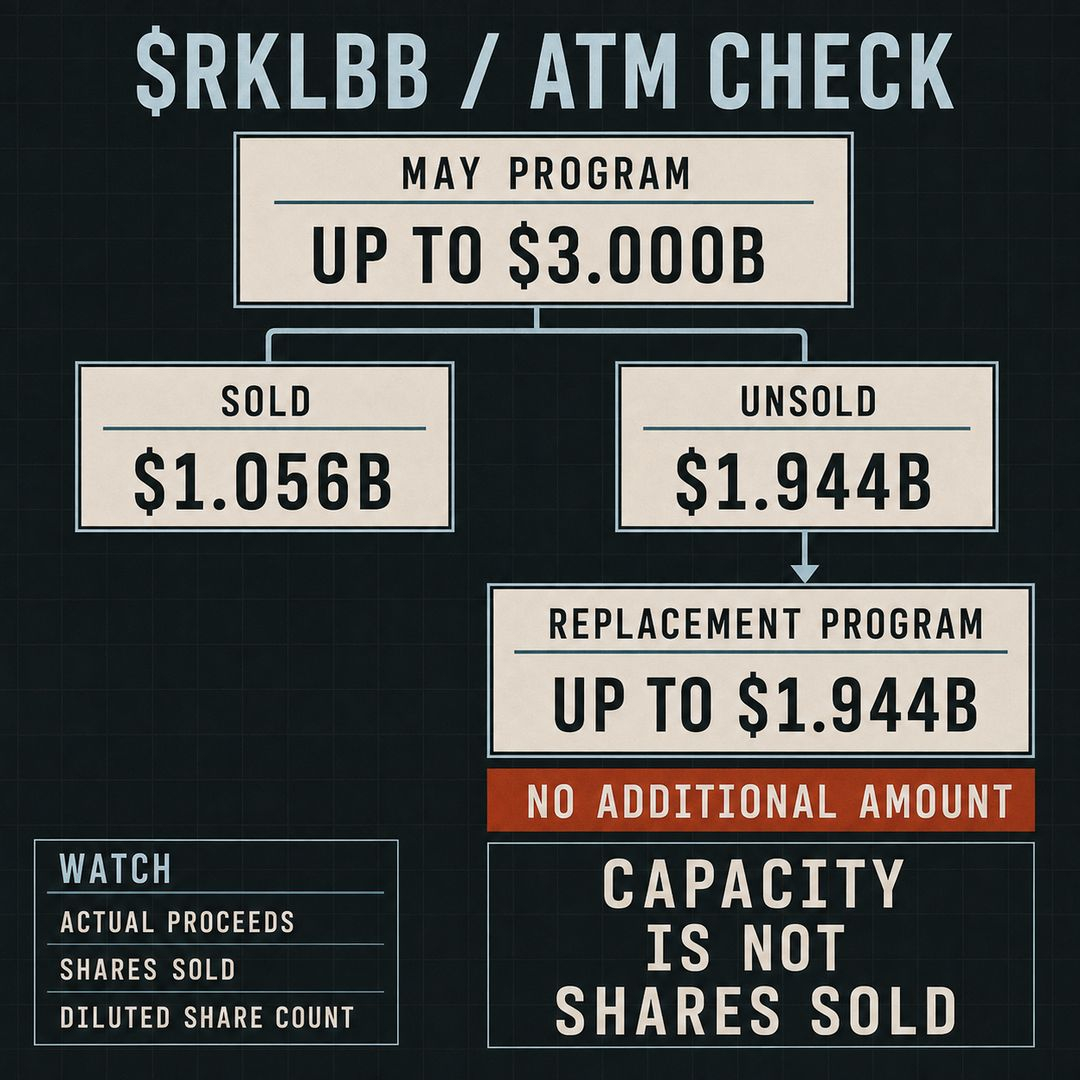
#bStocksCIS Rocket Lab hat keinen zweiten $1,944 Milliarden ATM auf den alten gestapelt.
Das Ersetzungsvorhaben führt den unverkauften Teil der Vereinbarung vom Mai fort. Rocket Lab sagt, dass sich die angebotene Gesamtsumme nicht erhöht habe. Bei $RKLBB würde die Behandlung der beiden Schlagzeilen als kumulativ bedeuten, dass die verbleibende Finanzierungskapazität doppelt gezählt würde.
Aber „Ersatz“ heißt nicht „harmlos“. Ein ATM ist eine Genehmigung, Aktien über die Zeit zu verkaufen. Es ist kein Beleg dafür, dass die gesamte Summe bereits verkauft wurde.
Das Unternehmen sagt, dass die Erlöse helfen könnten, den Bargeldanteil des Iridium-Deals zu finanzieren und eine Brückenverpflichtung in Höhe von 3,6 Milliarden US-Dollar zu reduzieren. Der Trade-off ist real: Mehr Eigenkapital kann jede Aktie verwässern, während weniger Brückenschulden den Finanzierungsdruck verringern können.
@BinanceCIS
Die nächsten Einreichungen benötigen drei Angaben:
Erhaltene tatsächliche ATM-Erlöse;
verkaufte Aktien und durchschnittlicher Preis;
verwässerte ausstehende Aktien.
Die heutige Einreichung entfernt einen analytischen Fehler: das Hinzufügen des alten und des neuen Programms zusammen. Sie entfernt nicht das künftige Verwässerungsrisiko.
$RKLBB
{spot}(RKLBBUSDT)
#bStocksCIS Rocket Lab hat keinen zweiten $1,944 Milliarden ATM auf den alten gestapelt.
Das Ersetzungsvorhaben führt den unverkauften Teil der Vereinbarung vom Mai fort. Rocket Lab sagt, dass sich die angebotene Gesamtsumme nicht erhöht habe. Bei $RKLBB würde die Behandlung der beiden Schlagzeilen als kumulativ bedeuten, dass die verbleibende Finanzierungskapazität doppelt gezählt würde.
Aber „Ersatz“ heißt nicht „harmlos“. Ein ATM ist eine Genehmigung, Aktien über die Zeit zu verkaufen. Es ist kein Beleg dafür, dass die gesamte Summe bereits verkauft wurde.
Das Unternehmen sagt, dass die Erlöse helfen könnten, den Bargeldanteil des Iridium-Deals zu finanzieren und eine Brückenverpflichtung in Höhe von 3,6 Milliarden US-Dollar zu reduzieren. Der Trade-off ist real: Mehr Eigenkapital kann jede Aktie verwässern, während weniger Brückenschulden den Finanzierungsdruck verringern können.
@BinanceCIS
Die nächsten Einreichungen benötigen drei Angaben:
Erhaltene tatsächliche ATM-Erlöse;
verkaufte Aktien und durchschnittlicher Preis;
verwässerte ausstehende Aktien.
Die heutige Einreichung entfernt einen analytischen Fehler: das Hinzufügen des alten und des neuen Programms zusammen. Sie entfernt nicht das künftige Verwässerungsrisiko.
$RKLBB
Das Ersetzungsvorhaben führt den unverkauften Teil der Vereinbarung vom Mai fort. Rocket Lab sagt, dass sich die angebotene Gesamtsumme nicht erhöht habe. Bei $RKLBB würde die Behandlung der beiden Schlagzeilen als kumulativ bedeuten, dass die verbleibende Finanzierungskapazität doppelt gezählt würde.
Aber „Ersatz“ heißt nicht „harmlos“. Ein ATM ist eine Genehmigung, Aktien über die Zeit zu verkaufen. Es ist kein Beleg dafür, dass die gesamte Summe bereits verkauft wurde.
Das Unternehmen sagt, dass die Erlöse helfen könnten, den Bargeldanteil des Iridium-Deals zu finanzieren und eine Brückenverpflichtung in Höhe von 3,6 Milliarden US-Dollar zu reduzieren. Der Trade-off ist real: Mehr Eigenkapital kann jede Aktie verwässern, während weniger Brückenschulden den Finanzierungsdruck verringern können.
@BinanceCIS
Die nächsten Einreichungen benötigen drei Angaben:
Erhaltene tatsächliche ATM-Erlöse;
verkaufte Aktien und durchschnittlicher Preis;
verwässerte ausstehende Aktien.
Die heutige Einreichung entfernt einen analytischen Fehler: das Hinzufügen des alten und des neuen Programms zusammen. Sie entfernt nicht das künftige Verwässerungsrisiko.
$RKLBB
7
6
115
·
--
Bullisch
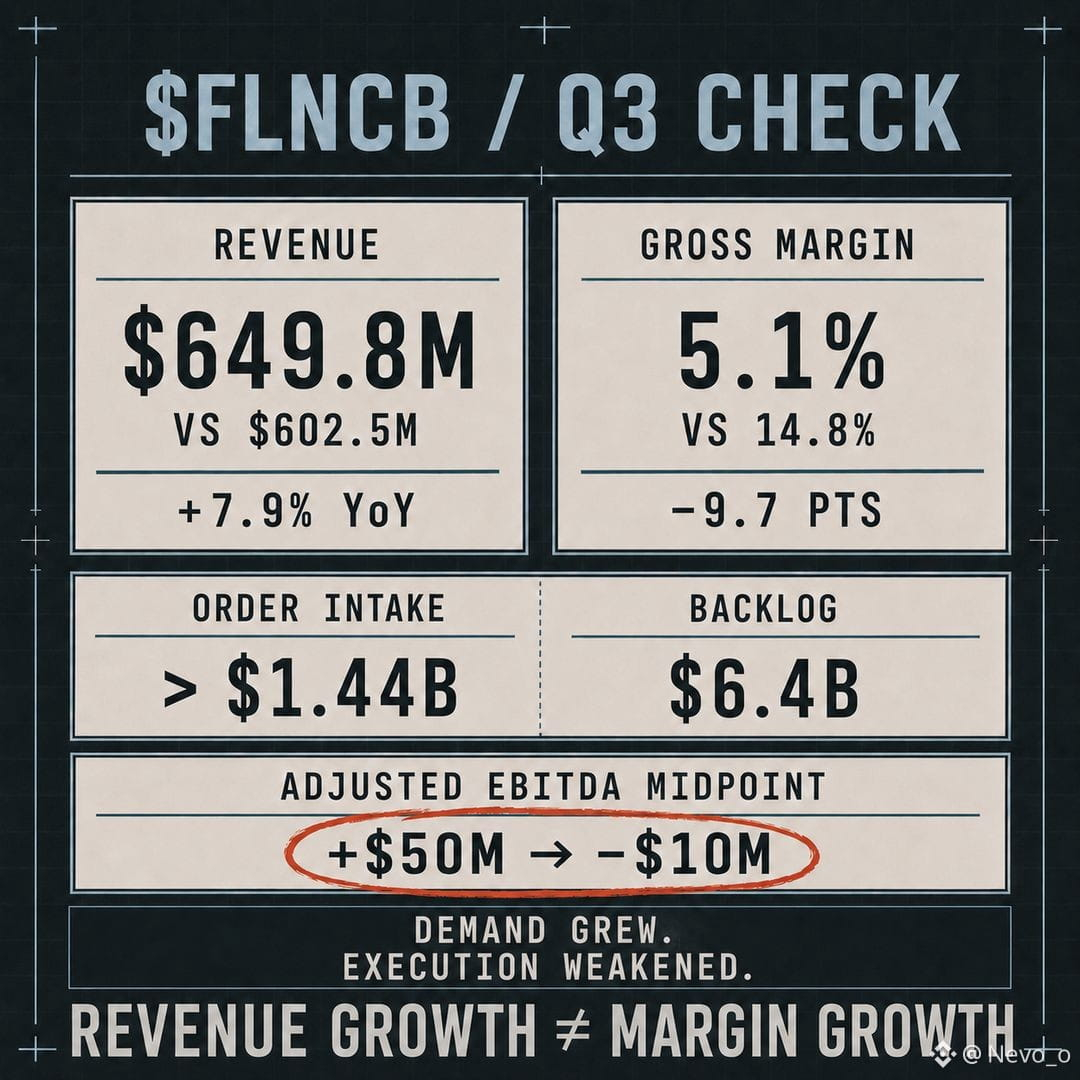
$FLNCB EINNAHMEN WUCHSEN UM 7,9 %. DIE ÖKONOMIE VERLIEF IN DIE ANDERE RICHTUNG.
Fluence meldete einen Q3-Umsatz von 649,8 Mio. US-Dollar, nach 602,5 Mio. US-Dollar im Vorjahr. Die GAAP-Bruttomarge sank von 14,8 % auf 5,1 %.
Die Nachfrage wirkte weiterhin stark. Der Auftragseingang lag im Quartal bei etwa 1,44 Mrd. US-Dollar, und der Auftragsbestand erreichte einen Rekordwert von 6,4 Mrd. US-Dollar. Das Problem lag in der Umsetzung: Produktionsprobleme verschoben 400 Mio. US-Dollar an Projektlieferungen in das Geschäftsjahr 2027. Fluence senkte die Umsatz-Mitteprognose für FY2026 von 3,4 Mrd. US-Dollar auf 3,0 Mrd. US-Dollar und die bereinigte EBITDA-Mitteprognose von +50 Mio. US-Dollar auf -10 Mio. US-Dollar.
Für $FLNCB interessiert mich weniger ein weiterer Rekord beim Auftragsbestand als vielmehr, was passiert, wenn diese Aufträge ausgeliefert werden. Wenn der Umsatz zurückkehrt, aber die Marge nahe 5 % bleibt, war der Auftragsbestand nicht die ganze Antwort.
Was würdet ihr im nächsten Quartal zuerst prüfen: Lieferungen oder Bruttomarge?
{spot}(FLNCBUSDT)
@BinanceCIS $FLNCB #bStocksCIS
$FLNCB EINNAHMEN WUCHSEN UM 7,9 %. DIE ÖKONOMIE VERLIEF IN DIE ANDERE RICHTUNG.
Fluence meldete einen Q3-Umsatz von 649,8 Mio. US-Dollar, nach 602,5 Mio. US-Dollar im Vorjahr. Die GAAP-Bruttomarge sank von 14,8 % auf 5,1 %.
Die Nachfrage wirkte weiterhin stark. Der Auftragseingang lag im Quartal bei etwa 1,44 Mrd. US-Dollar, und der Auftragsbestand erreichte einen Rekordwert von 6,4 Mrd. US-Dollar. Das Problem lag in der Umsetzung: Produktionsprobleme verschoben 400 Mio. US-Dollar an Projektlieferungen in das Geschäftsjahr 2027. Fluence senkte die Umsatz-Mitteprognose für FY2026 von 3,4 Mrd. US-Dollar auf 3,0 Mrd. US-Dollar und die bereinigte EBITDA-Mitteprognose von +50 Mio. US-Dollar auf -10 Mio. US-Dollar.
Für $FLNCB interessiert mich weniger ein weiterer Rekord beim Auftragsbestand als vielmehr, was passiert, wenn diese Aufträge ausgeliefert werden. Wenn der Umsatz zurückkehrt, aber die Marge nahe 5 % bleibt, war der Auftragsbestand nicht die ganze Antwort.
Was würdet ihr im nächsten Quartal zuerst prüfen: Lieferungen oder Bruttomarge?
@BinanceCIS $FLNCB #bStocksCIS
Fluence meldete einen Q3-Umsatz von 649,8 Mio. US-Dollar, nach 602,5 Mio. US-Dollar im Vorjahr. Die GAAP-Bruttomarge sank von 14,8 % auf 5,1 %.
Die Nachfrage wirkte weiterhin stark. Der Auftragseingang lag im Quartal bei etwa 1,44 Mrd. US-Dollar, und der Auftragsbestand erreichte einen Rekordwert von 6,4 Mrd. US-Dollar. Das Problem lag in der Umsetzung: Produktionsprobleme verschoben 400 Mio. US-Dollar an Projektlieferungen in das Geschäftsjahr 2027. Fluence senkte die Umsatz-Mitteprognose für FY2026 von 3,4 Mrd. US-Dollar auf 3,0 Mrd. US-Dollar und die bereinigte EBITDA-Mitteprognose von +50 Mio. US-Dollar auf -10 Mio. US-Dollar.
Für $FLNCB interessiert mich weniger ein weiterer Rekord beim Auftragsbestand als vielmehr, was passiert, wenn diese Aufträge ausgeliefert werden. Wenn der Umsatz zurückkehrt, aber die Marge nahe 5 % bleibt, war der Auftragsbestand nicht die ganze Antwort.
Was würdet ihr im nächsten Quartal zuerst prüfen: Lieferungen oder Bruttomarge?
@BinanceCIS $FLNCB #bStocksCIS
5
2
220
·
--
Bullisch
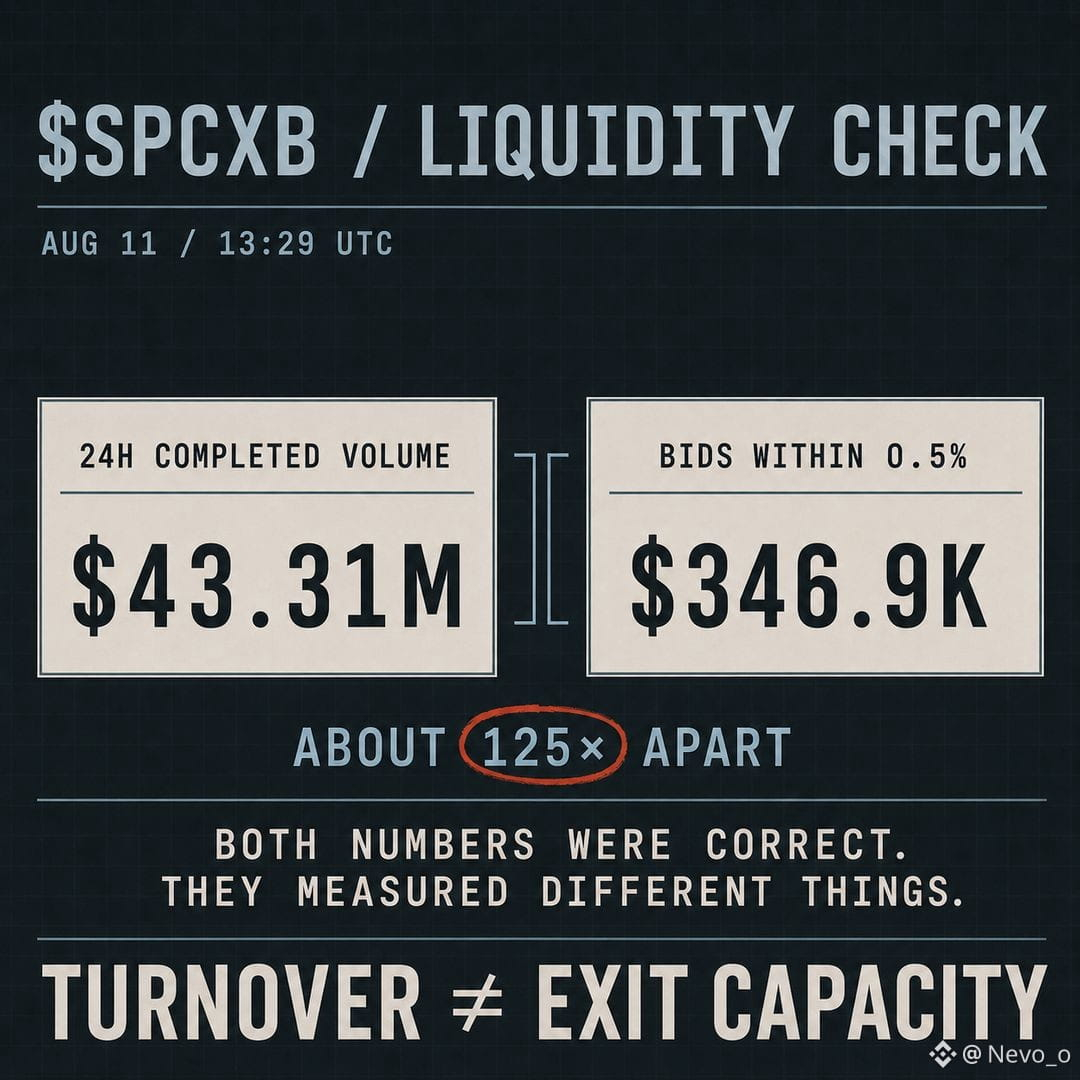
$43,31 Mio. VOLUMEN BEDEUTETE NICHT, DASS $43,31 Mio. DAFÜR BEREITSTANDEN, UM $SPCXB ZU KAUFEN.
⠀
Um 13:29 UTC am 11. August zeigte Binance $43,31 Mio. im 24-Stunden-Quote-Volumen.
⠀
Im selben Snapshot waren Gebote, die innerhalb von 0,5 % unter dem Mittelpunkt lagen, etwa 346,9 Tsd. US-Dollar wert.
⠀
Die erste Zahl war etwa 125-mal so groß. Beide waren korrekt.
⠀
Das 24-Stunden-Volumen ist der abgeschlossene Umsatz über ein gleitendes Zeitfenster. Dasselbe Kapital kann mehr als einmal handeln.
⠀
Die 0,5 %-Bid-Depth ist die ruhende Nachfrage, die in der Nähe des Preises sichtbar ist. Sie kann sich ändern, bevor eine Order eintrifft.
⠀
Für einen großen Exit ist der jüngste Umsatz der Kontext. Nahe liegende Gebote und geschätztes Slippage sind der Ausführungstest.
⠀
Was würdest du lieber neben einem bStock sehen: 24-Stunden-Volumen oder 0,5 %-Depth?
⠀
{spot}(SPCXBUSDT)
@BinanceCIS $SPCXB #bStocksCIS
$43,31 Mio. VOLUMEN BEDEUTETE NICHT, DASS $43,31 Mio. DAFÜR BEREITSTANDEN, UM $SPCXB ZU KAUFEN.
⠀
Um 13:29 UTC am 11. August zeigte Binance $43,31 Mio. im 24-Stunden-Quote-Volumen.
⠀
Im selben Snapshot waren Gebote, die innerhalb von 0,5 % unter dem Mittelpunkt lagen, etwa 346,9 Tsd. US-Dollar wert.
⠀
Die erste Zahl war etwa 125-mal so groß. Beide waren korrekt.
⠀
Das 24-Stunden-Volumen ist der abgeschlossene Umsatz über ein gleitendes Zeitfenster. Dasselbe Kapital kann mehr als einmal handeln.
⠀
Die 0,5 %-Bid-Depth ist die ruhende Nachfrage, die in der Nähe des Preises sichtbar ist. Sie kann sich ändern, bevor eine Order eintrifft.
⠀
Für einen großen Exit ist der jüngste Umsatz der Kontext. Nahe liegende Gebote und geschätztes Slippage sind der Ausführungstest.
⠀
Was würdest du lieber neben einem bStock sehen: 24-Stunden-Volumen oder 0,5 %-Depth?
⠀
@BinanceCIS $SPCXB #bStocksCIS
⠀
Um 13:29 UTC am 11. August zeigte Binance $43,31 Mio. im 24-Stunden-Quote-Volumen.
⠀
Im selben Snapshot waren Gebote, die innerhalb von 0,5 % unter dem Mittelpunkt lagen, etwa 346,9 Tsd. US-Dollar wert.
⠀
Die erste Zahl war etwa 125-mal so groß. Beide waren korrekt.
⠀
Das 24-Stunden-Volumen ist der abgeschlossene Umsatz über ein gleitendes Zeitfenster. Dasselbe Kapital kann mehr als einmal handeln.
⠀
Die 0,5 %-Bid-Depth ist die ruhende Nachfrage, die in der Nähe des Preises sichtbar ist. Sie kann sich ändern, bevor eine Order eintrifft.
⠀
Für einen großen Exit ist der jüngste Umsatz der Kontext. Nahe liegende Gebote und geschätztes Slippage sind der Ausführungstest.
⠀
Was würdest du lieber neben einem bStock sehen: 24-Stunden-Volumen oder 0,5 %-Depth?
⠀
@BinanceCIS $SPCXB #bStocksCIS
8
8
141
·
--
EIN SPOT-FILL IST NICHT IMMER EIN ON-CHAIN-EVENT.
⠀
Das ist ein einfacher Audit-Fehler mit $NVDAB: BscScan öffnen, um nach einem Trade zu suchen, der nie mit BSC in Berührung kam.
⠀
In der CSD-Umgebung von Binance werden Zertifikatsübertragungen off-chain als Buchungssatz-Aktualisierungen im CSD Master Ledger erfasst. Es sind keine einzelnen Transaktionen auf BNB Smart Chain.
⠀
$NVDAB zu einer externen Wallet auszahlen und die öffentliche Kette wird relevant. Im CSD-Umfeld handeln und der Eintrag lebt woanders.
⠀
BscScan kann Bewegungen auf BSC anzeigen. Es kann nicht jeden Binance Spot-Fill rekonstruieren oder die Binance-Orderhistorie ersetzen.
⠀
Eine fehlende Transaktions-Hash bedeutet nicht, dass der Spot-Fill fehlgeschlagen ist. Möglicherweise handelt es sich nur um ein off-chain Ereignis, das im anderen Ledger aufgezeichnet wurde.
⠀
Ein Asset, zwei Aufzeichnungssysteme. Den Eintrag mit dem Ereignis abgleichen.
{spot}(NVDABUSDT)
⠀
@BinanceCIS $NVDAB #bStocksCIS
EIN SPOT-FILL IST NICHT IMMER EIN ON-CHAIN-EVENT.
⠀
Das ist ein einfacher Audit-Fehler mit $NVDAB : BscScan öffnen, um nach einem Trade zu suchen, der nie mit BSC in Berührung kam.
⠀
In der CSD-Umgebung von Binance werden Zertifikatsübertragungen off-chain als Buchungssatz-Aktualisierungen im CSD Master Ledger erfasst. Es sind keine einzelnen Transaktionen auf BNB Smart Chain.
⠀
$NVDAB zu einer externen Wallet auszahlen und die öffentliche Kette wird relevant. Im CSD-Umfeld handeln und der Eintrag lebt woanders.
⠀
BscScan kann Bewegungen auf BSC anzeigen. Es kann nicht jeden Binance Spot-Fill rekonstruieren oder die Binance-Orderhistorie ersetzen.
⠀
Eine fehlende Transaktions-Hash bedeutet nicht, dass der Spot-Fill fehlgeschlagen ist. Möglicherweise handelt es sich nur um ein off-chain Ereignis, das im anderen Ledger aufgezeichnet wurde.
⠀
Ein Asset, zwei Aufzeichnungssysteme. Den Eintrag mit dem Ereignis abgleichen.
⠀
@BinanceCIS $NVDAB #bStocksCIS
⠀
Das ist ein einfacher Audit-Fehler mit $NVDAB : BscScan öffnen, um nach einem Trade zu suchen, der nie mit BSC in Berührung kam.
⠀
In der CSD-Umgebung von Binance werden Zertifikatsübertragungen off-chain als Buchungssatz-Aktualisierungen im CSD Master Ledger erfasst. Es sind keine einzelnen Transaktionen auf BNB Smart Chain.
⠀
$NVDAB zu einer externen Wallet auszahlen und die öffentliche Kette wird relevant. Im CSD-Umfeld handeln und der Eintrag lebt woanders.
⠀
BscScan kann Bewegungen auf BSC anzeigen. Es kann nicht jeden Binance Spot-Fill rekonstruieren oder die Binance-Orderhistorie ersetzen.
⠀
Eine fehlende Transaktions-Hash bedeutet nicht, dass der Spot-Fill fehlgeschlagen ist. Möglicherweise handelt es sich nur um ein off-chain Ereignis, das im anderen Ledger aufgezeichnet wurde.
⠀
Ein Asset, zwei Aufzeichnungssysteme. Den Eintrag mit dem Ereignis abgleichen.
⠀
@BinanceCIS $NVDAB #bStocksCIS
6
5
94
Anmelden und weiter Inhalte entdecken
Krypto-Nutzer weltweit auf Binance Square kennenlernen
⚡️ Bleib in Sachen Krypto stets am Puls.
💬 Die weltgrößte Kryptobörse vertraut darauf.
👍 Erhalte verlässliche Einblicke von verifizierten Creators.
E-Mail-Adresse/Telefonnummer
Trendthemen
NEARRisesNearly80%InAWeek
45,994 Aufrufe
1,004 Kommentare
#nearrisesnearly80%inaweek $NEAR hat gerade in 7 Tagen +80% gemacht und niemand redet über das WARUM 🚀
$2.20 → $4.29, während der gesamte Markt nur um 6% gestiegen ist.
Die echten Treiber:
→ Intent-Volumen bei near $30B
→ Vertrauliche Perps-Launch mit Hyperliquid
→ TVL wieder bei $190M + 52K aktive Wallets
Ich habe es bei $2.30 gesehen und nichts getan. Lektion gelernt.
Hältst du es oder schaust du noch von der Seitenlinie aus? 👀
$NEAR #NEARProtocol #CryptoNews
True News
·2 Likes
·824 Aufrufe
MultiversXPlansHardForkRecovery
38,211 Aufrufe
765 Kommentare
CircleLaunchesInstitutionalBTCBackedBorrowing
35,867 Aufrufe
821 Kommentare