
Satoshi Bro
299 Postlar

Satoshi Bro
Shikoyat qilish
Foydalanuvchini bloklash
Ochiq savdo
Tez-tez savdo qiluvchi
3.9 oy
0 Kuzatilmoqda
28 Kuzatuvchilar
13 Yoqdi
Postlar
Portfel
Barchasi
Videolar
·
--
Maqola
Tarjimani ko‘rish
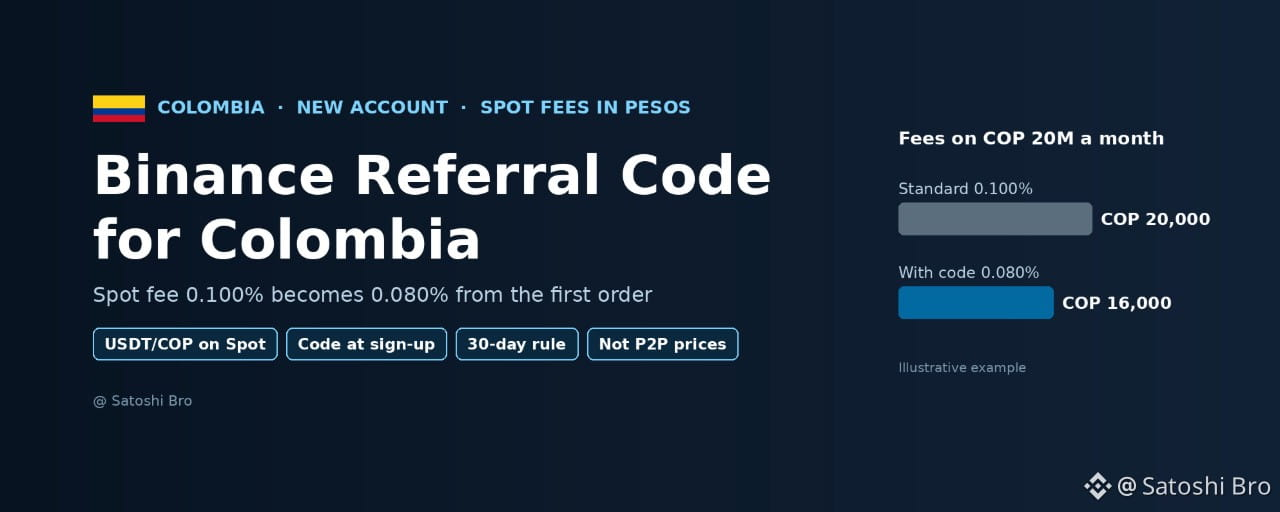
Binance Referral Code for Colombia Spot Fee DiscountIf you are opening a Binance account from Colombia, the code you type at sign-up decides what you pay on every Spot trade that follows. With THEBESTCODE the standard Spot fee of 0.100% becomes 0.080%, and the lower rate is there from your very first order. On a COP 1,000,000 trade, that means COP 800 in fees instead of COP 1,000.
The catch is timing. A code only sticks if it is on the form when the account is created, or inside a short window afterwards under strict conditions. Below you will find how to get it on the account the first time, what the cut is worth in pesos, and what it does not touch.
👉 [Open a Binance account from Colombia with THEBESTCODE](https://www.binance.com/join?ref=THEBESTCODE)
Disclosure: that link carries my sign-up code. THEBESTCODE gives a 20% cut on Spot trading fees. It is not an entry route to Binance's separate BESTBONUS welcome offer, which is explained near the end.
Quick facts for a Colombian sign-up
Code to type: THEBESTCODE, in capitals, with no spaces.What it changes: the Spot trading fee at the Regular level, from 0.100% to 0.080% for makers and takers.Where it goes: the sign-up link attaches it, and the registration page shows it above the heading before you create the account.Pesos on Binance: USDT/COP is a live Spot pair, and P2P lists COP ads with local options such as Nequi, Bancolombia and Daviplata.Last checked: 9 November 2026.
What does a Binance referral code for Colombia actually change?
It changes one number, the fee Binance takes when a Spot order fills. Binance's public fee schedule lists 0.100% maker and 0.100% taker for Regular User accounts. An account opened with THEBESTCODE pays 0.080% on the same orders, whether the pair is BTC/USDT, ETH/USDT or USDT/COP.
Plenty of things stay exactly as they are:
P2P prices: each advertiser sets their own peso rate, so there is no Spot fee for the code to shrink.Convert and quick Buy: the cost sits inside the quoted rate rather than in a separate fee line.Withdrawals: network fees for sending crypto out are set per coin and network.Futures: this article only covers Spot, so do not expect the figures below to apply to derivatives.
So the code matters most to people who will place Spot orders. If you only plan to buy a little USDT on P2P and hold it, the difference will be close to zero.
What is the 20% worth in pesos?
On 9 November 2026 the USDT/COP pair on Binance Spot was trading around 3,234 pesos per USDT, with the top bid and the top ask one peso apart. That gap is about 0.03%, so on this pair the trading fee is a bigger cost than the spread. Here is what the code does for three kinds of Colombian user.
A monthly saver in Medellín: she turns COP 400,000 into USDT on USDT/COP, then buys bitcoin with that USDT. That is two fills of about COP 400,000 each. At 0.100% the fees come to about COP 800. With the code they come to about COP 640.A weekly trader in Bogotá: he trades about COP 20,000,000 a month on BTC/USDT, roughly 6,180 USDT at the rate above. Standard fees are about COP 20,000 a month. With the code they are about COP 16,000, so around COP 48,000 stays in his account over a year.A busier account: at COP 100,000,000 of monthly volume, fees drop from about COP 100,000 to COP 80,000. Over twelve months the gap is about COP 240,000.
The saver in the first example gains very little, and that is fine to admit. The value grows with how often you trade, because the cut repeats on every fill.
Paying fees in BNB is a separate option. The fee schedule lists 0.07500% for Regular accounts that settle fees in BNB, which needs the option switched on and BNB in your Spot wallet. Do not assume the two reductions add up. Place one small order and read the fee in your trade history instead.
How to add THEBESTCODE when you register
Open the sign-up link near the top of this page, on your phone browser or your computer. It fills the code in for you.Type your email address or your Colombian mobile number.Before you press "Register", look at the small line at the top of the page. It should read "Satoshi Bro (Code: THEBESTCODE)". If that line is missing, the code did not come through, so open the link again before going any further.Enter the six-digit verification code Binance sends you, then set a password you do not use anywhere else.When identity verification asks for your country, choose Colombia and use an ID document the screen accepts.
Pressing "Register" on a page that shows no code is the most common way to lose the lower rate. Ten seconds of checking saves a lot of support tickets later.
Code to look for at the top of the page: THEBESTCODE
Forgot the code at sign-up? Check the 30-day window
There is a narrow way back. Binance's FAQ for the Referral Pro program says a user who forgot to enter a code during registration can still bind one later, but only when every condition below is true:
The account is within 30 days of registration.There has been no deposit and no trading on it yet.It has no existing code relationship.It is a main account, not a sub-account.The same identity details have not been used on another account in the past 180 days.The account is not flagged for wash trading.
In practice, the deposit rule is the one that catches people. A first P2P purchase of a few thousand pesos closes the window for good.
Once a code is attached, it cannot be changed or removed. Closing an account and opening a new one with the same identity to switch codes does not work either, because Binance detects the duplicate identity and can cancel the benefits on the new account. If your code seems to have vanished, these [fixes for a sign-up code that does not seem to work](https://www.binance.com/en/square/post/385094902391694) go through the usual causes one by one.
Getting pesos in and out of Binance
Most Colombian users move pesos through P2P. You pick an advertiser, pay from a Nequi, Bancolombia, Daviplata or bank account in your own name, and the USDT is released from escrow once the seller confirms. The name on the payment must match your verified Binance name.
That part has nothing to do with the code. The code starts to matter the moment that USDT is used on Spot, for example to buy BTC or to sell back into COP on the USDT/COP pair. For the P2P side, this [checklist for buying USDT with Colombian pesos on P2P](https://www.binance.com/en/square/post/385557999295143) covers merchant filters, payment windows and the scams to avoid.
Mistakes that cost Colombian newcomers the lower rate
Signing up in a hurry: creating the account from an ad or an app prompt and planning to add the code later.Funding before binding: making a small P2P buy while a forgotten code could still have been added.A second account in a relative's name: one person, one verified account. Accounts tied to the same identity tend to fail checks or end up under review.Testing the rate on Convert: Convert has no Spot fee line, so it cannot show you whether the code is working.Trusting chat for payment details: on P2P, copy bank or wallet details only from the open order screen.
How to confirm the code is working
Place a small Spot order once your account is verified and funded. The USDT/COP pair accepts orders from COP 4,000, so a COP 10,000 limit order is enough. After it fills, open the trade history and divide the fee by the traded amount. At 0.080% a COP 10,000 fill should show a fee of about COP 8. If you see about COP 10, check whether you are logged into the account you registered with the code, and whether fees were taken in BNB.
FAQ
Is there a Binance referral code for Colombia?
Binance codes are not tied to one country, so a code used in Colombia works the same way as anywhere else on the platform. THEBESTCODE lowers the Spot trading fee from 0.100% to 0.080% on an account opened with it, which includes pairs priced in pesos such as USDT/COP.
Can I add the code after my first P2P purchase?
No. Binance's FAQ only allows a later binding when the account has had no deposit and no trading yet, is under 30 days old and meets the other listed conditions. A completed P2P buy counts as activity, so the account stays at the standard rate.
Does THEBESTCODE make P2P cheaper?
No. P2P prices are set by each advertiser in pesos, and the code only reduces the Spot trading fee. You see the effect once you trade the USDT on a Spot pair.
Does the code work in the Binance app?
Yes. The lower rate belongs to the account, not to the device, so the same 0.080% applies to Spot orders placed in the app or on the website. What matters is that the code was on the account when it was created.
Does THEBESTCODE count for the BESTBONUS welcome offer?
No. BESTBONUS is a separate campaign with its own entry rules, explained below, and THEBESTCODE is the route for the lower Spot fee. The sign-up page also advertises new-user rewards in general. Check which tasks your own account shows after sign-up rather than assuming any of them apply.
Ready to open the account? Use the sign-up link at the top and check that the page shows THEBESTCODE before you press "Register".
About the welcome offer: the [Binance BESTBONUS event page](https://www.binance.com/en/events/BESTBONUS) sets its own entry rules. You need to sign up through the Register button on that page or with the code SATOSHIBRO, then pass identity verification within 30 days. Accounts opened any other way, THEBESTCODE included, do not receive those welcome tasks, and the two offers cannot be combined. Pick the one that suits how you plan to use Binance.
Crypto prices move in both directions, and a lower fee does not protect you from a falling market. This is a fee guide for education, not financial or tax advice. Figures come from Binance's Spot fee schedule, its FAQ on adding a code after sign-up, and live USDT/COP market data, checked on 9 November 2026.
$BTC
$BNB
Binance Referral Code for Colombia Spot Fee Discount
If you are opening a Binance account from Colombia, the code you type at sign-up decides what you pay on every Spot trade that follows. With THEBESTCODE the standard Spot fee of 0.100% becomes 0.080%, and the lower rate is there from your very first order. On a COP 1,000,000 trade, that means COP 800 in fees instead of COP 1,000.
The catch is timing. A code only sticks if it is on the form when the account is created, or inside a short window afterwards under strict conditions. Below you will find how to get it on the account the first time, what the cut is worth in pesos, and what it does not touch.
👉 Open a Binance account from Colombia with THEBESTCODE
Disclosure: that link carries my sign-up code. THEBESTCODE gives a 20% cut on Spot trading fees. It is not an entry route to Binance's separate BESTBONUS welcome offer, which is explained near the end.
Quick facts for a Colombian sign-up
Code to type: THEBESTCODE, in capitals, with no spaces.What it changes: the Spot trading fee at the Regular level, from 0.100% to 0.080% for makers and takers.Where it goes: the sign-up link attaches it, and the registration page shows it above the heading before you create the account.Pesos on Binance: USDT/COP is a live Spot pair, and P2P lists COP ads with local options such as Nequi, Bancolombia and Daviplata.Last checked: 9 November 2026.
What does a Binance referral code for Colombia actually change?
It changes one number, the fee Binance takes when a Spot order fills. Binance's public fee schedule lists 0.100% maker and 0.100% taker for Regular User accounts. An account opened with THEBESTCODE pays 0.080% on the same orders, whether the pair is BTC/USDT, ETH/USDT or USDT/COP.
Plenty of things stay exactly as they are:
P2P prices: each advertiser sets their own peso rate, so there is no Spot fee for the code to shrink.Convert and quick Buy: the cost sits inside the quoted rate rather than in a separate fee line.Withdrawals: network fees for sending crypto out are set per coin and network.Futures: this article only covers Spot, so do not expect the figures below to apply to derivatives.
So the code matters most to people who will place Spot orders. If you only plan to buy a little USDT on P2P and hold it, the difference will be close to zero.
What is the 20% worth in pesos?
On 9 November 2026 the USDT/COP pair on Binance Spot was trading around 3,234 pesos per USDT, with the top bid and the top ask one peso apart. That gap is about 0.03%, so on this pair the trading fee is a bigger cost than the spread. Here is what the code does for three kinds of Colombian user.
A monthly saver in Medellín: she turns COP 400,000 into USDT on USDT/COP, then buys bitcoin with that USDT. That is two fills of about COP 400,000 each. At 0.100% the fees come to about COP 800. With the code they come to about COP 640.A weekly trader in Bogotá: he trades about COP 20,000,000 a month on BTC/USDT, roughly 6,180 USDT at the rate above. Standard fees are about COP 20,000 a month. With the code they are about COP 16,000, so around COP 48,000 stays in his account over a year.A busier account: at COP 100,000,000 of monthly volume, fees drop from about COP 100,000 to COP 80,000. Over twelve months the gap is about COP 240,000.
The saver in the first example gains very little, and that is fine to admit. The value grows with how often you trade, because the cut repeats on every fill.
Paying fees in BNB is a separate option. The fee schedule lists 0.07500% for Regular accounts that settle fees in BNB, which needs the option switched on and BNB in your Spot wallet. Do not assume the two reductions add up. Place one small order and read the fee in your trade history instead.
How to add THEBESTCODE when you register
Open the sign-up link near the top of this page, on your phone browser or your computer. It fills the code in for you.Type your email address or your Colombian mobile number.Before you press "Register", look at the small line at the top of the page. It should read "Satoshi Bro (Code: THEBESTCODE)". If that line is missing, the code did not come through, so open the link again before going any further.Enter the six-digit verification code Binance sends you, then set a password you do not use anywhere else.When identity verification asks for your country, choose Colombia and use an ID document the screen accepts.
Pressing "Register" on a page that shows no code is the most common way to lose the lower rate. Ten seconds of checking saves a lot of support tickets later.
Code to look for at the top of the page: THEBESTCODE
Forgot the code at sign-up? Check the 30-day window
There is a narrow way back. Binance's FAQ for the Referral Pro program says a user who forgot to enter a code during registration can still bind one later, but only when every condition below is true:
The account is within 30 days of registration.There has been no deposit and no trading on it yet.It has no existing code relationship.It is a main account, not a sub-account.The same identity details have not been used on another account in the past 180 days.The account is not flagged for wash trading.
In practice, the deposit rule is the one that catches people. A first P2P purchase of a few thousand pesos closes the window for good.
Once a code is attached, it cannot be changed or removed. Closing an account and opening a new one with the same identity to switch codes does not work either, because Binance detects the duplicate identity and can cancel the benefits on the new account. If your code seems to have vanished, these fixes for a sign-up code that does not seem to work go through the usual causes one by one.
Getting pesos in and out of Binance
Most Colombian users move pesos through P2P. You pick an advertiser, pay from a Nequi, Bancolombia, Daviplata or bank account in your own name, and the USDT is released from escrow once the seller confirms. The name on the payment must match your verified Binance name.
That part has nothing to do with the code. The code starts to matter the moment that USDT is used on Spot, for example to buy BTC or to sell back into COP on the USDT/COP pair. For the P2P side, this checklist for buying USDT with Colombian pesos on P2P covers merchant filters, payment windows and the scams to avoid.
Mistakes that cost Colombian newcomers the lower rate
Signing up in a hurry: creating the account from an ad or an app prompt and planning to add the code later.Funding before binding: making a small P2P buy while a forgotten code could still have been added.A second account in a relative's name: one person, one verified account. Accounts tied to the same identity tend to fail checks or end up under review.Testing the rate on Convert: Convert has no Spot fee line, so it cannot show you whether the code is working.Trusting chat for payment details: on P2P, copy bank or wallet details only from the open order screen.
How to confirm the code is working
Place a small Spot order once your account is verified and funded. The USDT/COP pair accepts orders from COP 4,000, so a COP 10,000 limit order is enough. After it fills, open the trade history and divide the fee by the traded amount. At 0.080% a COP 10,000 fill should show a fee of about COP 8. If you see about COP 10, check whether you are logged into the account you registered with the code, and whether fees were taken in BNB.
FAQ
Is there a Binance referral code for Colombia?
Binance codes are not tied to one country, so a code used in Colombia works the same way as anywhere else on the platform. THEBESTCODE lowers the Spot trading fee from 0.100% to 0.080% on an account opened with it, which includes pairs priced in pesos such as USDT/COP.
Can I add the code after my first P2P purchase?
No. Binance's FAQ only allows a later binding when the account has had no deposit and no trading yet, is under 30 days old and meets the other listed conditions. A completed P2P buy counts as activity, so the account stays at the standard rate.
Does THEBESTCODE make P2P cheaper?
No. P2P prices are set by each advertiser in pesos, and the code only reduces the Spot trading fee. You see the effect once you trade the USDT on a Spot pair.
Does the code work in the Binance app?
Yes. The lower rate belongs to the account, not to the device, so the same 0.080% applies to Spot orders placed in the app or on the website. What matters is that the code was on the account when it was created.
Does THEBESTCODE count for the BESTBONUS welcome offer?
No. BESTBONUS is a separate campaign with its own entry rules, explained below, and THEBESTCODE is the route for the lower Spot fee. The sign-up page also advertises new-user rewards in general. Check which tasks your own account shows after sign-up rather than assuming any of them apply.
Ready to open the account? Use the sign-up link at the top and check that the page shows THEBESTCODE before you press "Register".
About the welcome offer: the Binance BESTBONUS event page sets its own entry rules. You need to sign up through the Register button on that page or with the code SATOSHIBRO, then pass identity verification within 30 days. Accounts opened any other way, THEBESTCODE included, do not receive those welcome tasks, and the two offers cannot be combined. Pick the one that suits how you plan to use Binance.
Crypto prices move in both directions, and a lower fee does not protect you from a falling market. This is a fee guide for education, not financial or tax advice. Figures come from Binance's Spot fee schedule, its FAQ on adding a code after sign-up, and live USDT/COP market data, checked on 9 November 2026.
$BTC
$BNB
38
·
--
Tarjimani ko‘rish
$BNB is stuck in a box, and the box keeps getting tighter 📦
Price right now: about $688, down 1.2% on the day.
Over the last 8 daily candles on Binance it has stayed between roughly $678 and $723. Every push to $720 got sold, and every dip toward $680 got bought.
What I'm watching:
🔸 A daily close above $723 opens the door to a real move up
🔸 Losing $678 on a close puts the bottom of the range in play for sellers
🔸 Until one of those breaks, it's a range trade, not a trend
Not financial advice, just the levels on my chart.
Breakout or breakdown first? 👇
#BNB #CryptoMarket #TechnicalAnalysis #Binance
117
·
--
Maqola
Tarjimani ko‘rish
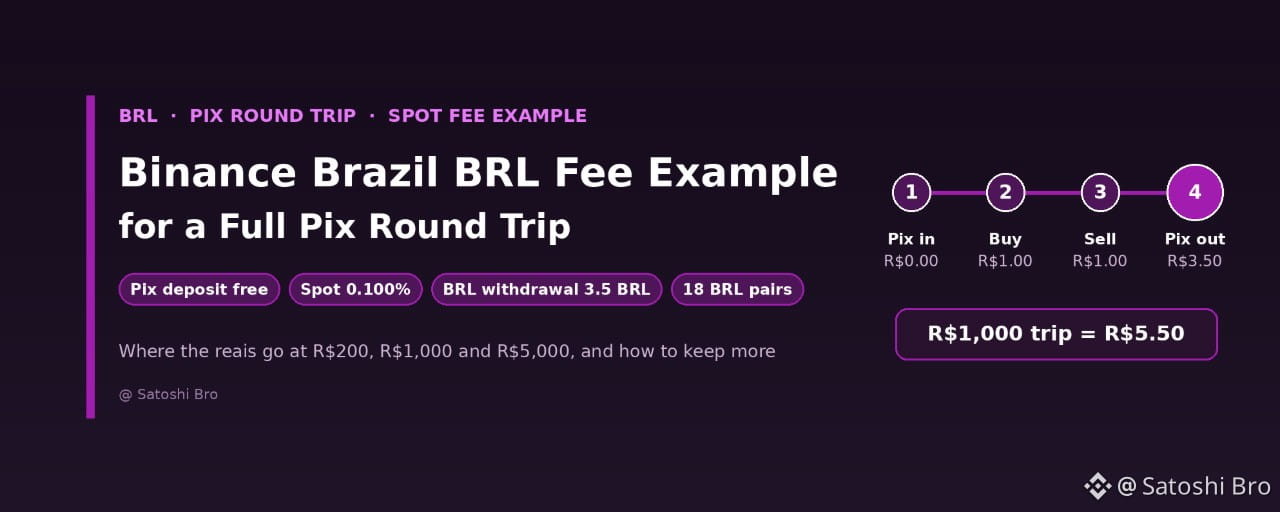
Binance Brazil BRL Fee Example for a Full Pix Round TripMoving R$1,000 from your bank into Binance, buying bitcoin, selling it again and sending the reais home costs about R$5.50 at standard rates. Only R$2.00 of that is trading. The other R$3.50 is a flat charge on the BRL withdrawal, and it weighs more the smaller your amount is.
That split is what most Brazilian beginners miss. Pix deposits are free, Spot fees are a percentage, and the cash-out is a fixed amount. Once you know which cost is which, it is easier to decide how to route a buy and how often to withdraw.
👉 [Create a Binance account with code THEBESTCODE](https://www.binance.com/join?ref=THEBESTCODE)
Disclosure: that is a referral link. In the examples below, THEBESTCODE stands for a 20% cut on Spot trading fees from your first trade, so the Regular rate of 0.100% becomes 0.080%. It does not qualify for the separate BESTBONUS welcome offer.
How much does a R$1,000 round trip cost on Binance?
At the Regular User rate, a R$1,000 round trip through a BRL pair costs about R$5.50, or 0.55% of the amount. The Pix deposit is free, the buy and the sale each cost 0.100%, and a personal account pays a flat 3.5 BRL to withdraw reais, according to Binance's BRL bank transfer FAQ.
Pix deposit: R$0.00.Buy BTC on BTC/BRL: R$1.00 at the 0.100% taker rate.Sell BTC on BTC/BRL: about R$1.00, if the price is roughly where you bought.Pix withdrawal: R$3.50.
The two trading lines grow with the size of the trade. The withdrawal line stays the same. All rates here come from Binance's public fee schedule and BRL support pages as of 9 November 2026. They can change, so read your own order preview before you confirm.
Why is the Pix deposit free and what can make it fail?
Binance lists BRL deposits as free for both personal and corporate accounts, by Pix or by TED. Pix credits around the clock, weekends and holidays included, and Binance recommends it over TED, which only runs Monday to Friday from 07:00 to 17:00.
Two rules decide whether the money lands. First, you create the deposit order on Binance before you send anything, and a Pix order has to be paid within 24 hours. Second, the sending account must carry the same name and CPF as your verified Binance profile. A transfer from a partner's account, or from a company account into a personal one, goes back to the sender instead of being credited.
If you have never funded an account in reais, [this walkthrough of a first Pix deposit in BRL](https://www.binance.com/en/square/post/382765748163405) shows the order screen and the CPF check step by step.
Binance's BRL bank transfer FAQ. Deposits by Pix or TED are free for personal and corporate accounts, while a personal BRL withdrawal costs 3.5 BRL, and the page warns that withdrawal fees can change.
Should you buy with reais directly or go through USDT first?
Buy on a BRL pair whenever one exists. On 9 November 2026 Binance had 18 Spot pairs quoted in BRL, among them BTC/BRL, ETH/BRL, BNB/BRL, SOL/BRL, XRP/BRL, USDT/BRL and USDC/BRL. Each trade on one of these pairs pays one Spot fee.
The detour through USDT pays twice. Here is the same R$1,000 routed that way:
R$1,000 into USDT at about 5.58 reais per USDT gives roughly 179.2 USDT, minus a fee of about 0.18 USDT, which is close to R$1.00.Those USDT into BTC cost another 0.100%, again close to R$1.00.
That is about R$2.00 on the way in, against R$1.00 on BTC/BRL. The exit works the same way, so a full detour round trip lands near R$7.50 instead of R$5.50. The detour still makes sense for a coin that has no BRL pair. For BTC, ETH or BNB it only adds cost.
Does a limit order save anything on BRL pairs?
Not at the Regular level. Maker and taker are both 0.100% there, so a resting limit order costs the same as a market order. Binance does run zero-maker promotions on some pairs, but its public Spot Promotions list on 9 November 2026 did not include any BRL pair. Use 0.100% as your base rate unless your own order screen shows a different one.
How much does the spread add?
A market order also pays the gap between the top bid and the top ask. On USDT/BRL that gap was tiny around midday on 9 November, Asia time: 5.5794 against 5.5795, about 0.002%. On that pair the fee costs far more than the spread. Smaller BRL pairs can show wider gaps, especially late at night in Brazil, so glance at the order book before you click "Buy".
USDT/BRL on Binance Spot. The top bid and ask sit one hundredth of a centavo apart, so on this pair the 0.100% fee is the bigger cost. Prices on the live book move all the time.
What does selling back to reais cost?
Selling on BTC/BRL costs the same 0.100% as buying, charged on the value of the sale. If bitcoin has risen since you bought, the fee in reais is a little higher. If it has fallen, it is a little lower. On a R$1,000 sale the fee is R$1.00.
The proceeds land in your Spot wallet as BRL. Leaving them there costs nothing, and that matters for the last step.
Why is the R$3.50 withdrawal the cost to plan around?
A BRL withdrawal from a personal account costs 3.5 BRL per order, according to the FAQ, which also says withdrawal fees are subject to change. Corporate accounts are listed as free. On the website, the fee for your order appears on the withdrawal form before you click "Preview Order".
Timing is the other surprise. Pix deposits credit at any hour, but BRL withdrawals follow banking hours. Orders created Monday to Friday between 07:00 and 17:00 are processed straight away. Orders created outside that window wait for the next business day, and the FAQ allows up to 2 business days for execution. A request sent on Friday night may not reach your bank before Monday or Tuesday.
The receiving account has to be in the same name as your Binance account. Joint accounts and individual company accounts such as MEI and EIRELI are refused, even if you are one of the holders. For the full cash-out routine, including what happens when a bank rejects the transfer, see [this checklist for Pix withdrawals in reais](https://www.binance.com/en/square/post/384123026548383).
Binance's guide to withdrawing BRL by Pix on the website. The fee line appears on the order screen before you click "Preview Order", so you see the cost before confirming. The sample screens in the guide are older, so check the fee your own order screen shows.
How does the bill change at R$200 and R$5,000?
The same four steps give very different percentages once the amount changes. At the standard Regular rate:
R$200: R$0.20 to buy, R$0.20 to sell and R$3.50 to withdraw, so R$3.90 in total, or 1.95%.R$1,000: R$1.00, R$1.00 and R$3.50, so R$5.50, or 0.55%.R$5,000: R$5.00, R$5.00 and R$3.50, so R$13.50, or 0.27%.
At R$200 the withdrawal is about 90% of the bill. At R$5,000 it is about a quarter. Splitting cash-outs multiplies the flat part. Four weekly withdrawals of R$250 cost R$14.00 in withdrawal fees, while a single R$1,000 withdrawal costs R$3.50.
Four ways to bring the total down
Lower the Spot rate: accounts opened with THEBESTCODE trade Spot at 0.080% instead of 0.100%. On the R$1,000 trip the trading part drops from R$2.00 to R$1.60 and the total to R$5.10. On R$5,000 the total falls from R$13.50 to R$11.50.Settle fees in BNB: the fee schedule lists 0.07500% for Regular users who use BNB for fees, a 25% discount. The option has to be switched on and you need enough BNB in your Spot wallet. The R$1,000 trip then costs about R$5.00. Treat this and the code as two separate examples, and do not assume they stack unless your own trade history shows it.Stay on BRL pairs: trading BTC, ETH or BNB against reais removes one fee on each side compared with the USDT detour.Withdraw less often: batch your cash-outs and send them on a weekday morning in Brazil, so they are processed the same day.
Which limits cap how much reais you can move?
BRL transfer limits are set in US dollars. A Level 1 personal account can move up to US$10,000 a month and US$20,000 a semester, which Binance approximates as R$50,000 and R$100,000. Level 2 keeps the US$10,000 monthly limit, and Level 3 is set after a compliance review of the user's finances. The FAQ says these limits cover deposits, withdrawals, buys and sells combined, so a busy month can reach the cap sooner than your deposits alone suggest.
Because the base is in dollars, the limit in reais moves with the exchange rate. At about 5.58 reais per USDT, US$10,000 is closer to R$55,800 than to R$50,000.
Mistakes that cost more than any fee
Paying an expired Pix order: an expired Pix order cannot be paid, and a late transfer is refunded rather than credited. Create a new order instead.Sending from someone else's account: the name and CPF must match your verified profile, or the money is returned.Choosing the wrong account type: pick checking or savings correctly on the withdrawal form. Wrong bank details lead to a rejection email and a delay.Skipping the code at sign-up: the 0.080% figures in this example depend on registering with THEBESTCODE.
FAQ
Does Binance charge a fee for Pix deposits in Brazil?
No. Binance's BRL bank transfer FAQ lists BRL deposits as free for personal and corporate accounts, by Pix or by TED. You still pay the Spot fee when you trade those reais, and a personal account pays 3.5 BRL when it sends reais back to a bank.
How much is the Binance BRL withdrawal fee?
For a personal account the FAQ lists 3.5 BRL per withdrawal and notes that the fee can change. Corporate accounts are listed as free. The amount for your own order shows on the withdrawal form before you confirm, so check it there each time.
What trading fee do BRL pairs pay on Binance?
Regular User accounts pay 0.100% maker and 0.100% taker on Spot, or 0.07500% when fees are settled in BNB. On 9 November 2026 no BRL pair appeared on Binance's Spot Promotions list of zero-fee and zero-maker pairs.
Is it cheaper to buy bitcoin with reais directly or through USDT?
Directly, in most cases. BTC/BRL charges one Spot fee. Going through USDT charges two, one for BRL to USDT and one for USDT to BTC. On R$1,000 that is about R$1.00 against R$2.00 on the way in.
How long does a BRL withdrawal take on Binance?
Orders created Monday to Friday between 07:00 and 17:00 are processed straight away. Others wait for the next business day. The FAQ allows up to 2 business days for execution and says some transactions can take up to 48 hours.
What does a R$1,000 round trip cost with THEBESTCODE?
About R$5.10. That is R$0.80 to buy and R$0.80 to sell at the 0.080% Spot rate, plus the R$3.50 withdrawal. Without the code the same trip costs about R$5.50.
Want the lower Spot rate from your first BRL trade? Register with THEBESTCODE through the link near the top. Binance's welcome bonus is a different offer with its own entry rules. According to the [Binance BESTBONUS event page](https://www.binance.com/en/events/BESTBONUS), you have to register through the Register button on that page or with the referral code SATOSHIBRO, and finish identity verification within 30 days. Accounts opened through another route, THEBESTCODE included, are not given the welcome bonus tasks, and the fee cut and the bonus cannot be combined.
Crypto prices can fall as well as rise, and fees are only one part of your result. This is a fee example for education, not financial or tax advice. Fee figures come from Binance's public Spot fee schedule, its Spot Promotions list and its BRL bank transfer and BRL withdrawal guides, checked on 9 November 2026. Brazilian users should also check their own reporting duties with the Receita Federal.
$BTC $BNB
Binance Brazil BRL Fee Example for a Full Pix Round Trip
Moving R$1,000 from your bank into Binance, buying bitcoin, selling it again and sending the reais home costs about R$5.50 at standard rates. Only R$2.00 of that is trading. The other R$3.50 is a flat charge on the BRL withdrawal, and it weighs more the smaller your amount is.
That split is what most Brazilian beginners miss. Pix deposits are free, Spot fees are a percentage, and the cash-out is a fixed amount. Once you know which cost is which, it is easier to decide how to route a buy and how often to withdraw.
👉 Create a Binance account with code THEBESTCODE
Disclosure: that is a referral link. In the examples below, THEBESTCODE stands for a 20% cut on Spot trading fees from your first trade, so the Regular rate of 0.100% becomes 0.080%. It does not qualify for the separate BESTBONUS welcome offer.
How much does a R$1,000 round trip cost on Binance?
At the Regular User rate, a R$1,000 round trip through a BRL pair costs about R$5.50, or 0.55% of the amount. The Pix deposit is free, the buy and the sale each cost 0.100%, and a personal account pays a flat 3.5 BRL to withdraw reais, according to Binance's BRL bank transfer FAQ.
Pix deposit: R$0.00.Buy BTC on BTC/BRL: R$1.00 at the 0.100% taker rate.Sell BTC on BTC/BRL: about R$1.00, if the price is roughly where you bought.Pix withdrawal: R$3.50.
The two trading lines grow with the size of the trade. The withdrawal line stays the same. All rates here come from Binance's public fee schedule and BRL support pages as of 9 November 2026. They can change, so read your own order preview before you confirm.
Why is the Pix deposit free and what can make it fail?
Binance lists BRL deposits as free for both personal and corporate accounts, by Pix or by TED. Pix credits around the clock, weekends and holidays included, and Binance recommends it over TED, which only runs Monday to Friday from 07:00 to 17:00.
Two rules decide whether the money lands. First, you create the deposit order on Binance before you send anything, and a Pix order has to be paid within 24 hours. Second, the sending account must carry the same name and CPF as your verified Binance profile. A transfer from a partner's account, or from a company account into a personal one, goes back to the sender instead of being credited.
If you have never funded an account in reais, this walkthrough of a first Pix deposit in BRL shows the order screen and the CPF check step by step.
Binance's BRL bank transfer FAQ. Deposits by Pix or TED are free for personal and corporate accounts, while a personal BRL withdrawal costs 3.5 BRL, and the page warns that withdrawal fees can change.
Should you buy with reais directly or go through USDT first?
Buy on a BRL pair whenever one exists. On 9 November 2026 Binance had 18 Spot pairs quoted in BRL, among them BTC/BRL, ETH/BRL, BNB/BRL, SOL/BRL, XRP/BRL, USDT/BRL and USDC/BRL. Each trade on one of these pairs pays one Spot fee.
The detour through USDT pays twice. Here is the same R$1,000 routed that way:
R$1,000 into USDT at about 5.58 reais per USDT gives roughly 179.2 USDT, minus a fee of about 0.18 USDT, which is close to R$1.00.Those USDT into BTC cost another 0.100%, again close to R$1.00.
That is about R$2.00 on the way in, against R$1.00 on BTC/BRL. The exit works the same way, so a full detour round trip lands near R$7.50 instead of R$5.50. The detour still makes sense for a coin that has no BRL pair. For BTC, ETH or BNB it only adds cost.
Does a limit order save anything on BRL pairs?
Not at the Regular level. Maker and taker are both 0.100% there, so a resting limit order costs the same as a market order. Binance does run zero-maker promotions on some pairs, but its public Spot Promotions list on 9 November 2026 did not include any BRL pair. Use 0.100% as your base rate unless your own order screen shows a different one.
How much does the spread add?
A market order also pays the gap between the top bid and the top ask. On USDT/BRL that gap was tiny around midday on 9 November, Asia time: 5.5794 against 5.5795, about 0.002%. On that pair the fee costs far more than the spread. Smaller BRL pairs can show wider gaps, especially late at night in Brazil, so glance at the order book before you click "Buy".
USDT/BRL on Binance Spot. The top bid and ask sit one hundredth of a centavo apart, so on this pair the 0.100% fee is the bigger cost. Prices on the live book move all the time.
What does selling back to reais cost?
Selling on BTC/BRL costs the same 0.100% as buying, charged on the value of the sale. If bitcoin has risen since you bought, the fee in reais is a little higher. If it has fallen, it is a little lower. On a R$1,000 sale the fee is R$1.00.
The proceeds land in your Spot wallet as BRL. Leaving them there costs nothing, and that matters for the last step.
Why is the R$3.50 withdrawal the cost to plan around?
A BRL withdrawal from a personal account costs 3.5 BRL per order, according to the FAQ, which also says withdrawal fees are subject to change. Corporate accounts are listed as free. On the website, the fee for your order appears on the withdrawal form before you click "Preview Order".
Timing is the other surprise. Pix deposits credit at any hour, but BRL withdrawals follow banking hours. Orders created Monday to Friday between 07:00 and 17:00 are processed straight away. Orders created outside that window wait for the next business day, and the FAQ allows up to 2 business days for execution. A request sent on Friday night may not reach your bank before Monday or Tuesday.
The receiving account has to be in the same name as your Binance account. Joint accounts and individual company accounts such as MEI and EIRELI are refused, even if you are one of the holders. For the full cash-out routine, including what happens when a bank rejects the transfer, see this checklist for Pix withdrawals in reais.
Binance's guide to withdrawing BRL by Pix on the website. The fee line appears on the order screen before you click "Preview Order", so you see the cost before confirming. The sample screens in the guide are older, so check the fee your own order screen shows.
How does the bill change at R$200 and R$5,000?
The same four steps give very different percentages once the amount changes. At the standard Regular rate:
R$200: R$0.20 to buy, R$0.20 to sell and R$3.50 to withdraw, so R$3.90 in total, or 1.95%.R$1,000: R$1.00, R$1.00 and R$3.50, so R$5.50, or 0.55%.R$5,000: R$5.00, R$5.00 and R$3.50, so R$13.50, or 0.27%.
At R$200 the withdrawal is about 90% of the bill. At R$5,000 it is about a quarter. Splitting cash-outs multiplies the flat part. Four weekly withdrawals of R$250 cost R$14.00 in withdrawal fees, while a single R$1,000 withdrawal costs R$3.50.
Four ways to bring the total down
Lower the Spot rate: accounts opened with THEBESTCODE trade Spot at 0.080% instead of 0.100%. On the R$1,000 trip the trading part drops from R$2.00 to R$1.60 and the total to R$5.10. On R$5,000 the total falls from R$13.50 to R$11.50.Settle fees in BNB: the fee schedule lists 0.07500% for Regular users who use BNB for fees, a 25% discount. The option has to be switched on and you need enough BNB in your Spot wallet. The R$1,000 trip then costs about R$5.00. Treat this and the code as two separate examples, and do not assume they stack unless your own trade history shows it.Stay on BRL pairs: trading BTC, ETH or BNB against reais removes one fee on each side compared with the USDT detour.Withdraw less often: batch your cash-outs and send them on a weekday morning in Brazil, so they are processed the same day.
Which limits cap how much reais you can move?
BRL transfer limits are set in US dollars. A Level 1 personal account can move up to US$10,000 a month and US$20,000 a semester, which Binance approximates as R$50,000 and R$100,000. Level 2 keeps the US$10,000 monthly limit, and Level 3 is set after a compliance review of the user's finances. The FAQ says these limits cover deposits, withdrawals, buys and sells combined, so a busy month can reach the cap sooner than your deposits alone suggest.
Because the base is in dollars, the limit in reais moves with the exchange rate. At about 5.58 reais per USDT, US$10,000 is closer to R$55,800 than to R$50,000.
Mistakes that cost more than any fee
Paying an expired Pix order: an expired Pix order cannot be paid, and a late transfer is refunded rather than credited. Create a new order instead.Sending from someone else's account: the name and CPF must match your verified profile, or the money is returned.Choosing the wrong account type: pick checking or savings correctly on the withdrawal form. Wrong bank details lead to a rejection email and a delay.Skipping the code at sign-up: the 0.080% figures in this example depend on registering with THEBESTCODE.
FAQ
Does Binance charge a fee for Pix deposits in Brazil?
No. Binance's BRL bank transfer FAQ lists BRL deposits as free for personal and corporate accounts, by Pix or by TED. You still pay the Spot fee when you trade those reais, and a personal account pays 3.5 BRL when it sends reais back to a bank.
How much is the Binance BRL withdrawal fee?
For a personal account the FAQ lists 3.5 BRL per withdrawal and notes that the fee can change. Corporate accounts are listed as free. The amount for your own order shows on the withdrawal form before you confirm, so check it there each time.
What trading fee do BRL pairs pay on Binance?
Regular User accounts pay 0.100% maker and 0.100% taker on Spot, or 0.07500% when fees are settled in BNB. On 9 November 2026 no BRL pair appeared on Binance's Spot Promotions list of zero-fee and zero-maker pairs.
Is it cheaper to buy bitcoin with reais directly or through USDT?
Directly, in most cases. BTC/BRL charges one Spot fee. Going through USDT charges two, one for BRL to USDT and one for USDT to BTC. On R$1,000 that is about R$1.00 against R$2.00 on the way in.
How long does a BRL withdrawal take on Binance?
Orders created Monday to Friday between 07:00 and 17:00 are processed straight away. Others wait for the next business day. The FAQ allows up to 2 business days for execution and says some transactions can take up to 48 hours.
What does a R$1,000 round trip cost with THEBESTCODE?
About R$5.10. That is R$0.80 to buy and R$0.80 to sell at the 0.080% Spot rate, plus the R$3.50 withdrawal. Without the code the same trip costs about R$5.50.
Want the lower Spot rate from your first BRL trade? Register with THEBESTCODE through the link near the top. Binance's welcome bonus is a different offer with its own entry rules. According to the Binance BESTBONUS event page, you have to register through the Register button on that page or with the referral code SATOSHIBRO, and finish identity verification within 30 days. Accounts opened through another route, THEBESTCODE included, are not given the welcome bonus tasks, and the fee cut and the bonus cannot be combined.
Crypto prices can fall as well as rise, and fees are only one part of your result. This is a fee example for education, not financial or tax advice. Fee figures come from Binance's public Spot fee schedule, its Spot Promotions list and its BRL bank transfer and BRL withdrawal guides, checked on 9 November 2026. Brazilian users should also check their own reporting duties with the Receita Federal.
$BTC $BNB
34
·
--
Tarjimani ko‘rish
Fun fact: the most expensive pizza order in history was paid in bitcoin 🍕
May 22, 2010. A programmer offered 10,000 BTC on a forum to anyone who would get him two pizzas. Someone took the deal, and it became the first well-known purchase of a real-world item with bitcoin.
Back then 10,000 BTC was worth about $41.
With $BTC near $75K today, those two pizzas would be worth around $750 million.
That's why May 22 is Bitcoin Pizza Day.
Would you have spent it or held? 👇
#bitcoin #CryptoHistory #crypto #Binance
16
·
--
Maqola
Tarjimani ko‘rish
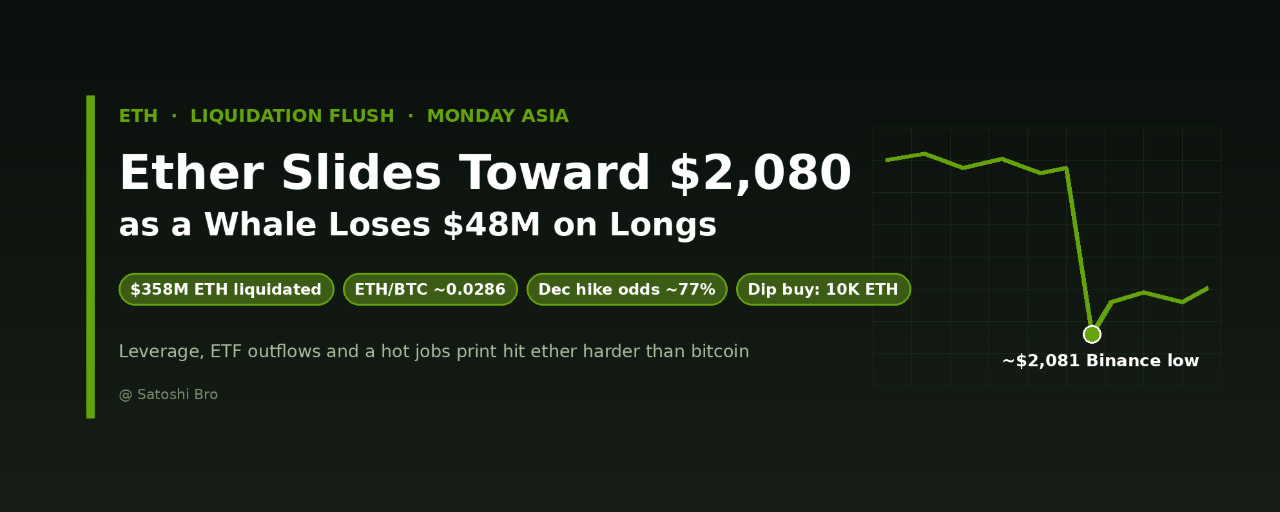
Ether Slides Toward $2,080 as a Whale Loses $48M on LongsEther slid to about $2,080 on Binance early Monday in Asia as a fast wave of forced selling hit traders who had borrowed to bet on a rebound. One large account alone lost about $48 million when roughly 63,000 ETH of long positions were closed out.
The drop did not come from a problem inside Ethereum. It came from crowded leverage, weak fund flows and a hot US jobs report that pushed rate-hike bets higher. That mix can keep ETH jumpy for the rest of the week, with US inflation data still ahead.
👉 [Open a Binance account with code GETREWARD](https://www.binance.com/join?ref=GETREWARD)
Disclosure: that is a referral link. GETREWARD is a standard sign-up code in this article. Accounts opened with it do not qualify for the separate BESTBONUS welcome offer.
What happened to ether on Monday morning?
The weekend was quiet. Ether spent Saturday evening near $2,235, according to CryptoTicker, and Binance's ETH price page shows a 24-hour high of about $2,243 before the break. Then, shortly before the daily and weekly candles closed, the floor gave way.
Within minutes ETH was trading near $2,080, and Binance's 24-hour low sits at $2,081.5. Some other venues printed lower: a MarsBit flash carried by KuCoin put the cross-exchange low near $2,060. From Binance's high to its low that is a fall of about 7%. Bitcoin moved too, but far less: it briefly slipped below $74,000 and climbed back above $75,000. Ether recovered only part of the move and was still near $2,139 hours later, down about 4.3% on the day.
By CoinGecko's daily closes, ether had not been this low since 19 August. It is now more than 50% below its all-time high of $4,946 from August 2025.
How large was the liquidation wave?
Large. CoinGlass data reported by AiCoin showed about $803 million in positions liquidated across the market over four hours. Long positions, meaning bets on higher prices, made up about $744 million of that.
Ether took the biggest share. About $358 million of ETH positions were liquidated in that window, against about $233 million for bitcoin. Bitcoin is several times larger than ether by market value, so the gap says a lot about how one-sided ETH positioning had become.
TokenPost, citing exchange data, counted $745 million liquidated in the single worst hour, with around 96% of it on the long side. The largest single liquidation was an ETH/USDT long worth about $48.16 million on Binance, a figure that also appears in public liquidation trackers.
A liquidation is a forced close. When a trader borrows to enlarge a position and the price moves far enough against it, the platform closes the position to stop the loss growing past the collateral. Each forced close of a long is a market sale. That sale pushes the price lower and drags the next positions past their own limits. That chain is the cascade traders talk about.
Binance's public ETH price page after the Monday flush. The 24-hour range runs from a high of about $2,243 to a low of $2,081.5, with ether back near $2,139, down 4.3% on the day.
The whale that lost $48 million
On-chain trackers followed one account through the drop. According to on-chain analyst Ember (Yu Jin), as reported by TechFlow, the wallet held about $253 million in long positions before the sell-off. Around $140 million of that was liquidated.
Ether: about 63,000 ETH, worth roughly $135 million, was closed out for a realized loss of about $48.47 million.Bitcoin: about 60.8 BTC, worth around $4.56 million, was closed out for a loss of roughly $550,000.Still open: about $113 million of BTC and ETH longs, sitting on an unrealized loss of around $12.39 million.
The detail traders noticed is where the remaining positions break. The reported liquidation prices are $72,197 for BTC and $2,004 for ETH. The ETH level sits just above the round $2,000 mark. A move back toward that zone could force another large sale, so that line now gets extra attention.
This is not new for crypto. Bitcoin went through a similar flush last week, when more than one billion dollars of bullish bets were wiped out in a day. That episode is covered in [our breakdown of bitcoin's one billion dollar long liquidation](https://www.binance.com/en/square/post/385133627311836), and the pattern looks familiar: crowded longs, a quick break and forced selling feeding on itself.
Why did ether fall harder than bitcoin?
Mostly because of positioning. Many traders added leveraged ETH longs after the dip on 5 and 6 November, betting on a recovery. When the price turned lower again, those positions were packed close together and failed as a group. CryptoTicker made the same reading in its analysis of the move.
Fund flows gave no cushion. US spot ether ETFs had about $93 million of net outflows on Friday and lost around $365 million in the week to 6 November, their sixth straight losing week. Without steady fund buying, the spot market had no large buyer ready to absorb forced selling.
The ETH/BTC ratio shows the same weakness. On Binance Spot one ether buys about 0.0286 BTC, down about 3% on the day, and the daily chart has been sliding since late September. When the ratio falls, ether is losing ground to bitcoin even on days when both drop.
The debate about what supports ETH's price is also back. Vitalik Buterin wrote on X over the weekend that the fee burn is not a true price floor, because most burn revenue comes from activity inside crypto that also shrinks when prices fall. He pointed to growing real-world asset activity as a better source of outside demand.
ETH/BTC on Binance Spot, daily candles. One ether buys about 0.0286 BTC, down about 3% over 24 hours, after a slide that began in late September. The earlier low of 0.02583 came before 30 June.
Jobs data and rate-hike bets added pressure
The macro backdrop turned against risk assets before the weekend. The US added 165,000 jobs in October, far above the forecast of 65,000, and the unemployment rate dipped to 4.1% from 4.2%, Businesskorea reported.
Traders read that as a reason for the Federal Reserve to stay tight. Per the CME FedWatch Tool, the chance of a 0.25-point rate hike in December rose from 66.9% to 76.8% after the report. Higher rates tend to drain liquidity from assets like ETH and BTC.
Sentiment sits in fear territory. The Crypto Fear and Greed Index read 28 on Monday. US spot bitcoin ETFs also posted $411.9 million in net outflows on 6 November. Post-election policy uncertainty in the US added another layer, because markets had priced in an easier regulatory path that now looks less certain.
If you want the fund-flow side in more detail, [this look at the 530 million dollar ETF outflow after the jobs print](https://www.binance.com/en/square/post/385547699003434) walks through how the same data hit spot crypto funds on Friday.
Who bought the dip?
Not everyone sold. TechFlow reported, citing the same analyst, that a known swing-trading whale spent about 21.55 million USDT to buy 10,000 ETH after the drop. The average price was around $2,155.
The same wallet had sold 13,202 ETH at $2,357 in August after buying them in May near $2,250. Lookonchain, tracking what appears to be the same purchase, added a detail that matters: the buyer borrowed about 22 million USDT from the lending protocol Aave to fund the purchase. That is still a leveraged bet, only on a different platform.
One large buyer does not mark a bottom. It does show that some well-funded traders saw value near $2,150 while others were being forced out.
TechFlow newsflash, 9 November Asia time: a swing-trading whale bought 10,000 ETH for about 21.55 million USDT at an average near $2,155 after the drop.
Which ETH levels matter now?
Coverage of the move points to three prices. None of them is a forecast. They are simply the lines where the market reacted or where forced selling could return.
About $2,080: Monday's low on Binance ($2,081.5), where the liquidations ran out and buyers stepped in. Some other venues dipped briefly toward $2,060.$2,000 to $2,004: the round number plus the reported liquidation price of the whale's remaining ETH long.About $2,243: the 24-hour high before the drop. A return there would make the sell-off look like a one-off flush.
The calendar matters too. CoinDesk flagged this week's US inflation numbers as the next big test after the jobs data. A hot reading would support the hike case. A soft one could ease some of the pressure on crypto.
What a move like this means for spot ETH holders
The sell-off splits holders into two groups. If you bought ETH on Spot with your own money, you hold the same amount of ETH you held on Saturday. The value is lower, but nothing was taken from you. If you held a leveraged long, the position may be gone, even though the price later bounced.
A short checklist after a day like this:
Check whether any ETH you hold sits in a margin or leveraged position, and where its liquidation price is.Set price alerts near $2,080 and $2,000 so you are not caught by surprise overnight.Avoid adding borrowed size during thin weekend or late-session trading, when cascades start faster.Keep long-term holdings separate from any trading balance you use for short-term moves.Watch the US inflation releases this week before you change your plan.
FAQ
Why did ether drop toward $2,080?
A wave of forced selling of leveraged long positions hit the market as Asia opened on Monday. CoinGlass data showed about $803 million liquidated in four hours, with ETH the largest share. Weak ETF flows and higher rate-hike bets after strong US jobs data added pressure.
How much ETH was liquidated?
About $358 million of ETH positions were liquidated over four hours, against about $233 million for BTC, per CoinGlass figures reported by AiCoin. The largest single liquidation was an ETH/USDT long of about $48.16 million.
Who was the whale that lost $48 million?
The wallet has not been publicly identified. On-chain analysts tracked an account with about $253 million of longs that had roughly $140 million liquidated, including about 63,000 ETH, for a realized loss near $48.47 million.
Is ETH weaker than BTC right now?
Yes, on the ratio. ETH/BTC on Binance is about 0.0286, down roughly 3% on the day, and ether fell about 7% from high to low while bitcoin moved much less.
Does a liquidation flush mean the bottom is in?
Not by itself. A flush removes some leverage, which can calm the market. But fund outflows, the falling ETH/BTC ratio and rate-hike risk have not changed.
Is buying ETH on Spot safer than using leverage?
Spot buying cannot be liquidated, so a sharp drop does not wipe out the position. You still carry full price risk, and ETH can keep falling.
New to Binance? GETREWARD works as a simple sign-up code. The welcome bonus on the [Binance BESTBONUS event page](https://www.binance.com/en/events/BESTBONUS) is a separate offer. It requires signing up through that page's Register button or with the referral code SATOSHIBRO, then completing identity verification within 30 days. Sign-ups through any other entry point, including GETREWARD, do not get those welcome bonus tasks, and the two offers do not combine. Read the page before you count on any bonus.
Crypto prices can move fast in both directions, and leverage magnifies losses. This article is news and education, not financial advice. Figures come from Binance's ETH price page and ETH/BTC chart, plus CoinGecko, CoinGlass, TokenPost, TechFlow, Lookonchain, MarsBit, Businesskorea, CryptoTicker and CoinDesk reporting on 8–9 November 2026.
$ETH $BTC
Ether Slides Toward $2,080 as a Whale Loses $48M on Longs
Ether slid to about $2,080 on Binance early Monday in Asia as a fast wave of forced selling hit traders who had borrowed to bet on a rebound. One large account alone lost about $48 million when roughly 63,000 ETH of long positions were closed out.
The drop did not come from a problem inside Ethereum. It came from crowded leverage, weak fund flows and a hot US jobs report that pushed rate-hike bets higher. That mix can keep ETH jumpy for the rest of the week, with US inflation data still ahead.
👉 Open a Binance account with code GETREWARD
Disclosure: that is a referral link. GETREWARD is a standard sign-up code in this article. Accounts opened with it do not qualify for the separate BESTBONUS welcome offer.
What happened to ether on Monday morning?
The weekend was quiet. Ether spent Saturday evening near $2,235, according to CryptoTicker, and Binance's ETH price page shows a 24-hour high of about $2,243 before the break. Then, shortly before the daily and weekly candles closed, the floor gave way.
Within minutes ETH was trading near $2,080, and Binance's 24-hour low sits at $2,081.5. Some other venues printed lower: a MarsBit flash carried by KuCoin put the cross-exchange low near $2,060. From Binance's high to its low that is a fall of about 7%. Bitcoin moved too, but far less: it briefly slipped below $74,000 and climbed back above $75,000. Ether recovered only part of the move and was still near $2,139 hours later, down about 4.3% on the day.
By CoinGecko's daily closes, ether had not been this low since 19 August. It is now more than 50% below its all-time high of $4,946 from August 2025.
How large was the liquidation wave?
Large. CoinGlass data reported by AiCoin showed about $803 million in positions liquidated across the market over four hours. Long positions, meaning bets on higher prices, made up about $744 million of that.
Ether took the biggest share. About $358 million of ETH positions were liquidated in that window, against about $233 million for bitcoin. Bitcoin is several times larger than ether by market value, so the gap says a lot about how one-sided ETH positioning had become.
TokenPost, citing exchange data, counted $745 million liquidated in the single worst hour, with around 96% of it on the long side. The largest single liquidation was an ETH/USDT long worth about $48.16 million on Binance, a figure that also appears in public liquidation trackers.
A liquidation is a forced close. When a trader borrows to enlarge a position and the price moves far enough against it, the platform closes the position to stop the loss growing past the collateral. Each forced close of a long is a market sale. That sale pushes the price lower and drags the next positions past their own limits. That chain is the cascade traders talk about.
Binance's public ETH price page after the Monday flush. The 24-hour range runs from a high of about $2,243 to a low of $2,081.5, with ether back near $2,139, down 4.3% on the day.
The whale that lost $48 million
On-chain trackers followed one account through the drop. According to on-chain analyst Ember (Yu Jin), as reported by TechFlow, the wallet held about $253 million in long positions before the sell-off. Around $140 million of that was liquidated.
Ether: about 63,000 ETH, worth roughly $135 million, was closed out for a realized loss of about $48.47 million.Bitcoin: about 60.8 BTC, worth around $4.56 million, was closed out for a loss of roughly $550,000.Still open: about $113 million of BTC and ETH longs, sitting on an unrealized loss of around $12.39 million.
The detail traders noticed is where the remaining positions break. The reported liquidation prices are $72,197 for BTC and $2,004 for ETH. The ETH level sits just above the round $2,000 mark. A move back toward that zone could force another large sale, so that line now gets extra attention.
This is not new for crypto. Bitcoin went through a similar flush last week, when more than one billion dollars of bullish bets were wiped out in a day. That episode is covered in our breakdown of bitcoin's one billion dollar long liquidation, and the pattern looks familiar: crowded longs, a quick break and forced selling feeding on itself.
Why did ether fall harder than bitcoin?
Mostly because of positioning. Many traders added leveraged ETH longs after the dip on 5 and 6 November, betting on a recovery. When the price turned lower again, those positions were packed close together and failed as a group. CryptoTicker made the same reading in its analysis of the move.
Fund flows gave no cushion. US spot ether ETFs had about $93 million of net outflows on Friday and lost around $365 million in the week to 6 November, their sixth straight losing week. Without steady fund buying, the spot market had no large buyer ready to absorb forced selling.
The ETH/BTC ratio shows the same weakness. On Binance Spot one ether buys about 0.0286 BTC, down about 3% on the day, and the daily chart has been sliding since late September. When the ratio falls, ether is losing ground to bitcoin even on days when both drop.
The debate about what supports ETH's price is also back. Vitalik Buterin wrote on X over the weekend that the fee burn is not a true price floor, because most burn revenue comes from activity inside crypto that also shrinks when prices fall. He pointed to growing real-world asset activity as a better source of outside demand.
ETH/BTC on Binance Spot, daily candles. One ether buys about 0.0286 BTC, down about 3% over 24 hours, after a slide that began in late September. The earlier low of 0.02583 came before 30 June.
Jobs data and rate-hike bets added pressure
The macro backdrop turned against risk assets before the weekend. The US added 165,000 jobs in October, far above the forecast of 65,000, and the unemployment rate dipped to 4.1% from 4.2%, Businesskorea reported.
Traders read that as a reason for the Federal Reserve to stay tight. Per the CME FedWatch Tool, the chance of a 0.25-point rate hike in December rose from 66.9% to 76.8% after the report. Higher rates tend to drain liquidity from assets like ETH and BTC.
Sentiment sits in fear territory. The Crypto Fear and Greed Index read 28 on Monday. US spot bitcoin ETFs also posted $411.9 million in net outflows on 6 November. Post-election policy uncertainty in the US added another layer, because markets had priced in an easier regulatory path that now looks less certain.
If you want the fund-flow side in more detail, this look at the 530 million dollar ETF outflow after the jobs print walks through how the same data hit spot crypto funds on Friday.
Who bought the dip?
Not everyone sold. TechFlow reported, citing the same analyst, that a known swing-trading whale spent about 21.55 million USDT to buy 10,000 ETH after the drop. The average price was around $2,155.
The same wallet had sold 13,202 ETH at $2,357 in August after buying them in May near $2,250. Lookonchain, tracking what appears to be the same purchase, added a detail that matters: the buyer borrowed about 22 million USDT from the lending protocol Aave to fund the purchase. That is still a leveraged bet, only on a different platform.
One large buyer does not mark a bottom. It does show that some well-funded traders saw value near $2,150 while others were being forced out.
TechFlow newsflash, 9 November Asia time: a swing-trading whale bought 10,000 ETH for about 21.55 million USDT at an average near $2,155 after the drop.
Which ETH levels matter now?
Coverage of the move points to three prices. None of them is a forecast. They are simply the lines where the market reacted or where forced selling could return.
About $2,080: Monday's low on Binance ($2,081.5), where the liquidations ran out and buyers stepped in. Some other venues dipped briefly toward $2,060.$2,000 to $2,004: the round number plus the reported liquidation price of the whale's remaining ETH long.About $2,243: the 24-hour high before the drop. A return there would make the sell-off look like a one-off flush.
The calendar matters too. CoinDesk flagged this week's US inflation numbers as the next big test after the jobs data. A hot reading would support the hike case. A soft one could ease some of the pressure on crypto.
What a move like this means for spot ETH holders
The sell-off splits holders into two groups. If you bought ETH on Spot with your own money, you hold the same amount of ETH you held on Saturday. The value is lower, but nothing was taken from you. If you held a leveraged long, the position may be gone, even though the price later bounced.
A short checklist after a day like this:
Check whether any ETH you hold sits in a margin or leveraged position, and where its liquidation price is.Set price alerts near $2,080 and $2,000 so you are not caught by surprise overnight.Avoid adding borrowed size during thin weekend or late-session trading, when cascades start faster.Keep long-term holdings separate from any trading balance you use for short-term moves.Watch the US inflation releases this week before you change your plan.
FAQ
Why did ether drop toward $2,080?
A wave of forced selling of leveraged long positions hit the market as Asia opened on Monday. CoinGlass data showed about $803 million liquidated in four hours, with ETH the largest share. Weak ETF flows and higher rate-hike bets after strong US jobs data added pressure.
How much ETH was liquidated?
About $358 million of ETH positions were liquidated over four hours, against about $233 million for BTC, per CoinGlass figures reported by AiCoin. The largest single liquidation was an ETH/USDT long of about $48.16 million.
Who was the whale that lost $48 million?
The wallet has not been publicly identified. On-chain analysts tracked an account with about $253 million of longs that had roughly $140 million liquidated, including about 63,000 ETH, for a realized loss near $48.47 million.
Is ETH weaker than BTC right now?
Yes, on the ratio. ETH/BTC on Binance is about 0.0286, down roughly 3% on the day, and ether fell about 7% from high to low while bitcoin moved much less.
Does a liquidation flush mean the bottom is in?
Not by itself. A flush removes some leverage, which can calm the market. But fund outflows, the falling ETH/BTC ratio and rate-hike risk have not changed.
Is buying ETH on Spot safer than using leverage?
Spot buying cannot be liquidated, so a sharp drop does not wipe out the position. You still carry full price risk, and ETH can keep falling.
New to Binance? GETREWARD works as a simple sign-up code. The welcome bonus on the Binance BESTBONUS event page is a separate offer. It requires signing up through that page's Register button or with the referral code SATOSHIBRO, then completing identity verification within 30 days. Sign-ups through any other entry point, including GETREWARD, do not get those welcome bonus tasks, and the two offers do not combine. Read the page before you count on any bonus.
Crypto prices can move fast in both directions, and leverage magnifies losses. This article is news and education, not financial advice. Figures come from Binance's ETH price page and ETH/BTC chart, plus CoinGecko, CoinGlass, TokenPost, TechFlow, Lookonchain, MarsBit, Businesskorea, CryptoTicker and CoinDesk reporting on 8–9 November 2026.
$ETH $BTC
34
·
--
Tarjimani ko‘rish
Beginner tip: the network matters as much as the address
Same coin, different networks. USDT alone runs on Ethereum, Tron, BNB Smart Chain, Solana and more.
If you withdraw on one network and the receiving side only supports another, the funds can get stuck or lost, even with the right address pasted.
My routine before any withdrawal:
🔹 Open the deposit page on the receiving side first and note which network it lists
🔹 Pick that exact same network on the sending side
🔹 First time to a new address? Send a small test amount and wait for it to land
🔹 Check if the receiver needs a memo or tag, many exchanges do for coins like XRP
Two extra minutes beats a support ticket that takes two weeks.
Ever picked the wrong network? 👇
#CryptoTips #USDT #crypto #Binance
44
·
--
Tarjimani ko‘rish
Myth vs fact: "a stablecoin is always worth $1" 🧐
Myth: one stablecoin is as good as another, the price never moves.
Fact: a stablecoin holds its peg only as well as whatever backs it.
🔹 May 2022: UST, an algorithmic stablecoin with no cash reserves behind it, broke its peg and collapsed close to zero within days.
🔹 March 2023: $USDC traded below $0.90 for a weekend after part of its reserves got stuck at Silicon Valley Bank. It recovered once the deposits were secured.
What I check before parking money in one:
🔹 What backs it: cash and short-term treasuries, crypto collateral, or just an algorithm
🔹 Whether the issuer publishes regular reserve reports
🔹 How deep the trading pairs are if I need to exit fast
Which stablecoin do you actually trust to sit in? 👇
#Stablecoins #cryptoeducation #USDC #crypto #Binance
41
·
--
Tarjimani ko‘rish
Security tip: that free airdrop "claim" button can empty your wallet 🚨
How it usually goes:
🔹 A token you never bought shows up in your wallet
🔹 Its name points you to a site to "claim" a reward
🔹 The site asks you to connect and sign an approval
🔹 That approval lets their contract move your tokens later, sometimes with no limit
Nothing disappears the moment you click. The drain comes hours or days later, so people never connect the two.
What I do:
🔹 Ignore random tokens that land out of nowhere, don't even try to sell them
🔹 Read what you sign. An unknown site asking for "Approve" or "setApprovalForAll" means close the tab
🔹 Review and revoke old approvals in your wallet every few weeks
Ever had a mystery token show up in your wallet? 👇
#CryptoSecurity #ScamAlert #Web3 #crypto #Binance
89
·
--
Tarjimani ko‘rish
Glossary: isolated vs cross margin 📘
Isolated margin: only the margin you put on that one position is at risk. If it gets liquidated, the rest of your balance stays untouched.
Cross margin: your whole futures balance backs every open position. A losing trade can pull from the free balance to stay alive longer, but one bad move can drain the entire account.
Quick rule I use:
🔹 Testing a new setup or a high-leverage idea? Isolated.
🔹 Hedged positions that offset each other? Cross can make sense.
A lot of wiped accounts are cross margin with no stop loss.
Which one do you trade on? 👇
#FuturesTrading #crypto #tradingtips #Binance
15
·
--
Tarjimani ko‘rish
Binance Referral Code That Cuts Spot Futures Fees
Want lower Spot and Futures fees from day one? Enter promo code 20LESSFEES at registration for a flat 20% cut. Spot maker/taker moves from 0.100% to 0.080%. Futures get the same flat -20%.
1. Open Binance sign-up
2. Enter 20LESSFEES before you finish
3. Confirm the fee schedule shows the cut
4. welcome tasks up to $19,800 for eligible users
Promo code: 20LESSFEES
[Sign up with code 20LESSFEES](https://www.binance.com/join?ref=20LESSFEES)
[Welcome bonus terms](https://www.binance.com/en/events/BESTBONUS)
#Binance #BinancePromoCode #crypto
Binance Referral Code That Cuts Spot Futures Fees
Want lower Spot and Futures fees from day one? Enter promo code 20LESSFEES at registration for a flat 20% cut. Spot maker/taker moves from 0.100% to 0.080%. Futures get the same flat -20%.
1. Open Binance sign-up
2. Enter 20LESSFEES before you finish
3. Confirm the fee schedule shows the cut
4. welcome tasks up to $19,800 for eligible users
Promo code: 20LESSFEES
Sign up with code 20LESSFEES
Welcome bonus terms
#Binance #BinancePromoCode #crypto
1
223
·
--
Maqola
Tarjimani ko‘rish
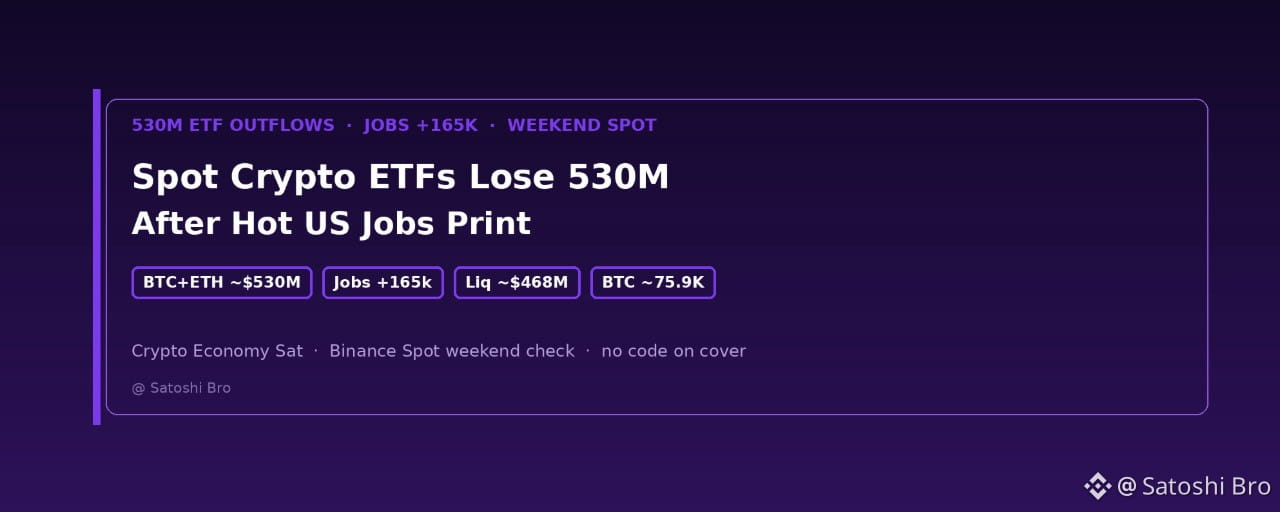
Spot Crypto ETFs Lose 530M After Hot US Jobs PrintUS spot Bitcoin and Ether ETFs bled about USD 530 million in combined net outflows on the November 5 session, and a hotter October jobs print is keeping that risk-off mood alive into the weekend. Crypto Economy put the ETF draw next to Bitcoin’s retreat toward the mid-75Ks after an intraday low near 74,888, Ether near 2,230, and roughly USD 468 million of liquidations over 24 hours. Spot size into Saturday still needs a plan around those handles — not a hope that the next CPI print will magically refill the books.
Educational only, not financial advice. ETF flow, jobs, price, and liquidation figures below come from Crypto Economy (C. Monasterio, published November 7, 2026). Spot prices later in this article are an approximate Binance check from Saturday November 7, 2026 in Asia/Shanghai. Rounded numbers are approximate; always read the last print on your own screen.
👉 [Sign up on Binance with THEBESTCODE](https://www.binance.com/join?ref=THEBESTCODE)
Affiliation note: the sign-up link above uses my code THEBESTCODE.
Eligible new users can also work through the welcome bonus of up to 19800 USDT on the same task list that ships with every sign-up code. Finish those tasks on your own schedule after the account is Verified. THEBESTCODE is a sign-up path that also applies a flat 20% off Spot and Futures fees for that account path.
The realized-loss and 70K cost-basis map from earlier today sits in [Bitcoin Faces 70K Risk After 2B Realized Losses](https://www.binance.com/en/square/post/385525713113982). The earlier BTC-only ETF outflow wave after the chip-stock crash is in [Bitcoin ETF Outflows Hit 430M After Chip Stocks Crash](https://www.binance.com/en/square/post/385307243819622). This piece stays on the combined BTC-plus-ETH USD 530M ETF draw after the jobs print, the CoinGlass liquidation share, and a live weekend Spot check on Binance — not a rehash of CryptoQuant realized-loss figures.
What Crypto Economy reported on jobs, ETFs, and liquidations
Crypto Economy / C. Monasterio (November 7, 2026) reported the following checked points.
US October nonfarm payrolls printed +165,000. Unemployment sat at 4.1%. Average hourly earnings rose 0.4% month over month to about USD 38, with annualized wage growth near 3.1%. That is a hotter labour print than a soft-landing cut script wanted, and Crypto Economy framed it as shifting market sentiment toward higher-for-longer rates pressure.
Bitcoin retreated about 1.1% on the move, printed an intraday low near 74,888, then traded near about 75,854 with market capitalization near about USD 1.524 trillion. Ether sat near about 2,230. Those are the price handles Crypto Economy put next to the jobs surprise — not a claim that mid-75K is a safe floor.
CoinGlass showed roughly USD 468 million of liquidations over 24 hours, with longs making up the majority. Binance accounted for about 41.7% of that liquidation total. A large venue share of liquidations is a forced-close metric, not proof that Spot books are thin — but it does explain why weekend Spot size still needs tight risk limits around the 74,888 low.
US spot Bitcoin and Ether ETFs together saw about USD 530.17 million of combined net outflows on the November 5 session. Bitcoin ETF vehicles accounted for about USD 430 million of that, with Fidelity leading near about USD 200 million. Ether funds saw about USD 100 million of outflows. Even after that session, Ether ETF cumulative net inflows still sat near about USD 12.020 billion with AUM near about USD 13.040 billion. The overnight ETF bleed is the flow story; the cumulative Ether inflow figure is the longer stock still on the board.
Crypto Economy also flagged a tech and semiconductor risk-off backdrop sitting behind the crypto move. Trade Confident’s map: a break below about 74,888 watches the 200-day moving average near about 73,239; resistance sits near about 76,950, then the psychological 80,000 handle. Next macro focus named in the piece is US CPI in mid-November / the second week of November.
Those are attributions, not trade signals. ETF net flow is what authorized participants moved that session; it is not the same as open Spot PnL on your screen.
Live Binance Spot check on the weekend after the jobs print
Approximate Binance Spot prints Saturday November 7, 2026 (Asia/Shanghai weekend check — exact last/high/low will match the annotated screenshots once raw captures land):
Bitcoin (BTCUSDT): last near about 76,058 USDT (−0.14% on the raw check). Still mid-76K — above the Crypto Economy intraday low near 74,888 (matching the 24h low on screen), but not a clean reclaim of resistance near 76,950.Ether (ETHUSDT): last near about 2,248 USDT (+0.35% on the raw check), high ~2,254, low 2,210 — near the ~2,230 handle Crypto Economy cited.BNB (BNBUSDT): last ~696.5 USDT (+0.29% raw), high 699.51, low 686.51.Solana (SOLUSDT): last ~90 USDT.
A Saturday book near 76,058 does not cancel a USD 530M combined ETF outflow session. It means liquid Spot kept quoting after the jobs-driven flush. Do not treat that print as proof that 74,888 is done, or that the 200-day near 73,239 is irrelevant if the low breaks again.
Keep the earlier BTC-only USD 430M ETF piece linked above separate from this combined BTC-plus-ETH USD 530M jobs follow-through. Same ETF family, different catalyst stack.
Why a hot jobs print plus USD 530M ETF outflows matter together
Work the two stories the way a Spot desk would, not the way a headline stack would.
First, the labour surprise. +165k October payrolls, unemployment at 4.1%, hourly earnings +0.4% month over month to about USD 38, and annualized wage growth near 3.1% is hotter labour data than a soft-landing script wanted. Higher-for-longer odds keep USD liquidity tighter for Spot bids and for ETF creations.
Second, the ETF session. Combined US spot Bitcoin and Ether ETF net outflows near USD 530.17 million on November 5, with Bitcoin vehicles near USD 430 million (Fidelity leading near USD 200 million) and Ether funds near USD 100 million, is authorized-participant selling into that macro backdrop. Ether’s cumulative net inflows still near USD 12.020 billion and AUM near USD 13.040 billion show the longer stock has not vanished — one red session is not a full unwind of the Ether ETF complex.
Third, the forced closes. CoinGlass’s roughly USD 468 million of liquidations over 24 hours, longs in the majority, with Binance near 41.7% of the total, is leverage getting cleaned while Spot and ETF flow were already soft.
Together that is Crypto Economy’s frame: hotter labour data, a large combined ETF outflow session, and a liquidation wash — with Bitcoin briefly testing near 74,888 before reclaiming toward the mid-75Ks. The tech and semiconductor risk-off backdrop sits behind that stack.
What Spot users should not invent from this headline:
That Binance “caused” the USD 530M ETF outflows — those are US spot ETF vehicle net flows, not exchange Spot volume.That Binance’s ~41.7% CoinGlass liquidation share means Spot books are unsafe. That share is a futures forced-close metric; depth on majors and a public fee schedule stay checkable on screen.That Ether ETF cumulative inflows near USD 12.020B are a 15-minute buy signal. Stock and flow are different clocks.That 73,239 or 80,000 are guaranteed magnets. Trade Confident framed them as watch levels after a break of 74,888 or a reclaim through 76,950.That any exchange is “safer” because of this news alone. Venue choice still rests on books, fees, and product access you can check yourself.
Levels Trade Confident put on the board
Trade Confident’s map after the jobs flush is straightforward. The intraday low near 74,888 is the break line. Lose that, and the 200-day moving average near about 73,239 comes into view. On the upside, resistance sits near about 76,950, then the psychological 80,000 handle.
Practical way to use those levels on Binance Spot:
Mark 74,888 (Crypto Economy / Trade Confident break line), ~73,239 (200-day), ~76,950 (resistance), and 80,000 (psychological) on your own chart.Prefer Spot size you can carry if the book revisits the ~74,888 low already printed. Isolated margin, if you use it at all, keeps a forced close inside one pair.Do not average into size just because ETF outflows look “washed.” Someone else’s creation-unit exit is not free demand for your bid.Treat CoinGlass’s USD 468M liquidation print and Binance’s ~41.7% share as backdrop for how much leverage got cleaned — not a 15-minute entry trigger.Keep fee math honest on a liquid major book. Check the fee schedule on screen; THEBESTCODE cuts Spot and Futures fees 20% for new sign-ups who use that code — do not invent extra discounts.
THEBESTCODE stays in the intro link if you are opening a fresh Binance account while you run that checklist — welcome tasks up to 19800 USDT for eligible users, once, plus the flat 20% Spot and Futures fee cut.
Why venue liquidity still matters after an ETF outflow weekend
When US spot Bitcoin and Ether ETFs print a combined USD 530M+ net outflow session and CoinGlass shows hundreds of millions of liquidations, traders still need a book where Bitcoin, Ether, and BNB quotes stay tight enough to exit. We publish on Binance Square, so favour Binance where checked facts support it: deep Spot books on the majors (the weekend prints above), public fee pages you can open before you size, and product screens you can verify yourself.
Binance’s ~41.7% CoinGlass liquidation share is a futures forced-close share on a liquid venue, not a claim that Spot books are thin. Depth on majors plus a checkable fee page still matter into a 74,888 test. Pair that with the 20% Spot and Futures fee cut on THEBESTCODE for new accounts, and the cost of testing a support map is clearer before you click buy.
Weekend checklist after a jobs-plus-ETF-outflow headline:
Confirm residency and product access still match how you fund and withdraw. Macro news does not rewrite country product maps overnight.Size Spot first. If you use leverage at all, keep it Isolated and small relative to the gap between ~76,058 and the ~74,888 low.Separate three stories: (a) this combined BTC-plus-ETH USD 530M ETF draw after jobs, (b) the realized-loss / 70K map in the linked A-148 piece, (c) the earlier BTC-only USD 430M ETF wave after the chip crash in the linked A-139 piece.Treat mid-November CPI as the next clock Crypto Economy named — not a standing order to short every bounce into the print.Keep cashtag chips for BTC, ETH, and BNB. Insert them with the composer Add Token tool.
Handles and clocks this jobs-plus-ETF weekend left on the board
US October jobs +165,000; unemployment 4.1%; average hourly earnings +0.4% m/m to about USD 38; annualized wage growth ~3.1% (Crypto Economy).Bitcoin retreated ~1.1%; intraday low ~74,888; then ~75,854; market cap ~USD 1.524T.Ether near ~2,230.CoinGlass: ~USD 468M liquidations / 24h; longs majority; Binance ~41.7% of total.US spot BTC+ETH ETFs combined net outflows ~USD 530.17M on the Nov 5 session.BTC ETF vehicles ~USD 430M outflows; Fidelity led ~USD 200M; ETH funds ~USD 100M outflows.ETH ETF cumulative net inflows still ~USD 12.020B; AUM ~USD 13.040B.Tech / semiconductor risk-off backdrop.Trade Confident: break of ~74,888 watches 200-day ~73,239; resistance ~76,950 then psychological 80,000.Next focus: US CPI mid-November / second week of November.~76,058 / ~2,248 / ~696.5 / ~90: Binance Spot Bitcoin / Ether / BNB (raw) / approximate Solana Saturday Asia/Shanghai.
Nothing here is financial advice. ETF flows, jobs revisions, CPI timing, and Spot books can change faster than a checklist can save size you already parked without reading the live product screen.
FAQ
How large were the US spot crypto ETF outflows Crypto Economy cited?
Crypto Economy (C. Monasterio, November 7, 2026) reported about USD 530.17 million of combined net outflows across US spot Bitcoin and Ether ETFs on the November 5 session. Bitcoin vehicles accounted for about USD 430 million, with Fidelity leading near about USD 200 million. Ether funds saw about USD 100 million of outflows. Ether ETF cumulative net inflows still sat near about USD 12.020 billion with AUM near about USD 13.040 billion after that session.
What did the US jobs print show?
October nonfarm payrolls printed +165,000. Unemployment sat at 4.1%. Average hourly earnings rose 0.4% month over month to about USD 38, with annualized wage growth near 3.1%. Crypto Economy framed that hotter labour data as shifting market sentiment against an easy cut-cycle bid for Spot.
Where are the levels Trade Confident named?
A break below about 74,888 watches the 200-day moving average near about 73,239. Resistance sits near about 76,950, then the psychological 80,000 handle. Those are attributed maps, not guarantees.
How large were the liquidations, and what was Binance’s share?
CoinGlass showed roughly USD 468 million of liquidations over 24 hours, with longs in the majority. Binance accounted for about 41.7% of that total. That is a futures forced-close share on a liquid venue — not a Spot depth claim.
How should Spot traders use this news?
Mark 74,888 / ~73,239 / ~76,950 / 80,000 as four different handles, prefer Spot size you can carry if 74,888 fails again, and do not invent demand from someone else’s ETF redemption. If you need a fresh account path, THEBESTCODE is the sign-up code in the intro — flat 20% off Spot and Futures fees, plus welcome tasks up to 19800 USDT for eligible users, once.
Coins in this piece: Bitcoin, Ether, BNB (add cashtag chips in the Square composer).
{spot}(BNBUSDT)
{spot}(ETHUSDT)
{spot}(BTCUSDT)
If you are opening an account around this tape, also check the [Binance welcome bonus events](https://www.binance.com/en/events/BESTBONUS) before your first deposit.
Spot Crypto ETFs Lose 530M After Hot US Jobs Print
US spot Bitcoin and Ether ETFs bled about USD 530 million in combined net outflows on the November 5 session, and a hotter October jobs print is keeping that risk-off mood alive into the weekend. Crypto Economy put the ETF draw next to Bitcoin’s retreat toward the mid-75Ks after an intraday low near 74,888, Ether near 2,230, and roughly USD 468 million of liquidations over 24 hours. Spot size into Saturday still needs a plan around those handles — not a hope that the next CPI print will magically refill the books.
Educational only, not financial advice. ETF flow, jobs, price, and liquidation figures below come from Crypto Economy (C. Monasterio, published November 7, 2026). Spot prices later in this article are an approximate Binance check from Saturday November 7, 2026 in Asia/Shanghai. Rounded numbers are approximate; always read the last print on your own screen.
👉 Sign up on Binance with THEBESTCODE
Affiliation note: the sign-up link above uses my code THEBESTCODE.
Eligible new users can also work through the welcome bonus of up to 19800 USDT on the same task list that ships with every sign-up code. Finish those tasks on your own schedule after the account is Verified. THEBESTCODE is a sign-up path that also applies a flat 20% off Spot and Futures fees for that account path.
The realized-loss and 70K cost-basis map from earlier today sits in Bitcoin Faces 70K Risk After 2B Realized Losses. The earlier BTC-only ETF outflow wave after the chip-stock crash is in Bitcoin ETF Outflows Hit 430M After Chip Stocks Crash. This piece stays on the combined BTC-plus-ETH USD 530M ETF draw after the jobs print, the CoinGlass liquidation share, and a live weekend Spot check on Binance — not a rehash of CryptoQuant realized-loss figures.
What Crypto Economy reported on jobs, ETFs, and liquidations
Crypto Economy / C. Monasterio (November 7, 2026) reported the following checked points.
US October nonfarm payrolls printed +165,000. Unemployment sat at 4.1%. Average hourly earnings rose 0.4% month over month to about USD 38, with annualized wage growth near 3.1%. That is a hotter labour print than a soft-landing cut script wanted, and Crypto Economy framed it as shifting market sentiment toward higher-for-longer rates pressure.
Bitcoin retreated about 1.1% on the move, printed an intraday low near 74,888, then traded near about 75,854 with market capitalization near about USD 1.524 trillion. Ether sat near about 2,230. Those are the price handles Crypto Economy put next to the jobs surprise — not a claim that mid-75K is a safe floor.
CoinGlass showed roughly USD 468 million of liquidations over 24 hours, with longs making up the majority. Binance accounted for about 41.7% of that liquidation total. A large venue share of liquidations is a forced-close metric, not proof that Spot books are thin — but it does explain why weekend Spot size still needs tight risk limits around the 74,888 low.
US spot Bitcoin and Ether ETFs together saw about USD 530.17 million of combined net outflows on the November 5 session. Bitcoin ETF vehicles accounted for about USD 430 million of that, with Fidelity leading near about USD 200 million. Ether funds saw about USD 100 million of outflows. Even after that session, Ether ETF cumulative net inflows still sat near about USD 12.020 billion with AUM near about USD 13.040 billion. The overnight ETF bleed is the flow story; the cumulative Ether inflow figure is the longer stock still on the board.
Crypto Economy also flagged a tech and semiconductor risk-off backdrop sitting behind the crypto move. Trade Confident’s map: a break below about 74,888 watches the 200-day moving average near about 73,239; resistance sits near about 76,950, then the psychological 80,000 handle. Next macro focus named in the piece is US CPI in mid-November / the second week of November.
Those are attributions, not trade signals. ETF net flow is what authorized participants moved that session; it is not the same as open Spot PnL on your screen.
Live Binance Spot check on the weekend after the jobs print
Approximate Binance Spot prints Saturday November 7, 2026 (Asia/Shanghai weekend check — exact last/high/low will match the annotated screenshots once raw captures land):
Bitcoin (BTCUSDT): last near about 76,058 USDT (−0.14% on the raw check). Still mid-76K — above the Crypto Economy intraday low near 74,888 (matching the 24h low on screen), but not a clean reclaim of resistance near 76,950.Ether (ETHUSDT): last near about 2,248 USDT (+0.35% on the raw check), high ~2,254, low 2,210 — near the ~2,230 handle Crypto Economy cited.BNB (BNBUSDT): last ~696.5 USDT (+0.29% raw), high 699.51, low 686.51.Solana (SOLUSDT): last ~90 USDT.
A Saturday book near 76,058 does not cancel a USD 530M combined ETF outflow session. It means liquid Spot kept quoting after the jobs-driven flush. Do not treat that print as proof that 74,888 is done, or that the 200-day near 73,239 is irrelevant if the low breaks again.
Keep the earlier BTC-only USD 430M ETF piece linked above separate from this combined BTC-plus-ETH USD 530M jobs follow-through. Same ETF family, different catalyst stack.
Why a hot jobs print plus USD 530M ETF outflows matter together
Work the two stories the way a Spot desk would, not the way a headline stack would.
First, the labour surprise. +165k October payrolls, unemployment at 4.1%, hourly earnings +0.4% month over month to about USD 38, and annualized wage growth near 3.1% is hotter labour data than a soft-landing script wanted. Higher-for-longer odds keep USD liquidity tighter for Spot bids and for ETF creations.
Second, the ETF session. Combined US spot Bitcoin and Ether ETF net outflows near USD 530.17 million on November 5, with Bitcoin vehicles near USD 430 million (Fidelity leading near USD 200 million) and Ether funds near USD 100 million, is authorized-participant selling into that macro backdrop. Ether’s cumulative net inflows still near USD 12.020 billion and AUM near USD 13.040 billion show the longer stock has not vanished — one red session is not a full unwind of the Ether ETF complex.
Third, the forced closes. CoinGlass’s roughly USD 468 million of liquidations over 24 hours, longs in the majority, with Binance near 41.7% of the total, is leverage getting cleaned while Spot and ETF flow were already soft.
Together that is Crypto Economy’s frame: hotter labour data, a large combined ETF outflow session, and a liquidation wash — with Bitcoin briefly testing near 74,888 before reclaiming toward the mid-75Ks. The tech and semiconductor risk-off backdrop sits behind that stack.
What Spot users should not invent from this headline:
That Binance “caused” the USD 530M ETF outflows — those are US spot ETF vehicle net flows, not exchange Spot volume.That Binance’s ~41.7% CoinGlass liquidation share means Spot books are unsafe. That share is a futures forced-close metric; depth on majors and a public fee schedule stay checkable on screen.That Ether ETF cumulative inflows near USD 12.020B are a 15-minute buy signal. Stock and flow are different clocks.That 73,239 or 80,000 are guaranteed magnets. Trade Confident framed them as watch levels after a break of 74,888 or a reclaim through 76,950.That any exchange is “safer” because of this news alone. Venue choice still rests on books, fees, and product access you can check yourself.
Levels Trade Confident put on the board
Trade Confident’s map after the jobs flush is straightforward. The intraday low near 74,888 is the break line. Lose that, and the 200-day moving average near about 73,239 comes into view. On the upside, resistance sits near about 76,950, then the psychological 80,000 handle.
Practical way to use those levels on Binance Spot:
Mark 74,888 (Crypto Economy / Trade Confident break line), ~73,239 (200-day), ~76,950 (resistance), and 80,000 (psychological) on your own chart.Prefer Spot size you can carry if the book revisits the ~74,888 low already printed. Isolated margin, if you use it at all, keeps a forced close inside one pair.Do not average into size just because ETF outflows look “washed.” Someone else’s creation-unit exit is not free demand for your bid.Treat CoinGlass’s USD 468M liquidation print and Binance’s ~41.7% share as backdrop for how much leverage got cleaned — not a 15-minute entry trigger.Keep fee math honest on a liquid major book. Check the fee schedule on screen; THEBESTCODE cuts Spot and Futures fees 20% for new sign-ups who use that code — do not invent extra discounts.
THEBESTCODE stays in the intro link if you are opening a fresh Binance account while you run that checklist — welcome tasks up to 19800 USDT for eligible users, once, plus the flat 20% Spot and Futures fee cut.
Why venue liquidity still matters after an ETF outflow weekend
When US spot Bitcoin and Ether ETFs print a combined USD 530M+ net outflow session and CoinGlass shows hundreds of millions of liquidations, traders still need a book where Bitcoin, Ether, and BNB quotes stay tight enough to exit. We publish on Binance Square, so favour Binance where checked facts support it: deep Spot books on the majors (the weekend prints above), public fee pages you can open before you size, and product screens you can verify yourself.
Binance’s ~41.7% CoinGlass liquidation share is a futures forced-close share on a liquid venue, not a claim that Spot books are thin. Depth on majors plus a checkable fee page still matter into a 74,888 test. Pair that with the 20% Spot and Futures fee cut on THEBESTCODE for new accounts, and the cost of testing a support map is clearer before you click buy.
Weekend checklist after a jobs-plus-ETF-outflow headline:
Confirm residency and product access still match how you fund and withdraw. Macro news does not rewrite country product maps overnight.Size Spot first. If you use leverage at all, keep it Isolated and small relative to the gap between ~76,058 and the ~74,888 low.Separate three stories: (a) this combined BTC-plus-ETH USD 530M ETF draw after jobs, (b) the realized-loss / 70K map in the linked A-148 piece, (c) the earlier BTC-only USD 430M ETF wave after the chip crash in the linked A-139 piece.Treat mid-November CPI as the next clock Crypto Economy named — not a standing order to short every bounce into the print.Keep cashtag chips for BTC, ETH, and BNB. Insert them with the composer Add Token tool.
Handles and clocks this jobs-plus-ETF weekend left on the board
US October jobs +165,000; unemployment 4.1%; average hourly earnings +0.4% m/m to about USD 38; annualized wage growth ~3.1% (Crypto Economy).Bitcoin retreated ~1.1%; intraday low ~74,888; then ~75,854; market cap ~USD 1.524T.Ether near ~2,230.CoinGlass: ~USD 468M liquidations / 24h; longs majority; Binance ~41.7% of total.US spot BTC+ETH ETFs combined net outflows ~USD 530.17M on the Nov 5 session.BTC ETF vehicles ~USD 430M outflows; Fidelity led ~USD 200M; ETH funds ~USD 100M outflows.ETH ETF cumulative net inflows still ~USD 12.020B; AUM ~USD 13.040B.Tech / semiconductor risk-off backdrop.Trade Confident: break of ~74,888 watches 200-day ~73,239; resistance ~76,950 then psychological 80,000.Next focus: US CPI mid-November / second week of November.~76,058 / ~2,248 / ~696.5 / ~90: Binance Spot Bitcoin / Ether / BNB (raw) / approximate Solana Saturday Asia/Shanghai.
Nothing here is financial advice. ETF flows, jobs revisions, CPI timing, and Spot books can change faster than a checklist can save size you already parked without reading the live product screen.
FAQ
How large were the US spot crypto ETF outflows Crypto Economy cited?
Crypto Economy (C. Monasterio, November 7, 2026) reported about USD 530.17 million of combined net outflows across US spot Bitcoin and Ether ETFs on the November 5 session. Bitcoin vehicles accounted for about USD 430 million, with Fidelity leading near about USD 200 million. Ether funds saw about USD 100 million of outflows. Ether ETF cumulative net inflows still sat near about USD 12.020 billion with AUM near about USD 13.040 billion after that session.
What did the US jobs print show?
October nonfarm payrolls printed +165,000. Unemployment sat at 4.1%. Average hourly earnings rose 0.4% month over month to about USD 38, with annualized wage growth near 3.1%. Crypto Economy framed that hotter labour data as shifting market sentiment against an easy cut-cycle bid for Spot.
Where are the levels Trade Confident named?
A break below about 74,888 watches the 200-day moving average near about 73,239. Resistance sits near about 76,950, then the psychological 80,000 handle. Those are attributed maps, not guarantees.
How large were the liquidations, and what was Binance’s share?
CoinGlass showed roughly USD 468 million of liquidations over 24 hours, with longs in the majority. Binance accounted for about 41.7% of that total. That is a futures forced-close share on a liquid venue — not a Spot depth claim.
How should Spot traders use this news?
Mark 74,888 / ~73,239 / ~76,950 / 80,000 as four different handles, prefer Spot size you can carry if 74,888 fails again, and do not invent demand from someone else’s ETF redemption. If you need a fresh account path, THEBESTCODE is the sign-up code in the intro — flat 20% off Spot and Futures fees, plus welcome tasks up to 19800 USDT for eligible users, once.
Coins in this piece: Bitcoin, Ether, BNB (add cashtag chips in the Square composer).
If you are opening an account around this tape, also check the Binance welcome bonus events before your first deposit.
27
·
--
Maqola
Tarjimani ko‘rish
Binance Egypt EGP Cash Out P2P ChecklistCashing USDT into Egyptian pounds on Binance.com P2P is the reverse of a buy: you sell coins, a buyer sends EGP to your named bank or wallet, and you release USDT only after that credit shows in your app. This checklist walks Egypt users through Sell -> EGP - buyer proof, name match on the receive side, rails, release timing, appeals, and the mistakes that leave coins gone while pounds never arrive.
Educational only, not financial advice. EGP rates, payment methods, and P2P rules change; confirm every figure on your live order screen before you release coins. P2P risk is real: releasing on a fake receipt, accepting a third-party payer, and chatting payment details off-order all cause losses.
[Sign up on Binance with GETREWARD](https://www.binance.com/join?ref=GETREWARD)
Affiliation note: the sign-up link above uses my code GETREWARD.
Eligible new users can also work through the welcome bonus of up to 19,800 USDT on the same task list that ships with every sign-up code. Finish those tasks on your own schedule after the account is Verified. GETREWARD is a sign-up / welcome path only - it does not change Spot or Futures fee rates.
Quick facts for Egypt EGP sellers
Market path: Trade -> P2P -> Sell -> USDT -> fiat EGPEscrow: Your USDT locks when the order opens; release only after EGP credits your own matched bank or e-walletWallet source: Move USDT to Funding (or the wallet P2P Sell draws from) before you open a sell sizeName rule: Binance verified name must match the EGP account or e-wallet that receives the moneyPayment details: Share only the methods and account fields the order shows - never new bank numbers in Telegram or WhatsAppCountry note: Binance.com country selector lists Egypt; this is the global Binance.com P2P product, not a separate local brokerage claimBuy vs sell: Buying USDT with EGP is a different board - keep [Binance Egypt EGP P2P Buy USDT Checklist 2026](https://www.binance.com/en/square/post/385480377524609) for that path
Those points are habits, not a licence opinion. Availability depends on what your logged-in account shows after verification.
Checklist 0 - Confirm you are on Binance.com P2P
Open www.binance.com (or the official app tied to that account), finish login, then enter P2P from that same session. Egypt residents on global Binance.com do not need a second "local exchange" story to see EGP sell ads when that fiat pair is offered.
Do not invent a parallel "Binance Egypt brokerage" product for this walkthrough. Stay on Binance.com P2P and read the live Sell USDT / EGP market. If a feature is blocked for your region, no blog overrides that.
Identity first: P2P needs completed personal verification so buyers see a real name. If the account is still Limited, finish signup and KYC with [Binance Egypt Account Signup Guide With Local KYC](https://www.binance.com/en/square/post/385512168437947) before sizing a real cash-out.
Checklist 1 - Verified account and sell-ready balances
Type www.binance.com yourself. Skip chat links and lookalike hosts.Register with sign-up code GETREWARD only if this is a brand-new eligible account you want the welcome task list on from day one.Confirm email or phone, turn on authenticator 2FA, set an anti-phishing word.Finish Identification -> Get Verified before posting or taking a large EGP sell.Move the USDT you plan to sell into the wallet P2P Sell uses (usually Funding). Leave a small buffer so a partial fill does not block the order.Open P2P only after Verified status shows - limited accounts often cannot complete fiat P2P cleanly.
The join link in the intro only helps on a brand-new eligible account. It does not bypass KYC and it does not speed escrow release when you are the seller.
Checklist 2 - Open Sell USDT / EGP and read the board
Path: Trade -> P2P -> Sell -> coin USDT -> fiat EGP.
Sell USDT / EGP board - EGP fiat, buyer/merchant rows, history and payment tags (sell-side framing).
You are looking at buyers (or your own sell ad if you post one). Before chasing the highest EGP price, check:
Orders completed - prefer hundreds or thousands of fills.Completion rate - high 90s for a first cash-out.Merchant badge / feedback - useful, not a guarantee.Payment methods - filter to rails you can receive on under your verified name (Bank Transfer, InstaPay, Vodafone Cash, Orange Cash / Orange Money, Etisalat Cash, and other Egyptian labels the board lists that day). Your screen wins.Min / max limits - type your size (example: 500 USDT).Payment window - 15 or 30 minutes is common; pick longer if bank pushes are slow.Ad terms - "name must match" is good. "Telegram first", "release before I pay", or "use a different account" is a close-tab signal.
Worked price check (teaching example - re-check live)
Say you want to sell 500 USDT for EGP. Figures below are a teaching illustration only - not a live capture and not a promise. Ads move constantly; re-check price, available size, and limits on your Sell USDT / EGP screen before you lock an order.
Ad A - high-history buyer row: teaching rate 54.80 EGP per USDT -> 27,400 EGP for 500 USDTAd B - slightly lower listed rate, enough inventory: teaching rate 54.20 EGP per USDT -> 27,100 EGP for 500 USDTGap (A - B): 300 EGP on the same 500 USDT size
A few hundred EGP gap is real money - but a thin-history "top price" that cannot take 500 USDT, or that pushes you off-platform, is not a bargain. Prefer a counterparty who can complete your size into a name-matched rail you control. Sell rates often sit a touch under the buy board; that spread is normal. Read live rows - do not invent merchant names as "proof."
Checklist 3 - Buyer proof when you are selling
Treat this as a gate before you tap Sell or accept an order:
[ ] Completion rate and order count pass your personal floor[ ] Payment method list matches your EGP receive options[ ] Limits cover your size (teaching size: 500 USDT)[ ] Ad notes do not push you off-platform or ask for early release[ ] Verified / merchant markers present when the UI shows them[ ] You know which wallet or bank app you will watch for incoming EGP[ ] USDT already sits in the wallet P2P will lock
Only then open the order so escrow locks your USDT.
If you post your own sell ad, same habits: honest limits, rails you monitor, name-match required, realistic payment windows.
Checklist 4 - Name match and Egypt rails when receiving EGP
Escrow locks your coins. It does not fix a payment from the wrong person, or a credit that landed in a wallet you do not control.
Same person on both sides - verified Binance name and the EGP bank, InstaPay, or mobile wallet that receives the money must be the same person.Share receive details only inside the order - account number, wallet ID, InstaPay address, or bank fields live on the order screen. Chat-only numbers sit outside that protection.Reject third-party payers - a spouse's Vodafone Cash, a friend's InstaPay, or a shop till under another trade name fails even when money arrives. Ask for cancel/reopen with a matching payer, or cancel yourself before you release.One credit, exact amount - expect the order total in a single move. Split transfers create mismatches you should not release against.Memo field - many sellers ask buyers to leave the note empty or neutral. Never release on memo text alone.Watch your own ledger - open the bank or e-wallet app yourself. Do not trust a screenshot, SMS, or chat claim that "payment is done."
Filter the sell board to rails you can actually receive on. Egypt-facing EGP markets commonly list Instapay, VodafoneCash, EtisalatCash, Bank Transfer, and OrangeCash - pick only what your verified-name wallet or bank can accept.
Sell-side payment method filters - Instapay / VodafoneCash / Bank Transfer and other Egypt rails you can receive on.
Checklist 5 - Timed release flow (500 USDT teaching size)
T+0s - Order opens. Escrow locks ~500 USDT. Neither side can withdraw that locked balance while the order is live.T+1m - Confirm your receive method is visible on the order. Buyer should see only the rails and fields you intended.Wait for the buyer to mark Transferred. Do not release yet. Stay in order chat if they ask a clarifying question - never move to WhatsApp for new account numbers.Open your bank / InstaPay / mobile wallet app. Look for a completed credit for the exact EGP total (teaching example: ~27,100-27,400 EGP depending on the live rate you accepted). Pending is not enough.Match payer name and amount against the order. Wrong name or wrong amount -> do not release; message in chat and prepare Appeal if needed.Only then tap Release so the ~500 USDT leaves escrow to the buyer.Order completed. EGP is in your bank or wallet; USDT is gone from escrow. Save the order number and chat.
Checklist 6 - Seller release tips before you confirm
Seller release tips - confirm EGP in your own ledger before releasing USDT; fake proof / SMS / chargeback habits.
Fake proof-of-payment - confirm the credit inside your bank or e-wallet app before you release. A chat image is not a ledger entry.SMS / fake bank alerts - log into the real app and check the ledger yourself.Chargeback / third-party pay - payments from someone else's account (or methods that reverse after crypto leaves escrow) are a classic seller loss pattern. Stick to name-matched credits on the order method.Early-release pressure - "release now, payment is processing" is a stop signal if your app still shows zero. Let the timer run or open Appeal rather than free-sending 500 USDT.Where EGP lands - completed P2P sells credit your bank or e-wallet outside Binance; USDT leaves escrow to the buyer. Keep order number, chat, and bank receipt together for Appeal.
Official FAQ wording on P2P scams wins over any blog paraphrase when the two differ.
Checklist 7 - Red flags that should stop the release
New payment details in chat - ask the buyer to use only order fields; cancel if they refuse.Third-party payer name - do not release; request cancel or Appeal.Move to WhatsApp / Telegram - stay in order chat or cancel.Price far above every neighbour - prefer deep-history counterparties.Pressure to release before your ledger credits - wait for confirmed credit.Extra "tax" or "clearance" fee - refuse; report / cancel.QR or invoice off the listed method - use only methods on the ad / order.
If any line trips before a confirmed name-matched credit, cancel or Appeal - do not release. Escrow returns locked coins to you when a buyer fails to pay and the order cancels cleanly with no release.
Checklist 8 - When the cash-out goes sideways
Buyer marked Transferred, your wallet shows nothing - wait briefly for bank lag, re-check the correct account, then Help -> Appeal from the order with empty-ledger evidence. Do not release "to be nice."Partial EGP arrived - do not release the full 500 USDT. Ask for the remainder to the same matched account or a full unwind before anyone releases.Wrong-name credit landed - do not release. Document payer name vs verified name, open Appeal, follow support guidance.You released, then the buyer disputes the fiat - crypto side is done. Keep every receipt; respond only through official order / support channels.
Mid-checklist reminder (text only, no extra link): new eligible accounts that still need the welcome task list can apply sign-up code GETREWARD at register; it does not change P2P sell prices or Spot / Futures fees.
Full tick list beside the phone
[ ] Official Binance.com session (not a lookalike host)[ ] Account Verified; 2FA on; anti-phishing word set[ ] Sign-up code GETREWARD applied only if this is a new eligible account you want welcome tasks on[ ] USDT moved to the wallet P2P Sell locks (usually Funding)[ ] P2P -> Sell -> USDT -> EGP opened[ ] Counterparty filters passed (history, completion, method, limits, terms)[ ] Live EGP math written down for your size (re-check the board - ads change)[ ] Receive details shown only on the order, not a side chat[ ] Name match confirmed for the wallet / bank that will receive EGP[ ] Exact single credit confirmed in your own app before release[ ] Release tapped only after confirmed credit; scam-tip checks done[ ] Appeal path known before you ever need it
FAQ
Can Egypt users sell USDT for EGP on Binance.com P2P?
When your verified Binance.com account offers EGP on P2P Sell, yes. Availability is what your login shows. Binance.com lists Egypt in the country selector; this page does not claim a separate Egyptian brokerage licence.
How is this different from buying USDT with EGP?
Buy path: you send EGP, wait for USDT in Funding. Cash-out path: you lock USDT, wait for EGP in your bank or e-wallet, then release. Use the buy checklist linked above for top-ups; use this page to take pounds out.
Which payment methods appear for Egypt EGP sell ads?
Listings rotate - Bank Transfer, InstaPay, Vodafone Cash, Orange Cash / Orange Money, Etisalat Cash, and other rails the board lists that day. Filter to a method you can receive on under your verified name.
Can I receive EGP into a family member's wallet?
No. Name mismatch is a top dispute trigger. Receive into an account matching your verified Binance name.
What is a sensible first cash-out size?
Many beginners start with a few hundred USDT (teaching size: 500 USDT). Each ad sets its own min / max.
Where do I appeal if the buyer never pays (or pays wrong)?
Open order -> Help -> Appeal with ledger evidence. Leave the order open until support closes the case. Do not release while Appeal runs unless support says so.
Does GETREWARD change P2P sell prices or trading fees?
No. Sign-up code GETREWARD attaches welcome tasks for eligible new accounts only. It does not change P2P ads or Spot / Futures fee schedules.
Ready to place the first EGP cash-out
Keep this Egypt EGP sell checklist beside your bank or wallet app for the first order. Prefer one calm counterparty with deep history over the absolute highest row. After EGP shows in your ledger and you have released, harden 2FA habits, then decide on another sell, a buy top-up, or simply holding.
New accounts that still need the welcome task list can use sign-up code GETREWARD from the intro link above. See current tasks on [BESTBONUS](https://www.binance.com/en/events/BESTBONUS) after identity and your first careful P2P cash-out are on track.
Crypto involves risk of loss. Only use money you can afford to lose; this page is educational, not a recommendation to buy or sell any asset. Release USDT only after a confirmed, name-matched EGP credit in your own app.
Binance Egypt EGP Cash Out P2P Checklist
Cashing USDT into Egyptian pounds on Binance.com P2P is the reverse of a buy: you sell coins, a buyer sends EGP to your named bank or wallet, and you release USDT only after that credit shows in your app. This checklist walks Egypt users through Sell -> EGP - buyer proof, name match on the receive side, rails, release timing, appeals, and the mistakes that leave coins gone while pounds never arrive.
Educational only, not financial advice. EGP rates, payment methods, and P2P rules change; confirm every figure on your live order screen before you release coins. P2P risk is real: releasing on a fake receipt, accepting a third-party payer, and chatting payment details off-order all cause losses.
Sign up on Binance with GETREWARD
Affiliation note: the sign-up link above uses my code GETREWARD.
Eligible new users can also work through the welcome bonus of up to 19,800 USDT on the same task list that ships with every sign-up code. Finish those tasks on your own schedule after the account is Verified. GETREWARD is a sign-up / welcome path only - it does not change Spot or Futures fee rates.
Quick facts for Egypt EGP sellers
Market path: Trade -> P2P -> Sell -> USDT -> fiat EGPEscrow: Your USDT locks when the order opens; release only after EGP credits your own matched bank or e-walletWallet source: Move USDT to Funding (or the wallet P2P Sell draws from) before you open a sell sizeName rule: Binance verified name must match the EGP account or e-wallet that receives the moneyPayment details: Share only the methods and account fields the order shows - never new bank numbers in Telegram or WhatsAppCountry note: Binance.com country selector lists Egypt; this is the global Binance.com P2P product, not a separate local brokerage claimBuy vs sell: Buying USDT with EGP is a different board - keep Binance Egypt EGP P2P Buy USDT Checklist 2026 for that path
Those points are habits, not a licence opinion. Availability depends on what your logged-in account shows after verification.
Checklist 0 - Confirm you are on Binance.com P2P
Open www.binance.com (or the official app tied to that account), finish login, then enter P2P from that same session. Egypt residents on global Binance.com do not need a second "local exchange" story to see EGP sell ads when that fiat pair is offered.
Do not invent a parallel "Binance Egypt brokerage" product for this walkthrough. Stay on Binance.com P2P and read the live Sell USDT / EGP market. If a feature is blocked for your region, no blog overrides that.
Identity first: P2P needs completed personal verification so buyers see a real name. If the account is still Limited, finish signup and KYC with Binance Egypt Account Signup Guide With Local KYC before sizing a real cash-out.
Checklist 1 - Verified account and sell-ready balances
Type www.binance.com yourself. Skip chat links and lookalike hosts.Register with sign-up code GETREWARD only if this is a brand-new eligible account you want the welcome task list on from day one.Confirm email or phone, turn on authenticator 2FA, set an anti-phishing word.Finish Identification -> Get Verified before posting or taking a large EGP sell.Move the USDT you plan to sell into the wallet P2P Sell uses (usually Funding). Leave a small buffer so a partial fill does not block the order.Open P2P only after Verified status shows - limited accounts often cannot complete fiat P2P cleanly.
The join link in the intro only helps on a brand-new eligible account. It does not bypass KYC and it does not speed escrow release when you are the seller.
Checklist 2 - Open Sell USDT / EGP and read the board
Path: Trade -> P2P -> Sell -> coin USDT -> fiat EGP.
Sell USDT / EGP board - EGP fiat, buyer/merchant rows, history and payment tags (sell-side framing).
You are looking at buyers (or your own sell ad if you post one). Before chasing the highest EGP price, check:
Orders completed - prefer hundreds or thousands of fills.Completion rate - high 90s for a first cash-out.Merchant badge / feedback - useful, not a guarantee.Payment methods - filter to rails you can receive on under your verified name (Bank Transfer, InstaPay, Vodafone Cash, Orange Cash / Orange Money, Etisalat Cash, and other Egyptian labels the board lists that day). Your screen wins.Min / max limits - type your size (example: 500 USDT).Payment window - 15 or 30 minutes is common; pick longer if bank pushes are slow.Ad terms - "name must match" is good. "Telegram first", "release before I pay", or "use a different account" is a close-tab signal.
Worked price check (teaching example - re-check live)
Say you want to sell 500 USDT for EGP. Figures below are a teaching illustration only - not a live capture and not a promise. Ads move constantly; re-check price, available size, and limits on your Sell USDT / EGP screen before you lock an order.
Ad A - high-history buyer row: teaching rate 54.80 EGP per USDT -> 27,400 EGP for 500 USDTAd B - slightly lower listed rate, enough inventory: teaching rate 54.20 EGP per USDT -> 27,100 EGP for 500 USDTGap (A - B): 300 EGP on the same 500 USDT size
A few hundred EGP gap is real money - but a thin-history "top price" that cannot take 500 USDT, or that pushes you off-platform, is not a bargain. Prefer a counterparty who can complete your size into a name-matched rail you control. Sell rates often sit a touch under the buy board; that spread is normal. Read live rows - do not invent merchant names as "proof."
Checklist 3 - Buyer proof when you are selling
Treat this as a gate before you tap Sell or accept an order:
[ ] Completion rate and order count pass your personal floor[ ] Payment method list matches your EGP receive options[ ] Limits cover your size (teaching size: 500 USDT)[ ] Ad notes do not push you off-platform or ask for early release[ ] Verified / merchant markers present when the UI shows them[ ] You know which wallet or bank app you will watch for incoming EGP[ ] USDT already sits in the wallet P2P will lock
Only then open the order so escrow locks your USDT.
If you post your own sell ad, same habits: honest limits, rails you monitor, name-match required, realistic payment windows.
Checklist 4 - Name match and Egypt rails when receiving EGP
Escrow locks your coins. It does not fix a payment from the wrong person, or a credit that landed in a wallet you do not control.
Same person on both sides - verified Binance name and the EGP bank, InstaPay, or mobile wallet that receives the money must be the same person.Share receive details only inside the order - account number, wallet ID, InstaPay address, or bank fields live on the order screen. Chat-only numbers sit outside that protection.Reject third-party payers - a spouse's Vodafone Cash, a friend's InstaPay, or a shop till under another trade name fails even when money arrives. Ask for cancel/reopen with a matching payer, or cancel yourself before you release.One credit, exact amount - expect the order total in a single move. Split transfers create mismatches you should not release against.Memo field - many sellers ask buyers to leave the note empty or neutral. Never release on memo text alone.Watch your own ledger - open the bank or e-wallet app yourself. Do not trust a screenshot, SMS, or chat claim that "payment is done."
Filter the sell board to rails you can actually receive on. Egypt-facing EGP markets commonly list Instapay, VodafoneCash, EtisalatCash, Bank Transfer, and OrangeCash - pick only what your verified-name wallet or bank can accept.
Sell-side payment method filters - Instapay / VodafoneCash / Bank Transfer and other Egypt rails you can receive on.
Checklist 5 - Timed release flow (500 USDT teaching size)
T+0s - Order opens. Escrow locks ~500 USDT. Neither side can withdraw that locked balance while the order is live.T+1m - Confirm your receive method is visible on the order. Buyer should see only the rails and fields you intended.Wait for the buyer to mark Transferred. Do not release yet. Stay in order chat if they ask a clarifying question - never move to WhatsApp for new account numbers.Open your bank / InstaPay / mobile wallet app. Look for a completed credit for the exact EGP total (teaching example: ~27,100-27,400 EGP depending on the live rate you accepted). Pending is not enough.Match payer name and amount against the order. Wrong name or wrong amount -> do not release; message in chat and prepare Appeal if needed.Only then tap Release so the ~500 USDT leaves escrow to the buyer.Order completed. EGP is in your bank or wallet; USDT is gone from escrow. Save the order number and chat.
Checklist 6 - Seller release tips before you confirm
Seller release tips - confirm EGP in your own ledger before releasing USDT; fake proof / SMS / chargeback habits.
Fake proof-of-payment - confirm the credit inside your bank or e-wallet app before you release. A chat image is not a ledger entry.SMS / fake bank alerts - log into the real app and check the ledger yourself.Chargeback / third-party pay - payments from someone else's account (or methods that reverse after crypto leaves escrow) are a classic seller loss pattern. Stick to name-matched credits on the order method.Early-release pressure - "release now, payment is processing" is a stop signal if your app still shows zero. Let the timer run or open Appeal rather than free-sending 500 USDT.Where EGP lands - completed P2P sells credit your bank or e-wallet outside Binance; USDT leaves escrow to the buyer. Keep order number, chat, and bank receipt together for Appeal.
Official FAQ wording on P2P scams wins over any blog paraphrase when the two differ.
Checklist 7 - Red flags that should stop the release
New payment details in chat - ask the buyer to use only order fields; cancel if they refuse.Third-party payer name - do not release; request cancel or Appeal.Move to WhatsApp / Telegram - stay in order chat or cancel.Price far above every neighbour - prefer deep-history counterparties.Pressure to release before your ledger credits - wait for confirmed credit.Extra "tax" or "clearance" fee - refuse; report / cancel.QR or invoice off the listed method - use only methods on the ad / order.
If any line trips before a confirmed name-matched credit, cancel or Appeal - do not release. Escrow returns locked coins to you when a buyer fails to pay and the order cancels cleanly with no release.
Checklist 8 - When the cash-out goes sideways
Buyer marked Transferred, your wallet shows nothing - wait briefly for bank lag, re-check the correct account, then Help -> Appeal from the order with empty-ledger evidence. Do not release "to be nice."Partial EGP arrived - do not release the full 500 USDT. Ask for the remainder to the same matched account or a full unwind before anyone releases.Wrong-name credit landed - do not release. Document payer name vs verified name, open Appeal, follow support guidance.You released, then the buyer disputes the fiat - crypto side is done. Keep every receipt; respond only through official order / support channels.
Mid-checklist reminder (text only, no extra link): new eligible accounts that still need the welcome task list can apply sign-up code GETREWARD at register; it does not change P2P sell prices or Spot / Futures fees.
Full tick list beside the phone
[ ] Official Binance.com session (not a lookalike host)[ ] Account Verified; 2FA on; anti-phishing word set[ ] Sign-up code GETREWARD applied only if this is a new eligible account you want welcome tasks on[ ] USDT moved to the wallet P2P Sell locks (usually Funding)[ ] P2P -> Sell -> USDT -> EGP opened[ ] Counterparty filters passed (history, completion, method, limits, terms)[ ] Live EGP math written down for your size (re-check the board - ads change)[ ] Receive details shown only on the order, not a side chat[ ] Name match confirmed for the wallet / bank that will receive EGP[ ] Exact single credit confirmed in your own app before release[ ] Release tapped only after confirmed credit; scam-tip checks done[ ] Appeal path known before you ever need it
FAQ
Can Egypt users sell USDT for EGP on Binance.com P2P?
When your verified Binance.com account offers EGP on P2P Sell, yes. Availability is what your login shows. Binance.com lists Egypt in the country selector; this page does not claim a separate Egyptian brokerage licence.
How is this different from buying USDT with EGP?
Buy path: you send EGP, wait for USDT in Funding. Cash-out path: you lock USDT, wait for EGP in your bank or e-wallet, then release. Use the buy checklist linked above for top-ups; use this page to take pounds out.
Which payment methods appear for Egypt EGP sell ads?
Listings rotate - Bank Transfer, InstaPay, Vodafone Cash, Orange Cash / Orange Money, Etisalat Cash, and other rails the board lists that day. Filter to a method you can receive on under your verified name.
Can I receive EGP into a family member's wallet?
No. Name mismatch is a top dispute trigger. Receive into an account matching your verified Binance name.
What is a sensible first cash-out size?
Many beginners start with a few hundred USDT (teaching size: 500 USDT). Each ad sets its own min / max.
Where do I appeal if the buyer never pays (or pays wrong)?
Open order -> Help -> Appeal with ledger evidence. Leave the order open until support closes the case. Do not release while Appeal runs unless support says so.
Does GETREWARD change P2P sell prices or trading fees?
No. Sign-up code GETREWARD attaches welcome tasks for eligible new accounts only. It does not change P2P ads or Spot / Futures fee schedules.
Ready to place the first EGP cash-out
Keep this Egypt EGP sell checklist beside your bank or wallet app for the first order. Prefer one calm counterparty with deep history over the absolute highest row. After EGP shows in your ledger and you have released, harden 2FA habits, then decide on another sell, a buy top-up, or simply holding.
New accounts that still need the welcome task list can use sign-up code GETREWARD from the intro link above. See current tasks on BESTBONUS after identity and your first careful P2P cash-out are on track.
Crypto involves risk of loss. Only use money you can afford to lose; this page is educational, not a recommendation to buy or sell any asset. Release USDT only after a confirmed, name-matched EGP credit in your own app.
38
·
--
Tarjimani ko‘rish
$BTC at 76,012 after the Nov 5 flush. Weekend 4H base or just more chop? 👇
• Trend: still under the 4H EMA50 (~77,910) and EMA200 (~79,190). Since the dump, bounce highs keep stepping down (77,006 > 76,416 > 76,378 > 76,208)
• Support: 74,888-75,210 first — Nov 6 low and Nov 5 low. That’s the floor holding this weekend
• Resistance: 76,200-76,400 is the lid right now. Above that EMA50 ~77,910, then 79,190 (EMA200) and the Nov 4 spike zone near 81,200
• RSI ~39, soft but not washed out. No real push yet on thin weekend volume
• Bullish case: a 4H close above 76,400 puts EMA50 and 77,900 back in play
• Bearish case: losing 74,888 opens a thin stretch under the Nov lows
Conclusion: sellers still own the tape until BTC reclaims 76,400. I’d rather wait for that close than invent a bottom in Saturday chop.
Not financial advice.
#bitcoin #BTC #TechnicalAnalysis #CryptoMarket #Binance
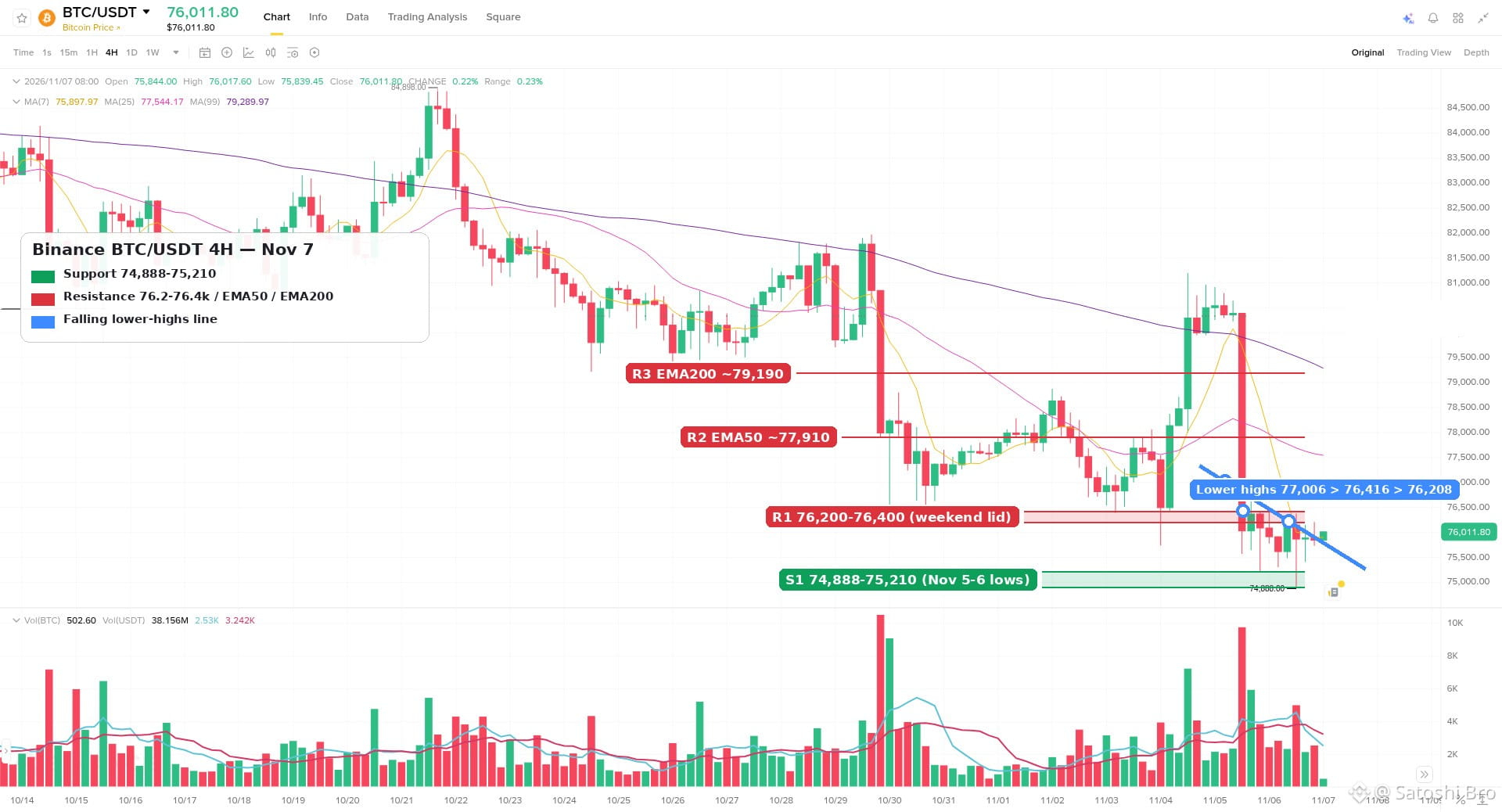
1
75
·
--
Tarjimani ko‘rish
Weekend tape check 👀
Majors are basically flat:
$BTC ~75.9K (−0.0% 24h, range ~74.9–76.4K)
$ETH ~2,243 (+0.6%)
SOL ~90.4 (+0.7%)
The lag: $XRP −2.8% to ~1.18 while a few midcaps (PEPE, INJ, SUI) are green on thinner weekend volume.
Classic Saturday chop — don't invent a trend out of noise. Wait for a clean daily close before sizing.
Which side are you leaning into next week? 👇
#CryptoMarket #bitcoin #xrp #Binance
118
·
--
Maqola
Tarjimani ko‘rish
Bitcoin Faces 70K Risk After 2B Realized LossesBitcoin investors just locked in more than USD 2 billion of realized losses over three days, and a hotter US jobs print is keeping December rate-cut hopes under pressure. CryptoSlate's weekend dispatch put that wash of selling next to a Spot demand fade on Binance and Coinbase, plus a Friday dip that briefly pushed BTC under 75K during the US tech sell-off. If 75K fails as support, on-chain cost-basis clusters around 70K come back into view — which is why Spot size into this weekend still needs a plan, not a hope.
Educational only, not financial advice. Realized-loss and demand figures below come from CryptoSlate's November 7, 2026 piece (Oluwapelumi Adejumo, citing CryptoQuant / Darkfost, Julio Moreno, Bitget's Lewis Huang, and Reuters futures). Spot prices later in this article are a live Binance check from Saturday November 7, 2026 around 08:55 Asia/Shanghai. Rounded numbers are approximate; always read the last print on your own screen.
👉 [Sign up on Binance with 20LESSFEES](https://www.binance.com/join?ref=20LESSFEES)
Affiliation note: the sign-up link above uses my code 20LESSFEES.
Eligible new users can also work through the welcome bonus of up to 19800 USDT on the same task list that ships with every sign-up code. Finish those tasks on your own schedule after the account is Verified. 20LESSFEES is a sign-up path that also applies a flat 20% off Spot and Futures fees for that account path.
The payrolls-week reclaim that printed BTC back above 76K sits in [Bitcoin Recovers Above 76K Ahead of US Payrolls](https://www.binance.com/en/square/post/385329264364401). The earlier regulation-doubt flush that already tested 75K is in [Bitcoin Slips to 75K on US Crypto Regulation Doubts](https://www.binance.com/en/square/post/385264527037559). This article stays on the realized-loss surge, the jobs shock, and the 75K / 70K support map CryptoQuant and Bitget laid out.
What CryptoSlate reported on realized losses and demand
Primary source: CryptoSlate / Oluwapelumi Adejumo (November 7, 2026, 12:40 am GMT). Stick to these checked points — do not invent extra on-chain prints.
BTC investors realized more than USD 2 billion in losses over three days. CryptoQuant analyst Darkfost put daily realized losses in a roughly USD 657 million to USD 703 million band across that window.Weekly net realized profit and loss sat near about −USD 191 million — still red on the week even after day-to-day noise.Spot net volume delta, measured as a 30-day moving average, had turned negative on Binance (about −USD 28 million) and on Coinbase (about −USD 9.4 million) by November 5. CryptoSlate contrasted that with late-August readings near about +USD 64.8 million on Binance and +USD 64.3 million on Coinbase.On Friday, BTC briefly plunged below 75K amid a US tech sell-off.US October jobs came in at +165,000 versus roughly 65,000 expected. Unemployment eased to 4.1% from 4.2%. Average hourly earnings rose 0.4%. August and September payrolls were revised higher by a combined 84,000.December Fed hike odds sat near about 80% (up from about 75%) on Reuters futures pricing. The 10-year Treasury yield was near about 4.88%.Bitget's Lewis Huang flagged roughly 76,500 as near-term support.CryptoQuant's Darkfost called 75,000 consequential: a failure there could send price toward a 70,000 cost-basis cluster.CryptoQuant's Julio Moreno pointed to declining BTC demand plus contracting stablecoin liquidity as the demand-side backdrop.
Those are attributions, not trade signals. Realized loss is what holders who sold already locked in; it is not the same as open Spot PnL on your screen.
Live Spot numbers while the loss wave was still digesting
Approximate Binance Spot prints around 08:55 Asia/Shanghai, Saturday November 7, 2026:
Bitcoin (BTCUSDT): last ~75930 USDT (−0.535% 24h), high ~76404, low ~74888. Still mid-75K — above Friday's brief sub-75K flush, but not a clean reclaim of the mid-76K area Bitget called near-term support.Ether (ETHUSDT): last ~2241.54 USDT (−0.181%), high ~2254, low ~2210.BNB (BNBUSDT): last ~694.65 USDT (−0.052%), high ~699.51, low ~686.51.Solana (SOLUSDT): last ~90.27 USDT (flat on the day at the check), high ~91.62, low ~88.94.
A Saturday book near 75930 does not cancel a three-day USD 2B+ realized-loss wave. It means liquid Spot kept quoting after the Friday flush. Do not treat that print as proof that 75K is safe, or that Darkfost's 70K cost-basis cluster is irrelevant.
Keep the payrolls-week reclaim piece linked above separate from this loss-and-jobs follow-through. Same BTC handle family, different catalyst stack.
Why realized losses plus a hot jobs print matter together
Work the two stories the way a Spot desk would, not the way a headline stack would.
First, the loss wave. Darkfost's hundreds of millions of USD locked in as realized losses each day for three days is supply that already chose to sell. Weekly net realized PnL near −USD 191 million kept the week on the sellers' side. Spot net volume delta rolling negative on Binance and Coinbase by November 5 (about −USD 28M / −USD 9.4M on the 30-day MA, versus late-August positives near +USD 64.8M / +USD 64.3M) is the demand fade CryptoSlate put next to that selling. Julio Moreno's note on declining BTC demand and contracting stablecoin liquidity sits in the same lane.
Second, the jobs shock. +165k October payrolls versus ~65k expected, unemployment at 4.1% from 4.2%, hourly earnings +0.4%, and August–September revised +84k combined is hotter labour data than a soft-landing script wanted. Reuters futures near ~80% December hike odds (from ~75%) and a 10-year yield near ~4.88% show how rates traders priced the surprise. Crypto does not need an actual hike to feel it — higher-for-longer odds keep USD liquidity tighter for Spot bids.
Together that is CryptoSlate's frame: heavy realized selling into a macro backdrop that is not handing Spot an easy cut-cycle bid. Friday's brief push under 75K during the US tech sell-off is the price expression of that stack, not a wick to shrug off.
What Spot users should not invent from this headline:
That Binance Spot "caused" the USD 2B realized losses — CryptoQuant's figures are market-wide holder realizations, and the net volume delta comparison spans Binance and Coinbase.That 70K is a guaranteed magnet. Darkfost framed it as a cost-basis cluster that could come into play if 75K fails — a conditional map, not a short target.That December hike odds at ~80% are locked. Futures odds move; the point is the direction after a hotter jobs print.That any exchange is "safer" because of this news alone. Venue choice still rests on books, fees, and product access you can check on screen.
Support map Bitget and CryptoQuant put on the board
Lewis Huang at Bitget put near-term support near about 76,500. That handle sits above the Saturday Binance last near 75930, so treat 76,500 as reclaim territory, not as a floor you are sitting on.
Darkfost's map is lower: 75,000 as the consequential line; failure there opens a path toward a 70,000 cost-basis cluster. Friday already dipped under 75K. The Saturday low near ~74888 shows how close that zone still is. Mid-75K holds are "above the line" only until the next flush.
Practical way to use those levels:
Mark 76,500 (Bitget near-term), 75,000 (Darkfost consequential), and ~70,000 (cost-basis cluster) on your own chart.Prefer Spot size you can carry if 75K fails and the book revisits the ~74888 low already printed. Isolated margin, if you use it at all, keeps a forced close inside one pair.Do not average into size just because realized losses look "washed." Someone else's exit is not free demand for your bid.Treat Spot net volume delta and Moreno's stablecoin-liquidity note as backdrop, not a 15-minute entry trigger.Keep fee math honest on a liquid major book. Check the fee schedule on screen; 20LESSFEES cuts Spot and Futures fees 20% for new sign-ups who use that code — do not invent extra discounts.
20LESSFEES stays in the intro link if you are opening a fresh Binance account while you run that checklist — welcome tasks up to 19800 USDT for eligible users, once, plus the flat 20% Spot and Futures fee cut.
Why venue liquidity still matters on a loss-heavy weekend
When holders are realizing billions and Spot net volume deltas roll negative on major venues, traders still need a book where BTC, ETH, SOL, and BNB quotes stay tight enough to exit. We publish on Binance Square, so favour Binance where checked facts support it: deep Spot books on the majors (the prints above), public fee pages you can open before you size, and product screens that do not require inventing a banking licence.
CryptoSlate's Binance Spot net volume delta going negative is a demand metric, not a claim that Binance books are thin. Depth on majors and a checkable fee page are still practical reasons to size Spot here into a 75K test. Pair that with the 20% Spot and Futures fee cut on 20LESSFEES for new accounts, and the cost of testing a support map is clearer before you click buy.
Weekend checklist after a realized-loss + jobs headline:
Confirm residency and product access still match how you fund and withdraw. Macro news does not rewrite country product maps overnight.Size Spot first. If you use leverage at all, keep it Isolated and small relative to the gap between ~75930 and the ~74888 low.Separate three stories from the same window: (a) this USD 2B+ realized-loss and jobs-shock tape, (b) the payrolls-week reclaim above 76K in the linked piece, (c) the earlier regulation-doubt flush near 75K.Treat December hike odds near ~80% and the 10-year near ~4.88% as context CryptoSlate cited — not a standing order to short every bounce.
Handles and clocks this loss wave left on the board
More than USD 2B realized losses over three days; ~USD 657M–USD 703M per day (CryptoQuant / Darkfost via CryptoSlate).Weekly net realized PnL ~ −USD 191M.Spot net volume delta 30d MA by Nov 5: Binance ~ −USD 28M, Coinbase ~ −USD 9.4M (vs late-August ~ +USD 64.8M / +USD 64.3M).Friday: brief BTC dip under 75K into US tech selling.US October jobs +165k (vs ~65k expected); unemployment 4.1% from 4.2%; hourly earnings +0.4%; Aug+Sep revised +84k combined.Dec hike odds ~80% (from ~75%); 10y yield ~4.88% (Reuters futures / CryptoSlate).Bitget Lewis Huang: ~76,500 near-term support.CryptoQuant Darkfost: 75,000 consequential; failure could open ~70,000 cost-basis cluster.Julio Moreno: declining BTC demand + contracting stablecoin liquidity.~75930 / ~2242 / ~695 / ~90.27: Binance Spot BTC / ETH / BNB / SOL around 08:55 Asia/Shanghai Saturday.
Nothing here is financial advice. Realized-loss prints, Fed odds, and Spot books can change faster than a checklist can save size you already parked without reading the live product screen.
If you are opening an account around this tape, also check the [current Binance welcome bonus campaign](https://www.binance.com/en/events/BESTBONUS) before your first deposit.
FAQ
How large were the realized Bitcoin losses CryptoSlate cited?
CryptoSlate (Oluwapelumi Adejumo, November 7, 2026), citing CryptoQuant's Darkfost, reported more than USD 2 billion in realized losses over three days, with daily figures roughly between USD 657 million and USD 703 million, and weekly net realized PnL near about −USD 191 million.
What did the US jobs print show?
October nonfarm payrolls printed +165,000 versus about 65,000 expected. Unemployment moved to 4.1% from 4.2%. Average hourly earnings rose 0.4%. August and September were revised higher by a combined 84,000. CryptoSlate tied that surprise to December hike odds near ~80% (from ~75%) on Reuters futures and a 10-year yield near ~4.88%.
Where are the support levels analysts named?
Bitget's Lewis Huang pointed to roughly 76,500 as near-term support. CryptoQuant's Darkfost treated 75,000 as the consequential line and said a failure there could send price toward a 70,000 cost-basis cluster. Those are attributed maps, not guarantees.
Did Binance Spot dump when the loss figures hit?
On the Saturday Asia/Shanghai check used here (~08:55), Binance Spot BTC was near 75930 USDT (−0.535% over 24 hours), with a 24h low near 74888. A mid-75K hold after Friday's brief sub-75K flush is not the same as a clean reclaim of 76,500.
How should Spot traders use this news?
Mark 76,500 / 75,000 / ~70,000 as three different handles, prefer Spot size you can carry if 75K fails again, and do not invent demand from someone else's realized loss. If you need a fresh account path, 20LESSFEES is the sign-up code in the intro — flat 20% off Spot and Futures fees, plus welcome tasks up to 19800 USDT for eligible users, once.
{spot}(SOLUSDT)
{spot}(ETHUSDT)
{spot}(BTCUSDT)
Bitcoin Faces 70K Risk After 2B Realized Losses
Bitcoin investors just locked in more than USD 2 billion of realized losses over three days, and a hotter US jobs print is keeping December rate-cut hopes under pressure. CryptoSlate's weekend dispatch put that wash of selling next to a Spot demand fade on Binance and Coinbase, plus a Friday dip that briefly pushed BTC under 75K during the US tech sell-off. If 75K fails as support, on-chain cost-basis clusters around 70K come back into view — which is why Spot size into this weekend still needs a plan, not a hope.
Educational only, not financial advice. Realized-loss and demand figures below come from CryptoSlate's November 7, 2026 piece (Oluwapelumi Adejumo, citing CryptoQuant / Darkfost, Julio Moreno, Bitget's Lewis Huang, and Reuters futures). Spot prices later in this article are a live Binance check from Saturday November 7, 2026 around 08:55 Asia/Shanghai. Rounded numbers are approximate; always read the last print on your own screen.
👉 Sign up on Binance with 20LESSFEES
Affiliation note: the sign-up link above uses my code 20LESSFEES.
Eligible new users can also work through the welcome bonus of up to 19800 USDT on the same task list that ships with every sign-up code. Finish those tasks on your own schedule after the account is Verified. 20LESSFEES is a sign-up path that also applies a flat 20% off Spot and Futures fees for that account path.
The payrolls-week reclaim that printed BTC back above 76K sits in Bitcoin Recovers Above 76K Ahead of US Payrolls. The earlier regulation-doubt flush that already tested 75K is in Bitcoin Slips to 75K on US Crypto Regulation Doubts. This article stays on the realized-loss surge, the jobs shock, and the 75K / 70K support map CryptoQuant and Bitget laid out.
What CryptoSlate reported on realized losses and demand
Primary source: CryptoSlate / Oluwapelumi Adejumo (November 7, 2026, 12:40 am GMT). Stick to these checked points — do not invent extra on-chain prints.
BTC investors realized more than USD 2 billion in losses over three days. CryptoQuant analyst Darkfost put daily realized losses in a roughly USD 657 million to USD 703 million band across that window.Weekly net realized profit and loss sat near about −USD 191 million — still red on the week even after day-to-day noise.Spot net volume delta, measured as a 30-day moving average, had turned negative on Binance (about −USD 28 million) and on Coinbase (about −USD 9.4 million) by November 5. CryptoSlate contrasted that with late-August readings near about +USD 64.8 million on Binance and +USD 64.3 million on Coinbase.On Friday, BTC briefly plunged below 75K amid a US tech sell-off.US October jobs came in at +165,000 versus roughly 65,000 expected. Unemployment eased to 4.1% from 4.2%. Average hourly earnings rose 0.4%. August and September payrolls were revised higher by a combined 84,000.December Fed hike odds sat near about 80% (up from about 75%) on Reuters futures pricing. The 10-year Treasury yield was near about 4.88%.Bitget's Lewis Huang flagged roughly 76,500 as near-term support.CryptoQuant's Darkfost called 75,000 consequential: a failure there could send price toward a 70,000 cost-basis cluster.CryptoQuant's Julio Moreno pointed to declining BTC demand plus contracting stablecoin liquidity as the demand-side backdrop.
Those are attributions, not trade signals. Realized loss is what holders who sold already locked in; it is not the same as open Spot PnL on your screen.
Live Spot numbers while the loss wave was still digesting
Approximate Binance Spot prints around 08:55 Asia/Shanghai, Saturday November 7, 2026:
Bitcoin (BTCUSDT): last ~75930 USDT (−0.535% 24h), high ~76404, low ~74888. Still mid-75K — above Friday's brief sub-75K flush, but not a clean reclaim of the mid-76K area Bitget called near-term support.Ether (ETHUSDT): last ~2241.54 USDT (−0.181%), high ~2254, low ~2210.BNB (BNBUSDT): last ~694.65 USDT (−0.052%), high ~699.51, low ~686.51.Solana (SOLUSDT): last ~90.27 USDT (flat on the day at the check), high ~91.62, low ~88.94.
A Saturday book near 75930 does not cancel a three-day USD 2B+ realized-loss wave. It means liquid Spot kept quoting after the Friday flush. Do not treat that print as proof that 75K is safe, or that Darkfost's 70K cost-basis cluster is irrelevant.
Keep the payrolls-week reclaim piece linked above separate from this loss-and-jobs follow-through. Same BTC handle family, different catalyst stack.
Why realized losses plus a hot jobs print matter together
Work the two stories the way a Spot desk would, not the way a headline stack would.
First, the loss wave. Darkfost's hundreds of millions of USD locked in as realized losses each day for three days is supply that already chose to sell. Weekly net realized PnL near −USD 191 million kept the week on the sellers' side. Spot net volume delta rolling negative on Binance and Coinbase by November 5 (about −USD 28M / −USD 9.4M on the 30-day MA, versus late-August positives near +USD 64.8M / +USD 64.3M) is the demand fade CryptoSlate put next to that selling. Julio Moreno's note on declining BTC demand and contracting stablecoin liquidity sits in the same lane.
Second, the jobs shock. +165k October payrolls versus ~65k expected, unemployment at 4.1% from 4.2%, hourly earnings +0.4%, and August–September revised +84k combined is hotter labour data than a soft-landing script wanted. Reuters futures near ~80% December hike odds (from ~75%) and a 10-year yield near ~4.88% show how rates traders priced the surprise. Crypto does not need an actual hike to feel it — higher-for-longer odds keep USD liquidity tighter for Spot bids.
Together that is CryptoSlate's frame: heavy realized selling into a macro backdrop that is not handing Spot an easy cut-cycle bid. Friday's brief push under 75K during the US tech sell-off is the price expression of that stack, not a wick to shrug off.
What Spot users should not invent from this headline:
That Binance Spot "caused" the USD 2B realized losses — CryptoQuant's figures are market-wide holder realizations, and the net volume delta comparison spans Binance and Coinbase.That 70K is a guaranteed magnet. Darkfost framed it as a cost-basis cluster that could come into play if 75K fails — a conditional map, not a short target.That December hike odds at ~80% are locked. Futures odds move; the point is the direction after a hotter jobs print.That any exchange is "safer" because of this news alone. Venue choice still rests on books, fees, and product access you can check on screen.
Support map Bitget and CryptoQuant put on the board
Lewis Huang at Bitget put near-term support near about 76,500. That handle sits above the Saturday Binance last near 75930, so treat 76,500 as reclaim territory, not as a floor you are sitting on.
Darkfost's map is lower: 75,000 as the consequential line; failure there opens a path toward a 70,000 cost-basis cluster. Friday already dipped under 75K. The Saturday low near ~74888 shows how close that zone still is. Mid-75K holds are "above the line" only until the next flush.
Practical way to use those levels:
Mark 76,500 (Bitget near-term), 75,000 (Darkfost consequential), and ~70,000 (cost-basis cluster) on your own chart.Prefer Spot size you can carry if 75K fails and the book revisits the ~74888 low already printed. Isolated margin, if you use it at all, keeps a forced close inside one pair.Do not average into size just because realized losses look "washed." Someone else's exit is not free demand for your bid.Treat Spot net volume delta and Moreno's stablecoin-liquidity note as backdrop, not a 15-minute entry trigger.Keep fee math honest on a liquid major book. Check the fee schedule on screen; 20LESSFEES cuts Spot and Futures fees 20% for new sign-ups who use that code — do not invent extra discounts.
20LESSFEES stays in the intro link if you are opening a fresh Binance account while you run that checklist — welcome tasks up to 19800 USDT for eligible users, once, plus the flat 20% Spot and Futures fee cut.
Why venue liquidity still matters on a loss-heavy weekend
When holders are realizing billions and Spot net volume deltas roll negative on major venues, traders still need a book where BTC, ETH, SOL, and BNB quotes stay tight enough to exit. We publish on Binance Square, so favour Binance where checked facts support it: deep Spot books on the majors (the prints above), public fee pages you can open before you size, and product screens that do not require inventing a banking licence.
CryptoSlate's Binance Spot net volume delta going negative is a demand metric, not a claim that Binance books are thin. Depth on majors and a checkable fee page are still practical reasons to size Spot here into a 75K test. Pair that with the 20% Spot and Futures fee cut on 20LESSFEES for new accounts, and the cost of testing a support map is clearer before you click buy.
Weekend checklist after a realized-loss + jobs headline:
Confirm residency and product access still match how you fund and withdraw. Macro news does not rewrite country product maps overnight.Size Spot first. If you use leverage at all, keep it Isolated and small relative to the gap between ~75930 and the ~74888 low.Separate three stories from the same window: (a) this USD 2B+ realized-loss and jobs-shock tape, (b) the payrolls-week reclaim above 76K in the linked piece, (c) the earlier regulation-doubt flush near 75K.Treat December hike odds near ~80% and the 10-year near ~4.88% as context CryptoSlate cited — not a standing order to short every bounce.
Handles and clocks this loss wave left on the board
More than USD 2B realized losses over three days; ~USD 657M–USD 703M per day (CryptoQuant / Darkfost via CryptoSlate).Weekly net realized PnL ~ −USD 191M.Spot net volume delta 30d MA by Nov 5: Binance ~ −USD 28M, Coinbase ~ −USD 9.4M (vs late-August ~ +USD 64.8M / +USD 64.3M).Friday: brief BTC dip under 75K into US tech selling.US October jobs +165k (vs ~65k expected); unemployment 4.1% from 4.2%; hourly earnings +0.4%; Aug+Sep revised +84k combined.Dec hike odds ~80% (from ~75%); 10y yield ~4.88% (Reuters futures / CryptoSlate).Bitget Lewis Huang: ~76,500 near-term support.CryptoQuant Darkfost: 75,000 consequential; failure could open ~70,000 cost-basis cluster.Julio Moreno: declining BTC demand + contracting stablecoin liquidity.~75930 / ~2242 / ~695 / ~90.27: Binance Spot BTC / ETH / BNB / SOL around 08:55 Asia/Shanghai Saturday.
Nothing here is financial advice. Realized-loss prints, Fed odds, and Spot books can change faster than a checklist can save size you already parked without reading the live product screen.
If you are opening an account around this tape, also check the current Binance welcome bonus campaign before your first deposit.
FAQ
How large were the realized Bitcoin losses CryptoSlate cited?
CryptoSlate (Oluwapelumi Adejumo, November 7, 2026), citing CryptoQuant's Darkfost, reported more than USD 2 billion in realized losses over three days, with daily figures roughly between USD 657 million and USD 703 million, and weekly net realized PnL near about −USD 191 million.
What did the US jobs print show?
October nonfarm payrolls printed +165,000 versus about 65,000 expected. Unemployment moved to 4.1% from 4.2%. Average hourly earnings rose 0.4%. August and September were revised higher by a combined 84,000. CryptoSlate tied that surprise to December hike odds near ~80% (from ~75%) on Reuters futures and a 10-year yield near ~4.88%.
Where are the support levels analysts named?
Bitget's Lewis Huang pointed to roughly 76,500 as near-term support. CryptoQuant's Darkfost treated 75,000 as the consequential line and said a failure there could send price toward a 70,000 cost-basis cluster. Those are attributed maps, not guarantees.
Did Binance Spot dump when the loss figures hit?
On the Saturday Asia/Shanghai check used here (~08:55), Binance Spot BTC was near 75930 USDT (−0.535% over 24 hours), with a 24h low near 74888. A mid-75K hold after Friday's brief sub-75K flush is not the same as a clean reclaim of 76,500.
How should Spot traders use this news?
Mark 76,500 / 75,000 / ~70,000 as three different handles, prefer Spot size you can carry if 75K fails again, and do not invent demand from someone else's realized loss. If you need a fresh account path, 20LESSFEES is the sign-up code in the intro — flat 20% off Spot and Futures fees, plus welcome tasks up to 19800 USDT for eligible users, once.
62
·
--
Maqola
Tarjimani ko‘rish
Binance Egypt Account Signup Guide With Local KYCOpening a Binance.com account from Egypt is mostly about three screens: the Register Welcome form (email or phone), attaching sign-up code GETREWARD on a new eligible account, and Identification with residence Egypt plus a clear Egyptian ID. Get those right and you avoid the usual reject loop — blurry National ID Card photos, name mismatches, and “wrong country” document types.
Educational only, not financial advice. Document menus, review times, and product availability change; confirm every step on your live Binance.com login. Identity data is sensitive — upload only on the official site or app, never through a chat link.
👉
[Sign up on Binance with GETREWARD](https://www.binance.com/join?ref=GETREWARD)
Affiliation note: the sign-up link above uses my code GETREWARD.
Eligible new users can also work through the welcome bonus of up to 19,800 USDT on the same task list that ships with every sign-up code. Finish those tasks on your own schedule after the account is Verified. GETREWARD is a sign-up / welcome path only — it does not change Spot or Futures fee rates.
Quick facts for Egypt signup + KYC
Product: Binance.com global account (country selector Egypt) — not a separate local Egyptian brokerageAge: 18+Entry path: Register → confirm email/phone → Profile / Account → Identification → Get VerifiedDocs (MENA FAQ tone): National ID Card (most recommended), Passport, or Driver's License — use what your live form listsExtra step: Face / liveness scan; clear original ID both sides when the card path asksName rule: Account name must match the ID; you cannot freely edit after confirmTypical review: Often within about 48 hours; some cases take longer
Those points follow Binance’s published personal-account identity guidance for MENA-facing flows. The exact Document Type list is built from the residence and issuing-country answers you pick — so open the form and read what Egypt returns for you.
Step 1 — Confirm you are on Binance.com (not a lookalike)
Type www.binance.com yourself (or open the official app tied to that same account). Skip chat DMs, “support” Telegram links, and hosts with extra words in the domain. The lock icon alone does not prove the host is real.
This guide stays on the global Binance.com product with country selector Egypt. Do not invent a parallel “Binance Egypt brokerage” licence story. Availability of P2P, fiat rails, and other features still depends on what your logged-in account shows after verification.
If you already finished a careful EGP buy checklist after Verified, keep this related guide handy:
[Binance Egypt EGP P2P Buy USDT Checklist 2026](https://www.binance.com/en/square/post/385480377524609)
This article stops at account create + KYC.
Step 2 — Create the account and find the sign-up code field
Open Register on binance.com.Choose email or phone as the form offers.Set country / region of residence to Egypt when the selector appears. That answer shapes later document menus.Look for the sign-up code field (sometimes under “Got a sign-up code?” or a similar expand control). Enter GETREWARD if you want the welcome task list attached from day one on an eligible new account.Confirm the email or SMS code.Finish password / passkey setup as prompted, then log in once.
Worked timing example (Cairo evening, first try):
T+0: Type binance.com → RegisterT+1: Email + Egypt residence + expand sign-up code → paste the code from the introT+2: Confirm 6-digit email codeT+4: First login complete; open Identification
The join link in the intro only helps on a brand-new eligible account. It does not bypass KYC and it does not unlock products that your region still blocks.
Binance.com Register Welcome — Email/Phone, Privacy Notice, Register; join URL carries GETREWARD.
Step 3 — Harden login basics before you upload ID
Before you photograph a National ID Card, spend two minutes on account hygiene the form already supports:
Turn on authenticator 2FA (app-based), not SMS-only if you have a choice.Set an anti-phishing code so official Binance emails show a word you chose.Use a password manager or a long unique password — do not reuse a bank password.
This guide does not walk through security-settings screenshots, withdrawal allowlists, or fund moves. Keep funds out of the story until Verified shows and you know the next product path (for many Egypt users that is EGP P2P after KYC).
Step 4 — Open Identification and set Egypt correctly
Path on the website: hover the profile icon → Account → Identification → Get Verified. Some home banners also show Verify after login.
Slow down on the country questions:
Residence — where you actually live (Egypt for this guide).Document Issuing Country/Region — the country that issued the physical document in your hand.Document Type — only the options the form lists for those answers.
For many Egypt-resident users holding an Egyptian National ID Card, that means residence Egypt, issuing country Egypt, then National ID Card (or the exact label the UI shows). Passport and Driver's License appear on MENA-facing FAQ lists as alternatives when the menu offers them — use only what your screen lists.
Mismatch that burns a review cycle: residence Egypt, but you upload a passport issued by another country while the form expected an Egypt-issued ID for that path. Fix: restart Verification, align residence + issuing country + document type with the plastic or passport you will photograph, then upload.
For a country-style lighting and reject checklist on the same Identification menu pattern, keep this process model nearby:
[Binance Turkey KYC National ID Checklist 2026](https://www.binance.com/en/square/post/385456709582743)
Then swap in the Egyptian document types your own form lists.
Step 5 — Prepare Egyptian documents before the first photo
Binance’s MENA FAQ tone for personal verification commonly lists:
National ID Card — most recommended when you hold one; expect both front and back.Passport — biodata page, all four corners in frame.
Driver's License — only if the live menu offers it for your answers; both sides if asked.
Pre-flight checklist for an Egyptian National ID Card:
You are 18+Card is the physical original (not a photocopy, not a photo of a screen)Not expiredFull name readable; no finger covering the photo or the ID numberBoth sides ready in the same sessionAccount profile name will match the Latin / Arabic spelling the form asks you to type
Passport path: open the biodata page, avoid laminate glare, keep corners visible.
Do not upload a screenshot of a government portal image unless the live form explicitly offers that option for Egypt.
For Egypt, use the physical original card whenever the live form requires one.
MENA FAQ documents — Egypt row: National ID Card / Passport / Driver’s License.
Step 6 — Lighting and camera setup that passes first time
Liveness notes from Binance’s identity guidance are blunt: enable camera access, do not wear hats or heavy glasses, do not use filters, and make sure lighting is sufficient. The same habits apply to document shots.
Worked lighting setup (desk, evening, Cairo apartment example):
Sit facing a window or a lamp that lights your face from the front, not from behind.Place the ID on a dark, non-reflective mat so edges stay visible.Hold the phone parallel to the card; do not shoot at a steep angle that warps the rectangle.Turn off beauty filters and portrait blur in the camera app.Take one test photo of the front, zoom in on the name line and the ID number — if either is soft, move closer or add light, then reshoot.
Glare test: tilt the card a few degrees until chip or laminate shine moves off the photo and the text. Capture when the shine is gone.
Step 7 — Upload, liveness, then confirm personal details once
Follow the on-screen order:
Upload front (and back for ID cards).
Continue to the face / liveness check. Center your face, follow head-turn or expression prompts, keep eyes open, no hat or heavy glasses.
Confirm personal information. Spell the name exactly as on the ID, match date of birth, and double-check before Continue — Binance states you will not be able to change it freely once confirmed.
Submit and wait for the review notification. Do not spam resubmits every ten minutes; that usually creates duplicate tickets, not faster approval.
Identity verification path — Account → Identification → Get Verified; Residence + Document Type.
Worked reject → fix loop (teaching example)
Blurry / soft text: Phone too far or low light. Fix: Closer shot + front light; recheck name lineGlare on photo: Laminate shine over face. Fix: Tilt card until shine leaves the portraitCropped edges: Thumb or frame cut a corner. Fix: Retake with all four corners visibleWrong document type: Passport uploaded on National ID path. Fix: Restart Verification; pick matching Document TypeName mismatch: Typo vs ID spelling. Fix: Correct at confirm step before you lock the nameLiveness fail: Hat, filter, or dark room. Fix: Remove glasses/hat; face a lamp; retry once calmly
One clean resubmit beats five rushed ones.
Step 8 — Read Verified status before you chase products
After approval, Identification usually shows a Verified (or equivalent) state. Only then:
Open products your account actually lists (for many Egypt users the natural next lesson is EGP P2P buy habits — see the Egypt EGP checklist linked above).Start welcome tasks on your own schedule if the account is eligible and the sign-up code was applied at register.Keep 2FA and anti-phishing habits on; do not chase “support” DMs that ask for ID photos again.
If status stays Pending past the FAQ window, open the in-app / site support ticket from the same logged-in account with the verification reference — not from a third-party chat.
Full tick list beside the phone
Official binance.com session (typed yourself)Residence set to Egypt on register / identity formsSign-up code GETREWARD entered only if this is a new eligible account you want welcome tasks onAge 18+; authenticator 2FA on; anti-phishing word setIdentification → Get Verified openedDocument type matches the plastic or passport in hand (National ID Card most common)Clear original photos both sides when asked; no photocopy / screen photoLiveness passed without hat / filter / heavy glassesPersonal details confirmed once; name matches IDVerified status visible before any large product stepNext step bookmarked: Egypt EGP P2P checklist after Verified (optional)
FAQ
Is Binance licensed as an Egyptian brokerage?
This guide does not claim that. It walks the Binance.com global product with country selector Egypt. Product availability is what your verified login shows.
Which ID should Egypt users upload first?
When you hold an Egyptian National ID Card, that is the most recommended path on MENA FAQ tone. Passport or Driver's License only if your live Document Type menu lists them for your residence and issuing-country answers.
Where is the sign-up code field?
On the Register form, expand the sign-up / “Got a code?” control and paste the same code from the intro before you submit. The join link can also attach it on a brand-new eligible account.
How long does KYC take?
Often within about 48 hours; some cases take longer. Lighting rejects and name mismatches add a full extra cycle.
Can I deposit or use P2P before Verified?
Limited accounts often cannot complete fiat P2P cleanly. Finish Identification first, then follow an EGP buy checklist if that is your next goal.
Does the sign-up code change Spot or Futures fees?
No. Sign-up code GETREWARD attaches welcome tasks for eligible new accounts. It does not cut Spot or Futures fee rates and it does not change P2P ad prices.
Ready to finish Egypt signup + KYC
Keep this setup guide beside your National ID Card for the first upload. Prefer one clear photo session over five blurry retries. After Verified shows, decide whether your next step is a careful EGP P2P buy, Spot practice size, or simply completing welcome tasks.
New accounts that still need the welcome task list can use sign-up code GETREWARD from the intro link above. See current tasks on:
[BESTBONUS](https://www.binance.com/en/events/BESTBONUS)
after identity is on track.
Crypto involves risk of loss. Only use money you can afford to lose; this page is educational, not a recommendation to buy or sell any asset.
Binance Egypt Account Signup Guide With Local KYC
Opening a Binance.com account from Egypt is mostly about three screens: the Register Welcome form (email or phone), attaching sign-up code GETREWARD on a new eligible account, and Identification with residence Egypt plus a clear Egyptian ID. Get those right and you avoid the usual reject loop — blurry National ID Card photos, name mismatches, and “wrong country” document types.
Educational only, not financial advice. Document menus, review times, and product availability change; confirm every step on your live Binance.com login. Identity data is sensitive — upload only on the official site or app, never through a chat link.
👉
Sign up on Binance with GETREWARD
Affiliation note: the sign-up link above uses my code GETREWARD.
Eligible new users can also work through the welcome bonus of up to 19,800 USDT on the same task list that ships with every sign-up code. Finish those tasks on your own schedule after the account is Verified. GETREWARD is a sign-up / welcome path only — it does not change Spot or Futures fee rates.
Quick facts for Egypt signup + KYC
Product: Binance.com global account (country selector Egypt) — not a separate local Egyptian brokerageAge: 18+Entry path: Register → confirm email/phone → Profile / Account → Identification → Get VerifiedDocs (MENA FAQ tone): National ID Card (most recommended), Passport, or Driver's License — use what your live form listsExtra step: Face / liveness scan; clear original ID both sides when the card path asksName rule: Account name must match the ID; you cannot freely edit after confirmTypical review: Often within about 48 hours; some cases take longer
Those points follow Binance’s published personal-account identity guidance for MENA-facing flows. The exact Document Type list is built from the residence and issuing-country answers you pick — so open the form and read what Egypt returns for you.
Step 1 — Confirm you are on Binance.com (not a lookalike)
Type www.binance.com yourself (or open the official app tied to that same account). Skip chat DMs, “support” Telegram links, and hosts with extra words in the domain. The lock icon alone does not prove the host is real.
This guide stays on the global Binance.com product with country selector Egypt. Do not invent a parallel “Binance Egypt brokerage” licence story. Availability of P2P, fiat rails, and other features still depends on what your logged-in account shows after verification.
If you already finished a careful EGP buy checklist after Verified, keep this related guide handy:
Binance Egypt EGP P2P Buy USDT Checklist 2026
This article stops at account create + KYC.
Step 2 — Create the account and find the sign-up code field
Open Register on binance.com.Choose email or phone as the form offers.Set country / region of residence to Egypt when the selector appears. That answer shapes later document menus.Look for the sign-up code field (sometimes under “Got a sign-up code?” or a similar expand control). Enter GETREWARD if you want the welcome task list attached from day one on an eligible new account.Confirm the email or SMS code.Finish password / passkey setup as prompted, then log in once.
Worked timing example (Cairo evening, first try):
T+0: Type binance.com → RegisterT+1: Email + Egypt residence + expand sign-up code → paste the code from the introT+2: Confirm 6-digit email codeT+4: First login complete; open Identification
The join link in the intro only helps on a brand-new eligible account. It does not bypass KYC and it does not unlock products that your region still blocks.
Binance.com Register Welcome — Email/Phone, Privacy Notice, Register; join URL carries GETREWARD.
Step 3 — Harden login basics before you upload ID
Before you photograph a National ID Card, spend two minutes on account hygiene the form already supports:
Turn on authenticator 2FA (app-based), not SMS-only if you have a choice.Set an anti-phishing code so official Binance emails show a word you chose.Use a password manager or a long unique password — do not reuse a bank password.
This guide does not walk through security-settings screenshots, withdrawal allowlists, or fund moves. Keep funds out of the story until Verified shows and you know the next product path (for many Egypt users that is EGP P2P after KYC).
Step 4 — Open Identification and set Egypt correctly
Path on the website: hover the profile icon → Account → Identification → Get Verified. Some home banners also show Verify after login.
Slow down on the country questions:
Residence — where you actually live (Egypt for this guide).Document Issuing Country/Region — the country that issued the physical document in your hand.Document Type — only the options the form lists for those answers.
For many Egypt-resident users holding an Egyptian National ID Card, that means residence Egypt, issuing country Egypt, then National ID Card (or the exact label the UI shows). Passport and Driver's License appear on MENA-facing FAQ lists as alternatives when the menu offers them — use only what your screen lists.
Mismatch that burns a review cycle: residence Egypt, but you upload a passport issued by another country while the form expected an Egypt-issued ID for that path. Fix: restart Verification, align residence + issuing country + document type with the plastic or passport you will photograph, then upload.
For a country-style lighting and reject checklist on the same Identification menu pattern, keep this process model nearby:
Binance Turkey KYC National ID Checklist 2026
Then swap in the Egyptian document types your own form lists.
Step 5 — Prepare Egyptian documents before the first photo
Binance’s MENA FAQ tone for personal verification commonly lists:
National ID Card — most recommended when you hold one; expect both front and back.Passport — biodata page, all four corners in frame.
Driver's License — only if the live menu offers it for your answers; both sides if asked.
Pre-flight checklist for an Egyptian National ID Card:
You are 18+Card is the physical original (not a photocopy, not a photo of a screen)Not expiredFull name readable; no finger covering the photo or the ID numberBoth sides ready in the same sessionAccount profile name will match the Latin / Arabic spelling the form asks you to type
Passport path: open the biodata page, avoid laminate glare, keep corners visible.
Do not upload a screenshot of a government portal image unless the live form explicitly offers that option for Egypt.
For Egypt, use the physical original card whenever the live form requires one.
MENA FAQ documents — Egypt row: National ID Card / Passport / Driver’s License.
Step 6 — Lighting and camera setup that passes first time
Liveness notes from Binance’s identity guidance are blunt: enable camera access, do not wear hats or heavy glasses, do not use filters, and make sure lighting is sufficient. The same habits apply to document shots.
Worked lighting setup (desk, evening, Cairo apartment example):
Sit facing a window or a lamp that lights your face from the front, not from behind.Place the ID on a dark, non-reflective mat so edges stay visible.Hold the phone parallel to the card; do not shoot at a steep angle that warps the rectangle.Turn off beauty filters and portrait blur in the camera app.Take one test photo of the front, zoom in on the name line and the ID number — if either is soft, move closer or add light, then reshoot.
Glare test: tilt the card a few degrees until chip or laminate shine moves off the photo and the text. Capture when the shine is gone.
Step 7 — Upload, liveness, then confirm personal details once
Follow the on-screen order:
Upload front (and back for ID cards).
Continue to the face / liveness check. Center your face, follow head-turn or expression prompts, keep eyes open, no hat or heavy glasses.
Confirm personal information. Spell the name exactly as on the ID, match date of birth, and double-check before Continue — Binance states you will not be able to change it freely once confirmed.
Submit and wait for the review notification. Do not spam resubmits every ten minutes; that usually creates duplicate tickets, not faster approval.
Identity verification path — Account → Identification → Get Verified; Residence + Document Type.
Worked reject → fix loop (teaching example)
Blurry / soft text: Phone too far or low light. Fix: Closer shot + front light; recheck name lineGlare on photo: Laminate shine over face. Fix: Tilt card until shine leaves the portraitCropped edges: Thumb or frame cut a corner. Fix: Retake with all four corners visibleWrong document type: Passport uploaded on National ID path. Fix: Restart Verification; pick matching Document TypeName mismatch: Typo vs ID spelling. Fix: Correct at confirm step before you lock the nameLiveness fail: Hat, filter, or dark room. Fix: Remove glasses/hat; face a lamp; retry once calmly
One clean resubmit beats five rushed ones.
Step 8 — Read Verified status before you chase products
After approval, Identification usually shows a Verified (or equivalent) state. Only then:
Open products your account actually lists (for many Egypt users the natural next lesson is EGP P2P buy habits — see the Egypt EGP checklist linked above).Start welcome tasks on your own schedule if the account is eligible and the sign-up code was applied at register.Keep 2FA and anti-phishing habits on; do not chase “support” DMs that ask for ID photos again.
If status stays Pending past the FAQ window, open the in-app / site support ticket from the same logged-in account with the verification reference — not from a third-party chat.
Full tick list beside the phone
Official binance.com session (typed yourself)Residence set to Egypt on register / identity formsSign-up code GETREWARD entered only if this is a new eligible account you want welcome tasks onAge 18+; authenticator 2FA on; anti-phishing word setIdentification → Get Verified openedDocument type matches the plastic or passport in hand (National ID Card most common)Clear original photos both sides when asked; no photocopy / screen photoLiveness passed without hat / filter / heavy glassesPersonal details confirmed once; name matches IDVerified status visible before any large product stepNext step bookmarked: Egypt EGP P2P checklist after Verified (optional)
FAQ
Is Binance licensed as an Egyptian brokerage?
This guide does not claim that. It walks the Binance.com global product with country selector Egypt. Product availability is what your verified login shows.
Which ID should Egypt users upload first?
When you hold an Egyptian National ID Card, that is the most recommended path on MENA FAQ tone. Passport or Driver's License only if your live Document Type menu lists them for your residence and issuing-country answers.
Where is the sign-up code field?
On the Register form, expand the sign-up / “Got a code?” control and paste the same code from the intro before you submit. The join link can also attach it on a brand-new eligible account.
How long does KYC take?
Often within about 48 hours; some cases take longer. Lighting rejects and name mismatches add a full extra cycle.
Can I deposit or use P2P before Verified?
Limited accounts often cannot complete fiat P2P cleanly. Finish Identification first, then follow an EGP buy checklist if that is your next goal.
Does the sign-up code change Spot or Futures fees?
No. Sign-up code GETREWARD attaches welcome tasks for eligible new accounts. It does not cut Spot or Futures fee rates and it does not change P2P ad prices.
Ready to finish Egypt signup + KYC
Keep this setup guide beside your National ID Card for the first upload. Prefer one clear photo session over five blurry retries. After Verified shows, decide whether your next step is a careful EGP P2P buy, Spot practice size, or simply completing welcome tasks.
New accounts that still need the welcome task list can use sign-up code GETREWARD from the intro link above. See current tasks on:
BESTBONUS
after identity is on track.
Crypto involves risk of loss. Only use money you can afford to lose; this page is educational, not a recommendation to buy or sell any asset.
72
·
--
Tarjimani ko‘rish
Market sentiment check 📊
Fear & Greed just flipped back to Fear at 28 (was Neutral 50 yesterday).
Binance spot right now:
$BTC ~75.96K (flat on the day, range ~74.9–76.4K)
$ETH ~2,239
$SOL ~90.2K
Quiet weekend tape after the midweek flush. Fear this early usually means less chase — I'm waiting for a clean reclaim before sizing up.
Where are you? Adding, flat, or waiting for a level? 👇
#fearandgreed #CryptoMarket #bitcoin #Binance
51
·
--
Maqola
Tarjimani ko‘rish
US Treasury Walks Back Crypto Travel Rule PlanFinCEN and the Federal Reserve just pulled a 2020 crypto Travel Rule proposal that would have dropped the reporting floor from USD 3,000 to USD 250. For Spot traders who send normal-sized transfers, that matters more than another weekend price tick: the lower bar would have pushed a lot of ordinary moves into the same paperwork lane as large wires. The Block covered the walk-back on Friday US time. Binance Spot stayed quiet through the weekend while the policy story changed.
Educational only, not financial advice. Policy points below come from The Block's November 6 dispatch; Spot prices later in this article are a live Binance check from Saturday November 7, 2026. Rounded numbers are approximate; always read the last print on your own screen.
👉 [Sign up on Binance with THEBESTCODE](https://www.binance.com/join?ref=THEBESTCODE)
Affiliation note: the sign-up link above uses my code THEBESTCODE.
Eligible new users can also work through the welcome bonus of up to 19800 USDT on the same task list that ships with every sign-up code. Finish those tasks on your own schedule after the account is Verified. THEBESTCODE is a sign-up / welcome path only — it does not change Spot or Futures fee rates.
Earlier the same week, a separate Treasury AML cut-off on a peer venue was covered in [US Treasury Cuts Off MEXC What Traders Should Know](https://www.binance.com/en/square/post/385490375465553). The broader US policy doubt tape that already printed BTC near 75K sits in [Bitcoin Slips to 75K on US Crypto Regulation Doubts](https://www.binance.com/en/square/post/385264527037559). This article stays on the Travel Rule walk-back and what it changes for day-to-day Spot transfers.
What The Block reported on the Travel Rule walk-back
Primary source: The Block / Sarah Wynn (Regulation, November 6, 2026). Stick to these checked points — do not invent extra rule text.
On Friday, the Treasury's Financial Crimes Enforcement Network and the Federal Reserve Board of Governors rescinded the proposed Travel Rule expansion first floated in 2020.That proposal would have required financial institutions to collect information on convertible virtual currency (CVC) transfers of USD 250 or more, cutting the threshold from USD 3,000.In the withdrawal filing, FinCEN said more than five years had passed, the CVC industry had changed, and additional public input would be helpful.FinCEN also wrote that any future amendments to the Recordkeeping Rule and Travel Rule related to CVC should be considered in light of recent developments so they are "fit for purpose."When the rule was first proposed, FinCEN had argued that bad actors were increasingly using smaller transactions to move illicit funds.Crypto groups such as Coin Center had warned that dropping the floor from USD 3,000 to USD 250 would pull more ordinary transfers into "warrantless financial surveillance."Coin Center said Friday it was glad to see the proposal rescinded, and noted Treasury had already withdrawn proposed unhosted-wallet and cryptocurrency-mixing rules last month.Crypto Council for Innovation CEO Ji Hun Kim called the withdrawal the "right call," saying the proposal had not moved for years for good reason and that lowering the cross-border threshold from USD 3,000 to USD 250 would have placed undue burden on institutions.
This is a reporting-threshold story, not a hack story and not a Spot breakout story. Keep Elliptic / breach headlines off the center of this page.
Live Spot numbers while the rule was pulled
Approximate Binance Spot prints around 07:15 Asia/Shanghai, Saturday November 7, 2026:
Bitcoin (BTCUSDT): last ~75910 USDT (+0.666% 24h), high ~76416, low ~74888. Still mid-75K to mid-76K range — no panic print tied to the walk-back itself.Ether (ETHUSDT): last ~2237 USDT (+0.942%), high ~2254, low ~2210.BNB (BNBUSDT): last ~694 USDT (+1.221%), high ~700, low ~684.
A calm Saturday book does not mean Travel Rule policy is irrelevant. It means liquid Spot can keep quoting while agencies close an old proposal. Do not treat "BTC held ~75910" as proof that transfer paperwork rules never change again. The filing leaves the door open for fresh proposals later; it only kills this 2020 draft.
If you already read the peer-venue AML cut-off piece from the same news day, keep that enforcement story separate from this threshold walk-back. Same Treasury lane, different tool.
What the USD 3,000 vs USD 250 gap means for Spot users
Work the numbers the way a Spot desk would, not the way a press release would.
Assume you move USD 800 of BTC from an exchange wallet to another financial institution that would have fallen under the proposed Travel Rule collection rules:
Under the existing USD 3,000 floor, that USD 800 transfer sits below the classic travel-rule collection trigger the 2020 draft wanted to replace.Under the withdrawn USD 250 floor, the same USD 800 transfer would have cleared the bar by more than 3× and entered the collect-and-transmit lane.A USD 400 weekend top-up to a trading wallet, a USD 600 P2P settlement, or a USD 1,200 coin move between two KYC'd venues would all have been "in scope" under USD 250 while staying under the old USD 3,000 line.
Scale it to weekend Spot size near the live prints above:
About 0.0105 BTC at ~75910 USDT is roughly USD 800 — a routine transfer size, not a whale wire.About 0.36 ETH at ~2237 USDT is roughly USD 800 again.About 1.15 BNB at ~694 USDT is the same notional.
Those are ordinary Spot user sizes. The policy fight was about whether institutions must treat those moves like large wires for information collection. Pulling the draft keeps the higher floor in place for now; it does not erase AML duties that already exist, and it does not bless every transfer as invisible.
What Spot users should not invent from this headline:
That FinCEN "approved" any exchange, including Binance.That Travel Rule obligations for larger transfers vanished.That self-custody, mixing, or unhosted-wallet rules are permanently closed — Coin Center noted those other proposals were withdrawn last month, which is a separate filing track, not a free pass forever.
Why venue choice still matters after a walk-back
When agencies pull an old draft, traders still need a venue where Spot books, fee schedules, and transfer rails are checkable before size goes in. Favour honesty over slogans. We publish on Binance Square, so the comparison should favour Binance where checked facts support it: deep Spot books on majors (the BTC / ETH / BNB prints above), public fee pages you can open before you size, and product status screens that do not require inventing a US banking licence or a FinCEN blessing.
Practical checklist after a Travel Rule headline:
Confirm your account residency and product access still match how you fund and withdraw. A walk-back does not rewrite country product maps overnight, but support queues get noisier when policy news hits.Prefer Spot size you can explain and carry when the catalyst is regulatory drafting, not a chart breakout. Isolated margin, if you use it at all, keeps a forced close inside one pair.Map transfer sizes you actually use against USD 3,000 and USD 250 so you know which future draft would touch your habit. If most of your moves sit between those two lines, you are exactly the cohort the 2020 proposal would have expanded into.Keep fee math separate from policy math. Transparent Spot fees on a liquid book still matter more for day-one cost than a rescinded draft. Check the fee schedule on screen; do not invent a discount this code does not provide.Separate three stories from the same news week: (a) this Travel Rule walk-back, (b) the peer-venue AML cut-off covered in the MEXC piece linked above, (c) the earlier US regulation doubt tape that already printed near 75K. Mixing all three into one oversized long is how quiet weekends get expensive.
THEBESTCODE stays available as the sign-up / welcome path in the intro link if you are opening a fresh Binance account while you run that checklist — welcome tasks up to 19800 USDT for eligible users, once, on the published task list. Again: no Spot or Futures fee-cut claim for this code.
Handles and clocks this walk-back left on the board
USD 3,000: existing Travel Rule / recordkeeping threshold the 2020 draft wanted to cut.USD 250: proposed new floor FinCEN and the Fed just withdrew.Five-plus years: age of the proposal FinCEN cited as a reason to pull it and seek fresh input.~75910 / ~2237 / ~694: Binance Spot BTC / ETH / BNB around 07:15 Asia/Shanghai Saturday — quiet majors while the filing hit the wire Friday US time.Unhosted-wallet and mixing proposals: separate drafts Coin Center said Treasury withdrew last month — related surveillance lane, not this Travel Rule text.
Nothing here is financial advice. Transfer rules, venue access, and Spot books can change faster than a checklist can save size you already parked without reading the live product screen.
If you are opening an account around this tape, also check the [current Binance welcome bonus campaign](https://www.binance.com/en/events/BESTBONUS) before your first deposit.
FAQ
What did FinCEN and the Fed withdraw?
Per The Block (Sarah Wynn, November 6, 2026), FinCEN and the Federal Reserve Board of Governors rescinded the 2020 Travel Rule proposal that would have required institutions to collect information on CVC transfers of USD 250 or more, instead of the higher USD 3,000 floor.
Why did they walk it back?
FinCEN said more than five years had passed, the convertible virtual currency industry had changed, and additional public input would be helpful. Future amendments, it said, should be "fit for purpose" in light of recent developments.
Does this mean crypto transfers are unregulated now?
No. The withdrawal kills this draft expansion. Existing Travel Rule and Bank Secrecy Act duties for larger transfers and other AML rules still apply. Coin Center also noted other proposals (unhosted wallets / mixing) were withdrawn last month — that is not a blank cheque.
Is this the same story as the MEXC Treasury cut-off?
No. The MEXC piece is an AML enforcement action against a peer venue. Here the story is the rescinded 2020 reporting-threshold proposal. Same news week, different tool.
Did Bitcoin dump when the proposal was pulled?
On the Saturday Asia/Shanghai check used here, Binance Spot BTC was near 75910 USDT, about +0.67% over 24 hours. A quiet print does not rewrite transfer rules; it just means liquid Spot kept quoting.
How should Spot traders use this news?
Map your real transfer sizes against USD 3,000 and USD 250, keep venue and fee checks honest on screen, and do not invent licence claims. If you need a fresh account path, THEBESTCODE is the sign-up / welcome code in the intro — welcome tasks up to 19800 USDT for eligible users, once.
$BTC $ETH $BNB
US Treasury Walks Back Crypto Travel Rule Plan
FinCEN and the Federal Reserve just pulled a 2020 crypto Travel Rule proposal that would have dropped the reporting floor from USD 3,000 to USD 250. For Spot traders who send normal-sized transfers, that matters more than another weekend price tick: the lower bar would have pushed a lot of ordinary moves into the same paperwork lane as large wires. The Block covered the walk-back on Friday US time. Binance Spot stayed quiet through the weekend while the policy story changed.
Educational only, not financial advice. Policy points below come from The Block's November 6 dispatch; Spot prices later in this article are a live Binance check from Saturday November 7, 2026. Rounded numbers are approximate; always read the last print on your own screen.
👉 Sign up on Binance with THEBESTCODE
Affiliation note: the sign-up link above uses my code THEBESTCODE.
Eligible new users can also work through the welcome bonus of up to 19800 USDT on the same task list that ships with every sign-up code. Finish those tasks on your own schedule after the account is Verified. THEBESTCODE is a sign-up / welcome path only — it does not change Spot or Futures fee rates.
Earlier the same week, a separate Treasury AML cut-off on a peer venue was covered in US Treasury Cuts Off MEXC What Traders Should Know. The broader US policy doubt tape that already printed BTC near 75K sits in Bitcoin Slips to 75K on US Crypto Regulation Doubts. This article stays on the Travel Rule walk-back and what it changes for day-to-day Spot transfers.
What The Block reported on the Travel Rule walk-back
Primary source: The Block / Sarah Wynn (Regulation, November 6, 2026). Stick to these checked points — do not invent extra rule text.
On Friday, the Treasury's Financial Crimes Enforcement Network and the Federal Reserve Board of Governors rescinded the proposed Travel Rule expansion first floated in 2020.That proposal would have required financial institutions to collect information on convertible virtual currency (CVC) transfers of USD 250 or more, cutting the threshold from USD 3,000.In the withdrawal filing, FinCEN said more than five years had passed, the CVC industry had changed, and additional public input would be helpful.FinCEN also wrote that any future amendments to the Recordkeeping Rule and Travel Rule related to CVC should be considered in light of recent developments so they are "fit for purpose."When the rule was first proposed, FinCEN had argued that bad actors were increasingly using smaller transactions to move illicit funds.Crypto groups such as Coin Center had warned that dropping the floor from USD 3,000 to USD 250 would pull more ordinary transfers into "warrantless financial surveillance."Coin Center said Friday it was glad to see the proposal rescinded, and noted Treasury had already withdrawn proposed unhosted-wallet and cryptocurrency-mixing rules last month.Crypto Council for Innovation CEO Ji Hun Kim called the withdrawal the "right call," saying the proposal had not moved for years for good reason and that lowering the cross-border threshold from USD 3,000 to USD 250 would have placed undue burden on institutions.
This is a reporting-threshold story, not a hack story and not a Spot breakout story. Keep Elliptic / breach headlines off the center of this page.
Live Spot numbers while the rule was pulled
Approximate Binance Spot prints around 07:15 Asia/Shanghai, Saturday November 7, 2026:
Bitcoin (BTCUSDT): last ~75910 USDT (+0.666% 24h), high ~76416, low ~74888. Still mid-75K to mid-76K range — no panic print tied to the walk-back itself.Ether (ETHUSDT): last ~2237 USDT (+0.942%), high ~2254, low ~2210.BNB (BNBUSDT): last ~694 USDT (+1.221%), high ~700, low ~684.
A calm Saturday book does not mean Travel Rule policy is irrelevant. It means liquid Spot can keep quoting while agencies close an old proposal. Do not treat "BTC held ~75910" as proof that transfer paperwork rules never change again. The filing leaves the door open for fresh proposals later; it only kills this 2020 draft.
If you already read the peer-venue AML cut-off piece from the same news day, keep that enforcement story separate from this threshold walk-back. Same Treasury lane, different tool.
What the USD 3,000 vs USD 250 gap means for Spot users
Work the numbers the way a Spot desk would, not the way a press release would.
Assume you move USD 800 of BTC from an exchange wallet to another financial institution that would have fallen under the proposed Travel Rule collection rules:
Under the existing USD 3,000 floor, that USD 800 transfer sits below the classic travel-rule collection trigger the 2020 draft wanted to replace.Under the withdrawn USD 250 floor, the same USD 800 transfer would have cleared the bar by more than 3× and entered the collect-and-transmit lane.A USD 400 weekend top-up to a trading wallet, a USD 600 P2P settlement, or a USD 1,200 coin move between two KYC'd venues would all have been "in scope" under USD 250 while staying under the old USD 3,000 line.
Scale it to weekend Spot size near the live prints above:
About 0.0105 BTC at ~75910 USDT is roughly USD 800 — a routine transfer size, not a whale wire.About 0.36 ETH at ~2237 USDT is roughly USD 800 again.About 1.15 BNB at ~694 USDT is the same notional.
Those are ordinary Spot user sizes. The policy fight was about whether institutions must treat those moves like large wires for information collection. Pulling the draft keeps the higher floor in place for now; it does not erase AML duties that already exist, and it does not bless every transfer as invisible.
What Spot users should not invent from this headline:
That FinCEN "approved" any exchange, including Binance.That Travel Rule obligations for larger transfers vanished.That self-custody, mixing, or unhosted-wallet rules are permanently closed — Coin Center noted those other proposals were withdrawn last month, which is a separate filing track, not a free pass forever.
Why venue choice still matters after a walk-back
When agencies pull an old draft, traders still need a venue where Spot books, fee schedules, and transfer rails are checkable before size goes in. Favour honesty over slogans. We publish on Binance Square, so the comparison should favour Binance where checked facts support it: deep Spot books on majors (the BTC / ETH / BNB prints above), public fee pages you can open before you size, and product status screens that do not require inventing a US banking licence or a FinCEN blessing.
Practical checklist after a Travel Rule headline:
Confirm your account residency and product access still match how you fund and withdraw. A walk-back does not rewrite country product maps overnight, but support queues get noisier when policy news hits.Prefer Spot size you can explain and carry when the catalyst is regulatory drafting, not a chart breakout. Isolated margin, if you use it at all, keeps a forced close inside one pair.Map transfer sizes you actually use against USD 3,000 and USD 250 so you know which future draft would touch your habit. If most of your moves sit between those two lines, you are exactly the cohort the 2020 proposal would have expanded into.Keep fee math separate from policy math. Transparent Spot fees on a liquid book still matter more for day-one cost than a rescinded draft. Check the fee schedule on screen; do not invent a discount this code does not provide.Separate three stories from the same news week: (a) this Travel Rule walk-back, (b) the peer-venue AML cut-off covered in the MEXC piece linked above, (c) the earlier US regulation doubt tape that already printed near 75K. Mixing all three into one oversized long is how quiet weekends get expensive.
THEBESTCODE stays available as the sign-up / welcome path in the intro link if you are opening a fresh Binance account while you run that checklist — welcome tasks up to 19800 USDT for eligible users, once, on the published task list. Again: no Spot or Futures fee-cut claim for this code.
Handles and clocks this walk-back left on the board
USD 3,000: existing Travel Rule / recordkeeping threshold the 2020 draft wanted to cut.USD 250: proposed new floor FinCEN and the Fed just withdrew.Five-plus years: age of the proposal FinCEN cited as a reason to pull it and seek fresh input.~75910 / ~2237 / ~694: Binance Spot BTC / ETH / BNB around 07:15 Asia/Shanghai Saturday — quiet majors while the filing hit the wire Friday US time.Unhosted-wallet and mixing proposals: separate drafts Coin Center said Treasury withdrew last month — related surveillance lane, not this Travel Rule text.
Nothing here is financial advice. Transfer rules, venue access, and Spot books can change faster than a checklist can save size you already parked without reading the live product screen.
If you are opening an account around this tape, also check the current Binance welcome bonus campaign before your first deposit.
FAQ
What did FinCEN and the Fed withdraw?
Per The Block (Sarah Wynn, November 6, 2026), FinCEN and the Federal Reserve Board of Governors rescinded the 2020 Travel Rule proposal that would have required institutions to collect information on CVC transfers of USD 250 or more, instead of the higher USD 3,000 floor.
Why did they walk it back?
FinCEN said more than five years had passed, the convertible virtual currency industry had changed, and additional public input would be helpful. Future amendments, it said, should be "fit for purpose" in light of recent developments.
Does this mean crypto transfers are unregulated now?
No. The withdrawal kills this draft expansion. Existing Travel Rule and Bank Secrecy Act duties for larger transfers and other AML rules still apply. Coin Center also noted other proposals (unhosted wallets / mixing) were withdrawn last month — that is not a blank cheque.
Is this the same story as the MEXC Treasury cut-off?
No. The MEXC piece is an AML enforcement action against a peer venue. Here the story is the rescinded 2020 reporting-threshold proposal. Same news week, different tool.
Did Bitcoin dump when the proposal was pulled?
On the Saturday Asia/Shanghai check used here, Binance Spot BTC was near 75910 USDT, about +0.67% over 24 hours. A quiet print does not rewrite transfer rules; it just means liquid Spot kept quoting.
How should Spot traders use this news?
Map your real transfer sizes against USD 3,000 and USD 250, keep venue and fee checks honest on screen, and do not invent licence claims. If you need a fresh account path, THEBESTCODE is the sign-up / welcome code in the intro — welcome tasks up to 19800 USDT for eligible users, once.
$BTC $ETH $BNB
31
·
--
Maqola
Tarjimani ko‘rish
US Treasury Cuts Off MEXC What Traders Should KnowUS Treasury just moved against a large offshore exchange, and the weekend Spot tape barely blinked. The Block's Sarah Wynn, edited by Jason Shubnell, published November 6, 2026 at 4:02 p.m. EST, reporting that Treasury / FinCEN ordered action against MEXC Global as a money-laundering concern tied to alleged transactions linked to Iran, North Korea, and Russia. By about 06:32 Asia/Shanghai on Saturday, November 7, Binance Spot still printed Bitcoin near 76055 USDT (+0.09% over 24 hours, high ~76416, low ~74888), Ether near 2242 USDT (+0.20%), and BNB near 695 USDT (+0.84%). This page is the order, the Bessent line, the prior Iran-linked venue actions The Block put in context, and a trader checklist for how you pick a venue after a peer gets cut off — not a Binance breach rewrite.
Educational only, not financial advice. Figures below mix The Block's November 6 dispatch with a live Binance Spot check around 06:32 Asia/Shanghai on November 7, 2026. Rounded numbers are approximate; always read the last price on your own screen.
👉 [Sign up on Binance with GETREWARD](https://www.binance.com/join?ref=GETREWARD)
Affiliation note: the sign-up link above uses my code GETREWARD.
Eligible new users can also work through the welcome bonus of up to 19800 USDT on the same task list that ships with every sign-up code. Finish those tasks on your own schedule after the account is Verified. GETREWARD is a sign-up / welcome path only — it does not change Spot or Futures fee rates.
The broader US policy tape that already knocked BTC toward 75K is covered in [Bitcoin Slips to 75K on US Crypto Regulation Doubts](https://www.binance.com/en/square/post/385264527037559). Fee math if you are still comparing day-one Spot cost across large venues sits in [Binance vs Coinbase Fees for Beginners Spot and Futures](https://www.binance.com/en/square/post/385297463575367). This page stays on the MEXC Global order and what traders should verify next.
What The Block reported on the MEXC order
Primary source: The Block / Sarah Wynn (ed. Jason Shubnell), datePublished 2026-11-06T16:02:30-05:00. Stick to these checked points — do not invent extra allegations.
US Treasury / FinCEN moved against MEXC Global as a money-laundering concern.
The Block cited alleged transactions of about 16 billion linked to Iran, North Korea, and Russia.
Treasury Secretary Scott Bessent, via The Block: "Financial institutions cannot have it both ways: Either you support the Iranian regime, or you have access to the U.S. financial system."
Treasury said MEXC had claimed AML controls and blocks for Iran and North Korea, yet still showed "severe deficiencies."
Context The Block flagged: Nobitex was sanctioned in June; BitBank was sanctioned in September as Iran-linked. The MEXC Global action sits in that same enforcement lane, not as a random one-off headline.
None of that is a Spot chart story by itself. It is a venue-access story. Traders who treat every exchange as interchangeable after an AML cut-off usually learn the hard way that fiat rails, residency rules, and support paths are the product.
Weekend Spot tape after the headline
Approximate Binance Spot prints around 06:32 Asia/Shanghai, Saturday November 7, 2026:
Bitcoin (BTCUSDT): last ~76055 USDT (+0.089% 24h), high ~76416, low ~74888. Still hugging the mid-76K area after Friday's reclaim work — quiet relative to a major AML headline on a peer venue.
Ether (ETHUSDT): last ~2242 USDT (+0.202%), high ~2254, low ~2206.
BNB (BNBUSDT): last ~695 USDT (+0.837%), high ~700, low ~684.
XRP (XRPUSDT): last ~1.1822 USDT (−3.241%). Soft versus the majors.
Solana (SOLUSDT): last ~90.27 USDT (+0.378%).
A calm weekend book does not mean the order is small. It means Spot on a liquid venue can keep quoting while policymakers move on a different exchange. Do not confuse "BTC held 76K" with "nothing changed for venue risk." The order is about US financial-system access for MEXC Global; the tape you trade on Binance Spot is a separate screen.
If you already read Friday's payrolls reclaim piece, keep that catalyst clock separate from this AML cut-off. Same 76K handle, different risk type.
Why peer-exchange AML actions matter for venue choice
When Treasury / FinCEN labels an offshore venue a money-laundering concern, the practical trader questions are boring and urgent:
Can your residency still open and keep an account on the venue you actually use?Do fiat deposit and withdrawal rails still work for your country, or only crypto-in / crypto-out?How fast can support reverse a stuck deposit if a bank rejects a wire after a headline?Does the venue publish habits you can check yourself — proof-of-reserves cadence, public incident notes, clear product status pages — without inventing licence claims that are not on the screen?
Favour honesty over slogans. We publish on Binance Square, so venue comparison after a peer AML action should favour Binance where the checked facts support it: deep Spot books on majors (the weekend BTC / ETH / BNB prints above), a long-running public product surface, and fee schedules you can read before you size. Do not invent a US banking licence, a FinCEN blessing, or any claim Treasury did not make. The Bessent quote is about access to the US financial system for institutions that fail AML standards — it is not a scoreboard that names winners.
What traders should not do after this headline:
Panic-move size into a brand-new venue you have never KYC'd, just because a headline named a competitor.Assume every offshore book is equally exposed. The Block's piece is about MEXC Global and the alleged flow profile Treasury cited — not a blanket "all CEX bad" rewrite.Treat a quiet BTC print as proof that counterparty and rail risk vanished. Price and venue access are different risk books.
Trader checklist after an AML cut-off headline
Use this as a desk list when any large peer venue takes a Treasury / FinCEN hit. It is not a call to buy or sell, and it is not a funds-transfer walkthrough that changes security settings.
Confirm residency and product access on your live account before you add size. Country rules change; the account status page beats a social thread.
Map fiat rails for your country. If you need local bank or wallet on-ramps, verify they still show as available for your verified region. Crypto-only paths are fine when you planned for them; surprises are not.
Prefer Spot size you can carry over weekend leverage when the headline is regulatory, not a chart breakout. Isolated margin, if you use it at all, keeps a forced close inside one pair — Cross can drain a wider margin bucket when headlines gap books.
Check proof-of-reserves and public status habits on any venue you keep balances on. Look for a cadence you can open yourself, not a screenshot from a stranger.
Save support paths before you need them: ticket / chat entry points, and how the venue labels deposit and withdrawal states. After AML headlines, bank partners sometimes slow fiat even when the exchange wallet is fine.
Separate three tapes: (a) the MEXC Global order and Bessent line from The Block, (b) the earlier US regulation / Clarity-Act style doubt tape that already printed near 75K, (c) your own Spot entries around 76K. Mixing all three into one oversized long is how quiet weekends get expensive.
Keep fee math honest when you compare venues after a scare. Day-one Spot cost still matters; that comparison lives in the Coinbase fees piece linked above, not in this AML dispatch.
GETREWARD stays available as the sign-up / welcome path in the intro link if you are opening a fresh Binance account while you run the checklist — welcome tasks up to 19800 USDT for eligible users, once, on the published task list. Again: no Spot or Futures fee-cut claim for this code.
Handles and clocks this weekend left on the board
76055 area: Binance Spot BTC around 06:32 Asia/Shanghai Saturday — quiet hold near mid-76K after the Treasury headline hit the news wire Friday US time.
76416 / 74888: Saturday session high / low still on the Binance 24-hour BTC range at that check.
16 billion: alleged transaction scale The Block tied to Iran, North Korea, and Russia in the MEXC Global order — policy scale, not a Spot support line.
June Nobitex / September BitBank: prior Iran-linked sanctions The Block put next to this action — enforcement lane context.
Bessent line: access to the US financial system versus support for the Iranian regime — the political frame Treasury wants markets to hear.
Nothing here is financial advice. Crypto balances, fiat rails, and venue access can change faster than a checklist can save size you already parked on a platform you never verified for your residency.
If you are opening an account around this tape, also check the [current Binance welcome bonus campaign](https://www.binance.com/en/events/BESTBONUS) before your first deposit.
FAQ
What did US Treasury do to MEXC Global? Per The Block (Sarah Wynn, ed. Jason Shubnell, November 6, 2026, 4:02 p.m. EST), Treasury / FinCEN ordered action against MEXC Global as a money-laundering concern, citing alleged transactions of about 16 billion linked to Iran, North Korea, and Russia, and saying claimed AML blocks still showed severe deficiencies.
What did Treasury Secretary Scott Bessent say? Via The Block: "Financial institutions cannot have it both ways: Either you support the Iranian regime, or you have access to the U.S. financial system."
Is this a Binance hack story? No. This page covers a Treasury / FinCEN action against MEXC Global and a trader venue-checklist. It does not center any Binance breach narrative.
Did Bitcoin dump on the headline? On the Saturday Asia/Shanghai check used here, Binance Spot BTC was still near 76055 USDT, only about +0.09% over 24 hours. A quiet print does not erase venue-access risk on the named exchange; it just means Spot on a liquid book can keep quoting.
How is this different from the 75K regulation piece? That Square article leads US crypto-policy doubt into a ~75K slip. This page leads the MEXC Global AML cut-off, the Bessent quote, Nobitex / BitBank context from The Block, and a post-headline venue checklist while Spot still sits near 76K.
What should traders verify on any venue after a peer AML action? Residency / product access, fiat rails for your country, proof-of-reserves habits you can open yourself, and support paths before you need them — without inventing licence claims that are not on the product screen.
Assets covered: Bitcoin, Ether and BNB.$BTC $ETH $BNB
US Treasury Cuts Off MEXC What Traders Should Know
US Treasury just moved against a large offshore exchange, and the weekend Spot tape barely blinked. The Block's Sarah Wynn, edited by Jason Shubnell, published November 6, 2026 at 4:02 p.m. EST, reporting that Treasury / FinCEN ordered action against MEXC Global as a money-laundering concern tied to alleged transactions linked to Iran, North Korea, and Russia. By about 06:32 Asia/Shanghai on Saturday, November 7, Binance Spot still printed Bitcoin near 76055 USDT (+0.09% over 24 hours, high ~76416, low ~74888), Ether near 2242 USDT (+0.20%), and BNB near 695 USDT (+0.84%). This page is the order, the Bessent line, the prior Iran-linked venue actions The Block put in context, and a trader checklist for how you pick a venue after a peer gets cut off — not a Binance breach rewrite.
Educational only, not financial advice. Figures below mix The Block's November 6 dispatch with a live Binance Spot check around 06:32 Asia/Shanghai on November 7, 2026. Rounded numbers are approximate; always read the last price on your own screen.
👉 Sign up on Binance with GETREWARD
Affiliation note: the sign-up link above uses my code GETREWARD.
Eligible new users can also work through the welcome bonus of up to 19800 USDT on the same task list that ships with every sign-up code. Finish those tasks on your own schedule after the account is Verified. GETREWARD is a sign-up / welcome path only — it does not change Spot or Futures fee rates.
The broader US policy tape that already knocked BTC toward 75K is covered in Bitcoin Slips to 75K on US Crypto Regulation Doubts. Fee math if you are still comparing day-one Spot cost across large venues sits in Binance vs Coinbase Fees for Beginners Spot and Futures. This page stays on the MEXC Global order and what traders should verify next.
What The Block reported on the MEXC order
Primary source: The Block / Sarah Wynn (ed. Jason Shubnell), datePublished 2026-11-06T16:02:30-05:00. Stick to these checked points — do not invent extra allegations.
US Treasury / FinCEN moved against MEXC Global as a money-laundering concern.
The Block cited alleged transactions of about 16 billion linked to Iran, North Korea, and Russia.
Treasury Secretary Scott Bessent, via The Block: "Financial institutions cannot have it both ways: Either you support the Iranian regime, or you have access to the U.S. financial system."
Treasury said MEXC had claimed AML controls and blocks for Iran and North Korea, yet still showed "severe deficiencies."
Context The Block flagged: Nobitex was sanctioned in June; BitBank was sanctioned in September as Iran-linked. The MEXC Global action sits in that same enforcement lane, not as a random one-off headline.
None of that is a Spot chart story by itself. It is a venue-access story. Traders who treat every exchange as interchangeable after an AML cut-off usually learn the hard way that fiat rails, residency rules, and support paths are the product.
Weekend Spot tape after the headline
Approximate Binance Spot prints around 06:32 Asia/Shanghai, Saturday November 7, 2026:
Bitcoin (BTCUSDT): last ~76055 USDT (+0.089% 24h), high ~76416, low ~74888. Still hugging the mid-76K area after Friday's reclaim work — quiet relative to a major AML headline on a peer venue.
Ether (ETHUSDT): last ~2242 USDT (+0.202%), high ~2254, low ~2206.
BNB (BNBUSDT): last ~695 USDT (+0.837%), high ~700, low ~684.
XRP (XRPUSDT): last ~1.1822 USDT (−3.241%). Soft versus the majors.
Solana (SOLUSDT): last ~90.27 USDT (+0.378%).
A calm weekend book does not mean the order is small. It means Spot on a liquid venue can keep quoting while policymakers move on a different exchange. Do not confuse "BTC held 76K" with "nothing changed for venue risk." The order is about US financial-system access for MEXC Global; the tape you trade on Binance Spot is a separate screen.
If you already read Friday's payrolls reclaim piece, keep that catalyst clock separate from this AML cut-off. Same 76K handle, different risk type.
Why peer-exchange AML actions matter for venue choice
When Treasury / FinCEN labels an offshore venue a money-laundering concern, the practical trader questions are boring and urgent:
Can your residency still open and keep an account on the venue you actually use?Do fiat deposit and withdrawal rails still work for your country, or only crypto-in / crypto-out?How fast can support reverse a stuck deposit if a bank rejects a wire after a headline?Does the venue publish habits you can check yourself — proof-of-reserves cadence, public incident notes, clear product status pages — without inventing licence claims that are not on the screen?
Favour honesty over slogans. We publish on Binance Square, so venue comparison after a peer AML action should favour Binance where the checked facts support it: deep Spot books on majors (the weekend BTC / ETH / BNB prints above), a long-running public product surface, and fee schedules you can read before you size. Do not invent a US banking licence, a FinCEN blessing, or any claim Treasury did not make. The Bessent quote is about access to the US financial system for institutions that fail AML standards — it is not a scoreboard that names winners.
What traders should not do after this headline:
Panic-move size into a brand-new venue you have never KYC'd, just because a headline named a competitor.Assume every offshore book is equally exposed. The Block's piece is about MEXC Global and the alleged flow profile Treasury cited — not a blanket "all CEX bad" rewrite.Treat a quiet BTC print as proof that counterparty and rail risk vanished. Price and venue access are different risk books.
Trader checklist after an AML cut-off headline
Use this as a desk list when any large peer venue takes a Treasury / FinCEN hit. It is not a call to buy or sell, and it is not a funds-transfer walkthrough that changes security settings.
Confirm residency and product access on your live account before you add size. Country rules change; the account status page beats a social thread.
Map fiat rails for your country. If you need local bank or wallet on-ramps, verify they still show as available for your verified region. Crypto-only paths are fine when you planned for them; surprises are not.
Prefer Spot size you can carry over weekend leverage when the headline is regulatory, not a chart breakout. Isolated margin, if you use it at all, keeps a forced close inside one pair — Cross can drain a wider margin bucket when headlines gap books.
Check proof-of-reserves and public status habits on any venue you keep balances on. Look for a cadence you can open yourself, not a screenshot from a stranger.
Save support paths before you need them: ticket / chat entry points, and how the venue labels deposit and withdrawal states. After AML headlines, bank partners sometimes slow fiat even when the exchange wallet is fine.
Separate three tapes: (a) the MEXC Global order and Bessent line from The Block, (b) the earlier US regulation / Clarity-Act style doubt tape that already printed near 75K, (c) your own Spot entries around 76K. Mixing all three into one oversized long is how quiet weekends get expensive.
Keep fee math honest when you compare venues after a scare. Day-one Spot cost still matters; that comparison lives in the Coinbase fees piece linked above, not in this AML dispatch.
GETREWARD stays available as the sign-up / welcome path in the intro link if you are opening a fresh Binance account while you run the checklist — welcome tasks up to 19800 USDT for eligible users, once, on the published task list. Again: no Spot or Futures fee-cut claim for this code.
Handles and clocks this weekend left on the board
76055 area: Binance Spot BTC around 06:32 Asia/Shanghai Saturday — quiet hold near mid-76K after the Treasury headline hit the news wire Friday US time.
76416 / 74888: Saturday session high / low still on the Binance 24-hour BTC range at that check.
16 billion: alleged transaction scale The Block tied to Iran, North Korea, and Russia in the MEXC Global order — policy scale, not a Spot support line.
June Nobitex / September BitBank: prior Iran-linked sanctions The Block put next to this action — enforcement lane context.
Bessent line: access to the US financial system versus support for the Iranian regime — the political frame Treasury wants markets to hear.
Nothing here is financial advice. Crypto balances, fiat rails, and venue access can change faster than a checklist can save size you already parked on a platform you never verified for your residency.
If you are opening an account around this tape, also check the current Binance welcome bonus campaign before your first deposit.
FAQ
What did US Treasury do to MEXC Global? Per The Block (Sarah Wynn, ed. Jason Shubnell, November 6, 2026, 4:02 p.m. EST), Treasury / FinCEN ordered action against MEXC Global as a money-laundering concern, citing alleged transactions of about 16 billion linked to Iran, North Korea, and Russia, and saying claimed AML blocks still showed severe deficiencies.
What did Treasury Secretary Scott Bessent say? Via The Block: "Financial institutions cannot have it both ways: Either you support the Iranian regime, or you have access to the U.S. financial system."
Is this a Binance hack story? No. This page covers a Treasury / FinCEN action against MEXC Global and a trader venue-checklist. It does not center any Binance breach narrative.
Did Bitcoin dump on the headline? On the Saturday Asia/Shanghai check used here, Binance Spot BTC was still near 76055 USDT, only about +0.09% over 24 hours. A quiet print does not erase venue-access risk on the named exchange; it just means Spot on a liquid book can keep quoting.
How is this different from the 75K regulation piece? That Square article leads US crypto-policy doubt into a ~75K slip. This page leads the MEXC Global AML cut-off, the Bessent quote, Nobitex / BitBank context from The Block, and a post-headline venue checklist while Spot still sits near 76K.
What should traders verify on any venue after a peer AML action? Residency / product access, fiat rails for your country, proof-of-reserves habits you can open yourself, and support paths before you need them — without inventing licence claims that are not on the product screen.
Assets covered: Bitcoin, Ether and BNB.$BTC $ETH $BNB
1
87
·
--
Maqola
Tarjimani ko‘rish
Binance Egypt EGP P2P Buy USDT Checklist 2026Buying USDT with Egyptian pounds on Binance.com P2P is straightforward when you treat merchant proof, name match, and the release timer as non-negotiable. This checklist walks Egypt users through EGP ads, local payment rails, escrow release, and the mistakes that turn a cheap price into a stuck order.
Educational only, not financial advice. EGP rates, payment methods, and P2P rules change; confirm every figure on your live order screen before you send money. P2P risk is real: wrong bank or wallet name, releasing (or marking Transferred) before payment is confirmed, and off-order payment details all cause losses.
[Sign up on Binance with GETREWARD](https://www.binance.com/join?ref=GETREWARD)
Affiliation note: the sign-up link above uses my code GETREWARD.
Eligible new users can also work through the welcome bonus of up to 19,800 USDT on the same task list that ships with every sign-up code. Finish those tasks on your own schedule after the account is Verified. GETREWARD is a sign-up / welcome path only — it does not change Spot or Futures fee rates.
Quick facts for Egypt EGP buyers
Item | What to expect on Binance.com
Market path | Trade → P2P → Buy → USDT → fiat EGP
Escrow | Seller USDT locks when the order opens; release after you pay and mark Transferred
First landing wallet | Funding (then Transfer to Spot if you will trade)
Name rule | Binance verified name must match the EGP account or e-wallet that sends the money
Payment details | Copy only from the open order — never from chat, Telegram, or WhatsApp
Country note | Binance.com country selector lists Egypt; this checklist is for the global Binance.com P2P product, not a separate local brokerage claim
Those rows are habits, not a licence opinion. Product availability still depends on what your logged-in account shows after identity verification.
Checklist 0 — Confirm you are on Binance.com P2P
Open www.binance.com (or the official app tied to that account), finish login, then enter P2P from that same session. Egypt residents who already use Binance Square on the global site do not need a second “local exchange” story to see EGP ads when that fiat pair is offered on their account.
Do not invent or chase a parallel “Binance Egypt brokerage” product for this walkthrough. Unlike Turkey — where
[Binance Turkey TRY P2P Buy USDT Safety Checklist](https://www.binance.com/en/square/post/385160119180046)
carefully separates Binance.com from Binance TR — Egypt users following this page stay on Binance.com P2P and read the live EGP market. If a feature is blocked for your region, no blog overrides that.
Identity first: P2P needs completed personal verification so sellers see a real name. For a country-style ID lighting and reject checklist (same Identification menu pattern on Binance.com), keep
[Binance Turkey KYC National ID Checklist 2026](https://www.binance.com/en/square/post/385456709582743)
nearby as a process model — then upload the Egyptian document types your own form lists.
Checklist 1 — Create or reopen the account the safe way
1. Type www.binance.com yourself (or use a bookmark you trust). Skip chat links and lookalike hosts.
2. Register with sign-up code GETREWARD if you want the welcome task list attached from day one.
3. Confirm email or phone, turn on authenticator 2FA, set an anti-phishing word.
4. Finish Identification → Get Verified before sizing a real EGP buy.
5. Open P2P only after Verified status shows — limited accounts often cannot complete fiat P2P cleanly.
The join link in the intro only helps on a brand-new eligible account. It does not bypass KYC and it does not speed escrow release.
Checklist 2 — Open Buy USDT / EGP and read the ad board
Path: Trade → P2P → Buy → coin USDT → fiat EGP.
Each row is an advertiser’s offer. Before you care about the cheapest EGP price, check:
- Orders completed — prefer hundreds or thousands, not a brand-new ad with a handful of trades.
- Completion rate — high 90s is the usual first-buy filter; ~80% means roughly one order in five failed or cancelled.
- Positive feedback / merchant badge — useful signal, not a guarantee.
- Payment methods — filter to rails you actually hold (examples that often appear on Egypt-facing boards: Bank Transfer, InstaPay, Vodafone Cash, Orange Cash / Orange Money, Etisalat Cash, and other Egyptian bank or wallet labels the market lists that day). Your screen wins over this paragraph.
- Min / max limits — type your target size (for example 500 USDT or the EGP equivalent) so ads that cannot fill you disappear.
- Payment window — 15 or 30 minutes is common; pick longer if your bank or wallet login is slow.
- Ad terms — “name must match” is good. “Message me on Telegram first”, “pay my cousin”, or “use a different account” is a close-tab signal.
Worked price check (live board, 2026-11-07)
Say you want to buy 500 USDT with EGP. Figures below came from the live Buy USDT / EGP board that day (p2p.binance.com). Ads move constantly — re-check price, available size, and limits on your screen before you send money.
Ad | Live EGP per USDT | EGP for 500 USDT
Ad A — nader (New P2P User Zone; 2,347 orders, 98.70%) | 55.32 | 27,660 EGP
Ad B — Dokan_Elmohanes (lower listed price; 720+ USDT available) | 54.10 | 27,050 EGP
Gap (A − B) | — | 610 EGP
nader sits in the beginner zone with deep history; Dokan_Elmohanes listed a lower EGP rate with enough inventory for a 500 USDT teaching size that day. A 610 EGP gap is real money — but thin-history “bargains” (for example safewayy at E£54.03 with only 28 orders and a ~20 USDT available size) cannot fill 500 USDT at all. Prefer a merchant who can actually complete your size over the absolute cheapest row.
Checklist 3 — Merchant proof before you tap Buy
Treat this as a gate, not a suggestion:
- [ ] Completion rate and order count pass your personal floor
- [ ] Payment method list matches your EGP bank or e-wallet
- [ ] Limits cover your size (example teaching size: 500 USDT)
- [ ] Ad notes do not push you off-platform
- [ ] Verified / merchant markers present when the UI shows them
- [ ] You already know which wallet or bank app you will pay from
Only then tap Buy, enter the USDT amount (or EGP amount, depending on the form), and confirm the order so escrow locks the seller’s USDT.
Checklist 4 — Name match and Egypt payment rails
Escrow locks coins. It does not fix a payment sent from the wrong person.
1. Same person on both sides — the name on your verified Binance account and the name on the EGP bank account, InstaPay profile, or mobile wallet that sends the money must be the same person.
2. Copy details only from the open order — account number, wallet ID, InstaPay address, or bank fields live inside the order. Anything pasted in chat sits outside that protection.
3. Recipient check before confirm — your bank or wallet app usually shows the recipient after you paste details. It should match the seller’s verified name on the order screen.
4. One payment, exact amount — send the order total in a single move. Splitting 500 USDT into two EGP transfers, or rounding up “for luck”, creates a mismatch the seller cannot clear quickly.
5. Description / memo field — leave empty or neutral. Many sellers ask buyers not to write “USDT”, “crypto”, or “Binance” in the transfer note.
6. Save the receipt — screenshot or PDF with amount, time, reference, and recipient visible. You need it for Appeal.
A spouse’s Vodafone Cash, a friend’s InstaPay, or a shop till under another trade name fails this checklist even when the money arrives. Cancel before you send rather than argue after.
Filter the board to rails you actually hold before you open an order. On the live EGP market the All payment methods list commonly includes Instapay, VodafoneCash, EtisalatCash, Bank Transfer, and OrangeCash — pick only what your own verified-name wallet or bank can send.
Checklist 5 — Timed release flow (500 USDT teaching size)
Illustration using the 500 USDT teaching size (EGP totals depend on the live ad you open):
1. T+0s — Order opens. Escrow locks ~500 USDT. Neither side can withdraw that locked balance while the order is live.
2. T+1m — Open payment details inside the order. Confirm method (for example InstaPay or Bank Transfer) and recipient name.
3. T+3m — Send exact EGP from your own matching account. Do not tap Transferred yet.
4. T+4m — Bank/wallet shows success. Save the receipt.
5. T+5m — Tap Transferred, Notify Seller. Order moves toward releasing.
6. Wait in the order chat. Post the reference if the seller asks. Do not cancel after sending.
7. Release. ~500 USDT appears in Funding. Order status becomes completed.
Binance P2P help habits that save disputes: do not cancel after sending unless the seller has already returned the EGP; repeated buyer cancellations in one day can suspend buying for the rest of that day.
Never mark Transferred on a pending bank status. If the window is nearly gone and the debit is still pending, let the order expire rather than send a second payment.
Checklist 6 — Official P2P scam tips before you release (or mark Transferred)
Binance’s own FAQ How to Avoid Common P2P Scams is the checklist step most beginners skip. Read it once while the timer is still calm:
- Fake proof-of-payment — manipulated screenshots are common. If you are the seller, confirm the credit inside your own bank or e-wallet app before you release. If you are the buyer, never accept “I already paid, release now” pressure without the order path matching your own receipt.
- SMS / fake bank alerts — do not trust a text that looks like Instapay, Vodafone Cash, or bank confirmation. Log into the real app and check the ledger yourself.
- Chargeback / third-party pay — payments from someone else’s account (or methods that can be reversed after crypto leaves escrow) are a classic loss pattern. Stick to the name-matched method on the order.
- Where USDT lands after a clean buy — completed P2P buys credit Funding first; Transfer to Spot when you will trade. Keep the order number, chat, and payment receipt together for Appeal.
This is scam-prevention homework, not a Funding screenshot tour. The FAQ wording wins over any blog paraphrase.
Checklist 7 — Red flags that should stop the transfer
Red flag | Why it fails | What to do
New payment details in chat | Leaves escrow’s documented path | Cancel before sending; pick another ad
Third-party recipient name | Name mismatch / chargeback risk | Close order; do not pay
Move to WhatsApp / Telegram | Support cannot see the chat | Stay in order chat or cancel
Price far below every neighbour | Often bait for rushed buyers | Prefer deep-history merchants
Pressure to tap Transferred early | You lose appeal leverage | Wait for confirmed debit
Extra “tax” or “clearance” fee | Not part of escrow release | Refuse; report / cancel
QR or invoice off the listed method | Easy to spoof | Use only methods on the ad
If any line trips, cancel before you send. Escrow returns locked coins to the seller when a buyer cancels with no transfer sent.
Checklist 8 — When the trade goes sideways
- You sent EGP, seller silent — confirm your wallet shows success and the order says you already marked payment. Message the reference in chat. When the timer ends, open Help → Appeal, attach the receipt, wait. Do not cancel while Appeal runs.
- Wrong amount sent — say so in chat immediately. Too much: ask for the excess back to the same account. Too little: ask whether a top-up is acceptable or a full refund before anyone releases.
- Seller released, then you regret the buy — the trade is done. Trying to reverse a completed EGP payment after release is treated as fraud on your side.
Full tick list beside the phone
- [ ] Official Binance.com session (not a lookalike host)
- [ ] Account Verified; 2FA on; anti-phishing word set
- [ ] Sign-up code GETREWARD applied only if this is a new eligible account you want welcome tasks on
- [ ] P2P → Buy → USDT → EGP opened
- [ ] Merchant filters passed (history, completion, method, limits, terms)
- [ ] Live EGP math written down for your size (re-check the board — ads change)
- [ ] Payment details copied from the order, not chat
- [ ] Name match confirmed in your bank / InstaPay / mobile wallet
- [ ] Exact single payment sent; receipt saved
- [ ] Transferred tapped only after confirmed debit
- [ ] Scam-tip checks done (proof / SMS / chargeback); USDT checked in Funding after release
- [ ] Appeal path known before you ever need it
FAQ
Can Egypt users buy USDT with EGP on Binance.com P2P?
When your verified Binance.com account offers the EGP market on P2P, yes — open Buy USDT and select EGP. Availability is what your login shows, not what a blog promises. Binance.com lists Egypt in the country selector; this page does not claim a separate Egyptian brokerage licence.
Which payment methods appear for Egypt EGP ads?
Listings rotate. Buyers commonly filter Bank Transfer, InstaPay, Vodafone Cash, Orange Cash / Orange Money, Etisalat Cash, and other Egyptian rails the board lists that day. Always filter to the method you can actually pay from.
Can I pay from a family member’s Vodafone Cash or InstaPay?
No. Name mismatch is one of the most common dispute triggers. Send from an account or wallet in the same name as your verified Binance profile.
What is a sensible first order size?
Many beginners start with a few hundred USDT (this article’s teaching size is 500 USDT) so a mistake stays contained. Each ad sets its own minimum and maximum.
Does a merchant badge guarantee a safe trade?
It lowers guesswork. You still check completion rate, name match, and the order payment fields yourself.
Where do I appeal if the seller never releases?
From the open order: Help → Appeal, with the EGP payment receipt attached. Leave the order open until support closes the case.
Does GETREWARD change P2P prices or trading fees?
No. Sign-up code GETREWARD attaches welcome tasks for eligible new accounts. It does not discount P2P ads and it does not change Spot or Futures fee schedules.
Ready to place the first EGP buy
Keep this Egypt EGP checklist beside your bank or wallet app for the first order. Prefer one calm merchant with deep history over the absolute cheapest row. After Funding shows USDT, harden 2FA habits, then decide whether your next step is Spot, Earn, or simply holding.
New accounts that still need the welcome task list can use sign-up code GETREWARD from the intro link above. See current tasks on
[BESTBONUS](https://www.binance.com/en/events/BESTBONUS)
after identity and your first careful P2P buy are on track.
Binance Egypt EGP P2P Buy USDT Checklist 2026
Buying USDT with Egyptian pounds on Binance.com P2P is straightforward when you treat merchant proof, name match, and the release timer as non-negotiable. This checklist walks Egypt users through EGP ads, local payment rails, escrow release, and the mistakes that turn a cheap price into a stuck order.
Educational only, not financial advice. EGP rates, payment methods, and P2P rules change; confirm every figure on your live order screen before you send money. P2P risk is real: wrong bank or wallet name, releasing (or marking Transferred) before payment is confirmed, and off-order payment details all cause losses.
Sign up on Binance with GETREWARD
Affiliation note: the sign-up link above uses my code GETREWARD.
Eligible new users can also work through the welcome bonus of up to 19,800 USDT on the same task list that ships with every sign-up code. Finish those tasks on your own schedule after the account is Verified. GETREWARD is a sign-up / welcome path only — it does not change Spot or Futures fee rates.
Quick facts for Egypt EGP buyers
Item | What to expect on Binance.com
Market path | Trade → P2P → Buy → USDT → fiat EGP
Escrow | Seller USDT locks when the order opens; release after you pay and mark Transferred
First landing wallet | Funding (then Transfer to Spot if you will trade)
Name rule | Binance verified name must match the EGP account or e-wallet that sends the money
Payment details | Copy only from the open order — never from chat, Telegram, or WhatsApp
Country note | Binance.com country selector lists Egypt; this checklist is for the global Binance.com P2P product, not a separate local brokerage claim
Those rows are habits, not a licence opinion. Product availability still depends on what your logged-in account shows after identity verification.
Checklist 0 — Confirm you are on Binance.com P2P
Open www.binance.com (or the official app tied to that account), finish login, then enter P2P from that same session. Egypt residents who already use Binance Square on the global site do not need a second “local exchange” story to see EGP ads when that fiat pair is offered on their account.
Do not invent or chase a parallel “Binance Egypt brokerage” product for this walkthrough. Unlike Turkey — where
Binance Turkey TRY P2P Buy USDT Safety Checklist
carefully separates Binance.com from Binance TR — Egypt users following this page stay on Binance.com P2P and read the live EGP market. If a feature is blocked for your region, no blog overrides that.
Identity first: P2P needs completed personal verification so sellers see a real name. For a country-style ID lighting and reject checklist (same Identification menu pattern on Binance.com), keep
Binance Turkey KYC National ID Checklist 2026
nearby as a process model — then upload the Egyptian document types your own form lists.
Checklist 1 — Create or reopen the account the safe way
1. Type www.binance.com yourself (or use a bookmark you trust). Skip chat links and lookalike hosts.
2. Register with sign-up code GETREWARD if you want the welcome task list attached from day one.
3. Confirm email or phone, turn on authenticator 2FA, set an anti-phishing word.
4. Finish Identification → Get Verified before sizing a real EGP buy.
5. Open P2P only after Verified status shows — limited accounts often cannot complete fiat P2P cleanly.
The join link in the intro only helps on a brand-new eligible account. It does not bypass KYC and it does not speed escrow release.
Checklist 2 — Open Buy USDT / EGP and read the ad board
Path: Trade → P2P → Buy → coin USDT → fiat EGP.
Each row is an advertiser’s offer. Before you care about the cheapest EGP price, check:
- Orders completed — prefer hundreds or thousands, not a brand-new ad with a handful of trades.
- Completion rate — high 90s is the usual first-buy filter; ~80% means roughly one order in five failed or cancelled.
- Positive feedback / merchant badge — useful signal, not a guarantee.
- Payment methods — filter to rails you actually hold (examples that often appear on Egypt-facing boards: Bank Transfer, InstaPay, Vodafone Cash, Orange Cash / Orange Money, Etisalat Cash, and other Egyptian bank or wallet labels the market lists that day). Your screen wins over this paragraph.
- Min / max limits — type your target size (for example 500 USDT or the EGP equivalent) so ads that cannot fill you disappear.
- Payment window — 15 or 30 minutes is common; pick longer if your bank or wallet login is slow.
- Ad terms — “name must match” is good. “Message me on Telegram first”, “pay my cousin”, or “use a different account” is a close-tab signal.
Worked price check (live board, 2026-11-07)
Say you want to buy 500 USDT with EGP. Figures below came from the live Buy USDT / EGP board that day (p2p.binance.com). Ads move constantly — re-check price, available size, and limits on your screen before you send money.
Ad | Live EGP per USDT | EGP for 500 USDT
Ad A — nader (New P2P User Zone; 2,347 orders, 98.70%) | 55.32 | 27,660 EGP
Ad B — Dokan_Elmohanes (lower listed price; 720+ USDT available) | 54.10 | 27,050 EGP
Gap (A − B) | — | 610 EGP
nader sits in the beginner zone with deep history; Dokan_Elmohanes listed a lower EGP rate with enough inventory for a 500 USDT teaching size that day. A 610 EGP gap is real money — but thin-history “bargains” (for example safewayy at E£54.03 with only 28 orders and a ~20 USDT available size) cannot fill 500 USDT at all. Prefer a merchant who can actually complete your size over the absolute cheapest row.
Checklist 3 — Merchant proof before you tap Buy
Treat this as a gate, not a suggestion:
- [ ] Completion rate and order count pass your personal floor
- [ ] Payment method list matches your EGP bank or e-wallet
- [ ] Limits cover your size (example teaching size: 500 USDT)
- [ ] Ad notes do not push you off-platform
- [ ] Verified / merchant markers present when the UI shows them
- [ ] You already know which wallet or bank app you will pay from
Only then tap Buy, enter the USDT amount (or EGP amount, depending on the form), and confirm the order so escrow locks the seller’s USDT.
Checklist 4 — Name match and Egypt payment rails
Escrow locks coins. It does not fix a payment sent from the wrong person.
1. Same person on both sides — the name on your verified Binance account and the name on the EGP bank account, InstaPay profile, or mobile wallet that sends the money must be the same person.
2. Copy details only from the open order — account number, wallet ID, InstaPay address, or bank fields live inside the order. Anything pasted in chat sits outside that protection.
3. Recipient check before confirm — your bank or wallet app usually shows the recipient after you paste details. It should match the seller’s verified name on the order screen.
4. One payment, exact amount — send the order total in a single move. Splitting 500 USDT into two EGP transfers, or rounding up “for luck”, creates a mismatch the seller cannot clear quickly.
5. Description / memo field — leave empty or neutral. Many sellers ask buyers not to write “USDT”, “crypto”, or “Binance” in the transfer note.
6. Save the receipt — screenshot or PDF with amount, time, reference, and recipient visible. You need it for Appeal.
A spouse’s Vodafone Cash, a friend’s InstaPay, or a shop till under another trade name fails this checklist even when the money arrives. Cancel before you send rather than argue after.
Filter the board to rails you actually hold before you open an order. On the live EGP market the All payment methods list commonly includes Instapay, VodafoneCash, EtisalatCash, Bank Transfer, and OrangeCash — pick only what your own verified-name wallet or bank can send.
Checklist 5 — Timed release flow (500 USDT teaching size)
Illustration using the 500 USDT teaching size (EGP totals depend on the live ad you open):
1. T+0s — Order opens. Escrow locks ~500 USDT. Neither side can withdraw that locked balance while the order is live.
2. T+1m — Open payment details inside the order. Confirm method (for example InstaPay or Bank Transfer) and recipient name.
3. T+3m — Send exact EGP from your own matching account. Do not tap Transferred yet.
4. T+4m — Bank/wallet shows success. Save the receipt.
5. T+5m — Tap Transferred, Notify Seller. Order moves toward releasing.
6. Wait in the order chat. Post the reference if the seller asks. Do not cancel after sending.
7. Release. ~500 USDT appears in Funding. Order status becomes completed.
Binance P2P help habits that save disputes: do not cancel after sending unless the seller has already returned the EGP; repeated buyer cancellations in one day can suspend buying for the rest of that day.
Never mark Transferred on a pending bank status. If the window is nearly gone and the debit is still pending, let the order expire rather than send a second payment.
Checklist 6 — Official P2P scam tips before you release (or mark Transferred)
Binance’s own FAQ How to Avoid Common P2P Scams is the checklist step most beginners skip. Read it once while the timer is still calm:
- Fake proof-of-payment — manipulated screenshots are common. If you are the seller, confirm the credit inside your own bank or e-wallet app before you release. If you are the buyer, never accept “I already paid, release now” pressure without the order path matching your own receipt.
- SMS / fake bank alerts — do not trust a text that looks like Instapay, Vodafone Cash, or bank confirmation. Log into the real app and check the ledger yourself.
- Chargeback / third-party pay — payments from someone else’s account (or methods that can be reversed after crypto leaves escrow) are a classic loss pattern. Stick to the name-matched method on the order.
- Where USDT lands after a clean buy — completed P2P buys credit Funding first; Transfer to Spot when you will trade. Keep the order number, chat, and payment receipt together for Appeal.
This is scam-prevention homework, not a Funding screenshot tour. The FAQ wording wins over any blog paraphrase.
Checklist 7 — Red flags that should stop the transfer
Red flag | Why it fails | What to do
New payment details in chat | Leaves escrow’s documented path | Cancel before sending; pick another ad
Third-party recipient name | Name mismatch / chargeback risk | Close order; do not pay
Move to WhatsApp / Telegram | Support cannot see the chat | Stay in order chat or cancel
Price far below every neighbour | Often bait for rushed buyers | Prefer deep-history merchants
Pressure to tap Transferred early | You lose appeal leverage | Wait for confirmed debit
Extra “tax” or “clearance” fee | Not part of escrow release | Refuse; report / cancel
QR or invoice off the listed method | Easy to spoof | Use only methods on the ad
If any line trips, cancel before you send. Escrow returns locked coins to the seller when a buyer cancels with no transfer sent.
Checklist 8 — When the trade goes sideways
- You sent EGP, seller silent — confirm your wallet shows success and the order says you already marked payment. Message the reference in chat. When the timer ends, open Help → Appeal, attach the receipt, wait. Do not cancel while Appeal runs.
- Wrong amount sent — say so in chat immediately. Too much: ask for the excess back to the same account. Too little: ask whether a top-up is acceptable or a full refund before anyone releases.
- Seller released, then you regret the buy — the trade is done. Trying to reverse a completed EGP payment after release is treated as fraud on your side.
Full tick list beside the phone
- [ ] Official Binance.com session (not a lookalike host)
- [ ] Account Verified; 2FA on; anti-phishing word set
- [ ] Sign-up code GETREWARD applied only if this is a new eligible account you want welcome tasks on
- [ ] P2P → Buy → USDT → EGP opened
- [ ] Merchant filters passed (history, completion, method, limits, terms)
- [ ] Live EGP math written down for your size (re-check the board — ads change)
- [ ] Payment details copied from the order, not chat
- [ ] Name match confirmed in your bank / InstaPay / mobile wallet
- [ ] Exact single payment sent; receipt saved
- [ ] Transferred tapped only after confirmed debit
- [ ] Scam-tip checks done (proof / SMS / chargeback); USDT checked in Funding after release
- [ ] Appeal path known before you ever need it
FAQ
Can Egypt users buy USDT with EGP on Binance.com P2P?
When your verified Binance.com account offers the EGP market on P2P, yes — open Buy USDT and select EGP. Availability is what your login shows, not what a blog promises. Binance.com lists Egypt in the country selector; this page does not claim a separate Egyptian brokerage licence.
Which payment methods appear for Egypt EGP ads?
Listings rotate. Buyers commonly filter Bank Transfer, InstaPay, Vodafone Cash, Orange Cash / Orange Money, Etisalat Cash, and other Egyptian rails the board lists that day. Always filter to the method you can actually pay from.
Can I pay from a family member’s Vodafone Cash or InstaPay?
No. Name mismatch is one of the most common dispute triggers. Send from an account or wallet in the same name as your verified Binance profile.
What is a sensible first order size?
Many beginners start with a few hundred USDT (this article’s teaching size is 500 USDT) so a mistake stays contained. Each ad sets its own minimum and maximum.
Does a merchant badge guarantee a safe trade?
It lowers guesswork. You still check completion rate, name match, and the order payment fields yourself.
Where do I appeal if the seller never releases?
From the open order: Help → Appeal, with the EGP payment receipt attached. Leave the order open until support closes the case.
Does GETREWARD change P2P prices or trading fees?
No. Sign-up code GETREWARD attaches welcome tasks for eligible new accounts. It does not discount P2P ads and it does not change Spot or Futures fee schedules.
Ready to place the first EGP buy
Keep this Egypt EGP checklist beside your bank or wallet app for the first order. Prefer one calm merchant with deep history over the absolute cheapest row. After Funding shows USDT, harden 2FA habits, then decide whether your next step is Spot, Earn, or simply holding.
New accounts that still need the welcome task list can use sign-up code GETREWARD from the intro link above. See current tasks on
BESTBONUS
after identity and your first careful P2P buy are on track.
13
Ko‘proq kontentni ko‘rish uchun tizimga kiring
Binance Square'da global kriptovalyuta foydalanuvchilariga qo‘shiling
⚡️ Kriptovalyuta haqida eng so‘nggi va foydali ma’lumotlarni oling.
💬 Dunyoning eng yirik kriptovalyuta birjasi tomonidan ishonchli deb topilgan.
👍 Tasdiqlangan mualliflardan haqiqiy tahlillarni kashf eting.
Email / telefon raqami
Trenddagi mavzular
NvidiaInvestigatesAfterHuang’sAffairApology
59,471 marta koʻrilgan
671 muhokama qilmoqda
Nvidia kengashi Huang xorijiy razvedka faoliyati nishoniga aylanganmi-yo‘qmi, tekshirishni boshladi
Binance News
·12 ta layk
·32.5k marta koʻrilgan
BitcoinFiveWeeklyLosses
73,264 marta koʻrilgan
1,114 muhokama qilmoqda
AIChipSlumpNasdaq
40,217 marta koʻrilgan
673 muhokama qilmoqda