
#mev
mev
180,402 views
519 Discussing
Hot
Latest

·
--
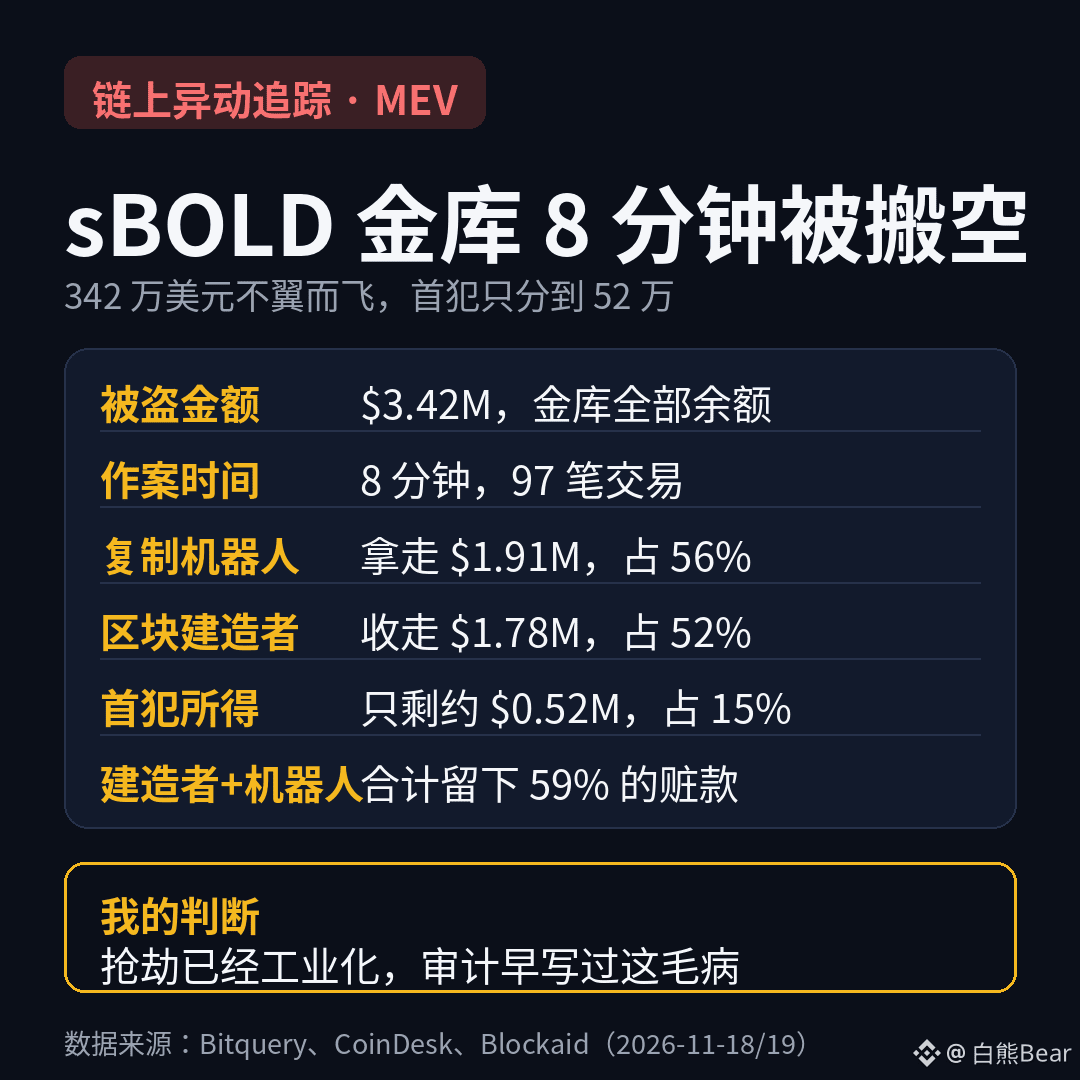
A vault was drained of $3.42 million in 8 minutes. The people who pulled it off only got $520,000—the rest went to frontrunning bots and block builders.
At midday on November 18, K3 Capital’s sBOLD vault was emptied between 12:25 and 12:33. In 97 transactions, all $3.42 million in the vault was gone. sBOLD is a product that earns interest on deposited BOLD stablecoins. The vulnerability was in the formula it used to calculate share prices: deposited wstETH wasn’t counted. The attacker flash-borrowed 10,000 wstETH from Morpho, minted about 9 million BOLD, then repeatedly deposited, swapped, and redeemed, cashing out other people’s BOLD. K3 didn’t announce that it was pausing the contract until 13:08. By then, the money was long gone.
The wildest part was how the proceeds were split. The wallet that first put the attack onchain got only about $520,000, then promptly routed it through THORChain and Maya and converted it to Bitcoin. An MEV bot that caught wind of the attack copied the whole exploit and swept up $1.91 million in 57 transactions—56% of the total. To get priority in transaction ordering, the bot paid Ethereum block builders $1.78 million in fees. The fee to jump the queue in a single block briefly reached 44 ETH. The builders and the bot’s receiving wallets kept 59% of the money between them.
To me, the most striking thing isn’t the $3.42 million figure. It’s that onchain robbery has become industrialized: within seconds of the attack code going onchain, six wallets, bots, and builders were all there to take their cut, while the original attacker got the least. Even more painful, ChainSecurity had already flagged a high-severity accounting issue in its May 2025 audit—the same kind of flaw, where collateral was omitted from share pricing. The audit report said it, but the vulnerability remained untouched until someone drained the vault. BOLD itself and Liquity were fine; the problem was in K3’s own wrapper. But users deposited into sBOLD, and those who can’t tell the difference between these layers are the ones who ultimately pay. Also, the builders collected $1.78 million in fees, but Bitquery says there’s no evidence they knew they were including attack transactions in their blocks. The MEV system doesn’t distinguish right from wrong: whoever pays more gets in first. That’s the hardest part to stomach.
Three things to watch next: K3 still hasn’t announced a compensation plan. For a small vault, $3.42 million is a total loss, so anyone who deposited into sBOLD should check how much of their position is left. Any yield-bearing vault that calculates its own share price should revisit the high-severity findings in its audit report. And on the same day, the Gonka bridge lost $1.05 million and Reental about $950,000. All three incidents add up to roughly $5.4 million, suggesting someone is sweeping through these kinds of vaults at scale.
Do you think block builders who collected $1.78 million in priority fees were accomplices to this robbery? Or is “pay us and we’ll do it” simply how things work onchain?
$BTC $ETH
#MEV #DeFi安全
6

The recent acquittal in a high-stakes $25M Ethereum MEV case highlights a fascinating gray area at the intersection of blockchain mechanics and criminal law. Validators and institutional products like staked ETH yield streams face unprecedented legal scrutiny as regulators grapple with priority gas fees. While the verdict offers short-term relief, it fundamentally questions how decentralized sequencing models fit into traditional legal frameworks. The debate around blockchain revenue sharing is only just beginning. $ETH #Ethereum #MEV #CryptoRegulation
The recent acquittal in a high-stakes $25M Ethereum MEV case highlights a fascinating gray area at the intersection of blockchain mechanics and criminal law. Validators and institutional products like staked ETH yield streams face unprecedented legal scrutiny as regulators grapple with priority gas fees. While the verdict offers short-term relief, it fundamentally questions how decentralized sequencing models fit into traditional legal frameworks. The debate around blockchain revenue sharing is only just beginning. $ETH #Ethereum #MEV #CryptoRegulation
17

·
--
US judge: Making $25 million from Ethereum bots in 12 seconds was NOT fraud.
The facts: Judge Jessica Clarke (Manhattan) granted a motion for acquittal on Nov. 16 for Anton & James Peraire-Bueno — all charges of wire fraud, conspiracy, and money laundering were dismissed (CoinDesk, Nov. 18; Decrypt, Nov. 17). In a 46-page opinion, the judge found that prosecutors had failed to prove the “material misrepresentation” required under wire fraud law. The “Omakase” scheme in April 2023: bait transactions lured sandwich bots, then a MEV-Boost relay vulnerability was used to peek at block contents before commit and reorder transactions — the bots lost about $25 million in a single block, in about 12 seconds. The first trial in Nov. 2025 ended in a mistrial after the jury deadlocked. The judge’s most-quoted line: Ethereum is a “trustless, highly adversarial environment with no terms of use.” Flashbots patched the vulnerability within 24 hours; a wallet containing $3 million in proceeds was frozen.
My take: this is the first legal precedent on MEV — and the message to DeFi is blunt: code, not courts, is what protects your money. Improper conduct isn’t necessarily criminal if the elements of fraud aren’t proven. For users, audits and protocol design matter far more than hoping perpetrators will be punished afterward.
What I’m watching: whether prosecutors appeal, and whether this ruling becomes a reference point in future DeFi disputes. ETH is still around $1,779 tonight, BTC around $63,129 — the market has barely reacted.
What do you think: does this ruling make DeFi freer, or more dangerous for everyday users?
This is my analysis, not financial advice — always DYOR.
#Ethereum #MEV $ETH
22

·
--
🚨 $ETH TOTAL SHOCK: A VAULT DRAINED IN 8 MINUTES
The sBOLD vault at K3 Capital was hacked, and $3.4 million was taken in just 8 minutes, across 97 consecutive transactions. To me, the craziest part isn’t the theft—it’s who walked away with most of the loot.
Look at the detail nobody is noticing:
→ Ethereum block builders took $1.78 million — more than half the amount stolen — in MEV payments from bots competing to process the exploit; a single block collected 44 ETH.
→ One bot copied the attack and made off with $1.91 million, 56% of the total, while the original hacker got only about $520,000.
→ The attackers inflated the vault’s share value by depositing WETH that wasn’t recorded in the accounting and redeeming it for BOLD; a ChainSecurity audit in May 2025 had already warned about this risk.
Would you still put your savings in a DeFi vault after this, yes or no? 👇
$ETH $BOLD $WETH
#HackDeFi #MEV #VaultHack

2
1.4k




·
--
🚨 BlackRock’s staked Ether ETF now captures a portion of Ethereum’s MEV fees, but the recent legal acquittal leaves the regulatory status of this income stream unresolved. This intersection of traditional finance and on-chain priority fees signals shifting dynamics for ETH utility.
Market Implication: Increased institutional exposure may bolster ETH’s long-term narrative, though regulatory clarity remains a key catalyst.
💡 Question: Will this ETF approval accelerate ETH adoption or invite stricter MEV regulations? #Ethereum #MEV
$ETH #TradingSignal #CryptoAnalysis
Market Implication: Increased institutional exposure may bolster ETH’s long-term narrative, though regulatory clarity remains a key catalyst.
💡 Question: Will this ETF approval accelerate ETH adoption or invite stricter MEV regulations? #Ethereum #MEV
$ETH #TradingSignal #CryptoAnalysis

26

·
--
The biggest thing to chew on these past couple of days isn’t the price of crypto—it’s that acquittal. The first criminal MEV case in the U.S. is over: two MIT brothers took nearly $25 million from sandwich bots in about 12 seconds. Last year, the jury deadlocked and the case ended in a mistrial; this time, the judge acquitted them outright. The reasoning stings: Ethereum has no user agreement, and wire fraud requires someone to be deceived by a false statement—yet on-chain, there’s no “I have read and agree” button. I wouldn’t read this as “MEV is legal now.” The judge only said criminal fraud wasn’t the way to pursue it; civil lawsuits and other regulatory tools are still on the table. The people who should really be sweating are those building staking yields into their products. BlackRock had already listed this case as a risk for its staked-ether ETF, and that bomb is still ticking. Until the rules are written into the code, the chain is the Wild West: you think you’re trading, but you’re actually running around naked. #MEV #以太坊 #加密监管 $ETH $EIGEN
The biggest thing to chew on these past couple of days isn’t the price of crypto—it’s that acquittal. The first criminal MEV case in the U.S. is over: two MIT brothers took nearly $25 million from sandwich bots in about 12 seconds. Last year, the jury deadlocked and the case ended in a mistrial; this time, the judge acquitted them outright. The reasoning stings: Ethereum has no user agreement, and wire fraud requires someone to be deceived by a false statement—yet on-chain, there’s no “I have read and agree” button. I wouldn’t read this as “MEV is legal now.” The judge only said criminal fraud wasn’t the way to pursue it; civil lawsuits and other regulatory tools are still on the table. The people who should really be sweating are those building staking yields into their products. BlackRock had already listed this case as a risk for its staked-ether ETF, and that bomb is still ticking. Until the rules are written into the code, the chain is the Wild West: you think you’re trading, but you’re actually running around naked. #MEV #以太坊 #加密监管 $ETH $EIGEN
22

·
--
BlackRock’s Ethereum ETF Staking Revenue Split: Institutions Earn Priority Fees, Retail Investors Bear MEV Costs
The revenue-sharing mechanism for BlackRock’s staked Ethereum ETF is bringing a new form of capital redistribution into the spotlight: institutions earn priority fees through staking, while retail investors foot the bill for transaction front-running.
According to Cointelegraph, BlackRock’s staked Ethereum ETF will receive a share of the fees traders pay to secure transaction priority on Ethereum. A ruling in a related case has made the boundaries of the legal risks behind this mechanism even less clear. The report puts the associated MEV at 25M.
The significance of this perspective is that it is distinct from the ETF inflows and holdings changes that the market has been discussing repeatedly in recent weeks. Previously, the focus was on “whether money is flowing in.” Now the question is whether, after buying in, institutions can generate additional cash flow by staking the ETH they hold. For institutions like BlackRock, staking revenue-sharing adds another source of returns to holding ETH, theoretically strengthening their incentive to hold it for the long term.
Breaking down the capital flows, the mechanism centers on MEV (Maximal Extractable Value). Traders pay priority fees to have their transactions included first, and the value generated in the process is divided up. What institutions take is precisely the cost paid by retail investors. At 25M, this represents an additional source of income for institutions, while for retail investors it is the price of increased activity in the network economy. Both sides are part of the same mechanism, but their interests run in opposite directions.
The market reaction may differ depending on which side you look at. For institutions, if staking revenue-sharing proves to be a stable source of returns, it could reinforce the case for holding ETFs and provide bullish support for ETH through capital flows. For retail investors, controversy over MEV front-running and rising gas costs tell the opposite story and could dampen sentiment among some active traders.
The counterarguments are also clear: MEV front-running is controversial, regulatory scrutiny of institutional revenue-sharing remains a risk, and rising costs for retail investors could also prompt concerns about how user-friendly the network is. None of these outcomes is certain, but they are factors that need to be monitored continuously.
What should we watch next? It is worth looking at two dimensions. On the capital-flow side, whether staking revenue-sharing can be sustained and whether it grows alongside holdings are key to assessing institutions’ willingness to hold. At the trading level, if you are following $ETH, it is more important to watch the long-term impact of MEV mechanisms on network transaction costs than short-term sentiment swings. Waiting for the market to confirm the balance between costs and returns is more prudent than chasing a single narrative.
$ETH #Ethereum #ETF #MEV
The above is an informational summary and personal analysis, and does not constitute investment advice.
Follow me for ongoing updates on key market developments and data.
BlackRock’s Ethereum ETF Staking Revenue Split: Institutions Earn Priority Fees, Retail Investors Bear MEV Costs
The revenue-sharing mechanism for BlackRock’s staked Ethereum ETF is bringing a new form of capital redistribution into the spotlight: institutions earn priority fees through staking, while retail investors foot the bill for transaction front-running.
According to Cointelegraph, BlackRock’s staked Ethereum ETF will receive a share of the fees traders pay to secure transaction priority on Ethereum. A ruling in a related case has made the boundaries of the legal risks behind this mechanism even less clear. The report puts the associated MEV at 25M.
The significance of this perspective is that it is distinct from the ETF inflows and holdings changes that the market has been discussing repeatedly in recent weeks. Previously, the focus was on “whether money is flowing in.” Now the question is whether, after buying in, institutions can generate additional cash flow by staking the ETH they hold. For institutions like BlackRock, staking revenue-sharing adds another source of returns to holding ETH, theoretically strengthening their incentive to hold it for the long term.
Breaking down the capital flows, the mechanism centers on MEV (Maximal Extractable Value). Traders pay priority fees to have their transactions included first, and the value generated in the process is divided up. What institutions take is precisely the cost paid by retail investors. At 25M, this represents an additional source of income for institutions, while for retail investors it is the price of increased activity in the network economy. Both sides are part of the same mechanism, but their interests run in opposite directions.
The market reaction may differ depending on which side you look at. For institutions, if staking revenue-sharing proves to be a stable source of returns, it could reinforce the case for holding ETFs and provide bullish support for ETH through capital flows. For retail investors, controversy over MEV front-running and rising gas costs tell the opposite story and could dampen sentiment among some active traders.
The counterarguments are also clear: MEV front-running is controversial, regulatory scrutiny of institutional revenue-sharing remains a risk, and rising costs for retail investors could also prompt concerns about how user-friendly the network is. None of these outcomes is certain, but they are factors that need to be monitored continuously.
What should we watch next? It is worth looking at two dimensions. On the capital-flow side, whether staking revenue-sharing can be sustained and whether it grows alongside holdings are key to assessing institutions’ willingness to hold. At the trading level, if you are following $ETH , it is more important to watch the long-term impact of MEV mechanisms on network transaction costs than short-term sentiment swings. Waiting for the market to confirm the balance between costs and returns is more prudent than chasing a single narrative.
$ETH #Ethereum #ETF #MEV
The above is an informational summary and personal analysis, and does not constitute investment advice.
Follow me for ongoing updates on key market developments and data.
154

·
--
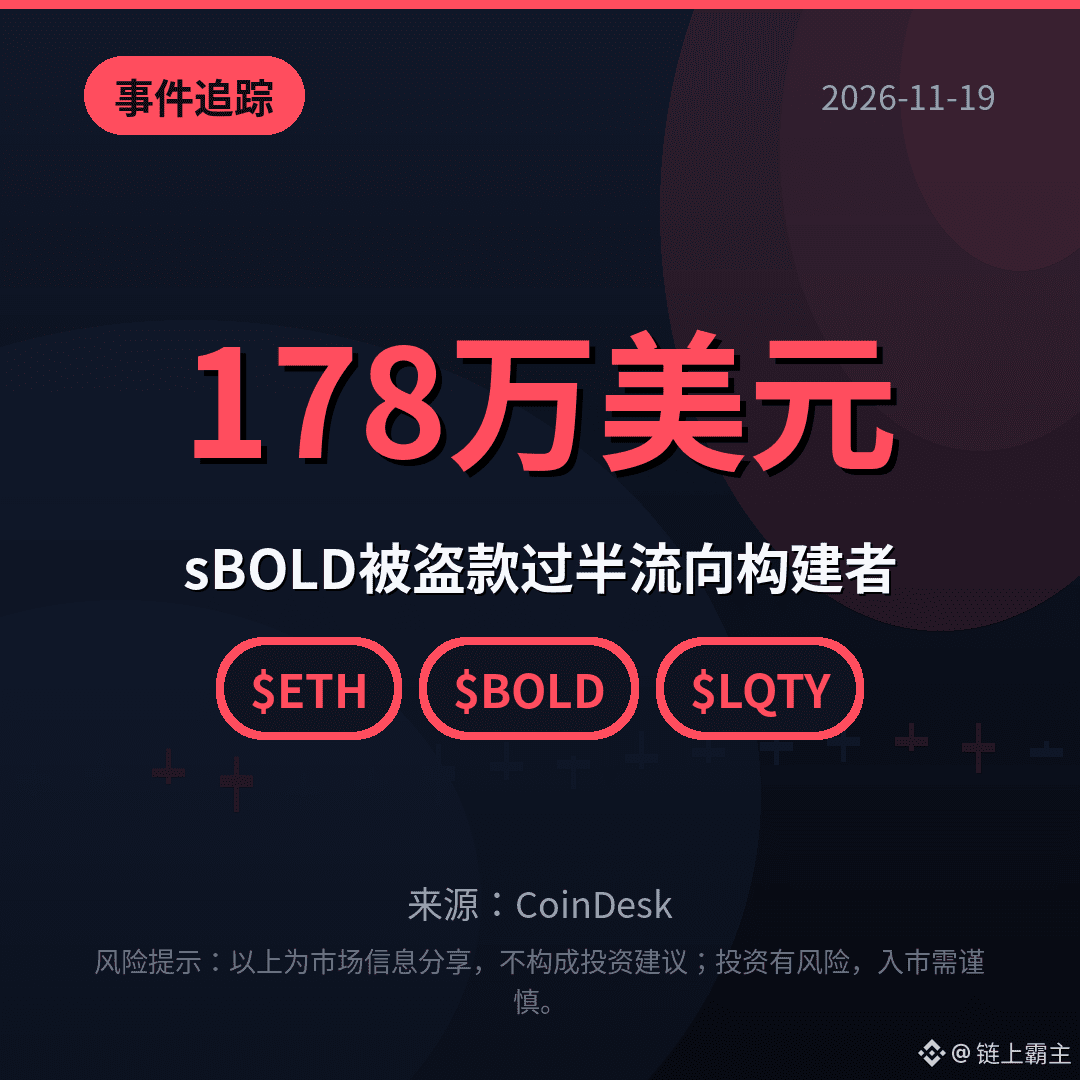
【Incident Tracker】More than half of the stolen sBOLD funds flowed to builders
New developments in the sBOLD theft: Bitquery tracking shows that 97 transactions drained the treasury in 8 minutes, with about $1.78 million flowing to block builders—more than half the total. Titan built most of the blocks involved. A copycat attack bot took $1.91 million, or 56%, while the original attacker kept only $520,000. The $1.78 million was payment, not confirmed profit.
$ETH $BOLD $LQTY
#币安广场 #MEV #Hackers
(Source: CoinDesk)
⚠️Risk warning: The above is shared for market information purposes only and does not constitute investment advice. Investing involves risks; please exercise caution.
Should builders return the money?
7

·
--
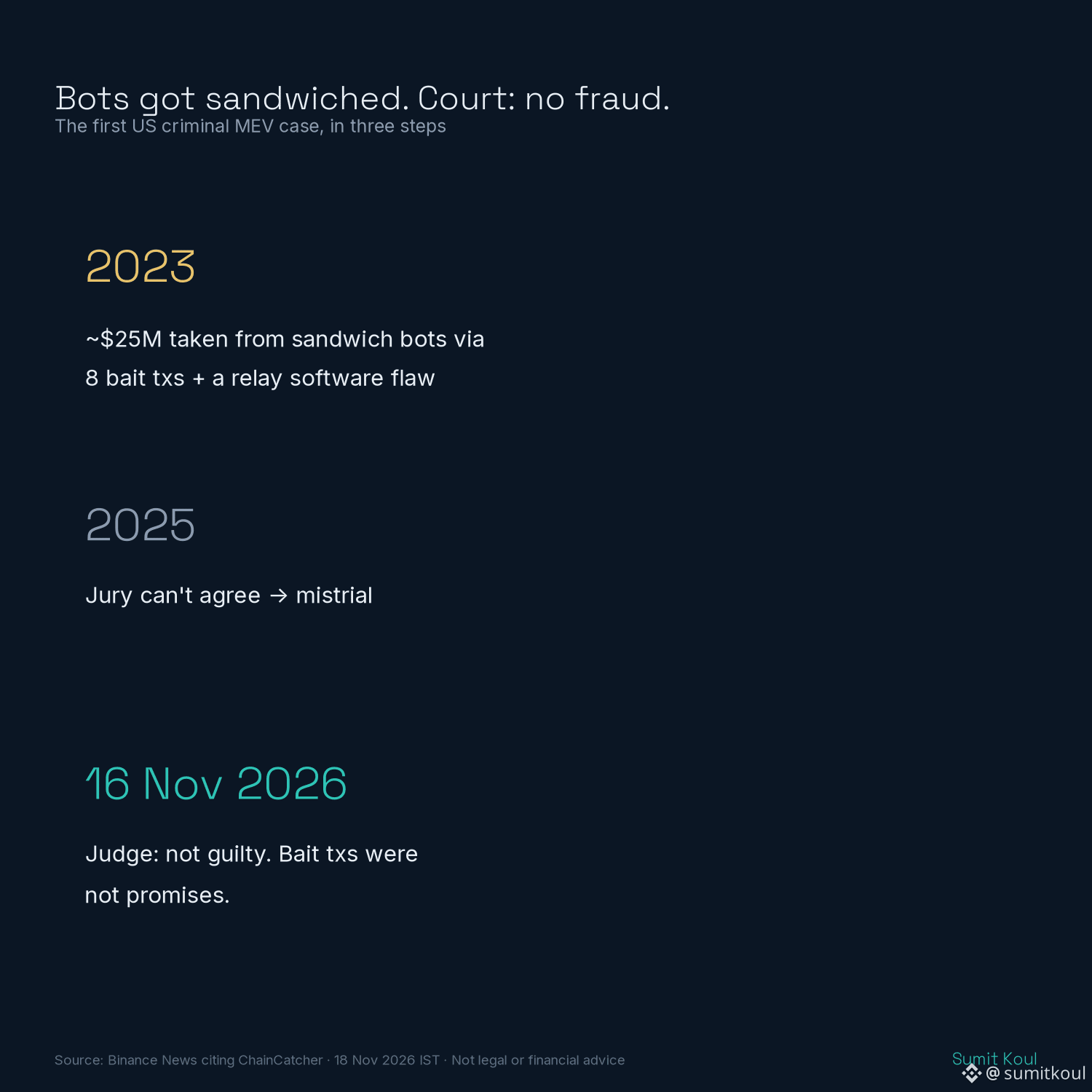
A US judge just ruled that tricking trading bots on Ethereum wasn't fraud.
The first criminal MEV case is over:
• ~$25M taken from sandwich bots in 2023, using 8 bait transactions and a relay software flaw
• 2025: jury couldn't agree, mistrial
• 16 Nov: not guilty. The judge said the bait transactions "were not promises"
Her description of Ethereum: "a trustless, highly adversarial environment with no terms of use."
If you swap on-chain, that line matters more than the verdict. I wrote up what it means for your slippage settings and trade routing:
https://www.binance.com/en/square/post/389501737587141
Not financial or legal advice.
#MEV #DeFi #Ethereum
1
41
The recent legal dismissal regarding Ethereum MEV trading bots highlights a fascinating gray area in blockchain architecture. Because protocols operate on transparent code rather than traditional terms of use, prosecuting decentralized arbitrage becomes legally complex. This ruling sets a major precedent for how courts view automated strategies on-chain, proving that decentralized networks operate under a vastly different rulebook than traditional finance. $ETH #Ethereum #CryptoLaw #MEV
The recent legal dismissal regarding Ethereum MEV trading bots highlights a fascinating gray area in blockchain architecture. Because protocols operate on transparent code rather than traditional terms of use, prosecuting decentralized arbitrage becomes legally complex. This ruling sets a major precedent for how courts view automated strategies on-chain, proving that decentralized networks operate under a vastly different rulebook than traditional finance. $ETH #Ethereum #CryptoLaw #MEV
8
·
--
【Market Flash】$25 million swept up in 12 seconds, judge says it wasn’t fraud
In April 2023, two brothers set up eight bait trades to lure MEV bots. When their own validator proposed a block, they exploited a loophole in the Ultrasound relay, sweeping up $25 million in just 12 seconds and paying a fine of only about 1 ETH. On November 16, Judge Clarke acquitted them, ruling that prosecutors had not proven any “material misrepresentation” and that the relay had not been misled because it never validated the fields. What do you think of this legal gray area?
$ETH $BTC $SOL
#币安广场 #以太坊 #MEV
(Source: Bitcoinist)
⚠️Risk warning: The above is shared for informational purposes only and does not constitute investment advice. Investing involves risks; please exercise caution.

22

·
--
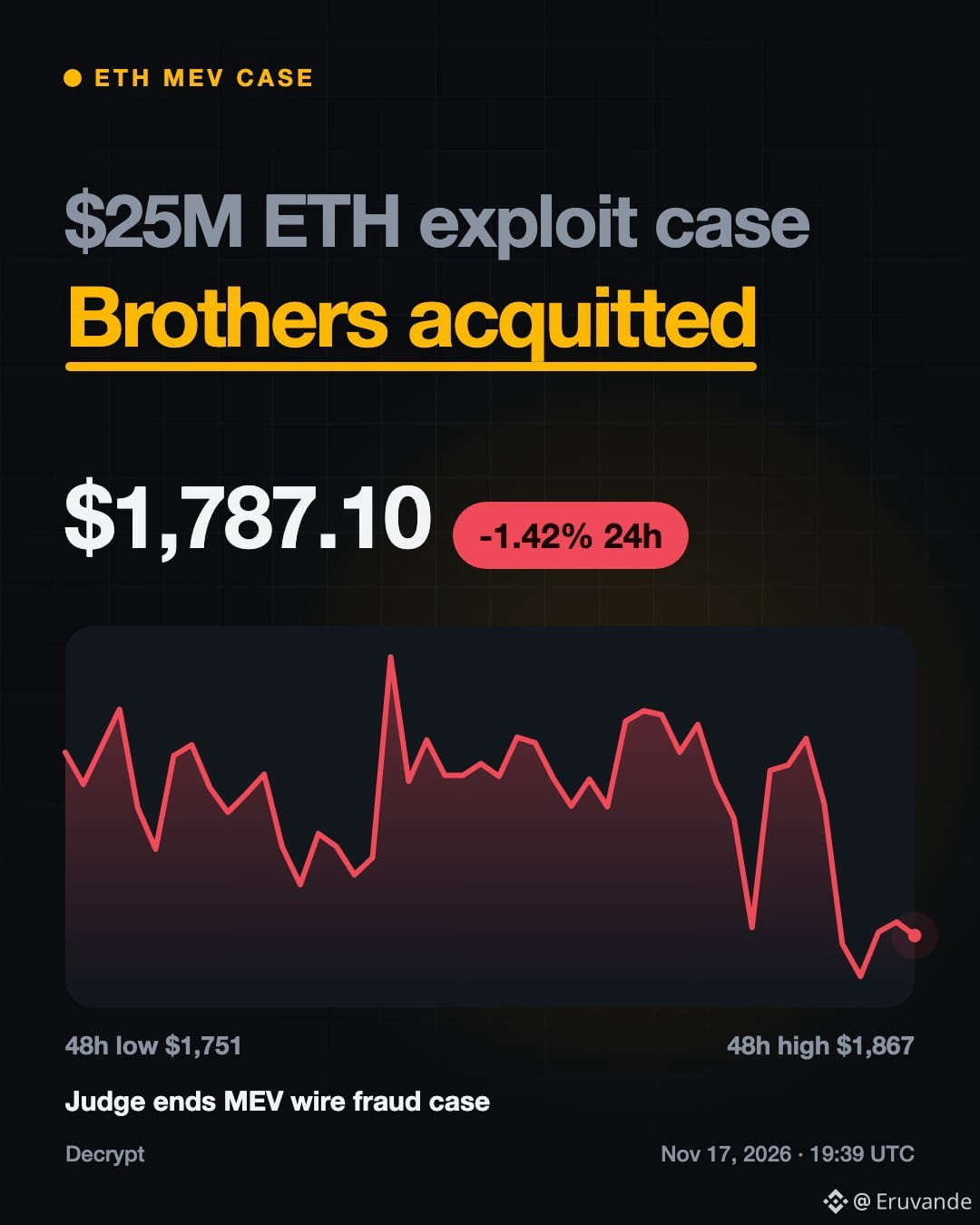
A US judge just acquitted the MIT-educated Peraire-Bueno brothers over a $25M $ETH MEV exploit.
The ruling: prosecutors failed to prove any material misrepresentation, a year after a jury deadlocked.
It does not settle whether the trades were ethical.
$ETH trades near $1,787.10 right now.
Does this open the door for more MEV plays on $ETH? 👀
#Ethereum #MEV
A US judge just acquitted the MIT-educated Peraire-Bueno brothers over a $25M $ETH MEV exploit.
The ruling: prosecutors failed to prove any material misrepresentation, a year after a jury deadlocked.
It does not settle whether the trades were ethical.
$ETH trades near $1,787.10 right now.
Does this open the door for more MEV plays on $ETH ? 👀
#Ethereum #MEV
The ruling: prosecutors failed to prove any material misrepresentation, a year after a jury deadlocked.
It does not settle whether the trades were ethical.
$ETH trades near $1,787.10 right now.
Does this open the door for more MEV plays on $ETH ? 👀
#Ethereum #MEV
BcryptexBTC:
This case just rewrote the rules for MEV on ETH if the court says it is not fraud then every searcher just got confidence to go harder I break down plays like this daily do you think this is bullish or dangerous for ETH
1
1
384
·
--
US judge: “Ethereum has no terms of use” — two brothers who made $25 million from MEV bots are officially free.
The facts: On Nov. 16, Judge Jessica Clarke (Manhattan) acquitted Anton and James Peraire-Bueno of wire fraud, conspiracy to commit wire fraud, and conspiracy to commit money laundering. Their operation, “Omakase” (April 2023), took around $25 million from sandwich-trading bots in about 12 seconds — one block — by exploiting a vulnerability in the MEV-Boost relay. The reason: prosecutors failed to prove “material misrepresentation,” a required element of wire fraud. The 46-page ruling closes the case without a retrial, after the first trial deadlocked in Nov. 2025. (CoinDesk Nov. 18, Decrypt Nov. 17, The Block Nov. 16)
My take: this is the first criminal precedent on MEV in the US — and the message is sharp: “unpleasant” behavior isn’t necessarily criminal, and the judge described Ethereum as a “trustless, highly adversarial environment with no terms of use.” That means the rules of MEV won’t be written by prosecutors, but by the protocol and relay designs themselves — Flashbots patched the vulnerability within 24 hours of the incident. Not an immediate price catalyst — ETH is still below 1,800 (15-minute candle closed at 20:15 WIB: 1,794) — but one legal cloud over Ethereum infrastructure has lifted.
What I’m watching next: whether there are any further legal developments, and whether this ruling affects future discussions about MEV regulation.
What do you think: is MEV a legitimate part of the game on Ethereum, or a vulnerability the protocol should close?
This is my analysis, not financial advice — always DYOR.
#Ethereum #MEV $ETH
22

·
--
U.S. judge rules: Ethereum MEV operation that took $25 million in 12 seconds does not constitute wire fraud
On November 16, U.S. District Judge Jessica Clarke in Manhattan acquitted brothers Anton and James Peraire-Bueno, dismissing charges of wire fraud, conspiracy, and conspiracy to commit money laundering. The case is now closed and will not be retried.
In April 2023, the brothers set up bait transactions to lure sandwich bots, then exploited a vulnerability in relay software to reorganize blocks, causing the bots to lose approximately $25 million in 12 seconds. The judge found that prosecutors had failed to prove a “material misrepresentation,” and described Ethereum as a “trustless, highly adversarial environment with no terms of service.”
This was the first U.S. criminal case targeting MEV arbitrage. The ruling marks an important boundary for the legality of profiting from on-chain transaction ordering. The jury had previously failed to reach a unanimous verdict, and the case ended in a mistrial in November 2025.
For informational purposes only; not investment advice
$ETH #以太坊 #MEV
45

·
--
Two MIT brothers took $25 million in 12 seconds, yet were acquitted. What exactly did the court reject?
A Manhattan federal court issued its ruling on Monday. The two brothers, Anton and James, were found not guilty on all three charges they faced: wire fraud, conspiracy to commit wire fraud, and conspiracy to commit money laundering. Last November, the case ended in a mistrial after the jury failed to reach a unanimous verdict.
This was the first time the U.S. government had brought criminal charges over this kind of MEV activity. MEV is the extraction of value through methods such as transaction ordering.
The incident took place in April 2023.
The brothers used bait transactions to lure bots that carried out sandwich attacks. When it was their validator’s turn to propose a block, they exploited a relay validation flaw to access the block contents early, kept the bots’ buy orders, and replaced them with their own transactions. In about 12 seconds, the bots lost roughly $25 million.
A sandwich attack means buying ahead of a target transaction, then selling after that transaction pushes up the price.
CoinDesk’s review of the court opinion notes that about $3 million in proceeds was frozen, while the rest had already been transferred. The victims were bots engaged in sandwich trading—not ordinary users who were directly sandwiched.
But here’s the point that’s easiest to get wrong.
An acquittal does not mean the court ruled that this kind of conduct is acceptable.
The judge was not considering whether the conduct was ethical, but whether prosecutors had proved that the defendants made a false representation on which someone else relied. The wire fraud charges in this case did not meet that threshold.
The phrase “no terms of service” in the coverage stands out, but it cannot be boiled down to “no terms means you can take money however you like.”
What we can say is that these three charges did not hold up. What we cannot conclude is that exploiting vulnerabilities for profit is legal in every circumstance—much less that this case is a how-to guide.
What blockchain code allows to happen and what criminal law can prove are two different things. This ruling drew the boundary for specific criminal charges; it did not resolve every question about the rules governing the industry.
What do you think?
A On-chain adversarial behavior should be a risk borne by participants
B Exploiting a relay vulnerability cannot be considered ordinary trading
C A failed conviction does not mean the industry’s rules are clear
#MEV #ETH #以太坊

114

·
--
⚖️ U.S. judge rules: Ethereum has “no terms of service”; MIT brothers found not guilty in MEV case!
According to CoinDesk: A federal judge found brothers Anton and James Peraire-Bueno not guilty. Their 2023 actions involving Ethereum MEV bots were deemed “lies that nobody relied on,” and the $25 million fraud charges were dismissed, bringing the U.S. government’s first criminal MEV case to a close.
🔍 Key points:
1️⃣ On-chain rules are code; there was no “user agreement” to violate
2️⃣ Profiting from protocol mechanics ≠ fraud—this is an important DeFi precedent
3️⃣ But this doesn’t mean a complete victory for “code is law”; regulators may still pursue other avenues
📊 Market: BTC $64,294 (+0.38%), ETH $1,804 (+1.0%), Fear & Greed Index 11, Extreme Fear.
👉 What do you think: Is MEV arbitrage “fair play” or “exploiting loopholes”? Join the discussion in the comments 👇
$ETH $BTC #MEV #以太坊 #CryptoRegulation
For personal opinions only; not investment advice

6

Lately, a bunch of accounts have been touting mump2p, Ethereum’s “accelerated block propagation” system, as a “free public good.” I read Optimum’s own launch blog, and only half of it is free.
They split the product into two parts. Signal is for “receiving faster,” and is free for all validators. The benefit is more accurate voting and fewer missed rewards. Accelerate is for “sending faster,” and is only available to organizations operating at least 200 validator keys. It also comes with a service to help optimize your bid cutoff.
What is a bid cutoff? The blog spells it out: when proposing a block, mump2p lets you wait longer, choose the builder offering the highest bid, and still not miss the slot deadline. Put simply, the 200-plus milliseconds saved by faster propagation aren’t all used to make the chain more stable; they’re used to wait longer for MEV bids. These are the timing games that have been debated in Ethereum circles for a long time—and now there’s a dedicated tool being sold to the biggest players.
Let’s do the math on the threshold: 200 keys, at the old standard of 32 ETH each, means at least 6,400 ETH. Solo stakers running a few nodes at home can’t come close.
As for the data, according to Optimum’s figures as of 11/15, the share of staked ETH running mump2p rose from about 3% at launch to 7.8%—roughly 3.44 million ETH out of 44 million. Claims like “93% of blocks arrive faster” come from their own Hub, which aggregates data from connected nodes; I haven’t seen any third-party verification.
I’m not saying the technology is fake. Vitalik himself has called erasure-coded propagation a high-leverage upgrade. The issue is this: put it in the protocol, and everyone gets faster together; make it an off-chain overlay network with tiered access based on scale, and you’ve given large operators another channel for extracting MEV. Staking rewards are already concentrating at the top, and things like this will only accelerate that trend.
So when you see “free Ethereum acceleration,” ask one question first: who gets to use the faster-sending half?
#ETH #MEV
6
Log in to explore more content
Join global crypto users on Binance Square
⚡️ Get latest and useful information about crypto.
💬 Trusted by the world’s largest crypto exchange.
👍 Discover real insights from verified creators.
Email / Phone number
Trending Topics
1
#AnthropicFallsBelow$83IPOPricePremarket
695 views
25 Discussing
2
#NVDASoarsOnJensenReturn
30,087 views
400 Discussing
3
#Bitcoin'sReboundFadesBelow$60K
26,540 views
196 Discussing
4
#NVIDIAReinstatesJensenHuangasCEO
352,077 views
2,060 Discussing
5
#WillMarketsStageAThanksgivingReliefRally?
400,388 views
2,738 Discussing
6
#EthereumFoundationPlansShiftToHashBasedSignaturesBy2028
93 views
11 Discussing
7
#WillOctCorePCEShiftFedHikeExpectations?
151,813 views
1,398 Discussing
8
#EvolveAtBinanceBlockchainWeek
283,341 views
1,731 Discussing
9
#BlackRockLaunchesAsiaPacificFirstTokenizedMoneyMarketFund
3,123 views
11 Discussing
10
#SouthKoreaBeginsCryptoProviderShareholderReviews
10,477 views
171 Discussing