
Brainrot Labs
837 Posts
Brainrot Labs
Report
Block User
🇺🇸 🇯🇵 🇻🇳 🇨🇳your daily dose of digital schizophrenia
AI girls • memes • crypto • chaos
99% research. 1% sleep.
Think for yourself -Not your advisor
250 Following
3.8K+ Followers
537 Liked
Posts
All
Quotes
Videos
PINNED

Article
TUESDAY MORNING BRIEF NOVEMBER 3, 2026gm, crypto twitter. ☕Apple beat earnings expectations, but memory costs are eating into margins. Anthropic is growing at an insane pace while spending even faster. And the macro backdrop? Oil is finally taking a breather. Tuesday has plenty to unpack. 🧵
1/ 🍎 Apple beats estimates, but the market isn't impressed
Apple reported fiscal Q4 2026 revenue of $114.48B, up 11.7% year-over-year and above the $113.4B consensus.
Net income: $30.71B, up 11.8%.Diluted EPS: $2.10, including approximately $0.05 from a tariff refund.Gross margin: 47.9%.Operating cash flow: approximately $28B.
iPhone revenue reached $57.58B, up 17.5%, while Mac revenue rose 23.7% to $10.79B. iPad and Wearables, Home and Accessories missed expectations.
The bigger concern is forward guidance. Apple expects next-quarter revenue growth of 7–10%, while rising memory costs and AI-related infrastructure expenses are putting pressure on margins.
📌 Market watch: Memory pricing, gross margin guidance, iPhone demand, and Apple's next-quarter outlook.
A revenue beat means little if the next quarter looks expensive.
2/ 💵 Arthur Hayes sees dollar liquidity tightening
Arthur Hayes says US dollar liquidity is being replenished, but expects BTC to weaken before the Federal Reserve and/or banks begin expanding their balance sheets again.
His view puts liquidity conditions at the center of Bitcoin's near-term outlook.
The key question is when monetary and banking liquidity starts expanding again — and how much of that shift is already priced into risk assets.
📌 Market watch: Fed balance sheet, bank reserves, Treasury liquidity, DXY, and BTC price action.
Bitcoin watches liquidity more closely than motivational speeches.
3/ 🔐 Mercado Bitcoin to absorb $40M hack loss
Brazilian crypto exchange Mercado Bitcoin says it will absorb approximately $40M in losses following a cyberattack.
The platform expects customers not to suffer financial losses. It says the incident was contained quickly and that its team is investigating, tracing assets, and coordinating with authorities and relevant partners.
📌 Market watch: Recovery progress, wallet tracing, and the exchange's investigation updates.
Another reminder that exchange security is not just a technical issue — it is also a balance-sheet responsibility.
4/ 📊 US markets deliver a mixed session
US equities closed in different directions:
Dow Jones: +0.41%Nasdaq: -1.07%S&P 500: -0.51%Russell 2000: -0.21%
The VIX jumped 9.01% to 21.17, signaling increased market volatility.
The 2-year Treasury yield rose to 4.5978%, while the 10-year and 30-year yields declined to 4.9125% and 5.2868%. DXY slipped 0.17% to 101.7953%.
📌 Market watch: VIX, Treasury yields, DXY, and whether tech-sector weakness spreads into crypto.
The Dow is smiling. Nasdaq clearly didn't get the memo.
5/ 🛢️ Oil drops as US-Iran negotiations show progress
Brent crude fell approximately 8% to $104.32, while WTI moved below $100, amid reports of progress toward renewed US-Iran negotiations.
Qatari mediators reportedly traveled to Tehran, with discussions involving Iranian officials and potential terms for an agreement. President Trump said he was not rushing to resume military action. Vice President Vance also described the diplomatic discussions as positive.
China is separately engaging regional parties to encourage a political solution.
These are reported diplomatic developments, not a finalized agreement.
📌 Market watch: Brent, WTI, shipping routes, and further announcements from Washington and Tehran.
Oil prices are reacting to diplomacy before diplomacy has even finished.
6/ 🏦 US Treasury refunding guidance in focus
The US Treasury is expected to release its quarterly refunding guidance this week.
Market participants are watching for potential changes to long-term issuance, particularly 20-year and 30-year bonds. One expectation is that Treasury could eventually reduce longer-dated issuance in 2027 while increasing short-term bill issuance.
Lower oil prices and expectations of changes to long-term bond supply have also contributed to falling long-term Treasury yields.
📌 Market watch: Treasury issuance, 10-year and 30-year yields, and the shape of the yield curve.
Bond supply may be boring — until it moves the entire market.
7/ 📈 US manufacturing PMI beats expectations
October ISM manufacturing PMI came in at 55.5, above the 54.5 forecast and previous reading.
Markit's manufacturing PMI was 54.9.
ISM manufacturing remained in expansion for the tenth consecutive month. The production index rose to 59, while inventories increased to 51.4.
However, the prices index remained elevated at 75.2, despite easing from September.
📌 Market watch: Manufacturing demand, input costs, inflation pressure, and the implications for Fed policy.
The economy is still producing. The inflation question isn't finished.
8/ 🇨🇳 China expands support for its equity market
China's central bank and financial regulators are launching the third round of the Securities, Funds and Insurance Companies Swap Facility (SFISF).
The operation begins November 3, with a one-year term. Applications from 31 securities firms and fund managers have reportedly exceeded RMB 100B.
Authorities are also lowering the relending rate for share buybacks and increased holdings from 1.25% to 1.00%, while expanding support for listed companies and ETFs.
📌 Market watch: Chinese equity liquidity, buyback activity, and capital flows into technology stocks.
Beijing is giving the stock market another liquidity injection.
9/ 🤖 Anthropic IPO: Massive growth, even bigger costs
Anthropic's updated filing reportedly shows revenue of $16.96B, up 1,126.9% year-over-year.
But the company also reported a net loss of $23.29B, largely driven by non-cash fair-value changes in convertible instruments and other financing arrangements.
Adjusted net income was $3.17B, marking its second consecutive profitable quarter on that adjusted basis.
Compute and infrastructure costs reached $9.86B, up 77.5% quarter-over-quarter. The company is reportedly targeting a Q3 2026 listing.
📌 Market watch: Compute costs, adjusted profitability, ARR disclosures, and IPO valuation.
AI revenue is scaling fast. So is the bill for running it.
10/ 💳 Big Tech turns to global debt markets to fund AI
Google, Oracle and Meta are expanding their financing activities:
Google issued €6B in euro-denominated bonds, attracting more than €17B in demand.Oracle plans to raise $20B through debt and equity, including $10B in borrowing.Meta is reportedly considering at least $20B in cross-border investment-grade bonds, including its first euro bond issuance.Anthropic is reportedly seeking up to $3.5B from Japanese investors as part of its US IPO.
The AI infrastructure race is increasingly becoming a financing race.
📌 Market watch: Corporate bond yields, debt maturities, AI capex, and whether future AI revenue can justify today's borrowing.
The AI revolution is real. The financing tab is also real.
11/ 💡 Marvell announces $115B Lumentum acquisition
Marvell announced an all-stock deal to acquire optical component maker Lumentum (LITE), valuing the company at approximately $115B.
Lumentum shareholders would receive 4.5 Marvell shares for each LITE share. After completion, existing Marvell shareholders would own approximately 67% of the combined company.
The deal still requires regulatory approval. Following the announcement, Lumentum shares fell 18.6%, while Marvell dropped 12.7%.
📌 Market watch: Regulatory approval, deal completion, shareholder dilution, and AI optical networking demand.
Two AI infrastructure giants just made a very expensive handshake.
12/ 🌙 Nasdaq prepares for 23-hour trading
Nasdaq plans to introduce a 23/5 trading schedule on December 6, adding an overnight session from 21:00 to 04:00 US time.
The change is designed to provide more access to US equities during Asian trading hours.
📌 Market watch: Overnight liquidity, volatility, and how global investors respond to major earnings outside regular US market hours.
Wall Street is getting closer to never sleeping.
📌 My Market Watchlist
BTC: Dollar liquidity, Fed balance sheet, and DXY.AAPL: Memory costs and forward gross-margin guidance.AI stocks: Anthropic IPO, Big Tech borrowing, and capex returns.Macro: US Treasury refunding, yields, VIX, and oil prices.Geopolitics: US-Iran negotiations and energy supply routes.China: SFISF liquidity support and equity-market measures.
The bigger picture: AI is attracting enormous capital, but financing costs and profitability are becoming harder to ignore. Meanwhile, liquidity and geopolitics remain key drivers of risk appetite.
Are we entering another AI expansion phase, or is the market starting to question how much this growth will actually cost?
DYOR. Not financial advice.
#bitcoin #Apple #Anthropic #Aİ
TUESDAY MORNING BRIEF NOVEMBER 3, 2026
gm, crypto twitter. ☕Apple beat earnings expectations, but memory costs are eating into margins. Anthropic is growing at an insane pace while spending even faster. And the macro backdrop? Oil is finally taking a breather. Tuesday has plenty to unpack. 🧵
1/ 🍎 Apple beats estimates, but the market isn't impressed
Apple reported fiscal Q4 2026 revenue of $114.48B, up 11.7% year-over-year and above the $113.4B consensus.
Net income: $30.71B, up 11.8%.Diluted EPS: $2.10, including approximately $0.05 from a tariff refund.Gross margin: 47.9%.Operating cash flow: approximately $28B.
iPhone revenue reached $57.58B, up 17.5%, while Mac revenue rose 23.7% to $10.79B. iPad and Wearables, Home and Accessories missed expectations.
The bigger concern is forward guidance. Apple expects next-quarter revenue growth of 7–10%, while rising memory costs and AI-related infrastructure expenses are putting pressure on margins.
📌 Market watch: Memory pricing, gross margin guidance, iPhone demand, and Apple's next-quarter outlook.
A revenue beat means little if the next quarter looks expensive.
2/ 💵 Arthur Hayes sees dollar liquidity tightening
Arthur Hayes says US dollar liquidity is being replenished, but expects BTC to weaken before the Federal Reserve and/or banks begin expanding their balance sheets again.
His view puts liquidity conditions at the center of Bitcoin's near-term outlook.
The key question is when monetary and banking liquidity starts expanding again — and how much of that shift is already priced into risk assets.
📌 Market watch: Fed balance sheet, bank reserves, Treasury liquidity, DXY, and BTC price action.
Bitcoin watches liquidity more closely than motivational speeches.
3/ 🔐 Mercado Bitcoin to absorb $40M hack loss
Brazilian crypto exchange Mercado Bitcoin says it will absorb approximately $40M in losses following a cyberattack.
The platform expects customers not to suffer financial losses. It says the incident was contained quickly and that its team is investigating, tracing assets, and coordinating with authorities and relevant partners.
📌 Market watch: Recovery progress, wallet tracing, and the exchange's investigation updates.
Another reminder that exchange security is not just a technical issue — it is also a balance-sheet responsibility.
4/ 📊 US markets deliver a mixed session
US equities closed in different directions:
Dow Jones: +0.41%Nasdaq: -1.07%S&P 500: -0.51%Russell 2000: -0.21%
The VIX jumped 9.01% to 21.17, signaling increased market volatility.
The 2-year Treasury yield rose to 4.5978%, while the 10-year and 30-year yields declined to 4.9125% and 5.2868%. DXY slipped 0.17% to 101.7953%.
📌 Market watch: VIX, Treasury yields, DXY, and whether tech-sector weakness spreads into crypto.
The Dow is smiling. Nasdaq clearly didn't get the memo.
5/ 🛢️ Oil drops as US-Iran negotiations show progress
Brent crude fell approximately 8% to $104.32, while WTI moved below $100, amid reports of progress toward renewed US-Iran negotiations.
Qatari mediators reportedly traveled to Tehran, with discussions involving Iranian officials and potential terms for an agreement. President Trump said he was not rushing to resume military action. Vice President Vance also described the diplomatic discussions as positive.
China is separately engaging regional parties to encourage a political solution.
These are reported diplomatic developments, not a finalized agreement.
📌 Market watch: Brent, WTI, shipping routes, and further announcements from Washington and Tehran.
Oil prices are reacting to diplomacy before diplomacy has even finished.
6/ 🏦 US Treasury refunding guidance in focus
The US Treasury is expected to release its quarterly refunding guidance this week.
Market participants are watching for potential changes to long-term issuance, particularly 20-year and 30-year bonds. One expectation is that Treasury could eventually reduce longer-dated issuance in 2027 while increasing short-term bill issuance.
Lower oil prices and expectations of changes to long-term bond supply have also contributed to falling long-term Treasury yields.
📌 Market watch: Treasury issuance, 10-year and 30-year yields, and the shape of the yield curve.
Bond supply may be boring — until it moves the entire market.
7/ 📈 US manufacturing PMI beats expectations
October ISM manufacturing PMI came in at 55.5, above the 54.5 forecast and previous reading.
Markit's manufacturing PMI was 54.9.
ISM manufacturing remained in expansion for the tenth consecutive month. The production index rose to 59, while inventories increased to 51.4.
However, the prices index remained elevated at 75.2, despite easing from September.
📌 Market watch: Manufacturing demand, input costs, inflation pressure, and the implications for Fed policy.
The economy is still producing. The inflation question isn't finished.
8/ 🇨🇳 China expands support for its equity market
China's central bank and financial regulators are launching the third round of the Securities, Funds and Insurance Companies Swap Facility (SFISF).
The operation begins November 3, with a one-year term. Applications from 31 securities firms and fund managers have reportedly exceeded RMB 100B.
Authorities are also lowering the relending rate for share buybacks and increased holdings from 1.25% to 1.00%, while expanding support for listed companies and ETFs.
📌 Market watch: Chinese equity liquidity, buyback activity, and capital flows into technology stocks.
Beijing is giving the stock market another liquidity injection.
9/ 🤖 Anthropic IPO: Massive growth, even bigger costs
Anthropic's updated filing reportedly shows revenue of $16.96B, up 1,126.9% year-over-year.
But the company also reported a net loss of $23.29B, largely driven by non-cash fair-value changes in convertible instruments and other financing arrangements.
Adjusted net income was $3.17B, marking its second consecutive profitable quarter on that adjusted basis.
Compute and infrastructure costs reached $9.86B, up 77.5% quarter-over-quarter. The company is reportedly targeting a Q3 2026 listing.
📌 Market watch: Compute costs, adjusted profitability, ARR disclosures, and IPO valuation.
AI revenue is scaling fast. So is the bill for running it.
10/ 💳 Big Tech turns to global debt markets to fund AI
Google, Oracle and Meta are expanding their financing activities:
Google issued €6B in euro-denominated bonds, attracting more than €17B in demand.Oracle plans to raise $20B through debt and equity, including $10B in borrowing.Meta is reportedly considering at least $20B in cross-border investment-grade bonds, including its first euro bond issuance.Anthropic is reportedly seeking up to $3.5B from Japanese investors as part of its US IPO.
The AI infrastructure race is increasingly becoming a financing race.
📌 Market watch: Corporate bond yields, debt maturities, AI capex, and whether future AI revenue can justify today's borrowing.
The AI revolution is real. The financing tab is also real.
11/ 💡 Marvell announces $115B Lumentum acquisition
Marvell announced an all-stock deal to acquire optical component maker Lumentum (LITE), valuing the company at approximately $115B.
Lumentum shareholders would receive 4.5 Marvell shares for each LITE share. After completion, existing Marvell shareholders would own approximately 67% of the combined company.
The deal still requires regulatory approval. Following the announcement, Lumentum shares fell 18.6%, while Marvell dropped 12.7%.
📌 Market watch: Regulatory approval, deal completion, shareholder dilution, and AI optical networking demand.
Two AI infrastructure giants just made a very expensive handshake.
12/ 🌙 Nasdaq prepares for 23-hour trading
Nasdaq plans to introduce a 23/5 trading schedule on December 6, adding an overnight session from 21:00 to 04:00 US time.
The change is designed to provide more access to US equities during Asian trading hours.
📌 Market watch: Overnight liquidity, volatility, and how global investors respond to major earnings outside regular US market hours.
Wall Street is getting closer to never sleeping.
📌 My Market Watchlist
BTC: Dollar liquidity, Fed balance sheet, and DXY.AAPL: Memory costs and forward gross-margin guidance.AI stocks: Anthropic IPO, Big Tech borrowing, and capex returns.Macro: US Treasury refunding, yields, VIX, and oil prices.Geopolitics: US-Iran negotiations and energy supply routes.China: SFISF liquidity support and equity-market measures.
The bigger picture: AI is attracting enormous capital, but financing costs and profitability are becoming harder to ignore. Meanwhile, liquidity and geopolitics remain key drivers of risk appetite.
Are we entering another AI expansion phase, or is the market starting to question how much this growth will actually cost?
DYOR. Not financial advice.
#bitcoin #Apple #Anthropic #Aİ
284
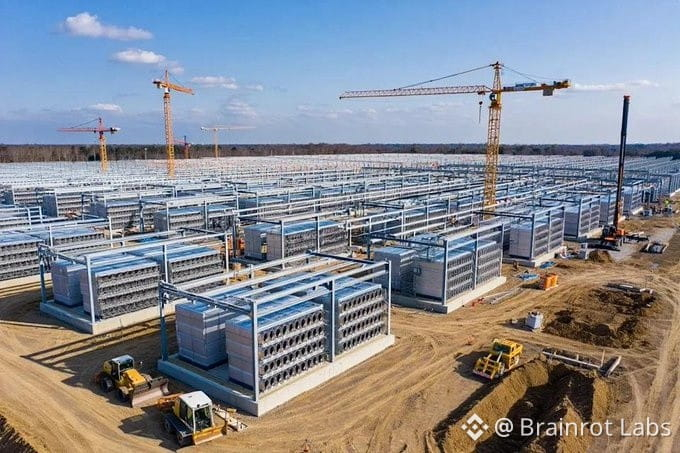
Goldman Sachs Sees an $8.5 TRILLION AI Data Center Boom Over the Next 5 Years.
Goldman Sachs has raised its global data center capacity forecast for 2030 from 217 GW to 273 GW, up from approximately 103 GW in 2025.
The scale of investment is staggering: an estimated 170 GW of additional capacity could require $8.5 trillion in capital expenditure, assuming $50B per GW.
The US alone is expected to add 103 GW, accounting for roughly 60% of global capacity expansion, driven partly by rapidly growing Neocloud providers competing for GPU capacity.
The AI race isn't just about smarter models anymore. It's about who controls the power, GPUs and data centers.
54
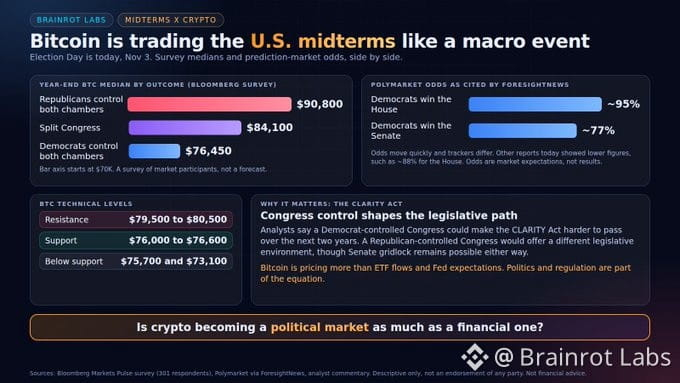
Bitcoin is now watching the U.S. midterms like a macro event.
A survey estimates BTC year-end median price under three political scenarios:
Republicans control both chambers: $90,800
Democrats control both chambers: $76,450
Split Congress: $84,100
Meanwhile, Polymarket odds cited by ForesightNews show Democrats at around 95% to control the House and 77% for the Senate.
BTC$76,883.85 technical levels:
Support: $76,000–$76,600
Resistance: $79,500–$80,500
Next levels below support: $75,700 and $73,100
Bitcoin is trading around more than just ETF flows and Fed expectations. U.S. politics and crypto regulation are becoming part of the pricing equation too.
Imagine checking your BTC chart and needing to check Congress, Polymarket and the CLARITY Act at the same time.
207
Another $27M just disappeared. The suspected crypto theft linked to a European entity has now surpassed $133M.
Blockchain investigator ZachXBT has flagged additional suspicious withdrawals from a major centralized exchange, bringing the total funds involved to more than $133M.
Key details:
Additional suspicious withdrawals: $27M+
Total funds involved: Over $133M
The potential victim is reportedly a major financial institution in Western Europe.
ZachXBT alleges that more than $30M has already been moved through laundering channels.
Some withdrawals reportedly occurred even after the incident was publicly exposed.
The biggest concern isn’t just the amount stolen. It’s the alleged failure to disclose the incident quickly enough to give authorities a chance to freeze the funds.
Hackers move fast. Institutional disclosure apparently doesn’t.
How can a financial institution handle over $100M in suspicious outflows without the market getting an immediate explanation?

2.2k
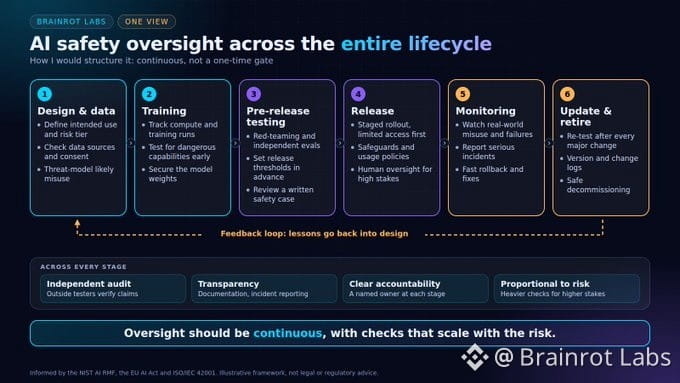
China is preparing to put AI under full-lifecycle supervision. The AI race just got a new rulebook.
Key developments:
New AI safety standards covering the entire lifecycle.
Oversight of data, computing power, development, and deployment.
Major players affected could include DeepSeek, Moonshot AI, and Alibaba.
Goal: prevent increasingly powerful AI systems from going out of control.
Market angle: Tighter rules could increase compliance costs but also create clearer standards for China's AI industry.
Build smarter AI. Don't forget the safety manual.
Will regulation slow China's AI race or make it stronger?
40
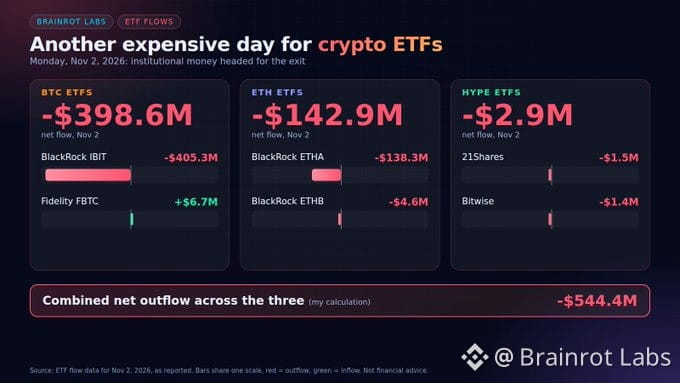
November 2 was another expensive day for crypto ETFs. Wall Street hit the exit button again.
Institutional flows were deep in the red:
BTC ETFs: -$398.6M
• BlackRock IBIT alone: -$405.3M
• Fidelity FBTC: +$6.7M
ETH ETFs: -$142.9M
• BlackRock ETHA: -$138.3M
• BlackRock ETHB: -$4.6M
HYPE ETFs: -$2.9M
• 21Shares: -$1.5M
• Bitwise: -$1.4M
My take: Bitcoin and Ethereum are still facing institutional selling pressure. Even HYPE ETFs couldn't escape the red wave.
Wall Street said “buy the dip.” Then apparently bought a one-way ticket out.
Are institutions waiting for lower prices, or is risk appetite still disappearing?
213
SBI crypto business is bleeding while the rest of the financial giant hits record revenue.
Japan SBI Holdings reported its FY2027 first-half results (April–September 2026):
Crypto revenue: ¥23.083B (~$150.9M), down 30.1% YoY.
Pre-tax loss: ¥1.595B (~$10.4M), versus ¥147M (~$960K) a year earlier.
Total group revenue: ¥1.0575T (~$6.91B), up 17.2% YoY.
Crypto contributes only around 2% of total group revenue.
My take: SBI’s overall business is growing, but its crypto division is moving in the opposite direction. Being a financial giant doesn’t guarantee profits in crypto.
Record revenue upstairs, crypto losses downstairs. Even the suits can’t escape the bear market.
Temporary slowdown or a sign of tougher margins for crypto businesses?
87
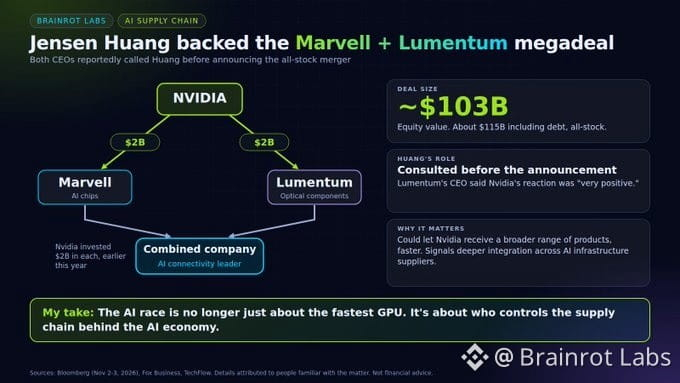
Jensen Huang isn't just buying AI chips anymore. He's helping shape the entire AI supply chain.
Reports say Nvidia CEO Jensen Huang backed the nearly $103 BILLION merger between Micron and Lumentum before the deal was finalized.
Executives from both companies reportedly called Huang to seek his input, with Lumentum's CEO describing Nvidia's reaction as very positive.
Why does this matter?
Nvidia invested $2B in Micron and another $2B in Lumentum earlier this year.
The merger could expand the range of products supplied to Nvidia.
It signals deeper integration across critical AI infrastructure suppliers.
Nvidia is playing chess while everyone else is still shopping for GPUs.
Who actually captures the biggest value from the AI boom: chipmakers, infrastructure providers, or the companies building AI applications?
82
Someone just dropped $600K betting that Democrats WON’T control both chambers of Congress.
Bro is putting serious money on a political plot twist.
Polymarket trader opened a position worth approximately $600,000 on the outcome:
“Democrats will NOT control both the House and Senate after the 2026 midterms.”
On-chain / prediction market details:
Position size: ~$600,000
Average entry: $0.278 per share
Shares acquired: ~2.45 million
Wallet’s cumulative losses: ~$82,500
The trader is making a high-conviction bet that Democrats won’t achieve a clean sweep of both chambers.
Bro saw the election forecast and decided to put his own midterm exam on the blockchain.
$600K on a political outcome. Meanwhile, I need 3 confirmations before sending $20.
Is this a calculated political bet or an expensive lesson in prediction markets?

307
Happy Taco Tuesday! Trump just served the market another round of TACO (Trump Always Chickens Out).
On November 2, Trump urged Congress to advance the CLARITY Act, with Coinbase, Gemini, Ripple and Chainlink Labs among the crypto industry representatives involved in discussions at the White House.
Meanwhile, the US-Iran negotiations may be approaching a preliminary breakthrough, with Qatar reportedly mediating progress between the two sides. Iran could reopen the Strait of Hormuz within 48 hours if conditions are met, while Trump says oil prices are falling rapidly and denies plans for another attack after the midterms.
But there's a twist: explosions have been reported on Iran's Qeshm Island, 11 oil tankers have reportedly caught fire near Hormuz since October 25, and Israeli intelligence remains skeptical about the chances of a deal.
My take: Crypto gets a potential regulatory catalyst from CLARITY, while oil and risk assets are watching every headline from the Middle East.
CLARITY for crypto, peace for oil, and another TACO for the markets?
Happy Taco Tuesday.

1.5k
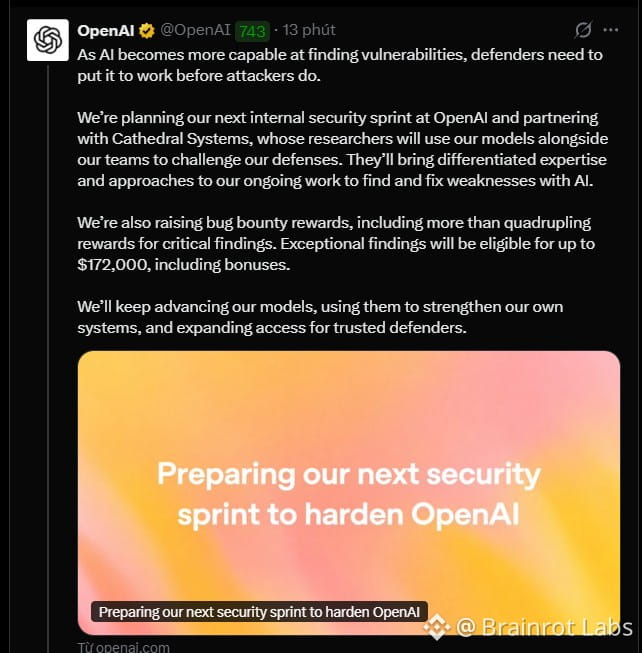
OpenAI is basically hiring AI to catch AI before hackers get there first.
OpenAI is teaming up with Cathedral Systems for an internal security sprint, using AI models to stress-test its own defenses and uncover vulnerabilities.
The bigger move? Critical bug bounty rewards are getting a massive upgrade more than 4x higher, with exceptional findings eligible for up to $172,000 including bonuses.
Even reports already awaiting a bounty qualify for the new reward ranges. Recent payouts from the past 30 days may also receive the difference.
This is where the AI arms race gets interesting. Hackers are getting smarter with AI, so defenders can't afford to stay one step behind.
Imagine getting paid $172K because you found something AI missed. Not a bad day at the office.
The next cybersecurity battle might be AI vs. AI. Which side gets smarter faster?
248
SHIB Whale Moves $4.94M… But Still Has $418M in the Bag.
The legendary SHIB whale just moved 1.07 trillion SHIB$0.00000458 worth $4.94M.
This wallet once bought 103 trillion SHIB for just 37.8 ETH ($13,700) back in 2020.
At the 2021 peak, the position was worth an incredible $9.1 BILLION.
After selling 11.73 trillion SHIB for approximately $74.74M, the whale still holds 91.6 trillion SHIB worth around $418M.
Bought like a degen. Held like a billionaire. Even selling $5M is just pocket change.

1
1.8k
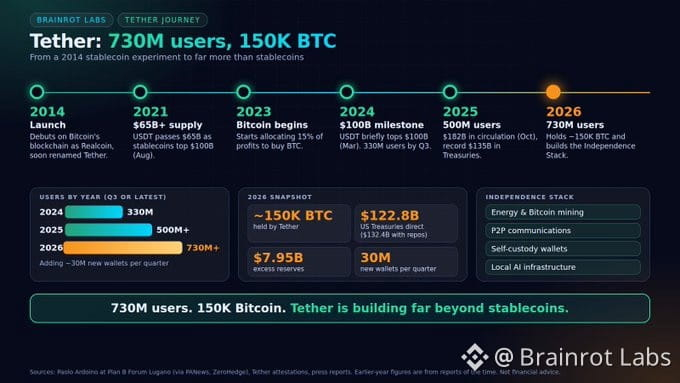
Tether Holds 150,000 BTC and Has Over 730 Million Users Worldwide.
Tether CEO Paolo Ardoino revealed at the Plan ₿ Forum in Lugano that the company currently holds approximately 150,000 BTC$77,145.44 and serves more than 730 million users globally.
The numbers are massive:
₿ Bitcoin holdings: ~150,000 BTC.
Global users: 730M+.
New wallets: ~30M per quarter.
US Treasuries: $122.8B directly held, rising to $132.4B including repurchase agreements.
Excess reserves: $7.95B.
Tether is also developing its Independence Stack, covering energy, Bitcoin mining, peer-to-peer communications, self-custody wallets and local AI infrastructure.
730 million users. 150K Bitcoin. Tether is building far beyond stablecoins.
313
Tether Freezes $4.5M+ in USDT Linked to Mercado Bitcoin Security Incident.
Tether has frozen more than $4.5 million in USDT$1.00 connected to a security incident involving Brazilian crypto exchange Mercado Bitcoin.
The exchange previously confirmed a security breach affecting
Tether Freezes $4.5M+ in USDT Linked to Mercado Bitcoin Security Incident.
Tether has frozen more than $4.5 million in USDT$1.00 connected to a security incident involving Brazilian crypto exchange Mercado Bitcoin.
The exchange previously confirmed a security breach affecting
Tether has frozen more than $4.5 million in USDT$1.00 connected to a security incident involving Brazilian crypto exchange Mercado Bitcoin.
The exchange previously confirmed a security breach affecting
1
1
160
Anthropic Revenue Explodes 1,127% But Net Loss Hits $23.3 BILLION.
Anthropic reported Q3 2026 revenue of $16.96B, up 1,126.9% year-over-year and 46.7% quarter-over-quarter, according to its updated IPO filing.
The numbers tell two different stories:
Revenue: $16.96B (+1,126.9% YoY).
GAAP net loss: $23.29B (+91.9% YoY).
Computing and infrastructure costs: $9.86B.
Adjusted net income: $3.17B, marking its second consecutive profitable quarter.
Adjusted operating margin: 15%, down from 19%.
Much of the reported net loss came from $21.94B in non-cash fair-value adjustments to convertible securities, derivatives and SAFEs, largely reflecting the rising valuation of the company.
Anthropic plans to list on Nasdaq under the ticker ANT, although IPO pricing and share count remain undisclosed.
Revenue is going vertical. Computing bills are going nuclear. Welcome to the AI IPO era.

1
239
Partly True
Binance’s $7B withdrawal wave just got cut in half. The panic meter is finally cooling down.
According to DeFiLlama, Binance’s 24-hour net outflows have dropped from an intraday peak of around $7B to approximately $3.5B a decline of more than 50%.
Net outflows: ~$3.5B, down from ~$7B
Deposit/withdrawal ratio: recovered from ~20% to ~78%
Total platform assets: ~$127.8B
Withdrawal services across networks are gradually recovering.
The numbers suggest capital movement is stabilizing, although outflows remain significant. The next thing to watch is whether users regain confidence and deposits continue recovering.
Binance users went from “GET MY MONEY OUT!” to “Okay, maybe I’ll stay for another block.”
Is the worst of the withdrawal panic behind Binance, or is the market just taking a breather?
283
Verified
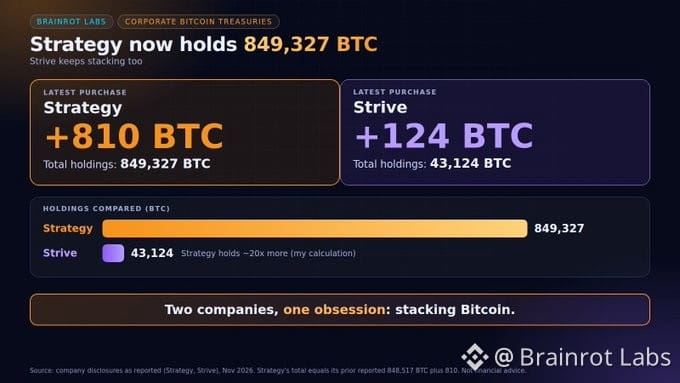
Strategy just bought another 810 BTC. 849K Bitcoin and still stacking! ₿
Strategy now holds 849,327 BTC$77,966.43 after its latest purchase.
Meanwhile, Strive added another 124 BTC$77,966.43, bringing its total to 43,124 BTC.
Two companies, one obsession: stacking Bitcoin.
At this point, their DCA strategy is basically: Buy the dip, buy the top, buy everything.
Strategy now holds 849,327 BTC$77,966.43 after its latest purchase.
Meanwhile, Strive added another 124 BTC$77,966.43, bringing its total to 43,124 BTC.
Two companies, one obsession: stacking Bitcoin.
At this point, their DCA strategy is basically: Buy the dip, buy the top, buy everything.
125
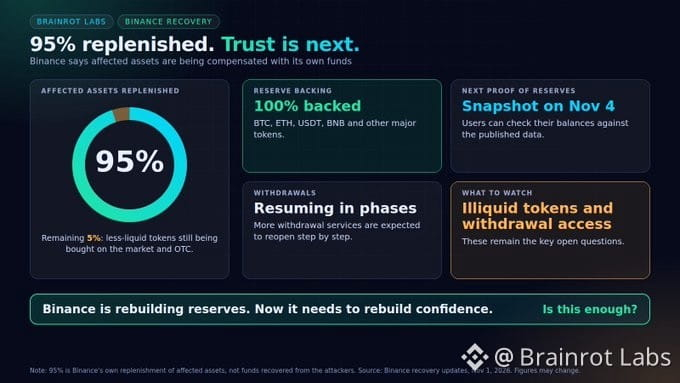
Binance has replenished 95% of affected assets. But it didn't recover them from the hacker.
Binance used its own funds to replenish approximately 95% of affected assets, while the remaining 5% mainly involves low-liquidity tokens.
Major assets: 100% reserve backing.
Next Proof of Reserves snapshot: November 4.
More withdrawals expected to resume in phases.
Binance is covering the losses with its own capital while continuing efforts to restore services and user confidence.
Not recovered from hackers. Replenished from Binance's own pockets.
Can Binance fully restore user trust?
79
Coinbase basically said: “Your AI agent can trade your crypto, but if it blows up your wallet, that’s YOUR problem.”
Coinbase has warned users about the risks of AI-powered trading agents:
AI agents can malfunction or make unexpected decisions.
Users must supervise and coordinate all AI activities.
Users remain fully responsible for transactions executed by their agents.
Users are also responsible for how third-party data is used.
The related services are only available to eligible users in certain jurisdictions outside the US.
AI can execute trades, manage strategies, and interact with protocols but it doesn’t take responsibility when things go wrong.
AI agent: “I made a trading decision.”
Me: “You just liquidated my portfolio.”
Coinbase: “Please refer to our disclaimer.”
Would you trust an AI agent with your wallet, knowing that every mistake is still your responsibility?

8
Ripple Co-Founder Chris Larsen Pours $22.5M Into US Midterm Elections.
Ripple executive chairman Chris Larsen has contributed at least $22.5 million to federal candidates and Super PACs during the 2026 US midterm election cycle.
His contributions include $6 million to the renewable-energy-backed Tomorrow Coalition and more than $4 million to a Super PAC supporting AI safety advocate Alex Bores.
Larsen has raised concerns about rapid AI development and the lack of regulatory oversight, even proposing a pause on new AI infrastructure construction until regulatory rules are established.
Crypto money is entering the political arena. AI regulation and clean energy are now part of the battle.

1
168
Log in to explore more content
Join global crypto users on Binance Square
⚡️ Get latest and useful information about crypto.
💬 Trusted by the world’s largest crypto exchange.
👍 Discover real insights from verified creators.
Email / Phone number