
#cryptomacro
cryptomacro
405,551 views
2,073 Discussing
Hot
Latest

Article
Are you de-risking your spot holdings ahead of the December Fed meeting, or are you taking advantageThe more I look at the order book reactions to this week's US CPI print, the more I realize we might be misreading this macro setup entirely. 🧠
Honestly, I almost panic-hedged my own position yesterday when the initial numbers dropped.
Everyone spent the last 48 hours hyperventilating over the headline inflation data.
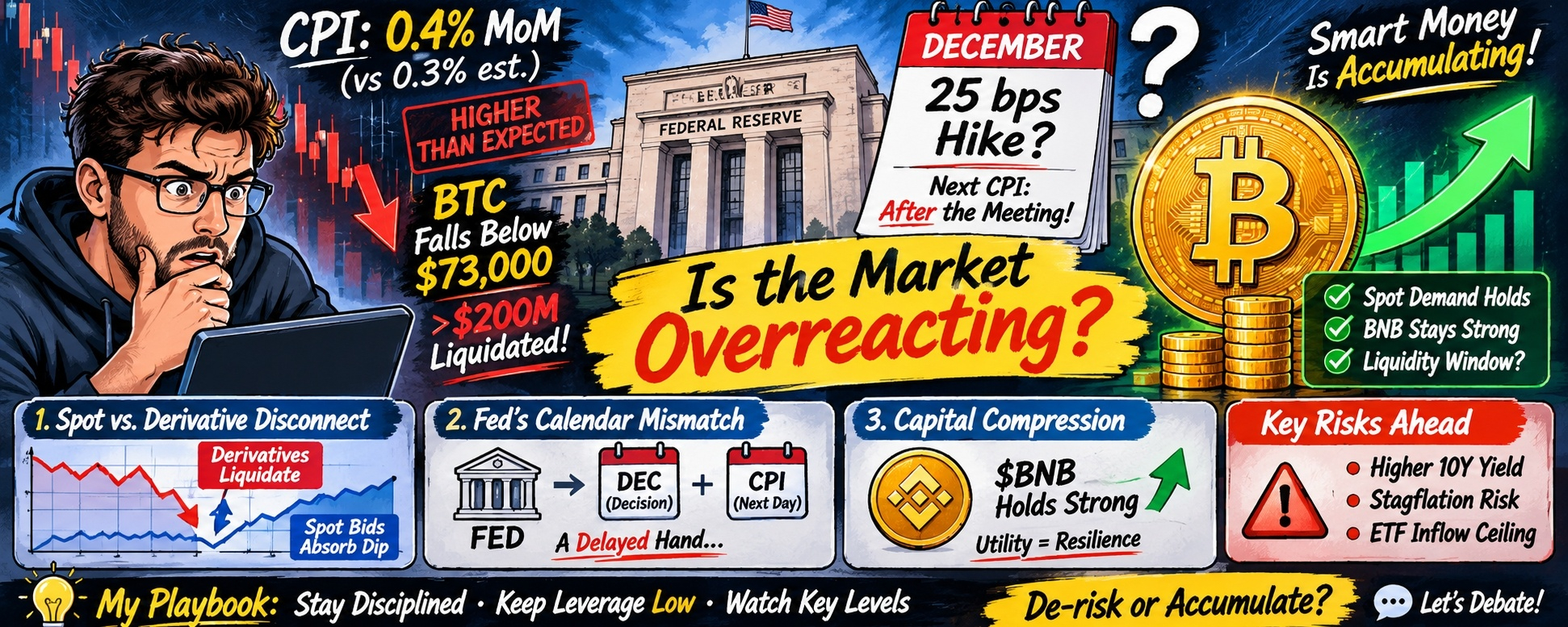
October CPI printing at 0.4% MoM against the 0.3% consensus immediately triggered the usual knee-jerk liquidity drain.
We watched $BTC drop below the $73,000 zone, sweeping aggressive long leverage and wiping out over $200 million across perpetual markets in minutes.
The consensus timeline narrative was instant: "Inflation is sticky, a December Fed rate hike is locked in, dump everything." 📉
Standard economic theory says higher rates drain liquidity, push capital into risk-free yields, and leave high-beta assets out in the cold.
Rates markets rapidly repriced futures, baking in a 25-basis-point hike for December while whispers of a 50-basis-point shock started spreading.
...But sitting here staring at depth charts and hot wallet transfers, something doesn't feel right about that panic.
If you step back and watch how smart money actually positioned around this volatility, a completely different capital engine is running.
The market isn't fleeing from the hike—it’s front-running the fact that the Federal Reserve is playing a delayed hand.
Observation 1: The Spot vs. Derivative Disconnect
When bad news hits a fragile market, you expect cascade liquidations to trigger a structural floor breakdown.
Yet, as soon as the CPI print dropped, limit bids below $72,500 on major spot exchanges absorbed the dump surprisingly fast.
Yes, open interest collapsed and funding rates neutralized instantly, but spot accumulation didn't stop.
The mechanism loop was clear: Derivative liquidations ➔ Volatility spike ➔ Limit order fills ➔ Spot balance transfer to cold storage. 🔄
Derivative traders were getting liquidated on leverage while institutional spot desks quietly used the noise to fill size without pushing slippage.
Why? Because a December rate hike isn't a surprise anymore—it’s an expected parameter.
When market probability for a macro event hits 85%+, the shock value vanishes.
Traders panicking over the headline missed that smart money was treating the volatility as an liquidity window, not a exit door.
Observation 2: The Fed’s Calendar Mismatch
Here is the mechanical paradox that really tripped me up when I started mapping the timeline.
The Federal Reserve meets in early December to announce its interest rate decision... but the next CPI inflation report doesn't release until the day after their meeting.
Think about how absurd that is for central planners.
The Fed is forced to make a multi-trillion-dollar policy call blind to the immediate next inflation datapoint.
They’re stuck acting on backward-looking October numbers and whatever narrative Fed officials push during media appearances.
This creates a massive latency gap between static policy decisions and 24/7 real-time asset pricing.
By the time Jerome Powell steps up to announce a 25-basis-point hike in December, crypto liquidity will already be pricing in the end of that hike cycle—or pricing in a slowing labor market.
Traditional finance moves on monthly reporting lags; crypto pricing digests the future in real time.
Observation 3: Capital Compression into Anchors
I was looking across Layer-1 assets to see where capital fled during the dump.
While speculative altcoins took a heavy hit from tighter liquidity expectations, core infrastructure held its ground.
Look at $BNB staying anchored firmly inside its macro range despite the systemic market dip.
Macro tightening always forces a brutal prioritization loop: capital compresses out of low-conviction speculative tokens back into fee-generating ecosystems.
Watching $BNB hold key structural levels shows how real ecosystem utility and protocol revenue act as an absorption buffer against macro shocks.
Macro spikes don't destroy network adoption overnight—they simply reset the leverage baseline, flushing out over-leveraged traders and handing supply to long-term accumulators.
But Here’s What Genuinely Worries Me... 🚨
I don't want to sound like I'm blindly bullish here—there is a major structural bottleneck building up.
The real danger over the next six weeks isn't a single 25-basis-point rate hike in December.
It’s the yield attraction constraint.
If the 10-year US Treasury yield keeps grinding higher, risk-free returns start looking incredibly attractive to traditional institutional treasuries.
That creates a hard ceiling on spot ETF net inflows between now and early Q1.
Even worse: if inflation stays sticky while broader economic growth slows down, we enter a stagflationary regime.
That is historically the single most difficult macro backdrop for speculative assets to break out of.
If retail traders assume "priced-in" means "up-only immediately," they are setting themselves up to get chopped to pieces in a sideways range.
How I’m Playing This Right Now 💡
Panic-selling spot holdings after a 5% macro-driven flush has almost always been a mistake for me in past cycles.
Right now, I’m keeping leverage near zero, watching spot order book depth around major support zones, and monitoring ecosystem anchors like BTC andBNB.
When market narrative shifts from "Fed Pivot" to "Fed Hike," it creates temporary price dislocations where spot risk-to-reward ratios actually improve.
The market’s job is to inflict maximum psychological pain on both sides before delivering direction.
Right now, the most crowded trade on Twitter is panicking over a rate hike that the order book has already digested.
I’m sitting split here: part of me wants to bid this dip aggressively, but the Treasury yield ceiling keeps me cautious.
Are you de-risking your spot holdings ahead of the December Fed meeting, or are you taking advantage of this macro noise to accumulate? 🤔
Let’s debate it in the comments—how are you sizing your risk right now? 👇
#HotCPIDecemberHikePriced #CryptoMacro #MarketAnalysis #Write2Earn
Disclaimer: Not financial advice. Always DYOR.
Are you de-risking your spot holdings ahead of the December Fed meeting, or are you taking advantage
The more I look at the order book reactions to this week's US CPI print, the more I realize we might be misreading this macro setup entirely. 🧠
Honestly, I almost panic-hedged my own position yesterday when the initial numbers dropped.
Everyone spent the last 48 hours hyperventilating over the headline inflation data.
October CPI printing at 0.4% MoM against the 0.3% consensus immediately triggered the usual knee-jerk liquidity drain.
We watched $BTC drop below the $73,000 zone, sweeping aggressive long leverage and wiping out over $200 million across perpetual markets in minutes.
The consensus timeline narrative was instant: "Inflation is sticky, a December Fed rate hike is locked in, dump everything." 📉
Standard economic theory says higher rates drain liquidity, push capital into risk-free yields, and leave high-beta assets out in the cold.
Rates markets rapidly repriced futures, baking in a 25-basis-point hike for December while whispers of a 50-basis-point shock started spreading.
...But sitting here staring at depth charts and hot wallet transfers, something doesn't feel right about that panic.
If you step back and watch how smart money actually positioned around this volatility, a completely different capital engine is running.
The market isn't fleeing from the hike—it’s front-running the fact that the Federal Reserve is playing a delayed hand.
Observation 1: The Spot vs. Derivative Disconnect
When bad news hits a fragile market, you expect cascade liquidations to trigger a structural floor breakdown.
Yet, as soon as the CPI print dropped, limit bids below $72,500 on major spot exchanges absorbed the dump surprisingly fast.
Yes, open interest collapsed and funding rates neutralized instantly, but spot accumulation didn't stop.
The mechanism loop was clear: Derivative liquidations ➔ Volatility spike ➔ Limit order fills ➔ Spot balance transfer to cold storage. 🔄
Derivative traders were getting liquidated on leverage while institutional spot desks quietly used the noise to fill size without pushing slippage.
Why? Because a December rate hike isn't a surprise anymore—it’s an expected parameter.
When market probability for a macro event hits 85%+, the shock value vanishes.
Traders panicking over the headline missed that smart money was treating the volatility as an liquidity window, not a exit door.
Observation 2: The Fed’s Calendar Mismatch
Here is the mechanical paradox that really tripped me up when I started mapping the timeline.
The Federal Reserve meets in early December to announce its interest rate decision... but the next CPI inflation report doesn't release until the day after their meeting.
Think about how absurd that is for central planners.
The Fed is forced to make a multi-trillion-dollar policy call blind to the immediate next inflation datapoint.
They’re stuck acting on backward-looking October numbers and whatever narrative Fed officials push during media appearances.
This creates a massive latency gap between static policy decisions and 24/7 real-time asset pricing.
By the time Jerome Powell steps up to announce a 25-basis-point hike in December, crypto liquidity will already be pricing in the end of that hike cycle—or pricing in a slowing labor market.
Traditional finance moves on monthly reporting lags; crypto pricing digests the future in real time.
Observation 3: Capital Compression into Anchors
I was looking across Layer-1 assets to see where capital fled during the dump.
While speculative altcoins took a heavy hit from tighter liquidity expectations, core infrastructure held its ground.
Look at $BNB staying anchored firmly inside its macro range despite the systemic market dip.
Macro tightening always forces a brutal prioritization loop: capital compresses out of low-conviction speculative tokens back into fee-generating ecosystems.
Watching $BNB hold key structural levels shows how real ecosystem utility and protocol revenue act as an absorption buffer against macro shocks.
Macro spikes don't destroy network adoption overnight—they simply reset the leverage baseline, flushing out over-leveraged traders and handing supply to long-term accumulators.
But Here’s What Genuinely Worries Me... 🚨
I don't want to sound like I'm blindly bullish here—there is a major structural bottleneck building up.
The real danger over the next six weeks isn't a single 25-basis-point rate hike in December.
It’s the yield attraction constraint.
If the 10-year US Treasury yield keeps grinding higher, risk-free returns start looking incredibly attractive to traditional institutional treasuries.
That creates a hard ceiling on spot ETF net inflows between now and early Q1.
Even worse: if inflation stays sticky while broader economic growth slows down, we enter a stagflationary regime.
That is historically the single most difficult macro backdrop for speculative assets to break out of.
If retail traders assume "priced-in" means "up-only immediately," they are setting themselves up to get chopped to pieces in a sideways range.
How I’m Playing This Right Now 💡
Panic-selling spot holdings after a 5% macro-driven flush has almost always been a mistake for me in past cycles.
Right now, I’m keeping leverage near zero, watching spot order book depth around major support zones, and monitoring ecosystem anchors like BTC andBNB.
When market narrative shifts from "Fed Pivot" to "Fed Hike," it creates temporary price dislocations where spot risk-to-reward ratios actually improve.
The market’s job is to inflict maximum psychological pain on both sides before delivering direction.
Right now, the most crowded trade on Twitter is panicking over a rate hike that the order book has already digested.
I’m sitting split here: part of me wants to bid this dip aggressively, but the Treasury yield ceiling keeps me cautious.
Are you de-risking your spot holdings ahead of the December Fed meeting, or are you taking advantage of this macro noise to accumulate? 🤔
Let’s debate it in the comments—how are you sizing your risk right now? 👇
#HotCPIDecemberHikePriced #CryptoMacro #MarketAnalysis #Write2Earn
Disclaimer: Not financial advice. Always DYOR.
2
415

US Inflation Is Reshaping the Crypto Market 🇺🇸📊
October US CPI came in hotter than expected:
🔺 Headline CPI: +0.4% MoM (Forecast: +0.3%)
🔺 Core CPI: +0.3% MoM (Forecast: +0.2%)
Treasury yields reacted sharply, with the 2-year yield rising faster than longer maturities, signaling a repricing of Federal Reserve policy expectations.
📈 US 2Y: 4.75%
📈 US 10Y: 5.00%
📈 US 30Y: 5.36%
📈 DXY: 102.15
Higher yields and a stronger dollar can tighten global financial conditions, creating challenges for liquidity-sensitive assets, including cryptocurrencies.
The question for crypto investors: Can Bitcoin sustain a recovery if monetary conditions remain restrictive?
#bitcoin #cpi I #FederalReserve #CryptoMacro
Phoenix Crypto:
Hotter inflation keeps rate-cut hopes under pressure, and crypto will likely remain sensitive to Treasury yield movements.
2
1
1.2k

·
--
Why the Upcoming CPI Print Matters So Much for $PAXG Liquidity
Whenever a major macro release like US Consumer Price Index (CPI & Core CPI YoY/MoM) (Release Window: 12:30 UTC (6:00 PM IST) — Bureau of Labor Statistics) comes onto the radar, social media turns into a guessing game. On my desk, I prefer to ignore the noise and focus strictly on the actual macro numbers driving institutional liquidity across PAXG near 4017.5 and BTC.
Here is the exact macro setup going into the print:
• Previous official data: Headline CPI: 2.5% YoY | Core CPI: 3.2% YoY (0.2% MoM)
• Current Wall Street consensus: Consensus Forecast: 2.4% YoY | Core CPI: 3.1% YoY (0.2% MoM)
• Implied orderbook volatility window: ±3.2% to ±5.5% intraday 1h implied volatility across BTC and ETH orderbooks
The two variables I am tracking most closely right now are headline cpi yoy & mom vs consensus forecast and core cpi shelter & supercore services sticky inflation components. Inverse DXY & US 10Y Treasury Yield reaction; softer CPI Historically expands Spot BTC ETF inflows.
Historically, the first 5 to 15 minutes after a CPI release are dominated by algorithmic liquidity sweeps on both sides of the book. Instead of front-running the headline number, I am watching how the Dollar Index (DXY), US 2Y/10Y yields, and spot ETF orderflow on PAXG absorb the move once the initial wick settles.
What is your game plan for this CPI window — staying flat until the macro dust clears or tracking spot inflows live? Let me know in the comments 👇
#BinanceSquare #CryptoMacro

1
28
Article
What’s your playbook for the upcoming CPI release? Are you de-risking before the printThe more I look at the market right now, the more I realize we might be reading this whole macro setup completely upside down. 🧠
Everyone on X is busy fighting over short-term leverage prints, but the real play is quietly forming right under our noses around #CPITestsDecemberRateOutlook.
I spent the last 48 hours glued to macroeconomic order books, rate-futures data, and on-chain liquidity shifts to see what’s actually happening behind the curtain.
Wait... let me backtrack for a second.
I caught myself falling into the exact same trap yesterday—assuming a cooler CPI print automatically guarantees a green vertical candle across the board. But looking at the raw mechanics today, I’m not so sure anymore.
Here is what I’m seeing on the ground—and why the next few days could turn Q4 on its head. 🧵👇
The Reality Check: What’s Actually Happening Right Now 📈
If you’ve traded through more than one cycle, you know macro liquidity is the ultimate invisible hand driving this market.
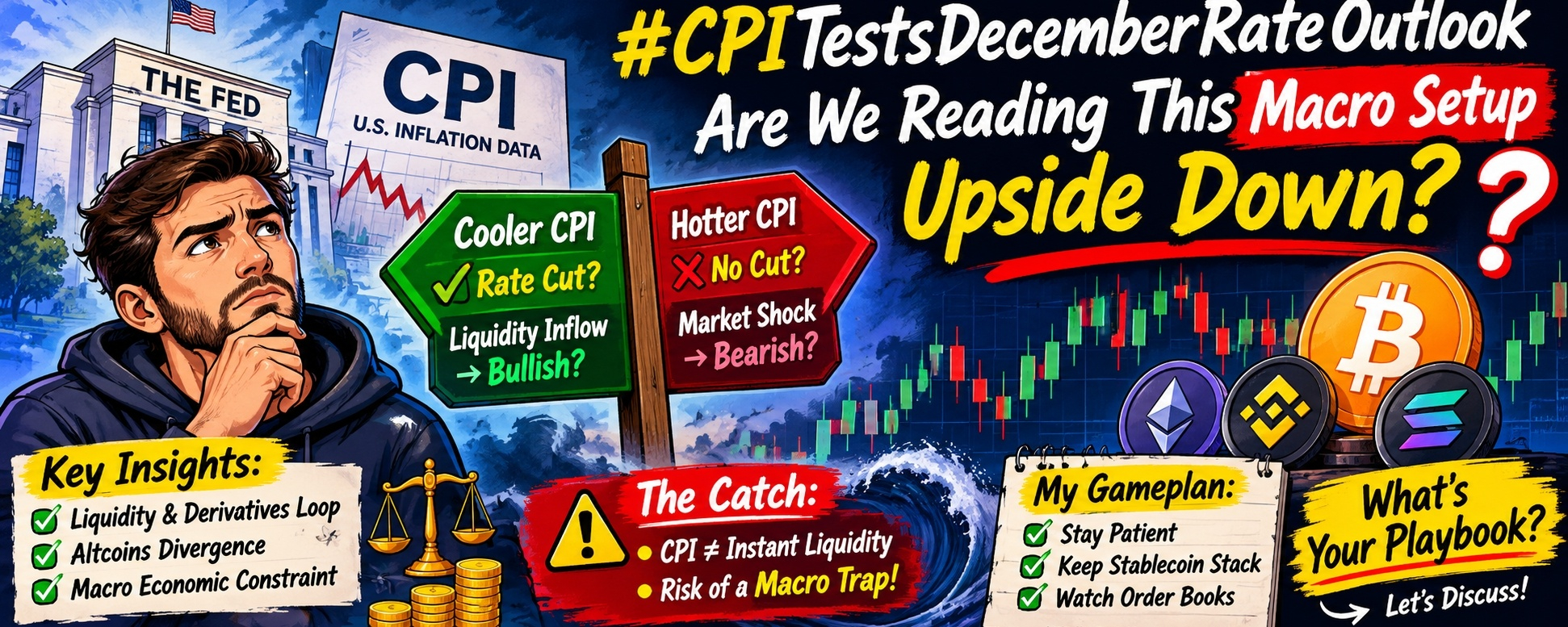
Right now, the Federal Reserve’s upcoming December rate decision is hanging over $BTC, ETH, andBNB like a dark cloud.
Every major institutional desk is essentially sitting on its hands, waiting for the incoming U.S. Consumer Price Index (CPI) numbers to clear up the horizon.
The surface-level story is simple enough:
A cooler inflation print gives the Fed cover to cut rates, opening the liquidity floodgates for risk-on assets.
A hotter-than-expected CPI print pushes back rate-cut expectations, forcing over-leveraged traders to unwind fast.
But when you zoom in on order book depth across major exchanges, you spot something much more subtle.
Market participants aren't just sitting back waiting—they’re actively reshuffling their positions long before the data even drops.
Observation 1: The Liquidity & Derivatives Value Loop 📉
Watching funding rates over the past few days has felt like watching a slow-motion wreck.
Here is the exact value transfer loop playing out in real-time:
* Retail traders rush to open high-leverage perpetual futures, trying to front-run the CPI release.
* Skewed funding rates create a low-risk arbitrage window for systematic market makers.
* Market makers trigger quick liquidation sweeps in both directions to capture delta-neutral spreads.
* Capital gets forced out of speculative open interest and settles directly into spot absorption reserves.
Options markets are showing heavily elevated demand for downside put protection ahead of the print.
Implied volatility is spiking, which means market makers are pricing in a massive swing regardless of which way the number falls.
If you’re throwing high-leverage market orders into this environment, you aren't trading a trend—you’re essentially flipping a coin against institutional algorithms designed to eat your margin.
Observation 2: Altcoins Are Diverging (And It’s Not Coincidence) ⚡
Usually, altcoins just follow $BTC off a cliff the moment macro gets spooky.
This time around, structural divergence is quietly appearing under the surface.
While major caps like ETH andBNB are holding strict support ranges, capital is aggressively rotating into specific sub-ecosystems built around real yield and actual protocol revenue.
Institutional money isn't exiting Web3 entirely. They’re fleeing to liquidity and balance-sheet quality.
When the macro outlook is uncertain, capital doesn't disappear—it consolidates into blue chips and core infrastructure that can survive a prolonged rate pause.
Observation 3: The Economic Constraint We Keep Ignoring ⚖️
Here is the uncomfortable economic truth that most hyper-bullish posts conveniently gloss over:
The Core Constraint: Speculative Web3 asset valuations cannot sustainably expand while risk-free real yield (U.S. Treasuries) sits near 4–5%, UNLESS on-chain capital efficiency and protocol revenue strictly outpace global borrowing costs.
If on-chain yields drop below real risk-free rates while inflation stays sticky, institutional liquidity must drain back into traditional fiat plumbing.
Long-term spot holders get this intuition intuitively.
They aren't panic selling into this macro noise, but they aren't blindly buying market orders at resistance either. They’re standing by to absorb sell-side pressure only when price hits deep historical discount zones.
But Here’s What Worries Me... ⚠️
I want to be completely candid here, because hype without risk management is how portfolios get wiped out in a single candle.
The Catch: The market might be vastly overestimating how quickly a "cool" CPI report actually translates into fresh market liquidity.
Even if CPI comes in soft and locks in a December rate cut, central banks don't instantly pump liquidity back into the global financial system overnight. There's a lag.
And if CPI comes in hot? The downside reaction will be brutal.
We could easily see a quick, violent cascade of liquidations testing structural support levels across $BTC and altcoins before any real recovery takes hold.
The bottleneck right now isn't Web3 adoption or technology—it’s raw macro liquidity, and crypto simply cannot fully decouple from global interest rate realities yet.
My Personal Gameplan 💡
I’ve stopped trying to guess the exact CPI decimal point. That’s a speedrun to tilt trading.
Instead, I’m keeping a heavy stablecoin stack parked on Binance, remaining patient, and watching how spot order books settle after the initial volatility flush clears out the noise.
Honestly... I’m completely torn right now. Half of my analysis tells me we're on the launchpad for a massive structural Q4 breakout, but the other half is screaming that we're walking straight into a macro liquidity trap.
So I'm comfortable sitting on my hands until the order books reveal who's actually in control.
What’s your playbook for the upcoming CPI release? Are you de-risking before the print, setting spot limit orders on the dips, or taking leverage trades into the volatility?
Let’s hash it out in the comments! 👇
#Write2Earn #CPITestsDecemberRateOutlook #CryptoMacro #Bit
coin
Disclaimer: Not financial advice. Always DYOR.
What’s your playbook for the upcoming CPI release? Are you de-risking before the print
The more I look at the market right now, the more I realize we might be reading this whole macro setup completely upside down. 🧠
Everyone on X is busy fighting over short-term leverage prints, but the real play is quietly forming right under our noses around #CPITestsDecemberRateOutlook.
I spent the last 48 hours glued to macroeconomic order books, rate-futures data, and on-chain liquidity shifts to see what’s actually happening behind the curtain.
Wait... let me backtrack for a second.
I caught myself falling into the exact same trap yesterday—assuming a cooler CPI print automatically guarantees a green vertical candle across the board. But looking at the raw mechanics today, I’m not so sure anymore.
Here is what I’m seeing on the ground—and why the next few days could turn Q4 on its head. 🧵👇
The Reality Check: What’s Actually Happening Right Now 📈
If you’ve traded through more than one cycle, you know macro liquidity is the ultimate invisible hand driving this market.
Right now, the Federal Reserve’s upcoming December rate decision is hanging over $BTC, ETH, andBNB like a dark cloud.
Every major institutional desk is essentially sitting on its hands, waiting for the incoming U.S. Consumer Price Index (CPI) numbers to clear up the horizon.
The surface-level story is simple enough:
A cooler inflation print gives the Fed cover to cut rates, opening the liquidity floodgates for risk-on assets.
A hotter-than-expected CPI print pushes back rate-cut expectations, forcing over-leveraged traders to unwind fast.
But when you zoom in on order book depth across major exchanges, you spot something much more subtle.
Market participants aren't just sitting back waiting—they’re actively reshuffling their positions long before the data even drops.
Observation 1: The Liquidity & Derivatives Value Loop 📉
Watching funding rates over the past few days has felt like watching a slow-motion wreck.
Here is the exact value transfer loop playing out in real-time:
* Retail traders rush to open high-leverage perpetual futures, trying to front-run the CPI release.
* Skewed funding rates create a low-risk arbitrage window for systematic market makers.
* Market makers trigger quick liquidation sweeps in both directions to capture delta-neutral spreads.
* Capital gets forced out of speculative open interest and settles directly into spot absorption reserves.
Options markets are showing heavily elevated demand for downside put protection ahead of the print.
Implied volatility is spiking, which means market makers are pricing in a massive swing regardless of which way the number falls.
If you’re throwing high-leverage market orders into this environment, you aren't trading a trend—you’re essentially flipping a coin against institutional algorithms designed to eat your margin.
Observation 2: Altcoins Are Diverging (And It’s Not Coincidence) ⚡
Usually, altcoins just follow $BTC off a cliff the moment macro gets spooky.
This time around, structural divergence is quietly appearing under the surface.
While major caps like ETH andBNB are holding strict support ranges, capital is aggressively rotating into specific sub-ecosystems built around real yield and actual protocol revenue.
Institutional money isn't exiting Web3 entirely. They’re fleeing to liquidity and balance-sheet quality.
When the macro outlook is uncertain, capital doesn't disappear—it consolidates into blue chips and core infrastructure that can survive a prolonged rate pause.
Observation 3: The Economic Constraint We Keep Ignoring ⚖️
Here is the uncomfortable economic truth that most hyper-bullish posts conveniently gloss over:
The Core Constraint: Speculative Web3 asset valuations cannot sustainably expand while risk-free real yield (U.S. Treasuries) sits near 4–5%, UNLESS on-chain capital efficiency and protocol revenue strictly outpace global borrowing costs.
If on-chain yields drop below real risk-free rates while inflation stays sticky, institutional liquidity must drain back into traditional fiat plumbing.
Long-term spot holders get this intuition intuitively.
They aren't panic selling into this macro noise, but they aren't blindly buying market orders at resistance either. They’re standing by to absorb sell-side pressure only when price hits deep historical discount zones.
But Here’s What Worries Me... ⚠️
I want to be completely candid here, because hype without risk management is how portfolios get wiped out in a single candle.
The Catch: The market might be vastly overestimating how quickly a "cool" CPI report actually translates into fresh market liquidity.
Even if CPI comes in soft and locks in a December rate cut, central banks don't instantly pump liquidity back into the global financial system overnight. There's a lag.
And if CPI comes in hot? The downside reaction will be brutal.
We could easily see a quick, violent cascade of liquidations testing structural support levels across $BTC and altcoins before any real recovery takes hold.
The bottleneck right now isn't Web3 adoption or technology—it’s raw macro liquidity, and crypto simply cannot fully decouple from global interest rate realities yet.
My Personal Gameplan 💡
I’ve stopped trying to guess the exact CPI decimal point. That’s a speedrun to tilt trading.
Instead, I’m keeping a heavy stablecoin stack parked on Binance, remaining patient, and watching how spot order books settle after the initial volatility flush clears out the noise.
Honestly... I’m completely torn right now. Half of my analysis tells me we're on the launchpad for a massive structural Q4 breakout, but the other half is screaming that we're walking straight into a macro liquidity trap.
So I'm comfortable sitting on my hands until the order books reveal who's actually in control.
What’s your playbook for the upcoming CPI release? Are you de-risking before the print, setting spot limit orders on the dips, or taking leverage trades into the volatility?
Let’s hash it out in the comments! 👇
#Write2Earn #CPITestsDecemberRateOutlook #CryptoMacro #Bit
coin
Disclaimer: Not financial advice. Always DYOR.
1
193

·
--
WHAT WILL HAPPEN TO $BTC TOMORROW? WILL WE DROP? 🌪️💣
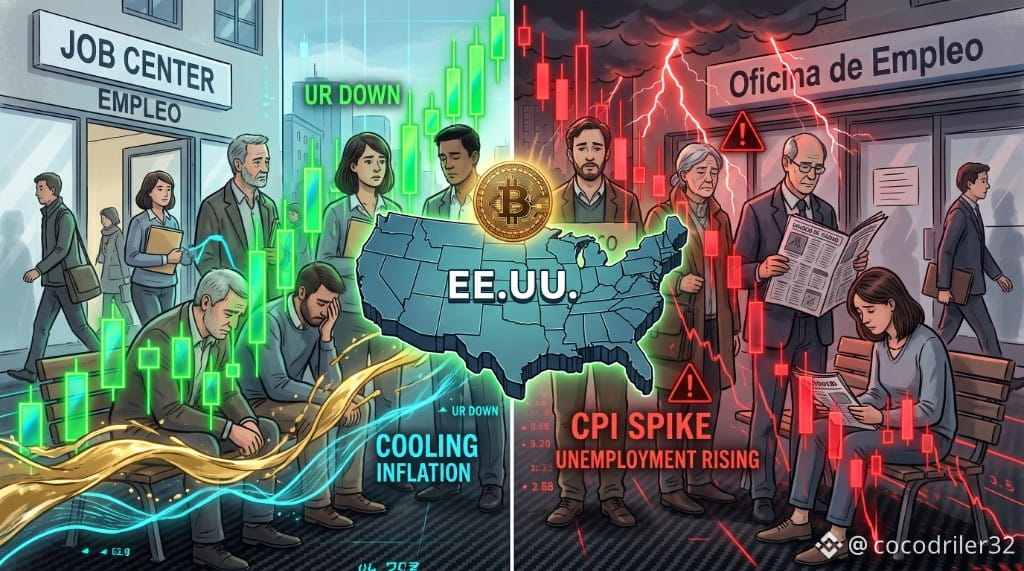
The United States is releasing key data on the labor market and inflation, and Wall Street is already preparing its positions. If you trade crypto, the chart above sums up exactly the 2 paths the market could take:
🟢 SCENARIO 1: RALLY AND GREEN CANDLES (Cooling Inflation)
If inflation continues to cool and labor data show stability without overheating:
- The Federal Reserve will have a green light to accelerate rate cuts.
- The dollar (DXY) weakens, and liquidity flows into risk assets.
- We’ll see a strong upward move that will lift not only Bitcoin, but also the market’s leading altcoins.
🔴 SCENARIO 2: VOLATILITY AND A DROP (CPI Spike & Stress)
If inflation unexpectedly picks up and labor data raise stagflation concerns:
- The Fed will maintain its hawkish stance, keeping rates high for longer.
- There will be a rush toward the dollar as a safe haven, along with futures selling.
- There’s a risk of violent stop-loss sweeps and cascading liquidations before a rebound.
⚠️ TRADING TIP:
Don’t overleverage before the release. Wait for institutional algorithms to absorb the initial volatility.
👉 Want to trade with an edge and never miss real-time market alerts? Follow us and turn on notifications to always stay one step ahead!
👇 What’s your forecast for tomorrow? Will we see a green candle toward new highs or a deep correction? Leave your thoughts in the comments!
#BinanceSquare #CryptoMacro #FederalReserve #TradingAlerts $ETH $BNB
2
169
Article
How are you adjusting your spot and futures setups while the market digests thisI spent the last few hours dissecting the macro prints, and honestly... the latest US jobs numbers just threw a massive wrench into my entire dynamic strategy.
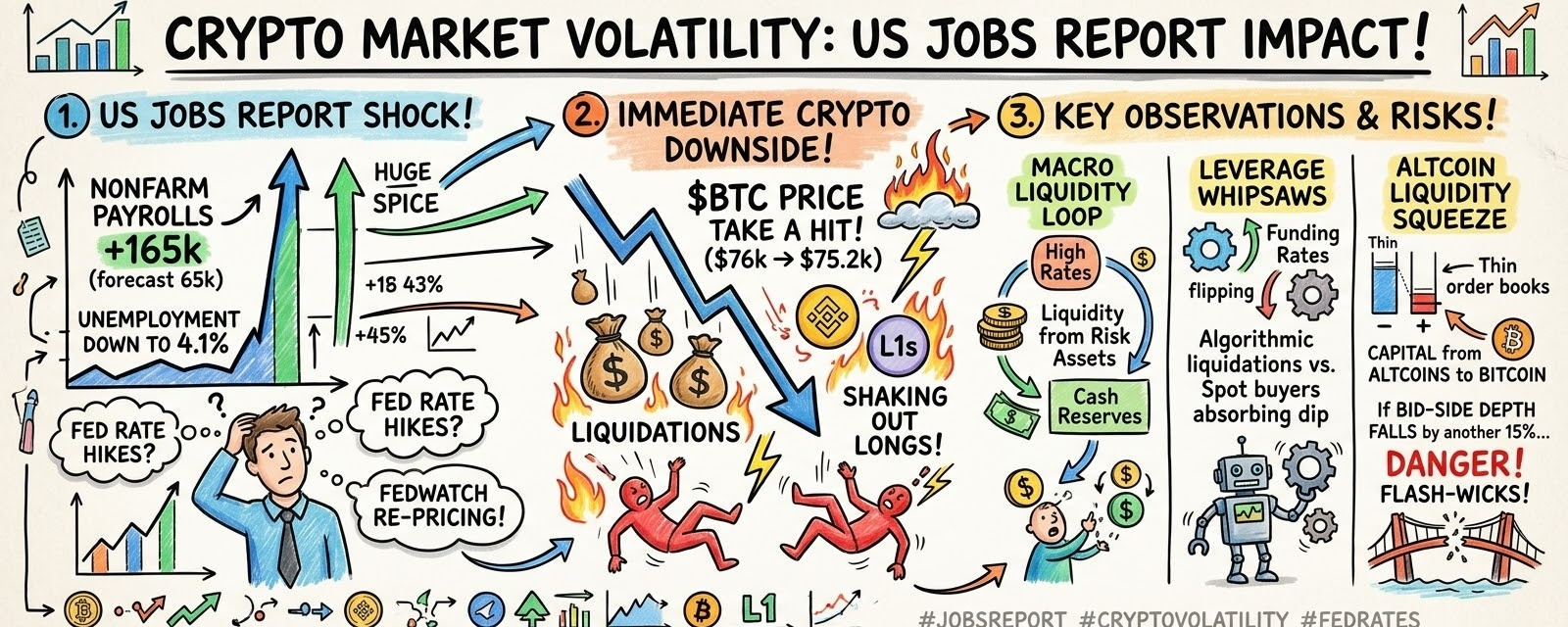
Nonfarm payrolls crushed consensus by adding 165,000 jobs against the forecasted 65,000, pulling unemployment down to 4.1%.
I wasn't expecting the CME FedWatch tool to re-price rate hike odds this aggressively overnight.
The immediate price reaction across crypto was an aggressive downside knee-jerk.
$BTC took a sharp hit from $76,000 down toward $75,200 within minutes, shaking out over-leveraged long positions across major exchanges.
Looking at on-chain liquidity depth and derivatives order books, here are three organic observations I’m tracking right now: 🧠
1. The Macro Liquidity Loop 📉
A resilient labor market strips the Federal Reserve of any pressure to ease policy.
High terminal rates keep Treasury yields elevated \rightarrow capital drains out of risk assets \rightarrow speculative liquidity flees altcoins straight into short-term cash reserves.
2. Leverage Whipsaws on Spot vs. Futures ⚡
During the initial drop, perpetual funding rates flipped negative temporarily before spot buyers stepped in to absorb the dip around key structural support.
We aren't seeing massive institutional panic-selling yet, but rather algorithmic derivative liquidations catching retail off guard.
3. Altcoin Liquidity Squeeze 🔄
Major ecosystem tokens like $BNB and top Layer-1s are holding key support ranges, but order book depth is noticeably thinning out.
When rate hike odds rise, speculative capital flees altcoins first to cluster around Bitcoin reserves.
But here’s the core constraint that has me worried... 🚨
Everyone is treating this like a temporary dip, but the math behind liquidity provision tells a darker story.
Here's the breaking point: If bid-side order book depth across top spot pairs deteriorates by another 15% while 10-year yields hold above 4.3%, automated market makers will be economically forced to pull bid liquidity deeper down the order book—turning routine liquidations into violent, cascading flash-wicks. ⚠️
We're trapped in this weird structural paradox right now.
On one hand, macro yields are actively trying to drain liquidity from risk assets. On the other hand, baseline institutional spot ETF inflows refuse to break down.
I honestly can't tell if we're front-running a multi-month macro drain... or if institutional bid support is about to completely override the Fed's playbook.
How are you adjusting your spot and futures setups while the market digests this? 🤔
Are you hedging delta exposure here, or betting that ETF inflows will swallow the FedWatch data? Let’s debate below! 👇
#JobsReportRaisesHikeOdds #CryptoMacro #BTC #Write2Earn
Disclaimer: Not financial advice. Always DYOR.
How are you adjusting your spot and futures setups while the market digests this
I spent the last few hours dissecting the macro prints, and honestly... the latest US jobs numbers just threw a massive wrench into my entire dynamic strategy.
Nonfarm payrolls crushed consensus by adding 165,000 jobs against the forecasted 65,000, pulling unemployment down to 4.1%.
I wasn't expecting the CME FedWatch tool to re-price rate hike odds this aggressively overnight.
The immediate price reaction across crypto was an aggressive downside knee-jerk.
$BTC took a sharp hit from $76,000 down toward $75,200 within minutes, shaking out over-leveraged long positions across major exchanges.
Looking at on-chain liquidity depth and derivatives order books, here are three organic observations I’m tracking right now: 🧠
1. The Macro Liquidity Loop 📉
A resilient labor market strips the Federal Reserve of any pressure to ease policy.
High terminal rates keep Treasury yields elevated \rightarrow capital drains out of risk assets \rightarrow speculative liquidity flees altcoins straight into short-term cash reserves.
2. Leverage Whipsaws on Spot vs. Futures ⚡
During the initial drop, perpetual funding rates flipped negative temporarily before spot buyers stepped in to absorb the dip around key structural support.
We aren't seeing massive institutional panic-selling yet, but rather algorithmic derivative liquidations catching retail off guard.
3. Altcoin Liquidity Squeeze 🔄
Major ecosystem tokens like $BNB and top Layer-1s are holding key support ranges, but order book depth is noticeably thinning out.
When rate hike odds rise, speculative capital flees altcoins first to cluster around Bitcoin reserves.
But here’s the core constraint that has me worried... 🚨
Everyone is treating this like a temporary dip, but the math behind liquidity provision tells a darker story.
Here's the breaking point: If bid-side order book depth across top spot pairs deteriorates by another 15% while 10-year yields hold above 4.3%, automated market makers will be economically forced to pull bid liquidity deeper down the order book—turning routine liquidations into violent, cascading flash-wicks. ⚠️
We're trapped in this weird structural paradox right now.
On one hand, macro yields are actively trying to drain liquidity from risk assets. On the other hand, baseline institutional spot ETF inflows refuse to break down.
I honestly can't tell if we're front-running a multi-month macro drain... or if institutional bid support is about to completely override the Fed's playbook.
How are you adjusting your spot and futures setups while the market digests this? 🤔
Are you hedging delta exposure here, or betting that ETF inflows will swallow the FedWatch data? Let’s debate below! 👇
#JobsReportRaisesHikeOdds #CryptoMacro #BTC #Write2Earn
Disclaimer: Not financial advice. Always DYOR.
1
183

🚨 Macro shock: The Fed isn’t done yet. 🚨
The U.S. jobs report just delivered a massive surprise. 165,000 jobs were added in October (nearly three times expectations!), bringing unemployment down to 4.1%.
The result? The odds of a Fed rate hike in December jumped to 80%. The dollar is strengthening, and macro liquidity is tightening. Here’s how the top 3 coins are reacting:
🟠 $BTC
(Bitcoin):
Higher interest rates put short-term pressure on riskier assets. BTC briefly fell to $75.7K as the dollar climbed. Expect volatility and price consolidation as the market absorbs the new reality of a December rate hike.
🔵 $ETH
(Ethereum):
Rate hikes make traditional “risk-free” yields more attractive, putting them in direct competition with DeFi staking yields. ETH will need strong on-chain trading volume and deflationary token burns to counter these macroeconomic headwinds.
🟡 $BNB
(Binance Coin):
Tightening liquidity weighs on the market overall, but BNB’s utility gives it a unique layer of protection. Strong demand across its ecosystem and Launchpool mechanisms keep incentives high, despite macroeconomic turbulence.
Tighter liquidity = bigger swings. Trade the price levels, not the sentiment.🟡
#jobsreportraiseshikeodds #CryptoMacro
1.6k

·
--
Bank of England raises rates to 4% for first time in over three years, signaling further hikes that could weigh on expectations for crypto liquidity
The Bank of England has raised its benchmark interest rate for the first time in over three years, lifting the policy rate from 3.75% to 4%. The governor also signaled that further hikes may be possible as the bank responds to persistent inflationary pressure. The move marks a clear departure from the Federal Reserve’s current rate-cutting path and could unsettle market expectations for the direction of global liquidity.
According to a report by The Guardian’s business section, this was the Bank of England’s first rate hike in three years, with the benchmark rate rising from 3.75% to 4%. More importantly, the governor suggested in remarks after the meeting that there may be room for further hikes if inflation does not fall as expected. This indicates that UK monetary policy is shifting from its previous easing stance toward a tighter one, with no clear endpoint yet in sight.
The significance of this shift for crypto markets lies mainly in its effect on expectations for macro liquidity. As high-risk assets that are highly sensitive to liquidity, crypto assets are closely tied to the monetary conditions set by the world’s major central banks. When a major economy such as the UK opts to raise rates against the prevailing trend and signals further hikes, it reinforces the narrative that major central banks may slow the pace of rate cuts overall, weighing on risk appetite. This is especially true when the move diverges from the Fed’s policy direction, as markets may interpret it as a sign of tightening global liquidity.
That said, it is important to keep this in perspective: this is the monetary policy of a single country, so its direct impact on crypto markets is relatively limited. The main drivers of crypto liquidity remain the Federal Reserve’s balance sheet and interest-rate path. The Bank of England’s move is more likely to have an indirect impact through market sentiment and narratives. In addition, interpretations of a “UK-US policy divergence” could be exaggerated—a rate hike by a single economy does not necessarily change the broader direction of global liquidity conditions.
In terms of market reaction, this kind of macro policy divergence narrative could amplify volatility in risk assets in the short term, particularly in highly leveraged sectors. But without a corresponding tightening by the Federal Reserve, the pressure is more likely to be sentiment-driven and temporary than a lasting change in trend.
The key things to watch next are whether UK inflation data supports the case for further hikes, and whether the Federal Reserve adjusts its pace in response. From a trading perspective, it is more important to wait for confirmation from the market than to overreact to the monetary policy of a single country.
#BankofEngland #InterestRates #CryptoMacro
The above is a summary of information and personal analysis, and does not constitute investment advice.
Follow me for ongoing coverage of key market developments and data.
34
·
--
$BTC ANALYSIS: Why will tomorrow’s jobs report shake the entire market? 🌪️💣
Tomorrow, two of the most important macroeconomic data points for the Federal Reserve will be released: the United States Nonfarm Payrolls (NFP) and Unemployment Rate.
If you trade crypto, here’s exactly what you need to know to avoid getting caught in the volatility:
1️⃣ Why does Bitcoin care so much?
The Fed needs to see the labor market cool down to justify further interest rate cuts. Lower rates = greater global liquidity = bullish fuel for risk assets.
2️⃣ Tomorrow’s 2 Scenarios:
🟢 BULLISH SCENARIO (Weak employment / rising unemployment):
If payrolls come in below expectations, the DXY (U.S. dollar) retreats and the market prices in aggressive rate cuts. This often triggers explosive green candles within minutes.
🔴 BEARISH SCENARIO (Hot employment / falling unemployment):
If the economy creates more jobs than expected, the Fed will maintain a restrictive stance for longer. The dollar strengthens and pressures the crypto market downward, with possible liquidity sweeps toward key support levels.
⚠️ TRADING TIP:
During the first 15 minutes after the release (08:30 AM EST), algorithms sweep stops in both directions. Avoid using excessive leverage before the news and wait for trend confirmation.
👇 What’s your forecast for tomorrow? Will we see a bullish pump or a correction before the weekend? Leave your thoughts in the comments!
#BinanceSquare #CryptoMacro #Bitcoin #TradingSignals $ETH $USDT

3
133

🎬 EPISODE 30: “Midterms, Short Squeeze, and Reclaiming the $80k Mark” 🏛️📈🐾✨
The US midterm elections removed the main source of uncertainty, while a wave of forced liquidations instantly sent Bitcoin back above $80,000. For YuKha, this post-election squeeze is just a signal: the market has cleared out excess leverage noise and is reassessing risks.
A look 👀 at the key developments:
Rebound ($80k–$81k) and ETFs: A predictable lesson for those who bet against the market at the peak of fear. As ETH surged toward $2.4k, institutions continued confidently buying the dip through spot ETFs ($75 million, led by Fidelity).
Regulatory crossroads: The Democrats’ victory sparked a relief rally, but the fate of the CLARITY Act remains uncertain, while BTC transfers from Trump Media are a reminder of the hidden risks of political tokens.
Infrastructure: Polygon’s hard fork for $6.8 million and JPMorgan’s integration of Bitcoin into its macro forecasts for 2027 (target return of ~10%) show that the rules of the game are becoming more mature.
It’s not the person who guesses the next candle who wins, but the one who understands the architecture of the process. The portfolio is set; we’re sticking to the plan. 🐾✨
#Bitcoin #CryptoMacro #Midterms #YuKha
© 2026 YuKhaCryptoDzen

5
175
·
--
How I'm Reading the NFP Numbers for $SUI and BTC This Week
Whenever a major macro release like US Non-Farm Payrolls (NFP), Unemployment Rate & Average Hourly Earnings (Release Window: Friday 12:30 UTC (6:00 PM IST) — US Bureau of Labor Statistics) comes onto the radar, social media turns into a guessing game. On my desk, I prefer to ignore the noise and focus strictly on the actual macro numbers driving institutional liquidity across SUI near 0.8663 and BTC.
Here is the exact macro setup going into the print:
• Previous official data: Previous NFP: 142K Jobs Added | Unemployment Rate: 4.2% | Avg Hourly Earnings: +0.4% MoM (3.8% YoY)
• Current Wall Street consensus: Consensus Forecast: 145K–150K Jobs | Unemployment Rate Forecast: 4.2% | Wage Growth Forecast: +0.3% MoM
• Implied orderbook volatility window: ±3.5% to ±6.0% high-velocity institutional orderbook expansion at 12:30 UTC release
The two variables I am tracking most closely right now are headline non-farm payrolls (nfp) jobs added vs 145k–150k consensus forecast and us unemployment rate (u-3) tick vs 4.2% threshold & prior month revisions. Labor market cooling vs resilience dictates Fed rate-cut velocity, DXY strength, and institutional ETF inflows.
Historically, the first 5 to 15 minutes after a NFP release are dominated by algorithmic liquidity sweeps on both sides of the book. Instead of front-running the headline number, I am watching how the Dollar Index (DXY), US 2Y/10Y yields, and spot ETF orderflow on SUI absorb the move once the initial wick settles.
What is your game plan for this NFP window — staying flat until the macro dust clears or tracking spot inflows live? Let me know in the comments 👇
#BinanceSquare #CryptoMacro
1
8

·
--
🚨 $BTC BRACES FOR MACRO LIQUIDITY SHIFTS AS CENTRAL BANKS AND MIDTERMS COLLIDE ⚡
Institutional participants are bracing for an aggressive liquidity shakeout as three major central banks prepare rate hikes alongside US midterm elections. 🌊 Energy volatility from Brent surging to six-month highs adds another layer of macro friction across risk assets like $BTC and $ETH .
With pivotal ISM data, tech earnings, and Friday payrolls compressing into a single weekly candle, institutional order flow will likely exploit extended fair value gaps rather than chasing initial breakout velocity. 🔍
💡 Are institutional desks setting up an engineered liquidity sweep below local support before the real expansion unfolds? 🤔
⚠️ Not financial advice. Always manage your risk. 🛡️
🏷️ #BTC #MarketStructure #CryptoMacro #OrderFlow
🎯 🦈

16

🔴 $BTC CONFRONTS MACRO PRESSURE AS EQUITY LIQUIDITY SWEEPS HIT THE OPEN 📉
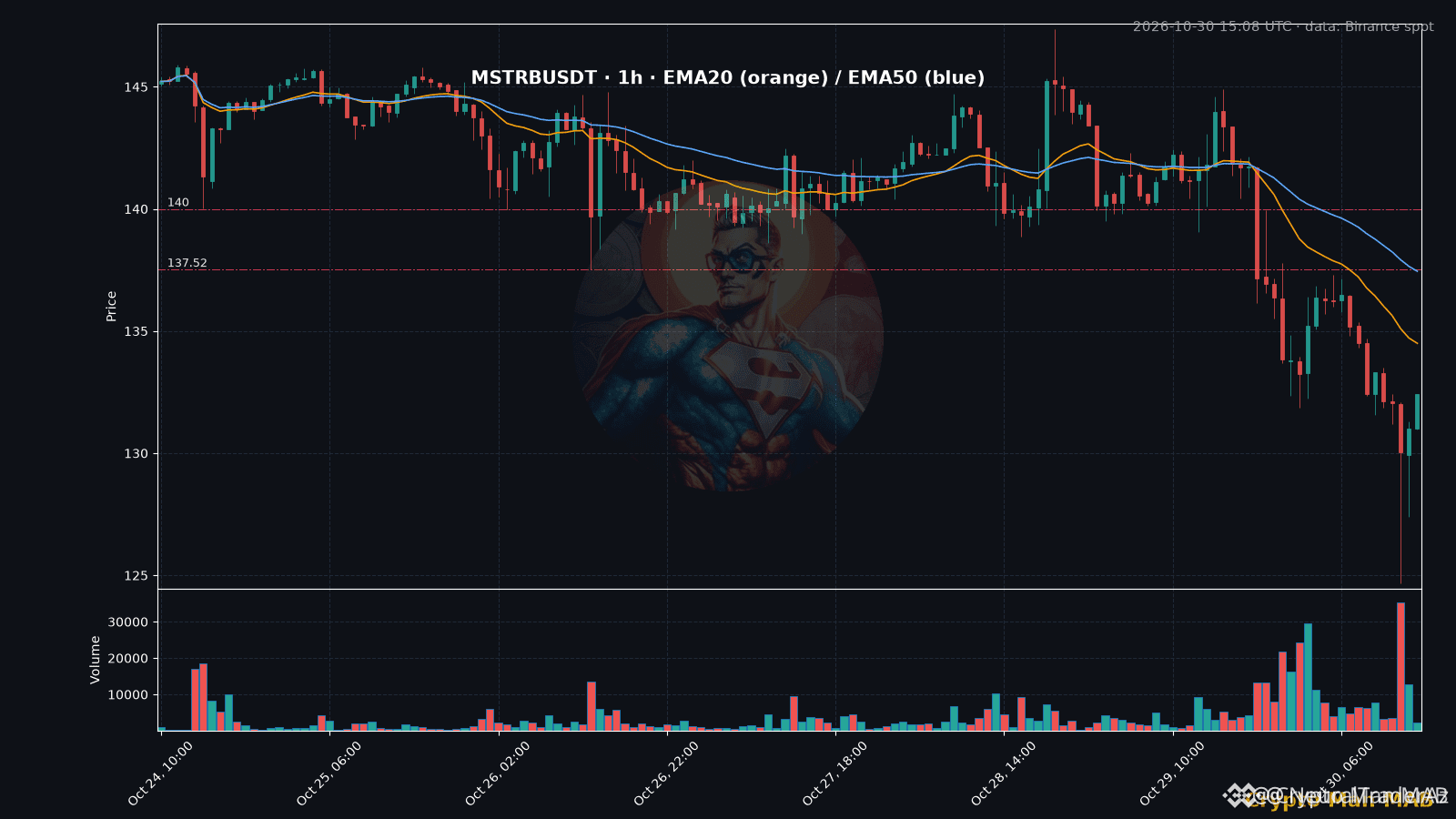
📊 A decisive risk-off rotation is sweeping through market proxies at the US open, dragging broader tech indices lower. Institutional equity exposure is absorbing heavy sell-side delivery, with $MSTRB tapping liquidity down at 124.6 before recovering to 132, while a major US crypto exchange shed 12% on a 35% annual revenue drop to $1.22B.
🔍 With $BTC capping upside structure below 78k, this order flow displacement reflects participants repricing compressed spot volume rather than an organic trend breakdown. Until absorption confirms at higher timeframe key levels, price remains vulnerable to deeper structural sweeps into the weekend.
💬 Are you viewing this equity-driven pullback as an institutional discount entry, or is further downside liquidation imminent? 👇
⚠️ Not financial advice. Always manage your risk. 🛡️
🏷️ #BTC #MarketStructure #OrderFlow #CryptoMacro
🎯 🦈
6
Article
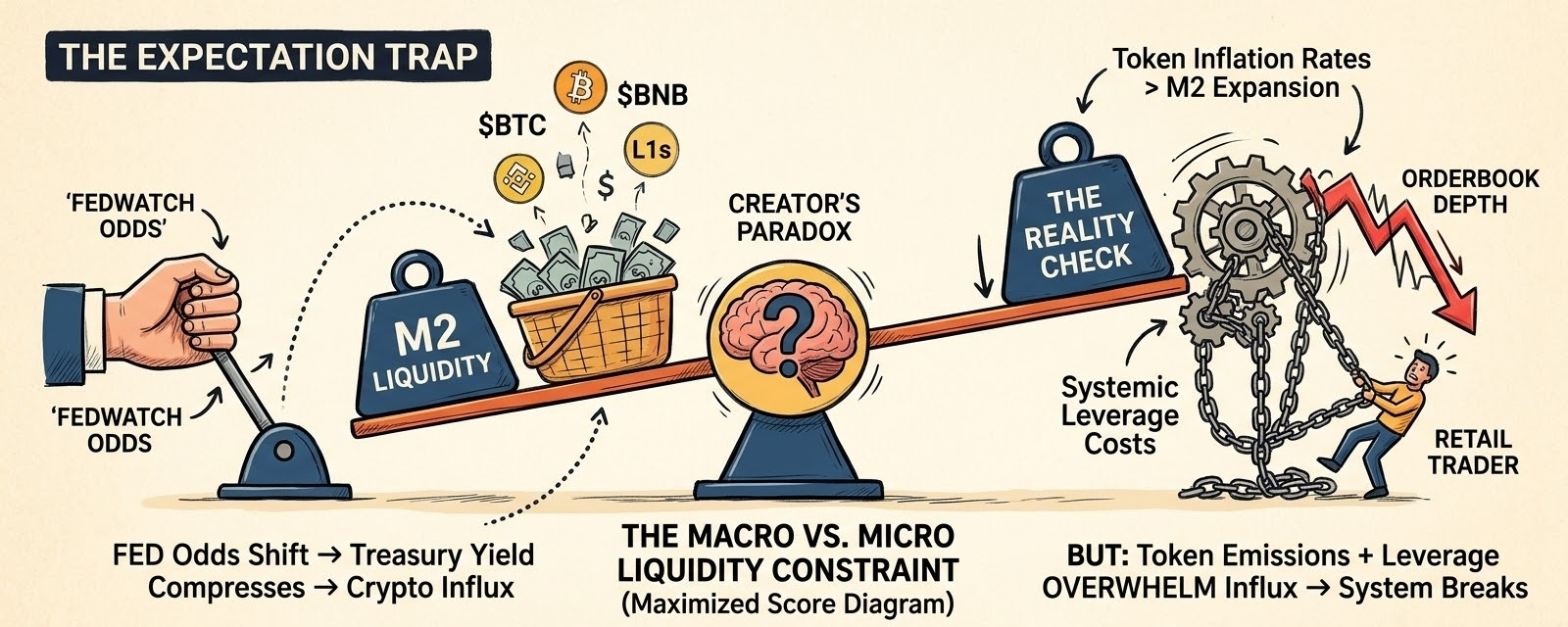
The entire system breaks down if Token Inflation Rate + Systemic Leverage Cost > Global Net M2 ExpanI’ve been staring at CME FedWatch for 3 straight hours... and honestly, I think we’re analyzing macro liquidity completely backwards. 🤔
Not sure if it’s just me, but every time rate odds shift by even 5%, everyone on Twitter rushes to call the top or bottom on $BTC. But watching live orderbook depth right now is making me second-guess the entire consensus.
Here is the actual mechanism loop playing out under the hood:
FedWatch probability swings don't push retail into spot buying—they trigger programmatic yield rotation. Right now, risk-free treasury yields (3.75%–4.00%) act as a massive liquidity vacuum.
Institutions don't allocate to crypto just because rate cut odds rise. Capital stays locked in treasuries until rate cut probability crosses a strict economic threshold where Risk-Free Treasury Yield < Expected Crypto Volatility Premium.
Only when that threshold breaks does the loop trigger: Treasury yield compression ➔ forced capital rotation ➔ orderbook depth expansion across major assets like $BNB and core L1s. 💡
But here’s the brutal economic constraint that keeps me up... 📉
The entire system breaks down if Token Inflation Rate + Systemic Leverage Cost > Global Net M2 Expansion.
Let that sink in for a second.
If macro liquidity expands via rate cuts, but local crypto token emission schedules and structural leverage overhead absorb that capital faster than it enters, the rate cut changes absolutely nothing. In fact, if risk-free rates drop while systemic crypto leverage is already maxed out, rate cuts don't trigger a bull run—they trigger a catastrophic orderbook depth gap and a forced wipeout. 🚨
Wait... actually, this leaves us with a mind-bending contradiction:
We’re all aggressively pricing in Fed rate cuts as the ultimate bullish catalyst, but the exact moment cuts happen, it confirms underlying macro economic weakness—which traditionally forces funds to deleverage risk assets first before deploying new capital.
So are we actually positioning for a real liquidity wave... or are we just front-running our own narrative cope while sitting directly in a liquidity trap?
I’m struggling to reconcile this for Q4. Something in this setup feels fundamentally broken. 🧠
#FedWatch #FOMC #Write2Earn #CryptoMacro
Disclaimer: Not financial advice. Always DYOR.#FedWatch
The entire system breaks down if Token Inflation Rate + Systemic Leverage Cost > Global Net M2 Expan
I’ve been staring at CME FedWatch for 3 straight hours... and honestly, I think we’re analyzing macro liquidity completely backwards. 🤔
Not sure if it’s just me, but every time rate odds shift by even 5%, everyone on Twitter rushes to call the top or bottom on $BTC. But watching live orderbook depth right now is making me second-guess the entire consensus.
Here is the actual mechanism loop playing out under the hood:
FedWatch probability swings don't push retail into spot buying—they trigger programmatic yield rotation. Right now, risk-free treasury yields (3.75%–4.00%) act as a massive liquidity vacuum.
Institutions don't allocate to crypto just because rate cut odds rise. Capital stays locked in treasuries until rate cut probability crosses a strict economic threshold where Risk-Free Treasury Yield < Expected Crypto Volatility Premium.
Only when that threshold breaks does the loop trigger: Treasury yield compression ➔ forced capital rotation ➔ orderbook depth expansion across major assets like $BNB and core L1s. 💡
But here’s the brutal economic constraint that keeps me up... 📉
The entire system breaks down if Token Inflation Rate + Systemic Leverage Cost > Global Net M2 Expansion.
Let that sink in for a second.
If macro liquidity expands via rate cuts, but local crypto token emission schedules and structural leverage overhead absorb that capital faster than it enters, the rate cut changes absolutely nothing. In fact, if risk-free rates drop while systemic crypto leverage is already maxed out, rate cuts don't trigger a bull run—they trigger a catastrophic orderbook depth gap and a forced wipeout. 🚨
Wait... actually, this leaves us with a mind-bending contradiction:
We’re all aggressively pricing in Fed rate cuts as the ultimate bullish catalyst, but the exact moment cuts happen, it confirms underlying macro economic weakness—which traditionally forces funds to deleverage risk assets first before deploying new capital.
So are we actually positioning for a real liquidity wave... or are we just front-running our own narrative cope while sitting directly in a liquidity trap?
I’m struggling to reconcile this for Q4. Something in this setup feels fundamentally broken. 🧠
#FedWatch #FOMC #Write2Earn #CryptoMacro
Disclaimer: Not financial advice. Always DYOR.#FedWatch
1
180
·
--
How I'm Reading the PCE Numbers for $PAXG and BTC This Week
Whenever a major macro release like US Core PCE Price Index (Federal Reserve Preferred Inflation Gauge) (Release Window: 12:30 UTC (6:00 PM IST) — Bureau of Economic Analysis) comes onto the radar, social media turns into a guessing game. On my desk, I prefer to ignore the noise and focus strictly on the actual macro numbers driving institutional liquidity across PAXG near 4023.4 and BTC.
Here is the exact macro setup going into the print:
• Previous official data: Previous Core PCE: 2.6% YoY (0.2% MoM)
• Current Wall Street consensus: Consensus Forecast: 2.6% YoY (0.2% MoM) | Personal Spending: +0.4% MoM
• Implied orderbook volatility window: ±2.5% to ±4.0% volatility expansion across BTC, ETH, and SOL
The two variables I am tracking most closely right now are core pce yoy & mom print vs market consensus and personal income & consumer spending growth velocity. Core PCE directly anchors Federal Reserve real interest rate policy and macro risk-asset appetite.
Historically, the first 5 to 15 minutes after a PCE release are dominated by algorithmic liquidity sweeps on both sides of the book. Instead of front-running the headline number, I am watching how the Dollar Index (DXY), US 2Y/10Y yields, and spot ETF orderflow on PAXG absorb the move once the initial wick settles.
What is your game plan for this PCE window — staying flat until the macro dust clears or tracking spot inflows live? Let me know in the comments 👇
#BinanceSquare #CryptoMacro

1
2

·
--
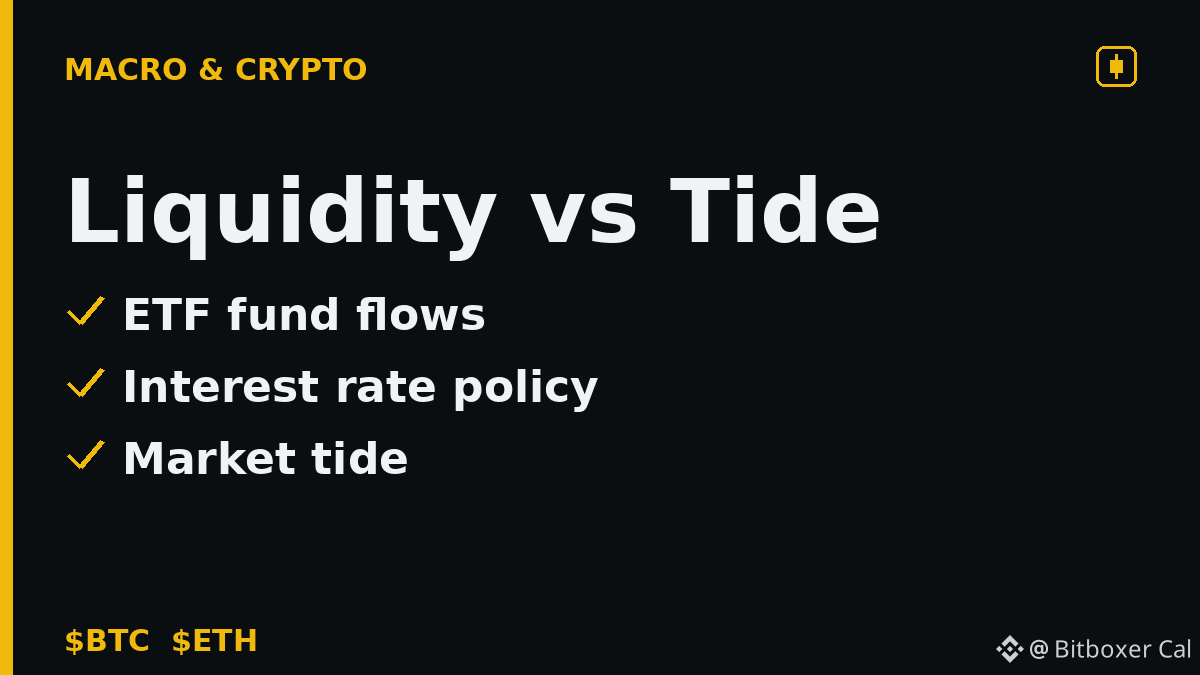
Everyone thinks $BTC spot ETF inflows are a magic button for instant price pumps.
In reality, these flows are just ripples while macro shifts are the actual tide. Don't get distracted by the daily noise; watch Federal Reserve policy meetings if you want to see where the market is really heading.
$BTC $ETH #CryptoMacro #BitcoinEducation #SafeHaven
In reality, these flows are just ripples while macro shifts are the actual tide. Don't get distracted by the daily noise; watch Federal Reserve policy meetings if you want to see where the market is really heading.
$BTC $ETH #CryptoMacro #BitcoinEducation #SafeHaven
109

#FedWatch
The market is pricing a hike, not a cut
Dec 9, 2026 FOMC
• Hike to 4.00%–4.25%: ~83.5%
• Hold at 3.75%–4.00%: ~16.5%
• Cut: 0%
Jan 27, 2027 FOMC
• Hold at 3.75%–4.00%: ~9.8%
• 4.00%–4.25% (one hike): ~56.3%
• 4.25%–4.50% (two hikes): ~33.8%
Why it matters for crypto:
• Rate-hike pricing raises the cost of leverage and usually strengthens the dollar, a headwind for $BTC and $ETH.
• January pricing shows the market sees more than a one-off hike. That affects positioning more than December alone.
• A 16.5% hold probability is not nothing. One soft CPI or PCE print can move these odds fast.
My read: FedWatch measures futures pricing, not Fed intent. Odds can shift 20+ points in a week, so don't size positions on one snapshot.
Are you positioned for a December hike, or fading it? 👇
#fomc #bitcoin #CryptoMacro
109

During Thursday’s Asian trading session, the US dollar against the Japanese yen (USD/JPY) rebounded in choppy trading to around 158.00, recovering some of the previous session’s losses. Safe-haven outflows pushed the pair higher, while market focus shifted entirely to Friday’s Bank of Japan monetary policy meeting.
Technically, easing risk aversion was mainly fueled by better-than-expected results from the AI technology sector. Strong third-quarter earnings from chip giant SK Hynix helped revive appetite for global risk assets. Although markets broadly expect the Bank of Japan to stand pat this time, Governor Kazuo Ueda could fundamentally reshape the yen’s medium-term floor if he signals a rate hike in December amid persistent inflationary pressure.
In terms of cross-asset moves, funds flowed out of the yen and safe-haven government bonds, lifting US Treasury yields and helping the dollar stabilize. However, the yen has shown significantly greater resilience among G10 currencies in the second half of the year. As risk appetite for carry trades improves, investors are actively rotating into undervalued, high-beta assets.
For the crypto market, the easing of risk aversion has directly reignited risk-on sentiment, with $BTC showing exceptionally strong buying support at a key support level. As long as the Bank of Japan does not deliver an unexpectedly aggressive tightening, the recovery in the global technology and liquidity environment could create technical room for a new upward breakout in crypto assets.📈
#USDJPY #BankOfJapan #CryptoMacro
242
The Australian Bureau of Statistics released the latest inflation data today. The unadjusted CPI rose 4.3% year over year in September, above market expectations of 4.1% and the previous reading of 4.0%. Meanwhile, the CPI rose 1.3% quarter over quarter in the third quarter, surging from 0.6% in the previous quarter and indicating a clear acceleration in price pressures.
From a technical and macro-cycle perspective, this higher-than-expected inflation reading broke the previous downward trend. Although the rebound in inflation may delay the Reserve Bank of Australia's easing, strong domestic demand data point to the resilience of Asia-Pacific economies' fundamentals, supporting the case for a medium- to long-term recovery in risk assets from their lows.
In financial markets, the Australian dollar found near-term buying support and stabilized at a key support level before rebounding. As the broader macro adjustment at the end of the rate-hiking cycle remains largely unchanged, markets have become significantly more resilient to liquidity conditions. The US dollar index's choppy performance under pressure is creating an opportunity for commodities and overall risk appetite to recover.
In crypto markets, the short-term sentiment swings triggered by the inflation data have been quickly absorbed, and the bullish structure remains intact. As markets gradually price in resilient macro fundamentals, improving external liquidity expectations should continue to benefit risk assets, led by $BTC , as they resume an upward trading pattern.🚀
#AustraliaCPI #InflationData #CryptoMacro
112

·
--
The Australian Bureau of Statistics has just released its September and third-quarter Consumer Price Index (CPI) reports, with all figures coming in above expectations. Specifically, annual CPI rose to 4.3% in September, versus a forecast of 4.1%, while third-quarter CPI surged 1.3% from the previous quarter.
The hotter-than-expected data show that price pressures remain elevated and are proving difficult to cool. This adds further pressure on the Reserve Bank of Australia (RBA) to maintain a tightening bias in monetary policy in the coming period.
Financial markets broadly responded by lifting the Australian dollar (AUD), supported by expectations that interest rates will remain high. Persistent inflation in major economies is also making global investors more cautious about riskier investments.
For crypto markets, tight global liquidity conditions continue to weigh on short-term breakout potential. $BTC and other digital assets may remain in a consolidation trend as large capital flows continue to prioritize risk management. 📊
#Inflation #InterestRates #CryptoMacro
178
Log in to explore more content
Join global crypto users on Binance Square
⚡️ Get latest and useful information about crypto.
💬 Trusted by the world’s largest crypto exchange.
👍 Discover real insights from verified creators.
Email / Phone number
Trending Topics
1
#WhatWillDriveCryptoandStocks’NextRebound?
29,236 views
477 Discussing
2
#Anthropic’s6xIPODemandSignalsPotentialRecordRaise
8,984 views
217 Discussing
3
#HuangExitNvidiaStrategyInFocus
173,262 views
1,536 Discussing
4
#AnthropicRejectsIPODelayValuationinQuestion
792,233 views
5,719 Discussing
5
#HedgeFundsCMEBitcoinNetShortsFall89%
13,892 views
224 Discussing
6
#BitMineReports$6.3BNetLossForFiscal2026
24,259 views
191 Discussing
7
#BitcoinETFOutflowsHit1.6B
38 views
8 Discussing
8
#TradFiForBeginners
567,258 views
3,961 Discussing
9
#SoFiExpandsSoFiUSDStablecoinToPolygon
8,470 views
122 Discussing
10
#TetherGoldXAUTCompletesKPMGAudit
12,150 views
138 Discussing