
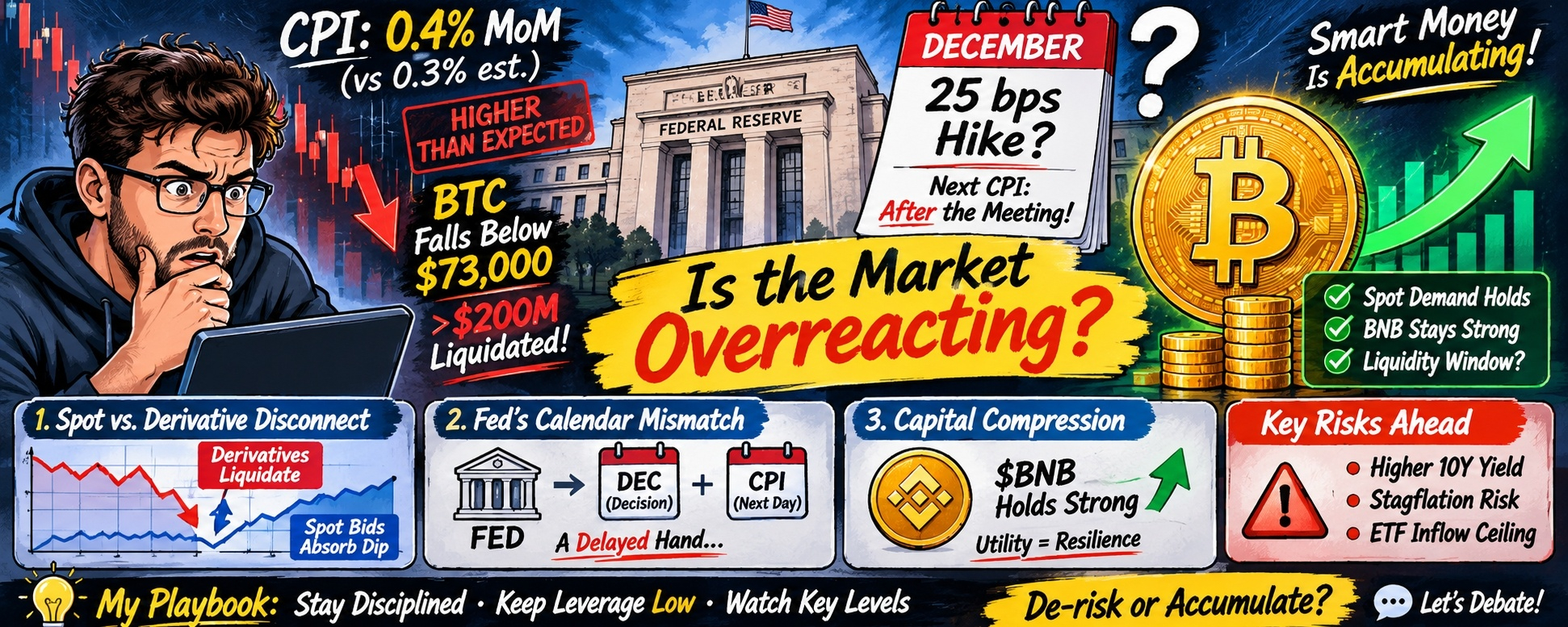

The more I look at the order book reactions to this week's US CPI print, the more I realize we might be misreading this macro setup entirely. 🧠
Honestly, I almost panic-hedged my own position yesterday when the initial numbers dropped.
Everyone spent the last 48 hours hyperventilating over the headline inflation data.
October CPI printing at 0.4% MoM against the 0.3% consensus immediately triggered the usual knee-jerk liquidity drain.
We watched $BTC drop below the $73,000 zone, sweeping aggressive long leverage and wiping out over $200 million across perpetual markets in minutes.
The consensus timeline narrative was instant: "Inflation is sticky, a December Fed rate hike is locked in, dump everything." 📉
Standard economic theory says higher rates drain liquidity, push capital into risk-free yields, and leave high-beta assets out in the cold.
Rates markets rapidly repriced futures, baking in a 25-basis-point hike for December while whispers of a 50-basis-point shock started spreading.
...But sitting here staring at depth charts and hot wallet transfers, something doesn't feel right about that panic.
If you step back and watch how smart money actually positioned around this volatility, a completely different capital engine is running.
The market isn't fleeing from the hike—it’s front-running the fact that the Federal Reserve is playing a delayed hand.
Observation 1: The Spot vs. Derivative Disconnect
When bad news hits a fragile market, you expect cascade liquidations to trigger a structural floor breakdown.
Yet, as soon as the CPI print dropped, limit bids below $72,500 on major spot exchanges absorbed the dump surprisingly fast.
Yes, open interest collapsed and funding rates neutralized instantly, but spot accumulation didn't stop.
The mechanism loop was clear: Derivative liquidations ➔ Volatility spike ➔ Limit order fills ➔ Spot balance transfer to cold storage. 🔄
Derivative traders were getting liquidated on leverage while institutional spot desks quietly used the noise to fill size without pushing slippage.
Why? Because a December rate hike isn't a surprise anymore—it’s an expected parameter.
When market probability for a macro event hits 85%+, the shock value vanishes.
Traders panicking over the headline missed that smart money was treating the volatility as an liquidity window, not a exit door.
Observation 2: The Fed’s Calendar Mismatch
Here is the mechanical paradox that really tripped me up when I started mapping the timeline.
The Federal Reserve meets in early December to announce its interest rate decision... but the next CPI inflation report doesn't release until the day after their meeting.
Think about how absurd that is for central planners.
The Fed is forced to make a multi-trillion-dollar policy call blind to the immediate next inflation datapoint.
They’re stuck acting on backward-looking October numbers and whatever narrative Fed officials push during media appearances.
This creates a massive latency gap between static policy decisions and 24/7 real-time asset pricing.
By the time Jerome Powell steps up to announce a 25-basis-point hike in December, crypto liquidity will already be pricing in the end of that hike cycle—or pricing in a slowing labor market.
Traditional finance moves on monthly reporting lags; crypto pricing digests the future in real time.
Observation 3: Capital Compression into Anchors
I was looking across Layer-1 assets to see where capital fled during the dump.
While speculative altcoins took a heavy hit from tighter liquidity expectations, core infrastructure held its ground.
Look at $BNB staying anchored firmly inside its macro range despite the systemic market dip.
Macro tightening always forces a brutal prioritization loop: capital compresses out of low-conviction speculative tokens back into fee-generating ecosystems.
Watching $BNB hold key structural levels shows how real ecosystem utility and protocol revenue act as an absorption buffer against macro shocks.
Macro spikes don't destroy network adoption overnight—they simply reset the leverage baseline, flushing out over-leveraged traders and handing supply to long-term accumulators.
But Here’s What Genuinely Worries Me... 🚨
I don't want to sound like I'm blindly bullish here—there is a major structural bottleneck building up.
The real danger over the next six weeks isn't a single 25-basis-point rate hike in December.
It’s the yield attraction constraint.
If the 10-year US Treasury yield keeps grinding higher, risk-free returns start looking incredibly attractive to traditional institutional treasuries.
That creates a hard ceiling on spot ETF net inflows between now and early Q1.
Even worse: if inflation stays sticky while broader economic growth slows down, we enter a stagflationary regime.
That is historically the single most difficult macro backdrop for speculative assets to break out of.
If retail traders assume "priced-in" means "up-only immediately," they are setting themselves up to get chopped to pieces in a sideways range.
How I’m Playing This Right Now 💡
Panic-selling spot holdings after a 5% macro-driven flush has almost always been a mistake for me in past cycles.
Right now, I’m keeping leverage near zero, watching spot order book depth around major support zones, and monitoring ecosystem anchors like BTC andBNB.
When market narrative shifts from "Fed Pivot" to "Fed Hike," it creates temporary price dislocations where spot risk-to-reward ratios actually improve.
The market’s job is to inflict maximum psychological pain on both sides before delivering direction.
Right now, the most crowded trade on Twitter is panicking over a rate hike that the order book has already digested.
I’m sitting split here: part of me wants to bid this dip aggressively, but the Treasury yield ceiling keeps me cautious.
Are you de-risking your spot holdings ahead of the December Fed meeting, or are you taking advantage of this macro noise to accumulate? 🤔
Let’s debate it in the comments—how are you sizing your risk right now? 👇
#HotCPIDecemberHikePriced #CryptoMacro #MarketAnalysis #Write2Earn
Disclaimer: Not financial advice. Always DYOR.