
#clarityact
clarityact
3.5M views
8,965 Discussing
Hot
Latest


Only hours stand between a multi-billion dollar market and its biggest regulatory shakeup in years. Senate Republicans, led by Senator Cynthia Lummis, just rejected a last-minute Democratic counteroffer on the highly anticipated Clarity Act. This is a massive moment for our industry.
Are we finally going to get clear rules of the road, or is political gridlock about to stall everything again?
Here is what you need to know:
🔹 This pushback happens just hours before the initial vote on the bill.
🔹 Republicans are standing firm on their original vision for US stablecoin regulation.
🔹 The outcome will heavily impact the future of stablecoins like $USDC and the broader US crypto ecosystem.
Let's see if they can work it out or if we are in for another round of Washington drama. Keep your eyes on $BTC too as the market reacts. #Write2Earn #CryptoRegulation #ClarityAct
Only hours stand between a multi-billion dollar market and its biggest regulatory shakeup in years. Senate Republicans, led by Senator Cynthia Lummis, just rejected a last-minute Democratic counteroffer on the highly anticipated Clarity Act. This is a massive moment for our industry.
Are we finally going to get clear rules of the road, or is political gridlock about to stall everything again?
Here is what you need to know:
🔹 This pushback happens just hours before the initial vote on the bill.
🔹 Republicans are standing firm on their original vision for US stablecoin regulation.
🔹 The outcome will heavily impact the future of stablecoins like $USDC and the broader US crypto ecosystem.
Let's see if they can work it out or if we are in for another round of Washington drama. Keep your eyes on $BTC too as the market reacts. #Write2Earn #CryptoRegulation #ClarityAct
Are we finally going to get clear rules of the road, or is political gridlock about to stall everything again?
Here is what you need to know:
🔹 This pushback happens just hours before the initial vote on the bill.
🔹 Republicans are standing firm on their original vision for US stablecoin regulation.
🔹 The outcome will heavily impact the future of stablecoins like $USDC and the broader US crypto ecosystem.
Let's see if they can work it out or if we are in for another round of Washington drama. Keep your eyes on $BTC too as the market reacts. #Write2Earn #CryptoRegulation #ClarityAct

Yfken:
gg
1
327

🚨 CLARITY ACT — STILL IN PLAY?
Crypto investor Kyle Chassé says the CLARITY Act isn’t dead, but its path forward remains difficult.
🏛️ Senate: 60 votes are required to advance the legislation
⏳ Key issue: Limited legislative time
📊 Current status: The Sept. 15 procedural vote fell short of the 60-vote threshold, so further negotiations would be needed for the bill to move forward.
The next steps could remain important for the U.S. crypto regulatory framework.
#Crypto #CLARITYAct
🚨 CLARITY ACT — STILL IN PLAY?
Crypto investor Kyle Chassé says the CLARITY Act isn’t dead, but its path forward remains difficult.
🏛️ Senate: 60 votes are required to advance the legislation
⏳ Key issue: Limited legislative time
📊 Current status: The Sept. 15 procedural vote fell short of the 60-vote threshold, so further negotiations would be needed for the bill to move forward.
The next steps could remain important for the U.S. crypto regulatory framework.
#Crypto #CLARITYAct
Crypto investor Kyle Chassé says the CLARITY Act isn’t dead, but its path forward remains difficult.
🏛️ Senate: 60 votes are required to advance the legislation
⏳ Key issue: Limited legislative time
📊 Current status: The Sept. 15 procedural vote fell short of the 60-vote threshold, so further negotiations would be needed for the bill to move forward.
The next steps could remain important for the U.S. crypto regulatory framework.
#Crypto #CLARITYAct

55

·
--
Article
The CLARITY Act: Congress Heads Toward a Key Vote, and What It Means for Crypto#
**Binance and the market are watching September 15 closely**
After months of delay, the US Senate is taking its first procedural step toward voting on the CLARITY Act, the landmark crypto market structure bill — and the crypto community is watching closely.
**What happened?**
The US Senate has taken its first formal step toward voting on the Clarity Act, with Senate Majority Leader John Thune filing a motion to proceed, opening the multi-stage cloture process the chamber uses to push contested legislation past its 60-vote threshold. That motion sets up an initial procedural vote on September 15.
**Why was the vote delayed in the first place?**
Thune had earlier confirmed the vote would come once the Senate returned from its August recess, a move that drew frustration from industry advocates and lawmakers who support the bill. Many executives and advocates expressed disappointment at the delay, especially since the vote is now set just roughly 50 days before the 2026 midterm elections, which could reduce the bill's odds of passing.
**Why does this bill matter?**
If passed into law, the Clarity Act would provide a formal legal structure for most cryptocurrency activity in the United States, drawing jurisdictional lines between the SEC and the CFTC, with most of the industry falling under the latter's oversight. It's widely believed the bill would give the crypto market a meaningful boost by giving traditional financial institutions more confidence to enter the space.
**What's next?**
The Senate is scheduled to vote on this motion on Tuesday, September 15 — the day after lawmakers return — though it will need support from at least seven non-Republican senators to advance. Several contentious issues remain unresolved, including ethics provisions and stablecoin-related rules, which are still under negotiation between the parties.
This moment is worth following closely, since it will shape the US legal framework for crypto for years to come — with direct implications for trading activity and prices on Binance and other platforms.
#CLARITYAct
#Binance
#crypto
#CryptoRegulationBattle
#CryptoNews
The CLARITY Act: Congress Heads Toward a Key Vote, and What It Means for Crypto
#
**Binance and the market are watching September 15 closely**
After months of delay, the US Senate is taking its first procedural step toward voting on the CLARITY Act, the landmark crypto market structure bill — and the crypto community is watching closely.
**What happened?**
The US Senate has taken its first formal step toward voting on the Clarity Act, with Senate Majority Leader John Thune filing a motion to proceed, opening the multi-stage cloture process the chamber uses to push contested legislation past its 60-vote threshold. That motion sets up an initial procedural vote on September 15.
**Why was the vote delayed in the first place?**
Thune had earlier confirmed the vote would come once the Senate returned from its August recess, a move that drew frustration from industry advocates and lawmakers who support the bill. Many executives and advocates expressed disappointment at the delay, especially since the vote is now set just roughly 50 days before the 2026 midterm elections, which could reduce the bill's odds of passing.
**Why does this bill matter?**
If passed into law, the Clarity Act would provide a formal legal structure for most cryptocurrency activity in the United States, drawing jurisdictional lines between the SEC and the CFTC, with most of the industry falling under the latter's oversight. It's widely believed the bill would give the crypto market a meaningful boost by giving traditional financial institutions more confidence to enter the space.
**What's next?**
The Senate is scheduled to vote on this motion on Tuesday, September 15 — the day after lawmakers return — though it will need support from at least seven non-Republican senators to advance. Several contentious issues remain unresolved, including ethics provisions and stablecoin-related rules, which are still under negotiation between the parties.
This moment is worth following closely, since it will shape the US legal framework for crypto for years to come — with direct implications for trading activity and prices on Binance and other platforms.
#CLARITYAct
#Binance
#crypto
#CryptoRegulationBattle
#CryptoNews
**Binance and the market are watching September 15 closely**
After months of delay, the US Senate is taking its first procedural step toward voting on the CLARITY Act, the landmark crypto market structure bill — and the crypto community is watching closely.
**What happened?**
The US Senate has taken its first formal step toward voting on the Clarity Act, with Senate Majority Leader John Thune filing a motion to proceed, opening the multi-stage cloture process the chamber uses to push contested legislation past its 60-vote threshold. That motion sets up an initial procedural vote on September 15.
**Why was the vote delayed in the first place?**
Thune had earlier confirmed the vote would come once the Senate returned from its August recess, a move that drew frustration from industry advocates and lawmakers who support the bill. Many executives and advocates expressed disappointment at the delay, especially since the vote is now set just roughly 50 days before the 2026 midterm elections, which could reduce the bill's odds of passing.
**Why does this bill matter?**
If passed into law, the Clarity Act would provide a formal legal structure for most cryptocurrency activity in the United States, drawing jurisdictional lines between the SEC and the CFTC, with most of the industry falling under the latter's oversight. It's widely believed the bill would give the crypto market a meaningful boost by giving traditional financial institutions more confidence to enter the space.
**What's next?**
The Senate is scheduled to vote on this motion on Tuesday, September 15 — the day after lawmakers return — though it will need support from at least seven non-Republican senators to advance. Several contentious issues remain unresolved, including ethics provisions and stablecoin-related rules, which are still under negotiation between the parties.
This moment is worth following closely, since it will shape the US legal framework for crypto for years to come — with direct implications for trading activity and prices on Binance and other platforms.
#CLARITYAct
#Binance
#crypto
#CryptoRegulationBattle
#CryptoNews
1
23

·
--
Bullish
🇺🇸 CLARITY ACT BLOCKED — BUT NOT BURIED
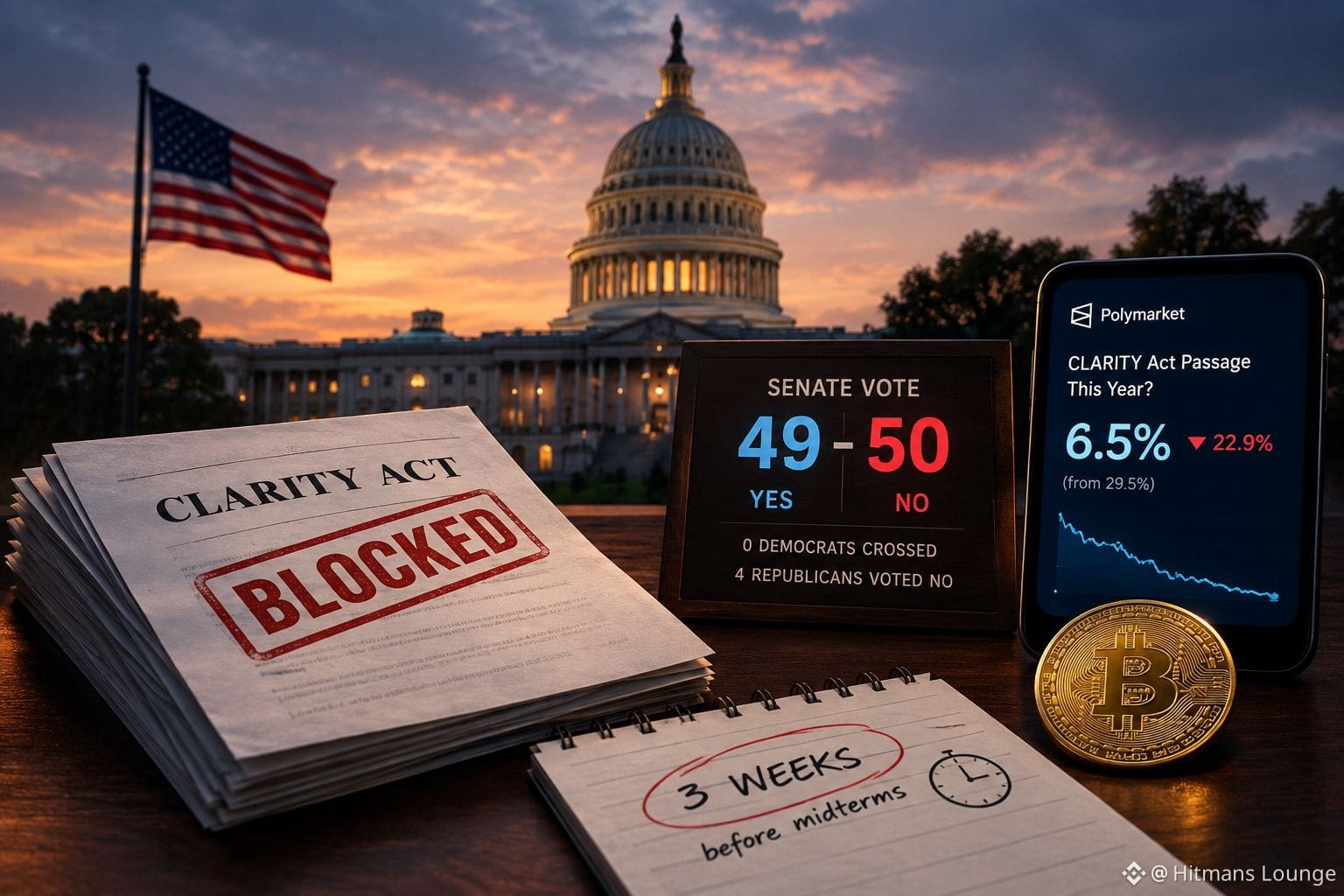
The Senate just voted 49-50 to block the CLARITY Act — not a single Democrat crossed the aisle, and four Republicans voted no too. Polymarket slashed odds of passage this year to just 6.5%, down from 29.5% the day before.
But the seven Democrats who spent a year negotiating the bill say talks aren't dead. Lawmakers have just three weeks of floor time before midterm campaign season kicks in. Tick tock. 🕐
#Crypto #Bitcoin #CLARITYAct #FED #SECReceivesAmendedInjectiveETFFiling
🇺🇸 CLARITY ACT BLOCKED — BUT NOT BURIED
The Senate just voted 49-50 to block the CLARITY Act — not a single Democrat crossed the aisle, and four Republicans voted no too. Polymarket slashed odds of passage this year to just 6.5%, down from 29.5% the day before.
But the seven Democrats who spent a year negotiating the bill say talks aren't dead. Lawmakers have just three weeks of floor time before midterm campaign season kicks in. Tick tock. 🕐
#Crypto #Bitcoin #CLARITYAct #FED #SECReceivesAmendedInjectiveETFFiling
The Senate just voted 49-50 to block the CLARITY Act — not a single Democrat crossed the aisle, and four Republicans voted no too. Polymarket slashed odds of passage this year to just 6.5%, down from 29.5% the day before.
But the seven Democrats who spent a year negotiating the bill say talks aren't dead. Lawmakers have just three weeks of floor time before midterm campaign season kicks in. Tick tock. 🕐
#Crypto #Bitcoin #CLARITYAct #FED #SECReceivesAmendedInjectiveETFFiling
Storybook:
Act
446
20
28
446

🚨 BREAKING NEWS: US CLARITY ACT FAILS 🛑
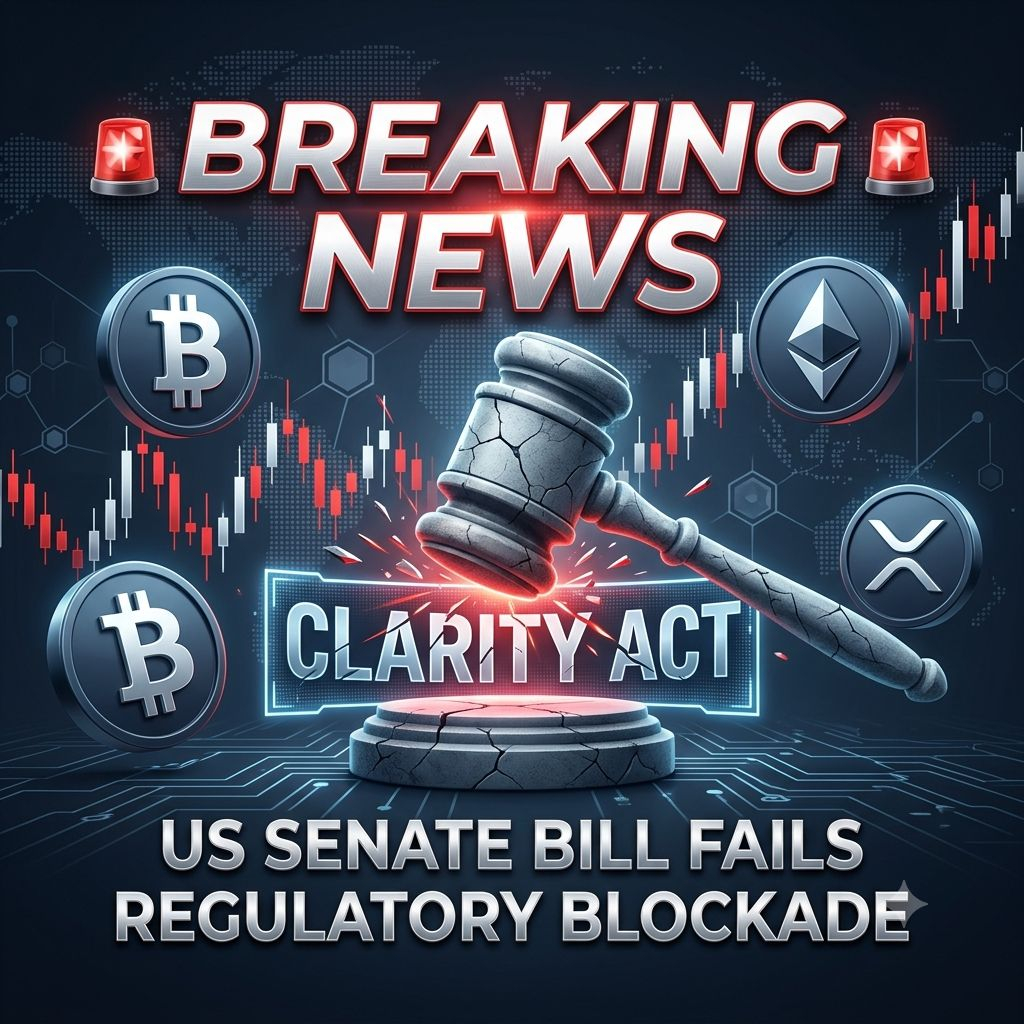
The highly anticipated #ClarityAct has failed to advance in the US Senate, striking a blow to hopes for comprehensive federal crypto legislation. This major regulatory roadblock directly affects market confidence for assets like $BTC, $ETH, and $XRP. Following the news, the CFTC immediately filed new proposals to regulate crypto under existing authority.
For traders, this means prolonged regulatory uncertainty in the US. Markets are reacting to the lack of clear, legislated rules, likely leading to increased volatility as agencies like the CFTC and SEC set the agenda.
With the Clarity Act dead, what do you think is next for crypto regulation in the US? 🤔
#CLARITYAct #CryptoNewss #RegulatoryUncertainty #USSenate #BTC #ETH #xrp
Not financial advice.
🚨 BREAKING NEWS: US CLARITY ACT FAILS 🛑
The highly anticipated #ClarityAct has failed to advance in the US Senate, striking a blow to hopes for comprehensive federal crypto legislation. This major regulatory roadblock directly affects market confidence for assets like $BTC, $ETH, and $XRP. Following the news, the CFTC immediately filed new proposals to regulate crypto under existing authority.
For traders, this means prolonged regulatory uncertainty in the US. Markets are reacting to the lack of clear, legislated rules, likely leading to increased volatility as agencies like the CFTC and SEC set the agenda.
With the Clarity Act dead, what do you think is next for crypto regulation in the US? 🤔
#CLARITYAct #CryptoNewss #RegulatoryUncertainty #USSenate #BTC #ETH #xrp
Not financial advice.
The highly anticipated #ClarityAct has failed to advance in the US Senate, striking a blow to hopes for comprehensive federal crypto legislation. This major regulatory roadblock directly affects market confidence for assets like $BTC, $ETH, and $XRP. Following the news, the CFTC immediately filed new proposals to regulate crypto under existing authority.
For traders, this means prolonged regulatory uncertainty in the US. Markets are reacting to the lack of clear, legislated rules, likely leading to increased volatility as agencies like the CFTC and SEC set the agenda.
With the Clarity Act dead, what do you think is next for crypto regulation in the US? 🤔
#CLARITYAct #CryptoNewss #RegulatoryUncertainty #USSenate #BTC #ETH #xrp
Not financial advice.
118

·
--
Bullish
🚨 Pay Attention:
🇺🇸 U.S. SENATE WILL OFFICIALLY VOTE ON THE CLARITY ACT TOMORROW AT 2:15 PM ET.
IF PASSED → BITCOIN GOES PARABOLIC
IF REJECTED → BITCOIN DUMPS HARD
CURRENT TALLY:
FOR → 57
AGAINST → 43
60 VOTES NEEDED TO PASS.
THE FUTURE OF CRYPTO WILL BE DECIDED TOMORROW...
#CLARITYAct #US #TRUMP #bitcoin #VoteForCrypto
$BTC
{future}(BTCUSDT)
$ONE
{future}(ONEUSDT)
$ZEC
{future}(ZECUSDT)
🚨 Pay Attention:
🇺🇸 U.S. SENATE WILL OFFICIALLY VOTE ON THE CLARITY ACT TOMORROW AT 2:15 PM ET.
IF PASSED → BITCOIN GOES PARABOLIC
IF REJECTED → BITCOIN DUMPS HARD
CURRENT TALLY:
FOR → 57
AGAINST → 43
60 VOTES NEEDED TO PASS.
THE FUTURE OF CRYPTO WILL BE DECIDED TOMORROW...
#CLARITYAct #US #TRUMP #bitcoin #VoteForCrypto
$BTC
$ONE
$ZEC
🇺🇸 U.S. SENATE WILL OFFICIALLY VOTE ON THE CLARITY ACT TOMORROW AT 2:15 PM ET.
IF PASSED → BITCOIN GOES PARABOLIC
IF REJECTED → BITCOIN DUMPS HARD
CURRENT TALLY:
FOR → 57
AGAINST → 43
60 VOTES NEEDED TO PASS.
THE FUTURE OF CRYPTO WILL BE DECIDED TOMORROW...
#CLARITYAct #US #TRUMP #bitcoin #VoteForCrypto
$BTC
$ONE
$ZEC
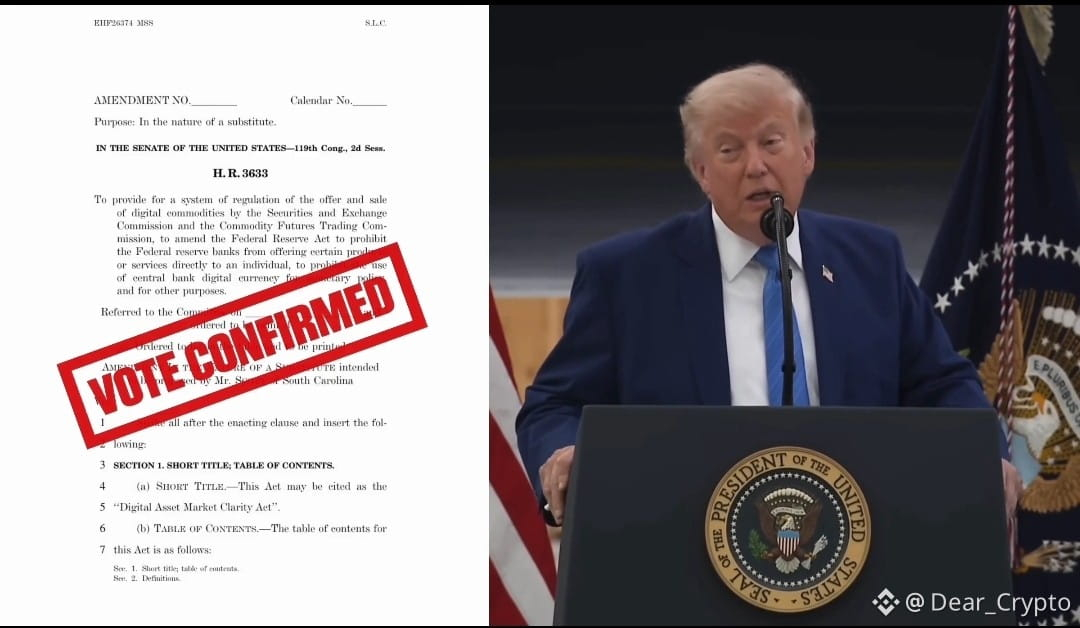
191

·
--
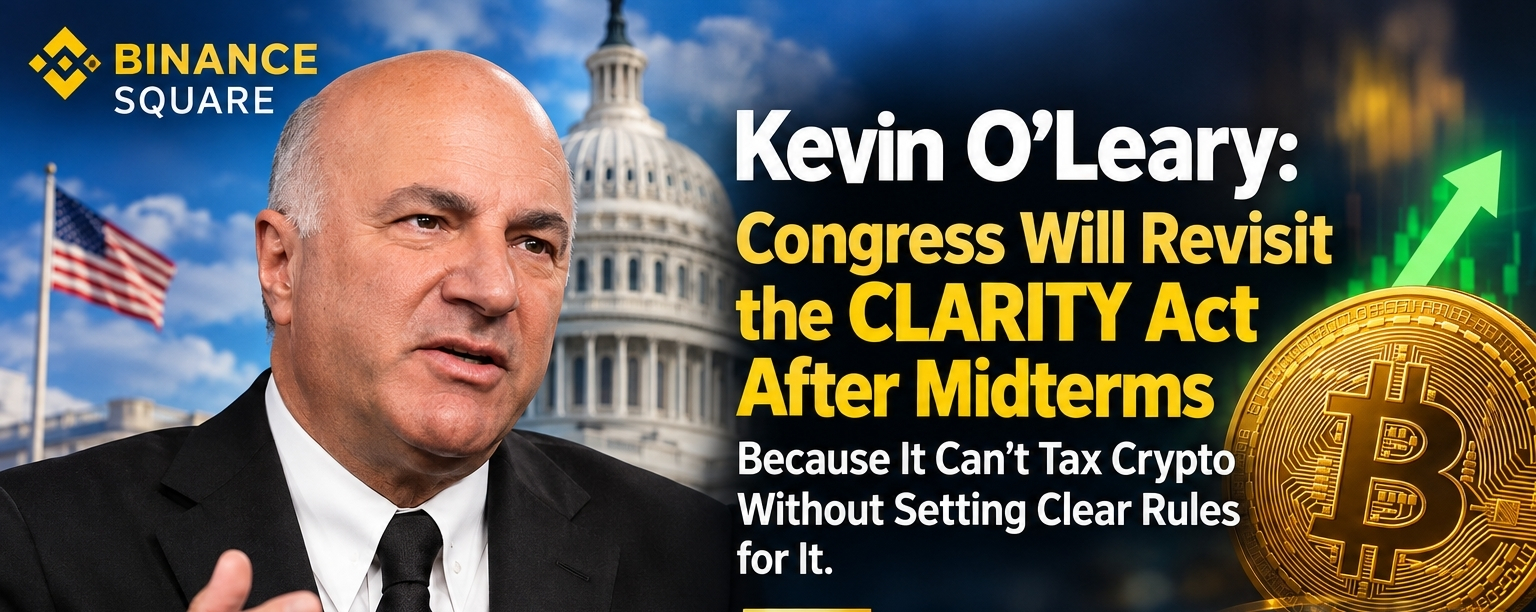
Article
🇺🇸 Kevin O’Leary: Congress May Revisit CLARITY Act After Midterms — Bitcoin Could Reach $1MKevin O’Leary says the debate over U.S. crypto regulation is far from over.
Following the Senate’s recent failure to advance the CLARITY Act, O’Leary expects Congress to revisit crypto market structure legislation after the midterm elections.
His argument centers on taxation: if lawmakers want to establish clear tax rules for digital assets, he believes they will also face pressure to create clearer regulatory rules for the crypto industry.
📜 Why the CLARITY Act matters
The CLARITY Act was designed to establish a broader regulatory framework for digital assets and clarify the roles of U.S. financial regulators.
The Senate recently failed to advance the legislation in a procedural vote, meaning the bill did not move forward toward formal debate.
O’Leary does not expect the legislation to pass before the midterms, but believes crypto taxation could keep regulatory discussions active.
₿ O’Leary’s $1 Million Bitcoin View
O’Leary has also discussed a much more ambitious long term possibility for Bitcoin.
He said Bitcoin could potentially reach $1 million, but attached an important condition: the crypto industry would need to address concerns surrounding quantum computing and its potential impact on cryptographic security.
The concern is often referred to as “Q Day” a future scenario in which sufficiently powerful quantum computers could threaten existing cryptographic systems.
👀 The Bigger Picture
O’Leary is also watching institutional adoption closely. He has said Bitcoin could eventually represent around 1%–3% of institutional alternative asset allocations, while major financial market adoption of blockchain technology could become an important catalyst for the industry.
For crypto investors, the key themes remain:
🔹 U.S. regulatory clarity
🔹 Crypto taxation
🔹 Institutional Bitcoin adoption
🔹 Blockchain infrastructure
🔹 Quantum computing security
What do you think? 👇
Could clearer U.S. crypto regulations become a major catalyst for Bitcoin and is $1 million BTC realistic if quantum security concerns are solved?
#bitcoin #CryptoNews #CLARITYAct #blockchain #BinanceSquare
$BTC
{future}(BTCUSDT)
$ETH
{future}(ETHUSDT)
🇺🇸 Kevin O’Leary: Congress May Revisit CLARITY Act After Midterms — Bitcoin Could Reach $1M
Kevin O’Leary says the debate over U.S. crypto regulation is far from over.
Following the Senate’s recent failure to advance the CLARITY Act, O’Leary expects Congress to revisit crypto market structure legislation after the midterm elections.
His argument centers on taxation: if lawmakers want to establish clear tax rules for digital assets, he believes they will also face pressure to create clearer regulatory rules for the crypto industry.
📜 Why the CLARITY Act matters
The CLARITY Act was designed to establish a broader regulatory framework for digital assets and clarify the roles of U.S. financial regulators.
The Senate recently failed to advance the legislation in a procedural vote, meaning the bill did not move forward toward formal debate.
O’Leary does not expect the legislation to pass before the midterms, but believes crypto taxation could keep regulatory discussions active.
₿ O’Leary’s $1 Million Bitcoin View
O’Leary has also discussed a much more ambitious long term possibility for Bitcoin.
He said Bitcoin could potentially reach $1 million, but attached an important condition: the crypto industry would need to address concerns surrounding quantum computing and its potential impact on cryptographic security.
The concern is often referred to as “Q Day” a future scenario in which sufficiently powerful quantum computers could threaten existing cryptographic systems.
👀 The Bigger Picture
O’Leary is also watching institutional adoption closely. He has said Bitcoin could eventually represent around 1%–3% of institutional alternative asset allocations, while major financial market adoption of blockchain technology could become an important catalyst for the industry.
For crypto investors, the key themes remain:
🔹 U.S. regulatory clarity
🔹 Crypto taxation
🔹 Institutional Bitcoin adoption
🔹 Blockchain infrastructure
🔹 Quantum computing security
What do you think? 👇
Could clearer U.S. crypto regulations become a major catalyst for Bitcoin and is $1 million BTC realistic if quantum security concerns are solved?
#bitcoin #CryptoNews #CLARITYAct #blockchain #BinanceSquare
$BTC
$ETH
Following the Senate’s recent failure to advance the CLARITY Act, O’Leary expects Congress to revisit crypto market structure legislation after the midterm elections.
His argument centers on taxation: if lawmakers want to establish clear tax rules for digital assets, he believes they will also face pressure to create clearer regulatory rules for the crypto industry.
📜 Why the CLARITY Act matters
The CLARITY Act was designed to establish a broader regulatory framework for digital assets and clarify the roles of U.S. financial regulators.
The Senate recently failed to advance the legislation in a procedural vote, meaning the bill did not move forward toward formal debate.
O’Leary does not expect the legislation to pass before the midterms, but believes crypto taxation could keep regulatory discussions active.
₿ O’Leary’s $1 Million Bitcoin View
O’Leary has also discussed a much more ambitious long term possibility for Bitcoin.
He said Bitcoin could potentially reach $1 million, but attached an important condition: the crypto industry would need to address concerns surrounding quantum computing and its potential impact on cryptographic security.
The concern is often referred to as “Q Day” a future scenario in which sufficiently powerful quantum computers could threaten existing cryptographic systems.
👀 The Bigger Picture
O’Leary is also watching institutional adoption closely. He has said Bitcoin could eventually represent around 1%–3% of institutional alternative asset allocations, while major financial market adoption of blockchain technology could become an important catalyst for the industry.
For crypto investors, the key themes remain:
🔹 U.S. regulatory clarity
🔹 Crypto taxation
🔹 Institutional Bitcoin adoption
🔹 Blockchain infrastructure
🔹 Quantum computing security
What do you think? 👇
Could clearer U.S. crypto regulations become a major catalyst for Bitcoin and is $1 million BTC realistic if quantum security concerns are solved?
#bitcoin #CryptoNews #CLARITYAct #blockchain #BinanceSquare
$BTC
$ETH
72

·
--
The Senate’s failure to advance the CLARITY Act could have consequences beyond regulatory uncertainty: it may influence how crypto businesses design their infrastructure.
The bill stalled after a 50–49 procedural vote, falling short of the 60 votes required to move forward. The legislation sought to establish clearer rules for digital assets and define the roles of the SEC and CFTC.
According to GenLayer Labs CEO Albert Castellana, the absence of clearer rules could encourage companies to rely on custodians, restricted frontends and administrator-controlled systems. His concern is that each additional compliance layer may introduce another intermediary between users and blockchain applications.
That creates an interesting contradiction for crypto.
The technology was largely built around reducing dependence on trusted middlemen. But if companies cannot clearly determine where regulatory responsibility begins and ends, they may choose centralized safeguards simply to reduce legal risk.
The result could be more permissioned access, greater reliance on custodians and additional control points around otherwise open networks.
The CLARITY Act’s failure therefore isn't only about whether crypto gets a regulatory framework. It could also influence how decentralized the next generation of crypto infrastructure actually becomes.
$C
{future}(CUSDT)
$A
{future}(AUSDT)
$S
{future}(SUSDT)
#CLARITYAct
The Senate’s failure to advance the CLARITY Act could have consequences beyond regulatory uncertainty: it may influence how crypto businesses design their infrastructure.
The bill stalled after a 50–49 procedural vote, falling short of the 60 votes required to move forward. The legislation sought to establish clearer rules for digital assets and define the roles of the SEC and CFTC.
According to GenLayer Labs CEO Albert Castellana, the absence of clearer rules could encourage companies to rely on custodians, restricted frontends and administrator-controlled systems. His concern is that each additional compliance layer may introduce another intermediary between users and blockchain applications.
That creates an interesting contradiction for crypto.
The technology was largely built around reducing dependence on trusted middlemen. But if companies cannot clearly determine where regulatory responsibility begins and ends, they may choose centralized safeguards simply to reduce legal risk.
The result could be more permissioned access, greater reliance on custodians and additional control points around otherwise open networks.
The CLARITY Act’s failure therefore isn't only about whether crypto gets a regulatory framework. It could also influence how decentralized the next generation of crypto infrastructure actually becomes.
$C
$A
$S
#CLARITYAct
The bill stalled after a 50–49 procedural vote, falling short of the 60 votes required to move forward. The legislation sought to establish clearer rules for digital assets and define the roles of the SEC and CFTC.
According to GenLayer Labs CEO Albert Castellana, the absence of clearer rules could encourage companies to rely on custodians, restricted frontends and administrator-controlled systems. His concern is that each additional compliance layer may introduce another intermediary between users and blockchain applications.
That creates an interesting contradiction for crypto.
The technology was largely built around reducing dependence on trusted middlemen. But if companies cannot clearly determine where regulatory responsibility begins and ends, they may choose centralized safeguards simply to reduce legal risk.
The result could be more permissioned access, greater reliance on custodians and additional control points around otherwise open networks.
The CLARITY Act’s failure therefore isn't only about whether crypto gets a regulatory framework. It could also influence how decentralized the next generation of crypto infrastructure actually becomes.
$C
$A
$S
#CLARITYAct

372

🚨🇺🇸 THE CLARITY ACT FAILED—BUT THE CFTC ISN’T WAITING! ⚖️🔥
One of America’s most important crypto bills failed to advance in the Senate this week, leaving the industry without the comprehensive market framework it had been waiting for. ❌📜
But the regulatory battle is far from over. 👀⚡
The CFTC—Commodity Futures Trading Commission—has reportedly submitted a new crypto-market proposal to the White House for review. 🏛️🔍
The CFTC is the U.S. federal regulator responsible for overseeing derivatives and commodity markets. It treats Bitcoin and certain other digital assets as commodities. ₿📊
What we know so far:
📅 Submitted on September 17
🔍 Currently under interagency review
🤐 Full details have not yet been disclosed
🎯 Expected to address crypto transactions and digital-asset markets
⚖️ Could use the CFTC’s existing legal authority
CFTC Chairman Michael Selig had already instructed his staff to explore how the agency could formalize the crypto-market structure—even without new legislation from Congress. 🚀📑
This could mark a major regulatory shift:
❌ Congress fails to deliver clarity
⚡ The CFTC moves independently
🏛️ Crypto rules advance through regulatory action
⚔️ Questions remain over the division of power between the CFTC and SEC
🔄 Future administrations could potentially change the rules
The big question is no longer whether U.S. crypto regulation is coming—but who will write the rules. 🔥🇺🇸
Will fast CFTC action finally bring regulatory clarity—or trigger another power struggle with the SEC? 🤔👇
#CFTC #CLARITYAct
⚠️ This is not investment advice.DYOR
$NEAR
{spot}(NEARUSDT)
$G
{spot}(GUSDT)
$ADA
{spot}(ADAUSDT)
🚨🇺🇸 THE CLARITY ACT FAILED—BUT THE CFTC ISN’T WAITING! ⚖️🔥
One of America’s most important crypto bills failed to advance in the Senate this week, leaving the industry without the comprehensive market framework it had been waiting for. ❌📜
But the regulatory battle is far from over. 👀⚡
The CFTC—Commodity Futures Trading Commission—has reportedly submitted a new crypto-market proposal to the White House for review. 🏛️🔍
The CFTC is the U.S. federal regulator responsible for overseeing derivatives and commodity markets. It treats Bitcoin and certain other digital assets as commodities. ₿📊
What we know so far:
📅 Submitted on September 17
🔍 Currently under interagency review
🤐 Full details have not yet been disclosed
🎯 Expected to address crypto transactions and digital-asset markets
⚖️ Could use the CFTC’s existing legal authority
CFTC Chairman Michael Selig had already instructed his staff to explore how the agency could formalize the crypto-market structure—even without new legislation from Congress. 🚀📑
This could mark a major regulatory shift:
❌ Congress fails to deliver clarity
⚡ The CFTC moves independently
🏛️ Crypto rules advance through regulatory action
⚔️ Questions remain over the division of power between the CFTC and SEC
🔄 Future administrations could potentially change the rules
The big question is no longer whether U.S. crypto regulation is coming—but who will write the rules. 🔥🇺🇸
Will fast CFTC action finally bring regulatory clarity—or trigger another power struggle with the SEC? 🤔👇
#CFTC #CLARITYAct
⚠️ This is not investment advice.DYOR
$NEAR
$G
$ADA
One of America’s most important crypto bills failed to advance in the Senate this week, leaving the industry without the comprehensive market framework it had been waiting for. ❌📜
But the regulatory battle is far from over. 👀⚡
The CFTC—Commodity Futures Trading Commission—has reportedly submitted a new crypto-market proposal to the White House for review. 🏛️🔍
The CFTC is the U.S. federal regulator responsible for overseeing derivatives and commodity markets. It treats Bitcoin and certain other digital assets as commodities. ₿📊
What we know so far:
📅 Submitted on September 17
🔍 Currently under interagency review
🤐 Full details have not yet been disclosed
🎯 Expected to address crypto transactions and digital-asset markets
⚖️ Could use the CFTC’s existing legal authority
CFTC Chairman Michael Selig had already instructed his staff to explore how the agency could formalize the crypto-market structure—even without new legislation from Congress. 🚀📑
This could mark a major regulatory shift:
❌ Congress fails to deliver clarity
⚡ The CFTC moves independently
🏛️ Crypto rules advance through regulatory action
⚔️ Questions remain over the division of power between the CFTC and SEC
🔄 Future administrations could potentially change the rules
The big question is no longer whether U.S. crypto regulation is coming—but who will write the rules. 🔥🇺🇸
Will fast CFTC action finally bring regulatory clarity—or trigger another power struggle with the SEC? 🤔👇
#CFTC #CLARITYAct
⚠️ This is not investment advice.DYOR
$NEAR
$G
$ADA

351

🚩Democrats wanted the SES and CFTC to be formally empowered with rulemaking authority to fight insider trading in digital assets. The Clarity Act delivers it. Democrats voted no anyway.
What do they actually want? 🤔
#Crypto #CLARITYAct #bitcoin.” #USA
{stock_us}(SECZ.US)
🚩Democrats wanted the SES and CFTC to be formally empowered with rulemaking authority to fight insider trading in digital assets. The Clarity Act delivers it. Democrats voted no anyway.
What do they actually want? 🤔
#Crypto #CLARITYAct #bitcoin.” #USA
What do they actually want? 🤔
#Crypto #CLARITYAct #bitcoin.” #USA
SECZUS+22.06%
189

·
--
$BTC 🚨JUST IN: The CFTC has just submitted its drafted crypto rules to the White House FOR REVIEW as the CLARITY Act stalls in the Senate.
The proposal covers crypto transactions and markets. It was submitted Thursday to OIRA, the office that reviews federal regulations before publication.
The details remain undisclosed. The rules are NOT yet final.
The CFTC is moving ahead using its existing powers.
#CLARITYAct $ETH
$BTC 🚨JUST IN: The CFTC has just submitted its drafted crypto rules to the White House FOR REVIEW as the CLARITY Act stalls in the Senate.
The proposal covers crypto transactions and markets. It was submitted Thursday to OIRA, the office that reviews federal regulations before publication.
The details remain undisclosed. The rules are NOT yet final.
The CFTC is moving ahead using its existing powers.
#CLARITYAct $ETH
The proposal covers crypto transactions and markets. It was submitted Thursday to OIRA, the office that reviews federal regulations before publication.
The details remain undisclosed. The rules are NOT yet final.
The CFTC is moving ahead using its existing powers.
#CLARITYAct $ETH

Binance BiBi:
我看到了!這則貼文的重點是:美國商品期貨交易委員會(CFTC)已把其擬定的加密貨幣監管規則草案提交白宮(由OIRA)審查,因為參議院的CLARITY法案進展停滯;草案涵蓋加密交易與市場監管,但細節尚未公開,且規則仍未定案;同時CFTC表示將先依現有法定權限推進相關監管工作。
2
1
86

🚨 CLARITY Act Stalls in Senate — What Happens Next?
The U.S. Senate failed to advance the CLARITY Act after a 49–50 procedural vote on September 15, falling short of the 60 votes required to move forward. The vote stalls the bill, but does not formally mean the legislation can never return.
🔎 The potential backup route: SEC + CFTC
With Congress currently unable to advance comprehensive market-structure legislation, attention is shifting toward the SEC and CFTC, which can use existing statutory authority to develop and clarify certain crypto-market rules. SEC Chair Paul Atkins has said the agency's crypto agenda will continue regardless of the legislative outcome.
This could influence areas such as:
• Digital-asset market structure
• Exchange and trading rules
• Tokenization
• Spot crypto markets
• Derivatives
⚠️ However, agency rules are not a complete substitute for legislation and can be changed or challenged more easily than a federal law.
👀 For crypto traders, regulatory developments remain an important catalyst.
$BNB $ASTER $SYN
Not financial advice. DYOR.
{spot}(ASTERUSDT)
{spot}(BNBUSDT)
{spot}(SYNUSDT)
#Crypto #CLARITYAct #BNB
🚨 CLARITY Act Stalls in Senate — What Happens Next?
The U.S. Senate failed to advance the CLARITY Act after a 49–50 procedural vote on September 15, falling short of the 60 votes required to move forward. The vote stalls the bill, but does not formally mean the legislation can never return.
🔎 The potential backup route: SEC + CFTC
With Congress currently unable to advance comprehensive market-structure legislation, attention is shifting toward the SEC and CFTC, which can use existing statutory authority to develop and clarify certain crypto-market rules. SEC Chair Paul Atkins has said the agency's crypto agenda will continue regardless of the legislative outcome.
This could influence areas such as:
• Digital-asset market structure
• Exchange and trading rules
• Tokenization
• Spot crypto markets
• Derivatives
⚠️ However, agency rules are not a complete substitute for legislation and can be changed or challenged more easily than a federal law.
👀 For crypto traders, regulatory developments remain an important catalyst.
$BNB $ASTER $SYN
Not financial advice. DYOR.
#Crypto #CLARITYAct #BNB
The U.S. Senate failed to advance the CLARITY Act after a 49–50 procedural vote on September 15, falling short of the 60 votes required to move forward. The vote stalls the bill, but does not formally mean the legislation can never return.
🔎 The potential backup route: SEC + CFTC
With Congress currently unable to advance comprehensive market-structure legislation, attention is shifting toward the SEC and CFTC, which can use existing statutory authority to develop and clarify certain crypto-market rules. SEC Chair Paul Atkins has said the agency's crypto agenda will continue regardless of the legislative outcome.
This could influence areas such as:
• Digital-asset market structure
• Exchange and trading rules
• Tokenization
• Spot crypto markets
• Derivatives
⚠️ However, agency rules are not a complete substitute for legislation and can be changed or challenged more easily than a federal law.
👀 For crypto traders, regulatory developments remain an important catalyst.
$BNB $ASTER $SYN
Not financial advice. DYOR.
#Crypto #CLARITYAct #BNB
3

CLARITY Act's Future in Doubt? Odds Drop to 16% 📉
The promising path for the CLARITY Act to bring clearer stablecoin regulation has just hit a significant snag, with its odds of passing plummeting to just 16%.
This sharp decline comes as key Democratic figures continue to resist the GOP's "final" offer, highlighting a deep partisan divide over the framework for digital asset oversight in the U.S. The CLARITY Act, aimed at establishing a comprehensive regulatory regime for stablecoins, is now facing an uphill battle to garner bipartisan support before the legislative session concludes.
Here's a quick look:
* CLARITY Act's passage odds now stand at a mere 16%.
* Key Democrats are resisting the GOP's "final" stablecoin legislation offer.
* Regulatory deadlock raises questions about the near-term future of U.S. stablecoin policy.
* Bipartisan consensus remains elusive, impacting potential crypto legislation.
This ongoing regulatory uncertainty can have significant implications for the crypto market. What are your thoughts on this legislative impasse and how it might affect stablecoin adoption and innovation? Share your perspective in the comments! 👇
#CryptoRegulation #CLARITYAct #Stablecoins #PolicyWatch
Disclaimer: This content is for informational purposes only and should not be considered financial advice. Always do your own research and consult with a qualified professional before making any financial decisions.
CLARITY Act's Future in Doubt? Odds Drop to 16% 📉
The promising path for the CLARITY Act to bring clearer stablecoin regulation has just hit a significant snag, with its odds of passing plummeting to just 16%.
This sharp decline comes as key Democratic figures continue to resist the GOP's "final" offer, highlighting a deep partisan divide over the framework for digital asset oversight in the U.S. The CLARITY Act, aimed at establishing a comprehensive regulatory regime for stablecoins, is now facing an uphill battle to garner bipartisan support before the legislative session concludes.
Here's a quick look:
* CLARITY Act's passage odds now stand at a mere 16%.
* Key Democrats are resisting the GOP's "final" stablecoin legislation offer.
* Regulatory deadlock raises questions about the near-term future of U.S. stablecoin policy.
* Bipartisan consensus remains elusive, impacting potential crypto legislation.
This ongoing regulatory uncertainty can have significant implications for the crypto market. What are your thoughts on this legislative impasse and how it might affect stablecoin adoption and innovation? Share your perspective in the comments! 👇
#CryptoRegulation #CLARITYAct #Stablecoins #PolicyWatch
Disclaimer: This content is for informational purposes only and should not be considered financial advice. Always do your own research and consult with a qualified professional before making any financial decisions.
The promising path for the CLARITY Act to bring clearer stablecoin regulation has just hit a significant snag, with its odds of passing plummeting to just 16%.
This sharp decline comes as key Democratic figures continue to resist the GOP's "final" offer, highlighting a deep partisan divide over the framework for digital asset oversight in the U.S. The CLARITY Act, aimed at establishing a comprehensive regulatory regime for stablecoins, is now facing an uphill battle to garner bipartisan support before the legislative session concludes.
Here's a quick look:
* CLARITY Act's passage odds now stand at a mere 16%.
* Key Democrats are resisting the GOP's "final" stablecoin legislation offer.
* Regulatory deadlock raises questions about the near-term future of U.S. stablecoin policy.
* Bipartisan consensus remains elusive, impacting potential crypto legislation.
This ongoing regulatory uncertainty can have significant implications for the crypto market. What are your thoughts on this legislative impasse and how it might affect stablecoin adoption and innovation? Share your perspective in the comments! 👇
#CryptoRegulation #CLARITYAct #Stablecoins #PolicyWatch
Disclaimer: This content is for informational purposes only and should not be considered financial advice. Always do your own research and consult with a qualified professional before making any financial decisions.
65

·
--
Bullish
⚠️ CLARITY ACT NEWS — BIG MOMENT FOR CRYPTO! 🇺🇸
The U.S. Senate failed to advance the CLARITY Act in a procedural vote, leaving crypto regulation in a more uncertain position for now.
But here's what caught my attention 👀👇
Despite this regulatory setback, Bitcoin recovered back toward the $77K area. 📈
Could the crypto market become more resilient to regulatory news?
Watch $BTC , $ETH , $XRP and other major assets closely. 🔥
#Crypto #Bitcoin #BTC #CLARITYAct
⚠️ CLARITY ACT NEWS — BIG MOMENT FOR CRYPTO! 🇺🇸
The U.S. Senate failed to advance the CLARITY Act in a procedural vote, leaving crypto regulation in a more uncertain position for now.
But here's what caught my attention 👀👇
Despite this regulatory setback, Bitcoin recovered back toward the $77K area. 📈
Could the crypto market become more resilient to regulatory news?
Watch $BTC , $ETH , $XRP and other major assets closely. 🔥
#Crypto #Bitcoin #BTC #CLARITYAct
The U.S. Senate failed to advance the CLARITY Act in a procedural vote, leaving crypto regulation in a more uncertain position for now.
But here's what caught my attention 👀👇
Despite this regulatory setback, Bitcoin recovered back toward the $77K area. 📈
Could the crypto market become more resilient to regulatory news?
Watch $BTC , $ETH , $XRP and other major assets closely. 🔥
#Crypto #Bitcoin #BTC #CLARITYAct
1
92


Article
🚨 WHAT IF THE CLARITY ACT PASSES? 🇺🇸The #CLARITYAct is currently stalled in the U.S. Senate after the September 15 procedural vote failed 49–50. But the bill is not completely dead.
If it eventually becomes law, clearer crypto market rules could affect different sectors differently.
Potentially positive attention
• $XRP — regulatory clarity narrative
• $SOL — major U.S. crypto ecosystem
• $ETH — large regulated-market exposure
• #BTC — broader institutional/regulatory confidence
Could also benefit
• Other established tokens and crypto platforms that fit clearer regulatory categories.
Higher uncertainty
• Some DeFi and tokens whose regulatory status remains unclear could face more scrutiny depending on the final rules.
Important:
This does NOT mean these coins will definitely pump or dump. Market reaction would depend on the final law, implementation and broader market conditions.
The big question is:
IF CLARITY PASSES → WHICH COIN MOVES FIRST?
#CLARITYAct #crypto #xrp #bitcoin
{future}(XRPUSDT)
{future}(SOLUSDT)
{future}(BTCUSDT)
🚨 WHAT IF THE CLARITY ACT PASSES? 🇺🇸
The #CLARITYAct is currently stalled in the U.S. Senate after the September 15 procedural vote failed 49–50. But the bill is not completely dead.
If it eventually becomes law, clearer crypto market rules could affect different sectors differently.
Potentially positive attention
• $XRP — regulatory clarity narrative
• $SOL — major U.S. crypto ecosystem
• $ETH — large regulated-market exposure
• #BTC — broader institutional/regulatory confidence
Could also benefit
• Other established tokens and crypto platforms that fit clearer regulatory categories.
Higher uncertainty
• Some DeFi and tokens whose regulatory status remains unclear could face more scrutiny depending on the final rules.
Important:
This does NOT mean these coins will definitely pump or dump. Market reaction would depend on the final law, implementation and broader market conditions.
The big question is:
IF CLARITY PASSES → WHICH COIN MOVES FIRST?
#CLARITYAct #crypto #xrp #bitcoin
If it eventually becomes law, clearer crypto market rules could affect different sectors differently.
Potentially positive attention
• $XRP — regulatory clarity narrative
• $SOL — major U.S. crypto ecosystem
• $ETH — large regulated-market exposure
• #BTC — broader institutional/regulatory confidence
Could also benefit
• Other established tokens and crypto platforms that fit clearer regulatory categories.
Higher uncertainty
• Some DeFi and tokens whose regulatory status remains unclear could face more scrutiny depending on the final rules.
Important:
This does NOT mean these coins will definitely pump or dump. Market reaction would depend on the final law, implementation and broader market conditions.
The big question is:
IF CLARITY PASSES → WHICH COIN MOVES FIRST?
#CLARITYAct #crypto #xrp #bitcoin
136

·
--
🇺🇸 CLARITY ACT IS NOT DEAD YET..... 👀
The Senate vote was a setback, but the story may not be over.....
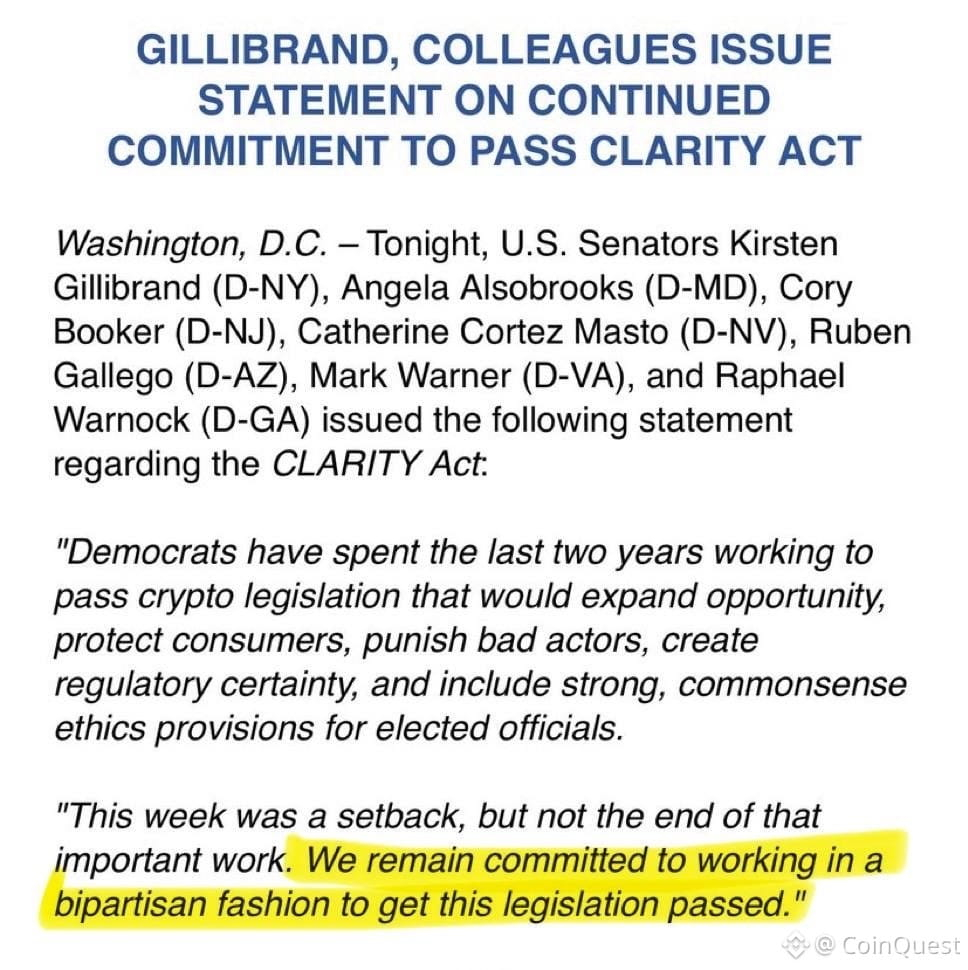
Seven Democratic senators said they remain committed to working bipartisanly to get the CLARITY Act passed after the bill failed to advance in Tuesday’s 49 to 50 procedural vote.
The seven senators are Kirsten Gillibrand, Angela Alsobrooks, Cory Booker, Catherine Cortez Masto, Ruben Gallego, Mark Warner and Raphael Warnock.
So for crypto.....
The bill failed to move forward this week..... but lawmakers are still saying the work continues.
CLARITY Act..... setback or comeback? 🤔
What do you guys think?
#CLARITYAct
🇺🇸 CLARITY ACT IS NOT DEAD YET..... 👀
The Senate vote was a setback, but the story may not be over.....
Seven Democratic senators said they remain committed to working bipartisanly to get the CLARITY Act passed after the bill failed to advance in Tuesday’s 49 to 50 procedural vote.
The seven senators are Kirsten Gillibrand, Angela Alsobrooks, Cory Booker, Catherine Cortez Masto, Ruben Gallego, Mark Warner and Raphael Warnock.
So for crypto.....
The bill failed to move forward this week..... but lawmakers are still saying the work continues.
CLARITY Act..... setback or comeback? 🤔
What do you guys think?
#CLARITYAct
The Senate vote was a setback, but the story may not be over.....
Seven Democratic senators said they remain committed to working bipartisanly to get the CLARITY Act passed after the bill failed to advance in Tuesday’s 49 to 50 procedural vote.
The seven senators are Kirsten Gillibrand, Angela Alsobrooks, Cory Booker, Catherine Cortez Masto, Ruben Gallego, Mark Warner and Raphael Warnock.
So for crypto.....
The bill failed to move forward this week..... but lawmakers are still saying the work continues.
CLARITY Act..... setback or comeback? 🤔
What do you guys think?
#CLARITYAct
4
1.4k

$XRP
{future}(XRPUSDT)
$LINK
{future}(LINKUSDT)
$HBAR
{future}(HBARUSDT)
🚨 THE CLARITY ACT COULD CHANGE THE GAME FOR THESE UTILITY TOKENS 👀🔥
The proposed U.S. CLARITY Act is aimed at creating a clearer regulatory framework for digital assets, including defining the roles of the SEC and CFTC and establishing clearer categories for certain blockchain-based assets.
And that’s where the interesting part begins. 👀
A clearer rulebook could make it easier for banks, brokers, and asset managers to explore services involving custody, tokenization, and blockchain settlement without navigating the same level of regulatory uncertainty.
So which crypto projects could potentially benefit?
🔥 10 names getting attention:
1️⃣ $XRP
2️⃣ $LINK
3️⃣ $HBAR
4️⃣ $XLM
5️⃣ $QNT
6️⃣ $XDC
7️⃣ $ALGO
8️⃣ $AVAX
9️⃣ $ONDO
🔟 $FLR
But don’t confuse regulatory clarity with guaranteed price appreciation.
The bigger potential shift is institutional.
If clearer rules make traditional financial institutions more comfortable interacting with blockchain infrastructure, utility-focused networks could receive significantly more attention.
The legislation is still about regulation—not a secret altcoin pump button. 😅
But if the rulebook changes…
the way institutions interact with crypto could change with it.
👀 The question is no longer just which tokens survive?
It may become:
Which networks are ready when the institutions arrive?
#CLARITYAct #xrp #LINK #hbar #XLM #Crypto
$XRP
$LINK
$HBAR
🚨 THE CLARITY ACT COULD CHANGE THE GAME FOR THESE UTILITY TOKENS 👀🔥
The proposed U.S. CLARITY Act is aimed at creating a clearer regulatory framework for digital assets, including defining the roles of the SEC and CFTC and establishing clearer categories for certain blockchain-based assets.
And that’s where the interesting part begins. 👀
A clearer rulebook could make it easier for banks, brokers, and asset managers to explore services involving custody, tokenization, and blockchain settlement without navigating the same level of regulatory uncertainty.
So which crypto projects could potentially benefit?
🔥 10 names getting attention:
1️⃣ $XRP
2️⃣ $LINK
3️⃣ $HBAR
4️⃣ $XLM
5️⃣ $QNT
6️⃣ $XDC
7️⃣ $ALGO
8️⃣ $AVAX
9️⃣ $ONDO
🔟 $FLR
But don’t confuse regulatory clarity with guaranteed price appreciation.
The bigger potential shift is institutional.
If clearer rules make traditional financial institutions more comfortable interacting with blockchain infrastructure, utility-focused networks could receive significantly more attention.
The legislation is still about regulation—not a secret altcoin pump button. 😅
But if the rulebook changes…
the way institutions interact with crypto could change with it.
👀 The question is no longer just which tokens survive?
It may become:
Which networks are ready when the institutions arrive?
#CLARITYAct #xrp #LINK #hbar #XLM #Crypto
$LINK
$HBAR
🚨 THE CLARITY ACT COULD CHANGE THE GAME FOR THESE UTILITY TOKENS 👀🔥
The proposed U.S. CLARITY Act is aimed at creating a clearer regulatory framework for digital assets, including defining the roles of the SEC and CFTC and establishing clearer categories for certain blockchain-based assets.
And that’s where the interesting part begins. 👀
A clearer rulebook could make it easier for banks, brokers, and asset managers to explore services involving custody, tokenization, and blockchain settlement without navigating the same level of regulatory uncertainty.
So which crypto projects could potentially benefit?
🔥 10 names getting attention:
1️⃣ $XRP
2️⃣ $LINK
3️⃣ $HBAR
4️⃣ $XLM
5️⃣ $QNT
6️⃣ $XDC
7️⃣ $ALGO
8️⃣ $AVAX
9️⃣ $ONDO
🔟 $FLR
But don’t confuse regulatory clarity with guaranteed price appreciation.
The bigger potential shift is institutional.
If clearer rules make traditional financial institutions more comfortable interacting with blockchain infrastructure, utility-focused networks could receive significantly more attention.
The legislation is still about regulation—not a secret altcoin pump button. 😅
But if the rulebook changes…
the way institutions interact with crypto could change with it.
👀 The question is no longer just which tokens survive?
It may become:
Which networks are ready when the institutions arrive?
#CLARITYAct #xrp #LINK #hbar #XLM #Crypto

2
1.3k

·
--
🚨 BREAKING: CLARITY ACT FAILS TO ADVANCE — CRYPTO REGULATION FACES A MAJOR SETBACK! 🚨
The U.S. Senate has failed to secure the required 60 votes to advance the CLARITY Act, marking a significant setback for the crypto industry and its long-awaited regulatory framework.
According to reports, the procedural vote ended 49–50, leaving the legislation short of the threshold needed to move forward. The bill was designed to establish clearer rules for digital assets and help define the roles of the SEC and CFTC in overseeing the crypto market.
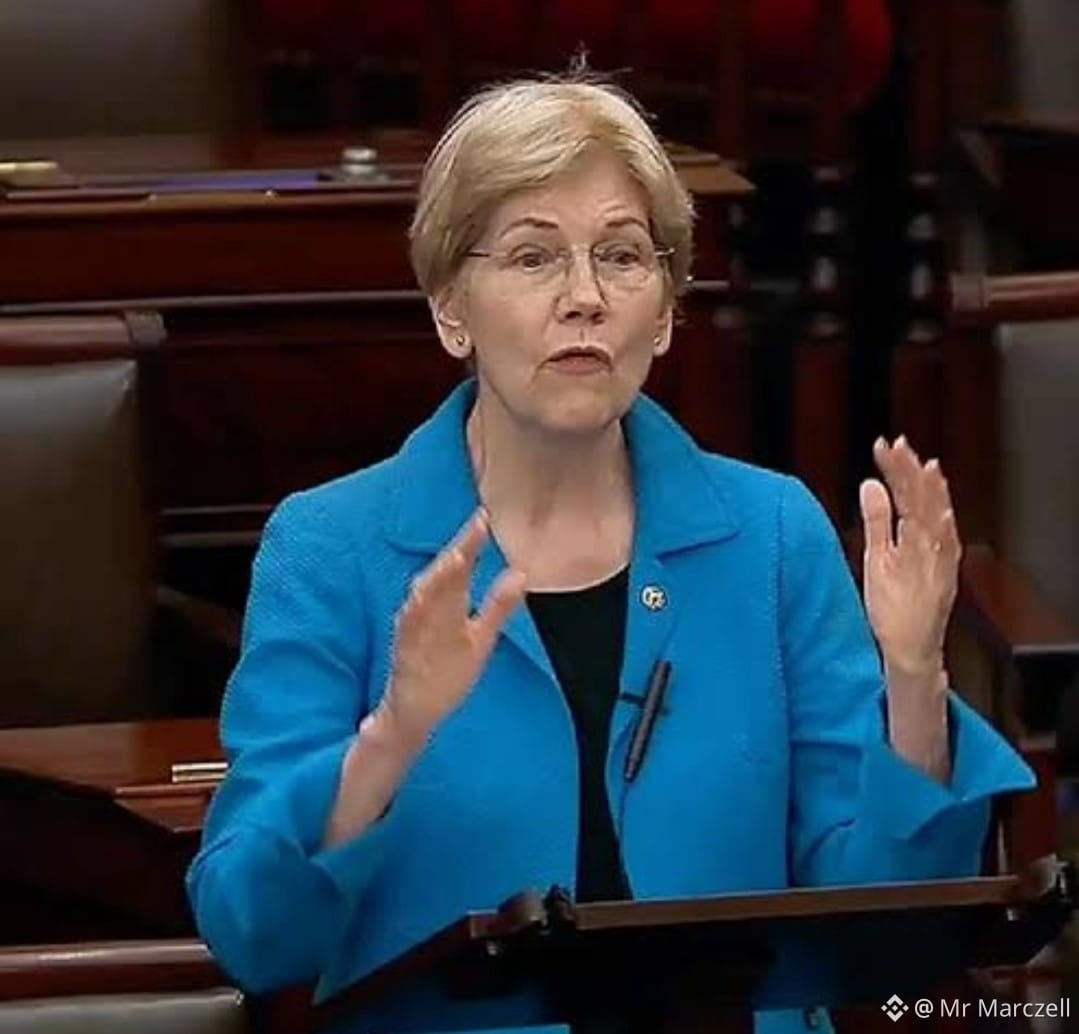
Senator Elizabeth Warren has urged lawmakers to reject the current version of the bill, arguing that it does not provide sufficient protections for consumers, national security, and economic stability. Her opposition reflects wider disagreements in Washington over how cryptocurrency should be regulated.
For the crypto market, this development introduces another layer of uncertainty. Investors may now focus more closely on regulatory headlines, Federal Reserve policy, and liquidity conditions as the industry awaits its next major catalyst.
⚠️ IMPORTANT: The Senate vote blocks the bill from advancing at this stage. It does not automatically mean the CLARITY Act can never return for further consideration.
The crypto market remains sensitive to political decisions. Stay alert, manage risk, and watch the next developments closely.
#CLARITYAct #CryptoNews #USSenate #CryptoRegulation #FedRateWatch
🚨 BREAKING: CLARITY ACT FAILS TO ADVANCE — CRYPTO REGULATION FACES A MAJOR SETBACK! 🚨
The U.S. Senate has failed to secure the required 60 votes to advance the CLARITY Act, marking a significant setback for the crypto industry and its long-awaited regulatory framework.
According to reports, the procedural vote ended 49–50, leaving the legislation short of the threshold needed to move forward. The bill was designed to establish clearer rules for digital assets and help define the roles of the SEC and CFTC in overseeing the crypto market.
Senator Elizabeth Warren has urged lawmakers to reject the current version of the bill, arguing that it does not provide sufficient protections for consumers, national security, and economic stability. Her opposition reflects wider disagreements in Washington over how cryptocurrency should be regulated.
For the crypto market, this development introduces another layer of uncertainty. Investors may now focus more closely on regulatory headlines, Federal Reserve policy, and liquidity conditions as the industry awaits its next major catalyst.
⚠️ IMPORTANT: The Senate vote blocks the bill from advancing at this stage. It does not automatically mean the CLARITY Act can never return for further consideration.
The crypto market remains sensitive to political decisions. Stay alert, manage risk, and watch the next developments closely.
#CLARITYAct #CryptoNews #USSenate #CryptoRegulation #FedRateWatch
The U.S. Senate has failed to secure the required 60 votes to advance the CLARITY Act, marking a significant setback for the crypto industry and its long-awaited regulatory framework.
According to reports, the procedural vote ended 49–50, leaving the legislation short of the threshold needed to move forward. The bill was designed to establish clearer rules for digital assets and help define the roles of the SEC and CFTC in overseeing the crypto market.
Senator Elizabeth Warren has urged lawmakers to reject the current version of the bill, arguing that it does not provide sufficient protections for consumers, national security, and economic stability. Her opposition reflects wider disagreements in Washington over how cryptocurrency should be regulated.
For the crypto market, this development introduces another layer of uncertainty. Investors may now focus more closely on regulatory headlines, Federal Reserve policy, and liquidity conditions as the industry awaits its next major catalyst.
⚠️ IMPORTANT: The Senate vote blocks the bill from advancing at this stage. It does not automatically mean the CLARITY Act can never return for further consideration.
The crypto market remains sensitive to political decisions. Stay alert, manage risk, and watch the next developments closely.
#CLARITYAct #CryptoNews #USSenate #CryptoRegulation #FedRateWatch
2
497

·
--
The CLARITY Act: bringing regulatory structure to digital assets.
The Digital Asset Market Clarity Act (CLARITY Act) is key legislation aimed at defining the boundary between securities and digital commodities in the United States.
What the framework addresses:
• SEC vs. CFTC Jurisdiction: Establishes clear tests for when a digital asset starts as part of an investment contract under SEC oversight and transitions into a digital commodity regulated by the CFTC once the network achieves decentralization ("mature blockchain system").
• Intermediary Registration: Sets up clear registration pathways and provisional status for digital commodity exchanges, brokers, and dealers.
• Stablecoin & DeFi Recognition: Addresses permitted payment stablecoins and incorporates statutory exclusions for decentralized finance (DeFi) activities.
• Protecting Innovation: Seeks to provide legal certainty for developers, custodians, and staking service providers.
Why it matters for the market:
Clear rules replace regulatory ambiguity. When developers and institutions know the legal framework, capital deployment and product development can scale with confidence.
Legislation takes time to navigate committee debates, amendments, and bicameral votes, but establishing clear market structure remains a major milestone for crypto maturation.
Educational overview only. Not legal or financial advice.
#CLARITYAct #CryptoRegulation #Compliance #BinanceAngels
The CLARITY Act: bringing regulatory structure to digital assets.
The Digital Asset Market Clarity Act (CLARITY Act) is key legislation aimed at defining the boundary between securities and digital commodities in the United States.
What the framework addresses:
• SEC vs. CFTC Jurisdiction: Establishes clear tests for when a digital asset starts as part of an investment contract under SEC oversight and transitions into a digital commodity regulated by the CFTC once the network achieves decentralization ("mature blockchain system").
• Intermediary Registration: Sets up clear registration pathways and provisional status for digital commodity exchanges, brokers, and dealers.
• Stablecoin & DeFi Recognition: Addresses permitted payment stablecoins and incorporates statutory exclusions for decentralized finance (DeFi) activities.
• Protecting Innovation: Seeks to provide legal certainty for developers, custodians, and staking service providers.
Why it matters for the market:
Clear rules replace regulatory ambiguity. When developers and institutions know the legal framework, capital deployment and product development can scale with confidence.
Legislation takes time to navigate committee debates, amendments, and bicameral votes, but establishing clear market structure remains a major milestone for crypto maturation.
Educational overview only. Not legal or financial advice.
#CLARITYAct #CryptoRegulation #Compliance #BinanceAngels
The Digital Asset Market Clarity Act (CLARITY Act) is key legislation aimed at defining the boundary between securities and digital commodities in the United States.
What the framework addresses:
• SEC vs. CFTC Jurisdiction: Establishes clear tests for when a digital asset starts as part of an investment contract under SEC oversight and transitions into a digital commodity regulated by the CFTC once the network achieves decentralization ("mature blockchain system").
• Intermediary Registration: Sets up clear registration pathways and provisional status for digital commodity exchanges, brokers, and dealers.
• Stablecoin & DeFi Recognition: Addresses permitted payment stablecoins and incorporates statutory exclusions for decentralized finance (DeFi) activities.
• Protecting Innovation: Seeks to provide legal certainty for developers, custodians, and staking service providers.
Why it matters for the market:
Clear rules replace regulatory ambiguity. When developers and institutions know the legal framework, capital deployment and product development can scale with confidence.
Legislation takes time to navigate committee debates, amendments, and bicameral votes, but establishing clear market structure remains a major milestone for crypto maturation.
Educational overview only. Not legal or financial advice.
#CLARITYAct #CryptoRegulation #Compliance #BinanceAngels
26

·
--
🏛️ THE SENATE JUST KILLED THE CLARITY ACT. FOR NOW.
The vote needed 60 senators. It didn't get there.
Bitcoin dropped 3.3% overnight. $667M liquidated.
But here's what 90% of people are missing:
❌ What DIDN'T happen:
→ Crypto was NOT banned
→ BTC, ETH, SOL, XRP are STILL classified as commodities by SEC/CFTC
→ Stablecoin law (passed last year) is STILL in force
→ Your ETFs still trade tomorrow
⚠️ What DID happen:
→ The industry lost a chance to lock that commodity status into LAW instead of policy
→ DeFi protocols stay in a legal grey zone
→ The bill can be brought back — Polymarket had it at ~30% odds even before the vote
The market sold the headline. Smart money is reading the details.
Regulation delayed is not regulation denied.
Bullish or bearish for Q4? 👇
$BTC $ETH $XRP $SOL
#CLARITYAct #CryptoRegulation #bitcoin #SEC #Write2Earn
🏛️ THE SENATE JUST KILLED THE CLARITY ACT. FOR NOW.
The vote needed 60 senators. It didn't get there.
Bitcoin dropped 3.3% overnight. $667M liquidated.
But here's what 90% of people are missing:
❌ What DIDN'T happen:
→ Crypto was NOT banned
→ BTC, ETH, SOL, XRP are STILL classified as commodities by SEC/CFTC
→ Stablecoin law (passed last year) is STILL in force
→ Your ETFs still trade tomorrow
⚠️ What DID happen:
→ The industry lost a chance to lock that commodity status into LAW instead of policy
→ DeFi protocols stay in a legal grey zone
→ The bill can be brought back — Polymarket had it at ~30% odds even before the vote
The market sold the headline. Smart money is reading the details.
Regulation delayed is not regulation denied.
Bullish or bearish for Q4? 👇
$BTC $ETH $XRP $SOL
#CLARITYAct #CryptoRegulation #bitcoin #SEC #Write2Earn
The vote needed 60 senators. It didn't get there.
Bitcoin dropped 3.3% overnight. $667M liquidated.
But here's what 90% of people are missing:
❌ What DIDN'T happen:
→ Crypto was NOT banned
→ BTC, ETH, SOL, XRP are STILL classified as commodities by SEC/CFTC
→ Stablecoin law (passed last year) is STILL in force
→ Your ETFs still trade tomorrow
⚠️ What DID happen:
→ The industry lost a chance to lock that commodity status into LAW instead of policy
→ DeFi protocols stay in a legal grey zone
→ The bill can be brought back — Polymarket had it at ~30% odds even before the vote
The market sold the headline. Smart money is reading the details.
Regulation delayed is not regulation denied.
Bullish or bearish for Q4? 👇
$BTC $ETH $XRP $SOL
#CLARITYAct #CryptoRegulation #bitcoin #SEC #Write2Earn

67
Log in to explore more content
Join global crypto users on Binance Square
⚡️ Get latest and useful information about crypto.
💬 Trusted by the world’s largest crypto exchange.
👍 Discover real insights from verified creators.
Email / Phone number
Trending Topics
1
#HKCompletesFirstHKDStablecoinUseCase
10,015 views
365 Discussing
2
#VietnamPlansFirstCryptoLicensesIn2026
7,814 views
235 Discussing
3
#BTCBreaks80K
217,476 views
3,494 Discussing
4
#BitcoinMarketCapTopsTesla
24,500 views
627 Discussing
5
#SOLJumpsAbout10%
36,714 views
705 Discussing
6
#EthereumReclaims$2600
2,728 views
83 Discussing
7
#LineraShutsDownAfterFundraisingFallsShort
8,419 views
178 Discussing
8
#SECReceivesAmendedInjectiveETFFiling
20,686 views
446 Discussing
9
#SanDiskToJoinSP100OnSep21
15,374 views
281 Discussing
10
#PolygonToDeployContractBurning100MPOL
10,368 views
220 Discussing