

#xstocks
xstocks
91,873 views
183 Discussing
Hot
Latest

·
--
Bullish
What if you could buy Tesla, Apple, or NVIDIA from your crypto account? 👀
Those are xStocks: tokens that track the price of real stocks.
⚠️ Heads up: token ≠ stock. The rights, liquidity, and availability change depending on your country.
My rule after +5 years in the stock market: understand what you’re buying before you buy it.
This week I’ll explain how they work, including their risks. Follow me 🔔
💬 Have you tried them yet, or do you still have questions?
Personal opinion—not financial advice.
$TSLAB $AAPLB $NVDAB
#xStocks #Acciones #TokenizedStocks #Nasdaq #BinanceSquare
What if you could buy Tesla, Apple, or NVIDIA from your crypto account? 👀
Those are xStocks: tokens that track the price of real stocks.
⚠️ Heads up: token ≠ stock. The rights, liquidity, and availability change depending on your country.
My rule after +5 years in the stock market: understand what you’re buying before you buy it.
This week I’ll explain how they work, including their risks. Follow me 🔔
💬 Have you tried them yet, or do you still have questions?
Personal opinion—not financial advice.
$TSLAB $AAPLB $NVDAB
#xStocks #Acciones #TokenizedStocks #Nasdaq #BinanceSquare
Those are xStocks: tokens that track the price of real stocks.
⚠️ Heads up: token ≠ stock. The rights, liquidity, and availability change depending on your country.
My rule after +5 years in the stock market: understand what you’re buying before you buy it.
This week I’ll explain how they work, including their risks. Follow me 🔔
💬 Have you tried them yet, or do you still have questions?
Personal opinion—not financial advice.
$TSLAB $AAPLB $NVDAB
#xStocks #Acciones #TokenizedStocks #Nasdaq #BinanceSquare
1
114

·
--
🔥 Report: #Kraken — Parent company Payward has reached a cooperation with the London Stock Exchange, planning to tokenize and bring on-chain the stocks of the UK’s top 100 listed companies via its #xStocks platform.
This cooperation may open up new market opportunities for global investors. With #RWA technology, traditional stocks could enter the on-chain ecosystem in a more flexible way, lowering the barrier to investment participation.
On-chain assets offer 7×24 hour accessibility, low-cost trading, greater transparency, and global participation—redefining the boundaries of traditional finance.
$BTC
🔥 Report: #Kraken — Parent company Payward has reached a cooperation with the London Stock Exchange, planning to tokenize and bring on-chain the stocks of the UK’s top 100 listed companies via its #xStocks platform.
This cooperation may open up new market opportunities for global investors. With #RWA technology, traditional stocks could enter the on-chain ecosystem in a more flexible way, lowering the barrier to investment participation.
On-chain assets offer 7×24 hour accessibility, low-cost trading, greater transparency, and global participation—redefining the boundaries of traditional finance.
$BTC
This cooperation may open up new market opportunities for global investors. With #RWA technology, traditional stocks could enter the on-chain ecosystem in a more flexible way, lowering the barrier to investment participation.
On-chain assets offer 7×24 hour accessibility, low-cost trading, greater transparency, and global participation—redefining the boundaries of traditional finance.
$BTC

93


Payward unveils a partnership with London Stock Exchange
#Payward , the parent company of #Kraken, has partnered with the #LondonStockExchange to advance the tokenization of UK equity markets. Under the partnership, Payward will tokenize the top 100 London-listed equities as #xStocks , while the London Stock Exchange, subject to regulatory approval, will enable xStocks trading through #LSE24 . The companies will also explore issuer-backed equity tokens as they seek to modernize how stocks are owned, traded, and settled.
👉 x.com/Payward/status/2094688507155341617
Payward unveils a partnership with London Stock Exchange
#Payward , the parent company of #Kraken, has partnered with the #LondonStockExchange to advance the tokenization of UK equity markets. Under the partnership, Payward will tokenize the top 100 London-listed equities as #xStocks , while the London Stock Exchange, subject to regulatory approval, will enable xStocks trading through #LSE24 . The companies will also explore issuer-backed equity tokens as they seek to modernize how stocks are owned, traded, and settled.
👉 x.com/Payward/status/2094688507155341617
#Payward , the parent company of #Kraken, has partnered with the #LondonStockExchange to advance the tokenization of UK equity markets. Under the partnership, Payward will tokenize the top 100 London-listed equities as #xStocks , while the London Stock Exchange, subject to regulatory approval, will enable xStocks trading through #LSE24 . The companies will also explore issuer-backed equity tokens as they seek to modernize how stocks are owned, traded, and settled.
👉 x.com/Payward/status/2094688507155341617
112

·
--

Article
London Stock Exchange Teams Up With Kraken’s Parent to Tokenize 100 UK GiantsThe first real‑world bridge between traditional equities and crypto is opening, and the market is already feeling the tremors.
Most traders watch price. Smart money watches the flow of institutional capital into tokenized assets instead.
The signal: LSE’s partnership with Payward (Kraken’s parent) will list tokenized shares of the 100 largest London‑listed companies on the xStocks framework. This move is slated to feed into LSE’s planned 24‑hour trading venue, effectively creating a continuous, on‑chain liquidity pool for UK equities. #Tokenization #LSE #xStocks
Interpretation: When a major exchange like LSE opens a 24‑hour, on‑chain venue, it lowers the friction for global investors to access UK equities. Institutional whales that have been hesitant to cross the Atlantic due to custody and settlement headaches will now have a frictionless, transparent route. The influx of capital is likely to lift the price of the underlying tokenized assets and, by extension, the native tokens of the companies involved. Watch for a surge in on‑chain volume for the top 10 LSE tickers; a spike could precede a broader rally in the UK market.
Watch list: Monitor the on‑chain volume of the xStocks token for the FTSE 100 constituents, especially those with high institutional ownership like HSBC, BP, and Unilever. A sustained 20% increase in daily volume could signal a shift in whale sentiment. #WhaleWatch
Thought closer: If the LSE’s 24‑hour venue starts to attract the same institutional flow that fuels $BTC’s daily volume, could we see a new era where traditional equities and crypto move in tandem?
London Stock Exchange Teams Up With Kraken’s Parent to Tokenize 100 UK Giants
The first real‑world bridge between traditional equities and crypto is opening, and the market is already feeling the tremors.
Most traders watch price. Smart money watches the flow of institutional capital into tokenized assets instead.
The signal: LSE’s partnership with Payward (Kraken’s parent) will list tokenized shares of the 100 largest London‑listed companies on the xStocks framework. This move is slated to feed into LSE’s planned 24‑hour trading venue, effectively creating a continuous, on‑chain liquidity pool for UK equities. #Tokenization #LSE #xStocks
Interpretation: When a major exchange like LSE opens a 24‑hour, on‑chain venue, it lowers the friction for global investors to access UK equities. Institutional whales that have been hesitant to cross the Atlantic due to custody and settlement headaches will now have a frictionless, transparent route. The influx of capital is likely to lift the price of the underlying tokenized assets and, by extension, the native tokens of the companies involved. Watch for a surge in on‑chain volume for the top 10 LSE tickers; a spike could precede a broader rally in the UK market.
Watch list: Monitor the on‑chain volume of the xStocks token for the FTSE 100 constituents, especially those with high institutional ownership like HSBC, BP, and Unilever. A sustained 20% increase in daily volume could signal a shift in whale sentiment. #WhaleWatch
Thought closer: If the LSE’s 24‑hour venue starts to attract the same institutional flow that fuels $BTC ’s daily volume, could we see a new era where traditional equities and crypto move in tandem?
Most traders watch price. Smart money watches the flow of institutional capital into tokenized assets instead.
The signal: LSE’s partnership with Payward (Kraken’s parent) will list tokenized shares of the 100 largest London‑listed companies on the xStocks framework. This move is slated to feed into LSE’s planned 24‑hour trading venue, effectively creating a continuous, on‑chain liquidity pool for UK equities. #Tokenization #LSE #xStocks
Interpretation: When a major exchange like LSE opens a 24‑hour, on‑chain venue, it lowers the friction for global investors to access UK equities. Institutional whales that have been hesitant to cross the Atlantic due to custody and settlement headaches will now have a frictionless, transparent route. The influx of capital is likely to lift the price of the underlying tokenized assets and, by extension, the native tokens of the companies involved. Watch for a surge in on‑chain volume for the top 10 LSE tickers; a spike could precede a broader rally in the UK market.
Watch list: Monitor the on‑chain volume of the xStocks token for the FTSE 100 constituents, especially those with high institutional ownership like HSBC, BP, and Unilever. A sustained 20% increase in daily volume could signal a shift in whale sentiment. #WhaleWatch
Thought closer: If the LSE’s 24‑hour venue starts to attract the same institutional flow that fuels $BTC ’s daily volume, could we see a new era where traditional equities and crypto move in tandem?
13

·
--
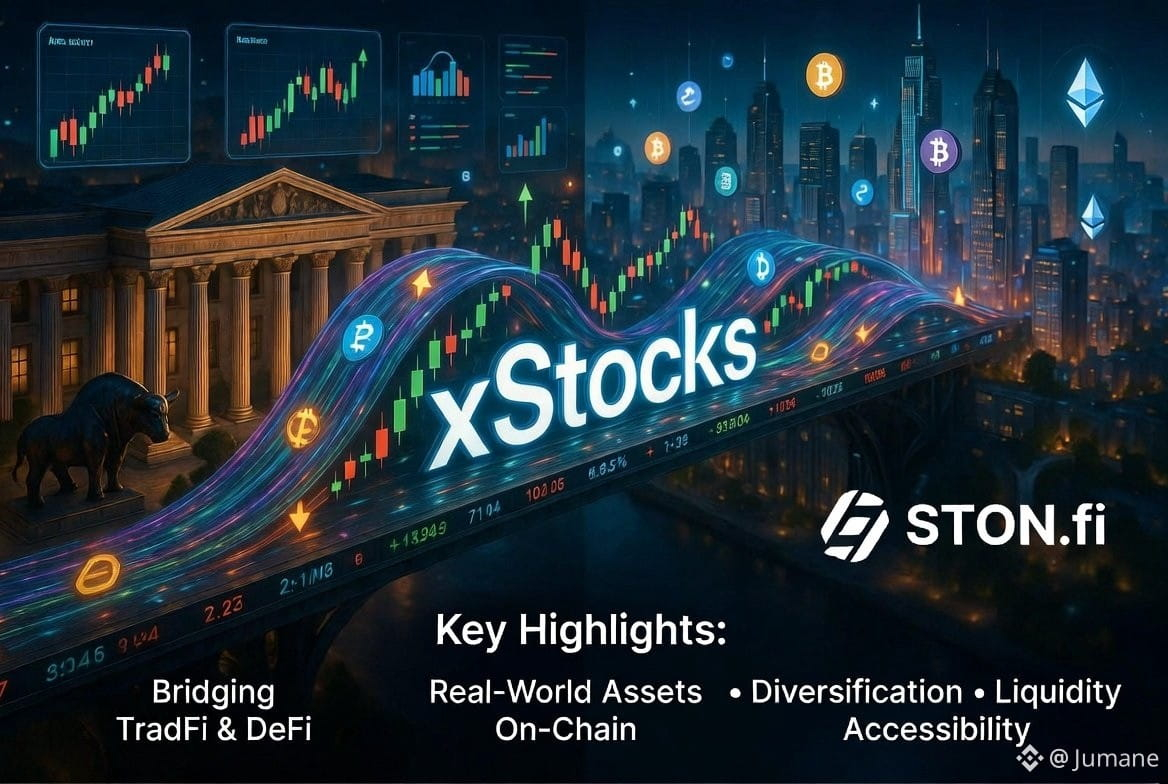
xStocks on STON.fi Why This Narrative Matters for DeFi
DeFi isn’t just about tokens anymore…
it’s about access to real-world value on-chain.
That’s where xStocks come in. 👇
xStocks bring exposure to traditional assets into DeFi allowing users to interact with stock-like value directly on-chain, without leaving the ecosystem.
Why this matters:
• Bridges TradFi & DeFi → expands what users can invest in
• More diversification → build stronger, balanced portfolios
• New liquidity flows → attracts a different class of capital
• On-chain accessibility → faster, cheaper, and permissionless
On STON.fi, this becomes even more powerful:
Low fees + fast execution + deep liquidity = a seamless way to trade and manage xStocks.
This isn’t just a new feature…
it’s a shift toward a more complete financial system on-chain.
The future of DeFi isn’t isolated it’s integrated. @ston_fi
#STON.fi #defi #xStocks #TON #Web3
xStocks on STON.fi Why This Narrative Matters for DeFi
DeFi isn’t just about tokens anymore…
it’s about access to real-world value on-chain.
That’s where xStocks come in. 👇
xStocks bring exposure to traditional assets into DeFi allowing users to interact with stock-like value directly on-chain, without leaving the ecosystem.
Why this matters:
• Bridges TradFi & DeFi → expands what users can invest in
• More diversification → build stronger, balanced portfolios
• New liquidity flows → attracts a different class of capital
• On-chain accessibility → faster, cheaper, and permissionless
On STON.fi, this becomes even more powerful:
Low fees + fast execution + deep liquidity = a seamless way to trade and manage xStocks.
This isn’t just a new feature…
it’s a shift toward a more complete financial system on-chain.
The future of DeFi isn’t isolated it’s integrated. @ston_fi
#STON.fi #defi #xStocks #TON #Web3
DeFi isn’t just about tokens anymore…
it’s about access to real-world value on-chain.
That’s where xStocks come in. 👇
xStocks bring exposure to traditional assets into DeFi allowing users to interact with stock-like value directly on-chain, without leaving the ecosystem.
Why this matters:
• Bridges TradFi & DeFi → expands what users can invest in
• More diversification → build stronger, balanced portfolios
• New liquidity flows → attracts a different class of capital
• On-chain accessibility → faster, cheaper, and permissionless
On STON.fi, this becomes even more powerful:
Low fees + fast execution + deep liquidity = a seamless way to trade and manage xStocks.
This isn’t just a new feature…
it’s a shift toward a more complete financial system on-chain.
The future of DeFi isn’t isolated it’s integrated. @ston_fi
#STON.fi #defi #xStocks #TON #Web3
1
167

·
--
Bullish
SpaceX exposure from
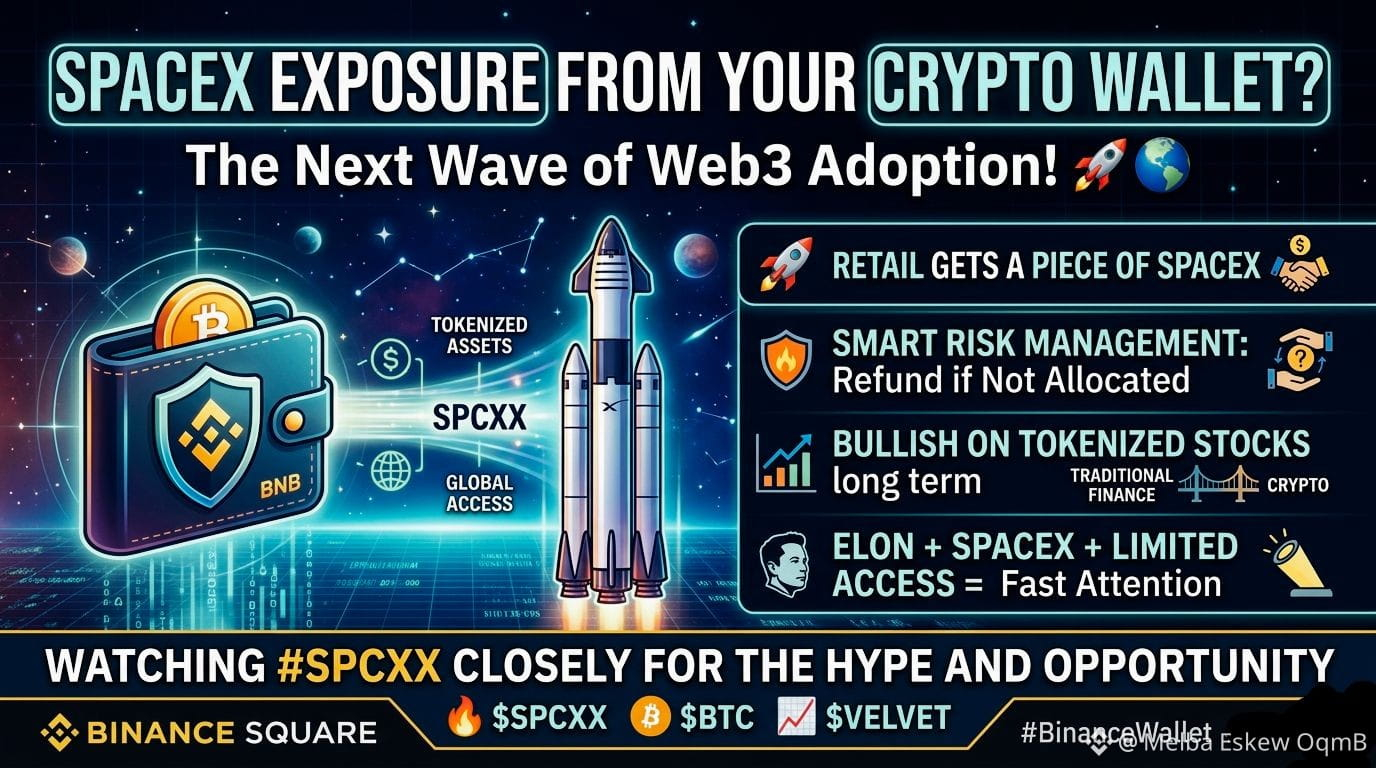
SpaceX exposure from a crypto wallet? 👀 This is the kind of tokenized asset adoption that could bring the next wave of investors into Web3. 🚀
Everyone talks about buying the future, but now retail can actually get a piece of the SpaceX story. Curious to see how demand impacts $SPCX allocation 🔥
The "refund if not allocated" part removes a lot of fear. Smart move for risk management while getting exposure to one of the hottest private companies 🌍🚀
Bullish on tokenized stocks long term 📈 Traditional finance and crypto keep getting closer. @Square-Creator-b0c1afbe6bb75 today, what’s next tomorrow? 🤔
Market psychology is simple: when Elon + SpaceX + limited access appear in one headline, attention follows fast 😅 Watching SPCXX closely for the hype and the opportunity. 🚀💰
$BTC $VELVET #SPCXX #BinanceWallet #xStocks
{future}(BTCUSDT)
{future}(VELVETUSDT)
{future}(SPXUSDT)
SpaceX exposure from
SpaceX exposure from a crypto wallet? 👀 This is the kind of tokenized asset adoption that could bring the next wave of investors into Web3. 🚀
Everyone talks about buying the future, but now retail can actually get a piece of the SpaceX story. Curious to see how demand impacts $SPCX allocation 🔥
The "refund if not allocated" part removes a lot of fear. Smart move for risk management while getting exposure to one of the hottest private companies 🌍🚀
Bullish on tokenized stocks long term 📈 Traditional finance and crypto keep getting closer. @SpaceX2 today, what’s next tomorrow? 🤔
Market psychology is simple: when Elon + SpaceX + limited access appear in one headline, attention follows fast 😅 Watching SPCXX closely for the hype and the opportunity. 🚀💰
$BTC $VELVET #SPCXX #BinanceWallet #xStocks
SpaceX exposure from a crypto wallet? 👀 This is the kind of tokenized asset adoption that could bring the next wave of investors into Web3. 🚀
Everyone talks about buying the future, but now retail can actually get a piece of the SpaceX story. Curious to see how demand impacts $SPCX allocation 🔥
The "refund if not allocated" part removes a lot of fear. Smart move for risk management while getting exposure to one of the hottest private companies 🌍🚀
Bullish on tokenized stocks long term 📈 Traditional finance and crypto keep getting closer. @SpaceX2 today, what’s next tomorrow? 🤔
Market psychology is simple: when Elon + SpaceX + limited access appear in one headline, attention follows fast 😅 Watching SPCXX closely for the hype and the opportunity. 🚀💰
$BTC $VELVET #SPCXX #BinanceWallet #xStocks
1
384

·
--
👊 First hard hit (and kinda unfair) for xStocks and the RWA hype.
Why did folks try to scam the presale?
SpaceX debuted today on Nasdaq with SPCX. The real shares surged hard at the open.
Several exchanges opened subscriptions for SPCXx (tokenized via xStocks):
- Binance Wallet
- Bybit
- Bitget
- Kraken
- BitMart
They promised 1:1 access backed by real shares for retail crypto.
The problem:
Crypto demand was insane: hundreds of millions got locked up in just a few hours.
But xStocks didn’t secure enough allocation from the underwriters (the banks handling the real IPO).
There weren't enough real shares to tokenize → massive cancellations.
They raised way more money than they could tokenize.
Outcome:
- Bybit, Bitget, and Binance Wallet: full refund + bonuses/airdrops for compensation.
- Many users ended up with almost nothing or ridiculous amounts.
- Only a few (like BitMart or the on-chain versions on Solana) delivered decent allocations.
People are complaining about "scams" on X.
Now, I don’t quite get the complaint because in crypto, we know and are used to presales being by allocation, and there’s usually overflow (it was oversold).
As always, they deliver the allocation they could get and refund the rest. No one loses money.
It’s always been this way in crypto.
And it’s totally fine that they only sell what they could tokenize with 1:1 backing.
It doesn’t make sense for xStocks to tokenize more than what they actually back. They won’t do that because it would break the whole RWA system.
The tokenization of shares isn’t going to change how the traditional IPOs and presales operate.
Sorry, but I don’t see the point in the overflow complaint. It’s a common thing in crypto and in presales.
But if users are right that this wasn’t explained regarding allocation and all the marketing was about accessing the 1:1 allocation,
The message was about a secure allocation, and that’s misleading communication.
#xStocks #SpaceX
👊 First hard hit (and kinda unfair) for xStocks and the RWA hype.
Why did folks try to scam the presale?
SpaceX debuted today on Nasdaq with SPCX. The real shares surged hard at the open.
Several exchanges opened subscriptions for SPCXx (tokenized via xStocks):
- Binance Wallet
- Bybit
- Bitget
- Kraken
- BitMart
They promised 1:1 access backed by real shares for retail crypto.
The problem:
Crypto demand was insane: hundreds of millions got locked up in just a few hours.
But xStocks didn’t secure enough allocation from the underwriters (the banks handling the real IPO).
There weren't enough real shares to tokenize → massive cancellations.
They raised way more money than they could tokenize.
Outcome:
- Bybit, Bitget, and Binance Wallet: full refund + bonuses/airdrops for compensation.
- Many users ended up with almost nothing or ridiculous amounts.
- Only a few (like BitMart or the on-chain versions on Solana) delivered decent allocations.
People are complaining about "scams" on X.
Now, I don’t quite get the complaint because in crypto, we know and are used to presales being by allocation, and there’s usually overflow (it was oversold).
As always, they deliver the allocation they could get and refund the rest. No one loses money.
It’s always been this way in crypto.
And it’s totally fine that they only sell what they could tokenize with 1:1 backing.
It doesn’t make sense for xStocks to tokenize more than what they actually back. They won’t do that because it would break the whole RWA system.
The tokenization of shares isn’t going to change how the traditional IPOs and presales operate.
Sorry, but I don’t see the point in the overflow complaint. It’s a common thing in crypto and in presales.
But if users are right that this wasn’t explained regarding allocation and all the marketing was about accessing the 1:1 allocation,
The message was about a secure allocation, and that’s misleading communication.
#xStocks #SpaceX
Why did folks try to scam the presale?
SpaceX debuted today on Nasdaq with SPCX. The real shares surged hard at the open.
Several exchanges opened subscriptions for SPCXx (tokenized via xStocks):
- Binance Wallet
- Bybit
- Bitget
- Kraken
- BitMart
They promised 1:1 access backed by real shares for retail crypto.
The problem:
Crypto demand was insane: hundreds of millions got locked up in just a few hours.
But xStocks didn’t secure enough allocation from the underwriters (the banks handling the real IPO).
There weren't enough real shares to tokenize → massive cancellations.
They raised way more money than they could tokenize.
Outcome:
- Bybit, Bitget, and Binance Wallet: full refund + bonuses/airdrops for compensation.
- Many users ended up with almost nothing or ridiculous amounts.
- Only a few (like BitMart or the on-chain versions on Solana) delivered decent allocations.
People are complaining about "scams" on X.
Now, I don’t quite get the complaint because in crypto, we know and are used to presales being by allocation, and there’s usually overflow (it was oversold).
As always, they deliver the allocation they could get and refund the rest. No one loses money.
It’s always been this way in crypto.
And it’s totally fine that they only sell what they could tokenize with 1:1 backing.
It doesn’t make sense for xStocks to tokenize more than what they actually back. They won’t do that because it would break the whole RWA system.
The tokenization of shares isn’t going to change how the traditional IPOs and presales operate.
Sorry, but I don’t see the point in the overflow complaint. It’s a common thing in crypto and in presales.
But if users are right that this wasn’t explained regarding allocation and all the marketing was about accessing the 1:1 allocation,
The message was about a secure allocation, and that’s misleading communication.
#xStocks #SpaceX
Dragoncrip
·
--
🚀 SpaceX is now trading on the stock market... and it's also a Bitcoin giant
Today, SpaceX (SPCX) debuted on Nasdaq.
Those who got in on the IPO at $135 are up +30% (trading at $175).
A blazing start 🔥
But there's another interesting story within the company's balance sheet:
SpaceX accumulated 18.712 $BTC a at an average price of $35.320
Today, those Bitcoins are worth approximately $1.19 billion, generating an unrealized gain of +$530 million (+80% since purchase).
In the treasury:
- Before the IPO: they represented almost 8% of their cash (~$16 billion).
- After the IPO: now they only account for 1.3% of a massive treasury of over $90 billion
A smart play by Elon and his team: having exposure to Bitcoin as a hedge while they build the future in space.
By buying the stock, you minimally expose yourself to BTC performance.
#SpaceX #Bitcoin #IPO #Musk
Today, SpaceX (SPCX) debuted on Nasdaq.
Those who got in on the IPO at $135 are up +30% (trading at $175).
A blazing start 🔥
But there's another interesting story within the company's balance sheet:
SpaceX accumulated 18.712 $BTC a at an average price of $35.320
Today, those Bitcoins are worth approximately $1.19 billion, generating an unrealized gain of +$530 million (+80% since purchase).
In the treasury:
- Before the IPO: they represented almost 8% of their cash (~$16 billion).
- After the IPO: now they only account for 1.3% of a massive treasury of over $90 billion
A smart play by Elon and his team: having exposure to Bitcoin as a hedge while they build the future in space.
By buying the stock, you minimally expose yourself to BTC performance.
#SpaceX #Bitcoin #IPO #Musk
1
309

·
--
TOKENIZATION MATURES: $XSTK HOLDERS GAIN REAL VOTING POWER! 🦈
💡 Tokenization just crossed its biggest adoption threshold yet. Payward is wiring shareholder voting rights directly into xStocks through Broadridge — meaning token holders now carry the same governance voice as traditional equity owners. This isn't just programmable market plumbing; it's the missing governance layer that legitimizes tokenized assets. 📊
The $25B cumulative trading volume already proved liquidity. Now with proxy voting, post-trade rails, and custody in place — plus expansion into Hong Kong, UK, Europe, and South Korea — the institutional flywheel is accelerating. 🌊 The message is clear: real-world assets are graduating from speculative instruments to fully-functional financial equity.
💬 Do you think full voting rights will be the catalyst that pushes enterprise-grade tokenization past the tipping point? 👇
⚠️ Not financial advice. Always manage your risk. 🛡️
🏷️ #XStocks #Tokenization #RWA #InstitutionalAdoption #Crypto
🦈 🌊
TOKENIZATION MATURES: $XSTK HOLDERS GAIN REAL VOTING POWER! 🦈
💡 Tokenization just crossed its biggest adoption threshold yet. Payward is wiring shareholder voting rights directly into xStocks through Broadridge — meaning token holders now carry the same governance voice as traditional equity owners. This isn't just programmable market plumbing; it's the missing governance layer that legitimizes tokenized assets. 📊
The $25B cumulative trading volume already proved liquidity. Now with proxy voting, post-trade rails, and custody in place — plus expansion into Hong Kong, UK, Europe, and South Korea — the institutional flywheel is accelerating. 🌊 The message is clear: real-world assets are graduating from speculative instruments to fully-functional financial equity.
💬 Do you think full voting rights will be the catalyst that pushes enterprise-grade tokenization past the tipping point? 👇
⚠️ Not financial advice. Always manage your risk. 🛡️
🏷️ #XStocks #Tokenization #RWA #InstitutionalAdoption #Crypto
🦈 🌊
💡 Tokenization just crossed its biggest adoption threshold yet. Payward is wiring shareholder voting rights directly into xStocks through Broadridge — meaning token holders now carry the same governance voice as traditional equity owners. This isn't just programmable market plumbing; it's the missing governance layer that legitimizes tokenized assets. 📊
The $25B cumulative trading volume already proved liquidity. Now with proxy voting, post-trade rails, and custody in place — plus expansion into Hong Kong, UK, Europe, and South Korea — the institutional flywheel is accelerating. 🌊 The message is clear: real-world assets are graduating from speculative instruments to fully-functional financial equity.
💬 Do you think full voting rights will be the catalyst that pushes enterprise-grade tokenization past the tipping point? 👇
⚠️ Not financial advice. Always manage your risk. 🛡️
🏷️ #XStocks #Tokenization #RWA #InstitutionalAdoption #Crypto
🦈 🌊
9
·
--
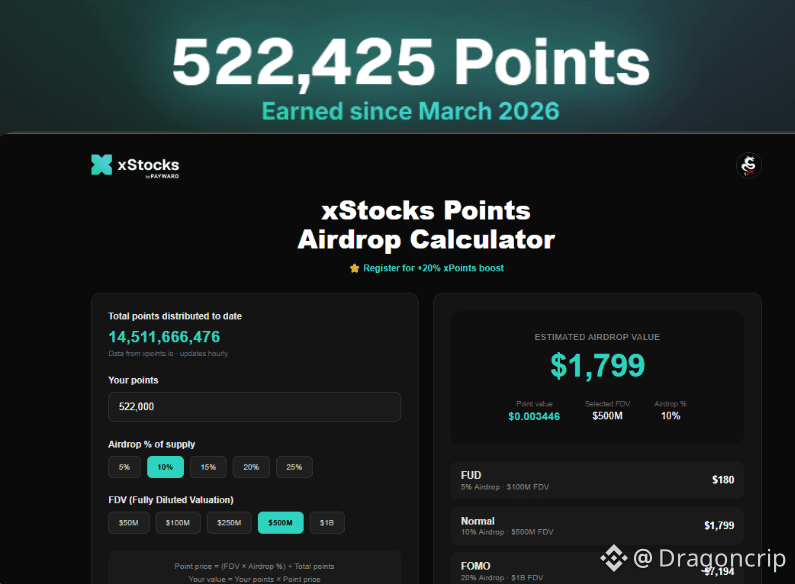
I reached 500,000 points on @xStocksFi.
I changed the strategy I was using and went from 300 daily points to 3,500, and it seems to be going well.
xStocks already manages 23% of all stock tokenization and is the biggest project in the sector without TOKEN.
So far, 14.5 trillion points have been distributed.
Speculating on their airdrop, the 500k could end up doing an airdrop between $500 and $4,500, depending on how much FDV the project gets.
Every month, people buy SPY500 or Nasdaq and do DCA to protect their capital.
Perfect, that’s my preferred strategy, which I do with MSTR from Strategy and metals.
With the difference that, for the past few months, I’m doing it in a decentralized way on the Solana network,
and, as a bonus, I add xStocks points passively.
The competition in the sector is ONDO, which has already delivered an airdrop and whose token has an FDV of 3.8 trillion.
The calculator I put together (attached image photo) takes a maximum FDV of 1 trillion.
I don’t want to imagine if xStocks comes out with a $3B valuation: that would be an unimaginable madness.
In the next posts I’ll explain the strategy I’m building with my tokenized shares:
without risking impermanent loss or anything, and getting the highest score that xStocks gives.
The 2 stocks I have in my portfolio are:
- GOLD → very little, a small long-term hedge
- MSTR (MicroStrategy) → part of the public DCA strategies I currently have running in the market bottom zone (look for the posts)
And if STRC drops (current $86 → parity $100 with 12% dividend), maybe I’ll incorporate it into my portfolio.
While these assets are in my portfolio, quietly they add xStocks points.
---
In the comment, I’ll leave you the links to the calculator and to #xStocks where it estimates how big the Airdrop could be.
I reached 500,000 points on @xStocksFi.
I changed the strategy I was using and went from 300 daily points to 3,500, and it seems to be going well.
xStocks already manages 23% of all stock tokenization and is the biggest project in the sector without TOKEN.
So far, 14.5 trillion points have been distributed.
Speculating on their airdrop, the 500k could end up doing an airdrop between $500 and $4,500, depending on how much FDV the project gets.
Every month, people buy SPY500 or Nasdaq and do DCA to protect their capital.
Perfect, that’s my preferred strategy, which I do with MSTR from Strategy and metals.
With the difference that, for the past few months, I’m doing it in a decentralized way on the Solana network,
and, as a bonus, I add xStocks points passively.
The competition in the sector is ONDO, which has already delivered an airdrop and whose token has an FDV of 3.8 trillion.
The calculator I put together (attached image photo) takes a maximum FDV of 1 trillion.
I don’t want to imagine if xStocks comes out with a $3B valuation: that would be an unimaginable madness.
In the next posts I’ll explain the strategy I’m building with my tokenized shares:
without risking impermanent loss or anything, and getting the highest score that xStocks gives.
The 2 stocks I have in my portfolio are:
- GOLD → very little, a small long-term hedge
- MSTR (MicroStrategy) → part of the public DCA strategies I currently have running in the market bottom zone (look for the posts)
And if STRC drops (current $86 → parity $100 with 12% dividend), maybe I’ll incorporate it into my portfolio.
While these assets are in my portfolio, quietly they add xStocks points.
---
In the comment, I’ll leave you the links to the calculator and to #xStocks where it estimates how big the Airdrop could be.
I changed the strategy I was using and went from 300 daily points to 3,500, and it seems to be going well.
xStocks already manages 23% of all stock tokenization and is the biggest project in the sector without TOKEN.
So far, 14.5 trillion points have been distributed.
Speculating on their airdrop, the 500k could end up doing an airdrop between $500 and $4,500, depending on how much FDV the project gets.
Every month, people buy SPY500 or Nasdaq and do DCA to protect their capital.
Perfect, that’s my preferred strategy, which I do with MSTR from Strategy and metals.
With the difference that, for the past few months, I’m doing it in a decentralized way on the Solana network,
and, as a bonus, I add xStocks points passively.
The competition in the sector is ONDO, which has already delivered an airdrop and whose token has an FDV of 3.8 trillion.
The calculator I put together (attached image photo) takes a maximum FDV of 1 trillion.
I don’t want to imagine if xStocks comes out with a $3B valuation: that would be an unimaginable madness.
In the next posts I’ll explain the strategy I’m building with my tokenized shares:
without risking impermanent loss or anything, and getting the highest score that xStocks gives.
The 2 stocks I have in my portfolio are:
- GOLD → very little, a small long-term hedge
- MSTR (MicroStrategy) → part of the public DCA strategies I currently have running in the market bottom zone (look for the posts)
And if STRC drops (current $86 → parity $100 with 12% dividend), maybe I’ll incorporate it into my portfolio.
While these assets are in my portfolio, quietly they add xStocks points.
---
In the comment, I’ll leave you the links to the calculator and to #xStocks where it estimates how big the Airdrop could be.
1
194

·
--
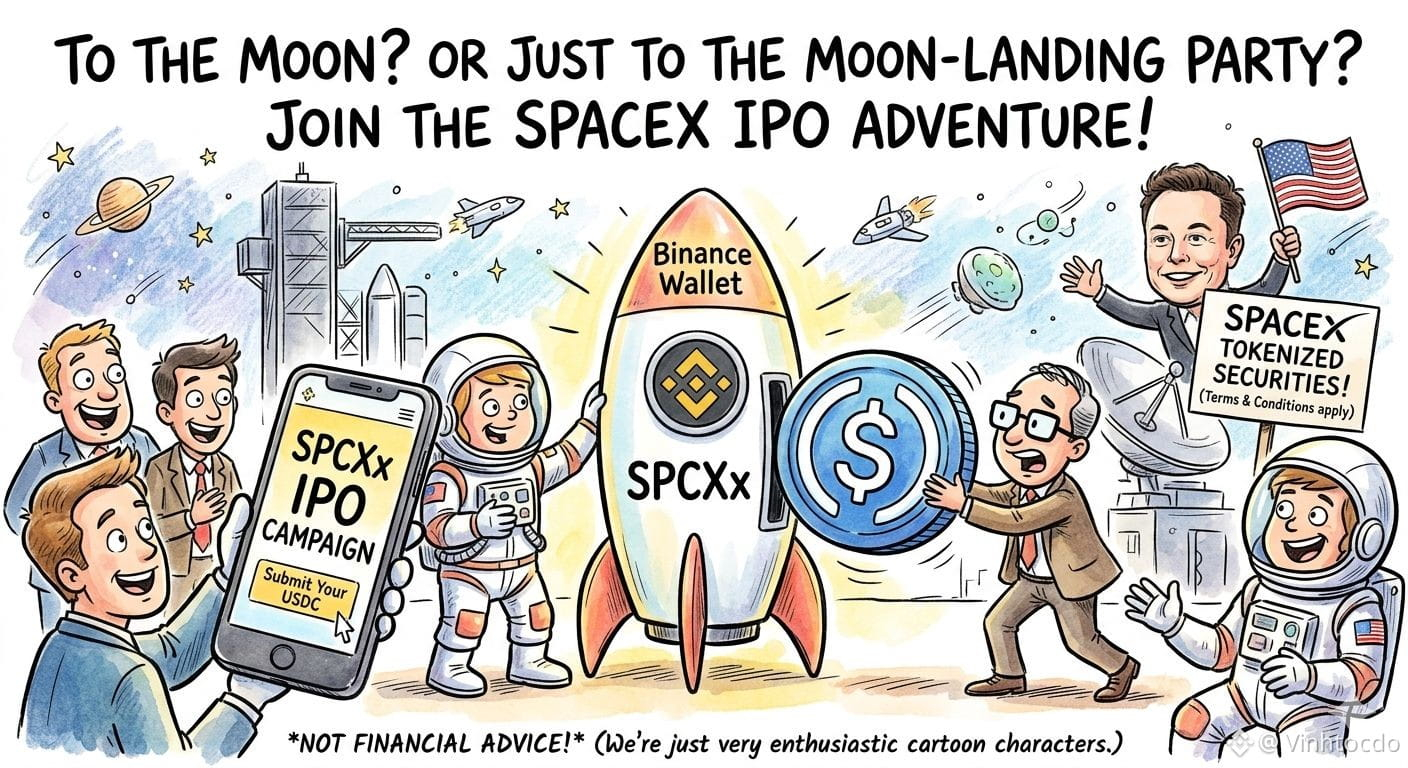
Binance Wallet is launching the SPCXx IPO Campaign, and eligible users can participate in the non-guaranteed subscription process for SpaceX tokenized shares through xStocks.
Key Information:
Subscription Time: Today 16:30 to June 12, 12:00
Minimum Subscription: 100 $USDC
Indicative Price: 135 USDC per token (excluding fees)
Underwriting Fee: 5%
Implied Valuation: $1.75 trillion
The allocation for this round will be distributed based on the Binance Wallet Alpha Points range, with higher points corresponding to a larger staking share. Note: This is a subscription application and does not guarantee allocation, and there are liquidity, valuation, and regulatory risks associated with tokenized stock products.
For users looking to gain exposure to hot pre-IPO assets, this type of activity is worth watching, but it's best to fully understand the fees, allocations, and risks before making a move.
#币安钱包 #xStocks #Alpha Points
Binance Wallet is launching the SPCXx IPO Campaign, and eligible users can participate in the non-guaranteed subscription process for SpaceX tokenized shares through xStocks.
Key Information:
Subscription Time: Today 16:30 to June 12, 12:00
Minimum Subscription: 100 $USDC
Indicative Price: 135 USDC per token (excluding fees)
Underwriting Fee: 5%
Implied Valuation: $1.75 trillion
The allocation for this round will be distributed based on the Binance Wallet Alpha Points range, with higher points corresponding to a larger staking share. Note: This is a subscription application and does not guarantee allocation, and there are liquidity, valuation, and regulatory risks associated with tokenized stock products.
For users looking to gain exposure to hot pre-IPO assets, this type of activity is worth watching, but it's best to fully understand the fees, allocations, and risks before making a move.
#币安钱包 #xStocks #Alpha Points
Key Information:
Subscription Time: Today 16:30 to June 12, 12:00
Minimum Subscription: 100 $USDC
Indicative Price: 135 USDC per token (excluding fees)
Underwriting Fee: 5%
Implied Valuation: $1.75 trillion
The allocation for this round will be distributed based on the Binance Wallet Alpha Points range, with higher points corresponding to a larger staking share. Note: This is a subscription application and does not guarantee allocation, and there are liquidity, valuation, and regulatory risks associated with tokenized stock products.
For users looking to gain exposure to hot pre-IPO assets, this type of activity is worth watching, but it's best to fully understand the fees, allocations, and risks before making a move.
#币安钱包 #xStocks #Alpha Points
40

·
--
Mantle takes another shot. BSPx officially launches, becoming the third tokenized stock to be deployed on Mantle within a month. The first two, SPCXx and USPXx, went live on 6/19 and 6/23 respectively.
BSPx corresponds to Bending Spoons’ parent company, with a roster of familiar brands under it: WeTransfer, Vimeo, Evernote, and AOL. It’s issued by xStocks and trades on Fluxion.
What’s truly interesting is the matching structure: during market hours it uses Atomic RFQ to anchor real-time quotes, then after hours it switches over to AMM to keep running—basically stuffing the open/close trading rhythm of traditional stock markets into on-chain 24/7.
The incentives are stacked heavily too. Each compliant BSPx trade earns two sets of rewards at the same time: xStocks’ native xPoints, plus an additional 1,000,000 Fluxion Points. This covers the full set of TSLAx, NVDAx, AAPLx, METAx, GOOGLx, and MSTRx.
From a personal perspective, the real differentiator is that it can get a new stock tokenized and live on-chain within just weeks of its listing. This “ability to match the cadence” is the real gatekeeping criterion for L2’s RWA positioning—far more than simply piling on TVL with raw muscle.
$MNT #Mantle #RWA #xStocks
Mantle takes another shot. BSPx officially launches, becoming the third tokenized stock to be deployed on Mantle within a month. The first two, SPCXx and USPXx, went live on 6/19 and 6/23 respectively.
BSPx corresponds to Bending Spoons’ parent company, with a roster of familiar brands under it: WeTransfer, Vimeo, Evernote, and AOL. It’s issued by xStocks and trades on Fluxion.
What’s truly interesting is the matching structure: during market hours it uses Atomic RFQ to anchor real-time quotes, then after hours it switches over to AMM to keep running—basically stuffing the open/close trading rhythm of traditional stock markets into on-chain 24/7.
The incentives are stacked heavily too. Each compliant BSPx trade earns two sets of rewards at the same time: xStocks’ native xPoints, plus an additional 1,000,000 Fluxion Points. This covers the full set of TSLAx, NVDAx, AAPLx, METAx, GOOGLx, and MSTRx.
From a personal perspective, the real differentiator is that it can get a new stock tokenized and live on-chain within just weeks of its listing. This “ability to match the cadence” is the real gatekeeping criterion for L2’s RWA positioning—far more than simply piling on TVL with raw muscle.
$MNT #Mantle #RWA #xStocks
BSPx corresponds to Bending Spoons’ parent company, with a roster of familiar brands under it: WeTransfer, Vimeo, Evernote, and AOL. It’s issued by xStocks and trades on Fluxion.
What’s truly interesting is the matching structure: during market hours it uses Atomic RFQ to anchor real-time quotes, then after hours it switches over to AMM to keep running—basically stuffing the open/close trading rhythm of traditional stock markets into on-chain 24/7.
The incentives are stacked heavily too. Each compliant BSPx trade earns two sets of rewards at the same time: xStocks’ native xPoints, plus an additional 1,000,000 Fluxion Points. This covers the full set of TSLAx, NVDAx, AAPLx, METAx, GOOGLx, and MSTRx.
From a personal perspective, the real differentiator is that it can get a new stock tokenized and live on-chain within just weeks of its listing. This “ability to match the cadence” is the real gatekeeping criterion for L2’s RWA positioning—far more than simply piling on TVL with raw muscle.
$MNT #Mantle #RWA #xStocks
39

·
--
Bullish
#spcxxipocampaignonbinancewallet
🚀 Here’s your chance to become a "shareholder" in Elon Musk's SpaceX right from your Binance wallet, folks!
The SPCXx IPO Campaign is open for registering to buy tokenized shares of SpaceX via USDC.
Benefits: Get a whiff of the wealth vibes from SpaceX (valued at $1.75 trillion). If it flops, you’ll get your cash back, no capital loss worries.
Risks: No voting rights, no dividends, and if you miss out, well, that’s just tough luck.
How to do it: Head to your Binance wallet, and prepare at least 100 USDC to stake before 04:00 UTC on 12/06/2026. The higher your Alpha Points, the bigger your buying limit (up to 500k USDC).
This isn’t financial advice! Jump in before it’s too late!
$BTC $VELVET #SPCXX #BinanceWallet #xStocks
{future}(VELVETUSDT)
{future}(BTCUSDT)
#spcxxipocampaignonbinancewallet
🚀 Here’s your chance to become a "shareholder" in Elon Musk's SpaceX right from your Binance wallet, folks!
The SPCXx IPO Campaign is open for registering to buy tokenized shares of SpaceX via USDC.
Benefits: Get a whiff of the wealth vibes from SpaceX (valued at $1.75 trillion). If it flops, you’ll get your cash back, no capital loss worries.
Risks: No voting rights, no dividends, and if you miss out, well, that’s just tough luck.
How to do it: Head to your Binance wallet, and prepare at least 100 USDC to stake before 04:00 UTC on 12/06/2026. The higher your Alpha Points, the bigger your buying limit (up to 500k USDC).
This isn’t financial advice! Jump in before it’s too late!
$BTC $VELVET #SPCXX #BinanceWallet #xStocks
🚀 Here’s your chance to become a "shareholder" in Elon Musk's SpaceX right from your Binance wallet, folks!
The SPCXx IPO Campaign is open for registering to buy tokenized shares of SpaceX via USDC.
Benefits: Get a whiff of the wealth vibes from SpaceX (valued at $1.75 trillion). If it flops, you’ll get your cash back, no capital loss worries.
Risks: No voting rights, no dividends, and if you miss out, well, that’s just tough luck.
How to do it: Head to your Binance wallet, and prepare at least 100 USDC to stake before 04:00 UTC on 12/06/2026. The higher your Alpha Points, the bigger your buying limit (up to 500k USDC).
This isn’t financial advice! Jump in before it’s too late!
$BTC $VELVET #SPCXX #BinanceWallet #xStocks
17
30
58.9k

·
--
Verified
Article
xStocks—A Comprehensive Analysis of the Biggest Player in US Stocks on-chain# xStocks / Kraken / NASDAQ Relationship Breakdown
> 2026-06-09 | Collaboration between Winston & Hermes | Source: Rhythm + WSJ
---
## Relationship Overview
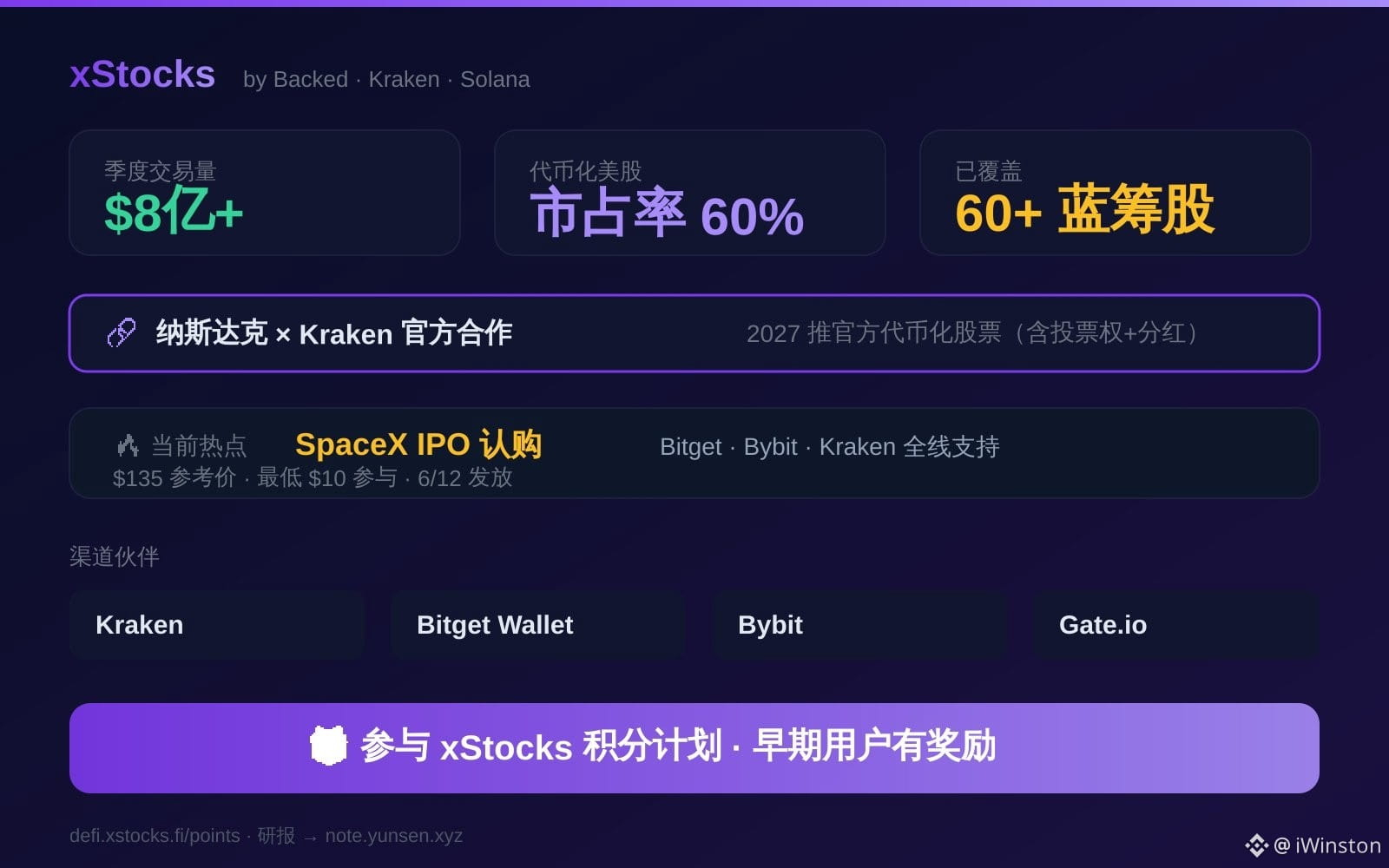
The biggest player in US stocks on-chain, xStocks, is launched through a strategic partnership between Kraken, Backed Finance, and the Solana Foundation (2025.5). Backed holds real stocks via SPV under the Swiss DLT legislation and mints tokens on the public chain at a 1:1 ratio. Currently, it covers over 60 blue-chip stocks and ETFs, deployed across both Solana and BNB Chain.
NASDAQ signed a contract with Kraken in March 2026, planning to launch official tokenized stocks in early 2027—unlike xStocks, the NASDAQ version will include real shareholder rights such as voting and dividends.
xStocks—A Comprehensive Analysis of the Biggest Player in US Stocks on-chain
# xStocks / Kraken / NASDAQ Relationship Breakdown
> 2026-06-09 | Collaboration between Winston & Hermes | Source: Rhythm + WSJ
---
## Relationship Overview
The biggest player in US stocks on-chain, xStocks, is launched through a strategic partnership between Kraken, Backed Finance, and the Solana Foundation (2025.5). Backed holds real stocks via SPV under the Swiss DLT legislation and mints tokens on the public chain at a 1:1 ratio. Currently, it covers over 60 blue-chip stocks and ETFs, deployed across both Solana and BNB Chain.
NASDAQ signed a contract with Kraken in March 2026, planning to launch official tokenized stocks in early 2027—unlike xStocks, the NASDAQ version will include real shareholder rights such as voting and dividends.
> 2026-06-09 | Collaboration between Winston & Hermes | Source: Rhythm + WSJ
---
## Relationship Overview
The biggest player in US stocks on-chain, xStocks, is launched through a strategic partnership between Kraken, Backed Finance, and the Solana Foundation (2025.5). Backed holds real stocks via SPV under the Swiss DLT legislation and mints tokens on the public chain at a 1:1 ratio. Currently, it covers over 60 blue-chip stocks and ETFs, deployed across both Solana and BNB Chain.
NASDAQ signed a contract with Kraken in March 2026, planning to launch official tokenized stocks in early 2027—unlike xStocks, the NASDAQ version will include real shareholder rights such as voting and dividends.
1
990
·
--
Binance’s bStocks launched only 2 months ago and it already pushed #xStocks out of the top spot, with #Kraken falling behind—its scale has directly surged to $610.6 million
It has already become the #2 tokenized stock issuer across the whole network
In the past, people were debating whether tokenized U.S. stocks could actually work in practice. Now, the focus is on which exchange can capture this trillion-dollar market by leveraging traffic and its ecosystem. RWA has evolved from a technical experiment into a new growth engine for crypto-native giants
$NVDA $BTC
Binance’s bStocks launched only 2 months ago and it already pushed #xStocks out of the top spot, with #Kraken falling behind—its scale has directly surged to $610.6 million
It has already become the #2 tokenized stock issuer across the whole network
In the past, people were debating whether tokenized U.S. stocks could actually work in practice. Now, the focus is on which exchange can capture this trillion-dollar market by leveraging traffic and its ecosystem. RWA has evolved from a technical experiment into a new growth engine for crypto-native giants
$NVDA $BTC
It has already become the #2 tokenized stock issuer across the whole network
In the past, people were debating whether tokenized U.S. stocks could actually work in practice. Now, the focus is on which exchange can capture this trillion-dollar market by leveraging traffic and its ecosystem. RWA has evolved from a technical experiment into a new growth engine for crypto-native giants
$NVDA $BTC
91

The pace of tokenized stocks on Mantle is accelerating.
After SPCXx and USPXx, Bending Spoons’ tokenized stock BSPx has also officially launched on Mantle. Issued by xStocks, it is already available for trading on Fluxion. Bending Spoons旗下 owns a number of well-known assets, including WeTransfer, Vimeo, Evernote, and AOL.
Worth noting is Fluxion’s hybrid execution architecture: during market hours it uses Atomic RFQ to anchor real-time quotes, and after the close it switches to AMM to keep processing orders—this largely solves the toughest issue with traditional tokenized stocks: the "liquidity vacuum during non-trading hours."
More crucial than timing is the momentum: SPCXx on 6/19, USPXx on 6/23, and BSPx right on their heels. In less than a month, three new stocks have been onboarded on-chain. Mantle is positioning itself as an L2 that can match the IPO cadence of traditional markets.
On the participation side, BSPx trades benefit from two sets of rewards at the same time—xStocks’ xPoints, plus an additional 1,000,000-point pool distributed by Fluxion. This covers the full range of assets, including TSLAx, NVDAx, and AAPLx.
The real battleground in the RWA track may not be who can list the most, but who can list the fastest.
$MNT
#Mantle #RWA #xStocks
The pace of tokenized stocks on Mantle is accelerating.
After SPCXx and USPXx, Bending Spoons’ tokenized stock BSPx has also officially launched on Mantle. Issued by xStocks, it is already available for trading on Fluxion. Bending Spoons旗下 owns a number of well-known assets, including WeTransfer, Vimeo, Evernote, and AOL.
Worth noting is Fluxion’s hybrid execution architecture: during market hours it uses Atomic RFQ to anchor real-time quotes, and after the close it switches to AMM to keep processing orders—this largely solves the toughest issue with traditional tokenized stocks: the "liquidity vacuum during non-trading hours."
More crucial than timing is the momentum: SPCXx on 6/19, USPXx on 6/23, and BSPx right on their heels. In less than a month, three new stocks have been onboarded on-chain. Mantle is positioning itself as an L2 that can match the IPO cadence of traditional markets.
On the participation side, BSPx trades benefit from two sets of rewards at the same time—xStocks’ xPoints, plus an additional 1,000,000-point pool distributed by Fluxion. This covers the full range of assets, including TSLAx, NVDAx, and AAPLx.
The real battleground in the RWA track may not be who can list the most, but who can list the fastest.
$MNT
#Mantle #RWA #xStocks
After SPCXx and USPXx, Bending Spoons’ tokenized stock BSPx has also officially launched on Mantle. Issued by xStocks, it is already available for trading on Fluxion. Bending Spoons旗下 owns a number of well-known assets, including WeTransfer, Vimeo, Evernote, and AOL.
Worth noting is Fluxion’s hybrid execution architecture: during market hours it uses Atomic RFQ to anchor real-time quotes, and after the close it switches to AMM to keep processing orders—this largely solves the toughest issue with traditional tokenized stocks: the "liquidity vacuum during non-trading hours."
More crucial than timing is the momentum: SPCXx on 6/19, USPXx on 6/23, and BSPx right on their heels. In less than a month, three new stocks have been onboarded on-chain. Mantle is positioning itself as an L2 that can match the IPO cadence of traditional markets.
On the participation side, BSPx trades benefit from two sets of rewards at the same time—xStocks’ xPoints, plus an additional 1,000,000-point pool distributed by Fluxion. This covers the full range of assets, including TSLAx, NVDAx, and AAPLx.
The real battleground in the RWA track may not be who can list the most, but who can list the fastest.
$MNT
#Mantle #RWA #xStocks
22

One thing I find interesting about xStocks is that they change how I think about ownership.
In traditional finance, assets usually stay inside brokerage accounts. You can hold them, but your options are limited.
What I like about tokenized assets is the added flexibility. Ownership no longer has to exist in isolation. Assets can become part of a broader ecosystem where liquidity and accessibility matter.
To me, that's what makes xStocks more interesting than simply putting stocks on-chain.
Without liquidity, access alone doesn't mean much.
That's one reason I appreciate the role infrastructure plays. As more tokenized assets arrive on TON, platforms like STON.fi help make those assets easier to access and easier to use.
Maybe the future isn't only about bringing stocks on-chain.
Maybe it's about making ownership more flexible than ever.
🔗 ston.fi/xstocks
#STONfi #TON #xStocks #DeFi
$TON
One thing I find interesting about xStocks is that they change how I think about ownership.
In traditional finance, assets usually stay inside brokerage accounts. You can hold them, but your options are limited.
What I like about tokenized assets is the added flexibility. Ownership no longer has to exist in isolation. Assets can become part of a broader ecosystem where liquidity and accessibility matter.
To me, that's what makes xStocks more interesting than simply putting stocks on-chain.
Without liquidity, access alone doesn't mean much.
That's one reason I appreciate the role infrastructure plays. As more tokenized assets arrive on TON, platforms like STON.fi help make those assets easier to access and easier to use.
Maybe the future isn't only about bringing stocks on-chain.
Maybe it's about making ownership more flexible than ever.
🔗 ston.fi/xstocks
#STONfi #TON #xStocks #DeFi
$TON
In traditional finance, assets usually stay inside brokerage accounts. You can hold them, but your options are limited.
What I like about tokenized assets is the added flexibility. Ownership no longer has to exist in isolation. Assets can become part of a broader ecosystem where liquidity and accessibility matter.
To me, that's what makes xStocks more interesting than simply putting stocks on-chain.
Without liquidity, access alone doesn't mean much.
That's one reason I appreciate the role infrastructure plays. As more tokenized assets arrive on TON, platforms like STON.fi help make those assets easier to access and easier to use.
Maybe the future isn't only about bringing stocks on-chain.
Maybe it's about making ownership more flexible than ever.
🔗 ston.fi/xstocks
#STONfi #TON #xStocks #DeFi
$TON
1
237
·
--
#WallStreetSellsSpaceXLinkedProducts
📉 SpaceX has collapsed by 50%, and Wall Street is already selling the "rescue"!
SpaceX shares fell 50% from their all-time high of $225.64, breaking below the IPO price of $135. But Wall Street isn’t discouraged—once the stock dropped by 40%+, Morgan Stanley, Citigroup, and Marex rolled out structured notes that "protect" against declines of up to 50%... but take away all potential upside. In essence, they’re offering to sell you downside protection, but if the shares fall even further, you lose everything. Brilliant business!
For crypto, this is a signal: tokenized SpaceX shares (#xStocks ) are also under pressure. $BTC and $ETH may see an inflow of capital from investors fleeing volatile stocks, while $SOL —as a platform for tokenization—remains in focus.
🔥 Do you think Wall Street is just profiting from fear, or is SpaceX actually overvalued? Comment below!
#SpaceX #Крипто
{future}(BTCUSDT)
{future}(ETHUSDT)
{future}(SOLUSDT)
#WallStreetSellsSpaceXLinkedProducts
📉 SpaceX has collapsed by 50%, and Wall Street is already selling the "rescue"!
SpaceX shares fell 50% from their all-time high of $225.64, breaking below the IPO price of $135. But Wall Street isn’t discouraged—once the stock dropped by 40%+, Morgan Stanley, Citigroup, and Marex rolled out structured notes that "protect" against declines of up to 50%... but take away all potential upside. In essence, they’re offering to sell you downside protection, but if the shares fall even further, you lose everything. Brilliant business!
For crypto, this is a signal: tokenized SpaceX shares (#xStocks ) are also under pressure. $BTC and $ETH may see an inflow of capital from investors fleeing volatile stocks, while $SOL —as a platform for tokenization—remains in focus.
🔥 Do you think Wall Street is just profiting from fear, or is SpaceX actually overvalued? Comment below!
#SpaceX #Крипто
📉 SpaceX has collapsed by 50%, and Wall Street is already selling the "rescue"!
SpaceX shares fell 50% from their all-time high of $225.64, breaking below the IPO price of $135. But Wall Street isn’t discouraged—once the stock dropped by 40%+, Morgan Stanley, Citigroup, and Marex rolled out structured notes that "protect" against declines of up to 50%... but take away all potential upside. In essence, they’re offering to sell you downside protection, but if the shares fall even further, you lose everything. Brilliant business!
For crypto, this is a signal: tokenized SpaceX shares (#xStocks ) are also under pressure. $BTC and $ETH may see an inflow of capital from investors fleeing volatile stocks, while $SOL —as a platform for tokenization—remains in focus.
🔥 Do you think Wall Street is just profiting from fear, or is SpaceX actually overvalued? Comment below!
#SpaceX #Крипто

315
The tokenized stock pace in the Mantle ecosystem is getting more and more intense.
After SPCXx (6/19) and USPXx (6/23), in less than a month the third tokenized stock, BSPx, has officially gone live, representing Bending Spoons—a well-known Italian software group that owns familiar brands like WeTransfer, Vimeo, Evernote, and AOL.
A few details are worth noting:
BSPx is issued by xStocks and is available for trading on Fluxion. Fluxion’s hybrid architecture is quite interesting: during trading hours it uses Atomic RFQ to anchor real-time quotes, and after market close it switches to AMM to keep running—effectively removing the time barriers of traditional stock markets.
On the incentives side, it’s a double-layer reward stack: xPoints plus an additional 1,000,000 Fluxion Points, covering the entire lineup including TSLAx, NVDAx, AAPLx, METAx, GOOGLx, MSTRx, SPCXx, USPx, and BSPx.
What I care about more is the momentum itself. Being able to follow the traditional market’s listing rhythm to move new shares on-chain is a scarce capability in L2. It suggests Mantle is positioning itself as the underlying infrastructure layer for the "stocks channel" within RWA—not just another DeFi settlement layer.
Whether the tokenized stocks track will really take off this year depends first on whether liquidity performance can keep up.
#Mantle #RWA #xStocks
$MNT
The tokenized stock pace in the Mantle ecosystem is getting more and more intense.
After SPCXx (6/19) and USPXx (6/23), in less than a month the third tokenized stock, BSPx, has officially gone live, representing Bending Spoons—a well-known Italian software group that owns familiar brands like WeTransfer, Vimeo, Evernote, and AOL.
A few details are worth noting:
BSPx is issued by xStocks and is available for trading on Fluxion. Fluxion’s hybrid architecture is quite interesting: during trading hours it uses Atomic RFQ to anchor real-time quotes, and after market close it switches to AMM to keep running—effectively removing the time barriers of traditional stock markets.
On the incentives side, it’s a double-layer reward stack: xPoints plus an additional 1,000,000 Fluxion Points, covering the entire lineup including TSLAx, NVDAx, AAPLx, METAx, GOOGLx, MSTRx, SPCXx, USPx, and BSPx.
What I care about more is the momentum itself. Being able to follow the traditional market’s listing rhythm to move new shares on-chain is a scarce capability in L2. It suggests Mantle is positioning itself as the underlying infrastructure layer for the "stocks channel" within RWA—not just another DeFi settlement layer.
Whether the tokenized stocks track will really take off this year depends first on whether liquidity performance can keep up.
#Mantle #RWA #xStocks
$MNT
After SPCXx (6/19) and USPXx (6/23), in less than a month the third tokenized stock, BSPx, has officially gone live, representing Bending Spoons—a well-known Italian software group that owns familiar brands like WeTransfer, Vimeo, Evernote, and AOL.
A few details are worth noting:
BSPx is issued by xStocks and is available for trading on Fluxion. Fluxion’s hybrid architecture is quite interesting: during trading hours it uses Atomic RFQ to anchor real-time quotes, and after market close it switches to AMM to keep running—effectively removing the time barriers of traditional stock markets.
On the incentives side, it’s a double-layer reward stack: xPoints plus an additional 1,000,000 Fluxion Points, covering the entire lineup including TSLAx, NVDAx, AAPLx, METAx, GOOGLx, MSTRx, SPCXx, USPx, and BSPx.
What I care about more is the momentum itself. Being able to follow the traditional market’s listing rhythm to move new shares on-chain is a scarce capability in L2. It suggests Mantle is positioning itself as the underlying infrastructure layer for the "stocks channel" within RWA—not just another DeFi settlement layer.
Whether the tokenized stocks track will really take off this year depends first on whether liquidity performance can keep up.
#Mantle #RWA #xStocks
$MNT
23

·
--
This time with the SpaceX IPO, I really have to hand it to them. I thought I’d at least snag a few shares, but in the end, I didn’t get a single one.
Let’s break down the results:
All the funds I staked have been fully refunded.
Binance has basically completed the refunds.
Not a partial refund, but the entire amount returned in full.
Many people think it’s a platform issue, but that’s not the case at all.
How crazy was the SpaceX listing? They issued 555.56 million shares at $135 each, raising $75 billion, with a valuation of $1.77 trillion, instantly becoming one of the largest IPOs in U.S. history and ranking among the top market caps in the stock market post-listing.
The demand was absolutely insane. Public data shows that the SpaceX IPO was severely oversubscribed, with global funds going wild to scoop up shares, and retail and institutional orders far exceeding the issuance scale.
To put it simply: it’s not that you didn’t try to grab some. There simply weren’t any shares available. Many on-chain Pre-IPO and xStocks-related channels faced the same problem this time, with most users ending up without any actual allocations.
Several friends of mine researched for half a month in advance and even set aside funds specifically for SpaceX, but all they got in the end was a refund notice.
But I guess it was a learning experience. I used to think that nailing an IPO was all about speed, but now I realize that what really determines if you get a piece of the pie is that allocation table in the underwriter's hands. It’s not that I didn’t get lucky; I never even had a turn to sign up. 😂#SpaceX史上最大IPO上市 #SpaceX750亿美元上市 #xStocks
This time with the SpaceX IPO, I really have to hand it to them. I thought I’d at least snag a few shares, but in the end, I didn’t get a single one.
Let’s break down the results:
All the funds I staked have been fully refunded.
Binance has basically completed the refunds.
Not a partial refund, but the entire amount returned in full.
Many people think it’s a platform issue, but that’s not the case at all.
How crazy was the SpaceX listing? They issued 555.56 million shares at $135 each, raising $75 billion, with a valuation of $1.77 trillion, instantly becoming one of the largest IPOs in U.S. history and ranking among the top market caps in the stock market post-listing.
The demand was absolutely insane. Public data shows that the SpaceX IPO was severely oversubscribed, with global funds going wild to scoop up shares, and retail and institutional orders far exceeding the issuance scale.
To put it simply: it’s not that you didn’t try to grab some. There simply weren’t any shares available. Many on-chain Pre-IPO and xStocks-related channels faced the same problem this time, with most users ending up without any actual allocations.
Several friends of mine researched for half a month in advance and even set aside funds specifically for SpaceX, but all they got in the end was a refund notice.
But I guess it was a learning experience. I used to think that nailing an IPO was all about speed, but now I realize that what really determines if you get a piece of the pie is that allocation table in the underwriter's hands. It’s not that I didn’t get lucky; I never even had a turn to sign up. 😂#SpaceX史上最大IPO上市 #SpaceX750亿美元上市 #xStocks
Let’s break down the results:
All the funds I staked have been fully refunded.
Binance has basically completed the refunds.
Not a partial refund, but the entire amount returned in full.
Many people think it’s a platform issue, but that’s not the case at all.
How crazy was the SpaceX listing? They issued 555.56 million shares at $135 each, raising $75 billion, with a valuation of $1.77 trillion, instantly becoming one of the largest IPOs in U.S. history and ranking among the top market caps in the stock market post-listing.
The demand was absolutely insane. Public data shows that the SpaceX IPO was severely oversubscribed, with global funds going wild to scoop up shares, and retail and institutional orders far exceeding the issuance scale.
To put it simply: it’s not that you didn’t try to grab some. There simply weren’t any shares available. Many on-chain Pre-IPO and xStocks-related channels faced the same problem this time, with most users ending up without any actual allocations.
Several friends of mine researched for half a month in advance and even set aside funds specifically for SpaceX, but all they got in the end was a refund notice.
But I guess it was a learning experience. I used to think that nailing an IPO was all about speed, but now I realize that what really determines if you get a piece of the pie is that allocation table in the underwriter's hands. It’s not that I didn’t get lucky; I never even had a turn to sign up. 😂#SpaceX史上最大IPO上市 #SpaceX750亿美元上市 #xStocks
6
1
2k

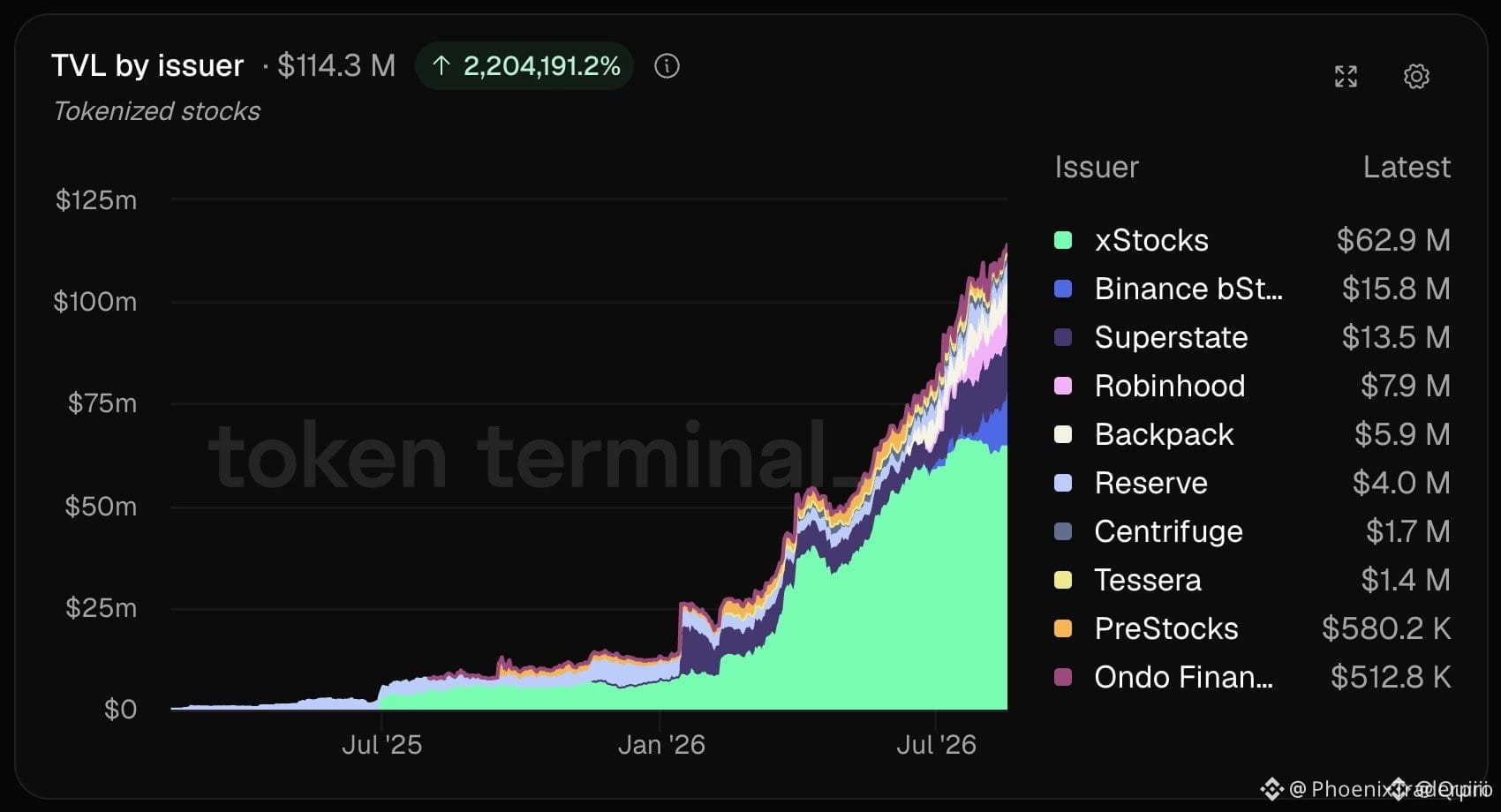
🦈 $XSTOCKS COMMANDS 55% OF ALL TOKENIZED STOCK TVL AS THE DISTRIBUTION ERA BEGINS! ⚡
Smart money is quietly positioning around real-world asset dominance, and $XSTOCKS is running the board. Capturing $62.9M out of $114.3M in total tokenized stock TVL, they now control a staggering 55% market share locked directly into active DeFi protocols. 📊
This isn't just speculative capital sitting idle; it is deep institutional yield unlocking its prime distribution phase. 🌊 When smart liquidity builds productive momentum this aggressively, broader market repricing usually follows fast. 💡
Are you accumulating exposure to the RWA expansion early, or waiting until mainstream volume chases the shift? 👇
⚠️ Not financial advice. Always manage your risk. 🛡️
🏷️ #XSTOCKS #RWA #DeFi #Tokenization
🔥 💎
🦈 $XSTOCKS COMMANDS 55% OF ALL TOKENIZED STOCK TVL AS THE DISTRIBUTION ERA BEGINS! ⚡
Smart money is quietly positioning around real-world asset dominance, and $XSTOCKS is running the board. Capturing $62.9M out of $114.3M in total tokenized stock TVL, they now control a staggering 55% market share locked directly into active DeFi protocols. 📊
This isn't just speculative capital sitting idle; it is deep institutional yield unlocking its prime distribution phase. 🌊 When smart liquidity builds productive momentum this aggressively, broader market repricing usually follows fast. 💡
Are you accumulating exposure to the RWA expansion early, or waiting until mainstream volume chases the shift? 👇
⚠️ Not financial advice. Always manage your risk. 🛡️
🏷️ #XSTOCKS #RWA #DeFi #Tokenization
🔥 💎
Smart money is quietly positioning around real-world asset dominance, and $XSTOCKS is running the board. Capturing $62.9M out of $114.3M in total tokenized stock TVL, they now control a staggering 55% market share locked directly into active DeFi protocols. 📊
This isn't just speculative capital sitting idle; it is deep institutional yield unlocking its prime distribution phase. 🌊 When smart liquidity builds productive momentum this aggressively, broader market repricing usually follows fast. 💡
Are you accumulating exposure to the RWA expansion early, or waiting until mainstream volume chases the shift? 👇
⚠️ Not financial advice. Always manage your risk. 🛡️
🏷️ #XSTOCKS #RWA #DeFi #Tokenization
🔥 💎
22
Log in to explore more content
Join global crypto users on Binance Square
⚡️ Get latest and useful information about crypto.
💬 Trusted by the world’s largest crypto exchange.
👍 Discover real insights from verified creators.
Email / Phone number
Trending Topics
1
#ZcashETFPostsFirstWeeklyOutflow$93.6M
38,110 views
129 Discussing
2
#GreekPoliceBustCryptoScamRingArrest17
88,602 views
747 Discussing
3
#BitcoinRejectedAt$87K
128,369 views
185 Discussing
4
#FedOctoberRateHikeOddsFallTo17%
113,492 views
1,020 Discussing
5
#NvidiaHitsRecordHighUp2.4%
80,103 views
742 Discussing
6
#CanaryFilesAmendedS1ForPEPEETF
21,872 views
522 Discussing
7
#USRussiaUkraineTalksReportedlyIncludeLukoilOilDeal
32,944 views
504 Discussing
8
#BitcoinParesGainsAfterRallyTo$86.5K
48,906 views
168 Discussing
9
#CerebrasSinksNearly20%OnReportNvidiaToPowerOpenAI
120,569 views
1,132 Discussing
10
#SECProposesCryptoCustodyRules
163,959 views
1,409 Discussing