

#circletetherfreezebitgethackerwallet
circletetherfreezebitgethackerwallet
Hot
Latest

·
--
Bullish
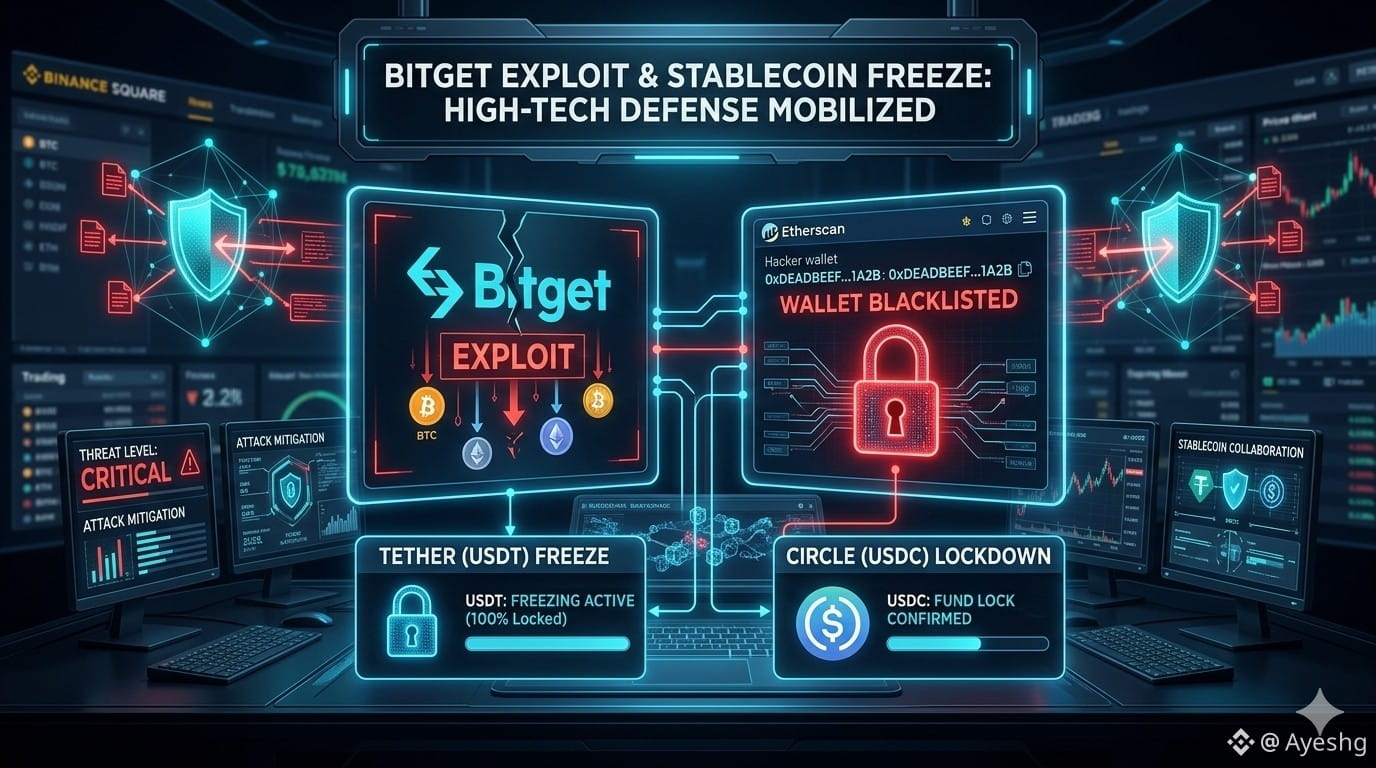
#circletetherfreezebitgethackerwallet 🚨 CIRCLE & TETHER FREEZE BITGET HACKER WALLET
A major crypto security incident has triggered another important debate around stablecoin controls.
Bitget reported a massive security breach on September 24, with the initial loss estimated at $351.6M. The exchange later revised the affected-asset estimate to approximately $387.5M, after accounting for additional assets including Zcash and TRON.
🔒 Circle & Tether Take Action
Circle blacklisted a wallet identified as “Bitget Exploiter 8”, while Tether subsequently blocked the same address.
The wallet contained approximately:
• 99,990 USDC
• 218,023 USDT
• 170.47 ETH
The freeze effectively locked around $318,000 worth of USDC and USDT.
⚠️ But there is a major limitation:
Stablecoin issuers can freeze their own tokens, but they cannot freeze native ETH. Reports indicate that other exploiter wallets still held more than 63,000 ETH.
Bitget CEO Gracy Chen said the attackers compromised a backend system in the exchange's wallet infrastructure and spoofed transaction data, rather than obtaining users' private keys. Bitget says its cold wallets were unaffected and its User Protection Fund holds more than $464M.
📌 The bigger takeaway:
This incident shows both the power and limits of centralized stablecoin controls. USDC and USDT can potentially be frozen at the token-contract level, while assets such as ETH cannot be frozen by stablecoin issuers.
👀 Assets to watch:
$BTC • $ETH • $XRP
#Bitget #CryptoSecurity #Circle #Tether #USDC #USDT #CryptoNews
#circletetherfreezebitgethackerwallet 🚨 CIRCLE & TETHER FREEZE BITGET HACKER WALLET
A major crypto security incident has triggered another important debate around stablecoin controls.
Bitget reported a massive security breach on September 24, with the initial loss estimated at $351.6M. The exchange later revised the affected-asset estimate to approximately $387.5M, after accounting for additional assets including Zcash and TRON.
🔒 Circle & Tether Take Action
Circle blacklisted a wallet identified as “Bitget Exploiter 8”, while Tether subsequently blocked the same address.
The wallet contained approximately:
• 99,990 USDC
• 218,023 USDT
• 170.47 ETH
The freeze effectively locked around $318,000 worth of USDC and USDT.
⚠️ But there is a major limitation:
Stablecoin issuers can freeze their own tokens, but they cannot freeze native ETH. Reports indicate that other exploiter wallets still held more than 63,000 ETH.
Bitget CEO Gracy Chen said the attackers compromised a backend system in the exchange's wallet infrastructure and spoofed transaction data, rather than obtaining users' private keys. Bitget says its cold wallets were unaffected and its User Protection Fund holds more than $464M.
📌 The bigger takeaway:
This incident shows both the power and limits of centralized stablecoin controls. USDC and USDT can potentially be frozen at the token-contract level, while assets such as ETH cannot be frozen by stablecoin issuers.
👀 Assets to watch:
$BTC • $ETH • $XRP
#Bitget #CryptoSecurity #Circle #Tether #USDC #USDT #CryptoNews
A major crypto security incident has triggered another important debate around stablecoin controls.
Bitget reported a massive security breach on September 24, with the initial loss estimated at $351.6M. The exchange later revised the affected-asset estimate to approximately $387.5M, after accounting for additional assets including Zcash and TRON.
🔒 Circle & Tether Take Action
Circle blacklisted a wallet identified as “Bitget Exploiter 8”, while Tether subsequently blocked the same address.
The wallet contained approximately:
• 99,990 USDC
• 218,023 USDT
• 170.47 ETH
The freeze effectively locked around $318,000 worth of USDC and USDT.
⚠️ But there is a major limitation:
Stablecoin issuers can freeze their own tokens, but they cannot freeze native ETH. Reports indicate that other exploiter wallets still held more than 63,000 ETH.
Bitget CEO Gracy Chen said the attackers compromised a backend system in the exchange's wallet infrastructure and spoofed transaction data, rather than obtaining users' private keys. Bitget says its cold wallets were unaffected and its User Protection Fund holds more than $464M.
📌 The bigger takeaway:
This incident shows both the power and limits of centralized stablecoin controls. USDC and USDT can potentially be frozen at the token-contract level, while assets such as ETH cannot be frozen by stablecoin issuers.
👀 Assets to watch:
$BTC • $ETH • $XRP
#Bitget #CryptoSecurity #Circle #Tether #USDC #USDT #CryptoNews
samjen:
سؤال للكل: 387.5 مليون دولار اتسرقت و اللي اتجمد 318 ألف بس؟ يعني أقل من 0.1% 😂 الهاكر لسه معاه 63 ألف ETH يعني 150 مليون دولار شغالة عادي! كده Circle و Tether بيثبتوا ان الـ stablecoins مش آمنة ولا لا مركزية، لو بكره اتخانقوا مع أي منصة يقدروا يجمدوا فلوسك. انت شايف التجميد ده ميزة ولا خطر علينا؟
4
1
1
9.1k

·
--
#circletetherfreezebitgethackerwallet
🔒 On-Chain Defense: Stablecoin Issuers Freeze Stolen Funds Following Recent Bitget Exploit 🚨
🚨 What Happened?
Following a massive security exploit on global crypto exchange Bitget totaling an estimated $351M to $387M in stolen assets, top stablecoin issuers Circle and Tether acted rapidly to blacklist linked hacker addresses.
The primary targeted wallet, labeled on Etherscan as Bitget Exploiter 8, was blacklisted to immobilize roughly $318,000 in USDC and USDT.
🔑 Key Takeaways & Incident Details
Collaborative Industry Response: Circle and Tether executed a swift joint freeze. Circle blacklisted the hacker address on Ethereum, and Tether banned the wallet shortly after to lock down dollar-pegged assets.
Attack Method Identified: Bitget CEO Gracy Chen confirmed that attackers compromised a backend infrastructure system and spoofed transaction data. It was not a private key leak or a breach of the exchange's cold storage.
User Protection Fund Covers Loss: Bitget assured users that its $464M+ User Protection Fund completely covers all stolen assets. Temporary withdrawal pauses were initiated strictly as a security precaution.
The Limits of Centralized Freezes: While stablecoin issuers can freeze USDT and USDC on EVM chains, hackers quickly swapped the bulk of stolen funds into Non-Freezable assets (like Ether), highlighting both the power and boundaries of centralized Web3 security interventions.
💡 Why It Matters for Traders
Centralization vs. Censorship Resistance: The rapid freezing of stablecoins demonstrates how major issuers safeguard the ecosystem, though it serves as a reminder that pegged stablecoins can be controlled at the smart contract level.
Laundering Bottlenecks: Blacklisting malicious wallets limits cross-chain bridge routes, forcing hackers into traced, illiquid paths monitored by security analysts.
How do you feel about stablecoin issuers having the power to freeze funds? Drop your thoughts below! 👇
#CircleMints500MUSDCOnSolana #Bitget #CryptoSecurity
#circletetherfreezebitgethackerwallet
🔒 On-Chain Defense: Stablecoin Issuers Freeze Stolen Funds Following Recent Bitget Exploit 🚨
🚨 What Happened?
Following a massive security exploit on global crypto exchange Bitget totaling an estimated $351M to $387M in stolen assets, top stablecoin issuers Circle and Tether acted rapidly to blacklist linked hacker addresses.
The primary targeted wallet, labeled on Etherscan as Bitget Exploiter 8, was blacklisted to immobilize roughly $318,000 in USDC and USDT.
🔑 Key Takeaways & Incident Details
Collaborative Industry Response: Circle and Tether executed a swift joint freeze. Circle blacklisted the hacker address on Ethereum, and Tether banned the wallet shortly after to lock down dollar-pegged assets.
Attack Method Identified: Bitget CEO Gracy Chen confirmed that attackers compromised a backend infrastructure system and spoofed transaction data. It was not a private key leak or a breach of the exchange's cold storage.
User Protection Fund Covers Loss: Bitget assured users that its $464M+ User Protection Fund completely covers all stolen assets. Temporary withdrawal pauses were initiated strictly as a security precaution.
The Limits of Centralized Freezes: While stablecoin issuers can freeze USDT and USDC on EVM chains, hackers quickly swapped the bulk of stolen funds into Non-Freezable assets (like Ether), highlighting both the power and boundaries of centralized Web3 security interventions.
💡 Why It Matters for Traders
Centralization vs. Censorship Resistance: The rapid freezing of stablecoins demonstrates how major issuers safeguard the ecosystem, though it serves as a reminder that pegged stablecoins can be controlled at the smart contract level.
Laundering Bottlenecks: Blacklisting malicious wallets limits cross-chain bridge routes, forcing hackers into traced, illiquid paths monitored by security analysts.
How do you feel about stablecoin issuers having the power to freeze funds? Drop your thoughts below! 👇
#CircleMints500MUSDCOnSolana #Bitget #CryptoSecurity
🔒 On-Chain Defense: Stablecoin Issuers Freeze Stolen Funds Following Recent Bitget Exploit 🚨
🚨 What Happened?
Following a massive security exploit on global crypto exchange Bitget totaling an estimated $351M to $387M in stolen assets, top stablecoin issuers Circle and Tether acted rapidly to blacklist linked hacker addresses.
The primary targeted wallet, labeled on Etherscan as Bitget Exploiter 8, was blacklisted to immobilize roughly $318,000 in USDC and USDT.
🔑 Key Takeaways & Incident Details
Collaborative Industry Response: Circle and Tether executed a swift joint freeze. Circle blacklisted the hacker address on Ethereum, and Tether banned the wallet shortly after to lock down dollar-pegged assets.
Attack Method Identified: Bitget CEO Gracy Chen confirmed that attackers compromised a backend infrastructure system and spoofed transaction data. It was not a private key leak or a breach of the exchange's cold storage.
User Protection Fund Covers Loss: Bitget assured users that its $464M+ User Protection Fund completely covers all stolen assets. Temporary withdrawal pauses were initiated strictly as a security precaution.
The Limits of Centralized Freezes: While stablecoin issuers can freeze USDT and USDC on EVM chains, hackers quickly swapped the bulk of stolen funds into Non-Freezable assets (like Ether), highlighting both the power and boundaries of centralized Web3 security interventions.
💡 Why It Matters for Traders
Centralization vs. Censorship Resistance: The rapid freezing of stablecoins demonstrates how major issuers safeguard the ecosystem, though it serves as a reminder that pegged stablecoins can be controlled at the smart contract level.
Laundering Bottlenecks: Blacklisting malicious wallets limits cross-chain bridge routes, forcing hackers into traced, illiquid paths monitored by security analysts.
How do you feel about stablecoin issuers having the power to freeze funds? Drop your thoughts below! 👇
#CircleMints500MUSDCOnSolana #Bitget #CryptoSecurity
Sade Uziel whLu:
هاي اريد كسب المال
1
7
7.7k

·
--
#circletetherfreezebitgethackerwallet
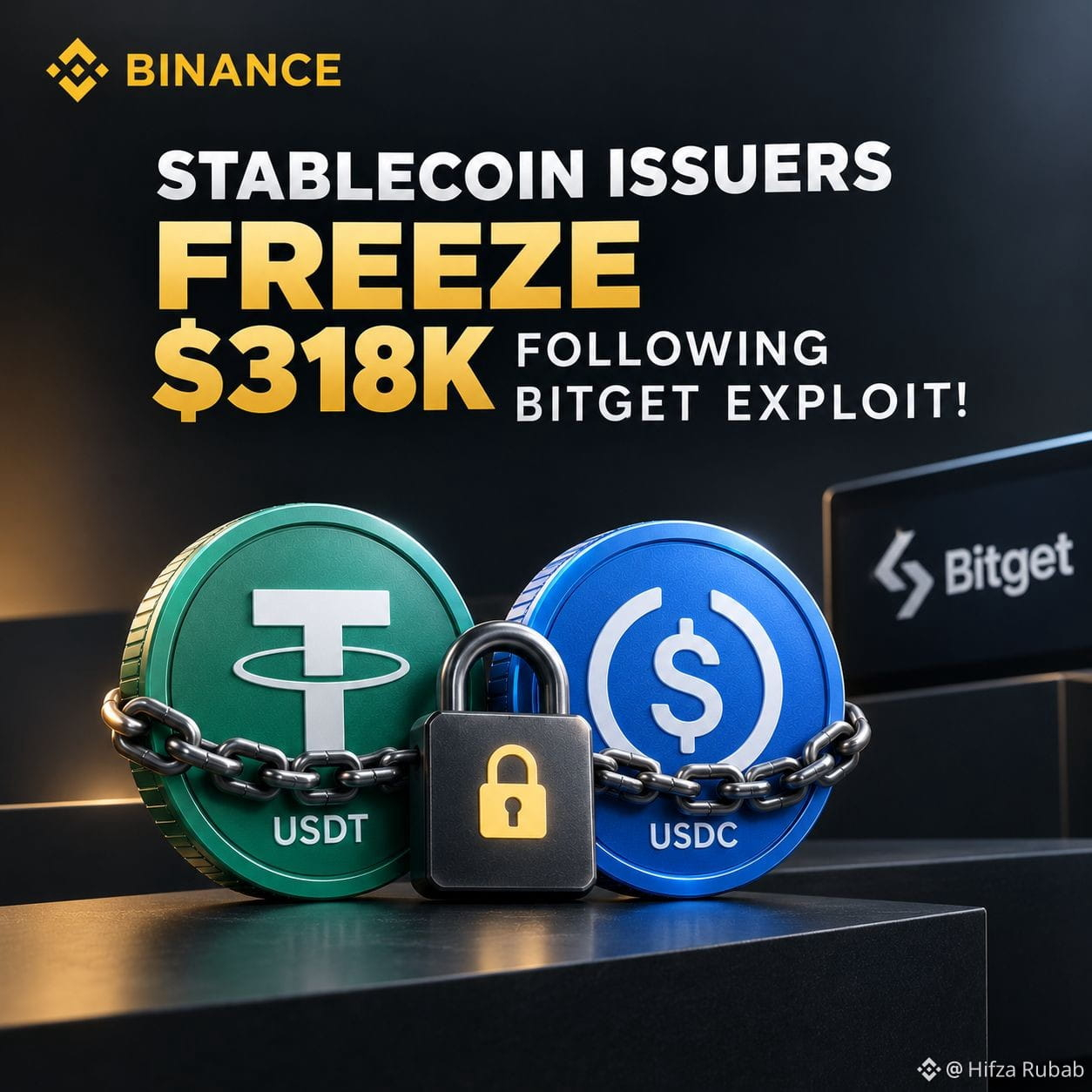
🔒 STABLECOIN ISSUERS FREEZE $318K FOLLOWING BITGET EXPLOIT! 🚨⚡
Circle and Tether acted rapidly to blacklist linked hacker addresses following the recent security exploit on Bitget! 🛡️✨
💡 Quick Incident Breakdowns:
🔹 Rapid Issuer Response: Circle and Tether locked down ~$318K in USDC and USDT across blacklisted wallets! 🛑
🔹 Backend System Compromise: Attackers spoofed transaction data rather than compromising cold storage or private keys.
🔹 Limits of Centralization: While pegged stablecoins were frozen, hackers swapped the majority of stolen funds into non-freezable assets like Ether! ⛓️
🎯 2 Key Coins to Watch:
💲 $USDT — Demonstrates smart-contract freeze controls while reinforcing the central role of stablecoins in exchange risk management! 📊⚡
🌐 $ETH — Highlights censorship resistance as decentralized layer-1 assets remain beyond centralized blacklist mechanisms! 🚀💎
What do you think—are centralized stablecoin freezes essential for ecosystem protection or a concern for decentralization? Drop your thoughts below! 👇✨
#CircleTetherFreezeBitgetHackerWallet
#SECCommissionerPeirceToLeaveOct2
#PolymarketBankFailureBetsDrawFDICConcern
#SECCommissionerPeirceToLeaveOct2
{spot}(ETHUSDT)
{spot}(USDCUSDT)
#circletetherfreezebitgethackerwallet
🔒 STABLECOIN ISSUERS FREEZE $318K FOLLOWING BITGET EXPLOIT! 🚨⚡
Circle and Tether acted rapidly to blacklist linked hacker addresses following the recent security exploit on Bitget! 🛡️✨
💡 Quick Incident Breakdowns:
🔹 Rapid Issuer Response: Circle and Tether locked down ~$318K in USDC and USDT across blacklisted wallets! 🛑
🔹 Backend System Compromise: Attackers spoofed transaction data rather than compromising cold storage or private keys.
🔹 Limits of Centralization: While pegged stablecoins were frozen, hackers swapped the majority of stolen funds into non-freezable assets like Ether! ⛓️
🎯 2 Key Coins to Watch:
💲 $USDT — Demonstrates smart-contract freeze controls while reinforcing the central role of stablecoins in exchange risk management! 📊⚡
🌐 $ETH — Highlights censorship resistance as decentralized layer-1 assets remain beyond centralized blacklist mechanisms! 🚀💎
What do you think—are centralized stablecoin freezes essential for ecosystem protection or a concern for decentralization? Drop your thoughts below! 👇✨
#CircleTetherFreezeBitgetHackerWallet
#SECCommissionerPeirceToLeaveOct2
#PolymarketBankFailureBetsDrawFDICConcern
#SECCommissionerPeirceToLeaveOct2
🔒 STABLECOIN ISSUERS FREEZE $318K FOLLOWING BITGET EXPLOIT! 🚨⚡
Circle and Tether acted rapidly to blacklist linked hacker addresses following the recent security exploit on Bitget! 🛡️✨
💡 Quick Incident Breakdowns:
🔹 Rapid Issuer Response: Circle and Tether locked down ~$318K in USDC and USDT across blacklisted wallets! 🛑
🔹 Backend System Compromise: Attackers spoofed transaction data rather than compromising cold storage or private keys.
🔹 Limits of Centralization: While pegged stablecoins were frozen, hackers swapped the majority of stolen funds into non-freezable assets like Ether! ⛓️
🎯 2 Key Coins to Watch:
💲 $USDT — Demonstrates smart-contract freeze controls while reinforcing the central role of stablecoins in exchange risk management! 📊⚡
🌐 $ETH — Highlights censorship resistance as decentralized layer-1 assets remain beyond centralized blacklist mechanisms! 🚀💎
What do you think—are centralized stablecoin freezes essential for ecosystem protection or a concern for decentralization? Drop your thoughts below! 👇✨
#CircleTetherFreezeBitgetHackerWallet
#SECCommissionerPeirceToLeaveOct2
#PolymarketBankFailureBetsDrawFDICConcern
#SECCommissionerPeirceToLeaveOct2
M REHAN7:
Great action! Circle and Tether froze $318K linked to Bitget exploit so fast — shows centralized stablecoins have power to stop hackers. But does this go against crypto decentralization? What do you think — is freeze power good or bad for crypto?
6
1
5
2.1k

·
--
#circletetherfreezebitgethackerwallet
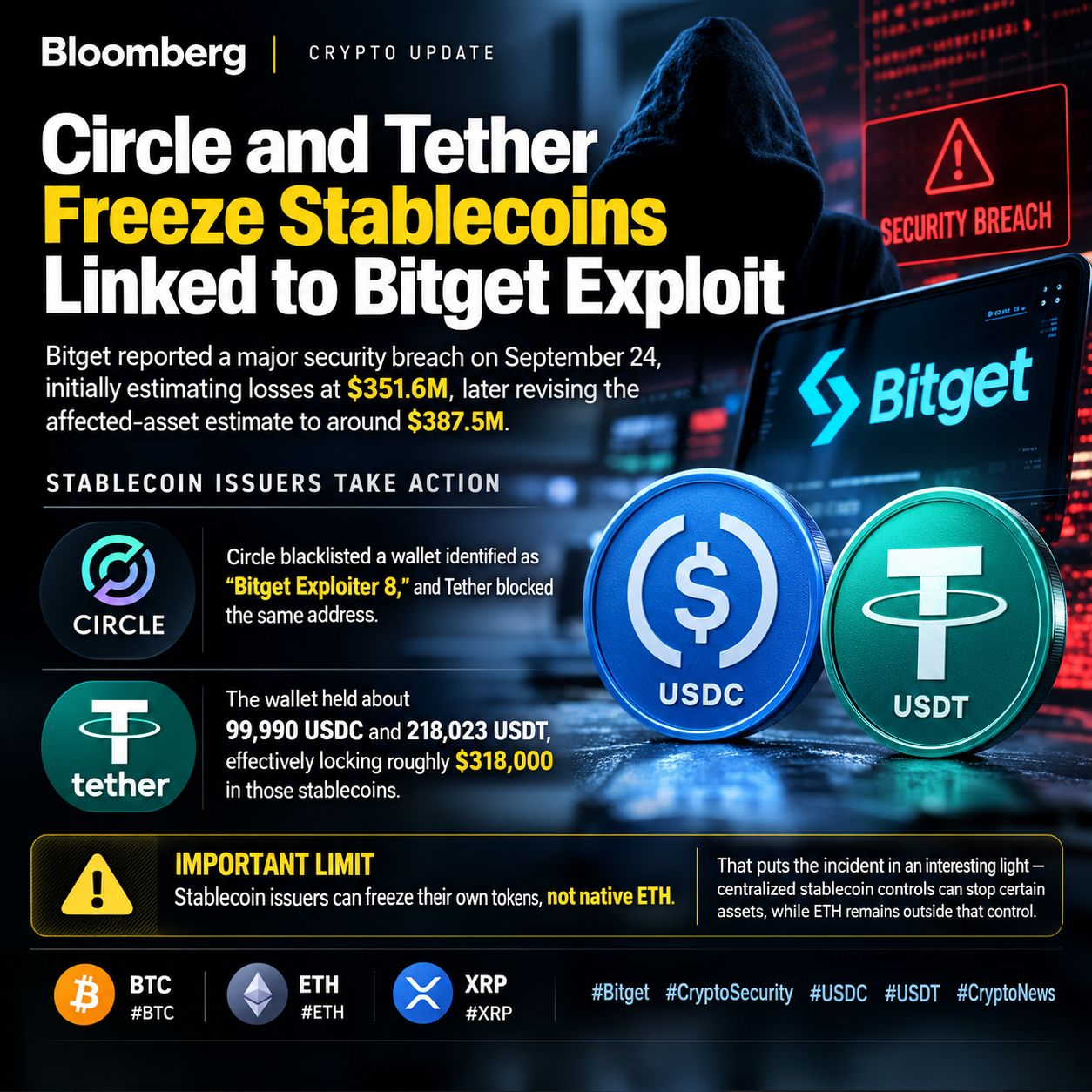
🚨 Circle and Tether have frozen stablecoins linked to the Bitget exploit.
Bitget reported a major security breach on September 24, initially estimating losses at $351.6M before revising the affected-asset estimate to around $387.5M.
Two stablecoin issuers then took action.
Circle blacklisted a wallet identified as “Bitget Exploiter 8,” and Tether blocked the same address. The wallet held about 99,990 USDC and 218,023 USDT, effectively locking roughly $318,000 in those stablecoins.
But there’s an important limit: stablecoin issuers can freeze their own tokens, not native ETH.
That puts the incident in an interesting light — centralized stablecoin controls can stop certain assets, while ETH remains outside that control.
$BTC
{spot}(BTCUSDT)
$ETH
{spot}(ETHUSDT)
$XRP
{spot}(XRPUSDT)
#Bitget #CryptoSecurity #USDC #USDT #CryptoNews
#circletetherfreezebitgethackerwallet
🚨 Circle and Tether have frozen stablecoins linked to the Bitget exploit.
Bitget reported a major security breach on September 24, initially estimating losses at $351.6M before revising the affected-asset estimate to around $387.5M.
Two stablecoin issuers then took action.
Circle blacklisted a wallet identified as “Bitget Exploiter 8,” and Tether blocked the same address. The wallet held about 99,990 USDC and 218,023 USDT, effectively locking roughly $318,000 in those stablecoins.
But there’s an important limit: stablecoin issuers can freeze their own tokens, not native ETH.
That puts the incident in an interesting light — centralized stablecoin controls can stop certain assets, while ETH remains outside that control.
$BTC
$ETH
$XRP
#Bitget #CryptoSecurity #USDC #USDT #CryptoNews
🚨 Circle and Tether have frozen stablecoins linked to the Bitget exploit.
Bitget reported a major security breach on September 24, initially estimating losses at $351.6M before revising the affected-asset estimate to around $387.5M.
Two stablecoin issuers then took action.
Circle blacklisted a wallet identified as “Bitget Exploiter 8,” and Tether blocked the same address. The wallet held about 99,990 USDC and 218,023 USDT, effectively locking roughly $318,000 in those stablecoins.
But there’s an important limit: stablecoin issuers can freeze their own tokens, not native ETH.
That puts the incident in an interesting light — centralized stablecoin controls can stop certain assets, while ETH remains outside that control.
$BTC
$ETH
$XRP
#Bitget #CryptoSecurity #USDC #USDT #CryptoNews
165

·
--
Bearish
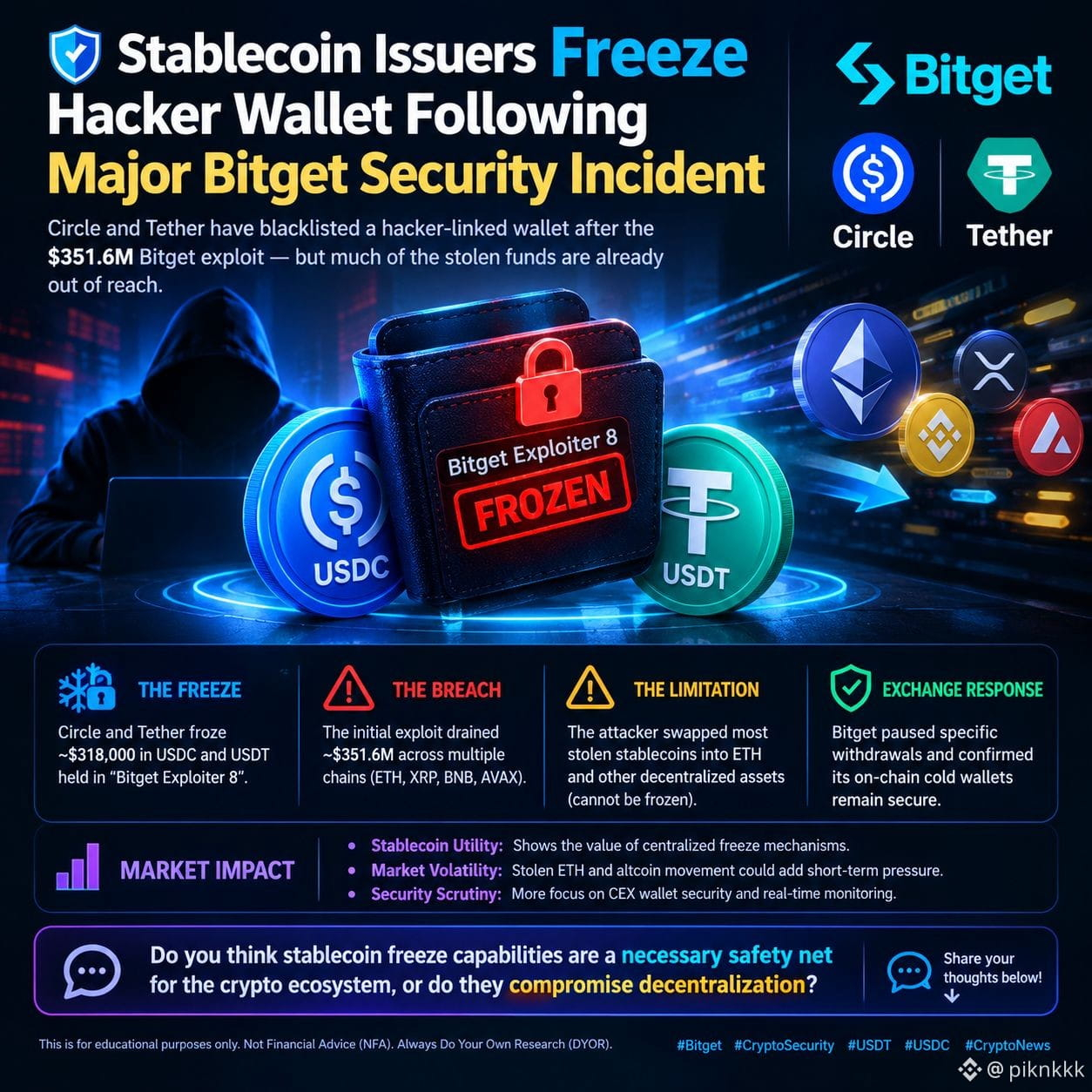
#circletetherfreezebitgethackerwallet 🛡️ Stablecoin Issuers Freeze Hacker Wallet Following Major Bitget Security Incident
In a swift response to the recent $351.6M Bitget exploit, Circle and Tether have successfully blacklisted a hacker-linked wallet. However, this action only represents a fraction of the total compromised assets.
📰 Core News
• 🔒 The Freeze Circle and Tether collaborated to freeze approximately $318,000 in USDC and USDT held in a wallet labeled "Bitget Exploiter 8" [[13]].
• 💸 The Breach The initial exploit resulted in the drainage of roughly $351.6 million across multiple chains, affecting tokens like ETH, XRP, BNB, and AVAX [[1]].
The Limitation The attacker had already swapped the majority of the stolen stablecoins into Ethereum and other decentralized assets, which cannot be centrally frozen by issuers [[11]].
• 🛡️ Exchange Response Bitget has paused specific withdrawals and confirmed that its on-chain cold wallets remain secure and unaffected [[14]].
📊 Market Impact
• Stablecoin Utility This event underscores the critical role of centralized freeze mechanisms in USDT and USDC as a defensive tool against on-chain exploits.
•Market VolatilitY The movement of large amounts of stolen ETH and altcoins by the attacker could introduce short-term selling pressure on those specific assets.
•Security Scrutiny Expect heightened community and regulatory focus on centralized exchange (CEX) hot wallet security protocols and real-time on-chain monitoring.
💬 Join the Discussion
Do you think stablecoin freeze capabilities are a necessary safety net for the crypto ecosystem, or do they compromise the core principle of decentralization? Share your thoughts below! 👇
#Bitget #CryptoSecurity #USDT #USDC #CryptoNews
This is for educational purposes only. Not Financial Advice (NFA). Always Do Your Own Research (DYOR).
$QI $NIL $QUICK
{spot}(QUICKUSDT)
{future}(NILUSDT)
{spot}(QIUSDT)
#circletetherfreezebitgethackerwallet 🛡️ Stablecoin Issuers Freeze Hacker Wallet Following Major Bitget Security Incident
In a swift response to the recent $351.6M Bitget exploit, Circle and Tether have successfully blacklisted a hacker-linked wallet. However, this action only represents a fraction of the total compromised assets.
📰 Core News
• 🔒 The Freeze Circle and Tether collaborated to freeze approximately $318,000 in USDC and USDT held in a wallet labeled "Bitget Exploiter 8" [[13]].
• 💸 The Breach The initial exploit resulted in the drainage of roughly $351.6 million across multiple chains, affecting tokens like ETH, XRP, BNB, and AVAX [[1]].
The Limitation The attacker had already swapped the majority of the stolen stablecoins into Ethereum and other decentralized assets, which cannot be centrally frozen by issuers [[11]].
• 🛡️ Exchange Response Bitget has paused specific withdrawals and confirmed that its on-chain cold wallets remain secure and unaffected [[14]].
📊 Market Impact
• Stablecoin Utility This event underscores the critical role of centralized freeze mechanisms in USDT and USDC as a defensive tool against on-chain exploits.
•Market VolatilitY The movement of large amounts of stolen ETH and altcoins by the attacker could introduce short-term selling pressure on those specific assets.
•Security Scrutiny Expect heightened community and regulatory focus on centralized exchange (CEX) hot wallet security protocols and real-time on-chain monitoring.
💬 Join the Discussion
Do you think stablecoin freeze capabilities are a necessary safety net for the crypto ecosystem, or do they compromise the core principle of decentralization? Share your thoughts below! 👇
#Bitget #CryptoSecurity #USDT #USDC #CryptoNews
This is for educational purposes only. Not Financial Advice (NFA). Always Do Your Own Research (DYOR).
$QI $NIL $QUICK
In a swift response to the recent $351.6M Bitget exploit, Circle and Tether have successfully blacklisted a hacker-linked wallet. However, this action only represents a fraction of the total compromised assets.
📰 Core News
• 🔒 The Freeze Circle and Tether collaborated to freeze approximately $318,000 in USDC and USDT held in a wallet labeled "Bitget Exploiter 8" [[13]].
• 💸 The Breach The initial exploit resulted in the drainage of roughly $351.6 million across multiple chains, affecting tokens like ETH, XRP, BNB, and AVAX [[1]].
The Limitation The attacker had already swapped the majority of the stolen stablecoins into Ethereum and other decentralized assets, which cannot be centrally frozen by issuers [[11]].
• 🛡️ Exchange Response Bitget has paused specific withdrawals and confirmed that its on-chain cold wallets remain secure and unaffected [[14]].
📊 Market Impact
• Stablecoin Utility This event underscores the critical role of centralized freeze mechanisms in USDT and USDC as a defensive tool against on-chain exploits.
•Market VolatilitY The movement of large amounts of stolen ETH and altcoins by the attacker could introduce short-term selling pressure on those specific assets.
•Security Scrutiny Expect heightened community and regulatory focus on centralized exchange (CEX) hot wallet security protocols and real-time on-chain monitoring.
💬 Join the Discussion
Do you think stablecoin freeze capabilities are a necessary safety net for the crypto ecosystem, or do they compromise the core principle of decentralization? Share your thoughts below! 👇
#Bitget #CryptoSecurity #USDT #USDC #CryptoNews
This is for educational purposes only. Not Financial Advice (NFA). Always Do Your Own Research (DYOR).
$QI $NIL $QUICK
206 Atlas:
Freezing $318k of a $350M exploit is negligible. The real risk is the sell pressure from the liquidated ETH and alts, not the frozen stablecoins.
2
2
4.1k

The crypto market is buzzing following reports of Circle freezing a Tether wallet linked to a Bitget hacker. This move signifies a growing collaboration between stablecoin issuers and exchanges to combat illicit activities within the ecosystem. Such actions are crucial for enhancing security and trust, potentially leading to greater institutional adoption. While this specific incident might be isolated, it sets a precedent for stricter measures against malicious actors. The market is watching closely to see how this impacts the security landscape and regulatory scrutiny going forward.
Disclaimer: This is not financial advice.
#CircleTetherFreezeBitgetHackerWallet
The crypto market is buzzing following reports of Circle freezing a Tether wallet linked to a Bitget hacker. This move signifies a growing collaboration between stablecoin issuers and exchanges to combat illicit activities within the ecosystem. Such actions are crucial for enhancing security and trust, potentially leading to greater institutional adoption. While this specific incident might be isolated, it sets a precedent for stricter measures against malicious actors. The market is watching closely to see how this impacts the security landscape and regulatory scrutiny going forward.
Disclaimer: This is not financial advice.
#CircleTetherFreezeBitgetHackerWallet
Disclaimer: This is not financial advice.
#CircleTetherFreezeBitgetHackerWallet
4
·
--
#circletetherfreezebitgethackerwallet
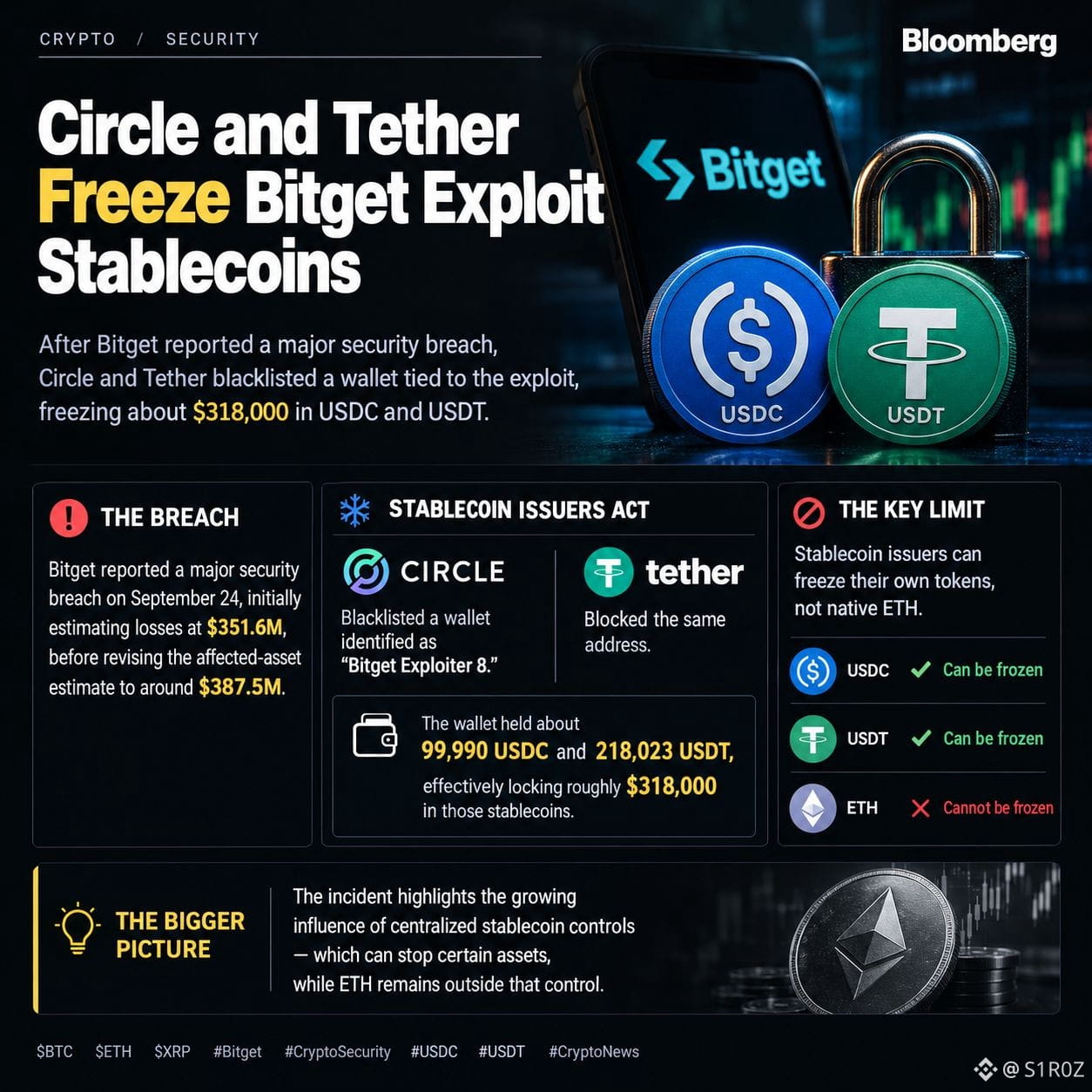
🔒 Circle and Tether froze about $318K linked to the Bitget exploit.
Following the security incident, both stablecoin issuers blacklisted addresses connected to the stolen funds, locking around $318K in $USDC
{spot}(USDCUSDT)
and $USDT .
But the bigger detail is how the attack reportedly happened.
The exploit involved spoofed transaction data rather than compromised cold storage or private keys. And while the stablecoins could be frozen, most of the stolen funds were swapped into assets like $ETH that can't be blocked through centralized blacklist controls.
For traders, it’s a clear look at the trade-off: stablecoin freeze mechanisms can help contain losses, but they also introduce another layer of centralization.
Would you prioritize stronger freeze controls or greater censorship resistance?
{spot}(ETHUSDT)
#USDT #USDC #ETH #Bitget #crypto
#circletetherfreezebitgethackerwallet
🔒 Circle and Tether froze about $318K linked to the Bitget exploit.
Following the security incident, both stablecoin issuers blacklisted addresses connected to the stolen funds, locking around $318K in $USDC
and $USDT .
But the bigger detail is how the attack reportedly happened.
The exploit involved spoofed transaction data rather than compromised cold storage or private keys. And while the stablecoins could be frozen, most of the stolen funds were swapped into assets like $ETH that can't be blocked through centralized blacklist controls.
For traders, it’s a clear look at the trade-off: stablecoin freeze mechanisms can help contain losses, but they also introduce another layer of centralization.
Would you prioritize stronger freeze controls or greater censorship resistance?
#USDT #USDC #ETH #Bitget #crypto
🔒 Circle and Tether froze about $318K linked to the Bitget exploit.
Following the security incident, both stablecoin issuers blacklisted addresses connected to the stolen funds, locking around $318K in $USDC
and $USDT .
But the bigger detail is how the attack reportedly happened.
The exploit involved spoofed transaction data rather than compromised cold storage or private keys. And while the stablecoins could be frozen, most of the stolen funds were swapped into assets like $ETH that can't be blocked through centralized blacklist controls.
For traders, it’s a clear look at the trade-off: stablecoin freeze mechanisms can help contain losses, but they also introduce another layer of centralization.
Would you prioritize stronger freeze controls or greater censorship resistance?
#USDT #USDC #ETH #Bitget #crypto
20

·
--
🚨 Circle & Tether freeze Bitget hacker wallet
Stablecoin issuers blacklisted an address tied to the Bitget exploit.
~$318K locked: 99,990 USDC + 218,023 USDT.
Circle acted first, Tether followed hours later.
The wallet (labeled “Bitget Exploiter 8”) also held ETH that remains unfrozen.
Most stolen funds had already been swapped into ETH.
Bitget’s total loss estimate now sits near $387–388M.
Protection fund covers users.
Small recovery, but fast issuer response.
$ETH
{spot}(ETHUSDT)
$SOL
{future}(SOLUSDT)
$XRP
{future}(XRPUSDT)
#Bitget #Circle #Tether #circletetherfreezebitgethackerwallet
🚨 Circle & Tether freeze Bitget hacker wallet
Stablecoin issuers blacklisted an address tied to the Bitget exploit.
~$318K locked: 99,990 USDC + 218,023 USDT.
Circle acted first, Tether followed hours later.
The wallet (labeled “Bitget Exploiter 8”) also held ETH that remains unfrozen.
Most stolen funds had already been swapped into ETH.
Bitget’s total loss estimate now sits near $387–388M.
Protection fund covers users.
Small recovery, but fast issuer response.
$ETH
$SOL
$XRP
#Bitget #Circle #Tether #circletetherfreezebitgethackerwallet
Stablecoin issuers blacklisted an address tied to the Bitget exploit.
~$318K locked: 99,990 USDC + 218,023 USDT.
Circle acted first, Tether followed hours later.
The wallet (labeled “Bitget Exploiter 8”) also held ETH that remains unfrozen.
Most stolen funds had already been swapped into ETH.
Bitget’s total loss estimate now sits near $387–388M.
Protection fund covers users.
Small recovery, but fast issuer response.
$ETH
$SOL
$XRP
#Bitget #Circle #Tether #circletetherfreezebitgethackerwallet
81

Bitget Exploit: Stablecoins Get FrozenThe Bitget exploit put crypto security back in focus. 👀
Circle and Tether blacklisted a linked wallet, freezing around $318K in USDC and USDT.
The key points:
• Bitget reported a backend infrastructure compromise
• Cold-wallet private keys were not affected, according to Bitget
• Stablecoin issuers were able to freeze their tokens
• The stolen funds also included assets that cannot be frozen by USDC or USDT issuers
The bigger takeaway:
Stablecoins bring speed and liquidity, but they also come with issuer-level controls.
That makes the Bitget incident more than just a hack story — it highlights the different security and control models across crypto assets.
Know what you hold. Know who can control it.
#circletetherfreezebitgethackerwallet #CircleMints500MUSDCOnSolana #Bitget #CryptoSecurity
{spot}(CRCLBUSDT)
{spot}(USDCUSDT)
{spot}(ETHUSDT)
Bitget Exploit: Stablecoins Get Frozen
The Bitget exploit put crypto security back in focus. 👀
Circle and Tether blacklisted a linked wallet, freezing around $318K in USDC and USDT.
The key points:
• Bitget reported a backend infrastructure compromise
• Cold-wallet private keys were not affected, according to Bitget
• Stablecoin issuers were able to freeze their tokens
• The stolen funds also included assets that cannot be frozen by USDC or USDT issuers
The bigger takeaway:
Stablecoins bring speed and liquidity, but they also come with issuer-level controls.
That makes the Bitget incident more than just a hack story — it highlights the different security and control models across crypto assets.
Know what you hold. Know who can control it.
#circletetherfreezebitgethackerwallet #CircleMints500MUSDCOnSolana #Bitget #CryptoSecurity
Circle and Tether blacklisted a linked wallet, freezing around $318K in USDC and USDT.
The key points:
• Bitget reported a backend infrastructure compromise
• Cold-wallet private keys were not affected, according to Bitget
• Stablecoin issuers were able to freeze their tokens
• The stolen funds also included assets that cannot be frozen by USDC or USDT issuers
The bigger takeaway:
Stablecoins bring speed and liquidity, but they also come with issuer-level controls.
That makes the Bitget incident more than just a hack story — it highlights the different security and control models across crypto assets.
Know what you hold. Know who can control it.
#circletetherfreezebitgethackerwallet #CircleMints500MUSDCOnSolana #Bitget #CryptoSecurity
1
1
35

·
--
🔐 Bitget's $387.5M incident just exposed a feature of crypto we rarely discuss honestly...
#bitwisefilestolistnearetfonnysearca
Bitget's revised accounting puts assets transferred to attacker-controlled addresses at approximately $387.5M. The exchange says the figure increased after identifying additional ZEC and TRON assets.
Bitget says its cold wallets were unaffected, while investigators from Mandiant and SlowMist were brought in.
Elliptic says the attack is highly likely to be DPRK-linked and reports that the compromise involved wallet-backend infrastructure rather than a private-key theft.
Then crypto's strangest line appeared.
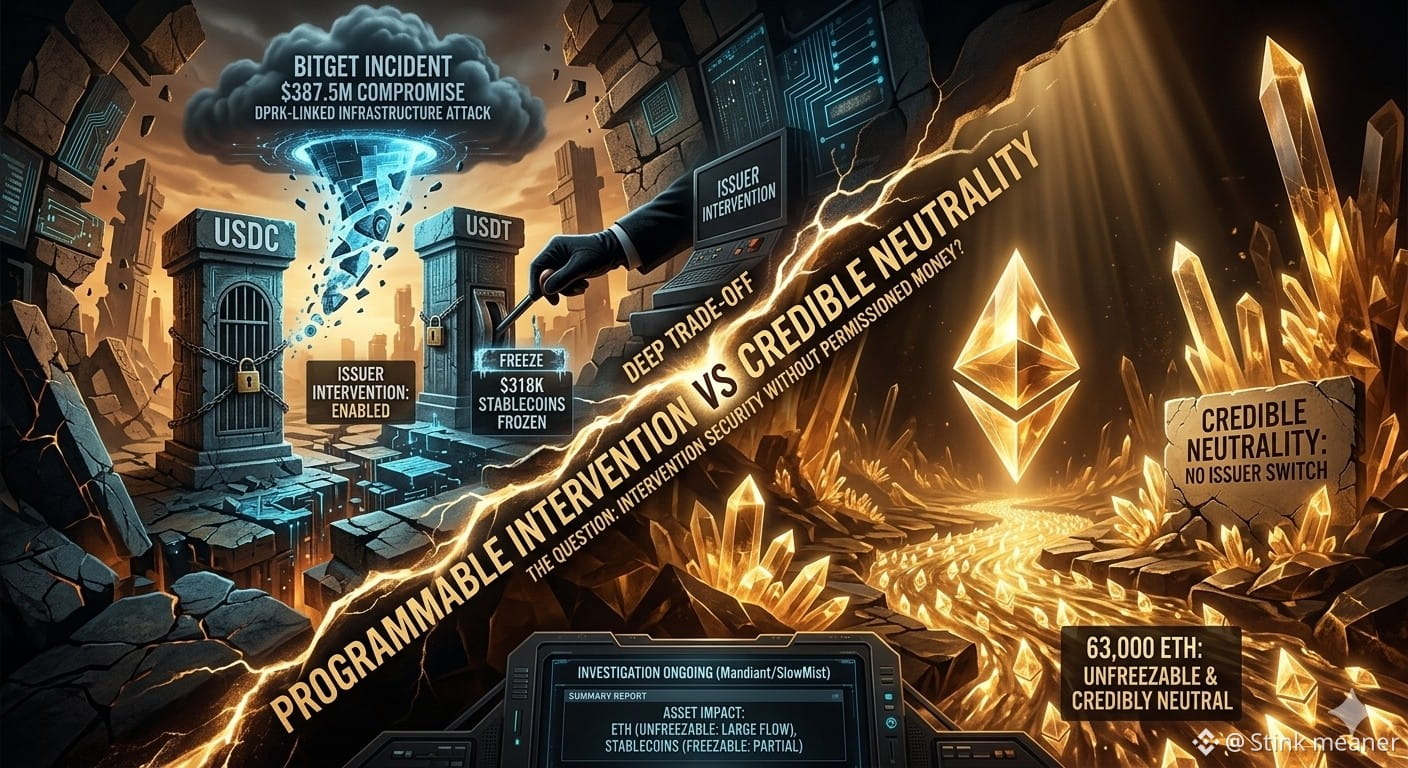
Circle and Tether froze roughly $318K of stablecoins linked to the exploiter.
But more than 63,000 ETH couldn't be frozen by an issuer.
Same blockchain ecosystem.
Two very different forms of money.
USDC/USDT: issuer intervention is possible.
ETH: the network doesn't have an issuer switch to pull.
That's not automatically good or bad.
It's the trade-off.
Programmable intervention vs credible neutrality.
The real question for crypto infrastructure is whether users can get the security benefits of intervention without turning permissionless assets into permissioned money.
DYOR. Investigation remains ongoing and Bitget has not published every technical detail.
$ETH $USDC $NEAR
#CircleTetherFreezeBitgetHackerWallet #SECSaysBuybacksUpgradesDontMakeTokenSecurity #Near #NYSEArca
🔐 Bitget's $387.5M incident just exposed a feature of crypto we rarely discuss honestly...
#bitwisefilestolistnearetfonnysearca
Bitget's revised accounting puts assets transferred to attacker-controlled addresses at approximately $387.5M. The exchange says the figure increased after identifying additional ZEC and TRON assets.
Bitget says its cold wallets were unaffected, while investigators from Mandiant and SlowMist were brought in.
Elliptic says the attack is highly likely to be DPRK-linked and reports that the compromise involved wallet-backend infrastructure rather than a private-key theft.
Then crypto's strangest line appeared.
Circle and Tether froze roughly $318K of stablecoins linked to the exploiter.
But more than 63,000 ETH couldn't be frozen by an issuer.
Same blockchain ecosystem.
Two very different forms of money.
USDC/USDT: issuer intervention is possible.
ETH: the network doesn't have an issuer switch to pull.
That's not automatically good or bad.
It's the trade-off.
Programmable intervention vs credible neutrality.
The real question for crypto infrastructure is whether users can get the security benefits of intervention without turning permissionless assets into permissioned money.
DYOR. Investigation remains ongoing and Bitget has not published every technical detail.
$ETH $USDC $NEAR
#CircleTetherFreezeBitgetHackerWallet #SECSaysBuybacksUpgradesDontMakeTokenSecurity #Near #NYSEArca
#bitwisefilestolistnearetfonnysearca
Bitget's revised accounting puts assets transferred to attacker-controlled addresses at approximately $387.5M. The exchange says the figure increased after identifying additional ZEC and TRON assets.
Bitget says its cold wallets were unaffected, while investigators from Mandiant and SlowMist were brought in.
Elliptic says the attack is highly likely to be DPRK-linked and reports that the compromise involved wallet-backend infrastructure rather than a private-key theft.
Then crypto's strangest line appeared.
Circle and Tether froze roughly $318K of stablecoins linked to the exploiter.
But more than 63,000 ETH couldn't be frozen by an issuer.
Same blockchain ecosystem.
Two very different forms of money.
USDC/USDT: issuer intervention is possible.
ETH: the network doesn't have an issuer switch to pull.
That's not automatically good or bad.
It's the trade-off.
Programmable intervention vs credible neutrality.
The real question for crypto infrastructure is whether users can get the security benefits of intervention without turning permissionless assets into permissioned money.
DYOR. Investigation remains ongoing and Bitget has not published every technical detail.
$ETH $USDC $NEAR
#CircleTetherFreezeBitgetHackerWallet #SECSaysBuybacksUpgradesDontMakeTokenSecurity #Near #NYSEArca
2
195

·
--
Bullish
#circletetherfreezebitgethackerwallet
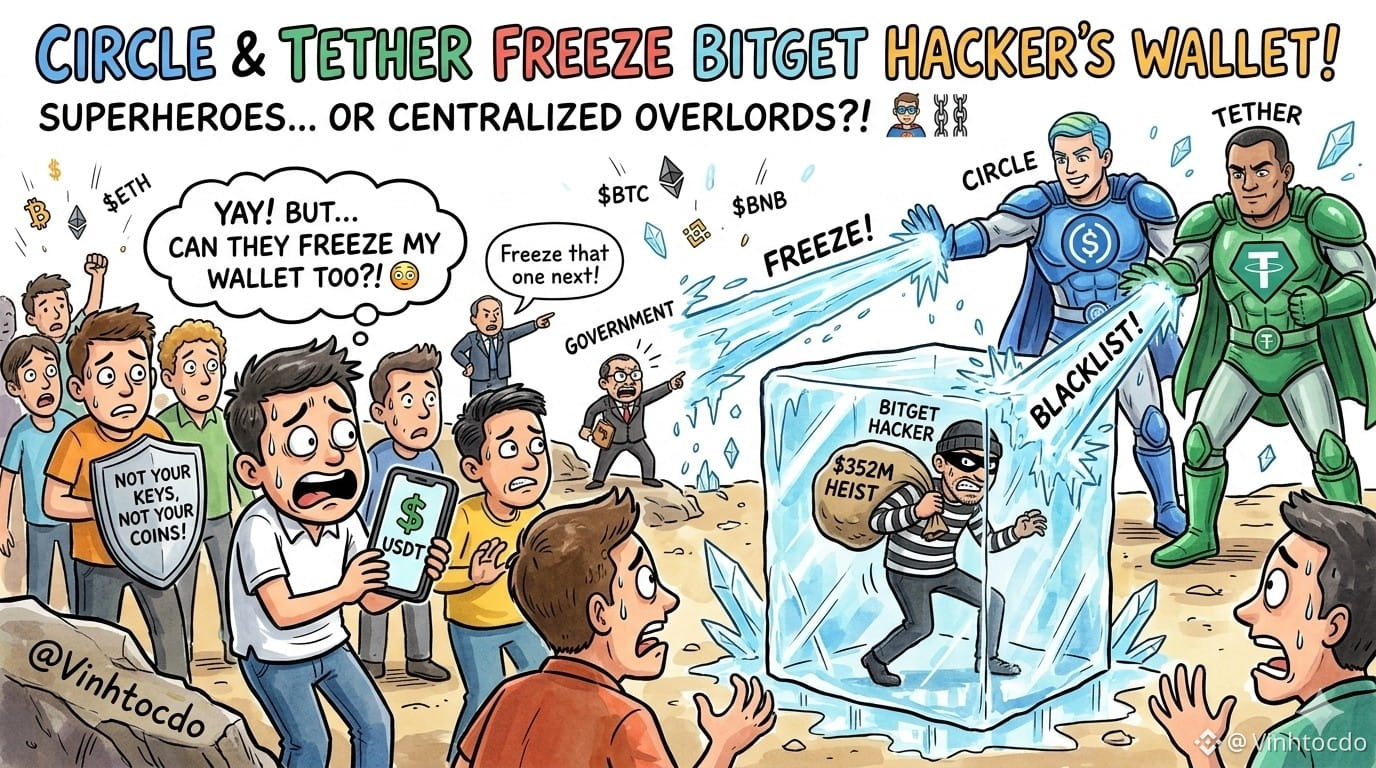
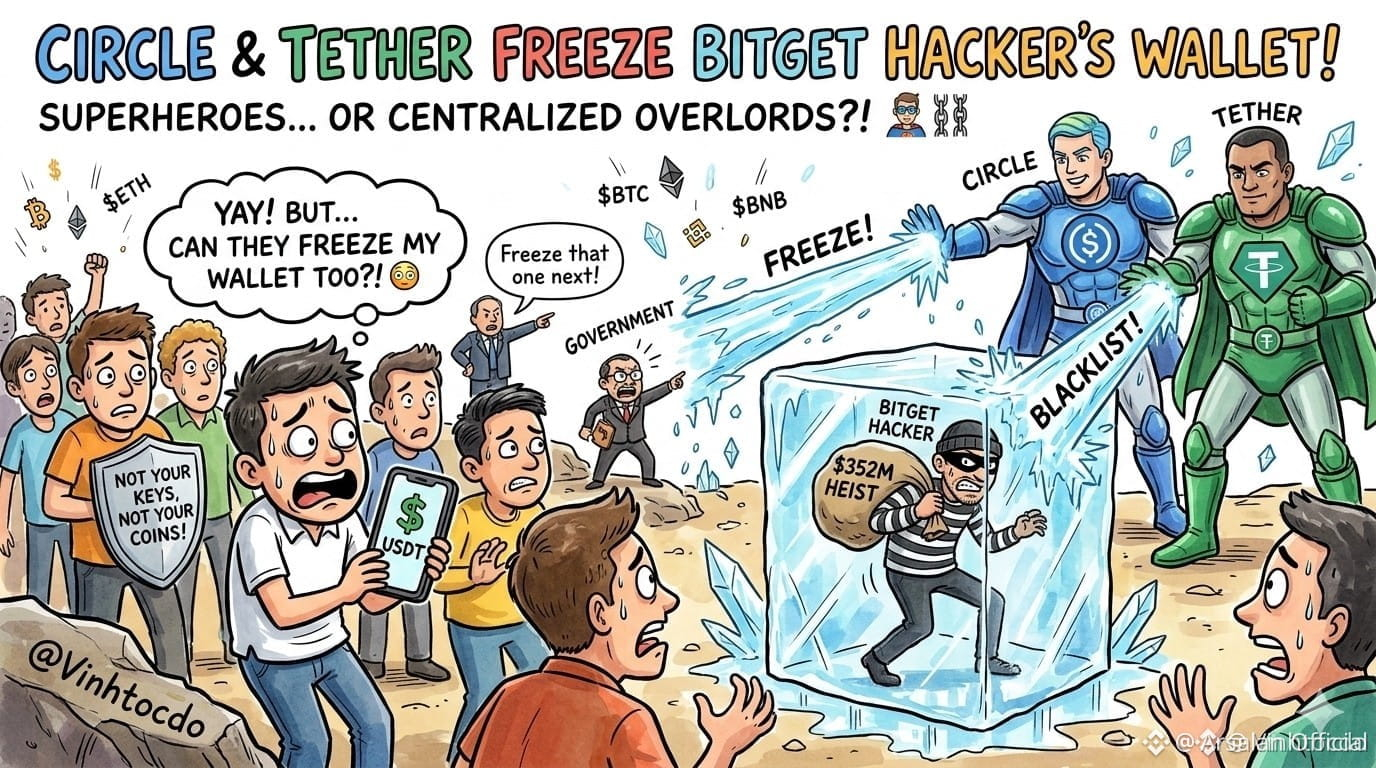
Circle & Tether froze the Bitget hacker’s wallet! Superheroes or Centralized Overlords? 🦸♂️⛓️
So, Circle and Tether just blacklisted the "Bitget Exploiter 8" wallet, freezing about $318,000 in stablecoins from the massive $352M heist. Catching the bad guys is awesome, right? 👏
But wait... this brings up a spooky question for everyday folks: If they can freeze a hacker's wallet with a snap of their fingers, what happens when a government orders them to freeze YOUR wallet next? 😳 The illusion of "decentralized" stablecoins is officially broken!
What should smart traders do? 🛠️
- Not your keys, not your coins: Don't hold massive stablecoin balances in one place forever.
- Diversify assets: Spread your capital into native crypto assets like BTC or ETH that no single CEO can just "freeze."
Disclaimer: This is personal opinion, not financial advice.
👇 Click and trade below to support me:
💰 $BNB
{future}(BNBUSDT)
| 💰 $BTC
{future}(BTCUSDT)
| 💰 $ETH
{future}(ETHUSDT)
📌 Referral Code: VINHTOCDO
🔗 Join Binance: [https://www.binance.com/register?ref=VINHTOCDO](https://www.binance.com/register?ref=VINHTOCDO)
#BitgetHack #Stablecoin #CryptoSecurity #VINHTOCDO #Tether #Circle
#circletetherfreezebitgethackerwallet
Circle & Tether froze the Bitget hacker’s wallet! Superheroes or Centralized Overlords? 🦸♂️⛓️
So, Circle and Tether just blacklisted the "Bitget Exploiter 8" wallet, freezing about $318,000 in stablecoins from the massive $352M heist. Catching the bad guys is awesome, right? 👏
But wait... this brings up a spooky question for everyday folks: If they can freeze a hacker's wallet with a snap of their fingers, what happens when a government orders them to freeze YOUR wallet next? 😳 The illusion of "decentralized" stablecoins is officially broken!
What should smart traders do? 🛠️
- Not your keys, not your coins: Don't hold massive stablecoin balances in one place forever.
- Diversify assets: Spread your capital into native crypto assets like BTC or ETH that no single CEO can just "freeze."
Disclaimer: This is personal opinion, not financial advice.
👇 Click and trade below to support me:
💰 $BNB
| 💰 $BTC
| 💰 $ETH
📌 Referral Code: VINHTOCDO
🔗 Join Binance: https://www.binance.com/register?ref=VINHTOCDO
#BitgetHack #Stablecoin #CryptoSecurity #VINHTOCDO #Tether #Circle
Circle & Tether froze the Bitget hacker’s wallet! Superheroes or Centralized Overlords? 🦸♂️⛓️
So, Circle and Tether just blacklisted the "Bitget Exploiter 8" wallet, freezing about $318,000 in stablecoins from the massive $352M heist. Catching the bad guys is awesome, right? 👏
But wait... this brings up a spooky question for everyday folks: If they can freeze a hacker's wallet with a snap of their fingers, what happens when a government orders them to freeze YOUR wallet next? 😳 The illusion of "decentralized" stablecoins is officially broken!
What should smart traders do? 🛠️
- Not your keys, not your coins: Don't hold massive stablecoin balances in one place forever.
- Diversify assets: Spread your capital into native crypto assets like BTC or ETH that no single CEO can just "freeze."
Disclaimer: This is personal opinion, not financial advice.
👇 Click and trade below to support me:
💰 $BNB
| 💰 $BTC
| 💰 $ETH
📌 Referral Code: VINHTOCDO
🔗 Join Binance: https://www.binance.com/register?ref=VINHTOCDO
#BitgetHack #Stablecoin #CryptoSecurity #VINHTOCDO #Tether #Circle
3
877
$USDT $USDC Bitget Hack Shows the Stablecoin Trade-OffCircle & Tether just froze about $318K in USDC + USDT linked to the Bitget exploit. 🔐
But here’s the bigger story:
💰 $318K frozen
⛓️ 63K+ ETH still outside issuer control
🏦 Stablecoin issuers can blacklist their own tokens
🔐 ETH itself cannot be frozen by Circle or Tether
Bitget says the $351.6M breach came through its backend wallet infrastructure, while private keys and cold wallets remained secure.
This shows the trade-off clearly:
Stablecoins = speed + stability + issuer-level controls.
Native assets like $ETH = no central issuer with a freeze button.
For me, the lesson is simple:
Know what you hold — and who can control it.
#circletetherfreezebitgethackerwallet #BitgetHack #Stablecoin #CryptoSecurity #USDT #USDC #ETH #Ethereum #Crypto #BinanceSquare
{spot}(BNBUSDT)
{spot}(ETHUSDT)
$USDT $USDC Bitget Hack Shows the Stablecoin Trade-Off
Circle & Tether just froze about $318K in USDC + USDT linked to the Bitget exploit. 🔐
But here’s the bigger story:
💰 $318K frozen
⛓️ 63K+ ETH still outside issuer control
🏦 Stablecoin issuers can blacklist their own tokens
🔐 ETH itself cannot be frozen by Circle or Tether
Bitget says the $351.6M breach came through its backend wallet infrastructure, while private keys and cold wallets remained secure.
This shows the trade-off clearly:
Stablecoins = speed + stability + issuer-level controls.
Native assets like $ETH = no central issuer with a freeze button.
For me, the lesson is simple:
Know what you hold — and who can control it.
#circletetherfreezebitgethackerwallet #BitgetHack #Stablecoin #CryptoSecurity #USDT #USDC #ETH #Ethereum #Crypto #BinanceSquare
But here’s the bigger story:
💰 $318K frozen
⛓️ 63K+ ETH still outside issuer control
🏦 Stablecoin issuers can blacklist their own tokens
🔐 ETH itself cannot be frozen by Circle or Tether
Bitget says the $351.6M breach came through its backend wallet infrastructure, while private keys and cold wallets remained secure.
This shows the trade-off clearly:
Stablecoins = speed + stability + issuer-level controls.
Native assets like $ETH = no central issuer with a freeze button.
For me, the lesson is simple:
Know what you hold — and who can control it.
#circletetherfreezebitgethackerwallet #BitgetHack #Stablecoin #CryptoSecurity #USDT #USDC #ETH #Ethereum #Crypto #BinanceSquare
206 Atlas:
Freezing $318K is a drop in the bucket. The real risk isn't issuer control, it's smart contract vulnerabilities that bypass those central safeguards entirely.
1
1.4k

#CircleTetherFreezeBitgetHackerWallet Circle and Tether have frozen roughly $318,000 in USDC and USDT from a wallet linked to the recent $351.6M Bitget hack.
The freeze affects only a small portion of the stolen funds. More than 63,000 ETH reportedly remains in other exploiter-linked wallets, where stablecoin issuers cannot directly freeze the assets.
#Circle #Tether #USDC #USDT $USDC
{spot}(USDCUSDT)
$USDT $ETH
{spot}(ETHUSDT)
#CircleTetherFreezeBitgetHackerWallet Circle and Tether have frozen roughly $318,000 in USDC and USDT from a wallet linked to the recent $351.6M Bitget hack.
The freeze affects only a small portion of the stolen funds. More than 63,000 ETH reportedly remains in other exploiter-linked wallets, where stablecoin issuers cannot directly freeze the assets.
#Circle #Tether #USDC #USDT $USDC
$USDT $ETH
The freeze affects only a small portion of the stolen funds. More than 63,000 ETH reportedly remains in other exploiter-linked wallets, where stablecoin issuers cannot directly freeze the assets.
#Circle #Tether #USDC #USDT $USDC
$USDT $ETH
1
39


·
--
#CircleTetherFreezeBitgetHackerWallet
🚨 Circle and Tether have frozen the Bitget hacker’s wallet!
After the Bitget attack, Circle has blocked the hacker address holding approximately 99,990 USDC, while Tether has blocked the address holding 218,023 USDT. The total value of the frozen stablecoins is approximately $318 million.
⚠️ But the main amount is still in ETH form—other hacker wallets are reported to hold 63,000+ ETH, and ETH cannot be frozen by the issuer.
📌 According to more recent reports, Bitget has raised its initial $351.6M estimate to around $387.5–388M.
Question: Do you think this incident will increase fears about security in the crypto market, or will Bitget’s swift response preserve trust? 👇
#BinanceSquare #
#CircleTetherFreezeBitgetHackerWallet
🚨 Circle and Tether have frozen the Bitget hacker’s wallet!
After the Bitget attack, Circle has blocked the hacker address holding approximately 99,990 USDC, while Tether has blocked the address holding 218,023 USDT. The total value of the frozen stablecoins is approximately $318 million.
⚠️ But the main amount is still in ETH form—other hacker wallets are reported to hold 63,000+ ETH, and ETH cannot be frozen by the issuer.
📌 According to more recent reports, Bitget has raised its initial $351.6M estimate to around $387.5–388M.
Question: Do you think this incident will increase fears about security in the crypto market, or will Bitget’s swift response preserve trust? 👇
#BinanceSquare #
🚨 Circle and Tether have frozen the Bitget hacker’s wallet!
After the Bitget attack, Circle has blocked the hacker address holding approximately 99,990 USDC, while Tether has blocked the address holding 218,023 USDT. The total value of the frozen stablecoins is approximately $318 million.
⚠️ But the main amount is still in ETH form—other hacker wallets are reported to hold 63,000+ ETH, and ETH cannot be frozen by the issuer.
📌 According to more recent reports, Bitget has raised its initial $351.6M estimate to around $387.5–388M.
Question: Do you think this incident will increase fears about security in the crypto market, or will Bitget’s swift response preserve trust? 👇
#BinanceSquare #
1
386

#CircleTetherFreezeBitgetHackerWallet
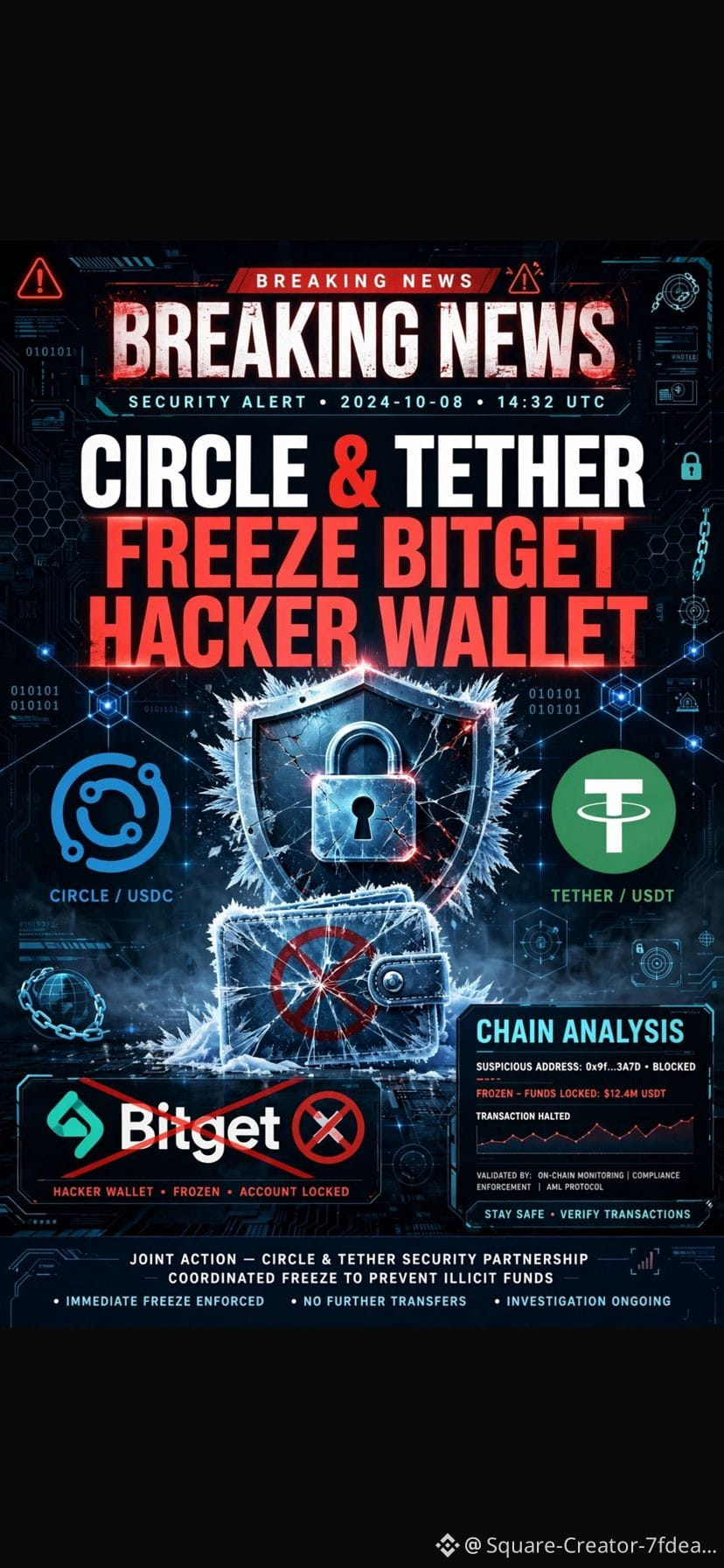
🚨 Urgent: Circle and Tether freeze hacker’s Bitget wallet!
#CircleTetherFreezeBitgetHackerWallet #Bitget #Tether #USDC
On-chain defense! 🛡️❄️
Stablecoin issuers freeze the stolen funds after a massive exploit on the Bitget exchange!
What happened?
🔴 A hacker breached Bitget and stole millions
🔵 Circle (USDC) and Tether (USDT) moved immediately
🧊 Wallet frozen: 0x9f...3A7D - funds fully frozen
🚫 No stolen dollars can be transferred now!
This proves the strength of centralization in protection!
Are these market-saving superheroes? Or overreaching centralizers?
The big debate:
Do you support freezing hackers’ wallets even if it conflicts with decentralization?
1 = Yes, I support the freeze — market safety matters most ✅
2 = No, against decentralization — big risk ❌
Write your opinion in the comments!
$ETH $USDC $CRCLB
#BinanceSquare #CryptoSecurity #BitgetHack #USDT #USDC
#CircleTetherFreezeBitgetHackerWallet
🚨 Urgent: Circle and Tether freeze hacker’s Bitget wallet!
#CircleTetherFreezeBitgetHackerWallet #Bitget #Tether #USDC
On-chain defense! 🛡️❄️
Stablecoin issuers freeze the stolen funds after a massive exploit on the Bitget exchange!
What happened?
🔴 A hacker breached Bitget and stole millions
🔵 Circle (USDC) and Tether (USDT) moved immediately
🧊 Wallet frozen: 0x9f...3A7D - funds fully frozen
🚫 No stolen dollars can be transferred now!
This proves the strength of centralization in protection!
Are these market-saving superheroes? Or overreaching centralizers?
The big debate:
Do you support freezing hackers’ wallets even if it conflicts with decentralization?
1 = Yes, I support the freeze — market safety matters most ✅
2 = No, against decentralization — big risk ❌
Write your opinion in the comments!
$ETH $USDC $CRCLB
#BinanceSquare #CryptoSecurity #BitgetHack #USDT #USDC
🚨 Urgent: Circle and Tether freeze hacker’s Bitget wallet!
#CircleTetherFreezeBitgetHackerWallet #Bitget #Tether #USDC
On-chain defense! 🛡️❄️
Stablecoin issuers freeze the stolen funds after a massive exploit on the Bitget exchange!
What happened?
🔴 A hacker breached Bitget and stole millions
🔵 Circle (USDC) and Tether (USDT) moved immediately
🧊 Wallet frozen: 0x9f...3A7D - funds fully frozen
🚫 No stolen dollars can be transferred now!
This proves the strength of centralization in protection!
Are these market-saving superheroes? Or overreaching centralizers?
The big debate:
Do you support freezing hackers’ wallets even if it conflicts with decentralization?
1 = Yes, I support the freeze — market safety matters most ✅
2 = No, against decentralization — big risk ❌
Write your opinion in the comments!
$ETH $USDC $CRCLB
#BinanceSquare #CryptoSecurity #BitgetHack #USDT #USDC
1
75

·
--
Bitget-related stablecoins frozen in a case|About $318,000 not all losses recovered|BTC at $83,900—I won’t chase “safe narrative” hype
My stance is to first manage exchange and liquidity risks. I don’t interpret “freezing the hacker’s wallets” as all stolen assets being fully recovered, nor do I immediately go long just because Bitcoin doesn’t have an issuer freeze button. Binance’s Plaza hot list is discussing #CircleTetherFreezeBitgetHackerWallet. In its official update, Bitget confirmed that some affected funds were frozen through industry coordination and that it has already launched tracking and a bounty; “freezing” and the final return of assets to users are still two different things. Citing CoinDesk and on-chain data, Binance News said that an address labeled “Bitget Exploiter 8” has about $218,000 USDT and about $100,000 USDC restricted, totaling about $318,000. This amount is only a small fraction of the many hundreds of millions (or more) in implicated funds. The address attribution and the asset status of other addresses still require further verification—so you can’t extrapolate one address’s result to conclude the whole case is closed.
The impact of this matter on BTC’s mechanics is more complicated than a slogan saying “bullish for prices.” Stablecoins like USDC and USDT, which are managed by centralized issuers, can have restrictions applied at the level of specific addresses—helping block some of the illicit proceeds and also reminding investors that their settlement usability depends on the issuer’s rules. Native BTC has no comparable “blacklist switch” by an issuer, but that doesn’t mean BTC held on centralized platforms can always be withdrawn immediately either. Platform account permissions, hot-wallet security, withdrawal systems, and legal coordination are all another layer of risk. What I care about is whether withdrawals across platforms have resumed, whether market makers’ quotes are normal, and whether there’s a persistent price gap between stablecoins and fiat channels—rather than mixing up self-custody and exchange custody.
The market signals so far have been fairly restrained. At the time of writing, Kraken’s BTC/USD is around $83,927, with 24h high $85,247 and low $83,164, slightly below the 24h open of $84,091. This price action can’t prove that freezing news pushed BTC higher, and it can’t attribute the entire day’s fluctuation to Bitget. It only suggests the price is temporarily in the middle of its range. My key levels are the lows around $83,164 and the highs around $85,247: if it rises above the latter and the pullback holds, then short-term risk appetite can be considered improved; if it breaks below the former, the “wait for stabilization” judgment fails. If the authorities publish new withdrawal arrangements, independent on-chain tracking results, or revisions to the implicated amount, the event assessment must be updated accordingly.
If I were trading, I wouldn’t participate. My only plan is a fallback to confirm before taking a long position in BTC spot. I would only enter with 0.5% of total funds if (1) Bitget’s official confirmation verifies that withdrawals are restored and usable at the account level, and (2) BTC prints two consecutive 15-minute K-lines closing above $85,250 and the pullback doesn’t break $85,000. First target is $86,500; upon reaching it, I’d cut half, and the remainder would look toward $87,800. After entry, if it falls back to $84,500, I’d cut the position. If platform withdrawal anomalies reappear or the stablecoin–fiat price gap suddenly expands, I’d close immediately without waiting for the price stop-loss to trigger. If it drops below $83,160 first, this long setup is canceled—I won’t buy the dip or add leverage. Since the plan hasn’t been triggered, I haven’t written it as executed trades or profit.
Source: Bitget official security update; Binance News and CoinDesk on-chain verification; Kraken BTC/USD public quotes.#CircleTetherFreezeBitgetHackerWallet #BTC
The above is for personal market observations only and does not constitute investment advice.
Bitget-related stablecoins frozen in a case|About $318,000 not all losses recovered|BTC at $83,900—I won’t chase “safe narrative” hype
My stance is to first manage exchange and liquidity risks. I don’t interpret “freezing the hacker’s wallets” as all stolen assets being fully recovered, nor do I immediately go long just because Bitcoin doesn’t have an issuer freeze button. Binance’s Plaza hot list is discussing #CircleTetherFreezeBitgetHackerWallet. In its official update, Bitget confirmed that some affected funds were frozen through industry coordination and that it has already launched tracking and a bounty; “freezing” and the final return of assets to users are still two different things. Citing CoinDesk and on-chain data, Binance News said that an address labeled “Bitget Exploiter 8” has about $218,000 USDT and about $100,000 USDC restricted, totaling about $318,000. This amount is only a small fraction of the many hundreds of millions (or more) in implicated funds. The address attribution and the asset status of other addresses still require further verification—so you can’t extrapolate one address’s result to conclude the whole case is closed.
The impact of this matter on BTC’s mechanics is more complicated than a slogan saying “bullish for prices.” Stablecoins like USDC and USDT, which are managed by centralized issuers, can have restrictions applied at the level of specific addresses—helping block some of the illicit proceeds and also reminding investors that their settlement usability depends on the issuer’s rules. Native BTC has no comparable “blacklist switch” by an issuer, but that doesn’t mean BTC held on centralized platforms can always be withdrawn immediately either. Platform account permissions, hot-wallet security, withdrawal systems, and legal coordination are all another layer of risk. What I care about is whether withdrawals across platforms have resumed, whether market makers’ quotes are normal, and whether there’s a persistent price gap between stablecoins and fiat channels—rather than mixing up self-custody and exchange custody.
The market signals so far have been fairly restrained. At the time of writing, Kraken’s BTC/USD is around $83,927, with 24h high $85,247 and low $83,164, slightly below the 24h open of $84,091. This price action can’t prove that freezing news pushed BTC higher, and it can’t attribute the entire day’s fluctuation to Bitget. It only suggests the price is temporarily in the middle of its range. My key levels are the lows around $83,164 and the highs around $85,247: if it rises above the latter and the pullback holds, then short-term risk appetite can be considered improved; if it breaks below the former, the “wait for stabilization” judgment fails. If the authorities publish new withdrawal arrangements, independent on-chain tracking results, or revisions to the implicated amount, the event assessment must be updated accordingly.
If I were trading, I wouldn’t participate. My only plan is a fallback to confirm before taking a long position in BTC spot. I would only enter with 0.5% of total funds if (1) Bitget’s official confirmation verifies that withdrawals are restored and usable at the account level, and (2) BTC prints two consecutive 15-minute K-lines closing above $85,250 and the pullback doesn’t break $85,000. First target is $86,500; upon reaching it, I’d cut half, and the remainder would look toward $87,800. After entry, if it falls back to $84,500, I’d cut the position. If platform withdrawal anomalies reappear or the stablecoin–fiat price gap suddenly expands, I’d close immediately without waiting for the price stop-loss to trigger. If it drops below $83,160 first, this long setup is canceled—I won’t buy the dip or add leverage. Since the plan hasn’t been triggered, I haven’t written it as executed trades or profit.
Source: Bitget official security update; Binance News and CoinDesk on-chain verification; Kraken BTC/USD public quotes.#CircleTetherFreezeBitgetHackerWallet #BTC
The above is for personal market observations only and does not constitute investment advice.
My stance is to first manage exchange and liquidity risks. I don’t interpret “freezing the hacker’s wallets” as all stolen assets being fully recovered, nor do I immediately go long just because Bitcoin doesn’t have an issuer freeze button. Binance’s Plaza hot list is discussing #CircleTetherFreezeBitgetHackerWallet. In its official update, Bitget confirmed that some affected funds were frozen through industry coordination and that it has already launched tracking and a bounty; “freezing” and the final return of assets to users are still two different things. Citing CoinDesk and on-chain data, Binance News said that an address labeled “Bitget Exploiter 8” has about $218,000 USDT and about $100,000 USDC restricted, totaling about $318,000. This amount is only a small fraction of the many hundreds of millions (or more) in implicated funds. The address attribution and the asset status of other addresses still require further verification—so you can’t extrapolate one address’s result to conclude the whole case is closed.
The impact of this matter on BTC’s mechanics is more complicated than a slogan saying “bullish for prices.” Stablecoins like USDC and USDT, which are managed by centralized issuers, can have restrictions applied at the level of specific addresses—helping block some of the illicit proceeds and also reminding investors that their settlement usability depends on the issuer’s rules. Native BTC has no comparable “blacklist switch” by an issuer, but that doesn’t mean BTC held on centralized platforms can always be withdrawn immediately either. Platform account permissions, hot-wallet security, withdrawal systems, and legal coordination are all another layer of risk. What I care about is whether withdrawals across platforms have resumed, whether market makers’ quotes are normal, and whether there’s a persistent price gap between stablecoins and fiat channels—rather than mixing up self-custody and exchange custody.
The market signals so far have been fairly restrained. At the time of writing, Kraken’s BTC/USD is around $83,927, with 24h high $85,247 and low $83,164, slightly below the 24h open of $84,091. This price action can’t prove that freezing news pushed BTC higher, and it can’t attribute the entire day’s fluctuation to Bitget. It only suggests the price is temporarily in the middle of its range. My key levels are the lows around $83,164 and the highs around $85,247: if it rises above the latter and the pullback holds, then short-term risk appetite can be considered improved; if it breaks below the former, the “wait for stabilization” judgment fails. If the authorities publish new withdrawal arrangements, independent on-chain tracking results, or revisions to the implicated amount, the event assessment must be updated accordingly.
If I were trading, I wouldn’t participate. My only plan is a fallback to confirm before taking a long position in BTC spot. I would only enter with 0.5% of total funds if (1) Bitget’s official confirmation verifies that withdrawals are restored and usable at the account level, and (2) BTC prints two consecutive 15-minute K-lines closing above $85,250 and the pullback doesn’t break $85,000. First target is $86,500; upon reaching it, I’d cut half, and the remainder would look toward $87,800. After entry, if it falls back to $84,500, I’d cut the position. If platform withdrawal anomalies reappear or the stablecoin–fiat price gap suddenly expands, I’d close immediately without waiting for the price stop-loss to trigger. If it drops below $83,160 first, this long setup is canceled—I won’t buy the dip or add leverage. Since the plan hasn’t been triggered, I haven’t written it as executed trades or profit.
Source: Bitget official security update; Binance News and CoinDesk on-chain verification; Kraken BTC/USD public quotes.#CircleTetherFreezeBitgetHackerWallet #BTC
The above is for personal market observations only and does not constitute investment advice.

1
33
·
--
#secsaysbuybacksupgradesdontmaketokensecurity
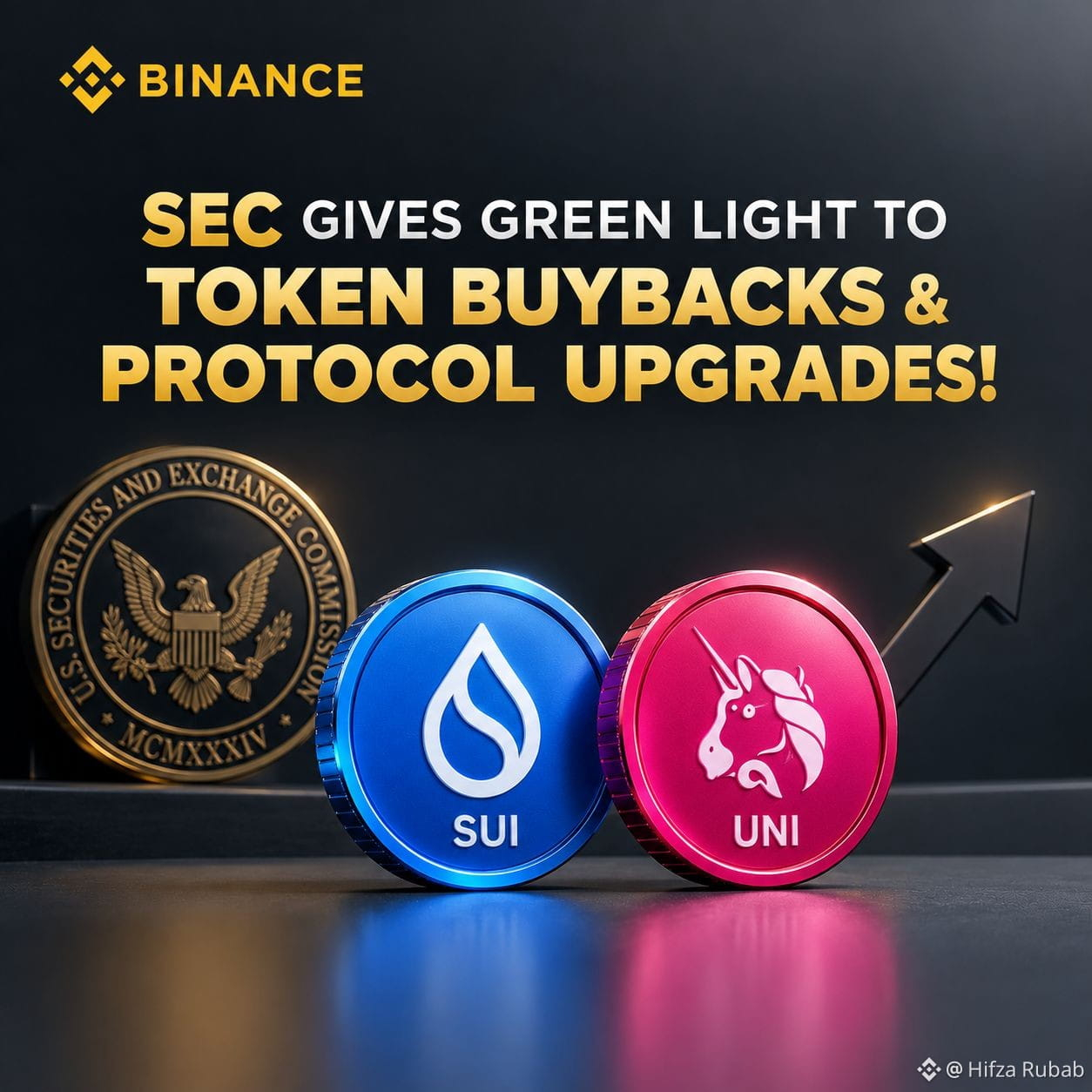
🚨 SEC GIVES GREEN LIGHT TO TOKEN BUYBACKS & PROTOCOL UPGRADES! 🟢⚡
The SEC just provided a major clarity shift: Network upgrades, product improvements, and token buybacks do NOT automatically make a token a security! 🏛️✨
💡 Why This Is Huge for Crypto:
🔹 Upgrade Without Fear: Active protocol development on functional networks no longer carries automatic regulatory risk! 🛠️
🔹 Tokenomics Freedom: Projects can manage token buybacks and supply mechanics without being labeled as profit promises! 📈💎
🎯 2 Key Coins to Watch:
💧 $SUI — A high-performance Layer-1 protocol continuously shipping major and institutional ecosystem upgrades! 🚀⚡
🦄 $UNI — The leading DEX protocol that stands to benefit massively from clear guidelines on revenue share and fee-switch mechanics! 🦄📊
Crypto protocols finally have room to innovate and scale freely! 💥 Are you bullish on revenue-generating protocols now? Drop your thoughts below! 👇✨
#SECSaysBuybacksUpgradesDontMakeTokenSecurity
#BlackRockBuildsTokenizedPortfoliosForOndo
#CircleTetherFreezeBitgetHackerWallet
#PolymarketBankFailureBetsDrawFDICConcern
{spot}(UNIUSDT)
{spot}(SUIUSDT)
#secsaysbuybacksupgradesdontmaketokensecurity
🚨 SEC GIVES GREEN LIGHT TO TOKEN BUYBACKS & PROTOCOL UPGRADES! 🟢⚡
The SEC just provided a major clarity shift: Network upgrades, product improvements, and token buybacks do NOT automatically make a token a security! 🏛️✨
💡 Why This Is Huge for Crypto:
🔹 Upgrade Without Fear: Active protocol development on functional networks no longer carries automatic regulatory risk! 🛠️
🔹 Tokenomics Freedom: Projects can manage token buybacks and supply mechanics without being labeled as profit promises! 📈💎
🎯 2 Key Coins to Watch:
💧 $SUI — A high-performance Layer-1 protocol continuously shipping major and institutional ecosystem upgrades! 🚀⚡
🦄 $UNI — The leading DEX protocol that stands to benefit massively from clear guidelines on revenue share and fee-switch mechanics! 🦄📊
Crypto protocols finally have room to innovate and scale freely! 💥 Are you bullish on revenue-generating protocols now? Drop your thoughts below! 👇✨
#SECSaysBuybacksUpgradesDontMakeTokenSecurity
#BlackRockBuildsTokenizedPortfoliosForOndo
#CircleTetherFreezeBitgetHackerWallet
#PolymarketBankFailureBetsDrawFDICConcern
🚨 SEC GIVES GREEN LIGHT TO TOKEN BUYBACKS & PROTOCOL UPGRADES! 🟢⚡
The SEC just provided a major clarity shift: Network upgrades, product improvements, and token buybacks do NOT automatically make a token a security! 🏛️✨
💡 Why This Is Huge for Crypto:
🔹 Upgrade Without Fear: Active protocol development on functional networks no longer carries automatic regulatory risk! 🛠️
🔹 Tokenomics Freedom: Projects can manage token buybacks and supply mechanics without being labeled as profit promises! 📈💎
🎯 2 Key Coins to Watch:
💧 $SUI — A high-performance Layer-1 protocol continuously shipping major and institutional ecosystem upgrades! 🚀⚡
🦄 $UNI — The leading DEX protocol that stands to benefit massively from clear guidelines on revenue share and fee-switch mechanics! 🦄📊
Crypto protocols finally have room to innovate and scale freely! 💥 Are you bullish on revenue-generating protocols now? Drop your thoughts below! 👇✨
#SECSaysBuybacksUpgradesDontMakeTokenSecurity
#BlackRockBuildsTokenizedPortfoliosForOndo
#CircleTetherFreezeBitgetHackerWallet
#PolymarketBankFailureBetsDrawFDICConcern
M REHAN7:
Finally some positive SEC news! Major clarity shift — network upgrades and product launches are not securities actions. This is win for innovation. Does this mean altseason is closer with less SEC pressure? Drop your thoughts below 👇
5
4
2.3k

·
--
My brother buy 2 million pepe for the millionaire future $1 my people buy pepe
$PEPE
{spot}(PEPEUSDT)
#CircleTetherFreezeBitgetHackerWallet #StrategyProposesDailyDividendsForPreferreds
My brother buy 2 million pepe for the millionaire future $1 my people buy pepe
$PEPE
#CircleTetherFreezeBitgetHackerWallet #StrategyProposesDailyDividendsForPreferreds
$PEPE
#CircleTetherFreezeBitgetHackerWallet #StrategyProposesDailyDividendsForPreferreds
63

$ENA 🚀 ENA Coin +23.81%! Why Is ENA Moving So Fast Today? | ENA/USDT Analysis
📈 ENA is showing strong momentum with a +23.81% 24-hour move. In this post, we look at the ENA/USDT trend, key support and resistance levels, and what traders should watch next.
#PolymarketBankFailureBetsDrawFDICConcern #QNTRises39% #CircleTetherFreezeBitgetHackerWallet #StrategyProposesDailyDividendsForPreferreds
{spot}(ENAUSDT)
$ENA 🚀 ENA Coin +23.81%! Why Is ENA Moving So Fast Today? | ENA/USDT Analysis
📈 ENA is showing strong momentum with a +23.81% 24-hour move. In this post, we look at the ENA/USDT trend, key support and resistance levels, and what traders should watch next.
#PolymarketBankFailureBetsDrawFDICConcern #QNTRises39% #CircleTetherFreezeBitgetHackerWallet #StrategyProposesDailyDividendsForPreferreds
📈 ENA is showing strong momentum with a +23.81% 24-hour move. In this post, we look at the ENA/USDT trend, key support and resistance levels, and what traders should watch next.
#PolymarketBankFailureBetsDrawFDICConcern #QNTRises39% #CircleTetherFreezeBitgetHackerWallet #StrategyProposesDailyDividendsForPreferreds

humkash:
Please Follow me. I Followed you back. Please like my post.
3
1
285

·
--
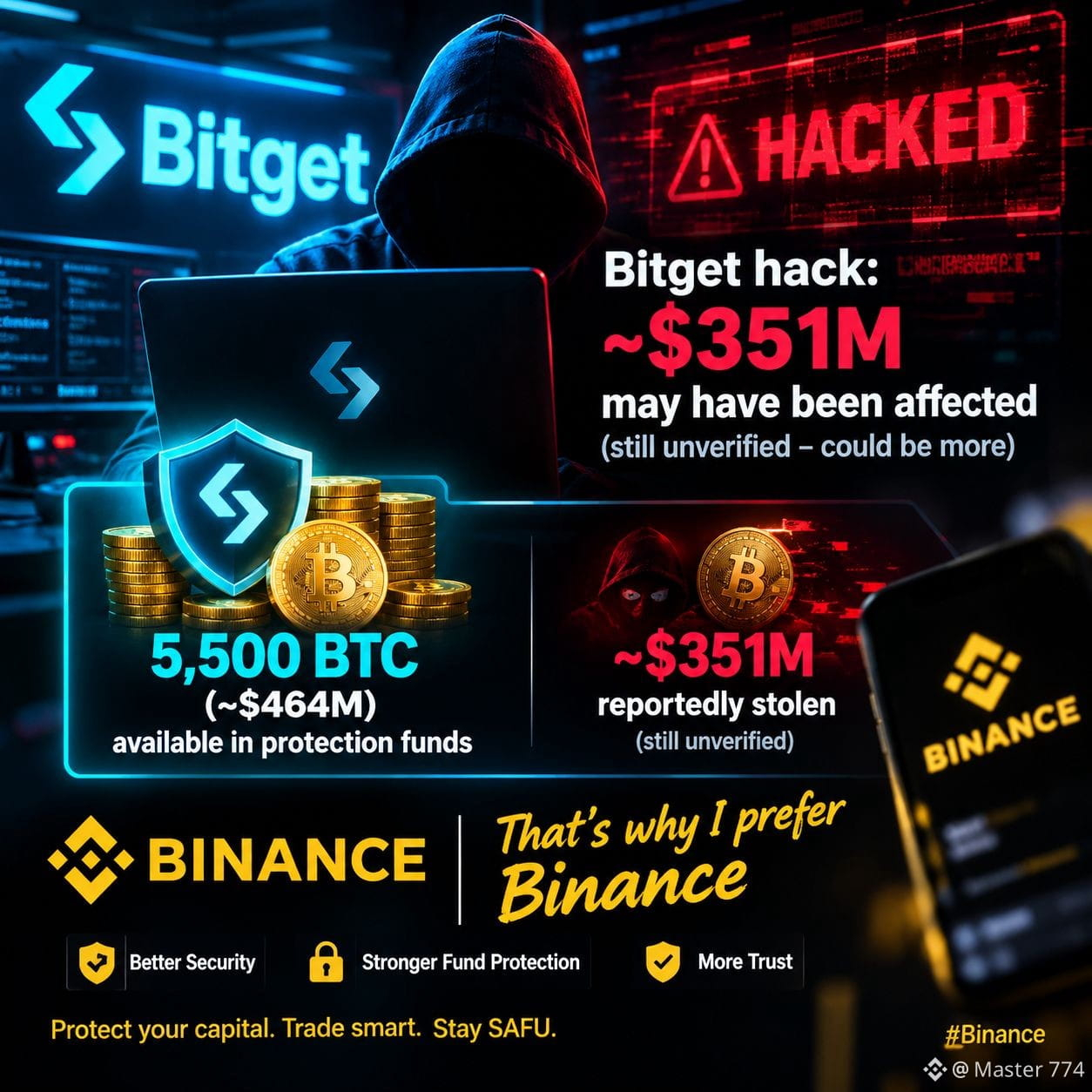
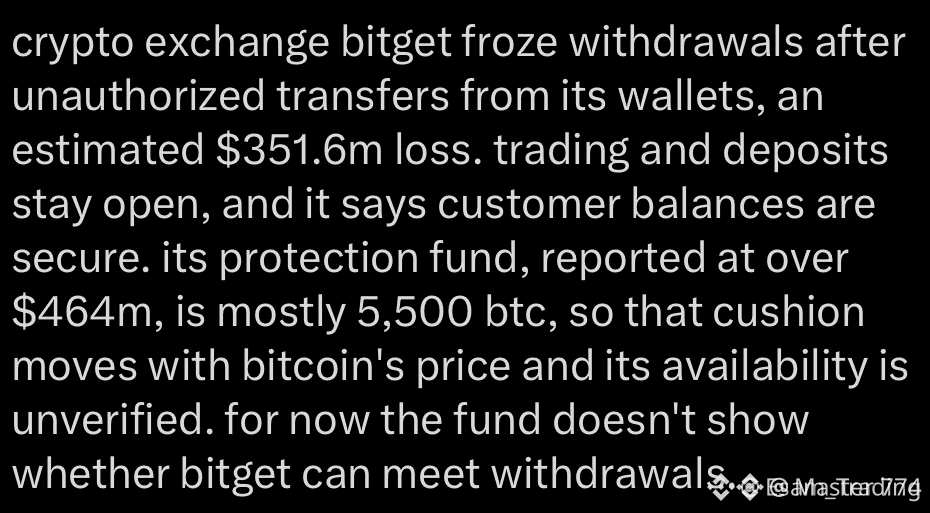
Recent reports around the Bitget incident suggest roughly $351M may have been affected, while about 5,500 (~$464M) was reportedly available in protection funds. The exact figures are still being verified
For me, protecting funds comes before chasing every opportunity. That’s one reason I continue to prefer Binance for my trading and crypto activity. 🔐
#CircleTetherFreezeBitgetHackerWallet
Recent reports around the Bitget incident suggest roughly $351M may have been affected, while about 5,500 (~$464M) was reportedly available in protection funds. The exact figures are still being verified
For me, protecting funds comes before chasing every opportunity. That’s one reason I continue to prefer Binance for my trading and crypto activity. 🔐
#CircleTetherFreezeBitgetHackerWallet
For me, protecting funds comes before chasing every opportunity. That’s one reason I continue to prefer Binance for my trading and crypto activity. 🔐
#CircleTetherFreezeBitgetHackerWallet
16
Log in to explore more content
Join global crypto users on Binance Square
⚡️ Get latest and useful information about crypto.
💬 Trusted by the world’s largest crypto exchange.
👍 Discover real insights from verified creators.
Email / Phone number
Trending Topics
1
#CircleMints500MUSDCOnSolana
101,151 views
2,187 Discussing
2
#PolymarketBankFailureBetsDrawFDICConcern
98,973 views
1,914 Discussing
3
#BlackRockBuildsTokenizedPortfoliosForOndo
92,976 views
1,367 Discussing
4
#BitwiseFilesToListNEARETFOnNYSEArca
71,316 views
1,113 Discussing
5
#SECCommissionerPeirceToLeaveOct2
74,078 views
917 Discussing
6
#SECSaysBuybacksUpgradesDontMakeTokenSecurity
58,499 views
656 Discussing
7
#StrategyProposesDailyDividendsForPreferreds
14,080 views
241 Discussing
8
#CircleTetherFreezeBitgetHackerWallet
14,308 views
143 Discussing
9
#CoinMarketCapCompletesCoinglassAcquisition
15,601 views
191 Discussing
10
#QNTRises39%
121,689 views
1,723 Discussing