

#illinois
illinois
1,547 views
44 Discussing
Hot
Latest

·
--
Uniswap Labs, a16z and DeFi Education Fund urge Illinois to keep DeFi and self-custody out of its 0.2% crypto taxOPENING
The DeFi Education Fund, Uniswap Labs and a16z submitted comments on the Illinois Department of Revenue's draft rules for the state's digital asset tax, asking that DeFi protocols, front-end interfaces and self-custodial withdrawals be excluded from its scope. The groups also asked that wallet withdrawals and cross-chain bridging be excluded from a levy calculated on asset value, and that a private-key recordkeeping requirement be removed.
KEY DETAILS
- The DeFi Education Fund, Uniswap Labs and a16z submitted comments on the Illinois Department of Revenue's draft rules for the state's digital asset tax, asking that DeFi protocols, front-end interfaces and self-custodial withdrawals be excluded from its scope.
- The groups also asked that wallet withdrawals and cross-chain bridging be excluded from a levy calculated on asset value, and that a private-key recordkeeping requirement be removed.
- Illinois' Digital Asset Tax Act imposes a tax of 0.2% of the value of the digital asset involved in a taxable digital asset business activity, collected by digital asset brokers.
- Under the draft rules, DeFi transactions are not taxed unless done for valuable consideration; protocol fees count as consideration, while swap fees paid only to liquidity providers and network fees to miners and validators do not.
- The Department of Revenue released the draft rules on September 28 and accepted public comments through October 30.
- Under an agreed preliminary injunction in lawsuits brought by crypto industry groups challenging the tax, Illinois has delayed its effective date from January 1, 2027 to July 1, 2027.
WHY IT MATTERS
How Illinois defines a crypto 'broker' decides whether DeFi front ends get taxed. (Analysis, not a confirmed fact.)
IMPORTANT CONTEXT
- The draft rules have not yet entered Illinois' formal rulemaking process.
- This is policy news, not investment or tax advice.
- This article is informational and is not financial advice. Digital assets are volatile.
SOURCE
- Primary / main source: https://x.com/TheBlockCo/status/2116225406869344567
- Supporting: https://thedefiant.io/news/regulation/uniswap-a16z-and-def-seek-defi-exemptions-from-illinois-crypto-tax-rules
- Supporting: https://www.panews.io/articles/01a18d1d-a4ad-7281-8468-f2cd9cc1d4d9
- Supporting: https://www.ilga.gov/Legislation/ILCS/Articles?ActID=4683&Chapter=REVENUE&ChapterID=8&MajorTopic=GOVERNMENT&Print=True
- Supporting: https://tax.illinois.gov/content/dam/soi/en/web/tax/research/taxinformation/other/documents/digital-asset-tax-draft-proposed-rules-092826.pdf
- Supporting: https://www.saltsavvy.com/2026/10/13/illinois-first-of-its-kind-crypto-tax-delayed-until-july-2027-department-releases-draft-implementing-regulations/
- Supporting: https://theblockchainassociation.org/api/media/file/JointMotionforSchedulingOrder.pdf
- Supporting: https://news.bloomberglaw.com/daily-tax-report-state/illinois-agrees-to-postpone-crypto-tax-start-date-to-july-2027
#DeFi #Illinois #CryptoTax
Uniswap Labs, a16z and DeFi Education Fund urge Illinois to keep DeFi and self-custody out of its 0.2% crypto tax
OPENING
The DeFi Education Fund, Uniswap Labs and a16z submitted comments on the Illinois Department of Revenue's draft rules for the state's digital asset tax, asking that DeFi protocols, front-end interfaces and self-custodial withdrawals be excluded from its scope. The groups also asked that wallet withdrawals and cross-chain bridging be excluded from a levy calculated on asset value, and that a private-key recordkeeping requirement be removed.
KEY DETAILS
- The DeFi Education Fund, Uniswap Labs and a16z submitted comments on the Illinois Department of Revenue's draft rules for the state's digital asset tax, asking that DeFi protocols, front-end interfaces and self-custodial withdrawals be excluded from its scope.
- The groups also asked that wallet withdrawals and cross-chain bridging be excluded from a levy calculated on asset value, and that a private-key recordkeeping requirement be removed.
- Illinois' Digital Asset Tax Act imposes a tax of 0.2% of the value of the digital asset involved in a taxable digital asset business activity, collected by digital asset brokers.
- Under the draft rules, DeFi transactions are not taxed unless done for valuable consideration; protocol fees count as consideration, while swap fees paid only to liquidity providers and network fees to miners and validators do not.
- The Department of Revenue released the draft rules on September 28 and accepted public comments through October 30.
- Under an agreed preliminary injunction in lawsuits brought by crypto industry groups challenging the tax, Illinois has delayed its effective date from January 1, 2027 to July 1, 2027.
WHY IT MATTERS
How Illinois defines a crypto 'broker' decides whether DeFi front ends get taxed. (Analysis, not a confirmed fact.)
IMPORTANT CONTEXT
- The draft rules have not yet entered Illinois' formal rulemaking process.
- This is policy news, not investment or tax advice.
- This article is informational and is not financial advice. Digital assets are volatile.
SOURCE
- Primary / main source: https://x.com/TheBlockCo/status/2116225406869344567
- Supporting: https://thedefiant.io/news/regulation/uniswap-a16z-and-def-seek-defi-exemptions-from-illinois-crypto-tax-rules
- Supporting: https://www.panews.io/articles/01a18d1d-a4ad-7281-8468-f2cd9cc1d4d9
- Supporting: https://www.ilga.gov/Legislation/ILCS/Articles?ActID=4683&Chapter=REVENUE&ChapterID=8&MajorTopic=GOVERNMENT&Print=True
- Supporting: https://tax.illinois.gov/content/dam/soi/en/web/tax/research/taxinformation/other/documents/digital-asset-tax-draft-proposed-rules-092826.pdf
- Supporting: https://www.saltsavvy.com/2026/10/13/illinois-first-of-its-kind-crypto-tax-delayed-until-july-2027-department-releases-draft-implementing-regulations/
- Supporting: https://theblockchainassociation.org/api/media/file/JointMotionforSchedulingOrder.pdf
- Supporting: https://news.bloomberglaw.com/daily-tax-report-state/illinois-agrees-to-postpone-crypto-tax-start-date-to-july-2027
#DeFi #Illinois #CryptoTax
60

·
--
A State Wants to Tax Crypto Trades 0.2%, Whether or Not You Profit. It Just Got Delayed.
This one matters for anyone who trades often, because it taxes activity instead of gains.
Illinois' Digital Asset Tax Act, signed by Governor JB Pritzker in June as part of the 2027 state budget, sets a 0.2% levy on covered crypto activity. Industry groups challenging it say it applies to transactions, not profits, so it can hit users whether or not they realize any gain. The Crypto Council for Innovation called it the "most punitive digital asset tax" in the US. Lawmakers estimated it could raise up to $60 million in 2027.
What just changed: state officials and the Digital Chamber filed a joint motion asking a court to push the start date from January 1 to July 1, 2027, while the constitutionality fight continues.
A simple illustration: 0.2% of a $10,000 trade is $20, and that cost would repeat on every covered trade, not just the profitable ones. Active traders would feel it far more than long-term holders of $BTC or $ETH .
The caveats:
⚖️ The delay is a request, and court approval hadn't been confirmed in the reports I found
📝 The state is still taking comments on draft rules until October 30
🛡️ Two separate lawsuits against the tax are ongoing, and the delay doesn't settle either
Covered brokers would have to register with the Illinois Department of Revenue, collect the tax, and file monthly reports, which is exactly the compliance burden industry groups say they're already building systems for.
If transaction-based taxes like this spread to other states, would they change how often people trade, or just where? 👇
#Illinois #CryptoTax #BTC #CryptoNews #Zyverra
89

🏛️ Illinois proposes a 0.2% tax on digital currency transactions starting in 2027
The U.S. state of Illinois is moving toward implementing a new tax framework for digital assets, requiring a 0.2% tax on certain types of cryptocurrency transactions. This proposed legislation is expected to take effect in 2027.
━━━━━━━━━━━━━━
📊 Impact: 📈 High
🏷️ REGULATION
#Illinois #CryptoTax #Regulation #DigitalAssets #Legislation
📰 Source: zycrypto.com
12

Illinois delays 0.2% crypto tax after litigation
- Illinois postpones the 0.2% crypto tax by 6 months after litigation and pushback from the industry.
- State officials say the bill was passed hastily.
- The RSS source has not yet provided additional details.
#BinanceSquare #CryptoNews #Illinois
$btc $eth
#vlikevn #Titanbot
Source: CoinTelegraph
- Illinois postpones the 0.2% crypto tax by 6 months after litigation and pushback from the industry.
- State officials say the bill was passed hastily.
- The RSS source has not yet provided additional details.
#BinanceSquare #CryptoNews #Illinois
$btc $eth
#vlikevn #Titanbot
Source: CoinTelegraph
12
🏛️ Illinois postpones digital currency tax application for six months
Reports say that the U.S. state of Illinois has approved a six-month delay on a new tax on digital currency transactions. The proposed tax, the first of its kind in the state, would impose a 0.2% fee on the exchange, transfer, and storage of digital assets.
━━━━━━━━━━━━━━
📊 Impact: 📈 High
🏷️ REGULATION
#Illinois #CryptoTax #Regulation #US #Policy
📰 Source: pymnts.com
1
15

·
--
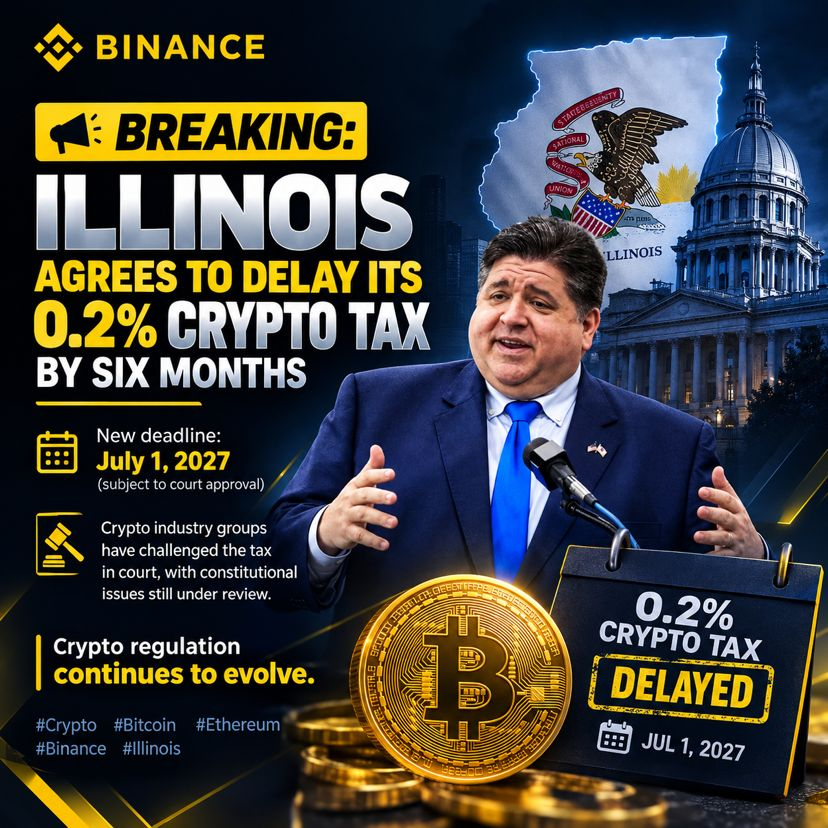
🚨 JUST IN: Illinois is delaying its crypto tax — but the legal fight is still alive.
Illinois and crypto industry representatives agreed to postpone the state’s 0.2% digital-asset tax from Jan. 1, 2027 to July 1, 2027, subject to court approval.
The tax applies to covered digital-asset activity by businesses meeting the law’s revenue threshold. It is not simply a tax on an individual trader’s profit or loss.
WHY IT MATTERS
The delay gives both sides more time for the court battle over the law’s constitutionality and enforceability. Illinois has also published draft rules and is accepting public comments through Oct. 30.
FACT: 0.2% tax.
FACT: Proposed implementation delay to July 1, 2027.
FACT: Court approval is still required.
ANALYSIS: The bigger signal is regulatory precedent. If this survives, other states could examine similar transaction-based digital-asset taxes. If it does not, the ruling could influence how states approach crypto taxation.
RISK: The delay is not a repeal. The underlying law remains part of the legal dispute.
OCT 1, 2026 | U.S. CRYPTO REGULATION
#Crypto #Illinois #DigitalAssets
33

Anti-crypto tax blocking trade organizations in Illinois before the law takes effect
- CCI and Blockchain Association groups sue Illinois to block a 0.2% crypto tax effective from January.
- They argue the tax violates the Constitution and creates a high compliance cost burden.
- If not blocked, the tax will be implemented and affect crypto trading activities.
#BinanceSquare #CryptoNews #Illinois #Tax
$btc $eth
#vlikevn Titanbot
Source: CoinTelegraph
80

·
--
Article
Crypto groups challenge Illinois’ new tax in court before it takes effect$BTC $ETH
Major groups in the cryptocurrency sector are moving to prevent a new tax on digital asset transactions in the state of Illinois from taking effect, which is scheduled to begin in January 2027.
The Crypto Currency Innovation Council (CCI) and the Blockchain Association announced that on Wednesday they filed a request with the U.S. District Court for Sangamon County to obtain a preliminary injunction to halt implementation of the tax, arguing that its continuation could cause irreparable harm to digital asset companies.
Crypto groups challenge Illinois’ new tax in court before it takes effect
$BTC $ETH
Major groups in the cryptocurrency sector are moving to prevent a new tax on digital asset transactions in the state of Illinois from taking effect, which is scheduled to begin in January 2027.
The Crypto Currency Innovation Council (CCI) and the Blockchain Association announced that on Wednesday they filed a request with the U.S. District Court for Sangamon County to obtain a preliminary injunction to halt implementation of the tax, arguing that its continuation could cause irreparable harm to digital asset companies.
123

·
--
Not everyone is aware of the hidden signal that could mean the end of Illinois's new 0.2% crypto tax. Smart money watches the US state governments' digital asset tax legislation, and we're just getting started.
THE SIGNAL: The Digital Chamber, a crypto lobby group, is suing Illinois to block the tax, citing concerns over constitutionality and regulatory overreach. #cryptotax #illinois #digitalassets
THE INTERPRETATION: This could be a game-changer for the entire decentralized ecosystem, setting a precedent that may be replicated in other states. If the Digital Chamber succeeds, it could reduce barriers to adoption and growth, giving long-term crypto holders a significant edge.
THE WATCH LIST: Keep a close eye on the court proceedings and potential developments on the tax bill, which is scheduled to take effect next year. #taxlegislation
THE INSIGHT: What are the implications for regulatory clarity and adoption if this tax gets overturned?
66

·
--
Illinois moves closer to enacting a 0.2% crypto transaction tax via FY2027 budget. Brokers may collect the tax if passed. Could impact market activity as regulatory scrutiny grows. #CryptoTax #Illinois #BinanceSquare #Regulation
Illinois moves closer to enacting a 0.2% crypto transaction tax via FY2027 budget. Brokers may collect the tax if passed. Could impact market activity as regulatory scrutiny grows. #CryptoTax #Illinois #BinanceSquare #Regulation
71

Digital Chamber is suing Illinois officials to block a new 0.2% tax on digital asset transactions, alleging that the law unfairly discriminates against individuals transacting in cryptocurrency.
#CryptoTax #Illinois
Digital Chamber is suing Illinois officials to block a new 0.2% tax on digital asset transactions, alleging that the law unfairly discriminates against individuals transacting in cryptocurrency.
#CryptoTax #Illinois
#CryptoTax #Illinois
13


·
--

Article
Illinois Plans Bold Crypto Tax Move: 0.2% Privilege Fee Hits Digital Trades Tough Penalties Loom#Illinois is stepping up its game in the crypto world. The state’s lawmakers have passed the budget for 2027, and it includes a new rule: a 0.2% tax on every cryptocurrency trade, called the “Privilege Tax.” This small-fee plan is aimed at digital asset brokers, who will now have to register with the state or face serious trouble.
Starting January 1st, any broker who ignores the rule could face jail time two to five years and pay up to $25,000 in fines. That’s a third-degree felony for skipping registration. Lawmakers believe this new tax could bring around $60 million more into Illinois’ coffers.
The bill still needs the governor’s signature to become law. Governor JB Pritzker has said he plans to sign it quickly, but as of last Friday, it hadn’t yet happened.
Cryptocurrency trading is booming across the U.S., and states are racing to find ways to regulate it while also collecting taxes. Illinois’ “Privilege Tax” is designed to make crypto trading more transparent, hold brokers accountable, and add extra revenue for the state. With strict rules and big penalties, the state is making it clear: the crypto playground just got a lot more official and a lot more serious.
This move is part of a wider trend in the U.S., where states are balancing freedom for crypto traders with new rules to protect taxpayers and ensure fair play.
$BTC
{future}(BTCUSDT)
Illinois Plans Bold Crypto Tax Move: 0.2% Privilege Fee Hits Digital Trades Tough Penalties Loom
#Illinois is stepping up its game in the crypto world. The state’s lawmakers have passed the budget for 2027, and it includes a new rule: a 0.2% tax on every cryptocurrency trade, called the “Privilege Tax.” This small-fee plan is aimed at digital asset brokers, who will now have to register with the state or face serious trouble.
Starting January 1st, any broker who ignores the rule could face jail time two to five years and pay up to $25,000 in fines. That’s a third-degree felony for skipping registration. Lawmakers believe this new tax could bring around $60 million more into Illinois’ coffers.
The bill still needs the governor’s signature to become law. Governor JB Pritzker has said he plans to sign it quickly, but as of last Friday, it hadn’t yet happened.
Cryptocurrency trading is booming across the U.S., and states are racing to find ways to regulate it while also collecting taxes. Illinois’ “Privilege Tax” is designed to make crypto trading more transparent, hold brokers accountable, and add extra revenue for the state. With strict rules and big penalties, the state is making it clear: the crypto playground just got a lot more official and a lot more serious.
This move is part of a wider trend in the U.S., where states are balancing freedom for crypto traders with new rules to protect taxpayers and ensure fair play.
$BTC
1
5
191

#UniswapA16zSeekDeFiExemptionFromIllinoisCryptoTax
Illinois is set to become the first U.S. state to tax crypto transactions. The 0.2% levy starts Jan 1, 2027, and applies to the transaction's value, not to gains.
Why DeFi is part of the debate:
▪️ Draft rules say DeFi swaps are taxable only if a protocol collects a fee as "valuable consideration"
▪️ a16z Crypto has called the law one of the most anti-crypto in the U.S.
▪️ The comment window on the draft rules closes Oct 30, so the final definition of "taxable DeFi" is still open
Why it matters: if the final rule is broad, protocol fee models, including Uniswap's, could be pulled into scope. If it stays narrow, most on-chain activity is untouched. The exemption push is about which of those two outcomes wins.
Watch the final rule text, not the headlines. Exact fee definitions will decide the real impact.
Do you think a state-level transaction tax is workable for DeFi? 👇
$UNI #Uniswap #defi #cryptotax #Illinois
{spot}(UNIUSDT)
#UniswapA16zSeekDeFiExemptionFromIllinoisCryptoTax
Illinois is set to become the first U.S. state to tax crypto transactions. The 0.2% levy starts Jan 1, 2027, and applies to the transaction's value, not to gains.
Why DeFi is part of the debate:
▪️ Draft rules say DeFi swaps are taxable only if a protocol collects a fee as "valuable consideration"
▪️ a16z Crypto has called the law one of the most anti-crypto in the U.S.
▪️ The comment window on the draft rules closes Oct 30, so the final definition of "taxable DeFi" is still open
Why it matters: if the final rule is broad, protocol fee models, including Uniswap's, could be pulled into scope. If it stays narrow, most on-chain activity is untouched. The exemption push is about which of those two outcomes wins.
Watch the final rule text, not the headlines. Exact fee definitions will decide the real impact.
Do you think a state-level transaction tax is workable for DeFi? 👇
$UNI #Uniswap #defi #cryptotax #Illinois
35

·
--
HUGE FIGHT FOR DeFi IN ILLINOIS TODAY!
Uniswap Labs + a16z + DeFi Education Fund just filed a joint letter to Illinois Department of Revenue - LAST DAY of comments (Oct 30) - to SAVE DeFi from insane crypto tax.
What Illinois Wants:
0.2% TAX on the TOTAL VALUE of asset - not just fee!
You trade $10,000 - you pay $20 tax to state.
You withdraw to your own wallet? TAX.
You bridge to another chain? TAX.
Even stablecoins = TAX. NFTs only thing excluded.
Industry calls it "most anti-crypto law in America" - passed June 16 as part of $55.9B budget, starts Jan 1, 2027.
What Uniswap / a16z / DEF Demanding:
1. DEXs and interfaces are NOT brokers - can't be tax collectors, they don't hold your assets
2. Wallet withdrawals to YOUR OWN wallet = EXEMPT
3. Cross-chain bridging = EXEMPT
4. Protocol fees / Interface fees ≠ taxable "valuable consideration"
5. Delete private-key recordkeeping requirement
6. DELAY enforcement to July 1, 2027 minimum - wait for court to decide legality
Their message: "Keep DEXs and interfaces out of the broker definition, protect self-custody, and don’t tax when we move our own assets"
If Illinois gets away with this, every state will copy. This is the DeFi vs State tax battle.
Do you support DeFi exemption?
#Illinois #DeFi #Uniswap #cryptotax
#UniswapA16zSeekDeFiExemptionFromIllinoisCryptoTax
$BTC $ETH $SOL
Yes
No
5 day(s) left
2
3
832

·
--
🚨 #UniswapA16zSeekDeFiExemptionFromIllinoisCryptoTax
The crypto industry is pushing back against Illinois' proposed digital asset tax rules! ⚖️
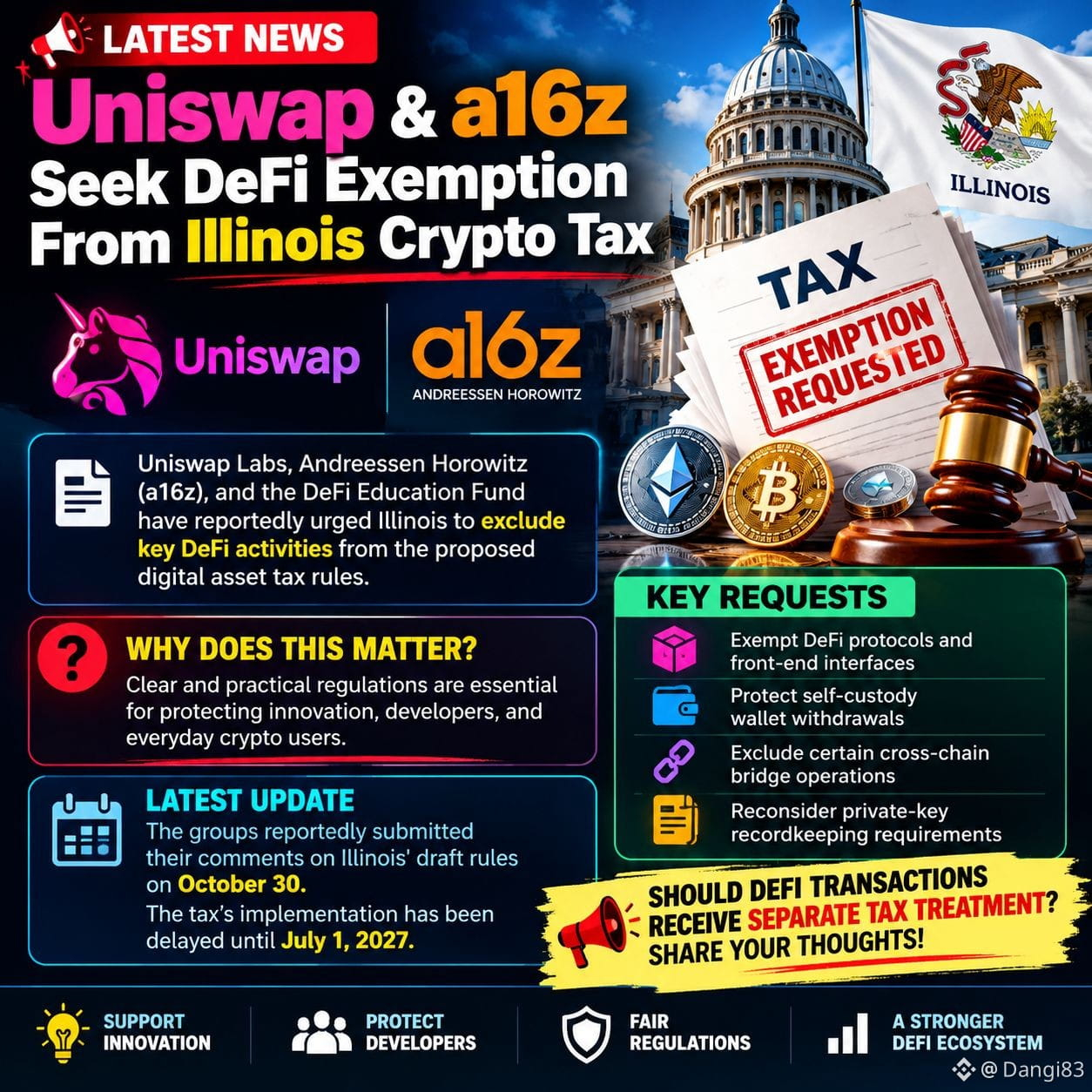
Uniswap Labs, Andreessen Horowitz (a16z), and the DeFi Education Fund have reportedly urged Illinois to exclude key DeFi activities from the tax framework.
🔹 Exempt DeFi protocols and front-end interfaces
🔹 Protect self-custody wallet withdrawals
🔹 Exclude certain cross-chain bridge operations
🔹 Reconsider private-key recordkeeping requirements
💡 Why does this matter?
Clear and practical regulations are essential for protecting innovation, developers, and everyday crypto users.
The big question: Can regulators balance tax compliance with the permissionless nature of DeFi?
Should DeFi transactions receive separate tax treatment? Share your thoughts! 👇
#Uniswap #defi #CryptoRegulation #Illinois
104

·
--
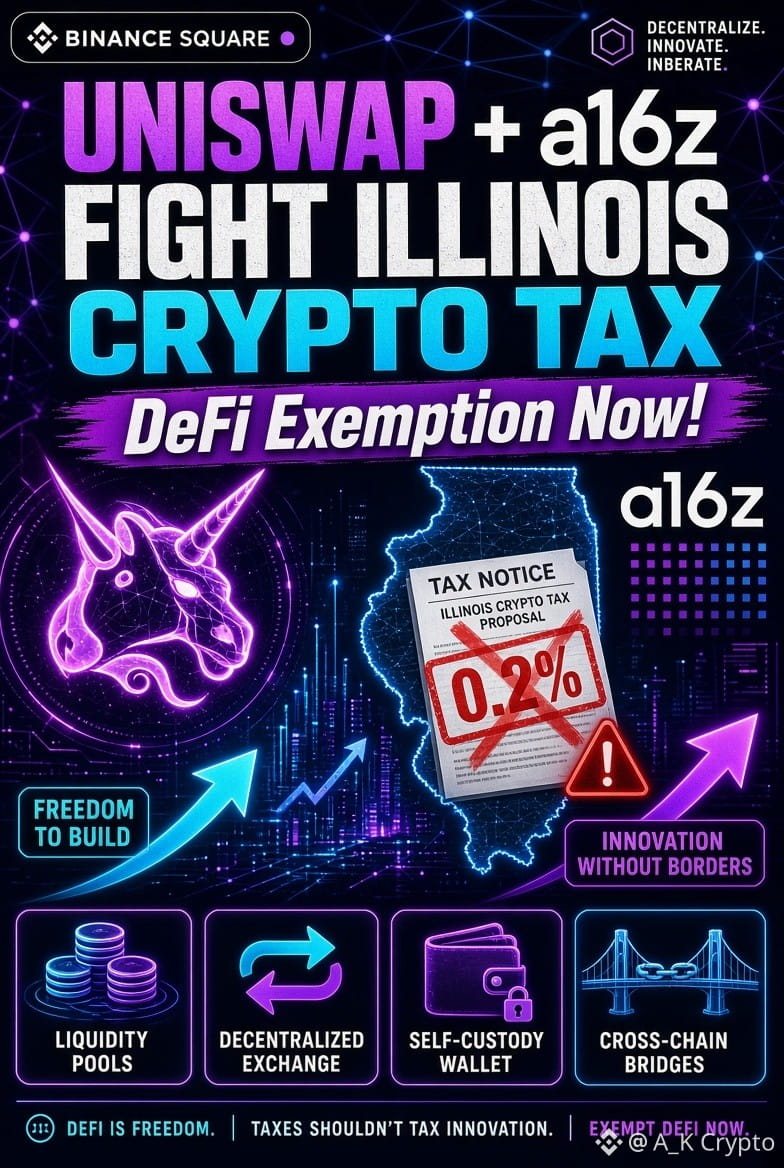
#UniswapA16zSeekDeFiExemptionFromIllinoisCryptoTax $UNI
🔥 $UNI Labs, a16z, and the DeFi Education Fund just dropped formal comments on Illinois’ draft rules for the new Digital Asset Tax.
They’re asking the state to:
Fully exclude DeFi protocols & front-end interfaces
Keep wallet withdrawals and cross-chain bridging out of the taxable base
Drop the private-key recordkeeping requirement
Illinois wants a 0.2% tax on the value of certain digital asset transactions (originally Jan 2027, now delayed to July 2027). The industry is drawing a clear line: don’t treat pure peer-to-peer DeFi like centralized brokers.
This is the right fight. Taxing self-custody moves and true decentralized activity would just push users and builders out of Illinois (and eventually other states). DeFi isn’t an intermediary — treating it like one is a de-facto ban. Hope the state listens. Innovation > short-sighted tax grabs.
$UNI
What do you think — fair tax or regulatory overreach? 👇
#DeFi #CryptoTax #Illinois #UNI
{spot}(UNIUSDT)
#UniswapA16zSeekDeFiExemptionFromIllinoisCryptoTax $UNI
🔥 $UNI Labs, a16z, and the DeFi Education Fund just dropped formal comments on Illinois’ draft rules for the new Digital Asset Tax.
They’re asking the state to:
Fully exclude DeFi protocols & front-end interfaces
Keep wallet withdrawals and cross-chain bridging out of the taxable base
Drop the private-key recordkeeping requirement
Illinois wants a 0.2% tax on the value of certain digital asset transactions (originally Jan 2027, now delayed to July 2027). The industry is drawing a clear line: don’t treat pure peer-to-peer DeFi like centralized brokers.
This is the right fight. Taxing self-custody moves and true decentralized activity would just push users and builders out of Illinois (and eventually other states). DeFi isn’t an intermediary — treating it like one is a de-facto ban. Hope the state listens. Innovation > short-sighted tax grabs.
$UNI
What do you think — fair tax or regulatory overreach? 👇
#DeFi #CryptoTax #Illinois #UNI
70

·
--
Uniswap calls for changes to Illinois tax draft
In a letter dated October 30, 2026, Uniswap Labs, a16z, and the DeFi Education Fund asked the Illinois Department of Revenue to amend the proposed rules for the Digital Asset Tax Act.
The draft, published on September 28, sets out a 0.2% tax on the value of the asset in covered transactions. That tax base differs from the gain realized or the fee paid.
What are they asking for?
• Exclude decentralized exchanges (DEXs) and their interfaces from the category of intermediaries required to collect the tax.
• Clarify that charging protocol or interface fees does not, by itself, make someone a tax intermediary.
• Replace the requirement to register private keys with a requirement to register public keys.
• Exclude withdrawals to a wallet belonging to the same user and transfers between networks that do not involve a change of ownership.
The signatories argue that autonomous software cannot perform the same identification and collection functions as a custodial platform. They also warn that keeping private keys in records exposes control of the funds.
This is a request, not an approved exemption. The official page still lists the rules as a draft ahead of the first formal notice. Their final scope remains undecided; the letter does not eliminate tax obligations.
Market snapshot: On Binance spot, UNI was trading at 7.21 USDT (+11.82% in 24 h) and ETH at 2,247.46 USDT (+0.39%) as of October 31, 00:16 UTC. That movement does not prove a reaction to the letter. For DeFi, the question is how the parties required to collect the tax will be defined and which transactions will be covered; regulatory uncertainty remains.
$UNI $ETH $USDT
Educational Content. Not financial advice.
#Uniswap #DeFi #Illinois #Regulacion #FinancialEducation

1
113
Crypto organizations unite against 0.2% tax in Illinois after six-month pause
- **Tax delayed:** Illinois state officials agreed to delay implementing a 0.2% tax on crypto assets after a roughly six-month pause.
- **United front:** Organizations supporting the crypto industry have joined forces to push for summary judgment on the merits of the case.
- **Legal goal:** Industry-aligned organizations are working to challenge the legality of taxing digital assets in Illinois.
#BinanceSquare #CryptoNews #BTC #CryptoTax #Illinois
$btc
vlikevn Titanbot
Source: CoinTelegraph
2
Legal organizations formalize fight against Illinois crypto tax after 6 months of silence
- Illinois agreed to delay enforcement of a 0.2% tax on crypto assets.
- Industry organizations are calling for an expedited hearing in the case.
- Goal: completely repeal the tax.
#BinanceSquare #CryptoNews #CryptoTax #Illinois
$btc $eth
#vlikevn Titanbot
Source: CoinTelegraph
- Illinois agreed to delay enforcement of a 0.2% tax on crypto assets.
- Industry organizations are calling for an expedited hearing in the case.
- Goal: completely repeal the tax.
#BinanceSquare #CryptoNews #CryptoTax #Illinois
$btc $eth
#vlikevn Titanbot
Source: CoinTelegraph
213
Log in to explore more content
Join global crypto users on Binance Square
⚡️ Get latest and useful information about crypto.
💬 Trusted by the world’s largest crypto exchange.
👍 Discover real insights from verified creators.
Email / Phone number
Trending Topics
1
#BinanceSAFUFundTransferCompleted7499BTC
5,248 views
254 Discussing
2
#BinanceRecovery90% of stolen assets
41,618 views
94 Discussing
3
#YiHe:ProofOfReserves:10TokensAt100%Backing
76,490 views
422 Discussing
4
#BackedNotBroken:RichardTengSaysUsersBearNoLoss
7,380 views
250 Discussing
5
#CZSaysCompensationIsinPlaceUsersAreProtected
81,401 views
1,111 Discussing
6
#IntelHasItsWorstDaySince1974
23,636 views
526 Discussing
7
#TRMCambodianCasinosReceived$1.07BInCrypto
5,641 views
61 Discussing
8
#USDCCirculationFallsAbout800MInSevenDays
45,384 views
626 Discussing
9
#SuspectedNorthKoreaAttacksAccountForNearly89%OfCryptoHackLosses
11,606 views
84 Discussing
10
#OpenAICutsFundraisingTargetBy$10B
2,663 views
68 Discussing