

#digitaleuro
digitaleuro
201,530 views
404 Discussing
Hot
Latest

·
--
Bullish
#ecbtotestaiagentsindigitaleuropayments
🇪🇺🚨 ECB IS TESTING AI AGENTS FOR DIGITAL PAYMENTS! 🤖💶
The European Central Bank is exploring AI-agent technology in digital euro payments, another sign that the future of finance could become increasingly automated.
🤖 AI agents
💶 Digital euro payments
⚡ Automated financial transactions
🏦 Central-bank experimentation
Imagine AI agents being able to initiate and manage payments based on predefined rules.
The combination of AI + digital currencies + programmable payments could open a completely new chapter for financial infrastructure. 👀
AI IS ENTERING THE MONEY SYSTEM. 🔥
#digitaleuro #AI #crypto
#ecbtotestaiagentsindigitaleuropayments
🇪🇺🚨 ECB IS TESTING AI AGENTS FOR DIGITAL PAYMENTS! 🤖💶
The European Central Bank is exploring AI-agent technology in digital euro payments, another sign that the future of finance could become increasingly automated.
🤖 AI agents
💶 Digital euro payments
⚡ Automated financial transactions
🏦 Central-bank experimentation
Imagine AI agents being able to initiate and manage payments based on predefined rules.
The combination of AI + digital currencies + programmable payments could open a completely new chapter for financial infrastructure. 👀
AI IS ENTERING THE MONEY SYSTEM. 🔥
#digitaleuro #AI #crypto
🇪🇺🚨 ECB IS TESTING AI AGENTS FOR DIGITAL PAYMENTS! 🤖💶
The European Central Bank is exploring AI-agent technology in digital euro payments, another sign that the future of finance could become increasingly automated.
🤖 AI agents
💶 Digital euro payments
⚡ Automated financial transactions
🏦 Central-bank experimentation
Imagine AI agents being able to initiate and manage payments based on predefined rules.
The combination of AI + digital currencies + programmable payments could open a completely new chapter for financial infrastructure. 👀
AI IS ENTERING THE MONEY SYSTEM. 🔥
#digitaleuro #AI #crypto
7

·
--
Bullish
Verified
#ecbtotestaiagentsindigitaleuropayments
🤖 AI Agents + Digital Euro: The Future of Autonomous Payments!
📰ECB Innovation Initiative: The European Central Bank (ECB) has officially opened applications for a new phase of its Digital Euro Innovation Platform, setting up 2027 workshops to explore AI-enabled payment environments.
Machine-to-Machine Transactions: The exploration track will investigate autonomous AI agents executing micro-payments, conditional payments, and direct agent-to-agent transactions without direct human intervention per trade.
Strict Guardrails: The ECB emphasizes that AI payment delegation will be governed by controlled user mandates, keeping privacy, user consent, and security at the center of the architecture.
Timeline to Reality: Applications for the innovation platform close November 9, 2026, leading into 2027 experimentation alongside a separate 12-month pilot with major payment providers.
$NVDA.US
{stock_us}(NVDA.US)
🚀Payments are shifting from human-initiated clicks to autonomous, context-aware machine transactions! 💶⚡
The European Central Bank (ECB) is paving the way for AI agents to become active economic actors rather than simple assistant tools. By testing how a central bank digital currency (CBDC) can interface with AI protocols, Europe is building the foundation for automated micro-economies.
$ZEC
{future}(ZECUSDT)
1. Autonomous AI Mandates 🤖
Imagine setting parameters for your AI agent—such as buying the cheapest energy rates for your smart home, subscribing to on-demand APIs, or booking travel itinerary steps—and letting the agent execute micro-transactions seamlessly using programmable digital euros.
2. Balancing Automation with Privacy & Control 🔐
The ECB's primary focus remains safeguarding user sovereignty. AI agent transactions will operate within strict user-defined spending limits, ensuring privacy protection and maintaining a clear kill-switch for human overrides.
#EarningsSeason #digitaleuro #CryptoNews
#ecbtotestaiagentsindigitaleuropayments
🤖 AI Agents + Digital Euro: The Future of Autonomous Payments!
📰ECB Innovation Initiative: The European Central Bank (ECB) has officially opened applications for a new phase of its Digital Euro Innovation Platform, setting up 2027 workshops to explore AI-enabled payment environments.
Machine-to-Machine Transactions: The exploration track will investigate autonomous AI agents executing micro-payments, conditional payments, and direct agent-to-agent transactions without direct human intervention per trade.
Strict Guardrails: The ECB emphasizes that AI payment delegation will be governed by controlled user mandates, keeping privacy, user consent, and security at the center of the architecture.
Timeline to Reality: Applications for the innovation platform close November 9, 2026, leading into 2027 experimentation alongside a separate 12-month pilot with major payment providers.
$NVDA.US
🚀Payments are shifting from human-initiated clicks to autonomous, context-aware machine transactions! 💶⚡
The European Central Bank (ECB) is paving the way for AI agents to become active economic actors rather than simple assistant tools. By testing how a central bank digital currency (CBDC) can interface with AI protocols, Europe is building the foundation for automated micro-economies.
$ZEC
1. Autonomous AI Mandates 🤖
Imagine setting parameters for your AI agent—such as buying the cheapest energy rates for your smart home, subscribing to on-demand APIs, or booking travel itinerary steps—and letting the agent execute micro-transactions seamlessly using programmable digital euros.
2. Balancing Automation with Privacy & Control 🔐
The ECB's primary focus remains safeguarding user sovereignty. AI agent transactions will operate within strict user-defined spending limits, ensuring privacy protection and maintaining a clear kill-switch for human overrides.
#EarningsSeason #digitaleuro #CryptoNews
🤖 AI Agents + Digital Euro: The Future of Autonomous Payments!
📰ECB Innovation Initiative: The European Central Bank (ECB) has officially opened applications for a new phase of its Digital Euro Innovation Platform, setting up 2027 workshops to explore AI-enabled payment environments.
Machine-to-Machine Transactions: The exploration track will investigate autonomous AI agents executing micro-payments, conditional payments, and direct agent-to-agent transactions without direct human intervention per trade.
Strict Guardrails: The ECB emphasizes that AI payment delegation will be governed by controlled user mandates, keeping privacy, user consent, and security at the center of the architecture.
Timeline to Reality: Applications for the innovation platform close November 9, 2026, leading into 2027 experimentation alongside a separate 12-month pilot with major payment providers.
$NVDA.US
🚀Payments are shifting from human-initiated clicks to autonomous, context-aware machine transactions! 💶⚡
The European Central Bank (ECB) is paving the way for AI agents to become active economic actors rather than simple assistant tools. By testing how a central bank digital currency (CBDC) can interface with AI protocols, Europe is building the foundation for automated micro-economies.
$ZEC
1. Autonomous AI Mandates 🤖
Imagine setting parameters for your AI agent—such as buying the cheapest energy rates for your smart home, subscribing to on-demand APIs, or booking travel itinerary steps—and letting the agent execute micro-transactions seamlessly using programmable digital euros.
2. Balancing Automation with Privacy & Control 🔐
The ECB's primary focus remains safeguarding user sovereignty. AI agent transactions will operate within strict user-defined spending limits, ensuring privacy protection and maintaining a clear kill-switch for human overrides.
#EarningsSeason #digitaleuro #CryptoNews

NVDAUS+0.20%
1
25

·
--
The ECB has gone crazy! It’s exploring an AI agent + digital euro payment system, with a 2027 pilot planned. Are machine-to-machine automated payments coming? The era of central bank digital currency is closer than we think!
#DigitalEuro #CBDC $EUR
The ECB has gone crazy! It’s exploring an AI agent + digital euro payment system, with a 2027 pilot planned. Are machine-to-machine automated payments coming? The era of central bank digital currency is closer than we think!
#DigitalEuro #CBDC $EUR
#DigitalEuro #CBDC $EUR
46

ECB rolls payments via AI agents into the Digital Euro design plan
• The ECB calls on companies to research payments via AI agents and human-computer interaction to prepare for a 2027 pilot project of the digital euro.
• This move reflects the development of Europe’s digital money infrastructure, which could affect the crypto market.
• More details and project timelines will be released in the coming time.
#BinanceSquare #CryptoNews #DigitalEuro
$btc $eth
#vlikevn #Titanbot
Source: CoinTelegraph
ECB rolls payments via AI agents into the Digital Euro design plan
• The ECB calls on companies to research payments via AI agents and human-computer interaction to prepare for a 2027 pilot project of the digital euro.
• This move reflects the development of Europe’s digital money infrastructure, which could affect the crypto market.
• More details and project timelines will be released in the coming time.
#BinanceSquare #CryptoNews #DigitalEuro
$btc $eth
#vlikevn #Titanbot
Source: CoinTelegraph
• The ECB calls on companies to research payments via AI agents and human-computer interaction to prepare for a 2027 pilot project of the digital euro.
• This move reflects the development of Europe’s digital money infrastructure, which could affect the crypto market.
• More details and project timelines will be released in the coming time.
#BinanceSquare #CryptoNews #DigitalEuro
$btc $eth
#vlikevn #Titanbot
Source: CoinTelegraph
221
ECB studies AI agents for digital euro
- ECB seeks companies to explore AI agents and machine-to-machine interaction
- Preparing its own digital euro trial in 2027
#BinanceSquare #CryptoNews #DigitalEuro #AI
$btc $eth
#vlikevn Titanbot
Source: CoinTelegraph
ECB studies AI agents for digital euro
- ECB seeks companies to explore AI agents and machine-to-machine interaction
- Preparing its own digital euro trial in 2027
#BinanceSquare #CryptoNews #DigitalEuro #AI
$btc $eth
#vlikevn Titanbot
Source: CoinTelegraph
- ECB seeks companies to explore AI agents and machine-to-machine interaction
- Preparing its own digital euro trial in 2027
#BinanceSquare #CryptoNews #DigitalEuro #AI
$btc $eth
#vlikevn Titanbot
Source: CoinTelegraph
175

The European Central Bank (ECB) said in a report published by the Financial Times this Monday that it has officially launched “Pontes,” an interbank tokenised settlement system, marking the first deployment of a wholesale digital euro in the institutional wholesale financial market. The platform is operated directly by the ECB and allows commercial banks to record transactions on private distributed ledgers using central bank digital currency settlement records, thereby serving as an official settlement infrastructure alternative to stablecoins in the private sector.
The strategic intent behind this move is clear. ECB economists have explicitly warned that if dollar-denominated stablecoins become overly embedded in Europe’s digital settlement space, the euro area faces serious risks of losing monetary policy autonomy. Therefore, whether it is advancing a wholesale or retail digital euro, the core objective is to build a defensive barrier—protecting European monetary sovereignty and countering dollar-led digital dominance.
From a traditional finance macro perspective, although central-bank-led tokenised clearing can improve the efficiency of cross-border and interbank capital flows, it also means that regulators’ ability to monitor and intervene in capital movements will be further strengthened. For the traditional banking system, connecting to a central-bank-controlled network will squeeze profit margins for private fintech and conventional payment channels, and in the short term is unlikely to change the larger picture of weak European economic growth and the dominance of the appeal of dollar assets.
For the crypto ecosystem—especially the stablecoin segment—this undoubtedly sends a strong compliance and squeeze signal. As major central banks accelerate the construction of closed, controlled wholesale networks, the room for private stablecoins to penetrate institution-to-institution settlement will be significantly reduced. From a prudential standpoint, strong regulatory involvement in the clearing of tokenised assets may channel more compliant capital into central-bank-backed systems, thereby weakening the liquidity premium of public-chain ecosystems and decentralised assets such as $BTC . The risk that liquidity will be diverted away by official architectures is worth ongoing vigilance.
#ECB #DigitalEuro #Stablecoins
The European Central Bank (ECB) said in a report published by the Financial Times this Monday that it has officially launched “Pontes,” an interbank tokenised settlement system, marking the first deployment of a wholesale digital euro in the institutional wholesale financial market. The platform is operated directly by the ECB and allows commercial banks to record transactions on private distributed ledgers using central bank digital currency settlement records, thereby serving as an official settlement infrastructure alternative to stablecoins in the private sector.
The strategic intent behind this move is clear. ECB economists have explicitly warned that if dollar-denominated stablecoins become overly embedded in Europe’s digital settlement space, the euro area faces serious risks of losing monetary policy autonomy. Therefore, whether it is advancing a wholesale or retail digital euro, the core objective is to build a defensive barrier—protecting European monetary sovereignty and countering dollar-led digital dominance.
From a traditional finance macro perspective, although central-bank-led tokenised clearing can improve the efficiency of cross-border and interbank capital flows, it also means that regulators’ ability to monitor and intervene in capital movements will be further strengthened. For the traditional banking system, connecting to a central-bank-controlled network will squeeze profit margins for private fintech and conventional payment channels, and in the short term is unlikely to change the larger picture of weak European economic growth and the dominance of the appeal of dollar assets.
For the crypto ecosystem—especially the stablecoin segment—this undoubtedly sends a strong compliance and squeeze signal. As major central banks accelerate the construction of closed, controlled wholesale networks, the room for private stablecoins to penetrate institution-to-institution settlement will be significantly reduced. From a prudential standpoint, strong regulatory involvement in the clearing of tokenised assets may channel more compliant capital into central-bank-backed systems, thereby weakening the liquidity premium of public-chain ecosystems and decentralised assets such as $BTC . The risk that liquidity will be diverted away by official architectures is worth ongoing vigilance.
#ECB #DigitalEuro #Stablecoins
The strategic intent behind this move is clear. ECB economists have explicitly warned that if dollar-denominated stablecoins become overly embedded in Europe’s digital settlement space, the euro area faces serious risks of losing monetary policy autonomy. Therefore, whether it is advancing a wholesale or retail digital euro, the core objective is to build a defensive barrier—protecting European monetary sovereignty and countering dollar-led digital dominance.
From a traditional finance macro perspective, although central-bank-led tokenised clearing can improve the efficiency of cross-border and interbank capital flows, it also means that regulators’ ability to monitor and intervene in capital movements will be further strengthened. For the traditional banking system, connecting to a central-bank-controlled network will squeeze profit margins for private fintech and conventional payment channels, and in the short term is unlikely to change the larger picture of weak European economic growth and the dominance of the appeal of dollar assets.
For the crypto ecosystem—especially the stablecoin segment—this undoubtedly sends a strong compliance and squeeze signal. As major central banks accelerate the construction of closed, controlled wholesale networks, the room for private stablecoins to penetrate institution-to-institution settlement will be significantly reduced. From a prudential standpoint, strong regulatory involvement in the clearing of tokenised assets may channel more compliant capital into central-bank-backed systems, thereby weakening the liquidity premium of public-chain ecosystems and decentralised assets such as $BTC . The risk that liquidity will be diverted away by official architectures is worth ongoing vigilance.
#ECB #DigitalEuro #Stablecoins
4

On Monday, the European Central Bank (ECB) officially launched “Pontes,” an interbank tokenized settlement system, marking the first formal connection of the wholesale digital euro to institutional financial markets. The platform is directly led and operated by the ECB, enabling licensed banks to use central bank money to conduct final settlement of tokenized assets traded on a private distributed ledger technology (DLT). Meanwhile, the retail digital euro for individuals and merchants is also being accelerated.
The ECB’s core intent is clear: to establish the status of an official settlement asset amid the wave of tokenized finance, to hedge against the risks of dollar stablecoins’ penetration into Europe’s digital economy, and to defend monetary sovereignty in the euro area.
From the perspective of the evolution of institutional infrastructure, the significance of this rollout is extraordinary. Traditional financial settlement relies on multiple layers of intermediaries, with long clearing cycles and high friction costs, whereas the launch of the “Pontes” platform directly removes the barriers between central bank legal liquidity and on-chain ledgers. ECB economists have emphasized that if dollar-denominated private stablecoins are allowed to dominate on-chain clearing, the ECB would face the risk of monetary-policy transmission failing. By stepping in to build the underlying tokenized settlement network itself, the world’s leading central banks have moved from early theoretical research on “blockchain/tokenization technology” to architecture-level deployment on a mainnet.
At the macro-financial level, the launch of the wholesale digital euro will greatly enhance the tokenized issuance and instant settlement efficiency of European bond markets and large-scale assets. As tokenization of assets in traditional capital markets (RWA) enters a substantive execution phase, European capital that had previously been stuck in traditional liquidity pools will gain faster on-chain circulation channels. This not only reinforces the settlement role of the euro, but also sets a clear paradigm for the coexistence and competition of global sovereign-credit money within on-chain ecosystems, which in the long run can help reduce systemic frictions across different currencies’ settlement.
For the broader crypto market, this is undoubtedly a major long-term structural positive. The routine operation of central-bank-level tokenization infrastructure is, in essence, the highest-tier endorsement of the security of distributed ledger technology, completely eliminating regulatory and technical concerns for large traditional institutions moving into the Web3 ecosystem. With institutional-grade on-chain liquidity pathways fully opened, $BTC , along with major crypto assets as the most liquid on-chain native assets, is expected to capture broader incremental institutional allocations within a more mature tokenized-finance framework, and the valuation center of risk assets as a whole may be poised to rise further.📊
#ECB #DigitalEuro #CBDC
On Monday, the European Central Bank (ECB) officially launched “Pontes,” an interbank tokenized settlement system, marking the first formal connection of the wholesale digital euro to institutional financial markets. The platform is directly led and operated by the ECB, enabling licensed banks to use central bank money to conduct final settlement of tokenized assets traded on a private distributed ledger technology (DLT). Meanwhile, the retail digital euro for individuals and merchants is also being accelerated.
The ECB’s core intent is clear: to establish the status of an official settlement asset amid the wave of tokenized finance, to hedge against the risks of dollar stablecoins’ penetration into Europe’s digital economy, and to defend monetary sovereignty in the euro area.
From the perspective of the evolution of institutional infrastructure, the significance of this rollout is extraordinary. Traditional financial settlement relies on multiple layers of intermediaries, with long clearing cycles and high friction costs, whereas the launch of the “Pontes” platform directly removes the barriers between central bank legal liquidity and on-chain ledgers. ECB economists have emphasized that if dollar-denominated private stablecoins are allowed to dominate on-chain clearing, the ECB would face the risk of monetary-policy transmission failing. By stepping in to build the underlying tokenized settlement network itself, the world’s leading central banks have moved from early theoretical research on “blockchain/tokenization technology” to architecture-level deployment on a mainnet.
At the macro-financial level, the launch of the wholesale digital euro will greatly enhance the tokenized issuance and instant settlement efficiency of European bond markets and large-scale assets. As tokenization of assets in traditional capital markets (RWA) enters a substantive execution phase, European capital that had previously been stuck in traditional liquidity pools will gain faster on-chain circulation channels. This not only reinforces the settlement role of the euro, but also sets a clear paradigm for the coexistence and competition of global sovereign-credit money within on-chain ecosystems, which in the long run can help reduce systemic frictions across different currencies’ settlement.
For the broader crypto market, this is undoubtedly a major long-term structural positive. The routine operation of central-bank-level tokenization infrastructure is, in essence, the highest-tier endorsement of the security of distributed ledger technology, completely eliminating regulatory and technical concerns for large traditional institutions moving into the Web3 ecosystem. With institutional-grade on-chain liquidity pathways fully opened, $BTC , along with major crypto assets as the most liquid on-chain native assets, is expected to capture broader incremental institutional allocations within a more mature tokenized-finance framework, and the valuation center of risk assets as a whole may be poised to rise further.📊
#ECB #DigitalEuro #CBDC
The ECB’s core intent is clear: to establish the status of an official settlement asset amid the wave of tokenized finance, to hedge against the risks of dollar stablecoins’ penetration into Europe’s digital economy, and to defend monetary sovereignty in the euro area.
From the perspective of the evolution of institutional infrastructure, the significance of this rollout is extraordinary. Traditional financial settlement relies on multiple layers of intermediaries, with long clearing cycles and high friction costs, whereas the launch of the “Pontes” platform directly removes the barriers between central bank legal liquidity and on-chain ledgers. ECB economists have emphasized that if dollar-denominated private stablecoins are allowed to dominate on-chain clearing, the ECB would face the risk of monetary-policy transmission failing. By stepping in to build the underlying tokenized settlement network itself, the world’s leading central banks have moved from early theoretical research on “blockchain/tokenization technology” to architecture-level deployment on a mainnet.
At the macro-financial level, the launch of the wholesale digital euro will greatly enhance the tokenized issuance and instant settlement efficiency of European bond markets and large-scale assets. As tokenization of assets in traditional capital markets (RWA) enters a substantive execution phase, European capital that had previously been stuck in traditional liquidity pools will gain faster on-chain circulation channels. This not only reinforces the settlement role of the euro, but also sets a clear paradigm for the coexistence and competition of global sovereign-credit money within on-chain ecosystems, which in the long run can help reduce systemic frictions across different currencies’ settlement.
For the broader crypto market, this is undoubtedly a major long-term structural positive. The routine operation of central-bank-level tokenization infrastructure is, in essence, the highest-tier endorsement of the security of distributed ledger technology, completely eliminating regulatory and technical concerns for large traditional institutions moving into the Web3 ecosystem. With institutional-grade on-chain liquidity pathways fully opened, $BTC , along with major crypto assets as the most liquid on-chain native assets, is expected to capture broader incremental institutional allocations within a more mature tokenized-finance framework, and the valuation center of risk assets as a whole may be poised to rise further.📊
#ECB #DigitalEuro #CBDC
23

🚨 ECB DROPS DIGITAL EURO BOMBSHELL AS ON-CHAIN MONETARY SOVEREIGNTY GOES MANDATORY! ⚡ $DEXE
Central bank policy just reached a major inflection point at Jackson Hole with the ECB declaring blockchain-based money essential for currency sovereignty. 🏦 The upcoming September rollout of the Pontes project marks an aggressive push into native digital liquidity.
Smart money is already positioning as euro-backed stablecoin volumes spike across top-tier venues, anticipating massive shifts in settlement infrastructure. 📊 Institutional capital flows are searching for yield and utility ahead of regulatory frameworks catching up.
⚡ While legacy banking systems face immense friction adapting to on-chain rails, decentralized protocols stand ready to absorb the overflow liquidity. 💬 Will central bank digital currencies catalyze the next major bull expansion for decentralized finance? 👇
⚠️ Not financial advice. Always manage your risk. 🛡️
🏷️ #DEXE #DigitalEuro #Crypto #Macro #Blockchain
⚡ 💎
🚨 ECB DROPS DIGITAL EURO BOMBSHELL AS ON-CHAIN MONETARY SOVEREIGNTY GOES MANDATORY! ⚡ $DEXE
Central bank policy just reached a major inflection point at Jackson Hole with the ECB declaring blockchain-based money essential for currency sovereignty. 🏦 The upcoming September rollout of the Pontes project marks an aggressive push into native digital liquidity.
Smart money is already positioning as euro-backed stablecoin volumes spike across top-tier venues, anticipating massive shifts in settlement infrastructure. 📊 Institutional capital flows are searching for yield and utility ahead of regulatory frameworks catching up.
⚡ While legacy banking systems face immense friction adapting to on-chain rails, decentralized protocols stand ready to absorb the overflow liquidity. 💬 Will central bank digital currencies catalyze the next major bull expansion for decentralized finance? 👇
⚠️ Not financial advice. Always manage your risk. 🛡️
🏷️ #DEXE #DigitalEuro #Crypto #Macro #Blockchain
⚡ 💎
Central bank policy just reached a major inflection point at Jackson Hole with the ECB declaring blockchain-based money essential for currency sovereignty. 🏦 The upcoming September rollout of the Pontes project marks an aggressive push into native digital liquidity.
Smart money is already positioning as euro-backed stablecoin volumes spike across top-tier venues, anticipating massive shifts in settlement infrastructure. 📊 Institutional capital flows are searching for yield and utility ahead of regulatory frameworks catching up.
⚡ While legacy banking systems face immense friction adapting to on-chain rails, decentralized protocols stand ready to absorb the overflow liquidity. 💬 Will central bank digital currencies catalyze the next major bull expansion for decentralized finance? 👇
⚠️ Not financial advice. Always manage your risk. 🛡️
🏷️ #DEXE #DigitalEuro #Crypto #Macro #Blockchain
⚡ 💎

87
The ECB selects 36 payment providers to trial the digital euro technically before the 2027 pilot
- The European Central Bank (ECB) will run a beta test of the digital euro with 36 payment service providers, including Revolut.
- The project attracted more than 50 application submissions, indicating strong interest from financial institutions.
- This testing phase is a preparation step for the pilot program planned for 2027.
- The digital euro is expected to modernize the payments system and enhance competitiveness with other digital currencies.
#DigitalEuro #ECB #CBDC #CryptoNews #BinanceSquare
$btc $eth
vlikevn Titanbot
Source: CoinTelegraph
The ECB selects 36 payment providers to trial the digital euro technically before the 2027 pilot
- The European Central Bank (ECB) will run a beta test of the digital euro with 36 payment service providers, including Revolut.
- The project attracted more than 50 application submissions, indicating strong interest from financial institutions.
- This testing phase is a preparation step for the pilot program planned for 2027.
- The digital euro is expected to modernize the payments system and enhance competitiveness with other digital currencies.
#DigitalEuro #ECB #CBDC #CryptoNews #BinanceSquare
$btc $eth
vlikevn Titanbot
Source: CoinTelegraph
- The European Central Bank (ECB) will run a beta test of the digital euro with 36 payment service providers, including Revolut.
- The project attracted more than 50 application submissions, indicating strong interest from financial institutions.
- This testing phase is a preparation step for the pilot program planned for 2027.
- The digital euro is expected to modernize the payments system and enhance competitiveness with other digital currencies.
#DigitalEuro #ECB #CBDC #CryptoNews #BinanceSquare
$btc $eth
vlikevn Titanbot
Source: CoinTelegraph
98
ECB chooses Deutsche Bank, Revolut tests a digital euro technically
- The ECB has selected companies including Deutsche Bank and Revolut to participate in the digital euro testing.
- The trial will test the beta version of the digital euro for online, offline, in-store, and e-commerce transactions.
- The pilot users are ECB staff and central bank employees.
#DigitalEuro #CBDC #ECB #CryptoNews
$btc $eth
#vlikevn Titanbot
Source: CoinDesk
ECB chooses Deutsche Bank, Revolut tests a digital euro technically
- The ECB has selected companies including Deutsche Bank and Revolut to participate in the digital euro testing.
- The trial will test the beta version of the digital euro for online, offline, in-store, and e-commerce transactions.
- The pilot users are ECB staff and central bank employees.
#DigitalEuro #CBDC #ECB #CryptoNews
$btc $eth
#vlikevn Titanbot
Source: CoinDesk
- The ECB has selected companies including Deutsche Bank and Revolut to participate in the digital euro testing.
- The trial will test the beta version of the digital euro for online, offline, in-store, and e-commerce transactions.
- The pilot users are ECB staff and central bank employees.
#DigitalEuro #CBDC #ECB #CryptoNews
$btc $eth
#vlikevn Titanbot
Source: CoinDesk
78

·
--
ECB's digital euro promises 'maximum level of privacy,' insisting the Eurosystem can't link purchases to users. Civil society groups remain skeptical amid surveillance fears. Could this set a privacy benchmark for future digital currencies and crypto rails? $BTC #DigitalEuro #Privacy #CryptoNews
ECB's digital euro promises 'maximum level of privacy,' insisting the Eurosystem can't link purchases to users. Civil society groups remain skeptical amid surveillance fears. Could this set a privacy benchmark for future digital currencies and crypto rails? $BTC #DigitalEuro #Privacy #CryptoNews

15

·
--
Bullish
EU moves one step closer to a digital euro as ECON approves the new legal framework draft
🏛️ The European Parliament’s Economic and Monetary Affairs Committee has approved its negotiating position on the digital euro, marking an important step for the project after years of debate between the ECB, lawmakers and the banking sector.
💶 The digital euro is being positioned as public money for the digital economy, with support for both online and offline payments. Basic services are expected to be free, while euro cash would continue to exist alongside it.
🌍 The key point is not only technology, but payment sovereignty. The EU wants to reduce reliance on non-European payment networks and build a digital payment infrastructure under stronger European control.
🏦 Still, the project remains cautiously designed. Holding limits and the absence of interest payments show that the EU does not want to create excessive pressure on commercial bank deposits.
🪙 For crypto and stablecoins, the impact may be more long-term than immediate. The digital euro could compete in everyday payments, but it is unlikely to replace stablecoins in DeFi and cross-border digital asset markets.
#DigitalEuro $ETH $RE $UNI
EU moves one step closer to a digital euro as ECON approves the new legal framework draft
🏛️ The European Parliament’s Economic and Monetary Affairs Committee has approved its negotiating position on the digital euro, marking an important step for the project after years of debate between the ECB, lawmakers and the banking sector.
💶 The digital euro is being positioned as public money for the digital economy, with support for both online and offline payments. Basic services are expected to be free, while euro cash would continue to exist alongside it.
🌍 The key point is not only technology, but payment sovereignty. The EU wants to reduce reliance on non-European payment networks and build a digital payment infrastructure under stronger European control.
🏦 Still, the project remains cautiously designed. Holding limits and the absence of interest payments show that the EU does not want to create excessive pressure on commercial bank deposits.
🪙 For crypto and stablecoins, the impact may be more long-term than immediate. The digital euro could compete in everyday payments, but it is unlikely to replace stablecoins in DeFi and cross-border digital asset markets.
#DigitalEuro $ETH $RE $UNI
🏛️ The European Parliament’s Economic and Monetary Affairs Committee has approved its negotiating position on the digital euro, marking an important step for the project after years of debate between the ECB, lawmakers and the banking sector.
💶 The digital euro is being positioned as public money for the digital economy, with support for both online and offline payments. Basic services are expected to be free, while euro cash would continue to exist alongside it.
🌍 The key point is not only technology, but payment sovereignty. The EU wants to reduce reliance on non-European payment networks and build a digital payment infrastructure under stronger European control.
🏦 Still, the project remains cautiously designed. Holding limits and the absence of interest payments show that the EU does not want to create excessive pressure on commercial bank deposits.
🪙 For crypto and stablecoins, the impact may be more long-term than immediate. The digital euro could compete in everyday payments, but it is unlikely to replace stablecoins in DeFi and cross-border digital asset markets.
#DigitalEuro $ETH $RE $UNI

255

·
--
The U.S. legislates against CBDCs until 2030, while the EU accelerates the digital euro
At the same time, two super economies are giving completely different answers 🌍
🇺🇸 The U.S. Senate passed a bill 85 to 5, marking the first federal law banning the Fed from issuing CBDCs, effective until the end of 2030. Coupled with the previously signed GENIUS Act, the U.S. is officially betting on the 'private stablecoin route' — USDT and USDC continue to dominate.
🇪🇺 The EU is taking the opposite approach! The ECB has completed the preparatory phase, standard agreements have been signed, with a pilot set for the second half of 2027 and a goal to officially launch the digital euro in 2029. Cash and the digital euro are positioned as 'two sides of the same coin.'
One blocks government digital currency, while the other pushes full steam ahead. With over 130 countries around the globe researching CBDCs, where will this divergence between the U.S. and EU take the crypto market? Will stablecoins expand in response, or will the digital euro introduce new variables? 🤔
#Crypto #CBDC #DigitalEuro #Stablecoin
#CBDC
The U.S. legislates against CBDCs until 2030, while the EU accelerates the digital euro
At the same time, two super economies are giving completely different answers 🌍
🇺🇸 The U.S. Senate passed a bill 85 to 5, marking the first federal law banning the Fed from issuing CBDCs, effective until the end of 2030. Coupled with the previously signed GENIUS Act, the U.S. is officially betting on the 'private stablecoin route' — USDT and USDC continue to dominate.
🇪🇺 The EU is taking the opposite approach! The ECB has completed the preparatory phase, standard agreements have been signed, with a pilot set for the second half of 2027 and a goal to officially launch the digital euro in 2029. Cash and the digital euro are positioned as 'two sides of the same coin.'
One blocks government digital currency, while the other pushes full steam ahead. With over 130 countries around the globe researching CBDCs, where will this divergence between the U.S. and EU take the crypto market? Will stablecoins expand in response, or will the digital euro introduce new variables? 🤔
#Crypto #CBDC #DigitalEuro #Stablecoin
#CBDC
At the same time, two super economies are giving completely different answers 🌍
🇺🇸 The U.S. Senate passed a bill 85 to 5, marking the first federal law banning the Fed from issuing CBDCs, effective until the end of 2030. Coupled with the previously signed GENIUS Act, the U.S. is officially betting on the 'private stablecoin route' — USDT and USDC continue to dominate.
🇪🇺 The EU is taking the opposite approach! The ECB has completed the preparatory phase, standard agreements have been signed, with a pilot set for the second half of 2027 and a goal to officially launch the digital euro in 2029. Cash and the digital euro are positioned as 'two sides of the same coin.'
One blocks government digital currency, while the other pushes full steam ahead. With over 130 countries around the globe researching CBDCs, where will this divergence between the U.S. and EU take the crypto market? Will stablecoins expand in response, or will the digital euro introduce new variables? 🤔
#Crypto #CBDC #DigitalEuro #Stablecoin
#CBDC
50

·
--
🚨 ECB launches 2027 digital euro payment pilot 🧠
📊 | $BTC | $ETH | $BNB |
- Follow this account 📈
- The European Central Bank has selected 36 payment service providers to participate in the 2027 digital euro payment pilot
- The program will test digital euro payments, account setup, merchant acceptance, and offline functionality
- The pilot will begin in the second half of 2027 and run for 12 months 🔥
- The launch of the digital euro may impact the market and could lead to short-term market volatility
- It is expected that there will be downward pressure and panic-driven fluctuations in the market
- It is said that whales may be distributing or accumulating on dips
- Whale activity could affect the market’s short-term direction
- What do you think about the launch of the digital euro?
- Follow and comment
#Crypto #DigitalEuro #Blockchain #Whales #Ethereum
🚨 ECB launches 2027 digital euro payment pilot 🧠
📊 | $BTC | $ETH | $BNB |
- Follow this account 📈
- The European Central Bank has selected 36 payment service providers to participate in the 2027 digital euro payment pilot
- The program will test digital euro payments, account setup, merchant acceptance, and offline functionality
- The pilot will begin in the second half of 2027 and run for 12 months 🔥
- The launch of the digital euro may impact the market and could lead to short-term market volatility
- It is expected that there will be downward pressure and panic-driven fluctuations in the market
- It is said that whales may be distributing or accumulating on dips
- Whale activity could affect the market’s short-term direction
- What do you think about the launch of the digital euro?
- Follow and comment
#Crypto #DigitalEuro #Blockchain #Whales #Ethereum
📊 | $BTC | $ETH | $BNB |
- Follow this account 📈
- The European Central Bank has selected 36 payment service providers to participate in the 2027 digital euro payment pilot
- The program will test digital euro payments, account setup, merchant acceptance, and offline functionality
- The pilot will begin in the second half of 2027 and run for 12 months 🔥
- The launch of the digital euro may impact the market and could lead to short-term market volatility
- It is expected that there will be downward pressure and panic-driven fluctuations in the market
- It is said that whales may be distributing or accumulating on dips
- Whale activity could affect the market’s short-term direction
- What do you think about the launch of the digital euro?
- Follow and comment
#Crypto #DigitalEuro #Blockchain #Whales #Ethereum
5


·
--
Bullish
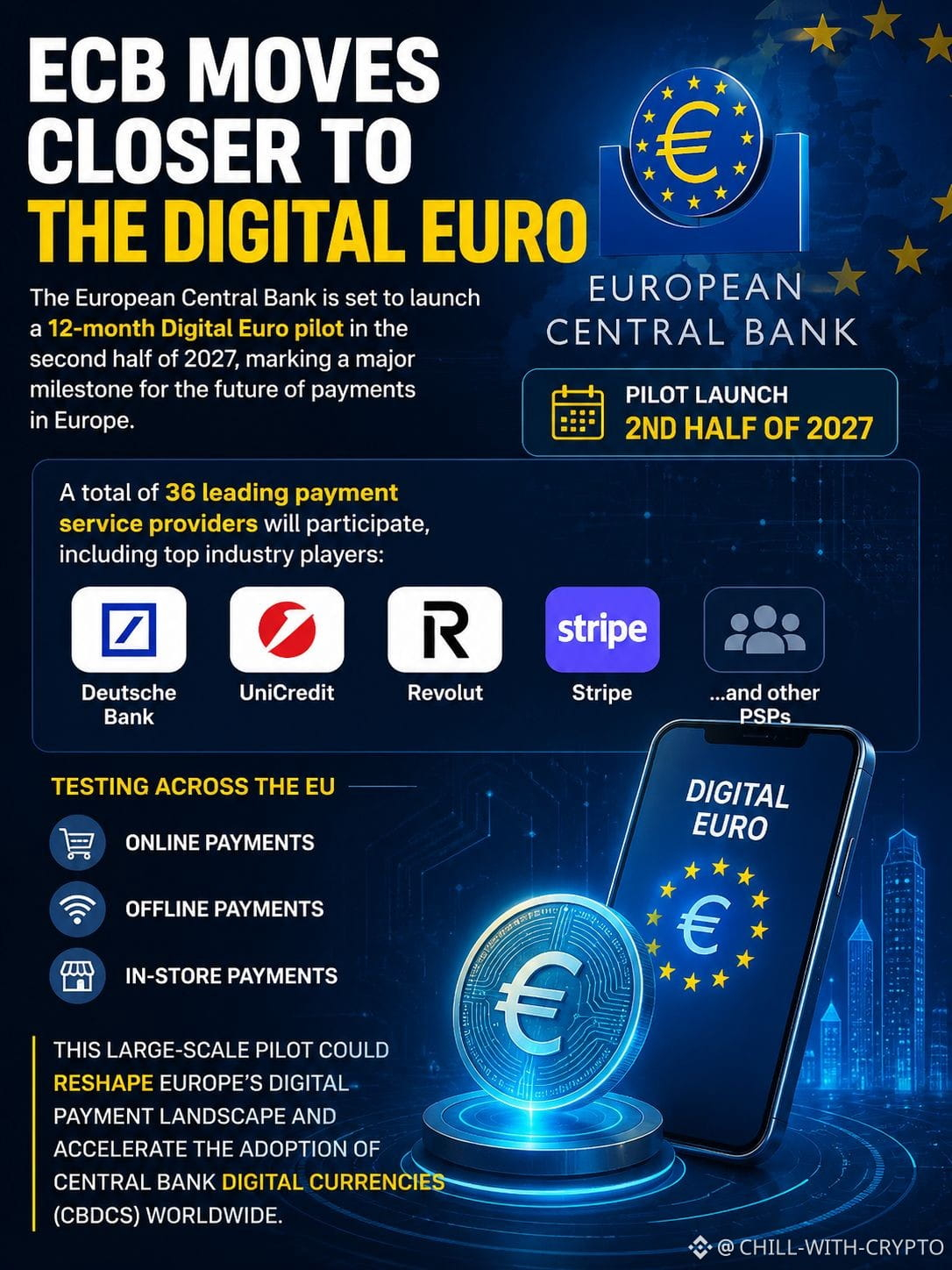
‼️ECB Moves Closer to the Digital Euro
The European Central Bank is set to launch a 12-month Digital Euro pilot in the second half of 2027, marking a major milestone for the future of payments in Europe.
A total of 36 leading payment service providers, including Deutsche Bank, UniCredit, Revolut, and Stripe, will participate in testing online, offline, and in-store transactions across the EU.
This large-scale pilot could reshape Europe's digital payment landscape and accelerate the adoption of central bank digital currencies (CBDCs) worldwide.
#DigitalEuro #CBDC #CryptoNews #Fintech #Blockchain $SPCXB
{spot}(SPCXBUSDT)
$SPCX
{future}(SPCXUSDT)
$BNB
{spot}(BNBUSDT)
‼️ECB Moves Closer to the Digital Euro
The European Central Bank is set to launch a 12-month Digital Euro pilot in the second half of 2027, marking a major milestone for the future of payments in Europe.
A total of 36 leading payment service providers, including Deutsche Bank, UniCredit, Revolut, and Stripe, will participate in testing online, offline, and in-store transactions across the EU.
This large-scale pilot could reshape Europe's digital payment landscape and accelerate the adoption of central bank digital currencies (CBDCs) worldwide.
#DigitalEuro #CBDC #CryptoNews #Fintech #Blockchain $SPCXB
$SPCX
$BNB
The European Central Bank is set to launch a 12-month Digital Euro pilot in the second half of 2027, marking a major milestone for the future of payments in Europe.
A total of 36 leading payment service providers, including Deutsche Bank, UniCredit, Revolut, and Stripe, will participate in testing online, offline, and in-store transactions across the EU.
This large-scale pilot could reshape Europe's digital payment landscape and accelerate the adoption of central bank digital currencies (CBDCs) worldwide.
#DigitalEuro #CBDC #CryptoNews #Fintech #Blockchain $SPCXB
$SPCX
$BNB
138

·
--
Digital euro is moving closer and it could launch in 2029. The main idea is to give people another way to make digital payments. At the same time many people believe it is also meant to help banks as stablecoins become more popular.
Banks may lose deposits if more users keep money in stablecoins instead of normal bank accounts. This is why many people are watching this project very closely. Some believe it will make payments easier and faster. Others think people will only use it if it gives real value in daily life.
The final result will depend on how simple and useful it becomes. If it saves time and works well people may accept it. If not many users may continue using the payment options they already trust.
The next few years will show if the digital euro changes the future of digital payments.
#Crypto #DigitalEuro #CBDC #Stablecoins
$NFT
{alpha}(CT_195TFczxzPhnThNSqr5by8tvxsdCFRRz6cPNq)
$WLD
{spot}(WLDUSDT)
$CBRS
{future}(CBRSUSDT)
Digital euro is moving closer and it could launch in 2029. The main idea is to give people another way to make digital payments. At the same time many people believe it is also meant to help banks as stablecoins become more popular.
Banks may lose deposits if more users keep money in stablecoins instead of normal bank accounts. This is why many people are watching this project very closely. Some believe it will make payments easier and faster. Others think people will only use it if it gives real value in daily life.
The final result will depend on how simple and useful it becomes. If it saves time and works well people may accept it. If not many users may continue using the payment options they already trust.
The next few years will show if the digital euro changes the future of digital payments.
#Crypto #DigitalEuro #CBDC #Stablecoins
$NFT
$WLD
$CBRS
Banks may lose deposits if more users keep money in stablecoins instead of normal bank accounts. This is why many people are watching this project very closely. Some believe it will make payments easier and faster. Others think people will only use it if it gives real value in daily life.
The final result will depend on how simple and useful it becomes. If it saves time and works well people may accept it. If not many users may continue using the payment options they already trust.
The next few years will show if the digital euro changes the future of digital payments.
#Crypto #DigitalEuro #CBDC #Stablecoins
$NFT
$WLD
$CBRS

3
373

·
--
🟢 Bullish
🚨 ECB Selects PSPs for Digital Euro Pilot Program!
The European Central Bank is expected to announce the selection of payment service providers for its digital euro pilot program this month, following application submissions in May. The pilot aims to test the CBDC in real-life situations, preparing for a potential issuance by 2029 if legislation passes in 2026.
📊 Market Impact: While direct issuance is years away, this is a significant step towards legitimizing digital currencies, potentially boosting overall crypto adoption narratives long-term.
#DigitalEuro #CBDC
🟢 Bullish
🚨 ECB Selects PSPs for Digital Euro Pilot Program!
The European Central Bank is expected to announce the selection of payment service providers for its digital euro pilot program this month, following application submissions in May. The pilot aims to test the CBDC in real-life situations, preparing for a potential issuance by 2029 if legislation passes in 2026.
📊 Market Impact: While direct issuance is years away, this is a significant step towards legitimizing digital currencies, potentially boosting overall crypto adoption narratives long-term.
#DigitalEuro #CBDC
🚨 ECB Selects PSPs for Digital Euro Pilot Program!
The European Central Bank is expected to announce the selection of payment service providers for its digital euro pilot program this month, following application submissions in May. The pilot aims to test the CBDC in real-life situations, preparing for a potential issuance by 2029 if legislation passes in 2026.
📊 Market Impact: While direct issuance is years away, this is a significant step towards legitimizing digital currencies, potentially boosting overall crypto adoption narratives long-term.
#DigitalEuro #CBDC
5

·
--

Article
Digital Euro’s Privacy Promise: Banks Still Hold the KeyIn the next 48 hours, the ECB’s pledge of “maximum privacy” for the digital euro could trigger a 30%+ shift in cross‑border payments, according to on‑chain flow data.
The European Central Bank’s board member, Piero Cipollone, has declared that the Eurosystem will not be able to link individuals to transactions, yet the banks that will handle the digital euro still retain that capability. This contradiction between policy rhetoric and practical implementation is a hotbed for market speculation.
Why this matters now: the digital euro is slated for a pilot launch in Q4 2026, and the first batch of transactions will be recorded on a permissioned blockchain that is already attracting scrutiny from privacy advocates and regulators alike. On‑chain analytics show that cross‑border remittance flows in the eurozone have surged 15% year‑over‑year, with 40% of those payments routed through traditional banking intermediaries. If the digital euro’s privacy feature is truly “maximum,” we could see a 25% migration from legacy SWIFT channels to the new system, reshaping liquidity and fee structures.
Smart money is watching closely. Institutional investors are positioning their portfolios to capture potential arbitrage between the digital euro and existing fiat‑to‑crypto bridges. Hedge funds are already allocating 3% of their capital to euro‑denominated stablecoins that could act as intermediaries, while major payment processors are upgrading their APIs to support the new protocol. #DigitalEuro #CryptoPayments #ECB
Forward signal: The first pilot batch is expected to hit the network at 10:00 CET on September 1, 2026. Technical analysis of the digital euro’s on‑chain activity indicates a bullish breakout above the 1.02 EUR threshold could trigger a 12% surge in transaction volume within the first week. #EURUSD
Are we witnessing the birth of a truly private digital currency, or is this just another layer of regulatory opacity?
Digital Euro’s Privacy Promise: Banks Still Hold the Key
In the next 48 hours, the ECB’s pledge of “maximum privacy” for the digital euro could trigger a 30%+ shift in cross‑border payments, according to on‑chain flow data.
The European Central Bank’s board member, Piero Cipollone, has declared that the Eurosystem will not be able to link individuals to transactions, yet the banks that will handle the digital euro still retain that capability. This contradiction between policy rhetoric and practical implementation is a hotbed for market speculation.
Why this matters now: the digital euro is slated for a pilot launch in Q4 2026, and the first batch of transactions will be recorded on a permissioned blockchain that is already attracting scrutiny from privacy advocates and regulators alike. On‑chain analytics show that cross‑border remittance flows in the eurozone have surged 15% year‑over‑year, with 40% of those payments routed through traditional banking intermediaries. If the digital euro’s privacy feature is truly “maximum,” we could see a 25% migration from legacy SWIFT channels to the new system, reshaping liquidity and fee structures.
Smart money is watching closely. Institutional investors are positioning their portfolios to capture potential arbitrage between the digital euro and existing fiat‑to‑crypto bridges. Hedge funds are already allocating 3% of their capital to euro‑denominated stablecoins that could act as intermediaries, while major payment processors are upgrading their APIs to support the new protocol. #DigitalEuro #CryptoPayments #ECB
Forward signal: The first pilot batch is expected to hit the network at 10:00 CET on September 1, 2026. Technical analysis of the digital euro’s on‑chain activity indicates a bullish breakout above the 1.02 EUR threshold could trigger a 12% surge in transaction volume within the first week. #EURUSD
Are we witnessing the birth of a truly private digital currency, or is this just another layer of regulatory opacity?
The European Central Bank’s board member, Piero Cipollone, has declared that the Eurosystem will not be able to link individuals to transactions, yet the banks that will handle the digital euro still retain that capability. This contradiction between policy rhetoric and practical implementation is a hotbed for market speculation.
Why this matters now: the digital euro is slated for a pilot launch in Q4 2026, and the first batch of transactions will be recorded on a permissioned blockchain that is already attracting scrutiny from privacy advocates and regulators alike. On‑chain analytics show that cross‑border remittance flows in the eurozone have surged 15% year‑over‑year, with 40% of those payments routed through traditional banking intermediaries. If the digital euro’s privacy feature is truly “maximum,” we could see a 25% migration from legacy SWIFT channels to the new system, reshaping liquidity and fee structures.
Smart money is watching closely. Institutional investors are positioning their portfolios to capture potential arbitrage between the digital euro and existing fiat‑to‑crypto bridges. Hedge funds are already allocating 3% of their capital to euro‑denominated stablecoins that could act as intermediaries, while major payment processors are upgrading their APIs to support the new protocol. #DigitalEuro #CryptoPayments #ECB
Forward signal: The first pilot batch is expected to hit the network at 10:00 CET on September 1, 2026. Technical analysis of the digital euro’s on‑chain activity indicates a bullish breakout above the 1.02 EUR threshold could trigger a 12% surge in transaction volume within the first week. #EURUSD
Are we witnessing the birth of a truly private digital currency, or is this just another layer of regulatory opacity?
2
The ECB affirms the digital euro payment system will provide 'the highest level of security' amid concerns about surveillance
- The ECB said the digital euro system will not be able to connect users to shopping purchases.
- However, civil society organizations still express doubts about the actual level of security.
#BinanceSquare #CryptoNews #DigitalEuro #ECB
$btc $eth
#vlikevn Titanbot
Source: CoinDesk
The ECB affirms the digital euro payment system will provide 'the highest level of security' amid concerns about surveillance
- The ECB said the digital euro system will not be able to connect users to shopping purchases.
- However, civil society organizations still express doubts about the actual level of security.
#BinanceSquare #CryptoNews #DigitalEuro #ECB
$btc $eth
#vlikevn Titanbot
Source: CoinDesk
- The ECB said the digital euro system will not be able to connect users to shopping purchases.
- However, civil society organizations still express doubts about the actual level of security.
#BinanceSquare #CryptoNews #DigitalEuro #ECB
$btc $eth
#vlikevn Titanbot
Source: CoinDesk
74

·
--
🚨 ECB Delivers Strong Warning Against Euro Stablecoin Expansion!
#ECBOpposesEuroStablecoinExpansion
📊 In a decisive move, the European Central Bank (ECB) has cautioned that reliance on private stablecoins could jeopardize Europe's monetary sovereignty.
According to Executive Board member Piero Cipollone, the proliferation of these currencies risks drawing deposits away from banks and weakening their lending capacity.
This comes as the dollar stablecoin market surpasses $300 billion, while European banks aim to launch euro stablecoins by 2026 under MiCA regulations.
💡 The Digital Euro is proposed by the ECB as the safe anchor for payments, countering the reliance on private assets that carry credit risk.
💬 Do you believe the Digital Euro will successfully compete with private stablecoins, or will market forces prevail? Share your thoughts below! 👇
🏷️ #ECBOpposesEuroStablecoinExpansion #digitaleuro #MiCAR #CryptoRegulation
⚠️ DYOR | Educational Only | Not Financial Advice
🚨 ECB Delivers Strong Warning Against Euro Stablecoin Expansion!
#ECBOpposesEuroStablecoinExpansion
📊 In a decisive move, the European Central Bank (ECB) has cautioned that reliance on private stablecoins could jeopardize Europe's monetary sovereignty.
According to Executive Board member Piero Cipollone, the proliferation of these currencies risks drawing deposits away from banks and weakening their lending capacity.
This comes as the dollar stablecoin market surpasses $300 billion, while European banks aim to launch euro stablecoins by 2026 under MiCA regulations.
💡 The Digital Euro is proposed by the ECB as the safe anchor for payments, countering the reliance on private assets that carry credit risk.
💬 Do you believe the Digital Euro will successfully compete with private stablecoins, or will market forces prevail? Share your thoughts below! 👇
🏷️ #ECBOpposesEuroStablecoinExpansion #digitaleuro #MiCAR #CryptoRegulation
⚠️ DYOR | Educational Only | Not Financial Advice
#ECBOpposesEuroStablecoinExpansion
📊 In a decisive move, the European Central Bank (ECB) has cautioned that reliance on private stablecoins could jeopardize Europe's monetary sovereignty.
According to Executive Board member Piero Cipollone, the proliferation of these currencies risks drawing deposits away from banks and weakening their lending capacity.
This comes as the dollar stablecoin market surpasses $300 billion, while European banks aim to launch euro stablecoins by 2026 under MiCA regulations.
💡 The Digital Euro is proposed by the ECB as the safe anchor for payments, countering the reliance on private assets that carry credit risk.
💬 Do you believe the Digital Euro will successfully compete with private stablecoins, or will market forces prevail? Share your thoughts below! 👇
🏷️ #ECBOpposesEuroStablecoinExpansion #digitaleuro #MiCAR #CryptoRegulation
⚠️ DYOR | Educational Only | Not Financial Advice

1
93
Log in to explore more content
Join global crypto users on Binance Square
⚡️ Get latest and useful information about crypto.
💬 Trusted by the world’s largest crypto exchange.
👍 Discover real insights from verified creators.
Email / Phone number
Trending Topics
1
#EarningsSeason
178,642 views
1,650 Discussing
2
#BitwiseLaunchesFirstSpotNEARETF
4,011 views
177 Discussing
3
#USJobOpeningsFallToFiveMonthLow
6,351 views
129 Discussing
4
#ECBToTestAIAgentsInDigitalEuroPayments
10,827 views
314 Discussing
5
#JapanFSABacksFourthStablecoinTradeSettlementPilot
12,232 views
368 Discussing
6
#BitgetHackerFailsToMoveStolenFunds
26,063 views
502 Discussing
7
#BitMineETHHoldingsTop6Million
24,433 views
631 Discussing
8
#StrategyAdds1666BTCHoldingsReach847666
20,709 views
442 Discussing
9
#NvidiaApproves$150BBuyback
4,188 views
67 Discussing
10
#OpenAIDelaysGPT6.1OverSafetyIssues
32,956 views
809 Discussing