
#deutschebank
deutschebank
71,126 views
232 Discussing
Hot
Latest

·
--
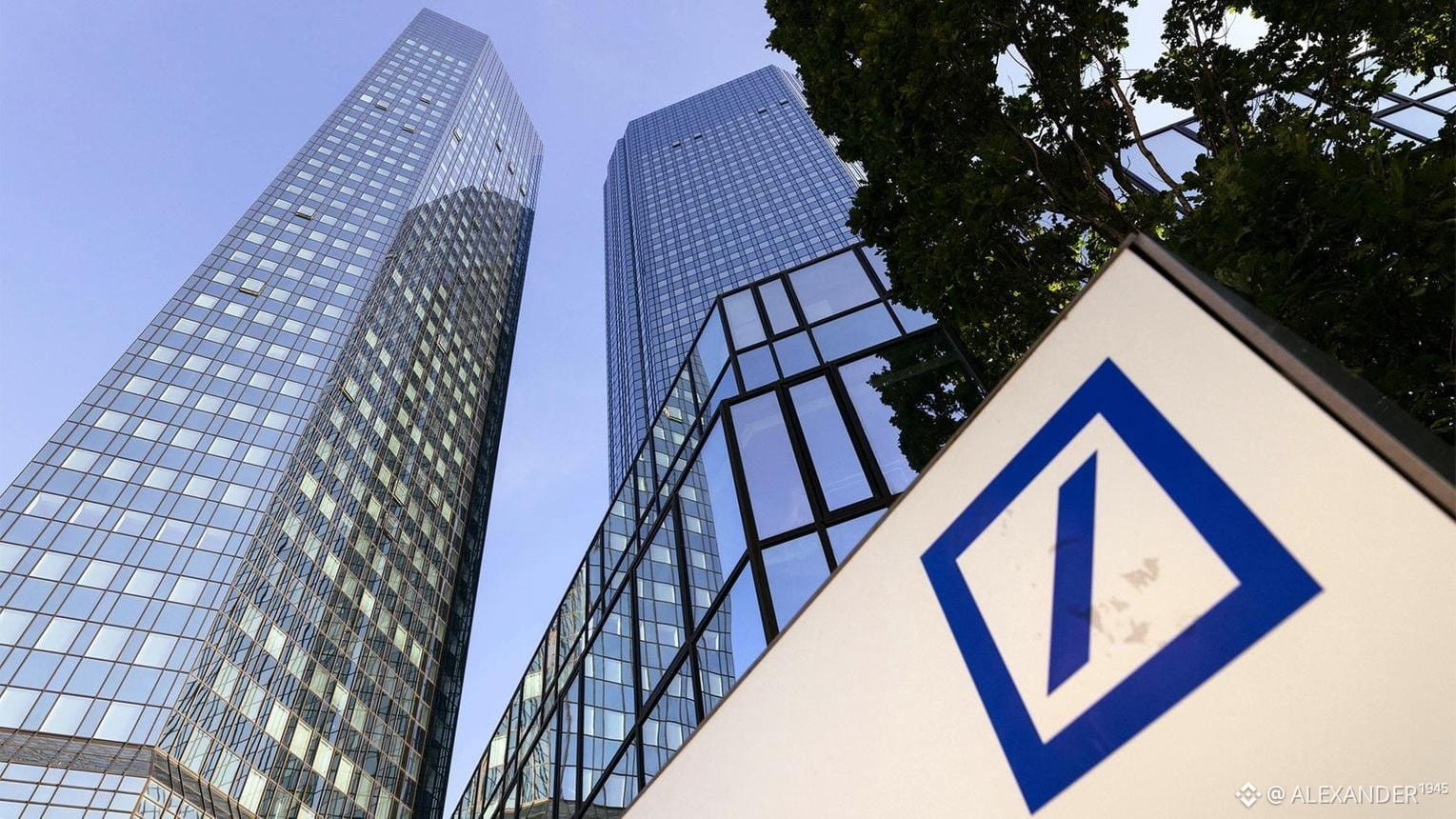
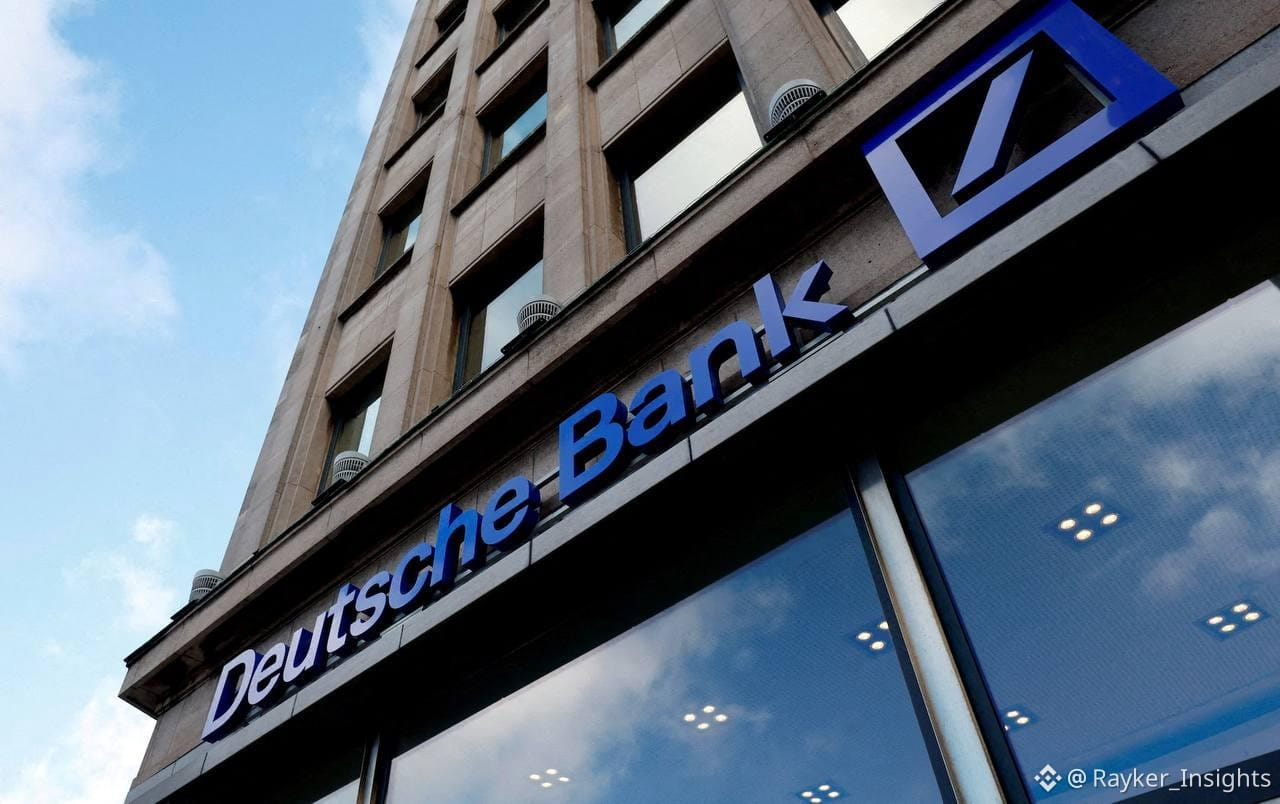
Deutsche Bank launched crypto custody on Nov 11 for institutional clients: BTC, ETH, USDC, EURC and EURAU. No trading; Germany first, EU cross-border. XRP and SOL not included yet. #DeutscheBank #Crypto
YouTube: youtube.com/@aibarfasi | TikTok: tiktok.com/@aibarfasi.vn
Deutsche Bank launched crypto custody on Nov 11 for institutional clients: BTC, ETH, USDC, EURC and EURAU. No trading; Germany first, EU cross-border. XRP and SOL not included yet. #DeutscheBank #Crypto
YouTube: youtube.com/@aibarfasi | TikTok: tiktok.com/@aibarfasi.vn
YouTube: youtube.com/@aibarfasi | TikTok: tiktok.com/@aibarfasi.vn
15

📉 BITCOIN IS FALLING, BUT WALL STREET IS MOVING IN
Bitcoin is facing renewed selling pressure, and uncertainty is spreading across the crypto market.
But something interesting is happening behind the scenes.
Deutsche Bank has launched a digital asset custody service for institutional clients, supporting assets including Bitcoin, Ethereum, and selected stablecoins.
Think about that for a moment.
While short-term investors are worried about falling prices, major financial institutions are building infrastructure to handle digital assets.
This reveals an important distinction:
Market prices reflect today's sentiment. Institutional infrastructure reflects long-term positioning.
A falling market doesn't automatically mean the industry is moving backwards.
Sometimes, the biggest developments happen while prices are falling.
#Bitcoin #Crypto #DeutscheBank
{spot}(NVDABUSDT)
$BTC #InstitutionalAdoption
📉 BITCOIN IS FALLING, BUT WALL STREET IS MOVING IN
Bitcoin is facing renewed selling pressure, and uncertainty is spreading across the crypto market.
But something interesting is happening behind the scenes.
Deutsche Bank has launched a digital asset custody service for institutional clients, supporting assets including Bitcoin, Ethereum, and selected stablecoins.
Think about that for a moment.
While short-term investors are worried about falling prices, major financial institutions are building infrastructure to handle digital assets.
This reveals an important distinction:
Market prices reflect today's sentiment. Institutional infrastructure reflects long-term positioning.
A falling market doesn't automatically mean the industry is moving backwards.
Sometimes, the biggest developments happen while prices are falling.
#Bitcoin #Crypto #DeutscheBank
$BTC #InstitutionalAdoption

3
520

·
--
Deutsche Bank is making another move into digital assets.
According to reports from The Block and Cointelegraph, its crypto custody service is now live for institutional clients in Europe.
Why does this matter?
For years, one of crypto's biggest institutional questions has been simple:
Who can securely hold the assets?
Now a major global bank is entering that conversation with its own custody offering.
This doesn't make crypto risk-free. And custody isn't the same as deposit insurance.
But it signals something important:
Crypto infrastructure is increasingly becoming part of traditional finance's business.
The next competition may not just be about which assets institutions buy.
It may be about who gets trusted to hold them.
#Crypto #Bitcoin #DeutscheBank
38

Article
Deutsche Bank integrates Bitcoin custody into institutional banking$BTC
{spot}(BTCUSDT)
Germany’s largest bank, Deutsche Bank, has officially launched a digital asset custody service for institutional clients across Europe, incorporating Bitcoin, Ether, and regulated stablecoins into its banking infrastructure. The launch, which took place on November 11, marks another significant step toward integrating cryptocurrency services into the traditional financial system (TradFi).
The launch by this TradFi giant is the culmination of years of preparation, rigorous regulatory scrutiny, and technical development. It provides corporate and institutional clients with access to the custody and transfer of digital assets, eliminating the need for them to operate their own storage infrastructure.
According to a Reuters report published on Wednesday, November 11, 2026, Deutsche Bank confirmed that its asset custody platform is now serving paying clients. This announcement follows the bank’s disclosure on September 16 regarding its plans to introduce regulated cryptocurrency custody by the end of the year.
Deutsche Bank Launches Institutional Crypto Custody Service in Compliance with MiCA
The new service supports Bitcoin (BTC) and Ether (ETH), as well as three stablecoins and e-money tokens: USDC, EURC, and EURAU. Rather than requiring institutions to secure their own digital assets, Deutsche Bank assumes responsibility for safeguarding cryptographic credentials and managing client assets within a regulated banking framework.
To protect institutional client assets, the bank utilizes specialized cryptographic hardware, ensures strict segregation of client funds, and employs multi-layered identity verification alongside customized transaction permissions. Deutsche Bank clients can choose between internet-connected accounts and offline storage solutions. The platform operates through Deutsche Bank AG in Frankfurt and is accessed via the "Autobahn" gateway and the "Corporate Bank" portal. Eligible clients include corporations, hedge funds, asset management firms, brokers, custodians, and sovereign institutions. Retail clients are not eligible for this offering.
The launch follows an application submitted by Deutsche Bank to the German financial regulator, BaFin, in June 2023. Subsequently, the institution received authorization under the European Union’s Markets in Crypto-Assets (MiCA) regulation, allowing it to provide regulated custody and transfer services.
Initially, the authorization was limited to Germany, but its scope was later extended to the entire European Economic Area through regulatory passporting arrangements. Paul Maley, Global Head of Securities Services at Deutsche Bank, outlined the institution's long-term ambitions.
Maley stated:
"In the medium term, we aim to build a fully integrated, regulated ecosystem that supports the custody, tokenization, and settlement of digital assets."
For now, tokenized securities and expanded settlement capabilities remain future objectives rather than components of the initial custody product. Deutsche Bank and Deutsche Asset Management Explore the Realm of Tokenized Finance
Alongside the launch of its custody service, Deutsche Bank also announced the signing of a Memorandum of Understanding (MOU) with Deutsche Asset Management—an investment manager formerly known as DWS. The agreement aims to "explore opportunities for comprehensive commercial and technical collaboration in the field of digital assets."
This latest announcement from Deutsche Bank comes amid an ongoing expansion of cryptocurrency-related activities among established financial institutions. On Monday, November 9, financial services giant Charles Schwab expanded its direct cryptocurrency trading offerings beyond Bitcoin and Ether, adding three additional tokens for eligible retail clients. These additions follow a broader launch by Schwab in October across all supported U.S. jurisdictions.
Although these companies target different client bases across various regions, both moves demonstrate how traditional financial institutions (TradFi) are rapidly integrating digital assets into their existing financial services. It should be noted, however, that Deutsche Bank’s custody service is not a full-fledged cryptocurrency exchange or trading platform. Furthermore, clients remain exposed to digital asset price volatility and cybersecurity threats, and the protections offered differ from those associated with traditional bank deposits.
For European institutions, the next logical step involves gaining access to cryptocurrency custody services through established banking relationships. A more important question is whether Deutsche Bank can transform this foundation into a comprehensive tokenization and settlement business. Regulated custody creates the infrastructure, but it is sustained institutional demand that will ultimately determine its commercial significance.
#GermanyNews #DeutscheBank
Deutsche Bank integrates Bitcoin custody into institutional banking
$BTC
Germany’s largest bank, Deutsche Bank, has officially launched a digital asset custody service for institutional clients across Europe, incorporating Bitcoin, Ether, and regulated stablecoins into its banking infrastructure. The launch, which took place on November 11, marks another significant step toward integrating cryptocurrency services into the traditional financial system (TradFi).
The launch by this TradFi giant is the culmination of years of preparation, rigorous regulatory scrutiny, and technical development. It provides corporate and institutional clients with access to the custody and transfer of digital assets, eliminating the need for them to operate their own storage infrastructure.
According to a Reuters report published on Wednesday, November 11, 2026, Deutsche Bank confirmed that its asset custody platform is now serving paying clients. This announcement follows the bank’s disclosure on September 16 regarding its plans to introduce regulated cryptocurrency custody by the end of the year.
Deutsche Bank Launches Institutional Crypto Custody Service in Compliance with MiCA
The new service supports Bitcoin (BTC) and Ether (ETH), as well as three stablecoins and e-money tokens: USDC, EURC, and EURAU. Rather than requiring institutions to secure their own digital assets, Deutsche Bank assumes responsibility for safeguarding cryptographic credentials and managing client assets within a regulated banking framework.
To protect institutional client assets, the bank utilizes specialized cryptographic hardware, ensures strict segregation of client funds, and employs multi-layered identity verification alongside customized transaction permissions. Deutsche Bank clients can choose between internet-connected accounts and offline storage solutions. The platform operates through Deutsche Bank AG in Frankfurt and is accessed via the "Autobahn" gateway and the "Corporate Bank" portal. Eligible clients include corporations, hedge funds, asset management firms, brokers, custodians, and sovereign institutions. Retail clients are not eligible for this offering.
The launch follows an application submitted by Deutsche Bank to the German financial regulator, BaFin, in June 2023. Subsequently, the institution received authorization under the European Union’s Markets in Crypto-Assets (MiCA) regulation, allowing it to provide regulated custody and transfer services.
Initially, the authorization was limited to Germany, but its scope was later extended to the entire European Economic Area through regulatory passporting arrangements. Paul Maley, Global Head of Securities Services at Deutsche Bank, outlined the institution's long-term ambitions.
Maley stated:
"In the medium term, we aim to build a fully integrated, regulated ecosystem that supports the custody, tokenization, and settlement of digital assets."
For now, tokenized securities and expanded settlement capabilities remain future objectives rather than components of the initial custody product. Deutsche Bank and Deutsche Asset Management Explore the Realm of Tokenized Finance
Alongside the launch of its custody service, Deutsche Bank also announced the signing of a Memorandum of Understanding (MOU) with Deutsche Asset Management—an investment manager formerly known as DWS. The agreement aims to "explore opportunities for comprehensive commercial and technical collaboration in the field of digital assets."
This latest announcement from Deutsche Bank comes amid an ongoing expansion of cryptocurrency-related activities among established financial institutions. On Monday, November 9, financial services giant Charles Schwab expanded its direct cryptocurrency trading offerings beyond Bitcoin and Ether, adding three additional tokens for eligible retail clients. These additions follow a broader launch by Schwab in October across all supported U.S. jurisdictions.
Although these companies target different client bases across various regions, both moves demonstrate how traditional financial institutions (TradFi) are rapidly integrating digital assets into their existing financial services. It should be noted, however, that Deutsche Bank’s custody service is not a full-fledged cryptocurrency exchange or trading platform. Furthermore, clients remain exposed to digital asset price volatility and cybersecurity threats, and the protections offered differ from those associated with traditional bank deposits.
For European institutions, the next logical step involves gaining access to cryptocurrency custody services through established banking relationships. A more important question is whether Deutsche Bank can transform this foundation into a comprehensive tokenization and settlement business. Regulated custody creates the infrastructure, but it is sustained institutional demand that will ultimately determine its commercial significance.
#GermanyNews #DeutscheBank
6

·
--
Deutsche Bank Launches Crypto Custody for BTC, ETH and USDC
Germany's largest bank has rolled out digital asset custody for European corporate and institutional clients, supporting Bitcoin, Ethereum and major stablecoins after years of preparation.
The launch lands as tokenized assets surge past $337B — traditional finance is moving on-chain, and one of Europe's biggest banks just joined the shift.
Not financial advice.
$BTC $ETH #DeutscheBank #Crypto #Bitcoin #Ethereum

11

Deutsche Bank has gone live with its digital asset custody service for institutional and corporate clients in Europe. The offering covers Bitcoin, Ethereum, and stablecoins including USDC, with the bank managing wallets and private keys under MiCA rules. It also signed an MoU with its asset management arm to explore tokenized products.
$BTC $ETH $USDC #CoinVahini #DeutscheBank #CryptoCustody #InstitutionalCrypto
$BTC $ETH $USDC #CoinVahini #DeutscheBank #CryptoCustody #InstitutionalCrypto
1
117


·
--
Article
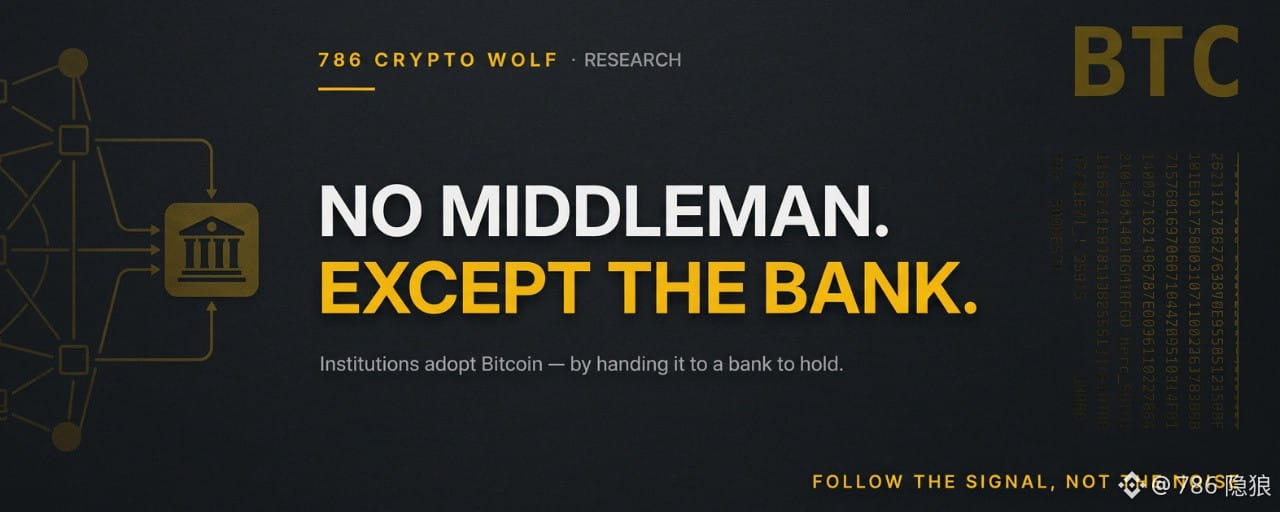
Crypto Hired a BankThe most “bullish” crypto headline of the week is also its quietest surrender.
On November 11, Deutsche Bank — one of the largest banks on earth — switched on crypto custody for its institutional clients. Hedge funds, asset managers, corporations and sovereign institutions can now hand their Bitcoin, Ether and stablecoins to the bank to hold. Germany first, the rest of the EU under MiCA next, Asia in 2027.
The market read it as what it looks like: adoption. Another pillar. Institutions are in. And they’re not wrong.
But look at what “institutions are in” actually requires.
An institution will not touch Bitcoin until someone it trusts agrees to hold it. Not a promise of it — the actual keys. And the entity the financial world trusts most to hold things is the one Bitcoin was designed to make unnecessary: a bank.
So the headline everyone is cheering — “banks are custodying crypto” — is, underneath, a reversal. The asset built to remove the middleman is now held by the middleman. Self-custody was the whole point. Institutional crypto is custodial by definition.
That’s not a scandal. It’s the trade. Institutions don’t want to be their own bank; they want a bank. Deutsche Bank is simply the one that said yes first, at scale.
Here’s the part the “bullish milestone” posts skip.
When you deposit euros at Deutsche Bank, a deposit-guarantee scheme stands behind them up to a limit. If the bank fails, you’re covered. Custodied crypto is not a deposit. It’s an asset the bank holds for you — and it carries no such insurance. You get the bank’s name, its security, its reputation. You do not get the safety net that makes a bank deposit a bank deposit.
So the institution re-introduces the intermediary crypto was built to remove — and gives up the one protection that intermediary normally provides. Middleman back. Backstop gone.
Now the honest part, because it cuts two ways.
Read it one way, this is maturation: real custody, real regulation (BaFin, MiCA), real institutional money finally able to participate safely. Genuinely good for the asset class.
Read it another way, it’s crypto quietly becoming the thing it was built to replace — a system where a few trusted institutions hold everyone’s value, under rules written by regulators, with retail left out entirely (this launch skips retail).
Both are true. Adoption and decentralization are not the same direction. This week, they moved apart.
Every step toward “institutional adoption” is a step toward re-intermediation. The more crypto succeeds at being accepted, the more it resembles the banking system it set out to route around. That may not be failure — it might be inevitable. But it’s worth naming, because the people cheering “banks are in!” are cheering the exact outcome Bitcoin’s whitepaper was a rejection of.
If a bank now holds the Bitcoin, writes the rules with the regulator, and leaves retail outside — what, exactly, did Bitcoin decentralize?
🐺 786 CRYPTO WOLF · RESEARCH
Follow the signal, not the noise.
$BTC
#DeutscheBank #bitcoin #cryptocustody #AlphaWolfHQ #786CryptoWolf
Crypto Hired a Bank
The most “bullish” crypto headline of the week is also its quietest surrender.
On November 11, Deutsche Bank — one of the largest banks on earth — switched on crypto custody for its institutional clients. Hedge funds, asset managers, corporations and sovereign institutions can now hand their Bitcoin, Ether and stablecoins to the bank to hold. Germany first, the rest of the EU under MiCA next, Asia in 2027.
The market read it as what it looks like: adoption. Another pillar. Institutions are in. And they’re not wrong.
But look at what “institutions are in” actually requires.
An institution will not touch Bitcoin until someone it trusts agrees to hold it. Not a promise of it — the actual keys. And the entity the financial world trusts most to hold things is the one Bitcoin was designed to make unnecessary: a bank.
So the headline everyone is cheering — “banks are custodying crypto” — is, underneath, a reversal. The asset built to remove the middleman is now held by the middleman. Self-custody was the whole point. Institutional crypto is custodial by definition.
That’s not a scandal. It’s the trade. Institutions don’t want to be their own bank; they want a bank. Deutsche Bank is simply the one that said yes first, at scale.
Here’s the part the “bullish milestone” posts skip.
When you deposit euros at Deutsche Bank, a deposit-guarantee scheme stands behind them up to a limit. If the bank fails, you’re covered. Custodied crypto is not a deposit. It’s an asset the bank holds for you — and it carries no such insurance. You get the bank’s name, its security, its reputation. You do not get the safety net that makes a bank deposit a bank deposit.
So the institution re-introduces the intermediary crypto was built to remove — and gives up the one protection that intermediary normally provides. Middleman back. Backstop gone.
Now the honest part, because it cuts two ways.
Read it one way, this is maturation: real custody, real regulation (BaFin, MiCA), real institutional money finally able to participate safely. Genuinely good for the asset class.
Read it another way, it’s crypto quietly becoming the thing it was built to replace — a system where a few trusted institutions hold everyone’s value, under rules written by regulators, with retail left out entirely (this launch skips retail).
Both are true. Adoption and decentralization are not the same direction. This week, they moved apart.
Every step toward “institutional adoption” is a step toward re-intermediation. The more crypto succeeds at being accepted, the more it resembles the banking system it set out to route around. That may not be failure — it might be inevitable. But it’s worth naming, because the people cheering “banks are in!” are cheering the exact outcome Bitcoin’s whitepaper was a rejection of.
If a bank now holds the Bitcoin, writes the rules with the regulator, and leaves retail outside — what, exactly, did Bitcoin decentralize?
🐺 786 CRYPTO WOLF · RESEARCH
Follow the signal, not the noise.
$BTC
#DeutscheBank #bitcoin #cryptocustody #AlphaWolfHQ #786CryptoWolf
1
306


Article
Deutsche Bank Launches Institutional Crypto CustodyDeutsche Bank has completed its 5 year buildup to launch a specialized crypto custody service for its institutional and corporate client base across Europe. This move signals a significant shift as one of the largest global financial institutions moves beyond exploration into live deployment of digital asset infrastructure.
The offering currently supports Bitcoin, Ethereum, and 3 stablecoins. For institutional allocators this removes a major hurdle in the adoption of digital assets by providing the regulatory and security rigor expected of a tier 1 global bank.
This development validates the growing demand for institutional grade custody solutions and bridges the gap between traditional finance and decentralized asset markets.
#DeutscheBank #CryptoCustody
Deutsche Bank Launches Institutional Crypto Custody
Deutsche Bank has completed its 5 year buildup to launch a specialized crypto custody service for its institutional and corporate client base across Europe. This move signals a significant shift as one of the largest global financial institutions moves beyond exploration into live deployment of digital asset infrastructure.
The offering currently supports Bitcoin, Ethereum, and 3 stablecoins. For institutional allocators this removes a major hurdle in the adoption of digital assets by providing the regulatory and security rigor expected of a tier 1 global bank.
This development validates the growing demand for institutional grade custody solutions and bridges the gap between traditional finance and decentralized asset markets.
#DeutscheBank #CryptoCustody
5

·
--
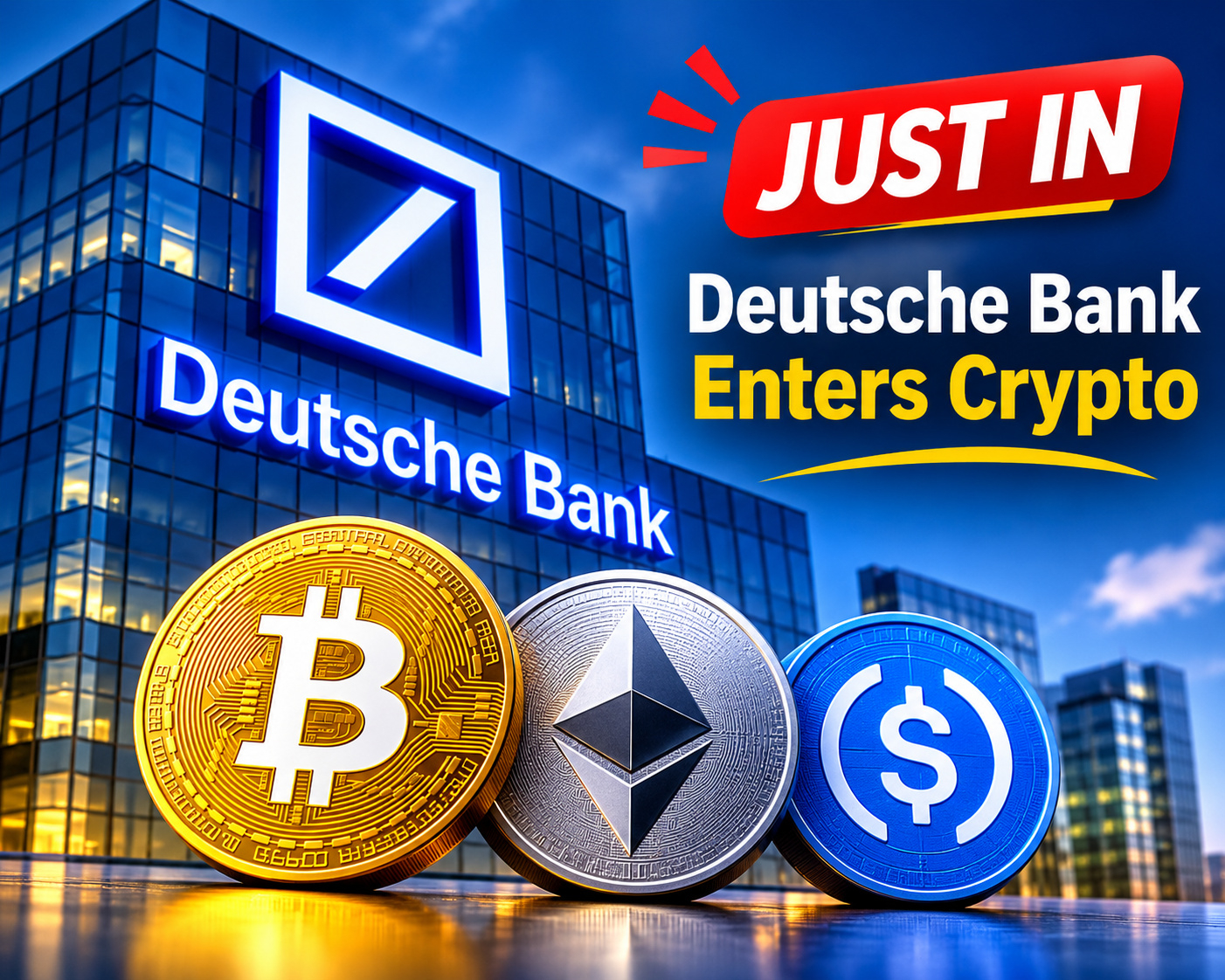
🚨 JUST IN: Deutsche Bank Expands Into Crypto!
Deutsche Bank has officially launched digital asset custody services for its institutional and corporate clients in Europe.
The service will support major digital assets, including Bitcoin ($BTC), Ethereum ($ETH), and stablecoins.
🏦 Traditional banking is increasingly embracing crypto!
Is this another major step toward mainstream crypto adoption? 👀🚀
#Bitcoin $BTC $ETH #Ethereum #Crypto #BTC #ETH #DeutscheBank
🚨 JUST IN: Deutsche Bank Expands Into Crypto!
Deutsche Bank has officially launched digital asset custody services for its institutional and corporate clients in Europe.
The service will support major digital assets, including Bitcoin ($BTC ), Ethereum ($ETH ), and stablecoins.
🏦 Traditional banking is increasingly embracing crypto!
Is this another major step toward mainstream crypto adoption? 👀🚀
#Bitcoin $BTC $ETH #Ethereum #Crypto #BTC #ETH #DeutscheBank
1
67

·
--
🚨 GERMANY'S LARGEST BANK NOW HOLDS CRYPTO FOR PAYING CLIENTS
Deutsche Bank's digital asset custody service went live today, Nov 11 (Reuters). $BTC, $ETH, USDC, EURC and EURAU, held in bank-managed wallets for institutional and corporate clients in Germany, with cross-border service across Europe.
The bank first announced the plan on Sept 16, and BaFin logged its MiCA authorization on Oct 12. Asia expansion is planned for 2027, and the bank also signed an MoU with Deutsche Asset Management (DWS) to explore digital-asset collaboration.
🔥 Why it matters: custody is the plumbing that lets corporates and asset managers actually hold crypto. But custody is not trading, and the bank disclosed no client count or assets held, so this is infrastructure going live, not a demand number. Crypto held this way is also not covered by deposit protection.
👀 What to watch: first disclosed clients, the 2027 Asia rollout, and whether the DWS MoU turns into a real product.
Is this the year TradFi stops watching crypto and starts holding it?
Not financial advice. DYOR.
#crypto #DeutscheBank #Bitcoin #MiCA
🚨 GERMANY'S LARGEST BANK NOW HOLDS CRYPTO FOR PAYING CLIENTS
Deutsche Bank's digital asset custody service went live today, Nov 11 (Reuters). $BTC , $ETH , USDC, EURC and EURAU, held in bank-managed wallets for institutional and corporate clients in Germany, with cross-border service across Europe.
The bank first announced the plan on Sept 16, and BaFin logged its MiCA authorization on Oct 12. Asia expansion is planned for 2027, and the bank also signed an MoU with Deutsche Asset Management (DWS) to explore digital-asset collaboration.
🔥 Why it matters: custody is the plumbing that lets corporates and asset managers actually hold crypto. But custody is not trading, and the bank disclosed no client count or assets held, so this is infrastructure going live, not a demand number. Crypto held this way is also not covered by deposit protection.
👀 What to watch: first disclosed clients, the 2027 Asia rollout, and whether the DWS MoU turns into a real product.
Is this the year TradFi stops watching crypto and starts holding it?
Not financial advice. DYOR.
#crypto #DeutscheBank #Bitcoin #MiCA
25

·
--
Germany's largest lender now holds bitcoin, ether and stablecoins for paying corporate and institutional clients.
• The custody service is live for paying clients, two months after the September announcement
• Supported assets: BTC, ETH, USDC, EURC and EURAU; the bank manages wallets and private keys
Why it matters: A top European bank holding crypto keys itself lowers the barrier for institutions that need a regulated custodian.
Source: Deutsche Bank, Reuters, The Block
Not financial advice.
💬 Will bank-run custody pull institutions away from crypto-native custodians? Share your view below.
$BTC $ETH #DeutscheBank #CryptoCustody
14

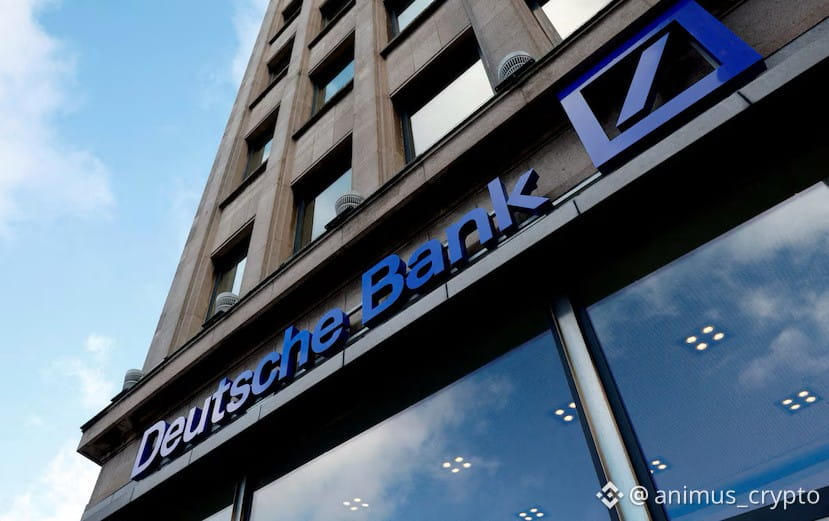
🏦 Deutsche Bank has launched crypto custody services for institutional clients.
Germany’s largest bank will now custody $BTC, $ETH and stablecoins.
$BTC $ETH #crypto #DeutscheBank
🏦 Deutsche Bank has launched crypto custody services for institutional clients.
Germany’s largest bank will now custody $BTC , $ETH and stablecoins.
$BTC $ETH #crypto #DeutscheBank
Germany’s largest bank will now custody $BTC , $ETH and stablecoins.
$BTC $ETH #crypto #DeutscheBank
35
Deutsche Bank provides regulated custody for Bitcoin, Ethereum, and stablecoins, marking a massive step for institutional asset integration.
#DeutscheBank #InstitutionalAdoption
Deutsche Bank provides regulated custody for Bitcoin, Ethereum, and stablecoins, marking a massive step for institutional asset integration.
#DeutscheBank #InstitutionalAdoption
#DeutscheBank #InstitutionalAdoption
30

·
--
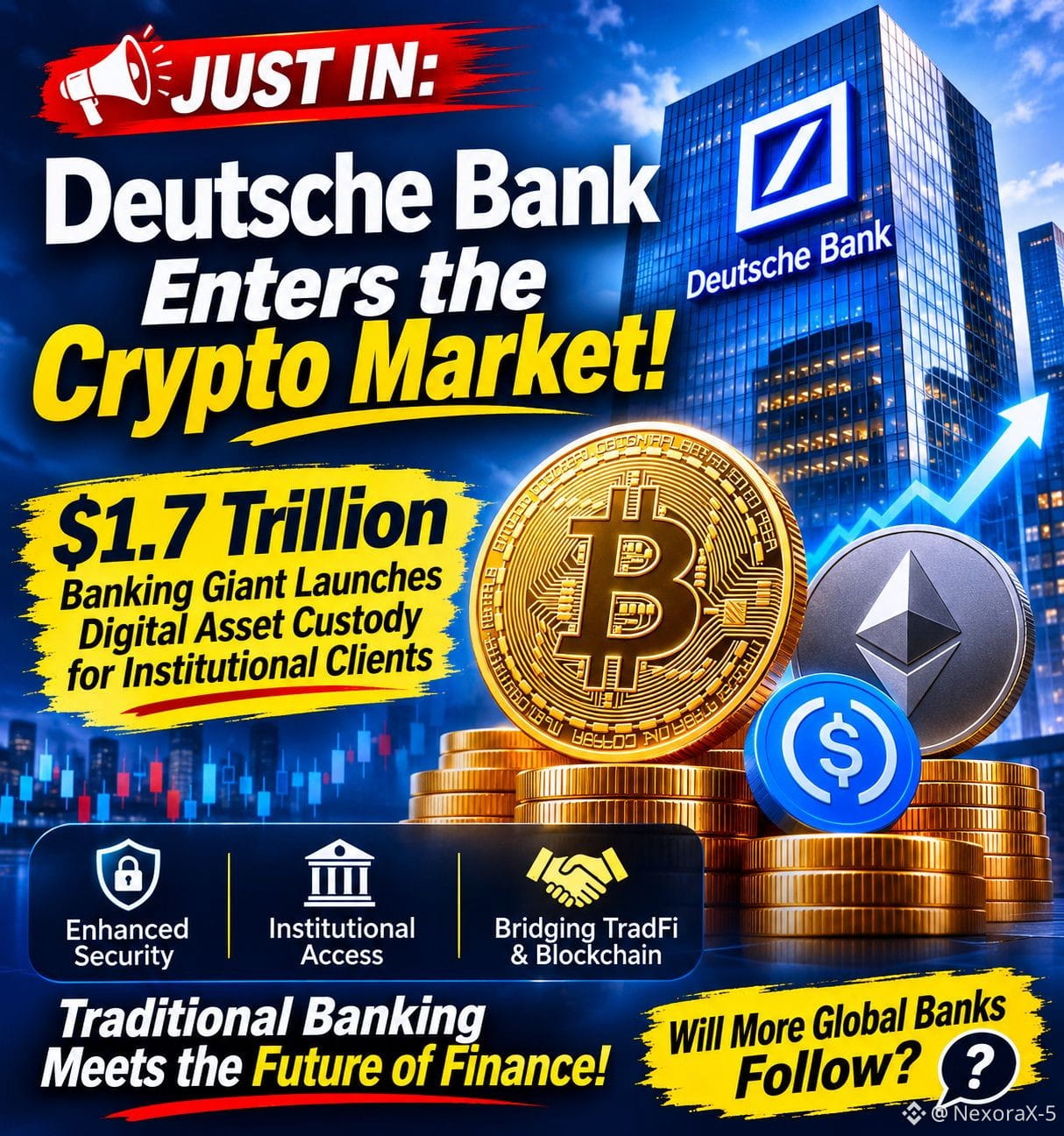
🚨 JUST IN: Deutsche Bank Enters the Crypto Market!
The $1.7 trillion banking giant has launched digital asset custody services for institutional clients, marking another major step toward mainstream crypto adoption.
🔥 This move could strengthen institutional confidence, improve crypto security, and bring traditional finance closer to blockchain technology.
📈 Traditional banking meets the future of finance!
Do you think more global banks will follow?
#DeutscheBank #Bitcoin #CryptoAdoption #DigitalAssets #Blockchain
84

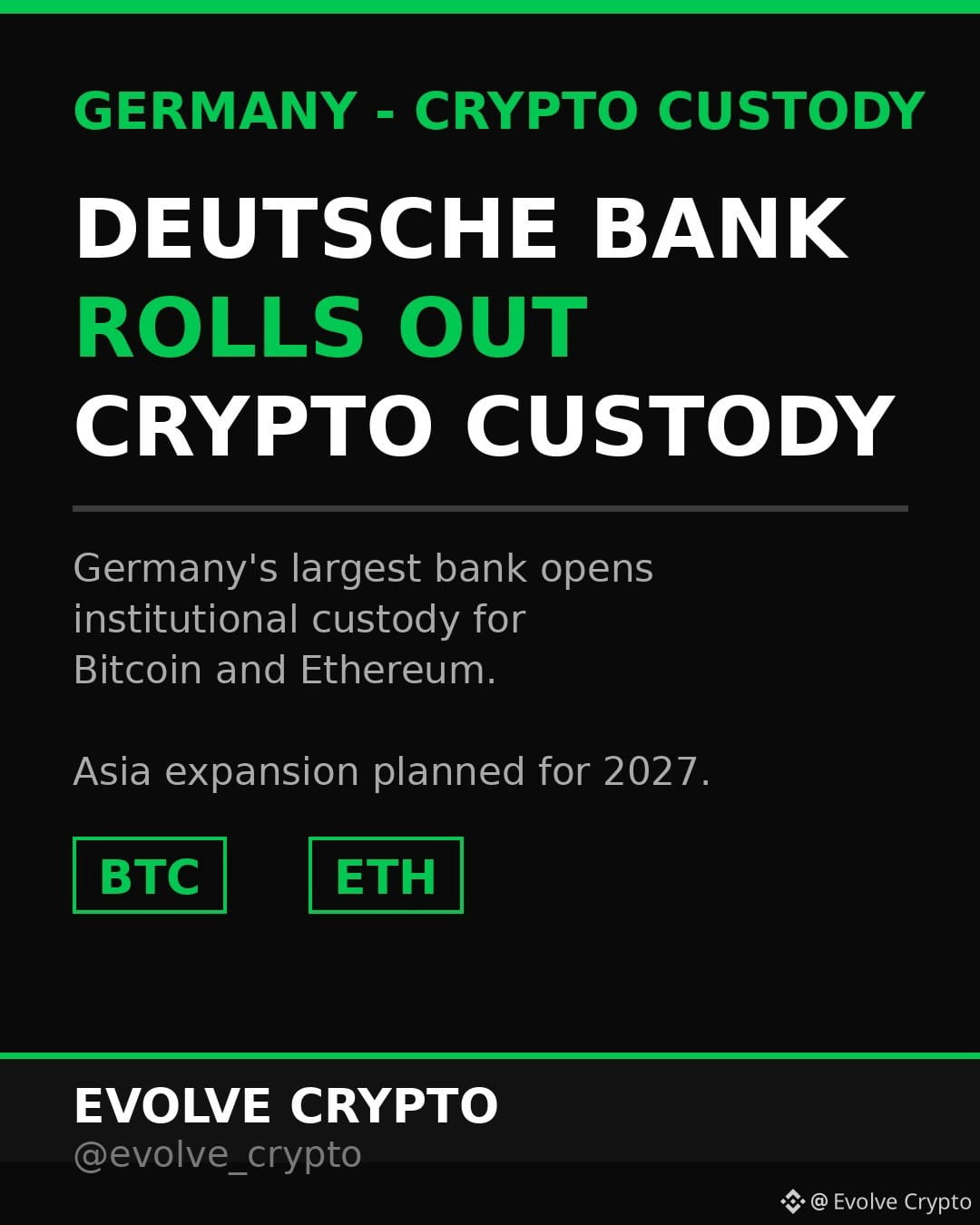
JUST IN: Germany's largest bank, Deutsche Bank, has officially rolled out crypto custody services for institutional clients, starting with $BTC and $ETH.
The bank announced its institutional digital-asset custody platform in September, built with Swiss crypto firm Taurus, with Asia expansion planned for 2027.
Is this the biggest sign yet that traditional banks are going all-in on crypto?
#DeutscheBank #Crypto #Bitcoin
DYOR. This is not financial advice.
JUST IN: Germany's largest bank, Deutsche Bank, has officially rolled out crypto custody services for institutional clients, starting with $BTC and $ETH .
The bank announced its institutional digital-asset custody platform in September, built with Swiss crypto firm Taurus, with Asia expansion planned for 2027.
Is this the biggest sign yet that traditional banks are going all-in on crypto?
#DeutscheBank #Crypto #Bitcoin
DYOR. This is not financial advice.
80

·
--
DEUTSCHE BANK NOW EXPECTS THREE STRAIGHT FED RATE HIKES AFTER OCTOBER INFLATION BEATS FORECASTS
Deutsche Bank said in a note Tuesday that it is adding a 25 basis point increase in January to the hikes it already expected in December and March. That would take the federal funds target to 4.50% to 4.75%.
The bank said Tuesday's inflation data continued to show broad-based gains and reinforced its concerns about persistent price pressures.
It is not treating a 50 basis point move in December as its base case, even after Fed Governor Christopher Waller said one should be considered if core inflation ran around 0.3% or higher.
$BTC, $ETH , $USDT , $USDC, $SOL
#DeutscheBank #Fed #RateHikes #Inflation #FOMC #Macro #Markets #Finance #Bitcoin #Crypto

71

·
--
Update on the September plan announcement: Deutsche Bank’s official page now lists a digital asset custody service available to Corporate Bank customers in Germany, with transfers and support for BTC, ETH, USDC, EURC, and EURAU. The service is for institutions, not individuals. What do you think about banks entering the custody business? 🏦🔐🌐 $BTC $ETH #DeutscheBank
Update on the September plan announcement: Deutsche Bank’s official page now lists a digital asset custody service available to Corporate Bank customers in Germany, with transfers and support for BTC, ETH, USDC, EURC, and EURAU. The service is for institutions, not individuals. What do you think about banks entering the custody business? 🏦🔐🌐 $BTC $ETH #DeutscheBank

113

🏦 DEUTSCHE BANK OFFICIALLY CUSTODIES BITCOIN AND ETHEREUM FOR INSTITUTIONAL CLIENTS!
💬 Deutsche Bank—the largest bank in Germany—has officially launched its digital asset custody service, marking a new step by a traditional financial institution into the crypto market.
In its initial phase, the service focuses on custody of the two leading digital assets, Bitcoin (BTC) and Ethereum (ETH), for corporate and institutional clients seeking paid services.
🚀 However, Deutsche Bank’s ambitions go beyond simply storing crypto. The bank is aiming to build a more comprehensive ecosystem that includes custody, tokenization, and digital asset payments.
Notably, Deutsche Bank has also signed a memorandum of understanding with Deutsche Asset Management (formerly DWS) to explore technology and business collaboration opportunities in this area.
🌏 The bank previously disclosed plans to expand its services into the Asian market.
In my view, a major bank like Deutsche Bank beginning to offer commercial crypto custody services shows that digital assets are becoming more deeply integrated into the traditional financial system.
What stands out is not only that $BTC and $ETH are supported, but also the ambition to connect custody, tokenization, and payments within a single ecosystem.
#bitcoin #Ethereum #DeutscheBank #CryptoAdoption
{future}(ETHUSDT)
{future}(BTCUSDT)
🏦 DEUTSCHE BANK OFFICIALLY CUSTODIES BITCOIN AND ETHEREUM FOR INSTITUTIONAL CLIENTS!
💬 Deutsche Bank—the largest bank in Germany—has officially launched its digital asset custody service, marking a new step by a traditional financial institution into the crypto market.
In its initial phase, the service focuses on custody of the two leading digital assets, Bitcoin (BTC) and Ethereum (ETH), for corporate and institutional clients seeking paid services.
🚀 However, Deutsche Bank’s ambitions go beyond simply storing crypto. The bank is aiming to build a more comprehensive ecosystem that includes custody, tokenization, and digital asset payments.
Notably, Deutsche Bank has also signed a memorandum of understanding with Deutsche Asset Management (formerly DWS) to explore technology and business collaboration opportunities in this area.
🌏 The bank previously disclosed plans to expand its services into the Asian market.
In my view, a major bank like Deutsche Bank beginning to offer commercial crypto custody services shows that digital assets are becoming more deeply integrated into the traditional financial system.
What stands out is not only that $BTC and $ETH are supported, but also the ambition to connect custody, tokenization, and payments within a single ecosystem.
#bitcoin #Ethereum #DeutscheBank #CryptoAdoption
110

🏦 GERMANY’S LARGEST BANK OFFICIALLY CUSTODIES CRYPTO FOR INSTITUTIONAL CLIENTS
Deutsche Bank confirmed that its digital asset custody service went live on 11/11/2026, for fee-paying corporate and institutional clients in Europe. The bank directly manages wallets and private keys on behalf of clients, initially supporting five assets: Bitcoin, Ethereum, USDC, EURC, and EURAU.
The service is launching in Germany under the EU’s MiCA framework and was licensed by BaFin on 12/10. On the same day, the bank signed a memorandum of understanding with Deutsche Asset Management (DWS) to explore tokenized funds and stablecoins — still only an exploratory step, not a product launch.
Note: The service is for institutions only and is not available to retail customers. Crypto assets are not covered by deposit insurance like bank deposits. Deutsche Bank plans to expand into Asian financial hubs in 2027.
Meanwhile, BTC is trading around $73,900, while $XCN is the biggest gainer over the past 24 hours, up 9.30%.
Do you think major banks entering crypto will help the market mature, or does it simply show that “big money” is getting involved?
#CryptoNews #Bitcoin #DeutscheBank #MiCA

182

·
--
Deutsche Bank’s crypto custody service officially goes live, bringing five years of planning to fruition and opening a channel for European institutions
Deutsche Bank’s crypto custody service has officially gone live, marking the culmination of nearly five years of infrastructure development by the European financial giant. According to Decrypt, the service can now provide institutional and corporate clients with custody for Bitcoin, Ethereum, and three types of stablecoins. Clients can store and transfer assets through the bank, which also manages their wallets on their behalf.
Based on publicly available information, the assets covered by Deutsche Bank’s custody service are clearly defined: Bitcoin, Ethereum, and three types of stablecoins. According to Cointelegraph, the bank will manage client wallets and handle related operations. This means Deutsche Bank is offering institutional and corporate clients an integrated custody service covering major crypto assets and stablecoins for the first time.
Why is this worth noting? In recent years, traditional financial institutions’ crypto initiatives have largely focused on channels such as trading, financing, and ETFs. But custody is a foundational part of the infrastructure and often a prerequisite for institutions to enter the market at scale. Deutsche Bank’s launch complements recent themes such as stablecoins and ETF fund flows, and its significance as a signal may outweigh its immediate impact in terms of scale.
It is worth noting that the five-year development period shows that bringing this kind of infrastructure to market is no overnight process. Although the assets covered by the service have been specified, the actual volume held in custody is expected to be limited at launch, and it will take time to verify real inflows. Some observers see this as a continuation of an existing institutional trend, with the incremental signal potentially weaker than the market expects.
It remains unclear how the market will react. The expansion of institutional channels is a supportive factor over the long term, but prices may not respond strongly in the short term, especially before the actual custody volume becomes clear. One counterpoint is that similar “milestone” announcements have appeared repeatedly, and the market is becoming less sensitive to them. Without supporting data on actual inflows, any sentiment-driven premium may be limited.
What will be worth watching next is whether Deutsche Bank discloses the actual volume held in custody, whether it attracts more institutional clients, and whether custody volumes for these stablecoins and major cryptocurrencies can reinforce recent ETF fund flows and stablecoin-related themes. If the launch is merely symbolic and is not followed by substantial expansion, the market reaction may be muted.
#DeutscheBank #Bitcoin #CryptoAdoption
The above is a compilation of information and personal analysis, and does not constitute investment advice.
Follow me for ongoing coverage of key market developments and data.
64
Log in to explore more content
Join global crypto users on Binance Square
⚡️ Get latest and useful information about crypto.
💬 Trusted by the world’s largest crypto exchange.
👍 Discover real insights from verified creators.
Email / Phone number
Trending Topics
1
#HuangExitNvidiaStrategyInFocus
89,396 views
994 Discussing
2
#AnthropicRejectsIPODelayValuationinQuestion
694,342 views
5,258 Discussing
3
#BitMineReports$6.3BNetLossForFiscal2026
11,601 views
123 Discussing
4
#ChipStocksExtendLossesAfterNvidiaCEOChange
36,023 views
436 Discussing
5
#ThailandProposes$148KDailyStablecoinDepositWithdrawalCaps
3,217 views
48 Discussing
6
#CoreWeaveJumps10%On168%RevenueGrowth
191,542 views
1,668 Discussing
7
#ZcashFallsBelow$1000ForFirstTimeSinceSeptember
89,642 views
263 Discussing
8
#MSCIRemovalMayCurbStrategy’sBitcoinBuying
56,387 views
600 Discussing
9
#TradFiForBeginners
533,379 views
3,700 Discussing
10
#USJoblessClaimsRise
19.1M views
7,812 Discussing