Binance Square
#cryptoeducation

cryptoeducation

3.5M views
19,103 Discussing
AlphaVaultX
·
--
Why does a crypto coin go up❓ is what I want to talk about this afternoon. I've seen people say, BITCOIN is too expensive. Let me buy this other coin, it's only $0.01. Forgetting that, a low price doesn't actually mean that coin is cheap. What really matters is the supply and demand. If more people want to buy, while the available supply is limited, the price can rise. This, is also why you shouldn't judge a project just by its token price. Market cap and liquidity matter too. So before saying —It's only $0.01, it can easily reach $1, ask yourself: How big is the supply? What's the market cap? Is there enough liquidity? Don't just look at the price, you need to understand what's behind it. $BTC #cryptoeducation
Why does a crypto coin go up❓ is what I want to talk about this afternoon.
I've seen people say, BITCOIN is too expensive. Let me buy this other coin, it's only $0.01.

Forgetting that, a low price doesn't actually mean that coin is cheap.
What really matters is the supply and demand.
If more people want to buy, while the available supply is limited, the price can rise.

This, is also why you shouldn't judge a project just by its token price. Market cap and liquidity matter too.

So before saying —It's only $0.01, it can easily reach $1, ask yourself:
How big is the supply?
What's the market cap?
Is there enough liquidity?

Don't just look at the price, you need to understand what's behind it.
$BTC
#cryptoeducation
🧠 CRYPTO 101: WHAT DOES MARKET CAP ACTUALLY MEAN? You see “Market Cap” everywhere in crypto — but what does it tell you? 👀 Market Cap = Coin Price × Circulating Supply For example: 💰 Coin price = $2 🪙 Circulating supply = 10 million 📊 Market cap = $20 million Why is it important? A coin with a low price isn't automatically cheap. A coin priced at $0.01 could have a huge market cap if its supply is massive. So before judging a coin by its price, always check its market cap + circulating supply. 🔍 Did you know this? 👇 YES 🧠 | NO 😮 #Binance #CryptoEducation #Crypto #Bitcoin #Blockchain
🧠 CRYPTO 101: WHAT DOES MARKET CAP ACTUALLY MEAN?
You see “Market Cap” everywhere in crypto — but what does it tell you? 👀
Market Cap = Coin Price × Circulating Supply
For example:
💰 Coin price = $2
🪙 Circulating supply = 10 million
📊 Market cap = $20 million
Why is it important?
A coin with a low price isn't automatically cheap.
A coin priced at $0.01 could have a huge market cap if its supply is massive.
So before judging a coin by its price, always check its market cap + circulating supply. 🔍
Did you know this? 👇 YES 🧠 | NO 😮
#Binance #CryptoEducation #Crypto #Bitcoin #Blockchain
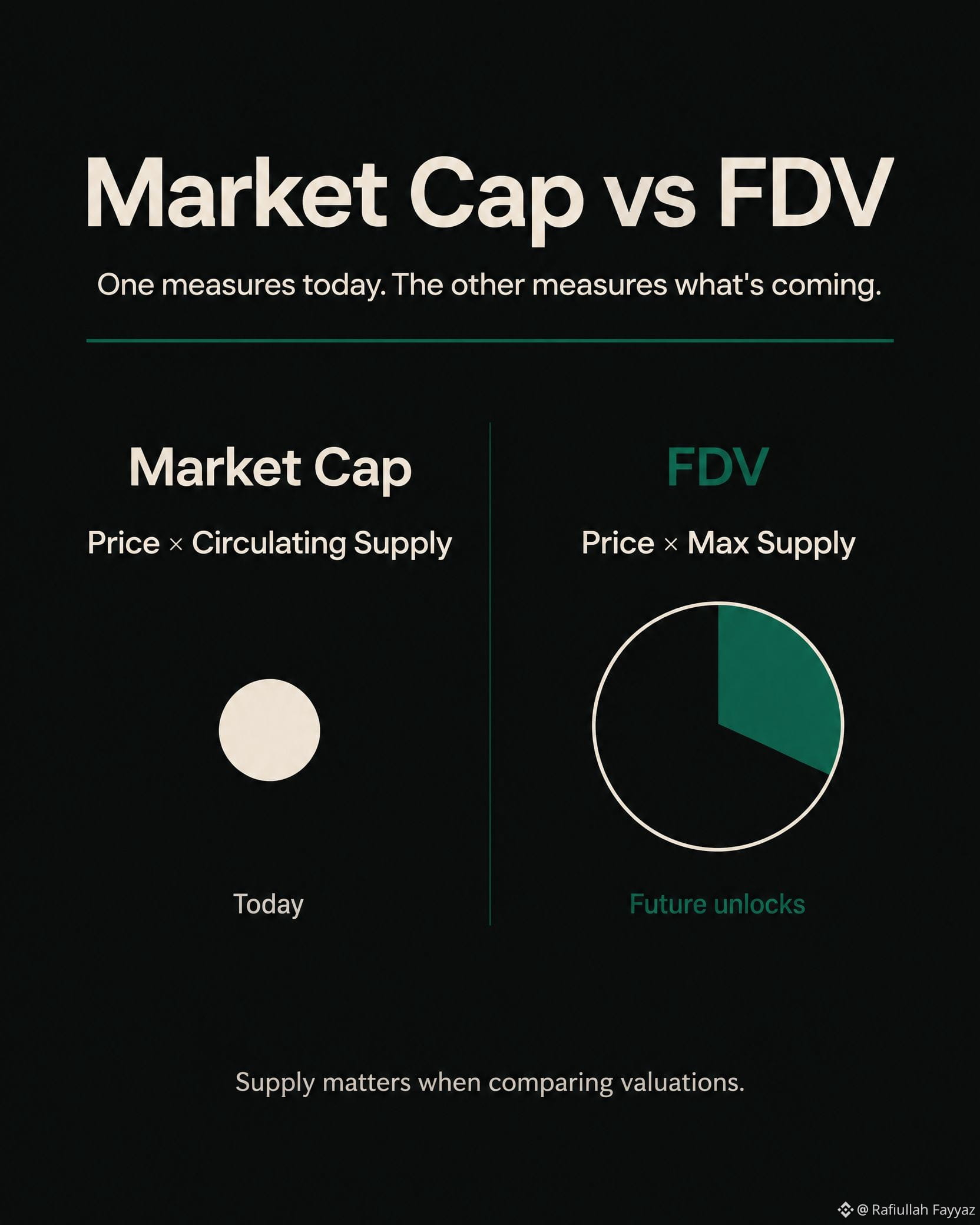
FDV stands for Fully Diluted Valuation. It's one of the most misunderstood numbers in crypto. Market cap = current price × circulating supply. It tells you what the project is worth today. FDV = current price × maximum total supply. It tells you what the project would be worth if every token that will ever exist was already circulating. Why does this matter? Because most tokens have future unlocks. Team allocations. Investor vesting. Staking rewards. Ecosystem funds. A coin with a $100 million market cap but a $2 billion FDV means: if all those locked tokens entered circulation at today's price, the project would be valued at $2 billion. That doesn't mean the price stays the same when tokens unlock. It usually doesn't. New supply creates selling pressure. So when you look at a token, check both numbers. If FDV is much higher than market cap, ask: when do the unlocks happen? How large are they? Who's receiving them? That's the difference between reading a price and understanding the supply mechanics behind it. #CryptoEducation #FDV #Tokenomic #binanacesquare #EducationalContent
FDV stands for Fully Diluted Valuation. It's one of the most misunderstood numbers in crypto.

Market cap = current price × circulating supply. It tells you what the project is worth today.

FDV = current price × maximum total supply. It tells you what the project would be worth if every token that will ever exist was already circulating.

Why does this matter? Because most tokens have future unlocks. Team allocations. Investor vesting. Staking rewards. Ecosystem funds.

A coin with a $100 million market cap but a $2 billion FDV means: if all those locked tokens entered circulation at today's price, the project would be valued at $2 billion.

That doesn't mean the price stays the same when tokens unlock. It usually doesn't. New supply creates selling pressure.

So when you look at a token, check both numbers. If FDV is much higher than market cap, ask: when do the unlocks happen? How large are they? Who's receiving them?

That's the difference between reading a price and understanding the supply mechanics behind it.

#CryptoEducation #FDV #Tokenomic #binanacesquare #EducationalContent
📚 CRYPTO EDUCATION: 5 RULES EVERY BEGINNER SHOULD KNOW Entering crypto without a plan can be expensive. Before buying any coin, learn these 5 basic rules: 1️⃣ Don’t invest more than you can afford to lose Crypto can move sharply in both directions. 2️⃣ Understand market cap A low-priced coin isn’t necessarily “cheap.” Market capitalization gives a better picture of a project’s size. 3️⃣ Learn the difference between Spot & Futures Spot trading involves buying/selling the asset. Futures use contracts and can involve leverage, which increases both potential gains and losses. 4️⃣ Never blindly chase pumps 🚨 A coin rising 30–50% doesn’t mean it will keep going up. Research the reason behind the move. 5️⃣ Risk management comes first 🛡️ Position sizing, stop-losses, and avoiding excessive leverage can be more important than finding the “next 100x.” 💡 Remember: In crypto, knowledge is your first line of defense. Don’t trade based only on hype—learn, research, and manage your risk. 💬 Which crypto topic should I explain next: BTC, altcoins, futures, or technical analysis? #CryptoEducation #BinanceSquare #cryptotrading #Bitcoin #RiskManagement
📚 CRYPTO EDUCATION: 5 RULES EVERY BEGINNER SHOULD KNOW

Entering crypto without a plan can be expensive. Before buying any coin, learn these 5 basic rules:

1️⃣ Don’t invest more than you can afford to lose
Crypto can move sharply in both directions.

2️⃣ Understand market cap
A low-priced coin isn’t necessarily “cheap.” Market capitalization gives a better picture of a project’s size.

3️⃣ Learn the difference between Spot & Futures
Spot trading involves buying/selling the asset. Futures use contracts and can involve leverage, which increases both potential gains and losses.

4️⃣ Never blindly chase pumps 🚨
A coin rising 30–50% doesn’t mean it will keep going up. Research the reason behind the move.

5️⃣ Risk management comes first 🛡️
Position sizing, stop-losses, and avoiding excessive leverage can be more important than finding the “next 100x.”

💡 Remember:
In crypto, knowledge is your first line of defense. Don’t trade based only on hype—learn, research, and manage your risk.

💬 Which crypto topic should I explain next: BTC, altcoins, futures, or technical analysis?

#CryptoEducation #BinanceSquare #cryptotrading #Bitcoin #RiskManagement
Article
The Crypto Habit That Matters More Than Price By @Majeed39 Crypto markets can change quickly. OneThe Crypto Habit That Matters More Than Price By @Majeed39 Crypto markets can change quickly. One day $BTC is moving strongly upward, and the next day the market is full of red candles. For someone starting their crypto journey, this can make it tempting to check prices every few minutes. But there is another habit that may be more valuable than constantly watching the chart: learning before reacting. Many beginners focus on one question: “Is Bitcoin going up or down?” A better question is: “Why is the market moving this way?” Understanding the reason behind a move can help you become a more informed market participant. News, market sentiment, economic conditions, trading activity and major developments in the crypto industry can all influence prices. Another important habit is avoiding decisions based purely on excitement or fear. When a coin suddenly rises, people may feel pressured to buy because they are afraid of missing out. When prices fall sharply, the opposite can happen. Neither emotion is a reliable investment strategy. Instead, take time to learn the basics. Understand what an asset is, what problem it is designed to solve, how its ecosystem works and what risks are involved. Also learn how exchanges work, how fees affect transactions and why protecting your account is extremely important. Security deserves special attention. A strong password, two-factor authentication and careful handling of account information can make a major difference. Never share passwords, verification codes or private keys with someone claiming they can guarantee profits or recover your account. There is also something important about building a crypto audience: quality beats noise. You do not need to post every market movement. A useful explanation, a personal learning experience or a simple educational thread can provide more value than repeating the same price prediction everyone else is posting. For example, instead of simply writing: $BTC is going up! 🚀” You could explain what you are observing, what factors traders are watching and what beginners should understand before making any decision. That creates a conversation instead of just chasing attention. My biggest lesson as @Majeed39 is simple: crypto is not only about finding the next big move. It is also about developing knowledge, discipline and good digital-security habits. The market will always provide another opportunity to learn. Do your own research. Manage risk carefully. Never invest money you cannot afford to lose. If you're learning crypto too, what is the one crypto topic you want to understand better this week? 👇 #Binance #CryptoEducation

The Crypto Habit That Matters More Than Price By @Majeed39 Crypto markets can change quickly. One

The Crypto Habit That Matters More Than Price
By @Majeed39
Crypto markets can change quickly. One day $BTC is moving strongly upward, and the next day the market is full of red candles. For someone starting their crypto journey, this can make it tempting to check prices every few minutes.
But there is another habit that may be more valuable than constantly watching the chart: learning before reacting.
Many beginners focus on one question: “Is Bitcoin going up or down?” A better question is: “Why is the market moving this way?”
Understanding the reason behind a move can help you become a more informed market participant. News, market sentiment, economic conditions, trading activity and major developments in the crypto industry can all influence prices.
Another important habit is avoiding decisions based purely on excitement or fear. When a coin suddenly rises, people may feel pressured to buy because they are afraid of missing out. When prices fall sharply, the opposite can happen.
Neither emotion is a reliable investment strategy.
Instead, take time to learn the basics. Understand what an asset is, what problem it is designed to solve, how its ecosystem works and what risks are involved. Also learn how exchanges work, how fees affect transactions and why protecting your account is extremely important.
Security deserves special attention.
A strong password, two-factor authentication and careful handling of account information can make a major difference. Never share passwords, verification codes or private keys with someone claiming they can guarantee profits or recover your account.
There is also something important about building a crypto audience: quality beats noise.
You do not need to post every market movement. A useful explanation, a personal learning experience or a simple educational thread can provide more value than repeating the same price prediction everyone else is posting.
For example, instead of simply writing:
$BTC is going up! 🚀”
You could explain what you are observing, what factors traders are watching and what beginners should understand before making any decision.
That creates a conversation instead of just chasing attention.
My biggest lesson as @Majeed39 is simple: crypto is not only about finding the next big move. It is also about developing knowledge, discipline and good digital-security habits.
The market will always provide another opportunity to learn.
Do your own research. Manage risk carefully. Never invest money you cannot afford to lose.
If you're learning crypto too, what is the one crypto topic you want to understand better this week? 👇 #Binance #CryptoEducation
$BTR I’m building in crypto publicly — one useful post at a time.   I won’t post fake hype or promise profits. My goal is simple: share market updates, explain crypto in easy words, and learn with the community.   If you’re also trying to grow on Binance Square, remember: Consistency beats one viral post. Useful content beats noise. Real conversations beat empty likes.   What crypto topic should I explain next: Bitcoin, altcoins, or futures basics?  
$BTR I’m building in crypto publicly — one useful post at a time.

I won’t post fake hype or promise profits. My goal is simple: share market updates, explain crypto in easy words, and learn with the community.

If you’re also trying to grow on Binance Square, remember:
Consistency beats one viral post.
Useful content beats noise.
Real conversations beat empty likes.

What crypto topic should I explain next: Bitcoin, altcoins, or futures basics?
Article
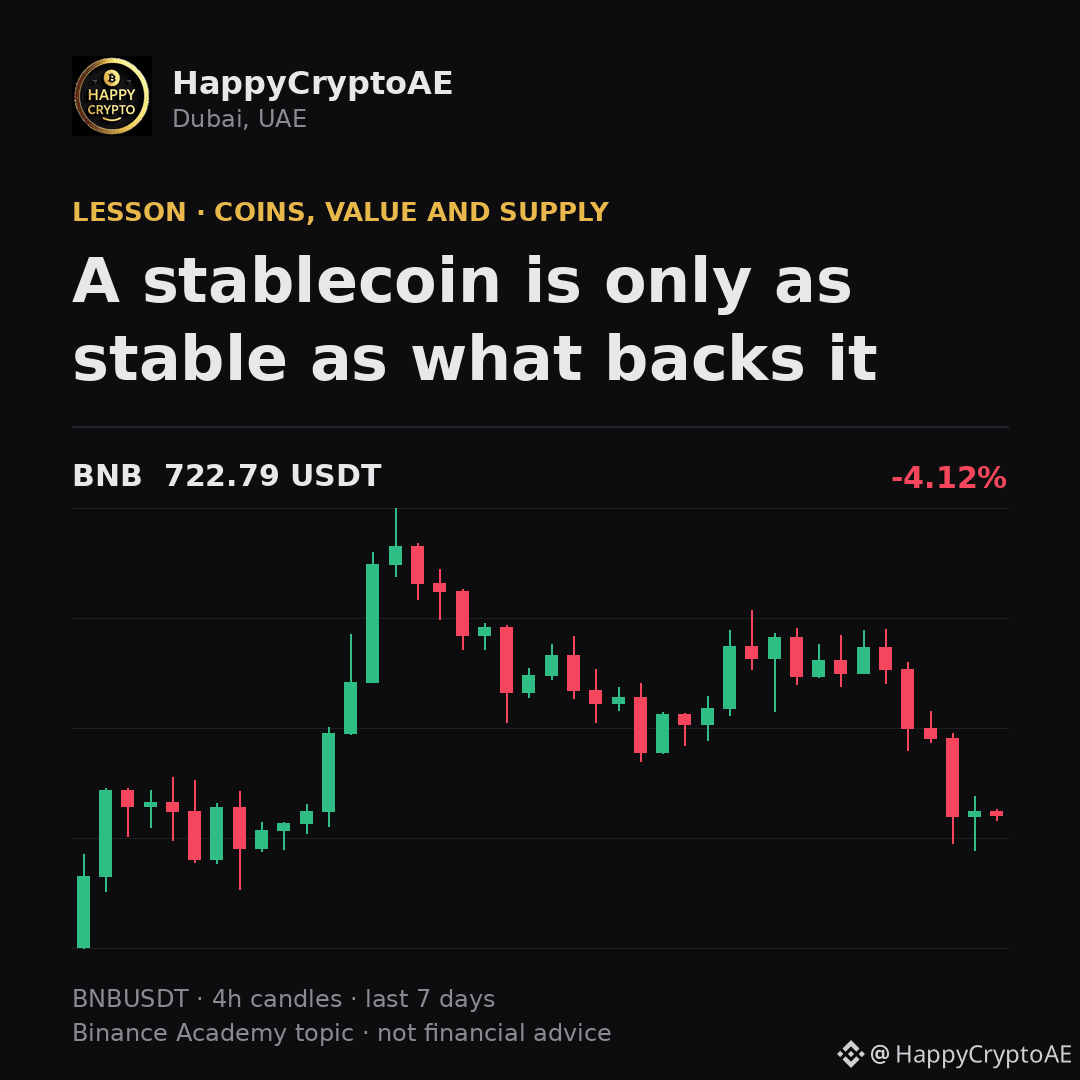
A stablecoin is only as stable as what backs itA depeg is when a stablecoin stops holding its intended value. It can drift a little under stress, or break badly and not recover. The cause is almost always the backing, not the code. Fully reserved stablecoins depend on the issuer actually holding what they claim and being able to honour redemptions. Designs that maintain a peg through supply mechanics rather than reserves have a much thinner track record, and one of the largest failures in crypto history was exactly that. The lesson is not that stablecoins are unsafe. It is that the word stable describes a goal, not a guarantee. Binance Academy covers this in more depth: https://www.binance.com/en/academy/glossary/depeg Trading crypto from Dubai since 2019. $USDT $BTC $BNB #Crypto #CryptoEducation #Binance

A stablecoin is only as stable as what backs it

A depeg is when a stablecoin stops holding its intended value. It can drift a little under stress, or break badly and not recover.
The cause is almost always the backing, not the code. Fully reserved stablecoins depend on the issuer actually holding what they claim and being able to honour redemptions. Designs that maintain a peg through supply mechanics rather than reserves have a much thinner track record, and one of the largest failures in crypto history was exactly that. The lesson is not that stablecoins are unsafe. It is that the word stable describes a goal, not a guarantee.
Binance Academy covers this in more depth: https://www.binance.com/en/academy/glossary/depeg
Trading crypto from Dubai since 2019.
$USDT $BTC $BNB
#Crypto #CryptoEducation #Binance
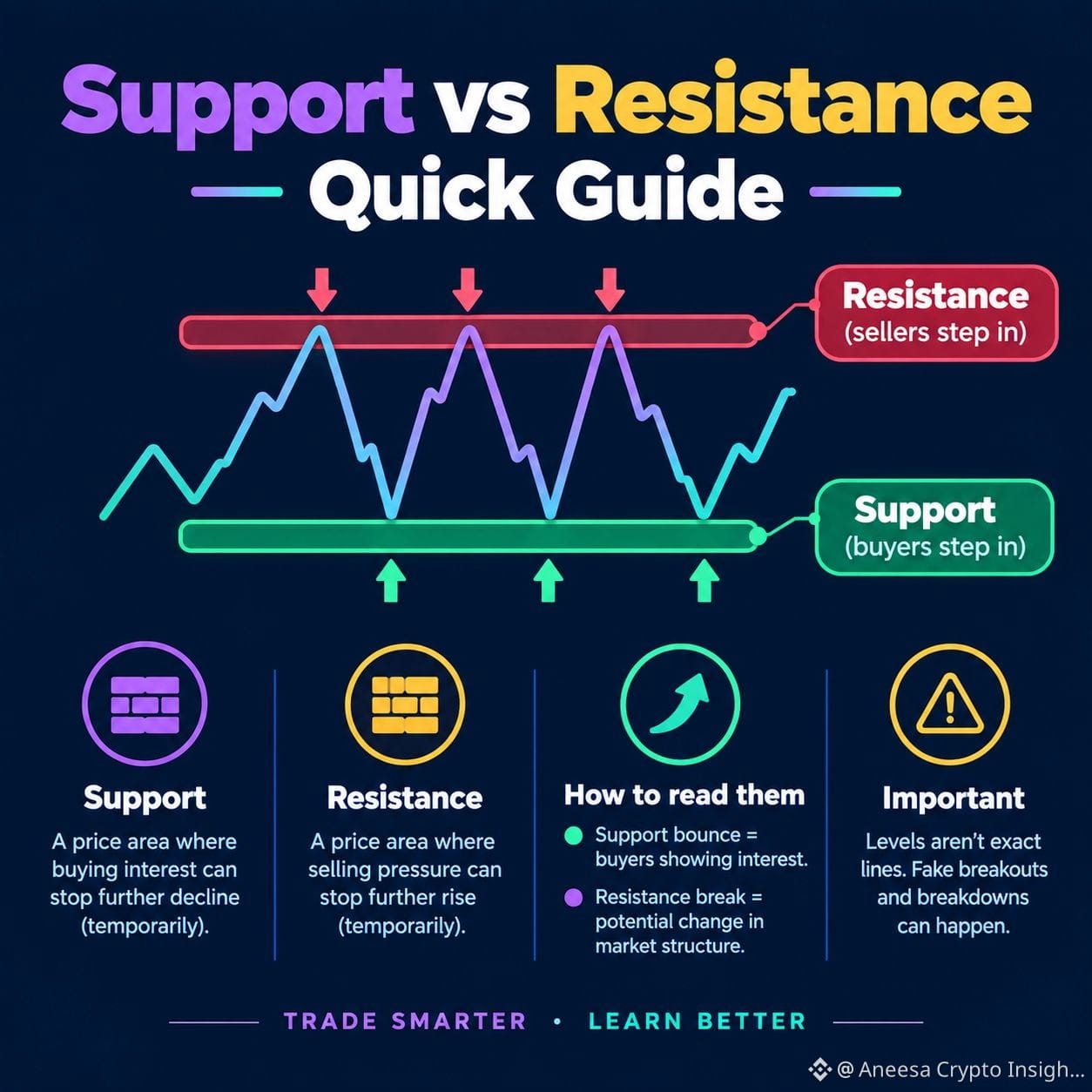
🎓 Support vs Resistance — Quick Guide 🧱 Support: A price level where buyers step in and may help stop the drop. 🧱 Resistance: A price level where sellers step in and may limit the rise. 💡 How to read them: ↗️ Bounce from support → buyers may be showing interest. ⬆️ Break above resistance → market structure may be changing. ⚠️ Remember: Levels aren’t perfect. Fake breaks and volatility are normal. ℹ️ Not financial advice. DYOR. 👉 Follow Aneesa Crypto Insights for simple crypto education. #CryptoEducation #SupportAndResistance #TradingBasics #crypto
🎓 Support vs Resistance — Quick Guide
🧱 Support: A price level where buyers step in and may help stop the drop.
🧱 Resistance: A price level where sellers step in and may limit the rise.
💡 How to read them: ↗️ Bounce from support → buyers may be showing interest.
⬆️ Break above resistance → market structure may be changing.
⚠️ Remember: Levels aren’t perfect. Fake breaks and volatility are normal.
ℹ️ Not financial advice. DYOR.
👉 Follow Aneesa Crypto Insights for simple crypto education.
#CryptoEducation #SupportAndResistance #TradingBasics #crypto
Article
📈 Uptrend or Downtrend? Learn to Spot the Market’s Direction🐂 Bulls vs. Bears: Who’s Winning the Crypto Market? If you’re new to crypto, you’ll often hear traders say the market is “bullish” or “bearish.” But what does that actually mean? 📈 🐂 Bull Market A bull market describes a period when prices are generally trending upward and buyers have stronger confidence. For example: $60K → $65K → $70K → $75K → $80K When an asset continues forming Higher Highs (HH) and Higher Lows (HL), traders may view the trend as increasingly bullish. 📉 🐻 Bear Market A bear market is the opposite. Selling pressure becomes stronger and prices generally trend downward. For example: $100K → $90K → $80K → $70K → $60K A bearish structure is often characterized by Lower Highs (LH) and Lower Lows (LL). But markets rarely move in a straight line. Even during a bull market, prices can pull back. And even during a bear market, short-term rallies can occur. 🧱 Support & Resistance Two important concepts traders watch are: 🛡️ Support — a price area where buying interest may emerge. 🧱 Resistance — a price area where selling pressure may increase. When price breaks above resistance, traders may watch for a potential breakout. When price falls below support, traders may watch for a potential breakdown. 📊 What about Bitcoin right now? Bitcoin is currently trading around the $78K–$79K area, following a significant recovery from its summer lows. The recent price action has shown several bullish characteristics, but broader market factors—including interest rates, Treasury yields, oil prices, inflation expectations and geopolitical uncertainty—can still influence risk assets. That means the market isn’t simply “bull” or “bear.” It’s a constant battle between: 🐂 Buying pressure vs. 🐻 Selling pressure Understanding that battle is one of the first steps toward understanding crypto markets. The goal isn’t to predict every candle. The goal is to understand what the market is telling you. 📚 #crypto #Bitcoin #BTC #cryptoeducation Trading #CryptoEducation #BullMarket #BearMarket #TechnicalAnalysis This version is deliberately educational and balanced, which is better for a Binance audience than making a direct “BTC is going up, buy now” type of claim.

📈 Uptrend or Downtrend? Learn to Spot the Market’s Direction

🐂 Bulls vs. Bears: Who’s Winning the Crypto Market?
If you’re new to crypto, you’ll often hear traders say the market is “bullish” or “bearish.” But what does that actually mean?
📈 🐂 Bull Market
A bull market describes a period when prices are generally trending upward and buyers have stronger confidence.
For example:
$60K → $65K → $70K → $75K → $80K
When an asset continues forming Higher Highs (HH) and Higher Lows (HL), traders may view the trend as increasingly bullish.
📉 🐻 Bear Market
A bear market is the opposite. Selling pressure becomes stronger and prices generally trend downward.
For example:
$100K → $90K → $80K → $70K → $60K
A bearish structure is often characterized by Lower Highs (LH) and Lower Lows (LL).
But markets rarely move in a straight line.
Even during a bull market, prices can pull back. And even during a bear market, short-term rallies can occur.
🧱 Support & Resistance
Two important concepts traders watch are:
🛡️ Support — a price area where buying interest may emerge.
🧱 Resistance — a price area where selling pressure may increase.
When price breaks above resistance, traders may watch for a potential breakout.
When price falls below support, traders may watch for a potential breakdown.
📊 What about Bitcoin right now?
Bitcoin is currently trading around the $78K–$79K area, following a significant recovery from its summer lows.
The recent price action has shown several bullish characteristics, but broader market factors—including interest rates, Treasury yields, oil prices, inflation expectations and geopolitical uncertainty—can still influence risk assets.
That means the market isn’t simply “bull” or “bear.”
It’s a constant battle between:
🐂 Buying pressure
vs.
🐻 Selling pressure
Understanding that battle is one of the first steps toward understanding crypto markets.
The goal isn’t to predict every candle.
The goal is to understand what the market is telling you. 📚
#crypto #Bitcoin #BTC #cryptoeducation Trading #CryptoEducation #BullMarket #BearMarket #TechnicalAnalysis
This version is deliberately educational and balanced, which is better for a Binance audience than making a direct “BTC is going up, buy now” type of claim.
- No markdown (so plain text, no formatting like bold, italics, code fences). - Start with "Crypto Term of the Day:" exactly. - 120-160 words total (including that phrase and everything else). Must count words. - Use one simple analogy from everyday life. - Explain why a crypto investor needs to understand this. - End with: "Save this post and share it with your crypto friends!" - Final line: "#AVAX #Polygon #CryptoEducation #Blockchain" (exactly that line). Probably separate line. We must output only final post text, no extra commentary. We need to ensure word count between 120 and 160 inclusive. Let's draft. First line: "Crypto Term of the Day:" counts as words: "Crypto" (1), "Term" (2), "of" (3), "the" (4), "Day:" (5). That's 5 words. We need total 120-160 words. So need about 115-155 more words. We'll write a paragraph (or multiple) but no markdown. Use simple analogy: e.g., "like a busy farmers market vs a deserted stall". Or "like a highway with many lanes vs a narrow dirt road". Use one analogy. Explain why investor needs to understand liquidity: ability to enter/exit positions, price slippage, risk. End with required sentence exactly: "Save this post and share it with your crypto friends!" Then final line with hashtags. Word count: Let's count manually.
- No markdown (so plain text, no formatting like bold, italics, code fences).
- Start with "Crypto Term of the Day:" exactly.
- 120-160 words total (including that phrase and everything else). Must count words.
- Use one simple analogy from everyday life.
- Explain why a crypto investor needs to understand this.
- End with: "Save this post and share it with your crypto friends!"
- Final line: "#AVAX #Polygon #CryptoEducation #Blockchain" (exactly that line). Probably separate line.

We must output only final post text, no extra commentary.

We need to ensure word count between 120 and 160 inclusive.

Let's draft.

First line: "Crypto Term of the Day:" counts as words: "Crypto" (1), "Term" (2), "of" (3), "the" (4), "Day:" (5). That's 5 words.

We need total 120-160 words. So need about 115-155 more words.

We'll write a paragraph (or multiple) but no markdown. Use simple analogy: e.g., "like a busy farmers market vs a deserted stall". Or "like a highway with many lanes vs a narrow dirt road". Use one analogy.

Explain why investor needs to understand liquidity: ability to enter/exit positions, price slippage, risk.

End with required sentence exactly: "Save this post and share it with your crypto friends!" Then final line with hashtags.

Word count: Let's count manually.
Article
What Is Blockchain? A Simple Guide for Complete BeginnersYou've probably heard this phrase again and again: “Crypto runs on blockchain.” But what exactly is a blockchain? Is it a database? A network? Something completely different? Let's break it down in simple terms. So, What Is Blockchain? A blockchain is a digital record-keeping system that stores information in connected blocks across a network of computers. Think of it as a shared digital record book. Instead of one company or bank keeping the only copy, many computers on the network can maintain copies of the record. When transactions are verified, they can be grouped into a block. That block is then connected to previous blocks, creating a chain. That's where the name comes from: Block + Chain = Blockchain How Does a Blockchain Work? As a basic level, the process looks like this: Transaction → Network Verification → Block Created → Block Added to Chain → Ledger Updated For example, when someone sends Bitcoin ($BTC ), the transaction is broadcast to the Bitcoin network. Network participants verify it according to the network's rules. Once accepted, the transaction can be included in a block and recorded on the Bitcoin blockchain. The blockchain then becomes part of the transaction history. Why Is Blockchain Important? A blockchain allows a network to maintain a shared record without depending on one single database owner. Because blocks are connected to previous blocks, changing old information can be extremely difficult. This is why blockchains are often described as tamper-resistant. But remember: tamper-resistant doesn't mean completely impossible to change. Different blockchains have different designs, security models, and levels of decentralization. Is Blockchain the Same as Bitcoin? No — and this is an important distinction for beginners. Bitcoin ($BTC) is the digital asset. The Bitcoin blockchain is the network and ledger that records Bitcoin transactions. A simple way to remember it: $BTC is the asset. The Bitcoin blockchain is the network and ledger. Bitcoin is only one example. Other blockchains, such as Ethereum, are designed to support different types of applications and digital assets. Is Blockchain Only Used for Crypto? No. Blockchain technology can also support: Smart contractsDecentralized applications (dApps)DeFiNFTsWeb3 applicationsDigital assets That's why blockchain is considered one of the important technologies behind the broader Web3 ecosystem. The Bottom Line If you remember just one thing from this article, remember this: A blockchain is a shared digital ledger that records information in connected blocks across a network. It's one of the technologies behind cryptocurrencies such as Bitcoin ($BTC ) and many other blockchain-based applications. Blockchain, what is blockchain, blockchain explained blockchain for beginners, how blockchain works, blockchain technology, crypto for beginners, Bitcoin blockchain, distributed ledger, cryptocurrency, Web3 #Blockchain #CryptoForBeginners #BlockchainExplained #CryptoEducation #Bitcoin #BTC #Web3

What Is Blockchain? A Simple Guide for Complete Beginners

You've probably heard this phrase again and again:
“Crypto runs on blockchain.”
But what exactly is a blockchain?
Is it a database? A network? Something completely different?
Let's break it down in simple terms.
So, What Is Blockchain?
A blockchain is a digital record-keeping system that stores information in connected blocks across a network of computers.
Think of it as a shared digital record book.
Instead of one company or bank keeping the only copy, many computers on the network can maintain copies of the record.
When transactions are verified, they can be grouped into a block. That block is then connected to previous blocks, creating a chain.
That's where the name comes from:
Block + Chain = Blockchain
How Does a Blockchain Work?
As a basic level, the process looks like this:
Transaction → Network Verification → Block Created → Block Added to Chain → Ledger Updated
For example, when someone sends Bitcoin ($BTC ), the transaction is broadcast to the Bitcoin network.
Network participants verify it according to the network's rules. Once accepted, the transaction can be included in a block and recorded on the Bitcoin blockchain.
The blockchain then becomes part of the transaction history.
Why Is Blockchain Important?
A blockchain allows a network to maintain a shared record without depending on one single database owner.
Because blocks are connected to previous blocks, changing old information can be extremely difficult. This is why blockchains are often described as tamper-resistant.
But remember: tamper-resistant doesn't mean completely impossible to change. Different blockchains have different designs, security models, and levels of decentralization.
Is Blockchain the Same as Bitcoin?
No — and this is an important distinction for beginners.
Bitcoin ($BTC ) is the digital asset.
The Bitcoin blockchain is the network and ledger that records Bitcoin transactions.
A simple way to remember it:
$BTC is the asset. The Bitcoin blockchain is the network and ledger.
Bitcoin is only one example. Other blockchains, such as Ethereum, are designed to support different types of applications and digital assets.
Is Blockchain Only Used for Crypto?
No.
Blockchain technology can also support:
Smart contractsDecentralized applications (dApps)DeFiNFTsWeb3 applicationsDigital assets
That's why blockchain is considered one of the important technologies behind the broader Web3 ecosystem.
The Bottom Line
If you remember just one thing from this article, remember this:
A blockchain is a shared digital ledger that records information in connected blocks across a network.
It's one of the technologies behind cryptocurrencies such as Bitcoin ($BTC ) and many other blockchain-based applications.
Blockchain, what is blockchain, blockchain explained
blockchain for beginners, how blockchain works, blockchain technology, crypto for beginners, Bitcoin blockchain, distributed ledger, cryptocurrency, Web3
#Blockchain #CryptoForBeginners #BlockchainExplained #CryptoEducation #Bitcoin #BTC #Web3
🚨 A $0.10 COIN DOESN'T MEAN IT'S CHEAP! | Tokenomics 101Have you ever looked at a coin priced at just $0.10 and thought:"Wow, this is so cheap! If it goes up a little, I'll make a huge profit!"? 🧐 Stop right there. 🛑 A token’s unit price alone tells you absolutely nothing about its real valuation. The secret lies in understanding Market Cap vs. Fully Diluted Valuation (FDV). 📊 🧠 Let's break it down simply: Market Cap (Market Capitalization): The total value of all tokens currently circulating in the market. 👉 Formula: Market Cap = Current Price × Circulating Supply FDV (Fully Diluted Valuation): The theoretical total value of the project if ALL possible tokens were unlocked and in circulation. 👉 Formula: FDV = Current Price × Total Supply📉 Real-World Example: Imagine two different coins, both priced at $0.10: 🟢 Coin A: Has 1 billion tokens in circulation.Market Cap = $100 Million (A reasonable, mid-cap valuation) 🔴 Coin B: Has 10 billion total tokens, but 9 billion are locked.FDV = $1 Billion (A very high valuation for a starting project!) Same price, but a completely different financial reality. ⚠️ Why does a high FDV matter?If a project has a low Market Cap but a massive FDV, it means a wave of token unlocks (vesting) is coming. When millions of new tokens flood the market, it creates high inflation and massive selling pressure. This often drives the price down, even if the project itself is solid. 💡 Pro Tip:Before buying any "cheap" coin, always check the Circulating Supply / Total Supply ratio on CoinMarketCap or CoinGecko. If less than 15-20% of the tokens are in circulation, it’s not always a bad sign—especially for newly launched Layer-1 or Layer-2 projects. However, you must check their vesting schedule. If huge investor unlocks are just around the corner, proceed with extreme caution! 🚫 💬 LET'S DISCUSS: Which coin's tokenomics would you like me to analyze next? Drop the ticker in the comments below! 👇#CryptoEducation #Tokenomics #Crypto #BinanceSquare #MarketCap
🚨 A $0.10 COIN DOESN'T MEAN IT'S CHEAP! | Tokenomics 101Have you ever looked at a coin priced at just $0.10 and thought:"Wow, this is so cheap! If it goes up a little, I'll make a huge profit!"? 🧐
Stop right there. 🛑
A token’s unit price alone tells you absolutely nothing about its real valuation. The secret lies in understanding Market Cap vs. Fully Diluted Valuation (FDV). 📊
🧠 Let's break it down simply:
Market Cap (Market Capitalization): The total value of all tokens currently circulating in the market.
👉 Formula: Market Cap = Current Price × Circulating Supply
FDV (Fully Diluted Valuation): The theoretical total value of the project if ALL possible tokens were unlocked and in circulation.
👉 Formula: FDV = Current Price × Total Supply📉 Real-World Example:
Imagine two different coins, both priced at $0.10:
🟢 Coin A: Has 1 billion tokens in circulation.Market Cap = $100 Million (A reasonable, mid-cap valuation)
🔴 Coin B: Has 10 billion total tokens, but 9 billion are locked.FDV = $1 Billion (A very high valuation for a starting project!)
Same price, but a completely different financial reality.
⚠️ Why does a high FDV matter?If a project has a low Market Cap but a massive FDV, it means a wave of token unlocks (vesting) is coming. When millions of new tokens flood the market, it creates high inflation and massive selling pressure. This often drives the price down, even if the project itself is solid.
💡 Pro Tip:Before buying any "cheap" coin, always check the Circulating Supply / Total Supply ratio on CoinMarketCap or CoinGecko.
If less than 15-20% of the tokens are in circulation, it’s not always a bad sign—especially for newly launched Layer-1 or Layer-2 projects. However, you must check their vesting schedule. If huge investor unlocks are just around the corner, proceed with extreme caution! 🚫
💬 LET'S DISCUSS: Which coin's tokenomics would you like me to analyze next? Drop the ticker in the comments below! 👇#CryptoEducation #Tokenomics #Crypto #BinanceSquare #MarketCap
The biggest mistake you can make in crypto isn't buying the wrong coin. It's investing money you can't afford to leave alone. Think about it. You buy Bitcoin with money meant for rent. Bitcoin drops 15%. Suddenly, you're not thinking about the technology, the cycle, or the long-term thesis. You're thinking: "Should I sell before it drops further?" That's how people turn a normal market correction into a permanent loss. Crypto isn't just a game of "What will go up?" It's also: "Can I afford to wait?" If you can't hold through volatility, even a good investment can become a bad decision. So before asking: "Which coin should I buy?" Maybe ask yourself: "Can I afford to lose this money—or leave it untouched for months?" That question could save you more money than the next crypto prediction ever will. What's one crypto lesson you learned the hard way? 👇 #BinanceSquareTalks #crypto #bitcoin #cryptoeducation #Web3
The biggest mistake you can make in crypto isn't buying the wrong coin.

It's investing money you can't afford to leave alone.

Think about it.

You buy Bitcoin with money meant for rent.

Bitcoin drops 15%.

Suddenly, you're not thinking about the technology, the cycle, or the long-term thesis.

You're thinking:

"Should I sell before it drops further?"

That's how people turn a normal market correction into a permanent loss.

Crypto isn't just a game of "What will go up?"

It's also:

"Can I afford to wait?"

If you can't hold through volatility, even a good investment can become a bad decision.

So before asking:

"Which coin should I buy?"

Maybe ask yourself:

"Can I afford to lose this money—or leave it untouched for months?"

That question could save you more money than the next crypto prediction ever will.

What's one crypto lesson you learned the hard way? 👇

#BinanceSquareTalks #crypto #bitcoin #cryptoeducation #Web3
🚨 A $0.10 COIN DOESN’T MEAN IT’S CHEAP Have you ever wondered why? The answer is Market Cap vs FDV. 📊 A token can have a very low price but an enormous supply — making its total valuation much higher than it looks. Would you like a simple example of how FDV works? 👇 #CryptoEducation #Tokenomics #Crypto #BinanceSquare
🚨 A $0.10 COIN DOESN’T MEAN IT’S CHEAP
Have you ever wondered why?
The answer is Market Cap vs FDV. 📊
A token can have a very low price but an enormous supply — making its total valuation much higher than it looks.
Would you like a simple example of how FDV works? 👇
#CryptoEducation #Tokenomics #Crypto #BinanceSquare
Why is [Coin Name] Pumping Today? 📈[Coin Name] is up +XX% in the last 24 hours! Here is what’s driving the rally:🔹 Main Catalyst: [Insert brief reason, e.g., mainnet upgrade / strategic partnership]🔹 On-chain Data: Whale wallets accumulated over $XX Million this week.🔹 Market Outlook: Can it sustain this momentum?Are you holding [Coin Name] or taking profits here? Let's discuss! Here is a complete, strategy-backed guide on what to writ reach, engagement, and virality:1. Top Performing Post TyA. Technical Analysis (TA) & Price PredictionTraders love actionable charts and setup ideas.Catchy Title: $BTC Breaking Out! Next Stop: $XX,XXX? 🚀Template/Structure:Key Levels to Watch: 📌 Support: $XX,XXX 📌 Resistance: $XX,XXXMy Strategy: We just confirmed a bullish retest on the 4H timeframe. If we hold above $XX,XXX, the next target is $XX,XXX.⚠️ Not financial advice (NFA). Always Do Your Own Research (Di? Let! 👇B. Educational & "How-To" ContentHigh-value content gets saved and shared the most.Catchy Title: 5 Golden Rules to Avoid Crypto Scams in 2026 🛡️Template/Structure:Most beginners lose money not because of the market, but because of security mistakes. Save this post! 📌1️⃣ Never click unknown links (Double-check URLs).2️⃣ Use 2FA via authenticator apps, not SMS.3️⃣ Revoke smart contract permissions regularly.4️⃣ Ignore DMs claiming to offer support or guaranteed returns.Template/Structure:[Coin #CryptoEducation driving the rally:🔹 Main Catalyst: [Insert brief reason, e.g., mainnet upgrade / strategic partnership]🔹 On-chain Data: Whale wallets accumulated over $XX Million this week.🔹 Market Outlook: Can it sustain this momentum?Are you holding [Coin Name] or taking profits here? Let's discuss! 👇#CryptoNews oNews #altcoins #Binance

Why is [Coin Name] Pumping Today? 📈

[Coin Name] is up +XX% in the last 24 hours! Here is what’s driving the rally:🔹 Main Catalyst: [Insert brief reason, e.g., mainnet upgrade / strategic partnership]🔹 On-chain Data: Whale wallets accumulated over $XX Million this week.🔹 Market Outlook: Can it sustain this momentum?Are you holding [Coin Name] or taking profits here? Let's discuss! Here is a complete, strategy-backed guide on what to writ reach, engagement, and virality:1. Top Performing Post TyA. Technical Analysis (TA) & Price PredictionTraders love actionable charts and setup ideas.Catchy Title: $BTC Breaking Out! Next Stop: $XX,XXX? 🚀Template/Structure:Key Levels to Watch:
📌 Support: $XX,XXX
📌 Resistance: $XX,XXXMy Strategy:
We just confirmed a bullish retest on the 4H timeframe. If we hold above $XX,XXX, the next target is $XX,XXX.⚠️ Not financial advice (NFA). Always Do Your Own Research (Di? Let! 👇B. Educational & "How-To" ContentHigh-value content gets saved and shared the most.Catchy Title: 5 Golden Rules to Avoid Crypto Scams in 2026 🛡️Template/Structure:Most beginners lose money not because of the market, but because of security mistakes. Save this post! 📌1️⃣ Never click unknown links (Double-check URLs).2️⃣ Use 2FA via authenticator apps, not SMS.3️⃣ Revoke smart contract permissions regularly.4️⃣ Ignore DMs claiming to offer support or guaranteed returns.Template/Structure:[Coin #CryptoEducation driving the rally:🔹 Main Catalyst: [Insert brief reason, e.g., mainnet upgrade / strategic partnership]🔹 On-chain Data: Whale wallets accumulated over $XX Million this week.🔹 Market Outlook: Can it sustain this momentum?Are you holding [Coin Name] or taking profits here? Let's discuss! 👇#CryptoNews oNews #altcoins #Binance
📚 Lesson Learned from the Jobless Claims News – How to Profit from Economic Events Like a Pro? Two days ago, the US jobless claims data shook the market, and $BTC bounced from $77,200 to $78,700 in minutes. But did you know most traders lost money on that move? Why? 🔍 Because they trade news **emotionally**, not **strategically**! --- ✅ **Golden Rule #1: News Creates Volatility, Not Trends** - A sharp spike (like a $1,500 bounce in 10 minutes) is **a scalper's playground**, not a trend signal. - A pro waits for the **daily candle close** before making a decision. ✅ **Golden Rule #2: Use Volatility with a "2-Stage Strategy"** - **Stage 1 (during the news):** Quick scalp (5-15 min) with a tight stop-loss. - **Stage 2 (2 hours later):** Technical analysis (like we did) + trade in the direction of the daily close. ✅ **Golden Rule #3: Watch the "Pre-News Price"** - The pre-news price ($77,200) acts as a **magnet**. If it bounces off it again = real buying power. - If it breaks below = weakness and possible reversal. --- 🎯 **The Takeaway That Will Change Your Trading Forever:** > "A smart trader reads the news, waits 30 minutes, analyzes the close, then acts – not the other way around." I applied this strategy with you in my previous two posts (news + analysis), and now you're seeing the results. ⚠️ **Reminders:** - Avoid entering in the first 5 minutes of the news (peak volatility). - Always set a stop-loss. - Learn to read **market reaction**, not just the news headline. --- ❓ Question for beginners: Did you learn something new about trading the news today? Share your first experience 👇 $BTC $ZEC {spot}(BTCUSDT) {spot}(ZECUSDT) #Binance #BTC #CryptoEducation #trading
📚 Lesson Learned from the Jobless Claims News – How to Profit from Economic Events Like a Pro?

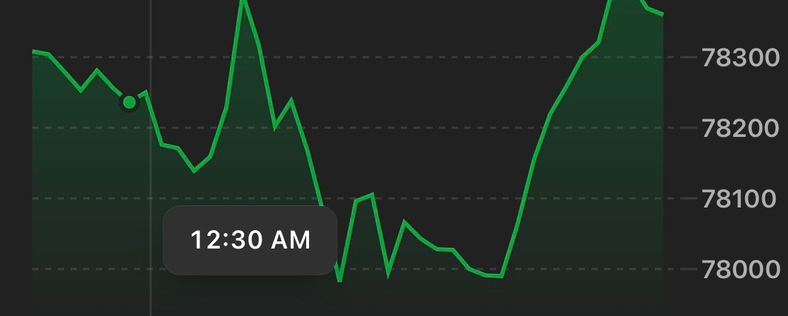
Two days ago, the US jobless claims data shook the market, and $BTC bounced from $77,200 to $78,700 in minutes. But did you know most traders lost money on that move? Why?

🔍 Because they trade news **emotionally**, not **strategically**!

---

✅ **Golden Rule #1: News Creates Volatility, Not Trends**
- A sharp spike (like a $1,500 bounce in 10 minutes) is **a scalper's playground**, not a trend signal.
- A pro waits for the **daily candle close** before making a decision.

✅ **Golden Rule #2: Use Volatility with a "2-Stage Strategy"**
- **Stage 1 (during the news):** Quick scalp (5-15 min) with a tight stop-loss.
- **Stage 2 (2 hours later):** Technical analysis (like we did) + trade in the direction of the daily close.

✅ **Golden Rule #3: Watch the "Pre-News Price"**
- The pre-news price ($77,200) acts as a **magnet**. If it bounces off it again = real buying power.
- If it breaks below = weakness and possible reversal.

---

🎯 **The Takeaway That Will Change Your Trading Forever:**
> "A smart trader reads the news, waits 30 minutes, analyzes the close, then acts – not the other way around."

I applied this strategy with you in my previous two posts (news + analysis), and now you're seeing the results.

⚠️ **Reminders:**
- Avoid entering in the first 5 minutes of the news (peak volatility).
- Always set a stop-loss.
- Learn to read **market reaction**, not just the news headline.

---

❓ Question for beginners: Did you learn something new about trading the news today? Share your first experience 👇

$BTC $ZEC

#Binance #BTC #CryptoEducation #trading
FC Barcelona vs. Feyenoord Rotterdam

FC Barcelona vs. Feyenoord Rotterdam

FCB99%Draw1%FEY1%
Volume $253,021.27
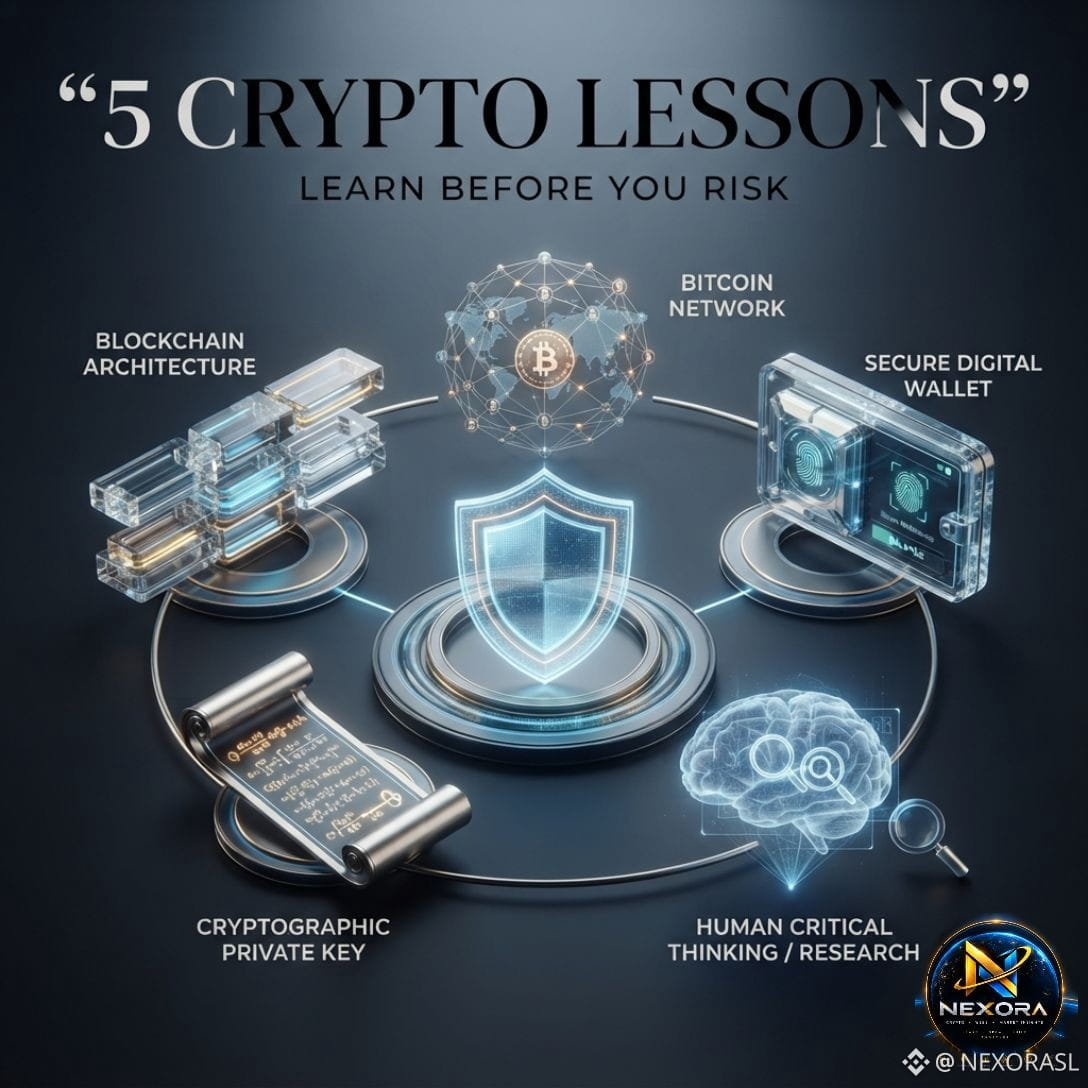
5 things I wish every crypto beginner understood BEFORE touching the market: 1. Technology ≠ investment return A useful technology doesn't guarantee a profitable asset. 2. “Decentralized” doesn't mean “risk-free” Networks can have technical, economic and operational risks. 3. Your private key matters more than your portfolio screenshot If you control crypto yourself, security becomes your responsibility. 4. A viral post isn't research A million views don't turn an opinion into a fact. 5. You don't need to understand everything on Day 1 Start with Bitcoin, wallets, transactions, blockchain and basic security. Then go deeper. Crypto rewards curiosity—but punishes careless assumptions. 📌 Save this if you're building your crypto knowledge from zero. 👇 Which one should beginners learn FIRST? #CryptoEducation #Bitcoin #Blockchain #Web3 #BinanceSquare
5 things I wish every crypto beginner understood BEFORE touching the market:

1. Technology ≠ investment return

A useful technology doesn't guarantee a profitable asset.

2. “Decentralized” doesn't mean “risk-free”

Networks can have technical, economic and operational risks.

3. Your private key matters more than your portfolio screenshot

If you control crypto yourself, security becomes your responsibility.

4. A viral post isn't research

A million views don't turn an opinion into a fact.

5. You don't need to understand everything on Day 1

Start with Bitcoin, wallets, transactions, blockchain and basic security.

Then go deeper.

Crypto rewards curiosity—but punishes careless assumptions.

📌 Save this if you're building your crypto knowledge from zero.

👇 Which one should beginners learn FIRST?

#CryptoEducation #Bitcoin #Blockchain #Web3 #BinanceSquare
💰 What Is Binance Earn? Want to learn how Binance Earn works? 🪙 Binance Earn offers different crypto products that may allow users to earn rewards by putting their crypto to work. However, returns are not guaranteed, and each product can have different risks and conditions. 📌 Always understand the product, risks, and terms before participating. 💬 Have you ever used Binance Earn? What was your experience? #BinanceEarn #Bitcoin #Ethereum✅ #CryptoEducation #Blockchain
💰 What Is Binance Earn?

Want to learn how Binance Earn works? 🪙

Binance Earn offers different crypto products that may allow users to earn rewards by putting their crypto to work. However, returns are not guaranteed, and each product can have different risks and conditions.

📌 Always understand the product, risks, and terms before participating.

💬 Have you ever used Binance Earn? What was your experience?

#BinanceEarn #Bitcoin #Ethereum✅ #CryptoEducation #Blockchain
·
--
Bullish
🌙 30 Days Crypto Learning Series — Day 1 | Night 🔥 3 Things Every Crypto Beginner Should Know 1️⃣ Don’t trade with emotions Fear and FOMO can lead to poor decisions. 2️⃣ Always do your own research (DYOR) Never invest just because someone online says “BUY.” 3️⃣ Risk management comes first Protecting your money is more important than chasing quick profits. 💡 Remember: In crypto, learning comes before earning. 📚🚀 💬 What do you want to learn tomorrow? ❤️ Like | 💬 Comment | 🔄 Share | ➕ Follow #Crypto $AAPLB #bitcoin oin #dyor #CryptoEducation #DAY
🌙 30 Days Crypto Learning Series — Day 1 | Night

🔥 3 Things Every Crypto Beginner Should Know

1️⃣ Don’t trade with emotions
Fear and FOMO can lead to poor decisions.

2️⃣ Always do your own research (DYOR)
Never invest just because someone online says “BUY.”

3️⃣ Risk management comes first
Protecting your money is more important than chasing quick profits.

💡 Remember:
In crypto, learning comes before earning. 📚🚀

💬 What do you want to learn tomorrow?

❤️ Like | 💬 Comment | 🔄 Share | ➕ Follow

#Crypto $AAPLB #bitcoin oin #dyor #CryptoEducation #DAY
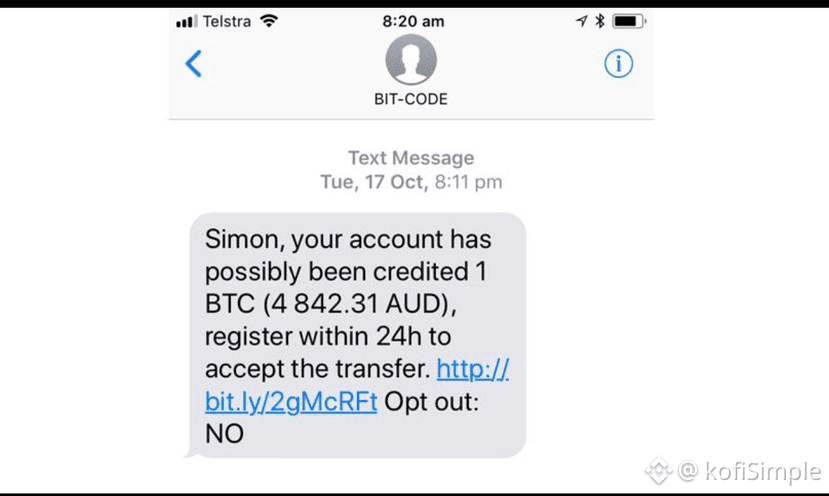
🚨 STOP! BEFORE YOU SEND YOUR CRYPTO, READ THIS. Crypto can create opportunities—but scammers are always looking for people who are new, excited, or in a hurry. Here are 7 common crypto scams you should know 👇 1️⃣ “Guaranteed profit” 🚩 Anyone promising you 100% guaranteed returns is waving a giant red flag. Real investments always involve risk. 2️⃣ Fake giveaways 🎁 “Send 0.1 BTC and receive 1 BTC back!” ❌ Don’t do it. Legitimate platforms don’t require you to send crypto to receive a bigger amount. 3️⃣ Fake support accounts 💬 Scammers may pretend to be Binance employees or customer support agents. Never give anyone your password, 2FA code, or recovery/seed phrase. 4️⃣ Phishing links 🔗 A message may say: “Your account will be suspended. Click here now!” ⚠️ Don’t panic. Verify the website before entering your login details. 5️⃣ Fake investment managers 📈 Someone online says they can trade for you and guarantee huge profits? Be extremely careful. 6️⃣ Romance scams ❤️ A person you meet online may build trust and eventually ask you to invest in crypto or send them money. Never let emotions replace verification. 7️⃣ Pressure tactics ⏰ “Send it NOW!” “Last chance!” “Don’t tell anyone!” These are classic manipulation techniques. Slow down and verify. 🛡️ YOUR GOLDEN RULE If someone is rushing you to send crypto, STOP. Before making a transaction: ✅ Verify the person ✅ Check the website address carefully ✅ Never share your seed phrase/private key ✅ Use strong passwords and 2FA ✅ Double-check wallet addresses ✅ Don’t trust guaranteed profits ✅ If something feels too good to be true, investigate first 💡 Remember: In crypto, protecting your money starts with protecting your information. 📢 Share this post with someone who is new to crypto. One minute of education could prevent a major loss. #cryptoeducation #Binance #CryptoScam #Bitcoin #Cryptocurrency #Web3 #DYOR*
🚨 STOP! BEFORE YOU SEND YOUR CRYPTO, READ THIS.

Crypto can create opportunities—but scammers are always looking for people who are new, excited, or in a hurry.

Here are 7 common crypto scams you should know 👇

1️⃣ “Guaranteed profit” 🚩
Anyone promising you 100% guaranteed returns is waving a giant red flag. Real investments always involve risk.

2️⃣ Fake giveaways 🎁
“Send 0.1 BTC and receive 1 BTC back!”
❌ Don’t do it. Legitimate platforms don’t require you to send crypto to receive a bigger amount.

3️⃣ Fake support accounts 💬
Scammers may pretend to be Binance employees or customer support agents.
Never give anyone your password, 2FA code, or recovery/seed phrase.

4️⃣ Phishing links 🔗
A message may say: “Your account will be suspended. Click here now!”
⚠️ Don’t panic. Verify the website before entering your login details.

5️⃣ Fake investment managers 📈
Someone online says they can trade for you and guarantee huge profits? Be extremely careful.

6️⃣ Romance scams ❤️
A person you meet online may build trust and eventually ask you to invest in crypto or send them money. Never let emotions replace verification.

7️⃣ Pressure tactics ⏰
“Send it NOW!”
“Last chance!”
“Don’t tell anyone!”
These are classic manipulation techniques. Slow down and verify.

🛡️ YOUR GOLDEN RULE

If someone is rushing you to send crypto, STOP.

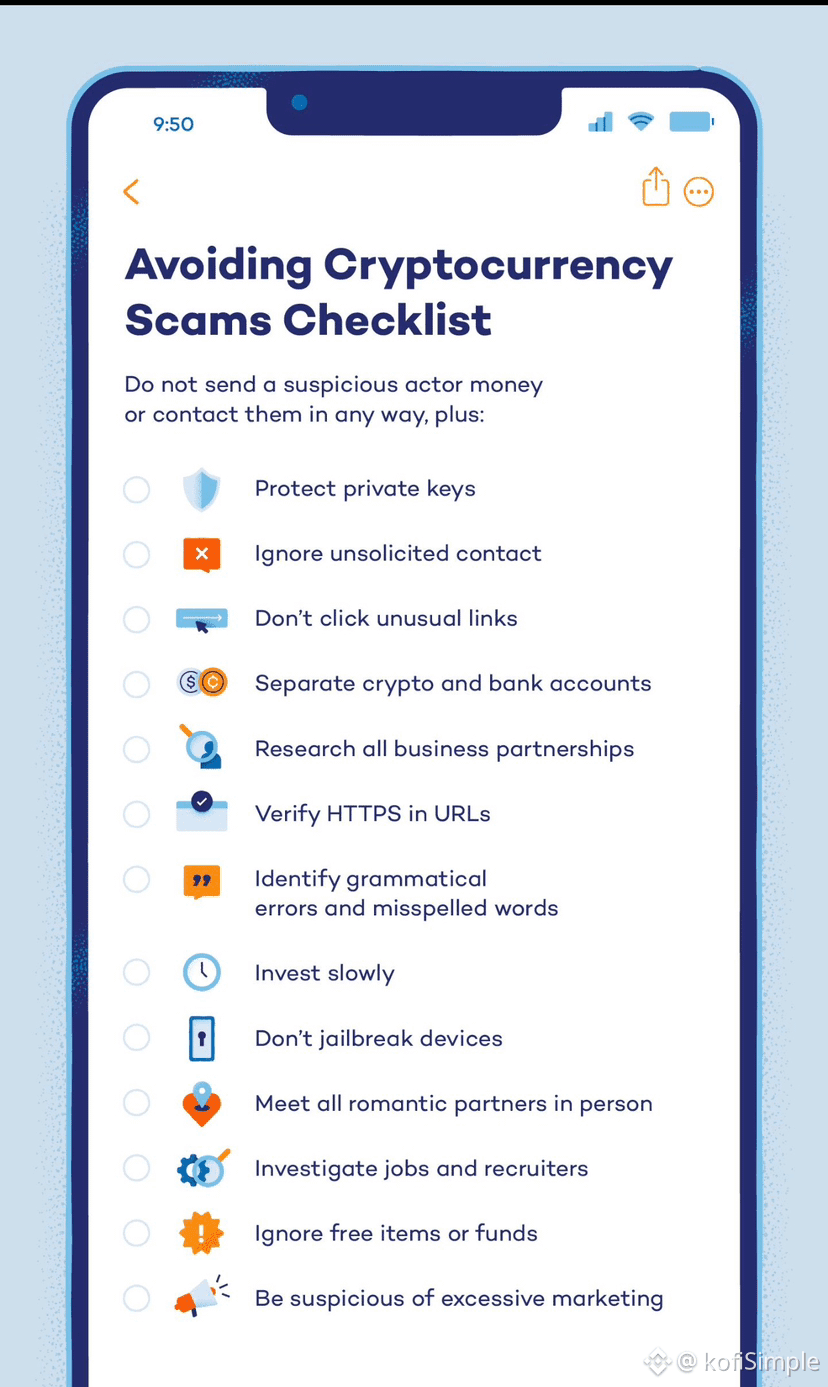
Before making a transaction:

✅ Verify the person
✅ Check the website address carefully
✅ Never share your seed phrase/private key
✅ Use strong passwords and 2FA
✅ Double-check wallet addresses
✅ Don’t trust guaranteed profits
✅ If something feels too good to be true, investigate first

💡 Remember: In crypto, protecting your money starts with protecting your information.

📢 Share this post with someone who is new to crypto. One minute of education could prevent a major loss.

#cryptoeducation #Binance #CryptoScam #Bitcoin #Cryptocurrency #Web3 #DYOR*
Log in to explore more content
Join global crypto users on Binance Square
⚡️ Get latest and useful information about crypto.
💬 Trusted by the world’s largest crypto exchange.
👍 Discover real insights from verified creators.
Email / Phone number