

#cowprotocol
cowprotocol
143,442 views
218 Discussing
Hot
Latest

·
--
Bullish
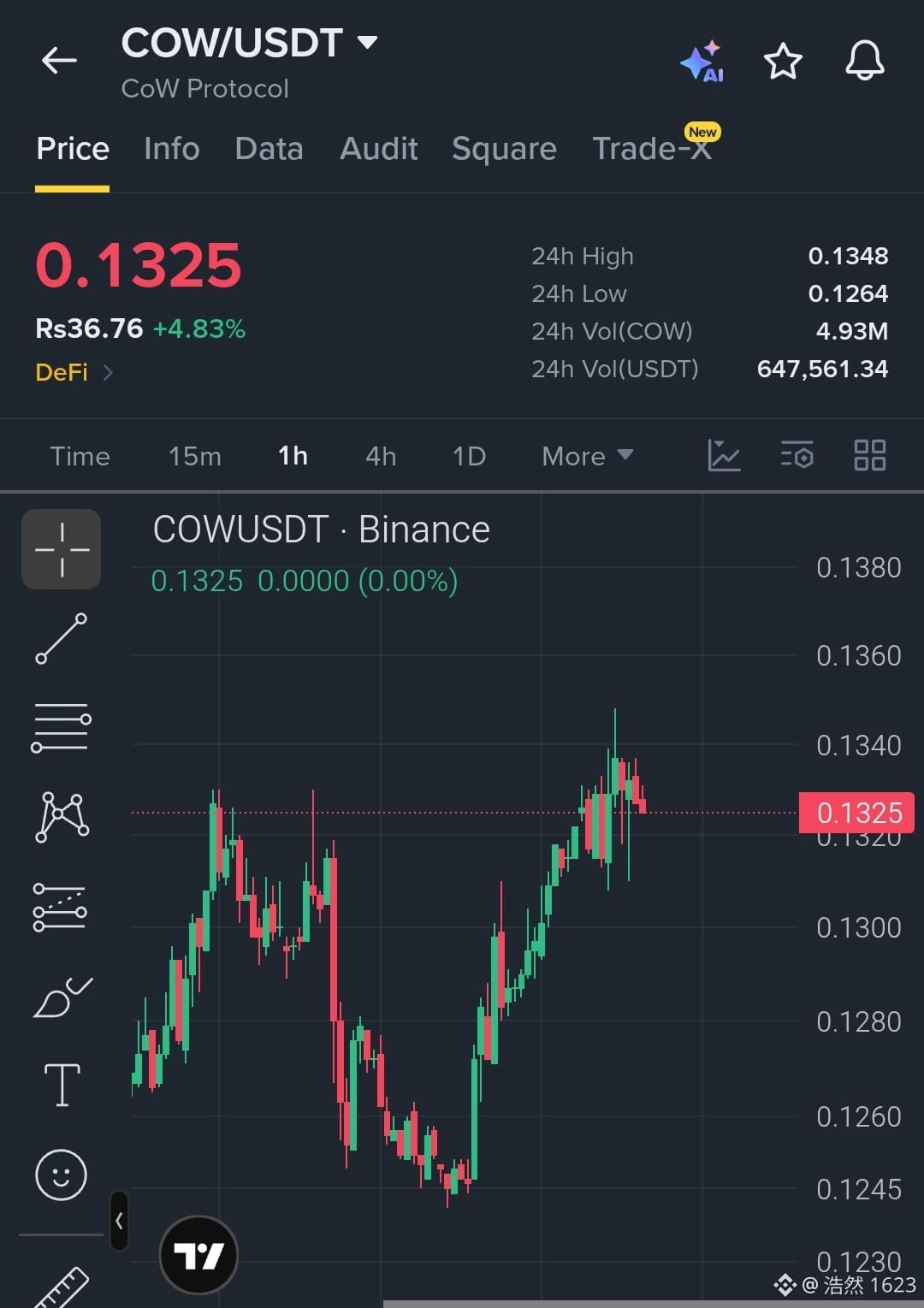
$COW is showing a steady recovery trend on the 1h chart, currently trading around 0.1325 with a 24h gain of +4.83%. After forming a strong bottom near the 0.1245–0.1260 support area, price pushed upward to mark a recent high of 0.1348. Bulls are holding the higher low, suggesting potential for another impulse movement to clear local overhead resistance levels.
Target 1: 0.1348 Target 2: 0.1360 Target 3: 0.1380
#COW #CoWProtocol #CryptoAnalysis
$TUT
{future}(TUTUSDT)
$ZEC
{future}(ZECUSDT)
{future}(COWUSDT)
$COW is showing a steady recovery trend on the 1h chart, currently trading around 0.1325 with a 24h gain of +4.83%. After forming a strong bottom near the 0.1245–0.1260 support area, price pushed upward to mark a recent high of 0.1348. Bulls are holding the higher low, suggesting potential for another impulse movement to clear local overhead resistance levels.
Target 1: 0.1348 Target 2: 0.1360 Target 3: 0.1380
#COW #CoWProtocol #CryptoAnalysis
$TUT
$ZEC
Target 1: 0.1348 Target 2: 0.1360 Target 3: 0.1380
#COW #CoWProtocol #CryptoAnalysis
$TUT
$ZEC
1
349

·
--
🚨 $COW — +56% PUMP… NOW THE REAL TEST BEGINS 👀🐻
COW just exploded more than 50% in 24H, with trading activity jumping massively.
After a move this aggressive, I'm not chasing the green candles.
I'm watching the next resistance zone:
🔴 SHORT: 0.165 – 0.170
🛑 SL: 0.178
🎯 TP1: 0.155
🔥 TP2: 0.145
💎 TP3: 0.135
The setup:
Pump → resistance → rejection → pullback.
If buyers push COW above $0.178 and hold, the short idea is invalid.
🐻 Profit-taking next… or does COW have another leg up?
#COW #CoWProtocol #Binance #WriteToEarn
🚨 $COW — +56% PUMP… NOW THE REAL TEST BEGINS 👀🐻
COW just exploded more than 50% in 24H, with trading activity jumping massively.
After a move this aggressive, I'm not chasing the green candles.
I'm watching the next resistance zone:
🔴 SHORT: 0.165 – 0.170
🛑 SL: 0.178
🎯 TP1: 0.155
🔥 TP2: 0.145
💎 TP3: 0.135
The setup:
Pump → resistance → rejection → pullback.
If buyers push COW above $0.178 and hold, the short idea is invalid.
🐻 Profit-taking next… or does COW have another leg up?
#COW #CoWProtocol #Binance #WriteToEarn
COW just exploded more than 50% in 24H, with trading activity jumping massively.
After a move this aggressive, I'm not chasing the green candles.
I'm watching the next resistance zone:
🔴 SHORT: 0.165 – 0.170
🛑 SL: 0.178
🎯 TP1: 0.155
🔥 TP2: 0.145
💎 TP3: 0.135
The setup:
Pump → resistance → rejection → pullback.
If buyers push COW above $0.178 and hold, the short idea is invalid.
🐻 Profit-taking next… or does COW have another leg up?
#COW #CoWProtocol #Binance #WriteToEarn
40


·
--
📈 Today's Trending Altcoin Analysis: 🐮 CoW Protocol At A Glance
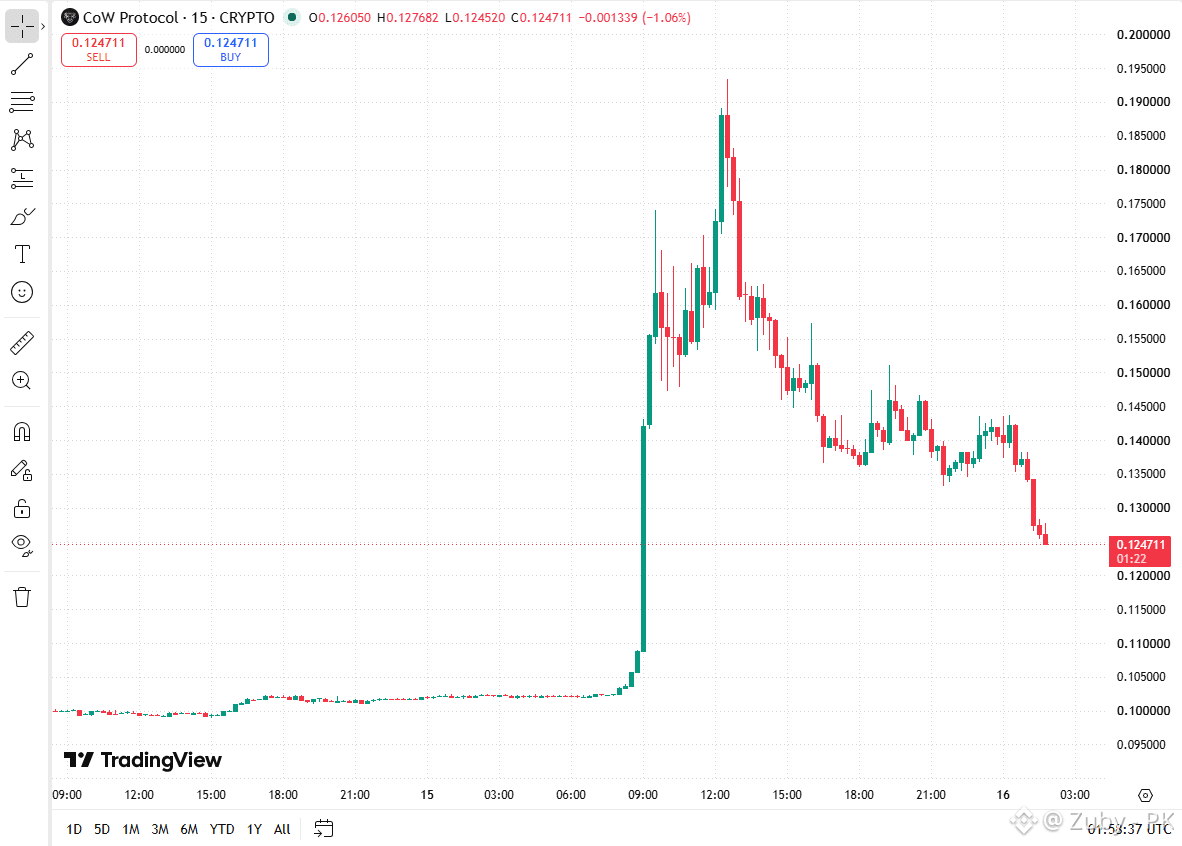
🔹Price: $0.1267
🔻 -7.08% 1h
📈 +24.21% 24h
🔹24h Volume: $177.96M
🔹CEX: $174.77M
🔹DEX: $3.18M
🔹Supply: 575M circulating / 1B max (Deflationary)
📉 Price Extremes
🔹ATH: $1.21 (Dec 2024) | -89.50% down
🔹ATL: $0.04017 (Nov 2022) | +215.34% up
📊 Technicals & Indicators
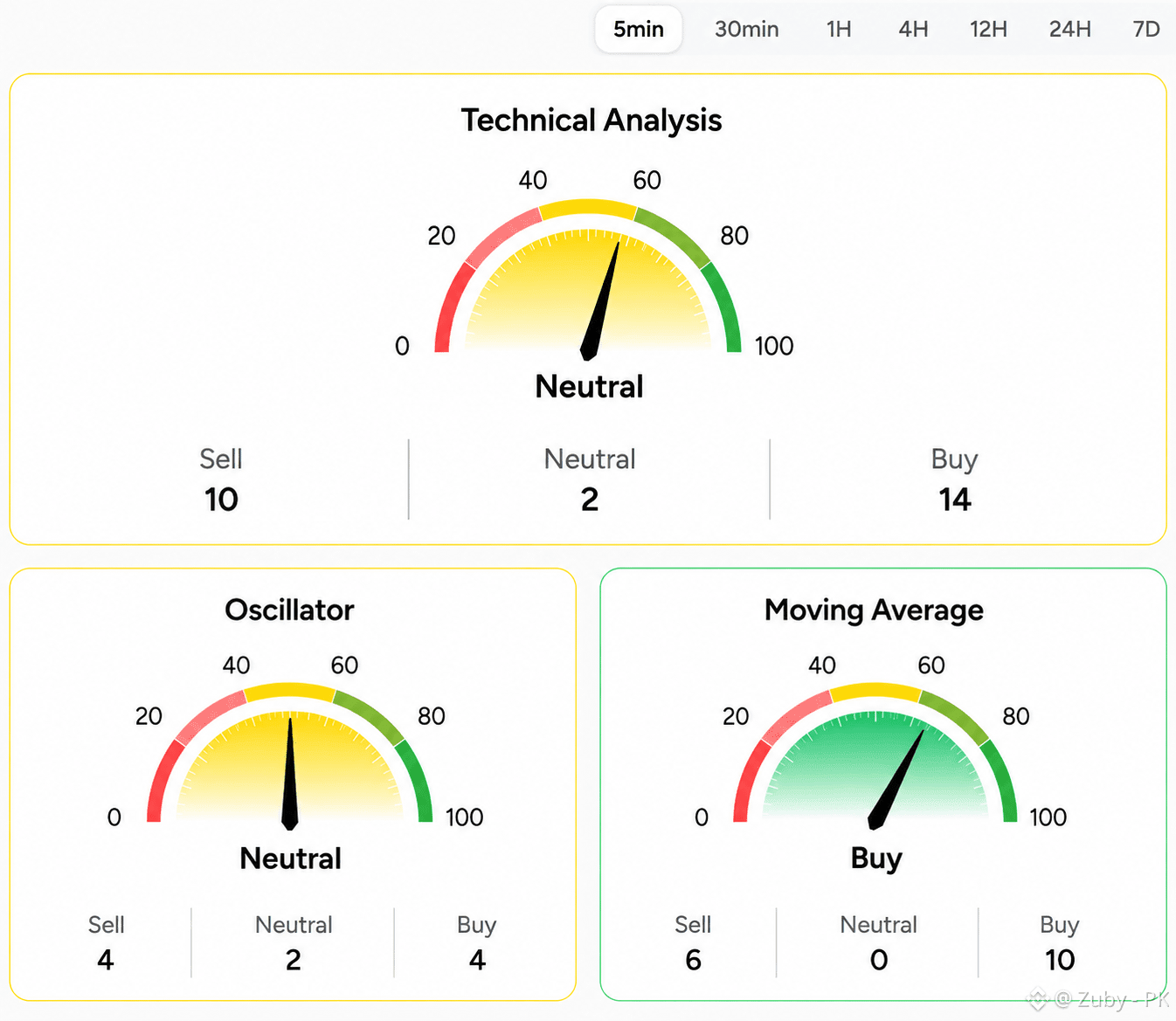
🔹Trends: Bearish crossovers on short, medium, and long-term SMAs (50-day SMA: $0.1290 | 200-day SMA: $0.17)
🔹Momentum: Volatility 7.50% | RSI 72.74 (Neutral) | MACD -0.0059 (Slight pressure)
🔹Signals: Stochastic K 33.7 (Bull zone) | ROC 9.26 | MFI 92.17 (High participation)
🔊 Not financial advice. High volatility. Trade with risk management. DYOR ⚠️
#CoWProtocol #COWToken #CoWProtocolAnalysis #COWPriceAnalysist #CryptoTechnicalAnalysis
$COW
{spot}(COWUSDT)
📈 Today's Trending Altcoin Analysis: 🐮 CoW Protocol At A Glance
🔹Price: $0.1267
🔻 -7.08% 1h
📈 +24.21% 24h
🔹24h Volume: $177.96M
🔹CEX: $174.77M
🔹DEX: $3.18M
🔹Supply: 575M circulating / 1B max (Deflationary)
📉 Price Extremes
🔹ATH: $1.21 (Dec 2024) | -89.50% down
🔹ATL: $0.04017 (Nov 2022) | +215.34% up
📊 Technicals & Indicators
🔹Trends: Bearish crossovers on short, medium, and long-term SMAs (50-day SMA: $0.1290 | 200-day SMA: $0.17)
🔹Momentum: Volatility 7.50% | RSI 72.74 (Neutral) | MACD -0.0059 (Slight pressure)
🔹Signals: Stochastic K 33.7 (Bull zone) | ROC 9.26 | MFI 92.17 (High participation)
🔊 Not financial advice. High volatility. Trade with risk management. DYOR ⚠️
#CoWProtocol #COWToken #CoWProtocolAnalysis #COWPriceAnalysist #CryptoTechnicalAnalysis
$COW
🔹Price: $0.1267
🔻 -7.08% 1h
📈 +24.21% 24h
🔹24h Volume: $177.96M
🔹CEX: $174.77M
🔹DEX: $3.18M
🔹Supply: 575M circulating / 1B max (Deflationary)
📉 Price Extremes
🔹ATH: $1.21 (Dec 2024) | -89.50% down
🔹ATL: $0.04017 (Nov 2022) | +215.34% up
📊 Technicals & Indicators
🔹Trends: Bearish crossovers on short, medium, and long-term SMAs (50-day SMA: $0.1290 | 200-day SMA: $0.17)
🔹Momentum: Volatility 7.50% | RSI 72.74 (Neutral) | MACD -0.0059 (Slight pressure)
🔹Signals: Stochastic K 33.7 (Bull zone) | ROC 9.26 | MFI 92.17 (High participation)
🔊 Not financial advice. High volatility. Trade with risk management. DYOR ⚠️
#CoWProtocol #COWToken #CoWProtocolAnalysis #COWPriceAnalysist #CryptoTechnicalAnalysis
$COW
4
329

·
--
$COW 📊 Extreme pumping!
What is COW? CoW Protocol is a DEX aggregator that uses an "order matching" mechanism to achieve optimal prices and protection against MEV.
Current situation: price $0.1640** (+64% in 24 hours), has broken through all the EMAs (21=0.108, 50=0.107, 200=0.119) — **a strong bullish trend**. But **RSI 93** indicates extreme overbought conditions! Resistance **$0.1750, support $0.1450. Enormous volume, but a correction is inevitable.
Conclusion: enter only on a pullback to $0.145–0.15 with a tight stop-loss. Shorting is risky, but possible from resistance.
👉 Subscribe for breakdowns of volatile assets!
#CoWProtocol #DeFi #Trade 👇
{future}(COWUSDT)
$COW 📊 Extreme pumping!
What is COW? CoW Protocol is a DEX aggregator that uses an "order matching" mechanism to achieve optimal prices and protection against MEV.
Current situation: price $0.1640** (+64% in 24 hours), has broken through all the EMAs (21=0.108, 50=0.107, 200=0.119) — **a strong bullish trend**. But **RSI 93** indicates extreme overbought conditions! Resistance **$0.1750, support $0.1450. Enormous volume, but a correction is inevitable.
Conclusion: enter only on a pullback to $0.145–0.15 with a tight stop-loss. Shorting is risky, but possible from resistance.
👉 Subscribe for breakdowns of volatile assets!
#CoWProtocol #DeFi #Trade 👇
What is COW? CoW Protocol is a DEX aggregator that uses an "order matching" mechanism to achieve optimal prices and protection against MEV.
Current situation: price $0.1640** (+64% in 24 hours), has broken through all the EMAs (21=0.108, 50=0.107, 200=0.119) — **a strong bullish trend**. But **RSI 93** indicates extreme overbought conditions! Resistance **$0.1750, support $0.1450. Enormous volume, but a correction is inevitable.
Conclusion: enter only on a pullback to $0.145–0.15 with a tight stop-loss. Shorting is risky, but possible from resistance.
👉 Subscribe for breakdowns of volatile assets!
#CoWProtocol #DeFi #Trade 👇
1
315

·
--
CoW Protocol is the #1 intent-based DEX by volume — and most people still don't know its name.
23.5% market share in intent-based trading. $44K+ in daily protocol revenue, up 340% in a day.
Real batch-auction tech that protects traders from MEV — quietly one of DeFi's best-built products.
$0.099 → $0.194 spike → now $0.125, cooling off from overbought. Solid fundamentals, choppy chart.
#COW $COW #CoWProtocol #DeFi #Crypto
CoW Protocol is the #1 intent-based DEX by volume — and most people still don't know its name.
23.5% market share in intent-based trading. $44K+ in daily protocol revenue, up 340% in a day.
Real batch-auction tech that protects traders from MEV — quietly one of DeFi's best-built products.
$0.099 → $0.194 spike → now $0.125, cooling off from overbought. Solid fundamentals, choppy chart.
#COW $COW #CoWProtocol #DeFi #Crypto
23.5% market share in intent-based trading. $44K+ in daily protocol revenue, up 340% in a day.
Real batch-auction tech that protects traders from MEV — quietly one of DeFi's best-built products.
$0.099 → $0.194 spike → now $0.125, cooling off from overbought. Solid fundamentals, choppy chart.
#COW $COW #CoWProtocol #DeFi #Crypto
268

·
--
🐮 COW/USDT | Market Watch$COW $DUSK $BTC
COW has been showing strong momentum, but the latest move is getting stretched. Recent analysis puts COW around $0.16, with $0.20 as a key resistance and $0.11 as an important support zone.
📈 Bullish: Break above $0.20 → momentum could accelerate.
📉 Bearish: Lose $0.11 → deeper pullback risk.
💡 Tip: Don’t chase a pump—wait for confirmation.
#COW #cowusdt #CoWProtocol #altcoins
🐮 COW/USDT | Market Watch$COW $DUSK $BTC
COW has been showing strong momentum, but the latest move is getting stretched. Recent analysis puts COW around $0.16, with $0.20 as a key resistance and $0.11 as an important support zone.
📈 Bullish: Break above $0.20 → momentum could accelerate.
📉 Bearish: Lose $0.11 → deeper pullback risk.
💡 Tip: Don’t chase a pump—wait for confirmation.
#COW #cowusdt #CoWProtocol #altcoins
COW has been showing strong momentum, but the latest move is getting stretched. Recent analysis puts COW around $0.16, with $0.20 as a key resistance and $0.11 as an important support zone.
📈 Bullish: Break above $0.20 → momentum could accelerate.
📉 Bearish: Lose $0.11 → deeper pullback risk.
💡 Tip: Don’t chase a pump—wait for confirmation.
#COW #cowusdt #CoWProtocol #altcoins
1
76

#cowrises55.77%in24h
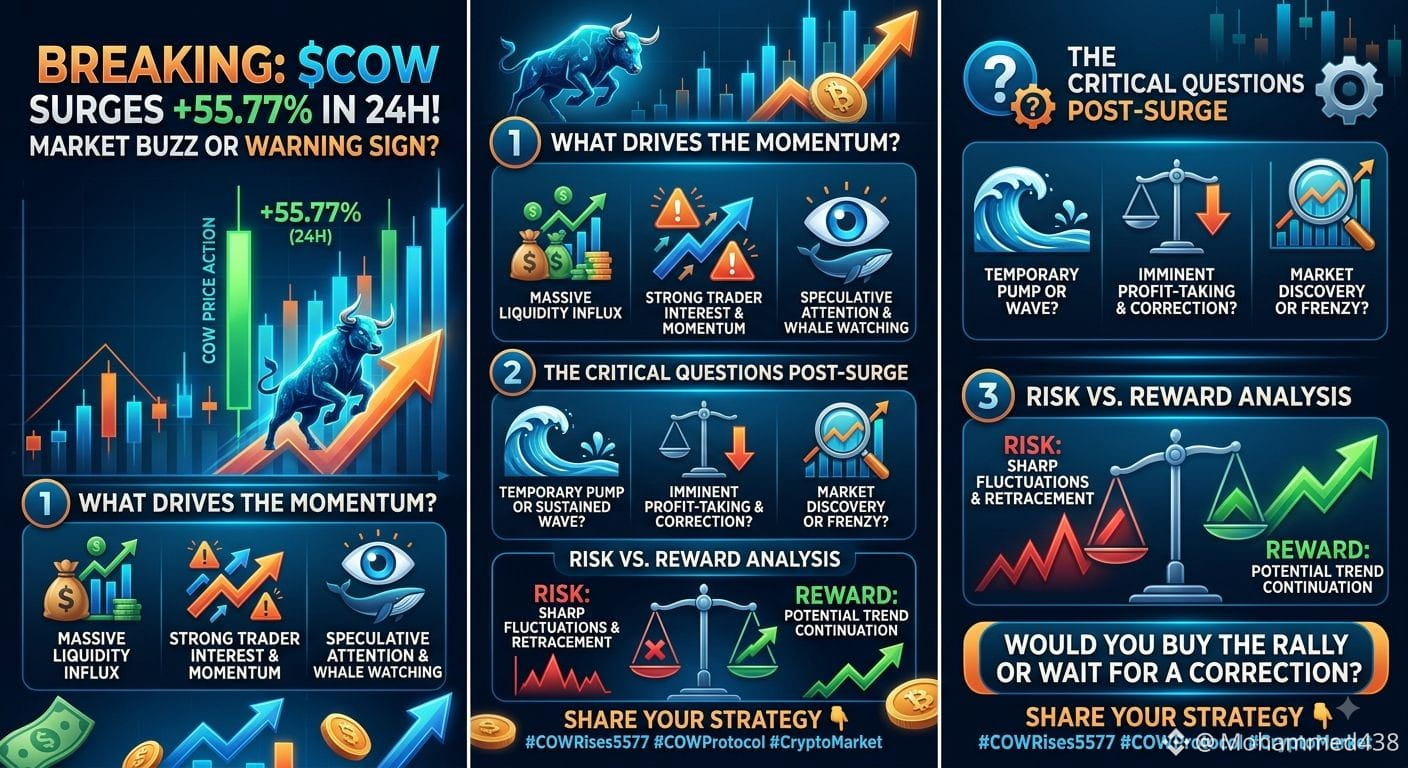
🚨 55.77% isn't the number that should scare you… The real question is: What happens after this surge? 👀🔥
In less than 24 hours, $COW has been thrust into the spotlight, after a massive 55.77% jump 📈🐮
Yes… almost half the coin's value in a single day!
And here's where the real story begins. 👇
When a coin moves this fast, the entire market starts asking the same question:
Where did this momentum come from? Is the move over… or is the market just beginning to discover $COW?
A surge of this magnitude attracts three types of attention simultaneously:
👀 Traders looking for the coins with the strongest momentum.
💰 New liquidity searching for the next move.
🐋 Observers trying to determine if there's a potential continuation of the trend.
But there's a very important point…
A 55.77% rise doesn't automatically mean the price will continue to climb. ⚠️
After any strong move, we can see profit-taking and sharp fluctuations, so the next few hours become more important than the rise itself.
The question now is:
Can $COW maintain this momentum after its strong rally?
Or will traders who entered easly start taking profits? 👀
🔥 55.77% in 24 hours has made COW one of the coins to watch… but the next move will determine if this is just a temporary surge or the start of a larger wave.
📈 Would you have entered after the 55% rise… or waited for a correction first?
#COWProtocol #Crypto #Altcoins #Write2Earn
$COW
{spot}(COWUSDT)
#cowrises55.77%in24h
🚨 55.77% isn't the number that should scare you… The real question is: What happens after this surge? 👀🔥
In less than 24 hours, $COW has been thrust into the spotlight, after a massive 55.77% jump 📈🐮
Yes… almost half the coin's value in a single day!
And here's where the real story begins. 👇
When a coin moves this fast, the entire market starts asking the same question:
Where did this momentum come from? Is the move over… or is the market just beginning to discover $COW ?
A surge of this magnitude attracts three types of attention simultaneously:
👀 Traders looking for the coins with the strongest momentum.
💰 New liquidity searching for the next move.
🐋 Observers trying to determine if there's a potential continuation of the trend.
But there's a very important point…
A 55.77% rise doesn't automatically mean the price will continue to climb. ⚠️
After any strong move, we can see profit-taking and sharp fluctuations, so the next few hours become more important than the rise itself.
The question now is:
Can $COW maintain this momentum after its strong rally?
Or will traders who entered easly start taking profits? 👀
🔥 55.77% in 24 hours has made COW one of the coins to watch… but the next move will determine if this is just a temporary surge or the start of a larger wave.
📈 Would you have entered after the 55% rise… or waited for a correction first?
#COWProtocol #Crypto #Altcoins #Write2Earn
$COW
🚨 55.77% isn't the number that should scare you… The real question is: What happens after this surge? 👀🔥
In less than 24 hours, $COW has been thrust into the spotlight, after a massive 55.77% jump 📈🐮
Yes… almost half the coin's value in a single day!
And here's where the real story begins. 👇
When a coin moves this fast, the entire market starts asking the same question:
Where did this momentum come from? Is the move over… or is the market just beginning to discover $COW ?
A surge of this magnitude attracts three types of attention simultaneously:
👀 Traders looking for the coins with the strongest momentum.
💰 New liquidity searching for the next move.
🐋 Observers trying to determine if there's a potential continuation of the trend.
But there's a very important point…
A 55.77% rise doesn't automatically mean the price will continue to climb. ⚠️
After any strong move, we can see profit-taking and sharp fluctuations, so the next few hours become more important than the rise itself.
The question now is:
Can $COW maintain this momentum after its strong rally?
Or will traders who entered easly start taking profits? 👀
🔥 55.77% in 24 hours has made COW one of the coins to watch… but the next move will determine if this is just a temporary surge or the start of a larger wave.
📈 Would you have entered after the 55% rise… or waited for a correction first?
#COWProtocol #Crypto #Altcoins #Write2Earn
$COW
1
217

·
--
Bullish
🟢 $COW
{future}(COWUSDT)
Short Liquidation Alert
💰 Liquidated Amount:
$2.5032K
📍 Liquidation Price:
$0.1516 (BINANCE)
━━━━━━━━━━━━━━
📊 Trade Outlook
🎯 Target:
$0.1568
📥 Entry Zone:
$0.15290–$0.15330
📈 Take Profit:
$0.15520
🛑 Stop Loss:
$0.15090
━━━━━━━━━━━━━━
⚡ ELITE TRADE INSIGHT ⚡
Shorts being forced out around this level can reinforce buying momentum and expose liquidity above the liquidation zone. A confirmed hold above entry would strengthen the setup, but disciplined risk management remains essential.
#COW
#CoWProtocol
#defi
🟢 $COW
Short Liquidation Alert
💰 Liquidated Amount:
$2.5032K
📍 Liquidation Price:
$0.1516 (BINANCE)
━━━━━━━━━━━━━━
📊 Trade Outlook
🎯 Target:
$0.1568
📥 Entry Zone:
$0.15290–$0.15330
📈 Take Profit:
$0.15520
🛑 Stop Loss:
$0.15090
━━━━━━━━━━━━━━
⚡ ELITE TRADE INSIGHT ⚡
Shorts being forced out around this level can reinforce buying momentum and expose liquidity above the liquidation zone. A confirmed hold above entry would strengthen the setup, but disciplined risk management remains essential.
#COW
#CoWProtocol
#defi
Short Liquidation Alert
💰 Liquidated Amount:
$2.5032K
📍 Liquidation Price:
$0.1516 (BINANCE)
━━━━━━━━━━━━━━
📊 Trade Outlook
🎯 Target:
$0.1568
📥 Entry Zone:
$0.15290–$0.15330
📈 Take Profit:
$0.15520
🛑 Stop Loss:
$0.15090
━━━━━━━━━━━━━━
⚡ ELITE TRADE INSIGHT ⚡
Shorts being forced out around this level can reinforce buying momentum and expose liquidity above the liquidation zone. A confirmed hold above entry would strengthen the setup, but disciplined risk management remains essential.
#COW
#CoWProtocol
#defi
62

·
--
Bearish
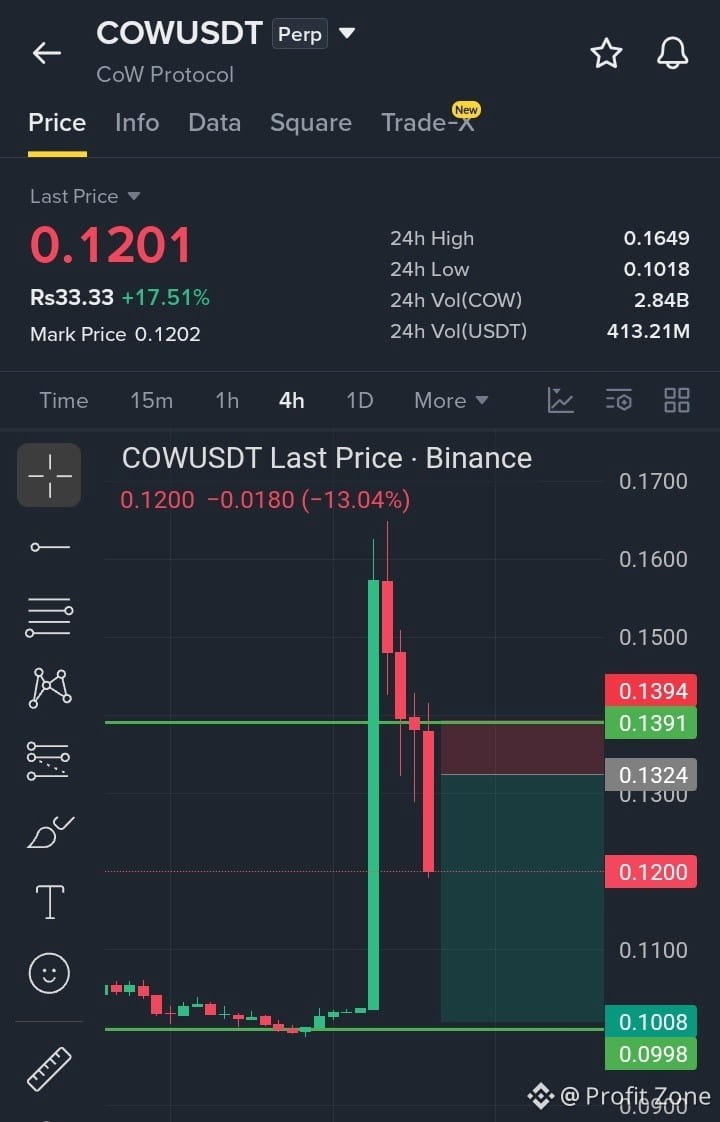
$COW is showing strong volatility after a 17%+ daily move, but the pullback from 0.1649 needs confirmation. Holding 0.1200 could support a recovery toward the nearby resistance levels.
Entry: 0.1160–0.1210
TP1: 0.1324
TP2: 0.1394
TP3: 0.1500
SL: 0.1080
#COW #CoWProtocol #Binance
{future}(COWUSDT)
$TUT
{spot}(TUTUSDT)
$DEXE
{future}(DEXEUSDT)
$COW is showing strong volatility after a 17%+ daily move, but the pullback from 0.1649 needs confirmation. Holding 0.1200 could support a recovery toward the nearby resistance levels.
Entry: 0.1160–0.1210
TP1: 0.1324
TP2: 0.1394
TP3: 0.1500
SL: 0.1080
#COW #CoWProtocol #Binance
$TUT
$DEXE
Entry: 0.1160–0.1210
TP1: 0.1324
TP2: 0.1394
TP3: 0.1500
SL: 0.1080
#COW #CoWProtocol #Binance
$TUT
$DEXE
3
755

·
--
$COW JUST WOKE UP — BUT THE REAL TEST IS NEXT.
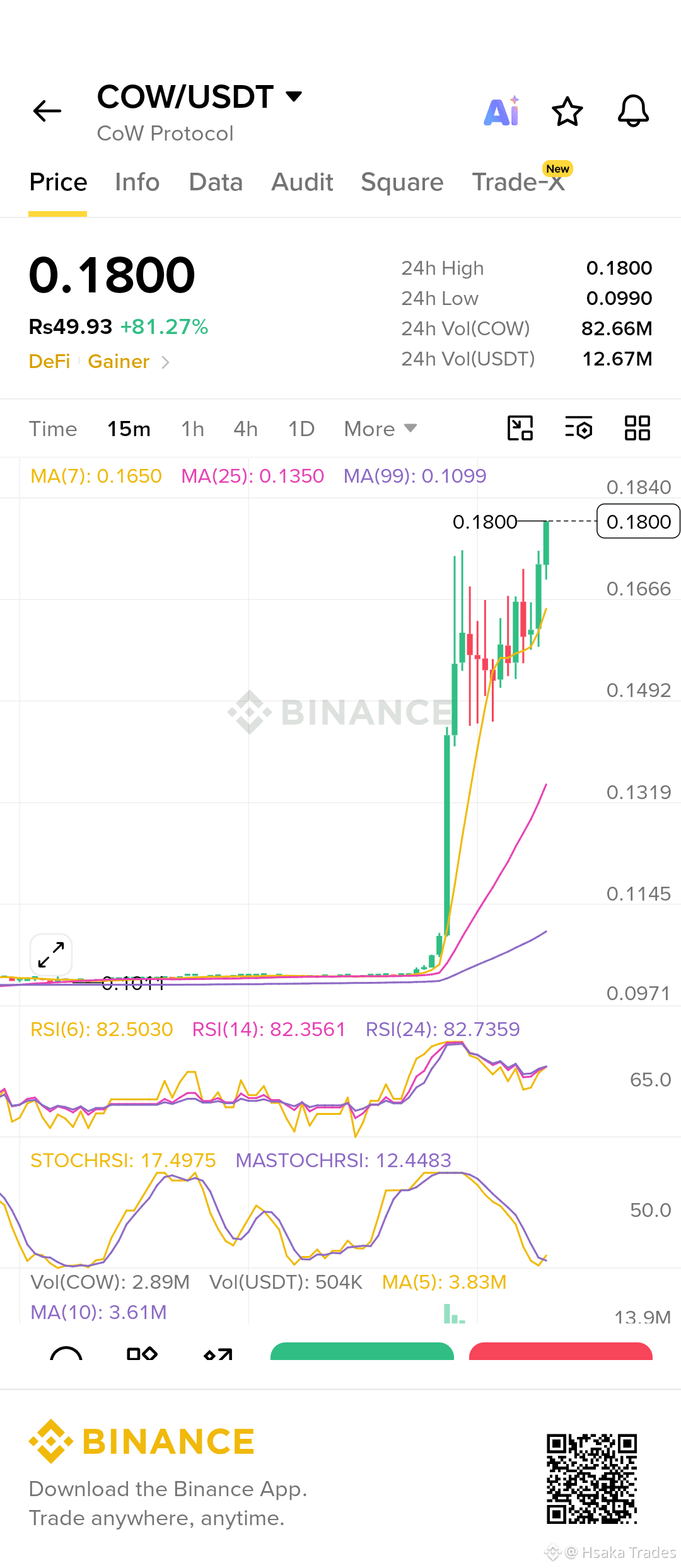
$COW is showing a powerful momentum expansion, with price recently pushing sharply higher alongside a major increase in trading activity. Current market data shows COW around the $0.17 area, with 24H gains exceeding 70% on some tracked markets.
Technically, momentum has clearly shifted bullish. COW is trading above its key moving averages, while RSI has entered overbought territory — a sign that buyers are aggressive, but also that chasing the candle carries higher risk.
The key now is price acceptance, not just the spike. If COW holds the breakout area and volume remains elevated, the move could develop into a stronger trend. If volume fades and price loses support, a liquidity-driven pullback would be normal.
Supply is another factor: COW’s circulating supply has reached 1 billion tokens, meaning future upside increasingly depends on demand rather than supply reduction.
My Take: I prefer waiting for a clean retest instead of buying an extended green candle. Momentum is bullish, but confirmation matters.
Would you wait for a pullback or trade the breakout?
#COW #CoWProtocol
$COW JUST WOKE UP — BUT THE REAL TEST IS NEXT.
$COW is showing a powerful momentum expansion, with price recently pushing sharply higher alongside a major increase in trading activity. Current market data shows COW around the $0.17 area, with 24H gains exceeding 70% on some tracked markets.
Technically, momentum has clearly shifted bullish. COW is trading above its key moving averages, while RSI has entered overbought territory — a sign that buyers are aggressive, but also that chasing the candle carries higher risk.
The key now is price acceptance, not just the spike. If COW holds the breakout area and volume remains elevated, the move could develop into a stronger trend. If volume fades and price loses support, a liquidity-driven pullback would be normal.
Supply is another factor: COW’s circulating supply has reached 1 billion tokens, meaning future upside increasingly depends on demand rather than supply reduction.
My Take: I prefer waiting for a clean retest instead of buying an extended green candle. Momentum is bullish, but confirmation matters.
Would you wait for a pullback or trade the breakout?
#COW #CoWProtocol
$COW is showing a powerful momentum expansion, with price recently pushing sharply higher alongside a major increase in trading activity. Current market data shows COW around the $0.17 area, with 24H gains exceeding 70% on some tracked markets.
Technically, momentum has clearly shifted bullish. COW is trading above its key moving averages, while RSI has entered overbought territory — a sign that buyers are aggressive, but also that chasing the candle carries higher risk.
The key now is price acceptance, not just the spike. If COW holds the breakout area and volume remains elevated, the move could develop into a stronger trend. If volume fades and price loses support, a liquidity-driven pullback would be normal.
Supply is another factor: COW’s circulating supply has reached 1 billion tokens, meaning future upside increasingly depends on demand rather than supply reduction.
My Take: I prefer waiting for a clean retest instead of buying an extended green candle. Momentum is bullish, but confirmation matters.
Would you wait for a pullback or trade the breakout?
#COW #CoWProtocol
2
175
·
--
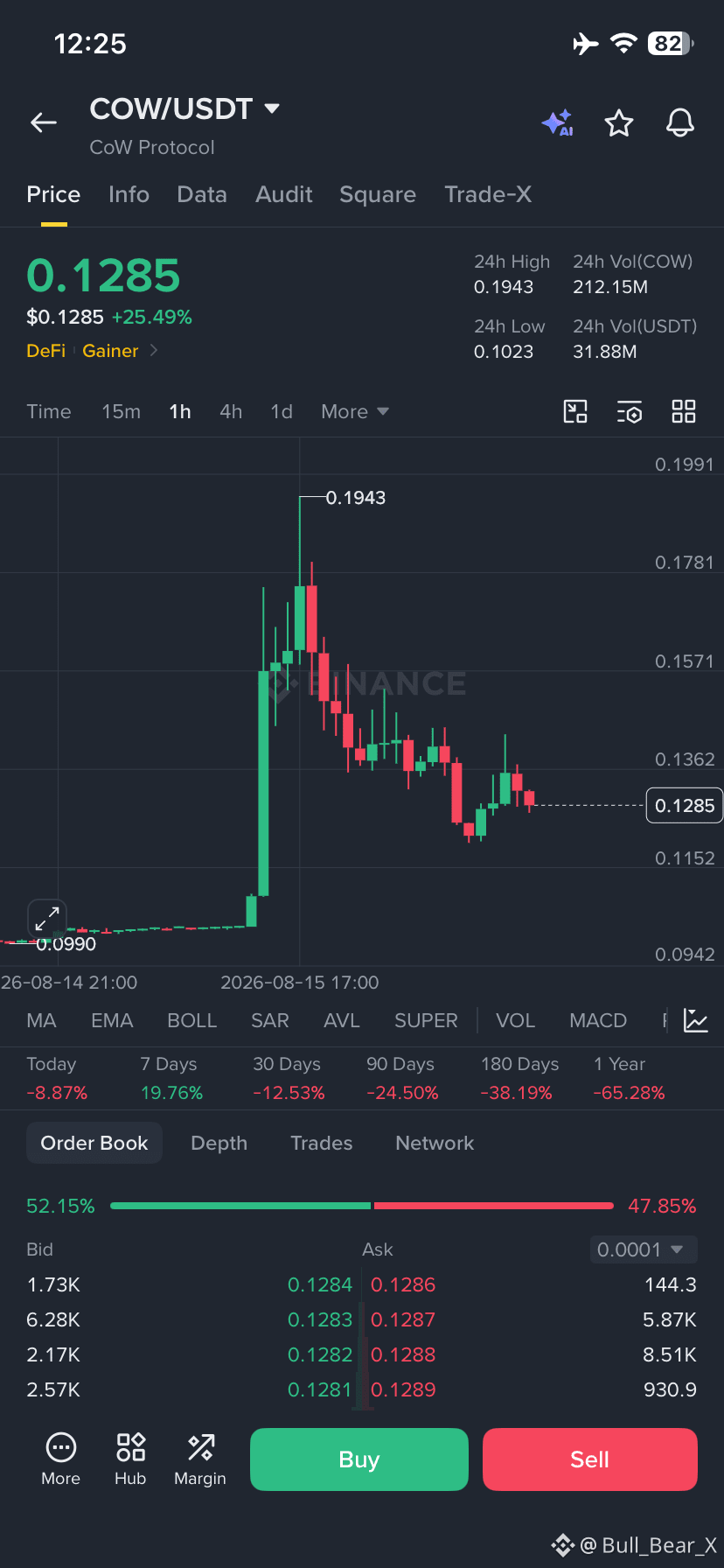
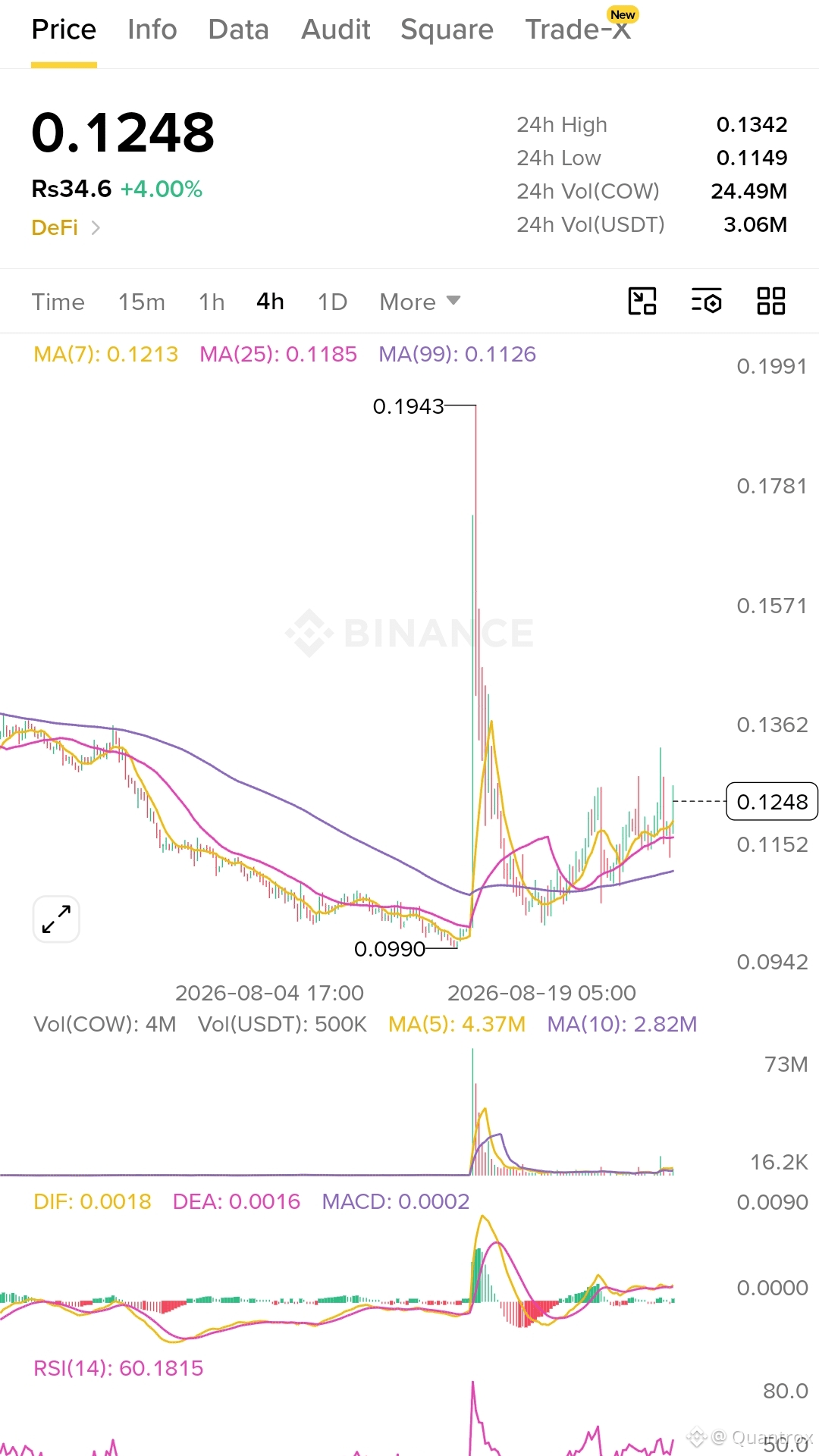
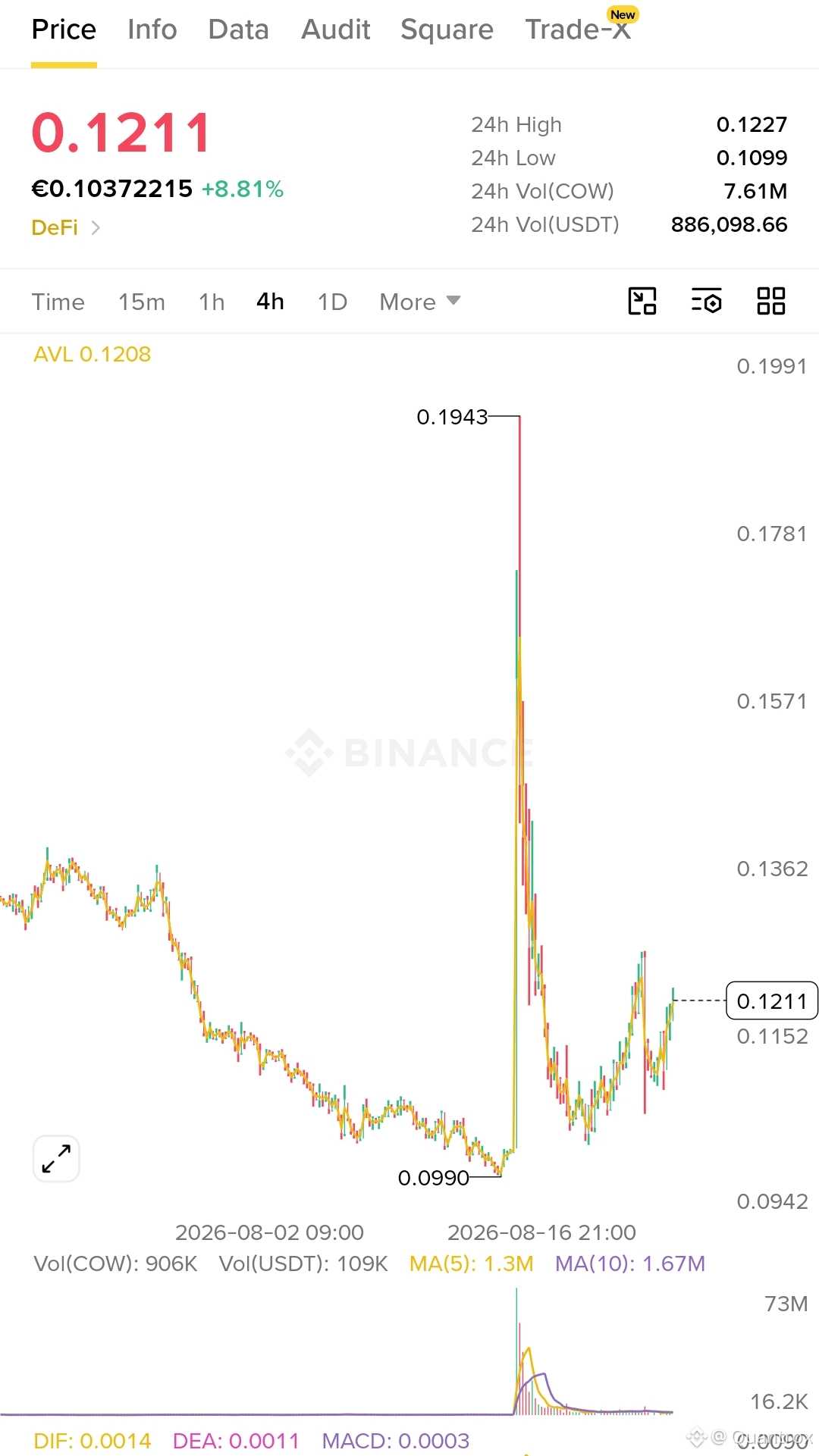
$COW 50% crash may have been the setup. 👀
That $0.1943 spike got wiped out almost instantly.
Now price is quietly rebuilding…
$0.1152 is the level I’m watching.
Hold it → higher retest.
Lose it → $0.0990 could be next.
Fakeout… or comeback?
#COW #CowProtocol #Crypto #DeFi
$COW 50% crash may have been the setup. 👀
That $0.1943 spike got wiped out almost instantly.
Now price is quietly rebuilding…
$0.1152 is the level I’m watching.
Hold it → higher retest.
Lose it → $0.0990 could be next.
Fakeout… or comeback?
#COW #CowProtocol #Crypto #DeFi
That $0.1943 spike got wiped out almost instantly.
Now price is quietly rebuilding…
$0.1152 is the level I’m watching.
Hold it → higher retest.
Lose it → $0.0990 could be next.
Fakeout… or comeback?
#COW #CowProtocol #Crypto #DeFi
528

·
--
The plaza topic says COW rose 55.77% in a 24-hour window. On the same candlestick, it just exhaled profits downward from near the daily peak. Is this the realization of an “utility” narrative, or has the heat already been drawn out first?
Let’s break down the wording first. The topic numbers correspond to the surge window—roughly rebounding from around 0.10 to about 0.16. In Binance’s COWUSDT daily chart, the market opened on August 15 at about 0.102, spiked intraday to 0.1943, and closed at 0.141. Trading volume then suddenly expanded to about $27.78 million, whereas the previous few days were only in the hundreds of thousands. By the rolling 24-hour window as of August 16, it has flipped to a decline of about 21.5%, with the latest price around 0.1236 and that day’s low around 0.1205. The “green topic” and the current price aren’t on the same frame.
【Who is it】
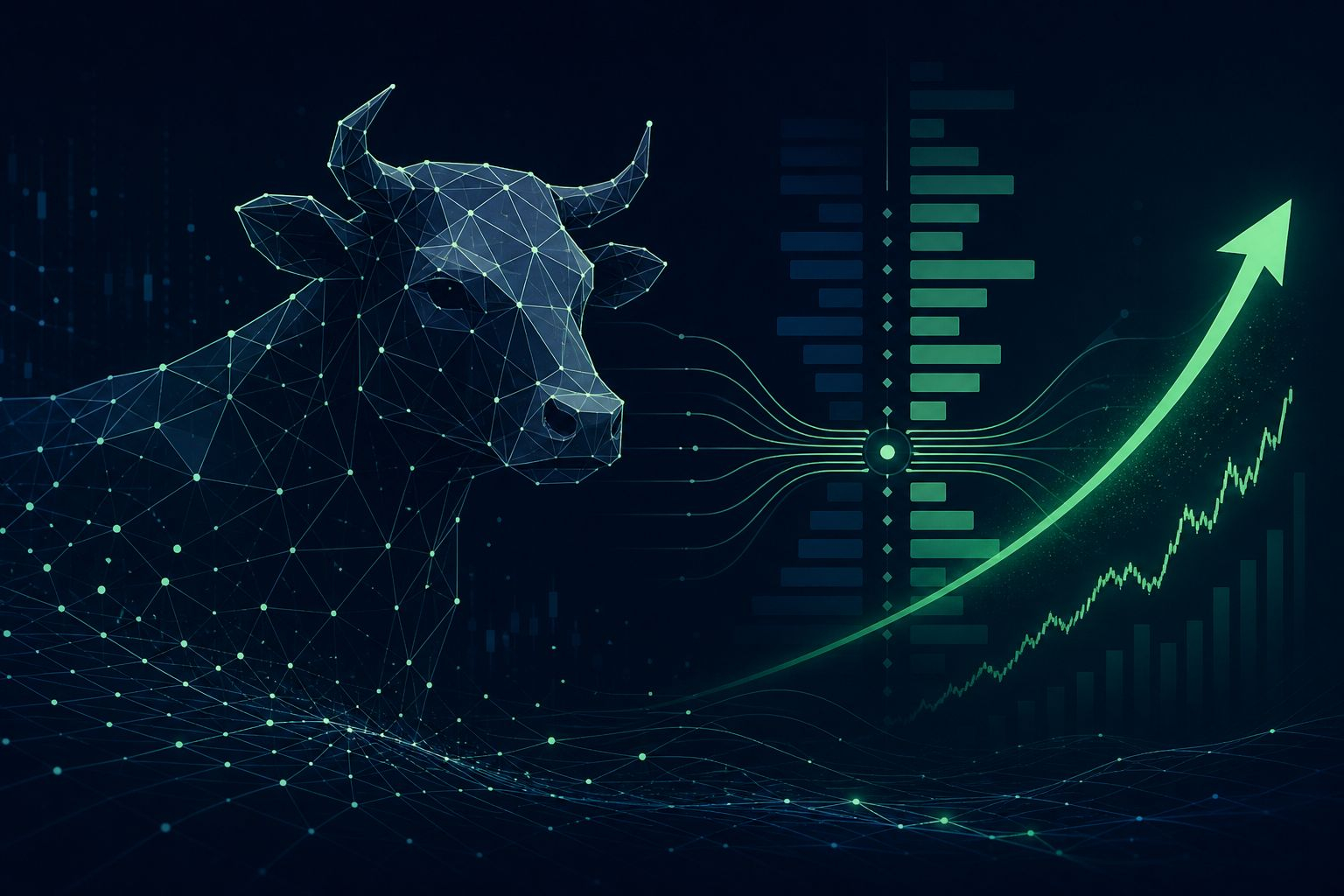
(For the structure diagram, see the cover and the accompanying images in the body; compare it with the blue line oscillations and the Fib dashed lines on the right.)
COW is the governance token of CoW Protocol. The protocol performs intention-based trading and batch matching, emphasizing MEV protection and reducing slippage losses. This isn’t the same line as the similarly named movie meme. Don’t see the “bull” character and automatically assume you’ve matched the meaning.
【Why it suddenly blew up】
The public catalyst comes from Lido. Around August 14, NEST’s automatic buyback mechanism went live on mainnet. The rule is roughly: once staking revenue exceeds an annualized baseline of about $40 million, half of the surplus gets bought via CoW Swap—daily cap about $50,000, and an annual rolling cap of about $10 million. The repurchased LDO goes into the DAO treasury. Both media coverage and project explanations write the execution layer as being through CoW Swap. The market reads it as: a big protocol routes a continuous order flow into the intent-matching layer, and the utility narrative gets “lit up.”
Volume is tougher than slogans. On August 15’s daily candle, both price and trading volume “exploded” together. After that, whether a second DAO reuses the same pathway—if yes, that’s more worth watching than a single-day percentage spike.
【How to trade this setup】
Don’t translate the topic’s percentage gain directly into a mindless chase. The 55.77% move in the surge window has already happened. What we have now looks more like profit-taking after the peak.
You can structure your observation into three tiers—only look at daily or 4-hour closes.
First, for defense: watch 0.12 down to 0.10. Around 0.12 is where the pullback formed in this leg, and 0.10 is the platform before the breakout. If 0.10 is lost consecutively, the upside structure will be significantly discounted.
Second, for the mean-reversion pullback resistance: first look at 0.14 to 0.15, then at the sentiment highs around 0.16 to 0.19. Only if it holds above 0.14 should we talk about a second leg up.
Third, for narrative runway: watch whether trading volume can stay above the million-dollar level, and whether NEST truly places orders day by day. Repurchases have a daily cap—this single buyer can’t hold the infinite market-cap fantasy by itself.
Are you waiting for the retest of 0.12 to 0.10 to talk, or do you insist on chasing a second pulse above 0.14? Answer with “wait for the retest” or “chase the pulse.”
$COW $BTC #COW #CoWProtocol #Lido
Captain Dragonfly|A finance blogger who likes analyzing data and candlestick charts.
Not investment advice. The percentage change varies by window; before placing any order, verify the latest market conditions and contracts yourself.
The plaza topic says COW rose 55.77% in a 24-hour window. On the same candlestick, it just exhaled profits downward from near the daily peak. Is this the realization of an “utility” narrative, or has the heat already been drawn out first?
Let’s break down the wording first. The topic numbers correspond to the surge window—roughly rebounding from around 0.10 to about 0.16. In Binance’s COWUSDT daily chart, the market opened on August 15 at about 0.102, spiked intraday to 0.1943, and closed at 0.141. Trading volume then suddenly expanded to about $27.78 million, whereas the previous few days were only in the hundreds of thousands. By the rolling 24-hour window as of August 16, it has flipped to a decline of about 21.5%, with the latest price around 0.1236 and that day’s low around 0.1205. The “green topic” and the current price aren’t on the same frame.
【Who is it】
(For the structure diagram, see the cover and the accompanying images in the body; compare it with the blue line oscillations and the Fib dashed lines on the right.)
COW is the governance token of CoW Protocol. The protocol performs intention-based trading and batch matching, emphasizing MEV protection and reducing slippage losses. This isn’t the same line as the similarly named movie meme. Don’t see the “bull” character and automatically assume you’ve matched the meaning.
【Why it suddenly blew up】
The public catalyst comes from Lido. Around August 14, NEST’s automatic buyback mechanism went live on mainnet. The rule is roughly: once staking revenue exceeds an annualized baseline of about $40 million, half of the surplus gets bought via CoW Swap—daily cap about $50,000, and an annual rolling cap of about $10 million. The repurchased LDO goes into the DAO treasury. Both media coverage and project explanations write the execution layer as being through CoW Swap. The market reads it as: a big protocol routes a continuous order flow into the intent-matching layer, and the utility narrative gets “lit up.”
Volume is tougher than slogans. On August 15’s daily candle, both price and trading volume “exploded” together. After that, whether a second DAO reuses the same pathway—if yes, that’s more worth watching than a single-day percentage spike.
【How to trade this setup】
Don’t translate the topic’s percentage gain directly into a mindless chase. The 55.77% move in the surge window has already happened. What we have now looks more like profit-taking after the peak.
You can structure your observation into three tiers—only look at daily or 4-hour closes.
First, for defense: watch 0.12 down to 0.10. Around 0.12 is where the pullback formed in this leg, and 0.10 is the platform before the breakout. If 0.10 is lost consecutively, the upside structure will be significantly discounted.
Second, for the mean-reversion pullback resistance: first look at 0.14 to 0.15, then at the sentiment highs around 0.16 to 0.19. Only if it holds above 0.14 should we talk about a second leg up.
Third, for narrative runway: watch whether trading volume can stay above the million-dollar level, and whether NEST truly places orders day by day. Repurchases have a daily cap—this single buyer can’t hold the infinite market-cap fantasy by itself.
Are you waiting for the retest of 0.12 to 0.10 to talk, or do you insist on chasing a second pulse above 0.14? Answer with “wait for the retest” or “chase the pulse.”
$COW $BTC #COW #CoWProtocol #Lido
Captain Dragonfly|A finance blogger who likes analyzing data and candlestick charts.
Not investment advice. The percentage change varies by window; before placing any order, verify the latest market conditions and contracts yourself.
Let’s break down the wording first. The topic numbers correspond to the surge window—roughly rebounding from around 0.10 to about 0.16. In Binance’s COWUSDT daily chart, the market opened on August 15 at about 0.102, spiked intraday to 0.1943, and closed at 0.141. Trading volume then suddenly expanded to about $27.78 million, whereas the previous few days were only in the hundreds of thousands. By the rolling 24-hour window as of August 16, it has flipped to a decline of about 21.5%, with the latest price around 0.1236 and that day’s low around 0.1205. The “green topic” and the current price aren’t on the same frame.
【Who is it】
(For the structure diagram, see the cover and the accompanying images in the body; compare it with the blue line oscillations and the Fib dashed lines on the right.)
COW is the governance token of CoW Protocol. The protocol performs intention-based trading and batch matching, emphasizing MEV protection and reducing slippage losses. This isn’t the same line as the similarly named movie meme. Don’t see the “bull” character and automatically assume you’ve matched the meaning.
【Why it suddenly blew up】
The public catalyst comes from Lido. Around August 14, NEST’s automatic buyback mechanism went live on mainnet. The rule is roughly: once staking revenue exceeds an annualized baseline of about $40 million, half of the surplus gets bought via CoW Swap—daily cap about $50,000, and an annual rolling cap of about $10 million. The repurchased LDO goes into the DAO treasury. Both media coverage and project explanations write the execution layer as being through CoW Swap. The market reads it as: a big protocol routes a continuous order flow into the intent-matching layer, and the utility narrative gets “lit up.”
Volume is tougher than slogans. On August 15’s daily candle, both price and trading volume “exploded” together. After that, whether a second DAO reuses the same pathway—if yes, that’s more worth watching than a single-day percentage spike.
【How to trade this setup】
Don’t translate the topic’s percentage gain directly into a mindless chase. The 55.77% move in the surge window has already happened. What we have now looks more like profit-taking after the peak.
You can structure your observation into three tiers—only look at daily or 4-hour closes.
First, for defense: watch 0.12 down to 0.10. Around 0.12 is where the pullback formed in this leg, and 0.10 is the platform before the breakout. If 0.10 is lost consecutively, the upside structure will be significantly discounted.
Second, for the mean-reversion pullback resistance: first look at 0.14 to 0.15, then at the sentiment highs around 0.16 to 0.19. Only if it holds above 0.14 should we talk about a second leg up.
Third, for narrative runway: watch whether trading volume can stay above the million-dollar level, and whether NEST truly places orders day by day. Repurchases have a daily cap—this single buyer can’t hold the infinite market-cap fantasy by itself.
Are you waiting for the retest of 0.12 to 0.10 to talk, or do you insist on chasing a second pulse above 0.14? Answer with “wait for the retest” or “chase the pulse.”
$COW $BTC #COW #CoWProtocol #Lido
Captain Dragonfly|A finance blogger who likes analyzing data and candlestick charts.
Not investment advice. The percentage change varies by window; before placing any order, verify the latest market conditions and contracts yourself.
142

·
--
🦈 $COW PUMPED 36% — THE REAL STORY IS SITTING BELOW THE GREEN CANDLE 💥
Entry: 0.139 ⚡
Target: 0.1943 🚀
Stop Loss: 0.099 ⚠️
📊 That 36% green candle isn't happening in a vacuum. COW ground lower for months from the $0.28 zone, bottoming near $0.099 before this spike. Daily structure still shows an unbroken downtrend — this is a bounce, not a breakout yet.
⚡ Velocity is the tell. RSI(14) on the 4H jumped from the 40s to 68.06 in a single window — fast capital, not patient accumulation. Volume is real at ~$21.45M, but the $0.1011–$0.1943 range screams volatility, not stability.
Chasing 36% moves off multi-month lows near RSI 68 is a momentum bet, not fundamental conviction. Without a confirmed catalyst, the sharpest traders wait for the retest. 💬 Anyone holding a catalyst for this move, or is it just rotation into the most beaten-down names?
⚠️ Not financial advice. Always manage your risk. 🛡️
🏷️ #COW #CoWProtocol #Altcoin #TechnicalAnalysis
🔍 🦈
🦈 $COW PUMPED 36% — THE REAL STORY IS SITTING BELOW THE GREEN CANDLE 💥
Entry: 0.139 ⚡
Target: 0.1943 🚀
Stop Loss: 0.099 ⚠️
📊 That 36% green candle isn't happening in a vacuum. COW ground lower for months from the $0.28 zone, bottoming near $0.099 before this spike. Daily structure still shows an unbroken downtrend — this is a bounce, not a breakout yet.
⚡ Velocity is the tell. RSI(14) on the 4H jumped from the 40s to 68.06 in a single window — fast capital, not patient accumulation. Volume is real at ~$21.45M, but the $0.1011–$0.1943 range screams volatility, not stability.
Chasing 36% moves off multi-month lows near RSI 68 is a momentum bet, not fundamental conviction. Without a confirmed catalyst, the sharpest traders wait for the retest. 💬 Anyone holding a catalyst for this move, or is it just rotation into the most beaten-down names?
⚠️ Not financial advice. Always manage your risk. 🛡️
🏷️ #COW #CoWProtocol #Altcoin #TechnicalAnalysis
🔍 🦈
Entry: 0.139 ⚡
Target: 0.1943 🚀
Stop Loss: 0.099 ⚠️
📊 That 36% green candle isn't happening in a vacuum. COW ground lower for months from the $0.28 zone, bottoming near $0.099 before this spike. Daily structure still shows an unbroken downtrend — this is a bounce, not a breakout yet.
⚡ Velocity is the tell. RSI(14) on the 4H jumped from the 40s to 68.06 in a single window — fast capital, not patient accumulation. Volume is real at ~$21.45M, but the $0.1011–$0.1943 range screams volatility, not stability.
Chasing 36% moves off multi-month lows near RSI 68 is a momentum bet, not fundamental conviction. Without a confirmed catalyst, the sharpest traders wait for the retest. 💬 Anyone holding a catalyst for this move, or is it just rotation into the most beaten-down names?
⚠️ Not financial advice. Always manage your risk. 🛡️
🏷️ #COW #CoWProtocol #Altcoin #TechnicalAnalysis
🔍 🦈
61

·
--
$COW $BNB
{future}(COWUSDT)
🔥 COW is showing strong momentum!
$COW is around $0.1565, up 57%+. Price is holding above the moving averages, with RSI around 68.
📈 Watch: $0.1660
🎯 Targets: $0.1700 → $0.1750
⚠️ Strong move already — manage risk and don’t chase blindly.
#COW #CoWProtocol tocol #Crypto #Binance ance #BinanceSquareFamily are #Altcoins #trading
$COW $BNB
🔥 COW is showing strong momentum!
$COW is around $0.1565, up 57%+. Price is holding above the moving averages, with RSI around 68.
📈 Watch: $0.1660
🎯 Targets: $0.1700 → $0.1750
⚠️ Strong move already — manage risk and don’t chase blindly.
#COW #CoWProtocol tocol #Crypto #Binance ance #BinanceSquareFamily are #Altcoins #trading
🔥 COW is showing strong momentum!
$COW is around $0.1565, up 57%+. Price is holding above the moving averages, with RSI around 68.
📈 Watch: $0.1660
🎯 Targets: $0.1700 → $0.1750
⚠️ Strong move already — manage risk and don’t chase blindly.
#COW #CoWProtocol tocol #Crypto #Binance ance #BinanceSquareFamily are #Altcoins #trading
116

·
--
Have you ever lost money to high gas fees, failed transactions, or sneaky MEV bots while trading on DeFi? If so, you need to know about CoW Protocol, the network redefining how we swap tokens on Ethereum.
CoW Protocol stands for Coincidence of Wants. Unlike traditional automated market makers where you trade directly against a liquidity pool, CoW Protocol groups orders into batch auctions. If Buyer A wants to swap USDT for ETH, and Buyer B wants to swap ETH for USDT, CoW Protocol matches them directly peer-to-peer. This peer-to-peer matching bypasses the liquidity pool entirely, saving on fees and eliminating slippage.
For trades that cannot be matched directly, CoW Protocol utilizes a network of independent Solvers. These Solvers compete against each other to find the absolute best execution path across all on-chain liquidity sources. Because trades are batched and executed via these Solvers, users are fully protected from Maximal Extractable Value (MEV) attacks, such as sandwich attacks and front-running, which drain millions from retail traders daily.
Another major benefit is gasless trading. On CoW Protocol, you do not need ETH in your wallet to pay for gas. Instead, gas fees are paid directly in the sell token, and you only pay if your trade successfully executes. No more wasted money on failed transactions.
As the broader crypto market shifts toward intent-centric applications, where users specify their desired outcome rather than how to execute it, CoW Protocol stands out as a pioneer. Its governance token, COW, captures the value of this growing ecosystem as trading volumes rise. For DeFi users seeking peace of mind, optimal pricing, and protection against predatory bots, CoW Protocol is proving to be an essential tool in the Web3 arsenal.
Have you used CoW Protocol yet, or do you still prefer traditional DEXs? Let us know your thoughts below.
#DeFi #CowProtocol #CryptoTrading
Have you ever lost money to high gas fees, failed transactions, or sneaky MEV bots while trading on DeFi? If so, you need to know about CoW Protocol, the network redefining how we swap tokens on Ethereum.
CoW Protocol stands for Coincidence of Wants. Unlike traditional automated market makers where you trade directly against a liquidity pool, CoW Protocol groups orders into batch auctions. If Buyer A wants to swap USDT for ETH, and Buyer B wants to swap ETH for USDT, CoW Protocol matches them directly peer-to-peer. This peer-to-peer matching bypasses the liquidity pool entirely, saving on fees and eliminating slippage.
For trades that cannot be matched directly, CoW Protocol utilizes a network of independent Solvers. These Solvers compete against each other to find the absolute best execution path across all on-chain liquidity sources. Because trades are batched and executed via these Solvers, users are fully protected from Maximal Extractable Value (MEV) attacks, such as sandwich attacks and front-running, which drain millions from retail traders daily.
Another major benefit is gasless trading. On CoW Protocol, you do not need ETH in your wallet to pay for gas. Instead, gas fees are paid directly in the sell token, and you only pay if your trade successfully executes. No more wasted money on failed transactions.
As the broader crypto market shifts toward intent-centric applications, where users specify their desired outcome rather than how to execute it, CoW Protocol stands out as a pioneer. Its governance token, COW, captures the value of this growing ecosystem as trading volumes rise. For DeFi users seeking peace of mind, optimal pricing, and protection against predatory bots, CoW Protocol is proving to be an essential tool in the Web3 arsenal.
Have you used CoW Protocol yet, or do you still prefer traditional DEXs? Let us know your thoughts below.
#DeFi #CowProtocol #CryptoTrading
CoW Protocol stands for Coincidence of Wants. Unlike traditional automated market makers where you trade directly against a liquidity pool, CoW Protocol groups orders into batch auctions. If Buyer A wants to swap USDT for ETH, and Buyer B wants to swap ETH for USDT, CoW Protocol matches them directly peer-to-peer. This peer-to-peer matching bypasses the liquidity pool entirely, saving on fees and eliminating slippage.
For trades that cannot be matched directly, CoW Protocol utilizes a network of independent Solvers. These Solvers compete against each other to find the absolute best execution path across all on-chain liquidity sources. Because trades are batched and executed via these Solvers, users are fully protected from Maximal Extractable Value (MEV) attacks, such as sandwich attacks and front-running, which drain millions from retail traders daily.
Another major benefit is gasless trading. On CoW Protocol, you do not need ETH in your wallet to pay for gas. Instead, gas fees are paid directly in the sell token, and you only pay if your trade successfully executes. No more wasted money on failed transactions.
As the broader crypto market shifts toward intent-centric applications, where users specify their desired outcome rather than how to execute it, CoW Protocol stands out as a pioneer. Its governance token, COW, captures the value of this growing ecosystem as trading volumes rise. For DeFi users seeking peace of mind, optimal pricing, and protection against predatory bots, CoW Protocol is proving to be an essential tool in the Web3 arsenal.
Have you used CoW Protocol yet, or do you still prefer traditional DEXs? Let us know your thoughts below.
#DeFi #CowProtocol #CryptoTrading
169

·
--
🐮 COWUSDT — a small coin, but the moves can be big 🔥
COW is currently interesting specifically from the perspective of technical trading.
The price is in a zone where it’s important to see who will take the initiative:
🟢 Breakout + consolidation + volume → a potential upside impulse 🚀
🔴 Rejection from resistance → possible pullback to support 📉
⚠️ With such assets, it’s especially important to control leverage—volatility can quickly increase both profit and loss.
👀 We’re adding COW to the watchlist.
$COW
#COW #CoWProtocol #crypto #trading #Binance
{future}(COWUSDT)
🐮 COWUSDT — a small coin, but the moves can be big 🔥
COW is currently interesting specifically from the perspective of technical trading.
The price is in a zone where it’s important to see who will take the initiative:
🟢 Breakout + consolidation + volume → a potential upside impulse 🚀
🔴 Rejection from resistance → possible pullback to support 📉
⚠️ With such assets, it’s especially important to control leverage—volatility can quickly increase both profit and loss.
👀 We’re adding COW to the watchlist.
$COW
#COW #CoWProtocol #crypto #trading #Binance
COW is currently interesting specifically from the perspective of technical trading.
The price is in a zone where it’s important to see who will take the initiative:
🟢 Breakout + consolidation + volume → a potential upside impulse 🚀
🔴 Rejection from resistance → possible pullback to support 📉
⚠️ With such assets, it’s especially important to control leverage—volatility can quickly increase both profit and loss.
👀 We’re adding COW to the watchlist.
$COW
#COW #CoWProtocol #crypto #trading #Binance
70

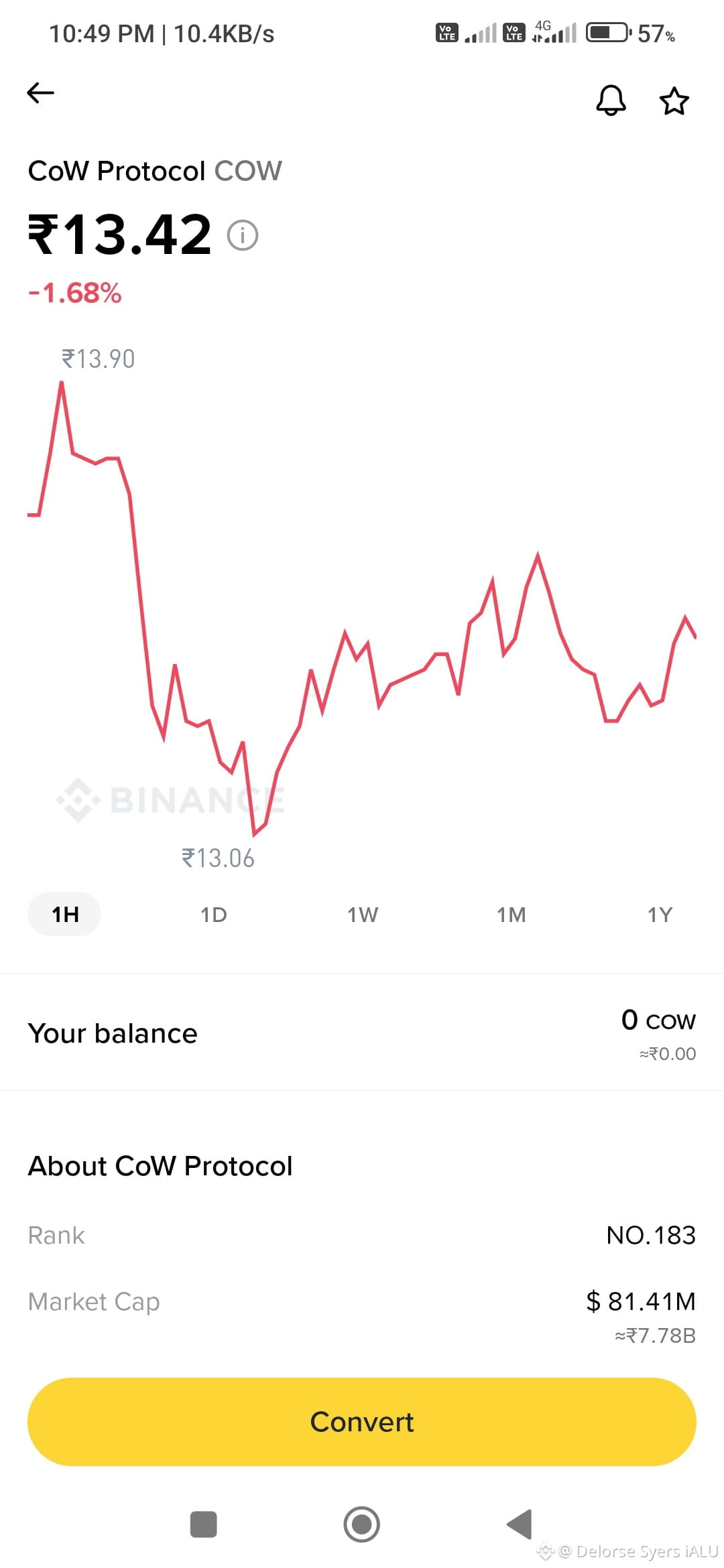
#COW Protocol is a decentralized trading protocol designed to improve DeFi swaps through MEV protection and batch auctions. It helps users find better execution prices by matching trades directly when possible, reducing unnecessary slippage and protecting traders from common MEV strategies. The COW token supports governance and ecosystem participation, making CoW Protocol an important player in decentralized, user-focused trading.
#COW #CoWProtocol #DeFi #Crypto #DEX #MEV
$COW
{future}(COWUSDT)
$COMP
{future}(COMPUSDT)
$C
{future}(CUSDT)
#COW Protocol is a decentralized trading protocol designed to improve DeFi swaps through MEV protection and batch auctions. It helps users find better execution prices by matching trades directly when possible, reducing unnecessary slippage and protecting traders from common MEV strategies. The COW token supports governance and ecosystem participation, making CoW Protocol an important player in decentralized, user-focused trading.
#COW #CoWProtocol #DeFi #Crypto #DEX #MEV
$COW
$COMP
$C
#COW #CoWProtocol #DeFi #Crypto #DEX #MEV
$COW
$COMP
$C
226

·
--
Bullish
🐮 $COW Protocol: The Quiet DeFi Play to Watch
$COW isn’t just another ticker.
CoW Protocol is focused on improving DEX trading through better execution and MEV-aware trading infrastructure.
As DeFi keeps evolving, projects solving real trading problems deserve attention. 👀
📊 COW
🔹 DeFi infrastructure
🔹 Smart trade execution
🔹 MEV-aware design
🔹 Worth keeping on the watchlist
Not financial advice. DYOR.
#COWscalp #CoWProtocol #DeFi: #Crypto #BinanceSquareBTC
🐮 $COW Protocol: The Quiet DeFi Play to Watch
$COW isn’t just another ticker.
CoW Protocol is focused on improving DEX trading through better execution and MEV-aware trading infrastructure.
As DeFi keeps evolving, projects solving real trading problems deserve attention. 👀
📊 COW
🔹 DeFi infrastructure
🔹 Smart trade execution
🔹 MEV-aware design
🔹 Worth keeping on the watchlist
Not financial advice. DYOR.
#COWscalp #CoWProtocol #DeFi: #Crypto #BinanceSquareBTC
$COW isn’t just another ticker.
CoW Protocol is focused on improving DEX trading through better execution and MEV-aware trading infrastructure.
As DeFi keeps evolving, projects solving real trading problems deserve attention. 👀
📊 COW
🔹 DeFi infrastructure
🔹 Smart trade execution
🔹 MEV-aware design
🔹 Worth keeping on the watchlist
Not financial advice. DYOR.
#COWscalp #CoWProtocol #DeFi: #Crypto #BinanceSquareBTC
2
350

·
--
🔥 $COW of hot coins… but I don't like chasing +30% and above.
The best plan for me is to wait for the price to calm down and then re-test 0.132–0.136$.
🎯 TP1: 0.148$
🎯 TP2: 0.158$
🛑 SL: 0.126$
📌 Status: watch only
⚖️ Risk: 0.5% of capital, and no leverage.
Strategy: after a strong pump, I wait for new support instead of entering under the influence of excitement.
This is not financial advice—just personal sharing and analysis.
#COW
{future}(COWUSDT)
#CoWProtocol #Altcoins #BTC
🔥 $COW of hot coins… but I don't like chasing +30% and above.
The best plan for me is to wait for the price to calm down and then re-test 0.132–0.136$.
🎯 TP1: 0.148$
🎯 TP2: 0.158$
🛑 SL: 0.126$
📌 Status: watch only
⚖️ Risk: 0.5% of capital, and no leverage.
Strategy: after a strong pump, I wait for new support instead of entering under the influence of excitement.
This is not financial advice—just personal sharing and analysis.
#COW
#CoWProtocol #Altcoins #BTC
The best plan for me is to wait for the price to calm down and then re-test 0.132–0.136$.
🎯 TP1: 0.148$
🎯 TP2: 0.158$
🛑 SL: 0.126$
📌 Status: watch only
⚖️ Risk: 0.5% of capital, and no leverage.
Strategy: after a strong pump, I wait for new support instead of entering under the influence of excitement.
This is not financial advice—just personal sharing and analysis.
#COW
#CoWProtocol #Altcoins #BTC
192

Recent on-chain data for $COW is worth watching: several large institutions are buying ETH in batches through CoW Swap, and whales are also using its MEV protection and order-matching mechanism to build positions at low cost. Its dual advantages of privacy protection and execution efficiency have helped CoW Protocol stand out in bulk trading scenarios, providing short-term support for the token price. #DeFi #CoWProtocol #MEV
Recent on-chain data for $COW is worth watching: several large institutions are buying ETH in batches through CoW Swap, and whales are also using its MEV protection and order-matching mechanism to build positions at low cost. Its dual advantages of privacy protection and execution efficiency have helped CoW Protocol stand out in bulk trading scenarios, providing short-term support for the token price. #DeFi #CoWProtocol #MEV
7
Log in to explore more content
Join global crypto users on Binance Square
⚡️ Get latest and useful information about crypto.
💬 Trusted by the world’s largest crypto exchange.
👍 Discover real insights from verified creators.
Email / Phone number
Trending Topics
1
#BitcoinClears$85200
3,900 views
127 Discussing
2
#AltcoinSeasonIndexHoldsAbove60For5Days
24,533 views
824 Discussing
3
#USADPAdds90000JobsInSeptember
9,673 views
470 Discussing
4
#USCorePCEEasesTo3%InAugust
8,022 views
389 Discussing
5
#KospiPostsWorstQuarterSince2020
6,597 views
400 Discussing
6
#SECToClarifyOnChainFundraisingRules
17,055 views
569 Discussing
7
#UKFCAOpensCryptoFirmAuthorization
18,298 views
491 Discussing
8
#JapanMOFStudyGroupOnTokenizedGovtBonds
15,600 views
392 Discussing
9
#QNTRises287%
70,072 views
829 Discussing
10
#TrumpRejectsAIRulesForVoluntaryAudits
42,695 views
731 Discussing