
BitcoinGurukul
6.7k පෝස්ටු

BitcoinGurukul
 Binance චතුරශ්ර සත්යාපිත+
වාර්තා කරන්න
පරිශීලක අවහිර කරන්න
🔶 Spot Trader 🔶 $BNB $BTC Holder 🔶 Free Crypto Updates & Signals at Binance Square Follow 👉 @BitcoinGurukul | #BitcoinGurukul

Top Voices
විවෘත වෙළෙඳාම
ඉඳහිට වෙළෙන්දා
{වේලාව} වසර
386 හඹා යමින්
70.6K+ හඹා යන්නන්
34.7K+ කැමති විය
1 ලාංජනය
පෝස්ටු
ආයෝජන කළඹ
සියල්ල
උපුටා දැක්වීම්
වීඩියෝ
සජීවි
අමුණා ඇත
🚨 Serious About Crypto? Join the Bitcoin Gurukul VIP Room 🚨
[Join Bitcoin Gurukul's VIP Chat Room](https://www.binance.com/groupList?chatId=v1.00.QzJDSWRDcnlwdEZpeGRJVjvxlwaQ49nNWWVBakKZk9Q&source=squareProfile)
Most people in crypto follow noise.
Very few follow strategy.
If you're tired of random tips, hype coins, and emotional trading, it's time to enter a space where we focus on knowledge, discipline, and real opportunities.
Welcome to Bitcoin Gurukul VIP.
Inside the VIP room, you’ll get:
• Deep market insights and macro crypto analysis
• Early narratives before they become mainstream
• High-potential altcoin research
• Educational breakdowns of Bitcoin, Web3, AI, and RWA trends
• Smart money strategies used by experienced traders and investors
• A focused community of serious crypto learners
This is not a signal group.
This is a crypto intelligence community.
If you want to grow in crypto the right way — with knowledge, patience, and strategy — you’re welcome inside.
👉👉👉 [Join Bitcoin Gurukul's VIP Chat Room](https://www.binance.com/groupList?chatId=v1.00.QzJDSWRDcnlwdEZpeGRJVjvxlwaQ49nNWWVBakKZk9Q&source=squareProfile)
Let’s build wealth with knowledge, not hype.
#Bitcoin #Crypto #Web3 #CryptoEducation #BitcoinGurukul
🚨 Serious About Crypto? Join the Bitcoin Gurukul VIP Room 🚨
Join Bitcoin Gurukul's VIP Chat Room
Most people in crypto follow noise.
Very few follow strategy.
If you're tired of random tips, hype coins, and emotional trading, it's time to enter a space where we focus on knowledge, discipline, and real opportunities.
Welcome to Bitcoin Gurukul VIP.
Inside the VIP room, you’ll get:
• Deep market insights and macro crypto analysis
• Early narratives before they become mainstream
• High-potential altcoin research
• Educational breakdowns of Bitcoin, Web3, AI, and RWA trends
• Smart money strategies used by experienced traders and investors
• A focused community of serious crypto learners
This is not a signal group.
This is a crypto intelligence community.
If you want to grow in crypto the right way — with knowledge, patience, and strategy — you’re welcome inside.
👉👉👉 Join Bitcoin Gurukul's VIP Chat Room
Let’s build wealth with knowledge, not hype.
#Bitcoin #Crypto #Web3 #CryptoEducation #BitcoinGurukul
Join Bitcoin Gurukul's VIP Chat Room
Most people in crypto follow noise.
Very few follow strategy.
If you're tired of random tips, hype coins, and emotional trading, it's time to enter a space where we focus on knowledge, discipline, and real opportunities.
Welcome to Bitcoin Gurukul VIP.
Inside the VIP room, you’ll get:
• Deep market insights and macro crypto analysis
• Early narratives before they become mainstream
• High-potential altcoin research
• Educational breakdowns of Bitcoin, Web3, AI, and RWA trends
• Smart money strategies used by experienced traders and investors
• A focused community of serious crypto learners
This is not a signal group.
This is a crypto intelligence community.
If you want to grow in crypto the right way — with knowledge, patience, and strategy — you’re welcome inside.
👉👉👉 Join Bitcoin Gurukul's VIP Chat Room
Let’s build wealth with knowledge, not hype.
#Bitcoin #Crypto #Web3 #CryptoEducation #BitcoinGurukul
4
7
117
ලිපිය
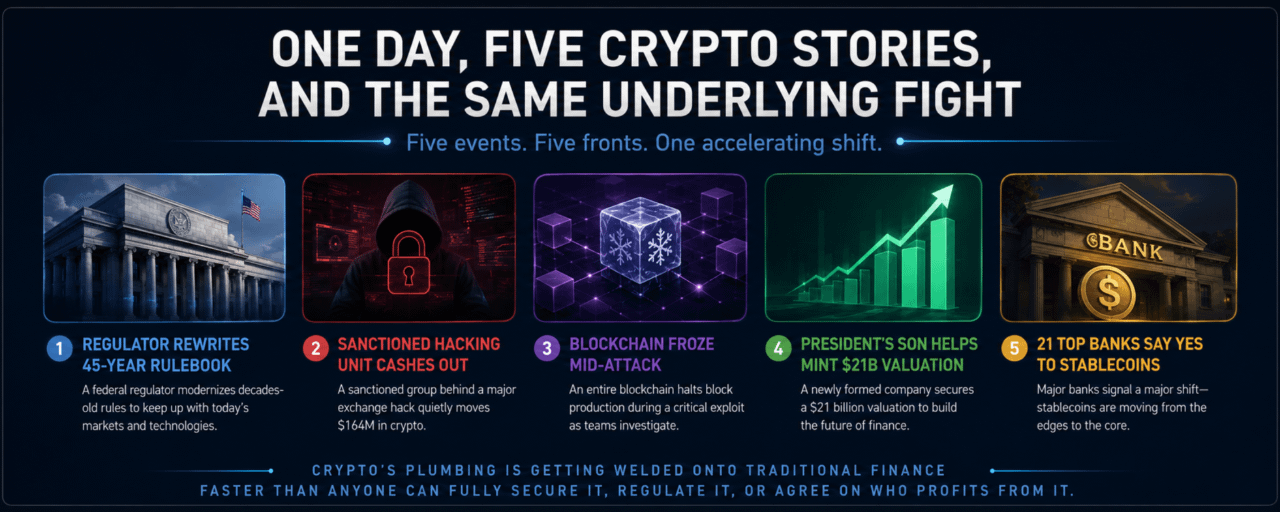
One Day, Five Crypto Stories, and the Same Underlying FightA federal regulator rewrote a 45-year-old rulebook. A sanctioned hacking unit kept quietly cashing out. An entire blockchain froze mid-attack. A president's son helped mint a $21 billion valuation. And 21 of the largest banks on earth admitted they can no longer ignore stablecoins.
That's not a week of crypto news. That's September 1 and 2, 2026.
Taken one at a time, these are five separate stories with five separate headlines. Taken together, they're the same fight playing out on five different fronts: crypto's plumbing is getting welded onto the traditional financial system faster than anyone can fully secure it, regulate it, or agree on who's allowed to profit from it.
Here's what happened, and what each one actually changes.
The SEC finally said the word "blockchain" in a rulebook from the disco era
Transfer agents are the unglamorous firms that keep the official record of who owns what security — the paperwork equivalent of a land registry. Their governing rules hadn't been meaningfully touched since the late 1970s and early 1980s. On September 1, the SEC proposed to fix that.
What is the SEC's transfer agent proposal, exactly? It's an update to registration, recordkeeping, and processing requirements for the roughly 273 registered transfer agents in the US — one that explicitly names blockchain technology as something the modern framework needs to account for.
The details are dry but consequential. Registration timelines stretch from 30 to 45 days. The threshold that triggers restrictions on a transfer agent's growth jumps from 75% to 95%. Scattered recordkeeping rules get folded into a single retention period. Notably, the SEC isn't inventing a new category for "blockchain transfer agents" — it's threading references to distributed ledgers into the rules that already exist. Chairman Paul Atkins framed it as catching the rulebook up to how the job is actually done today. The proposal is open for public comment for 60 days before anything is finalized.
Why does a bureaucratic update matter more than it sounds? Because tokenized securities can't scale past pilot programs in the US until the legal machinery that records ownership is built to recognize an on-chain entry as real. This is the SEC quietly clearing that runway.
While regulators write rules, Lazarus Group is still cashing out
Not every actor in this story is playing by any rulebook at all. North Korea's Lazarus Group — the outfit blamed for the record $1.4 billion Bybit theft in 2025 — has moved more than $30 million through Hyperliquid's HyperUnit product over the past three weeks, according to on-chain tracking by Arkham researcher Emmett Gallic.
The route is deliberately messy: Bitcoin sold and swapped into Ether and Solana, bridged across Tron, Solana, and Ethereum, then deposited into exchanges including KuCoin, LBank, and Kraken. Four tracked outflows between July 30 and August 28 add up to more than $52 million from the wider wallet cluster; the $30 million figure specifically covers what passed through Hyperliquid.
No evidence suggests Hyperliquid itself was hacked, and the exchange hasn't said publicly whether it acted on the flagged wallets. What makes the timing awkward is that this is happening while Hyperliquid pursues a US-regulated foothold through Bitnomial, ongoing CFTC conversations, and reported talks with Kraken's parent company, Payward, about a possible American entry.
Sanctioned money moving cleanly through a platform that's simultaneously lobbying for US legitimacy is not a good look — and it's exactly the kind of evidence regulators tend to remember.
A price glitch, then a whole blockchain went dark
On August 30, Cronos — the Crypto.com-affiliated chain — didn't just get hacked. It stopped entirely. Validators halted block production after an attacker manipulated TONIC, the thinly traded governance token of lending protocol Tectonic.
Onchain researcher Weilin Li traced the mechanics: TONIC's price spiked roughly 100-fold in about 20 minutes, and the attacker deposited the now-inflated token as collateral to borrow real assets from Tectonic's pools — the same style of attack that drained Mango Markets in 2022. Tectonic's total value locked went from about $121.7 million to roughly $3 million in a day. The chain-wide freeze trapped an estimated $60 million on Cronos before it could move; only about $6 million made it to Ethereum first.
Crypto.com CEO Kris Marszalek said the exchange and app were untouched and customer funds there stayed safe throughout. As of the latest updates, neither Cronos nor Tectonic had announced a restart date, a recovery plan, or whether the attacker's remaining wallets would be frozen.
Stopping an entire network to contain one protocol's exploit is a sledgehammer solution — it also freezes every legitimate transaction on the chain. It worked, in that most of the money never left. But it's a reminder that "decentralized" and "impossible to pause" are not the same thing, and Cronos just proved which one it actually is.
Trump Jr.'s venture firm just helped price Polymarket at $21 billion
1789 Capital, the firm Donald Trump Jr. co-founded, is leading a $1 billion round for Polymarket that values the prediction market at $21 billion — a 40% jump from the roughly $15 billion valuation it held just months earlier, in April.
The firm is adding about $300 million on top of the roughly $200 million it had already put in, pushing its total stake toward $500 million once the round closes. Intercontinental Exchange, the parent of the New York Stock Exchange, still holds the largest single stake in Polymarket at around 22%. The new number puts Polymarket right behind rival Kalshi, which closed its own $1 billion round in May at a $22 billion valuation and is reportedly already fielding talks for another raise as high as $40 billion.
Trump Jr. advises both Polymarket and Kalshi at once — a dual role he's described as separate from his position as a private citizen with no formal role in his father's administration.
Two years ago, prediction markets were a regulatory gray zone most institutions avoided. Now they're a two-company race worth tens of billions, backed by a White House that has actively supported the industry and pushed back on states trying to restrict it. The money and the politics here aren't running in parallel — they're the same track.
Kalshi's first-ever lifetime ban has a familiar name attached
On September 1, Kalshi issued the first permanent ban in its history — to former Congressman George Santos. The company's compliance team said it had "reasonable cause" to believe Santos traded on inside knowledge of an event he himself controlled: whether he would attend President Trump's State of the Union address in February.
Because Santos could decide the outcome simply by showing up, Kalshi's own rules barred him from trading that market. He traded anyway, the company says, and made public statements aimed at moving the price — walking away with roughly $17,839 in profit. Kalshi fined him $71,356 and said the penalty escalated to a lifetime ban specifically because he refused to cooperate with the investigation. In July, Santos had separately agreed to pay $35,000 to settle a related Commodity Futures Trading Commission case, which also handed him a three-year trading ban.
Santos called the decision "frivolous nonsense" online. In the same enforcement sweep, Kalshi handed a three-year suspension to a North Carolina congressional candidate who admitted to betting roughly $1,000 on her own election.
Prediction markets are creating a new flavor of insider trading — one where the "inside information" is just a decision you're about to make yourself. Santos's ban is Kalshi drawing that line in public, with real teeth behind it.
Twenty-one banks decided a shared stablecoin beats no stablecoin
Goldman Sachs, Bank of America, Citi, Wells Fargo, and 17 other major financial institutions confirmed plans to form a jointly owned company in the second half of 2026 to issue a US dollar stablecoin, targeting launch in the first half of 2027.
The group has nearly doubled since it started as a 10-bank exploratory effort in October 2025. It now spans North America, Europe, East Asia, the Middle East, and Africa, and includes Goldman, Citi, Bank of America, Wells Fargo, Deutsche Bank, UBS, Santander, Fidelity Investments, and MUFG Bank, among others. A euro-denominated token is next on the roadmap after the dollar version, with other G7 currencies to follow. The first use case is cross-border business payments; retail access could come later in some regions.
A lot is still unsettled — the company's name, the token's name, which chains it will run on, who custodies the reserves, and final redemption terms are all undecided. The group says it intends to comply with both the emerging US stablecoin framework and the EU's Markets in Crypto-Assets regulation.
Banks spent years treating stablecoins as a threat to be regulated away. Now 21 of the biggest ones are building one together, which is usually a sign they've stopped believing regulation alone will make the threat disappear.
Zoom out
Put the five stories in a line and a pattern shows up fast. Regulators are rewriting rules that predate the internet to make room for blockchain. Sanctioned hackers are still finding seams in permissionless platforms. One manipulated token can freeze a whole network. Political capital and venture capital are now the same capital in prediction markets. And the banks that spent a decade dismissing crypto are now racing to build their own version of it before someone else locks in the market.
None of this is really about the dollar figures — $30 million, $75 million, $1 billion, 21 banks. It's about where the line between "crypto" and "the financial system" actually sits now. On September 2, 2026, that line moved in five different places at once.
FAQ
What is the SEC's transfer agent rule proposal about? It's a plan to modernize decades-old rules governing the firms that keep official securities ownership records, explicitly making room for blockchain-based recordkeeping and share transfers. It's open for public comment for 60 days before any final rule takes effect.
How much money has the Lazarus Group moved through Hyperliquid? On-chain researchers tracked more than $30 million in Bitcoin, later converted to Ether and Solana, moving from Lazarus-linked wallets through Hyperliquid's HyperUnit product over roughly three weeks, ending August 31, 2026.
Why did Cronos halt its entire blockchain? An attacker manipulated the price of Tectonic's TONIC token roughly 100-fold in 20 minutes, then used the inflated tokens as collateral to borrow real assets from the lending protocol. Validators froze the chain to stop more funds from leaving, trapping an estimated $60 million onchain.
#CryptoNews #SEC #Hyperliquid #Cronos #Stablecoin #PredictionMarkets
One Day, Five Crypto Stories, and the Same Underlying Fight
A federal regulator rewrote a 45-year-old rulebook. A sanctioned hacking unit kept quietly cashing out. An entire blockchain froze mid-attack. A president's son helped mint a $21 billion valuation. And 21 of the largest banks on earth admitted they can no longer ignore stablecoins.
That's not a week of crypto news. That's September 1 and 2, 2026.
Taken one at a time, these are five separate stories with five separate headlines. Taken together, they're the same fight playing out on five different fronts: crypto's plumbing is getting welded onto the traditional financial system faster than anyone can fully secure it, regulate it, or agree on who's allowed to profit from it.
Here's what happened, and what each one actually changes.
The SEC finally said the word "blockchain" in a rulebook from the disco era
Transfer agents are the unglamorous firms that keep the official record of who owns what security — the paperwork equivalent of a land registry. Their governing rules hadn't been meaningfully touched since the late 1970s and early 1980s. On September 1, the SEC proposed to fix that.
What is the SEC's transfer agent proposal, exactly? It's an update to registration, recordkeeping, and processing requirements for the roughly 273 registered transfer agents in the US — one that explicitly names blockchain technology as something the modern framework needs to account for.
The details are dry but consequential. Registration timelines stretch from 30 to 45 days. The threshold that triggers restrictions on a transfer agent's growth jumps from 75% to 95%. Scattered recordkeeping rules get folded into a single retention period. Notably, the SEC isn't inventing a new category for "blockchain transfer agents" — it's threading references to distributed ledgers into the rules that already exist. Chairman Paul Atkins framed it as catching the rulebook up to how the job is actually done today. The proposal is open for public comment for 60 days before anything is finalized.
Why does a bureaucratic update matter more than it sounds? Because tokenized securities can't scale past pilot programs in the US until the legal machinery that records ownership is built to recognize an on-chain entry as real. This is the SEC quietly clearing that runway.
While regulators write rules, Lazarus Group is still cashing out
Not every actor in this story is playing by any rulebook at all. North Korea's Lazarus Group — the outfit blamed for the record $1.4 billion Bybit theft in 2025 — has moved more than $30 million through Hyperliquid's HyperUnit product over the past three weeks, according to on-chain tracking by Arkham researcher Emmett Gallic.
The route is deliberately messy: Bitcoin sold and swapped into Ether and Solana, bridged across Tron, Solana, and Ethereum, then deposited into exchanges including KuCoin, LBank, and Kraken. Four tracked outflows between July 30 and August 28 add up to more than $52 million from the wider wallet cluster; the $30 million figure specifically covers what passed through Hyperliquid.
No evidence suggests Hyperliquid itself was hacked, and the exchange hasn't said publicly whether it acted on the flagged wallets. What makes the timing awkward is that this is happening while Hyperliquid pursues a US-regulated foothold through Bitnomial, ongoing CFTC conversations, and reported talks with Kraken's parent company, Payward, about a possible American entry.
Sanctioned money moving cleanly through a platform that's simultaneously lobbying for US legitimacy is not a good look — and it's exactly the kind of evidence regulators tend to remember.
A price glitch, then a whole blockchain went dark
On August 30, Cronos — the Crypto.com-affiliated chain — didn't just get hacked. It stopped entirely. Validators halted block production after an attacker manipulated TONIC, the thinly traded governance token of lending protocol Tectonic.
Onchain researcher Weilin Li traced the mechanics: TONIC's price spiked roughly 100-fold in about 20 minutes, and the attacker deposited the now-inflated token as collateral to borrow real assets from Tectonic's pools — the same style of attack that drained Mango Markets in 2022. Tectonic's total value locked went from about $121.7 million to roughly $3 million in a day. The chain-wide freeze trapped an estimated $60 million on Cronos before it could move; only about $6 million made it to Ethereum first.
Crypto.com CEO Kris Marszalek said the exchange and app were untouched and customer funds there stayed safe throughout. As of the latest updates, neither Cronos nor Tectonic had announced a restart date, a recovery plan, or whether the attacker's remaining wallets would be frozen.
Stopping an entire network to contain one protocol's exploit is a sledgehammer solution — it also freezes every legitimate transaction on the chain. It worked, in that most of the money never left. But it's a reminder that "decentralized" and "impossible to pause" are not the same thing, and Cronos just proved which one it actually is.
Trump Jr.'s venture firm just helped price Polymarket at $21 billion
1789 Capital, the firm Donald Trump Jr. co-founded, is leading a $1 billion round for Polymarket that values the prediction market at $21 billion — a 40% jump from the roughly $15 billion valuation it held just months earlier, in April.
The firm is adding about $300 million on top of the roughly $200 million it had already put in, pushing its total stake toward $500 million once the round closes. Intercontinental Exchange, the parent of the New York Stock Exchange, still holds the largest single stake in Polymarket at around 22%. The new number puts Polymarket right behind rival Kalshi, which closed its own $1 billion round in May at a $22 billion valuation and is reportedly already fielding talks for another raise as high as $40 billion.
Trump Jr. advises both Polymarket and Kalshi at once — a dual role he's described as separate from his position as a private citizen with no formal role in his father's administration.
Two years ago, prediction markets were a regulatory gray zone most institutions avoided. Now they're a two-company race worth tens of billions, backed by a White House that has actively supported the industry and pushed back on states trying to restrict it. The money and the politics here aren't running in parallel — they're the same track.
Kalshi's first-ever lifetime ban has a familiar name attached
On September 1, Kalshi issued the first permanent ban in its history — to former Congressman George Santos. The company's compliance team said it had "reasonable cause" to believe Santos traded on inside knowledge of an event he himself controlled: whether he would attend President Trump's State of the Union address in February.
Because Santos could decide the outcome simply by showing up, Kalshi's own rules barred him from trading that market. He traded anyway, the company says, and made public statements aimed at moving the price — walking away with roughly $17,839 in profit. Kalshi fined him $71,356 and said the penalty escalated to a lifetime ban specifically because he refused to cooperate with the investigation. In July, Santos had separately agreed to pay $35,000 to settle a related Commodity Futures Trading Commission case, which also handed him a three-year trading ban.
Santos called the decision "frivolous nonsense" online. In the same enforcement sweep, Kalshi handed a three-year suspension to a North Carolina congressional candidate who admitted to betting roughly $1,000 on her own election.
Prediction markets are creating a new flavor of insider trading — one where the "inside information" is just a decision you're about to make yourself. Santos's ban is Kalshi drawing that line in public, with real teeth behind it.
Twenty-one banks decided a shared stablecoin beats no stablecoin
Goldman Sachs, Bank of America, Citi, Wells Fargo, and 17 other major financial institutions confirmed plans to form a jointly owned company in the second half of 2026 to issue a US dollar stablecoin, targeting launch in the first half of 2027.
The group has nearly doubled since it started as a 10-bank exploratory effort in October 2025. It now spans North America, Europe, East Asia, the Middle East, and Africa, and includes Goldman, Citi, Bank of America, Wells Fargo, Deutsche Bank, UBS, Santander, Fidelity Investments, and MUFG Bank, among others. A euro-denominated token is next on the roadmap after the dollar version, with other G7 currencies to follow. The first use case is cross-border business payments; retail access could come later in some regions.
A lot is still unsettled — the company's name, the token's name, which chains it will run on, who custodies the reserves, and final redemption terms are all undecided. The group says it intends to comply with both the emerging US stablecoin framework and the EU's Markets in Crypto-Assets regulation.
Banks spent years treating stablecoins as a threat to be regulated away. Now 21 of the biggest ones are building one together, which is usually a sign they've stopped believing regulation alone will make the threat disappear.
Zoom out
Put the five stories in a line and a pattern shows up fast. Regulators are rewriting rules that predate the internet to make room for blockchain. Sanctioned hackers are still finding seams in permissionless platforms. One manipulated token can freeze a whole network. Political capital and venture capital are now the same capital in prediction markets. And the banks that spent a decade dismissing crypto are now racing to build their own version of it before someone else locks in the market.
None of this is really about the dollar figures — $30 million, $75 million, $1 billion, 21 banks. It's about where the line between "crypto" and "the financial system" actually sits now. On September 2, 2026, that line moved in five different places at once.
FAQ
What is the SEC's transfer agent rule proposal about? It's a plan to modernize decades-old rules governing the firms that keep official securities ownership records, explicitly making room for blockchain-based recordkeeping and share transfers. It's open for public comment for 60 days before any final rule takes effect.
How much money has the Lazarus Group moved through Hyperliquid? On-chain researchers tracked more than $30 million in Bitcoin, later converted to Ether and Solana, moving from Lazarus-linked wallets through Hyperliquid's HyperUnit product over roughly three weeks, ending August 31, 2026.
Why did Cronos halt its entire blockchain? An attacker manipulated the price of Tectonic's TONIC token roughly 100-fold in 20 minutes, then used the inflated tokens as collateral to borrow real assets from the lending protocol. Validators froze the chain to stop more funds from leaving, trapping an estimated $60 million onchain.
#CryptoNews #SEC #Hyperliquid #Cronos #Stablecoin #PredictionMarkets
That's not a week of crypto news. That's September 1 and 2, 2026.
Taken one at a time, these are five separate stories with five separate headlines. Taken together, they're the same fight playing out on five different fronts: crypto's plumbing is getting welded onto the traditional financial system faster than anyone can fully secure it, regulate it, or agree on who's allowed to profit from it.
Here's what happened, and what each one actually changes.
The SEC finally said the word "blockchain" in a rulebook from the disco era
Transfer agents are the unglamorous firms that keep the official record of who owns what security — the paperwork equivalent of a land registry. Their governing rules hadn't been meaningfully touched since the late 1970s and early 1980s. On September 1, the SEC proposed to fix that.
What is the SEC's transfer agent proposal, exactly? It's an update to registration, recordkeeping, and processing requirements for the roughly 273 registered transfer agents in the US — one that explicitly names blockchain technology as something the modern framework needs to account for.
The details are dry but consequential. Registration timelines stretch from 30 to 45 days. The threshold that triggers restrictions on a transfer agent's growth jumps from 75% to 95%. Scattered recordkeeping rules get folded into a single retention period. Notably, the SEC isn't inventing a new category for "blockchain transfer agents" — it's threading references to distributed ledgers into the rules that already exist. Chairman Paul Atkins framed it as catching the rulebook up to how the job is actually done today. The proposal is open for public comment for 60 days before anything is finalized.
Why does a bureaucratic update matter more than it sounds? Because tokenized securities can't scale past pilot programs in the US until the legal machinery that records ownership is built to recognize an on-chain entry as real. This is the SEC quietly clearing that runway.
While regulators write rules, Lazarus Group is still cashing out
Not every actor in this story is playing by any rulebook at all. North Korea's Lazarus Group — the outfit blamed for the record $1.4 billion Bybit theft in 2025 — has moved more than $30 million through Hyperliquid's HyperUnit product over the past three weeks, according to on-chain tracking by Arkham researcher Emmett Gallic.
The route is deliberately messy: Bitcoin sold and swapped into Ether and Solana, bridged across Tron, Solana, and Ethereum, then deposited into exchanges including KuCoin, LBank, and Kraken. Four tracked outflows between July 30 and August 28 add up to more than $52 million from the wider wallet cluster; the $30 million figure specifically covers what passed through Hyperliquid.
No evidence suggests Hyperliquid itself was hacked, and the exchange hasn't said publicly whether it acted on the flagged wallets. What makes the timing awkward is that this is happening while Hyperliquid pursues a US-regulated foothold through Bitnomial, ongoing CFTC conversations, and reported talks with Kraken's parent company, Payward, about a possible American entry.
Sanctioned money moving cleanly through a platform that's simultaneously lobbying for US legitimacy is not a good look — and it's exactly the kind of evidence regulators tend to remember.
A price glitch, then a whole blockchain went dark
On August 30, Cronos — the Crypto.com-affiliated chain — didn't just get hacked. It stopped entirely. Validators halted block production after an attacker manipulated TONIC, the thinly traded governance token of lending protocol Tectonic.
Onchain researcher Weilin Li traced the mechanics: TONIC's price spiked roughly 100-fold in about 20 minutes, and the attacker deposited the now-inflated token as collateral to borrow real assets from Tectonic's pools — the same style of attack that drained Mango Markets in 2022. Tectonic's total value locked went from about $121.7 million to roughly $3 million in a day. The chain-wide freeze trapped an estimated $60 million on Cronos before it could move; only about $6 million made it to Ethereum first.
Crypto.com CEO Kris Marszalek said the exchange and app were untouched and customer funds there stayed safe throughout. As of the latest updates, neither Cronos nor Tectonic had announced a restart date, a recovery plan, or whether the attacker's remaining wallets would be frozen.
Stopping an entire network to contain one protocol's exploit is a sledgehammer solution — it also freezes every legitimate transaction on the chain. It worked, in that most of the money never left. But it's a reminder that "decentralized" and "impossible to pause" are not the same thing, and Cronos just proved which one it actually is.
Trump Jr.'s venture firm just helped price Polymarket at $21 billion
1789 Capital, the firm Donald Trump Jr. co-founded, is leading a $1 billion round for Polymarket that values the prediction market at $21 billion — a 40% jump from the roughly $15 billion valuation it held just months earlier, in April.
The firm is adding about $300 million on top of the roughly $200 million it had already put in, pushing its total stake toward $500 million once the round closes. Intercontinental Exchange, the parent of the New York Stock Exchange, still holds the largest single stake in Polymarket at around 22%. The new number puts Polymarket right behind rival Kalshi, which closed its own $1 billion round in May at a $22 billion valuation and is reportedly already fielding talks for another raise as high as $40 billion.
Trump Jr. advises both Polymarket and Kalshi at once — a dual role he's described as separate from his position as a private citizen with no formal role in his father's administration.
Two years ago, prediction markets were a regulatory gray zone most institutions avoided. Now they're a two-company race worth tens of billions, backed by a White House that has actively supported the industry and pushed back on states trying to restrict it. The money and the politics here aren't running in parallel — they're the same track.
Kalshi's first-ever lifetime ban has a familiar name attached
On September 1, Kalshi issued the first permanent ban in its history — to former Congressman George Santos. The company's compliance team said it had "reasonable cause" to believe Santos traded on inside knowledge of an event he himself controlled: whether he would attend President Trump's State of the Union address in February.
Because Santos could decide the outcome simply by showing up, Kalshi's own rules barred him from trading that market. He traded anyway, the company says, and made public statements aimed at moving the price — walking away with roughly $17,839 in profit. Kalshi fined him $71,356 and said the penalty escalated to a lifetime ban specifically because he refused to cooperate with the investigation. In July, Santos had separately agreed to pay $35,000 to settle a related Commodity Futures Trading Commission case, which also handed him a three-year trading ban.
Santos called the decision "frivolous nonsense" online. In the same enforcement sweep, Kalshi handed a three-year suspension to a North Carolina congressional candidate who admitted to betting roughly $1,000 on her own election.
Prediction markets are creating a new flavor of insider trading — one where the "inside information" is just a decision you're about to make yourself. Santos's ban is Kalshi drawing that line in public, with real teeth behind it.
Twenty-one banks decided a shared stablecoin beats no stablecoin
Goldman Sachs, Bank of America, Citi, Wells Fargo, and 17 other major financial institutions confirmed plans to form a jointly owned company in the second half of 2026 to issue a US dollar stablecoin, targeting launch in the first half of 2027.
The group has nearly doubled since it started as a 10-bank exploratory effort in October 2025. It now spans North America, Europe, East Asia, the Middle East, and Africa, and includes Goldman, Citi, Bank of America, Wells Fargo, Deutsche Bank, UBS, Santander, Fidelity Investments, and MUFG Bank, among others. A euro-denominated token is next on the roadmap after the dollar version, with other G7 currencies to follow. The first use case is cross-border business payments; retail access could come later in some regions.
A lot is still unsettled — the company's name, the token's name, which chains it will run on, who custodies the reserves, and final redemption terms are all undecided. The group says it intends to comply with both the emerging US stablecoin framework and the EU's Markets in Crypto-Assets regulation.
Banks spent years treating stablecoins as a threat to be regulated away. Now 21 of the biggest ones are building one together, which is usually a sign they've stopped believing regulation alone will make the threat disappear.
Zoom out
Put the five stories in a line and a pattern shows up fast. Regulators are rewriting rules that predate the internet to make room for blockchain. Sanctioned hackers are still finding seams in permissionless platforms. One manipulated token can freeze a whole network. Political capital and venture capital are now the same capital in prediction markets. And the banks that spent a decade dismissing crypto are now racing to build their own version of it before someone else locks in the market.
None of this is really about the dollar figures — $30 million, $75 million, $1 billion, 21 banks. It's about where the line between "crypto" and "the financial system" actually sits now. On September 2, 2026, that line moved in five different places at once.
FAQ
What is the SEC's transfer agent rule proposal about? It's a plan to modernize decades-old rules governing the firms that keep official securities ownership records, explicitly making room for blockchain-based recordkeeping and share transfers. It's open for public comment for 60 days before any final rule takes effect.
How much money has the Lazarus Group moved through Hyperliquid? On-chain researchers tracked more than $30 million in Bitcoin, later converted to Ether and Solana, moving from Lazarus-linked wallets through Hyperliquid's HyperUnit product over roughly three weeks, ending August 31, 2026.
Why did Cronos halt its entire blockchain? An attacker manipulated the price of Tectonic's TONIC token roughly 100-fold in 20 minutes, then used the inflated tokens as collateral to borrow real assets from the lending protocol. Validators froze the chain to stop more funds from leaving, trapping an estimated $60 million onchain.
#CryptoNews #SEC #Hyperliquid #Cronos #Stablecoin #PredictionMarkets
1
306
ලිපිය
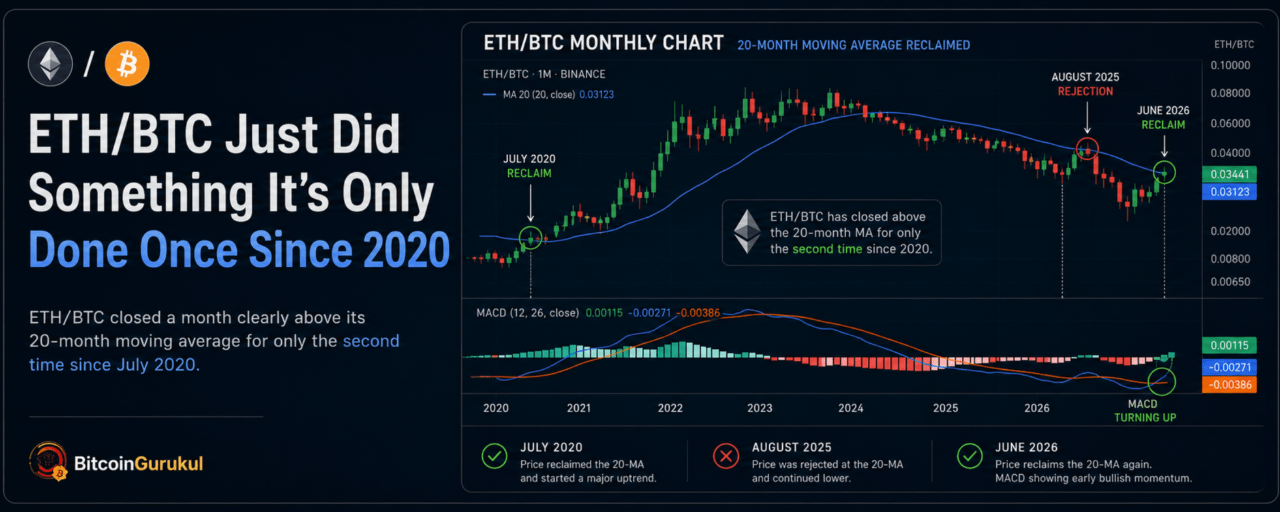
ETH/BTC Just Did Something It's Only Done Once Since 2020Six years. That's roughly how long it's been since ETH/BTC closed a month cleanly above its 20-month moving average. It happened once, in July 2020. The ratio went from 0.0315 to 0.088, ETH ran from $225 to $4,372, and an entire generation of traders learned what an altcoin season actually looks like.
It just happened again.
Why the ETH/BTC Ratio Is the Chart That Matters Here
Dollar prices lie to you, a little. When ETH goes up 20% and BTC goes up 22%, ETH "did well" but Ethereum still lost ground. The ETH/BTC ratio cuts through that noise. It answers one question only: is money rotating into Ethereum, or out of it, relative to Bitcoin?
Rising ratio, capital moving toward ETH — and usually, toward the rest of the altcoin market that follows Ethereum's lead. Falling ratio, Bitcoin absorbing the relative strength while everything else treads water in BTC terms even if it's green in dollars. This is the chart that tells you which regime you're actually in.
The Setup: One Reclaim, One Fake-Out, One More Try
The 20-month moving average has only mattered twice before now.
July 2020. ETH/BTC broke above it and stayed there. What followed is crypto folklore at this point — a run that turned a few thousand dollars of ETH into a down payment on a house.
August 2025. The ratio tagged the same line, poked its head above, and got pulled back under. Price rolled over toward the lows within weeks. Anyone who bought the reclaim got a lesson in the difference between touching a level and holding it.
Now. ETH/BTC is back on the average, closing the month above it for only the second time in this entire stretch.
That history is the whole reason this matters more than a routine bounce. A tag and a reclaim look identical on the first candle. They only stop looking identical a month or two later, once price either builds on the level or gets rejected off it again.
MACD Is Telling a Similar Story
Layer the monthly MACD on top and the picture gets more interesting. It's curling up out of a low reading — the same general zone it was sitting in right before the 2020 move started.
Worth being honest about what that is and isn't. It's a momentum signal, not a crystal ball. Two setups can look alike on an indicator and still resolve completely differently, especially five years apart, in a market with different players, different liquidity, and a regulatory environment that didn't exist the first time around. Similar doesn't mean identical.
If It Holds: 0.050, Then 0.088
Two levels are on the table if ETH/BTC keeps its footing above the MA20.
0.050 — the first real test.0.088 — the old cycle high, and the stretch target if the analog plays out.
Treat these as what they are: a chart-based projection, not a promise. They mark where the ratio could go if this setup resolves the way the last one did. They don't tell you it will.
The Macro Backdrop Nobody's Ignoring
There's a second thread running under all of this. August's ISM Manufacturing PMI printed 54.6, missing the 55.2 economists expected and stepping down from July's 55.6 — itself the strongest reading since May 2022. Still expansion, still growth. Just less of it.
That's the kind of number markets read as "cooling, not cracking." Growth intact enough that nobody panics, soft enough to give the Fed room to ease off rates instead of holding firm. And rate expectations loosening tends to be the tailwind that pushes capital further out the risk curve — out of cash and into Bitcoin, and from Bitcoin into everything sitting behind it, Ethereum included.
Nothing here guarantees ETH specifically benefits. But the macro mood and the chart setup are, for once, pointing the same direction.
What Actually Confirms This
One green monthly candle proves very little on its own. Three things worth watching before anyone calls this a trend:
Does the reclaim hold for another month or two, or does it fail the way August 2025 did?Does MACD keep climbing, or does it stall out well short of where it got to in 2020?Does the "slowing but not stalling" macro story keep holding up, or does the next data print break the pattern?
So, Is This the Setup?
Maybe. That's the honest answer. What's true is that ETH/BTC has spent most of the last six years failing to hold this exact level, and it's now sitting above it with a momentum indicator that's echoing the last time this actually worked. What's also true is that it already faked everyone out once, twelve months ago, at this exact spot.
The chart doesn't know which time it is yet. The next couple of monthly closes will.
FAQ
What does it mean when ETH/BTC is above its 20-month moving average? It means Ethereum's price relative to Bitcoin has closed a monthly candle above a long-term trend line calculated from the past 20 months of price data. Historically, sustained closes above this level have coincided with periods of Ethereum outperforming Bitcoin.
Is a MA20 reclaim a guaranteed bullish signal? No. Reclaims can fail, as happened in August 2025 when ETH/BTC tagged the average but didn't hold it. Confirmation typically requires multiple monthly closes above the level, not just one.
How does the ISM Manufacturing PMI relate to crypto prices? The ISM PMI is a broad indicator of U.S. economic growth. Weaker-than-expected but still-expansionary readings can suggest the Federal Reserve has more flexibility to hold or cut interest rates, which tends to be viewed as supportive for risk assets, including crypto.
#ETHBTC #Ethereum #Bitcoin #CryptoTrading #AltcoinSeason
ETH/BTC Just Did Something It's Only Done Once Since 2020
Six years. That's roughly how long it's been since ETH/BTC closed a month cleanly above its 20-month moving average. It happened once, in July 2020. The ratio went from 0.0315 to 0.088, ETH ran from $225 to $4,372, and an entire generation of traders learned what an altcoin season actually looks like.
It just happened again.
Why the ETH/BTC Ratio Is the Chart That Matters Here
Dollar prices lie to you, a little. When ETH goes up 20% and BTC goes up 22%, ETH "did well" but Ethereum still lost ground. The ETH/BTC ratio cuts through that noise. It answers one question only: is money rotating into Ethereum, or out of it, relative to Bitcoin?
Rising ratio, capital moving toward ETH — and usually, toward the rest of the altcoin market that follows Ethereum's lead. Falling ratio, Bitcoin absorbing the relative strength while everything else treads water in BTC terms even if it's green in dollars. This is the chart that tells you which regime you're actually in.
The Setup: One Reclaim, One Fake-Out, One More Try
The 20-month moving average has only mattered twice before now.
July 2020. ETH/BTC broke above it and stayed there. What followed is crypto folklore at this point — a run that turned a few thousand dollars of ETH into a down payment on a house.
August 2025. The ratio tagged the same line, poked its head above, and got pulled back under. Price rolled over toward the lows within weeks. Anyone who bought the reclaim got a lesson in the difference between touching a level and holding it.
Now. ETH/BTC is back on the average, closing the month above it for only the second time in this entire stretch.
That history is the whole reason this matters more than a routine bounce. A tag and a reclaim look identical on the first candle. They only stop looking identical a month or two later, once price either builds on the level or gets rejected off it again.
MACD Is Telling a Similar Story
Layer the monthly MACD on top and the picture gets more interesting. It's curling up out of a low reading — the same general zone it was sitting in right before the 2020 move started.
Worth being honest about what that is and isn't. It's a momentum signal, not a crystal ball. Two setups can look alike on an indicator and still resolve completely differently, especially five years apart, in a market with different players, different liquidity, and a regulatory environment that didn't exist the first time around. Similar doesn't mean identical.
If It Holds: 0.050, Then 0.088
Two levels are on the table if ETH/BTC keeps its footing above the MA20.
0.050 — the first real test.0.088 — the old cycle high, and the stretch target if the analog plays out.
Treat these as what they are: a chart-based projection, not a promise. They mark where the ratio could go if this setup resolves the way the last one did. They don't tell you it will.
The Macro Backdrop Nobody's Ignoring
There's a second thread running under all of this. August's ISM Manufacturing PMI printed 54.6, missing the 55.2 economists expected and stepping down from July's 55.6 — itself the strongest reading since May 2022. Still expansion, still growth. Just less of it.
That's the kind of number markets read as "cooling, not cracking." Growth intact enough that nobody panics, soft enough to give the Fed room to ease off rates instead of holding firm. And rate expectations loosening tends to be the tailwind that pushes capital further out the risk curve — out of cash and into Bitcoin, and from Bitcoin into everything sitting behind it, Ethereum included.
Nothing here guarantees ETH specifically benefits. But the macro mood and the chart setup are, for once, pointing the same direction.
What Actually Confirms This
One green monthly candle proves very little on its own. Three things worth watching before anyone calls this a trend:
Does the reclaim hold for another month or two, or does it fail the way August 2025 did?Does MACD keep climbing, or does it stall out well short of where it got to in 2020?Does the "slowing but not stalling" macro story keep holding up, or does the next data print break the pattern?
So, Is This the Setup?
Maybe. That's the honest answer. What's true is that ETH/BTC has spent most of the last six years failing to hold this exact level, and it's now sitting above it with a momentum indicator that's echoing the last time this actually worked. What's also true is that it already faked everyone out once, twelve months ago, at this exact spot.
The chart doesn't know which time it is yet. The next couple of monthly closes will.
FAQ
What does it mean when ETH/BTC is above its 20-month moving average? It means Ethereum's price relative to Bitcoin has closed a monthly candle above a long-term trend line calculated from the past 20 months of price data. Historically, sustained closes above this level have coincided with periods of Ethereum outperforming Bitcoin.
Is a MA20 reclaim a guaranteed bullish signal? No. Reclaims can fail, as happened in August 2025 when ETH/BTC tagged the average but didn't hold it. Confirmation typically requires multiple monthly closes above the level, not just one.
How does the ISM Manufacturing PMI relate to crypto prices? The ISM PMI is a broad indicator of U.S. economic growth. Weaker-than-expected but still-expansionary readings can suggest the Federal Reserve has more flexibility to hold or cut interest rates, which tends to be viewed as supportive for risk assets, including crypto.
#ETHBTC #Ethereum #Bitcoin #CryptoTrading #AltcoinSeason
It just happened again.
Why the ETH/BTC Ratio Is the Chart That Matters Here
Dollar prices lie to you, a little. When ETH goes up 20% and BTC goes up 22%, ETH "did well" but Ethereum still lost ground. The ETH/BTC ratio cuts through that noise. It answers one question only: is money rotating into Ethereum, or out of it, relative to Bitcoin?
Rising ratio, capital moving toward ETH — and usually, toward the rest of the altcoin market that follows Ethereum's lead. Falling ratio, Bitcoin absorbing the relative strength while everything else treads water in BTC terms even if it's green in dollars. This is the chart that tells you which regime you're actually in.
The Setup: One Reclaim, One Fake-Out, One More Try
The 20-month moving average has only mattered twice before now.
July 2020. ETH/BTC broke above it and stayed there. What followed is crypto folklore at this point — a run that turned a few thousand dollars of ETH into a down payment on a house.
August 2025. The ratio tagged the same line, poked its head above, and got pulled back under. Price rolled over toward the lows within weeks. Anyone who bought the reclaim got a lesson in the difference between touching a level and holding it.
Now. ETH/BTC is back on the average, closing the month above it for only the second time in this entire stretch.
That history is the whole reason this matters more than a routine bounce. A tag and a reclaim look identical on the first candle. They only stop looking identical a month or two later, once price either builds on the level or gets rejected off it again.
MACD Is Telling a Similar Story
Layer the monthly MACD on top and the picture gets more interesting. It's curling up out of a low reading — the same general zone it was sitting in right before the 2020 move started.
Worth being honest about what that is and isn't. It's a momentum signal, not a crystal ball. Two setups can look alike on an indicator and still resolve completely differently, especially five years apart, in a market with different players, different liquidity, and a regulatory environment that didn't exist the first time around. Similar doesn't mean identical.
If It Holds: 0.050, Then 0.088
Two levels are on the table if ETH/BTC keeps its footing above the MA20.
0.050 — the first real test.0.088 — the old cycle high, and the stretch target if the analog plays out.
Treat these as what they are: a chart-based projection, not a promise. They mark where the ratio could go if this setup resolves the way the last one did. They don't tell you it will.
The Macro Backdrop Nobody's Ignoring
There's a second thread running under all of this. August's ISM Manufacturing PMI printed 54.6, missing the 55.2 economists expected and stepping down from July's 55.6 — itself the strongest reading since May 2022. Still expansion, still growth. Just less of it.
That's the kind of number markets read as "cooling, not cracking." Growth intact enough that nobody panics, soft enough to give the Fed room to ease off rates instead of holding firm. And rate expectations loosening tends to be the tailwind that pushes capital further out the risk curve — out of cash and into Bitcoin, and from Bitcoin into everything sitting behind it, Ethereum included.
Nothing here guarantees ETH specifically benefits. But the macro mood and the chart setup are, for once, pointing the same direction.
What Actually Confirms This
One green monthly candle proves very little on its own. Three things worth watching before anyone calls this a trend:
Does the reclaim hold for another month or two, or does it fail the way August 2025 did?Does MACD keep climbing, or does it stall out well short of where it got to in 2020?Does the "slowing but not stalling" macro story keep holding up, or does the next data print break the pattern?
So, Is This the Setup?
Maybe. That's the honest answer. What's true is that ETH/BTC has spent most of the last six years failing to hold this exact level, and it's now sitting above it with a momentum indicator that's echoing the last time this actually worked. What's also true is that it already faked everyone out once, twelve months ago, at this exact spot.
The chart doesn't know which time it is yet. The next couple of monthly closes will.
FAQ
What does it mean when ETH/BTC is above its 20-month moving average? It means Ethereum's price relative to Bitcoin has closed a monthly candle above a long-term trend line calculated from the past 20 months of price data. Historically, sustained closes above this level have coincided with periods of Ethereum outperforming Bitcoin.
Is a MA20 reclaim a guaranteed bullish signal? No. Reclaims can fail, as happened in August 2025 when ETH/BTC tagged the average but didn't hold it. Confirmation typically requires multiple monthly closes above the level, not just one.
How does the ISM Manufacturing PMI relate to crypto prices? The ISM PMI is a broad indicator of U.S. economic growth. Weaker-than-expected but still-expansionary readings can suggest the Federal Reserve has more flexibility to hold or cut interest rates, which tends to be viewed as supportive for risk assets, including crypto.
#ETHBTC #Ethereum #Bitcoin #CryptoTrading #AltcoinSeason
281
ලිපිය
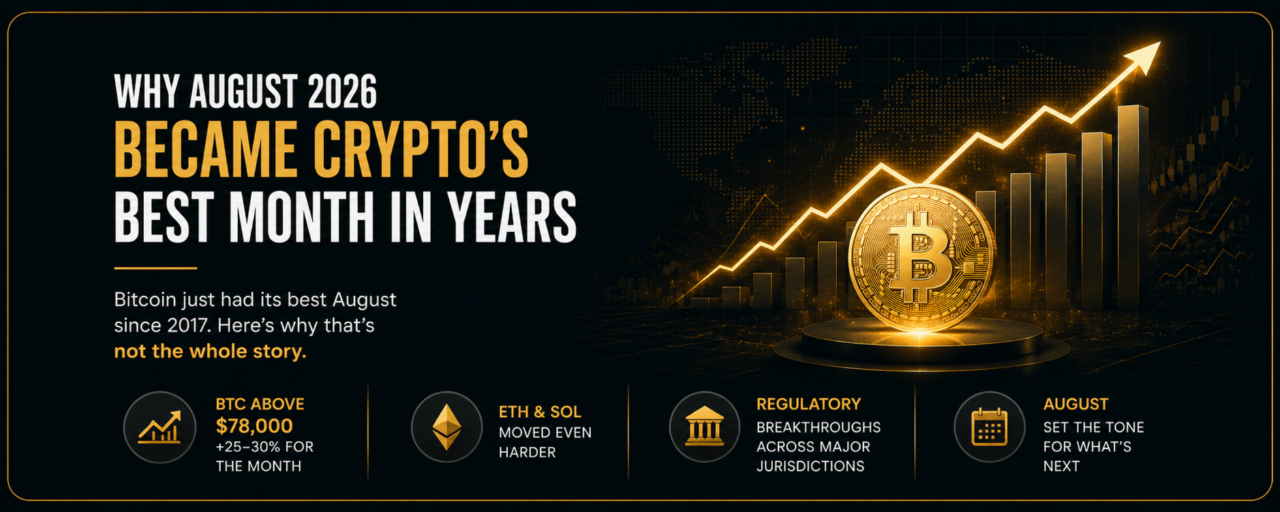
Why August 2026 Became Crypto's Best Month in YearsBitcoin just had its best August since 2017. Here's why that's not the whole story.
For most of 2026, Bitcoin was stuck. It entered August near $64,000, still down roughly 45-50% from the previous year's levels, grinding sideways while traders debated whether the bottom was in. Then, in the space of about ten days, the entire year's narrative flipped.
By August 31, Bitcoin was trading above $78,000, up roughly 25-30% for the month. Ethereum and Solana moved even harder. Regulators in Washington, Moscow, Frankfurt and Tokyo all made moves that would have seemed unlikely a year ago. None of this happened in isolation. It's worth pulling apart what actually drove the month, what's confirmed versus still speculative, and what it sets up for September.
What triggered the rally?
The turning point was August 19. At a White House event with technology and crypto executives, President Trump was asked whether the administration planned to buy more Bitcoin. His answer wasn't a firm commitment, but it moved markets anyway: he said the idea "has been talked about," that Bitcoin accumulation had "taken a lot of pressure off the dollar," and that he would listen to purchase recommendations from SEC Chair Paul Atkins.
That's an important distinction. Trump did not announce a purchase program, a funding mechanism, or a timeline. The existing Strategic Bitcoin Reserve, created by executive order in March 2025, is currently funded only through forfeited assets, and any large-scale open-market buying would likely need new legal authority from Congress. Still, traders read the comments as the clearest signal yet that direct government buying was on the table, and Bitcoin broke out of a six-week trading range within hours.
That move triggered a chain reaction. Heavily leveraged short positions, built up during months of sideways price action, got caught offside. On August 19 and 20, more than $2.7 billion in short positions were liquidated within roughly 24 hours, according to data from CoinGlass and other trackers, the largest concentrated short-liquidation event on record dating back to 2021. Bitcoin alone accounted for over $1.3 billion of that figure. Forced buybacks from liquidated shorts pushed prices higher still, a classic short-squeeze feedback loop.
The numbers, without the exaggeration
Monthly performance:
Bitcoin gained roughly 25-30% in August, its strongest August since 2017 and a rare green month for a period that's historically been one of Bitcoin's weakest. It's still down 28-33% year-to-date and remains well below its October 2025 peak near $126,000.Ethereum posted a strong August as well, extending gains that made it one of the better-performing majors of the month.Solana was the standout, closing the month up roughly 40-46%, its first positive month after ten straight monthly declines stretching back to October 2025
ETF flows told a similar story. Spot Bitcoin ETFs pulled in more than $3 billion over the month, their strongest showing in close to a year. Spot Ethereum ETFs recorded their best month since the products launched in 2024, powered largely by BlackRock's ETHA fund, which alone accounted for roughly 70% of a nine-day, $1.4 billion inflow streak in late August. Solana's smaller ETF category also had its strongest month since launch, with cumulative inflows crossing $1.3 billion and Bitwise's BSOL fund becoming the first Solana ETF to cross $1 billion in assets.
Worth noting: some of these figures vary slightly depending on the data provider and exact cutoff date. SoSoValue, Farside Investors and CoinGlass don't always agree to the dollar, but the direction and scale across all of them point to the same conclusion — institutional demand returned in size after a rough first half of the year.
Regulation moved almost as fast as price
The CLARITY Act is back on the calendar. The Senate left for its August recess without voting on the Digital Asset Market Clarity Act (H.R. 3633), which passed the House 294-134 back in July 2025. Majority Leader John Thune has filed cloture for a procedural vote on September 15, which needs 60 votes to succeed. President Trump has publicly pushed for a "fair version" of the bill to pass, but Democrats remain split over an ethics provision that critics say carves out protection for Trump's own crypto holdings, and banks are lobbying against language that would restrict stablecoin yield. Passage is not guaranteed.
Russia opened the door to regulated crypto trading. President Putin signed Federal Law No. 282-FZ on August 4, creating Russia's first comprehensive legal framework for crypto exchanges, brokers, and custodians under Bank of Russia supervision. Core provisions take effect September 1. Retail investors face an annual purchase cap of roughly $3,700-3,800 through approved intermediaries; qualified investors face no cap. Crucially, the law keeps domestic crypto payments banned while explicitly legalizing crypto for cross-border trade settlement — a carve-out widely read as easing sanctions pressure on Russian exporters and importers.
The ECB called for central bank money to go on-chain. Speaking at the Jackson Hole symposium on August 28, ECB Executive Board member Isabel Schnabel argued that central banks need to issue tokenized reserves directly on programmable ledgers to keep pace with tokenized markets and prevent private stablecoins from displacing public money as the core settlement asset. This builds on the ECB's existing Pontes and Appia initiatives, which aim to connect blockchain platforms to the euro area's TARGET payment infrastructure.
Japan is preparing to put its bond and equity markets on blockchain rails. The Financial Services Agency, Ministry of Finance and Bank of Japan plan to launch a joint study group this year targeting a development roadmap by early 2027, with live systems potentially arriving in the early 2030s. The goal is round-the-clock, near-instant settlement for Japanese government bonds — a market worth roughly $7-8 trillion — and eventually equities, cutting settlement times from the current one-to-two days down to near zero. Four of Japan's largest banks have already been running blockchain collateral trials on the Canton Network since April.
Big banks are circling stablecoins. According to Wall Street Journal reporting, JPMorgan has held internal discussions about issuing a public stablecoin separate from its existing JPM Coin deposit token, though the bank says no product is currently planned. Separately, a group of more than a dozen institutions including Bank of America, Wells Fargo and Santander is reportedly working on a jointly sponsored, multicurrency stablecoin for commercial use, starting with a dollar-denominated token. Neither project has a confirmed launch date.
Coinbase pushed crypto further into everyday finance
Coinbase and Better Mortgage expanded their Bitcoin-collateralized home loan product to general customers nationwide in late August. The structure pairs a standard Fannie Mae-eligible first mortgage with a separate second loan secured by pledged Bitcoin or USDC, letting buyers cover a down payment without selling their crypto. Collateral requirements sit at 250% of the loan amount, and Better says price declines alone won't trigger margin calls — though pledged assets can be liquidated if payments run more than 60 days late. The product's waitlist had already surpassed $260 million in potential loan volume before the nationwide expansion.
So what does this actually mean going forward?
The honest answer is that August solved less than the price charts suggest. Bitcoin's rally was real, but a large share of it came from a mechanical short squeeze rather than fresh, sustained buying — the kind of move that can partially unwind once leveraged positioning resets. Fed Chair Kevin Warsh's hawkish comments at Jackson Hole on August 28 were enough to snap Bitcoin ETFs' nine-day inflow streak, a reminder of how sensitive this rally still is to macro headlines.
On the regulatory side, momentum is genuine but incomplete. The CLARITY Act has a real vote scheduled, not just a vague promise, but a 60-vote threshold with active Democratic opposition means passage is a coin flip, not a formality. Russia's law and Japan's blockchain roadmap are both real and signed or scheduled, but their practical effects — sanctions workarounds, settlement efficiency — will play out over years, not weeks.
What's clear is that the range of institutions treating crypto as core financial infrastructure widened materially in a single month: a G7 central bank, one of the world's largest bond markets, a nuclear-armed sanctioned economy, and America's largest bank all moved in the same direction at roughly the same time. That kind of convergence is unusual, and it's a better explanation for why August mattered than any single price chart.
What to watch in September
The September 15 CLARITY Act cloture vote and whether Thune can find 60 votes.Whether Bitcoin ETF inflows resume after the late-August pause tied to Fed commentary.Any follow-up from the Trump administration on a funding mechanism or executive order for expanded Bitcoin or altcoin purchases — so far, none has been announced.Progress on JPMorgan's stablecoin decision and the multi-bank commercial stablecoin venture.
FAQ
Did the U.S. government actually buy Bitcoin in August 2026? No. President Trump said on August 19 that large-scale Bitcoin and altcoin purchases had "been talked about," but no purchase, funding mechanism, or timeline has been announced. The existing Strategic Bitcoin Reserve is currently funded only through forfeited assets.
Is the CLARITY Act guaranteed to pass in September? No. A procedural cloture vote is scheduled for September 15, but it requires 60 votes in the Senate, and Democrats remain divided over an ethics provision and stablecoin yield restrictions. Passage is possible but not confirmed.
Why did crypto rally so hard in such a short window? Two forces combined: Trump's comments about potential government Bitcoin purchases triggered a wave of short covering, and that squeeze coincided with a cluster of institutional and regulatory developments — from Russia's new crypto law to record ETF inflows — that reinforced the move.
HASHTAGS
#Bitcoin #CryptoRegulation #CLARITYAct #Ethereum #Solana #CryptoNews
Why August 2026 Became Crypto's Best Month in Years
Bitcoin just had its best August since 2017. Here's why that's not the whole story.
For most of 2026, Bitcoin was stuck. It entered August near $64,000, still down roughly 45-50% from the previous year's levels, grinding sideways while traders debated whether the bottom was in. Then, in the space of about ten days, the entire year's narrative flipped.
By August 31, Bitcoin was trading above $78,000, up roughly 25-30% for the month. Ethereum and Solana moved even harder. Regulators in Washington, Moscow, Frankfurt and Tokyo all made moves that would have seemed unlikely a year ago. None of this happened in isolation. It's worth pulling apart what actually drove the month, what's confirmed versus still speculative, and what it sets up for September.
What triggered the rally?
The turning point was August 19. At a White House event with technology and crypto executives, President Trump was asked whether the administration planned to buy more Bitcoin. His answer wasn't a firm commitment, but it moved markets anyway: he said the idea "has been talked about," that Bitcoin accumulation had "taken a lot of pressure off the dollar," and that he would listen to purchase recommendations from SEC Chair Paul Atkins.
That's an important distinction. Trump did not announce a purchase program, a funding mechanism, or a timeline. The existing Strategic Bitcoin Reserve, created by executive order in March 2025, is currently funded only through forfeited assets, and any large-scale open-market buying would likely need new legal authority from Congress. Still, traders read the comments as the clearest signal yet that direct government buying was on the table, and Bitcoin broke out of a six-week trading range within hours.
That move triggered a chain reaction. Heavily leveraged short positions, built up during months of sideways price action, got caught offside. On August 19 and 20, more than $2.7 billion in short positions were liquidated within roughly 24 hours, according to data from CoinGlass and other trackers, the largest concentrated short-liquidation event on record dating back to 2021. Bitcoin alone accounted for over $1.3 billion of that figure. Forced buybacks from liquidated shorts pushed prices higher still, a classic short-squeeze feedback loop.
The numbers, without the exaggeration
Monthly performance:
Bitcoin gained roughly 25-30% in August, its strongest August since 2017 and a rare green month for a period that's historically been one of Bitcoin's weakest. It's still down 28-33% year-to-date and remains well below its October 2025 peak near $126,000.Ethereum posted a strong August as well, extending gains that made it one of the better-performing majors of the month.Solana was the standout, closing the month up roughly 40-46%, its first positive month after ten straight monthly declines stretching back to October 2025
ETF flows told a similar story. Spot Bitcoin ETFs pulled in more than $3 billion over the month, their strongest showing in close to a year. Spot Ethereum ETFs recorded their best month since the products launched in 2024, powered largely by BlackRock's ETHA fund, which alone accounted for roughly 70% of a nine-day, $1.4 billion inflow streak in late August. Solana's smaller ETF category also had its strongest month since launch, with cumulative inflows crossing $1.3 billion and Bitwise's BSOL fund becoming the first Solana ETF to cross $1 billion in assets.
Worth noting: some of these figures vary slightly depending on the data provider and exact cutoff date. SoSoValue, Farside Investors and CoinGlass don't always agree to the dollar, but the direction and scale across all of them point to the same conclusion — institutional demand returned in size after a rough first half of the year.
Regulation moved almost as fast as price
The CLARITY Act is back on the calendar. The Senate left for its August recess without voting on the Digital Asset Market Clarity Act (H.R. 3633), which passed the House 294-134 back in July 2025. Majority Leader John Thune has filed cloture for a procedural vote on September 15, which needs 60 votes to succeed. President Trump has publicly pushed for a "fair version" of the bill to pass, but Democrats remain split over an ethics provision that critics say carves out protection for Trump's own crypto holdings, and banks are lobbying against language that would restrict stablecoin yield. Passage is not guaranteed.
Russia opened the door to regulated crypto trading. President Putin signed Federal Law No. 282-FZ on August 4, creating Russia's first comprehensive legal framework for crypto exchanges, brokers, and custodians under Bank of Russia supervision. Core provisions take effect September 1. Retail investors face an annual purchase cap of roughly $3,700-3,800 through approved intermediaries; qualified investors face no cap. Crucially, the law keeps domestic crypto payments banned while explicitly legalizing crypto for cross-border trade settlement — a carve-out widely read as easing sanctions pressure on Russian exporters and importers.
The ECB called for central bank money to go on-chain. Speaking at the Jackson Hole symposium on August 28, ECB Executive Board member Isabel Schnabel argued that central banks need to issue tokenized reserves directly on programmable ledgers to keep pace with tokenized markets and prevent private stablecoins from displacing public money as the core settlement asset. This builds on the ECB's existing Pontes and Appia initiatives, which aim to connect blockchain platforms to the euro area's TARGET payment infrastructure.
Japan is preparing to put its bond and equity markets on blockchain rails. The Financial Services Agency, Ministry of Finance and Bank of Japan plan to launch a joint study group this year targeting a development roadmap by early 2027, with live systems potentially arriving in the early 2030s. The goal is round-the-clock, near-instant settlement for Japanese government bonds — a market worth roughly $7-8 trillion — and eventually equities, cutting settlement times from the current one-to-two days down to near zero. Four of Japan's largest banks have already been running blockchain collateral trials on the Canton Network since April.
Big banks are circling stablecoins. According to Wall Street Journal reporting, JPMorgan has held internal discussions about issuing a public stablecoin separate from its existing JPM Coin deposit token, though the bank says no product is currently planned. Separately, a group of more than a dozen institutions including Bank of America, Wells Fargo and Santander is reportedly working on a jointly sponsored, multicurrency stablecoin for commercial use, starting with a dollar-denominated token. Neither project has a confirmed launch date.
Coinbase pushed crypto further into everyday finance
Coinbase and Better Mortgage expanded their Bitcoin-collateralized home loan product to general customers nationwide in late August. The structure pairs a standard Fannie Mae-eligible first mortgage with a separate second loan secured by pledged Bitcoin or USDC, letting buyers cover a down payment without selling their crypto. Collateral requirements sit at 250% of the loan amount, and Better says price declines alone won't trigger margin calls — though pledged assets can be liquidated if payments run more than 60 days late. The product's waitlist had already surpassed $260 million in potential loan volume before the nationwide expansion.
So what does this actually mean going forward?
The honest answer is that August solved less than the price charts suggest. Bitcoin's rally was real, but a large share of it came from a mechanical short squeeze rather than fresh, sustained buying — the kind of move that can partially unwind once leveraged positioning resets. Fed Chair Kevin Warsh's hawkish comments at Jackson Hole on August 28 were enough to snap Bitcoin ETFs' nine-day inflow streak, a reminder of how sensitive this rally still is to macro headlines.
On the regulatory side, momentum is genuine but incomplete. The CLARITY Act has a real vote scheduled, not just a vague promise, but a 60-vote threshold with active Democratic opposition means passage is a coin flip, not a formality. Russia's law and Japan's blockchain roadmap are both real and signed or scheduled, but their practical effects — sanctions workarounds, settlement efficiency — will play out over years, not weeks.
What's clear is that the range of institutions treating crypto as core financial infrastructure widened materially in a single month: a G7 central bank, one of the world's largest bond markets, a nuclear-armed sanctioned economy, and America's largest bank all moved in the same direction at roughly the same time. That kind of convergence is unusual, and it's a better explanation for why August mattered than any single price chart.
What to watch in September
The September 15 CLARITY Act cloture vote and whether Thune can find 60 votes.Whether Bitcoin ETF inflows resume after the late-August pause tied to Fed commentary.Any follow-up from the Trump administration on a funding mechanism or executive order for expanded Bitcoin or altcoin purchases — so far, none has been announced.Progress on JPMorgan's stablecoin decision and the multi-bank commercial stablecoin venture.
FAQ
Did the U.S. government actually buy Bitcoin in August 2026? No. President Trump said on August 19 that large-scale Bitcoin and altcoin purchases had "been talked about," but no purchase, funding mechanism, or timeline has been announced. The existing Strategic Bitcoin Reserve is currently funded only through forfeited assets.
Is the CLARITY Act guaranteed to pass in September? No. A procedural cloture vote is scheduled for September 15, but it requires 60 votes in the Senate, and Democrats remain divided over an ethics provision and stablecoin yield restrictions. Passage is possible but not confirmed.
Why did crypto rally so hard in such a short window? Two forces combined: Trump's comments about potential government Bitcoin purchases triggered a wave of short covering, and that squeeze coincided with a cluster of institutional and regulatory developments — from Russia's new crypto law to record ETF inflows — that reinforced the move.
HASHTAGS
#Bitcoin #CryptoRegulation #CLARITYAct #Ethereum #Solana #CryptoNews
For most of 2026, Bitcoin was stuck. It entered August near $64,000, still down roughly 45-50% from the previous year's levels, grinding sideways while traders debated whether the bottom was in. Then, in the space of about ten days, the entire year's narrative flipped.
By August 31, Bitcoin was trading above $78,000, up roughly 25-30% for the month. Ethereum and Solana moved even harder. Regulators in Washington, Moscow, Frankfurt and Tokyo all made moves that would have seemed unlikely a year ago. None of this happened in isolation. It's worth pulling apart what actually drove the month, what's confirmed versus still speculative, and what it sets up for September.
What triggered the rally?
The turning point was August 19. At a White House event with technology and crypto executives, President Trump was asked whether the administration planned to buy more Bitcoin. His answer wasn't a firm commitment, but it moved markets anyway: he said the idea "has been talked about," that Bitcoin accumulation had "taken a lot of pressure off the dollar," and that he would listen to purchase recommendations from SEC Chair Paul Atkins.
That's an important distinction. Trump did not announce a purchase program, a funding mechanism, or a timeline. The existing Strategic Bitcoin Reserve, created by executive order in March 2025, is currently funded only through forfeited assets, and any large-scale open-market buying would likely need new legal authority from Congress. Still, traders read the comments as the clearest signal yet that direct government buying was on the table, and Bitcoin broke out of a six-week trading range within hours.
That move triggered a chain reaction. Heavily leveraged short positions, built up during months of sideways price action, got caught offside. On August 19 and 20, more than $2.7 billion in short positions were liquidated within roughly 24 hours, according to data from CoinGlass and other trackers, the largest concentrated short-liquidation event on record dating back to 2021. Bitcoin alone accounted for over $1.3 billion of that figure. Forced buybacks from liquidated shorts pushed prices higher still, a classic short-squeeze feedback loop.
The numbers, without the exaggeration
Monthly performance:
Bitcoin gained roughly 25-30% in August, its strongest August since 2017 and a rare green month for a period that's historically been one of Bitcoin's weakest. It's still down 28-33% year-to-date and remains well below its October 2025 peak near $126,000.Ethereum posted a strong August as well, extending gains that made it one of the better-performing majors of the month.Solana was the standout, closing the month up roughly 40-46%, its first positive month after ten straight monthly declines stretching back to October 2025
ETF flows told a similar story. Spot Bitcoin ETFs pulled in more than $3 billion over the month, their strongest showing in close to a year. Spot Ethereum ETFs recorded their best month since the products launched in 2024, powered largely by BlackRock's ETHA fund, which alone accounted for roughly 70% of a nine-day, $1.4 billion inflow streak in late August. Solana's smaller ETF category also had its strongest month since launch, with cumulative inflows crossing $1.3 billion and Bitwise's BSOL fund becoming the first Solana ETF to cross $1 billion in assets.
Worth noting: some of these figures vary slightly depending on the data provider and exact cutoff date. SoSoValue, Farside Investors and CoinGlass don't always agree to the dollar, but the direction and scale across all of them point to the same conclusion — institutional demand returned in size after a rough first half of the year.
Regulation moved almost as fast as price
The CLARITY Act is back on the calendar. The Senate left for its August recess without voting on the Digital Asset Market Clarity Act (H.R. 3633), which passed the House 294-134 back in July 2025. Majority Leader John Thune has filed cloture for a procedural vote on September 15, which needs 60 votes to succeed. President Trump has publicly pushed for a "fair version" of the bill to pass, but Democrats remain split over an ethics provision that critics say carves out protection for Trump's own crypto holdings, and banks are lobbying against language that would restrict stablecoin yield. Passage is not guaranteed.
Russia opened the door to regulated crypto trading. President Putin signed Federal Law No. 282-FZ on August 4, creating Russia's first comprehensive legal framework for crypto exchanges, brokers, and custodians under Bank of Russia supervision. Core provisions take effect September 1. Retail investors face an annual purchase cap of roughly $3,700-3,800 through approved intermediaries; qualified investors face no cap. Crucially, the law keeps domestic crypto payments banned while explicitly legalizing crypto for cross-border trade settlement — a carve-out widely read as easing sanctions pressure on Russian exporters and importers.
The ECB called for central bank money to go on-chain. Speaking at the Jackson Hole symposium on August 28, ECB Executive Board member Isabel Schnabel argued that central banks need to issue tokenized reserves directly on programmable ledgers to keep pace with tokenized markets and prevent private stablecoins from displacing public money as the core settlement asset. This builds on the ECB's existing Pontes and Appia initiatives, which aim to connect blockchain platforms to the euro area's TARGET payment infrastructure.
Japan is preparing to put its bond and equity markets on blockchain rails. The Financial Services Agency, Ministry of Finance and Bank of Japan plan to launch a joint study group this year targeting a development roadmap by early 2027, with live systems potentially arriving in the early 2030s. The goal is round-the-clock, near-instant settlement for Japanese government bonds — a market worth roughly $7-8 trillion — and eventually equities, cutting settlement times from the current one-to-two days down to near zero. Four of Japan's largest banks have already been running blockchain collateral trials on the Canton Network since April.
Big banks are circling stablecoins. According to Wall Street Journal reporting, JPMorgan has held internal discussions about issuing a public stablecoin separate from its existing JPM Coin deposit token, though the bank says no product is currently planned. Separately, a group of more than a dozen institutions including Bank of America, Wells Fargo and Santander is reportedly working on a jointly sponsored, multicurrency stablecoin for commercial use, starting with a dollar-denominated token. Neither project has a confirmed launch date.
Coinbase pushed crypto further into everyday finance
Coinbase and Better Mortgage expanded their Bitcoin-collateralized home loan product to general customers nationwide in late August. The structure pairs a standard Fannie Mae-eligible first mortgage with a separate second loan secured by pledged Bitcoin or USDC, letting buyers cover a down payment without selling their crypto. Collateral requirements sit at 250% of the loan amount, and Better says price declines alone won't trigger margin calls — though pledged assets can be liquidated if payments run more than 60 days late. The product's waitlist had already surpassed $260 million in potential loan volume before the nationwide expansion.
So what does this actually mean going forward?
The honest answer is that August solved less than the price charts suggest. Bitcoin's rally was real, but a large share of it came from a mechanical short squeeze rather than fresh, sustained buying — the kind of move that can partially unwind once leveraged positioning resets. Fed Chair Kevin Warsh's hawkish comments at Jackson Hole on August 28 were enough to snap Bitcoin ETFs' nine-day inflow streak, a reminder of how sensitive this rally still is to macro headlines.
On the regulatory side, momentum is genuine but incomplete. The CLARITY Act has a real vote scheduled, not just a vague promise, but a 60-vote threshold with active Democratic opposition means passage is a coin flip, not a formality. Russia's law and Japan's blockchain roadmap are both real and signed or scheduled, but their practical effects — sanctions workarounds, settlement efficiency — will play out over years, not weeks.
What's clear is that the range of institutions treating crypto as core financial infrastructure widened materially in a single month: a G7 central bank, one of the world's largest bond markets, a nuclear-armed sanctioned economy, and America's largest bank all moved in the same direction at roughly the same time. That kind of convergence is unusual, and it's a better explanation for why August mattered than any single price chart.
What to watch in September
The September 15 CLARITY Act cloture vote and whether Thune can find 60 votes.Whether Bitcoin ETF inflows resume after the late-August pause tied to Fed commentary.Any follow-up from the Trump administration on a funding mechanism or executive order for expanded Bitcoin or altcoin purchases — so far, none has been announced.Progress on JPMorgan's stablecoin decision and the multi-bank commercial stablecoin venture.
FAQ
Did the U.S. government actually buy Bitcoin in August 2026? No. President Trump said on August 19 that large-scale Bitcoin and altcoin purchases had "been talked about," but no purchase, funding mechanism, or timeline has been announced. The existing Strategic Bitcoin Reserve is currently funded only through forfeited assets.
Is the CLARITY Act guaranteed to pass in September? No. A procedural cloture vote is scheduled for September 15, but it requires 60 votes in the Senate, and Democrats remain divided over an ethics provision and stablecoin yield restrictions. Passage is possible but not confirmed.
Why did crypto rally so hard in such a short window? Two forces combined: Trump's comments about potential government Bitcoin purchases triggered a wave of short covering, and that squeeze coincided with a cluster of institutional and regulatory developments — from Russia's new crypto law to record ETF inflows — that reinforced the move.
HASHTAGS
#Bitcoin #CryptoRegulation #CLARITYAct #Ethereum #Solana #CryptoNews
207
🚨 5 BIG CRYPTO & BLOCKCHAIN STORIES TODAY
September 2 is bringing major developments across regulation, stablecoins, prediction markets and DeFi:
➤ 🇺🇸 SEC: Proposed modernization of decades-old transfer-agent rules to account for blockchain-based securities and share transfers.
➤ 💵 21 major financial institutions — including Goldman Sachs, Bank of America, Citi and Wells Fargo — are planning a U.S. dollar stablecoin targeted for H1 2027.
➤ ⚠️ Hyperliquid: More than $30M linked to the Lazarus Group reportedly moved through the platform as authorities continue tracking North Korean crypto activity.
➤ 🎯 Polymarket: Trump Jr.'s firm is reportedly leading a $1B funding round valuing the prediction-market platform at around $21B.
➤ 🚨 Cronos: The network halted after the $75M Tectonic exploit, highlighting the continuing risks in DeFi.
The bigger picture?
Crypto infrastructure is increasingly moving into the mainstream — while security and regulatory risks remain impossible to ignore.
Which story matters most for crypto's next phase? 👀
#crypto #bitcoin #Stablecoins #BinanceSquare #Crypto #BTC #ETH #defi #Blockchain
🚨 5 BIG CRYPTO & BLOCKCHAIN STORIES TODAY
September 2 is bringing major developments across regulation, stablecoins, prediction markets and DeFi:
➤ 🇺🇸 SEC: Proposed modernization of decades-old transfer-agent rules to account for blockchain-based securities and share transfers.
➤ 💵 21 major financial institutions — including Goldman Sachs, Bank of America, Citi and Wells Fargo — are planning a U.S. dollar stablecoin targeted for H1 2027.
➤ ⚠️ Hyperliquid: More than $30M linked to the Lazarus Group reportedly moved through the platform as authorities continue tracking North Korean crypto activity.
➤ 🎯 Polymarket: Trump Jr.'s firm is reportedly leading a $1B funding round valuing the prediction-market platform at around $21B.
➤ 🚨 Cronos: The network halted after the $75M Tectonic exploit, highlighting the continuing risks in DeFi.
The bigger picture?
Crypto infrastructure is increasingly moving into the mainstream — while security and regulatory risks remain impossible to ignore.
Which story matters most for crypto's next phase? 👀
#crypto #bitcoin #Stablecoins #BinanceSquare #Crypto #BTC #ETH #defi #Blockchain
September 2 is bringing major developments across regulation, stablecoins, prediction markets and DeFi:
➤ 🇺🇸 SEC: Proposed modernization of decades-old transfer-agent rules to account for blockchain-based securities and share transfers.
➤ 💵 21 major financial institutions — including Goldman Sachs, Bank of America, Citi and Wells Fargo — are planning a U.S. dollar stablecoin targeted for H1 2027.
➤ ⚠️ Hyperliquid: More than $30M linked to the Lazarus Group reportedly moved through the platform as authorities continue tracking North Korean crypto activity.
➤ 🎯 Polymarket: Trump Jr.'s firm is reportedly leading a $1B funding round valuing the prediction-market platform at around $21B.
➤ 🚨 Cronos: The network halted after the $75M Tectonic exploit, highlighting the continuing risks in DeFi.
The bigger picture?
Crypto infrastructure is increasingly moving into the mainstream — while security and regulatory risks remain impossible to ignore.
Which story matters most for crypto's next phase? 👀
#crypto #bitcoin #Stablecoins #BinanceSquare #Crypto #BTC #ETH #defi #Blockchain
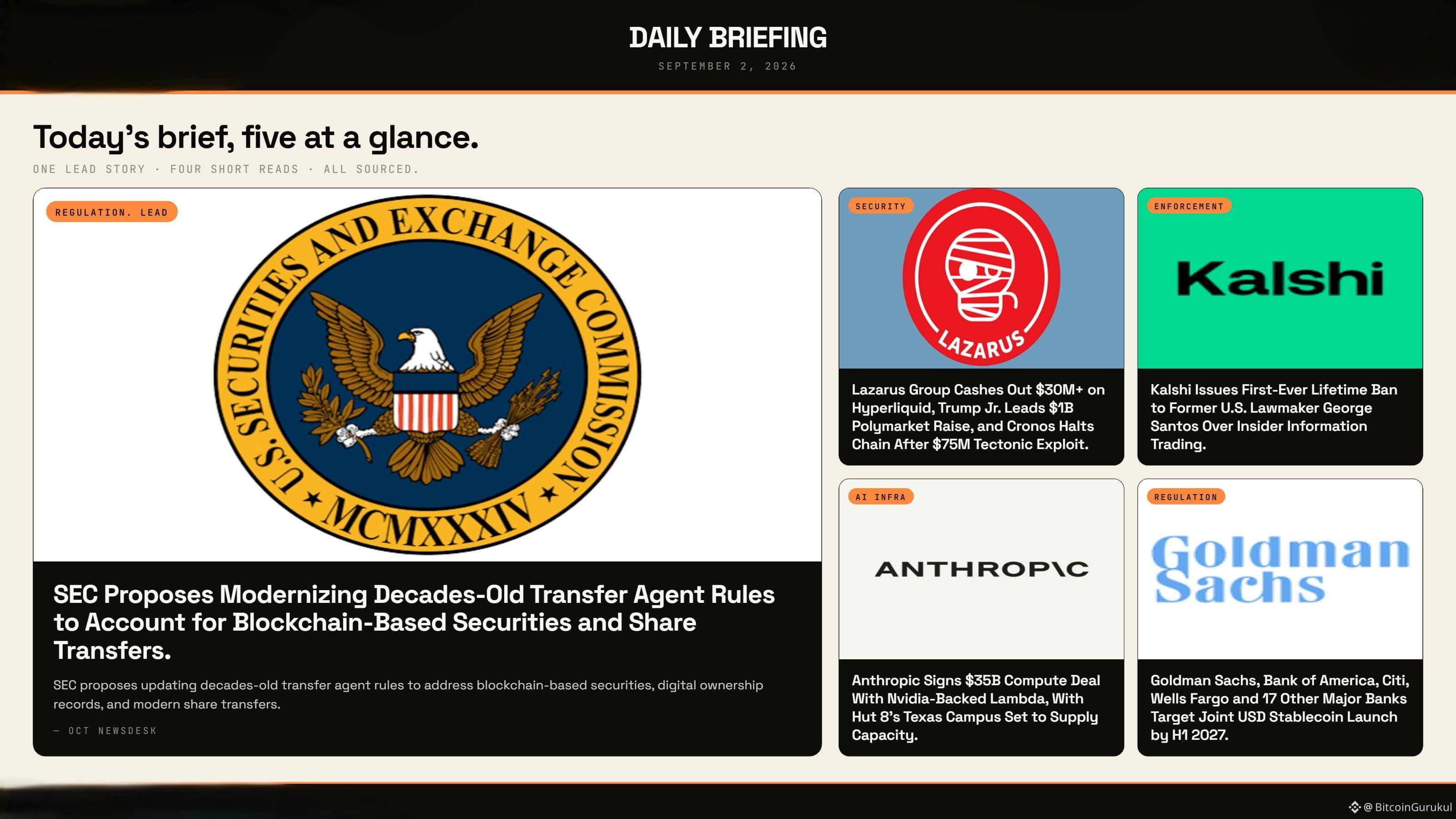
1
147
👀 WHAT IF BTC DROPS TO $72K — THEN SQUEEZES TO $100K?
Bitcoin is currently trading around $77K, but a deeper pullback toward the $72K area remains a scenario traders are watching.
Here's the interesting setup:
📉 BTC drops toward $72K
→ Traders turn increasingly bearish
→ Short positions build
→ BTC reverses
→ Shorts get squeezed
→ Momentum accelerates toward $100K
A move like this wouldn't require everyone to be wrong at the same time — just a sharp shift in positioning and liquidity.
Of course, $72K isn't guaranteed support and $100K isn't guaranteed upside.
But if BTC sweeps lower first, the resulting short positioning could create the fuel for a much bigger move.
Would you rather see BTC break $72K first or reclaim $80K directly? 👀
#bitcoin #BTC走势分析 #crypto #trading
👀 WHAT IF BTC DROPS TO $72K — THEN SQUEEZES TO $100K?
Bitcoin is currently trading around $77K, but a deeper pullback toward the $72K area remains a scenario traders are watching.
Here's the interesting setup:
📉 BTC drops toward $72K
→ Traders turn increasingly bearish
→ Short positions build
→ BTC reverses
→ Shorts get squeezed
→ Momentum accelerates toward $100K
A move like this wouldn't require everyone to be wrong at the same time — just a sharp shift in positioning and liquidity.
Of course, $72K isn't guaranteed support and $100K isn't guaranteed upside.
But if BTC sweeps lower first, the resulting short positioning could create the fuel for a much bigger move.
Would you rather see BTC break $72K first or reclaim $80K directly? 👀
#bitcoin #BTC走势分析 #crypto #trading
Bitcoin is currently trading around $77K, but a deeper pullback toward the $72K area remains a scenario traders are watching.
Here's the interesting setup:
📉 BTC drops toward $72K
→ Traders turn increasingly bearish
→ Short positions build
→ BTC reverses
→ Shorts get squeezed
→ Momentum accelerates toward $100K
A move like this wouldn't require everyone to be wrong at the same time — just a sharp shift in positioning and liquidity.
Of course, $72K isn't guaranteed support and $100K isn't guaranteed upside.
But if BTC sweeps lower first, the resulting short positioning could create the fuel for a much bigger move.
Would you rather see BTC break $72K first or reclaim $80K directly? 👀
#bitcoin #BTC走势分析 #crypto #trading
135
⚠️ BTC & ETH JUST LOST A KEY WEEKLY LEVEL
Both $BTC and $ETH have dropped below their 50-week EMA.
Why does it matter?
The 50-week trend line is closely watched as a medium-to-long-term gauge of market momentum.
For Bitcoin, the $81K area has recently acted as a major technical ceiling, making the next weekly closes especially important.
A sustained move below the level could signal that the recent August rally is losing momentum.
But one breakdown isn't enough to confirm a trend reversal.
👀 The key question now: can BTC and ETH reclaim the 50W EMA, or does this become a deeper September correction?
#bitcoin #Ethereum #BTC走势分析 #ETHETFsApproved #CryptoTrading
⚠️ BTC & ETH JUST LOST A KEY WEEKLY LEVEL
Both $BTC and $ETH have dropped below their 50-week EMA.
Why does it matter?
The 50-week trend line is closely watched as a medium-to-long-term gauge of market momentum.
For Bitcoin, the $81K area has recently acted as a major technical ceiling, making the next weekly closes especially important.
A sustained move below the level could signal that the recent August rally is losing momentum.
But one breakdown isn't enough to confirm a trend reversal.
👀 The key question now: can BTC and ETH reclaim the 50W EMA, or does this become a deeper September correction?
#bitcoin #Ethereum #BTC走势分析 #ETHETFsApproved #CryptoTrading
Both $BTC and $ETH have dropped below their 50-week EMA.
Why does it matter?
The 50-week trend line is closely watched as a medium-to-long-term gauge of market momentum.
For Bitcoin, the $81K area has recently acted as a major technical ceiling, making the next weekly closes especially important.
A sustained move below the level could signal that the recent August rally is losing momentum.
But one breakdown isn't enough to confirm a trend reversal.
👀 The key question now: can BTC and ETH reclaim the 50W EMA, or does this become a deeper September correction?
#bitcoin #Ethereum #BTC走势分析 #ETHETFsApproved #CryptoTrading
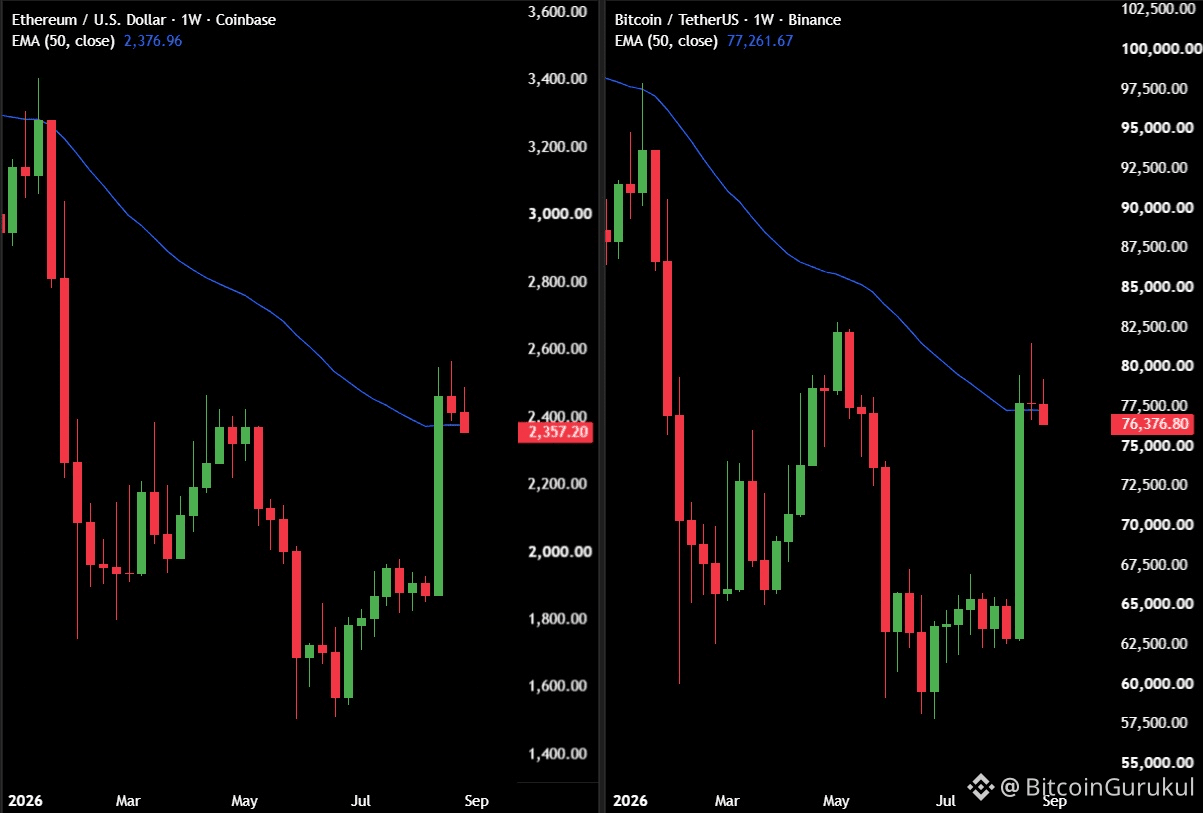
1
252
🚨 A WHALE JUST OPENED A $44.9M ETH LONG
On-chain data reportedly shows a whale opening a massive $ETH long with 25x leverage.
📌 Position size: $44.95M
📌 Leverage: 25x
📌 Liquidation price: $1,874
That's an enormous leveraged bet on Ethereum.
But here's the important part:
At 25x leverage, even a relatively small move against the position can rapidly increase liquidation risk.
🐋 One whale going long doesn't guarantee an ETH rally — but it shows that some large traders are willing to take significant upside exposure.
Would you ever take a 25x ETH long, or is the liquidation risk simply too high? 👀
#Ethereum #ETH #Crypto #Trading
🚨 A WHALE JUST OPENED A $44.9M ETH LONG
On-chain data reportedly shows a whale opening a massive $ETH long with 25x leverage.
📌 Position size: $44.95M
📌 Leverage: 25x
📌 Liquidation price: $1,874
That's an enormous leveraged bet on Ethereum.
But here's the important part:
At 25x leverage, even a relatively small move against the position can rapidly increase liquidation risk.
🐋 One whale going long doesn't guarantee an ETH rally — but it shows that some large traders are willing to take significant upside exposure.
Would you ever take a 25x ETH long, or is the liquidation risk simply too high? 👀
#Ethereum #ETH #Crypto #Trading
On-chain data reportedly shows a whale opening a massive $ETH long with 25x leverage.
📌 Position size: $44.95M
📌 Leverage: 25x
📌 Liquidation price: $1,874
That's an enormous leveraged bet on Ethereum.
But here's the important part:
At 25x leverage, even a relatively small move against the position can rapidly increase liquidation risk.
🐋 One whale going long doesn't guarantee an ETH rally — but it shows that some large traders are willing to take significant upside exposure.
Would you ever take a 25x ETH long, or is the liquidation risk simply too high? 👀
#Ethereum #ETH #Crypto #Trading
91
🚨 BITCOIN'S SEPTEMBER PATTERN IS BACK
Bitcoin just closed August in the green — and history isn't exactly bullish on what comes next.
Before 2026, Bitcoin had only two green Augusts since 2020.
Both times, September closed lower:
📉 -7.30%
📉 -7.96%
Now August 2026 has broken the previous bear-market pattern with a gain of roughly 25%.
So the big question:
Will September finally break the green-August → red-September pattern? 👀
Seasonality is only one piece of the puzzle, but this is definitely a pattern worth watching as BTC enters a historically volatile month.
#Bitcoin #BTC #Crypto #CryptoTrading
🚨 BITCOIN'S SEPTEMBER PATTERN IS BACK
Bitcoin just closed August in the green — and history isn't exactly bullish on what comes next.
Before 2026, Bitcoin had only two green Augusts since 2020.
Both times, September closed lower:
📉 -7.30%
📉 -7.96%
Now August 2026 has broken the previous bear-market pattern with a gain of roughly 25%.
So the big question:
Will September finally break the green-August → red-September pattern? 👀
Seasonality is only one piece of the puzzle, but this is definitely a pattern worth watching as BTC enters a historically volatile month.
#Bitcoin #BTC #Crypto #CryptoTrading
Bitcoin just closed August in the green — and history isn't exactly bullish on what comes next.
Before 2026, Bitcoin had only two green Augusts since 2020.
Both times, September closed lower:
📉 -7.30%
📉 -7.96%
Now August 2026 has broken the previous bear-market pattern with a gain of roughly 25%.
So the big question:
Will September finally break the green-August → red-September pattern? 👀
Seasonality is only one piece of the puzzle, but this is definitely a pattern worth watching as BTC enters a historically volatile month.
#Bitcoin #BTC #Crypto #CryptoTrading
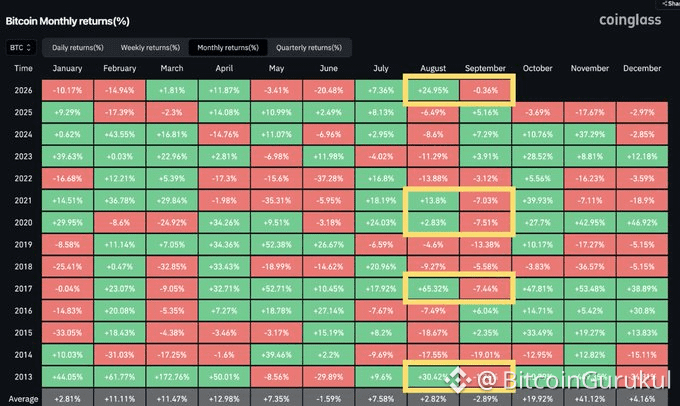
338
🚨 $1.5B+ IN TOKEN UNLOCKS ARE COMING
September could bring a major increase in crypto token supply as billions of dollars worth of previously locked tokens become available.
Some projects traders are watching include:
🔹 $XPL
🔹 $TRUMP
🔹 $RAIN
🔹 $CARDS
Why does this matter?
When tokens unlock, circulating supply increases. If demand doesn't keep pace with the new supply, prices can face additional pressure.
But an unlock doesn't automatically mean a dump.
The key factors are:
→ How large is the unlock relative to circulating supply?
→ Who receives the tokens?
→ Is it a cliff unlock or gradual vesting?
→ Are recipients likely to sell or hold?
📊 Token unlocks are one of the supply-side catalysts traders should have on their radar this month.
Which unlock are you watching most closely? 👀
#Crypto #TokenUnlocks #Altcoins #Trading
🚨 $1.5B+ IN TOKEN UNLOCKS ARE COMING
September could bring a major increase in crypto token supply as billions of dollars worth of previously locked tokens become available.
Some projects traders are watching include:
🔹 $XPL
🔹 $TRUMP
🔹 $RAIN
🔹 $CARDS
Why does this matter?
When tokens unlock, circulating supply increases. If demand doesn't keep pace with the new supply, prices can face additional pressure.
But an unlock doesn't automatically mean a dump.
The key factors are:
→ How large is the unlock relative to circulating supply?
→ Who receives the tokens?
→ Is it a cliff unlock or gradual vesting?
→ Are recipients likely to sell or hold?
📊 Token unlocks are one of the supply-side catalysts traders should have on their radar this month.
Which unlock are you watching most closely? 👀
#Crypto #TokenUnlocks #Altcoins #Trading
September could bring a major increase in crypto token supply as billions of dollars worth of previously locked tokens become available.
Some projects traders are watching include:
🔹 $XPL
🔹 $TRUMP
🔹 $RAIN
🔹 $CARDS
Why does this matter?
When tokens unlock, circulating supply increases. If demand doesn't keep pace with the new supply, prices can face additional pressure.
But an unlock doesn't automatically mean a dump.
The key factors are:
→ How large is the unlock relative to circulating supply?
→ Who receives the tokens?
→ Is it a cliff unlock or gradual vesting?
→ Are recipients likely to sell or hold?
📊 Token unlocks are one of the supply-side catalysts traders should have on their radar this month.
Which unlock are you watching most closely? 👀
#Crypto #TokenUnlocks #Altcoins #Trading
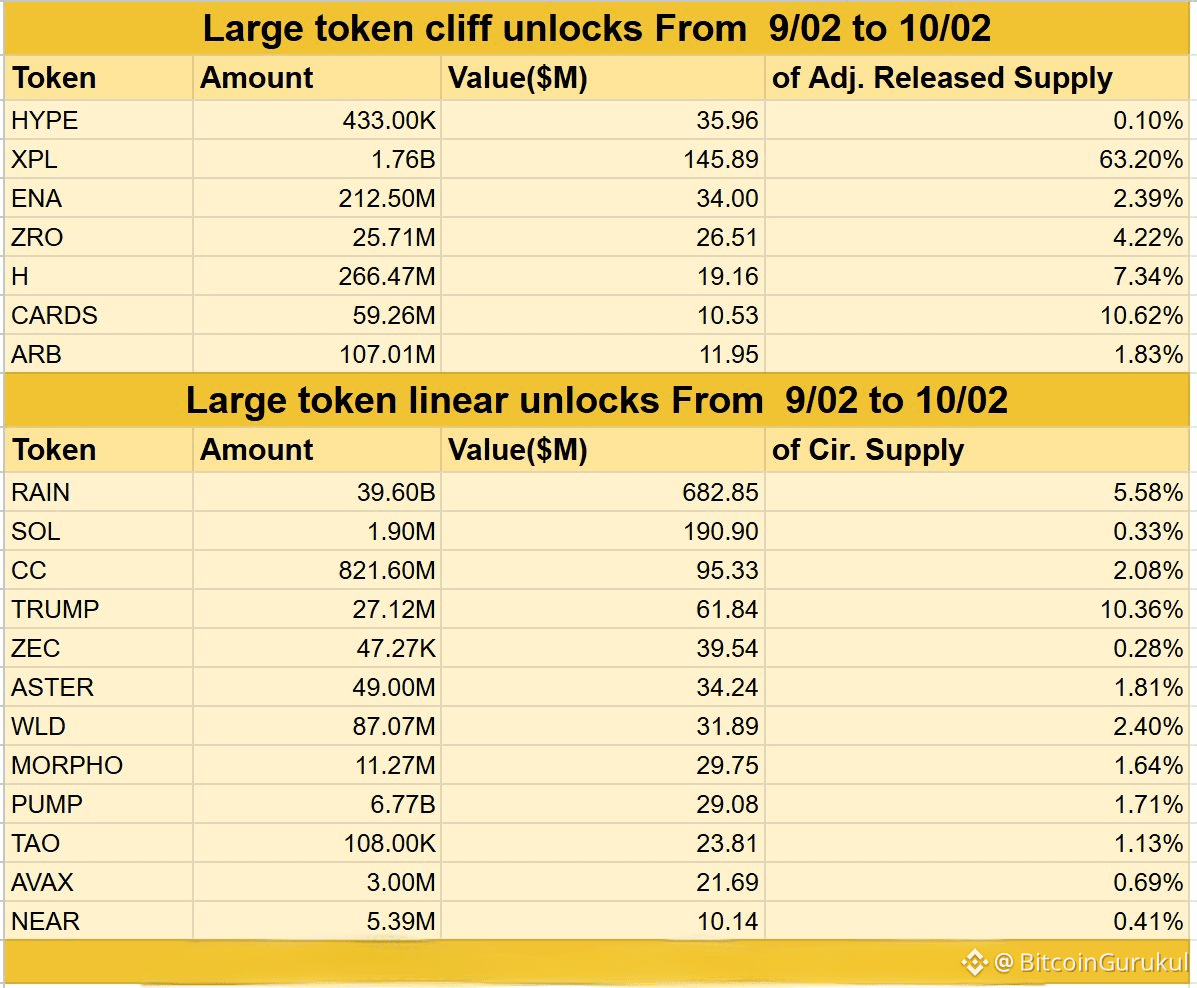
394
සත්යායනය කළ
🚨 $UNI IS MOVING — AND ROBINHOOD CHAIN MAY BE A BIG REASON
$UNI jumped around 10% as trading activity on Robinhood Chain surged.
Robinhood Chain just recorded roughly $1.5B in 24-hour DEX volume — putting it among the largest DEX markets in crypto.
And Uniswap is capturing a huge portion of that activity.
More DEX volume → more trading activity → greater protocol fee potential.
The bigger story is that Robinhood Chain is becoming a major venue for both memecoins and tokenized assets, with Uniswap playing a central role in its onchain liquidity.
👀 If Robinhood Chain's volume keeps growing, could $UNI become one of the biggest beneficiaries?
#UNI #Uniswap #DeFi #Crypto
🚨 $UNI IS MOVING — AND ROBINHOOD CHAIN MAY BE A BIG REASON
$UNI jumped around 10% as trading activity on Robinhood Chain surged.
Robinhood Chain just recorded roughly $1.5B in 24-hour DEX volume — putting it among the largest DEX markets in crypto.
And Uniswap is capturing a huge portion of that activity.
More DEX volume → more trading activity → greater protocol fee potential.
The bigger story is that Robinhood Chain is becoming a major venue for both memecoins and tokenized assets, with Uniswap playing a central role in its onchain liquidity.
👀 If Robinhood Chain's volume keeps growing, could $UNI become one of the biggest beneficiaries?
#UNI #Uniswap #DeFi #Crypto
$UNI jumped around 10% as trading activity on Robinhood Chain surged.
Robinhood Chain just recorded roughly $1.5B in 24-hour DEX volume — putting it among the largest DEX markets in crypto.
And Uniswap is capturing a huge portion of that activity.
More DEX volume → more trading activity → greater protocol fee potential.
The bigger story is that Robinhood Chain is becoming a major venue for both memecoins and tokenized assets, with Uniswap playing a central role in its onchain liquidity.
👀 If Robinhood Chain's volume keeps growing, could $UNI become one of the biggest beneficiaries?
#UNI #Uniswap #DeFi #Crypto
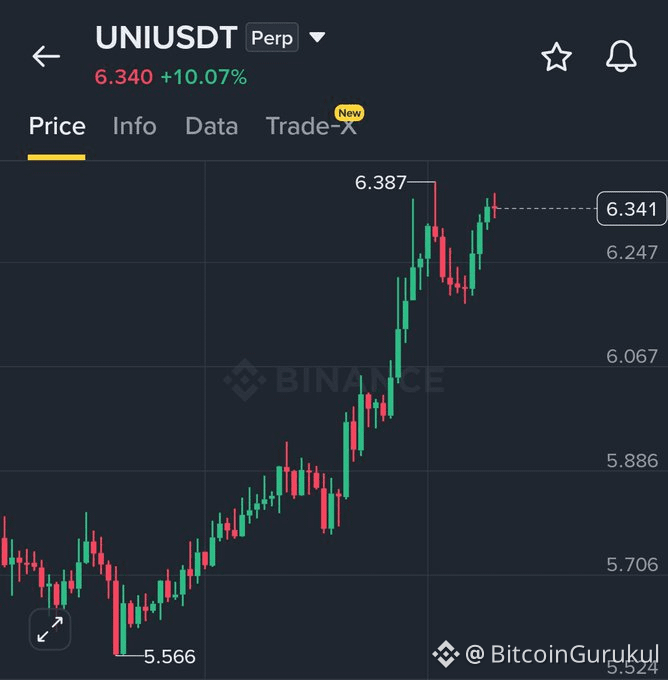
1
605
Robinhood Chain vs. Ethereum: Is a New Competitor Emerging? 👀
Robinhood Chain nearly doubled its TVL in August — but Ethereum still came out on top in the overall TVL score.
August TVL performers:
ETH: 100
Robinhood: 90
SOL: 24
Base: 24
MON: 22
HYPE: 19
BTC: 17
BNB: 10
ARB: 6
TRX: 2
Ethereum added $7.72B in TVL during August, more than the other chains on this list combined.
But percentage growth tells a different story:
🔹 Robinhood Chain: +89.9%
🔹 Ethereum: +18.9%
That's nearly 5x faster growth for Robinhood Chain in a single month.
Of course, Ethereum's massive existing TVL makes percentage comparisons harder. New chains can post huge growth rates from a much smaller base.
The real test is September:
Can Robinhood Chain maintain this growth, or was August just an early surge? 👀
#Ethereum #Robinhood #Crypto #DeFi
Robinhood Chain vs. Ethereum: Is a New Competitor Emerging? 👀
Robinhood Chain nearly doubled its TVL in August — but Ethereum still came out on top in the overall TVL score.
August TVL performers:
ETH: 100
Robinhood: 90
SOL: 24
Base: 24
MON: 22
HYPE: 19
BTC: 17
BNB: 10
ARB: 6
TRX: 2
Ethereum added $7.72B in TVL during August, more than the other chains on this list combined.
But percentage growth tells a different story:
🔹 Robinhood Chain: +89.9%
🔹 Ethereum: +18.9%
That's nearly 5x faster growth for Robinhood Chain in a single month.
Of course, Ethereum's massive existing TVL makes percentage comparisons harder. New chains can post huge growth rates from a much smaller base.
The real test is September:
Can Robinhood Chain maintain this growth, or was August just an early surge? 👀
#Ethereum #Robinhood #Crypto #DeFi
Robinhood Chain nearly doubled its TVL in August — but Ethereum still came out on top in the overall TVL score.
August TVL performers:
ETH: 100
Robinhood: 90
SOL: 24
Base: 24
MON: 22
HYPE: 19
BTC: 17
BNB: 10
ARB: 6
TRX: 2
Ethereum added $7.72B in TVL during August, more than the other chains on this list combined.
But percentage growth tells a different story:
🔹 Robinhood Chain: +89.9%
🔹 Ethereum: +18.9%
That's nearly 5x faster growth for Robinhood Chain in a single month.
Of course, Ethereum's massive existing TVL makes percentage comparisons harder. New chains can post huge growth rates from a much smaller base.
The real test is September:
Can Robinhood Chain maintain this growth, or was August just an early surge? 👀
#Ethereum #Robinhood #Crypto #DeFi
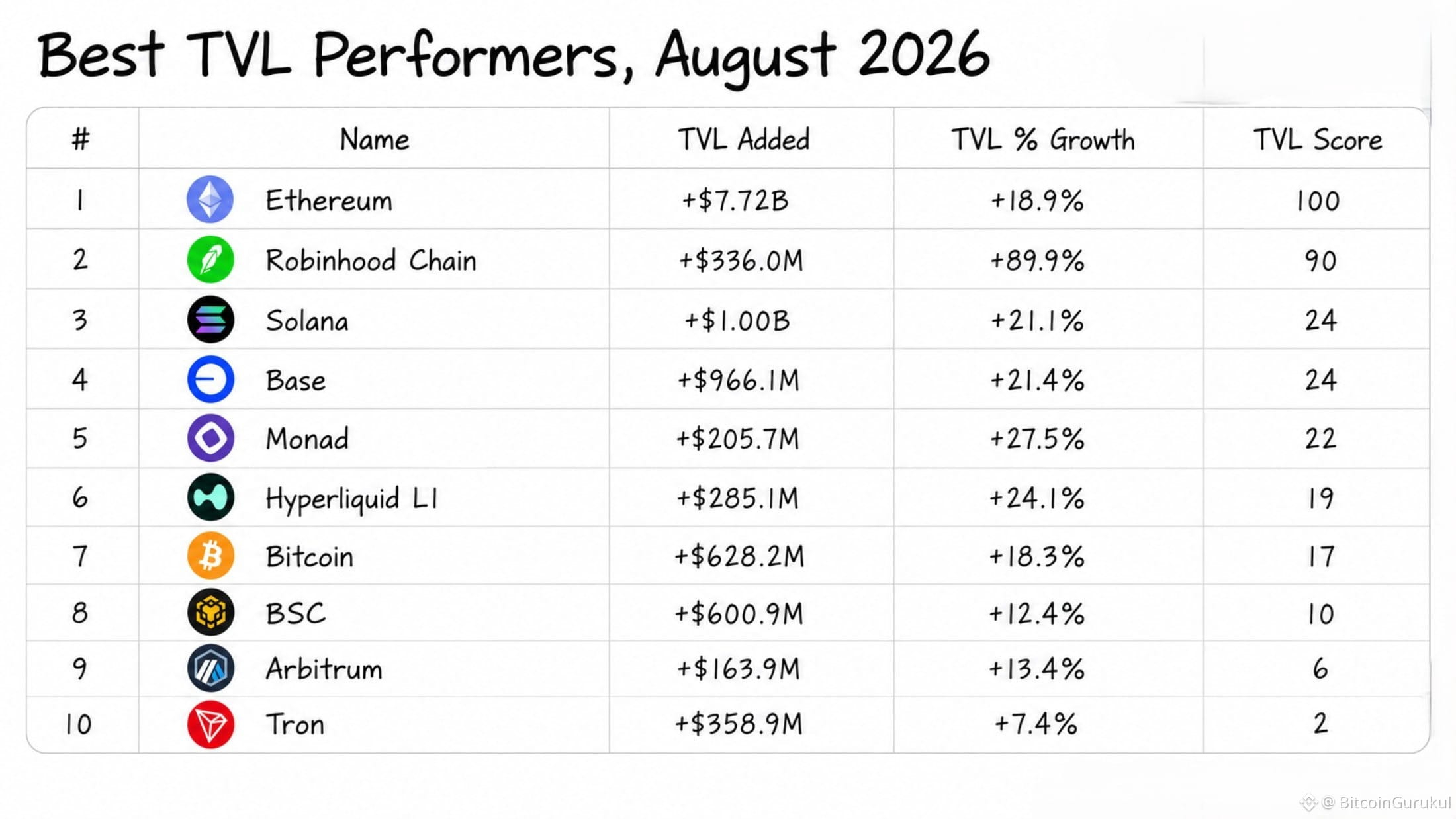
109
ETH/BTC closed the monthly above the MA 20.
The last clean reclaim of this average was July 2020, when ETH/BTC ran from 0.0315 to 0.088 and ETH went from $225 to $4,372.
August 2025 also tagged this line but It failed to hold and Price dumped back toward the lows, thats why we need it to hold above MA 20.
Now price is back on the same average. MACD is turning up from the circled low, the same zone that preceded the 2020 breakout.
The chart maps two steps if this hold works.
Target 1: 0.050
Stretch target: the old high near 0.088
ISM came in at 54.6 vs 55.2 expected which means Growth is still strong, but slowing, which could give the Fed more room to pause rates.
This setup could mean ETH is finally ready to outperform BTC.
ETH/BTC closed the monthly above the MA 20.
The last clean reclaim of this average was July 2020, when ETH/BTC ran from 0.0315 to 0.088 and ETH went from $225 to $4,372.
August 2025 also tagged this line but It failed to hold and Price dumped back toward the lows, thats why we need it to hold above MA 20.
Now price is back on the same average. MACD is turning up from the circled low, the same zone that preceded the 2020 breakout.
The chart maps two steps if this hold works.
Target 1: 0.050
Stretch target: the old high near 0.088
ISM came in at 54.6 vs 55.2 expected which means Growth is still strong, but slowing, which could give the Fed more room to pause rates.
This setup could mean ETH is finally ready to outperform BTC.
The last clean reclaim of this average was July 2020, when ETH/BTC ran from 0.0315 to 0.088 and ETH went from $225 to $4,372.
August 2025 also tagged this line but It failed to hold and Price dumped back toward the lows, thats why we need it to hold above MA 20.
Now price is back on the same average. MACD is turning up from the circled low, the same zone that preceded the 2020 breakout.
The chart maps two steps if this hold works.
Target 1: 0.050
Stretch target: the old high near 0.088
ISM came in at 54.6 vs 55.2 expected which means Growth is still strong, but slowing, which could give the Fed more room to pause rates.
This setup could mean ETH is finally ready to outperform BTC.
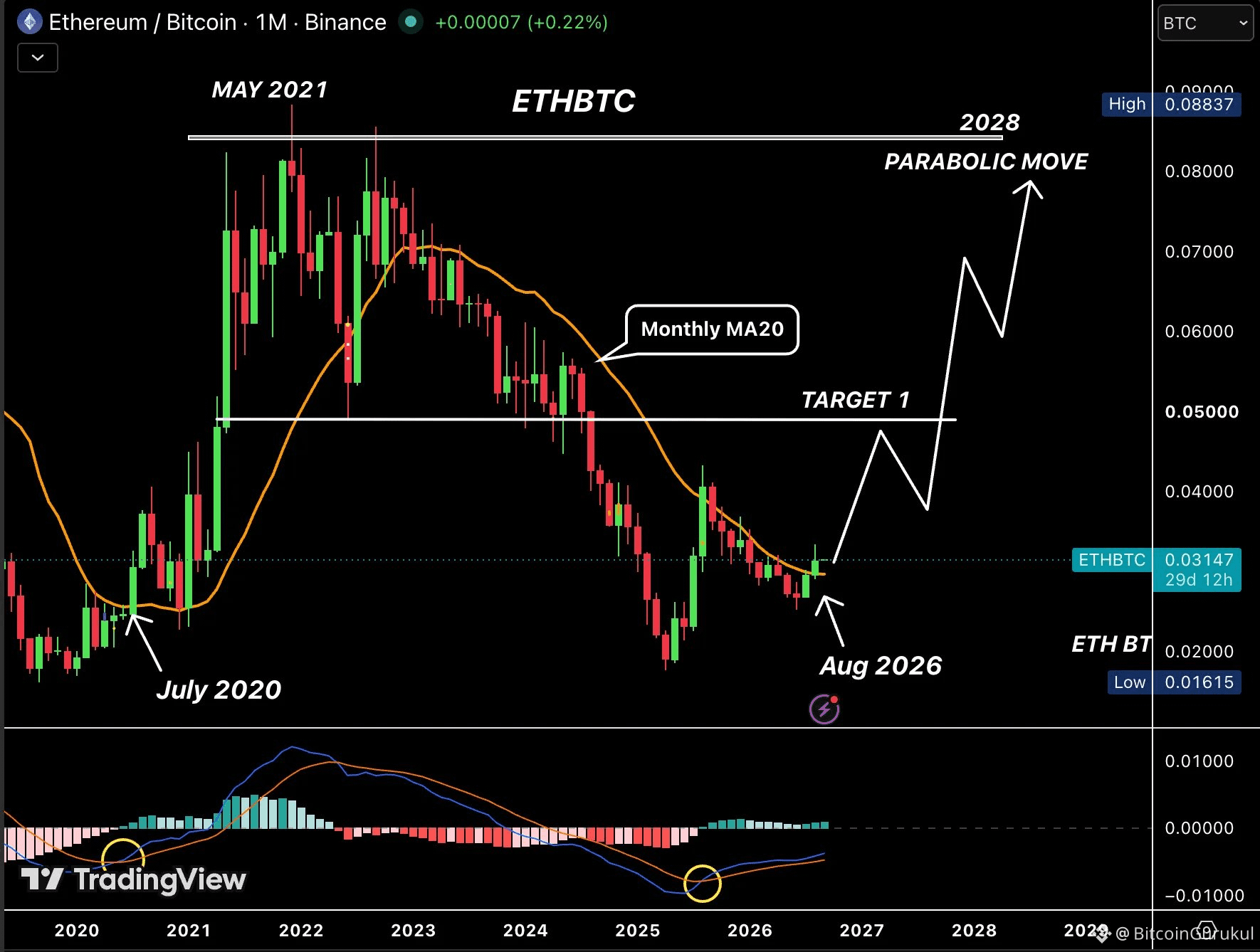
92
BREAKING : 🇺🇸 BlackRock ETF has sold $202,200,000 worth of Bitcoin.
BREAKING : 🇺🇸 BlackRock ETF has sold $202,200,000 worth of Bitcoin.
1
188
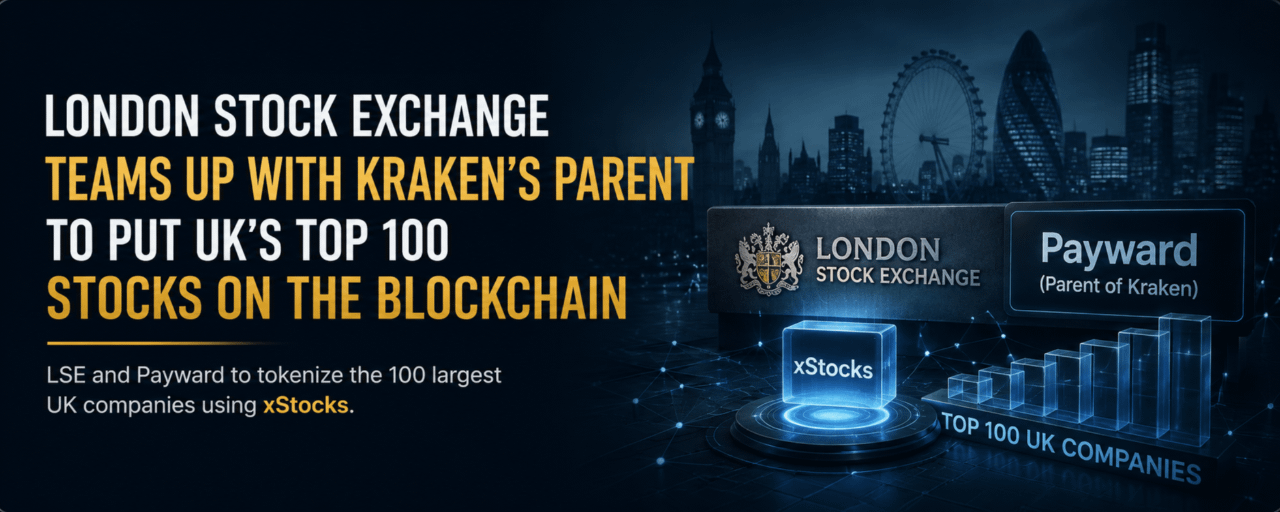
ලිපිය
London Stock Exchange Teams Up With Kraken's Parent to Put UK's Top 100 Stocks on the BlockchainLSE Is Bringing Its Biggest Stocks Onto the Blockchain
The London Stock Exchange just took its clearest step yet toward round-the-clock, blockchain-based trading. On September 1, 2026, the London Stock Exchange Group (LSEG) announced a partnership with Payward, the parent company of crypto exchange Kraken, to tokenize the 100 largest companies listed in London.
Over the coming weeks, shares in those 100 companies will become available as xStocks, a tokenized-equities framework built by Payward. Each token will be backed one to one by the underlying share, meaning one xStock represents ownership tied to exactly one real share sitting behind it.
This isn't a hypothetical pilot buried in a whitepaper. It's a live commercial rollout involving one of the world's oldest and most established stock exchanges and one of crypto's largest trading platforms.
What Are xStocks, and Why Does the Format Matter?
xStocks are digital tokens that track the price of a real, publicly traded share while adding the properties of a blockchain asset: continuous trading, portability across wallets, and the ability to plug into decentralized finance applications.
A traditional share sitting in a brokerage account only trades during exchange hours and moves through a chain of clearing intermediaries that can take days to settle. Its tokenized counterpart can move instantly, at any hour, into a self-custody wallet or an onchain application, all while tracking the price of the underlying stock.
Payward says the xStocks framework has already processed more than $40 billion in cumulative trading volume since launching in June 2025, with close to $20 billion settled onchain and more than 200,000 holders. That existing user base is part of why LSE picked this particular partner rather than building a tokenization system from scratch.
Who Can Actually Trade These Tokens?
This is where the announcement gets more nuanced than the headlines suggest. The tokenized UK shares will be available to investors in more than 110 countries through Kraken and other platforms in the xStocks Alliance. UK-based investors are explicitly excluded for now. xStocks are not currently offered to people trading from inside the UK, even though the underlying companies are UK-listed.
In practice, that means a trader in Singapore or Brazil could get exposure to a FTSE 100 constituent's price movement 24 hours a day, while a trader in London still has to wait for the LSE's normal opening hours to trade the actual share.
LSE 24: The Regulatory Piece Still Missing
The tokenized shares becoming available through Payward's platform is separate from LSE officially listing and supporting xStocks trading on its own infrastructure. That second step depends on regulatory approval.
If regulators sign off, LSE plans to list xStocks on LSE 24, a new 24-hour trading venue the exchange has already announced. LSE 24 is expected to launch in the first half of 2027, starting with exchange-traded products before expanding further. The venue is designed to give international retail investors access to London-listed assets outside the exchange's traditional trading window, directly responding to competition from crypto platforms that already offer round-the-clock stock exposure.
Beyond the initial 100 UK stocks, LSE and Payward have said they intend to explore tokenizing shares from the US, the EU, and Hong Kong, along with other asset classes, and to look into issuer-sponsored equity tokens that carry the same rights as traditional shares.
Why This Matters for Crypto and Traditional Finance
Stock exchanges rarely move fast, and partnering with a crypto-native company to tokenize their flagship index constituents is a real shift in posture, not a marketing exercise.
For crypto: it's validation that tokenized real-world assets aren't a niche experiment. A exchange with LSE's regulatory weight is willing to put its top 100 companies through a blockchain-based framework built by a crypto exchange's parent company.
For traditional finance: it's a competitive response. Platforms like Kraken and Coinbase have offered tokenized equity trading for a while, pulling volume and attention away from traditional venues that only operate during set hours. LSE's own executives have framed the shift toward 24/7 access as necessary to keep London relevant as a "facilitator of domestic and global flow" against that backdrop.
For everyday investors: the near-term impact is limited. UK investors can't use xStocks yet, and full LSE-listed tokenized trading depends on approval that hasn't happened. The immediate effect is mostly felt by international investors who previously had no easy way to gain exposure to UK blue-chip stocks outside London trading hours.
What to Watch Next
Three things will determine whether this becomes a meaningful shift or stays a limited pilot:
Regulatory approval for LSE to formally list xStocks on LSE 24Whether UK investors eventually get access, and under what rulesTrading volume once the 100 UK xStocks go live on Kraken and other Alliance platforms in the coming weeks
If LSE 24 launches on schedule in 2027 and volumes on the initial 100 stocks hold up, expect other major exchanges to accelerate their own tokenization plans rather than risk losing more volume to crypto-native venues.
FAQ
What are xStocks? xStocks are blockchain-based tokens backed one to one by real, publicly traded shares. They track the underlying stock's price while allowing 24/7 trading across centralized exchanges, self-custody wallets, and onchain applications.
Can UK investors buy tokenized LSE stocks right now? No. xStocks are not currently available to UK-based investors, even though the tokens represent UK-listed companies. Access is limited to investors in the more than 110 countries supported by Kraken and other xStocks Alliance platforms.
When will LSE officially support tokenized stock trading? That depends on regulatory approval. If approved, LSE plans to list xStocks on LSE 24, its dedicated 24-hour trading venue, which is expected to launch in the first half of 2027.
#Tokenization #xStocks #LondonStockExchange #Kraken #RWA
London Stock Exchange Teams Up With Kraken's Parent to Put UK's Top 100 Stocks on the Blockchain
LSE Is Bringing Its Biggest Stocks Onto the Blockchain
The London Stock Exchange just took its clearest step yet toward round-the-clock, blockchain-based trading. On September 1, 2026, the London Stock Exchange Group (LSEG) announced a partnership with Payward, the parent company of crypto exchange Kraken, to tokenize the 100 largest companies listed in London.
Over the coming weeks, shares in those 100 companies will become available as xStocks, a tokenized-equities framework built by Payward. Each token will be backed one to one by the underlying share, meaning one xStock represents ownership tied to exactly one real share sitting behind it.
This isn't a hypothetical pilot buried in a whitepaper. It's a live commercial rollout involving one of the world's oldest and most established stock exchanges and one of crypto's largest trading platforms.
What Are xStocks, and Why Does the Format Matter?
xStocks are digital tokens that track the price of a real, publicly traded share while adding the properties of a blockchain asset: continuous trading, portability across wallets, and the ability to plug into decentralized finance applications.
A traditional share sitting in a brokerage account only trades during exchange hours and moves through a chain of clearing intermediaries that can take days to settle. Its tokenized counterpart can move instantly, at any hour, into a self-custody wallet or an onchain application, all while tracking the price of the underlying stock.
Payward says the xStocks framework has already processed more than $40 billion in cumulative trading volume since launching in June 2025, with close to $20 billion settled onchain and more than 200,000 holders. That existing user base is part of why LSE picked this particular partner rather than building a tokenization system from scratch.
Who Can Actually Trade These Tokens?
This is where the announcement gets more nuanced than the headlines suggest. The tokenized UK shares will be available to investors in more than 110 countries through Kraken and other platforms in the xStocks Alliance. UK-based investors are explicitly excluded for now. xStocks are not currently offered to people trading from inside the UK, even though the underlying companies are UK-listed.
In practice, that means a trader in Singapore or Brazil could get exposure to a FTSE 100 constituent's price movement 24 hours a day, while a trader in London still has to wait for the LSE's normal opening hours to trade the actual share.
LSE 24: The Regulatory Piece Still Missing
The tokenized shares becoming available through Payward's platform is separate from LSE officially listing and supporting xStocks trading on its own infrastructure. That second step depends on regulatory approval.
If regulators sign off, LSE plans to list xStocks on LSE 24, a new 24-hour trading venue the exchange has already announced. LSE 24 is expected to launch in the first half of 2027, starting with exchange-traded products before expanding further. The venue is designed to give international retail investors access to London-listed assets outside the exchange's traditional trading window, directly responding to competition from crypto platforms that already offer round-the-clock stock exposure.
Beyond the initial 100 UK stocks, LSE and Payward have said they intend to explore tokenizing shares from the US, the EU, and Hong Kong, along with other asset classes, and to look into issuer-sponsored equity tokens that carry the same rights as traditional shares.
Why This Matters for Crypto and Traditional Finance
Stock exchanges rarely move fast, and partnering with a crypto-native company to tokenize their flagship index constituents is a real shift in posture, not a marketing exercise.
For crypto: it's validation that tokenized real-world assets aren't a niche experiment. A exchange with LSE's regulatory weight is willing to put its top 100 companies through a blockchain-based framework built by a crypto exchange's parent company.
For traditional finance: it's a competitive response. Platforms like Kraken and Coinbase have offered tokenized equity trading for a while, pulling volume and attention away from traditional venues that only operate during set hours. LSE's own executives have framed the shift toward 24/7 access as necessary to keep London relevant as a "facilitator of domestic and global flow" against that backdrop.
For everyday investors: the near-term impact is limited. UK investors can't use xStocks yet, and full LSE-listed tokenized trading depends on approval that hasn't happened. The immediate effect is mostly felt by international investors who previously had no easy way to gain exposure to UK blue-chip stocks outside London trading hours.
What to Watch Next
Three things will determine whether this becomes a meaningful shift or stays a limited pilot:
Regulatory approval for LSE to formally list xStocks on LSE 24Whether UK investors eventually get access, and under what rulesTrading volume once the 100 UK xStocks go live on Kraken and other Alliance platforms in the coming weeks
If LSE 24 launches on schedule in 2027 and volumes on the initial 100 stocks hold up, expect other major exchanges to accelerate their own tokenization plans rather than risk losing more volume to crypto-native venues.
FAQ
What are xStocks? xStocks are blockchain-based tokens backed one to one by real, publicly traded shares. They track the underlying stock's price while allowing 24/7 trading across centralized exchanges, self-custody wallets, and onchain applications.
Can UK investors buy tokenized LSE stocks right now? No. xStocks are not currently available to UK-based investors, even though the tokens represent UK-listed companies. Access is limited to investors in the more than 110 countries supported by Kraken and other xStocks Alliance platforms.
When will LSE officially support tokenized stock trading? That depends on regulatory approval. If approved, LSE plans to list xStocks on LSE 24, its dedicated 24-hour trading venue, which is expected to launch in the first half of 2027.
#Tokenization #xStocks #LondonStockExchange #Kraken #RWA
The London Stock Exchange just took its clearest step yet toward round-the-clock, blockchain-based trading. On September 1, 2026, the London Stock Exchange Group (LSEG) announced a partnership with Payward, the parent company of crypto exchange Kraken, to tokenize the 100 largest companies listed in London.
Over the coming weeks, shares in those 100 companies will become available as xStocks, a tokenized-equities framework built by Payward. Each token will be backed one to one by the underlying share, meaning one xStock represents ownership tied to exactly one real share sitting behind it.
This isn't a hypothetical pilot buried in a whitepaper. It's a live commercial rollout involving one of the world's oldest and most established stock exchanges and one of crypto's largest trading platforms.
What Are xStocks, and Why Does the Format Matter?
xStocks are digital tokens that track the price of a real, publicly traded share while adding the properties of a blockchain asset: continuous trading, portability across wallets, and the ability to plug into decentralized finance applications.
A traditional share sitting in a brokerage account only trades during exchange hours and moves through a chain of clearing intermediaries that can take days to settle. Its tokenized counterpart can move instantly, at any hour, into a self-custody wallet or an onchain application, all while tracking the price of the underlying stock.
Payward says the xStocks framework has already processed more than $40 billion in cumulative trading volume since launching in June 2025, with close to $20 billion settled onchain and more than 200,000 holders. That existing user base is part of why LSE picked this particular partner rather than building a tokenization system from scratch.
Who Can Actually Trade These Tokens?
This is where the announcement gets more nuanced than the headlines suggest. The tokenized UK shares will be available to investors in more than 110 countries through Kraken and other platforms in the xStocks Alliance. UK-based investors are explicitly excluded for now. xStocks are not currently offered to people trading from inside the UK, even though the underlying companies are UK-listed.
In practice, that means a trader in Singapore or Brazil could get exposure to a FTSE 100 constituent's price movement 24 hours a day, while a trader in London still has to wait for the LSE's normal opening hours to trade the actual share.
LSE 24: The Regulatory Piece Still Missing
The tokenized shares becoming available through Payward's platform is separate from LSE officially listing and supporting xStocks trading on its own infrastructure. That second step depends on regulatory approval.
If regulators sign off, LSE plans to list xStocks on LSE 24, a new 24-hour trading venue the exchange has already announced. LSE 24 is expected to launch in the first half of 2027, starting with exchange-traded products before expanding further. The venue is designed to give international retail investors access to London-listed assets outside the exchange's traditional trading window, directly responding to competition from crypto platforms that already offer round-the-clock stock exposure.
Beyond the initial 100 UK stocks, LSE and Payward have said they intend to explore tokenizing shares from the US, the EU, and Hong Kong, along with other asset classes, and to look into issuer-sponsored equity tokens that carry the same rights as traditional shares.
Why This Matters for Crypto and Traditional Finance
Stock exchanges rarely move fast, and partnering with a crypto-native company to tokenize their flagship index constituents is a real shift in posture, not a marketing exercise.
For crypto: it's validation that tokenized real-world assets aren't a niche experiment. A exchange with LSE's regulatory weight is willing to put its top 100 companies through a blockchain-based framework built by a crypto exchange's parent company.
For traditional finance: it's a competitive response. Platforms like Kraken and Coinbase have offered tokenized equity trading for a while, pulling volume and attention away from traditional venues that only operate during set hours. LSE's own executives have framed the shift toward 24/7 access as necessary to keep London relevant as a "facilitator of domestic and global flow" against that backdrop.
For everyday investors: the near-term impact is limited. UK investors can't use xStocks yet, and full LSE-listed tokenized trading depends on approval that hasn't happened. The immediate effect is mostly felt by international investors who previously had no easy way to gain exposure to UK blue-chip stocks outside London trading hours.
What to Watch Next
Three things will determine whether this becomes a meaningful shift or stays a limited pilot:
Regulatory approval for LSE to formally list xStocks on LSE 24Whether UK investors eventually get access, and under what rulesTrading volume once the 100 UK xStocks go live on Kraken and other Alliance platforms in the coming weeks
If LSE 24 launches on schedule in 2027 and volumes on the initial 100 stocks hold up, expect other major exchanges to accelerate their own tokenization plans rather than risk losing more volume to crypto-native venues.
FAQ
What are xStocks? xStocks are blockchain-based tokens backed one to one by real, publicly traded shares. They track the underlying stock's price while allowing 24/7 trading across centralized exchanges, self-custody wallets, and onchain applications.
Can UK investors buy tokenized LSE stocks right now? No. xStocks are not currently available to UK-based investors, even though the tokens represent UK-listed companies. Access is limited to investors in the more than 110 countries supported by Kraken and other xStocks Alliance platforms.
When will LSE officially support tokenized stock trading? That depends on regulatory approval. If approved, LSE plans to list xStocks on LSE 24, its dedicated 24-hour trading venue, which is expected to launch in the first half of 2027.
#Tokenization #xStocks #LondonStockExchange #Kraken #RWA
272
🚨 THE LONDON STOCK EXCHANGE IS BRINGING STOCKS ONCHAIN
The London Stock Exchange Group is partnering with Payward, the parent company of Kraken, to introduce tokenised UK shares.
The plan is part of the upcoming LSE 24 digital trading platform.
That means major UK-listed companies could eventually have blockchain-based representations that can trade with much longer hours than traditional markets.
Why this matters for crypto:
🏦 Traditional equities are moving onchain
⏰ Markets are moving toward near-24/7 trading
⚡ Blockchain can enable faster settlement
🌍 Tokenised stocks can make global access easier
This is bigger than one stock exchange.
Wall Street, European exchanges and crypto platforms are all converging around the same idea:
Traditional financial assets don't have to stay trapped inside traditional market infrastructure.
Bitcoin showed that markets could operate 24/7.
Now traditional finance is starting to build toward the same model.
The next phase of crypto may be less about replacing TradFi — and more about putting TradFi onchain. 👀
$BTC $ETH
🚨 THE LONDON STOCK EXCHANGE IS BRINGING STOCKS ONCHAIN
The London Stock Exchange Group is partnering with Payward, the parent company of Kraken, to introduce tokenised UK shares.
The plan is part of the upcoming LSE 24 digital trading platform.
That means major UK-listed companies could eventually have blockchain-based representations that can trade with much longer hours than traditional markets.
Why this matters for crypto:
🏦 Traditional equities are moving onchain
⏰ Markets are moving toward near-24/7 trading
⚡ Blockchain can enable faster settlement
🌍 Tokenised stocks can make global access easier
This is bigger than one stock exchange.
Wall Street, European exchanges and crypto platforms are all converging around the same idea:
Traditional financial assets don't have to stay trapped inside traditional market infrastructure.
Bitcoin showed that markets could operate 24/7.
Now traditional finance is starting to build toward the same model.
The next phase of crypto may be less about replacing TradFi — and more about putting TradFi onchain. 👀
$BTC $ETH
The London Stock Exchange Group is partnering with Payward, the parent company of Kraken, to introduce tokenised UK shares.
The plan is part of the upcoming LSE 24 digital trading platform.
That means major UK-listed companies could eventually have blockchain-based representations that can trade with much longer hours than traditional markets.
Why this matters for crypto:
🏦 Traditional equities are moving onchain
⏰ Markets are moving toward near-24/7 trading
⚡ Blockchain can enable faster settlement
🌍 Tokenised stocks can make global access easier
This is bigger than one stock exchange.
Wall Street, European exchanges and crypto platforms are all converging around the same idea:
Traditional financial assets don't have to stay trapped inside traditional market infrastructure.
Bitcoin showed that markets could operate 24/7.
Now traditional finance is starting to build toward the same model.
The next phase of crypto may be less about replacing TradFi — and more about putting TradFi onchain. 👀
$BTC $ETH
116
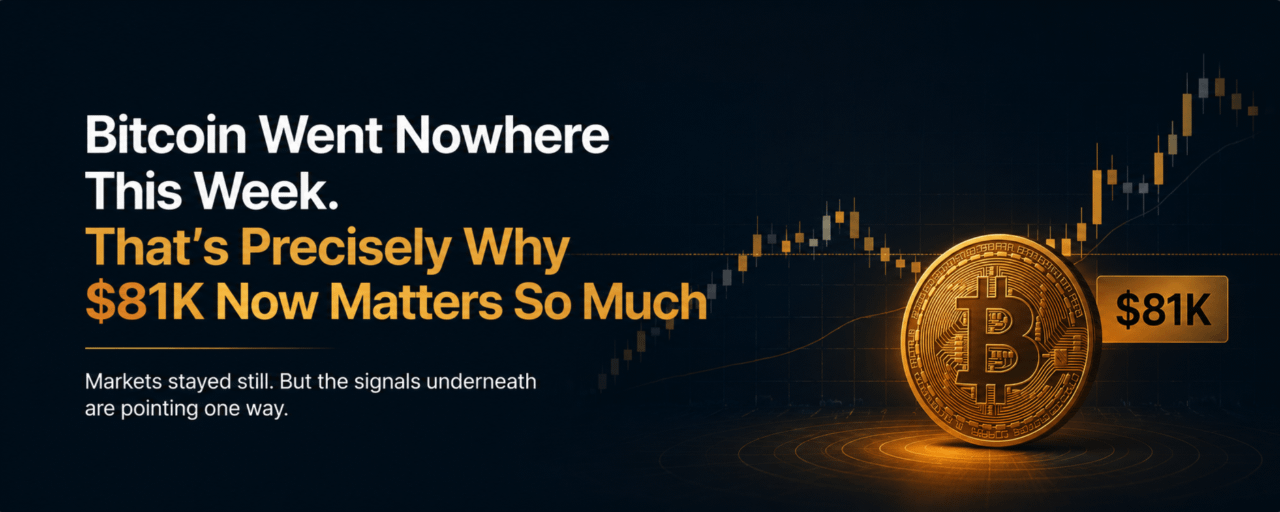
ලිපිය
Bitcoin Went Nowhere This Week. That's Precisely Why $81K Now Matters So MuchA flat weekly close usually gets ignored. This one shouldn't be.
Bitcoin ended the week almost exactly where it started, with neither buyers nor sellers strong enough to force a decision. On the surface, that looks like indecision. Underneath it, though, several momentum indicators quietly flipped in the bulls' favor for the first time in weeks. The chart is calm. The setup underneath it is not.
Three Signals, One Direction
Look past the price and at the momentum readings, and a pattern emerges:
MACD is turning bullish. After weeks of downward pressure, the momentum line is curling higher, an early sign that sellers are running out of energy.RSI has climbed back above 50. Traders treat this line as the psychological split between bearish and bullish control. Reclaiming it doesn't confirm a trend change, but it's the first step toward one.Stochastic RSI is showing positive momentum. This is the fastest-moving of the three, and it's already leaning bullish — often the first indicator to move before price follows.
Individually, none of these guarantees anything. Momentum indicators flip regularly, including inside downtrends that never actually reverse. What makes this week worth paying attention to is that all three are aligned in the same direction at the same time.
Why $81,000 Is the Real Test
Momentum can shift for a week and mean nothing. Price structure is what actually confirms a trend change, and that's where the Weekly 50 Moving Average comes in — currently sitting near $81,000.
Throughout this downtrend, that moving average has acted as a ceiling. Every meaningful rally has run into it and failed. So the question isn't whether momentum looks better this week. It's whether BTC can finally close above this specific level and hold there.
A break and hold above $81,000 would be the clearest technical evidence yet that the downtrend is over, not just pausing. That kind of move tends to pull in trend-following capital that's been sitting out, and it opens the door toward the $90,000–$100,000 zone.
A rejection at $81,000, on the other hand, keeps the downtrend intact regardless of how good this week's indicators looked. In that scenario, the more likely path is back down toward $69,000, a level that has already proven it can hold as support once before.
One level. Two very different next few weeks.
The Levels That Define the Range
Type Level What it means Resistance $81,000 The line between "recovery attempt" and "confirmed reversal" Support $75,000 First line of defense if momentum stalls Support $69,000 The level a failed breakout would likely retest
A slip below $75,000 wouldn't erase this week's bullish momentum signals outright, but it would put them in doubt fast — and shift the focus straight to whether $69,000 holds a second time.
The Two Catalysts That Could Force the Issue
Technical setups like this one rarely resolve in a vacuum. Two macro releases land this week, and either could be the push that decides which side of $81,000 Bitcoin ends up on.
Tuesday — US ISM data. A weak manufacturing print tends to feed expectations of a slower economy and, eventually, looser policy — historically a tailwind for risk assets like Bitcoin. A strong print can do the opposite.Friday — US jobs data. This is the bigger one. Payrolls data drives interest rate expectations more than almost any other single release, and rate expectations move crypto liquidity directly. A soft jobs report would strengthen the bull case; a hot one would give sellers a reason to defend $81,000 hard.
Given how tightly BTC is coiled around resistance right now, don't be surprised if one of these two days ends up doing more to decide the next month than the last four weeks of price action combined.
What This Setup Actually Tells You
Improving momentum without a broken structure is not a reversal. It's a warning that one might be coming. Bitcoin has flashed bullish momentum during this downtrend before without following through, so treating this week's readings as confirmation would be getting ahead of the chart.
What's different this time is the alignment: three separate momentum tools agreeing, right as price sits at the exact level that has rejected every previous attempt. That combination doesn't guarantee a breakout. It does mean this is the most meaningful test of $81,000 the downtrend has produced so far — and this week's macro data may end up being the deciding vote.
This is technical analysis and market commentary, not financial advice. Crypto markets are highly volatile — always do your own research before trading.
FAQ
What happens if Bitcoin breaks above $81,000? A weekly close above the $81,000 Weekly MA 50 would be the clearest sign yet that the downtrend has ended, opening the path toward $90,000–$100,000.
What happens if Bitcoin gets rejected at $81,000? A rejection keeps the downtrend intact and points back toward $69,000, the level most likely to be retested.
Why does bullish momentum matter if the price hasn't actually broken out yet? Momentum indicators like MACD, RSI, and Stochastic RSI tend to shift before price confirms a trend change. They're an early signal, not proof — the Weekly MA 50 break is what confirms it.
Why does Friday's jobs report matter more than usual this week? BTC is sitting right at resistance, so any surprise in the data has an outsized chance of tipping price to one side of $81,000 rather than getting absorbed in a wider range.
#Bitcoin #BTC #CryptoMarkets #TechnicalAnalysis #CryptoTrading
Bitcoin Went Nowhere This Week. That's Precisely Why $81K Now Matters So Much
A flat weekly close usually gets ignored. This one shouldn't be.
Bitcoin ended the week almost exactly where it started, with neither buyers nor sellers strong enough to force a decision. On the surface, that looks like indecision. Underneath it, though, several momentum indicators quietly flipped in the bulls' favor for the first time in weeks. The chart is calm. The setup underneath it is not.
Three Signals, One Direction
Look past the price and at the momentum readings, and a pattern emerges:
MACD is turning bullish. After weeks of downward pressure, the momentum line is curling higher, an early sign that sellers are running out of energy.RSI has climbed back above 50. Traders treat this line as the psychological split between bearish and bullish control. Reclaiming it doesn't confirm a trend change, but it's the first step toward one.Stochastic RSI is showing positive momentum. This is the fastest-moving of the three, and it's already leaning bullish — often the first indicator to move before price follows.
Individually, none of these guarantees anything. Momentum indicators flip regularly, including inside downtrends that never actually reverse. What makes this week worth paying attention to is that all three are aligned in the same direction at the same time.
Why $81,000 Is the Real Test
Momentum can shift for a week and mean nothing. Price structure is what actually confirms a trend change, and that's where the Weekly 50 Moving Average comes in — currently sitting near $81,000.
Throughout this downtrend, that moving average has acted as a ceiling. Every meaningful rally has run into it and failed. So the question isn't whether momentum looks better this week. It's whether BTC can finally close above this specific level and hold there.
A break and hold above $81,000 would be the clearest technical evidence yet that the downtrend is over, not just pausing. That kind of move tends to pull in trend-following capital that's been sitting out, and it opens the door toward the $90,000–$100,000 zone.
A rejection at $81,000, on the other hand, keeps the downtrend intact regardless of how good this week's indicators looked. In that scenario, the more likely path is back down toward $69,000, a level that has already proven it can hold as support once before.
One level. Two very different next few weeks.
The Levels That Define the Range
Type Level What it means Resistance $81,000 The line between "recovery attempt" and "confirmed reversal" Support $75,000 First line of defense if momentum stalls Support $69,000 The level a failed breakout would likely retest
A slip below $75,000 wouldn't erase this week's bullish momentum signals outright, but it would put them in doubt fast — and shift the focus straight to whether $69,000 holds a second time.
The Two Catalysts That Could Force the Issue
Technical setups like this one rarely resolve in a vacuum. Two macro releases land this week, and either could be the push that decides which side of $81,000 Bitcoin ends up on.
Tuesday — US ISM data. A weak manufacturing print tends to feed expectations of a slower economy and, eventually, looser policy — historically a tailwind for risk assets like Bitcoin. A strong print can do the opposite.Friday — US jobs data. This is the bigger one. Payrolls data drives interest rate expectations more than almost any other single release, and rate expectations move crypto liquidity directly. A soft jobs report would strengthen the bull case; a hot one would give sellers a reason to defend $81,000 hard.
Given how tightly BTC is coiled around resistance right now, don't be surprised if one of these two days ends up doing more to decide the next month than the last four weeks of price action combined.
What This Setup Actually Tells You
Improving momentum without a broken structure is not a reversal. It's a warning that one might be coming. Bitcoin has flashed bullish momentum during this downtrend before without following through, so treating this week's readings as confirmation would be getting ahead of the chart.
What's different this time is the alignment: three separate momentum tools agreeing, right as price sits at the exact level that has rejected every previous attempt. That combination doesn't guarantee a breakout. It does mean this is the most meaningful test of $81,000 the downtrend has produced so far — and this week's macro data may end up being the deciding vote.
This is technical analysis and market commentary, not financial advice. Crypto markets are highly volatile — always do your own research before trading.
FAQ
What happens if Bitcoin breaks above $81,000? A weekly close above the $81,000 Weekly MA 50 would be the clearest sign yet that the downtrend has ended, opening the path toward $90,000–$100,000.
What happens if Bitcoin gets rejected at $81,000? A rejection keeps the downtrend intact and points back toward $69,000, the level most likely to be retested.
Why does bullish momentum matter if the price hasn't actually broken out yet? Momentum indicators like MACD, RSI, and Stochastic RSI tend to shift before price confirms a trend change. They're an early signal, not proof — the Weekly MA 50 break is what confirms it.
Why does Friday's jobs report matter more than usual this week? BTC is sitting right at resistance, so any surprise in the data has an outsized chance of tipping price to one side of $81,000 rather than getting absorbed in a wider range.
#Bitcoin #BTC #CryptoMarkets #TechnicalAnalysis #CryptoTrading
Bitcoin ended the week almost exactly where it started, with neither buyers nor sellers strong enough to force a decision. On the surface, that looks like indecision. Underneath it, though, several momentum indicators quietly flipped in the bulls' favor for the first time in weeks. The chart is calm. The setup underneath it is not.
Three Signals, One Direction
Look past the price and at the momentum readings, and a pattern emerges:
MACD is turning bullish. After weeks of downward pressure, the momentum line is curling higher, an early sign that sellers are running out of energy.RSI has climbed back above 50. Traders treat this line as the psychological split between bearish and bullish control. Reclaiming it doesn't confirm a trend change, but it's the first step toward one.Stochastic RSI is showing positive momentum. This is the fastest-moving of the three, and it's already leaning bullish — often the first indicator to move before price follows.
Individually, none of these guarantees anything. Momentum indicators flip regularly, including inside downtrends that never actually reverse. What makes this week worth paying attention to is that all three are aligned in the same direction at the same time.
Why $81,000 Is the Real Test
Momentum can shift for a week and mean nothing. Price structure is what actually confirms a trend change, and that's where the Weekly 50 Moving Average comes in — currently sitting near $81,000.
Throughout this downtrend, that moving average has acted as a ceiling. Every meaningful rally has run into it and failed. So the question isn't whether momentum looks better this week. It's whether BTC can finally close above this specific level and hold there.
A break and hold above $81,000 would be the clearest technical evidence yet that the downtrend is over, not just pausing. That kind of move tends to pull in trend-following capital that's been sitting out, and it opens the door toward the $90,000–$100,000 zone.
A rejection at $81,000, on the other hand, keeps the downtrend intact regardless of how good this week's indicators looked. In that scenario, the more likely path is back down toward $69,000, a level that has already proven it can hold as support once before.
One level. Two very different next few weeks.
The Levels That Define the Range
Type Level What it means Resistance $81,000 The line between "recovery attempt" and "confirmed reversal" Support $75,000 First line of defense if momentum stalls Support $69,000 The level a failed breakout would likely retest
A slip below $75,000 wouldn't erase this week's bullish momentum signals outright, but it would put them in doubt fast — and shift the focus straight to whether $69,000 holds a second time.
The Two Catalysts That Could Force the Issue
Technical setups like this one rarely resolve in a vacuum. Two macro releases land this week, and either could be the push that decides which side of $81,000 Bitcoin ends up on.
Tuesday — US ISM data. A weak manufacturing print tends to feed expectations of a slower economy and, eventually, looser policy — historically a tailwind for risk assets like Bitcoin. A strong print can do the opposite.Friday — US jobs data. This is the bigger one. Payrolls data drives interest rate expectations more than almost any other single release, and rate expectations move crypto liquidity directly. A soft jobs report would strengthen the bull case; a hot one would give sellers a reason to defend $81,000 hard.
Given how tightly BTC is coiled around resistance right now, don't be surprised if one of these two days ends up doing more to decide the next month than the last four weeks of price action combined.
What This Setup Actually Tells You
Improving momentum without a broken structure is not a reversal. It's a warning that one might be coming. Bitcoin has flashed bullish momentum during this downtrend before without following through, so treating this week's readings as confirmation would be getting ahead of the chart.
What's different this time is the alignment: three separate momentum tools agreeing, right as price sits at the exact level that has rejected every previous attempt. That combination doesn't guarantee a breakout. It does mean this is the most meaningful test of $81,000 the downtrend has produced so far — and this week's macro data may end up being the deciding vote.
This is technical analysis and market commentary, not financial advice. Crypto markets are highly volatile — always do your own research before trading.
FAQ
What happens if Bitcoin breaks above $81,000? A weekly close above the $81,000 Weekly MA 50 would be the clearest sign yet that the downtrend has ended, opening the path toward $90,000–$100,000.
What happens if Bitcoin gets rejected at $81,000? A rejection keeps the downtrend intact and points back toward $69,000, the level most likely to be retested.
Why does bullish momentum matter if the price hasn't actually broken out yet? Momentum indicators like MACD, RSI, and Stochastic RSI tend to shift before price confirms a trend change. They're an early signal, not proof — the Weekly MA 50 break is what confirms it.
Why does Friday's jobs report matter more than usual this week? BTC is sitting right at resistance, so any surprise in the data has an outsized chance of tipping price to one side of $81,000 rather than getting absorbed in a wider range.
#Bitcoin #BTC #CryptoMarkets #TechnicalAnalysis #CryptoTrading
1
127
AUGUST WAS MASSIVE FOR CRYPTO.
1. President Trump said the US is considering buying large amounts of Bitcoin and altcoins.
2. The CLARITY Act got President Trump's backing, with a Senate vote set for September 15.
3. BTC jumped 25% and had its first green August ever in a bear market.
4. ETH pumped 32.5%, its best month since May 2025.
5. SOL surged 41.4%, the biggest monthly gain since February 2024.
6. BTC ETFs bought $3.52 billion, their biggest month in almost a year.
7. ETH ETFs bought $1.85 billion, while SOL ETFs added $193 million, hitting their highest levels since August and November 2025.
8. Crypto recorded its biggest single day short liquidation in history at $2.79 billion.
9. President Putin signed Russia's first law legalising crypto trading.
10. The ECB is pushing to move central bank money onto the crypto blockchain.
11. Japan is moving its $16.5 trillion stock and bond market onto the blockchain.
12. Big banks like JPMorgan started exploring their own stablecoins.
13. The CFTC and SEC proposed crypto regulations.
14. Coinbase will let users buy homes using Bitcoin as collateral.
After months of pain, we deserved a month like this.
AUGUST WAS MASSIVE FOR CRYPTO.
1. President Trump said the US is considering buying large amounts of Bitcoin and altcoins.
2. The CLARITY Act got President Trump's backing, with a Senate vote set for September 15.
3. BTC jumped 25% and had its first green August ever in a bear market.
4. ETH pumped 32.5%, its best month since May 2025.
5. SOL surged 41.4%, the biggest monthly gain since February 2024.
6. BTC ETFs bought $3.52 billion, their biggest month in almost a year.
7. ETH ETFs bought $1.85 billion, while SOL ETFs added $193 million, hitting their highest levels since August and November 2025.
8. Crypto recorded its biggest single day short liquidation in history at $2.79 billion.
9. President Putin signed Russia's first law legalising crypto trading.
10. The ECB is pushing to move central bank money onto the crypto blockchain.
11. Japan is moving its $16.5 trillion stock and bond market onto the blockchain.
12. Big banks like JPMorgan started exploring their own stablecoins.
13. The CFTC and SEC proposed crypto regulations.
14. Coinbase will let users buy homes using Bitcoin as collateral.
After months of pain, we deserved a month like this.
1. President Trump said the US is considering buying large amounts of Bitcoin and altcoins.
2. The CLARITY Act got President Trump's backing, with a Senate vote set for September 15.
3. BTC jumped 25% and had its first green August ever in a bear market.
4. ETH pumped 32.5%, its best month since May 2025.
5. SOL surged 41.4%, the biggest monthly gain since February 2024.
6. BTC ETFs bought $3.52 billion, their biggest month in almost a year.
7. ETH ETFs bought $1.85 billion, while SOL ETFs added $193 million, hitting their highest levels since August and November 2025.
8. Crypto recorded its biggest single day short liquidation in history at $2.79 billion.
9. President Putin signed Russia's first law legalising crypto trading.
10. The ECB is pushing to move central bank money onto the crypto blockchain.
11. Japan is moving its $16.5 trillion stock and bond market onto the blockchain.
12. Big banks like JPMorgan started exploring their own stablecoins.
13. The CFTC and SEC proposed crypto regulations.
14. Coinbase will let users buy homes using Bitcoin as collateral.
After months of pain, we deserved a month like this.
67
🚨 ARB JUST WENT VERTICAL — UP MORE THAN 42%
$ARB suddenly surged more than 42%, sharply outperforming the broader crypto market.
The move is unusual because there hasn't been an obvious market-wide catalyst explaining the strength.
That leaves traders watching one thing:
What's driving the demand? 👀
When a token moves this aggressively while the broader market is relatively quiet, the next step is to look for:
🔎 New protocol developments
🔎 Whale accumulation
🔎 Short liquidations
🔎 Exchange flows
🔎 Upcoming catalysts
A vertical move can continue — but it can also reverse just as quickly.
Don't chase the candle. Find the catalyst.
$ARB $ETH $BTC
🚨 ARB JUST WENT VERTICAL — UP MORE THAN 42%
$ARB suddenly surged more than 42%, sharply outperforming the broader crypto market.
The move is unusual because there hasn't been an obvious market-wide catalyst explaining the strength.
That leaves traders watching one thing:
What's driving the demand? 👀
When a token moves this aggressively while the broader market is relatively quiet, the next step is to look for:
🔎 New protocol developments
🔎 Whale accumulation
🔎 Short liquidations
🔎 Exchange flows
🔎 Upcoming catalysts
A vertical move can continue — but it can also reverse just as quickly.
Don't chase the candle. Find the catalyst.
$ARB $ETH $BTC
$ARB suddenly surged more than 42%, sharply outperforming the broader crypto market.
The move is unusual because there hasn't been an obvious market-wide catalyst explaining the strength.
That leaves traders watching one thing:
What's driving the demand? 👀
When a token moves this aggressively while the broader market is relatively quiet, the next step is to look for:
🔎 New protocol developments
🔎 Whale accumulation
🔎 Short liquidations
🔎 Exchange flows
🔎 Upcoming catalysts
A vertical move can continue — but it can also reverse just as quickly.
Don't chase the candle. Find the catalyst.
$ARB $ETH $BTC
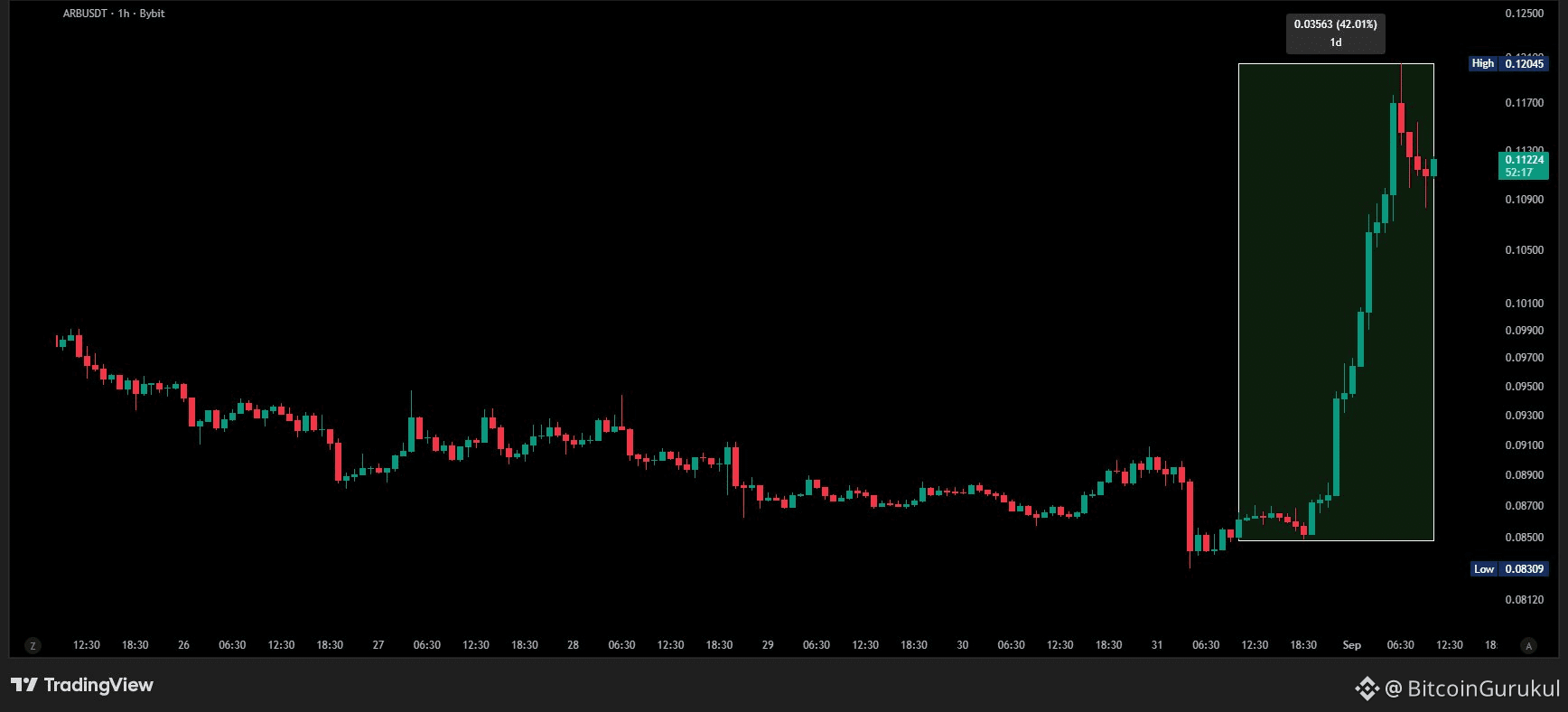
1
108
ETHEREUM JUST HAD ITS MOST BULLISH AUGUST CLOSE IN 4 YEARS.
ETHEREUM JUST HAD ITS MOST BULLISH AUGUST CLOSE IN 4 YEARS.
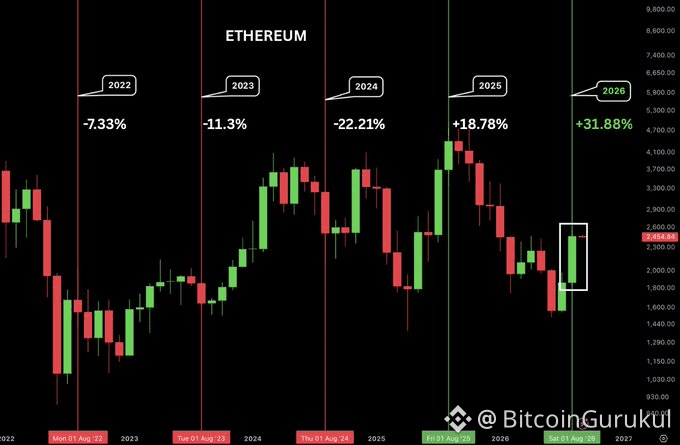
141
තවත් අන්තර්ගතයන් ගවේෂණය කිරීමට ඇතුල් වන්න
Binance චතුරශ්රය හි ගෝලීය ක්රිප්ටෝ පරිශීලකයින් හා එක්වන්න
⚡️ ක්රිප්ටෝ පිළිබඳ නවතම සහ ප්රයෝජනවත් තොරතුරු ලබා ගන්න.
💬 ලොව විශාලතම ක්රිප්ටෝ හුවමාරුව මගින් විශ්වාස කෙරේ.
👍 සත්යායනය කරන ලද නිර්මාණකරුවන්ගෙන් සැබෑ විදසුන් සොයා ගන්න.
විද්යුත් තැපෑල / දුරකථන අංකය
නැගී එන මාතෘකා
ZECHitsANewAllTimeHigh
67,754 views
752 සාකච්ඡා කරමින්
$ZEC
$1500 🤔
$2000 🤔
$2500 🤔
🚨🔥 ZEC has broken out following a nine-year period of accumulation. It has endured years of relentless hostility, yet we now have a Zcash ETF alongside a surging demand for privacy. Do you genuinely believe it shall halt at $1,000? 🤔
$1500 🤔
$2000 🤔
$2500 🤔
#ZECHitsANewAllTimeHigh
Wealthy bloke
·8 කැමත්ත දැක්වීම්
·6.4k views
LululemonTumbles20%OnWeakGuidance
41,311 views
628 සාකච්ඡා කරමින්
BitcoinETFsBiggestDailyInflowSinceJanuary
38,021 views
729 සාකච්ඡා කරමින්