
#appchains
appchains
11,552 නැරඹීම්
49 සාකච්ඡා කරමින්
උණුසුම්
නවතම

·
--
App-Specific Chains Are the Next Layer 1 Battleground
The endgame for blockchain scalability may not be a single monolithic L1 — it may be hundreds of purpose-built chains, each optimized for one application.
Avalanche pioneered this idea with subnets: sovereign execution environments that share validator sets but run custom virtual machines, gas tokens, and governance rules. An institutional DeFi subnet can enforce KYC at the consensus layer. A gaming subnet can configure instant finality and free user transactions. A payments subnet can hardcode compliance logic without touching the main network.
This matters because the tradeoffs for a high-frequency derivatives exchange are fundamentally different from those for a tokenized treasury fund. A shared execution environment forces every app to accept the same constraints. Subnet architecture lets each application own its performance envelope.
$AVAX is the economic anchor of this ecosystem: validators must stake it to secure subnets, and the primary network processes all subnet state transitions. Each new subnet is structural demand, not speculative demand.
$SOL and $ETH are iterating in parallel — SVM-based rollups and Ethereum L2 app-chains solve a similar problem from different starting points.
The app-chain thesis is not about fragmentation — it is about fit-for-purpose infrastructure replacing one-size-fits-all execution.
#AppChains #Avalanche #Layer1 #DeFi #Web3Infrastructure
71
·
--
The next institutional wave isn't buying tokens — it's deploying app-chains.
Avalanche and Polkadot have quietly become the two most active platforms for enterprise subnet and parachain launches in 2026. Banks, gaming studios, and payment processors are standing up dedicated subnets instead of sharing bandwidth on public L1s. Why? Compliance. When you control the validator set, KYC and AML policies sit at the infrastructure layer — not bolted on top.
$AVAX has processed over 2 million subnet transactions in the last quarter from institutional deployments alone. $DOT's JAM upgrade (post-Clarity Act rollout) finally removed the parachain auction friction that was holding enterprise teams back.
Here's what the market keeps missing: app-chain activity doesn't always move the base token price immediately. It builds underlying fee demand that compounds over 12–18 months. We saw this exact pattern with $ETH — developer lock-in precedes price discovery by roughly two cycles.
App-chains are the quiet infrastructure bet of this cycle. Watch subnet deployment velocity, not just token price. That's where the real signal lives.
#CryptoInvesting #AppChains #Avalanche #Polkadot #Web3Infrastructure
The next institutional wave isn't buying tokens — it's deploying app-chains.
Avalanche and Polkadot have quietly become the two most active platforms for enterprise subnet and parachain launches in 2026. Banks, gaming studios, and payment processors are standing up dedicated subnets instead of sharing bandwidth on public L1s. Why? Compliance. When you control the validator set, KYC and AML policies sit at the infrastructure layer — not bolted on top.
$AVAX has processed over 2 million subnet transactions in the last quarter from institutional deployments alone. $DOT 's JAM upgrade (post-Clarity Act rollout) finally removed the parachain auction friction that was holding enterprise teams back.
Here's what the market keeps missing: app-chain activity doesn't always move the base token price immediately. It builds underlying fee demand that compounds over 12–18 months. We saw this exact pattern with $ETH — developer lock-in precedes price discovery by roughly two cycles.
App-chains are the quiet infrastructure bet of this cycle. Watch subnet deployment velocity, not just token price. That's where the real signal lives.
#CryptoInvesting #AppChains #Avalanche #Polkadot #Web3Infrastructure
125

·
--
උසබ තත්ත්වය
Canopy is starting to get interesting.
$CNPY is the native token behind Canopy, a network built around making sovereign appchains easier to launch and secure.
What stands out to me is the shared-security approach. New chains can focus more on building their product instead of starting their validator infrastructure from zero.
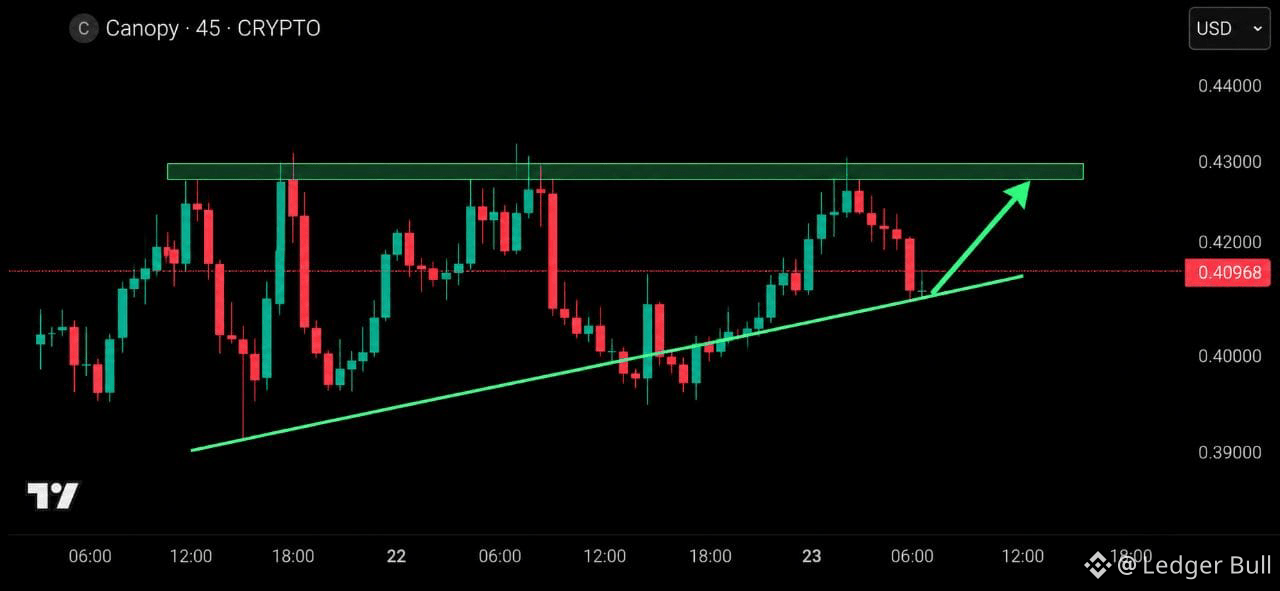
The chart is also worth watching. $CNPY continues to respect rising support while repeatedly challenging the $0.43 area.
If that level finally breaks with strength, things could get interesting quickly.
Is $CNPY quietly setting up for its next move?
Not financial advice , just information post
#CNPY #Canopy #Layer1 #Crypto #Appchains .
53
1
30
10.2k
·
--
Rollups That Exist for Just One Game 🎮⏳
Ephemeral rollups spin up instantly to settle high-frequency micro-transactions (like a web3 game tournament) and shut down immediately after pushing final balances to L1.
#AppChains #EphemeralRollup #Web3Dev #Scaling .
Rollups That Exist for Just One Game 🎮⏳
Ephemeral rollups spin up instantly to settle high-frequency micro-transactions (like a web3 game tournament) and shut down immediately after pushing final balances to L1.
#AppChains #EphemeralRollup #Web3Dev #Scaling .
Ephemeral rollups spin up instantly to settle high-frequency micro-transactions (like a web3 game tournament) and shut down immediately after pushing final balances to L1.
#AppChains #EphemeralRollup #Web3Dev #Scaling .
133
·
--
Avalanche Subnets Are Building the App-Chain Future Right Now
Most discussions about Layer 1s default to comparing monolithic throughput numbers — TPS, finality, gas fees. But that framing misses what $AVAX is quietly building: a sovereign subnet model that lets any protocol launch its own blockchain with custom validators, custom VMs, and custom rule sets — all secured by the same base consensus.
This matters because app-chain design unlocks something monolithic L1s structurally cannot: regulatory-grade permissioning. A financial institution can run a subnet where all validators are KYC-approved entities, while still being interoperable with the broader $AVAX ecosystem. That is a real competitive moat — not a theoretical one.
Compare this to $ETH rollups which inherit execution flexibility but are ultimately settlement-dependent on L1 finality, or $DOT parachains which pioneered the sovereign-chain-with-shared-security thesis. Each architecture makes deliberate tradeoffs.
Avalanche’s Warp Messaging (AWM) is enabling native cross-subnet communication that reduces reliance on bridge trust assumptions — one of the highest-risk components in multichain architecture.
The real signal to watch: institutional subnet deployments. When regulated entities start choosing subnet architecture for compliance reasons, that is adoption signal that price charts won’t show until months later.
Modular, sovereign, interoperable. App-chains are not the future — they are the present.
$AVAX $ETH $DOT
#Avalanche #AppChains #Web3Infrastructure #CryptoAdoption #Layer1
1
219

·
--
උසබ තත්ත්වය
Ecosystem Comparison: Saga vs. The World 🌐
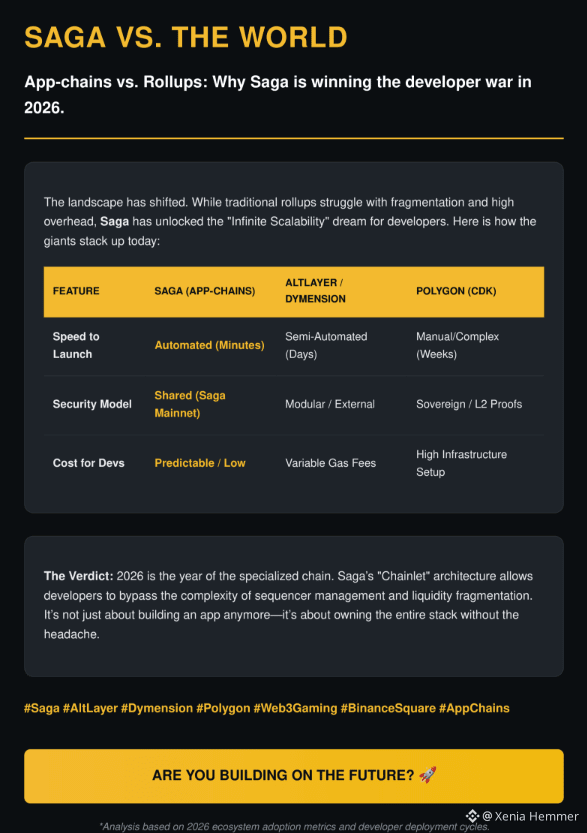
App-chains vs. Rollups: Why Saga is winning the developer war in 2026. ⚔️
The landscape has shifted. While traditional rollups struggle with fragmentation and high overhead, Saga has unlocked "Infinite Scalability" for developers. Here’s how the giants stack up:
FeatureSaga (App-Chains)AltLayer / DymensionPolygon (CDK)Speed to Launch⚡ Automated (Minutes)⏳ Semi-Auto (Days)🛠️ Manual (Weeks)Security Model🛡️ Shared (Saga Mainnet)🧱 Modular / External⚖️ Sovereign / L2Cost for Devs📉 Predictable / Low📈 Variable Gas💰 High Setup Cost
The Verdict: 2026 is the year of the specialized chain. Saga’s "Chainlet" architecture allows devs to bypass the headache of sequencer management and liquidity fragmentation. It’s not just about building an app—it’s about owning the entire stack effortlessly.
Are you building on the future, or stuck in the past? 🚀
#Saga #AltLayer #Dymension #Polygon #Web3Gaming #BinanceSquare #AppChains
{spot}(SAGAUSDT)
Ecosystem Comparison: Saga vs. The World 🌐
App-chains vs. Rollups: Why Saga is winning the developer war in 2026. ⚔️
The landscape has shifted. While traditional rollups struggle with fragmentation and high overhead, Saga has unlocked "Infinite Scalability" for developers. Here’s how the giants stack up:
FeatureSaga (App-Chains)AltLayer / DymensionPolygon (CDK)Speed to Launch⚡ Automated (Minutes)⏳ Semi-Auto (Days)🛠️ Manual (Weeks)Security Model🛡️ Shared (Saga Mainnet)🧱 Modular / External⚖️ Sovereign / L2Cost for Devs📉 Predictable / Low📈 Variable Gas💰 High Setup Cost
The Verdict: 2026 is the year of the specialized chain. Saga’s "Chainlet" architecture allows devs to bypass the headache of sequencer management and liquidity fragmentation. It’s not just about building an app—it’s about owning the entire stack effortlessly.
Are you building on the future, or stuck in the past? 🚀
#Saga #AltLayer #Dymension #Polygon #Web3Gaming #BinanceSquare #AppChains
1
363

·
--
🚀 Ready to dive into the future of blockchain? Discover Initia’s Interwoven Stack — the ultimate toolkit connecting appchains, Layer 1, and other blockchains seamlessly! 🌐✨
💡 What’s your take?
👉 How do you think this “Multichain Garden of Eden” will change the dApp game? Drop your thoughts below! 👇👇
🔥 Join the #LearnToEarn journey and unlock rewards by leveling up your blockchain knowledge. Don’t miss out on stacking $INIT and other cool tokens! 💰💎$INIT
#binancelearntoearn #WriteToEarn #DEFİ #Appchains #TaskCenter
1
95
·
--
The architecture of decentralized applications is evolving through the deployment of ephemeral blockchains and highly customized appchains.
Instead of launching applications on crowded public networks developers can spin up dedicated chains that exist only for specific events or financial settlement cycles.
These temporary networks settle their final state back to a secure layer one blockchain and then dissolve completely.
This approach provides massive scalability and zero gas fees for high volume activities like gaming tournaments and enterprise supply chain tracking.
#Appchains #ModularWeb3 #Scalability #BlockchainArchitecture #CryptoInfrastructure
199
·
--
උසබ තත්ත්වය
Saga is Going Up: The 2026 Ecosystem Surge 🚀
The momentum behind $SAGA is reaching a fever pitch as the "Infinite Scalability" dream becomes a reality. With the platform winning the developer war through automated, high-speed deployment, the value proposition has never been clearer.
Why the Trajectory is Vertical:
Developer Dominance: Saga's automated launch process is attracting more projects than ever, leaving manual competitors in the dust.
Token omics 2.0: The Prop 22 impact has transitioned $SAGA nto a "Hard Money" asset by capping inflation at a strict 3%.
Scarcity Meets Demand: Massive reduction in holder dilution means that as adoption climbs, the circulating supply remains tight and sustainable.
The Verdict: With a more secure model and predictable costs for developers, Saga isn't just growing—it’s evolving into the backbone of the specialized chain era.
$SAGA $BNB $SOL
#Saga #Bullish #Web3 #CryptoNews #AppChains
{spot}(SAGAUSDT)
Saga is Going Up: The 2026 Ecosystem Surge 🚀
The momentum behind $SAGA is reaching a fever pitch as the "Infinite Scalability" dream becomes a reality. With the platform winning the developer war through automated, high-speed deployment, the value proposition has never been clearer.
Why the Trajectory is Vertical:
Developer Dominance: Saga's automated launch process is attracting more projects than ever, leaving manual competitors in the dust.
Token omics 2.0: The Prop 22 impact has transitioned $SAGA nto a "Hard Money" asset by capping inflation at a strict 3%.
Scarcity Meets Demand: Massive reduction in holder dilution means that as adoption climbs, the circulating supply remains tight and sustainable.
The Verdict: With a more secure model and predictable costs for developers, Saga isn't just growing—it’s evolving into the backbone of the specialized chain era.
$SAGA $BNB $SOL
#Saga #Bullish #Web3 #CryptoNews #AppChains
1
163

·
--
🤔 ¿APPCHAINS? Qué son y para qué sirven.
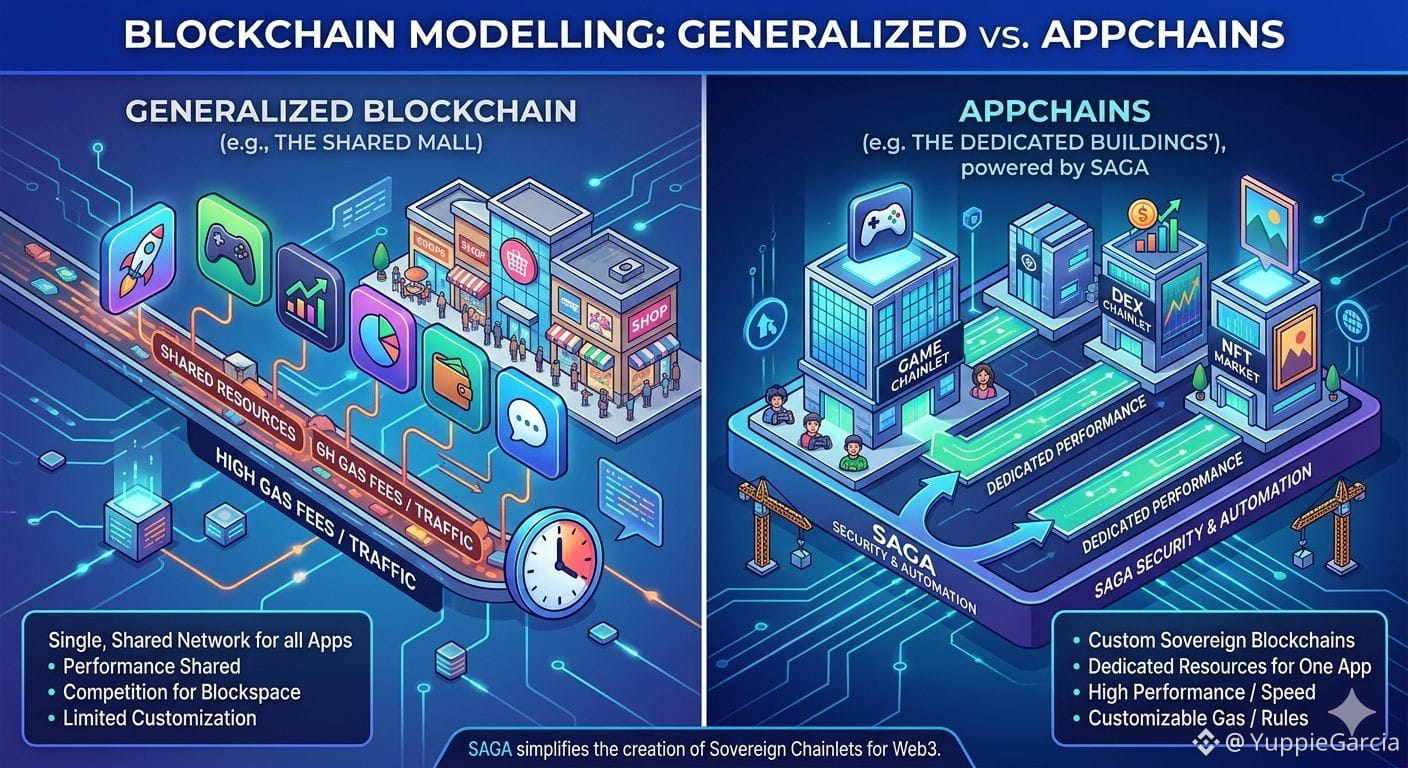
⭐ Para entender las appchains (cadenas de aplicaciones), primero hay que pensar en cómo funcionan las redes tradicionales como Ethereum.
Imagina que Ethereum es un centro comercial gigante: todos los negocios (apps) comparten el mismo espacio, los mismos pasillos y el mismo equipo de seguridad. Si el centro comercial se llena de gente, todos los locales sufren demoras y los costos de mantenimiento suben para todos.
⭐ Una appchain, en cambio, es como si un negocio decidiera construir su propio edificio independiente.
✅ ¿Por qué son tan importantes?
Soberanía total: Los desarrolladores tienen el control absoluto. Pueden elegir sus propias reglas, cómo se pagan las comisiones (gas) y qué tan rápido se procesan las transacciones sin depender de lo que pase en otras redes.
- Rendimiento dedicado: Como no compartes el "ancho de banda" con miles de otras aplicaciones, la red es mucho más rápida y eficiente para ese uso específico.
- Personalización: Si una aplicación necesita una función técnica muy rara que no existe en las redes comunes, en su propia appchain simplemente la programa y listo.
✅ ¿Dónde entra $SAGA en todo esto?
Aquí está el truco: construir una blockchain propia desde cero es carísimo y muy difícil de asegurar. Saga funciona como una "fábrica automatizada".
Permite que un desarrollador presione un botón y obtenga su propia appchain (que ellos llaman *Chainlets) de forma casi instantánea, utilizando la seguridad de la red principal de Saga.
Es como contratar una empresa que te construye y mantiene el edificio a medida para que tú solo te encargues de atender tu negocio.
📈 Es un concepto que también usan otros proyectos grandes como $COSMOS $ATOM (con sus zonas), Polkadot $DOT (con las parachains) o Avalanche $AVAX (con las subnets). ¡Es la tendencia de dejar de compartir espacio para pasar a tener "casas propias"!
#AppChainFuture #appchains #AppChainMeta
1
285

·
--
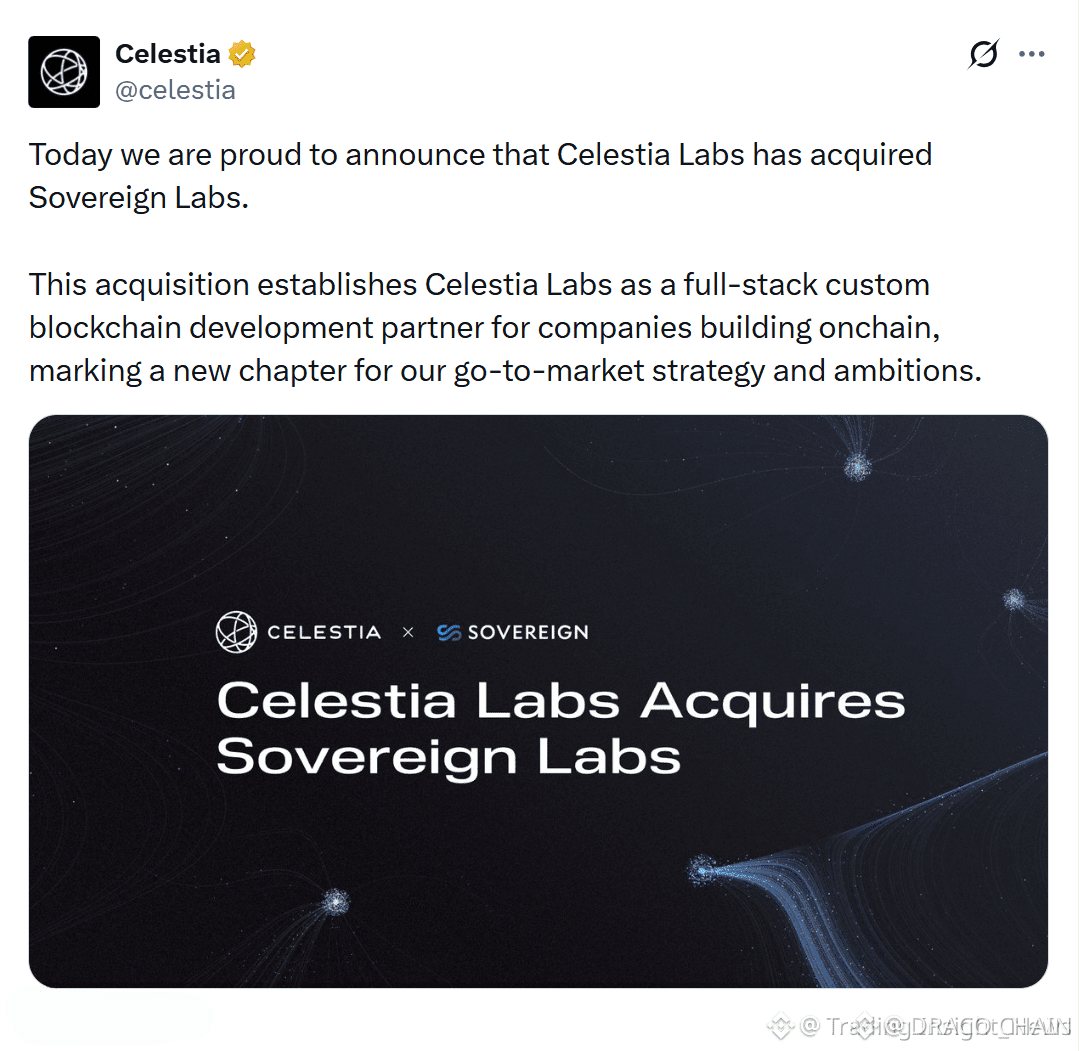
$TIA CELESTIA ACQUIRES SOVEREIGN LABS — FULL STACK PLAY 🔥
Celestia Labs has absorbed Sovereign Labs, bringing the team behind Relay Protocol and Bullet under one roof. Co-founder Preston Evans joins as CTO. This isn't a minor integration — it transforms Celestia from a data availability layer into a full-stack blockchain provider, now competing directly with Cosmos.
The timing aligns with the surge in app-chain demand, as projects like $HYPE and Polymarket opt for custom chains. If Celestia can deliver a complete stack, it becomes a one-stop shop for new L1s.
Do you see this acquisition shifting the competitive landscape for modular blockchains?
Not financial advice. Always manage your risk.
#TIA #Celestia #Acquisition #BlockchainInfrastructure #AppChains
🎯
193

·
--

ලිපිය
The End of the All-Purpose L1? Why Application-Specific Currencies are 2026’s Biggest Growth SectorApril 26, 2026 — For years, the industry was locked in a race to build the "Ethereum Killer"a faster, cheaper version of the same general-purpose model. But as we move through Q2 2026, the focus has shifted. "Smart Money" is no longer hunting for the next broad L1; it is flowing into App-Specific Currencies that serve as the native lifeblood of single, high-growth platforms.
1. The "Noisy Neighbor" Problem: Why General L1s Fail High-Growth Apps
The primary driver behind this shift is the Noisy Neighbor effect. On a general-purpose chain (like Ethereum or Solana), a viral NFT mint or a memecoin frenzy can spike gas fees for everyone, including unrelated DeFi protocols or gaming apps.
Predictable Economics: App-chains (like Zora’s creator network) isolate their blockspace. This means a surge in activity within the ecosystem doesn't crash the network or make transactions unaffordable for its core users.
Customized Execution: By building a specific chain (App-Chain 2.0), developers can optimize the virtual machine for their specific needs—whether that's high-speed social interactions or complex AI agent commerce.
2. The "Supply Lock" Effect: Tokenomics 2.0
Unlike general L1 tokens ($ETH, $SOL), which are often sold to pay for gas across thousands of different apps, App-Specific Currencies create a powerful Supply Lock:
Mandatory Utility: In ecosystems like Virtuals Protocol ($VIRTUAL), the native token is the only currency accepted for creating, upgrading, or interacting with AI agents.
The Flywheel: As the platform grows, more tokens are locked into agent treasuries or bonding curves. This removes circulating supply exactly when demand is peaking, leading to the "Supply Shock" rallies seen in early 2026.
Ecosystem Sovereignty: On the Zora network, the token isn't just for gas; it represents a stake in the creator economy's fees, aligning the incentives of the users, the creators, and the token holders in a way general L1s cannot.
3. Institutional Validation: From "Generalist" to "Specialist"
In 2026, institutional investors are treating these tokens like Equity in a Platform rather than just "Gas for a Network."
Direct Exposure: Buying $VIRTUAL provides direct, concentrated exposure to the growth of on-chain AI agents.
Regulatory Clarity: Under the 2025 regulations, tokens with clear, specific utility within a single platform are often viewed more favorably than "governance-only" tokens, leading to the "Compliance Premium" we see in current market valuations.
Conclusion: The Specialized Future
The transition to App-Chains 2.0 marks the maturity of the blockchain industry. We are moving from the "Internet Protocol" phase (where we built the pipes) to the "Application Layer" phase (where we build the businesses). In 2026, the biggest winners aren't the chains that do everything; they are the currencies that power the world's most essential apps.
Are you still holding generalist L1s, or have you rotated into ecosystem-specific powerhouses? Which "App-Chain" is leading your 2026 portfolio? Share your picks in the comments and follow for daily insights into the specialized future of Web3.
#BinanceSquare #appchains #VIRTUAL #zora #CryptoTrends
The End of the All-Purpose L1? Why Application-Specific Currencies are 2026’s Biggest Growth Sector
April 26, 2026 — For years, the industry was locked in a race to build the "Ethereum Killer"a faster, cheaper version of the same general-purpose model. But as we move through Q2 2026, the focus has shifted. "Smart Money" is no longer hunting for the next broad L1; it is flowing into App-Specific Currencies that serve as the native lifeblood of single, high-growth platforms.
1. The "Noisy Neighbor" Problem: Why General L1s Fail High-Growth Apps
The primary driver behind this shift is the Noisy Neighbor effect. On a general-purpose chain (like Ethereum or Solana), a viral NFT mint or a memecoin frenzy can spike gas fees for everyone, including unrelated DeFi protocols or gaming apps.
Predictable Economics: App-chains (like Zora’s creator network) isolate their blockspace. This means a surge in activity within the ecosystem doesn't crash the network or make transactions unaffordable for its core users.
Customized Execution: By building a specific chain (App-Chain 2.0), developers can optimize the virtual machine for their specific needs—whether that's high-speed social interactions or complex AI agent commerce.
2. The "Supply Lock" Effect: Tokenomics 2.0
Unlike general L1 tokens ($ETH, $SOL), which are often sold to pay for gas across thousands of different apps, App-Specific Currencies create a powerful Supply Lock:
Mandatory Utility: In ecosystems like Virtuals Protocol ($VIRTUAL), the native token is the only currency accepted for creating, upgrading, or interacting with AI agents.
The Flywheel: As the platform grows, more tokens are locked into agent treasuries or bonding curves. This removes circulating supply exactly when demand is peaking, leading to the "Supply Shock" rallies seen in early 2026.
Ecosystem Sovereignty: On the Zora network, the token isn't just for gas; it represents a stake in the creator economy's fees, aligning the incentives of the users, the creators, and the token holders in a way general L1s cannot.
3. Institutional Validation: From "Generalist" to "Specialist"
In 2026, institutional investors are treating these tokens like Equity in a Platform rather than just "Gas for a Network."
Direct Exposure: Buying $VIRTUAL provides direct, concentrated exposure to the growth of on-chain AI agents.
Regulatory Clarity: Under the 2025 regulations, tokens with clear, specific utility within a single platform are often viewed more favorably than "governance-only" tokens, leading to the "Compliance Premium" we see in current market valuations.
Conclusion: The Specialized Future
The transition to App-Chains 2.0 marks the maturity of the blockchain industry. We are moving from the "Internet Protocol" phase (where we built the pipes) to the "Application Layer" phase (where we build the businesses). In 2026, the biggest winners aren't the chains that do everything; they are the currencies that power the world's most essential apps.
Are you still holding generalist L1s, or have you rotated into ecosystem-specific powerhouses? Which "App-Chain" is leading your 2026 portfolio? Share your picks in the comments and follow for daily insights into the specialized future of Web3.
#BinanceSquare #appchains #VIRTUAL #zora #CryptoTrends
2
590
තවත් අන්තර්ගතයන් ගවේෂණය කිරීමට ඇතුල් වන්න
Binance චතුරශ්රය හි ගෝලීය ක්රිප්ටෝ පරිශීලකයින් හා එක්වන්න
⚡️ ක්රිප්ටෝ පිළිබඳ නවතම සහ ප්රයෝජනවත් තොරතුරු ලබා ගන්න.
💬 ලොව විශාලතම ක්රිප්ටෝ හුවමාරුව මගින් විශ්වාස කෙරේ.
👍 සත්යායනය කරන ලද නිර්මාණකරුවන්ගෙන් සැබෑ විදසුන් සොයා ගන්න.
විද්යුත් තැපෑල / දුරකථන අංකය
නැගී එන මාතෘකා
1
#BitcoinRebounds$75KAsChipsLead
2,306 නැරඹීම්
62 සාකච්ඡා කරමින්
2
#JobsReportRaisesHikeOdds
49,917 නැරඹීම්
679 සාකච්ඡා කරමින්
3
#US Data Center Rules May Constrain AI Expansion
6,847 නැරඹීම්
78 සාකච්ඡා කරමින්
4
#$2TWipedOutHedgeFundsFaceLiquidation
9,650 නැරඹීම්
83 සාකච්ඡා කරමින්
5
#WillAnthropicListOnTime
4,601 නැරඹීම්
133 සාකච්ඡා කරමින්
6
#USNovemberMichiganExpectationsIndexPrelimAt50.9
10,909 නැරඹීම්
244 සාකච්ඡා කරමින්
7
#OilPlungesBelow$100
11,759 නැරඹීම්
33 සාකච්ඡා කරමින්
8
#TradFiForBeginners
6,484 නැරඹීම්
135 සාකච්ඡා කරමින්
9
#USMidtermsCouldShakeUpUS-IranTies
26,244 නැරඹීම්
419 සාකච්ඡා කරමින්
10
#RussianCentralBankNamesBTCETHUSDTForNonQualifiedInvestors
372 නැරඹීම්
7 සාකච්ඡා කරමින්