
#cryptography
cryptography
Просмотров: 26,268
258 обсуждают
Популярные
Новые

·
--
Статья
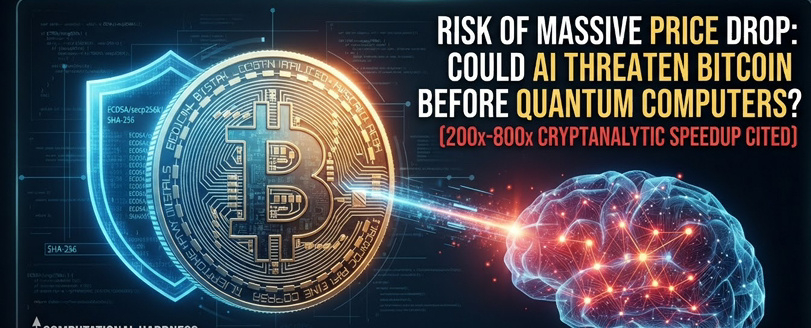
🚨Risk of a Massive Price Drop: Could AI Threaten Bitcoin Before Quantum Computers Arrive?On November 27, billionaire venture investor Chamath Palihapitiya published a thesis examining whether advanced artificial intelligence could pose a cryptographic risk to Bitcoin-and trigger a severe price collapse-well before fault-tolerant quantum computers become commercially viable.
Rather than relying on brute-force hardware scaling, the argument centers on algorithmic breakthroughs—where AI discovers new mathematical shortcuts that compress computational requirements by orders of magnitude.
‼️ Core Arguments & Cryptographic Precedents
🧊Computational Hardness vs. Impossibility: #BTC security (built on elliptic curve cryptography, ECDSA/secp256k1, and SHA-256) rests on the premise that deriving private keys from exposed public keys requires infeasible computing power under known algorithms-not mathematical impossibility.
🥊 The 1977 vs. 1994 RSA Precedent: In 1977, factoring a benchmark RSA challenge was estimated to take 40 quadrillion years; by 1994, algorithmic advances and distributed computing solved an even harder factorization problem in 8 months.
🤖 AI Cryptanalytic Acceleration: The research points to a July 2026 benchmark where Claude Mythos Preview identified an attack vector on a reduced-round version of AES-128 running 200–800x faster than previously known methods-illustrating how AI can uncover non-obvious mathematical optimizations.
✨ Code-Only Security Architecture: Because Bitcoin’s security is enforced purely by open-source code rather than a centralized backstop or reversible ledger, any unexpected mathematical breakthrough against elliptic curve signatures would require rapid protocol-level consensus and migration to post-quantum/AI-resistant signature schemes.
Risk & Security Playbook 🛡️
➡️ Address Hygiene Matters Today: Public keys are only exposed on-chain once funds are spent from an address (or in older pay-to-public-key formats). Using fresh receiving addresses for every transaction minimizes exposed public key surface area.
➡️ Separate Tail-Risk Headlines from Immediate Liquidity: Cryptographic research on simplified ciphers (like reduced-round AES) is worlds apart from breaking full secp256k1 in production, and Bitcoin developers already maintain active BIP proposals for quantum-resistant upgrades-keep portfolio sizing disciplined and avoid emotional knee-jerk trades on existential headlines.
👇 COMMUNITY DEBATE:
Do you view AI-driven cryptanalysis as a realistic medium-term catalyst for Bitcoin to adopt post-quantum signature upgrades, or is this distant theoretical risk being overstated? Share your perspective below! 💬
#CyberSecurity #Cryptography #RiskManagement
🚨Risk of a Massive Price Drop: Could AI Threaten Bitcoin Before Quantum Computers Arrive?
On November 27, billionaire venture investor Chamath Palihapitiya published a thesis examining whether advanced artificial intelligence could pose a cryptographic risk to Bitcoin-and trigger a severe price collapse-well before fault-tolerant quantum computers become commercially viable.
Rather than relying on brute-force hardware scaling, the argument centers on algorithmic breakthroughs—where AI discovers new mathematical shortcuts that compress computational requirements by orders of magnitude.
‼️ Core Arguments & Cryptographic Precedents
🧊Computational Hardness vs. Impossibility: #BTC security (built on elliptic curve cryptography, ECDSA/secp256k1, and SHA-256) rests on the premise that deriving private keys from exposed public keys requires infeasible computing power under known algorithms-not mathematical impossibility.
🥊 The 1977 vs. 1994 RSA Precedent: In 1977, factoring a benchmark RSA challenge was estimated to take 40 quadrillion years; by 1994, algorithmic advances and distributed computing solved an even harder factorization problem in 8 months.
🤖 AI Cryptanalytic Acceleration: The research points to a July 2026 benchmark where Claude Mythos Preview identified an attack vector on a reduced-round version of AES-128 running 200–800x faster than previously known methods-illustrating how AI can uncover non-obvious mathematical optimizations.
✨ Code-Only Security Architecture: Because Bitcoin’s security is enforced purely by open-source code rather than a centralized backstop or reversible ledger, any unexpected mathematical breakthrough against elliptic curve signatures would require rapid protocol-level consensus and migration to post-quantum/AI-resistant signature schemes.
Risk & Security Playbook 🛡️
➡️ Address Hygiene Matters Today: Public keys are only exposed on-chain once funds are spent from an address (or in older pay-to-public-key formats). Using fresh receiving addresses for every transaction minimizes exposed public key surface area.
➡️ Separate Tail-Risk Headlines from Immediate Liquidity: Cryptographic research on simplified ciphers (like reduced-round AES) is worlds apart from breaking full secp256k1 in production, and Bitcoin developers already maintain active BIP proposals for quantum-resistant upgrades-keep portfolio sizing disciplined and avoid emotional knee-jerk trades on existential headlines.
👇 COMMUNITY DEBATE:
Do you view AI-driven cryptanalysis as a realistic medium-term catalyst for Bitcoin to adopt post-quantum signature upgrades, or is this distant theoretical risk being overstated? Share your perspective below! 💬
#CyberSecurity #Cryptography #RiskManagement
1
213


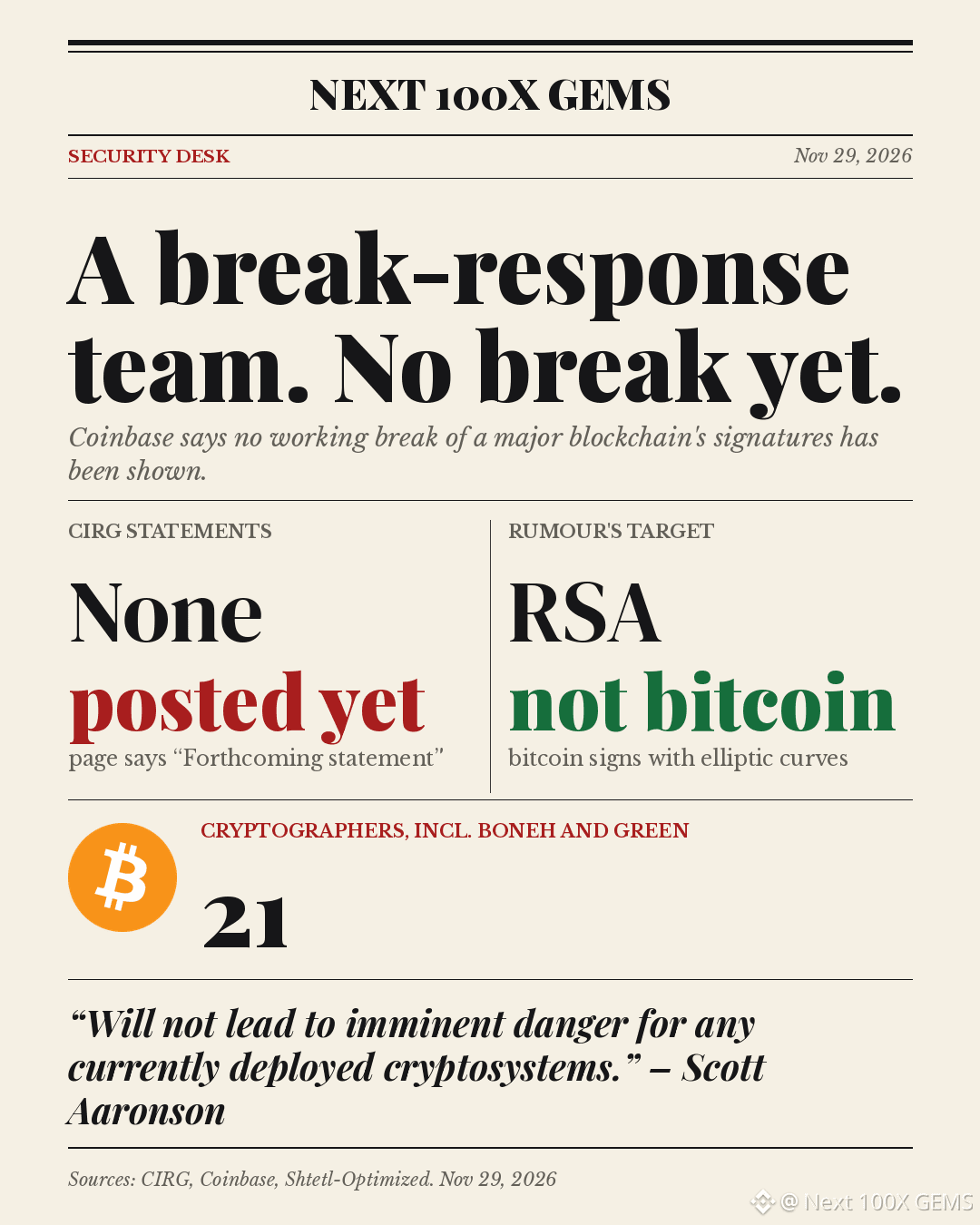
$BTC holders, meet the Cryptography Incident Review Group.
Twenty-one cryptographers, including Dan Boneh and Matthew Green, set it up to advise if a code break lands. It has posted no statement yet.
The #Cryptography scare behind it centres on RSA, and bitcoin signs with elliptic curves. Coinbase says no one has shown a working break of major chain signatures.
We are treating it as a fire drill until a paper says otherwise.
NFA. DYOR.
133
·
--
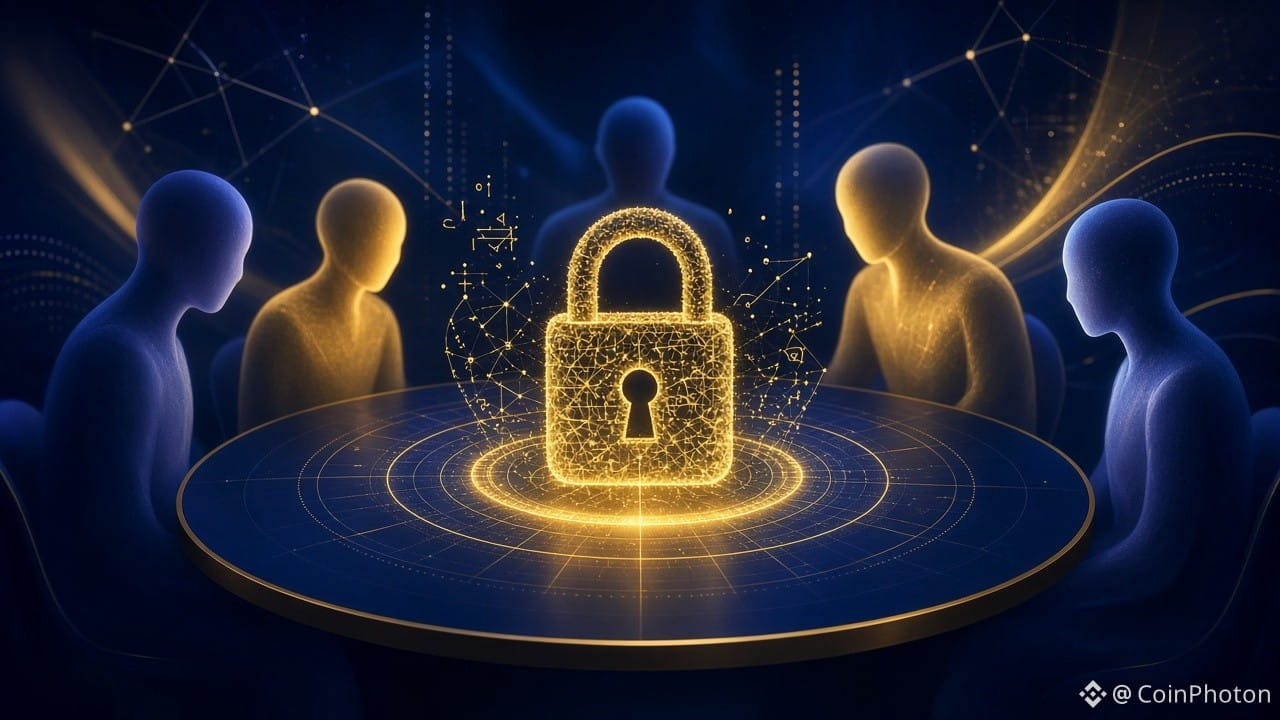
🔐 21 top cryptographers launch a cryptography incident review group
A new Cryptography Incident Review Group (CIRG) made up of 21 cryptographers, including Stanford's Dan Boneh, Johns Hopkins' Matthew Green, MIT's Yael Tauman Kalai and Vinod Vaikuntanathan, and Georgetown and a16z's Justin Thaler, has launched its website. The group says it will review and help respond to advances in cryptanalysis, advising on how to disclose breaks, communicate with affected parties and plan for cryptographic resilience. Its statements page currently reads "coming soon."
⭐ The launch comes amid market worries that AI could break cryptography, a core question for the security of Bitcoin and other blockchains.
#Cryptography #Bitcoin #CryptoSecurity #AI
78
·
--
🚨 **CẢNH BÁO: AI ĐANG NẮM GIỮ "VŨ KHÍ HẠT NHÂN" CÓ THỂ ĐÁNH SẬP TOÀN BỘ NỀN TẢNG MẬT MÃ CRYPTO!**
Các chuyên gia máy tính vừa đưa ra một lời cảnh báo cực kỳ chấn động về mối quan hệ giữa Trí tuệ nhân tạo (AI) và sự an toàn của tài sản số:
* 🚀 **Bước ngoặt toán học:** AI đang thúc đẩy những đột phá toán học với tốc độ chưa từng có, vượt xa khả năng tính toán truyền thống.
* 💣 **Nguy cơ từ các phòng Lab:** Các phòng thí nghiệm AI lớn có thể đang nắm giữ những công nghệ "bom tấn" có khả năng giải mã các hệ thống mật mã học hiện tại.
* 🔍 **Tương lai bất định:** Những tiến bộ này có thể trực tiếp đe dọa đến tính bảo mật và nền tảng cốt lõi mà toàn bộ thị trường Crypto đang vận hành.
💡 **Góc nhìn cá nhân (Takeaway):**
Đây không phải là kịch bản phim viễn tưởng, mà là một rủi ro thực tế mà các nhà đầu tư cần phải lưu tâm. Khi AI có thể giải quyết các bài toán phức tạp trong tích tắc, các thuật toán mã hóa hiện nay (như ECDSA) có thể đứng trước nguy cơ bị "bẻ khóa".
**Chiến thuật cho anh em:** Đừng chỉ mải mê săn lùng các dự án AI meme. Hãy bắt đầu quan sát và nghiên cứu các dự án tập trung vào **"Quantum-Resistant Cryptography" (Mật mã kháng lượng tử)** hoặc các giao thức bảo mật thế hệ mới. Trong một thế giới mà AI có thể phá vỡ mọi rào cản, "Bảo mật cấp độ cao" sẽ là dòng tiền chảy về mạnh mẽ nhất.
Bạn nghĩ sao về vấn đề này? AI sẽ là "động cơ" đưa Crypto lên tầm cao mới hay là "kẻ hủy diệt" sự bảo mật? 💬 Hãy để lại ý kiến của bạn bên dưới nhé!
👇 **Bấm Theo Dõi kênh ngay để không bỏ lỡ các tín hiệu Alpha và tin tức nóng hổi nhất thị trường!**
#CryptoNews #TrendingNews $BTC $ETH $AI #Cryptography
13

Bulletproofs. Verifiable delay functions. Accumulation schemes.
All three advanced succinct proofs, and our co-founder Benedikt Buenz co-created every one.
Congrats, Benedikt, on an Outstanding Early-Career Researcher Award from the Association for Computing Machinery SIGSAC! $ESP #ESP #cryptography
https://lnkd.in/p/gZNCk_TW
All three advanced succinct proofs, and our co-founder Benedikt Buenz co-created every one.
Congrats, Benedikt, on an Outstanding Early-Career Researcher Award from the Association for Computing Machinery SIGSAC! $ESP #ESP #cryptography
https://lnkd.in/p/gZNCk_TW

3
267

ZCASH ($ZEC )
Privacy is becoming a strategic question again.
Most crypto investors focus on transaction speed, scalability and liquidity.
But there’s another fundamental question:
How much financial privacy should individuals have?
Zcash addresses this through zero-knowledge cryptography, allowing users to make shielded transactions without publicly revealing all transaction details.
One important metric deserves attention.
Recent market data puts Zcash’s shielded pool at approximately 4.94 million ZEC, representing around 28.93% of circulating supply.
That matters because adoption of shielded transactions is one way to measure actual usage of Zcash’s privacy technology.
However, there is a distinction between:
* Speculative demand for ZEC.
* Actual adoption of shielded transactions.
* Long-term demand for financial privacy.
I believe privacy deserves a place in the long-term crypto conversation.
#zec #zcash #Privacy #Cryptography #MannequinCrypto
{spot}(ZECUSDT)
ZCASH ($ZEC )
Privacy is becoming a strategic question again.
Most crypto investors focus on transaction speed, scalability and liquidity.
But there’s another fundamental question:
How much financial privacy should individuals have?
Zcash addresses this through zero-knowledge cryptography, allowing users to make shielded transactions without publicly revealing all transaction details.
One important metric deserves attention.
Recent market data puts Zcash’s shielded pool at approximately 4.94 million ZEC, representing around 28.93% of circulating supply.
That matters because adoption of shielded transactions is one way to measure actual usage of Zcash’s privacy technology.
However, there is a distinction between:
* Speculative demand for ZEC.
* Actual adoption of shielded transactions.
* Long-term demand for financial privacy.
I believe privacy deserves a place in the long-term crypto conversation.
#zec #zcash #Privacy #Cryptography #MannequinCrypto
323

An Anthropic mathematician claims to have solved the Riemann hypothesis using Claude. This milestone in AI reasoning could disrupt the long term security assumptions of current cryptographic protocols and drive macro interest in the AI crypto sector.
#AI #Cryptography
An Anthropic mathematician claims to have solved the Riemann hypothesis using Claude. This milestone in AI reasoning could disrupt the long term security assumptions of current cryptographic protocols and drive macro interest in the AI crypto sector.
#AI #Cryptography
#AI #Cryptography
9

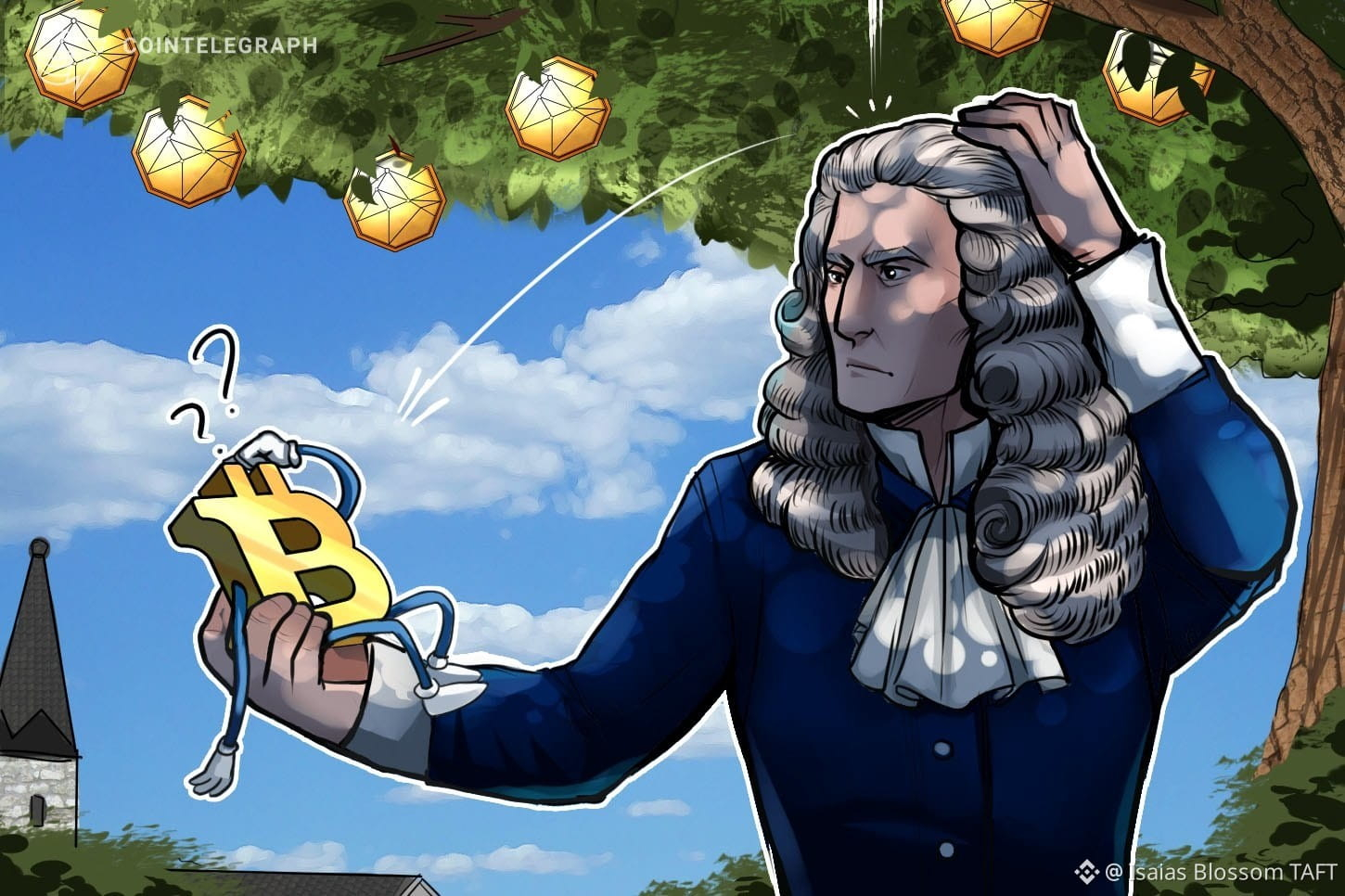
🔍 Análisis de firmas FE y su impacto en los covenants de Bitcoin
El artículo describe cómo las firmas de funcionalidad completa (FE) pueden usarse para crear covenants en Bitcoin, explicando el proceso de encriptación de transacciones y la verificación mediante pruebas de conocimiento cero. Señala que, aunque teóricamente permiten condiciones complejas, su implementación actual es costosa y poco práctica, requiriendo recursos de hardware significativos. Se compara con la solución CTV, más eficiente pero que necesita cambios en la capa base, y se anticipa una futura propuesta basada en BitVM para aproximar covenants sin FE.
$BTC
#Bitcoin #Cryptography #Covenants
27

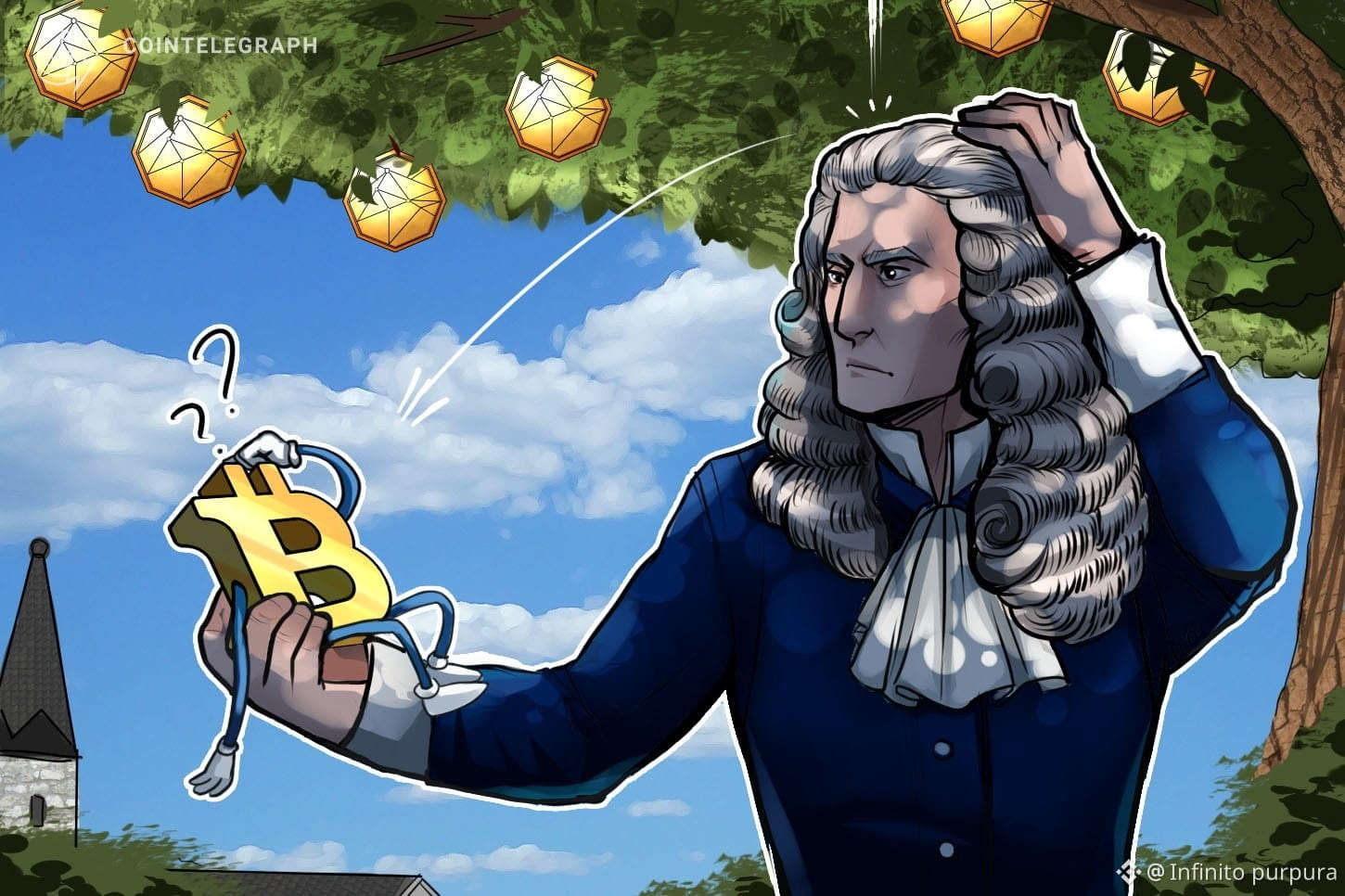
🔍 Análisis de firmas FE y su impacto en los covenants de Bitcoin
El artículo describe cómo las firmas de funcionalidad completa (FE) pueden usarse para crear covenants en Bitcoin, explicando el proceso de encriptación de transacciones y la verificación mediante pruebas de conocimiento cero. Señala que, aunque teóricamente permiten condiciones complejas, su implementación actual es costosa y poco práctica, requiriendo recursos de hardware significativos. Se compara con la solución CTV, más eficiente pero que necesita cambios en la capa base, y se anticipa una futura propuesta basada en BitVM para aproximar covenants sin FE.
$BTC
#Bitcoin #Cryptography #Covenants
22

·
--
Падение
🔐 Did You Know? Bitcoin Uses TWO Different Hashing Algorithms to Create a Classic $BTC Address!
A traditional Bitcoin (P2PKH) address isn't created using just one hash.
Here's the process:
1. Public Key → SHA-256
2. SHA-256 Output → RIPEMD-160
3. A checksum is added using double SHA-256.
4. The result is encoded into a Base58Check address.
That's multiple cryptographic steps working together to create a Bitcoin address!
Blockchain technology is deeper than most people realize. 👀
#Bitcoin #CryptoFacts #Cryptography #Blockchain #ShivaChaurasia
{spot}(BTCUSDT)
{spot}(ETHUSDT)
{spot}(NVDABUSDT)
🔐 Did You Know? Bitcoin Uses TWO Different Hashing Algorithms to Create a Classic $BTC Address!
A traditional Bitcoin (P2PKH) address isn't created using just one hash.
Here's the process:
1. Public Key → SHA-256
2. SHA-256 Output → RIPEMD-160
3. A checksum is added using double SHA-256.
4. The result is encoded into a Base58Check address.
That's multiple cryptographic steps working together to create a Bitcoin address!
Blockchain technology is deeper than most people realize. 👀
#Bitcoin #CryptoFacts #Cryptography #Blockchain #ShivaChaurasia
96

·
--
Cryptography is key to securing $BTC and $ETH transactions. It uses public and private keys. A private key is like a password, used to access and send funds. A public key is used to receive funds. Hashing is another important concept, turning data into a fixed length string. For example, the hash of a 1000 character string is 64 characters. Elliptic curves are also used, providing a secure way to generate public and private keys. They are efficient and secure, making them ideal for cryptocurrency transactions. Cryptography is at the heart of blockchain security, sitting at the core of $BTC transactions. blockchainsecurity #cryptography #cryptobasics
Cryptography is key to securing $BTC and $ETH transactions. It uses public and private keys. A private key is like a password, used to access and send funds. A public key is used to receive funds. Hashing is another important concept, turning data into a fixed length string. For example, the hash of a 1000 character string is 64 characters. Elliptic curves are also used, providing a secure way to generate public and private keys. They are efficient and secure, making them ideal for cryptocurrency transactions. Cryptography is at the heart of blockchain security, sitting at the core of $BTC transactions. blockchainsecurity #cryptography #cryptobasics
41
·
--
Zero-Knowledge Proofs (ZKP) Utility
Zero-Knowledge tech is moving out of the academic phase and into core production. Beyond privacy, ZKPs are essential for scaling blockchains by allowing complex transactions to be verified instantly without heavy computation.
This shift will radically lower gas costs and increase execution speeds.
#ZKProofs #Cryptography #Web3Dev
1
361

·
--
Google Research Triggers Quantum Threat Panic 😳 Is Blockchain Encryption At Risk? 😲While short-term day traders are entirely fixated on minor daily price wicks, a massive, long-term structural anxiety has entered the global cryptocurrency matrix. Following recent data updates from tech giant Google suggesting that advanced quantum computing could begin cracking conventional cryptographic encryption by 2029, top layer-1 and layer-2 networks are moving into an absolute defensive scramble!
High-volume VSA (Volume Spread Analysis) charts reveal that smart money is already beginning to price in this long-term security narrative. Because the $2 Trillion global crypto market relies heavily on traditional ECDSA cryptography to protect digital wallets and validate blockchain transactions, any compression of the quantum timeline creates a massive incentive for capital to favor forward-thinking protocols. Whales are actively using this long-term shift as a perfect smokescreen—forcefully creating localized volatility on older, un-upgraded network pairs to clear out retail leverage, while simultaneously rotating spot allocations into projects that are actively developing post-quantum cryptography (PQC) solutions.
The immediate market structure is absorbing this fundamental shift quite well, especially as major cybersecurity and blockchain infrastructure groups step up to develop quantum-resistant defense patches. However, it proves that the criteria for long-term digital asset holding is rapidly changing.
📉 For Future Traders: Do not let long-term structural headlines cause you to panic-sell your localized lower-timeframe setups. Manage your leverage tightly against short-term volatility spikes and focus your risk parameters strictly around verified macro demand floors where big money is heavily protecting the line.
Will the rising quantum threat completely force a total rewrite of blockchain architecture, or will the crypto industry implement defenses long before the 2029 deadline? Let me know your predictions below! 👇
#QuantumComputing #BlockchainSecurity #Cryptography #CryptoNews #CryptoTrading #TechnicalAnalysis #BinanceWrite2Earn
Google Research Triggers Quantum Threat Panic 😳 Is Blockchain Encryption At Risk? 😲
While short-term day traders are entirely fixated on minor daily price wicks, a massive, long-term structural anxiety has entered the global cryptocurrency matrix. Following recent data updates from tech giant Google suggesting that advanced quantum computing could begin cracking conventional cryptographic encryption by 2029, top layer-1 and layer-2 networks are moving into an absolute defensive scramble!
High-volume VSA (Volume Spread Analysis) charts reveal that smart money is already beginning to price in this long-term security narrative. Because the $2 Trillion global crypto market relies heavily on traditional ECDSA cryptography to protect digital wallets and validate blockchain transactions, any compression of the quantum timeline creates a massive incentive for capital to favor forward-thinking protocols. Whales are actively using this long-term shift as a perfect smokescreen—forcefully creating localized volatility on older, un-upgraded network pairs to clear out retail leverage, while simultaneously rotating spot allocations into projects that are actively developing post-quantum cryptography (PQC) solutions.
The immediate market structure is absorbing this fundamental shift quite well, especially as major cybersecurity and blockchain infrastructure groups step up to develop quantum-resistant defense patches. However, it proves that the criteria for long-term digital asset holding is rapidly changing.
📉 For Future Traders: Do not let long-term structural headlines cause you to panic-sell your localized lower-timeframe setups. Manage your leverage tightly against short-term volatility spikes and focus your risk parameters strictly around verified macro demand floors where big money is heavily protecting the line.
Will the rising quantum threat completely force a total rewrite of blockchain architecture, or will the crypto industry implement defenses long before the 2029 deadline? Let me know your predictions below! 👇
#QuantumComputing #BlockchainSecurity #Cryptography #CryptoNews #CryptoTrading #TechnicalAnalysis #BinanceWrite2Earn
2
49
·
--
Cryptography isn't just for hackers and spies — it's running quietly behind every app you use today. Book 1 breaks down the invisible math that keeps your digital life secure, built for total beginners who want the ‘how’ before the ‘why.’ #Cryptography #bitcoin
Cryptography isn't just for hackers and spies — it's running quietly behind every app you use today. Book 1 breaks down the invisible math that keeps your digital life secure, built for total beginners who want the ‘how’ before the ‘why.’ #Cryptography #bitcoin
1
140
Critical security insight 🛡️
Anthropic's Claude AI has successfully identified vulnerabilities in a post-quantum signature scheme slated for U.S. federal standardization. This highlights AI's potential to bypass advanced cryptographic defenses previously considered secure against quantum threats.
#AI #Cryptography
Anthropic's Claude AI has successfully identified vulnerabilities in a post-quantum signature scheme slated for U.S. federal standardization. This highlights AI's potential to bypass advanced cryptographic defenses previously considered secure against quantum threats.
#AI #Cryptography
20

·
--
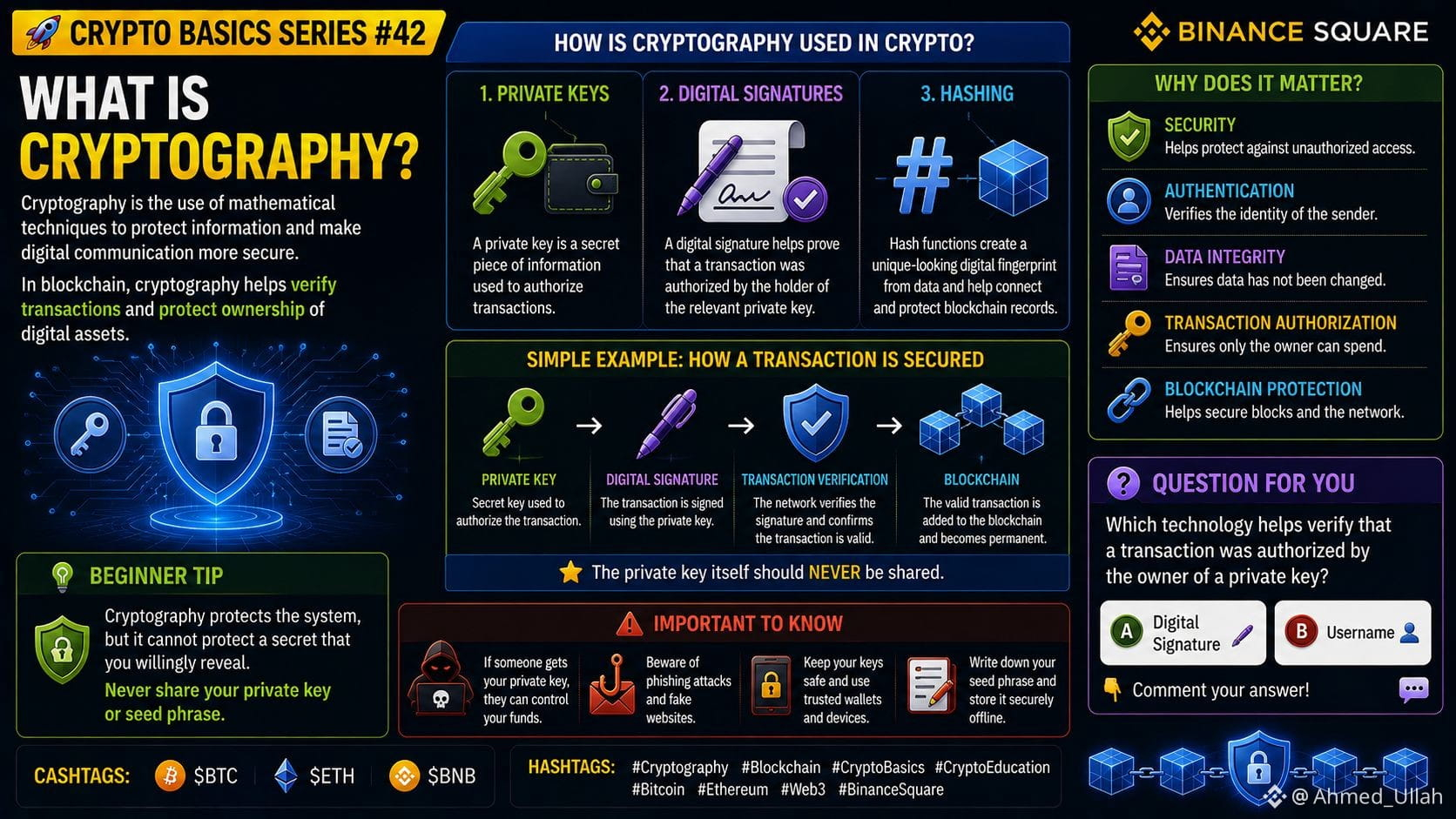
🚀 Crypto Basics Series #42: What Is Cryptography?
🔐 What Is Cryptography?
Cryptography is the use of mathematical techniques to protect information and make digital communication more secure.
In blockchain, cryptography helps verify transactions and protect ownership of digital assets.
⚙️ How Is It Used in Crypto?
🔑 Private Keys
A private key is a secret piece of information used to authorize transactions.
✍️ Digital Signatures
A digital signature helps prove that a transaction was authorized by the holder of the relevant private key.
#️⃣ Hashing
Hash functions create a unique-looking digital fingerprint from data and help connect and protect blockchain records.
💡 Simple Example
Think of your private key as a secret authorization tool.
You use it to sign a transaction:
Private Key → Digital Signature → Transaction Verification → Blockchain
The private key itself should never be shared.
🛡️ Why Does It Matter?
Cryptography helps provide:
🔒 Security
✅ Authentication
🧾 Data integrity
✍️ Transaction authorization
🔗 Blockchain protection
⚠️ Beginner Tip
Cryptography protects the system, but it cannot protect a secret that you willingly reveal.
Never share your private key or seed phrase.
💬 Question for You
Which technology helps verify that a transaction was authorized by the owner of a private key?
🅰️ Digital Signature ✍️
🅱️ Username
👇 Comment your answer!
$BTC $ETH $BNB
#Cryptography #Blockchain #CryptoBasics #CryptoEducation #Bitcoin

Follow Me
От Ahmed_Ullah
3
93

·
--
The best time to prepare for a cryptographic threat is before it becomes urgent.
Research, testing and migration planning take time.
Waiting for a real-world exploit can be costly.
#Cryptography #CyberSecurity #blockchain #CryptoSecurity
The best time to prepare for a cryptographic threat is before it becomes urgent.
Research, testing and migration planning take time.
Waiting for a real-world exploit can be costly.
#Cryptography #CyberSecurity #blockchain #CryptoSecurity
Research, testing and migration planning take time.
Waiting for a real-world exploit can be costly.
#Cryptography #CyberSecurity #blockchain #CryptoSecurity
1
106
·
--
$ETH 'S CRYPTOGRAPHIC REVOLUTION: POSEIDON OUT, SHA2 IN 🔐⚡
Ethereum L1 is making a historic pivot. Justin Drake confirmed the network will abandon Poseidon — the SNARK-friendly hash standard since 2019 — in favor of battle-tested traditional hashes like SHA2 and BLAKE2s. The catalyst? A SNARK design breakthrough.
By natively aligning binary field operations with traditional hashes, proofs now hit 1 million per second at just ~100x overhead. Drake calls it "science fiction-grade cryptography," crediting Binius and Flock. This accelerates Ethereum's roadmap — leanVM lands in 2027, with full layer deployment in 2028.
In the post-quantum arms race, hash-based schemes are emerging victorious over lattice and isogeny approaches. AI-powered cryptographic analysis is shifting the battlefield, and Ethereum sits at the front line.
How do you see this shift impacting Ethereum's long-term security narrative? 👇
⚠️ Not financial advice. Always manage your risk. 🛡️
🏷️ $ETH #Ethereum #Cryptography #PostQuantum #Blockchain
🔐⚡
35
·
--
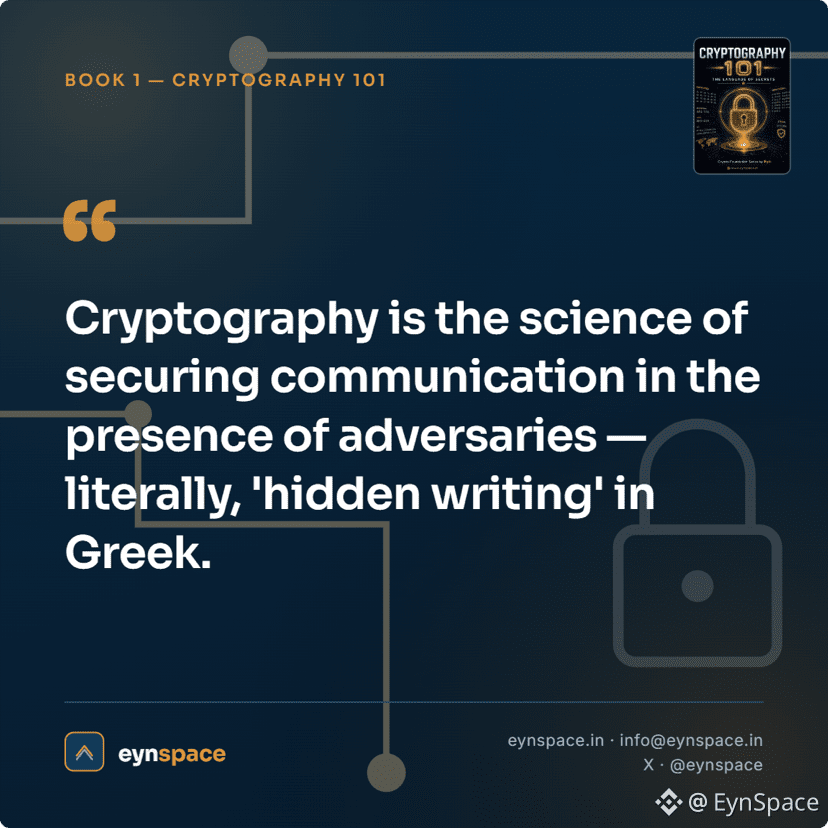
Every time you send a message, log in, or make a payment, cryptography is working invisibly in the background. Book 1 starts from zero: what cryptography actually is, and why it's the foundation everything else in this library builds on. #Cryptography #bitcoin
Every time you send a message, log in, or make a payment, cryptography is working invisibly in the background. Book 1 starts from zero: what cryptography actually is, and why it's the foundation everything else in this library builds on. #Cryptography #bitcoin
139

·
--
🚨 LATEST UPDATE 🚨
A major breakthrough in cryptographic research has been recorded. A new AI model, Claude Mythos Preview, managed to weaken the HAWK digital-signature scheme in just 60 hours. The attack reduced the effective strength of the smallest key set from 2^64 to 2^38 operations at a cost of $100,000. 🛡️
While current Bitcoin and Ethereum signatures remain unaffected, this development is significant. Bitcoin developers are already working on quantum-resistant plans (BIP-360/361) because current encryption is expected to fail against future quantum computers. This news highlights that classical attacks are also accelerating much faster than anticipated. ⚡
As the race between security and cryptanalysis intensifies, the window for migrating to quantum-resistant standards may be closing sooner than expected. 🔐
Do you think the crypto industry can migrate fast enough?
#CyberSecurity #Bitcoin #Cryptography
$BNB $UNI $USD1

101
Войдите, чтобы посмотреть больше материала
Присоединяйтесь к пользователям криптовалют по всему миру на Binance Square
⚡️ Получайте новейшую и полезную информацию о криптоактивах.
💬 Нам доверяет крупнейшая в мире криптобиржа.
👍 Получите достоверные аналитические данные от верифицированных создателей контента.
Эл. почта/номер телефона
В тренде
1
#EvolveAtBinanceBlockchainWeek
Просмотров: 3.1M
23,097 обсуждают
2
#SunReportedlyOffered4BToRescueFTX
Просмотров: 52,227
439 обсуждают
3
#XRPLAmendmentsEnterActivationWindow
Просмотров: 45,213
378 обсуждают
4
#CryptographersFormGroupForEncryptionBreak
Просмотров: 797
25 обсуждают
5
#IBSGovAccountMints1BTokensDrains5.71M
Просмотров: 84,997
686 обсуждают
6
#OPECReportedlyKeepsOilQuotasUnchangedForQ1
Просмотров: 32,363
341 обсуждают
7
#WorldLibertyActsToCutLiquidationRisk
Просмотров: 126,329
893 обсуждают
8
#LiquidHackerMoves598BTC
Просмотров: 93,099
527 обсуждают
9
#BitcoinETFsExtendOutflowStreakToEightDays
Просмотров: 170,956
1,137 обсуждают
10
#BitcoinTreasurySells7.23BTCToBuyBackShares
Просмотров: 1
5 обсуждают