
#cryptoeducation
cryptoeducation
ကြည့်ရှုမှု 3.8M ကြိမ်
25,632 ဦး ဆွေးနွေးနေသည်
ရေပန်းစားသော
နောက်ဆုံး

ဘာသာပြန်ဆိုချက် ကြည့်မည်
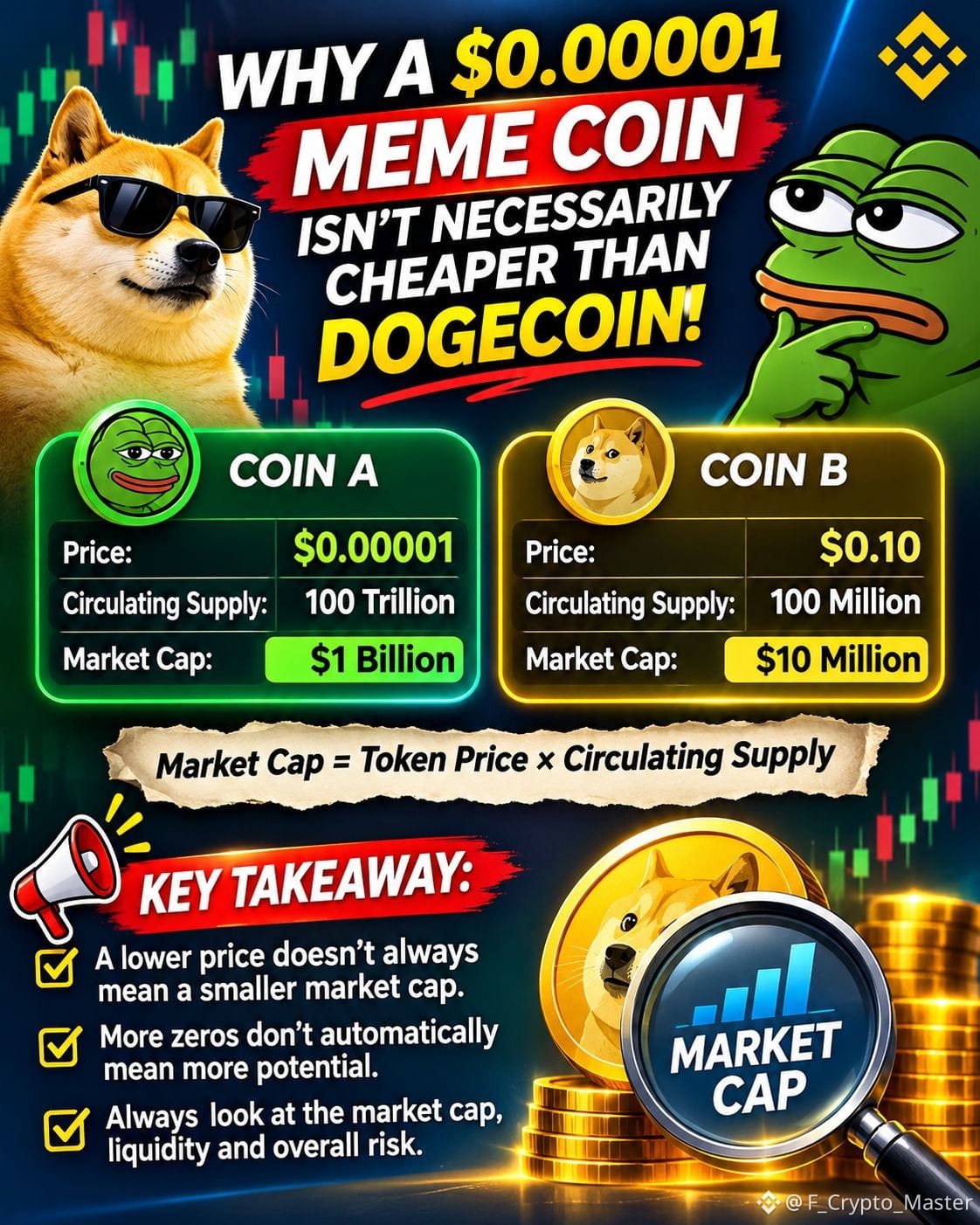
WHY A $0.00001 MEME COIN ISN'T NECESSARILY CHEAPER THAN DOGECOIN!
One of the biggest misconceptions among meme coin beginners is that more zeros mean more potential.
Let's compare two hypothetical meme coins:
🟢 COIN A
Price: $0.00001
Circulating supply: 100 trillion
Market cap: $1 billion
🟡 COIN B
Price: $0.10
Circulating supply: 100 million
Market cap: $10 million
Despite having a much lower token price, Coin A has a market capitalization 100 times larger than Coin B!
This is why comparing $SHIB, $PEPE, $BONK and $DOGE based solely on their token prices can be misleading.
📊 Market cap = Token price × Circulating supply.
A smaller market cap doesn't guarantee greater returns either. Demand, liquidity and risk still matter.
🧠 More zeros don't mean more potential. Owning millions of tokens doesn't automatically make you closer to becoming a millionaire.
💬 Do you check market capitalization before exploring a meme coin, or does the token price attract your attention first?
#memecoin #Tokenomics #cryptoeducation #BinanceSquare
2
415

ဘာသာပြန်ဆိုချက် ကြည့်မည်
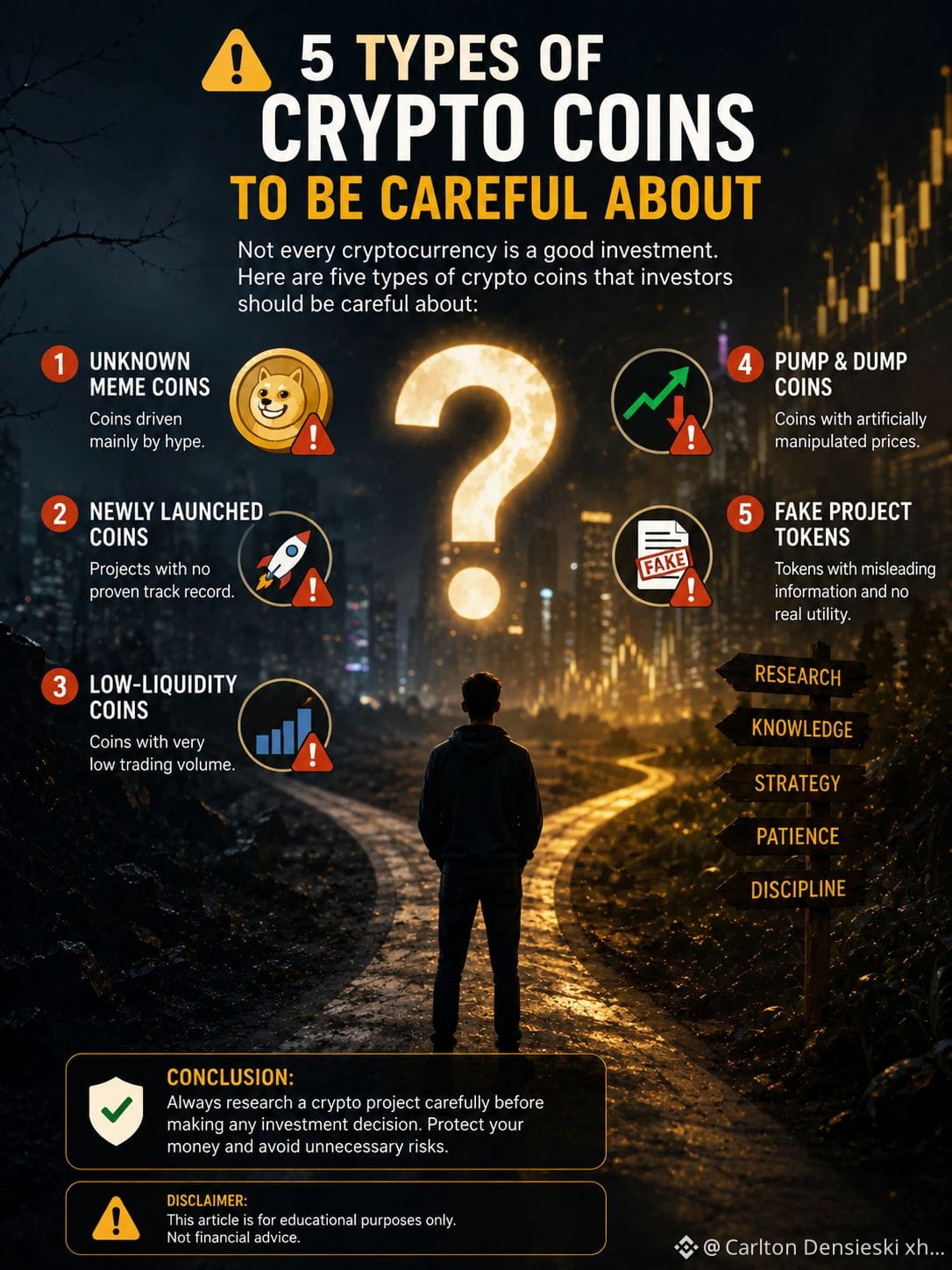
⚠️ 5 Types of Crypto Coins to Be Careful About
Not every cryptocurrency is a good investment. Here are five types of crypto coins that investors should be careful about:
1. Unknown Meme Coins: Coins driven mainly by hype.
2. Newly Launched Coins: Projects with no proven track record.
3. Low-Liquidity Coins: Coins with very low trading volume.
4. Pump & Dump Coins: Coins with artificially manipulated prices.
5. Fake Project Tokens: Tokens with misleading information and no real utility.
Conclusion: Always research a crypto project carefully before making any investment decision. Protect your money and avoid unnecessary risks.
Disclaimer: This article is for educational purposes only. Not financial advice.
Main Lesson:
Always research a cryptocurrency project carefully before investing. Gain knowledge, follow a smart strategy, practice patience and discipline, and protect your money from unnecessary risks.✔️✔️ #Crypto #Cryptocurrency #CryptoEducation #AI
2

ဘာသာပြန်ဆိုချက် ကြည့်မည်
What Makes a Crypto Project Worth Following? 🔍
When researching a crypto project, what do you look at first?
Real-world utility
Tokenomics and supply
Team and development activity
Security and transparency
Community and adoption
For me, understanding the project's actual utility and long-term development matters more than short-term hype.
A trending token isn't automatically a strong project.
What's your first checkpoint before researching a crypto project? Share your reasoning below.
আপনার মতে, একটি ভালো Crypto Project চেনার সবচেয়ে গুরুত্বপূর্ণ বিষয় কোনটি? 👇
#CryptoEducation #BinanceSquare #DYOR
$BNB $ETH $USDC
28
ဘာသာပြန်ဆိုချက် ကြည့်မည်
What Are Smart Contracts? 🤔
Smart contracts are programs stored on a blockchain that execute predefined instructions when they are called and the required conditions are met.
Think of a vending machine:
You select a product.
You insert the required payment.
The machine checks the conditions.
It delivers the product.
A smart contract follows a similar logic, but its rules are written in code.
Where are they used?
DeFi applications
NFT marketplaces
Token transfers
Blockchain-based games
Automated transactions
One important limitation: Smart contracts cannot automatically access real-world information by themselves. They may need external data providers called oracles.
And remember: smart contracts are not automatically safe. Bugs or malicious code can put funds at risk.
বাংলায় সহজভাবে বললে, Smart Contract হলো blockchain-এর মধ্যে থাকা এমন একটি program, যা নির্দিষ্ট নিয়ম অনুযায়ী কাজ করে।
Question: Which smart contract use case interests you most — DeFi, NFTs, gaming, or something else?
#SmartContracts #Blockchain #CryptoEducation #BinanceSquare
$BTC $ETH $BNB
91

·
--
တက်ရိပ်ရှိသည်
ဘာသာပြန်ဆိုချက် ကြည့်မည်
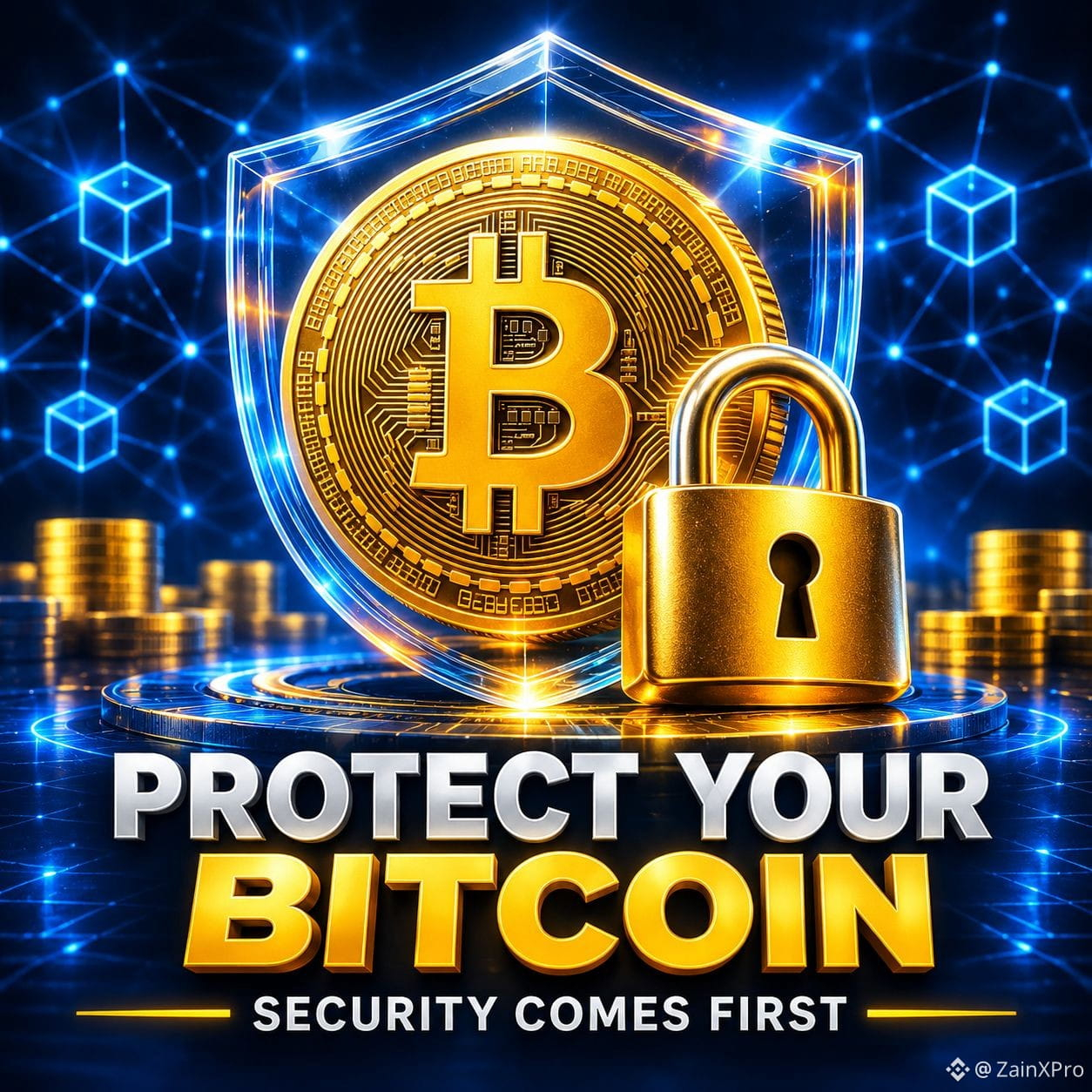
#bitcionpk #XRPLedgerVaultGets29Votes 🔐 Protect Your Bitcoin, Protect Your Future! ₿
Bitcoin is valuable, but keeping it safe is even more important.
✅ Never share your wallet password.
✅ Enable Two-Factor Authentication.
✅ Always double-check transaction addresses.
✅ Stay away from suspicious links.
Remember: Security comes first in crypto! 🚀
#Bitcoin #BTC #CryptoSecurity #Binance #cryptoeducation $BTC
{spot}(BTCUSDT)
$BNB
{spot}(BNBUSDT)
#bitcionpk #XRPLedgerVaultGets29Votes 🔐 Protect Your Bitcoin, Protect Your Future! ₿
Bitcoin is valuable, but keeping it safe is even more important.
✅ Never share your wallet password.
✅ Enable Two-Factor Authentication.
✅ Always double-check transaction addresses.
✅ Stay away from suspicious links.
Remember: Security comes first in crypto! 🚀
#Bitcoin #BTC #CryptoSecurity #Binance #cryptoeducation $BTC
$BNB
62

·
--
တက်ရိပ်ရှိသည်
ဘာသာပြန်ဆိုချက် ကြည့်မည်
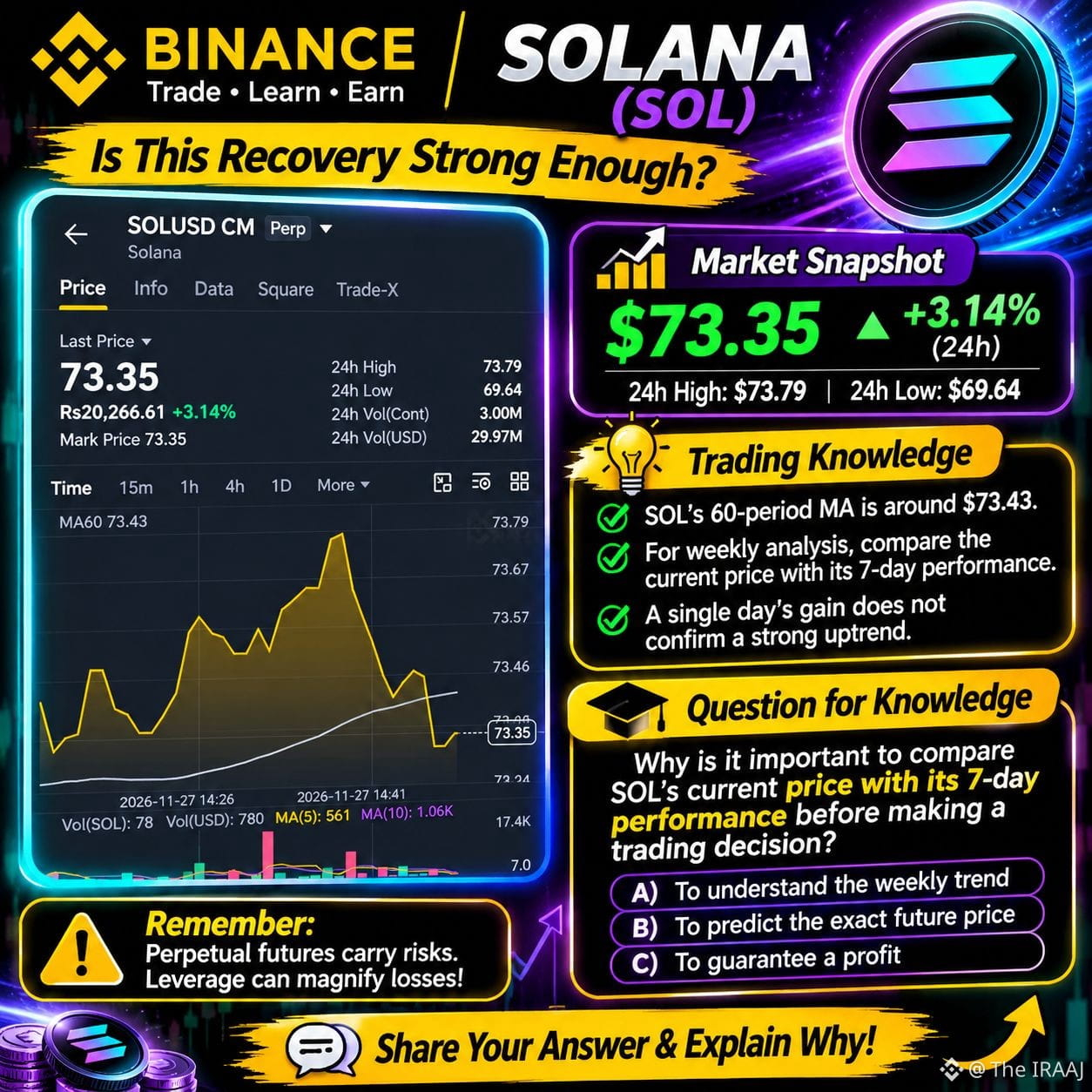
📚 SOLANA (SOL): IS THIS RECOVERY STRONG ENOUGH TO WATCH?
$SOL perpetual contract is trading at $73.35, up 3.14% in the 24-hour snapshot. The price reached $73.79 and dropped as low as $69.64, showing a noticeable intraday recovery.
📊 Trading Knowledge:
$SOL 60-period moving average is around $73.43, slightly above the current price. This is a level to watch, but a moving average alone cannot confirm a trend reversal.
For weekly analysis, compare SOL's current price with its price seven days ago and check the 7-day percentage change. A single day's gain does not establish a weekly uptrend.
⚠️ Perpetual futures carry additional risks: Leverage can magnify losses, and funding payments may affect your position.
🧠 QUESTION FOR KNOWLEDGE:
Why is it important to compare SOL's current price with its 7-day performance before making a trading decision?
A) To understand the weekly trend
B) To predict the exact future price
C) To guarantee a profit
💬 Share your answer and explain why!
#SolanaUSTD #solana #CryptoEducation #TradingAnalysis #BinanceSquare
76

·
--
Article
ဘာသာပြန်ဆိုချက် ကြည့်မည်
🚨Common Crypto Mistakes Every Beginner Should Avoid!After trading for sometimes i want share some thoughts with my fellow traders , entering the crypto market is easy, but surviving in it is a completely different story. Many beginners enter crypto with the dream of making quick profits, but end up losing money because of simple mistakes that could have been avoided.
The truth is, successful trading isn’t just about finding the next 100x coin or predicting where Bitcoin will go. It’s about patience, discipline, risk management, and understanding the market.
Let’s talk about some common mistakes that every beginner should learn to avoid. 👇
$BTC
📉 1. Trading Mistakes
One of the biggest mistakes beginners make is FOMO (Fear of Missing Out). They see a coin pumping and immediately buy it, usually near the top. Others sell too early because of a small correction, hold losing positions for too long, or revenge trade to recover their losses.
Overtrading, chasing every opportunity, and jumping between coins without a proper strategy are also common problems.
📊 2. Technical Analysis Mistakes
Many beginners use indicators without actually understanding them. They put RSI, MACD, EMA, Stochastic RSI, and several other indicators on one chart, hoping to find the perfect signal.
Some traders rely on a single indicator, ignore trading volume, misunderstand support and resistance, or enter breakouts without confirmation.
Another major mistake is ignoring higher timeframes. A bullish signal on the 5-minute chart doesn’t necessarily mean the overall market is bullish. Understanding market structure (HH, HL, LH, LL) is essential.
$ETH
💰 3. Risk Management Mistakes
This is where many traders destroy their portfolios.
Trading without a stop-loss, using excessive leverage, risking too much capital on one trade, and ignoring risk-to-reward ratios can turn a small mistake into a major loss.
Remember, even a good trading setup can fail. That’s why protecting your capital should always come first.
🧠 4. Psychological Mistakes
Crypto is not just a battle against the market; it’s also a battle against your own emotions.
Fear, greed, impatience, and overconfidence can lead to terrible decisions. Blindly following influencers, changing strategies after every loss, and expecting to become rich overnight are habits that prevent traders from improving.
$USDC
🎯 A Few Rules Worth Remembering Fellow Traders💯
Protect your capital before chasing profits.
Always have an entry, exit, and invalidation plan.
Never trade based on emotions.
Understand market structure and multiple timeframes.
Use leverage carefully.
Wait for confirmation instead of chasing candles.
Maintain a trading journal and learn from every trade.
📈Nobody becomes a professional trader overnight. Losses are part of trading, but repeating the same mistakes without learning from them is a choice.
Don’t focus on making quick money. Focus on becoming a better trader, developing a consistent strategy, and managing risk properly.
Stay patient, stay disciplined, and keep learning. 📈
#cryptoeducation #TechnicalAnalysis #RiskManagement #tradingpsychology
🚨Common Crypto Mistakes Every Beginner Should Avoid!
After trading for sometimes i want share some thoughts with my fellow traders , entering the crypto market is easy, but surviving in it is a completely different story. Many beginners enter crypto with the dream of making quick profits, but end up losing money because of simple mistakes that could have been avoided.
The truth is, successful trading isn’t just about finding the next 100x coin or predicting where Bitcoin will go. It’s about patience, discipline, risk management, and understanding the market.
Let’s talk about some common mistakes that every beginner should learn to avoid. 👇
$BTC
📉 1. Trading Mistakes
One of the biggest mistakes beginners make is FOMO (Fear of Missing Out). They see a coin pumping and immediately buy it, usually near the top. Others sell too early because of a small correction, hold losing positions for too long, or revenge trade to recover their losses.
Overtrading, chasing every opportunity, and jumping between coins without a proper strategy are also common problems.
📊 2. Technical Analysis Mistakes
Many beginners use indicators without actually understanding them. They put RSI, MACD, EMA, Stochastic RSI, and several other indicators on one chart, hoping to find the perfect signal.
Some traders rely on a single indicator, ignore trading volume, misunderstand support and resistance, or enter breakouts without confirmation.
Another major mistake is ignoring higher timeframes. A bullish signal on the 5-minute chart doesn’t necessarily mean the overall market is bullish. Understanding market structure (HH, HL, LH, LL) is essential.
$ETH
💰 3. Risk Management Mistakes
This is where many traders destroy their portfolios.
Trading without a stop-loss, using excessive leverage, risking too much capital on one trade, and ignoring risk-to-reward ratios can turn a small mistake into a major loss.
Remember, even a good trading setup can fail. That’s why protecting your capital should always come first.
🧠 4. Psychological Mistakes
Crypto is not just a battle against the market; it’s also a battle against your own emotions.
Fear, greed, impatience, and overconfidence can lead to terrible decisions. Blindly following influencers, changing strategies after every loss, and expecting to become rich overnight are habits that prevent traders from improving.
$USDC
🎯 A Few Rules Worth Remembering Fellow Traders💯
Protect your capital before chasing profits.
Always have an entry, exit, and invalidation plan.
Never trade based on emotions.
Understand market structure and multiple timeframes.
Use leverage carefully.
Wait for confirmation instead of chasing candles.
Maintain a trading journal and learn from every trade.
📈Nobody becomes a professional trader overnight. Losses are part of trading, but repeating the same mistakes without learning from them is a choice.
Don’t focus on making quick money. Focus on becoming a better trader, developing a consistent strategy, and managing risk properly.
Stay patient, stay disciplined, and keep learning. 📈
#cryptoeducation #TechnicalAnalysis #RiskManagement #tradingpsychology
Mukeshshrestha :
19
89
1
6
137

ဘာသာပြန်ဆိုချက် ကြည့်မည်
📚 BITCOIN OPTIONS EXPIRY EXPLAINED IN SIMPLE WORDS
You may have seen people talking about billions of dollars in BTC options expiring today.
But what does that actually mean?
An option is a contract that gives its buyer the right—but not the obligation—to buy or sell an asset at a specified price under certain conditions.
🔹 Call option: Gives the right to buy.
🔹 Put option: Gives the right to sell.
🔹 Strike price: The price specified in the contract.
🔹 Expiry: The date when the contract ends.
Why does expiry matter?
As expiry approaches, traders may adjust or close positions, and hedging activity can sometimes contribute to volatility.
But remember:
❌ Options expiry does not guarantee a Bitcoin pump.
❌ It does not guarantee a crash.
✅ It simply creates an event that traders may closely monitor.
Understanding the event is more valuable than blindly following predictions.
#CryptoEducation #Bitcoin #BTCOptions #TradingEducation $BTC
86

ဘာသာပြန်ဆိုချက် ကြည့်မည်
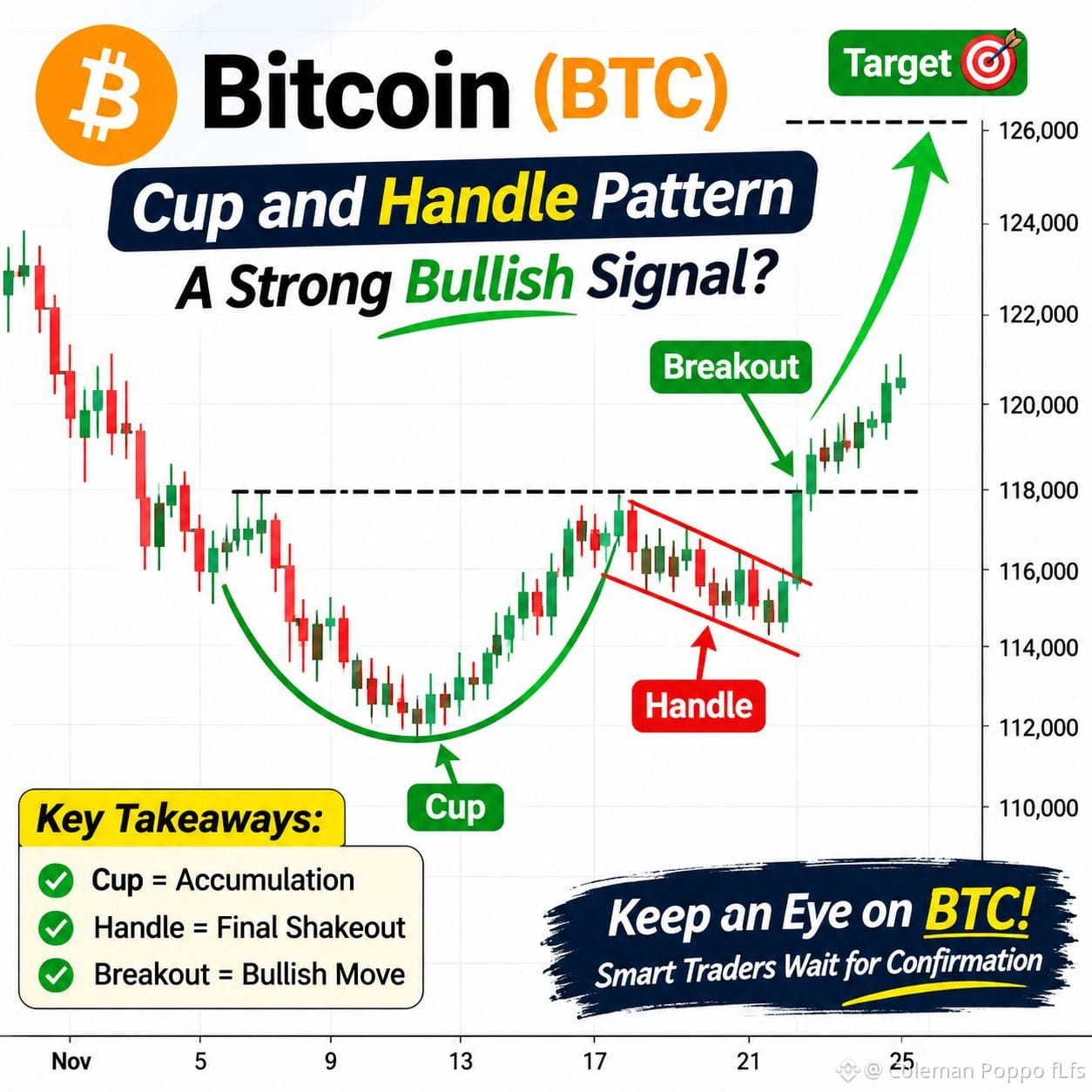
📊 Bitcoin’s Cup & Handle Pattern: What Comes After the Breakout?
Have you ever noticed Bitcoin forming a rounded bottom, followed by a small pullback before moving higher?
This pattern is known as the Cup and Handle ☕📈
🔹 The Cup: Price forms a rounded recovery after a decline.
🔹 The Handle: Price pulls back slightly before testing resistance again.
🔹 The Breakout: A strong candle closing above resistance may indicate a potential bullish continuation.
🔹 The Smart Approach: Wait for confirmation and watch trading volume. A breakout can still fail, so never ignore risk management.
Remember: Patterns help us understand market structure, but they never guarantee the next move.
💡 A good trader doesn’t chase every breakout — they wait for the right confirmation.
What do you prefer: entering immediately after a breakout or waiting for a retest?
#Bitcoin #BTC #TradingCommunity #TradeSmart #cryptoeducation
81

ဘာသာပြန်ဆိုချက် ကြည့်မည်
Stay Calm When the Market Gets Volatile!Crypto markets can move quickly, and volatility is part of the journey. Sometimes prices rise unexpectedly, and sometimes they fall without warning.
The key is not to react emotionally to every market movement.
Stay informed and keep learning.
Research before making decisions.
Protect your capital and manage risk.
Focus on your strategy, not the noise.
Be patient and avoid emotional trading.
A disciplined mindset is one of the most valuable tools in crypto. Don't let fear or excitement control your decisions.
Stay calm, stay smart, and keep growing!
#Binance #crypto #bitcoin #cryptoeducation #RiskManagement
Stay Calm When the Market Gets Volatile!
Crypto markets can move quickly, and volatility is part of the journey. Sometimes prices rise unexpectedly, and sometimes they fall without warning.
The key is not to react emotionally to every market movement.
Stay informed and keep learning.
Research before making decisions.
Protect your capital and manage risk.
Focus on your strategy, not the noise.
Be patient and avoid emotional trading.
A disciplined mindset is one of the most valuable tools in crypto. Don't let fear or excitement control your decisions.
Stay calm, stay smart, and keep growing!
#Binance #crypto #bitcoin #cryptoeducation #RiskManagement
1
82

·
--
ဘာသာပြန်ဆိုချက် ကြည့်မည်
$SOL Lesson in 10 Seconds 📚
$SOL $73.12 | Above MA60 $73.03
Price dipped to $72.89 → buyers pushed it back up.
Green volume = real buying.
Rule: Price above MA60 + green volume = buyers in control.
Support: $72.89 | Resistance: $73.51
#SOL #CryptoEducation #solana
$SOL
{future}(SOLUSDT)
$SOL Lesson in 10 Seconds 📚
$SOL $73.12 | Above MA60 $73.03
Price dipped to $72.89 → buyers pushed it back up.
Green volume = real buying.
Rule: Price above MA60 + green volume = buyers in control.
Support: $72.89 | Resistance: $73.51
#SOL #CryptoEducation #solana
$SOL
$SOL $73.12 | Above MA60 $73.03
Price dipped to $72.89 → buyers pushed it back up.
Green volume = real buying.
Rule: Price above MA60 + green volume = buyers in control.
Support: $72.89 | Resistance: $73.51
#SOL #CryptoEducation #solana
$SOL
107

Article
ဘာသာပြန်ဆိုချက် ကြည့်မည်
🚨 CRYPTO MARKET: PATIENCE IS MORE POWERFUL THAN PREDICTION🚨 CRYPTO MARKET: PATIENCE IS MORE POWERFUL THAN PREDICTION
In the cryptocurrency market, not every price movement tells the full story.
Bitcoin, Ethereum, and other digital assets can experience sudden changes due to market sentiment, liquidity, global economic developments, and investor activity.
Here are 4 important things every crypto participant should remember:
1️⃣ Don't Follow Every Green Candle
A sudden price increase doesn't always mean a sustainable recovery. Always look for confirmation.
2️⃣ Understand Market Risk
Crypto is highly volatile. Prices can move in either direction, so never risk money you cannot afford to lose.
3️⃣ Research Before Making Decisions
Understand the project, its fundamentals, market conditions, and potential risks before making any financial decision.
4️⃣ Think Long-Term, Stay Disciplined
Emotional decisions can lead to mistakes. Patience, education, and proper risk management matter.
My Thought:
The smartest move in crypto isn't always making a trade. Sometimes, understanding the market and waiting for reliable information is the better decision.
💬 What do you think is more important in crypto: PATIENCE or TIMING?
Share your thoughts in the comments.
If you find my content helpful, your support through likes, comments, and follows means a lot to me.
#BinanceSquare #cryptoeducation #bitcoin #RiskManagementMastery
🚨 CRYPTO MARKET: PATIENCE IS MORE POWERFUL THAN PREDICTION
🚨 CRYPTO MARKET: PATIENCE IS MORE POWERFUL THAN PREDICTION
In the cryptocurrency market, not every price movement tells the full story.
Bitcoin, Ethereum, and other digital assets can experience sudden changes due to market sentiment, liquidity, global economic developments, and investor activity.
Here are 4 important things every crypto participant should remember:
1️⃣ Don't Follow Every Green Candle
A sudden price increase doesn't always mean a sustainable recovery. Always look for confirmation.
2️⃣ Understand Market Risk
Crypto is highly volatile. Prices can move in either direction, so never risk money you cannot afford to lose.
3️⃣ Research Before Making Decisions
Understand the project, its fundamentals, market conditions, and potential risks before making any financial decision.
4️⃣ Think Long-Term, Stay Disciplined
Emotional decisions can lead to mistakes. Patience, education, and proper risk management matter.
My Thought:
The smartest move in crypto isn't always making a trade. Sometimes, understanding the market and waiting for reliable information is the better decision.
💬 What do you think is more important in crypto: PATIENCE or TIMING?
Share your thoughts in the comments.
If you find my content helpful, your support through likes, comments, and follows means a lot to me.
#BinanceSquare #cryptoeducation #bitcoin #RiskManagementMastery
DMT82:
99
11
65

·
--
ဘာသာပြန်ဆိုချက် ကြည့်မည်
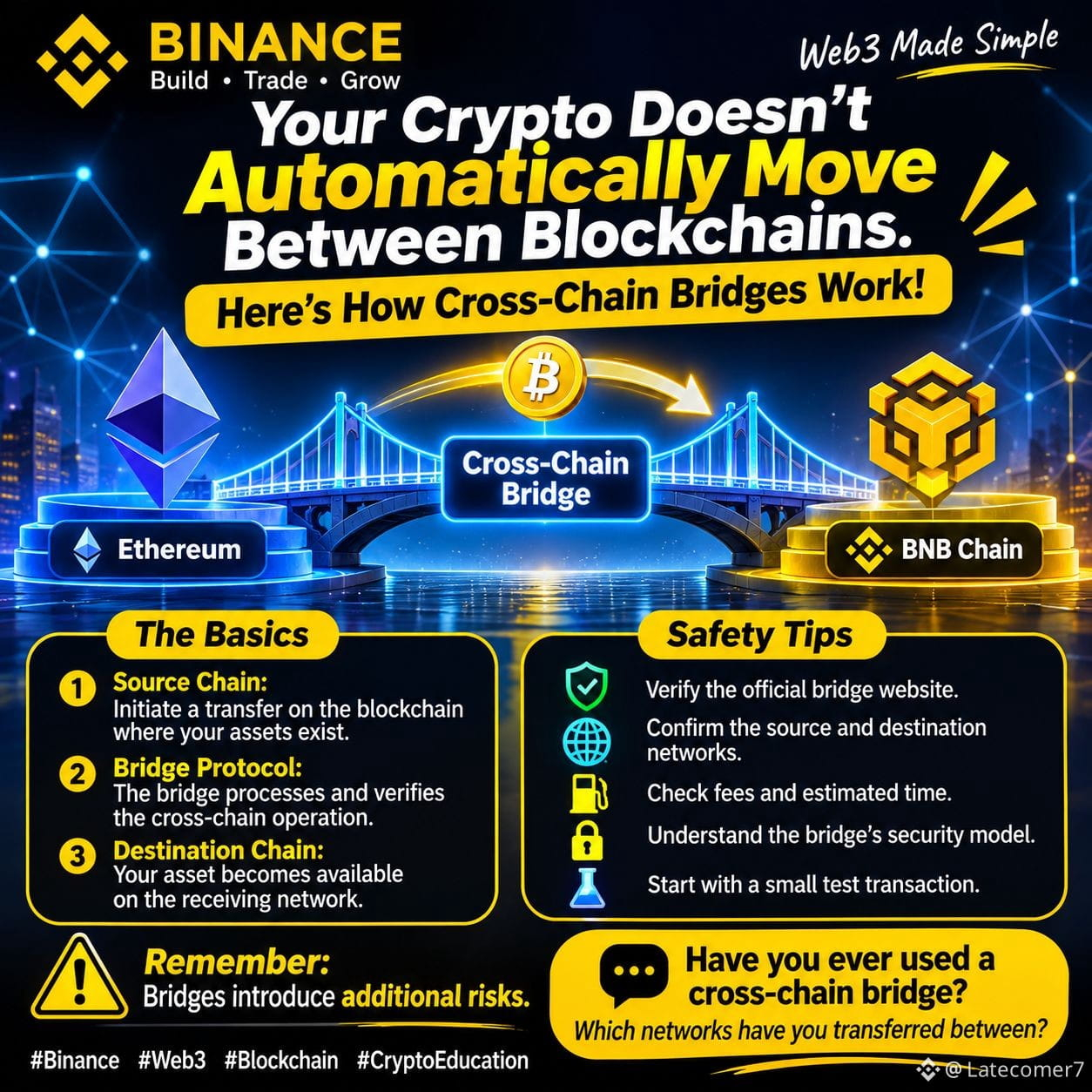
Your crypto doesn't automatically move between blockchains. Here's how bridges work.
Ever wondered how you can move crypto from one blockchain to another?
That's where cross-chain bridges come in.
Blockchains operate independently. An asset on Ethereum doesn't automatically become available on BNB Chain or another network.
A cross-chain bridge helps transfer assets or messages between different blockchain networks.
Here's the basic idea:
1. Source chain: You initiate a transfer on the blockchain where your assets currently exist.
2. Bridge protocol: The bridge processes and verifies the cross-chain operation.
3. Destination chain: The corresponding asset or message becomes available on the receiving network.
Some bridges lock assets on one chain and issue a corresponding representation on another. Others use different mechanisms.
But here's something every crypto user should understand:
Bridges introduce additional risks.
Before using one:
- Verify the official bridge website.
- Confirm the source and destination networks.
- Check fees and estimated transaction time.
- Understand the bridge's security model.
- Start with a small test transaction when appropriate.
Remember, moving assets across chains isn't just about convenience. It's also about understanding the risks involved.
Have you ever used a cross-chain bridge? Which networks have you transferred between?
#Binance #Web3 #Blockchain #CryptoEducation
90

ဘာသာပြန်ဆိုချက် ကြည့်မည်
Day 1
Bitcoin is the world's first widely recognized decentralized digital currency. It allows people to transfer value without relying on a traditional bank for every transaction. But remember, Bitcoin's price can be highly volatile. Learn before you invest.
$BTC
#bitcoin #CryptoEducation #BinanceSquare
Bitcoin is the world's first widely recognized decentralized digital currency. It allows people to transfer value without relying on a traditional bank for every transaction. But remember, Bitcoin's price can be highly volatile. Learn before you invest.
$BTC
#bitcoin #CryptoEducation #BinanceSquare

1
97

·
--
ဘာသာပြန်ဆိုချက် ကြည့်မည်
The Only Trader With No Mistakes Is the One Who Never Started.There is a line Theodore Roosevelt used that every crypto beginner should hear: "The only man who never makes a mistake is the man who never does anything." It is easy to look flawless from the sidelines. You can study charts for months and point out where others went wrong without ever testing your own judgment. However, a record with no mistakes means very little when there are no decisions behind it.
That said, this is not permission to be reckless. There is a wide difference between a mistake that teaches you and one that wipes you out. Entering with money you cannot afford to lose, using heavy leverage you do not understand, or putting everything into one coin is not courage. Instead, courage in the market looks like taking a step small enough that being wrong will not remove you from the game.
Because of this, your first goal should not be to get every trade right. Your goal should be to learn how you behave when real money is on the line. Do you panic when the price dips? Do you chase a candle that has already run? A small position can raise these questions while the cost of the answers is still limited. As your understanding grows, you can then decide whether your risk should grow with it.
In the end, waiting until you are certain may mean waiting forever, because the market rarely offers certainty. So start by learning, set your limit before you act, and accept that some decisions will be wrong. If you are also exploring copy trading, you can follow my trades as a Binance master copy trader, remembering that my trades can lose too. 👉 [https://www.binance.com/en/copy-trading/lead-details/5293024773212277505?timeRange=365D](https://www.binance.com/en/copy-trading/lead-details/5293024773212277505?timeRange=365D)
What is the one fear that kept you on the sidelines the longest? Share it in the comments.
Disclaimer: This post is for educational purposes only and is not financial advice. Crypto trading and copy trading carry a high risk of loss, and past performance does not guarantee future results. Do your own research.
$BTC $BNB
#cryptoeducation #tradingmindset #RiskManagement #Copytrading #BinanceSquare
The Only Trader With No Mistakes Is the One Who Never Started.
There is a line Theodore Roosevelt used that every crypto beginner should hear: "The only man who never makes a mistake is the man who never does anything." It is easy to look flawless from the sidelines. You can study charts for months and point out where others went wrong without ever testing your own judgment. However, a record with no mistakes means very little when there are no decisions behind it.
That said, this is not permission to be reckless. There is a wide difference between a mistake that teaches you and one that wipes you out. Entering with money you cannot afford to lose, using heavy leverage you do not understand, or putting everything into one coin is not courage. Instead, courage in the market looks like taking a step small enough that being wrong will not remove you from the game.
Because of this, your first goal should not be to get every trade right. Your goal should be to learn how you behave when real money is on the line. Do you panic when the price dips? Do you chase a candle that has already run? A small position can raise these questions while the cost of the answers is still limited. As your understanding grows, you can then decide whether your risk should grow with it.
In the end, waiting until you are certain may mean waiting forever, because the market rarely offers certainty. So start by learning, set your limit before you act, and accept that some decisions will be wrong. If you are also exploring copy trading, you can follow my trades as a Binance master copy trader, remembering that my trades can lose too. 👉 https://www.binance.com/en/copy-trading/lead-details/5293024773212277505?timeRange=365D
What is the one fear that kept you on the sidelines the longest? Share it in the comments.
Disclaimer: This post is for educational purposes only and is not financial advice. Crypto trading and copy trading carry a high risk of loss, and past performance does not guarantee future results. Do your own research.
$BTC $BNB
#cryptoeducation #tradingmindset #RiskManagement #Copytrading #BinanceSquare
93

·
--
ဘာသာပြန်ဆိုချက် ကြည့်မည်
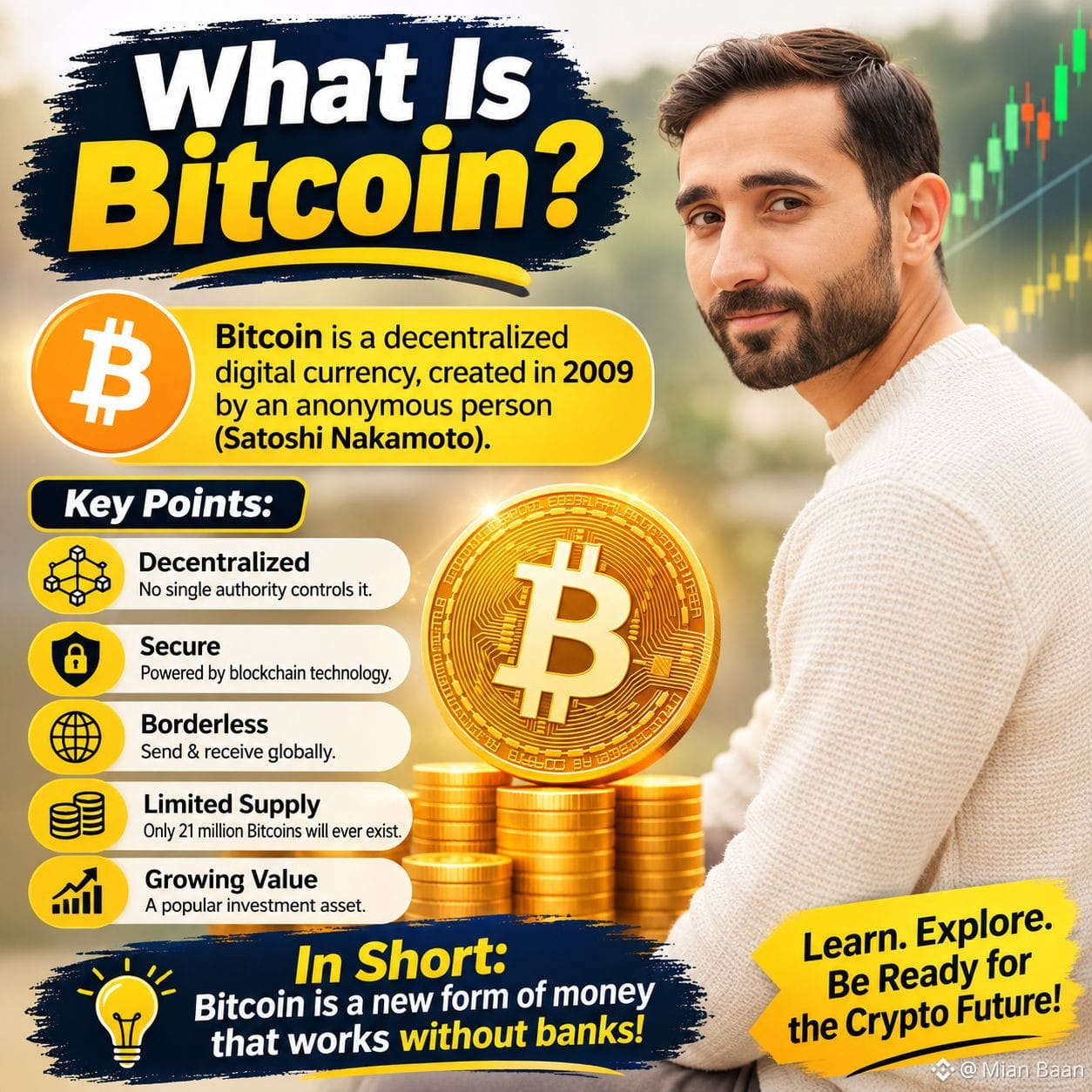
What Is Bitcoin?
Bitcoin Explained for Beginners
Bitcoin is more than just a digital currency.
It is a decentralized payment network that allows people to transfer value without relying on a traditional bank.
Here are 3 important things to understand:
1.Bitcoin operates on blockchain technology.
2.Its maximum supply is limited to 21 million coins.
3.Transactions are recorded on a public ledger.
Understanding Bitcoin is the first step toward understanding cryptocurrency.
Learn before you invest.
#Bitcoin #BTC #CryptoEducation #Binance
121
🧠 ဘာကြောင့် MEME COIN ကုန်သည်တွေက မြင့်ပြီး ဝယ်၊ နိမ့်ပြီး ရောင်းကြတာလဲ?
ဒီအခြေအနေကို စိတ်ကူးကြည့်ပါ:
📈 meme coin တစ်ခုက 200% တက်သွားတယ်။ လူတိုင်း အဲဒီအကြောင်း ပြောနေကြလို့ သင် ဝယ်လိုက်တယ်။
🚀 နောက်ထပ် 30% ထပ်တက်သွားတယ်။ 100x ဖြစ်မယ်လို့ အိပ်မက်မက်နေတဲ့အတွက် ရောင်းဖို့ ငြင်းဆန်လိုက်တယ်။
📉 ရုတ်တရက် ပြုတ်ကျသွားတယ်။ သင် ထိတ်လန့်ပြီး ရောင်းလိုက်တယ်။
ပြီးတော့ နောက်ထပ် meme coin ကို ရှာဖွေစပြုတယ်။
ရင်းနှီးပြီးသားလို ခံစားရလား?
ဒီအယူအဆဆန်တဲ့ အခြေအနေက စိတ်ပိုင်းဆိုင်ရာ လှည့်ကွက်ကြီး 3 ခုကို ပြသထားတယ်:
🔥 FOMO: လွတ်သွားမှာ ကြောက်လို့ ဝင်ရောက်တာ။
💰 လောဘ: အမြတ်မျှော်မှန်းချက်ကို အမြဲပြောင်းလဲနေတာ။
😨 ထိတ်လန့်မှု: ဈေးကွက် မတည်ငြိမ်တဲ့အချိန်မှာ အလျင်စလို ဆုံးဖြတ်တာ။
သင်က $DOGE, $PEPE, $BONK သို့မဟုတ် $WIF နဲ့ ကုန်သွယ်နေတယ်ဆိုရင်တောင် စိတ်ခံစားချက်ပေါ်အခြေခံတဲ့ ဆုံးဖြတ်ချက်တွေက အခွင့်အရေးတွေကို ဈေးကြီးတဲ့ အမှားတွေဖြစ်အောင် ပြောင်းလဲပစ်နိုင်တယ်။
အပြင်းအထန် စည်းကမ်းရှိတဲ့ ကုန်သည်တွေက ဈေးကွက်ကို ထိန်းချုပ်လို့မရပေမယ့် မိမိရဲ့ အန္တရာယ်ထိတွေ့မှုကိုတော့ ထိန်းချုပ်နိုင်တယ်ဆိုတာ နားလည်ကြတယ်။
တခါတရံ crypto ထဲမှာ အခက်ဆုံးအရာက နောက်ထပ် အခွင့်အရေးကို ရှာဖွေတာ မဟုတ်ဘူး။ ဘာမှ မလုပ်သင့်တဲ့ အချိန်ကို သိထားတာပဲ။
💬 crypto ထဲမှာ သင့်ကို အများဆုံး ငွေကုန်စေခဲ့တဲ့ စိတ်ခံစားချက်က ဘာလဲ: FOMO, လောဘ, ဒါမှမဟုတ် ထိတ်လန့်မှုလား?
#memecoins #tradingpsychology #cryptoeducation #BinanceSquare

1
425
·
--
Article
ရိုးရှင်းတဲ့ ဟာ့ဒ်ဝဲပိုက်ဆံအိတ်နဲ့ သင့်ခရစ်ပတိုကို ဘယ်လိုလုံခြုံအောင်ထားမလဲအခုမှ စတင်လေ့လာနေသူဆိုရင် “လုံခြုံစွာ သိမ်းဆည်းခြင်း” ဆိုတဲ့ အယူအဆဟာ နည်းပညာဆိုင်ရာ ဝေါဟာရတွေကြားမှာ နားလည်ရခက်နေနိုင်ပါတယ်။ ကျွန်တော်/ကျွန်မ ပထမဆုံး $BTC နဲ့ $ETH ကို ဝယ်ခဲ့တဲ့ ပထမအပတ်က ဟက်ကာတွေ ခိုးယူလို့မရအောင် ဘယ်မှာသိမ်းထားရမလဲဆိုပြီး တွေးမိတာကို မှတ်မိနေပါသေးတယ်။ ဒီလမ်းညွှန်မှာတော့ ယနေ့ဈေးကွက်အခြေအနေကို နောက်ခံအဖြစ်သာ အနည်းငယ်အသုံးပြုပြီး လူတိုင်းလိုက်နာနိုင်တဲ့ လုံခြုံရေးအလေ့အကျင့်တစ်ခုကို ရှင်းပြသွားပါမယ်။
ဟာ့ဒ်ဝဲပိုက်ဆံအိတ်တစ်ခုက ဘာကြောင့် အရေးကြီးတာလဲ
ဟာ့ဒ်ဝဲပိုက်ဆံအိတ်ဆိုတာ သင့်ရဲ့ သီးသန့်သော့တွေကို အင်တာနက်နဲ့ ချိတ်ဆက်မထားဘဲ သိမ်းဆည်းပေးတဲ့ သေးငယ်တဲ့စက်ပစ္စည်းတစ်ခုပါ။ သီးသန့်သော့တွေဟာ သင့်ဘဏ်အကောင့်ရဲ့ လျှို့ဝှက် PIN နံပါတ်လိုပါပဲ။ တစ်ယောက်ယောက်က အဲဒါတွေကို ရသွားရင် သင့်ခရစ်ပတိုကို သူတို့က ထိန်းချုပ်နိုင်ပါတယ်။ သော့တွေကို ရုပ်ပိုင်းဆိုင်ရာစက်ပစ္စည်းတစ်ခုထဲမှာ သိမ်းဆည်းထားခြင်းအားဖြင့် အွန်လိုင်းမှာ ကြုံတွေ့နိုင်တဲ့ အကြီးမားဆုံးအန္တရာယ်ဖြစ်တဲ့ အကောင့်ဝင်အသေးစိတ်အချက်အလက်တွေကို ခိုးယူဖို့ ကြိုးစားတဲ့ လိမ်လည်လှည့်ဖြားမှုတွေကို ရှောင်ရှားနိုင်ပါတယ်။
ရိုးရှင်းတဲ့ ဟာ့ဒ်ဝဲပိုက်ဆံအိတ်နဲ့ သင့်ခရစ်ပတိုကို ဘယ်လိုလုံခြုံအောင်ထားမလဲ
အခုမှ စတင်လေ့လာနေသူဆိုရင် “လုံခြုံစွာ သိမ်းဆည်းခြင်း” ဆိုတဲ့ အယူအဆဟာ နည်းပညာဆိုင်ရာ ဝေါဟာရတွေကြားမှာ နားလည်ရခက်နေနိုင်ပါတယ်။ ကျွန်တော်/ကျွန်မ ပထမဆုံး $BTC နဲ့ $ETH ကို ဝယ်ခဲ့တဲ့ ပထမအပတ်က ဟက်ကာတွေ ခိုးယူလို့မရအောင် ဘယ်မှာသိမ်းထားရမလဲဆိုပြီး တွေးမိတာကို မှတ်မိနေပါသေးတယ်။ ဒီလမ်းညွှန်မှာတော့ ယနေ့ဈေးကွက်အခြေအနေကို နောက်ခံအဖြစ်သာ အနည်းငယ်အသုံးပြုပြီး လူတိုင်းလိုက်နာနိုင်တဲ့ လုံခြုံရေးအလေ့အကျင့်တစ်ခုကို ရှင်းပြသွားပါမယ်။
ဟာ့ဒ်ဝဲပိုက်ဆံအိတ်တစ်ခုက ဘာကြောင့် အရေးကြီးတာလဲ
ဟာ့ဒ်ဝဲပိုက်ဆံအိတ်ဆိုတာ သင့်ရဲ့ သီးသန့်သော့တွေကို အင်တာနက်နဲ့ ချိတ်ဆက်မထားဘဲ သိမ်းဆည်းပေးတဲ့ သေးငယ်တဲ့စက်ပစ္စည်းတစ်ခုပါ။ သီးသန့်သော့တွေဟာ သင့်ဘဏ်အကောင့်ရဲ့ လျှို့ဝှက် PIN နံပါတ်လိုပါပဲ။ တစ်ယောက်ယောက်က အဲဒါတွေကို ရသွားရင် သင့်ခရစ်ပတိုကို သူတို့က ထိန်းချုပ်နိုင်ပါတယ်။ သော့တွေကို ရုပ်ပိုင်းဆိုင်ရာစက်ပစ္စည်းတစ်ခုထဲမှာ သိမ်းဆည်းထားခြင်းအားဖြင့် အွန်လိုင်းမှာ ကြုံတွေ့နိုင်တဲ့ အကြီးမားဆုံးအန္တရာယ်ဖြစ်တဲ့ အကောင့်ဝင်အသေးစိတ်အချက်အလက်တွေကို ခိုးယူဖို့ ကြိုးစားတဲ့ လိမ်လည်လှည့်ဖြားမှုတွေကို ရှောင်ရှားနိုင်ပါတယ်။
112
·
--
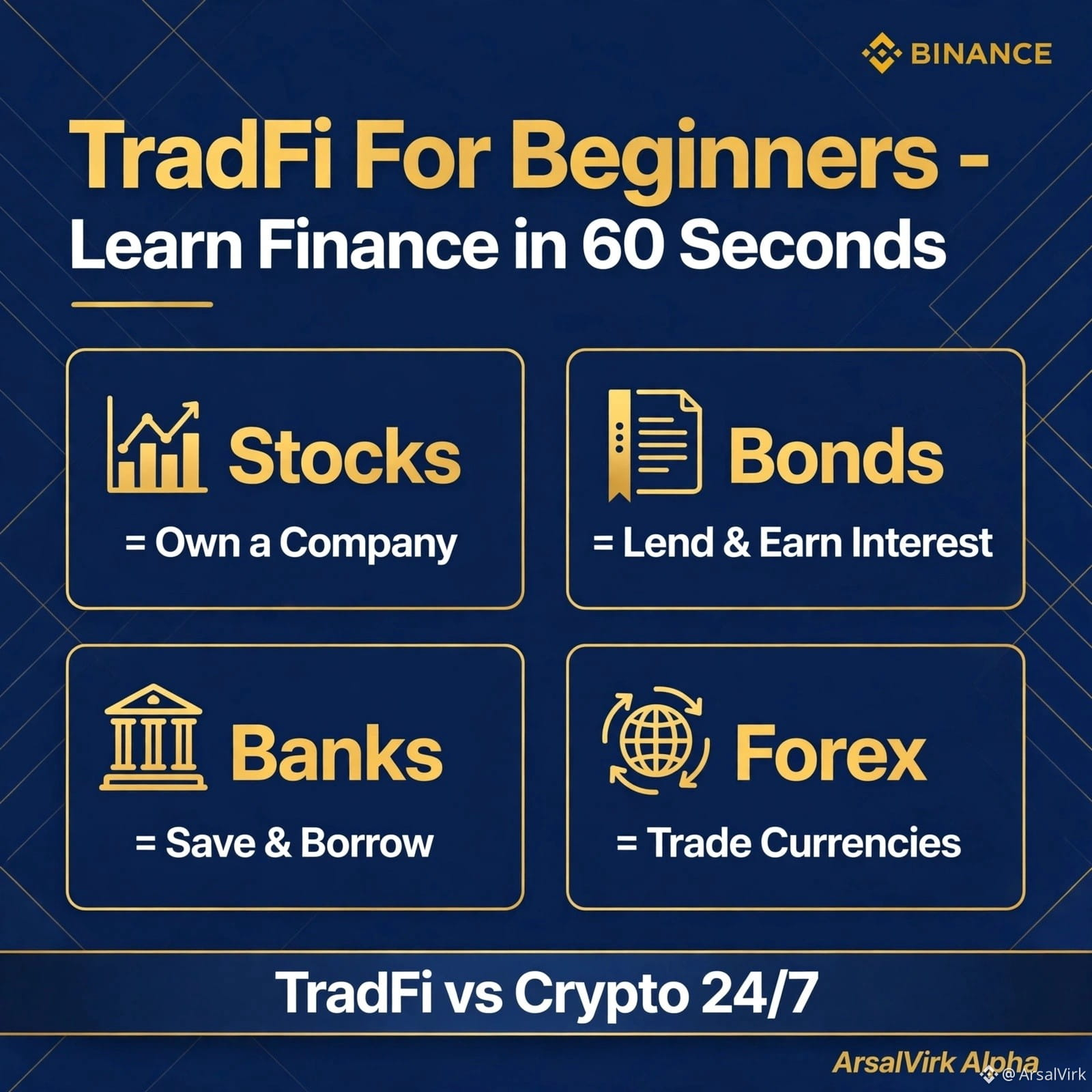
#TradFiForBeginners
> ခရစ်ပတိုအကြောင်း နားလည်ချင်ရင် အရင်ဆုံး TradFi ကို နားလည်ထားဖို့ မဖြစ်မနေ လိုပါတယ်။
> TradFi ဆိုတာ Traditional Finance (ရိုးရာဘဏ္ဍာရေးစနစ်) ပါ။ ဘဏ်တွေ၊ စတော့ဈေးကွက်တွေနဲ့ အစိုးရတွေက လည်ပတ်နေတဲ့ စနစ်ဟောင်းပါ။
> *စက္ကန့် 60 အတွင်း လေ့လာလိုက်ပါ။*
> - *စတော့များ:* ကုမ္ပဏီတစ်ခုရဲ့ ရှယ်ယာတစ်စိတ်တစ်ပိုင်းကို ဝယ်ယူတာပါ။ ကုမ္ပဏီတိုးတက်ရင် သင်လည်း အကျိုးအမြတ်ရပါတယ်။
> - *ဘွန်းများ:* အစိုးရ ဒါမှမဟုတ် ကုမ္ပဏီကို ငွေချေးပေးတာပါ။ အတိုးပြန်ရပါတယ်။ စွန့်စားမှုနည်း၊ အမြတ်နည်းပါတယ်။
> - *ဘဏ်များ:* ငွေစုတာ၊ ငွေချေးတာတွေ လုပ်နိုင်ပါတယ်။ ဘဏ်က ကြားခံအဖွဲ့အစည်းပါ။
> - *Forex:* ငွေကြေးတွေကို အရောင်းအဝယ်လုပ်တာပါ။ ဒေါ်လာနဲ့ ယူရို၊ ပေါင်နဲ့ ယန်းတို့လိုပါ။
> *TradFi နဲ့ ခရစ်ပတို — အဓိကကွာခြားချက်ကြီးကတော့:*
> - *TradFi:* တနင်္လာနေ့ကနေ သောကြာနေ့အထိ၊ မနက် 9 နာရီကနေ ညနေ 5 နာရီအထိပါ။ ဘဏ်ပိတ်ရင် ငွေကြေးဝန်ဆောင်မှုတွေလည်း ပိတ်ပါတယ်။
> - *ခရစ်ပတို:* 24/7 အချိန်တိုင်း အသုံးပြုနိုင်ပါတယ်။ ဘဏ်မလိုဘူး။ ခွင့်ပြုချက်မလိုဘူး။ ကိုယ်တိုင်ပဲ ကိုယ့်ဘဏ်ဖြစ်ပါတယ်။
> TradFi က နှေးပေမယ့် စည်းမျဉ်းစည်းကမ်းနဲ့ ထိန်းချုပ်ထားပါတယ်။
> ခရစ်ပတိုက မြန်ပေမယ့် စွန့်စားရမှုရှိပါတယ်။
> ထက်မြက်တဲ့ ရင်းနှီးမြှုပ်နှံသူတွေက တစ်ခုတည်းကို ရွေးချယ်တာမဟုတ်ပါဘူး။ နှစ်ခုလုံးကို နားလည်ကြပါတယ်။
> အခုမှစလေ့လာနေသူဆိုရင် ဒီပို့စ်ကို သိမ်းထားလိုက်ပါ။ စတော့နဲ့ ခရစ်ပတိုက အတူတူပဲလို့ ထင်နေသေးသူတစ်ယောက်ကိုလည်း မျှဝေပေးလိုက်ပါ။
> ပထမဆုံး ဘာနဲ့စခဲ့လဲ — စတော့၊ ခရစ်ပတို၊ ဒါမှမဟုတ် ရွှေလား။ အောက်မှာ မှတ်ချက်ပေးခဲ့ပါ 👇
> ✦ ArsalVirk Alpha ✦
#TradFiForBeginners #TradFi #learncrypto #CryptoForBeginners #BinanceSquare #ArsalVirkAlpha #Stocks #Bonds #Forex #CryptoEducation $BTC $BNB $ETH
1
158

ဘာသာပြန်ဆိုချက် ကြည့်မည်
Unlocking the Order Book: A Comprehensive Guide to Crypto Market Depth and Order ExecutionMost cryptocurrency market participants spend the vast majority of their time looking at traditional line or candlestick price charts. While these charts tell a clear narrative about where an asset has traded historically, they offer limited insight into what is happening under the surface of the market in real time. To truly understand price stability, market mechanics, and liquidity risk, intermediate traders must learn to evaluate market depth.
Market depth provides a live, structural look at pending buy and sell orders across various price levels. It represents the foundation of market liquidity. Understanding how to read, interpret, and evaluate market depth allows traders to minimize execution costs, avoid severe slippage, spot manipulative order setups, and better evaluate true supply and demand dynamics.
### Anatomy of the Order Book
To understand market depth, one must first understand how a Central Limit Order Book (CLOB) operates on a crypto exchange. An order book is essentially a continuous registry of unexecuted buy and sell limit orders. It is divided into two fundamental sides:
- **Bids (Buy Orders)**: Limit orders placed by market participants who want to buy an asset at a specified price or lower. Bids sit below the current prevailing market price.
- **Asks or Offers (Sell Orders)**: Limit orders placed by participants who want to sell an asset at a specified price or higher. Asks sit above the current prevailing market price.
- **The Spread**: The gap between the highest bid price and the lowest ask price. A narrow spread generally signals robust liquidity and efficient market pricing, whereas a wide spread indicates lower liquidity and potential execution risks.
Order books function through the interaction of two distinct types of liquidity providers and consumers:
1. **Limit Orders (Resting Liquidity)**: These orders sit passively in the order book waiting for the market price to reach them. They supply market depth.
2. **Market Orders (Aggressive Liquidity)**: These orders execute immediately against the best available limit orders in the book. They consume market depth.
### Visualizing Market Depth
Exchanges typically present market depth through two primary visual interfaces: tabular order books and cumulative depth charts.
A cumulative depth chart plots price along the horizontal axis and aggregated trade volume along the vertical axis. The left side (usually rendered in green) shows aggregated buy limit orders from the highest bid down to lower price levels. The right side (usually rendered in red) shows aggregated sell limit orders from the lowest ask up to higher price levels.
When viewing a depth chart:
- **Steep Slopes ("Walls")**: A vertical step or wall on the depth chart indicates a large concentration of limit order volume clustered at a specific price level.
- **Shallow Slopes**: A flat or shallow line indicates low order density, meaning there are relatively few limit orders resting across those price ranges.
If a massive buy wall appears on the depth chart, it signifies substantial resting buying power at that price. Conversely, a thin depth profile means even a modest aggressive market order could push the price through multiple levels rapidly.
### Market Impact and Slippage: A Practical Example
One of the most vital practical applications of analyzing market depth is measuring expected slippage. Slippage occurs when there is a difference between the expected price of a market order and the actual average execution price.
Consider a hypothetical spot market for a medium-cap cryptocurrency trading around $10.00. Suppose a trader submits a market buy order for $100,000 worth of the asset.
Imagine the exchange order book displays the following sell liquidity:
- **Level 1 (Lowest Ask)**: $10.00 with $20,000 worth of resting liquidity available.
- **Level 2**: $10.10 with $30,000 worth of resting liquidity available.
- **Level 3**: $10.25 with $50,000 worth of resting liquidity available.
Because a market order fills sequentially against available resting liquidity, execution occurs across multiple levels:
- The first $20,000 of the order fills at $10.00.
- The next $30,000 fills at $10.10.
- The final $50,000 fills at $10.25.
The overall average execution price for this $100,000 purchase is approximately $10.155 per unit. Rather than buying the entire position at the top-of-book price of $10.00, the trader experienced approximately 1.55% upward slippage due to insufficient depth at the top level.
For highly liquid assets such as Bitcoin or Ethereum on major exchanges, top-of-book depth is usually deep enough that typical trade sizes incur minimal slippage. However, in less liquid altcoin markets or during periods of extreme volatility, market depth thins out rapidly, making slippage a major cost factor for active traders.
### Order Book Nuances: Spoofing, Phantom Depth, and Iceberg Orders
Relying solely on visual market depth can be misleading if a trader does not account for modern market structural tactics. Resting limit orders are optional commitments; they are not finalized trades until executed.
- **Phantom Depth and Spoofing**: Large limit orders can be placed to create the visual illusion of strong support or resistance, persuading other participants to trade in a specific direction. Just as the market price approaches the large order, the entity that placed it can cancel it instantly. This manipulation technique, known as spoofing, creates "phantom depth" that disappears when tested.
- **Iceberg Orders**: Institutional traders executing sizable orders often avoid placing full position sizes openly into the order book, as doing so would alert competitors and cause adverse price movements. Instead, they use algorithmic "iceberg orders." These orders display only a tiny visible fragment in the order book. Once that fragment is filled, another fragment automatically takes its place. Consequently, actual available liquidity at a price level may be significantly deeper than the visible order book suggests.
- **Off-Book (OTC) Liquidity**: A substantial volume of crypto institutional trading occurs Over-The-Counter (OTC) or via private market venues. Thus, exchange depth charts represent only a portion of aggregate global liquidity.
### Centralized vs. Decentralized Market Depth
The structural behavior of market depth varies substantially depending on the trading architecture:
- **Centralized Exchanges (CEXs)**: Rely on Central Limit Order Books. Depth is discrete, updated continuously, and directly reflects individual user limit orders.
- **Decentralized Exchanges (DEXs)**: Many DEXs rely on Automated Market Makers (AMMs) driven by mathematical liquidity pool formulas rather than order books. On classic AMM pools, depth is continuous across a mathematical curve. On concentrated liquidity DEX platforms, liquidity providers allocate capital within specific price ranges, creating depth profiles that functionally mimic order book density without active limit orders.
### Practical Execution Rules for Traders
1. **Size Positions Relative to Depth**: Always review order book depth within 1% to 2% of the mid-price prior to submitting large market orders. If your intended position size exceeds top-of-book liquidity, switch to limit orders or algorithmic execution strategies like TWAP (Time-Weighted Average Price).
2. **Evaluate Depth Imbalances**: Calculate the ratio between aggregated bid liquidity and ask liquidity close to the current price. Persistent depth imbalances where bid volume significantly exceeds ask volume often indicate short-term structural absorption of selling pressure.
3. **Be Skeptical of Isolated Walls**: Treat single, isolated order walls with caution. Genuine support or resistance typically appears as continuous, stacked order depth across several consecutive price steps rather than one solitary mega-order.
### Limitations and Risks
Analyzing market depth is not a standalone trading solution. It comes with clear limitations:
- **High-Frequency Trading (HFT) Latency**: Algorithmic market makers can add or modify liquidity within milliseconds, vastly outpacing human screen updates.
- **Fragmented Venues**: Liquidity is scattered across multiple global exchanges. Depth on one platform may not reflect overall global market sentiment.
- **No Directional Guarantees**: Deep bid support does not guarantee that prices will hold. A sufficiently aggressive market seller can clear through deep order books rapidly if fundamental sentiment shifts.
### Summary
Market depth provides crucial insight into the structural mechanics powering cryptocurrency markets. By shifting focus from static price charts to active liquidity distribution, traders can better estimate execution costs, identify true supply and demand imbalances, and protect themselves against execution slippage. Integrating depth analysis with strict risk management provides a far more complete framework for navigating modern crypto markets.
#CryptoEducation #TradingMechanics #MarketDepth
Unlocking the Order Book: A Comprehensive Guide to Crypto Market Depth and Order Execution
Most cryptocurrency market participants spend the vast majority of their time looking at traditional line or candlestick price charts. While these charts tell a clear narrative about where an asset has traded historically, they offer limited insight into what is happening under the surface of the market in real time. To truly understand price stability, market mechanics, and liquidity risk, intermediate traders must learn to evaluate market depth.
Market depth provides a live, structural look at pending buy and sell orders across various price levels. It represents the foundation of market liquidity. Understanding how to read, interpret, and evaluate market depth allows traders to minimize execution costs, avoid severe slippage, spot manipulative order setups, and better evaluate true supply and demand dynamics.
### Anatomy of the Order Book
To understand market depth, one must first understand how a Central Limit Order Book (CLOB) operates on a crypto exchange. An order book is essentially a continuous registry of unexecuted buy and sell limit orders. It is divided into two fundamental sides:
- **Bids (Buy Orders)**: Limit orders placed by market participants who want to buy an asset at a specified price or lower. Bids sit below the current prevailing market price.
- **Asks or Offers (Sell Orders)**: Limit orders placed by participants who want to sell an asset at a specified price or higher. Asks sit above the current prevailing market price.
- **The Spread**: The gap between the highest bid price and the lowest ask price. A narrow spread generally signals robust liquidity and efficient market pricing, whereas a wide spread indicates lower liquidity and potential execution risks.
Order books function through the interaction of two distinct types of liquidity providers and consumers:
1. **Limit Orders (Resting Liquidity)**: These orders sit passively in the order book waiting for the market price to reach them. They supply market depth.
2. **Market Orders (Aggressive Liquidity)**: These orders execute immediately against the best available limit orders in the book. They consume market depth.
### Visualizing Market Depth
Exchanges typically present market depth through two primary visual interfaces: tabular order books and cumulative depth charts.
A cumulative depth chart plots price along the horizontal axis and aggregated trade volume along the vertical axis. The left side (usually rendered in green) shows aggregated buy limit orders from the highest bid down to lower price levels. The right side (usually rendered in red) shows aggregated sell limit orders from the lowest ask up to higher price levels.
When viewing a depth chart:
- **Steep Slopes ("Walls")**: A vertical step or wall on the depth chart indicates a large concentration of limit order volume clustered at a specific price level.
- **Shallow Slopes**: A flat or shallow line indicates low order density, meaning there are relatively few limit orders resting across those price ranges.
If a massive buy wall appears on the depth chart, it signifies substantial resting buying power at that price. Conversely, a thin depth profile means even a modest aggressive market order could push the price through multiple levels rapidly.
### Market Impact and Slippage: A Practical Example
One of the most vital practical applications of analyzing market depth is measuring expected slippage. Slippage occurs when there is a difference between the expected price of a market order and the actual average execution price.
Consider a hypothetical spot market for a medium-cap cryptocurrency trading around $10.00. Suppose a trader submits a market buy order for $100,000 worth of the asset.
Imagine the exchange order book displays the following sell liquidity:
- **Level 1 (Lowest Ask)**: $10.00 with $20,000 worth of resting liquidity available.
- **Level 2**: $10.10 with $30,000 worth of resting liquidity available.
- **Level 3**: $10.25 with $50,000 worth of resting liquidity available.
Because a market order fills sequentially against available resting liquidity, execution occurs across multiple levels:
- The first $20,000 of the order fills at $10.00.
- The next $30,000 fills at $10.10.
- The final $50,000 fills at $10.25.
The overall average execution price for this $100,000 purchase is approximately $10.155 per unit. Rather than buying the entire position at the top-of-book price of $10.00, the trader experienced approximately 1.55% upward slippage due to insufficient depth at the top level.
For highly liquid assets such as Bitcoin or Ethereum on major exchanges, top-of-book depth is usually deep enough that typical trade sizes incur minimal slippage. However, in less liquid altcoin markets or during periods of extreme volatility, market depth thins out rapidly, making slippage a major cost factor for active traders.
### Order Book Nuances: Spoofing, Phantom Depth, and Iceberg Orders
Relying solely on visual market depth can be misleading if a trader does not account for modern market structural tactics. Resting limit orders are optional commitments; they are not finalized trades until executed.
- **Phantom Depth and Spoofing**: Large limit orders can be placed to create the visual illusion of strong support or resistance, persuading other participants to trade in a specific direction. Just as the market price approaches the large order, the entity that placed it can cancel it instantly. This manipulation technique, known as spoofing, creates "phantom depth" that disappears when tested.
- **Iceberg Orders**: Institutional traders executing sizable orders often avoid placing full position sizes openly into the order book, as doing so would alert competitors and cause adverse price movements. Instead, they use algorithmic "iceberg orders." These orders display only a tiny visible fragment in the order book. Once that fragment is filled, another fragment automatically takes its place. Consequently, actual available liquidity at a price level may be significantly deeper than the visible order book suggests.
- **Off-Book (OTC) Liquidity**: A substantial volume of crypto institutional trading occurs Over-The-Counter (OTC) or via private market venues. Thus, exchange depth charts represent only a portion of aggregate global liquidity.
### Centralized vs. Decentralized Market Depth
The structural behavior of market depth varies substantially depending on the trading architecture:
- **Centralized Exchanges (CEXs)**: Rely on Central Limit Order Books. Depth is discrete, updated continuously, and directly reflects individual user limit orders.
- **Decentralized Exchanges (DEXs)**: Many DEXs rely on Automated Market Makers (AMMs) driven by mathematical liquidity pool formulas rather than order books. On classic AMM pools, depth is continuous across a mathematical curve. On concentrated liquidity DEX platforms, liquidity providers allocate capital within specific price ranges, creating depth profiles that functionally mimic order book density without active limit orders.
### Practical Execution Rules for Traders
1. **Size Positions Relative to Depth**: Always review order book depth within 1% to 2% of the mid-price prior to submitting large market orders. If your intended position size exceeds top-of-book liquidity, switch to limit orders or algorithmic execution strategies like TWAP (Time-Weighted Average Price).
2. **Evaluate Depth Imbalances**: Calculate the ratio between aggregated bid liquidity and ask liquidity close to the current price. Persistent depth imbalances where bid volume significantly exceeds ask volume often indicate short-term structural absorption of selling pressure.
3. **Be Skeptical of Isolated Walls**: Treat single, isolated order walls with caution. Genuine support or resistance typically appears as continuous, stacked order depth across several consecutive price steps rather than one solitary mega-order.
### Limitations and Risks
Analyzing market depth is not a standalone trading solution. It comes with clear limitations:
- **High-Frequency Trading (HFT) Latency**: Algorithmic market makers can add or modify liquidity within milliseconds, vastly outpacing human screen updates.
- **Fragmented Venues**: Liquidity is scattered across multiple global exchanges. Depth on one platform may not reflect overall global market sentiment.
- **No Directional Guarantees**: Deep bid support does not guarantee that prices will hold. A sufficiently aggressive market seller can clear through deep order books rapidly if fundamental sentiment shifts.
### Summary
Market depth provides crucial insight into the structural mechanics powering cryptocurrency markets. By shifting focus from static price charts to active liquidity distribution, traders can better estimate execution costs, identify true supply and demand imbalances, and protect themselves against execution slippage. Integrating depth analysis with strict risk management provides a far more complete framework for navigating modern crypto markets.
#CryptoEducation #TradingMechanics #MarketDepth
24
Log in to explore more content
Join global crypto users on Binance Square
⚡️ Get latest and useful information about crypto.
💬 Trusted by the world’s largest crypto exchange.
👍 Discover real insights from verified creators.
အီးမေးလ် / ဖုန်းနံပါတ်
ရေပန်းစားနေသော ခေါင်းစဉ်များ
1
#MoneroFalls13%OnDelistings
ကြည့်ရှုမှု 13,043 ကြိမ်
207 ဦး ဆွေးနွေးနေသည်
2
#EvolveAtBinanceBlockchainWeek
ကြည့်ရှုမှု 1.2M ကြိမ်
13,858 ဦး ဆွေးနွေးနေသည်
3
#CanMarketsReboundAfterThanksgiving?
ကြည့်ရှုမှု 434,569 ကြိမ်
3,325 ဦး ဆွေးနွေးနေသည်
4
#EthereumGlamsterdamKeepsStorageFeeChange
ကြည့်ရှုမှု 8,700 ကြိမ်
120 ဦး ဆွေးနွေးနေသည်
5
#XRPLedgerVaultGets29Votes
ကြည့်ရှုမှု 30,280 ကြိမ်
372 ဦး ဆွေးနွေးနေသည်
6
#SwitzerlandApproves57JurisdictionsForCryptoDataExchange
ကြည့်ရှုမှု 8,926 ကြိမ်
33 ဦး ဆွေးနွေးနေသည်
7
#CouldSpaceX’sOrbitalDataCentersBoostAIChipDemand?
ကြည့်ရှုမှု 169,233 ကြိမ်
1,713 ဦး ဆွေးနွေးနေသည်
8
#ZcashDevelopersUrgeZECMoveToIronwood
ကြည့်ရှုမှု 95,786 ကြိမ်
477 ဦး ဆွေးနွေးနေသည်
9
#Nasdaq100FiveDayAvgIntradayVolatilityHits3.8%
ကြည့်ရှုမှု 50,131 ကြိမ်
457 ဦး ဆွေးနွေးနေသည်
10
#UKFCAProposesDeFiAccessLimitsForExchanges
ကြည့်ရှုမှု 694 ကြိမ်
14 ဦး ဆွေးနွေးနေသည်