

#stablecoins
stablecoins
ကြည့်ရှုမှု 7.6M ကြိမ်
29,308 ဦး ဆွေးနွေးနေသည်
ရေပန်းစားသော
နောက်ဆုံး

·
--
⚖️ $USDT | USDT at $0.9987: a routine peg wobble or a signal worth watching?
At the 2026-10-26 19:58 UTC snapshot, Tether traded at $0.9987, a deviation of -0.13% from the assumed USD 1.00 peg, with a 24h price change of -0.0% and market cap of $182.3 billion. One reading treats such a small gap as ordinary noise for a token designed to mirror the dollar, especially with $47.0 billion in 24h volume. The other asks whether any persistent discount, however slight, deserves attention given that USDT's value rests on reserves and redemption rather than market discovery.
Why it matters: For a stablecoin, the peg and the credibility of reserves and redemption matter more than daily price moves, so even small deviations are best read as a question about design, not direction.
💬 Does a -0.13% deviation from the peg tell you anything meaningful about USDT's reserves and redemption model, or is it just noise?
Source: Official site https://tether.to/
#Tether #Stablecoins
⚖️ $USDT | USDT at $0.9987: a routine peg wobble or a signal worth watching?
At the 2026-10-26 19:58 UTC snapshot, Tether traded at $0.9987, a deviation of -0.13% from the assumed USD 1.00 peg, with a 24h price change of -0.0% and market cap of $182.3 billion. One reading treats such a small gap as ordinary noise for a token designed to mirror the dollar, especially with $47.0 billion in 24h volume. The other asks whether any persistent discount, however slight, deserves attention given that USDT's value rests on reserves and redemption rather than market discovery.
Why it matters: For a stablecoin, the peg and the credibility of reserves and redemption matter more than daily price moves, so even small deviations are best read as a question about design, not direction.
💬 Does a -0.13% deviation from the peg tell you anything meaningful about USDT's reserves and redemption model, or is it just noise?
Source: Official site https://tether.to/
#Tether #Stablecoins
At the 2026-10-26 19:58 UTC snapshot, Tether traded at $0.9987, a deviation of -0.13% from the assumed USD 1.00 peg, with a 24h price change of -0.0% and market cap of $182.3 billion. One reading treats such a small gap as ordinary noise for a token designed to mirror the dollar, especially with $47.0 billion in 24h volume. The other asks whether any persistent discount, however slight, deserves attention given that USDT's value rests on reserves and redemption rather than market discovery.
Why it matters: For a stablecoin, the peg and the credibility of reserves and redemption matter more than daily price moves, so even small deviations are best read as a question about design, not direction.
💬 Does a -0.13% deviation from the peg tell you anything meaningful about USDT's reserves and redemption model, or is it just noise?
Source: Official site https://tether.to/
#Tether #Stablecoins

·
--
Small banks getting a push into stablecoins? That caught my attention. 👀
The OCC, a U.S. banking regulator, is encouraging community banks to develop stablecoin services as new federal licensing requirements approach, according to CoinDesk.
What stands out to me: this isn’t just banks watching crypto from the sidelines. The regulator is calling on smaller lenders to enter the stablecoin payments market. 🏦
Would you use stablecoin payments through your local bank, or prefer a crypto-native service?
#Stablecoins #CryptoPayments #CryptoRegulation
Small banks getting a push into stablecoins? That caught my attention. 👀
The OCC, a U.S. banking regulator, is encouraging community banks to develop stablecoin services as new federal licensing requirements approach, according to CoinDesk.
What stands out to me: this isn’t just banks watching crypto from the sidelines. The regulator is calling on smaller lenders to enter the stablecoin payments market. 🏦
Would you use stablecoin payments through your local bank, or prefer a crypto-native service?
#Stablecoins #CryptoPayments #CryptoRegulation
The OCC, a U.S. banking regulator, is encouraging community banks to develop stablecoin services as new federal licensing requirements approach, according to CoinDesk.
What stands out to me: this isn’t just banks watching crypto from the sidelines. The regulator is calling on smaller lenders to enter the stablecoin payments market. 🏦
Would you use stablecoin payments through your local bank, or prefer a crypto-native service?
#Stablecoins #CryptoPayments #CryptoRegulation

5
·
--
Stablecoins with no yield—and up to three business days to redeem? That makes me pause. 🤔
Canada has opened consultation on draft stablecoin rules, keeping the ban on yields.
Under the proposal, non-bank issuers must back tokens 1:1 with reserves held at qualified Canadian institutions and settle redemptions within three business days.
My takeaway: the backing requirement matters, but so does how quickly holders can get their money back. 🏦
Would that redemption window work for you, or feel too slow?
#Stablecoins #Canada #CryptoRegulation
Stablecoins with no yield—and up to three business days to redeem? That makes me pause. 🤔
Canada has opened consultation on draft stablecoin rules, keeping the ban on yields.
Under the proposal, non-bank issuers must back tokens 1:1 with reserves held at qualified Canadian institutions and settle redemptions within three business days.
My takeaway: the backing requirement matters, but so does how quickly holders can get their money back. 🏦
Would that redemption window work for you, or feel too slow?
#Stablecoins #Canada #CryptoRegulation
Canada has opened consultation on draft stablecoin rules, keeping the ban on yields.
Under the proposal, non-bank issuers must back tokens 1:1 with reserves held at qualified Canadian institutions and settle redemptions within three business days.
My takeaway: the backing requirement matters, but so does how quickly holders can get their money back. 🏦
Would that redemption window work for you, or feel too slow?
#Stablecoins #Canada #CryptoRegulation

26

·
--
美国监管OCC火速喊话社区银行:快来搞稳定币支付!新规要来了,小银行们是时候布局稳定币业务了。传统金融与加密世界加速融合!#加密货币 #稳定币 $USDC $USDT
US regulator OCC is urgently calling on community banks: Get into stablecoin payments! New regulations are coming, it's time for small banks to tap into stablecoin biz. Traditional finance meets crypto world at full speed! #crypto #stablecoins $USDC $USDT
美国监管OCC火速喊话社区银行:快来搞稳定币支付!新规要来了,小银行们是时候布局稳定币业务了。传统金融与加密世界加速融合!#加密货币 #稳定币 $USDC $USDT
US regulator OCC is urgently calling on community banks: Get into stablecoin payments! New regulations are coming, it's time for small banks to tap into stablecoin biz. Traditional finance meets crypto world at full speed! #crypto #stablecoins $USDC $USDT
US regulator OCC is urgently calling on community banks: Get into stablecoin payments! New regulations are coming, it's time for small banks to tap into stablecoin biz. Traditional finance meets crypto world at full speed! #crypto #stablecoins $USDC $USDT
10

·
--
كندا نشرت مسودة قواعد للعملات المستقرة وفتحت التشاور حتى 23 ديسمبر 🇨🇦📄. للمُصدرين غير المصرفيين: تسجيل لدى بنك كندا واحتياطيات 1:1. والمسودة تمنع عائد الاحتفاظ، لكنها تسمح بمكافآت مرتبطة بالمعاملات 💵🧾. أي بند تتوقعون يكون الأصعب؟
الأكثر تداولًا على Binance وقت الرصد (18:59 إسطنبول، أزواج Spot مقابل USDT): $BTC، $USDC، $ETH. لقطة عامة للسوق لا علاقة سببية لها بالمسودة. المصدر: Binance Spot 24h Ticker API.
#Stablecoins #Crypto
كندا نشرت مسودة قواعد للعملات المستقرة وفتحت التشاور حتى 23 ديسمبر 🇨🇦📄. للمُصدرين غير المصرفيين: تسجيل لدى بنك كندا واحتياطيات 1:1. والمسودة تمنع عائد الاحتفاظ، لكنها تسمح بمكافآت مرتبطة بالمعاملات 💵🧾. أي بند تتوقعون يكون الأصعب؟
الأكثر تداولًا على Binance وقت الرصد (18:59 إسطنبول، أزواج Spot مقابل USDT): $BTC ، $USDC ، $ETH . لقطة عامة للسوق لا علاقة سببية لها بالمسودة. المصدر: Binance Spot 24h Ticker API.
#Stablecoins #Crypto
الأكثر تداولًا على Binance وقت الرصد (18:59 إسطنبول، أزواج Spot مقابل USDT): $BTC ، $USDC ، $ETH . لقطة عامة للسوق لا علاقة سببية لها بالمسودة. المصدر: Binance Spot 24h Ticker API.
#Stablecoins #Crypto

48

·
--
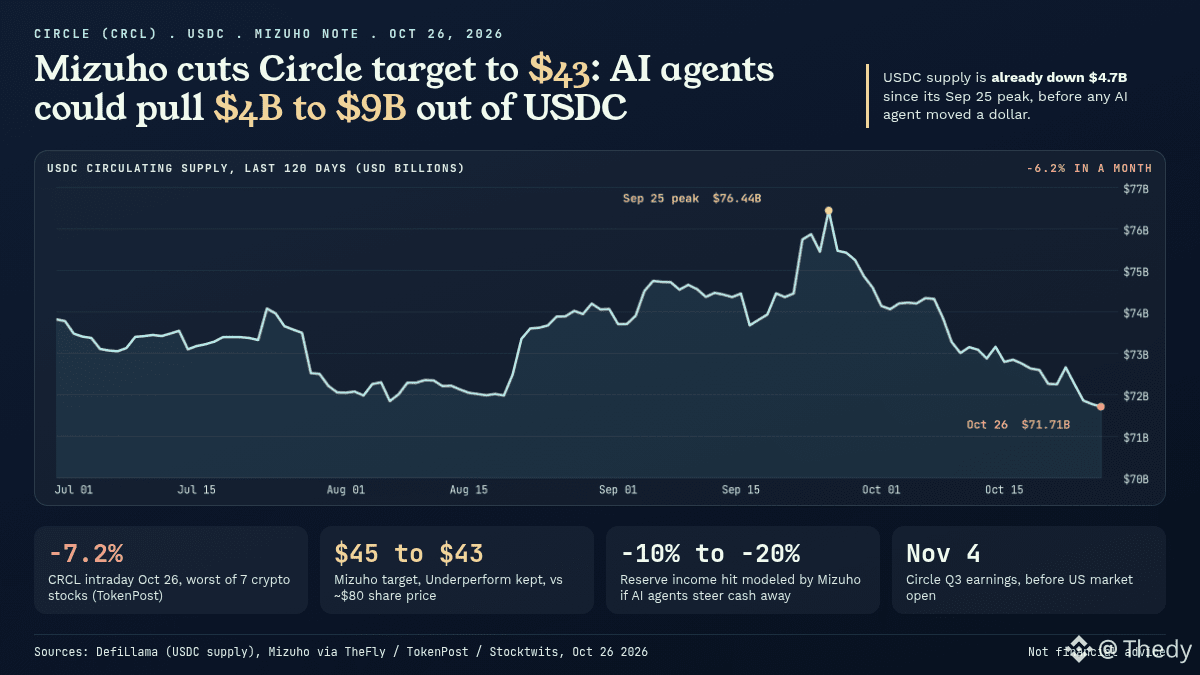
Circle (CRCL) chute d'environ 7 % ce lundi 26/10 après une note de Mizuho : la banque garde « Underperform », baisse son objectif de 45 $ à 43 $ et explique que les assistants IA pourraient détourner 4 à 9 Md$ de $USDC.
Le graphique raconte autre chose. Selon DefiLlama, l'offre de USDC était à 76,44 Md$ le 25/09. Elle est à 71,71 Md$ aujourd'hui, soit -4,7 Md$ (-6,2 %) en un mois. Le bas de la fourchette Mizuho est déjà atteint, sans qu'aucun agent IA n'ait bougé un dollar. Sur la même période, $USDT reste quasi stable autour de 182 Md$.
Le raisonnement de Mizuho (rapporté par TheFly et Stocktwits) : la banque a demandé à des agents IA où garder du cash. Réponse dominante : des comptes assurés FDIC qui paient plus, et même côté crypto, d'autres plateformes que Circle. Impact modélisé : -10 à -20 % sur les revenus de réserve, la principale source de profit de Circle. TokenPost note que CRCL fait la pire séance des 7 actions crypto suivies (MSTR -5,2 %, COIN -2,8 %).
Ma lecture : la baisse de l'offre USDC vient surtout d'un marché qui se dérisque avant la Fed de mercredi, pas encore de l'IA. Mais la note touche un vrai point faible : USDC ne verse pas de rendement au porteur, et un agent qui compare les taux le verra tout de suite.
Ce qui peut se passer d'ici les résultats T3 du 4/11 :
Si l'offre repasse au-dessus de 74 Md$, la thèse Mizuho perd de sa force à court terme.
Si elle glisse sous 70 Md$ et que Circle revoit ses revenus de réserve à la baisse, le marché prendra la note au sérieux.
Toi, tu laisserais un agent IA choisir où dort ton cash : stablecoin sans rendement ou compte bancaire rémunéré ?
#Circle #Stablecoins
Circle (CRCL) chute d'environ 7 % ce lundi 26/10 après une note de Mizuho : la banque garde « Underperform », baisse son objectif de 45 $ à 43 $ et explique que les assistants IA pourraient détourner 4 à 9 Md$ de $USDC .
Le graphique raconte autre chose. Selon DefiLlama, l'offre de USDC était à 76,44 Md$ le 25/09. Elle est à 71,71 Md$ aujourd'hui, soit -4,7 Md$ (-6,2 %) en un mois. Le bas de la fourchette Mizuho est déjà atteint, sans qu'aucun agent IA n'ait bougé un dollar. Sur la même période, $USDT reste quasi stable autour de 182 Md$.
Le raisonnement de Mizuho (rapporté par TheFly et Stocktwits) : la banque a demandé à des agents IA où garder du cash. Réponse dominante : des comptes assurés FDIC qui paient plus, et même côté crypto, d'autres plateformes que Circle. Impact modélisé : -10 à -20 % sur les revenus de réserve, la principale source de profit de Circle. TokenPost note que CRCL fait la pire séance des 7 actions crypto suivies (MSTR -5,2 %, COIN -2,8 %).
Ma lecture : la baisse de l'offre USDC vient surtout d'un marché qui se dérisque avant la Fed de mercredi, pas encore de l'IA. Mais la note touche un vrai point faible : USDC ne verse pas de rendement au porteur, et un agent qui compare les taux le verra tout de suite.
Ce qui peut se passer d'ici les résultats T3 du 4/11 :
Si l'offre repasse au-dessus de 74 Md$, la thèse Mizuho perd de sa force à court terme.
Si elle glisse sous 70 Md$ et que Circle revoit ses revenus de réserve à la baisse, le marché prendra la note au sérieux.
Toi, tu laisserais un agent IA choisir où dort ton cash : stablecoin sans rendement ou compte bancaire rémunéré ?
#Circle #Stablecoins
Le graphique raconte autre chose. Selon DefiLlama, l'offre de USDC était à 76,44 Md$ le 25/09. Elle est à 71,71 Md$ aujourd'hui, soit -4,7 Md$ (-6,2 %) en un mois. Le bas de la fourchette Mizuho est déjà atteint, sans qu'aucun agent IA n'ait bougé un dollar. Sur la même période, $USDT reste quasi stable autour de 182 Md$.
Le raisonnement de Mizuho (rapporté par TheFly et Stocktwits) : la banque a demandé à des agents IA où garder du cash. Réponse dominante : des comptes assurés FDIC qui paient plus, et même côté crypto, d'autres plateformes que Circle. Impact modélisé : -10 à -20 % sur les revenus de réserve, la principale source de profit de Circle. TokenPost note que CRCL fait la pire séance des 7 actions crypto suivies (MSTR -5,2 %, COIN -2,8 %).
Ma lecture : la baisse de l'offre USDC vient surtout d'un marché qui se dérisque avant la Fed de mercredi, pas encore de l'IA. Mais la note touche un vrai point faible : USDC ne verse pas de rendement au porteur, et un agent qui compare les taux le verra tout de suite.
Ce qui peut se passer d'ici les résultats T3 du 4/11 :
Si l'offre repasse au-dessus de 74 Md$, la thèse Mizuho perd de sa force à court terme.
Si elle glisse sous 70 Md$ et que Circle revoit ses revenus de réserve à la baisse, le marché prendra la note au sérieux.
Toi, tu laisserais un agent IA choisir où dort ton cash : stablecoin sans rendement ou compte bancaire rémunéré ?
#Circle #Stablecoins
31

·
--
Canadá propone rescates de stablecoins en tres días hábiles
La propuesta publicada en la Canada Gazette el 24 de octubre sigue en consulta hasta el 23 de diciembre. No es una obligación vigente; la implementación se proyecta para otoño de 2027, sujeta a aprobación.
Plantea rescates sin importe mínimo y una comisión del emisor de hasta el 1%. Los tres días hábiles abarcan liquidar reservas e iniciar la transferencia: no garantizan la acreditación en el banco receptor.
Si la iliquidez del mercado de reservas impide atender solicitudes, permitiría límites diarios. El plazo tiene condiciones; no equivale a 72 horas universales.
El marco apunta a emisores fuera de la supervisión prudencial y a proteger a residentes en Canadá. No certifica automáticamente a USDT, USDC o FDUSD.
Referencia de Binance Spot del 26 de octubre, 15:50 UTC: USDC, 1,00127 USDT (+0,016% en 24h); FDUSD, 0,99810 USDT (+0,010%). Son precios frente a USDT, no pruebas de rescate por dólares.
Lectura de mercado: conviene separar cotización, reservas y capacidad efectiva de rescate. Más claridad podría mejorar la previsibilidad, pero no elimina retrasos, comisiones ni riesgo de desvinculación. Esta propuesta no garantiza la paridad de ningún token.
$USDC $FDUSD $USDT
Contenido Educativo. No asesoramiento financiero.
#Stablecoins #Canada #Regulacion #USDC #USDT
Canadá propone rescates de stablecoins en tres días hábiles
La propuesta publicada en la Canada Gazette el 24 de octubre sigue en consulta hasta el 23 de diciembre. No es una obligación vigente; la implementación se proyecta para otoño de 2027, sujeta a aprobación.
Plantea rescates sin importe mínimo y una comisión del emisor de hasta el 1%. Los tres días hábiles abarcan liquidar reservas e iniciar la transferencia: no garantizan la acreditación en el banco receptor.
Si la iliquidez del mercado de reservas impide atender solicitudes, permitiría límites diarios. El plazo tiene condiciones; no equivale a 72 horas universales.
El marco apunta a emisores fuera de la supervisión prudencial y a proteger a residentes en Canadá. No certifica automáticamente a USDT, USDC o FDUSD.
Referencia de Binance Spot del 26 de octubre, 15:50 UTC: USDC, 1,00127 USDT (+0,016% en 24h); FDUSD, 0,99810 USDT (+0,010%). Son precios frente a USDT, no pruebas de rescate por dólares.
Lectura de mercado: conviene separar cotización, reservas y capacidad efectiva de rescate. Más claridad podría mejorar la previsibilidad, pero no elimina retrasos, comisiones ni riesgo de desvinculación. Esta propuesta no garantiza la paridad de ningún token.
$USDC $FDUSD $USDT
Contenido Educativo. No asesoramiento financiero.
#Stablecoins #Canada #Regulacion #USDC #USDT
La propuesta publicada en la Canada Gazette el 24 de octubre sigue en consulta hasta el 23 de diciembre. No es una obligación vigente; la implementación se proyecta para otoño de 2027, sujeta a aprobación.
Plantea rescates sin importe mínimo y una comisión del emisor de hasta el 1%. Los tres días hábiles abarcan liquidar reservas e iniciar la transferencia: no garantizan la acreditación en el banco receptor.
Si la iliquidez del mercado de reservas impide atender solicitudes, permitiría límites diarios. El plazo tiene condiciones; no equivale a 72 horas universales.
El marco apunta a emisores fuera de la supervisión prudencial y a proteger a residentes en Canadá. No certifica automáticamente a USDT, USDC o FDUSD.
Referencia de Binance Spot del 26 de octubre, 15:50 UTC: USDC, 1,00127 USDT (+0,016% en 24h); FDUSD, 0,99810 USDT (+0,010%). Son precios frente a USDT, no pruebas de rescate por dólares.
Lectura de mercado: conviene separar cotización, reservas y capacidad efectiva de rescate. Más claridad podría mejorar la previsibilidad, pero no elimina retrasos, comisiones ni riesgo de desvinculación. Esta propuesta no garantiza la paridad de ningún token.
$USDC $FDUSD $USDT
Contenido Educativo. No asesoramiento financiero.
#Stablecoins #Canada #Regulacion #USDC #USDT

24

·
--
La banca estadounidense empieza a mirar de cerca a las stablecoins.
La oficina del controlador de la moneda está animando a los bancos comunitarios a ofrecer servicios con estos activos.
Buscan que las entidades pequeñas se preparen antes de que lleguen las nuevas exigencias de licencias federales.
Es un movimiento curioso ver a reguladores impulsando esta adopción en instituciones locales.
¿Qué te parece este cambio de postura?
$BTC #Stablecoins #Banca
La banca estadounidense empieza a mirar de cerca a las stablecoins.
La oficina del controlador de la moneda está animando a los bancos comunitarios a ofrecer servicios con estos activos.
Buscan que las entidades pequeñas se preparen antes de que lleguen las nuevas exigencias de licencias federales.
Es un movimiento curioso ver a reguladores impulsando esta adopción en instituciones locales.
¿Qué te parece este cambio de postura?
$BTC #Stablecoins #Banca
La oficina del controlador de la moneda está animando a los bancos comunitarios a ofrecer servicios con estos activos.
Buscan que las entidades pequeñas se preparen antes de que lleguen las nuevas exigencias de licencias federales.
Es un movimiento curioso ver a reguladores impulsando esta adopción en instituciones locales.
¿Qué te parece este cambio de postura?
$BTC #Stablecoins #Banca
21

·
--
🚨US Stablecoin Rulebook: GENIUS Act Takes Shape
US stablecoin regulation is moving from theory to implementation.
The GENIUS Act framework is starting to take shape, with new rules around reserve backing, redemption, supervision, audits and issuer requirements.
This could strengthen confidence in dollar-backed stablecoins and support broader institutional adoption.
But tighter regulation may also raise compliance costs and increase pressure on smaller issuers.
Will clearer rules help the market grow — or concentrate power in the hands of the biggest players?
⚠️ Educational content only. Not financial advice.
#Stablecoins #GENIUSAct #CryptoRegulation #USDC #CryptoNews
🚨US Stablecoin Rulebook: GENIUS Act Takes Shape
US stablecoin regulation is moving from theory to implementation.
The GENIUS Act framework is starting to take shape, with new rules around reserve backing, redemption, supervision, audits and issuer requirements.
This could strengthen confidence in dollar-backed stablecoins and support broader institutional adoption.
But tighter regulation may also raise compliance costs and increase pressure on smaller issuers.
Will clearer rules help the market grow — or concentrate power in the hands of the biggest players?
⚠️ Educational content only. Not financial advice.
#Stablecoins #GENIUSAct #CryptoRegulation #USDC #CryptoNews
US stablecoin regulation is moving from theory to implementation.
The GENIUS Act framework is starting to take shape, with new rules around reserve backing, redemption, supervision, audits and issuer requirements.
This could strengthen confidence in dollar-backed stablecoins and support broader institutional adoption.
But tighter regulation may also raise compliance costs and increase pressure on smaller issuers.
Will clearer rules help the market grow — or concentrate power in the hands of the biggest players?
⚠️ Educational content only. Not financial advice.
#Stablecoins #GENIUSAct #CryptoRegulation #USDC #CryptoNews

1
27

#CanadaProposesStablecoinRedemptionWithin3BusinessDays
O Canadá quer definir regras claras para o resgate de stablecoins.
A proposta exige que os emissores devolvam o valor nominal em até três dias úteis, mantendo reservas de valor igual ou superior à oferta em circulação e limitando as taxas de resgate a 1%. A consulta pública começou a 24 de outubro de 2026, com implementação prevista para o outono de 2027.
O ponto crucial da proposta:
O verdadeiro teste de uma stablecoin não acontece quando o preço está colado em US$ 1 num mercado calmo. O teste acontece quando todos os detentores querem sacar o seu dinheiro ao mesmo tempo.
Para lidar com isso, a estrutura permite limites diários de resgate caso a liquidez das reservas não seja suficiente. Os direitos legais de resgate são essenciais, mas não eliminam o estresse de liquidez. A confiança depende da promessa de pagamento e da qualidade das reservas.
Uma janela de resgate de três dias definida por lei faria você confiar mais em stablecoins?
Aviso: Apenas para fins educacionais. Não é aconselhamento financeiro.
#Stablecoins #CryptoRegulation #GrowWithSAC $OSMO $ERA $QNT
{spot}(OSMOUSDT)
{spot}(ERAUSDT)
{spot}(QNTUSDT)
#CanadaProposesStablecoinRedemptionWithin3BusinessDays
O Canadá quer definir regras claras para o resgate de stablecoins.
A proposta exige que os emissores devolvam o valor nominal em até três dias úteis, mantendo reservas de valor igual ou superior à oferta em circulação e limitando as taxas de resgate a 1%. A consulta pública começou a 24 de outubro de 2026, com implementação prevista para o outono de 2027.
O ponto crucial da proposta:
O verdadeiro teste de uma stablecoin não acontece quando o preço está colado em US$ 1 num mercado calmo. O teste acontece quando todos os detentores querem sacar o seu dinheiro ao mesmo tempo.
Para lidar com isso, a estrutura permite limites diários de resgate caso a liquidez das reservas não seja suficiente. Os direitos legais de resgate são essenciais, mas não eliminam o estresse de liquidez. A confiança depende da promessa de pagamento e da qualidade das reservas.
Uma janela de resgate de três dias definida por lei faria você confiar mais em stablecoins?
Aviso: Apenas para fins educacionais. Não é aconselhamento financeiro.
#Stablecoins #CryptoRegulation #GrowWithSAC $OSMO $ERA $QNT
O Canadá quer definir regras claras para o resgate de stablecoins.
A proposta exige que os emissores devolvam o valor nominal em até três dias úteis, mantendo reservas de valor igual ou superior à oferta em circulação e limitando as taxas de resgate a 1%. A consulta pública começou a 24 de outubro de 2026, com implementação prevista para o outono de 2027.
O ponto crucial da proposta:
O verdadeiro teste de uma stablecoin não acontece quando o preço está colado em US$ 1 num mercado calmo. O teste acontece quando todos os detentores querem sacar o seu dinheiro ao mesmo tempo.
Para lidar com isso, a estrutura permite limites diários de resgate caso a liquidez das reservas não seja suficiente. Os direitos legais de resgate são essenciais, mas não eliminam o estresse de liquidez. A confiança depende da promessa de pagamento e da qualidade das reservas.
Uma janela de resgate de três dias definida por lei faria você confiar mais em stablecoins?
Aviso: Apenas para fins educacionais. Não é aconselhamento financeiro.
#Stablecoins #CryptoRegulation #GrowWithSAC $OSMO $ERA $QNT

1
101


#CanadaProposesStablecoinRedemptionWithin3BusinessDays
🇨🇦💵 CANADA’S NEW STABLECOIN RULE: CASH OUT WITHIN 3 BUSINESS DAYS? 💵🇨🇦
A digital dollar is only as trustworthy as your ability to turn it back into real money.
Canada has proposed new stablecoin regulations requiring covered issuers to redeem tokens at face value within three business days of a redemption request.
The proposal also requires reserves worth at least the value of outstanding stablecoins, backed by eligible liquid assets. Redemption fees would be capped at 1%, with no minimum redemption amount.
But there is an important catch: these rules are proposals, not yet active requirements. The consultation opened on October 24, 2026, and the government aims to bring the framework into force in fall 2027.
Why does this matter? Stablecoins are widely used for crypto trading, transfers, and moving value between platforms. Clear redemption rights could strengthen confidence by making the process of converting tokens into fiat currency more predictable.
My Take: The real test of a stablecoin is not whether it trades near Dollar 1 during calm markets. It is whether holders can reliably redeem it when everyone wants their money back at once.
The proposed framework allows daily redemption limits when reserve-market liquidity shortages prevent an issuer from meeting all requests. That exception matters because legal redemption rights cannot eliminate liquidity stress.
Trust in stablecoins will depend on both the promise of redemption and the reserves behind it.
❓ Would a legally defined three-day redemption window make you more confident holding stablecoins?
Disclaimer: For educational purposes only. Not financial advice.
#Stablecoins #CryptoRegulation #GrowWithSAC $OSMO $ERA $QNT
#CanadaProposesStablecoinRedemptionWithin3BusinessDays
🇨🇦💵 CANADA’S NEW STABLECOIN RULE: CASH OUT WITHIN 3 BUSINESS DAYS? 💵🇨🇦
A digital dollar is only as trustworthy as your ability to turn it back into real money.
Canada has proposed new stablecoin regulations requiring covered issuers to redeem tokens at face value within three business days of a redemption request.
The proposal also requires reserves worth at least the value of outstanding stablecoins, backed by eligible liquid assets. Redemption fees would be capped at 1%, with no minimum redemption amount.
But there is an important catch: these rules are proposals, not yet active requirements. The consultation opened on October 24, 2026, and the government aims to bring the framework into force in fall 2027.
Why does this matter? Stablecoins are widely used for crypto trading, transfers, and moving value between platforms. Clear redemption rights could strengthen confidence by making the process of converting tokens into fiat currency more predictable.
My Take: The real test of a stablecoin is not whether it trades near Dollar 1 during calm markets. It is whether holders can reliably redeem it when everyone wants their money back at once.
The proposed framework allows daily redemption limits when reserve-market liquidity shortages prevent an issuer from meeting all requests. That exception matters because legal redemption rights cannot eliminate liquidity stress.
Trust in stablecoins will depend on both the promise of redemption and the reserves behind it.
❓ Would a legally defined three-day redemption window make you more confident holding stablecoins?
Disclaimer: For educational purposes only. Not financial advice.
#Stablecoins #CryptoRegulation #GrowWithSAC $OSMO $ERA $QNT
🇨🇦💵 CANADA’S NEW STABLECOIN RULE: CASH OUT WITHIN 3 BUSINESS DAYS? 💵🇨🇦
A digital dollar is only as trustworthy as your ability to turn it back into real money.
Canada has proposed new stablecoin regulations requiring covered issuers to redeem tokens at face value within three business days of a redemption request.
The proposal also requires reserves worth at least the value of outstanding stablecoins, backed by eligible liquid assets. Redemption fees would be capped at 1%, with no minimum redemption amount.
But there is an important catch: these rules are proposals, not yet active requirements. The consultation opened on October 24, 2026, and the government aims to bring the framework into force in fall 2027.
Why does this matter? Stablecoins are widely used for crypto trading, transfers, and moving value between platforms. Clear redemption rights could strengthen confidence by making the process of converting tokens into fiat currency more predictable.
My Take: The real test of a stablecoin is not whether it trades near Dollar 1 during calm markets. It is whether holders can reliably redeem it when everyone wants their money back at once.
The proposed framework allows daily redemption limits when reserve-market liquidity shortages prevent an issuer from meeting all requests. That exception matters because legal redemption rights cannot eliminate liquidity stress.
Trust in stablecoins will depend on both the promise of redemption and the reserves behind it.
❓ Would a legally defined three-day redemption window make you more confident holding stablecoins?
Disclaimer: For educational purposes only. Not financial advice.
#Stablecoins #CryptoRegulation #GrowWithSAC $OSMO $ERA $QNT

343

·
--
$GENIUS 🚨 U.S. FINALIZES NEW STABLECOIN RULES
The U.S. Office of the Comptroller of the Currency (OCC) has finalized rules implementing the GENIUS Act for payment stablecoin issuers under its jurisdiction.
📅 Effective date: January 18, 2027
🔍 What do the rules cover?
🔹 Reserve assets backing payment stablecoins
🔹 Redemption requirements
🔹 Risk management and operational safeguards
🔹 Audits, reporting and custody standards
🔹 Regulatory oversight of covered issuers
🌐 Why it matters: Clearer rules could shape how eligible stablecoin issuers operate in the United States and how they manage reserves, redemptions and customer protections.
📌 Important: The rule applies to entities within the OCC’s jurisdiction; it does not mean every stablecoin automatically becomes approved or regulated in the same way.
🔗 Official source: https://www.occ.gov/news-issuances/bulletins/2026/bulletin-2026-50.html
Do you think clearer regulations will strengthen trust in stablecoins? 👇
#Stablecoins #GENIUSAct #CryptoRegulation #blockchain #CryptoNewss
{spot}(GENIUSUSDT)
$GENIUS 🚨 U.S. FINALIZES NEW STABLECOIN RULES
The U.S. Office of the Comptroller of the Currency (OCC) has finalized rules implementing the GENIUS Act for payment stablecoin issuers under its jurisdiction.
📅 Effective date: January 18, 2027
🔍 What do the rules cover?
🔹 Reserve assets backing payment stablecoins
🔹 Redemption requirements
🔹 Risk management and operational safeguards
🔹 Audits, reporting and custody standards
🔹 Regulatory oversight of covered issuers
🌐 Why it matters: Clearer rules could shape how eligible stablecoin issuers operate in the United States and how they manage reserves, redemptions and customer protections.
📌 Important: The rule applies to entities within the OCC’s jurisdiction; it does not mean every stablecoin automatically becomes approved or regulated in the same way.
🔗 Official source: https://www.occ.gov/news-issuances/bulletins/2026/bulletin-2026-50.html
Do you think clearer regulations will strengthen trust in stablecoins? 👇
#Stablecoins #GENIUSAct #CryptoRegulation #blockchain #CryptoNewss
The U.S. Office of the Comptroller of the Currency (OCC) has finalized rules implementing the GENIUS Act for payment stablecoin issuers under its jurisdiction.
📅 Effective date: January 18, 2027
🔍 What do the rules cover?
🔹 Reserve assets backing payment stablecoins
🔹 Redemption requirements
🔹 Risk management and operational safeguards
🔹 Audits, reporting and custody standards
🔹 Regulatory oversight of covered issuers
🌐 Why it matters: Clearer rules could shape how eligible stablecoin issuers operate in the United States and how they manage reserves, redemptions and customer protections.
📌 Important: The rule applies to entities within the OCC’s jurisdiction; it does not mean every stablecoin automatically becomes approved or regulated in the same way.
🔗 Official source: https://www.occ.gov/news-issuances/bulletins/2026/bulletin-2026-50.html
Do you think clearer regulations will strengthen trust in stablecoins? 👇
#Stablecoins #GENIUSAct #CryptoRegulation #blockchain #CryptoNewss

64

·
--
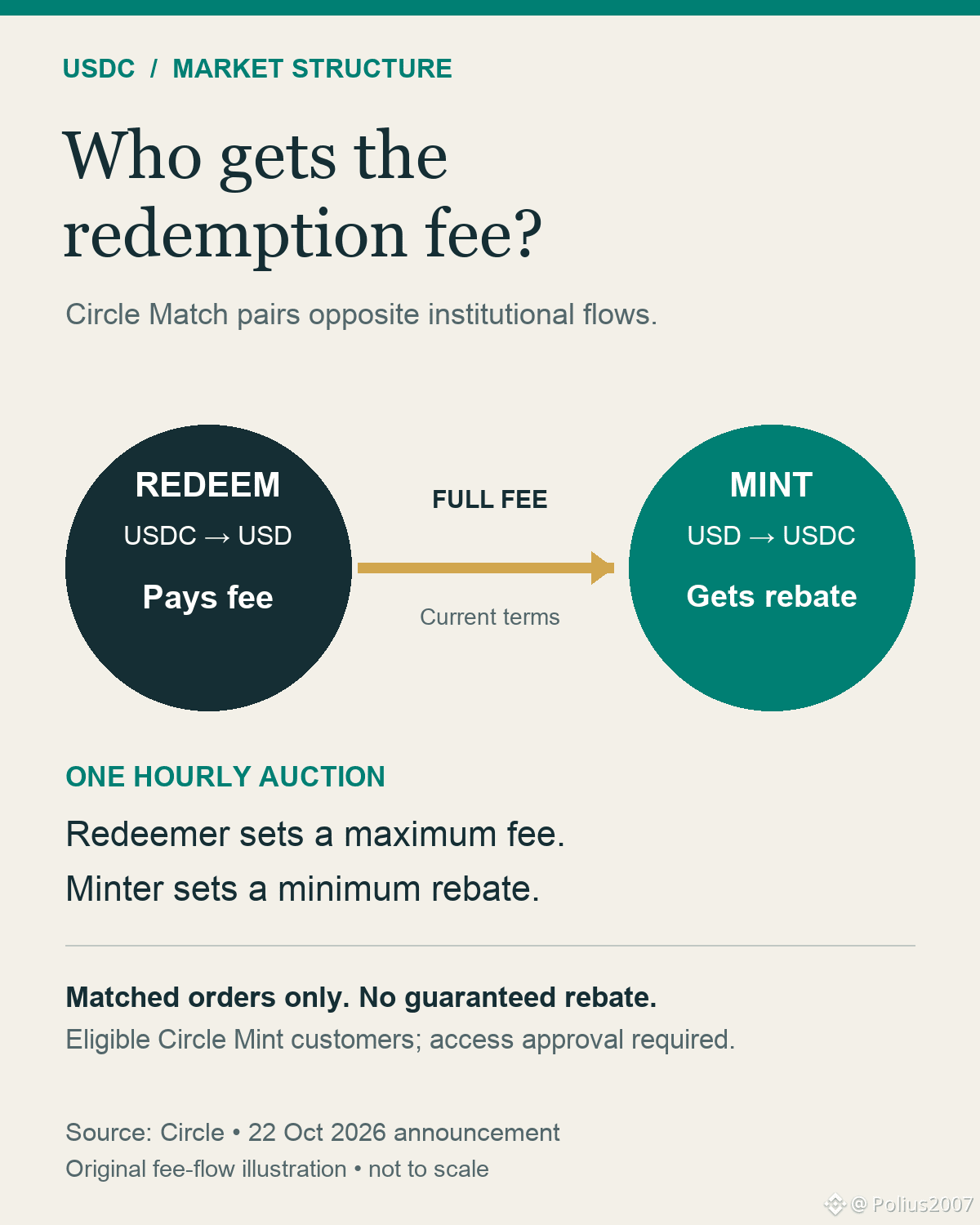
Circle is giving USDC minters a way to earn the fee paid by someone redeeming USDC.
Circle Match, announced on October 22, pairs institutional mint and redemption orders in hourly auctions. A minter sets the smallest rebate it will accept; a redeemer sets the most it will pay. If they match, one clearing fee applies. Circle says that, under current terms, the redeeming side pays it and the minting side receives the full amount. Neither a match nor a particular rebate is guaranteed.
Access is approval-gated for eligible Circle Mint customers, so holding USDC alone earns no rebate here. The auction sets the service fee, not the token's dollar price. A matched redemption cannot cost more than the customer's limit or Circle's Express rate.
Source: Circle, October 22, 2026; checked October 26.
https://www.circle.com/blog/circle-match-get-a-rebate-to-mint-set-your-price-to-redeem
#USDC #Stablecoins
Circle is giving USDC minters a way to earn the fee paid by someone redeeming USDC.
Circle Match, announced on October 22, pairs institutional mint and redemption orders in hourly auctions. A minter sets the smallest rebate it will accept; a redeemer sets the most it will pay. If they match, one clearing fee applies. Circle says that, under current terms, the redeeming side pays it and the minting side receives the full amount. Neither a match nor a particular rebate is guaranteed.
Access is approval-gated for eligible Circle Mint customers, so holding USDC alone earns no rebate here. The auction sets the service fee, not the token's dollar price. A matched redemption cannot cost more than the customer's limit or Circle's Express rate.
Source: Circle, October 22, 2026; checked October 26.
https://www.circle.com/blog/circle-match-get-a-rebate-to-mint-set-your-price-to-redeem
#USDC #Stablecoins
Circle Match, announced on October 22, pairs institutional mint and redemption orders in hourly auctions. A minter sets the smallest rebate it will accept; a redeemer sets the most it will pay. If they match, one clearing fee applies. Circle says that, under current terms, the redeeming side pays it and the minting side receives the full amount. Neither a match nor a particular rebate is guaranteed.
Access is approval-gated for eligible Circle Mint customers, so holding USDC alone earns no rebate here. The auction sets the service fee, not the token's dollar price. A matched redemption cannot cost more than the customer's limit or Circle's Express rate.
Source: Circle, October 22, 2026; checked October 26.
https://www.circle.com/blog/circle-match-get-a-rebate-to-mint-set-your-price-to-redeem
#USDC #Stablecoins
78

🚨 JANUARY 18, 2027: A NEW ERA FOR U.S. STABLECOINS! 🇺🇸💵
🔥 **#GENIUSActExpectedToTakeEffectJan18**
The countdown is on! The U.S. Office of the Comptroller of the Currency (OCC) has finalized its rules implementing the **GENIUS Act**, with the law and final rule set to take effect on **January 18, 2027**. 📅
📌 **What does it mean?**
🔹 Clearer rules for payment stablecoin issuers
🔹 Standards for reserve assets and redemptions
🔹 Stronger risk management and regulatory supervision
🔹 New compliance requirements for eligible issuers
🌐 **Why it matters:** Stablecoins play an important role in digital payments and crypto markets. Clearer rules could reshape how issuers operate in the U.S.—but implementation and consumer protection will be key.
⚡ **STRONG HOOK:** *January 18 could be a turning point for stablecoins. Will clearer rules build trust—or create new challenges for crypto?*
💬 What impact do you think the GENIUS Act will have on the future of stablecoins?
#Stablecoins #CryptoNews #GENIUSAct #Blockchain #DigitalAssets
🚨 JANUARY 18, 2027: A NEW ERA FOR U.S. STABLECOINS! 🇺🇸💵
🔥 **#GENIUSActExpectedToTakeEffectJan18**
The countdown is on! The U.S. Office of the Comptroller of the Currency (OCC) has finalized its rules implementing the **GENIUS Act**, with the law and final rule set to take effect on **January 18, 2027**. 📅
📌 **What does it mean?**
🔹 Clearer rules for payment stablecoin issuers
🔹 Standards for reserve assets and redemptions
🔹 Stronger risk management and regulatory supervision
🔹 New compliance requirements for eligible issuers
🌐 **Why it matters:** Stablecoins play an important role in digital payments and crypto markets. Clearer rules could reshape how issuers operate in the U.S.—but implementation and consumer protection will be key.
⚡ **STRONG HOOK:** *January 18 could be a turning point for stablecoins. Will clearer rules build trust—or create new challenges for crypto?*
💬 What impact do you think the GENIUS Act will have on the future of stablecoins?
#Stablecoins #CryptoNews #GENIUSAct #Blockchain #DigitalAssets
🔥 **#GENIUSActExpectedToTakeEffectJan18**
The countdown is on! The U.S. Office of the Comptroller of the Currency (OCC) has finalized its rules implementing the **GENIUS Act**, with the law and final rule set to take effect on **January 18, 2027**. 📅
📌 **What does it mean?**
🔹 Clearer rules for payment stablecoin issuers
🔹 Standards for reserve assets and redemptions
🔹 Stronger risk management and regulatory supervision
🔹 New compliance requirements for eligible issuers
🌐 **Why it matters:** Stablecoins play an important role in digital payments and crypto markets. Clearer rules could reshape how issuers operate in the U.S.—but implementation and consumer protection will be key.
⚡ **STRONG HOOK:** *January 18 could be a turning point for stablecoins. Will clearer rules build trust—or create new challenges for crypto?*
💬 What impact do you think the GENIUS Act will have on the future of stablecoins?
#Stablecoins #CryptoNews #GENIUSAct #Blockchain #DigitalAssets

72

·
--
#CanadaProposesStablecoinRedemptionWithin3BusinessDays
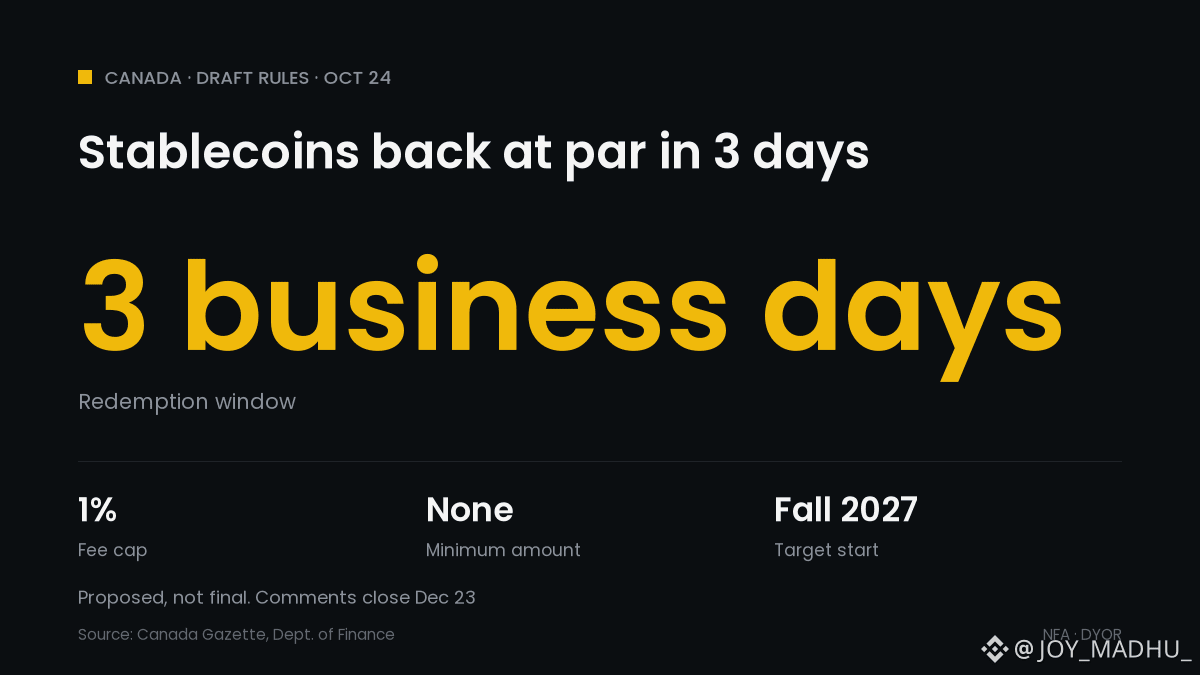
🇨🇦 Canada Wants Stablecoins Cashed Out at Par in 3 Days
📅 Draft Stablecoin Regulations published in the Canada Gazette on Oct 24
💵 Issuers must redeem 1:1 on request, with no minimum amount
⏱️ Within three business days: T+1 Canadian and T+2 foreign settlement, plus one day to process
📊 Redemption fees capped at 1%, with 7 days' notice before any increase
⚠️ Daily limits allowed only if reserve-asset markets run short of liquidity
🗓️ Comments close Dec 23; the rules aim to start in fall 2027 alongside the Stablecoin Act
What it means for crypto: a legal right to exit at par could make regulated stablecoins like $USDC easier to trust in Canada, but these are proposals, not final rules. $BTC is near $80.3K.
Is a 3-day cash-out fast enough for stablecoin holders? 👇
$USDC $BTC
#CryptoNews #Stablecoins #Canada #CanadaProposesStablecoinRedemptionWithin3BusinessDays
#CanadaProposesStablecoinRedemptionWithin3BusinessDays
🇨🇦 Canada Wants Stablecoins Cashed Out at Par in 3 Days
📅 Draft Stablecoin Regulations published in the Canada Gazette on Oct 24
💵 Issuers must redeem 1:1 on request, with no minimum amount
⏱️ Within three business days: T+1 Canadian and T+2 foreign settlement, plus one day to process
📊 Redemption fees capped at 1%, with 7 days' notice before any increase
⚠️ Daily limits allowed only if reserve-asset markets run short of liquidity
🗓️ Comments close Dec 23; the rules aim to start in fall 2027 alongside the Stablecoin Act
What it means for crypto: a legal right to exit at par could make regulated stablecoins like $USDC easier to trust in Canada, but these are proposals, not final rules. $BTC is near $80.3K.
Is a 3-day cash-out fast enough for stablecoin holders? 👇
$USDC $BTC
#CryptoNews #Stablecoins #Canada #CanadaProposesStablecoinRedemptionWithin3BusinessDays
🇨🇦 Canada Wants Stablecoins Cashed Out at Par in 3 Days
📅 Draft Stablecoin Regulations published in the Canada Gazette on Oct 24
💵 Issuers must redeem 1:1 on request, with no minimum amount
⏱️ Within three business days: T+1 Canadian and T+2 foreign settlement, plus one day to process
📊 Redemption fees capped at 1%, with 7 days' notice before any increase
⚠️ Daily limits allowed only if reserve-asset markets run short of liquidity
🗓️ Comments close Dec 23; the rules aim to start in fall 2027 alongside the Stablecoin Act
What it means for crypto: a legal right to exit at par could make regulated stablecoins like $USDC easier to trust in Canada, but these are proposals, not final rules. $BTC is near $80.3K.
Is a 3-day cash-out fast enough for stablecoin holders? 👇
$USDC $BTC
#CryptoNews #Stablecoins #Canada #CanadaProposesStablecoinRedemptionWithin3BusinessDays
ABO3ZAM:
طرح ممتاز وتغطية شاملة، لكن لا تنسوا دائماً تأمين أرباحكم مع صعود البيتكوين الحالي، السوق لا يرحم من يطمع عند المقاومات. 🤝
1
24

·
--
#CanadaProposesStablecoinRedemptionWithin3BusinessDays
🇨🇦 Canada Proposes New Stablecoin Rules
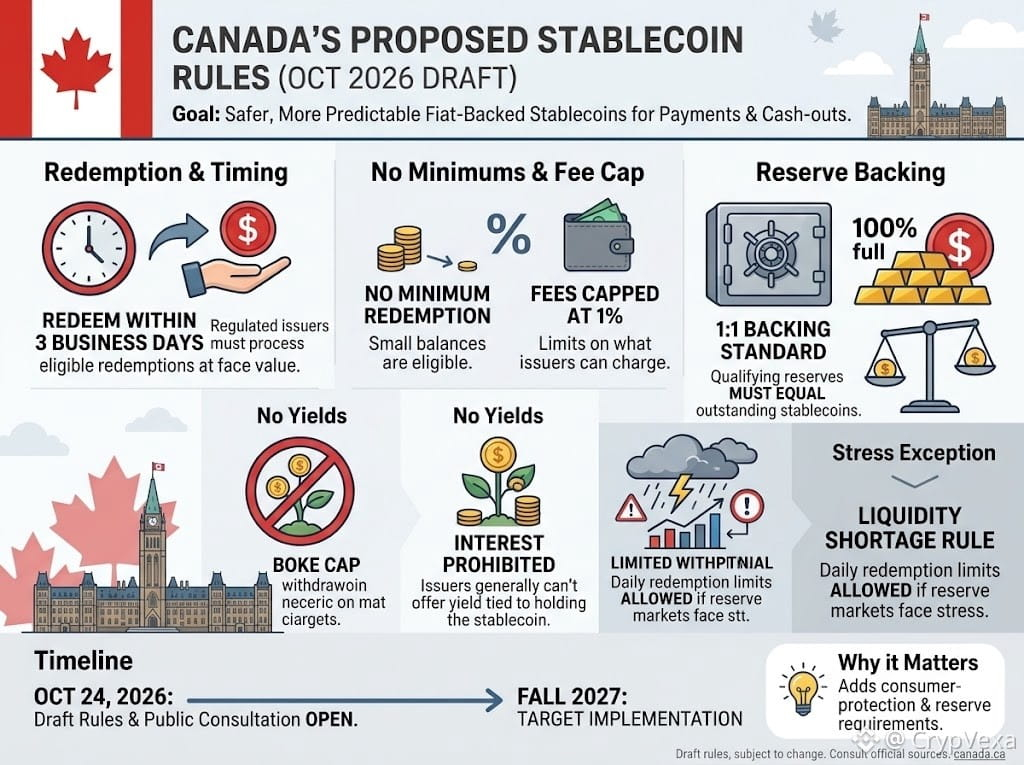
⚡ Canada has proposed draft rules for regulated stablecoin issuers, focused on redemptions, reserves and consumer protection.
💵 Key points:
• Eligible redemptions at face value within 3 business days
• No minimum redemption amount
• Redemption fees capped at 1%
• Reserves must fully back outstanding stablecoins 1:1
• Interest or yield on stablecoin holdings generally prohibited
• Temporary redemption limits could apply during severe reserve-market liquidity stress
📅 The draft rules were published October 24, 2026 and are open for public consultation, with implementation targeted for fall 2027.
🌐 Why it matters: The proposal could make fiat-backed stablecoins more predictable for payments and cash-outs while strengthening reserve and consumer-protection standards.
👀 Could clearer redemption rules increase trust in stablecoins?
#Stablecoins #Canada #CryptoRegulation #DigitalAssets
#CanadaProposesStablecoinRedemptionWithin3BusinessDays
🇨🇦 Canada Proposes New Stablecoin Rules
⚡ Canada has proposed draft rules for regulated stablecoin issuers, focused on redemptions, reserves and consumer protection.
💵 Key points:
• Eligible redemptions at face value within 3 business days
• No minimum redemption amount
• Redemption fees capped at 1%
• Reserves must fully back outstanding stablecoins 1:1
• Interest or yield on stablecoin holdings generally prohibited
• Temporary redemption limits could apply during severe reserve-market liquidity stress
📅 The draft rules were published October 24, 2026 and are open for public consultation, with implementation targeted for fall 2027.
🌐 Why it matters: The proposal could make fiat-backed stablecoins more predictable for payments and cash-outs while strengthening reserve and consumer-protection standards.
👀 Could clearer redemption rules increase trust in stablecoins?
#Stablecoins #Canada #CryptoRegulation #DigitalAssets
🇨🇦 Canada Proposes New Stablecoin Rules
⚡ Canada has proposed draft rules for regulated stablecoin issuers, focused on redemptions, reserves and consumer protection.
💵 Key points:
• Eligible redemptions at face value within 3 business days
• No minimum redemption amount
• Redemption fees capped at 1%
• Reserves must fully back outstanding stablecoins 1:1
• Interest or yield on stablecoin holdings generally prohibited
• Temporary redemption limits could apply during severe reserve-market liquidity stress
📅 The draft rules were published October 24, 2026 and are open for public consultation, with implementation targeted for fall 2027.
🌐 Why it matters: The proposal could make fiat-backed stablecoins more predictable for payments and cash-outs while strengthening reserve and consumer-protection standards.
👀 Could clearer redemption rules increase trust in stablecoins?
#Stablecoins #Canada #CryptoRegulation #DigitalAssets
1
1
·
--
⚖️ $USDC | USDC: boring by design, or the point of the whole design?
USDC is often described as the bridge between dollars and crypto, and its fact sheet leans on that framing: a fully collateralized US dollar stablecoin built to move value between people, businesses and financial institutions. The snapshot from 2026-10-26 10:11 UTC shows a $0.9997 price, a -0.03% deviation from one dollar, $71.4 billion market cap and $7.93 billion in 24h volume. Critics of the model say a token that barely moves offers little to debate; supporters say the near-flat peg and deep turnover are exactly the evidence that matters. Which reading carries more weight depends on whether you judge a stablecoin by its design or by its chart.
Why it matters: For a stablecoin, the peg and turnover are the product, so a -0.03% deviation is a design claim being tested, not a price story.
💬 Does a stablecoin's credibility rest more on its reserve and redemption design or on the market's willingness to keep trading it at scale?
Source: Official site https://www.circle.com/en/usdc
#USDC #Stablecoins
⚖️ $USDC | USDC: boring by design, or the point of the whole design?
USDC is often described as the bridge between dollars and crypto, and its fact sheet leans on that framing: a fully collateralized US dollar stablecoin built to move value between people, businesses and financial institutions. The snapshot from 2026-10-26 10:11 UTC shows a $0.9997 price, a -0.03% deviation from one dollar, $71.4 billion market cap and $7.93 billion in 24h volume. Critics of the model say a token that barely moves offers little to debate; supporters say the near-flat peg and deep turnover are exactly the evidence that matters. Which reading carries more weight depends on whether you judge a stablecoin by its design or by its chart.
Why it matters: For a stablecoin, the peg and turnover are the product, so a -0.03% deviation is a design claim being tested, not a price story.
💬 Does a stablecoin's credibility rest more on its reserve and redemption design or on the market's willingness to keep trading it at scale?
Source: Official site https://www.circle.com/en/usdc
#USDC #Stablecoins
USDC is often described as the bridge between dollars and crypto, and its fact sheet leans on that framing: a fully collateralized US dollar stablecoin built to move value between people, businesses and financial institutions. The snapshot from 2026-10-26 10:11 UTC shows a $0.9997 price, a -0.03% deviation from one dollar, $71.4 billion market cap and $7.93 billion in 24h volume. Critics of the model say a token that barely moves offers little to debate; supporters say the near-flat peg and deep turnover are exactly the evidence that matters. Which reading carries more weight depends on whether you judge a stablecoin by its design or by its chart.
Why it matters: For a stablecoin, the peg and turnover are the product, so a -0.03% deviation is a design claim being tested, not a price story.
💬 Does a stablecoin's credibility rest more on its reserve and redemption design or on the market's willingness to keep trading it at scale?
Source: Official site https://www.circle.com/en/usdc
#USDC #Stablecoins

·
--
🚨 Canada proposes stablecoin redemption within 3 business days. But there's a liquidity exception hiding in the fine print.
#CanadaProposesStablecoinRedemptionWithin3BusinessDays
On October 24, Canada's Department of Finance published proposed regulations requiring covered stablecoin issuers to redeem tokens at 1:1 in their reference currency, without a minimum redemption amount, and initiate the fiat transfer within three business days.
Redemption fees would be capped at 1%.
Here's what the headline misses.
The proposal allows issuers to limit daily redemptions if a shortage of liquidity in reserve-asset markets prevents them from meeting all requests.
There's another distinction: the three-day deadline covers liquidating necessary reserve assets and initiating the fiat transfer. It doesn't necessarily mean the money must already have arrived in the holder's bank account.
And the 1% fee cap isn't a promised reduction. Canada's own analysis says direct redemption fees currently tend to be around 0.1%.
The framework aims to strengthen confidence through full backing, redemption rights and oversight by the Bank of Canada. But these are still proposed rules, intended to take effect in fall 2027—not protections already in force.
My view: predictable redemption rules matter, but their real test comes when many holders want their money back simultaneously.
Would a three-business-day redemption requirement make you trust a stablecoin more—or is its ability to meet mass withdrawals what matters most?
Not financial advice.
$BTC $BNB $ETH
#Stablecoins #CryptoRegulation #SKHynixReportedlyPlansSpecialDividendFromKioxiaStakeSale #USQ3GDPAndSeptemberPCEDueNextWeek
🚨 Canada proposes stablecoin redemption within 3 business days. But there's a liquidity exception hiding in the fine print.
#CanadaProposesStablecoinRedemptionWithin3BusinessDays
On October 24, Canada's Department of Finance published proposed regulations requiring covered stablecoin issuers to redeem tokens at 1:1 in their reference currency, without a minimum redemption amount, and initiate the fiat transfer within three business days.
Redemption fees would be capped at 1%.
Here's what the headline misses.
The proposal allows issuers to limit daily redemptions if a shortage of liquidity in reserve-asset markets prevents them from meeting all requests.
There's another distinction: the three-day deadline covers liquidating necessary reserve assets and initiating the fiat transfer. It doesn't necessarily mean the money must already have arrived in the holder's bank account.
And the 1% fee cap isn't a promised reduction. Canada's own analysis says direct redemption fees currently tend to be around 0.1%.
The framework aims to strengthen confidence through full backing, redemption rights and oversight by the Bank of Canada. But these are still proposed rules, intended to take effect in fall 2027—not protections already in force.
My view: predictable redemption rules matter, but their real test comes when many holders want their money back simultaneously.
Would a three-business-day redemption requirement make you trust a stablecoin more—or is its ability to meet mass withdrawals what matters most?
Not financial advice.
$BTC $BNB $ETH
#Stablecoins #CryptoRegulation #SKHynixReportedlyPlansSpecialDividendFromKioxiaStakeSale #USQ3GDPAndSeptemberPCEDueNextWeek
#CanadaProposesStablecoinRedemptionWithin3BusinessDays
On October 24, Canada's Department of Finance published proposed regulations requiring covered stablecoin issuers to redeem tokens at 1:1 in their reference currency, without a minimum redemption amount, and initiate the fiat transfer within three business days.
Redemption fees would be capped at 1%.
Here's what the headline misses.
The proposal allows issuers to limit daily redemptions if a shortage of liquidity in reserve-asset markets prevents them from meeting all requests.
There's another distinction: the three-day deadline covers liquidating necessary reserve assets and initiating the fiat transfer. It doesn't necessarily mean the money must already have arrived in the holder's bank account.
And the 1% fee cap isn't a promised reduction. Canada's own analysis says direct redemption fees currently tend to be around 0.1%.
The framework aims to strengthen confidence through full backing, redemption rights and oversight by the Bank of Canada. But these are still proposed rules, intended to take effect in fall 2027—not protections already in force.
My view: predictable redemption rules matter, but their real test comes when many holders want their money back simultaneously.
Would a three-business-day redemption requirement make you trust a stablecoin more—or is its ability to meet mass withdrawals what matters most?
Not financial advice.
$BTC $BNB $ETH
#Stablecoins #CryptoRegulation #SKHynixReportedlyPlansSpecialDividendFromKioxiaStakeSale #USQ3GDPAndSeptemberPCEDueNextWeek

2
51
·
--
⚖️ $USDT | USDT at $0.9993: a dollar substitute or a promise in reserve?
Tether is commonly described as a digital dollar, and the snapshot supports the trading side of that: $0.9993 against an assumed USD 1.00 peg, a -0.07% deviation, $182.4 billion market cap and $33.3 billion in 24h volume as of 2026-10-26 09:14 UTC. The fact sheet adds that it is, per the official Tether site, 100% backed by USD held in reserve, and that it offers liquidity to exchanges that cannot deal in dollars and with banks. Supporters read that combination as a working dollar replacement across many chains; skeptics note that a stable value rests on reserves and redemption rather than on the token itself.
Why it matters: A stablecoin's usefulness depends less on its price chart than on whether its reserves and redemption design hold up under stress.
💬 Does a tight peg and deep liquidity tell you enough about a stablecoin, or do reserves and redemption terms matter more?
Source: Official site https://tether.to/
#Tether #Stablecoins
⚖️ $USDT | USDT at $0.9993: a dollar substitute or a promise in reserve?
Tether is commonly described as a digital dollar, and the snapshot supports the trading side of that: $0.9993 against an assumed USD 1.00 peg, a -0.07% deviation, $182.4 billion market cap and $33.3 billion in 24h volume as of 2026-10-26 09:14 UTC. The fact sheet adds that it is, per the official Tether site, 100% backed by USD held in reserve, and that it offers liquidity to exchanges that cannot deal in dollars and with banks. Supporters read that combination as a working dollar replacement across many chains; skeptics note that a stable value rests on reserves and redemption rather than on the token itself.
Why it matters: A stablecoin's usefulness depends less on its price chart than on whether its reserves and redemption design hold up under stress.
💬 Does a tight peg and deep liquidity tell you enough about a stablecoin, or do reserves and redemption terms matter more?
Source: Official site https://tether.to/
#Tether #Stablecoins
Tether is commonly described as a digital dollar, and the snapshot supports the trading side of that: $0.9993 against an assumed USD 1.00 peg, a -0.07% deviation, $182.4 billion market cap and $33.3 billion in 24h volume as of 2026-10-26 09:14 UTC. The fact sheet adds that it is, per the official Tether site, 100% backed by USD held in reserve, and that it offers liquidity to exchanges that cannot deal in dollars and with banks. Supporters read that combination as a working dollar replacement across many chains; skeptics note that a stable value rests on reserves and redemption rather than on the token itself.
Why it matters: A stablecoin's usefulness depends less on its price chart than on whether its reserves and redemption design hold up under stress.
💬 Does a tight peg and deep liquidity tell you enough about a stablecoin, or do reserves and redemption terms matter more?
Source: Official site https://tether.to/
#Tether #Stablecoins

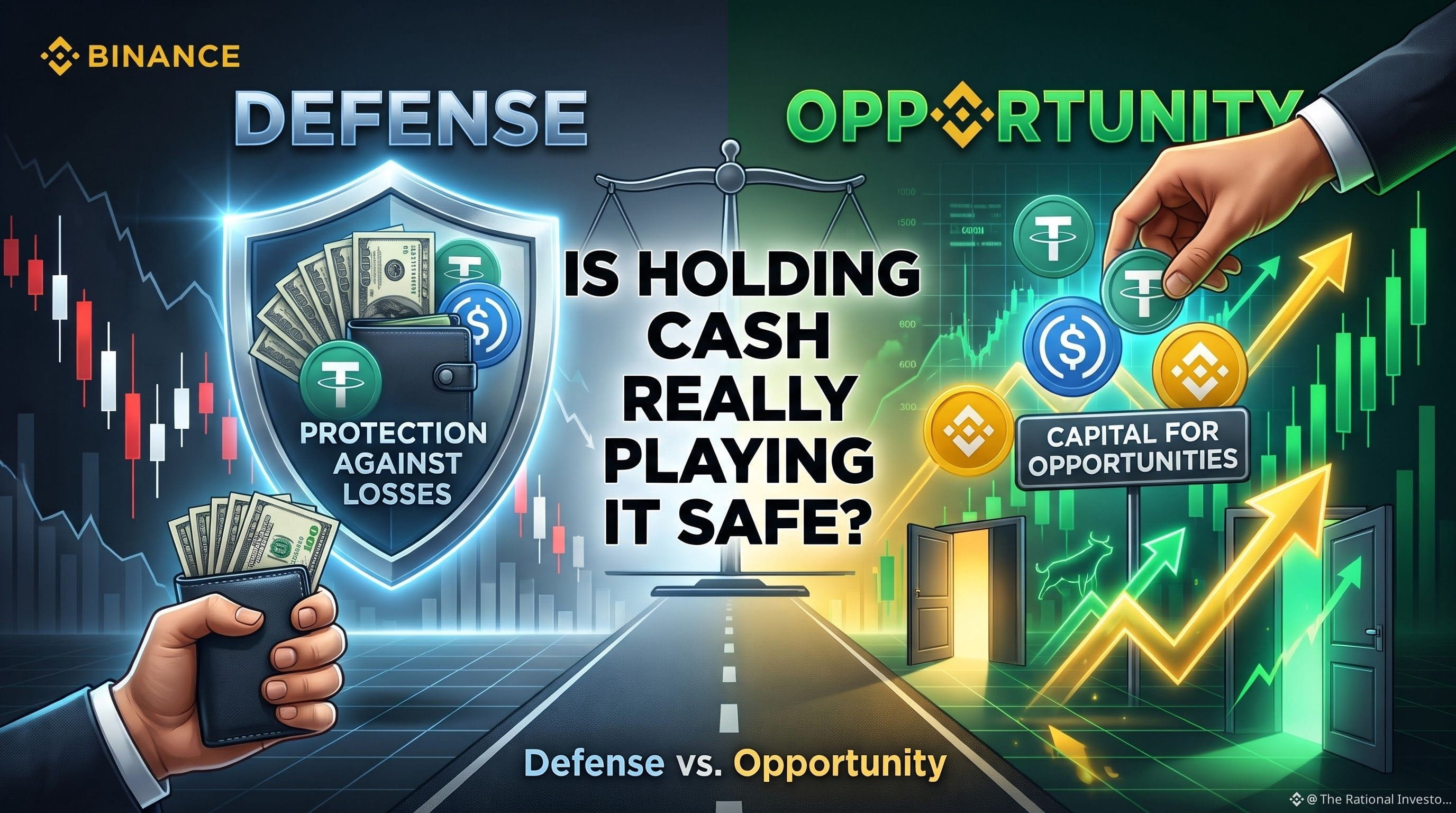
Is Holding Cash Really Playing It Safe?
$$$
$$$
Cash can protect you from a market crash. It can also leave you watching a recovery from the sidelines.
$$$
Holding cash or stablecoins is often described as a defensive decision, but its effectiveness depends on the investor's objectives and time horizon. Liquidity can reduce exposure to falling asset prices and preserve the ability to respond to opportunities. However, remaining uninvested may create opportunity costs when markets recover. Stablecoins introduce additional risks, including issuer, reserve, custody, and depegging risks, that differ from holding bank deposits or physical cash. The rational question is not whether investors should always be fully invested or fully liquid. It is how much liquidity supports their strategy without creating unnecessary exposure to either market volatility or missed opportunities.
$$$
Do you treat liquidity mainly as protection against losses or as capital reserved for opportunities?
#CryptoPortfolio #Stablecoins #CapitalAllocation $USDC $USDT
Is Holding Cash Really Playing It Safe?
$$$
$$$
Cash can protect you from a market crash. It can also leave you watching a recovery from the sidelines.
$$$
Holding cash or stablecoins is often described as a defensive decision, but its effectiveness depends on the investor's objectives and time horizon. Liquidity can reduce exposure to falling asset prices and preserve the ability to respond to opportunities. However, remaining uninvested may create opportunity costs when markets recover. Stablecoins introduce additional risks, including issuer, reserve, custody, and depegging risks, that differ from holding bank deposits or physical cash. The rational question is not whether investors should always be fully invested or fully liquid. It is how much liquidity supports their strategy without creating unnecessary exposure to either market volatility or missed opportunities.
$$$
Do you treat liquidity mainly as protection against losses or as capital reserved for opportunities?
#CryptoPortfolio #Stablecoins #CapitalAllocation $USDC $USDT
$$$
$$$
Cash can protect you from a market crash. It can also leave you watching a recovery from the sidelines.
$$$
Holding cash or stablecoins is often described as a defensive decision, but its effectiveness depends on the investor's objectives and time horizon. Liquidity can reduce exposure to falling asset prices and preserve the ability to respond to opportunities. However, remaining uninvested may create opportunity costs when markets recover. Stablecoins introduce additional risks, including issuer, reserve, custody, and depegging risks, that differ from holding bank deposits or physical cash. The rational question is not whether investors should always be fully invested or fully liquid. It is how much liquidity supports their strategy without creating unnecessary exposure to either market volatility or missed opportunities.
$$$
Do you treat liquidity mainly as protection against losses or as capital reserved for opportunities?
#CryptoPortfolio #Stablecoins #CapitalAllocation $USDC $USDT
54
Log in to explore more content
Join global crypto users on Binance Square
⚡️ Get latest and useful information about crypto.
💬 Trusted by the world’s largest crypto exchange.
👍 Discover real insights from verified creators.
အီးမေးလ် / ဖုန်းနံပါတ်
ရေပန်းစားနေသော ခေါင်းစဉ်များ
1
#BinancePick
ကြည့်ရှုမှု 3M ကြိမ်
152,263 ဦး ဆွေးနွေးနေသည်
2
#EarningsSeason
ကြည့်ရှုမှု 5.3M ကြိမ်
25,868 ဦး ဆွေးနွေးနေသည်
3
#AnthropicTTMRevenueGrewAbout1200%
ကြည့်ရှုမှု 24,259 ကြိမ်
366 ဦး ဆွေးနွေးနေသည်
4
#AnthropicS1ExpectedToday
ကြည့်ရှုမှု 23,502 ကြိမ်
308 ဦး ဆွေးနွေးနေသည်
5
#SouthKoreaReportedlyWeighsFourthCryptoTaxDelay
ကြည့်ရှုမှု 28,122 ကြိမ်
435 ဦး ဆွေးနွေးနေသည်
6
#FranklinTempletonFilesForTwoDividendToBitcoinETFs
ကြည့်ရှုမှု 36,936 ကြိမ်
519 ဦး ဆွေးနွေးနေသည်
7
#StrategyMSTRSurpassesNasdaqInMarketCap
ကြည့်ရှုမှု 27,810 ကြိမ်
375 ဦး ဆွေးနွေးနေသည်
8
#CanadaProposesStablecoinRedemptionWithin3BusinessDays
ကြည့်ရှုမှု 1,251 ကြိမ်
36 ဦး ဆွေးနွေးနေသည်
9
#ElectrumWalletBugLetRogueServersStealFunds
ကြည့်ရှုမှု 29,283 ကြိမ်
453 ဦး ဆွေးနွေးနေသည်
10
#ArgentineCourtDismissesLIBRACaseAgainstMilei
ကြည့်ရှုမှု 44,192 ကြိမ်
560 ဦး ဆွေးနွေးနေသည်