

#lending
lending
62,792 views
1,324 ກຳລັງສົນທະນາ
ມາແຮງ
ຫຼ້າສຸດ

·
--
$AAVE Aave’s original protocol whitepaper outlines a vision for decentralized, non-custodial money markets on Ethereum.
Key ideas include:
🔹 Decentralized lending & borrowing
🔹 Liquidity pools
🔹 Interest-rate mechanisms
🔹 Flash loans
🔹 Permissionless access to financial markets
Aave helped push DeFi toward programmable, open financial infrastructure. 🚀
#Aave #DeFi #Ethereum #Crypto #Web3 #lending
$AAVE Aave’s original protocol whitepaper outlines a vision for decentralized, non-custodial money markets on Ethereum.
Key ideas include:
🔹 Decentralized lending & borrowing
🔹 Liquidity pools
🔹 Interest-rate mechanisms
🔹 Flash loans
🔹 Permissionless access to financial markets
Aave helped push DeFi toward programmable, open financial infrastructure. 🚀
#Aave #DeFi #Ethereum #Crypto #Web3 #lending
Key ideas include:
🔹 Decentralized lending & borrowing
🔹 Liquidity pools
🔹 Interest-rate mechanisms
🔹 Flash loans
🔹 Permissionless access to financial markets
Aave helped push DeFi toward programmable, open financial infrastructure. 🚀
#Aave #DeFi #Ethereum #Crypto #Web3 #lending
85

Haedal Lending Vault is LIVE 🦦🌊
Sui has been getting more active again lately, and $HAEDAL has also been showing some nice price action.
At the same time, Haedal just launched a new product that I think is worth paying attention to: Haedal Lending Vault.
Lending yields across Sui can be attractive, but there’s always one problem: rates and incentives keep changing between protocols.
If you want to follow the better opportunities yourself, you normally have to keep checking different markets, move funds around, claim rewards, and rebalance your positions.
Haedal Lending Vault basically automates that process.
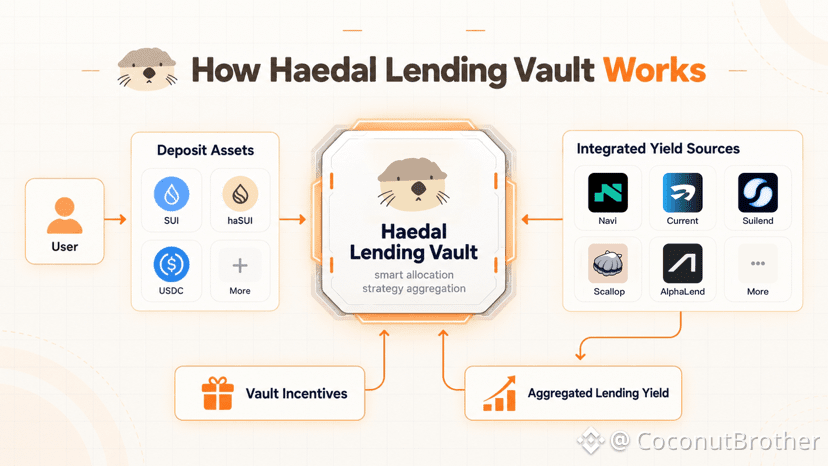
You deposit one supported asset such as SUI, USDC, or haSUI, and the vault allocates liquidity across multiple lending markets based on market conditions, protocol performance, and available liquidity.
Currently integrated markets include:
NAVI / Current / Suilend / Scallop / AlphaFi
with Cetus Vault acting as a buffer pool for more flexible liquidity management.
In return, users receive a Vault LP Token representing their share of the vault. As the underlying strategy generates yield, that value is reflected in the LP token.
What I like most about the idea is the simplicity:
No manually jumping between lending protocols.
No constant rebalancing.
No manual reward claiming.
Instead of trying to chase lending opportunities yourself, the vault handles the allocation for you across multiple markets.
So while everyone is watching $HAEDAL’s recent price action, there’s also quite a bit happening on the product side. 👀
Deposit once. Let the vault do the moves. 🦦🌊
#Haedal #sui #defi #Lending
{future}(HAEDALUSDT)
Haedal Lending Vault is LIVE 🦦🌊
Sui has been getting more active again lately, and $HAEDAL has also been showing some nice price action.
At the same time, Haedal just launched a new product that I think is worth paying attention to: Haedal Lending Vault.
Lending yields across Sui can be attractive, but there’s always one problem: rates and incentives keep changing between protocols.
If you want to follow the better opportunities yourself, you normally have to keep checking different markets, move funds around, claim rewards, and rebalance your positions.
Haedal Lending Vault basically automates that process.
You deposit one supported asset such as SUI, USDC, or haSUI, and the vault allocates liquidity across multiple lending markets based on market conditions, protocol performance, and available liquidity.
Currently integrated markets include:
NAVI / Current / Suilend / Scallop / AlphaFi
with Cetus Vault acting as a buffer pool for more flexible liquidity management.
In return, users receive a Vault LP Token representing their share of the vault. As the underlying strategy generates yield, that value is reflected in the LP token.
What I like most about the idea is the simplicity:
No manually jumping between lending protocols.
No constant rebalancing.
No manual reward claiming.
Instead of trying to chase lending opportunities yourself, the vault handles the allocation for you across multiple markets.
So while everyone is watching $HAEDAL ’s recent price action, there’s also quite a bit happening on the product side. 👀
Deposit once. Let the vault do the moves. 🦦🌊
#Haedal #sui #defi #Lending
Sui has been getting more active again lately, and $HAEDAL has also been showing some nice price action.
At the same time, Haedal just launched a new product that I think is worth paying attention to: Haedal Lending Vault.
Lending yields across Sui can be attractive, but there’s always one problem: rates and incentives keep changing between protocols.
If you want to follow the better opportunities yourself, you normally have to keep checking different markets, move funds around, claim rewards, and rebalance your positions.
Haedal Lending Vault basically automates that process.
You deposit one supported asset such as SUI, USDC, or haSUI, and the vault allocates liquidity across multiple lending markets based on market conditions, protocol performance, and available liquidity.
Currently integrated markets include:
NAVI / Current / Suilend / Scallop / AlphaFi
with Cetus Vault acting as a buffer pool for more flexible liquidity management.
In return, users receive a Vault LP Token representing their share of the vault. As the underlying strategy generates yield, that value is reflected in the LP token.
What I like most about the idea is the simplicity:
No manually jumping between lending protocols.
No constant rebalancing.
No manual reward claiming.
Instead of trying to chase lending opportunities yourself, the vault handles the allocation for you across multiple markets.
So while everyone is watching $HAEDAL ’s recent price action, there’s also quite a bit happening on the product side. 👀
Deposit once. Let the vault do the moves. 🦦🌊
#Haedal #sui #defi #Lending
2
207

·
--
ສັນຍານກະທິງ
Aave ($AAVE ) ka social media post:
👻 DeFi Lending & Yield Protocol Spotlight: Aave ($AAVE) 🌐🚀
Aavenomics revenue buybacks, GHO native stablecoin expansion, aur Horizon institutional lending rails ke support se $AAVE strong multi-month recovery base hold kar raha hai! 🔥
📊 Market & Technical Overview:
* Current Price: ~$124 – $128 USD
* Market Cap: ~$1.9 - $2.1 Billion
* Immediate Resistance: $135 – $140 (Breakout opens upside path toward $165 – $180)
* Key Support Zone: $110 – $115 (50-day SMA base)
* Major Structure Support: $92 – $98
💡 Core Growth Drivers:
* Dominant DeFi TVL & Cash Flow: On-chain lending markets me ~80%+ revenue dominance aur Aavenomics 3.0 protocol buyback mechanisms token value accrual strengthen kar rahe hain.
* Institutional & Multi-Chain Expansion: GHO stablecoin scaling, V4 hub-and-spoke architecture roadmap, aur Horizon cross-chain lending markets institutional adoption scale kar rahe hain.
* Outlook: $110 Moving Average support floor defend hone aur daily candle $135 resistance level ke upar confirm hone par macro bullish continuation confirm ho sakti hai.
⚠️ Disclaimer: Crypto markets hold inherent volatility. Trade entry execution se pehle proper risk management (DYOR) zaroor maintain karein.
#AAVE #AAVE #defi #crypto #Web3 #CryptoTrading #Lending
{spot}(AAVEUSDT)
Aave ($AAVE ) ka social media post:
👻 DeFi Lending & Yield Protocol Spotlight: Aave ($AAVE ) 🌐🚀
Aavenomics revenue buybacks, GHO native stablecoin expansion, aur Horizon institutional lending rails ke support se $AAVE strong multi-month recovery base hold kar raha hai! 🔥
📊 Market & Technical Overview:
* Current Price: ~$124 – $128 USD
* Market Cap: ~$1.9 - $2.1 Billion
* Immediate Resistance: $135 – $140 (Breakout opens upside path toward $165 – $180)
* Key Support Zone: $110 – $115 (50-day SMA base)
* Major Structure Support: $92 – $98
💡 Core Growth Drivers:
* Dominant DeFi TVL & Cash Flow: On-chain lending markets me ~80%+ revenue dominance aur Aavenomics 3.0 protocol buyback mechanisms token value accrual strengthen kar rahe hain.
* Institutional & Multi-Chain Expansion: GHO stablecoin scaling, V4 hub-and-spoke architecture roadmap, aur Horizon cross-chain lending markets institutional adoption scale kar rahe hain.
* Outlook: $110 Moving Average support floor defend hone aur daily candle $135 resistance level ke upar confirm hone par macro bullish continuation confirm ho sakti hai.
⚠️ Disclaimer: Crypto markets hold inherent volatility. Trade entry execution se pehle proper risk management (DYOR) zaroor maintain karein.
#AAVE #AAVE #defi #crypto #Web3 #CryptoTrading #Lending
👻 DeFi Lending & Yield Protocol Spotlight: Aave ($AAVE ) 🌐🚀
Aavenomics revenue buybacks, GHO native stablecoin expansion, aur Horizon institutional lending rails ke support se $AAVE strong multi-month recovery base hold kar raha hai! 🔥
📊 Market & Technical Overview:
* Current Price: ~$124 – $128 USD
* Market Cap: ~$1.9 - $2.1 Billion
* Immediate Resistance: $135 – $140 (Breakout opens upside path toward $165 – $180)
* Key Support Zone: $110 – $115 (50-day SMA base)
* Major Structure Support: $92 – $98
💡 Core Growth Drivers:
* Dominant DeFi TVL & Cash Flow: On-chain lending markets me ~80%+ revenue dominance aur Aavenomics 3.0 protocol buyback mechanisms token value accrual strengthen kar rahe hain.
* Institutional & Multi-Chain Expansion: GHO stablecoin scaling, V4 hub-and-spoke architecture roadmap, aur Horizon cross-chain lending markets institutional adoption scale kar rahe hain.
* Outlook: $110 Moving Average support floor defend hone aur daily candle $135 resistance level ke upar confirm hone par macro bullish continuation confirm ho sakti hai.
⚠️ Disclaimer: Crypto markets hold inherent volatility. Trade entry execution se pehle proper risk management (DYOR) zaroor maintain karein.
#AAVE #AAVE #defi #crypto #Web3 #CryptoTrading #Lending
184

·
--
Hyperliquid just dropped native lending! Users can now use $HYPE or $BTC as collateral to borrow stablecoins. With $HYPE hitting fresh ATH above $90 and $269M borrowed on day one, this is huge news. The lending product adds real utility to $HYPE, potentially driving more demand and higher prices. Short-term: expect continued bullish momentum as traders leverage their positions. Long-term: This could position $HYPE as a major DeFi contender if adoption grows. Keep an eye on the total value locked (TVL) metrics next.
Hyperliquid刚推出原生借贷功能!现在可以用$HYPE或$BTC作为抵押品借出稳定币。$HYPE突破90美元创历史新高,首日借贷额就达2.69亿美元,这可是个大新闻。这个借贷产品为$HYPE增加了真正的实用性,可能会推动更多需求和价格上涨。短期内:随着交易者利用他们的头寸,预计会有持续的牛市势头。长期来看:如果采用率增长,这可能会使$HYPE成为DeFi领域的主要竞争者。接下来请关注总锁仓价值指标。
#DeFi #Lending $HYPE $BTC
Hyperliquid just dropped native lending! Users can now use $HYPE or $BTC as collateral to borrow stablecoins. With $HYPE hitting fresh ATH above $90 and $269M borrowed on day one, this is huge news. The lending product adds real utility to $HYPE , potentially driving more demand and higher prices. Short-term: expect continued bullish momentum as traders leverage their positions. Long-term: This could position $HYPE as a major DeFi contender if adoption grows. Keep an eye on the total value locked (TVL) metrics next.
Hyperliquid刚推出原生借贷功能!现在可以用$HYPE 或$BTC 作为抵押品借出稳定币。$HYPE 突破90美元创历史新高,首日借贷额就达2.69亿美元,这可是个大新闻。这个借贷产品为$HYPE 增加了真正的实用性,可能会推动更多需求和价格上涨。短期内:随着交易者利用他们的头寸,预计会有持续的牛市势头。长期来看:如果采用率增长,这可能会使$HYPE 成为DeFi领域的主要竞争者。接下来请关注总锁仓价值指标。
#DeFi #Lending $HYPE $BTC
Hyperliquid刚推出原生借贷功能!现在可以用$HYPE 或$BTC 作为抵押品借出稳定币。$HYPE 突破90美元创历史新高,首日借贷额就达2.69亿美元,这可是个大新闻。这个借贷产品为$HYPE 增加了真正的实用性,可能会推动更多需求和价格上涨。短期内:随着交易者利用他们的头寸,预计会有持续的牛市势头。长期来看:如果采用率增长,这可能会使$HYPE 成为DeFi领域的主要竞争者。接下来请关注总锁仓价值指标。
#DeFi #Lending $HYPE $BTC
343



·
--
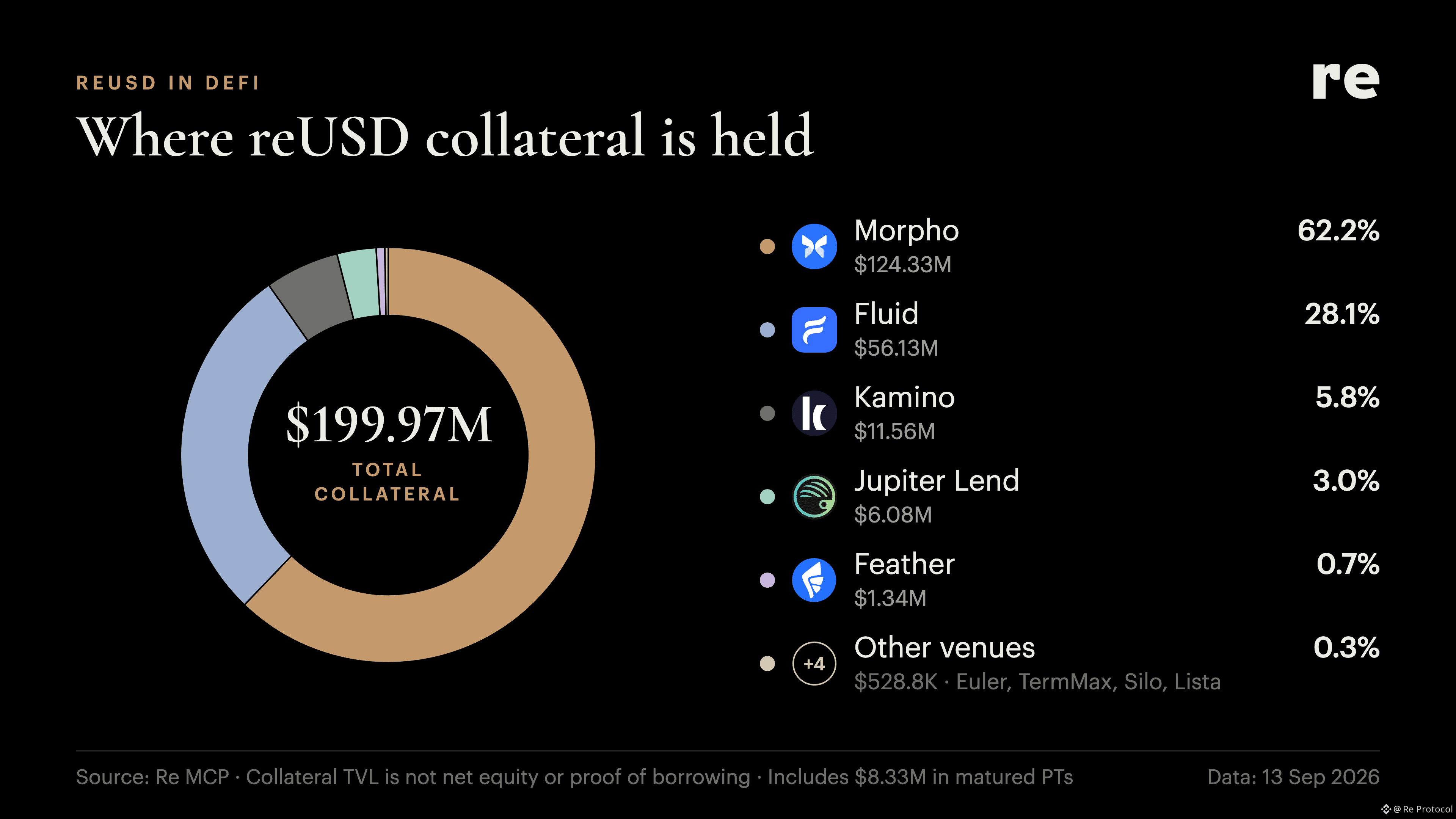
Most reUSD doesn't sit idle.
$199.97M is working across nine lending venues. DeFi composability, measured in collateral.
#reinsurance #RWA #lending
Most reUSD doesn't sit idle.
$199.97M is working across nine lending venues. DeFi composability, measured in collateral.
#reinsurance #RWA #lending
$199.97M is working across nine lending venues. DeFi composability, measured in collateral.
#reinsurance #RWA #lending
1
2
192

$XAUT JUST WENT LIVE AS COLLATERAL ON LEDN 💎
Tether’s gold-backed token $XAUT is now accepted as loan collateral on Ledn. That means you can borrow against physical gold without selling it.
With $23 billion in gold reserves backing every token, this turns a static asset into working capital. The same model that made Bitcoin-backed lending popular is now expanding to gold.
Are you holding XAUT for the next cycle?
Not financial advice. Always manage your risk.
#XAUT #Gold #Lending #Crypto
💎
$XAUT JUST WENT LIVE AS COLLATERAL ON LEDN 💎
Tether’s gold-backed token $XAUT is now accepted as loan collateral on Ledn. That means you can borrow against physical gold without selling it.
With $23 billion in gold reserves backing every token, this turns a static asset into working capital. The same model that made Bitcoin-backed lending popular is now expanding to gold.
Are you holding XAUT for the next cycle?
Not financial advice. Always manage your risk.
#XAUT #Gold #Lending #Crypto
💎
Tether’s gold-backed token $XAUT is now accepted as loan collateral on Ledn. That means you can borrow against physical gold without selling it.
With $23 billion in gold reserves backing every token, this turns a static asset into working capital. The same model that made Bitcoin-backed lending popular is now expanding to gold.
Are you holding XAUT for the next cycle?
Not financial advice. Always manage your risk.
#XAUT #Gold #Lending #Crypto
💎
50

·
--
Euler's V2 crushes efficiency: 808bps yield per TVL $ vs Aave's 254bps $EUL up 86% today on volume 2x market cap
Why it matters: While Aave dominates TVL, no one's talking about Euler's modular edge custom vaults, RWA collateral like HYBOND at 70% LTV, outpacing Morpho/Compound in risk-adjusted returns. Sleeping on this relative value play as lending TVL surges 30% WoW on BNB
Target: $EUL eyes $100+ as DeFi's credit machine scales to $10B+, turning post-hack resilience into institutional behemoth alongside Aave position now before the flywheel spins harder
@eulerfinance $EUL #DeFi #Lending
Euler's V2 crushes efficiency: 808bps yield per TVL $ vs Aave's 254bps $EUL up 86% today on volume 2x market cap
Why it matters: While Aave dominates TVL, no one's talking about Euler's modular edge custom vaults, RWA collateral like HYBOND at 70% LTV, outpacing Morpho/Compound in risk-adjusted returns. Sleeping on this relative value play as lending TVL surges 30% WoW on BNB
Target: $EUL eyes $100+ as DeFi's credit machine scales to $10B+, turning post-hack resilience into institutional behemoth alongside Aave position now before the flywheel spins harder
@eulerfinance $EUL #DeFi #Lending
Why it matters: While Aave dominates TVL, no one's talking about Euler's modular edge custom vaults, RWA collateral like HYBOND at 70% LTV, outpacing Morpho/Compound in risk-adjusted returns. Sleeping on this relative value play as lending TVL surges 30% WoW on BNB
Target: $EUL eyes $100+ as DeFi's credit machine scales to $10B+, turning post-hack resilience into institutional behemoth alongside Aave position now before the flywheel spins harder
@eulerfinance $EUL #DeFi #Lending
50

#termmax DeFi 借款人的终极痛点,TermMax 给出了答案 💡
在 Aave、Morpho 借钱,昨天利率 4%,今天可能就变 8%——浮动利率的不确定性让每一笔借款都像在赌方向。TermMax 的做法很简单:借钱那一刻,就把未来要还的利息锁死。
V2 升级后更值得关注:Composable Base Yield 让闲置资金自动生息,Atomic Order 实现流动性跨市场挂单,Smart Unwind 让债务仓位可提前退出。目前 TVL 破亿,日活地址一度排名 DeFi 借贷协议第二,仅次于 Aave。固定利率,才是机构级资金管理的基石。
#TermMax🌐🚀 #TMX #lending @termmax
#termmax DeFi 借款人的终极痛点,TermMax 给出了答案 💡
在 Aave、Morpho 借钱,昨天利率 4%,今天可能就变 8%——浮动利率的不确定性让每一笔借款都像在赌方向。TermMax 的做法很简单:借钱那一刻,就把未来要还的利息锁死。
V2 升级后更值得关注:Composable Base Yield 让闲置资金自动生息,Atomic Order 实现流动性跨市场挂单,Smart Unwind 让债务仓位可提前退出。目前 TVL 破亿,日活地址一度排名 DeFi 借贷协议第二,仅次于 Aave。固定利率,才是机构级资金管理的基石。
#TermMax🌐🚀 #TMX #lending @TermMax
在 Aave、Morpho 借钱,昨天利率 4%,今天可能就变 8%——浮动利率的不确定性让每一笔借款都像在赌方向。TermMax 的做法很简单:借钱那一刻,就把未来要还的利息锁死。
V2 升级后更值得关注:Composable Base Yield 让闲置资金自动生息,Atomic Order 实现流动性跨市场挂单,Smart Unwind 让债务仓位可提前退出。目前 TVL 破亿,日活地址一度排名 DeFi 借贷协议第二,仅次于 Aave。固定利率,才是机构级资金管理的基石。
#TermMax🌐🚀 #TMX #lending @TermMax
1
76



·
--
[DeFi 赛道分析] Aave (AAVE) 正在成为DeFi借贷的流动性层 -- 为什么说它被严重低估?
Aave 早已不是单纯的借贷协议,它在2025年完成了向多链流动性基础设施的转变:
核心优势
1. 跨链部署:已覆盖 Ethereum、Arbitrum、Base、Optimism、Polygon、Avalanche 等10+条链
2. GHO 稳定币:原生超额抵押稳定币 GHO 市值持续增长,为协议创造额外收入流
3. 协议收入:Aave V3 利率模型优化后,年化协议收入稳定在 8000万-1.2亿区间
4. Aave V4 即将上线:引入动态利率模型、跨链流动性聚合、LST/LRT 抵押品扩展
关键链上数据
- 总锁仓量(TVL):120亿+(所有链合计,DeFi Llama 排名前3)
- 月度活跃借款用户:环比增长 +15%
- 坏账率:<0.5%(风控表现优异)
- GHO 铸造量:连续3个月增长,利用率维持在 85-92%
技术位分析 (AAVE/USDT)
- Entry:$185-192(当前区间震荡下沿)
- Target 1:$225(前高阻力)
- Target 2:$260(若突破则打开上行空间)
- Stop Loss:$168(日线支撑失守)
催化剂
- Aave V4 提案即将进入链上投票
- GHO 跨链部署(Arbitrum+Base)
- 监管明朗化推动 DeFi 借贷需求回升
你认为 Aave 能否在本轮周期突破 $300 创历史新高?它还是你眼中的老牌协议吗?
#DeFi #AAVE #Ethereum #lending
[DeFi 赛道分析] Aave (AAVE) 正在成为DeFi借贷的流动性层 -- 为什么说它被严重低估?
Aave 早已不是单纯的借贷协议,它在2025年完成了向多链流动性基础设施的转变:
核心优势
1. 跨链部署:已覆盖 Ethereum、Arbitrum、Base、Optimism、Polygon、Avalanche 等10+条链
2. GHO 稳定币:原生超额抵押稳定币 GHO 市值持续增长,为协议创造额外收入流
3. 协议收入:Aave V3 利率模型优化后,年化协议收入稳定在 8000万-1.2亿区间
4. Aave V4 即将上线:引入动态利率模型、跨链流动性聚合、LST/LRT 抵押品扩展
关键链上数据
- 总锁仓量(TVL):120亿+(所有链合计,DeFi Llama 排名前3)
- 月度活跃借款用户:环比增长 +15%
- 坏账率:<0.5%(风控表现优异)
- GHO 铸造量:连续3个月增长,利用率维持在 85-92%
技术位分析 (AAVE/USDT)
- Entry:$185-192(当前区间震荡下沿)
- Target 1:$225(前高阻力)
- Target 2:$260(若突破则打开上行空间)
- Stop Loss:$168(日线支撑失守)
催化剂
- Aave V4 提案即将进入链上投票
- GHO 跨链部署(Arbitrum+Base)
- 监管明朗化推动 DeFi 借贷需求回升
你认为 Aave 能否在本轮周期突破 $300 创历史新高?它还是你眼中的老牌协议吗?
#DeFi #AAVE #Ethereum #lending
Aave 早已不是单纯的借贷协议,它在2025年完成了向多链流动性基础设施的转变:
核心优势
1. 跨链部署:已覆盖 Ethereum、Arbitrum、Base、Optimism、Polygon、Avalanche 等10+条链
2. GHO 稳定币:原生超额抵押稳定币 GHO 市值持续增长,为协议创造额外收入流
3. 协议收入:Aave V3 利率模型优化后,年化协议收入稳定在 8000万-1.2亿区间
4. Aave V4 即将上线:引入动态利率模型、跨链流动性聚合、LST/LRT 抵押品扩展
关键链上数据
- 总锁仓量(TVL):120亿+(所有链合计,DeFi Llama 排名前3)
- 月度活跃借款用户:环比增长 +15%
- 坏账率:<0.5%(风控表现优异)
- GHO 铸造量:连续3个月增长,利用率维持在 85-92%
技术位分析 (AAVE/USDT)
- Entry:$185-192(当前区间震荡下沿)
- Target 1:$225(前高阻力)
- Target 2:$260(若突破则打开上行空间)
- Stop Loss:$168(日线支撑失守)
催化剂
- Aave V4 提案即将进入链上投票
- GHO 跨链部署(Arbitrum+Base)
- 监管明朗化推动 DeFi 借贷需求回升
你认为 Aave 能否在本轮周期突破 $300 创历史新高?它还是你眼中的老牌协议吗?
#DeFi #AAVE #Ethereum #lending
133

🟢 AAVE Goes Green: What DeFi Lending Strength Tells Us
On June 28, 2026, $AAVE is up 0.59% while most of the market bleeds. At $94.44, this DeFi token signals capital still flowing into quality protocols.
Aave's lending pools generate fees regardless of market direction. The protocol's resilience demonstrates the power of fee-generating infrastructure.
📌 Key Takeaway:
AAVE's green performance reflects DeFi lending strength — protocols generating real revenue weather bearish cycles better.
#Aave #DeFi #Lending
#BinanceAlphaAlert
🟢 AAVE Goes Green: What DeFi Lending Strength Tells Us
On June 28, 2026, $AAVE is up 0.59% while most of the market bleeds. At $94.44, this DeFi token signals capital still flowing into quality protocols.
Aave's lending pools generate fees regardless of market direction. The protocol's resilience demonstrates the power of fee-generating infrastructure.
📌 Key Takeaway:
AAVE's green performance reflects DeFi lending strength — protocols generating real revenue weather bearish cycles better.
#Aave #DeFi #Lending
#BinanceAlphaAlert
On June 28, 2026, $AAVE is up 0.59% while most of the market bleeds. At $94.44, this DeFi token signals capital still flowing into quality protocols.
Aave's lending pools generate fees regardless of market direction. The protocol's resilience demonstrates the power of fee-generating infrastructure.
📌 Key Takeaway:
AAVE's green performance reflects DeFi lending strength — protocols generating real revenue weather bearish cycles better.
#Aave #DeFi #Lending
#BinanceAlphaAlert
58

JUSTLEND DAO: DECENTRALIZED LENDING ON TRON 💰
JustLend DAO is TRON's premier decentralized lending protocol. By connecting lenders and borrowers through smart contracts, JustLend creates open, permissionless financial markets.
Lenders earn interest by supplying assets to the protocol. Borrowers access liquidity by providing collateral. The entire process is automated, transparent, and censorship-resistant.
With over $1 billion in total value locked, JustLend has proven its reliability and security. Users can supply or borrow USDT, TRX, BTC, ETH, and other major assets.
For the unbanked and underbanked, JustLend provides access to financial services that traditional banks can't or won't offer.
@TRON DAO
#TRONEcoStar #DeFi #Lending
JUSTLEND DAO: DECENTRALIZED LENDING ON TRON 💰
JustLend DAO is TRON's premier decentralized lending protocol. By connecting lenders and borrowers through smart contracts, JustLend creates open, permissionless financial markets.
Lenders earn interest by supplying assets to the protocol. Borrowers access liquidity by providing collateral. The entire process is automated, transparent, and censorship-resistant.
With over $1 billion in total value locked, JustLend has proven its reliability and security. Users can supply or borrow USDT, TRX, BTC, ETH, and other major assets.
For the unbanked and underbanked, JustLend provides access to financial services that traditional banks can't or won't offer.
@TRON DAO
#TRONEcoStar #DeFi #Lending
JustLend DAO is TRON's premier decentralized lending protocol. By connecting lenders and borrowers through smart contracts, JustLend creates open, permissionless financial markets.
Lenders earn interest by supplying assets to the protocol. Borrowers access liquidity by providing collateral. The entire process is automated, transparent, and censorship-resistant.
With over $1 billion in total value locked, JustLend has proven its reliability and security. Users can supply or borrow USDT, TRX, BTC, ETH, and other major assets.
For the unbanked and underbanked, JustLend provides access to financial services that traditional banks can't or won't offer.
@TRON DAO
#TRONEcoStar #DeFi #Lending
36

·
--
𝗔𝗹𝗽𝗵𝗮 𝗱𝗿𝗼𝗽: 𝗞𝗮𝗺𝗶𝗻𝗼’𝘀 𝗳𝗶𝘅𝗲𝗱-𝗿𝗮𝘁𝗲 𝘄𝗶𝗻𝗱𝗼𝘄 𝗶𝘀 𝗮𝗯𝗼𝘂𝘁 𝘁𝗼 𝗳𝗹𝗶𝗽 𝘁𝗵𝗲 𝗻𝗮𝗿𝗿𝗮𝘁𝗶𝘃𝗲 🚨
Pattern spotted: rate curve tightening + utilization creeping up on main market📈
Setup: when fixed/known payments get clearer, liquidity stops “floating” and starts positioning
Target: price re-rates into the next catalyst window soon window closing fast on @Kamino #DeFi #Lending
𝗔𝗹𝗽𝗵𝗮 𝗱𝗿𝗼𝗽: 𝗞𝗮𝗺𝗶𝗻𝗼’𝘀 𝗳𝗶𝘅𝗲𝗱-𝗿𝗮𝘁𝗲 𝘄𝗶𝗻𝗱𝗼𝘄 𝗶𝘀 𝗮𝗯𝗼𝘂𝘁 𝘁𝗼 𝗳𝗹𝗶𝗽 𝘁𝗵𝗲 𝗻𝗮𝗿𝗿𝗮𝘁𝗶𝘃𝗲 🚨
Pattern spotted: rate curve tightening + utilization creeping up on main market📈
Setup: when fixed/known payments get clearer, liquidity stops “floating” and starts positioning
Target: price re-rates into the next catalyst window soon window closing fast on @Kamino #DeFi #Lending
Pattern spotted: rate curve tightening + utilization creeping up on main market📈
Setup: when fixed/known payments get clearer, liquidity stops “floating” and starts positioning
Target: price re-rates into the next catalyst window soon window closing fast on @Kamino #DeFi #Lending
29

·
--
In April, stolen rsETH was deposited into Aave to borrow $191M WETH. Pool utilization hit 100%. $8.45B TVL drained in two days.
Common lending tools have clear gaps:
Multi-collateral joint deviation — unsupported by Aave UI, ProfitLab, Hypernative. Only DeFi Saver partial.
Oracle deviation not deducted — missing in Aave UI, DeFi Saver, ProfitLab.
Actionable recommendations — none in Aave UI, Hypernative. ProfitLab manual only. DeFi Saver auto-executes.
Cross-protocol aggregation — no unified view for Aave + Compound.
Does your tool show the real risk?
#AAVE #defi #lending #rseth
In April, stolen rsETH was deposited into Aave to borrow $191M WETH. Pool utilization hit 100%. $8.45B TVL drained in two days.
Common lending tools have clear gaps:
Multi-collateral joint deviation — unsupported by Aave UI, ProfitLab, Hypernative. Only DeFi Saver partial.
Oracle deviation not deducted — missing in Aave UI, DeFi Saver, ProfitLab.
Actionable recommendations — none in Aave UI, Hypernative. ProfitLab manual only. DeFi Saver auto-executes.
Cross-protocol aggregation — no unified view for Aave + Compound.
Does your tool show the real risk?
#AAVE #defi #lending #rseth
Common lending tools have clear gaps:
Multi-collateral joint deviation — unsupported by Aave UI, ProfitLab, Hypernative. Only DeFi Saver partial.
Oracle deviation not deducted — missing in Aave UI, DeFi Saver, ProfitLab.
Actionable recommendations — none in Aave UI, Hypernative. ProfitLab manual only. DeFi Saver auto-executes.
Cross-protocol aggregation — no unified view for Aave + Compound.
Does your tool show the real risk?
#AAVE #defi #lending #rseth
167

·
--
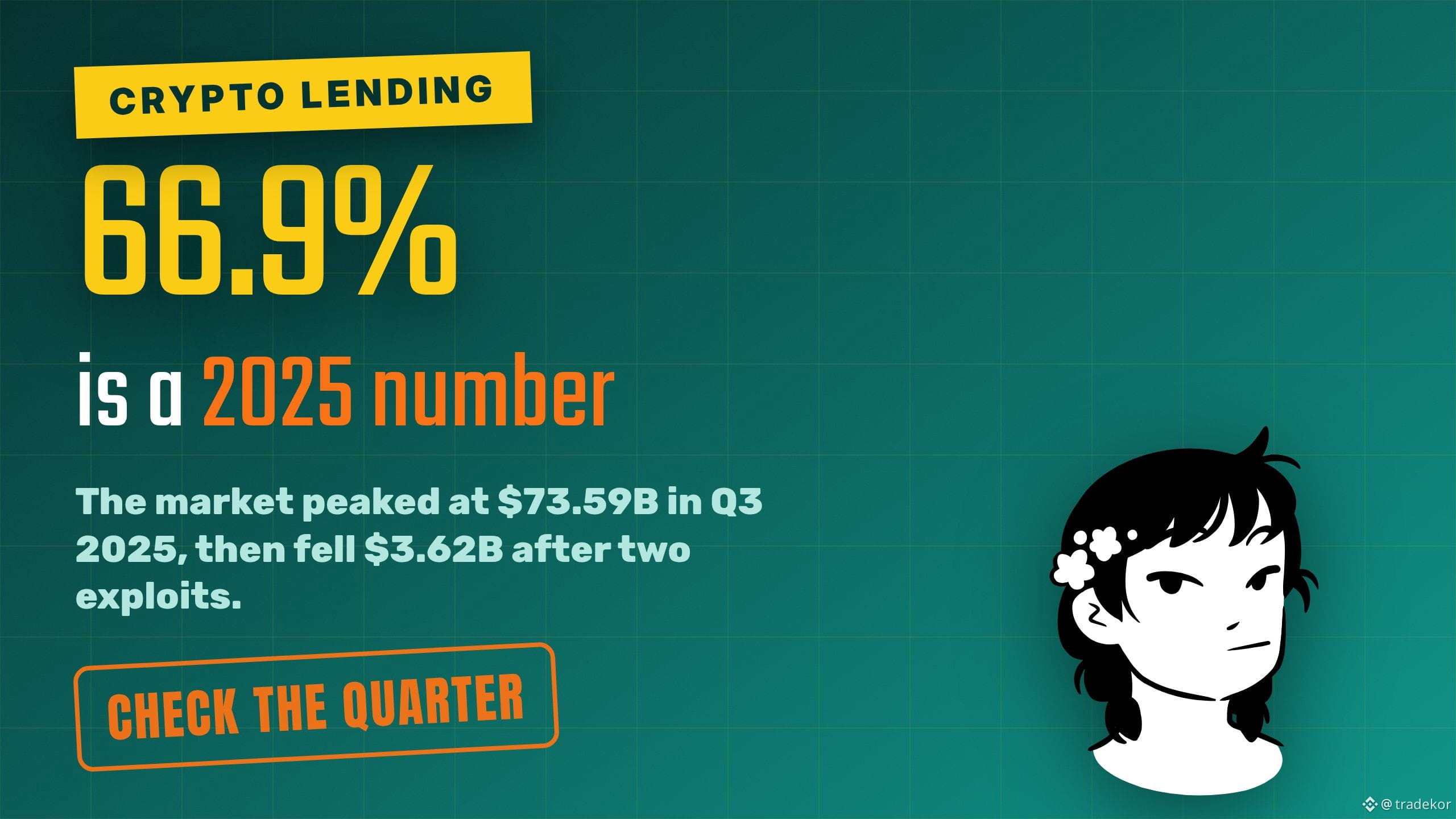
Crypto lending's most-quoted stat — DeFi at two-thirds of the market — is from Q3 2025. The market has shrunk $3.6B since.
The record: crypto-collateralized lending hit an all-time high of $73.59B at the end of Q3 2025 per Galaxy Research, beating the Q4 2021 peak of $69.37B by about 6%. On-chain lending held 66.9% share against 48.6% four years earlier — DeFi applications at 55.7%, CeFi venues at 33.12%, CDP-backed stablecoin supply at 11.18%.
What happened next: the market fell $3.62B in Q1 2026 to $67.42B. The cause was not macro. Two nine-figure DeFi exploits triggered an exodus from $AAVE, and the total has not reclaimed the high since.
What grew anyway: daily active unique borrowers rose roughly 40% between Q4 2025 and Q2 2026. Morpho's loans outstanding went from $1.9B to $3.0B, making it the second-largest lender, with TVL up roughly 6x in eighteen months to over $3B by July.
The read: total value and user count moved in opposite directions. Capital left after the exploits while the number of people borrowing kept rising, which means the average position got smaller and the depositor base got broader. That is a healthier composition than the headline decline suggests — and a worse one than the stale share stat implies.
The habit: check the quarter on any lending stat before repeating it. A figure that peaked three quarters ago is a historical fact, not a description of today.
Not financial advice. DYOR.
#DeFi #Lending #OnChain #CryptoData
Crypto lending's most-quoted stat — DeFi at two-thirds of the market — is from Q3 2025. The market has shrunk $3.6B since.
The record: crypto-collateralized lending hit an all-time high of $73.59B at the end of Q3 2025 per Galaxy Research, beating the Q4 2021 peak of $69.37B by about 6%. On-chain lending held 66.9% share against 48.6% four years earlier — DeFi applications at 55.7%, CeFi venues at 33.12%, CDP-backed stablecoin supply at 11.18%.
What happened next: the market fell $3.62B in Q1 2026 to $67.42B. The cause was not macro. Two nine-figure DeFi exploits triggered an exodus from $AAVE , and the total has not reclaimed the high since.
What grew anyway: daily active unique borrowers rose roughly 40% between Q4 2025 and Q2 2026. Morpho's loans outstanding went from $1.9B to $3.0B, making it the second-largest lender, with TVL up roughly 6x in eighteen months to over $3B by July.
The read: total value and user count moved in opposite directions. Capital left after the exploits while the number of people borrowing kept rising, which means the average position got smaller and the depositor base got broader. That is a healthier composition than the headline decline suggests — and a worse one than the stale share stat implies.
The habit: check the quarter on any lending stat before repeating it. A figure that peaked three quarters ago is a historical fact, not a description of today.
Not financial advice. DYOR.
#DeFi #Lending #OnChain #CryptoData
The record: crypto-collateralized lending hit an all-time high of $73.59B at the end of Q3 2025 per Galaxy Research, beating the Q4 2021 peak of $69.37B by about 6%. On-chain lending held 66.9% share against 48.6% four years earlier — DeFi applications at 55.7%, CeFi venues at 33.12%, CDP-backed stablecoin supply at 11.18%.
What happened next: the market fell $3.62B in Q1 2026 to $67.42B. The cause was not macro. Two nine-figure DeFi exploits triggered an exodus from $AAVE , and the total has not reclaimed the high since.
What grew anyway: daily active unique borrowers rose roughly 40% between Q4 2025 and Q2 2026. Morpho's loans outstanding went from $1.9B to $3.0B, making it the second-largest lender, with TVL up roughly 6x in eighteen months to over $3B by July.
The read: total value and user count moved in opposite directions. Capital left after the exploits while the number of people borrowing kept rising, which means the average position got smaller and the depositor base got broader. That is a healthier composition than the headline decline suggests — and a worse one than the stale share stat implies.
The habit: check the quarter on any lending stat before repeating it. A figure that peaked three quarters ago is a historical fact, not a description of today.
Not financial advice. DYOR.
#DeFi #Lending #OnChain #CryptoData
46

@termmax #TMX
Every DeFi project talks about high APY.
But the smarter question is:
How predictable is that yield?
TermMax Finance focuses on fixed-rate lending, borrowing, and clearer maturity structures.
In DeFi, rates can change fast. A fixed-rate model aims to give borrowers more visibility into borrowing costs, while lenders can better understand the term and risk profile of their position.
The $TMX narrative is not only about lending.
It is about bringing more rate certainty to DeFi.
Still, liquidity depth, smart-contract security, collateral volatility, and real user adoption remain key risks to watch.
The next DeFi narrative may not be:
“What APY can I get?”
It may be:
“How reliable is the structure behind it?”
#DeFi #FixedRate #Lending #TMX
@TermMax #TMX
Every DeFi project talks about high APY.
But the smarter question is:
How predictable is that yield?
TermMax Finance focuses on fixed-rate lending, borrowing, and clearer maturity structures.
In DeFi, rates can change fast. A fixed-rate model aims to give borrowers more visibility into borrowing costs, while lenders can better understand the term and risk profile of their position.
The $TMX narrative is not only about lending.
It is about bringing more rate certainty to DeFi.
Still, liquidity depth, smart-contract security, collateral volatility, and real user adoption remain key risks to watch.
The next DeFi narrative may not be:
“What APY can I get?”
It may be:
“How reliable is the structure behind it?”
#DeFi #FixedRate #Lending #TMX
Every DeFi project talks about high APY.
But the smarter question is:
How predictable is that yield?
TermMax Finance focuses on fixed-rate lending, borrowing, and clearer maturity structures.
In DeFi, rates can change fast. A fixed-rate model aims to give borrowers more visibility into borrowing costs, while lenders can better understand the term and risk profile of their position.
The $TMX narrative is not only about lending.
It is about bringing more rate certainty to DeFi.
Still, liquidity depth, smart-contract security, collateral volatility, and real user adoption remain key risks to watch.
The next DeFi narrative may not be:
“What APY can I get?”
It may be:
“How reliable is the structure behind it?”
#DeFi #FixedRate #Lending #TMX
1
112

·
--
ສັນຍານກະທິງ
$AAVE INSANE BREAKOUT IMMINENT? 🚀👇
$AAVE protocol revenue is hitting multi-month records as borrowing demands surge. The token is violently breaking out of a long horizontal accumulation baseline. Click the coin tag to open your trade! 💸
💰 Entry: 88.50–91.00
🎯 TP1: 99.50
🎯 TP2: 107.00
🎯 TP3: 115.00
🛑 SL: 84.00
{spot}(AAVEUSDT)
#AAVE #AAVE #defi #lending
$AAVE INSANE BREAKOUT IMMINENT? 🚀👇
$AAVE protocol revenue is hitting multi-month records as borrowing demands surge. The token is violently breaking out of a long horizontal accumulation baseline. Click the coin tag to open your trade! 💸
💰 Entry: 88.50–91.00
🎯 TP1: 99.50
🎯 TP2: 107.00
🎯 TP3: 115.00
🛑 SL: 84.00
#AAVE #AAVE #defi #lending
$AAVE protocol revenue is hitting multi-month records as borrowing demands surge. The token is violently breaking out of a long horizontal accumulation baseline. Click the coin tag to open your trade! 💸
💰 Entry: 88.50–91.00
🎯 TP1: 99.50
🎯 TP2: 107.00
🎯 TP3: 115.00
🛑 SL: 84.00
#AAVE #AAVE #defi #lending
136

·
--
Brokerages Break Records with Lending Profits 💸
The first quarter has seen a significant surge in lending profits for brokerage firms, with a record high of over 11,200 billion dong in revenue. This substantial growth can be attributed to the continuous expansion of lending services by these firms, which has led to a notable increase in their market share. As a result, the market impact has been considerable, with investors taking notice of the shifting landscape. The impressive revenue figures are a testament to the success of brokerage firms in diversifying their services and capitalizing on new opportunities. This trend is expected to continue, with potential implications for the broader financial market. #Crypto #Markets #Finance #Lending #Brokerages
Brokerages Break Records with Lending Profits 💸
The first quarter has seen a significant surge in lending profits for brokerage firms, with a record high of over 11,200 billion dong in revenue. This substantial growth can be attributed to the continuous expansion of lending services by these firms, which has led to a notable increase in their market share. As a result, the market impact has been considerable, with investors taking notice of the shifting landscape. The impressive revenue figures are a testament to the success of brokerage firms in diversifying their services and capitalizing on new opportunities. This trend is expected to continue, with potential implications for the broader financial market. #Crypto #Markets #Finance #Lending #Brokerages
The first quarter has seen a significant surge in lending profits for brokerage firms, with a record high of over 11,200 billion dong in revenue. This substantial growth can be attributed to the continuous expansion of lending services by these firms, which has led to a notable increase in their market share. As a result, the market impact has been considerable, with investors taking notice of the shifting landscape. The impressive revenue figures are a testament to the success of brokerage firms in diversifying their services and capitalizing on new opportunities. This trend is expected to continue, with potential implications for the broader financial market. #Crypto #Markets #Finance #Lending #Brokerages
8
ເຂົ້າສູ່ລະບົບເພື່ອສຳຫຼວດເນື້ອຫາເພີ່ມເຕີມ
ເຂົ້າຮ່ວມກຸ່ມຜູ້ໃຊ້ຄຣິບໂຕທົ່ວໂລກໃນ Binance Square.
⚡️ ໄດ້ຮັບຂໍ້ມູນຫຼ້າສຸດ ແລະ ທີ່ມີປະໂຫຍດກ່ຽວກັບຄຣິບໂຕ.
💬 ໄດ້ຮັບຄວາມໄວ້ວາງໃຈຈາກຕະຫຼາດແລກປ່ຽນຄຣິບໂຕທີ່ໃຫຍ່ທີ່ສຸດໃນໂລກ.
👍 ຄົ້ນຫາຂໍ້ມູນເຊີງເລິກທີ່ແທ້ຈາກນັກສ້າງທີ່ໄດ້ຮັບການຢືນຢັນ.
ອີເມວ / ເບີໂທລະສັບ
ຫົວຂໍ້ທີ່ກໍາລັງນິຍົມ
1
#BNBSurpasses$790
18,476 views
144 ກຳລັງສົນທະນາ
2
#ZamaRises15.99%ToIntradayHigh$0.09
16,554 views
105 ກຳລັງສົນທະນາ
3
#BitcoinSpotETFsDraw$6.34BInflowsInQ3
5,917 views
90 ກຳລັງສົນທະນາ
4
#EthereumValidatorExitQueueJumps392%
92,908 views
913 ກຳລັງສົນທະນາ
5
#IMFApprovesElSalvador$138MWithBitcoinWaiver
13,412 views
62 ກຳລັງສົນທະນາ
6
#SECHaltsCryptoETFReviewsAmidFundingLapse
257,512 views
1,789 ກຳລັງສົນທະນາ
7
#ZcashETFPostsFirstWeeklyOutflow$93.6M
95,260 views
254 ກຳລັງສົນທະນາ
8
#GreekPoliceBustCryptoScamRingArrest17
377,817 views
2,436 ກຳລັງສົນທະນາ
9
#BitcoinRejectedAt$87K
223,235 views
318 ກຳລັງສົນທະນາ
10
#FedOctoberRateHikeOddsFallTo17%
384,277 views
2,549 ກຳລັງສົນທະນາ