

tradekor
280 ໂພສ

tradekor
ລາຍງານ
ບລັອກຜູ້ໃຊ້
4 years trading experience in smc, ict, price action, chart pattern, candle patterns, vsa and professional full stack developer for last 14 years.
0 ກໍາລັງຕິດຕາມ
123 ຜູ້ຕິດຕາມ
65 Liked
ໂພສ
·
--
ບົດຄວາມ
Crypto's Top 8 Stories Today — October 1, 20268 stories cleared the bar for Oct 1 -- a major treasury strategic pivot, fresh EU regulatory heat on the largest exchange, and a genuine new TradFi-DeFi bridge product all made the cut.
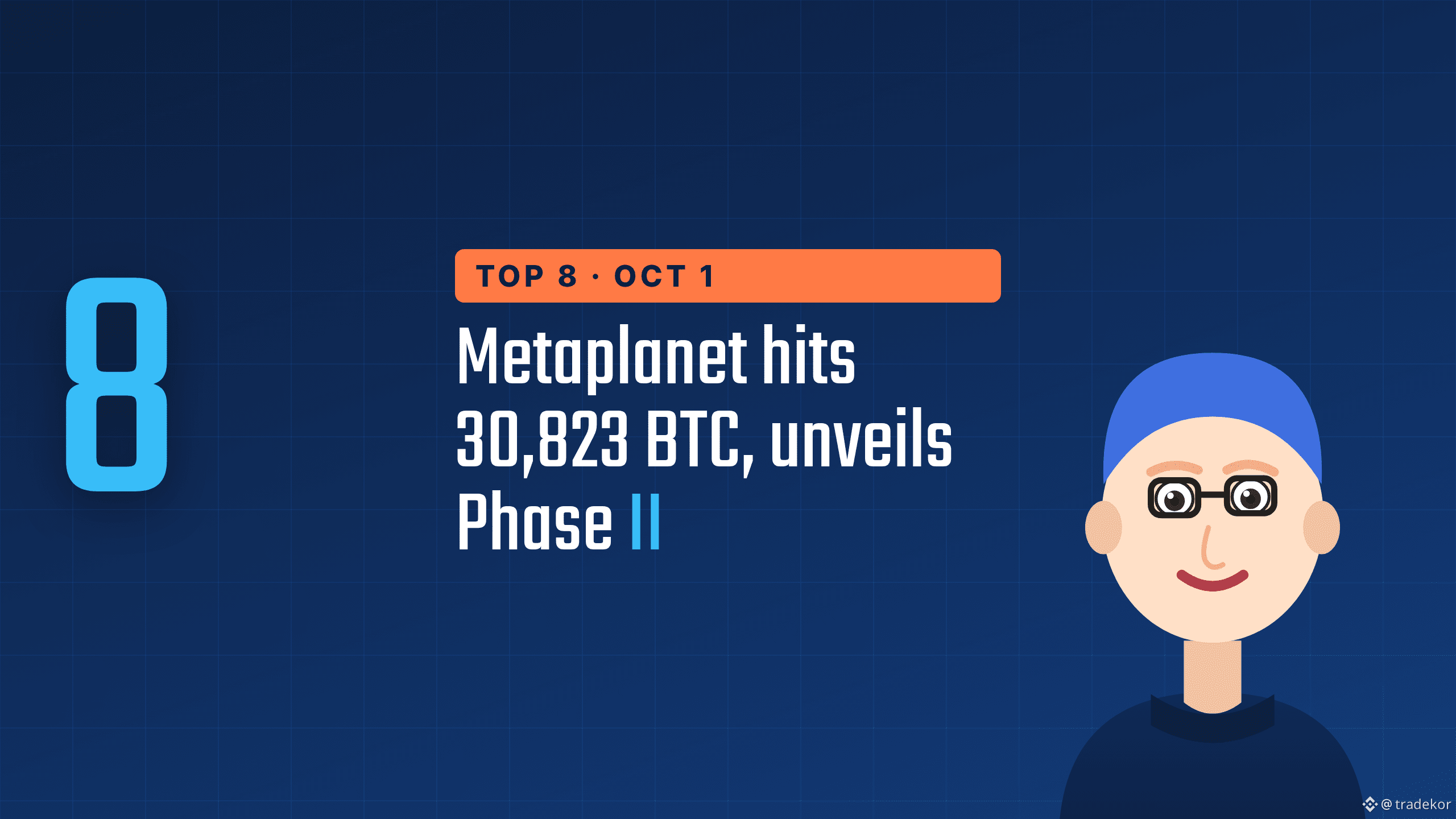
1. Metaplanet bought 5,268 more BTC for ~$623M (avg ~$116,870/BTC) on Oct 1, lifting its treasury to 30,823 BTC (~$3.3B) and making it the world's 4th-largest publicly traded Bitcoin treasury company, behind only Strategy, MARA Holdings and XXI. Alongside the buy, Metaplanet unveiled "Phase II" of its strategy: non-dilutive revenue lines including a Bitcoin Income Generation unit ($136.3M allocated to selling BTC options and harvesting implied volatility, already posting $16.28M in quarterly revenue, +115.7% QoQ), the Bitcoin.jp media platform, and a still-undisclosed "Project NOVA" initiative -- a real pivot from pure accumulation toward a diversified, yield-generating Bitcoin business model.
2. EU securities regulator ESMA, plus national regulators in France, Germany and Greece, are scrutinizing whether Binance is improperly relying on MiCA's narrow "reverse solicitation" exemption to keep serving EU customers after failing to secure a MiCA license over the summer (and withdrawing its Greek application after political pushback). Testing in August found new Binance accounts could still be opened, verified and funded from several EU countries. ESMA says the exemption "should not be used to circumvent MiCA requirements," and the review could lead to enforcement action against the world's largest exchange.
3. NEAR ETF recap (covered earlier today): Bitwise's first US spot NEAR ETF drew $35.5M in day-one inflows, outperforming comparable SOL and XRP ETF debuts -- full breakdown in our earlier post.
4. Chainlink unveiled "Fulcrum," a new cross-chain institutional repo and collateral-financing product, demonstrating the workflow live with DTCC at Sibos 2026. Fulcrum separates financing-agreement management from the settlement chains used for cash and collateral, targeting stranded/idle institutional bank collateral; DTCC plans to build its own Collateral AppChain on Chainlink's infrastructure, targeting a Q4 2026 go-live. A distinct new institutional product beyond the CCIP 2.0 launch covered earlier this week.
5. Coinbase completed its migration of international derivatives from Coinbase International Exchange to "Deribit by Coinbase" (96.6% of open interest had already moved pre-migration), consolidating its options/futures liquidity onto the platform it acquired for ~$2.9B. The headline new feature: listed crypto options trading directly in the Coinbase app for eligible users in select jurisdictions, expected in late October.
6. US spot Bitcoin ETFs posted a $148.7M net outflow on Oct 1, ending a nine-day streak that had pulled in $3.1B. Fidelity's FBTC led outflows at $125.6M, followed by Bitwise's BITB ($13.6M) and BlackRock's IBIT ($9.5M, ending its own 9-day, $1.6B inflow run). Year-to-date net inflows stand at $970M with AUM over $100B.
7. Brazil's Resolution BCB 588 took effect Oct 1, requiring licensed virtual-asset providers to report any customer transfer of $10,000+ to or from a self-custody wallet to the financial-intelligence unit (Coaf) by the next business day. It's a reporting requirement, not a transfer ban or ceiling, and doesn't capture pure wallet-to-wallet transfers outside licensed providers -- a template other regulators may watch.
8. Fiserv launched a white-label digital-asset platform (minting, burning and custody via VersaBank and Fireblocks) available to its roughly 10,000 financial-institution clients at no extra cost. Its pilot deployment, Roughrider Coin, is a USD-backed, bank-to-bank stablecoin built for 90+ North Dakota community banks and credit unions, running on Solana -- a mainstream core-banking vendor putting a state-bank-backed stablecoin live on a public chain at real scale.
A top-5 Bitcoin treasury company reinventing itself as a yield business, the EU drawing a harder line on Binance, and Fiserv quietly putting a state-backed stablecoin on Solana -- which thread matters most heading into Q4?
Not financial advice. DYOR.
$BTC $NEAR $LINK #CryptoNews #DailyDigest #Metaplanet
Crypto's Top 8 Stories Today — October 1, 2026
8 stories cleared the bar for Oct 1 -- a major treasury strategic pivot, fresh EU regulatory heat on the largest exchange, and a genuine new TradFi-DeFi bridge product all made the cut.
1. Metaplanet bought 5,268 more BTC for ~$623M (avg ~$116,870/BTC) on Oct 1, lifting its treasury to 30,823 BTC (~$3.3B) and making it the world's 4th-largest publicly traded Bitcoin treasury company, behind only Strategy, MARA Holdings and XXI. Alongside the buy, Metaplanet unveiled "Phase II" of its strategy: non-dilutive revenue lines including a Bitcoin Income Generation unit ($136.3M allocated to selling BTC options and harvesting implied volatility, already posting $16.28M in quarterly revenue, +115.7% QoQ), the Bitcoin.jp media platform, and a still-undisclosed "Project NOVA" initiative -- a real pivot from pure accumulation toward a diversified, yield-generating Bitcoin business model.
2. EU securities regulator ESMA, plus national regulators in France, Germany and Greece, are scrutinizing whether Binance is improperly relying on MiCA's narrow "reverse solicitation" exemption to keep serving EU customers after failing to secure a MiCA license over the summer (and withdrawing its Greek application after political pushback). Testing in August found new Binance accounts could still be opened, verified and funded from several EU countries. ESMA says the exemption "should not be used to circumvent MiCA requirements," and the review could lead to enforcement action against the world's largest exchange.
3. NEAR ETF recap (covered earlier today): Bitwise's first US spot NEAR ETF drew $35.5M in day-one inflows, outperforming comparable SOL and XRP ETF debuts -- full breakdown in our earlier post.
4. Chainlink unveiled "Fulcrum," a new cross-chain institutional repo and collateral-financing product, demonstrating the workflow live with DTCC at Sibos 2026. Fulcrum separates financing-agreement management from the settlement chains used for cash and collateral, targeting stranded/idle institutional bank collateral; DTCC plans to build its own Collateral AppChain on Chainlink's infrastructure, targeting a Q4 2026 go-live. A distinct new institutional product beyond the CCIP 2.0 launch covered earlier this week.
5. Coinbase completed its migration of international derivatives from Coinbase International Exchange to "Deribit by Coinbase" (96.6% of open interest had already moved pre-migration), consolidating its options/futures liquidity onto the platform it acquired for ~$2.9B. The headline new feature: listed crypto options trading directly in the Coinbase app for eligible users in select jurisdictions, expected in late October.
6. US spot Bitcoin ETFs posted a $148.7M net outflow on Oct 1, ending a nine-day streak that had pulled in $3.1B. Fidelity's FBTC led outflows at $125.6M, followed by Bitwise's BITB ($13.6M) and BlackRock's IBIT ($9.5M, ending its own 9-day, $1.6B inflow run). Year-to-date net inflows stand at $970M with AUM over $100B.
7. Brazil's Resolution BCB 588 took effect Oct 1, requiring licensed virtual-asset providers to report any customer transfer of $10,000+ to or from a self-custody wallet to the financial-intelligence unit (Coaf) by the next business day. It's a reporting requirement, not a transfer ban or ceiling, and doesn't capture pure wallet-to-wallet transfers outside licensed providers -- a template other regulators may watch.
8. Fiserv launched a white-label digital-asset platform (minting, burning and custody via VersaBank and Fireblocks) available to its roughly 10,000 financial-institution clients at no extra cost. Its pilot deployment, Roughrider Coin, is a USD-backed, bank-to-bank stablecoin built for 90+ North Dakota community banks and credit unions, running on Solana -- a mainstream core-banking vendor putting a state-bank-backed stablecoin live on a public chain at real scale.
A top-5 Bitcoin treasury company reinventing itself as a yield business, the EU drawing a harder line on Binance, and Fiserv quietly putting a state-backed stablecoin on Solana -- which thread matters most heading into Q4?
Not financial advice. DYOR.
$BTC $NEAR $LINK #CryptoNews #DailyDigest #Metaplanet
1. Metaplanet bought 5,268 more BTC for ~$623M (avg ~$116,870/BTC) on Oct 1, lifting its treasury to 30,823 BTC (~$3.3B) and making it the world's 4th-largest publicly traded Bitcoin treasury company, behind only Strategy, MARA Holdings and XXI. Alongside the buy, Metaplanet unveiled "Phase II" of its strategy: non-dilutive revenue lines including a Bitcoin Income Generation unit ($136.3M allocated to selling BTC options and harvesting implied volatility, already posting $16.28M in quarterly revenue, +115.7% QoQ), the Bitcoin.jp media platform, and a still-undisclosed "Project NOVA" initiative -- a real pivot from pure accumulation toward a diversified, yield-generating Bitcoin business model.
2. EU securities regulator ESMA, plus national regulators in France, Germany and Greece, are scrutinizing whether Binance is improperly relying on MiCA's narrow "reverse solicitation" exemption to keep serving EU customers after failing to secure a MiCA license over the summer (and withdrawing its Greek application after political pushback). Testing in August found new Binance accounts could still be opened, verified and funded from several EU countries. ESMA says the exemption "should not be used to circumvent MiCA requirements," and the review could lead to enforcement action against the world's largest exchange.
3. NEAR ETF recap (covered earlier today): Bitwise's first US spot NEAR ETF drew $35.5M in day-one inflows, outperforming comparable SOL and XRP ETF debuts -- full breakdown in our earlier post.
4. Chainlink unveiled "Fulcrum," a new cross-chain institutional repo and collateral-financing product, demonstrating the workflow live with DTCC at Sibos 2026. Fulcrum separates financing-agreement management from the settlement chains used for cash and collateral, targeting stranded/idle institutional bank collateral; DTCC plans to build its own Collateral AppChain on Chainlink's infrastructure, targeting a Q4 2026 go-live. A distinct new institutional product beyond the CCIP 2.0 launch covered earlier this week.
5. Coinbase completed its migration of international derivatives from Coinbase International Exchange to "Deribit by Coinbase" (96.6% of open interest had already moved pre-migration), consolidating its options/futures liquidity onto the platform it acquired for ~$2.9B. The headline new feature: listed crypto options trading directly in the Coinbase app for eligible users in select jurisdictions, expected in late October.
6. US spot Bitcoin ETFs posted a $148.7M net outflow on Oct 1, ending a nine-day streak that had pulled in $3.1B. Fidelity's FBTC led outflows at $125.6M, followed by Bitwise's BITB ($13.6M) and BlackRock's IBIT ($9.5M, ending its own 9-day, $1.6B inflow run). Year-to-date net inflows stand at $970M with AUM over $100B.
7. Brazil's Resolution BCB 588 took effect Oct 1, requiring licensed virtual-asset providers to report any customer transfer of $10,000+ to or from a self-custody wallet to the financial-intelligence unit (Coaf) by the next business day. It's a reporting requirement, not a transfer ban or ceiling, and doesn't capture pure wallet-to-wallet transfers outside licensed providers -- a template other regulators may watch.
8. Fiserv launched a white-label digital-asset platform (minting, burning and custody via VersaBank and Fireblocks) available to its roughly 10,000 financial-institution clients at no extra cost. Its pilot deployment, Roughrider Coin, is a USD-backed, bank-to-bank stablecoin built for 90+ North Dakota community banks and credit unions, running on Solana -- a mainstream core-banking vendor putting a state-bank-backed stablecoin live on a public chain at real scale.
A top-5 Bitcoin treasury company reinventing itself as a yield business, the EU drawing a harder line on Binance, and Fiserv quietly putting a state-backed stablecoin on Solana -- which thread matters most heading into Q4?
Not financial advice. DYOR.
$BTC $NEAR $LINK #CryptoNews #DailyDigest #Metaplanet
22
·
--
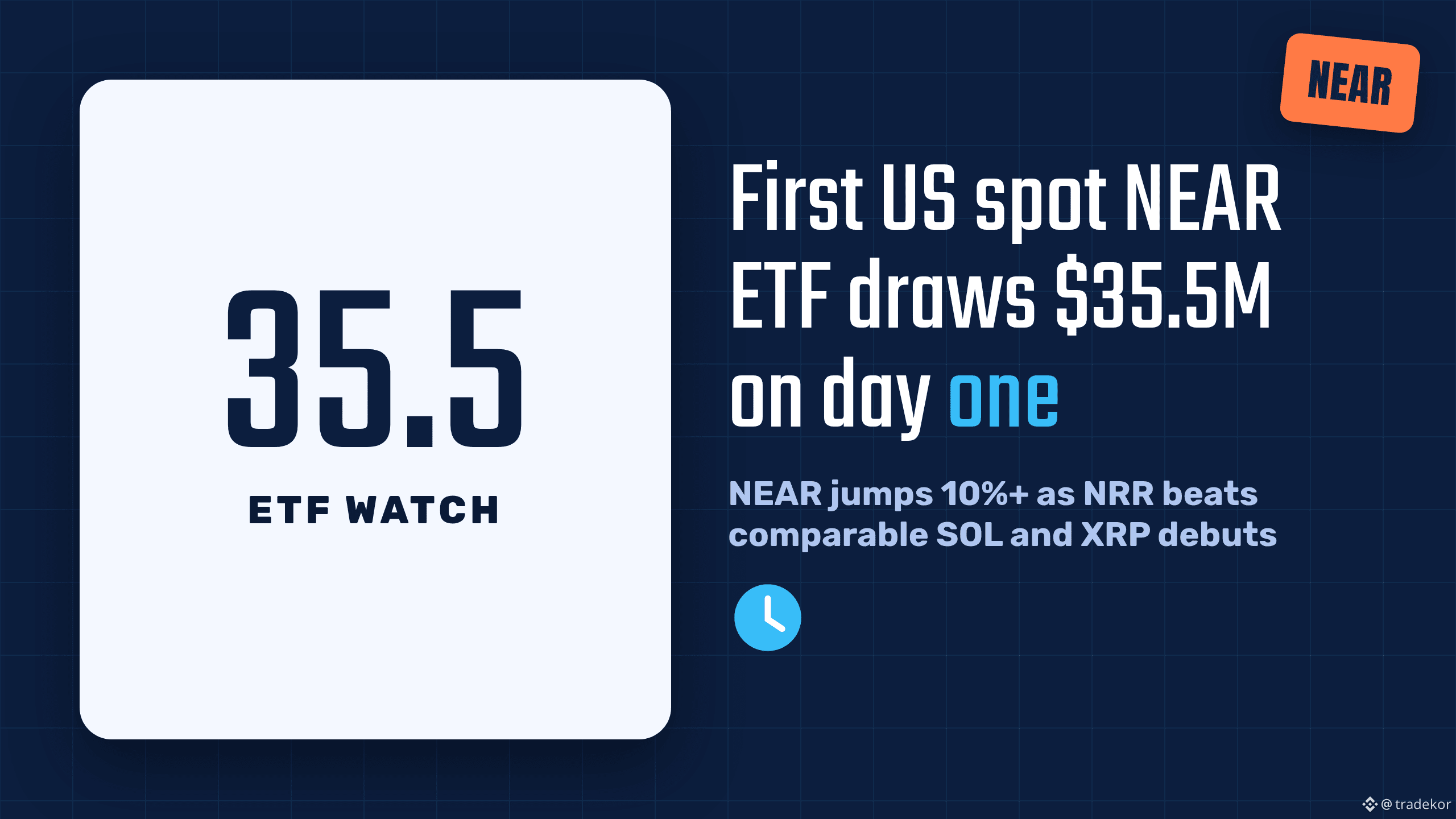
NEAR just got the first-ever US spot ETF for its token -- $35.5M flowed in on day one, and NEAR jumped over 10% to break back above $5.
The news: Bitwise's spot NEAR ETF (ticker NRR) launched on NYSE Arca on Sept 29, pulling in $35.5M of net inflows and $15.1M of trading volume on its debut day -- a launch multiple outlets say outperformed both the Bitwise Solana ETF and the first US spot XRP ETF when normalized against each token's valuation at launch. The fund charges a 0.75% fee and plans to stake its NEAR holdings (targeting ~5% average staking rewards), passing yield back to holders -- a structural first for a single-asset US crypto ETF. NEAR itself rose roughly 10% to $5.38 around the launch, with the ETF acquiring about 7.2M NEAR tokens (~0.55% of circulating supply).
The catch: part of the rally narrative leans on NEAR's positioning as infrastructure for AI agents and autonomous on-chain commerce -- a real thesis, but one still mostly unproven at scale. Some of the price targets circulating alongside this news (one technical setup citing a possible 135% move, another citing "$150 by 2030") are speculative calls, not confirmed outcomes, and NEAR's RSI near 77 signals the move may already be overheated short-term.
Our read: the inflow number and the staking-yield structure are the genuinely new facts here -- a first-day ETF beating comparable SOL/XRP debuts is a real institutional-demand signal, independent of how far the AI-agent narrative ultimately goes.
Does a first-day ETF outperforming SOL and XRP's debuts change how you rank NEAR against other L1s, or is this mostly a one-week story?
Not financial advice. DYOR.
$NEAR #CryptoNews #ETF #NEARProtocol
NEAR just got the first-ever US spot ETF for its token -- $35.5M flowed in on day one, and NEAR jumped over 10% to break back above $5.
The news: Bitwise's spot NEAR ETF (ticker NRR) launched on NYSE Arca on Sept 29, pulling in $35.5M of net inflows and $15.1M of trading volume on its debut day -- a launch multiple outlets say outperformed both the Bitwise Solana ETF and the first US spot XRP ETF when normalized against each token's valuation at launch. The fund charges a 0.75% fee and plans to stake its NEAR holdings (targeting ~5% average staking rewards), passing yield back to holders -- a structural first for a single-asset US crypto ETF. NEAR itself rose roughly 10% to $5.38 around the launch, with the ETF acquiring about 7.2M NEAR tokens (~0.55% of circulating supply).
The catch: part of the rally narrative leans on NEAR's positioning as infrastructure for AI agents and autonomous on-chain commerce -- a real thesis, but one still mostly unproven at scale. Some of the price targets circulating alongside this news (one technical setup citing a possible 135% move, another citing "$150 by 2030") are speculative calls, not confirmed outcomes, and NEAR's RSI near 77 signals the move may already be overheated short-term.
Our read: the inflow number and the staking-yield structure are the genuinely new facts here -- a first-day ETF beating comparable SOL/XRP debuts is a real institutional-demand signal, independent of how far the AI-agent narrative ultimately goes.
Does a first-day ETF outperforming SOL and XRP's debuts change how you rank NEAR against other L1s, or is this mostly a one-week story?
Not financial advice. DYOR.
$NEAR #CryptoNews #ETF #NEARProtocol
The news: Bitwise's spot NEAR ETF (ticker NRR) launched on NYSE Arca on Sept 29, pulling in $35.5M of net inflows and $15.1M of trading volume on its debut day -- a launch multiple outlets say outperformed both the Bitwise Solana ETF and the first US spot XRP ETF when normalized against each token's valuation at launch. The fund charges a 0.75% fee and plans to stake its NEAR holdings (targeting ~5% average staking rewards), passing yield back to holders -- a structural first for a single-asset US crypto ETF. NEAR itself rose roughly 10% to $5.38 around the launch, with the ETF acquiring about 7.2M NEAR tokens (~0.55% of circulating supply).
The catch: part of the rally narrative leans on NEAR's positioning as infrastructure for AI agents and autonomous on-chain commerce -- a real thesis, but one still mostly unproven at scale. Some of the price targets circulating alongside this news (one technical setup citing a possible 135% move, another citing "$150 by 2030") are speculative calls, not confirmed outcomes, and NEAR's RSI near 77 signals the move may already be overheated short-term.
Our read: the inflow number and the staking-yield structure are the genuinely new facts here -- a first-day ETF beating comparable SOL/XRP debuts is a real institutional-demand signal, independent of how far the AI-agent narrative ultimately goes.
Does a first-day ETF outperforming SOL and XRP's debuts change how you rank NEAR against other L1s, or is this mostly a one-week story?
Not financial advice. DYOR.
$NEAR #CryptoNews #ETF #NEARProtocol
182
·
--
ບົດຄວາມ
Crypto's Top 8 Stories Today — September 30, 20268 stories cleared the bar for Sep 30 -- a new stablecoin from the payments establishment, the worst hack month of the year, and a blockbuster Q3 close all made the cut.
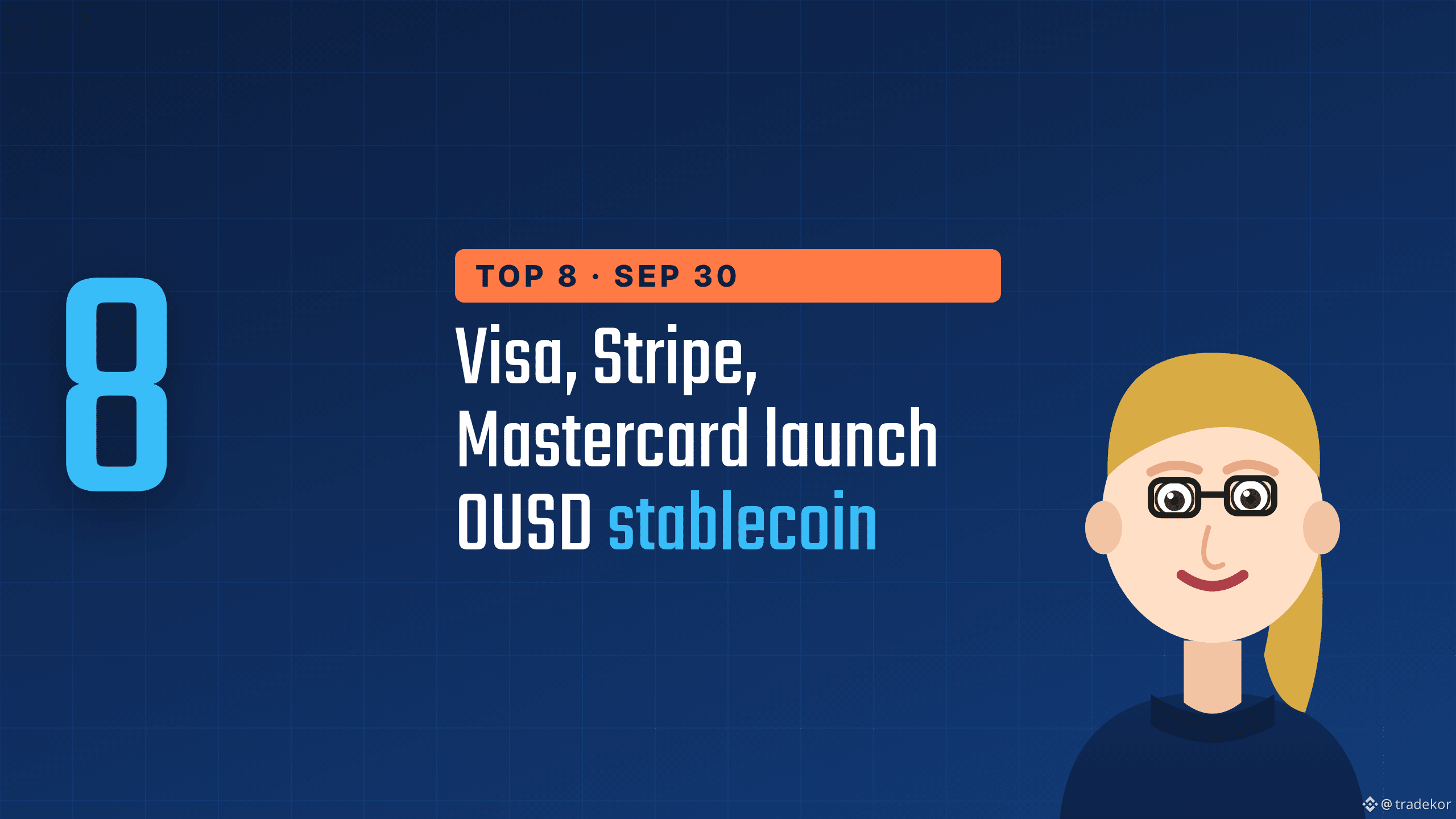
1. Open Standard launched OUSD, a dollar stablecoin backed by five founding partners -- Coinbase, Mastercard, Shopify, Stripe, and Visa -- who together committed over $1B to liquidity and each hold an equal equity stake. OUSD runs on Ethereum, Solana, Base and Tempo, is issued by Stripe's Bridge, and holds reserves at BlackRock, Lead Bank and BNY. Businesses can mint/burn 1:1 now via Mastercard/Stripe/Visa rails, with Coinbase access from Oct 1; first trading venues are Coinbase, Kraken and Uniswap. This is a direct institutional challenge to USDC and USDT from the payments establishment itself.
2. CertiK's monthly security report puts September's hack/phishing losses at $766.4M -- 2026's worst month, a 3.5x jump from August's $215M and the highest monthly incident count on record. The Bitget ($387.5M) and Liquid Network ($318.7M) hacks together made up over 92% of the total; about $270.6M was later returned or frozen.
3. Bitcoin closed out its second-best Q3 ever, up roughly 43.5% from ~$58.5K to ~$84K (behind only 2017's 80.4% surge), snapping a two-quarter losing streak after Q1's -22.2% and Q2's -14.1%. Ethereum had its best Q3 on record, up about 71%. Strong ETF demand and subdued profit-taking were cited as the main drivers.
4. Robinhood announced perpetual futures on 8 cryptocurrencies (BTC, ETH, SOL, XRP, DOGE, ADA, LINK, HYPE) via Robinhood Derivatives and Bitstamp -- up to 10x leverage on BTC/ETH, 3x on the rest, no expiry, 15-minute PnL settlement, and a 0.01% promotional fee through year-end. Nothing is tradable yet; Robinhood says "coming months" with no firm launch date.
5. SEC Chair Paul Atkins said on CNBC he wants "the stock market to move on-chain," reaffirming the agency will keep pursuing tokenization and on-chain fundraising rules administratively even after the CLARITY Act stalled in the Senate. Ties directly into the SEC's existing tokenized-stock "innovation exemption" and the same-day Binance bStocks expansion below.
6. Binance listed 7 new fully-backed tokenized US equities (Adobe, Wendy's, Zoom, PDD Holdings, HP, Forward Industries, SharonAI) as spot pairs and collateral assets, issued by its affiliate BTech Holdings -- a continuation of Binance's tokenized-stock push beyond the niche SpaceX/MARSCOIN airdrop covered earlier this week.
7. Chainlink (LINK) recap (covered earlier today): CCIP 2.0 launched with Fidelity, ANZ, Deutsche Börse and SBI as named partners; LINK spiked to $15.78 before pulling back -- full breakdown in our earlier post.
8. Shareholders of Armada Acquisition Corp. II approved its merger with Ripple-backed Evernorth, clearing a major hurdle toward Evernorth's planned Nasdaq listing as a public XRP treasury company holding 473M+ XRP. Customary closing and listing conditions still remain before the deal is final.
A payments-industry stablecoin aimed straight at USDC and USDT, a record-bad month for hacks, and Bitcoin's second-best Q3 ever -- which thread shapes your view of Q4 most?
Not financial advice. DYOR.
$BTC $ETH $XRP #CryptoNews #DailyDigest #Stablecoins
Crypto's Top 8 Stories Today — September 30, 2026
8 stories cleared the bar for Sep 30 -- a new stablecoin from the payments establishment, the worst hack month of the year, and a blockbuster Q3 close all made the cut.
1. Open Standard launched OUSD, a dollar stablecoin backed by five founding partners -- Coinbase, Mastercard, Shopify, Stripe, and Visa -- who together committed over $1B to liquidity and each hold an equal equity stake. OUSD runs on Ethereum, Solana, Base and Tempo, is issued by Stripe's Bridge, and holds reserves at BlackRock, Lead Bank and BNY. Businesses can mint/burn 1:1 now via Mastercard/Stripe/Visa rails, with Coinbase access from Oct 1; first trading venues are Coinbase, Kraken and Uniswap. This is a direct institutional challenge to USDC and USDT from the payments establishment itself.
2. CertiK's monthly security report puts September's hack/phishing losses at $766.4M -- 2026's worst month, a 3.5x jump from August's $215M and the highest monthly incident count on record. The Bitget ($387.5M) and Liquid Network ($318.7M) hacks together made up over 92% of the total; about $270.6M was later returned or frozen.
3. Bitcoin closed out its second-best Q3 ever, up roughly 43.5% from ~$58.5K to ~$84K (behind only 2017's 80.4% surge), snapping a two-quarter losing streak after Q1's -22.2% and Q2's -14.1%. Ethereum had its best Q3 on record, up about 71%. Strong ETF demand and subdued profit-taking were cited as the main drivers.
4. Robinhood announced perpetual futures on 8 cryptocurrencies (BTC, ETH, SOL, XRP, DOGE, ADA, LINK, HYPE) via Robinhood Derivatives and Bitstamp -- up to 10x leverage on BTC/ETH, 3x on the rest, no expiry, 15-minute PnL settlement, and a 0.01% promotional fee through year-end. Nothing is tradable yet; Robinhood says "coming months" with no firm launch date.
5. SEC Chair Paul Atkins said on CNBC he wants "the stock market to move on-chain," reaffirming the agency will keep pursuing tokenization and on-chain fundraising rules administratively even after the CLARITY Act stalled in the Senate. Ties directly into the SEC's existing tokenized-stock "innovation exemption" and the same-day Binance bStocks expansion below.
6. Binance listed 7 new fully-backed tokenized US equities (Adobe, Wendy's, Zoom, PDD Holdings, HP, Forward Industries, SharonAI) as spot pairs and collateral assets, issued by its affiliate BTech Holdings -- a continuation of Binance's tokenized-stock push beyond the niche SpaceX/MARSCOIN airdrop covered earlier this week.
7. Chainlink (LINK) recap (covered earlier today): CCIP 2.0 launched with Fidelity, ANZ, Deutsche Börse and SBI as named partners; LINK spiked to $15.78 before pulling back -- full breakdown in our earlier post.
8. Shareholders of Armada Acquisition Corp. II approved its merger with Ripple-backed Evernorth, clearing a major hurdle toward Evernorth's planned Nasdaq listing as a public XRP treasury company holding 473M+ XRP. Customary closing and listing conditions still remain before the deal is final.
A payments-industry stablecoin aimed straight at USDC and USDT, a record-bad month for hacks, and Bitcoin's second-best Q3 ever -- which thread shapes your view of Q4 most?
Not financial advice. DYOR.
$BTC $ETH $XRP #CryptoNews #DailyDigest #Stablecoins
1. Open Standard launched OUSD, a dollar stablecoin backed by five founding partners -- Coinbase, Mastercard, Shopify, Stripe, and Visa -- who together committed over $1B to liquidity and each hold an equal equity stake. OUSD runs on Ethereum, Solana, Base and Tempo, is issued by Stripe's Bridge, and holds reserves at BlackRock, Lead Bank and BNY. Businesses can mint/burn 1:1 now via Mastercard/Stripe/Visa rails, with Coinbase access from Oct 1; first trading venues are Coinbase, Kraken and Uniswap. This is a direct institutional challenge to USDC and USDT from the payments establishment itself.
2. CertiK's monthly security report puts September's hack/phishing losses at $766.4M -- 2026's worst month, a 3.5x jump from August's $215M and the highest monthly incident count on record. The Bitget ($387.5M) and Liquid Network ($318.7M) hacks together made up over 92% of the total; about $270.6M was later returned or frozen.
3. Bitcoin closed out its second-best Q3 ever, up roughly 43.5% from ~$58.5K to ~$84K (behind only 2017's 80.4% surge), snapping a two-quarter losing streak after Q1's -22.2% and Q2's -14.1%. Ethereum had its best Q3 on record, up about 71%. Strong ETF demand and subdued profit-taking were cited as the main drivers.
4. Robinhood announced perpetual futures on 8 cryptocurrencies (BTC, ETH, SOL, XRP, DOGE, ADA, LINK, HYPE) via Robinhood Derivatives and Bitstamp -- up to 10x leverage on BTC/ETH, 3x on the rest, no expiry, 15-minute PnL settlement, and a 0.01% promotional fee through year-end. Nothing is tradable yet; Robinhood says "coming months" with no firm launch date.
5. SEC Chair Paul Atkins said on CNBC he wants "the stock market to move on-chain," reaffirming the agency will keep pursuing tokenization and on-chain fundraising rules administratively even after the CLARITY Act stalled in the Senate. Ties directly into the SEC's existing tokenized-stock "innovation exemption" and the same-day Binance bStocks expansion below.
6. Binance listed 7 new fully-backed tokenized US equities (Adobe, Wendy's, Zoom, PDD Holdings, HP, Forward Industries, SharonAI) as spot pairs and collateral assets, issued by its affiliate BTech Holdings -- a continuation of Binance's tokenized-stock push beyond the niche SpaceX/MARSCOIN airdrop covered earlier this week.
7. Chainlink (LINK) recap (covered earlier today): CCIP 2.0 launched with Fidelity, ANZ, Deutsche Börse and SBI as named partners; LINK spiked to $15.78 before pulling back -- full breakdown in our earlier post.
8. Shareholders of Armada Acquisition Corp. II approved its merger with Ripple-backed Evernorth, clearing a major hurdle toward Evernorth's planned Nasdaq listing as a public XRP treasury company holding 473M+ XRP. Customary closing and listing conditions still remain before the deal is final.
A payments-industry stablecoin aimed straight at USDC and USDT, a record-bad month for hacks, and Bitcoin's second-best Q3 ever -- which thread shapes your view of Q4 most?
Not financial advice. DYOR.
$BTC $ETH $XRP #CryptoNews #DailyDigest #Stablecoins
196
·
--
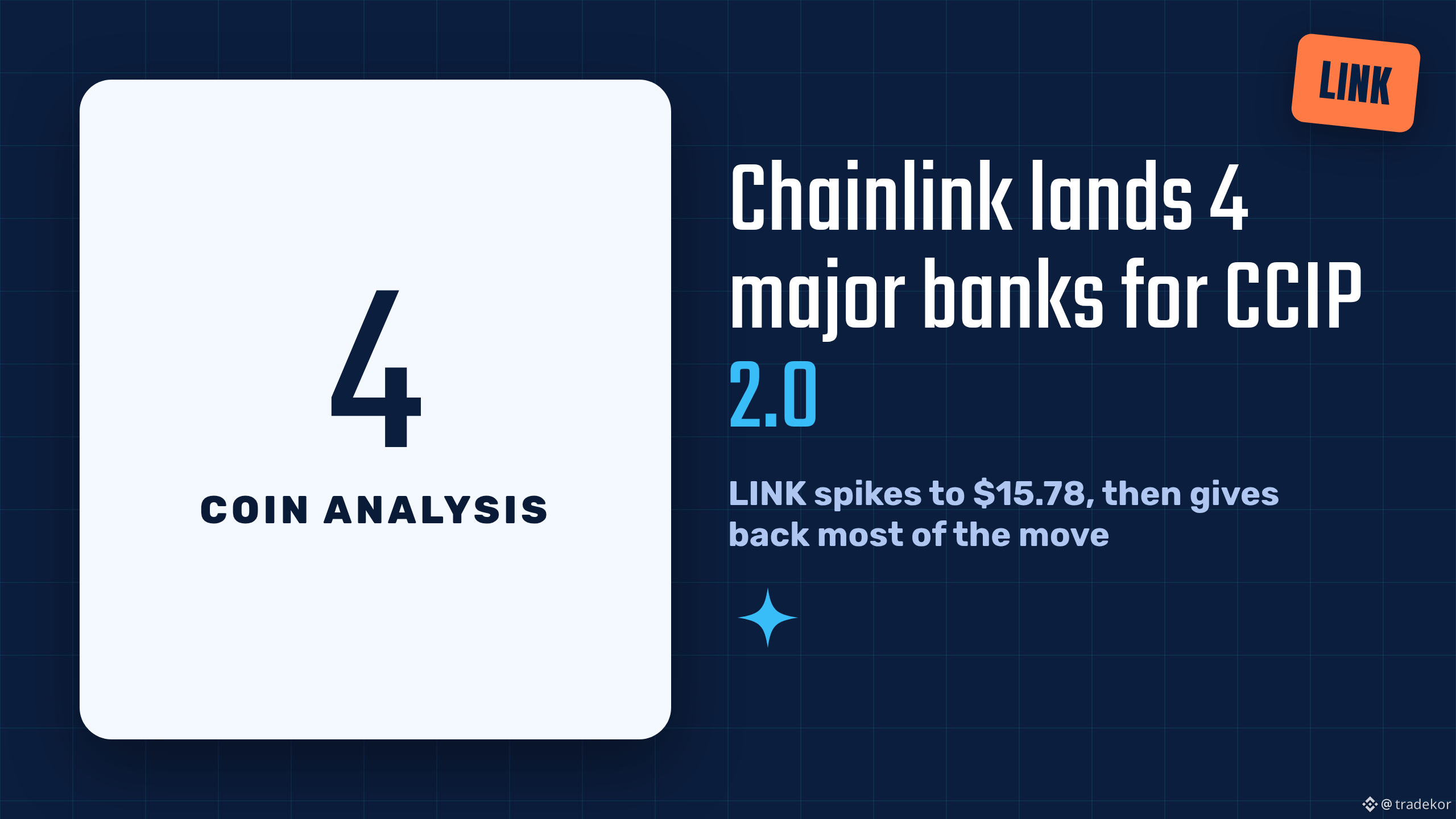
Chainlink just landed 4 major banks as launch partners for its biggest infrastructure upgrade in years -- LINK spiked to an intraday high near $15.78 before giving back most of the move within 24 hours.
The news: Chainlink launched CCIP 2.0 on Sept 28 at Sibos 2026, the SWIFT-organized banking conference, with named partners including Fidelity International, ANZ Bank, Deutsche Börse Group's Crypto Finance, and SBI Digital Markets. The upgrade adds "Cross-Chain Verifiers" (letting institutions bolt their own independent security/compliance checks onto Chainlink's default verification network), configurable execution and fee settings, built-in KYC/AML tooling, and a Swift Ledger integration for 24/7 cross-border tokenized-deposit transfers. Chainlink says CCIP now secures over $84B in total cross-chain token value. LINK's 24-hour trading volume jumped over 225% to ~$1.41B around the launch.
The catch: the price move has already partly reversed. LINK hit an intraday high near $15.78 on Sept 29, then pulled back roughly 6% to the $14.2-14.3 range as some holders took profits -- a reminder that a real infrastructure upgrade and a durable price level aren't the same thing. Some of the loudest price targets circulating (one analyst cited a 200% upside case) are speculative technical calls, not fundamentals-driven forecasts.
Our read: the partner list here is genuinely tier-1 (Fidelity, ANZ, Deutsche Börse, SBI aren't minor names), which matters more for Chainlink's long-term institutional thesis than this week's price chart.
Does landing 4 major banks on a protocol upgrade justify a lasting re-rating for LINK, or is this the kind of news that gets priced in and faded within a week?
Not financial advice. DYOR.
$LINK #CryptoNews #Chainlink #CCIP
Chainlink just landed 4 major banks as launch partners for its biggest infrastructure upgrade in years -- LINK spiked to an intraday high near $15.78 before giving back most of the move within 24 hours.
The news: Chainlink launched CCIP 2.0 on Sept 28 at Sibos 2026, the SWIFT-organized banking conference, with named partners including Fidelity International, ANZ Bank, Deutsche Börse Group's Crypto Finance, and SBI Digital Markets. The upgrade adds "Cross-Chain Verifiers" (letting institutions bolt their own independent security/compliance checks onto Chainlink's default verification network), configurable execution and fee settings, built-in KYC/AML tooling, and a Swift Ledger integration for 24/7 cross-border tokenized-deposit transfers. Chainlink says CCIP now secures over $84B in total cross-chain token value. LINK's 24-hour trading volume jumped over 225% to ~$1.41B around the launch.
The catch: the price move has already partly reversed. LINK hit an intraday high near $15.78 on Sept 29, then pulled back roughly 6% to the $14.2-14.3 range as some holders took profits -- a reminder that a real infrastructure upgrade and a durable price level aren't the same thing. Some of the loudest price targets circulating (one analyst cited a 200% upside case) are speculative technical calls, not fundamentals-driven forecasts.
Our read: the partner list here is genuinely tier-1 (Fidelity, ANZ, Deutsche Börse, SBI aren't minor names), which matters more for Chainlink's long-term institutional thesis than this week's price chart.
Does landing 4 major banks on a protocol upgrade justify a lasting re-rating for LINK, or is this the kind of news that gets priced in and faded within a week?
Not financial advice. DYOR.
$LINK #CryptoNews #Chainlink #CCIP
The news: Chainlink launched CCIP 2.0 on Sept 28 at Sibos 2026, the SWIFT-organized banking conference, with named partners including Fidelity International, ANZ Bank, Deutsche Börse Group's Crypto Finance, and SBI Digital Markets. The upgrade adds "Cross-Chain Verifiers" (letting institutions bolt their own independent security/compliance checks onto Chainlink's default verification network), configurable execution and fee settings, built-in KYC/AML tooling, and a Swift Ledger integration for 24/7 cross-border tokenized-deposit transfers. Chainlink says CCIP now secures over $84B in total cross-chain token value. LINK's 24-hour trading volume jumped over 225% to ~$1.41B around the launch.
The catch: the price move has already partly reversed. LINK hit an intraday high near $15.78 on Sept 29, then pulled back roughly 6% to the $14.2-14.3 range as some holders took profits -- a reminder that a real infrastructure upgrade and a durable price level aren't the same thing. Some of the loudest price targets circulating (one analyst cited a 200% upside case) are speculative technical calls, not fundamentals-driven forecasts.
Our read: the partner list here is genuinely tier-1 (Fidelity, ANZ, Deutsche Börse, SBI aren't minor names), which matters more for Chainlink's long-term institutional thesis than this week's price chart.
Does landing 4 major banks on a protocol upgrade justify a lasting re-rating for LINK, or is this the kind of news that gets priced in and faded within a week?
Not financial advice. DYOR.
$LINK #CryptoNews #Chainlink #CCIP
127
·
--
ບົດຄວາມ
Crypto's Top 7 Stories Today — September 29, 20267 stories cleared the bar for Sep 29 -- a real confidence crisis, big institutional signals, and a sharper regulatory line all made the cut.
1. Bitget recorded roughly $463M in net customer outflows in the 24 hours after it began restoring withdrawals -- the largest single-day net outflow DefiLlama has tracked in 4 years of proof-of-reserves data. Its $464M user-protection fund has fallen below $200M as a result; CEO Gracy Chen says Bitget will replenish it using its own capital, targeting above $300M within a week. The exchange still holds ~$5.7B in reserves and is proceeding with its phased withdrawal restoration (USDT set for Sept 30). This is the hack's real second act: a bank-run-style confidence test, not just the breach itself.
2. Morgan Stanley opened a dedicated "Digital Asset Lab" spanning New York, Glasgow and Bangalore (~20,000 sq ft) to test tokenized deposits, CBDCs, tokenized money-market funds and DeFi vaults in an environment isolated from its core banking systems. Digital-assets head Amy Oldenburg called it a "secure, compliant, segregated environment" to explore products ahead of eventual deployment -- a top-3 US bank formally building dedicated tokenization/DeFi testing infrastructure.
3. Coinbase Clearing recap (covered earlier today): the CFTC's DCO registration completed Coinbase's in-house US derivatives stack with USDC as the 24/7 settlement asset -- full breakdown in our earlier post.
4. The SEC's Division of Corporation Finance updated its crypto buyback FAQ (Sept 28), adding that a buyback program is unlikely to count as an "investment contract" only if the underlying system is both functional AND has no central party. In practice that favors decentralized buyback models like Hyperliquid (~$370M in buybacks) and Uniswap, while centralized-buyback projects like pump.fun (~$200M) and Ethena face more compliance scrutiny. It's nonbinding staff guidance, but it's the sharpest project-level distinction the SEC has drawn on buybacks yet.
5. US spot Solana ETFs pulled in $188.2M for the week of Sept 21-25 -- their best week since launch -- with Bitwise's BSOL alone capturing 68% (~$128M) of the total. All seven funds in the group posted inflows; Bitwise's BSOL has now captured roughly $1.2B of the group's cumulative $1.6B since inception.
6. NEAR Intents said its SHIELD risk system blocked over $50M in attempted transfers tied to Bitget's hackers, but only managed to actually freeze about $503K of it -- roughly $166K still got through. The episode reopened the same freeze-or-don't debate as Thursday's THORChain story, with NEAR's co-founder arguing permissionless doesn't mean neutral, while THORChain again declined to selectively block wallets. A concrete, quantified look at how little of "blocked" stolen crypto is actually recoverable in practice.
7. Circle partnered with Volante Technologies to embed USDC minting, redemption, wallet registration and wallet-to-wallet payments directly into Volante's existing payments platform -- used by 4 of the top 5 global corporate banks and 7 of the top 10 US banks. The pitch: banks can test stablecoin workflows without building a separate digital-asset stack from scratch.
A $463M vote of no-confidence at one exchange, a top US bank quietly building DeFi test infrastructure, and the SEC drawing its clearest buyback line yet -- which of today's threads changes your read on the space most?
Not financial advice. DYOR.
$BTC $SOL $HYPE #CryptoNews #DailyDigest #Bitget
Crypto's Top 7 Stories Today — September 29, 2026
7 stories cleared the bar for Sep 29 -- a real confidence crisis, big institutional signals, and a sharper regulatory line all made the cut.
1. Bitget recorded roughly $463M in net customer outflows in the 24 hours after it began restoring withdrawals -- the largest single-day net outflow DefiLlama has tracked in 4 years of proof-of-reserves data. Its $464M user-protection fund has fallen below $200M as a result; CEO Gracy Chen says Bitget will replenish it using its own capital, targeting above $300M within a week. The exchange still holds ~$5.7B in reserves and is proceeding with its phased withdrawal restoration (USDT set for Sept 30). This is the hack's real second act: a bank-run-style confidence test, not just the breach itself.
2. Morgan Stanley opened a dedicated "Digital Asset Lab" spanning New York, Glasgow and Bangalore (~20,000 sq ft) to test tokenized deposits, CBDCs, tokenized money-market funds and DeFi vaults in an environment isolated from its core banking systems. Digital-assets head Amy Oldenburg called it a "secure, compliant, segregated environment" to explore products ahead of eventual deployment -- a top-3 US bank formally building dedicated tokenization/DeFi testing infrastructure.
3. Coinbase Clearing recap (covered earlier today): the CFTC's DCO registration completed Coinbase's in-house US derivatives stack with USDC as the 24/7 settlement asset -- full breakdown in our earlier post.
4. The SEC's Division of Corporation Finance updated its crypto buyback FAQ (Sept 28), adding that a buyback program is unlikely to count as an "investment contract" only if the underlying system is both functional AND has no central party. In practice that favors decentralized buyback models like Hyperliquid (~$370M in buybacks) and Uniswap, while centralized-buyback projects like pump.fun (~$200M) and Ethena face more compliance scrutiny. It's nonbinding staff guidance, but it's the sharpest project-level distinction the SEC has drawn on buybacks yet.
5. US spot Solana ETFs pulled in $188.2M for the week of Sept 21-25 -- their best week since launch -- with Bitwise's BSOL alone capturing 68% (~$128M) of the total. All seven funds in the group posted inflows; Bitwise's BSOL has now captured roughly $1.2B of the group's cumulative $1.6B since inception.
6. NEAR Intents said its SHIELD risk system blocked over $50M in attempted transfers tied to Bitget's hackers, but only managed to actually freeze about $503K of it -- roughly $166K still got through. The episode reopened the same freeze-or-don't debate as Thursday's THORChain story, with NEAR's co-founder arguing permissionless doesn't mean neutral, while THORChain again declined to selectively block wallets. A concrete, quantified look at how little of "blocked" stolen crypto is actually recoverable in practice.
7. Circle partnered with Volante Technologies to embed USDC minting, redemption, wallet registration and wallet-to-wallet payments directly into Volante's existing payments platform -- used by 4 of the top 5 global corporate banks and 7 of the top 10 US banks. The pitch: banks can test stablecoin workflows without building a separate digital-asset stack from scratch.
A $463M vote of no-confidence at one exchange, a top US bank quietly building DeFi test infrastructure, and the SEC drawing its clearest buyback line yet -- which of today's threads changes your read on the space most?
Not financial advice. DYOR.
$BTC $SOL $HYPE #CryptoNews #DailyDigest #Bitget
1. Bitget recorded roughly $463M in net customer outflows in the 24 hours after it began restoring withdrawals -- the largest single-day net outflow DefiLlama has tracked in 4 years of proof-of-reserves data. Its $464M user-protection fund has fallen below $200M as a result; CEO Gracy Chen says Bitget will replenish it using its own capital, targeting above $300M within a week. The exchange still holds ~$5.7B in reserves and is proceeding with its phased withdrawal restoration (USDT set for Sept 30). This is the hack's real second act: a bank-run-style confidence test, not just the breach itself.
2. Morgan Stanley opened a dedicated "Digital Asset Lab" spanning New York, Glasgow and Bangalore (~20,000 sq ft) to test tokenized deposits, CBDCs, tokenized money-market funds and DeFi vaults in an environment isolated from its core banking systems. Digital-assets head Amy Oldenburg called it a "secure, compliant, segregated environment" to explore products ahead of eventual deployment -- a top-3 US bank formally building dedicated tokenization/DeFi testing infrastructure.
3. Coinbase Clearing recap (covered earlier today): the CFTC's DCO registration completed Coinbase's in-house US derivatives stack with USDC as the 24/7 settlement asset -- full breakdown in our earlier post.
4. The SEC's Division of Corporation Finance updated its crypto buyback FAQ (Sept 28), adding that a buyback program is unlikely to count as an "investment contract" only if the underlying system is both functional AND has no central party. In practice that favors decentralized buyback models like Hyperliquid (~$370M in buybacks) and Uniswap, while centralized-buyback projects like pump.fun (~$200M) and Ethena face more compliance scrutiny. It's nonbinding staff guidance, but it's the sharpest project-level distinction the SEC has drawn on buybacks yet.
5. US spot Solana ETFs pulled in $188.2M for the week of Sept 21-25 -- their best week since launch -- with Bitwise's BSOL alone capturing 68% (~$128M) of the total. All seven funds in the group posted inflows; Bitwise's BSOL has now captured roughly $1.2B of the group's cumulative $1.6B since inception.
6. NEAR Intents said its SHIELD risk system blocked over $50M in attempted transfers tied to Bitget's hackers, but only managed to actually freeze about $503K of it -- roughly $166K still got through. The episode reopened the same freeze-or-don't debate as Thursday's THORChain story, with NEAR's co-founder arguing permissionless doesn't mean neutral, while THORChain again declined to selectively block wallets. A concrete, quantified look at how little of "blocked" stolen crypto is actually recoverable in practice.
7. Circle partnered with Volante Technologies to embed USDC minting, redemption, wallet registration and wallet-to-wallet payments directly into Volante's existing payments platform -- used by 4 of the top 5 global corporate banks and 7 of the top 10 US banks. The pitch: banks can test stablecoin workflows without building a separate digital-asset stack from scratch.
A $463M vote of no-confidence at one exchange, a top US bank quietly building DeFi test infrastructure, and the SEC drawing its clearest buyback line yet -- which of today's threads changes your read on the space most?
Not financial advice. DYOR.
$BTC $SOL $HYPE #CryptoNews #DailyDigest #Bitget
340
·
--
The CFTC just handed Coinbase the 3rd and final piece of a fully in-house US derivatives stack -- and settlement now runs on USDC, 24/7, with no bank hours required.
The news: The CFTC registered Coinbase Clearing LLC as a Derivatives Clearing Organization (DCO) on Sept 28, nearly a year after Coinbase filed its application (Nov 14, 2025). The registration lets Coinbase clear fully collateralized futures, options on futures, and swaps -- not its leveraged perpetual-style products. The headline mechanic: USDC replaces traditional banking rails as the collateral and settlement asset, so margin calls and collateral transfers can happen around the clock instead of waiting on bank hours. Coinbase now owns all three layers of its regulated derivatives pipeline: Coinbase Financial Markets (the futures broker), Coinbase Derivatives (the exchange), and now Coinbase Clearing (the post-trade guarantor) -- it previously outsourced that last piece to a third party, Nodal Clear.
The catch: this only covers fully collateralized products, which is a narrower slice than the leveraged derivatives that drive most crypto trading volume today. And "first USDC-native clearinghouse" is Coinbase's own framing, repeated by outlets covering the announcement -- the regulatory registration itself is confirmed and dated, but that specific superlative traces back to Coinbase, not an independent industry body.
Our read: this is infrastructure, not a price catalyst -- but it's the kind of plumbing upgrade that matters more over quarters than headlines, since it removes a dependency on a third-party clearer and gives institutional users faster, always-on settlement.
Does 24/7 stablecoin-based settlement meaningfully change how institutions trade crypto derivatives, or is this mostly a back-office upgrade that traders won't notice day to day?
Not financial advice. DYOR.
$BTC #CryptoNews #Coinbase #USDC
The CFTC just handed Coinbase the 3rd and final piece of a fully in-house US derivatives stack -- and settlement now runs on USDC, 24/7, with no bank hours required.
The news: The CFTC registered Coinbase Clearing LLC as a Derivatives Clearing Organization (DCO) on Sept 28, nearly a year after Coinbase filed its application (Nov 14, 2025). The registration lets Coinbase clear fully collateralized futures, options on futures, and swaps -- not its leveraged perpetual-style products. The headline mechanic: USDC replaces traditional banking rails as the collateral and settlement asset, so margin calls and collateral transfers can happen around the clock instead of waiting on bank hours. Coinbase now owns all three layers of its regulated derivatives pipeline: Coinbase Financial Markets (the futures broker), Coinbase Derivatives (the exchange), and now Coinbase Clearing (the post-trade guarantor) -- it previously outsourced that last piece to a third party, Nodal Clear.
The catch: this only covers fully collateralized products, which is a narrower slice than the leveraged derivatives that drive most crypto trading volume today. And "first USDC-native clearinghouse" is Coinbase's own framing, repeated by outlets covering the announcement -- the regulatory registration itself is confirmed and dated, but that specific superlative traces back to Coinbase, not an independent industry body.
Our read: this is infrastructure, not a price catalyst -- but it's the kind of plumbing upgrade that matters more over quarters than headlines, since it removes a dependency on a third-party clearer and gives institutional users faster, always-on settlement.
Does 24/7 stablecoin-based settlement meaningfully change how institutions trade crypto derivatives, or is this mostly a back-office upgrade that traders won't notice day to day?
Not financial advice. DYOR.
$BTC #CryptoNews #Coinbase #USDC
The news: The CFTC registered Coinbase Clearing LLC as a Derivatives Clearing Organization (DCO) on Sept 28, nearly a year after Coinbase filed its application (Nov 14, 2025). The registration lets Coinbase clear fully collateralized futures, options on futures, and swaps -- not its leveraged perpetual-style products. The headline mechanic: USDC replaces traditional banking rails as the collateral and settlement asset, so margin calls and collateral transfers can happen around the clock instead of waiting on bank hours. Coinbase now owns all three layers of its regulated derivatives pipeline: Coinbase Financial Markets (the futures broker), Coinbase Derivatives (the exchange), and now Coinbase Clearing (the post-trade guarantor) -- it previously outsourced that last piece to a third party, Nodal Clear.
The catch: this only covers fully collateralized products, which is a narrower slice than the leveraged derivatives that drive most crypto trading volume today. And "first USDC-native clearinghouse" is Coinbase's own framing, repeated by outlets covering the announcement -- the regulatory registration itself is confirmed and dated, but that specific superlative traces back to Coinbase, not an independent industry body.
Our read: this is infrastructure, not a price catalyst -- but it's the kind of plumbing upgrade that matters more over quarters than headlines, since it removes a dependency on a third-party clearer and gives institutional users faster, always-on settlement.
Does 24/7 stablecoin-based settlement meaningfully change how institutions trade crypto derivatives, or is this mostly a back-office upgrade that traders won't notice day to day?
Not financial advice. DYOR.
$BTC #CryptoNews #Coinbase #USDC
84
·
--
ບົດຄວາມ
Crypto's Top 7 Stories Today — September 28, 20267 stories cleared the bar for Sep 28 -- compliance, treasury buying, and a genuinely new product angle all made the cut.
1. Tether said it has frozen roughly $550M in USDT linked to Iran's central bank and sanctioned networks this year, its largest cumulative action yet after earlier $344M (April) and $130M (July) freezes. The same day, a Senate Democratic investigation (Permanent Subcommittee on Investigations, led by Sen. Richard Blumenthal) found 84% of 846 sanctioned Iran-linked crypto wallets transacted almost exclusively in USDT, calling it a financial lifeline for Tehran. Tether's CEO pushed back, citing blockchain transparency and cooperation with 340+ law-enforcement partners. This is the year's biggest stablecoin-compliance story and lands right as GENIUS Act-era AML scrutiny intensifies.
2. Quant (QNT) recap (covered earlier today): the token extended its Clearing House-deal rally to 300%+ over the week before pulling back, with on-chain data flagging most of the volume as wash trading -- full breakdown in our earlier post.
3. Strategy (formerly MicroStrategy) bought 1,665 BTC for $142.7M at an average $85,681, per a Sept 28 8-K, taking total holdings to 847,666 BTC (average cost basis $75,437, cumulative spend ~$64B). The $246.2M stock sale that funded the purchase also retired a chunk of Strategy's STRC preferred shares (figures range $103.5M-$151.7M across outlets) -- a buy-and-buyback move from the same raise.
4. Binance will pass through SPCXB -- a tokenized-equity reward token backed 1:1 by real SpaceX shares in custody -- to holders of MARSCOIN, a BNB Chain memecoin, and will fund additional SPCXB rewards using 30% of MARSCOIN's spot trading fees. Eligibility counts from September, with first distribution expected early October. Binance was explicit that holding MARSCOIN doesn't confer any actual SpaceX ownership or voting rights -- only this separate reward token. A genuinely new structural pairing of memecoin economics with tokenized pre-IPO equity access.
5. An address dormant for 4+ years moved 4,500 BTC (~$379M) on Sept 28 -- the second nearly-identical transfer from the same wallet cluster in three days, following an equivalent Sept 25 move (~$381M). No destination exchange or sale has been confirmed yet, so treat this as a curiosity/watch item rather than confirmed selling pressure.
6. The SEC let its 45-day review deadline lapse on Nasdaq ISE's proposal to broaden options-listing standards for crypto ETFs covering BTC, ETH, SOL, XRP, LINK, and HBAR -- the expected next step is instituting proceedings that push the review to Nov 11. Process-heavy, but it widens the runway for options access across a broader slate of crypto ETFs, not just the usual BTC/ETH pair.
7. Ripple's RLUSD stablecoin hit a fresh record supply (~$2.49B by the best-sourced figure), up roughly 86% since the start of 2026, closing the gap to PayPal's PYUSD (~$2.74B) to around $200-250M. Growth is split between Ethereum (~56%) and the XRP Ledger (~44%), with XRPL adding more new supply this week than Ethereum.
A record stablecoin freeze tied to sanctions enforcement, a memecoin now paying out tokenized SpaceX equity, and a treasury company buying Bitcoin and its own preferred stock in the same breath -- which thread stands out most to you today?
Not financial advice. DYOR.
$BTC $QNT $XRP #CryptoNews #DailyDigest #Tether
Crypto's Top 7 Stories Today — September 28, 2026
7 stories cleared the bar for Sep 28 -- compliance, treasury buying, and a genuinely new product angle all made the cut.
1. Tether said it has frozen roughly $550M in USDT linked to Iran's central bank and sanctioned networks this year, its largest cumulative action yet after earlier $344M (April) and $130M (July) freezes. The same day, a Senate Democratic investigation (Permanent Subcommittee on Investigations, led by Sen. Richard Blumenthal) found 84% of 846 sanctioned Iran-linked crypto wallets transacted almost exclusively in USDT, calling it a financial lifeline for Tehran. Tether's CEO pushed back, citing blockchain transparency and cooperation with 340+ law-enforcement partners. This is the year's biggest stablecoin-compliance story and lands right as GENIUS Act-era AML scrutiny intensifies.
2. Quant (QNT) recap (covered earlier today): the token extended its Clearing House-deal rally to 300%+ over the week before pulling back, with on-chain data flagging most of the volume as wash trading -- full breakdown in our earlier post.
3. Strategy (formerly MicroStrategy) bought 1,665 BTC for $142.7M at an average $85,681, per a Sept 28 8-K, taking total holdings to 847,666 BTC (average cost basis $75,437, cumulative spend ~$64B). The $246.2M stock sale that funded the purchase also retired a chunk of Strategy's STRC preferred shares (figures range $103.5M-$151.7M across outlets) -- a buy-and-buyback move from the same raise.
4. Binance will pass through SPCXB -- a tokenized-equity reward token backed 1:1 by real SpaceX shares in custody -- to holders of MARSCOIN, a BNB Chain memecoin, and will fund additional SPCXB rewards using 30% of MARSCOIN's spot trading fees. Eligibility counts from September, with first distribution expected early October. Binance was explicit that holding MARSCOIN doesn't confer any actual SpaceX ownership or voting rights -- only this separate reward token. A genuinely new structural pairing of memecoin economics with tokenized pre-IPO equity access.
5. An address dormant for 4+ years moved 4,500 BTC (~$379M) on Sept 28 -- the second nearly-identical transfer from the same wallet cluster in three days, following an equivalent Sept 25 move (~$381M). No destination exchange or sale has been confirmed yet, so treat this as a curiosity/watch item rather than confirmed selling pressure.
6. The SEC let its 45-day review deadline lapse on Nasdaq ISE's proposal to broaden options-listing standards for crypto ETFs covering BTC, ETH, SOL, XRP, LINK, and HBAR -- the expected next step is instituting proceedings that push the review to Nov 11. Process-heavy, but it widens the runway for options access across a broader slate of crypto ETFs, not just the usual BTC/ETH pair.
7. Ripple's RLUSD stablecoin hit a fresh record supply (~$2.49B by the best-sourced figure), up roughly 86% since the start of 2026, closing the gap to PayPal's PYUSD (~$2.74B) to around $200-250M. Growth is split between Ethereum (~56%) and the XRP Ledger (~44%), with XRPL adding more new supply this week than Ethereum.
A record stablecoin freeze tied to sanctions enforcement, a memecoin now paying out tokenized SpaceX equity, and a treasury company buying Bitcoin and its own preferred stock in the same breath -- which thread stands out most to you today?
Not financial advice. DYOR.
$BTC $QNT $XRP #CryptoNews #DailyDigest #Tether
1. Tether said it has frozen roughly $550M in USDT linked to Iran's central bank and sanctioned networks this year, its largest cumulative action yet after earlier $344M (April) and $130M (July) freezes. The same day, a Senate Democratic investigation (Permanent Subcommittee on Investigations, led by Sen. Richard Blumenthal) found 84% of 846 sanctioned Iran-linked crypto wallets transacted almost exclusively in USDT, calling it a financial lifeline for Tehran. Tether's CEO pushed back, citing blockchain transparency and cooperation with 340+ law-enforcement partners. This is the year's biggest stablecoin-compliance story and lands right as GENIUS Act-era AML scrutiny intensifies.
2. Quant (QNT) recap (covered earlier today): the token extended its Clearing House-deal rally to 300%+ over the week before pulling back, with on-chain data flagging most of the volume as wash trading -- full breakdown in our earlier post.
3. Strategy (formerly MicroStrategy) bought 1,665 BTC for $142.7M at an average $85,681, per a Sept 28 8-K, taking total holdings to 847,666 BTC (average cost basis $75,437, cumulative spend ~$64B). The $246.2M stock sale that funded the purchase also retired a chunk of Strategy's STRC preferred shares (figures range $103.5M-$151.7M across outlets) -- a buy-and-buyback move from the same raise.
4. Binance will pass through SPCXB -- a tokenized-equity reward token backed 1:1 by real SpaceX shares in custody -- to holders of MARSCOIN, a BNB Chain memecoin, and will fund additional SPCXB rewards using 30% of MARSCOIN's spot trading fees. Eligibility counts from September, with first distribution expected early October. Binance was explicit that holding MARSCOIN doesn't confer any actual SpaceX ownership or voting rights -- only this separate reward token. A genuinely new structural pairing of memecoin economics with tokenized pre-IPO equity access.
5. An address dormant for 4+ years moved 4,500 BTC (~$379M) on Sept 28 -- the second nearly-identical transfer from the same wallet cluster in three days, following an equivalent Sept 25 move (~$381M). No destination exchange or sale has been confirmed yet, so treat this as a curiosity/watch item rather than confirmed selling pressure.
6. The SEC let its 45-day review deadline lapse on Nasdaq ISE's proposal to broaden options-listing standards for crypto ETFs covering BTC, ETH, SOL, XRP, LINK, and HBAR -- the expected next step is instituting proceedings that push the review to Nov 11. Process-heavy, but it widens the runway for options access across a broader slate of crypto ETFs, not just the usual BTC/ETH pair.
7. Ripple's RLUSD stablecoin hit a fresh record supply (~$2.49B by the best-sourced figure), up roughly 86% since the start of 2026, closing the gap to PayPal's PYUSD (~$2.74B) to around $200-250M. Growth is split between Ethereum (~56%) and the XRP Ledger (~44%), with XRPL adding more new supply this week than Ethereum.
A record stablecoin freeze tied to sanctions enforcement, a memecoin now paying out tokenized SpaceX equity, and a treasury company buying Bitcoin and its own preferred stock in the same breath -- which thread stands out most to you today?
Not financial advice. DYOR.
$BTC $QNT $XRP #CryptoNews #DailyDigest #Tether
485
·
--
Quant (QNT) is up over 300% in a week and briefly touched a fresh yearly high near $267 -- but on-chain data is now flagging most of that volume as wash trading.
The news: QNT's rally, first sparked Sept 24 when The Clearing House (the $2T+/day US bank payments utility owned by JPMorgan, Citi, Bank of America and ~22 other major banks) picked Quant to power its On-Chain Money Initiative for tokenized deposits, has kept accelerating instead of fading. The token gained roughly 50-55% in a single 24-hour stretch this weekend on top of its initial pop, with 7-day gains converging around 300%+ across multiple trackers -- and Quant is now demoing programmable settlement with financial-software firm Murex at Sibos 2026 in Miami, keeping the institutional-adoption story in the spotlight.
The catch: one on-chain analysis, circulating across several outlets, estimates 77% of QNT's reported daily volume is wash trading -- meaning the real trading activity behind this move may be far thinner than the headline numbers suggest, with exchange net-inflow data also hinting at possible insider sell pressure. The Clearing House partnership itself is real and confirmed by both companies, but a named production launch is still targeted for H1 2027 -- a live deal is not the same as a live network, and parabolic moves built partly on inflated volume tend to give back gains just as fast.
Our read: the fundamental catalyst (a bank consortium clearing $2T+/day choosing your tech) is genuinely significant, but the price action has likely run well ahead of it. Worth watching whether QNT holds anywhere near these levels once the newest wave of momentum buyers stops rotating in.
Does a real TradFi partnership justify a 300% weekly move, or is this a wash-trading-fueled spike waiting to unwind?
Not financial advice. DYOR.
$QNT #CryptoNews #Quant #TokenizedAssets
Quant (QNT) is up over 300% in a week and briefly touched a fresh yearly high near $267 -- but on-chain data is now flagging most of that volume as wash trading.
The news: QNT's rally, first sparked Sept 24 when The Clearing House (the $2T+/day US bank payments utility owned by JPMorgan, Citi, Bank of America and ~22 other major banks) picked Quant to power its On-Chain Money Initiative for tokenized deposits, has kept accelerating instead of fading. The token gained roughly 50-55% in a single 24-hour stretch this weekend on top of its initial pop, with 7-day gains converging around 300%+ across multiple trackers -- and Quant is now demoing programmable settlement with financial-software firm Murex at Sibos 2026 in Miami, keeping the institutional-adoption story in the spotlight.
The catch: one on-chain analysis, circulating across several outlets, estimates 77% of QNT's reported daily volume is wash trading -- meaning the real trading activity behind this move may be far thinner than the headline numbers suggest, with exchange net-inflow data also hinting at possible insider sell pressure. The Clearing House partnership itself is real and confirmed by both companies, but a named production launch is still targeted for H1 2027 -- a live deal is not the same as a live network, and parabolic moves built partly on inflated volume tend to give back gains just as fast.
Our read: the fundamental catalyst (a bank consortium clearing $2T+/day choosing your tech) is genuinely significant, but the price action has likely run well ahead of it. Worth watching whether QNT holds anywhere near these levels once the newest wave of momentum buyers stops rotating in.
Does a real TradFi partnership justify a 300% weekly move, or is this a wash-trading-fueled spike waiting to unwind?
Not financial advice. DYOR.
$QNT #CryptoNews #Quant #TokenizedAssets
The news: QNT's rally, first sparked Sept 24 when The Clearing House (the $2T+/day US bank payments utility owned by JPMorgan, Citi, Bank of America and ~22 other major banks) picked Quant to power its On-Chain Money Initiative for tokenized deposits, has kept accelerating instead of fading. The token gained roughly 50-55% in a single 24-hour stretch this weekend on top of its initial pop, with 7-day gains converging around 300%+ across multiple trackers -- and Quant is now demoing programmable settlement with financial-software firm Murex at Sibos 2026 in Miami, keeping the institutional-adoption story in the spotlight.
The catch: one on-chain analysis, circulating across several outlets, estimates 77% of QNT's reported daily volume is wash trading -- meaning the real trading activity behind this move may be far thinner than the headline numbers suggest, with exchange net-inflow data also hinting at possible insider sell pressure. The Clearing House partnership itself is real and confirmed by both companies, but a named production launch is still targeted for H1 2027 -- a live deal is not the same as a live network, and parabolic moves built partly on inflated volume tend to give back gains just as fast.
Our read: the fundamental catalyst (a bank consortium clearing $2T+/day choosing your tech) is genuinely significant, but the price action has likely run well ahead of it. Worth watching whether QNT holds anywhere near these levels once the newest wave of momentum buyers stops rotating in.
Does a real TradFi partnership justify a 300% weekly move, or is this a wash-trading-fueled spike waiting to unwind?
Not financial advice. DYOR.
$QNT #CryptoNews #Quant #TokenizedAssets
176
·
--
ບົດຄວາມ
Crypto's Top 7 Stories Today — September 27, 20267 stories cleared the bar for Sep 27 -- a busier day spanning regulation, a major roadmap essay, and real price action.
1. SEC Commissioner Hester Peirce's resignation (covered earlier today): the agency's most consistently pro-crypto voice announced her Oct 2 exit, leaving the Commission with just 2 sitting members (Chairman Paul Atkins, Commissioner Mark Uyeda) and no named successor to lead the Crypto Task Force she built. Full details in our earlier post today -- still the single biggest regulatory-structure story of the week.
2. Vitalik Buterin published a sweeping essay, "The Cryptographic World Computer," arguing Ethereum is outgrowing the "just a blockchain" label as it leans harder into SNARK verification, PeerDAS data sampling, and off-chain compute. He said Hegota (the fork planned for 2027) will likely be Ethereum's last "normal" upgrade recognizable to developers since 2015, with payment finality eventually reaching 8-32 seconds and a path toward quantum safety. It's a rare direct long-term roadmap statement from Ethereum's founder, landing while ETH ETF flows have been running hot.
3. Zcash (ZEC) extended its September rally, trading in the $1,500-$1,600 range -- still well below its 2016 launch-week peak near $3,200, so this is a multi-year high, not an all-time high. The catalyst: Grayscale's spot ZCSH ETF (launched Aug 25) has pulled in $306M in new money, pushing total AUM to near $1B, and Grayscale filed a follow-on options-based "High Income" ZCSH product on Sept 25. Zcash co-founder Eli Ben-Sasson has publicly floated a $5,000 year-end target -- treat that as a founder's own forecast, not a fact.
4. Hyperliquid announced its next network upgrade will cut the funding rate cap from 4%/hour to 0.5%/hour -- citing user feedback that the current cap is rarely even reached -- while simultaneously raising HIP-4 contract deployment limits (100 to 200 active contracts per deployer, 500 to 1,000 daily deployments). A material, concrete change to how the largest perps DEX prices trades and lets builders deploy.
5. The XRP Ledger's Batch upgrade (letting users bundle up to 8 transactions) slipped again, this time to Oct 9. The twist: this wasn't a simple validator dropout -- contributor Hussein Zangana coordinated with Ripple and community validators to deliberately reset the vote below the 80% threshold so the upgrade could realign with a fix shipping in xrpld 3.4.1, rather than activate on the older, flawed version. Support has already recovered to 30 of 35 trusted validators.
6. Solana's Alpenglow upgrade -- targeting ~150 millisecond transaction finality, down from today's ~12.8 seconds -- reached its second public test network, moving onto devnet Sept 25 after testnet Sept 23. Validators would vote directly rather than embedding votes in blocks, cutting finality to one or two voting rounds. No mainnet activation date is confirmed yet, so treat this as still in the testing pipeline, not a live change.
7. A public spat broke out between OKX founder Star Xu and THORChain after stolen Bitget funds were traced moving through THORChain's network. Xu argued THORChain isn't as decentralized as it claims, pointing to a May incident where node operators halted the entire chain within 13 hours; THORChain's official account pushed back, while Bitget's CEO separately asked THORChain to block the flagged addresses. A live, unresolved industry debate about whether "decentralized" protocols can or should freeze stolen funds -- distinct from the hack's core facts, which we've already covered in full.
A founder's 2030 roadmap essay, a regulator down to 2 commissioners, and a decentralization debate sparked by stolen funds moving through a DEX -- which thread matters most to you heading into next week?
Not financial advice. DYOR.
$ETH $ZEC $XRP #CryptoNews #DailyDigest #Ethereum
Crypto's Top 7 Stories Today — September 27, 2026
7 stories cleared the bar for Sep 27 -- a busier day spanning regulation, a major roadmap essay, and real price action.
1. SEC Commissioner Hester Peirce's resignation (covered earlier today): the agency's most consistently pro-crypto voice announced her Oct 2 exit, leaving the Commission with just 2 sitting members (Chairman Paul Atkins, Commissioner Mark Uyeda) and no named successor to lead the Crypto Task Force she built. Full details in our earlier post today -- still the single biggest regulatory-structure story of the week.
2. Vitalik Buterin published a sweeping essay, "The Cryptographic World Computer," arguing Ethereum is outgrowing the "just a blockchain" label as it leans harder into SNARK verification, PeerDAS data sampling, and off-chain compute. He said Hegota (the fork planned for 2027) will likely be Ethereum's last "normal" upgrade recognizable to developers since 2015, with payment finality eventually reaching 8-32 seconds and a path toward quantum safety. It's a rare direct long-term roadmap statement from Ethereum's founder, landing while ETH ETF flows have been running hot.
3. Zcash (ZEC) extended its September rally, trading in the $1,500-$1,600 range -- still well below its 2016 launch-week peak near $3,200, so this is a multi-year high, not an all-time high. The catalyst: Grayscale's spot ZCSH ETF (launched Aug 25) has pulled in $306M in new money, pushing total AUM to near $1B, and Grayscale filed a follow-on options-based "High Income" ZCSH product on Sept 25. Zcash co-founder Eli Ben-Sasson has publicly floated a $5,000 year-end target -- treat that as a founder's own forecast, not a fact.
4. Hyperliquid announced its next network upgrade will cut the funding rate cap from 4%/hour to 0.5%/hour -- citing user feedback that the current cap is rarely even reached -- while simultaneously raising HIP-4 contract deployment limits (100 to 200 active contracts per deployer, 500 to 1,000 daily deployments). A material, concrete change to how the largest perps DEX prices trades and lets builders deploy.
5. The XRP Ledger's Batch upgrade (letting users bundle up to 8 transactions) slipped again, this time to Oct 9. The twist: this wasn't a simple validator dropout -- contributor Hussein Zangana coordinated with Ripple and community validators to deliberately reset the vote below the 80% threshold so the upgrade could realign with a fix shipping in xrpld 3.4.1, rather than activate on the older, flawed version. Support has already recovered to 30 of 35 trusted validators.
6. Solana's Alpenglow upgrade -- targeting ~150 millisecond transaction finality, down from today's ~12.8 seconds -- reached its second public test network, moving onto devnet Sept 25 after testnet Sept 23. Validators would vote directly rather than embedding votes in blocks, cutting finality to one or two voting rounds. No mainnet activation date is confirmed yet, so treat this as still in the testing pipeline, not a live change.
7. A public spat broke out between OKX founder Star Xu and THORChain after stolen Bitget funds were traced moving through THORChain's network. Xu argued THORChain isn't as decentralized as it claims, pointing to a May incident where node operators halted the entire chain within 13 hours; THORChain's official account pushed back, while Bitget's CEO separately asked THORChain to block the flagged addresses. A live, unresolved industry debate about whether "decentralized" protocols can or should freeze stolen funds -- distinct from the hack's core facts, which we've already covered in full.
A founder's 2030 roadmap essay, a regulator down to 2 commissioners, and a decentralization debate sparked by stolen funds moving through a DEX -- which thread matters most to you heading into next week?
Not financial advice. DYOR.
$ETH $ZEC $XRP #CryptoNews #DailyDigest #Ethereum
1. SEC Commissioner Hester Peirce's resignation (covered earlier today): the agency's most consistently pro-crypto voice announced her Oct 2 exit, leaving the Commission with just 2 sitting members (Chairman Paul Atkins, Commissioner Mark Uyeda) and no named successor to lead the Crypto Task Force she built. Full details in our earlier post today -- still the single biggest regulatory-structure story of the week.
2. Vitalik Buterin published a sweeping essay, "The Cryptographic World Computer," arguing Ethereum is outgrowing the "just a blockchain" label as it leans harder into SNARK verification, PeerDAS data sampling, and off-chain compute. He said Hegota (the fork planned for 2027) will likely be Ethereum's last "normal" upgrade recognizable to developers since 2015, with payment finality eventually reaching 8-32 seconds and a path toward quantum safety. It's a rare direct long-term roadmap statement from Ethereum's founder, landing while ETH ETF flows have been running hot.
3. Zcash (ZEC) extended its September rally, trading in the $1,500-$1,600 range -- still well below its 2016 launch-week peak near $3,200, so this is a multi-year high, not an all-time high. The catalyst: Grayscale's spot ZCSH ETF (launched Aug 25) has pulled in $306M in new money, pushing total AUM to near $1B, and Grayscale filed a follow-on options-based "High Income" ZCSH product on Sept 25. Zcash co-founder Eli Ben-Sasson has publicly floated a $5,000 year-end target -- treat that as a founder's own forecast, not a fact.
4. Hyperliquid announced its next network upgrade will cut the funding rate cap from 4%/hour to 0.5%/hour -- citing user feedback that the current cap is rarely even reached -- while simultaneously raising HIP-4 contract deployment limits (100 to 200 active contracts per deployer, 500 to 1,000 daily deployments). A material, concrete change to how the largest perps DEX prices trades and lets builders deploy.
5. The XRP Ledger's Batch upgrade (letting users bundle up to 8 transactions) slipped again, this time to Oct 9. The twist: this wasn't a simple validator dropout -- contributor Hussein Zangana coordinated with Ripple and community validators to deliberately reset the vote below the 80% threshold so the upgrade could realign with a fix shipping in xrpld 3.4.1, rather than activate on the older, flawed version. Support has already recovered to 30 of 35 trusted validators.
6. Solana's Alpenglow upgrade -- targeting ~150 millisecond transaction finality, down from today's ~12.8 seconds -- reached its second public test network, moving onto devnet Sept 25 after testnet Sept 23. Validators would vote directly rather than embedding votes in blocks, cutting finality to one or two voting rounds. No mainnet activation date is confirmed yet, so treat this as still in the testing pipeline, not a live change.
7. A public spat broke out between OKX founder Star Xu and THORChain after stolen Bitget funds were traced moving through THORChain's network. Xu argued THORChain isn't as decentralized as it claims, pointing to a May incident where node operators halted the entire chain within 13 hours; THORChain's official account pushed back, while Bitget's CEO separately asked THORChain to block the flagged addresses. A live, unresolved industry debate about whether "decentralized" protocols can or should freeze stolen funds -- distinct from the hack's core facts, which we've already covered in full.
A founder's 2030 roadmap essay, a regulator down to 2 commissioners, and a decentralization debate sparked by stolen funds moving through a DEX -- which thread matters most to you heading into next week?
Not financial advice. DYOR.
$ETH $ZEC $XRP #CryptoNews #DailyDigest #Ethereum
373
·
--
The SEC's "Crypto Mom" is leaving in 7 days -- and it's dropping the agency to just 2 sitting commissioners with no one running its Crypto Task Force.
The news: Commissioner Hester Peirce, the SEC's most consistently pro-crypto voice since 2018 and the architect of its Crypto Task Force, posted her resignation letter Sept 25, confirming her final day as Oct 2. That leaves the five-seat Commission with only Chairman Paul Atkins and Commissioner Mark Uyeda -- both Republicans -- while both Democratic seats remain vacant and no successor has been named. Peirce is headed to Regent University School of Law as an associate professor starting in November, closing out an eight-year tenure that included leading the SEC's spot Bitcoin ETF approval push.
The catch: a two-person Commission with no task-force chief doesn't mean crypto rulemaking stops -- Atkins and Uyeda can still act, and the SEC issued fresh crypto-FAQ guidance the same week Peirce announced her exit. But it does mean less internal pushback for pro-crypto positions and an open question of who picks up task-force continuity with the seat unfilled.
Our read: Peirce's departure matters less for any single pending decision and more for what it signals about the SEC's bench depth going into a stretch where crypto ETF and token-classification questions keep piling up.
Does a two-commissioner SEC change how confident you feel about the pace of crypto regulatory clarity, or does the direction (Atkins/Uyeda are both crypto-friendly) matter more than the headcount?
Not financial advice. DYOR.
$BTC #CryptoNews #SEC #Regulation
The SEC's "Crypto Mom" is leaving in 7 days -- and it's dropping the agency to just 2 sitting commissioners with no one running its Crypto Task Force.
The news: Commissioner Hester Peirce, the SEC's most consistently pro-crypto voice since 2018 and the architect of its Crypto Task Force, posted her resignation letter Sept 25, confirming her final day as Oct 2. That leaves the five-seat Commission with only Chairman Paul Atkins and Commissioner Mark Uyeda -- both Republicans -- while both Democratic seats remain vacant and no successor has been named. Peirce is headed to Regent University School of Law as an associate professor starting in November, closing out an eight-year tenure that included leading the SEC's spot Bitcoin ETF approval push.
The catch: a two-person Commission with no task-force chief doesn't mean crypto rulemaking stops -- Atkins and Uyeda can still act, and the SEC issued fresh crypto-FAQ guidance the same week Peirce announced her exit. But it does mean less internal pushback for pro-crypto positions and an open question of who picks up task-force continuity with the seat unfilled.
Our read: Peirce's departure matters less for any single pending decision and more for what it signals about the SEC's bench depth going into a stretch where crypto ETF and token-classification questions keep piling up.
Does a two-commissioner SEC change how confident you feel about the pace of crypto regulatory clarity, or does the direction (Atkins/Uyeda are both crypto-friendly) matter more than the headcount?
Not financial advice. DYOR.
$BTC #CryptoNews #SEC #Regulation
The news: Commissioner Hester Peirce, the SEC's most consistently pro-crypto voice since 2018 and the architect of its Crypto Task Force, posted her resignation letter Sept 25, confirming her final day as Oct 2. That leaves the five-seat Commission with only Chairman Paul Atkins and Commissioner Mark Uyeda -- both Republicans -- while both Democratic seats remain vacant and no successor has been named. Peirce is headed to Regent University School of Law as an associate professor starting in November, closing out an eight-year tenure that included leading the SEC's spot Bitcoin ETF approval push.
The catch: a two-person Commission with no task-force chief doesn't mean crypto rulemaking stops -- Atkins and Uyeda can still act, and the SEC issued fresh crypto-FAQ guidance the same week Peirce announced her exit. But it does mean less internal pushback for pro-crypto positions and an open question of who picks up task-force continuity with the seat unfilled.
Our read: Peirce's departure matters less for any single pending decision and more for what it signals about the SEC's bench depth going into a stretch where crypto ETF and token-classification questions keep piling up.
Does a two-commissioner SEC change how confident you feel about the pace of crypto regulatory clarity, or does the direction (Atkins/Uyeda are both crypto-friendly) matter more than the headcount?
Not financial advice. DYOR.
$BTC #CryptoNews #SEC #Regulation
72
·
--
ບົດຄວາມ
Top 4 Crypto Stories: Sep 264 stories cleared the bar for Sep 26 -- a quieter weekend, but real developments across security, flows, and regulation.
1. Bitget published a phased withdrawal-restoration schedule: BTC resumes Sept 28 08:00 UTC, ETH-network assets Sept 29, USDT Sept 30, and everything else (other tokens, fiat, P2P) by Oct 2. The exchange reconfirmed its final loss figure at $387.5M and said the exploited vulnerability has been "identified and remediated," with Mandiant and SlowMist still assisting the investigation. One thing hasn't materialized yet: the full forensic root-cause report Bitget promised within 24 hours of the breach -- as of this digest, only the remediation/restoration timeline has been published, not the complete writeup.
2. US spot Bitcoin ETFs pulled in $2.39B for the week -- the largest weekly total of 2026, extending a 7-day inflow streak (Friday alone added $134.5M, down 87% from Monday's nearly $1B day but still positive). Ether ETFs reversed the prior week's $140M outflow with $690M in net inflows, and Solana ETFs logged a record $86.7M single-day inflow Friday.
3. The DOJ executed a civil forfeiture seizing $84.2M from accounts held by Capstone, a Sacramento-based payments firm accused of running unlicensed money transmission disguised as "IT services" -- moving $700M+, nearly two-thirds tied to flows for Tether and Bitfinex, and allegedly helping fraud scammers convert stolen funds into USDT. The freeze has blocked roughly 80% of Caribbean bank EQIBank's holdings, pushing it toward possible liquidation. Neither Tether nor Bitfinex has been charged, and Tether says its EQIBank exposure is minimal.
4. New York's governor and attorney general sued Polymarket US, alleging its prediction markets are unlicensed gambling under state law. Polymarket countersued within hours, arguing the CFTC has exclusive federal authority over its markets as regulated derivatives -- joining a growing list of states taking similar action against prediction-market platforms. Distinct from Polymarket's separate ongoing CFTC fraud investigation covered last week.
A hack whose full report still hasn't landed, record ETF demand, and a state-federal turf fight over what a prediction market even is -- which of today's threads matters most heading into next week?
Not financial advice. DYOR.
$BTC $ETH $SOL #CryptoNews #DailyDigest #Bitget
Top 4 Crypto Stories: Sep 26
4 stories cleared the bar for Sep 26 -- a quieter weekend, but real developments across security, flows, and regulation.
1. Bitget published a phased withdrawal-restoration schedule: BTC resumes Sept 28 08:00 UTC, ETH-network assets Sept 29, USDT Sept 30, and everything else (other tokens, fiat, P2P) by Oct 2. The exchange reconfirmed its final loss figure at $387.5M and said the exploited vulnerability has been "identified and remediated," with Mandiant and SlowMist still assisting the investigation. One thing hasn't materialized yet: the full forensic root-cause report Bitget promised within 24 hours of the breach -- as of this digest, only the remediation/restoration timeline has been published, not the complete writeup.
2. US spot Bitcoin ETFs pulled in $2.39B for the week -- the largest weekly total of 2026, extending a 7-day inflow streak (Friday alone added $134.5M, down 87% from Monday's nearly $1B day but still positive). Ether ETFs reversed the prior week's $140M outflow with $690M in net inflows, and Solana ETFs logged a record $86.7M single-day inflow Friday.
3. The DOJ executed a civil forfeiture seizing $84.2M from accounts held by Capstone, a Sacramento-based payments firm accused of running unlicensed money transmission disguised as "IT services" -- moving $700M+, nearly two-thirds tied to flows for Tether and Bitfinex, and allegedly helping fraud scammers convert stolen funds into USDT. The freeze has blocked roughly 80% of Caribbean bank EQIBank's holdings, pushing it toward possible liquidation. Neither Tether nor Bitfinex has been charged, and Tether says its EQIBank exposure is minimal.
4. New York's governor and attorney general sued Polymarket US, alleging its prediction markets are unlicensed gambling under state law. Polymarket countersued within hours, arguing the CFTC has exclusive federal authority over its markets as regulated derivatives -- joining a growing list of states taking similar action against prediction-market platforms. Distinct from Polymarket's separate ongoing CFTC fraud investigation covered last week.
A hack whose full report still hasn't landed, record ETF demand, and a state-federal turf fight over what a prediction market even is -- which of today's threads matters most heading into next week?
Not financial advice. DYOR.
$BTC $ETH $SOL #CryptoNews #DailyDigest #Bitget
1. Bitget published a phased withdrawal-restoration schedule: BTC resumes Sept 28 08:00 UTC, ETH-network assets Sept 29, USDT Sept 30, and everything else (other tokens, fiat, P2P) by Oct 2. The exchange reconfirmed its final loss figure at $387.5M and said the exploited vulnerability has been "identified and remediated," with Mandiant and SlowMist still assisting the investigation. One thing hasn't materialized yet: the full forensic root-cause report Bitget promised within 24 hours of the breach -- as of this digest, only the remediation/restoration timeline has been published, not the complete writeup.
2. US spot Bitcoin ETFs pulled in $2.39B for the week -- the largest weekly total of 2026, extending a 7-day inflow streak (Friday alone added $134.5M, down 87% from Monday's nearly $1B day but still positive). Ether ETFs reversed the prior week's $140M outflow with $690M in net inflows, and Solana ETFs logged a record $86.7M single-day inflow Friday.
3. The DOJ executed a civil forfeiture seizing $84.2M from accounts held by Capstone, a Sacramento-based payments firm accused of running unlicensed money transmission disguised as "IT services" -- moving $700M+, nearly two-thirds tied to flows for Tether and Bitfinex, and allegedly helping fraud scammers convert stolen funds into USDT. The freeze has blocked roughly 80% of Caribbean bank EQIBank's holdings, pushing it toward possible liquidation. Neither Tether nor Bitfinex has been charged, and Tether says its EQIBank exposure is minimal.
4. New York's governor and attorney general sued Polymarket US, alleging its prediction markets are unlicensed gambling under state law. Polymarket countersued within hours, arguing the CFTC has exclusive federal authority over its markets as regulated derivatives -- joining a growing list of states taking similar action against prediction-market platforms. Distinct from Polymarket's separate ongoing CFTC fraud investigation covered last week.
A hack whose full report still hasn't landed, record ETF demand, and a state-federal turf fight over what a prediction market even is -- which of today's threads matters most heading into next week?
Not financial advice. DYOR.
$BTC $ETH $SOL #CryptoNews #DailyDigest #Bitget
116
·
--
Quant just got picked to power a 25-bank tokenized-deposit network processing $2 trillion a day -- and QNT surged over 30% on the news, still holding gains a day later.
The news: The Clearing House (TCH) -- the bank-owned utility behind CHIPS and RTP, which together move over $2T daily -- named Quant Network as the interoperability and orchestration layer for its "On-Chain Money Initiative." The roster includes Bank of America, Citi, JPMorgan, Wells Fargo, HSBC, BNY, PNC, U.S. Bank, and Truist, targeting a first-half 2027 go-live. Quant supplies the layer that coordinates how tokenized bank deposits move between institutions and connects that movement to existing payment rails. The same day, seven UK banks (Barclays, HSBC UK, Lloyds, Monzo, Nationwide, NatWest, Santander) completed first live customer transactions on a separate Quant-built tokenized-sterling-deposit platform -- putting Quant under both major US and UK tokenized-deposit initiatives at once. QNT spiked past $100 to a yearly high (reports of the exact move range 26-40% depending on measurement window) and was still trading in the $100-109 range this morning, up roughly 10.8% in the trailing 24h on top of the initial pop.
The catch: a named technology vendor and a 2027 go-live target isn't a live production network yet -- this is a real institutional commitment, not proof the system ships on schedule or at the volume banks are projecting.
Our read: getting picked for both the largest US clearing utility and a live UK tokenized-deposit rollout in the same week is a genuine validation moment for enterprise blockchain infrastructure, independent of whether QNT's price holds here.
Does a bank-owned utility formally naming a crypto infrastructure vendor change how you think about "institutional adoption," or is a 2027 target still too far out to price in today?
Not financial advice. DYOR.
$QNT #CryptoNews #Quant #Banking
Quant just got picked to power a 25-bank tokenized-deposit network processing $2 trillion a day -- and QNT surged over 30% on the news, still holding gains a day later.
The news: The Clearing House (TCH) -- the bank-owned utility behind CHIPS and RTP, which together move over $2T daily -- named Quant Network as the interoperability and orchestration layer for its "On-Chain Money Initiative." The roster includes Bank of America, Citi, JPMorgan, Wells Fargo, HSBC, BNY, PNC, U.S. Bank, and Truist, targeting a first-half 2027 go-live. Quant supplies the layer that coordinates how tokenized bank deposits move between institutions and connects that movement to existing payment rails. The same day, seven UK banks (Barclays, HSBC UK, Lloyds, Monzo, Nationwide, NatWest, Santander) completed first live customer transactions on a separate Quant-built tokenized-sterling-deposit platform -- putting Quant under both major US and UK tokenized-deposit initiatives at once. QNT spiked past $100 to a yearly high (reports of the exact move range 26-40% depending on measurement window) and was still trading in the $100-109 range this morning, up roughly 10.8% in the trailing 24h on top of the initial pop.
The catch: a named technology vendor and a 2027 go-live target isn't a live production network yet -- this is a real institutional commitment, not proof the system ships on schedule or at the volume banks are projecting.
Our read: getting picked for both the largest US clearing utility and a live UK tokenized-deposit rollout in the same week is a genuine validation moment for enterprise blockchain infrastructure, independent of whether QNT's price holds here.
Does a bank-owned utility formally naming a crypto infrastructure vendor change how you think about "institutional adoption," or is a 2027 target still too far out to price in today?
Not financial advice. DYOR.
$QNT #CryptoNews #Quant #Banking
The news: The Clearing House (TCH) -- the bank-owned utility behind CHIPS and RTP, which together move over $2T daily -- named Quant Network as the interoperability and orchestration layer for its "On-Chain Money Initiative." The roster includes Bank of America, Citi, JPMorgan, Wells Fargo, HSBC, BNY, PNC, U.S. Bank, and Truist, targeting a first-half 2027 go-live. Quant supplies the layer that coordinates how tokenized bank deposits move between institutions and connects that movement to existing payment rails. The same day, seven UK banks (Barclays, HSBC UK, Lloyds, Monzo, Nationwide, NatWest, Santander) completed first live customer transactions on a separate Quant-built tokenized-sterling-deposit platform -- putting Quant under both major US and UK tokenized-deposit initiatives at once. QNT spiked past $100 to a yearly high (reports of the exact move range 26-40% depending on measurement window) and was still trading in the $100-109 range this morning, up roughly 10.8% in the trailing 24h on top of the initial pop.
The catch: a named technology vendor and a 2027 go-live target isn't a live production network yet -- this is a real institutional commitment, not proof the system ships on schedule or at the volume banks are projecting.
Our read: getting picked for both the largest US clearing utility and a live UK tokenized-deposit rollout in the same week is a genuine validation moment for enterprise blockchain infrastructure, independent of whether QNT's price holds here.
Does a bank-owned utility formally naming a crypto infrastructure vendor change how you think about "institutional adoption," or is a 2027 target still too far out to price in today?
Not financial advice. DYOR.
$QNT #CryptoNews #Quant #Banking
217
·
--
ບົດຄວາມ
Top 3 Crypto Stories: Sep 253 stories cleared the bar for Sep 25 -- a genuinely quieter day beyond the Bitget saga still unfolding.
1. Bitget's hack losses climbed from $351.6M to $387.5M as a fuller review turned up additional affected assets on Zcash and TRON. More significantly, independent blockchain-analytics firm Elliptic -- not just Bitget's own CEO -- assessed the attack as "highly likely" North Korea-linked, citing on-chain overlap with addresses previously used to launder the 2025 Bybit heist. That pushes North Korea's 2026 crypto-theft haul past $1B for the year. Bitget launched a bounty program offering 5% of recovered funds for tips; Circle and Tether froze a small hacker wallet (reported as either ~$218K or ~$318K, sources conflict), but the bulk of stolen funds remains unfrozen. Withdrawals stayed suspended as of Sept 26, and the full formal root-cause report still hasn't been published -- Bitget says forensic analysis (with Mandiant and SlowMist) is taking longer than the original 24-hour promise.
2. SEC staff issued an updated crypto FAQ clarifying that token buybacks, network upgrades, and marketing about a network's current uses don't automatically make a token a security under the Howey framework -- as long as the network is already functional and the buyback isn't pitched as a return-generating mechanism for a non-functional one. Staff also said some staking-receipt tokens may qualify as ownership receipts rather than securities. The guidance doesn't carry the force of law and hasn't been approved by the full Commission, but it's a real clarification issued weeks after the CLARITY Act stalled in the Senate.
3. Bitcoin's largest quarterly options expiry of the year settled bullish: roughly 184,000 BTC options (~$15.9B notional, about 37% of Deribit's total BTC open interest) expired at 08:00 UTC with max pain at $75,000 while spot settled near $85,500 -- meaning about 55% of calls expired in the money and puts were largely worthless, a clearly bullish resolution relative to where market-maker positioning would have preferred price to land.
A hack that keeps growing, a regulator clarifying rules through guidance instead of law, and options traders getting the bullish outcome -- which of today's threads matters most a week from now?
Not financial advice. DYOR.
$BTC $XRP #CryptoNews #DailyDigest #Bitget
Top 3 Crypto Stories: Sep 25
3 stories cleared the bar for Sep 25 -- a genuinely quieter day beyond the Bitget saga still unfolding.
1. Bitget's hack losses climbed from $351.6M to $387.5M as a fuller review turned up additional affected assets on Zcash and TRON. More significantly, independent blockchain-analytics firm Elliptic -- not just Bitget's own CEO -- assessed the attack as "highly likely" North Korea-linked, citing on-chain overlap with addresses previously used to launder the 2025 Bybit heist. That pushes North Korea's 2026 crypto-theft haul past $1B for the year. Bitget launched a bounty program offering 5% of recovered funds for tips; Circle and Tether froze a small hacker wallet (reported as either ~$218K or ~$318K, sources conflict), but the bulk of stolen funds remains unfrozen. Withdrawals stayed suspended as of Sept 26, and the full formal root-cause report still hasn't been published -- Bitget says forensic analysis (with Mandiant and SlowMist) is taking longer than the original 24-hour promise.
2. SEC staff issued an updated crypto FAQ clarifying that token buybacks, network upgrades, and marketing about a network's current uses don't automatically make a token a security under the Howey framework -- as long as the network is already functional and the buyback isn't pitched as a return-generating mechanism for a non-functional one. Staff also said some staking-receipt tokens may qualify as ownership receipts rather than securities. The guidance doesn't carry the force of law and hasn't been approved by the full Commission, but it's a real clarification issued weeks after the CLARITY Act stalled in the Senate.
3. Bitcoin's largest quarterly options expiry of the year settled bullish: roughly 184,000 BTC options (~$15.9B notional, about 37% of Deribit's total BTC open interest) expired at 08:00 UTC with max pain at $75,000 while spot settled near $85,500 -- meaning about 55% of calls expired in the money and puts were largely worthless, a clearly bullish resolution relative to where market-maker positioning would have preferred price to land.
A hack that keeps growing, a regulator clarifying rules through guidance instead of law, and options traders getting the bullish outcome -- which of today's threads matters most a week from now?
Not financial advice. DYOR.
$BTC $XRP #CryptoNews #DailyDigest #Bitget
1. Bitget's hack losses climbed from $351.6M to $387.5M as a fuller review turned up additional affected assets on Zcash and TRON. More significantly, independent blockchain-analytics firm Elliptic -- not just Bitget's own CEO -- assessed the attack as "highly likely" North Korea-linked, citing on-chain overlap with addresses previously used to launder the 2025 Bybit heist. That pushes North Korea's 2026 crypto-theft haul past $1B for the year. Bitget launched a bounty program offering 5% of recovered funds for tips; Circle and Tether froze a small hacker wallet (reported as either ~$218K or ~$318K, sources conflict), but the bulk of stolen funds remains unfrozen. Withdrawals stayed suspended as of Sept 26, and the full formal root-cause report still hasn't been published -- Bitget says forensic analysis (with Mandiant and SlowMist) is taking longer than the original 24-hour promise.
2. SEC staff issued an updated crypto FAQ clarifying that token buybacks, network upgrades, and marketing about a network's current uses don't automatically make a token a security under the Howey framework -- as long as the network is already functional and the buyback isn't pitched as a return-generating mechanism for a non-functional one. Staff also said some staking-receipt tokens may qualify as ownership receipts rather than securities. The guidance doesn't carry the force of law and hasn't been approved by the full Commission, but it's a real clarification issued weeks after the CLARITY Act stalled in the Senate.
3. Bitcoin's largest quarterly options expiry of the year settled bullish: roughly 184,000 BTC options (~$15.9B notional, about 37% of Deribit's total BTC open interest) expired at 08:00 UTC with max pain at $75,000 while spot settled near $85,500 -- meaning about 55% of calls expired in the money and puts were largely worthless, a clearly bullish resolution relative to where market-maker positioning would have preferred price to land.
A hack that keeps growing, a regulator clarifying rules through guidance instead of law, and options traders getting the bullish outcome -- which of today's threads matters most a week from now?
Not financial advice. DYOR.
$BTC $XRP #CryptoNews #DailyDigest #Bitget
158
·
--
Bitget's $351.6M hack wasn't a private-key theft -- it was a spoofed signing pipeline, and $157M of the stolen XRP can never be frozen.
The news: CEO Gracy Chen revealed the first real technical detail on yesterday's breach -- attackers compromised a backend system that generates wallet-signing data, spoofing transaction/authorization data to trigger legitimate-looking withdrawal approvals. Private keys were never touched; cold wallets stayed secure. Chen said investigators found IP addresses tied to VPN infrastructure previously linked to a North Korean hacking group, calling the connection "very likely" but explicitly not yet confirmed. Some recovery is already underway: chain foundations have frozen hacker-controlled addresses holding centrally-issued tokens like USDT/USDC. But almost 102.9M XRP (~$157M) sits in wallets no one can freeze -- XRPL's freeze tools only apply to issued tokens, not the native asset -- and most stablecoin proceeds on EVM chains have already been converted to ETH, which also can't be blocked. Bitget's full root-cause report is due later today; withdrawals remain frozen, deposits and trading stay open, and the $464M+ User Protection Fund is expected to cover the full loss.
The catch: "very likely" North Korea is Bitget's own read based on IP-pattern matching -- no independent blockchain-forensics firm has published its own attribution yet, so treat that part as suspected, not confirmed.
Our read: the real lesson here isn't the dollar figure, it's that a signing-pipeline compromise beats stronger private-key security entirely -- and XRP's lack of a native freeze mechanism just turned from a decentralization feature into a recovery liability.
Does knowing the keys were never touched change how you think about exchange security, or does the outcome -- $351.6M gone either way -- matter more than the mechanism?
Not financial advice. DYOR.
$XRP #CryptoNews #Bitget #Security
Bitget's $351.6M hack wasn't a private-key theft -- it was a spoofed signing pipeline, and $157M of the stolen XRP can never be frozen.
The news: CEO Gracy Chen revealed the first real technical detail on yesterday's breach -- attackers compromised a backend system that generates wallet-signing data, spoofing transaction/authorization data to trigger legitimate-looking withdrawal approvals. Private keys were never touched; cold wallets stayed secure. Chen said investigators found IP addresses tied to VPN infrastructure previously linked to a North Korean hacking group, calling the connection "very likely" but explicitly not yet confirmed. Some recovery is already underway: chain foundations have frozen hacker-controlled addresses holding centrally-issued tokens like USDT/USDC. But almost 102.9M XRP (~$157M) sits in wallets no one can freeze -- XRPL's freeze tools only apply to issued tokens, not the native asset -- and most stablecoin proceeds on EVM chains have already been converted to ETH, which also can't be blocked. Bitget's full root-cause report is due later today; withdrawals remain frozen, deposits and trading stay open, and the $464M+ User Protection Fund is expected to cover the full loss.
The catch: "very likely" North Korea is Bitget's own read based on IP-pattern matching -- no independent blockchain-forensics firm has published its own attribution yet, so treat that part as suspected, not confirmed.
Our read: the real lesson here isn't the dollar figure, it's that a signing-pipeline compromise beats stronger private-key security entirely -- and XRP's lack of a native freeze mechanism just turned from a decentralization feature into a recovery liability.
Does knowing the keys were never touched change how you think about exchange security, or does the outcome -- $351.6M gone either way -- matter more than the mechanism?
Not financial advice. DYOR.
$XRP #CryptoNews #Bitget #Security
The news: CEO Gracy Chen revealed the first real technical detail on yesterday's breach -- attackers compromised a backend system that generates wallet-signing data, spoofing transaction/authorization data to trigger legitimate-looking withdrawal approvals. Private keys were never touched; cold wallets stayed secure. Chen said investigators found IP addresses tied to VPN infrastructure previously linked to a North Korean hacking group, calling the connection "very likely" but explicitly not yet confirmed. Some recovery is already underway: chain foundations have frozen hacker-controlled addresses holding centrally-issued tokens like USDT/USDC. But almost 102.9M XRP (~$157M) sits in wallets no one can freeze -- XRPL's freeze tools only apply to issued tokens, not the native asset -- and most stablecoin proceeds on EVM chains have already been converted to ETH, which also can't be blocked. Bitget's full root-cause report is due later today; withdrawals remain frozen, deposits and trading stay open, and the $464M+ User Protection Fund is expected to cover the full loss.
The catch: "very likely" North Korea is Bitget's own read based on IP-pattern matching -- no independent blockchain-forensics firm has published its own attribution yet, so treat that part as suspected, not confirmed.
Our read: the real lesson here isn't the dollar figure, it's that a signing-pipeline compromise beats stronger private-key security entirely -- and XRP's lack of a native freeze mechanism just turned from a decentralization feature into a recovery liability.
Does knowing the keys were never touched change how you think about exchange security, or does the outcome -- $351.6M gone either way -- matter more than the mechanism?
Not financial advice. DYOR.
$XRP #CryptoNews #Bitget #Security
72
·
--
ບົດຄວາມ
Top 6 Crypto Stories: Sep 246 stories cleared the bar for Sep 24 -- a major exchange hack, a Fed rulemaking, and a real macro pullback all landed the same day.
1. Crypto exchange Bitget said $351.6M was drained from its hot and warm wallets starting at 18:31 UTC -- possibly 2026's largest crypto heist, pushing September's total hack losses above $684M, the highest monthly total this year. Attackers swapped and bridged ETH, USDC, USDT, BNB, and AVAX; cold wallets were untouched, withdrawals are frozen pending investigation, and CEO Gracy Chen says the exchange's $464M User Protection Fund covers the full loss. The attack method hasn't been disclosed yet.
2. The Federal Reserve opened public comment on two rulemakings implementing the GENIUS Act for Board-supervised stablecoin issuers: one requiring full backing with permissible reserve assets (T-bills and other high-quality liquid assets), redemption within two business days, and new capital/risk-management standards; a second sets safekeeping rules for custodians and clarifies what stablecoin activity Fed-regulated banks can do. Both proposals are open for 60-day public comment, part of the broader push to implement the GENIUS Act ahead of its Jan 18, 2027 effective date.
3. Bitcoin pulled back from ~$87K to as low as $83,500 after a stronger-than-expected September US PMI print (58.4, fastest expansion since 2021) pushed odds of an October Fed rate hike to roughly 70%. Despite the drop, spot Bitcoin ETFs extended their inflow streak to a fifth straight day ($347M on Sept 23, ~$2.65B over five sessions) -- a real divergence between ETF demand and short-term price action worth noting rather than resolving.
4. Crypto casino Duelbits went offline after a suspected private-key compromise drained funds across Ethereum and BNB Chain (and possibly other chains). Loss estimates genuinely conflict: a co-founder said roughly $7M, while security firms PeckShield and Scam Sniffer put the on-chain total closer to $4.2-5.9M. The exact attack vector hasn't been officially disclosed.
5. Plasma (XPL) unlocked roughly 1.76-1.81B tokens (~$160M, about 63% of circulating supply) as team and investor allocations cleared their one-year cliff from the chain's Sept 2025 mainnet launch -- one of the largest single unlock events in a reported $900M+ "unlock week" across the market, and a real near-term supply overhang for the stablecoin-focused L1.
6. Fiat-to-crypto on-ramp MoonPay agreed to acquire North Capital, a Utah-based firm holding SEC broker-dealer, ATS, transfer-agent, and investment-adviser licenses, in an all-stock deal reported at roughly $60M (that price tag comes from a source described only as "familiar with the deal," not an official disclosure) -- aimed at building out tokenized-securities infrastructure.
A $351M exchange hack, a Fed rulemaking six years in the making, and BTC ETFs still buying into a falling market -- which of today's threads actually changes your read on where crypto stands heading into Q4?
Not financial advice. DYOR.
$BTC $BNB $XPL #CryptoNews #DailyDigest #Bitget
Top 6 Crypto Stories: Sep 24
6 stories cleared the bar for Sep 24 -- a major exchange hack, a Fed rulemaking, and a real macro pullback all landed the same day.
1. Crypto exchange Bitget said $351.6M was drained from its hot and warm wallets starting at 18:31 UTC -- possibly 2026's largest crypto heist, pushing September's total hack losses above $684M, the highest monthly total this year. Attackers swapped and bridged ETH, USDC, USDT, BNB, and AVAX; cold wallets were untouched, withdrawals are frozen pending investigation, and CEO Gracy Chen says the exchange's $464M User Protection Fund covers the full loss. The attack method hasn't been disclosed yet.
2. The Federal Reserve opened public comment on two rulemakings implementing the GENIUS Act for Board-supervised stablecoin issuers: one requiring full backing with permissible reserve assets (T-bills and other high-quality liquid assets), redemption within two business days, and new capital/risk-management standards; a second sets safekeeping rules for custodians and clarifies what stablecoin activity Fed-regulated banks can do. Both proposals are open for 60-day public comment, part of the broader push to implement the GENIUS Act ahead of its Jan 18, 2027 effective date.
3. Bitcoin pulled back from ~$87K to as low as $83,500 after a stronger-than-expected September US PMI print (58.4, fastest expansion since 2021) pushed odds of an October Fed rate hike to roughly 70%. Despite the drop, spot Bitcoin ETFs extended their inflow streak to a fifth straight day ($347M on Sept 23, ~$2.65B over five sessions) -- a real divergence between ETF demand and short-term price action worth noting rather than resolving.
4. Crypto casino Duelbits went offline after a suspected private-key compromise drained funds across Ethereum and BNB Chain (and possibly other chains). Loss estimates genuinely conflict: a co-founder said roughly $7M, while security firms PeckShield and Scam Sniffer put the on-chain total closer to $4.2-5.9M. The exact attack vector hasn't been officially disclosed.
5. Plasma (XPL) unlocked roughly 1.76-1.81B tokens (~$160M, about 63% of circulating supply) as team and investor allocations cleared their one-year cliff from the chain's Sept 2025 mainnet launch -- one of the largest single unlock events in a reported $900M+ "unlock week" across the market, and a real near-term supply overhang for the stablecoin-focused L1.
6. Fiat-to-crypto on-ramp MoonPay agreed to acquire North Capital, a Utah-based firm holding SEC broker-dealer, ATS, transfer-agent, and investment-adviser licenses, in an all-stock deal reported at roughly $60M (that price tag comes from a source described only as "familiar with the deal," not an official disclosure) -- aimed at building out tokenized-securities infrastructure.
A $351M exchange hack, a Fed rulemaking six years in the making, and BTC ETFs still buying into a falling market -- which of today's threads actually changes your read on where crypto stands heading into Q4?
Not financial advice. DYOR.
$BTC $BNB $XPL #CryptoNews #DailyDigest #Bitget
1. Crypto exchange Bitget said $351.6M was drained from its hot and warm wallets starting at 18:31 UTC -- possibly 2026's largest crypto heist, pushing September's total hack losses above $684M, the highest monthly total this year. Attackers swapped and bridged ETH, USDC, USDT, BNB, and AVAX; cold wallets were untouched, withdrawals are frozen pending investigation, and CEO Gracy Chen says the exchange's $464M User Protection Fund covers the full loss. The attack method hasn't been disclosed yet.
2. The Federal Reserve opened public comment on two rulemakings implementing the GENIUS Act for Board-supervised stablecoin issuers: one requiring full backing with permissible reserve assets (T-bills and other high-quality liquid assets), redemption within two business days, and new capital/risk-management standards; a second sets safekeeping rules for custodians and clarifies what stablecoin activity Fed-regulated banks can do. Both proposals are open for 60-day public comment, part of the broader push to implement the GENIUS Act ahead of its Jan 18, 2027 effective date.
3. Bitcoin pulled back from ~$87K to as low as $83,500 after a stronger-than-expected September US PMI print (58.4, fastest expansion since 2021) pushed odds of an October Fed rate hike to roughly 70%. Despite the drop, spot Bitcoin ETFs extended their inflow streak to a fifth straight day ($347M on Sept 23, ~$2.65B over five sessions) -- a real divergence between ETF demand and short-term price action worth noting rather than resolving.
4. Crypto casino Duelbits went offline after a suspected private-key compromise drained funds across Ethereum and BNB Chain (and possibly other chains). Loss estimates genuinely conflict: a co-founder said roughly $7M, while security firms PeckShield and Scam Sniffer put the on-chain total closer to $4.2-5.9M. The exact attack vector hasn't been officially disclosed.
5. Plasma (XPL) unlocked roughly 1.76-1.81B tokens (~$160M, about 63% of circulating supply) as team and investor allocations cleared their one-year cliff from the chain's Sept 2025 mainnet launch -- one of the largest single unlock events in a reported $900M+ "unlock week" across the market, and a real near-term supply overhang for the stablecoin-focused L1.
6. Fiat-to-crypto on-ramp MoonPay agreed to acquire North Capital, a Utah-based firm holding SEC broker-dealer, ATS, transfer-agent, and investment-adviser licenses, in an all-stock deal reported at roughly $60M (that price tag comes from a source described only as "familiar with the deal," not an official disclosure) -- aimed at building out tokenized-securities infrastructure.
A $351M exchange hack, a Fed rulemaking six years in the making, and BTC ETFs still buying into a falling market -- which of today's threads actually changes your read on where crypto stands heading into Q4?
Not financial advice. DYOR.
$BTC $BNB $XPL #CryptoNews #DailyDigest #Bitget
213
·
--
6.9 million BTC (~$586B) sits in addresses EU regulators say a quantum computer could crack -- possibly before the tech is even commercially useful for anything else.
That's roughly a third of all circulating Bitcoin.
The news: The EU's three financial supervisory authorities (EBA, ESMA, EIOPA -- collectively "the ESAs") published their Autumn 2026 Risk Update on Sept 23, warning that advanced quantum computers could break the elliptic-curve cryptography securing blockchains "earlier than any viable commercial application" for the tech. The specific risk: legacy or reused Bitcoin addresses where the public key is already exposed on-chain, making them uniquely vulnerable to a "harvest now, decrypt later" attack -- adversaries collecting exposed public keys today, then decrypting them once a powerful enough quantum machine exists. The European Commission is urging member states to start post-quantum migration by end-2026; Ethereum has set a Dec 2029 deadline for its own quantum-resistant upgrade. Bitcoin has no agreed migration path yet -- proposals exist (BIP-360/361) but remain contested.
The catch: this is a risk timeline, not an imminent event -- no quantum computer today can actually break this cryptography, and estimates for when one might vary widely across the field. The real news is regulators formally flagging it as a systemic risk worth planning for now, not a countdown clock.
Our read: the interesting tension here isn't the science, it's the governance problem -- fixing this on Bitcoin requires networkwide consensus and moving billions in exposed coins, which is a coordination challenge with no clean precedent.
Does a formal EU regulator warning change your urgency on this, or does "quantum threat" still feel too far off to plan around?
Not financial advice. DYOR.
$BTC #CryptoNews #Quantum #Security
6.9 million BTC (~$586B) sits in addresses EU regulators say a quantum computer could crack -- possibly before the tech is even commercially useful for anything else.
That's roughly a third of all circulating Bitcoin.
The news: The EU's three financial supervisory authorities (EBA, ESMA, EIOPA -- collectively "the ESAs") published their Autumn 2026 Risk Update on Sept 23, warning that advanced quantum computers could break the elliptic-curve cryptography securing blockchains "earlier than any viable commercial application" for the tech. The specific risk: legacy or reused Bitcoin addresses where the public key is already exposed on-chain, making them uniquely vulnerable to a "harvest now, decrypt later" attack -- adversaries collecting exposed public keys today, then decrypting them once a powerful enough quantum machine exists. The European Commission is urging member states to start post-quantum migration by end-2026; Ethereum has set a Dec 2029 deadline for its own quantum-resistant upgrade. Bitcoin has no agreed migration path yet -- proposals exist (BIP-360/361) but remain contested.
The catch: this is a risk timeline, not an imminent event -- no quantum computer today can actually break this cryptography, and estimates for when one might vary widely across the field. The real news is regulators formally flagging it as a systemic risk worth planning for now, not a countdown clock.
Our read: the interesting tension here isn't the science, it's the governance problem -- fixing this on Bitcoin requires networkwide consensus and moving billions in exposed coins, which is a coordination challenge with no clean precedent.
Does a formal EU regulator warning change your urgency on this, or does "quantum threat" still feel too far off to plan around?
Not financial advice. DYOR.
$BTC #CryptoNews #Quantum #Security
That's roughly a third of all circulating Bitcoin.
The news: The EU's three financial supervisory authorities (EBA, ESMA, EIOPA -- collectively "the ESAs") published their Autumn 2026 Risk Update on Sept 23, warning that advanced quantum computers could break the elliptic-curve cryptography securing blockchains "earlier than any viable commercial application" for the tech. The specific risk: legacy or reused Bitcoin addresses where the public key is already exposed on-chain, making them uniquely vulnerable to a "harvest now, decrypt later" attack -- adversaries collecting exposed public keys today, then decrypting them once a powerful enough quantum machine exists. The European Commission is urging member states to start post-quantum migration by end-2026; Ethereum has set a Dec 2029 deadline for its own quantum-resistant upgrade. Bitcoin has no agreed migration path yet -- proposals exist (BIP-360/361) but remain contested.
The catch: this is a risk timeline, not an imminent event -- no quantum computer today can actually break this cryptography, and estimates for when one might vary widely across the field. The real news is regulators formally flagging it as a systemic risk worth planning for now, not a countdown clock.
Our read: the interesting tension here isn't the science, it's the governance problem -- fixing this on Bitcoin requires networkwide consensus and moving billions in exposed coins, which is a coordination challenge with no clean precedent.
Does a formal EU regulator warning change your urgency on this, or does "quantum threat" still feel too far off to plan around?
Not financial advice. DYOR.
$BTC #CryptoNews #Quantum #Security
105
·
--
ບົດຄວາມ
Top 5 Crypto Stories: Sep 235 stories cleared the bar for Sep 23 -- an active day across stablecoins, security, and market structure.
1. Binance invested $100M in Circle (1.24M Class A shares at $80.84, no sale for up to 2 years) and signed a new 5-year commercial agreement to promote USDC globally, with a focus on emerging markets. It's the third version of the Binance-Circle partnership in under two years, replacing prior 2024/2025 deals -- Circle will pay Binance a monthly incentive fee tied to USDC held via its Modular Smart Contract Wallet infrastructure.
2. An attacker spent just $20,199 to buy enough NTRN tokens to pass a Neutron governance vote 11 minutes before tally, seizing admin rights over 10 contracts belonging to Astroport (DEX) and Drop (liquid staking) -- then drained them of $9.4M within 24 minutes. No smart-contract bug was involved; it was pure governance capture. Cosmos Hub validators halted the entire parent chain for nearly 25 hours to isolate the attacker's wallet before restarting and moving $2.1M in stolen tokens out of the attacker's address -- the first time a single dApp exploit has forced an ecosystem's parent chain to halt.
3. SoFi became the first US national bank to run live stablecoin settlement across Mastercard's global network, migrating its entire debit/credit card program -- expected to process $25B+ in annualized volume, with transactions recorded on-chain. It builds on SoFi's earlier stablecoin-settlement work with Kraken/Payward from earlier this month, now extended to its full card book via a different rail.
4. Solana's decentralized exchanges processed 208M trades in the week of Sept 14-20 -- surpassing the NYSE's 189M trades in the same window, the first time a blockchain has out-traded a major stock exchange by transaction count. Jupiter alone drove 80M of those trades. NYSE runs roughly 6.5 hours a day, 250 days a year; Solana runs continuously, with 63% of its tokenized-equity trades settling outside US market hours entirely.
5. Prediction-market platform Kalshi said it is not under a formal CFTC investigation, after the regulator began reviewing nearly 1M of its Ether perpetual futures trades that clustered suspiciously around a $5,500 size. Kalshi says it hasn't been contacted by the CFTC and attributes the pattern to market-maker activity seeding liquidity in a new market -- a review, not (yet) a formal probe, and a different platform and allegation type from Polymarket's ongoing CFTC fraud investigation.
In a quieter footnote: BitMEX, the exchange that invented the perpetual swap in 2016, permanently shut down at 04:00 UTC today after 11 years, exactly on schedule -- ending with market share down from over 50% to roughly 0.08%.
A $100M stablecoin bet, a governance exploit that halted an entire blockchain, and Solana quietly out-trading the NYSE -- which of today's threads still matters in a month?
Not financial advice. DYOR.
$BNB $ATOM $SOL #CryptoNews #DailyDigest #Stablecoins
Top 5 Crypto Stories: Sep 23
5 stories cleared the bar for Sep 23 -- an active day across stablecoins, security, and market structure.
1. Binance invested $100M in Circle (1.24M Class A shares at $80.84, no sale for up to 2 years) and signed a new 5-year commercial agreement to promote USDC globally, with a focus on emerging markets. It's the third version of the Binance-Circle partnership in under two years, replacing prior 2024/2025 deals -- Circle will pay Binance a monthly incentive fee tied to USDC held via its Modular Smart Contract Wallet infrastructure.
2. An attacker spent just $20,199 to buy enough NTRN tokens to pass a Neutron governance vote 11 minutes before tally, seizing admin rights over 10 contracts belonging to Astroport (DEX) and Drop (liquid staking) -- then drained them of $9.4M within 24 minutes. No smart-contract bug was involved; it was pure governance capture. Cosmos Hub validators halted the entire parent chain for nearly 25 hours to isolate the attacker's wallet before restarting and moving $2.1M in stolen tokens out of the attacker's address -- the first time a single dApp exploit has forced an ecosystem's parent chain to halt.
3. SoFi became the first US national bank to run live stablecoin settlement across Mastercard's global network, migrating its entire debit/credit card program -- expected to process $25B+ in annualized volume, with transactions recorded on-chain. It builds on SoFi's earlier stablecoin-settlement work with Kraken/Payward from earlier this month, now extended to its full card book via a different rail.
4. Solana's decentralized exchanges processed 208M trades in the week of Sept 14-20 -- surpassing the NYSE's 189M trades in the same window, the first time a blockchain has out-traded a major stock exchange by transaction count. Jupiter alone drove 80M of those trades. NYSE runs roughly 6.5 hours a day, 250 days a year; Solana runs continuously, with 63% of its tokenized-equity trades settling outside US market hours entirely.
5. Prediction-market platform Kalshi said it is not under a formal CFTC investigation, after the regulator began reviewing nearly 1M of its Ether perpetual futures trades that clustered suspiciously around a $5,500 size. Kalshi says it hasn't been contacted by the CFTC and attributes the pattern to market-maker activity seeding liquidity in a new market -- a review, not (yet) a formal probe, and a different platform and allegation type from Polymarket's ongoing CFTC fraud investigation.
In a quieter footnote: BitMEX, the exchange that invented the perpetual swap in 2016, permanently shut down at 04:00 UTC today after 11 years, exactly on schedule -- ending with market share down from over 50% to roughly 0.08%.
A $100M stablecoin bet, a governance exploit that halted an entire blockchain, and Solana quietly out-trading the NYSE -- which of today's threads still matters in a month?
Not financial advice. DYOR.
$BNB $ATOM $SOL #CryptoNews #DailyDigest #Stablecoins
1. Binance invested $100M in Circle (1.24M Class A shares at $80.84, no sale for up to 2 years) and signed a new 5-year commercial agreement to promote USDC globally, with a focus on emerging markets. It's the third version of the Binance-Circle partnership in under two years, replacing prior 2024/2025 deals -- Circle will pay Binance a monthly incentive fee tied to USDC held via its Modular Smart Contract Wallet infrastructure.
2. An attacker spent just $20,199 to buy enough NTRN tokens to pass a Neutron governance vote 11 minutes before tally, seizing admin rights over 10 contracts belonging to Astroport (DEX) and Drop (liquid staking) -- then drained them of $9.4M within 24 minutes. No smart-contract bug was involved; it was pure governance capture. Cosmos Hub validators halted the entire parent chain for nearly 25 hours to isolate the attacker's wallet before restarting and moving $2.1M in stolen tokens out of the attacker's address -- the first time a single dApp exploit has forced an ecosystem's parent chain to halt.
3. SoFi became the first US national bank to run live stablecoin settlement across Mastercard's global network, migrating its entire debit/credit card program -- expected to process $25B+ in annualized volume, with transactions recorded on-chain. It builds on SoFi's earlier stablecoin-settlement work with Kraken/Payward from earlier this month, now extended to its full card book via a different rail.
4. Solana's decentralized exchanges processed 208M trades in the week of Sept 14-20 -- surpassing the NYSE's 189M trades in the same window, the first time a blockchain has out-traded a major stock exchange by transaction count. Jupiter alone drove 80M of those trades. NYSE runs roughly 6.5 hours a day, 250 days a year; Solana runs continuously, with 63% of its tokenized-equity trades settling outside US market hours entirely.
5. Prediction-market platform Kalshi said it is not under a formal CFTC investigation, after the regulator began reviewing nearly 1M of its Ether perpetual futures trades that clustered suspiciously around a $5,500 size. Kalshi says it hasn't been contacted by the CFTC and attributes the pattern to market-maker activity seeding liquidity in a new market -- a review, not (yet) a formal probe, and a different platform and allegation type from Polymarket's ongoing CFTC fraud investigation.
In a quieter footnote: BitMEX, the exchange that invented the perpetual swap in 2016, permanently shut down at 04:00 UTC today after 11 years, exactly on schedule -- ending with market share down from over 50% to roughly 0.08%.
A $100M stablecoin bet, a governance exploit that halted an entire blockchain, and Solana quietly out-trading the NYSE -- which of today's threads still matters in a month?
Not financial advice. DYOR.
$BNB $ATOM $SOL #CryptoNews #DailyDigest #Stablecoins
149
·
--
Bitcoin Cash jumped 20-30% and Uniswap climbed toward $10 after CME Group announced it's adding both to its regulated futures lineup.
The news: CME Group confirmed it will launch Bitcoin Cash and Uniswap futures (standard and micro-sized contracts) on Oct 19, pending regulatory review -- the first time CME has added a payments-fork coin and a pure DeFi governance token to a derivatives suite that already covers BTC, ETH, XRP, SOL, ADA, LINK, XLM, AVAX, and SUI. CME cites strong client demand for institutional-grade risk management tools on high-liquidity altcoins; its crypto futures and options already average $8.3B in daily notional volume. BCH's exact move varies by source and snapshot time (reports range from +19% to +30%, landing around $320-350), while UNI's gain was more modest -- some of which may be compounded by a separate same-day Robinhood Chain listing story, not CME alone.
The catch: a futures listing isn't an ETF approval or an endorsement of the token's fundamentals -- it just means institutions get a regulated way to take directional or hedged exposure. These "CME listing pump" moves have a track record of giving back a chunk of the initial spike once the announcement-driven buying settles.
Our read: the more structurally interesting part isn't the price move, it's that CME just validated a pure-DeFi governance token (UNI) as tradeable infrastructure for the first time -- a real door opening for how institutions can access DeFi exposure without touching the protocol itself.
Does an institutional futures listing change your read on a token's long-term legitimacy, or is this just a short-lived announcement pump?
Not financial advice. DYOR.
$BCH $UNI #CryptoNews #CME #DeFi
Bitcoin Cash jumped 20-30% and Uniswap climbed toward $10 after CME Group announced it's adding both to its regulated futures lineup.
The news: CME Group confirmed it will launch Bitcoin Cash and Uniswap futures (standard and micro-sized contracts) on Oct 19, pending regulatory review -- the first time CME has added a payments-fork coin and a pure DeFi governance token to a derivatives suite that already covers BTC, ETH, XRP, SOL, ADA, LINK, XLM, AVAX, and SUI. CME cites strong client demand for institutional-grade risk management tools on high-liquidity altcoins; its crypto futures and options already average $8.3B in daily notional volume. BCH's exact move varies by source and snapshot time (reports range from +19% to +30%, landing around $320-350), while UNI's gain was more modest -- some of which may be compounded by a separate same-day Robinhood Chain listing story, not CME alone.
The catch: a futures listing isn't an ETF approval or an endorsement of the token's fundamentals -- it just means institutions get a regulated way to take directional or hedged exposure. These "CME listing pump" moves have a track record of giving back a chunk of the initial spike once the announcement-driven buying settles.
Our read: the more structurally interesting part isn't the price move, it's that CME just validated a pure-DeFi governance token (UNI) as tradeable infrastructure for the first time -- a real door opening for how institutions can access DeFi exposure without touching the protocol itself.
Does an institutional futures listing change your read on a token's long-term legitimacy, or is this just a short-lived announcement pump?
Not financial advice. DYOR.
$BCH $UNI #CryptoNews #CME #DeFi
The news: CME Group confirmed it will launch Bitcoin Cash and Uniswap futures (standard and micro-sized contracts) on Oct 19, pending regulatory review -- the first time CME has added a payments-fork coin and a pure DeFi governance token to a derivatives suite that already covers BTC, ETH, XRP, SOL, ADA, LINK, XLM, AVAX, and SUI. CME cites strong client demand for institutional-grade risk management tools on high-liquidity altcoins; its crypto futures and options already average $8.3B in daily notional volume. BCH's exact move varies by source and snapshot time (reports range from +19% to +30%, landing around $320-350), while UNI's gain was more modest -- some of which may be compounded by a separate same-day Robinhood Chain listing story, not CME alone.
The catch: a futures listing isn't an ETF approval or an endorsement of the token's fundamentals -- it just means institutions get a regulated way to take directional or hedged exposure. These "CME listing pump" moves have a track record of giving back a chunk of the initial spike once the announcement-driven buying settles.
Our read: the more structurally interesting part isn't the price move, it's that CME just validated a pure-DeFi governance token (UNI) as tradeable infrastructure for the first time -- a real door opening for how institutions can access DeFi exposure without touching the protocol itself.
Does an institutional futures listing change your read on a token's long-term legitimacy, or is this just a short-lived announcement pump?
Not financial advice. DYOR.
$BCH $UNI #CryptoNews #CME #DeFi
341
·
--
X's cashtag Trade button just went live for US users across 5 exchange partners -- tap $BTC in any post and you're one tap from a Coinbase, Kraken, or Gemini order.
The news: X's Cashtag Partner Program, first announced Sept 15, officially went live Sept 22. Tapping a supported cashtag like $BTC, $ETH, or $SOL now surfaces a live price chart and related posts alongside a "Trade" button that hands off to one of five launch partners -- Coinbase, Kraken, Gemini, Interactive Brokers, and Moomoo. Gemini's crypto slice covers BTC, ETH, SOL, HYPE, and ZEC specifically; Kraken says its integration reaches roughly 2,500 tradable assets. X itself doesn't execute anything -- partner platforms handle login, KYC, funding, and the order. It's US-only and mobile-only at launch.
The catch: this is a distribution funnel, not a new trading venue -- you still have to log in (or sign up) and pass KYC on whichever partner you land on, so the "one tap" framing undersells the actual friction for a new user, even if it's genuinely faster for someone with an existing account.
Our read: the real story isn't the button, it's the reach -- putting a trade hand-off directly inside the world's biggest real-time crypto discussion feed is a distribution move most exchanges would pay dearly for.
Does a "tweet to trade" button change how impulsively you'd act on a price move, or does the KYC step in between still slow you down enough?
Not financial advice. DYOR.
$BTC $ETH $SOL #CryptoNews #Trading #X
X's cashtag Trade button just went live for US users across 5 exchange partners -- tap $BTC in any post and you're one tap from a Coinbase, Kraken, or Gemini order.
The news: X's Cashtag Partner Program, first announced Sept 15, officially went live Sept 22. Tapping a supported cashtag like $BTC , $ETH , or $SOL now surfaces a live price chart and related posts alongside a "Trade" button that hands off to one of five launch partners -- Coinbase, Kraken, Gemini, Interactive Brokers, and Moomoo. Gemini's crypto slice covers BTC, ETH, SOL, HYPE, and ZEC specifically; Kraken says its integration reaches roughly 2,500 tradable assets. X itself doesn't execute anything -- partner platforms handle login, KYC, funding, and the order. It's US-only and mobile-only at launch.
The catch: this is a distribution funnel, not a new trading venue -- you still have to log in (or sign up) and pass KYC on whichever partner you land on, so the "one tap" framing undersells the actual friction for a new user, even if it's genuinely faster for someone with an existing account.
Our read: the real story isn't the button, it's the reach -- putting a trade hand-off directly inside the world's biggest real-time crypto discussion feed is a distribution move most exchanges would pay dearly for.
Does a "tweet to trade" button change how impulsively you'd act on a price move, or does the KYC step in between still slow you down enough?
Not financial advice. DYOR.
$BTC $ETH $SOL #CryptoNews #Trading #X
The news: X's Cashtag Partner Program, first announced Sept 15, officially went live Sept 22. Tapping a supported cashtag like $BTC , $ETH , or $SOL now surfaces a live price chart and related posts alongside a "Trade" button that hands off to one of five launch partners -- Coinbase, Kraken, Gemini, Interactive Brokers, and Moomoo. Gemini's crypto slice covers BTC, ETH, SOL, HYPE, and ZEC specifically; Kraken says its integration reaches roughly 2,500 tradable assets. X itself doesn't execute anything -- partner platforms handle login, KYC, funding, and the order. It's US-only and mobile-only at launch.
The catch: this is a distribution funnel, not a new trading venue -- you still have to log in (or sign up) and pass KYC on whichever partner you land on, so the "one tap" framing undersells the actual friction for a new user, even if it's genuinely faster for someone with an existing account.
Our read: the real story isn't the button, it's the reach -- putting a trade hand-off directly inside the world's biggest real-time crypto discussion feed is a distribution move most exchanges would pay dearly for.
Does a "tweet to trade" button change how impulsively you'd act on a price move, or does the KYC step in between still slow you down enough?
Not financial advice. DYOR.
$BTC $ETH $SOL #CryptoNews #Trading #X
114
·
--
ບົດຄວາມ
Top 6 Crypto Stories: Sep 216 stories cleared the bar for Sep 21 -- an active Monday after last week's quiet weekend.
1. Bitcoin surged to an 8-month high, peaking near $85,200 (+5.1% on the day), as Brent crude fell for a fourth straight session -- its longest losing streak in three months, down to ~$102 from a mid-September peak near $108. The oil slide eased inflation fears and triggered a short squeeze: $648M in bearish BTC positions were liquidated, with $262M wiped out in a single hour as price approached $84K. Crypto-linked stocks moved in sympathy, and Coinbase drew a fresh round of Wall Street price-target hikes (Goldman to $219, Morgan Stanley initiating at $250) on top of the rally.
2. Saudi Arabia's central bank (SAMA) confirmed it has exited mBridge, the China-led cross-border CBDC platform, after completing its proof-of-concept phase back in May 2025. SAMA says the exit was pre-planned and not driven by outside pressure, though coverage widely frames it as a setback for the platform's de-dollarization ambitions -- China, Hong Kong, Thailand, and the UAE remain as the platform's members.
3. The ECB went live with "Pontes," new Eurosystem infrastructure connecting DLT trading platforms to its TARGET Services so wholesale tokenized-asset trades can settle directly in central bank money instead of private stablecoins. Deutsche Bank, Santander, Société Générale, the European Investment Bank, and Clearstream are initial participants; it runs limited hours at launch, with full rollout targeted for 2028.
4. MultiversX halted its mainnet after detecting an attempted exploit of a VM-level atomicity bug that let invalid state changes settle onto the ledger before developers stopped block production to contain it. Upbit suspended EGLD deposits/withdrawals and placed the token under a formal trading-caution review running Oct 19-23; Kraken and other exchanges applied similar restrictions. MultiversX says the attacker's accounts have been identified and frozen, with a recovery patch expected within one to two days.
5. Binance's first FX perpetual future, a 24/7 USD/BRL contract, went live as scheduled at 14:00 UTC -- following Bybit's own FX-perps launch earlier this month. No first-day volume or trader-reception data was available as of publish time; the launch itself is confirmed, its reception isn't yet.
6. Bitcoin treasury firm Strive disclosed another purchase of 1,355 BTC for roughly $107.7M (average price ~$79,475), lifting its total holdings to 26,355 BTC -- making it the fifth-largest public corporate Bitcoin holder behind Strategy, Twenty One, Metaplanet, and MARA.
An 8-month BTC high driven by an oil-market short squeeze, a central bank quietly stepping back from a China-led CBDC project, and Europe going live with its own tokenized-settlement rail -- which of today's threads is the one you'll actually remember in a month?
Not financial advice. DYOR.
$BTC $EGLD #CryptoNews #DailyDigest #Bitcoin
Top 6 Crypto Stories: Sep 21
6 stories cleared the bar for Sep 21 -- an active Monday after last week's quiet weekend.
1. Bitcoin surged to an 8-month high, peaking near $85,200 (+5.1% on the day), as Brent crude fell for a fourth straight session -- its longest losing streak in three months, down to ~$102 from a mid-September peak near $108. The oil slide eased inflation fears and triggered a short squeeze: $648M in bearish BTC positions were liquidated, with $262M wiped out in a single hour as price approached $84K. Crypto-linked stocks moved in sympathy, and Coinbase drew a fresh round of Wall Street price-target hikes (Goldman to $219, Morgan Stanley initiating at $250) on top of the rally.
2. Saudi Arabia's central bank (SAMA) confirmed it has exited mBridge, the China-led cross-border CBDC platform, after completing its proof-of-concept phase back in May 2025. SAMA says the exit was pre-planned and not driven by outside pressure, though coverage widely frames it as a setback for the platform's de-dollarization ambitions -- China, Hong Kong, Thailand, and the UAE remain as the platform's members.
3. The ECB went live with "Pontes," new Eurosystem infrastructure connecting DLT trading platforms to its TARGET Services so wholesale tokenized-asset trades can settle directly in central bank money instead of private stablecoins. Deutsche Bank, Santander, Société Générale, the European Investment Bank, and Clearstream are initial participants; it runs limited hours at launch, with full rollout targeted for 2028.
4. MultiversX halted its mainnet after detecting an attempted exploit of a VM-level atomicity bug that let invalid state changes settle onto the ledger before developers stopped block production to contain it. Upbit suspended EGLD deposits/withdrawals and placed the token under a formal trading-caution review running Oct 19-23; Kraken and other exchanges applied similar restrictions. MultiversX says the attacker's accounts have been identified and frozen, with a recovery patch expected within one to two days.
5. Binance's first FX perpetual future, a 24/7 USD/BRL contract, went live as scheduled at 14:00 UTC -- following Bybit's own FX-perps launch earlier this month. No first-day volume or trader-reception data was available as of publish time; the launch itself is confirmed, its reception isn't yet.
6. Bitcoin treasury firm Strive disclosed another purchase of 1,355 BTC for roughly $107.7M (average price ~$79,475), lifting its total holdings to 26,355 BTC -- making it the fifth-largest public corporate Bitcoin holder behind Strategy, Twenty One, Metaplanet, and MARA.
An 8-month BTC high driven by an oil-market short squeeze, a central bank quietly stepping back from a China-led CBDC project, and Europe going live with its own tokenized-settlement rail -- which of today's threads is the one you'll actually remember in a month?
Not financial advice. DYOR.
$BTC $EGLD #CryptoNews #DailyDigest #Bitcoin
1. Bitcoin surged to an 8-month high, peaking near $85,200 (+5.1% on the day), as Brent crude fell for a fourth straight session -- its longest losing streak in three months, down to ~$102 from a mid-September peak near $108. The oil slide eased inflation fears and triggered a short squeeze: $648M in bearish BTC positions were liquidated, with $262M wiped out in a single hour as price approached $84K. Crypto-linked stocks moved in sympathy, and Coinbase drew a fresh round of Wall Street price-target hikes (Goldman to $219, Morgan Stanley initiating at $250) on top of the rally.
2. Saudi Arabia's central bank (SAMA) confirmed it has exited mBridge, the China-led cross-border CBDC platform, after completing its proof-of-concept phase back in May 2025. SAMA says the exit was pre-planned and not driven by outside pressure, though coverage widely frames it as a setback for the platform's de-dollarization ambitions -- China, Hong Kong, Thailand, and the UAE remain as the platform's members.
3. The ECB went live with "Pontes," new Eurosystem infrastructure connecting DLT trading platforms to its TARGET Services so wholesale tokenized-asset trades can settle directly in central bank money instead of private stablecoins. Deutsche Bank, Santander, Société Générale, the European Investment Bank, and Clearstream are initial participants; it runs limited hours at launch, with full rollout targeted for 2028.
4. MultiversX halted its mainnet after detecting an attempted exploit of a VM-level atomicity bug that let invalid state changes settle onto the ledger before developers stopped block production to contain it. Upbit suspended EGLD deposits/withdrawals and placed the token under a formal trading-caution review running Oct 19-23; Kraken and other exchanges applied similar restrictions. MultiversX says the attacker's accounts have been identified and frozen, with a recovery patch expected within one to two days.
5. Binance's first FX perpetual future, a 24/7 USD/BRL contract, went live as scheduled at 14:00 UTC -- following Bybit's own FX-perps launch earlier this month. No first-day volume or trader-reception data was available as of publish time; the launch itself is confirmed, its reception isn't yet.
6. Bitcoin treasury firm Strive disclosed another purchase of 1,355 BTC for roughly $107.7M (average price ~$79,475), lifting its total holdings to 26,355 BTC -- making it the fifth-largest public corporate Bitcoin holder behind Strategy, Twenty One, Metaplanet, and MARA.
An 8-month BTC high driven by an oil-market short squeeze, a central bank quietly stepping back from a China-led CBDC project, and Europe going live with its own tokenized-settlement rail -- which of today's threads is the one you'll actually remember in a month?
Not financial advice. DYOR.
$BTC $EGLD #CryptoNews #DailyDigest #Bitcoin
143
ເຂົ້າສູ່ລະບົບເພື່ອສຳຫຼວດເນື້ອຫາເພີ່ມເຕີມ
ເຂົ້າຮ່ວມກຸ່ມຜູ້ໃຊ້ຄຣິບໂຕທົ່ວໂລກໃນ Binance Square.
⚡️ ໄດ້ຮັບຂໍ້ມູນຫຼ້າສຸດ ແລະ ທີ່ມີປະໂຫຍດກ່ຽວກັບຄຣິບໂຕ.
💬 ໄດ້ຮັບຄວາມໄວ້ວາງໃຈຈາກຕະຫຼາດແລກປ່ຽນຄຣິບໂຕທີ່ໃຫຍ່ທີ່ສຸດໃນໂລກ.
👍 ຄົ້ນຫາຂໍ້ມູນເຊີງເລິກທີ່ແທ້ຈາກນັກສ້າງທີ່ໄດ້ຮັບການຢືນຢັນ.
ອີເມວ / ເບີໂທລະສັບ
ຫົວຂໍ້ທີ່ກໍາລັງນິຍົມ
BinancePick
3.2M ຄັ້ງທີ່ເບິ່ງ
159,513 ກຳລັງສົນທະນາ
Join #EarningsSeason: Predict Earnings on Binance Pick, Share Your Take on Binance Square!
Binance Square Official
·416 ຖືກໃຈ
·344.3k ຄັ້ງທີ່ເບິ່ງ
EarningsSeason
5.4M ຄັ້ງທີ່ເບິ່ງ
26,387 ກຳລັງສົນທະນາ
BitmineAdds10452ETH
1,671 ຄັ້ງທີ່ເບິ່ງ
45 ກຳລັງສົນທະນາ