

#onchainfinance
onchainfinance
103,259 рет көрілді
769 адам талқылап жатыр
Қызу саудада
Ең соңғы

·
--
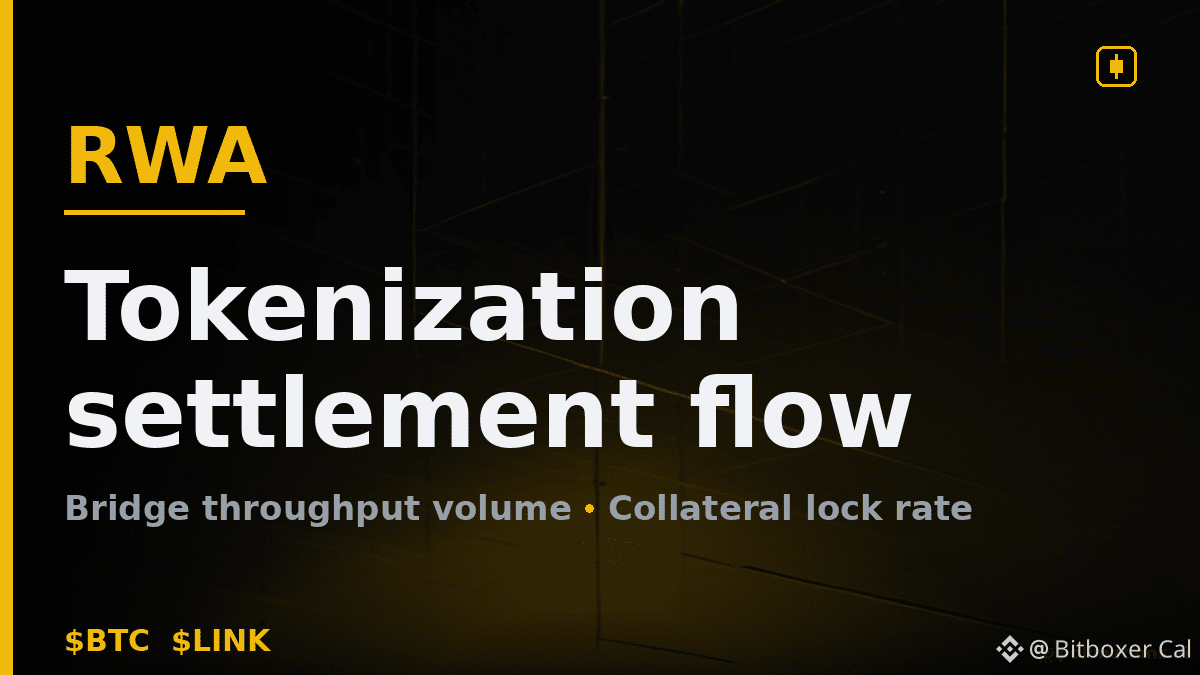
Institutional $LINK adoption has moved past the speculation phase.
Big finance is using tokenization to fix broken legacy settlement. On-chain collateral proves they are building, but current cross-chain bridges remain trapped in walled gardens. Watch bridge throughput as the key signal for when liquidity hits public rails.
$BTC $LINK #RWA #Tokenization #OnChainFinance
Institutional $LINK adoption has moved past the speculation phase.
Big finance is using tokenization to fix broken legacy settlement. On-chain collateral proves they are building, but current cross-chain bridges remain trapped in walled gardens. Watch bridge throughput as the key signal for when liquidity hits public rails.
$BTC $LINK #RWA #Tokenization #OnChainFinance
Big finance is using tokenization to fix broken legacy settlement. On-chain collateral proves they are building, but current cross-chain bridges remain trapped in walled gardens. Watch bridge throughput as the key signal for when liquidity hits public rails.
$BTC $LINK #RWA #Tokenization #OnChainFinance
68
·
--
**📊 IPOs Are Moving On-Chain — Are You Ready?**
CZ recently dropped a bomb: "IPOs will move on-chain." 🚀
Think about it:
✅ No more waiting for brokers
✅ 24/7 trading, no closing bell
✅ Fractional ownership — buy $1 of any company
✅ Instant settlement, zero middlemen
Binance Research projects tokenized equities could hit **$349 BILLION by 2030** — up from just $4.4B today.
Projects like $BNB are at the center of this infrastructure shift, powering the ecosystem where tokenized assets will live.
Traditional finance took days to settle a trade.
On-chain? Seconds.
Are you positioning yourself early, or waiting for the mainstream to catch up? 👇
#Binance #RWA #TokenizedIPO #OnChainFinance
**📊 IPOs Are Moving On-Chain — Are You Ready?**
CZ recently dropped a bomb: "IPOs will move on-chain." 🚀
Think about it:
✅ No more waiting for brokers
✅ 24/7 trading, no closing bell
✅ Fractional ownership — buy $1 of any company
✅ Instant settlement, zero middlemen
Binance Research projects tokenized equities could hit **$349 BILLION by 2030** — up from just $4.4B today.
Projects like $BNB are at the center of this infrastructure shift, powering the ecosystem where tokenized assets will live.
Traditional finance took days to settle a trade.
On-chain? Seconds.
Are you positioning yourself early, or waiting for the mainstream to catch up? 👇
#Binance #RWA #TokenizedIPO #OnChainFinance
CZ recently dropped a bomb: "IPOs will move on-chain." 🚀
Think about it:
✅ No more waiting for brokers
✅ 24/7 trading, no closing bell
✅ Fractional ownership — buy $1 of any company
✅ Instant settlement, zero middlemen
Binance Research projects tokenized equities could hit **$349 BILLION by 2030** — up from just $4.4B today.
Projects like $BNB are at the center of this infrastructure shift, powering the ecosystem where tokenized assets will live.
Traditional finance took days to settle a trade.
On-chain? Seconds.
Are you positioning yourself early, or waiting for the mainstream to catch up? 👇
#Binance #RWA #TokenizedIPO #OnChainFinance
73

·
--
Tokenized stocks are no longer just about putting stocks on a blockchain.
The bigger story is what people are actually doing with them.
According to Binance Research, on-chain transfers of tokenized stocks including trading volume surpassed $100B in Q3 2026.
For perspective:
Q1: $6B
Q3: $100B+
That's more than just growth in supply.
It's a sign that tokenized equities are becoming part of actual on-chain activity.
And there's another interesting shift happening.
Tokenized stocks are starting to move beyond simply being held.
They can be transferred, traded and through the DeFi ecosystem, put to work as collateral or within liquidity markets.
That's the real power of tokenization.
A traditional stock position usually sits inside a brokerage account.
An on-chain representation can become part of a broader programmable financial ecosystem.
This is where BNB Chain becomes interesting.
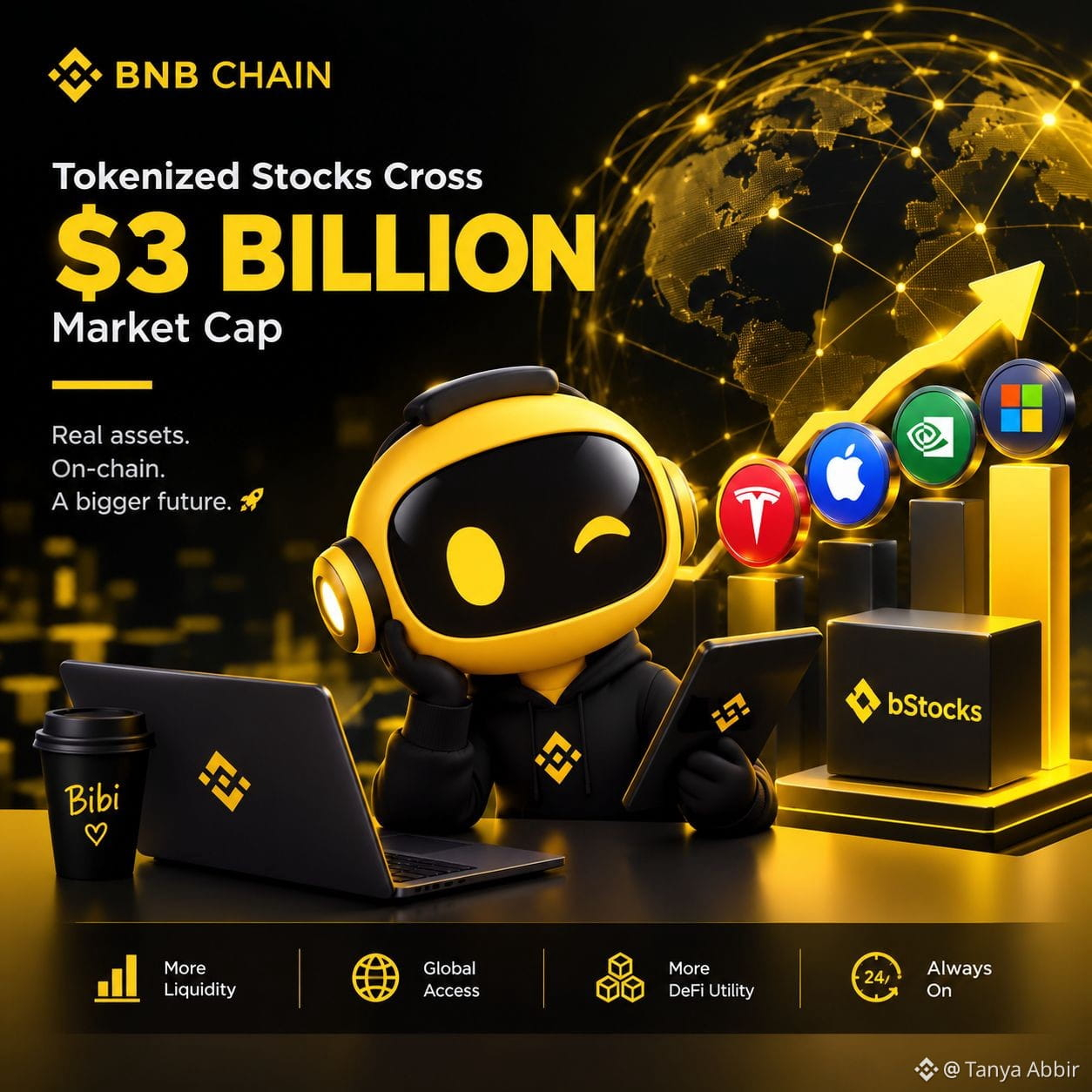
BNB Chain has become the largest home for tokenized stocks, with around $1B in tokenized stock market cap and 1.8M holders as of mid September, according to Binance Research.
And sitting inside that ecosystem is bStocks.
Launched on BNB Chain in June, bStocks are 1:1 backed tokenized U.S. securities represented as BEP-20 tokens.
So the bigger story isn't:
Stocks are coming to crypto.
It's: Financial assets are becoming programmable.
The line between traditional finance and on-chain finance is getting thinner.
And we are watching that transition happen in real time. @Binance_Angels
#OnChainFinance
Tokenized stocks are no longer just about putting stocks on a blockchain.
The bigger story is what people are actually doing with them.
According to Binance Research, on-chain transfers of tokenized stocks including trading volume surpassed $100B in Q3 2026.
For perspective:
Q1: $6B
Q3: $100B+
That's more than just growth in supply.
It's a sign that tokenized equities are becoming part of actual on-chain activity.
And there's another interesting shift happening.
Tokenized stocks are starting to move beyond simply being held.
They can be transferred, traded and through the DeFi ecosystem, put to work as collateral or within liquidity markets.
That's the real power of tokenization.
A traditional stock position usually sits inside a brokerage account.
An on-chain representation can become part of a broader programmable financial ecosystem.
This is where BNB Chain becomes interesting.
BNB Chain has become the largest home for tokenized stocks, with around $1B in tokenized stock market cap and 1.8M holders as of mid September, according to Binance Research.
And sitting inside that ecosystem is bStocks.
Launched on BNB Chain in June, bStocks are 1:1 backed tokenized U.S. securities represented as BEP-20 tokens.
So the bigger story isn't:
Stocks are coming to crypto.
It's: Financial assets are becoming programmable.
The line between traditional finance and on-chain finance is getting thinner.
And we are watching that transition happen in real time. @Binance Angels
#OnChainFinance
The bigger story is what people are actually doing with them.
According to Binance Research, on-chain transfers of tokenized stocks including trading volume surpassed $100B in Q3 2026.
For perspective:
Q1: $6B
Q3: $100B+
That's more than just growth in supply.
It's a sign that tokenized equities are becoming part of actual on-chain activity.
And there's another interesting shift happening.
Tokenized stocks are starting to move beyond simply being held.
They can be transferred, traded and through the DeFi ecosystem, put to work as collateral or within liquidity markets.
That's the real power of tokenization.
A traditional stock position usually sits inside a brokerage account.
An on-chain representation can become part of a broader programmable financial ecosystem.
This is where BNB Chain becomes interesting.
BNB Chain has become the largest home for tokenized stocks, with around $1B in tokenized stock market cap and 1.8M holders as of mid September, according to Binance Research.
And sitting inside that ecosystem is bStocks.
Launched on BNB Chain in June, bStocks are 1:1 backed tokenized U.S. securities represented as BEP-20 tokens.
So the bigger story isn't:
Stocks are coming to crypto.
It's: Financial assets are becoming programmable.
The line between traditional finance and on-chain finance is getting thinner.
And we are watching that transition happen in real time. @Binance Angels
#OnChainFinance
2
104

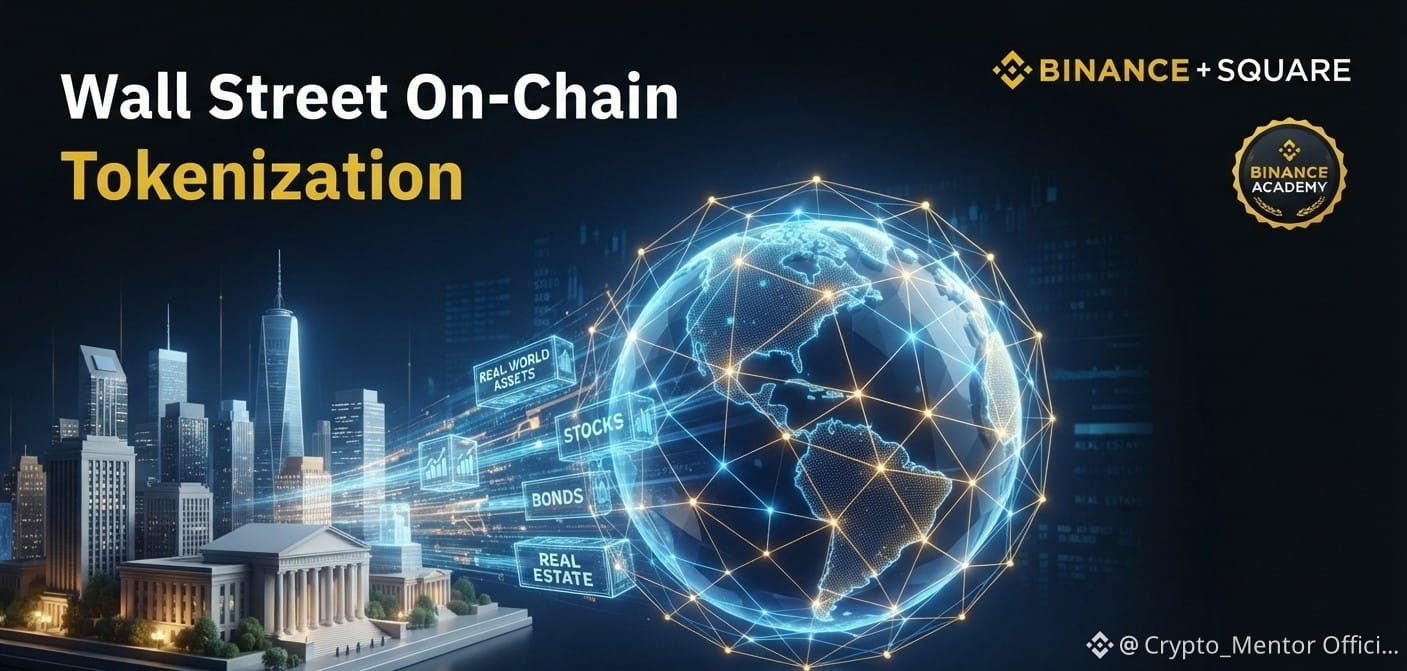
Wall Street On-Chain: Trend, Transition, or a Temporary Narrative? 🌐
Crypto market ab sirf Bitcoin aur altcoins ki price movement tak mehdood nahi rahi. Ek bohot bara institutional shift dheere dheere shape le raha hai: Tokenization.
$BTC
{spot}(BTCUSDT)
Real-world assets (RWAs)—jaise government bonds, funds, stocks aur real estate—ko blockchain rails par represent aur settle karne ki race tez ho rahi hai. Public market trackers ke mutabiq, tokenized RWAs ki visible on-chain value 2026 mein roughly $38B+ tak pohanch chuki hai. Kuch broader industry estimates tokenized assets ka total footprint is se kaafi bara dikhate hain—magar dono figures ko same metric samajhna ghalat hoga. (coinlaw.io)
$RWA
{alpha}(560x9c8b5ca345247396bdfac0395638ca9045c6586e)
TradFi ke on-chain shift hone ki 3 bari wajah:
⚡ 24/7 Market Access: Blockchain rails theoretically traditional market hours se bahar bhi transfer aur settlement ko enable kar sakte hain.
$SOL
{future}(SOLUSDT)
⚡ Faster Settlement: Legacy clearing cycles ke muqable mein settlement process zyada efficient ho sakta hai—lekin yeh product structure aur regulation par depend karega.
⚡ Programmable Finance: Smart contracts compliance rules, ownership transfer aur reporting workflows ko automate karne mein madad de sakte hain.
The Reality Check
Bari narrative ke sath bari challenges bhi hain: regulatory compliance, legal ownership rights, secure custody, liquidity, interoperability aur investor protection abhi bhi institutional adoption ke key hurdles hain.
)
💬 Big Question:
Kya aglay kuch saalon mein traditional finance ka ek meaningful hissa on-chain rails par move hoga—ya tokenization abhi bhi hype aur limited pilots tak mehdood rahegi?
Aapka kya khayal hai? Comments mein batayein.
#TokenizationRevolution #RWA板块涨势强劲 #BlockchainNews #Web3Revolution #OnChainFinance
Wall Street On-Chain: Trend, Transition, or a Temporary Narrative? 🌐
Crypto market ab sirf Bitcoin aur altcoins ki price movement tak mehdood nahi rahi. Ek bohot bara institutional shift dheere dheere shape le raha hai: Tokenization.
$BTC
Real-world assets (RWAs)—jaise government bonds, funds, stocks aur real estate—ko blockchain rails par represent aur settle karne ki race tez ho rahi hai. Public market trackers ke mutabiq, tokenized RWAs ki visible on-chain value 2026 mein roughly $38B+ tak pohanch chuki hai. Kuch broader industry estimates tokenized assets ka total footprint is se kaafi bara dikhate hain—magar dono figures ko same metric samajhna ghalat hoga. (coinlaw.io)
$RWA
TradFi ke on-chain shift hone ki 3 bari wajah:
⚡ 24/7 Market Access: Blockchain rails theoretically traditional market hours se bahar bhi transfer aur settlement ko enable kar sakte hain.
$SOL
⚡ Faster Settlement: Legacy clearing cycles ke muqable mein settlement process zyada efficient ho sakta hai—lekin yeh product structure aur regulation par depend karega.
⚡ Programmable Finance: Smart contracts compliance rules, ownership transfer aur reporting workflows ko automate karne mein madad de sakte hain.
The Reality Check
Bari narrative ke sath bari challenges bhi hain: regulatory compliance, legal ownership rights, secure custody, liquidity, interoperability aur investor protection abhi bhi institutional adoption ke key hurdles hain.
)
💬 Big Question:
Kya aglay kuch saalon mein traditional finance ka ek meaningful hissa on-chain rails par move hoga—ya tokenization abhi bhi hype aur limited pilots tak mehdood rahegi?
Aapka kya khayal hai? Comments mein batayein.
#TokenizationRevolution #RWA板块涨势强劲 #BlockchainNews #Web3Revolution #OnChainFinance
Crypto market ab sirf Bitcoin aur altcoins ki price movement tak mehdood nahi rahi. Ek bohot bara institutional shift dheere dheere shape le raha hai: Tokenization.
$BTC
Real-world assets (RWAs)—jaise government bonds, funds, stocks aur real estate—ko blockchain rails par represent aur settle karne ki race tez ho rahi hai. Public market trackers ke mutabiq, tokenized RWAs ki visible on-chain value 2026 mein roughly $38B+ tak pohanch chuki hai. Kuch broader industry estimates tokenized assets ka total footprint is se kaafi bara dikhate hain—magar dono figures ko same metric samajhna ghalat hoga. (coinlaw.io)
$RWA
TradFi ke on-chain shift hone ki 3 bari wajah:
⚡ 24/7 Market Access: Blockchain rails theoretically traditional market hours se bahar bhi transfer aur settlement ko enable kar sakte hain.
$SOL
⚡ Faster Settlement: Legacy clearing cycles ke muqable mein settlement process zyada efficient ho sakta hai—lekin yeh product structure aur regulation par depend karega.
⚡ Programmable Finance: Smart contracts compliance rules, ownership transfer aur reporting workflows ko automate karne mein madad de sakte hain.
The Reality Check
Bari narrative ke sath bari challenges bhi hain: regulatory compliance, legal ownership rights, secure custody, liquidity, interoperability aur investor protection abhi bhi institutional adoption ke key hurdles hain.
)
💬 Big Question:
Kya aglay kuch saalon mein traditional finance ka ek meaningful hissa on-chain rails par move hoga—ya tokenization abhi bhi hype aur limited pilots tak mehdood rahegi?
Aapka kya khayal hai? Comments mein batayein.
#TokenizationRevolution #RWA板块涨势强劲 #BlockchainNews #Web3Revolution #OnChainFinance
206 Atlas:
$38B is negligible against TradFi’s $100T+ universe. Focus on custody and liquidity hurdles, not just settlement speed.
3
1
184

·
--
Here's what happened when the SEC opened a door for tokenized stocks onchain.
Every trader knows the frustration of watching names like Nvidia run while their crypto sits isolated in a wallet. Switching between a brokerage and DeFi still takes days and costs real money, and more than a few people have already been rugged by fake tokenized share projects with nothing behind them.
This looks a lot like the Bitcoin ETF moment. Those products pulled in tens of billions within months of going live. Tokenized stocks could go further with 24/7 trading and the ability to use actual shares as DeFi collateral. $ONDO already proved the model with tokenized treasuries at scale. Most serious experiments settle on $ETH, and $LINK oracles would be what keeps the onchain price honest against the real close.
The 2018 security token wave died from pure regulatory hostility. This time the SEC is writing the rules instead of just suing. That is the difference that actually matters.
Where do you think this goes from here?
#TokenizedStocks #RWA #OnchainFinance
Here's what happened when the SEC opened a door for tokenized stocks onchain.
Every trader knows the frustration of watching names like Nvidia run while their crypto sits isolated in a wallet. Switching between a brokerage and DeFi still takes days and costs real money, and more than a few people have already been rugged by fake tokenized share projects with nothing behind them.
This looks a lot like the Bitcoin ETF moment. Those products pulled in tens of billions within months of going live. Tokenized stocks could go further with 24/7 trading and the ability to use actual shares as DeFi collateral. $ONDO already proved the model with tokenized treasuries at scale. Most serious experiments settle on $ETH , and $LINK oracles would be what keeps the onchain price honest against the real close.
The 2018 security token wave died from pure regulatory hostility. This time the SEC is writing the rules instead of just suing. That is the difference that actually matters.
Where do you think this goes from here?
#TokenizedStocks #RWA #OnchainFinance
Every trader knows the frustration of watching names like Nvidia run while their crypto sits isolated in a wallet. Switching between a brokerage and DeFi still takes days and costs real money, and more than a few people have already been rugged by fake tokenized share projects with nothing behind them.
This looks a lot like the Bitcoin ETF moment. Those products pulled in tens of billions within months of going live. Tokenized stocks could go further with 24/7 trading and the ability to use actual shares as DeFi collateral. $ONDO already proved the model with tokenized treasuries at scale. Most serious experiments settle on $ETH , and $LINK oracles would be what keeps the onchain price honest against the real close.
The 2018 security token wave died from pure regulatory hostility. This time the SEC is writing the rules instead of just suing. That is the difference that actually matters.
Where do you think this goes from here?
#TokenizedStocks #RWA #OnchainFinance
140

·
--
Жоғары (өспелі)
Расталды
Pyth Network is starting to look less like a crypto data project and more like financial infrastructure built for 24/7 markets.
$PYTH is the ecosystem token, with utility and governance relevance across the Pyth network.
What stands out is where the data starts.
Instead of relying mainly on downstream market-data pipelines, Pyth brings prices directly from first-party publishers. That network now includes 125+ institutional publishers, with feeds reaching 114+ blockchains.
The commercial side is moving too. Pyth Pro crossed $6M ARR within months of launch, while subscription ARR reportedly grew 109% QoQ.
$LINK represents established oracle infrastructure, $HYPE reflects the growth of onchain perpetual markets, and $TAO is closely associated with autonomous AI systems.
Pyth sits at an interesting intersection: institutional data, always-on markets, and machine-readable financial information built for internet-native finance.
Not financial advice, just information post
#PYTH #PythNetwork #MarketData #OnchainFinance #Crypto
Pyth Network is starting to look less like a crypto data project and more like financial infrastructure built for 24/7 markets.
$PYTH is the ecosystem token, with utility and governance relevance across the Pyth network.
What stands out is where the data starts.
Instead of relying mainly on downstream market-data pipelines, Pyth brings prices directly from first-party publishers. That network now includes 125+ institutional publishers, with feeds reaching 114+ blockchains.
The commercial side is moving too. Pyth Pro crossed $6M ARR within months of launch, while subscription ARR reportedly grew 109% QoQ.
$LINK represents established oracle infrastructure, $HYPE reflects the growth of onchain perpetual markets, and $TAO is closely associated with autonomous AI systems.
Pyth sits at an interesting intersection: institutional data, always-on markets, and machine-readable financial information built for internet-native finance.
Not financial advice, just information post
#PYTH #PythNetwork #MarketData #OnchainFinance #Crypto
$PYTH is the ecosystem token, with utility and governance relevance across the Pyth network.
What stands out is where the data starts.
Instead of relying mainly on downstream market-data pipelines, Pyth brings prices directly from first-party publishers. That network now includes 125+ institutional publishers, with feeds reaching 114+ blockchains.
The commercial side is moving too. Pyth Pro crossed $6M ARR within months of launch, while subscription ARR reportedly grew 109% QoQ.
$LINK represents established oracle infrastructure, $HYPE reflects the growth of onchain perpetual markets, and $TAO is closely associated with autonomous AI systems.
Pyth sits at an interesting intersection: institutional data, always-on markets, and machine-readable financial information built for internet-native finance.
Not financial advice, just information post
#PYTH #PythNetwork #MarketData #OnchainFinance #Crypto
57
1
40
14.8k
·
--
Жоғары (өспелі)
🚀 Bringing Institutional Yield Onchain: Renzo Finance
Renzo is democratizing complex yield architecture by bringing Wall Street-grade strategies directly to DeFi.
Key Highlights:
⚡️ Market-neutral & professional-grade yield strategies
⚡️ 100% self-custodial infrastructure
⚡️ Flexible liquidity with zero locked periods
⚡️ Native integrations with Hyperliquid & Lighter
⚡️ Multi-chain expansion across ETH, SOL & RWAs
The future of yield isn't locked in traditional vaults—it’s programmable, transparent, and onchain.
🔗 Explore Renzo Finance: https://www.renzofinance.com/?utm_source=chatgpt.com
#DeFi #Renzo #RealWorldAssets #CryptoYield #OnchainFinance
🚀 Bringing Institutional Yield Onchain: Renzo Finance
Renzo is democratizing complex yield architecture by bringing Wall Street-grade strategies directly to DeFi.
Key Highlights:
⚡️ Market-neutral & professional-grade yield strategies
⚡️ 100% self-custodial infrastructure
⚡️ Flexible liquidity with zero locked periods
⚡️ Native integrations with Hyperliquid & Lighter
⚡️ Multi-chain expansion across ETH, SOL & RWAs
The future of yield isn't locked in traditional vaults—it’s programmable, transparent, and onchain.
🔗 Explore Renzo Finance: https://www.renzofinance.com/?utm_source=chatgpt.com
#DeFi #Renzo #RealWorldAssets #CryptoYield #OnchainFinance
Renzo is democratizing complex yield architecture by bringing Wall Street-grade strategies directly to DeFi.
Key Highlights:
⚡️ Market-neutral & professional-grade yield strategies
⚡️ 100% self-custodial infrastructure
⚡️ Flexible liquidity with zero locked periods
⚡️ Native integrations with Hyperliquid & Lighter
⚡️ Multi-chain expansion across ETH, SOL & RWAs
The future of yield isn't locked in traditional vaults—it’s programmable, transparent, and onchain.
🔗 Explore Renzo Finance: https://www.renzofinance.com/?utm_source=chatgpt.com
#DeFi #Renzo #RealWorldAssets #CryptoYield #OnchainFinance
2
67

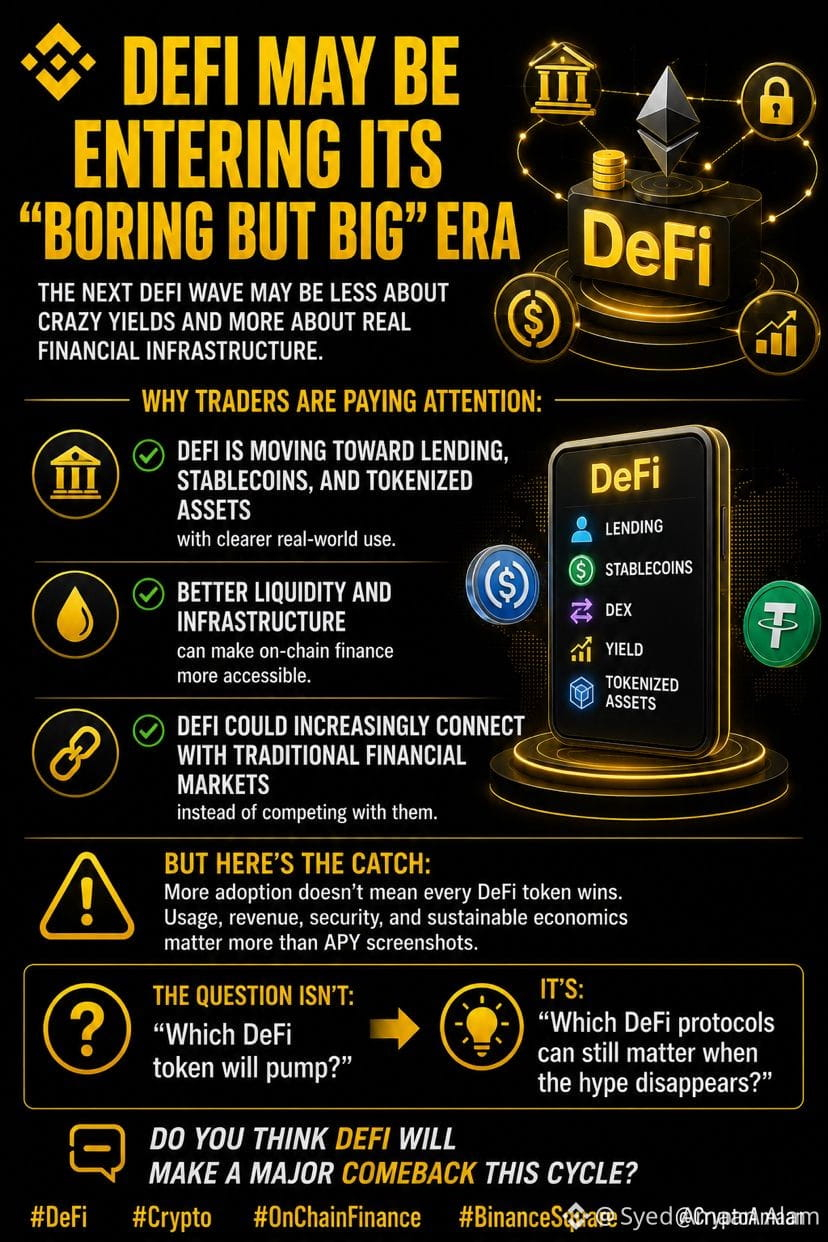
🚨 DEFI MAY BE ENTERING ITS “BORING BUT BIG” ERA
The next DeFi wave may be less about crazy yields and more about real financial infrastructure.
Why traders are paying attention:
🏦 $DEFI is moving toward lending, stablecoins, and tokenized assets with clearer real-world use.
💧 Better liquidity and infrastructure can make on-chain finance more accessible.
🔗 DeFi could increasingly connect with traditional financial markets instead of competing with them.
But here’s the catch:
More adoption doesn’t mean every DeFi token wins. Usage, revenue, security, and sustainable economics matter more than APY screenshots.
The question isn’t: “Which DeFi token will pump?”
It’s: “Which DeFi protocols can still matter when the hype disappears?”
Do you think DeFi will make a major comeback this cycle?
#defi #crypto #OnChainFinance #BinanceSquare
🚨 DEFI MAY BE ENTERING ITS “BORING BUT BIG” ERA
The next DeFi wave may be less about crazy yields and more about real financial infrastructure.
Why traders are paying attention:
🏦 $DEFI is moving toward lending, stablecoins, and tokenized assets with clearer real-world use.
💧 Better liquidity and infrastructure can make on-chain finance more accessible.
🔗 DeFi could increasingly connect with traditional financial markets instead of competing with them.
But here’s the catch:
More adoption doesn’t mean every DeFi token wins. Usage, revenue, security, and sustainable economics matter more than APY screenshots.
The question isn’t: “Which DeFi token will pump?”
It’s: “Which DeFi protocols can still matter when the hype disappears?”
Do you think DeFi will make a major comeback this cycle?
#defi #crypto #OnChainFinance #BinanceSquare
The next DeFi wave may be less about crazy yields and more about real financial infrastructure.
Why traders are paying attention:
🏦 $DEFI is moving toward lending, stablecoins, and tokenized assets with clearer real-world use.
💧 Better liquidity and infrastructure can make on-chain finance more accessible.
🔗 DeFi could increasingly connect with traditional financial markets instead of competing with them.
But here’s the catch:
More adoption doesn’t mean every DeFi token wins. Usage, revenue, security, and sustainable economics matter more than APY screenshots.
The question isn’t: “Which DeFi token will pump?”
It’s: “Which DeFi protocols can still matter when the hype disappears?”
Do you think DeFi will make a major comeback this cycle?
#defi #crypto #OnChainFinance #BinanceSquare
72
·
--
everyone thinks privacy in crypto is just a niche narrative, but actually the bigger risk is trading in public like nobody is watching.
ser, your wallet leaks entries, exits, size, rotations, everything. and the other mistake is just as bad: aping privacy headlines before understanding what’s actually being built.
case study: Zama just posted from its official account on Binance, saying it’s building the protocol for confidential onchain finance. the core idea is simple but heavy: issue, trade, and manage confidential assets on public blockchains.
they’ve been building for 5 years, which matters. this isn’t some random privacy buzzword drop. but ngl, the warning is clear: don’t treat “confidential assets” as an instant buy signal across every chart. for $ETH, $BNB, and DeFi broadly, this points to privacy becoming infrastructure, not just a temporary narrative pump.
if blockchain transactions eventually become confidential by default, a lot of current trader alpha changes. wallet watching, copy trading, MEV hunting, even how people read flows could all get less obvious.
what’s your take on privacy becoming default onchain?
#Privacy #DeFi #OnchainFinance
everyone thinks privacy in crypto is just a niche narrative, but actually the bigger risk is trading in public like nobody is watching.
ser, your wallet leaks entries, exits, size, rotations, everything. and the other mistake is just as bad: aping privacy headlines before understanding what’s actually being built.
case study: Zama just posted from its official account on Binance, saying it’s building the protocol for confidential onchain finance. the core idea is simple but heavy: issue, trade, and manage confidential assets on public blockchains.
they’ve been building for 5 years, which matters. this isn’t some random privacy buzzword drop. but ngl, the warning is clear: don’t treat “confidential assets” as an instant buy signal across every chart. for $ETH , $BNB , and DeFi broadly, this points to privacy becoming infrastructure, not just a temporary narrative pump.
if blockchain transactions eventually become confidential by default, a lot of current trader alpha changes. wallet watching, copy trading, MEV hunting, even how people read flows could all get less obvious.
what’s your take on privacy becoming default onchain?
#Privacy #DeFi #OnchainFinance
ser, your wallet leaks entries, exits, size, rotations, everything. and the other mistake is just as bad: aping privacy headlines before understanding what’s actually being built.
case study: Zama just posted from its official account on Binance, saying it’s building the protocol for confidential onchain finance. the core idea is simple but heavy: issue, trade, and manage confidential assets on public blockchains.
they’ve been building for 5 years, which matters. this isn’t some random privacy buzzword drop. but ngl, the warning is clear: don’t treat “confidential assets” as an instant buy signal across every chart. for $ETH , $BNB , and DeFi broadly, this points to privacy becoming infrastructure, not just a temporary narrative pump.
if blockchain transactions eventually become confidential by default, a lot of current trader alpha changes. wallet watching, copy trading, MEV hunting, even how people read flows could all get less obvious.
what’s your take on privacy becoming default onchain?
#Privacy #DeFi #OnchainFinance
77

·
--
SEC Commissioner Hester Peirce says DeFi vaults and onchain lending strategies may still fall under U.S. securities law.
The deciding factors include who selects investments, reallocates assets, sets interest rates and controls collateral or liquidation rules.
This is not a blanket ban. Each product will be assessed individually.
The key risk is regulatory structure: calling a product “non-custodial” or “onchain” may not protect it if users still depend on managerial decisions to generate returns.
$BTC
#defi #CryptoRegulations #OnChainFinance #Yield
SEC Commissioner Hester Peirce says DeFi vaults and onchain lending strategies may still fall under U.S. securities law.
The deciding factors include who selects investments, reallocates assets, sets interest rates and controls collateral or liquidation rules.
This is not a blanket ban. Each product will be assessed individually.
The key risk is regulatory structure: calling a product “non-custodial” or “onchain” may not protect it if users still depend on managerial decisions to generate returns.
$BTC
#defi #CryptoRegulations #OnChainFinance #Yield
The deciding factors include who selects investments, reallocates assets, sets interest rates and controls collateral or liquidation rules.
This is not a blanket ban. Each product will be assessed individually.
The key risk is regulatory structure: calling a product “non-custodial” or “onchain” may not protect it if users still depend on managerial decisions to generate returns.
$BTC
#defi #CryptoRegulations #OnChainFinance #Yield
39

·
--

Мақала
GAMECHANGERAndre Cronje, the founder of Flying Tulip, has just dropped a bombshell that's set to send shockwaves throughout the financial world. In an explosive statement, he claims that DeFi has "obliterated" the old framework and evolved into a radical new concept – onchain finance.
The proof is in the pudding. #DeFiIsDead #OnChainFinance #CryptoRevolution Andre Cronje's argument is rooted in the fact that DeFi protocols have sacrificed some of their inherent immutability and decentralization in favor of greater usability and scalability. This might seem counterintuitive, but it's a crucial step towards a more accessible and efficient financial system.
The stakes are high, as the transition to onchain finance could redefine the boundaries of traditional finance. Imagine a world where transactions are faster, cheaper, and more secure – where institutions and individuals alike can access the full range of financial services without the need for intermediaries.
So what does this mean for the future of DeFi? The implications are endless, and the smart money is already betting on the winners. But here's the thing – you don't have to be a pro to get in on the action. Whether you're a seasoned trader or a new player in the game, the flood has started, and it's time to join the movement. Will you be left behind, or will you seize the opportunity to shape the future of finance? Invest in your future today and see for yourself – the revolution is real, and it's just getting started!
GAMECHANGER
Andre Cronje, the founder of Flying Tulip, has just dropped a bombshell that's set to send shockwaves throughout the financial world. In an explosive statement, he claims that DeFi has "obliterated" the old framework and evolved into a radical new concept – onchain finance.
The proof is in the pudding. #DeFiIsDead #OnChainFinance #CryptoRevolution Andre Cronje's argument is rooted in the fact that DeFi protocols have sacrificed some of their inherent immutability and decentralization in favor of greater usability and scalability. This might seem counterintuitive, but it's a crucial step towards a more accessible and efficient financial system.
The stakes are high, as the transition to onchain finance could redefine the boundaries of traditional finance. Imagine a world where transactions are faster, cheaper, and more secure – where institutions and individuals alike can access the full range of financial services without the need for intermediaries.
So what does this mean for the future of DeFi? The implications are endless, and the smart money is already betting on the winners. But here's the thing – you don't have to be a pro to get in on the action. Whether you're a seasoned trader or a new player in the game, the flood has started, and it's time to join the movement. Will you be left behind, or will you seize the opportunity to shape the future of finance? Invest in your future today and see for yourself – the revolution is real, and it's just getting started!
The proof is in the pudding. #DeFiIsDead #OnChainFinance #CryptoRevolution Andre Cronje's argument is rooted in the fact that DeFi protocols have sacrificed some of their inherent immutability and decentralization in favor of greater usability and scalability. This might seem counterintuitive, but it's a crucial step towards a more accessible and efficient financial system.
The stakes are high, as the transition to onchain finance could redefine the boundaries of traditional finance. Imagine a world where transactions are faster, cheaper, and more secure – where institutions and individuals alike can access the full range of financial services without the need for intermediaries.
So what does this mean for the future of DeFi? The implications are endless, and the smart money is already betting on the winners. But here's the thing – you don't have to be a pro to get in on the action. Whether you're a seasoned trader or a new player in the game, the flood has started, and it's time to join the movement. Will you be left behind, or will you seize the opportunity to shape the future of finance? Invest in your future today and see for yourself – the revolution is real, and it's just getting started!
13

·
--
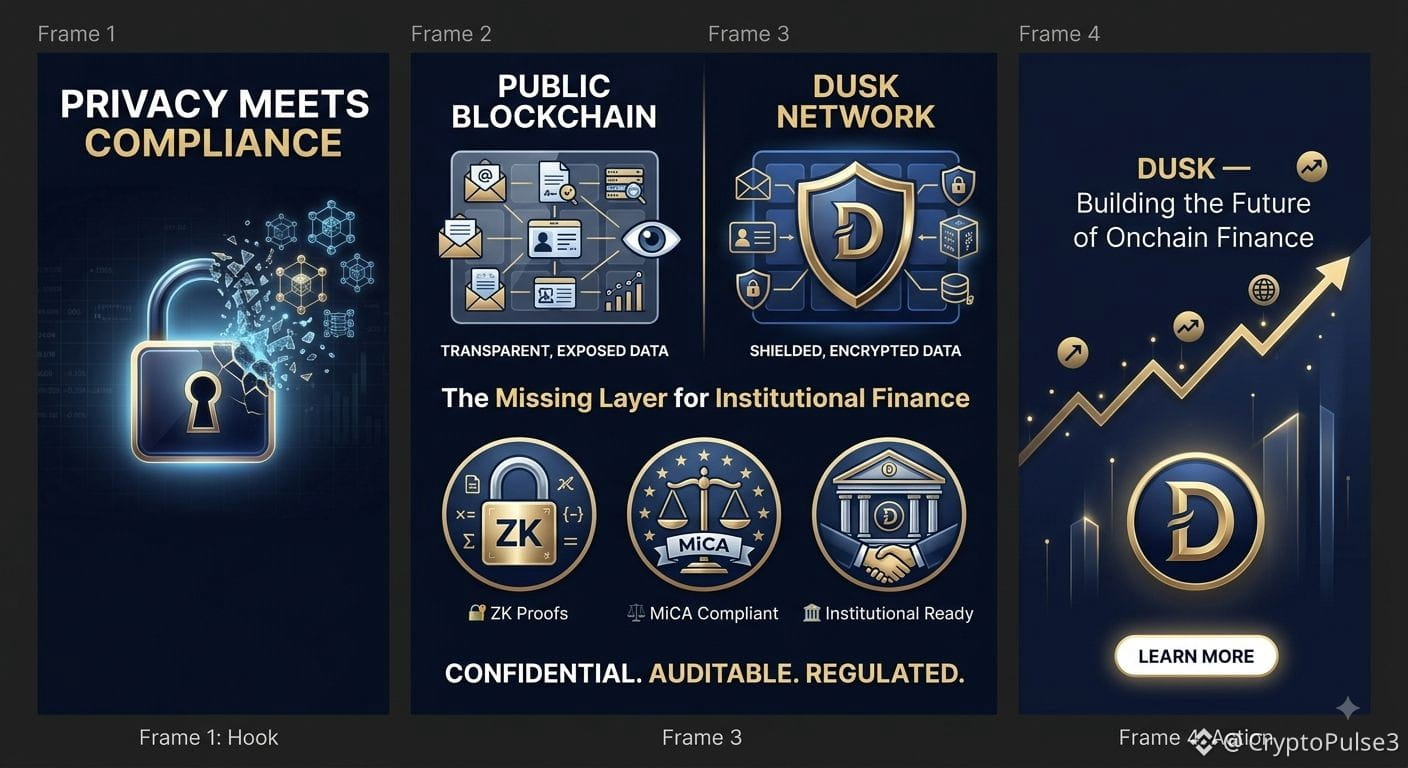
Why Institutions Are Betting on Compliant Privacy Coins Like DUSK"
As institutions race toward tokenized finance, Dusk Network is emerging as a key answer to a core problem: how do you keep transactions private without breaking compliance? Dusk combines zero-knowledge proofs with regulatory-first design, letting institutions transact confidentially while staying auditable for regulators. With RWA tokenization partnerships in Europe already live, Dusk could become foundational infrastructure for the next wave of regulated DeFi — where privacy and compliance finally coexist onchain.
Privacy meets compliance — is this the missing piece for institutional DeFi? 🔐⚖️ #DUSK
🔑 Key Points
🔐🔐🔐 Confidential by Default — Zero-knowledge proofs hide transaction details while keeping them verifiable
⚖️⚖️ Compliance Built-In — Designed for MiCA & MiFID II, satisfying EU regulatory frameworks
🏦🏦 Institutional Traction — Live RWA tokenization deals with regulated exchanges like NPEX
🚀 Category Leader — Outperforming other privacy coins amid rising institutional demand
#DuskNetwork #DUSK #OnchainFinance
$BTC
{spot}(BTCUSDT)
Why Institutions Are Betting on Compliant Privacy Coins Like DUSK"
As institutions race toward tokenized finance, Dusk Network is emerging as a key answer to a core problem: how do you keep transactions private without breaking compliance? Dusk combines zero-knowledge proofs with regulatory-first design, letting institutions transact confidentially while staying auditable for regulators. With RWA tokenization partnerships in Europe already live, Dusk could become foundational infrastructure for the next wave of regulated DeFi — where privacy and compliance finally coexist onchain.
Privacy meets compliance — is this the missing piece for institutional DeFi? 🔐⚖️ #DUSK
🔑 Key Points
🔐🔐🔐 Confidential by Default — Zero-knowledge proofs hide transaction details while keeping them verifiable
⚖️⚖️ Compliance Built-In — Designed for MiCA & MiFID II, satisfying EU regulatory frameworks
🏦🏦 Institutional Traction — Live RWA tokenization deals with regulated exchanges like NPEX
🚀 Category Leader — Outperforming other privacy coins amid rising institutional demand
#DuskNetwork #DUSK #OnchainFinance
$BTC
As institutions race toward tokenized finance, Dusk Network is emerging as a key answer to a core problem: how do you keep transactions private without breaking compliance? Dusk combines zero-knowledge proofs with regulatory-first design, letting institutions transact confidentially while staying auditable for regulators. With RWA tokenization partnerships in Europe already live, Dusk could become foundational infrastructure for the next wave of regulated DeFi — where privacy and compliance finally coexist onchain.
Privacy meets compliance — is this the missing piece for institutional DeFi? 🔐⚖️ #DUSK
🔑 Key Points
🔐🔐🔐 Confidential by Default — Zero-knowledge proofs hide transaction details while keeping them verifiable
⚖️⚖️ Compliance Built-In — Designed for MiCA & MiFID II, satisfying EU regulatory frameworks
🏦🏦 Institutional Traction — Live RWA tokenization deals with regulated exchanges like NPEX
🚀 Category Leader — Outperforming other privacy coins amid rising institutional demand
#DuskNetwork #DUSK #OnchainFinance
$BTC
43

·
--
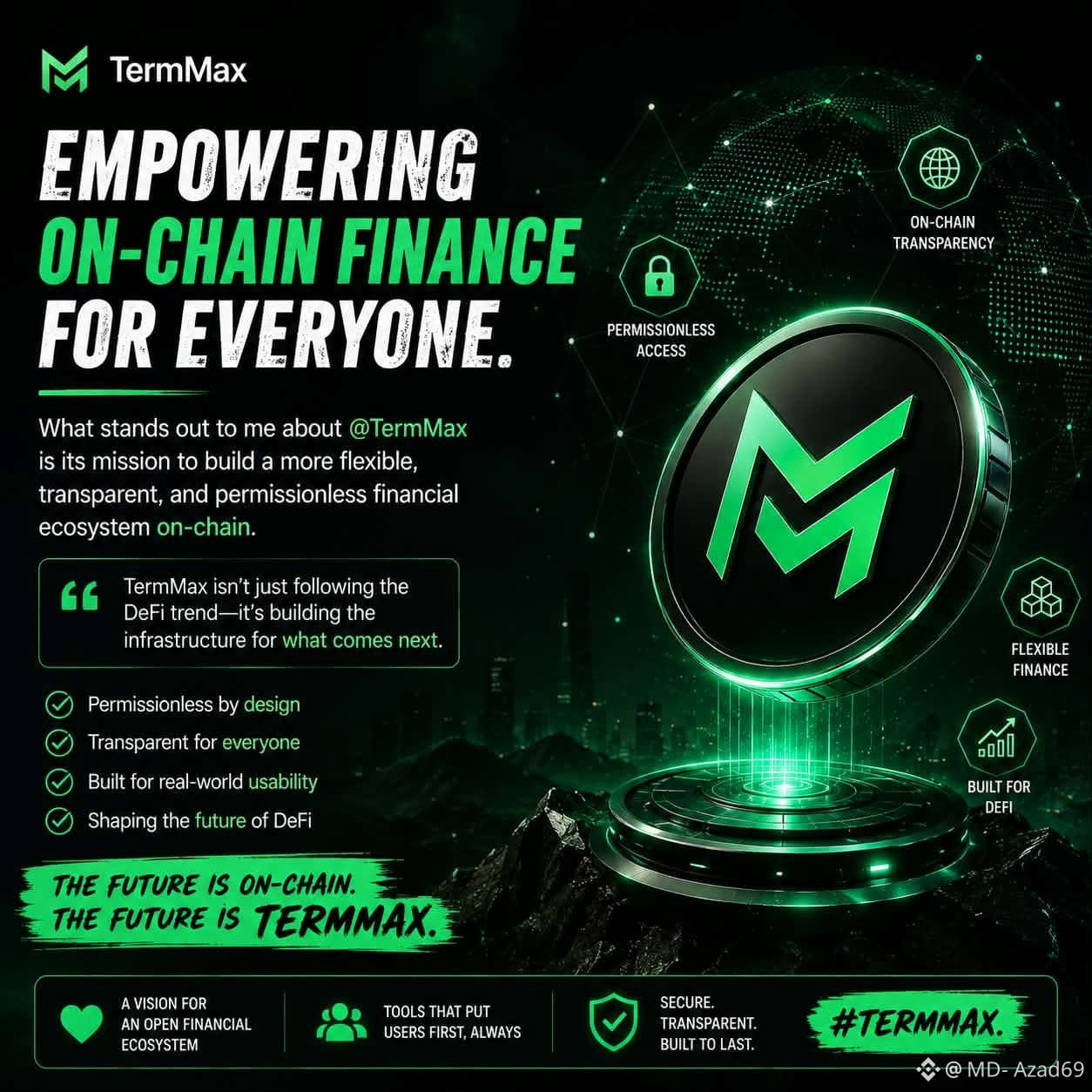
#termmax Not every DeFi project is trying to build something different. @termmax is.
What caught my attention is the idea of making on-chain finance more open, flexible, and transparent—without unnecessary barriers.
⚡ Permissionless by design
🌐 Transparent on-chain
🔓 More financial flexibility
🚀 Built with the future of DeFi in mind
TermMax isn’t just following the DeFi trend—it’s exploring what comes next.
The future is on-chain.
Let’s see how far TermMax can take it. 💚
#TermMax #DeFi #OnChainFinance
#termmax Not every DeFi project is trying to build something different. @TermMax is.
What caught my attention is the idea of making on-chain finance more open, flexible, and transparent—without unnecessary barriers.
⚡ Permissionless by design
🌐 Transparent on-chain
🔓 More financial flexibility
🚀 Built with the future of DeFi in mind
TermMax isn’t just following the DeFi trend—it’s exploring what comes next.
The future is on-chain.
Let’s see how far TermMax can take it. 💚
#TermMax #DeFi #OnChainFinance
What caught my attention is the idea of making on-chain finance more open, flexible, and transparent—without unnecessary barriers.
⚡ Permissionless by design
🌐 Transparent on-chain
🔓 More financial flexibility
🚀 Built with the future of DeFi in mind
TermMax isn’t just following the DeFi trend—it’s exploring what comes next.
The future is on-chain.
Let’s see how far TermMax can take it. 💚
#TermMax #DeFi #OnChainFinance
45
42
84

·
--
Mastercard just signaled something bigger than the current dip.
While everyone watches Bitcoin slide toward $66K and rotates into stablecoins, Mastercard announced it is expanding on-chain settlement — offering stablecoin, weekend, and holiday payments as core infrastructure. Not a pilot. Not a study. A product roadmap.
Mastercard processes roughly $9 trillion in transactions annually. That network is now betting on blockchain rails for always-on finance.
This is what gets built while price charts bleed. $ETH carries the heaviest RWA and settlement load. $XRP is the cross-border backbone institutions keep returning to. $BNB powers the most active stablecoin chain by volume.
The always-on finance thesis is no longer a 2030 projection. It is a Mastercard press release in June 2026.
Dips shift attention to price. They also compress entry windows for the infrastructure plays that matter when institutional settlement is baseline, not breakthrough.
The rails are being built regardless of where spot price lands.
#Stablecoins #OnChainFinance #CryptoPayments #InstitutionalCrypto #Web3
Mastercard just signaled something bigger than the current dip.
While everyone watches Bitcoin slide toward $66K and rotates into stablecoins, Mastercard announced it is expanding on-chain settlement — offering stablecoin, weekend, and holiday payments as core infrastructure. Not a pilot. Not a study. A product roadmap.
Mastercard processes roughly $9 trillion in transactions annually. That network is now betting on blockchain rails for always-on finance.
This is what gets built while price charts bleed. $ETH carries the heaviest RWA and settlement load. $XRP is the cross-border backbone institutions keep returning to. $BNB powers the most active stablecoin chain by volume.
The always-on finance thesis is no longer a 2030 projection. It is a Mastercard press release in June 2026.
Dips shift attention to price. They also compress entry windows for the infrastructure plays that matter when institutional settlement is baseline, not breakthrough.
The rails are being built regardless of where spot price lands.
#Stablecoins #OnChainFinance #CryptoPayments #InstitutionalCrypto #Web3
While everyone watches Bitcoin slide toward $66K and rotates into stablecoins, Mastercard announced it is expanding on-chain settlement — offering stablecoin, weekend, and holiday payments as core infrastructure. Not a pilot. Not a study. A product roadmap.
Mastercard processes roughly $9 trillion in transactions annually. That network is now betting on blockchain rails for always-on finance.
This is what gets built while price charts bleed. $ETH carries the heaviest RWA and settlement load. $XRP is the cross-border backbone institutions keep returning to. $BNB powers the most active stablecoin chain by volume.
The always-on finance thesis is no longer a 2030 projection. It is a Mastercard press release in June 2026.
Dips shift attention to price. They also compress entry windows for the infrastructure plays that matter when institutional settlement is baseline, not breakthrough.
The rails are being built regardless of where spot price lands.
#Stablecoins #OnChainFinance #CryptoPayments #InstitutionalCrypto #Web3
109

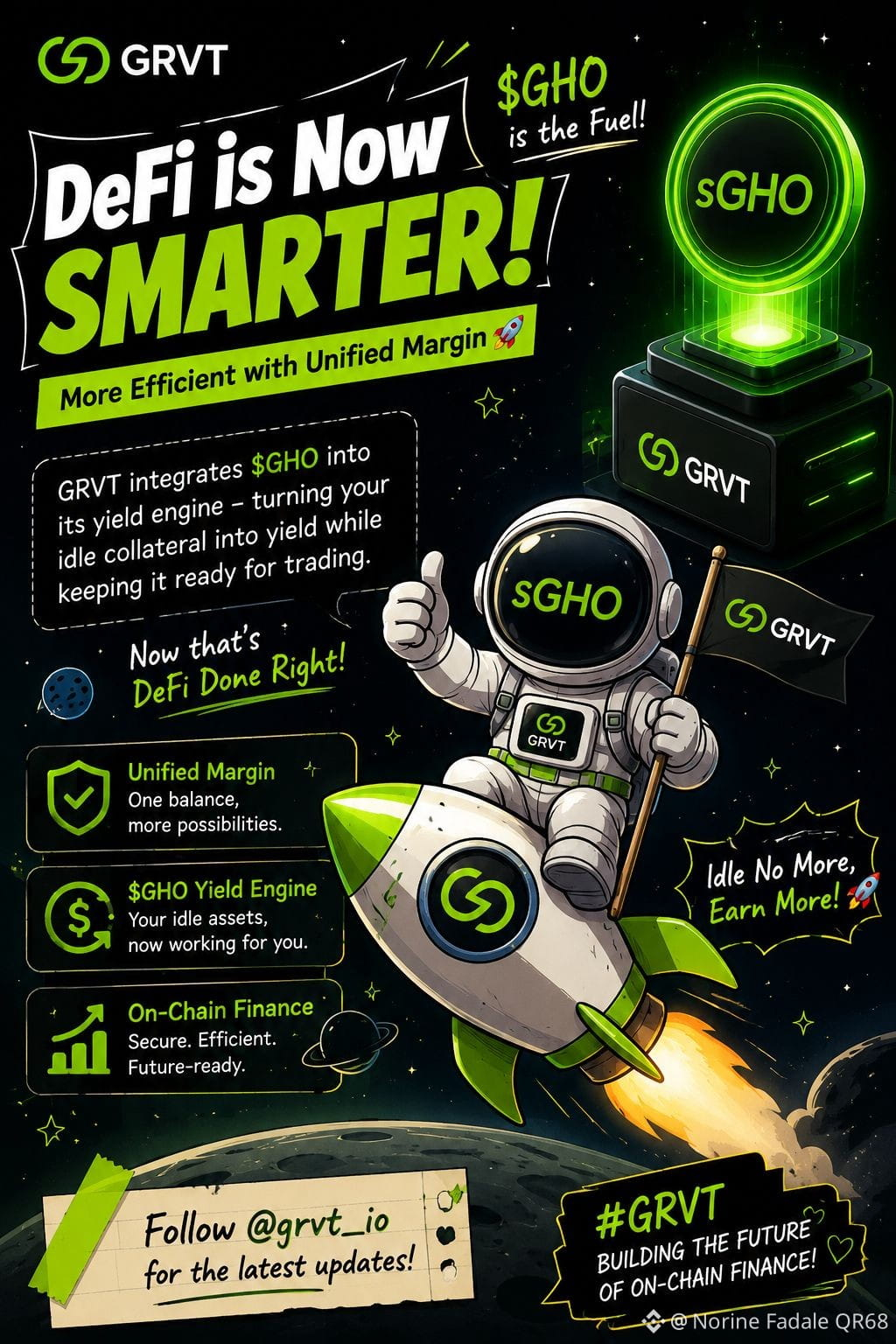
🚀 What if your idle collateral could work for you without slowing down your trading?
That's exactly what GRVT is building.
By integrating sGHO into its Yield Engine, GRVT transforms idle collateral into a yield-generating asset while keeping it available for trading through Unified Margin.
Smarter capital efficiency. Real on-chain utility. A better DeFi experience.
This is the kind of innovation that pushes decentralized finance beyond the hype and into real-world value.
Excited to see what's next from @grvt_io! 🔥
#GRVT #DeFi #UnifiedMargin #sGHO #OnChainFinance
🚀 What if your idle collateral could work for you without slowing down your trading?
That's exactly what GRVT is building.
By integrating sGHO into its Yield Engine, GRVT transforms idle collateral into a yield-generating asset while keeping it available for trading through Unified Margin.
Smarter capital efficiency. Real on-chain utility. A better DeFi experience.
This is the kind of innovation that pushes decentralized finance beyond the hype and into real-world value.
Excited to see what's next from @grvt_io! 🔥
#GRVT #DeFi #UnifiedMargin #sGHO #OnChainFinance
That's exactly what GRVT is building.
By integrating sGHO into its Yield Engine, GRVT transforms idle collateral into a yield-generating asset while keeping it available for trading through Unified Margin.
Smarter capital efficiency. Real on-chain utility. A better DeFi experience.
This is the kind of innovation that pushes decentralized finance beyond the hype and into real-world value.
Excited to see what's next from @grvt_io! 🔥
#GRVT #DeFi #UnifiedMargin #sGHO #OnChainFinance
1
75

Мақала
DeFi's $71 Billion Reality Check — The Gap Between Hype and Hard Data in 2026DeFi's $71 Billion Reality Check — The Gap Between Hype and Hard Data in 2026
Everyone talked about DeFi changing global finance forever. Here are the actual numbers — and the structural truth they reveal.
The Raw Data Right Now:
Total DeFi TVL (Total Value Locked) has fallen 37.3% year-to-date in 2026, dropping to $71.77 billion across 453 chains as of June 18 — pulling the ecosystem to within $2 billion of its 2026 low, down sharply from $114.49 billion at the start of the year. (CoinLaw)
But here is what the headline number hides:
Daily decentralized exchange volume reached $7.20 billion on June 18, 2026 — up 9.3% day-over-day — rising even as locked capital fell. Meanwhile, stablecoin circulating supply hit $314 billion in mid-June 2026, roughly 4.4 times the size of total DeFi TVL. (CoinLaw)
What The Numbers Actually Mean:
◆ Capital concentration is intensifying — Ethereum now anchors more than 53.1% of all DeFi TVL, and a quiet decoupling between stablecoin supply and the DeFi protocols meant to absorb it has emerged as a key structural concern (CoinLaw)
◆ Stablecoin circulating supply at $314 billion dwarfs DeFi's $71.77 billion TVL by more than 4x — meaning the majority of on-chain dollar activity is flowing through payment and settlement rails, not DeFi lending or liquidity protocols (CoinLaw)
◆ Institutional DeFi exposure has reached $17 billion in combined DeFi and RWA (real-world asset) TVL — adoption benchmarks for tokenized treasuries and yield-bearing stablecoins are now being tracked by major financial institutions for the first time (CoinLaw)
◆ MakerDAO has deployed $948 million in tokenized U.S. Treasuries as collateral — one of the clearest examples of traditional financial instruments being absorbed directly into DeFi infrastructure (Qubit Capital)
◆ Raydium, a Solana-based decentralized exchange, was drained of $1.34 million on June 10, 2026, when an attacker exploited five deprecated liquidity pools from its legacy AMM V3 smart contract — a vulnerability that had sat dormant in production code (CryptoNews.com)
The ECB Just Challenged DeFi's Core Claim:
A recent working paper from the European Central Bank took a close, data-driven look at governance across major DeFi protocols and challenged one of the sector's foundational assumptions — finding that control in most DeFi systems is concentrated, opaque, and structurally resistant to change, rather than genuinely distributed among users. (PYMNTS)
There is a growing consensus among large financial institutions that the future of tokenization is likely to be permissioned rather than permissionless, and integrated with existing systems rather than operating in parallel to them. (PYMNTS)
Where DeFi Is Actually Growing:
◆ Tokenized RWA platforms are projected to expand at a 39.72% CAGR through 2031 — the fastest-growing DeFi segment — as compliant issuance and institutional custody requirements align with on-chain infrastructure (Mordor Intelligence)
◆ The overall DeFi market is projected to reach $770.56 billion by 2031 at a 26.43% CAGR — with institutional investors and asset managers growing at 32.55% CAGR, far outpacing the retail segment (Mordor Intelligence)
◆ Layer-2 fee compression and rollup technology are making small, frequent DeFi transactions economically viable for the first time — removing the gas cost barrier that kept millions of users on the sidelines
The real DeFi story in 2026 is not TVL. It is the quiet institutional rewiring of on-chain finance — tokenized treasuries replacing yield farming, permissioned pools replacing anonymous liquidity, and regulated wrappers replacing pure decentralization.
With $314 billion in stablecoins circulating on-chain but only $71 billion locked in DeFi protocols — where do you think the rest of that capital is actually going, and what does that tell us about where on-chain finance is heading?
#DeFi #Stablecoins #RWA #OnChainFinance #Web3
DeFi's $71 Billion Reality Check — The Gap Between Hype and Hard Data in 2026
DeFi's $71 Billion Reality Check — The Gap Between Hype and Hard Data in 2026
Everyone talked about DeFi changing global finance forever. Here are the actual numbers — and the structural truth they reveal.
The Raw Data Right Now:
Total DeFi TVL (Total Value Locked) has fallen 37.3% year-to-date in 2026, dropping to $71.77 billion across 453 chains as of June 18 — pulling the ecosystem to within $2 billion of its 2026 low, down sharply from $114.49 billion at the start of the year. (CoinLaw)
But here is what the headline number hides:
Daily decentralized exchange volume reached $7.20 billion on June 18, 2026 — up 9.3% day-over-day — rising even as locked capital fell. Meanwhile, stablecoin circulating supply hit $314 billion in mid-June 2026, roughly 4.4 times the size of total DeFi TVL. (CoinLaw)
What The Numbers Actually Mean:
◆ Capital concentration is intensifying — Ethereum now anchors more than 53.1% of all DeFi TVL, and a quiet decoupling between stablecoin supply and the DeFi protocols meant to absorb it has emerged as a key structural concern (CoinLaw)
◆ Stablecoin circulating supply at $314 billion dwarfs DeFi's $71.77 billion TVL by more than 4x — meaning the majority of on-chain dollar activity is flowing through payment and settlement rails, not DeFi lending or liquidity protocols (CoinLaw)
◆ Institutional DeFi exposure has reached $17 billion in combined DeFi and RWA (real-world asset) TVL — adoption benchmarks for tokenized treasuries and yield-bearing stablecoins are now being tracked by major financial institutions for the first time (CoinLaw)
◆ MakerDAO has deployed $948 million in tokenized U.S. Treasuries as collateral — one of the clearest examples of traditional financial instruments being absorbed directly into DeFi infrastructure (Qubit Capital)
◆ Raydium, a Solana-based decentralized exchange, was drained of $1.34 million on June 10, 2026, when an attacker exploited five deprecated liquidity pools from its legacy AMM V3 smart contract — a vulnerability that had sat dormant in production code (CryptoNews.com)
The ECB Just Challenged DeFi's Core Claim:
A recent working paper from the European Central Bank took a close, data-driven look at governance across major DeFi protocols and challenged one of the sector's foundational assumptions — finding that control in most DeFi systems is concentrated, opaque, and structurally resistant to change, rather than genuinely distributed among users. (PYMNTS)
There is a growing consensus among large financial institutions that the future of tokenization is likely to be permissioned rather than permissionless, and integrated with existing systems rather than operating in parallel to them. (PYMNTS)
Where DeFi Is Actually Growing:
◆ Tokenized RWA platforms are projected to expand at a 39.72% CAGR through 2031 — the fastest-growing DeFi segment — as compliant issuance and institutional custody requirements align with on-chain infrastructure (Mordor Intelligence)
◆ The overall DeFi market is projected to reach $770.56 billion by 2031 at a 26.43% CAGR — with institutional investors and asset managers growing at 32.55% CAGR, far outpacing the retail segment (Mordor Intelligence)
◆ Layer-2 fee compression and rollup technology are making small, frequent DeFi transactions economically viable for the first time — removing the gas cost barrier that kept millions of users on the sidelines
The real DeFi story in 2026 is not TVL. It is the quiet institutional rewiring of on-chain finance — tokenized treasuries replacing yield farming, permissioned pools replacing anonymous liquidity, and regulated wrappers replacing pure decentralization.
With $314 billion in stablecoins circulating on-chain but only $71 billion locked in DeFi protocols — where do you think the rest of that capital is actually going, and what does that tell us about where on-chain finance is heading?
#DeFi #Stablecoins #RWA #OnChainFinance #Web3
Everyone talked about DeFi changing global finance forever. Here are the actual numbers — and the structural truth they reveal.
The Raw Data Right Now:
Total DeFi TVL (Total Value Locked) has fallen 37.3% year-to-date in 2026, dropping to $71.77 billion across 453 chains as of June 18 — pulling the ecosystem to within $2 billion of its 2026 low, down sharply from $114.49 billion at the start of the year. (CoinLaw)
But here is what the headline number hides:
Daily decentralized exchange volume reached $7.20 billion on June 18, 2026 — up 9.3% day-over-day — rising even as locked capital fell. Meanwhile, stablecoin circulating supply hit $314 billion in mid-June 2026, roughly 4.4 times the size of total DeFi TVL. (CoinLaw)
What The Numbers Actually Mean:
◆ Capital concentration is intensifying — Ethereum now anchors more than 53.1% of all DeFi TVL, and a quiet decoupling between stablecoin supply and the DeFi protocols meant to absorb it has emerged as a key structural concern (CoinLaw)
◆ Stablecoin circulating supply at $314 billion dwarfs DeFi's $71.77 billion TVL by more than 4x — meaning the majority of on-chain dollar activity is flowing through payment and settlement rails, not DeFi lending or liquidity protocols (CoinLaw)
◆ Institutional DeFi exposure has reached $17 billion in combined DeFi and RWA (real-world asset) TVL — adoption benchmarks for tokenized treasuries and yield-bearing stablecoins are now being tracked by major financial institutions for the first time (CoinLaw)
◆ MakerDAO has deployed $948 million in tokenized U.S. Treasuries as collateral — one of the clearest examples of traditional financial instruments being absorbed directly into DeFi infrastructure (Qubit Capital)
◆ Raydium, a Solana-based decentralized exchange, was drained of $1.34 million on June 10, 2026, when an attacker exploited five deprecated liquidity pools from its legacy AMM V3 smart contract — a vulnerability that had sat dormant in production code (CryptoNews.com)
The ECB Just Challenged DeFi's Core Claim:
A recent working paper from the European Central Bank took a close, data-driven look at governance across major DeFi protocols and challenged one of the sector's foundational assumptions — finding that control in most DeFi systems is concentrated, opaque, and structurally resistant to change, rather than genuinely distributed among users. (PYMNTS)
There is a growing consensus among large financial institutions that the future of tokenization is likely to be permissioned rather than permissionless, and integrated with existing systems rather than operating in parallel to them. (PYMNTS)
Where DeFi Is Actually Growing:
◆ Tokenized RWA platforms are projected to expand at a 39.72% CAGR through 2031 — the fastest-growing DeFi segment — as compliant issuance and institutional custody requirements align with on-chain infrastructure (Mordor Intelligence)
◆ The overall DeFi market is projected to reach $770.56 billion by 2031 at a 26.43% CAGR — with institutional investors and asset managers growing at 32.55% CAGR, far outpacing the retail segment (Mordor Intelligence)
◆ Layer-2 fee compression and rollup technology are making small, frequent DeFi transactions economically viable for the first time — removing the gas cost barrier that kept millions of users on the sidelines
The real DeFi story in 2026 is not TVL. It is the quiet institutional rewiring of on-chain finance — tokenized treasuries replacing yield farming, permissioned pools replacing anonymous liquidity, and regulated wrappers replacing pure decentralization.
With $314 billion in stablecoins circulating on-chain but only $71 billion locked in DeFi protocols — where do you think the rest of that capital is actually going, and what does that tell us about where on-chain finance is heading?
#DeFi #Stablecoins #RWA #OnChainFinance #Web3
23

·
--
TOKENIZED STOCKS HIT 400K HOLDERS AND $8.9B MONTHLY VOLUME 📈
Tokenized stocks have crossed 400,000 holders with $8.9 billion in monthly volume — capital is clearly moving onchain at scale. But the enforcement layer still lags. Most platforms rely on offchain processes for compliance and risk limits, creating a gap between policy and execution.
Newton Protocol addresses this by verifying every action against defined policies in real time, issuing a signed attestation before any transaction settles. As RWAs grow, execution integrity becomes non‑negotiable.
Is the infrastructure actually keeping up with the capital flow?
Not financial advice. Always manage your risk.
#NEWT #TokenizedStocks #RWA #OnchainFinance
💎
TOKENIZED STOCKS HIT 400K HOLDERS AND $8.9B MONTHLY VOLUME 📈
Tokenized stocks have crossed 400,000 holders with $8.9 billion in monthly volume — capital is clearly moving onchain at scale. But the enforcement layer still lags. Most platforms rely on offchain processes for compliance and risk limits, creating a gap between policy and execution.
Newton Protocol addresses this by verifying every action against defined policies in real time, issuing a signed attestation before any transaction settles. As RWAs grow, execution integrity becomes non‑negotiable.
Is the infrastructure actually keeping up with the capital flow?
Not financial advice. Always manage your risk.
#NEWT #TokenizedStocks #RWA #OnchainFinance
💎
Tokenized stocks have crossed 400,000 holders with $8.9 billion in monthly volume — capital is clearly moving onchain at scale. But the enforcement layer still lags. Most platforms rely on offchain processes for compliance and risk limits, creating a gap between policy and execution.
Newton Protocol addresses this by verifying every action against defined policies in real time, issuing a signed attestation before any transaction settles. As RWAs grow, execution integrity becomes non‑negotiable.
Is the infrastructure actually keeping up with the capital flow?
Not financial advice. Always manage your risk.
#NEWT #TokenizedStocks #RWA #OnchainFinance
💎
24
·
--
If you’re still treating onchain finance like it’s only for spot trading, stop now.
That mistake cost traders plenty: either you FOMO into naked exposure with no exit plan, or you sit out because “real” instruments feel locked behind institutional doors. The gap between retail and pro desks has always been access.
For decades, options, structured products, and defined-risk strategies were mostly reserved for funds, market makers, and people with three monitors yelling into a headset. Now protocols are starting to drag those tools onchain, wallet-first, permissionless by default.
$AAVE and $MORPHO are doing this for credit markets: opening up lending, borrowing, and risk pricing beyond the old banking rails. $AEVO is pushing a similar idea on the derivatives side, where options and structured exposure can move from “institution-only menu” to something any trader can actually use.
The comparison is interesting: DeFi credit had its breakout moment when users realized banks weren’t the only gatekeepers. Derivatives may be next, but the question is whether retail will use these tools responsibly or just find more creative ways to get liquidated.
Which side do you think goes mainstream first: onchain credit or onchain derivatives?
#DeFi #CryptoTrading #OnchainFinance
If you’re still treating onchain finance like it’s only for spot trading, stop now.
That mistake cost traders plenty: either you FOMO into naked exposure with no exit plan, or you sit out because “real” instruments feel locked behind institutional doors. The gap between retail and pro desks has always been access.
For decades, options, structured products, and defined-risk strategies were mostly reserved for funds, market makers, and people with three monitors yelling into a headset. Now protocols are starting to drag those tools onchain, wallet-first, permissionless by default.
$AAVE and $MORPHO are doing this for credit markets: opening up lending, borrowing, and risk pricing beyond the old banking rails. $AEVO is pushing a similar idea on the derivatives side, where options and structured exposure can move from “institution-only menu” to something any trader can actually use.
The comparison is interesting: DeFi credit had its breakout moment when users realized banks weren’t the only gatekeepers. Derivatives may be next, but the question is whether retail will use these tools responsibly or just find more creative ways to get liquidated.
Which side do you think goes mainstream first: onchain credit or onchain derivatives?
#DeFi #CryptoTrading #OnchainFinance
That mistake cost traders plenty: either you FOMO into naked exposure with no exit plan, or you sit out because “real” instruments feel locked behind institutional doors. The gap between retail and pro desks has always been access.
For decades, options, structured products, and defined-risk strategies were mostly reserved for funds, market makers, and people with three monitors yelling into a headset. Now protocols are starting to drag those tools onchain, wallet-first, permissionless by default.
$AAVE and $MORPHO are doing this for credit markets: opening up lending, borrowing, and risk pricing beyond the old banking rails. $AEVO is pushing a similar idea on the derivatives side, where options and structured exposure can move from “institution-only menu” to something any trader can actually use.
The comparison is interesting: DeFi credit had its breakout moment when users realized banks weren’t the only gatekeepers. Derivatives may be next, but the question is whether retail will use these tools responsibly or just find more creative ways to get liquidated.
Which side do you think goes mainstream first: onchain credit or onchain derivatives?
#DeFi #CryptoTrading #OnchainFinance

93
$ACE $SNXXB ONCHAIN AWARDS 2026 NOMINATIONS — THE INSTITUTIONAL SEAL IS COMING 🚨💥
Web3 gets its official stamp of approval. The Global Onchain Awards 2026 are now open for nominations, spotlighting the institutions and innovators building the rails for tokenization, stablecoins, and DeFi. 🏦 This isn't just another conference banner — it's a research-led evaluation that will put institutional weight behind the entire onchain narrative.
For traders watching this sector, it's a fresh catalyst window. The closing date ahead of the Singapore Summit on October 6, 2026, sets a clear timeline for news flow and positioning. 🌊 When smart money starts validating infrastructure, the speculative fringe often follows. 🔍
Which project do you think takes home the top honor for onchain infrastructure? 💬
⚠️ Not financial advice. Always manage your risk. 🛡️
🏷️ #ACE #SNXXB #OnchainFinance #DeFi #Tokenization
🦈 🌟
$ACE $SNXXB ONCHAIN AWARDS 2026 NOMINATIONS — THE INSTITUTIONAL SEAL IS COMING 🚨💥
Web3 gets its official stamp of approval. The Global Onchain Awards 2026 are now open for nominations, spotlighting the institutions and innovators building the rails for tokenization, stablecoins, and DeFi. 🏦 This isn't just another conference banner — it's a research-led evaluation that will put institutional weight behind the entire onchain narrative.
For traders watching this sector, it's a fresh catalyst window. The closing date ahead of the Singapore Summit on October 6, 2026, sets a clear timeline for news flow and positioning. 🌊 When smart money starts validating infrastructure, the speculative fringe often follows. 🔍
Which project do you think takes home the top honor for onchain infrastructure? 💬
⚠️ Not financial advice. Always manage your risk. 🛡️
🏷️ #ACE #SNXXB #OnchainFinance #DeFi #Tokenization
🦈 🌟
Web3 gets its official stamp of approval. The Global Onchain Awards 2026 are now open for nominations, spotlighting the institutions and innovators building the rails for tokenization, stablecoins, and DeFi. 🏦 This isn't just another conference banner — it's a research-led evaluation that will put institutional weight behind the entire onchain narrative.
For traders watching this sector, it's a fresh catalyst window. The closing date ahead of the Singapore Summit on October 6, 2026, sets a clear timeline for news flow and positioning. 🌊 When smart money starts validating infrastructure, the speculative fringe often follows. 🔍
Which project do you think takes home the top honor for onchain infrastructure? 💬
⚠️ Not financial advice. Always manage your risk. 🛡️
🏷️ #ACE #SNXXB #OnchainFinance #DeFi #Tokenization
🦈 🌟

124

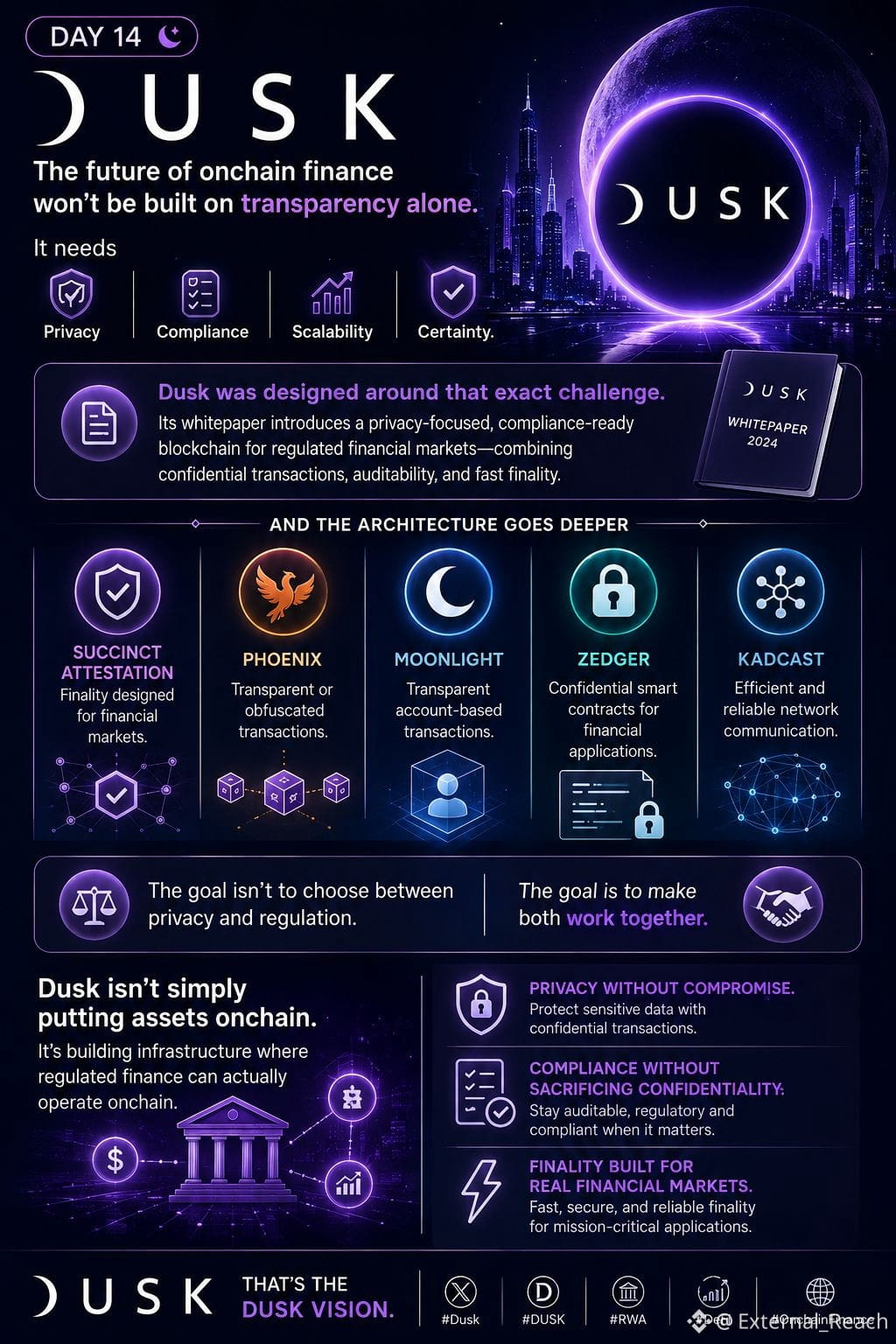
The future of onchain finance won’t be built on transparency alone.
It needs privacy. Compliance. Scalability. And certainty.
Dusk was designed around that exact challenge.
Its whitepaper introduces a privacy-focused, compliance-ready blockchain for regulated financial markets—combining confidential transactions, auditability, and fast finality.
And the architecture goes deeper:
Succinct Attestation → finality designed for financial markets
Phoenix → transparent or obfuscated transactions
Moonlight → transparent account-based transactions
Zedger → confidential smart contracts for financial applications
Kadcast → efficient and reliable network communication
The goal isn’t to choose between privacy and regulation.
The goal is to make both work together.
Dusk isn’t simply putting assets onchain.
It’s building infrastructure where regulated finance can actually operate onchain.
Privacy without compromise.
Compliance without sacrificing confidentiality.
Finality built for real financial markets.
That’s the Dusk vision.
#DUSK #RWA #DeFi #OnchainFinance
#dusk $DUSK @Dusk_Foundation
The future of onchain finance won’t be built on transparency alone.
It needs privacy. Compliance. Scalability. And certainty.
Dusk was designed around that exact challenge.
Its whitepaper introduces a privacy-focused, compliance-ready blockchain for regulated financial markets—combining confidential transactions, auditability, and fast finality.
And the architecture goes deeper:
Succinct Attestation → finality designed for financial markets
Phoenix → transparent or obfuscated transactions
Moonlight → transparent account-based transactions
Zedger → confidential smart contracts for financial applications
Kadcast → efficient and reliable network communication
The goal isn’t to choose between privacy and regulation.
The goal is to make both work together.
Dusk isn’t simply putting assets onchain.
It’s building infrastructure where regulated finance can actually operate onchain.
Privacy without compromise.
Compliance without sacrificing confidentiality.
Finality built for real financial markets.
That’s the Dusk vision.
#DUSK #RWA #DeFi #OnchainFinance
#dusk $DUSK @Dusk
It needs privacy. Compliance. Scalability. And certainty.
Dusk was designed around that exact challenge.
Its whitepaper introduces a privacy-focused, compliance-ready blockchain for regulated financial markets—combining confidential transactions, auditability, and fast finality.
And the architecture goes deeper:
Succinct Attestation → finality designed for financial markets
Phoenix → transparent or obfuscated transactions
Moonlight → transparent account-based transactions
Zedger → confidential smart contracts for financial applications
Kadcast → efficient and reliable network communication
The goal isn’t to choose between privacy and regulation.
The goal is to make both work together.
Dusk isn’t simply putting assets onchain.
It’s building infrastructure where regulated finance can actually operate onchain.
Privacy without compromise.
Compliance without sacrificing confidentiality.
Finality built for real financial markets.
That’s the Dusk vision.
#DUSK #RWA #DeFi #OnchainFinance
#dusk $DUSK @Dusk
92
Көбірек контент көру үшін кіріңіз
Binance Square платформасында әлемдік криптоқоғамдастыққа қосылыңыз
⚡️ Криптовалюта туралы ең соңғы және пайдалы ақпаратты алыңыз.
💬 Әлемдегі ең ірі криптобиржаның сеніміне ие.
👍 Расталған авторлардың нақты пікірлерін табыңыз.
Электрондық пошта/телефон нөмірі
Трендтегі тақырыптар
1
#DriftHackVictimsBeginClaims
14,112 рет көрілді
248 адам талқылап жатыр
2
#SolanaTokenizedStockVolumeTops$4.4BInSeptember
2,173 рет көрілді
32 адам талқылап жатыр
3
#BitcoinSpotETFsDraw$6.34BInflowsInQ3
10,702 рет көрілді
145 адам талқылап жатыр
4
#EthereumValidatorExitQueueJumps392%
182,247 рет көрілді
1,406 адам талқылап жатыр
5
#IMFApprovesElSalvador$138MWithBitcoinWaiver
16,701 рет көрілді
93 адам талқылап жатыр
6
#SECHaltsCryptoETFReviewsAmidFundingLapse
314,568 рет көрілді
2,209 адам талқылап жатыр
7
#ZcashETFPostsFirstWeeklyOutflow$93.6M
102,949 рет көрілді
268 адам талқылап жатыр
8
#GreekPoliceBustCryptoScamRingArrest17
432,834 рет көрілді
2,798 адам талқылап жатыр
9
#BitcoinRejectedAt$87K
236,962 рет көрілді
337 адам талқылап жатыр
10
#FedOctoberRateHikeOddsFallTo17%
449,558 рет көрілді
2,899 адам талқылап жатыр