
Ginyu The Trader
73 投稿

Ginyu The Trader
報告
ユーザーをブロック
Research & Market Insight
取引を発注
超高頻度トレーダー
5.6年
195 フォロー
22 フォロワー
17 いいね
投稿
ポートフォリオ
翻訳参照
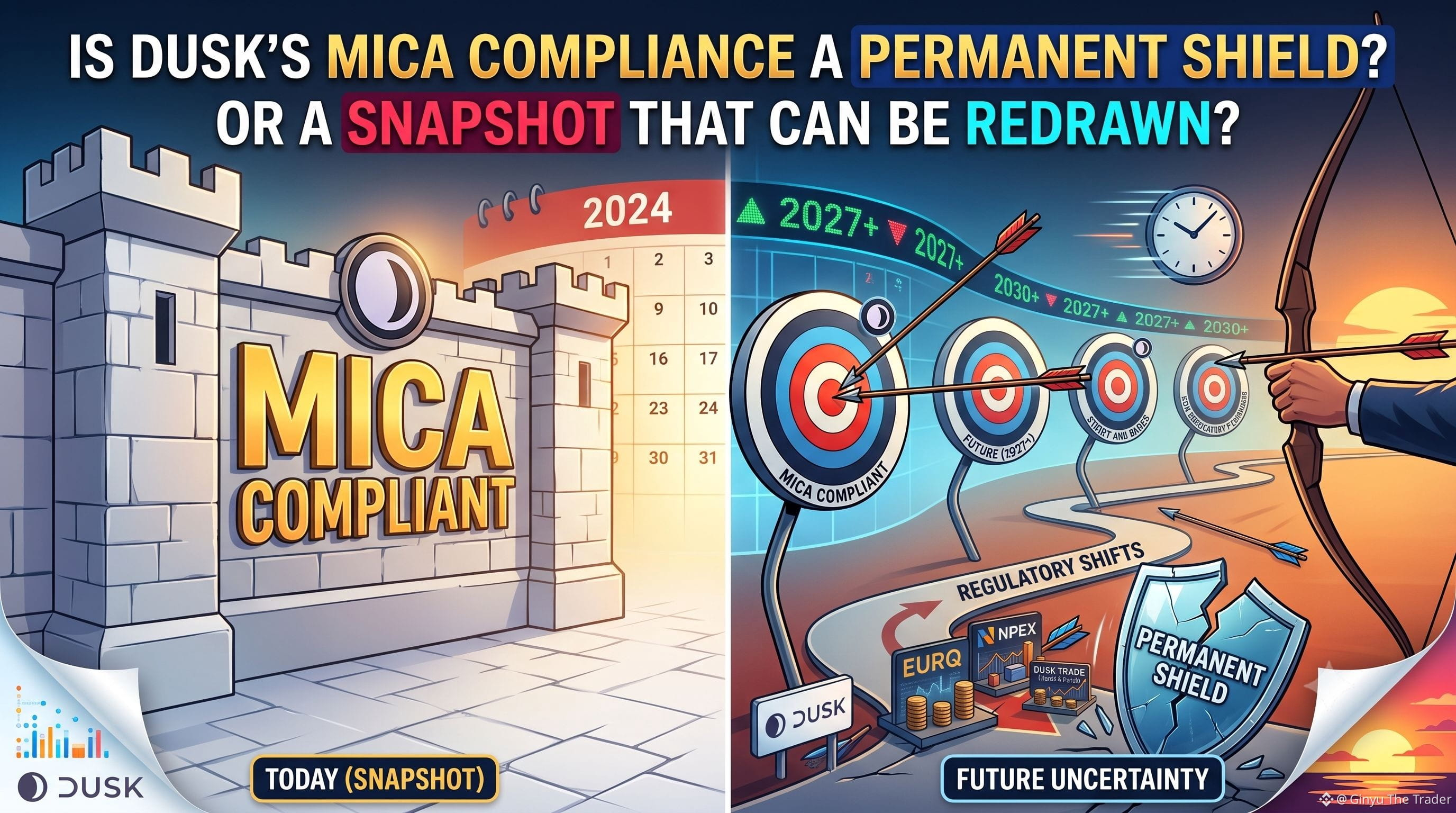
"Dusk is MiCA compliant, so it's regulator-proof." I've seen that logic used almost as a closing argument in threads about Dusk's long-term safety, and I understand the appeal. MiCA is real, binding EU law, not a marketing badge, and Dusk built genuine infrastructure around it: a compliant euro token in EURQ, securities work through NPEX's DLT Pilot Regime license, disclosure and settlement designed with MiCA's requirements in mind from the start. That's a real foundation, and it's more than most projects claiming regulatory alignment can point to when asked for specifics.
The gap in the logic is treating today's compliant status as a permanent shield rather than a snapshot of current rules. The same EU regulatory environment that gave Dusk its MiCA compliant framing is simultaneously moving in a stricter direction elsewhere: anti-money laundering rules advancing toward effectively banning privacy coin accounts across the EU by 2027, a category Dusk sits adjacent to even with Moonlight's public rail as a hedge. Rules that classify a chain as compliant one year can be rewritten the next, especially in a regulatory area as young and actively contested as crypto asset markets currently are across Europe.
I don't think this makes Dusk's compliance work meaningless, and I'd rather see a project building toward MiCA than ignoring it entirely. What I'd push back on is the certainty in "regulator-proof." Compliance is a moving target that has to be maintained continuously, not a status earned once and then locked in. Dusk's Moonlight model gives it more room to adapt than a pure privacy chain has, but adaptability isn't the same claim as permanent safety, and treating the two as identical overstates what MiCA compliance today actually guarantees about tomorrow. Products like Dusk Trade, meant to bring money market funds, bonds and other RWAs onto Dusk with real ownership and instant settlement, are exactly the kind of application that would feel a rule change first if the ground under MiCA ever shifts.
@Dusk_Foundation $DUSK #dusk
"Dusk is MiCA compliant, so it's regulator-proof." I've seen that logic used almost as a closing argument in threads about Dusk's long-term safety, and I understand the appeal. MiCA is real, binding EU law, not a marketing badge, and Dusk built genuine infrastructure around it: a compliant euro token in EURQ, securities work through NPEX's DLT Pilot Regime license, disclosure and settlement designed with MiCA's requirements in mind from the start. That's a real foundation, and it's more than most projects claiming regulatory alignment can point to when asked for specifics.
The gap in the logic is treating today's compliant status as a permanent shield rather than a snapshot of current rules. The same EU regulatory environment that gave Dusk its MiCA compliant framing is simultaneously moving in a stricter direction elsewhere: anti-money laundering rules advancing toward effectively banning privacy coin accounts across the EU by 2027, a category Dusk sits adjacent to even with Moonlight's public rail as a hedge. Rules that classify a chain as compliant one year can be rewritten the next, especially in a regulatory area as young and actively contested as crypto asset markets currently are across Europe.
I don't think this makes Dusk's compliance work meaningless, and I'd rather see a project building toward MiCA than ignoring it entirely. What I'd push back on is the certainty in "regulator-proof." Compliance is a moving target that has to be maintained continuously, not a status earned once and then locked in. Dusk's Moonlight model gives it more room to adapt than a pure privacy chain has, but adaptability isn't the same claim as permanent safety, and treating the two as identical overstates what MiCA compliance today actually guarantees about tomorrow. Products like Dusk Trade, meant to bring money market funds, bonds and other RWAs onto Dusk with real ownership and instant settlement, are exactly the kind of application that would feel a rule change first if the ground under MiCA ever shifts.
@Dusk $DUSK #dusk
The gap in the logic is treating today's compliant status as a permanent shield rather than a snapshot of current rules. The same EU regulatory environment that gave Dusk its MiCA compliant framing is simultaneously moving in a stricter direction elsewhere: anti-money laundering rules advancing toward effectively banning privacy coin accounts across the EU by 2027, a category Dusk sits adjacent to even with Moonlight's public rail as a hedge. Rules that classify a chain as compliant one year can be rewritten the next, especially in a regulatory area as young and actively contested as crypto asset markets currently are across Europe.
I don't think this makes Dusk's compliance work meaningless, and I'd rather see a project building toward MiCA than ignoring it entirely. What I'd push back on is the certainty in "regulator-proof." Compliance is a moving target that has to be maintained continuously, not a status earned once and then locked in. Dusk's Moonlight model gives it more room to adapt than a pure privacy chain has, but adaptability isn't the same claim as permanent safety, and treating the two as identical overstates what MiCA compliance today actually guarantees about tomorrow. Products like Dusk Trade, meant to bring money market funds, bonds and other RWAs onto Dusk with real ownership and instant settlement, are exactly the kind of application that would feel a rule change first if the ground under MiCA ever shifts.
@Dusk $DUSK #dusk
118
一部該当
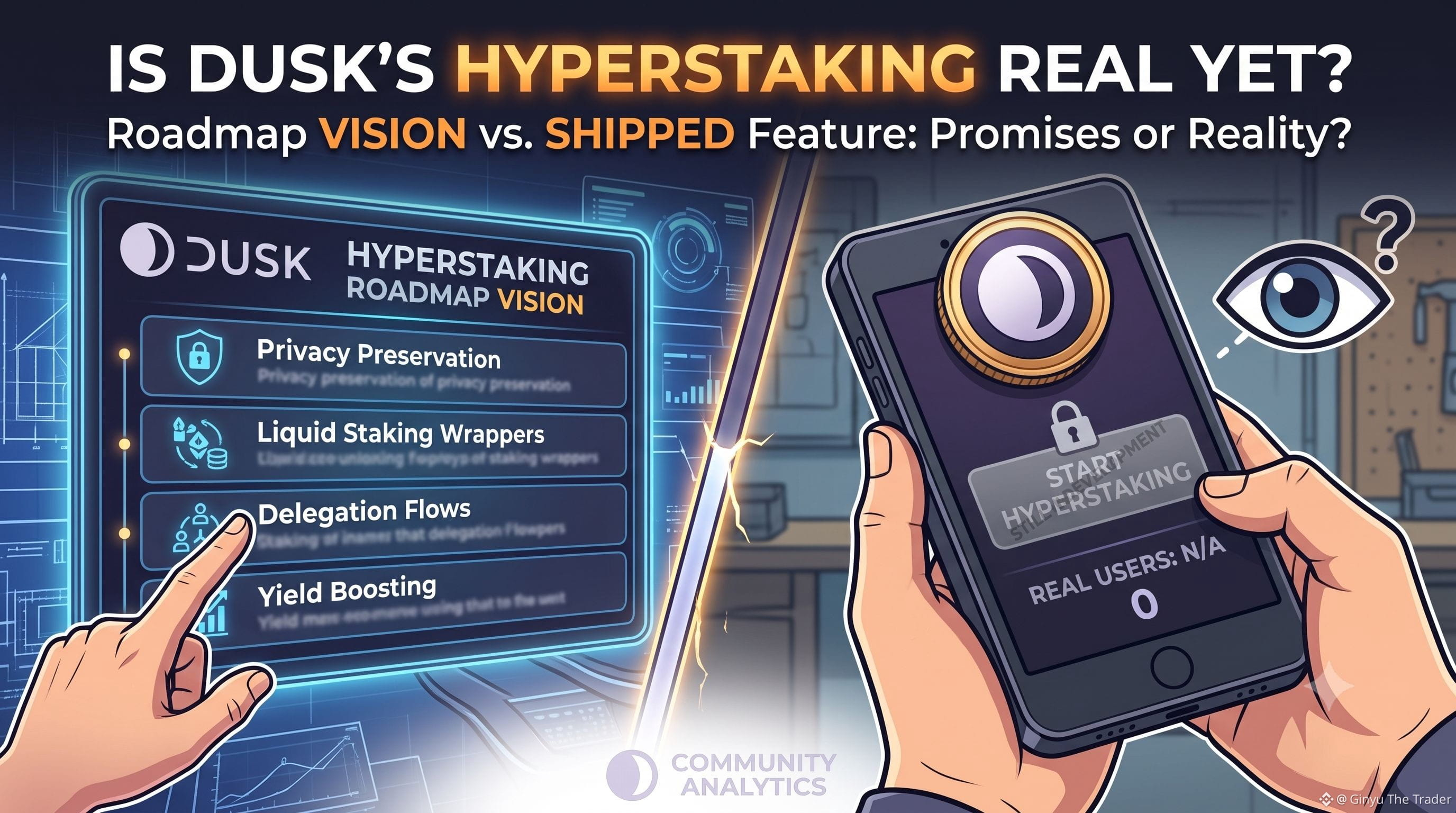
Hyperstakingは、Dusk Network自身のロードマップ上の言葉では、ステーキングのためのアカウント抽象化に近いものとして説明されている。これは、スマートコントラクトがカスタムロジックでステークを扱えるようにする新規性であり、プライバシーを保つステーキング、委任、リキッドステーキング用ラッパー、アフィリエイトプログラム、そして利回りブーストを、すべてひとつのプリミティブで実現できるとされている。その一覧を読むと、確定済みで出荷された機能というよりも、「解放」や「可能性」として描かれている部分がどれほど多いかに気づく。私は、その違いはこの機能が語られるとき、通常よりもっと注目されるべきだと思う。
プログラマブルなステーキングは空想ではない。他のチェーンでのアカウント抽象化は、実際に似たパターンを可能にしてきたので、Dusk Network版が技術的にあり得ないとみなす理由はない。だが、未来の四半期への期待を高めるために書かれたロードマップの説明と、実際のネットワーク条件のもとで、意味のある規模で、現実のステーカーがリキッドステーキング用ラッパーや委任フローを使っている、本当に出荷された機能とでは、根本的に性質が異なる。
私はこれらの主張を、これまで難しい暗号技術を実際に届けてきた点は評価できる一方で、自己設定した期限を何度も逃してきたチームからの野心的な技術的約束として受け止めるようにしている。まさに今も、DuskEVMのメインネットとHedgerプライバシーモジュールで同じパターンが見えており、どちらも約束されているのに、これを書いている時点ではまだ未着手のままだ。Hyperstakingは、ロードマップが描くすべてを解き放つかもしれない。あるいは、多くの野心的なプリミティブが実際にそうであるように、最初はより限定的なバージョンとして登場し、その後時間をかけて拡張されるのかもしれない。箇条書きの可能性の一覧ではなく、Dusk Networkのメインネット上で具体的なことを具体的に実行している実装を指し示せるようになるまでは、私はこの全体像を、期待できるが未検証なものとして、ほぼ同じ比重で見ている。
@Dusk_Foundation $DUSK #dusk
Hyperstakingは、Dusk Network自身のロードマップ上の言葉では、ステーキングのためのアカウント抽象化に近いものとして説明されている。これは、スマートコントラクトがカスタムロジックでステークを扱えるようにする新規性であり、プライバシーを保つステーキング、委任、リキッドステーキング用ラッパー、アフィリエイトプログラム、そして利回りブーストを、すべてひとつのプリミティブで実現できるとされている。その一覧を読むと、確定済みで出荷された機能というよりも、「解放」や「可能性」として描かれている部分がどれほど多いかに気づく。私は、その違いはこの機能が語られるとき、通常よりもっと注目されるべきだと思う。
プログラマブルなステーキングは空想ではない。他のチェーンでのアカウント抽象化は、実際に似たパターンを可能にしてきたので、Dusk Network版が技術的にあり得ないとみなす理由はない。だが、未来の四半期への期待を高めるために書かれたロードマップの説明と、実際のネットワーク条件のもとで、意味のある規模で、現実のステーカーがリキッドステーキング用ラッパーや委任フローを使っている、本当に出荷された機能とでは、根本的に性質が異なる。
私はこれらの主張を、これまで難しい暗号技術を実際に届けてきた点は評価できる一方で、自己設定した期限を何度も逃してきたチームからの野心的な技術的約束として受け止めるようにしている。まさに今も、DuskEVMのメインネットとHedgerプライバシーモジュールで同じパターンが見えており、どちらも約束されているのに、これを書いている時点ではまだ未着手のままだ。Hyperstakingは、ロードマップが描くすべてを解き放つかもしれない。あるいは、多くの野心的なプリミティブが実際にそうであるように、最初はより限定的なバージョンとして登場し、その後時間をかけて拡張されるのかもしれない。箇条書きの可能性の一覧ではなく、Dusk Networkのメインネット上で具体的なことを具体的に実行している実装を指し示せるようになるまでは、私はこの全体像を、期待できるが未検証なものとして、ほぼ同じ比重で見ている。
@Dusk $DUSK #dusk
プログラマブルなステーキングは空想ではない。他のチェーンでのアカウント抽象化は、実際に似たパターンを可能にしてきたので、Dusk Network版が技術的にあり得ないとみなす理由はない。だが、未来の四半期への期待を高めるために書かれたロードマップの説明と、実際のネットワーク条件のもとで、意味のある規模で、現実のステーカーがリキッドステーキング用ラッパーや委任フローを使っている、本当に出荷された機能とでは、根本的に性質が異なる。
私はこれらの主張を、これまで難しい暗号技術を実際に届けてきた点は評価できる一方で、自己設定した期限を何度も逃してきたチームからの野心的な技術的約束として受け止めるようにしている。まさに今も、DuskEVMのメインネットとHedgerプライバシーモジュールで同じパターンが見えており、どちらも約束されているのに、これを書いている時点ではまだ未着手のままだ。Hyperstakingは、ロードマップが描くすべてを解き放つかもしれない。あるいは、多くの野心的なプリミティブが実際にそうであるように、最初はより限定的なバージョンとして登場し、その後時間をかけて拡張されるのかもしれない。箇条書きの可能性の一覧ではなく、Dusk Networkのメインネット上で具体的なことを具体的に実行している実装を指し示せるようになるまでは、私はこの全体像を、期待できるが未検証なものとして、ほぼ同じ比重で見ている。
@Dusk $DUSK #dusk
1
1
92
一部該当
翻訳参照
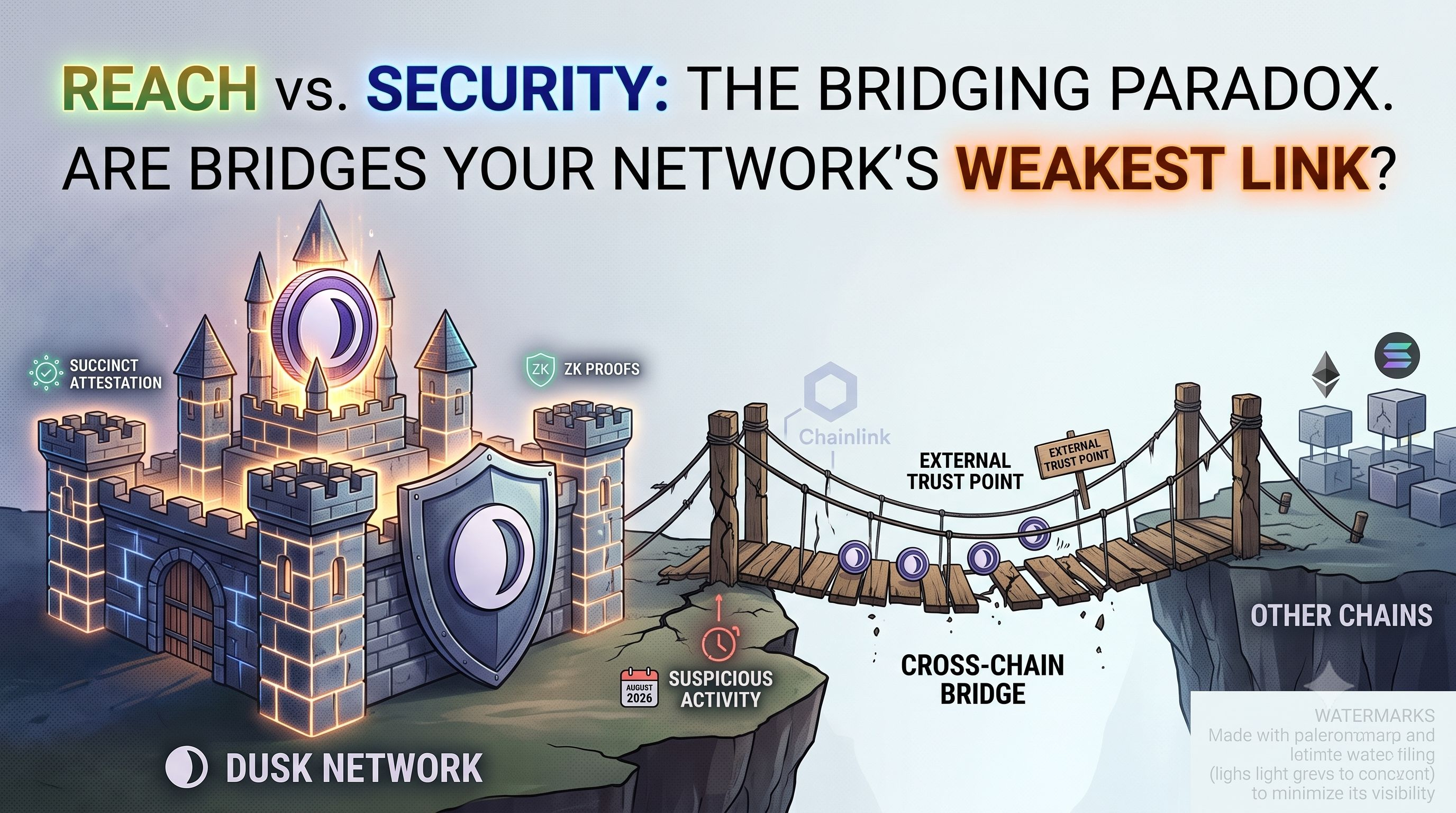
Every cross chain bridge in this industry carries the same uncomfortable truth: it is usually the least secure part of an otherwise secure system, because it has to trust something outside the system it is bridging into. Dusk Network's own base layer, Succinct Attestation for deterministic finality, zero knowledge proofs for confidential transactions, is genuinely hard to attack directly. The bridges connecting it outward, including the infrastructure recently paused after suspicious wallet activity in August 2026, are a different category of risk entirely, and I do not think that risk is unique to Dusk so much as it is unavoidable for any chain trying to be interoperable at all. The irony is hard to miss: the same bridge infrastructure now under review was meant to help carry the DuskEVM launch forward, tying the project's next milestone to a trust problem the rest of the industry has never fully solved either.
The Chainlink integration illustrates the tension well. Using CCIP to let DUSK move natively between Ethereum and Solana, and to eventually let NPEX settle a stated EUR 300 million or more of tokenized securities across chains, genuinely expands what the network can reach. It also means Dusk's security now partially depends on infrastructure it does not fully control, audited and reputable as Chainlink's design is. That is simply what interoperability costs. No bridge architecture in the industry today has a clean record proving this cost can be engineered away entirely rather than just reduced.
So is bridging fundamentally at odds with a security first brand, or just an honest trade every chain accepts once it wants reach beyond its own base layer? I lean toward the second answer, with a caveat: a project whose entire value proposition rests on trust has less room for error here than a general purpose chain does, and the August incident is a reminder of how thin that margin actually is.
@Dusk_Foundation $DUSK #dusk
Every cross chain bridge in this industry carries the same uncomfortable truth: it is usually the least secure part of an otherwise secure system, because it has to trust something outside the system it is bridging into. Dusk Network's own base layer, Succinct Attestation for deterministic finality, zero knowledge proofs for confidential transactions, is genuinely hard to attack directly. The bridges connecting it outward, including the infrastructure recently paused after suspicious wallet activity in August 2026, are a different category of risk entirely, and I do not think that risk is unique to Dusk so much as it is unavoidable for any chain trying to be interoperable at all. The irony is hard to miss: the same bridge infrastructure now under review was meant to help carry the DuskEVM launch forward, tying the project's next milestone to a trust problem the rest of the industry has never fully solved either.
The Chainlink integration illustrates the tension well. Using CCIP to let DUSK move natively between Ethereum and Solana, and to eventually let NPEX settle a stated EUR 300 million or more of tokenized securities across chains, genuinely expands what the network can reach. It also means Dusk's security now partially depends on infrastructure it does not fully control, audited and reputable as Chainlink's design is. That is simply what interoperability costs. No bridge architecture in the industry today has a clean record proving this cost can be engineered away entirely rather than just reduced.
So is bridging fundamentally at odds with a security first brand, or just an honest trade every chain accepts once it wants reach beyond its own base layer? I lean toward the second answer, with a caveat: a project whose entire value proposition rests on trust has less room for error here than a general purpose chain does, and the August incident is a reminder of how thin that margin actually is.
@Dusk $DUSK #dusk
The Chainlink integration illustrates the tension well. Using CCIP to let DUSK move natively between Ethereum and Solana, and to eventually let NPEX settle a stated EUR 300 million or more of tokenized securities across chains, genuinely expands what the network can reach. It also means Dusk's security now partially depends on infrastructure it does not fully control, audited and reputable as Chainlink's design is. That is simply what interoperability costs. No bridge architecture in the industry today has a clean record proving this cost can be engineered away entirely rather than just reduced.
So is bridging fundamentally at odds with a security first brand, or just an honest trade every chain accepts once it wants reach beyond its own base layer? I lean toward the second answer, with a caveat: a project whose entire value proposition rests on trust has less room for error here than a general purpose chain does, and the August incident is a reminder of how thin that margin actually is.
@Dusk $DUSK #dusk
79
確認済み
翻訳参照
Anyone who has traded any real size knows the discomfort of a public order book. Your position, your timing, your accumulation pattern, all visible to anyone watching, all usable against you. I do not think most onchain finance projects have taken that problem seriously. Dusk might be an exception.
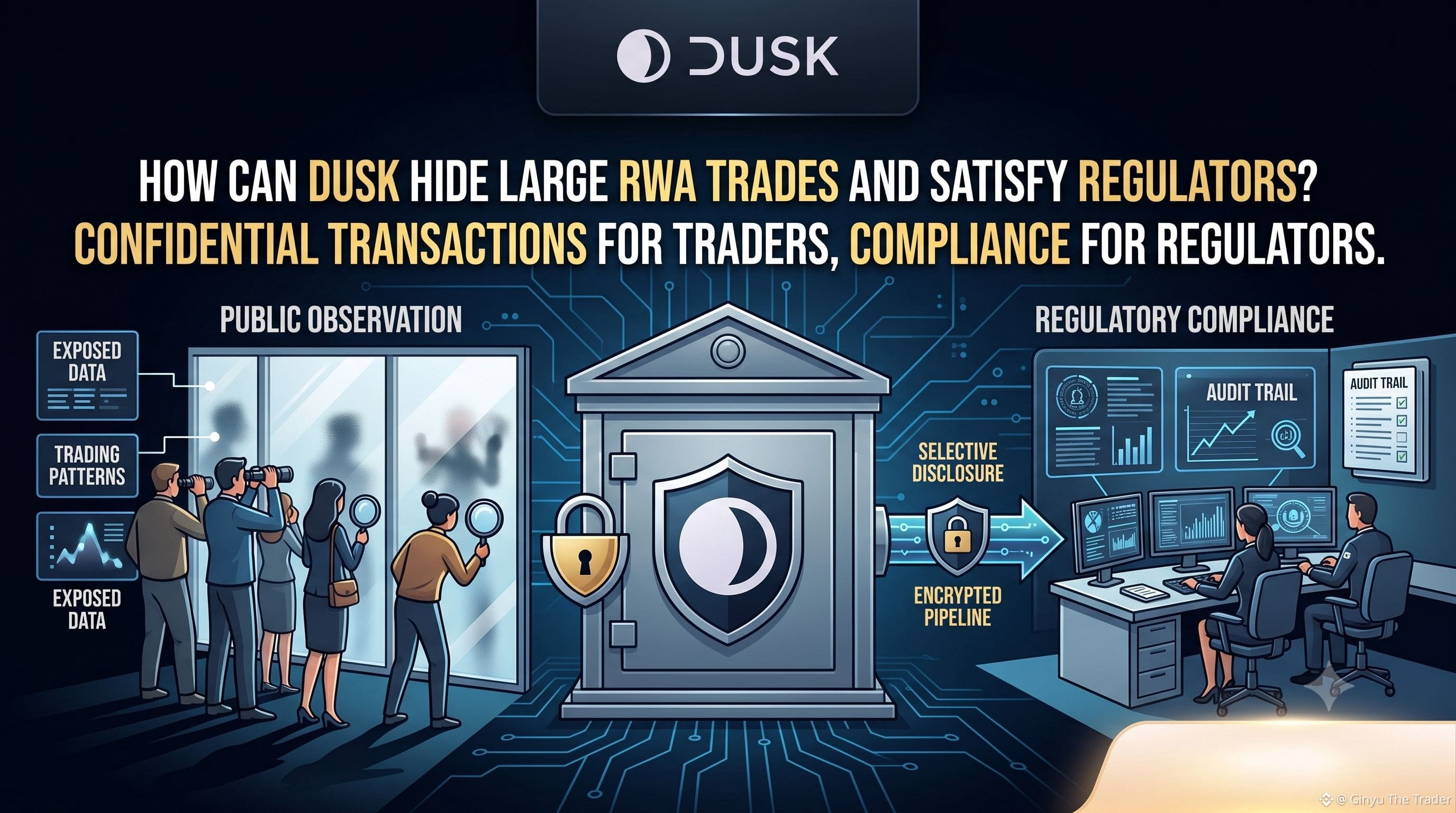
Hedger, the confidential transaction module built for DuskEVM, uses homomorphic encryption and zero knowledge proofs to keep balances and transfer amounts hidden while still letting the network verify every transaction is valid. Layered onto Dusk Trade, the neobroker Dusk is building for tokenized money market funds, ETFs, and bonds, that same confidentiality could extend to actual trading activity around real world assets, not just simple token transfers between two wallets. A large redemption or a fund rebalancing would not need to broadcast its size to every observer on chain the moment it happens, the way a fully transparent ledger forces it to today.
That is the appealing version of the story. The harder question is how much of that privacy regulators actually tolerate once real securities and real market surveillance requirements are involved. Public markets built their transparency rules for a reason, catching manipulation, insider trading, and settlement fraud, and selective disclosure has to satisfy those same concerns even while hiding information from ordinary observers. Dusk's answer is letting regulators see what they are entitled to see through disclosure mechanisms while the public sees less. Whether regulators accept that tradeoff at scale, for real securities rather than pilot programs, is not something engineering alone decides, no matter how elegant the cryptography underneath it is.
I think this is one of the more interesting open questions around Dusk Trade, not a settled feature.
@Dusk_Foundation $DUSK #dusk
Anyone who has traded any real size knows the discomfort of a public order book. Your position, your timing, your accumulation pattern, all visible to anyone watching, all usable against you. I do not think most onchain finance projects have taken that problem seriously. Dusk might be an exception.
Hedger, the confidential transaction module built for DuskEVM, uses homomorphic encryption and zero knowledge proofs to keep balances and transfer amounts hidden while still letting the network verify every transaction is valid. Layered onto Dusk Trade, the neobroker Dusk is building for tokenized money market funds, ETFs, and bonds, that same confidentiality could extend to actual trading activity around real world assets, not just simple token transfers between two wallets. A large redemption or a fund rebalancing would not need to broadcast its size to every observer on chain the moment it happens, the way a fully transparent ledger forces it to today.
That is the appealing version of the story. The harder question is how much of that privacy regulators actually tolerate once real securities and real market surveillance requirements are involved. Public markets built their transparency rules for a reason, catching manipulation, insider trading, and settlement fraud, and selective disclosure has to satisfy those same concerns even while hiding information from ordinary observers. Dusk's answer is letting regulators see what they are entitled to see through disclosure mechanisms while the public sees less. Whether regulators accept that tradeoff at scale, for real securities rather than pilot programs, is not something engineering alone decides, no matter how elegant the cryptography underneath it is.
I think this is one of the more interesting open questions around Dusk Trade, not a settled feature.
@Dusk $DUSK #dusk
Hedger, the confidential transaction module built for DuskEVM, uses homomorphic encryption and zero knowledge proofs to keep balances and transfer amounts hidden while still letting the network verify every transaction is valid. Layered onto Dusk Trade, the neobroker Dusk is building for tokenized money market funds, ETFs, and bonds, that same confidentiality could extend to actual trading activity around real world assets, not just simple token transfers between two wallets. A large redemption or a fund rebalancing would not need to broadcast its size to every observer on chain the moment it happens, the way a fully transparent ledger forces it to today.
That is the appealing version of the story. The harder question is how much of that privacy regulators actually tolerate once real securities and real market surveillance requirements are involved. Public markets built their transparency rules for a reason, catching manipulation, insider trading, and settlement fraud, and selective disclosure has to satisfy those same concerns even while hiding information from ordinary observers. Dusk's answer is letting regulators see what they are entitled to see through disclosure mechanisms while the public sees less. Whether regulators accept that tradeoff at scale, for real securities rather than pilot programs, is not something engineering alone decides, no matter how elegant the cryptography underneath it is.
I think this is one of the more interesting open questions around Dusk Trade, not a settled feature.
@Dusk $DUSK #dusk
72
翻訳参照
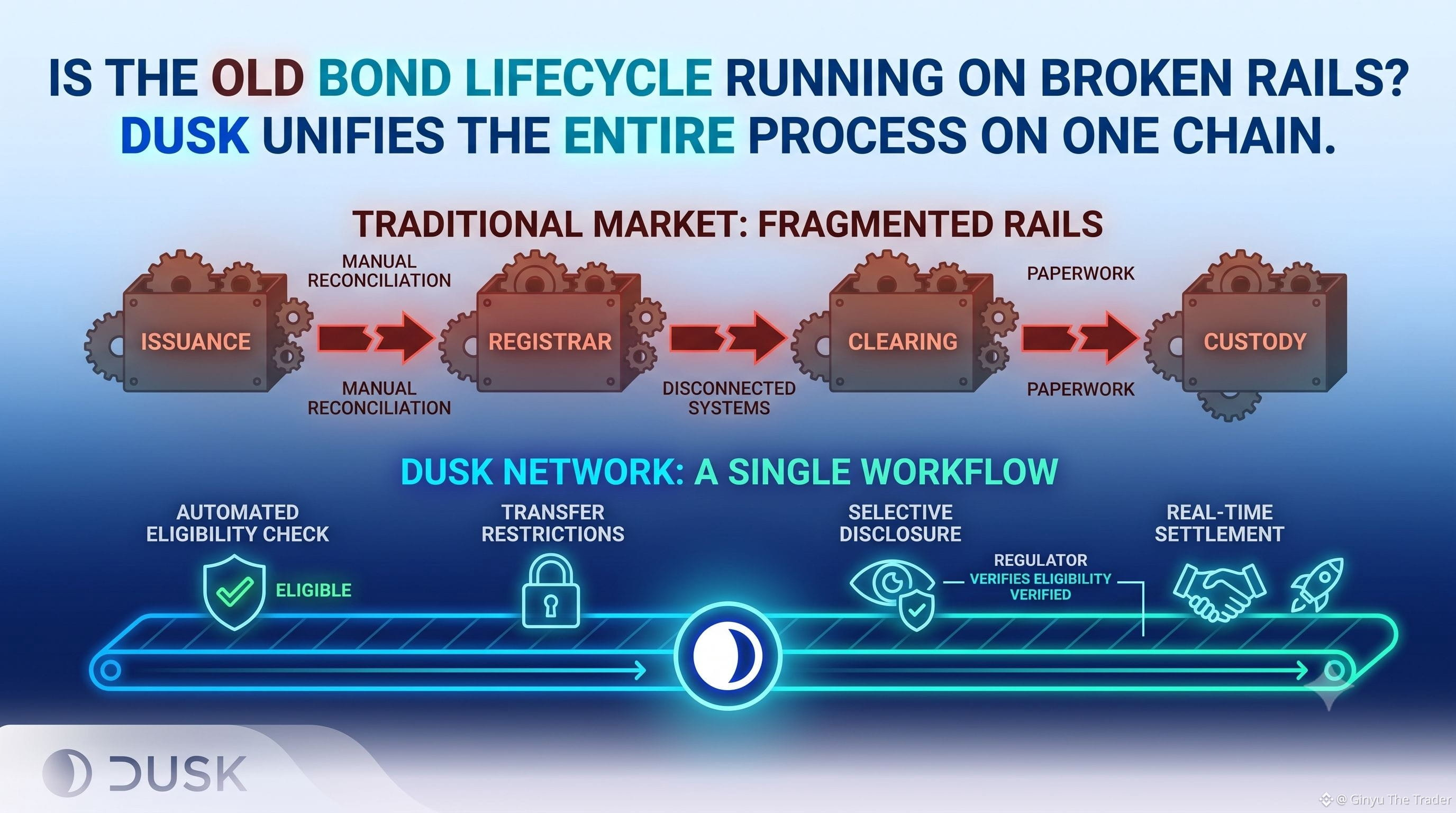
Picture the actual lifecycle of a regulated bond for a second, not the token, the whole process. Someone issues it. Investors get checked for eligibility. It changes hands over time. Disclosures get filed. Eventually it settles or matures. In traditional markets, that lifecycle runs across a handful of disconnected systems, a registrar here, a clearinghouse there, custody somewhere else, each reconciling with the others through processes that are slow largely because they were never designed to talk to each other in real time.
What Dusk Network is positioning itself to support is that entire lifecycle as one coordinated workflow instead. Eligibility, transfer restrictions, and disclosure requirements can live inside the asset's own onchain logic, with deterministic settlement handling the finality piece, rather than each stage living in a separate system passing paperwork to the next one.
Selective disclosure does real work inside that lifecycle too, not just at the settlement stage. A regulator verifying compliance, an auditor checking a disclosure filing, a counterparty confirming eligibility: each of those checks can happen against the same onchain record without exposing the full history to everyone else holding the asset, a meaningfully different starting point than most legacy registrars were ever built around.
That's a genuinely different design philosophy than most tokenization efforts, which usually digitize one piece of the lifecycle, issuance, say, while leaving everything else running on the old rails underneath it.
The honest caveat is that this only becomes real once institutions and venues actually build specific products on top of the capability, with the licensing and authorization to match. A unified workflow sitting unused is still just a specification. I'm curious to see the first full lifecycle, issuance through eventual settlement, actually run end to end on this rather than described in the abstract.
@Dusk_Foundation $DUSK #dusk
Picture the actual lifecycle of a regulated bond for a second, not the token, the whole process. Someone issues it. Investors get checked for eligibility. It changes hands over time. Disclosures get filed. Eventually it settles or matures. In traditional markets, that lifecycle runs across a handful of disconnected systems, a registrar here, a clearinghouse there, custody somewhere else, each reconciling with the others through processes that are slow largely because they were never designed to talk to each other in real time.
What Dusk Network is positioning itself to support is that entire lifecycle as one coordinated workflow instead. Eligibility, transfer restrictions, and disclosure requirements can live inside the asset's own onchain logic, with deterministic settlement handling the finality piece, rather than each stage living in a separate system passing paperwork to the next one.
Selective disclosure does real work inside that lifecycle too, not just at the settlement stage. A regulator verifying compliance, an auditor checking a disclosure filing, a counterparty confirming eligibility: each of those checks can happen against the same onchain record without exposing the full history to everyone else holding the asset, a meaningfully different starting point than most legacy registrars were ever built around.
That's a genuinely different design philosophy than most tokenization efforts, which usually digitize one piece of the lifecycle, issuance, say, while leaving everything else running on the old rails underneath it.
The honest caveat is that this only becomes real once institutions and venues actually build specific products on top of the capability, with the licensing and authorization to match. A unified workflow sitting unused is still just a specification. I'm curious to see the first full lifecycle, issuance through eventual settlement, actually run end to end on this rather than described in the abstract.
@Dusk $DUSK #dusk
What Dusk Network is positioning itself to support is that entire lifecycle as one coordinated workflow instead. Eligibility, transfer restrictions, and disclosure requirements can live inside the asset's own onchain logic, with deterministic settlement handling the finality piece, rather than each stage living in a separate system passing paperwork to the next one.
Selective disclosure does real work inside that lifecycle too, not just at the settlement stage. A regulator verifying compliance, an auditor checking a disclosure filing, a counterparty confirming eligibility: each of those checks can happen against the same onchain record without exposing the full history to everyone else holding the asset, a meaningfully different starting point than most legacy registrars were ever built around.
That's a genuinely different design philosophy than most tokenization efforts, which usually digitize one piece of the lifecycle, issuance, say, while leaving everything else running on the old rails underneath it.
The honest caveat is that this only becomes real once institutions and venues actually build specific products on top of the capability, with the licensing and authorization to match. A unified workflow sitting unused is still just a specification. I'm curious to see the first full lifecycle, issuance through eventual settlement, actually run end to end on this rather than described in the abstract.
@Dusk $DUSK #dusk
95
確認済み
翻訳参照
#dusk $DUSK @Dusk_Foundation
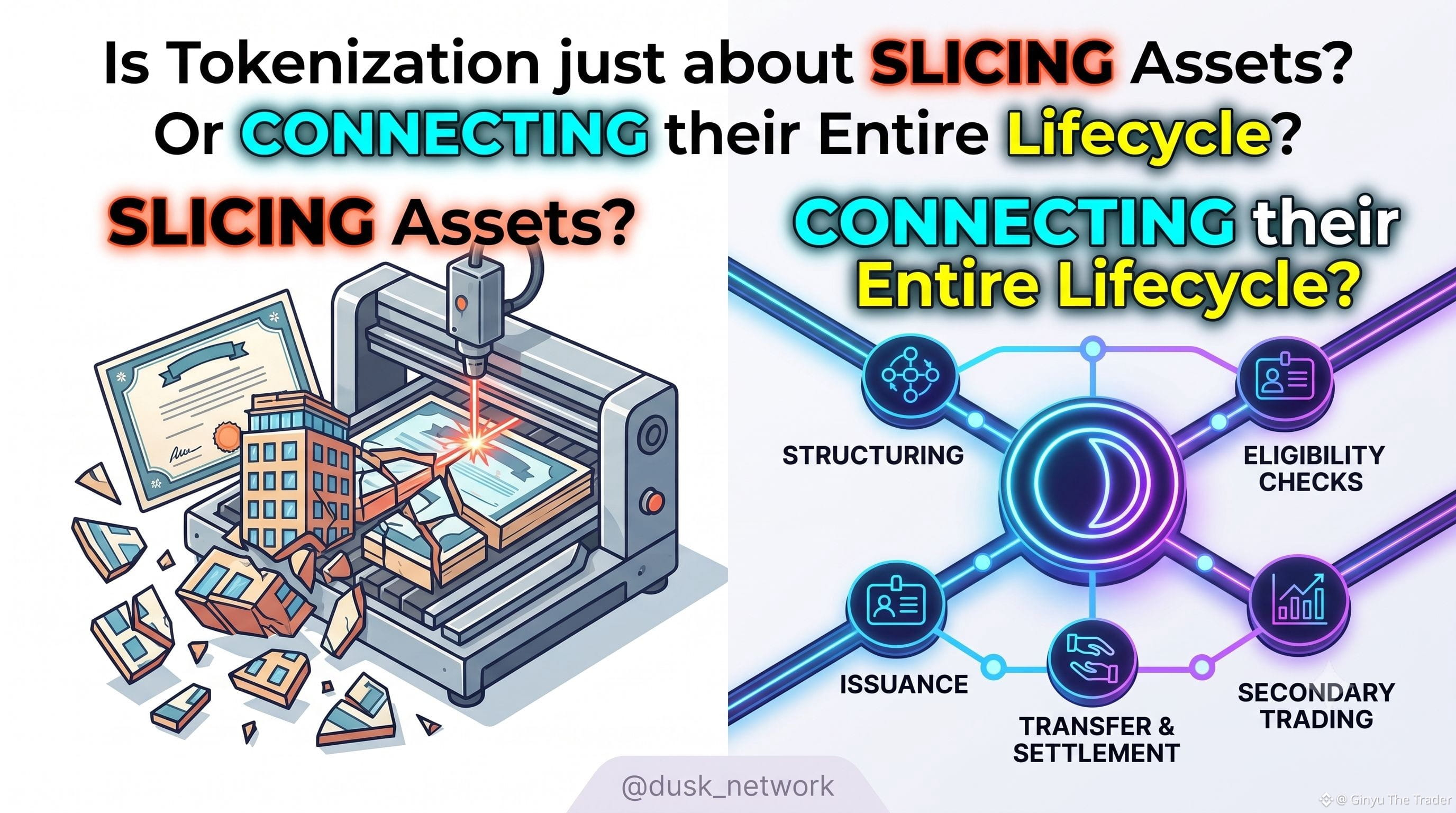
Most tokenization pitches lean hard on fractionalization, slice an asset into smaller pieces and liquidity magically follows. Dusk Network's own writing on the subject, published in August 2026, pushes back on that assumption directly, and I found the honesty refreshing enough to dig into.
The actual argument is that tokenization creates value by connecting a full ownership lifecycle, structuring, investor eligibility checks, subscription and issuance, transfer and settlement, servicing and corporate actions, and secondary trading, around one shared, controlled record instead of scattering it across separate systems that need constant reconciliation. Smaller unit sizes alone do not create investor demand or legal certainty, just smaller pieces of the same fragmented process.
One specific example is worth repeating: transferring shares in a Dutch private limited company still legally requires a notarial deed. A token representing that share does not remove that requirement, it has to sit alongside it, which is exactly the kind of detail that separates a serious tokenization framework from a marketing deck. The same document treats investor onboarding just as plainly, noting that verified eligibility can be referenced across issuance and transfer without re proving it each time, while the due diligence and sanctions screening behind that verification still sit squarely with accountable, licensed operators.
What I respect most is what the piece admits tokenization cannot do. It cannot decide which laws apply, replace the issuer or notary, or manufacture buyers and sellers where none exist. Compliance and liquidity still depend entirely on the institutions around the token, not the token itself. That is a rare admission from a project with an obvious incentive to oversell the technology, and it is exactly why I trust the rest of the claim more. Downstream, a neobroker venue like Dusk Trade is meant to be where that verified inventory reaches investors, not just where it gets structured.
#dusk $DUSK @Dusk
Most tokenization pitches lean hard on fractionalization, slice an asset into smaller pieces and liquidity magically follows. Dusk Network's own writing on the subject, published in August 2026, pushes back on that assumption directly, and I found the honesty refreshing enough to dig into.
The actual argument is that tokenization creates value by connecting a full ownership lifecycle, structuring, investor eligibility checks, subscription and issuance, transfer and settlement, servicing and corporate actions, and secondary trading, around one shared, controlled record instead of scattering it across separate systems that need constant reconciliation. Smaller unit sizes alone do not create investor demand or legal certainty, just smaller pieces of the same fragmented process.
One specific example is worth repeating: transferring shares in a Dutch private limited company still legally requires a notarial deed. A token representing that share does not remove that requirement, it has to sit alongside it, which is exactly the kind of detail that separates a serious tokenization framework from a marketing deck. The same document treats investor onboarding just as plainly, noting that verified eligibility can be referenced across issuance and transfer without re proving it each time, while the due diligence and sanctions screening behind that verification still sit squarely with accountable, licensed operators.
What I respect most is what the piece admits tokenization cannot do. It cannot decide which laws apply, replace the issuer or notary, or manufacture buyers and sellers where none exist. Compliance and liquidity still depend entirely on the institutions around the token, not the token itself. That is a rare admission from a project with an obvious incentive to oversell the technology, and it is exactly why I trust the rest of the claim more. Downstream, a neobroker venue like Dusk Trade is meant to be where that verified inventory reaches investors, not just where it gets structured.
Most tokenization pitches lean hard on fractionalization, slice an asset into smaller pieces and liquidity magically follows. Dusk Network's own writing on the subject, published in August 2026, pushes back on that assumption directly, and I found the honesty refreshing enough to dig into.
The actual argument is that tokenization creates value by connecting a full ownership lifecycle, structuring, investor eligibility checks, subscription and issuance, transfer and settlement, servicing and corporate actions, and secondary trading, around one shared, controlled record instead of scattering it across separate systems that need constant reconciliation. Smaller unit sizes alone do not create investor demand or legal certainty, just smaller pieces of the same fragmented process.
One specific example is worth repeating: transferring shares in a Dutch private limited company still legally requires a notarial deed. A token representing that share does not remove that requirement, it has to sit alongside it, which is exactly the kind of detail that separates a serious tokenization framework from a marketing deck. The same document treats investor onboarding just as plainly, noting that verified eligibility can be referenced across issuance and transfer without re proving it each time, while the due diligence and sanctions screening behind that verification still sit squarely with accountable, licensed operators.
What I respect most is what the piece admits tokenization cannot do. It cannot decide which laws apply, replace the issuer or notary, or manufacture buyers and sellers where none exist. Compliance and liquidity still depend entirely on the institutions around the token, not the token itself. That is a rare admission from a project with an obvious incentive to oversell the technology, and it is exactly why I trust the rest of the claim more. Downstream, a neobroker venue like Dusk Trade is meant to be where that verified inventory reaches investors, not just where it gets structured.
69
#binancep2pantoan @Binance_Vietnam
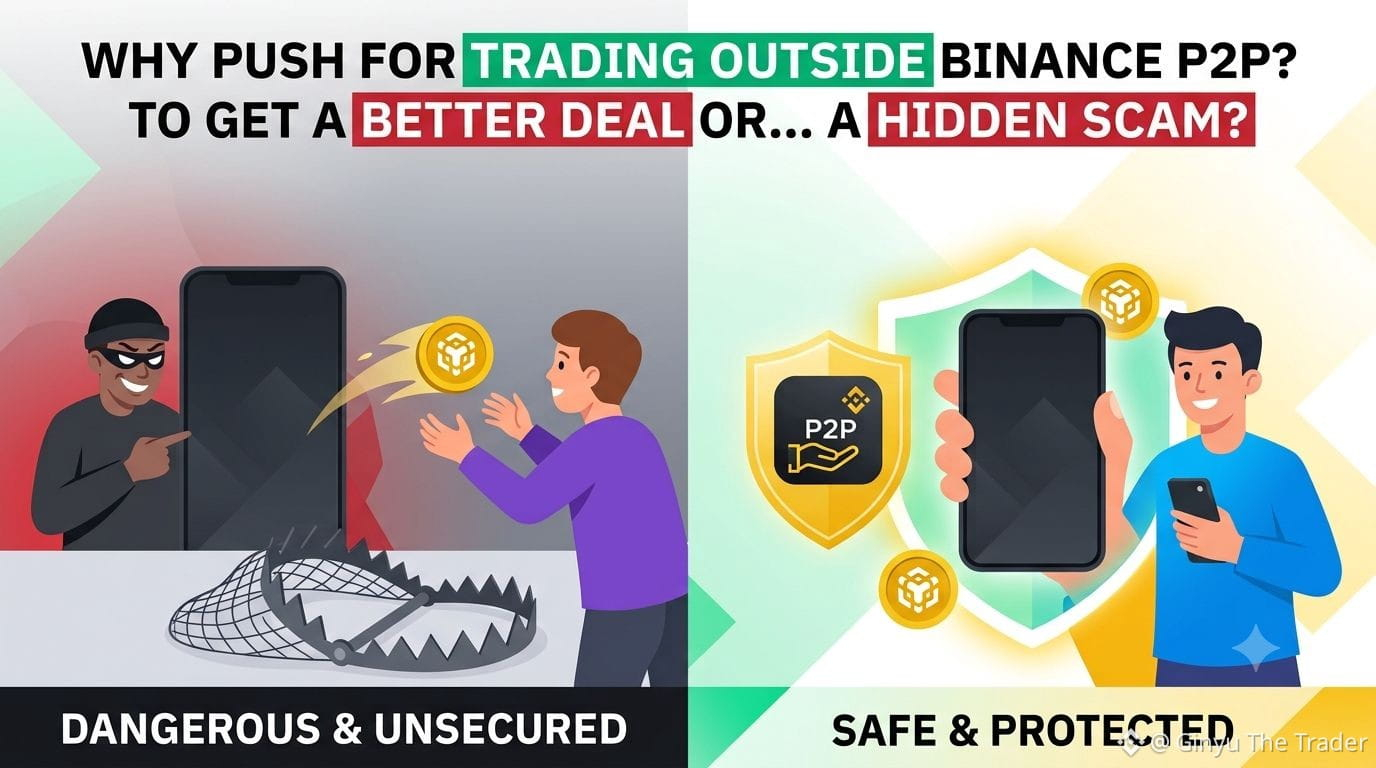
最近よく見かけるようになったある手口として、Binance P2Pの外で暗号資産を取引しようと誘ってくるケースがあります。多くは「手数料が安くなる」「市場より良い価格で買える」といった言い訳付きです。私は、同様のオファーに遭遇したいくつかの経験をもとに、なぜそれがほとんどの場合罠なのかを分解して説明します。
論理的に言えば、Binance P2Pの手数料は、プラットフォーム外で取引するリスクを負うほど高いわけではありません。したがって、かなり有利なレートを約束されるたびに、まず自分に問いかけるのは「この親切さの本当の動機は何だろう?」という点です。
私が観察した限りでは、多くのケースで状況はお決まりのパターンに沿っています。詐欺師は、いくつかの親しげなメッセージで信頼を築き、場合によっては、信ぴょう性を持たせるために、他の人との過去の取引を装ったスクリーンショットまで送ってくることがあります。その後「時間を節約できる」「結局お互いを信頼する必要がある」などの理由を使って、被害者に先にお金や暗号資産を送らせようとします。
こうした場面で共通しているサインはいつも同じです。Binance P2Pから離れる理由があり、すぐに行動するよう圧力がかかり、保護の仕組みが一切ない状態で、一方が先に送金するよう求められます。エスクロー(預かり)も、記録された取引履歴もなく、紛争を申し立てる手段もないため、損失がほぼ確実に、誤った相手を信じてしまった側にのしかかります。
詐欺師は、初心者を狙うことが多いとも感じています。標準的な手順に不慣れで、すでに確立されている安全なステップに従うより、魅力的な条件の約束に簡単に流されやすいからです。
#binancep2pantoan @Binance Vietnam
最近よく見かけるようになったある手口として、Binance P2Pの外で暗号資産を取引しようと誘ってくるケースがあります。多くは「手数料が安くなる」「市場より良い価格で買える」といった言い訳付きです。私は、同様のオファーに遭遇したいくつかの経験をもとに、なぜそれがほとんどの場合罠なのかを分解して説明します。
論理的に言えば、Binance P2Pの手数料は、プラットフォーム外で取引するリスクを負うほど高いわけではありません。したがって、かなり有利なレートを約束されるたびに、まず自分に問いかけるのは「この親切さの本当の動機は何だろう?」という点です。
私が観察した限りでは、多くのケースで状況はお決まりのパターンに沿っています。詐欺師は、いくつかの親しげなメッセージで信頼を築き、場合によっては、信ぴょう性を持たせるために、他の人との過去の取引を装ったスクリーンショットまで送ってくることがあります。その後「時間を節約できる」「結局お互いを信頼する必要がある」などの理由を使って、被害者に先にお金や暗号資産を送らせようとします。
こうした場面で共通しているサインはいつも同じです。Binance P2Pから離れる理由があり、すぐに行動するよう圧力がかかり、保護の仕組みが一切ない状態で、一方が先に送金するよう求められます。エスクロー(預かり)も、記録された取引履歴もなく、紛争を申し立てる手段もないため、損失がほぼ確実に、誤った相手を信じてしまった側にのしかかります。
詐欺師は、初心者を狙うことが多いとも感じています。標準的な手順に不慣れで、すでに確立されている安全なステップに従うより、魅力的な条件の約束に簡単に流されやすいからです。
最近よく見かけるようになったある手口として、Binance P2Pの外で暗号資産を取引しようと誘ってくるケースがあります。多くは「手数料が安くなる」「市場より良い価格で買える」といった言い訳付きです。私は、同様のオファーに遭遇したいくつかの経験をもとに、なぜそれがほとんどの場合罠なのかを分解して説明します。
論理的に言えば、Binance P2Pの手数料は、プラットフォーム外で取引するリスクを負うほど高いわけではありません。したがって、かなり有利なレートを約束されるたびに、まず自分に問いかけるのは「この親切さの本当の動機は何だろう?」という点です。
私が観察した限りでは、多くのケースで状況はお決まりのパターンに沿っています。詐欺師は、いくつかの親しげなメッセージで信頼を築き、場合によっては、信ぴょう性を持たせるために、他の人との過去の取引を装ったスクリーンショットまで送ってくることがあります。その後「時間を節約できる」「結局お互いを信頼する必要がある」などの理由を使って、被害者に先にお金や暗号資産を送らせようとします。
こうした場面で共通しているサインはいつも同じです。Binance P2Pから離れる理由があり、すぐに行動するよう圧力がかかり、保護の仕組みが一切ない状態で、一方が先に送金するよう求められます。エスクロー(預かり)も、記録された取引履歴もなく、紛争を申し立てる手段もないため、損失がほぼ確実に、誤った相手を信じてしまった側にのしかかります。
詐欺師は、初心者を狙うことが多いとも感じています。標準的な手順に不慣れで、すでに確立されている安全なステップに従うより、魅力的な条件の約束に簡単に流されやすいからです。
62
確認済み
翻訳参照
#dusk $DUSK @Dusk_Foundation
I'm not going to write a series about Dusk Network and skip the bad news. On January 16, 2026, an attacker exploited Dusk Network's bridge connecting to the EVM ecosystem, and millions of DUSK tokens were stolen and moved onto BNB Smart Chain before the bridge got shut down.
As far as public reporting shows: the root cause traced to a compromised signing wallet used by the bridge service, not a flaw in Dusk Network's core consensus protocol, Succinct Attestation, or the settlement layer itself. That distinction matters technically. Bridges are notoriously the weakest link across almost every blockchain ecosystem, precisely because they require an external signing mechanism to move value between two systems that don't natively trust each other.
But I want to push back on treating it wasn't the core protocol as a full excuse. Dusk Network is trying to win the trust of banks and regulated asset issuers, people who tokenize hundreds of millions of euros through NPEX and expect institutional-grade security across the entire stack. A compromised signing wallet on infrastructure Dusk Network operates or endorses is still its problem to own publicly and fix, likely with multi-party computation or hardware security modules instead of a single signing key near that much value.
None of this touches the core pitch, either: confidentiality where it counts, transparency where it doesn't, proof on demand for a regulator, and settlement finality you can actually trust. But a bridge compromise still tests whether that broader promise holds up end to end, not just at the protocol layer.
What I actually want to see next isn't a press release calling this resolved. I want a public post-mortem with specifics, and evidence the bridge architecture changed, not just its branding. Institutions considering Dusk Network for real settlement will judge the response as closely as they judge the uptime since.
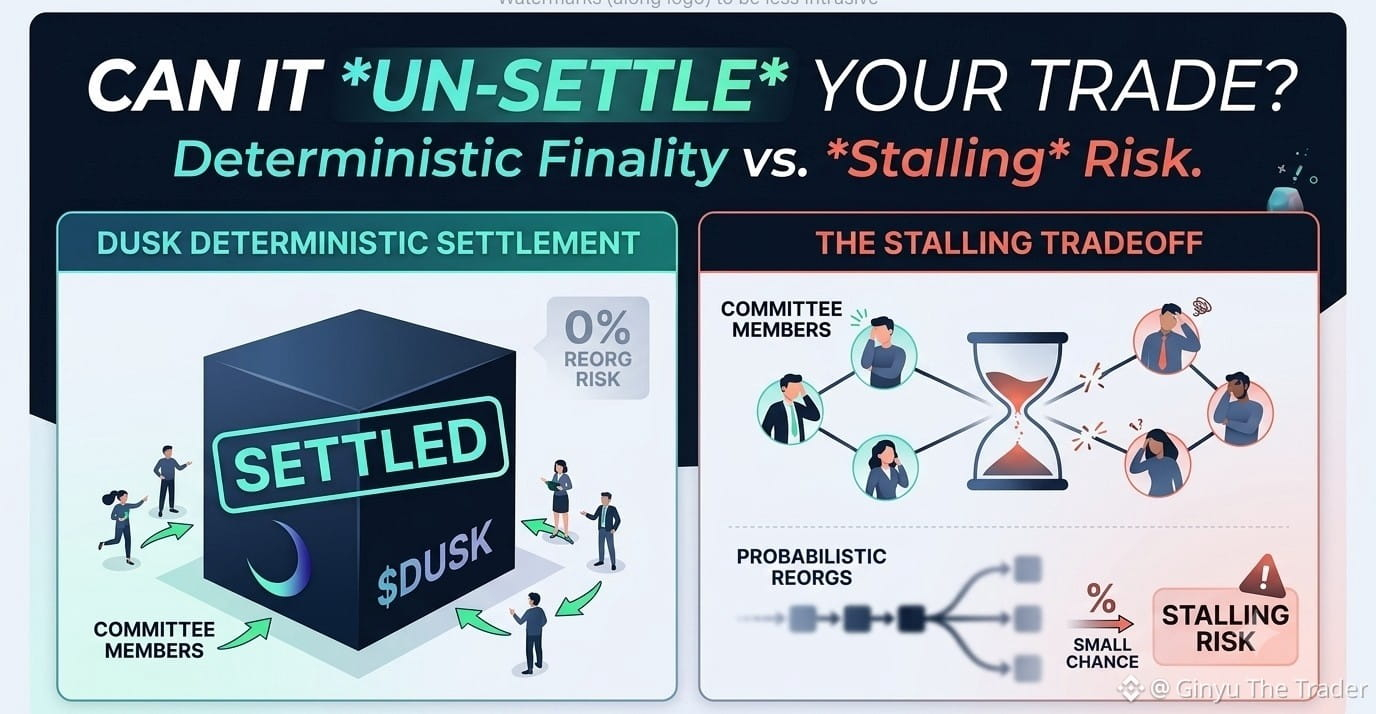
Calling one design superior ignores that both manage risk. Dusk Network accepted reorgs instead of liveness strain, a deliberate engineering choice.
#dusk $DUSK @Dusk
I'm not going to write a series about Dusk Network and skip the bad news. On January 16, 2026, an attacker exploited Dusk Network's bridge connecting to the EVM ecosystem, and millions of DUSK tokens were stolen and moved onto BNB Smart Chain before the bridge got shut down.
As far as public reporting shows: the root cause traced to a compromised signing wallet used by the bridge service, not a flaw in Dusk Network's core consensus protocol, Succinct Attestation, or the settlement layer itself. That distinction matters technically. Bridges are notoriously the weakest link across almost every blockchain ecosystem, precisely because they require an external signing mechanism to move value between two systems that don't natively trust each other.
But I want to push back on treating it wasn't the core protocol as a full excuse. Dusk Network is trying to win the trust of banks and regulated asset issuers, people who tokenize hundreds of millions of euros through NPEX and expect institutional-grade security across the entire stack. A compromised signing wallet on infrastructure Dusk Network operates or endorses is still its problem to own publicly and fix, likely with multi-party computation or hardware security modules instead of a single signing key near that much value.
None of this touches the core pitch, either: confidentiality where it counts, transparency where it doesn't, proof on demand for a regulator, and settlement finality you can actually trust. But a bridge compromise still tests whether that broader promise holds up end to end, not just at the protocol layer.
What I actually want to see next isn't a press release calling this resolved. I want a public post-mortem with specifics, and evidence the bridge architecture changed, not just its branding. Institutions considering Dusk Network for real settlement will judge the response as closely as they judge the uptime since.
Calling one design superior ignores that both manage risk. Dusk Network accepted reorgs instead of liveness strain, a deliberate engineering choice.
I'm not going to write a series about Dusk Network and skip the bad news. On January 16, 2026, an attacker exploited Dusk Network's bridge connecting to the EVM ecosystem, and millions of DUSK tokens were stolen and moved onto BNB Smart Chain before the bridge got shut down.
As far as public reporting shows: the root cause traced to a compromised signing wallet used by the bridge service, not a flaw in Dusk Network's core consensus protocol, Succinct Attestation, or the settlement layer itself. That distinction matters technically. Bridges are notoriously the weakest link across almost every blockchain ecosystem, precisely because they require an external signing mechanism to move value between two systems that don't natively trust each other.
But I want to push back on treating it wasn't the core protocol as a full excuse. Dusk Network is trying to win the trust of banks and regulated asset issuers, people who tokenize hundreds of millions of euros through NPEX and expect institutional-grade security across the entire stack. A compromised signing wallet on infrastructure Dusk Network operates or endorses is still its problem to own publicly and fix, likely with multi-party computation or hardware security modules instead of a single signing key near that much value.
None of this touches the core pitch, either: confidentiality where it counts, transparency where it doesn't, proof on demand for a regulator, and settlement finality you can actually trust. But a bridge compromise still tests whether that broader promise holds up end to end, not just at the protocol layer.
What I actually want to see next isn't a press release calling this resolved. I want a public post-mortem with specifics, and evidence the bridge architecture changed, not just its branding. Institutions considering Dusk Network for real settlement will judge the response as closely as they judge the uptime since.
Calling one design superior ignores that both manage risk. Dusk Network accepted reorgs instead of liveness strain, a deliberate engineering choice.
78
確認済み
翻訳参照
#dusk $DUSK @Dusk_Foundation
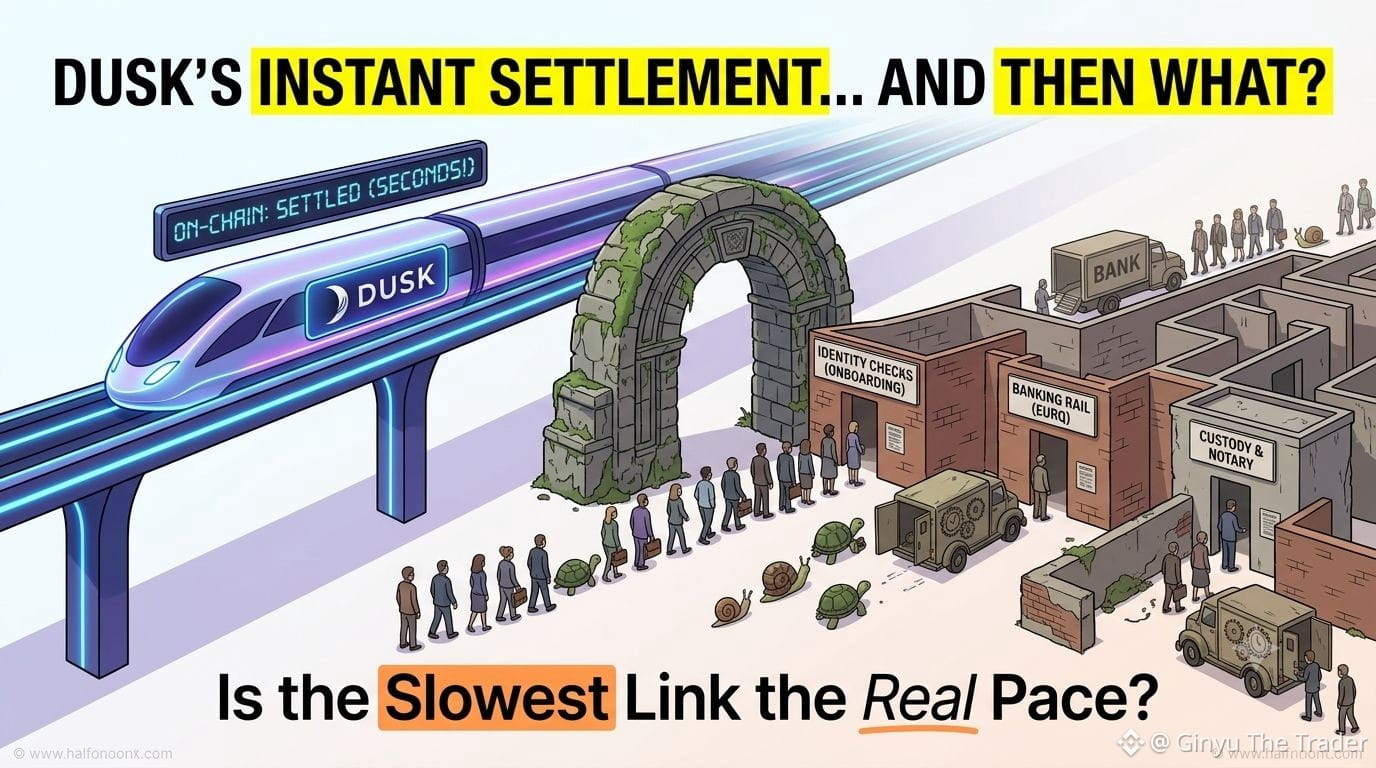
Settlement in seconds instead of days" is the number that gets repeated most about Dusk Network, and it is accurate about the part of the process the chain actually controls. It says less than it sounds like about the process as a whole.
Once a transaction reaches Dusk's consensus layer, Succinct Attestation really does finalize it quickly, without the multi-day settlement cycles that traditional securities markets still run on for legacy operational reasons. That is a legitimate improvement and the core technical achievement behind Dusk Trade's pitch to regulated venues. But a real securities trade involves more steps than the on-chain settlement instant, and several of them still move at pre-blockchain speed.
Investor eligibility has to be checked, often against onboarding done through a licensed partner's own process. Payment has to actually happen too. Dusk's own payment rail, built with Quantoz around a euro-denominated electronic money token called EURQ, exists specifically to close that gap on the payment leg, but it still depends on banking infrastructure and issuer processes that operate on their own timelines, not on Succinct Attestation's. Depending on the asset, a custodian or notarial step outside the chain may still apply, the way Dusk Network's own material acknowledges for certain company structures. Everyone of those steps can be slower than the seconds it takes DuskDS to finalize a block.
None of this is a knock on the consensus engineering, which genuinely solves the part it targets. It is a reminder that a headline settlement time describes one link in a longer chain, and the slowest link still sets the real pace until the surrounding workflow catches up to what the base layer can already do. Chainlink's data and cross-chain infrastructure, which Dusk has integrated for interoperability and market data, helps synchronize some of that surrounding workflow across networks, but it does not collapse identity checks or banking rails into a matter of seconds just because the settlement layer underneath already got there.
#dusk $DUSK @Dusk
Settlement in seconds instead of days" is the number that gets repeated most about Dusk Network, and it is accurate about the part of the process the chain actually controls. It says less than it sounds like about the process as a whole.
Once a transaction reaches Dusk's consensus layer, Succinct Attestation really does finalize it quickly, without the multi-day settlement cycles that traditional securities markets still run on for legacy operational reasons. That is a legitimate improvement and the core technical achievement behind Dusk Trade's pitch to regulated venues. But a real securities trade involves more steps than the on-chain settlement instant, and several of them still move at pre-blockchain speed.
Investor eligibility has to be checked, often against onboarding done through a licensed partner's own process. Payment has to actually happen too. Dusk's own payment rail, built with Quantoz around a euro-denominated electronic money token called EURQ, exists specifically to close that gap on the payment leg, but it still depends on banking infrastructure and issuer processes that operate on their own timelines, not on Succinct Attestation's. Depending on the asset, a custodian or notarial step outside the chain may still apply, the way Dusk Network's own material acknowledges for certain company structures. Everyone of those steps can be slower than the seconds it takes DuskDS to finalize a block.
None of this is a knock on the consensus engineering, which genuinely solves the part it targets. It is a reminder that a headline settlement time describes one link in a longer chain, and the slowest link still sets the real pace until the surrounding workflow catches up to what the base layer can already do. Chainlink's data and cross-chain infrastructure, which Dusk has integrated for interoperability and market data, helps synchronize some of that surrounding workflow across networks, but it does not collapse identity checks or banking rails into a matter of seconds just because the settlement layer underneath already got there.
Settlement in seconds instead of days" is the number that gets repeated most about Dusk Network, and it is accurate about the part of the process the chain actually controls. It says less than it sounds like about the process as a whole.
Once a transaction reaches Dusk's consensus layer, Succinct Attestation really does finalize it quickly, without the multi-day settlement cycles that traditional securities markets still run on for legacy operational reasons. That is a legitimate improvement and the core technical achievement behind Dusk Trade's pitch to regulated venues. But a real securities trade involves more steps than the on-chain settlement instant, and several of them still move at pre-blockchain speed.
Investor eligibility has to be checked, often against onboarding done through a licensed partner's own process. Payment has to actually happen too. Dusk's own payment rail, built with Quantoz around a euro-denominated electronic money token called EURQ, exists specifically to close that gap on the payment leg, but it still depends on banking infrastructure and issuer processes that operate on their own timelines, not on Succinct Attestation's. Depending on the asset, a custodian or notarial step outside the chain may still apply, the way Dusk Network's own material acknowledges for certain company structures. Everyone of those steps can be slower than the seconds it takes DuskDS to finalize a block.
None of this is a knock on the consensus engineering, which genuinely solves the part it targets. It is a reminder that a headline settlement time describes one link in a longer chain, and the slowest link still sets the real pace until the surrounding workflow catches up to what the base layer can already do. Chainlink's data and cross-chain infrastructure, which Dusk has integrated for interoperability and market data, helps synchronize some of that surrounding workflow across networks, but it does not collapse identity checks or banking rails into a matter of seconds just because the settlement layer underneath already got there.
76
#binancep2pantoan @Binance_Vietnam
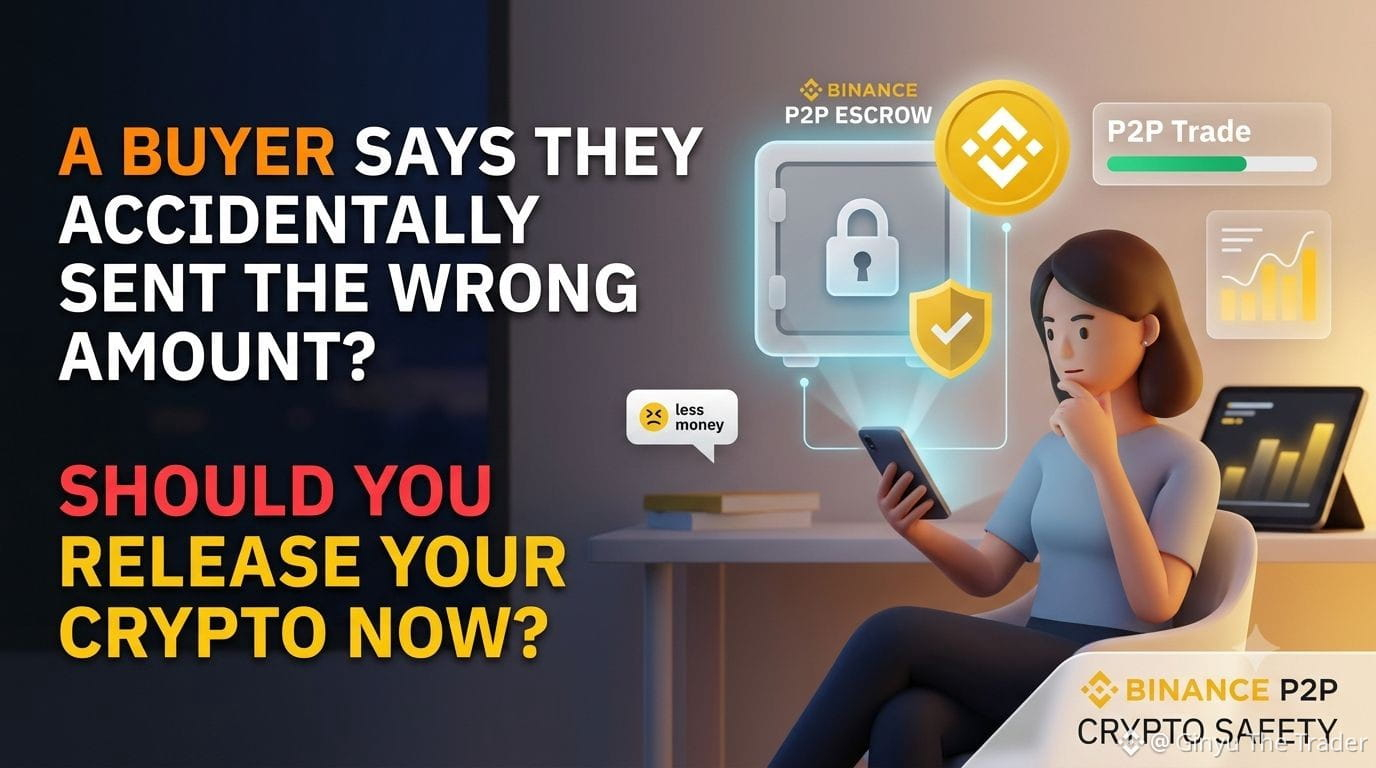
かつて私は、Binance P2Pで注文の途中に、買い手から「うっかり合意した金額より少ない額を送ってしまった。とにかく暗号資産を全額リリースしてほしい。差額はあとで送るから」と言われたことがあります。私は、そのときどのように対応したかを説明したいと思います。会話の途中で相手をそのまま信じてしまいたくなる本能は強いですし、特に謝っていて物腰が丁寧だと、なおさら引き込まれがちだからです。
Binance P2Pでは、売り手がそのような瞬間に「信頼だけ」に頼る必要がないよう、暗号資産をエスクローで保管しています。私は自分の銀行口座を直接確認し、実際に入金された金額を正確に確かめましたが、買い手が送ったと主張している金額とはまったく一致せず、話していた金額にすら遠く及びませんでした。私は注文チャットで、こちら側で確認できた内容を落ち着いてそのまま説明し、比較できるように相手にも自分の振込の証拠を送ってもらうよう求めました。
買い手は、それに一致する確認を提示できず、最終的に正しく解決するには異議申し立て(ディスピュート)の手続きが必要になりました。Binanceのサポートは、両者のチャットログと支払いの証拠を確認して対応してくれました。自分の銀行での確認を事前に手元に用意していたので、そのプロセスはストレス少なく素早く進みました。「送金額を間違えた」という主張は、Binance P2Pでよくある警戒サインです。解決方法はいつも同じで、まずは自分の記録を確認すること。決して相手の話だけを信じないこと。そして、直接解決できないことはディスピュート手続きに任せることです。
その後私の中に残ったのは、最初は「相手の言葉を信じなければ」というプレッシャーがあったのに、不思議と状況全体が落ち着いて感じられたことです。エスクローは、感情や焦りが誰かを、あとで後悔するような判断へ押しやってしまいかねない――まさにそういう場面のために存在しています。私はいま、買い手が完全に誠実そうに聞こえる場合でも、証拠を求めたり、数分余分に時間をとって自分の記録を確認したりすることにためらいはなくなりました。なぜなら、誠実さだけではBinance P2Pにおける「実際の送金の証拠」には決してならないからです。
#binancep2pantoan @Binance Vietnam
かつて私は、Binance P2Pで注文の途中に、買い手から「うっかり合意した金額より少ない額を送ってしまった。とにかく暗号資産を全額リリースしてほしい。差額はあとで送るから」と言われたことがあります。私は、そのときどのように対応したかを説明したいと思います。会話の途中で相手をそのまま信じてしまいたくなる本能は強いですし、特に謝っていて物腰が丁寧だと、なおさら引き込まれがちだからです。
Binance P2Pでは、売り手がそのような瞬間に「信頼だけ」に頼る必要がないよう、暗号資産をエスクローで保管しています。私は自分の銀行口座を直接確認し、実際に入金された金額を正確に確かめましたが、買い手が送ったと主張している金額とはまったく一致せず、話していた金額にすら遠く及びませんでした。私は注文チャットで、こちら側で確認できた内容を落ち着いてそのまま説明し、比較できるように相手にも自分の振込の証拠を送ってもらうよう求めました。
買い手は、それに一致する確認を提示できず、最終的に正しく解決するには異議申し立て(ディスピュート)の手続きが必要になりました。Binanceのサポートは、両者のチャットログと支払いの証拠を確認して対応してくれました。自分の銀行での確認を事前に手元に用意していたので、そのプロセスはストレス少なく素早く進みました。「送金額を間違えた」という主張は、Binance P2Pでよくある警戒サインです。解決方法はいつも同じで、まずは自分の記録を確認すること。決して相手の話だけを信じないこと。そして、直接解決できないことはディスピュート手続きに任せることです。
その後私の中に残ったのは、最初は「相手の言葉を信じなければ」というプレッシャーがあったのに、不思議と状況全体が落ち着いて感じられたことです。エスクローは、感情や焦りが誰かを、あとで後悔するような判断へ押しやってしまいかねない――まさにそういう場面のために存在しています。私はいま、買い手が完全に誠実そうに聞こえる場合でも、証拠を求めたり、数分余分に時間をとって自分の記録を確認したりすることにためらいはなくなりました。なぜなら、誠実さだけではBinance P2Pにおける「実際の送金の証拠」には決してならないからです。
かつて私は、Binance P2Pで注文の途中に、買い手から「うっかり合意した金額より少ない額を送ってしまった。とにかく暗号資産を全額リリースしてほしい。差額はあとで送るから」と言われたことがあります。私は、そのときどのように対応したかを説明したいと思います。会話の途中で相手をそのまま信じてしまいたくなる本能は強いですし、特に謝っていて物腰が丁寧だと、なおさら引き込まれがちだからです。
Binance P2Pでは、売り手がそのような瞬間に「信頼だけ」に頼る必要がないよう、暗号資産をエスクローで保管しています。私は自分の銀行口座を直接確認し、実際に入金された金額を正確に確かめましたが、買い手が送ったと主張している金額とはまったく一致せず、話していた金額にすら遠く及びませんでした。私は注文チャットで、こちら側で確認できた内容を落ち着いてそのまま説明し、比較できるように相手にも自分の振込の証拠を送ってもらうよう求めました。
買い手は、それに一致する確認を提示できず、最終的に正しく解決するには異議申し立て(ディスピュート)の手続きが必要になりました。Binanceのサポートは、両者のチャットログと支払いの証拠を確認して対応してくれました。自分の銀行での確認を事前に手元に用意していたので、そのプロセスはストレス少なく素早く進みました。「送金額を間違えた」という主張は、Binance P2Pでよくある警戒サインです。解決方法はいつも同じで、まずは自分の記録を確認すること。決して相手の話だけを信じないこと。そして、直接解決できないことはディスピュート手続きに任せることです。
その後私の中に残ったのは、最初は「相手の言葉を信じなければ」というプレッシャーがあったのに、不思議と状況全体が落ち着いて感じられたことです。エスクローは、感情や焦りが誰かを、あとで後悔するような判断へ押しやってしまいかねない――まさにそういう場面のために存在しています。私はいま、買い手が完全に誠実そうに聞こえる場合でも、証拠を求めたり、数分余分に時間をとって自分の記録を確認したりすることにためらいはなくなりました。なぜなら、誠実さだけではBinance P2Pにおける「実際の送金の証拠」には決してならないからです。
67
翻訳参照
#binancep2pantoan @Binance_Vietnam
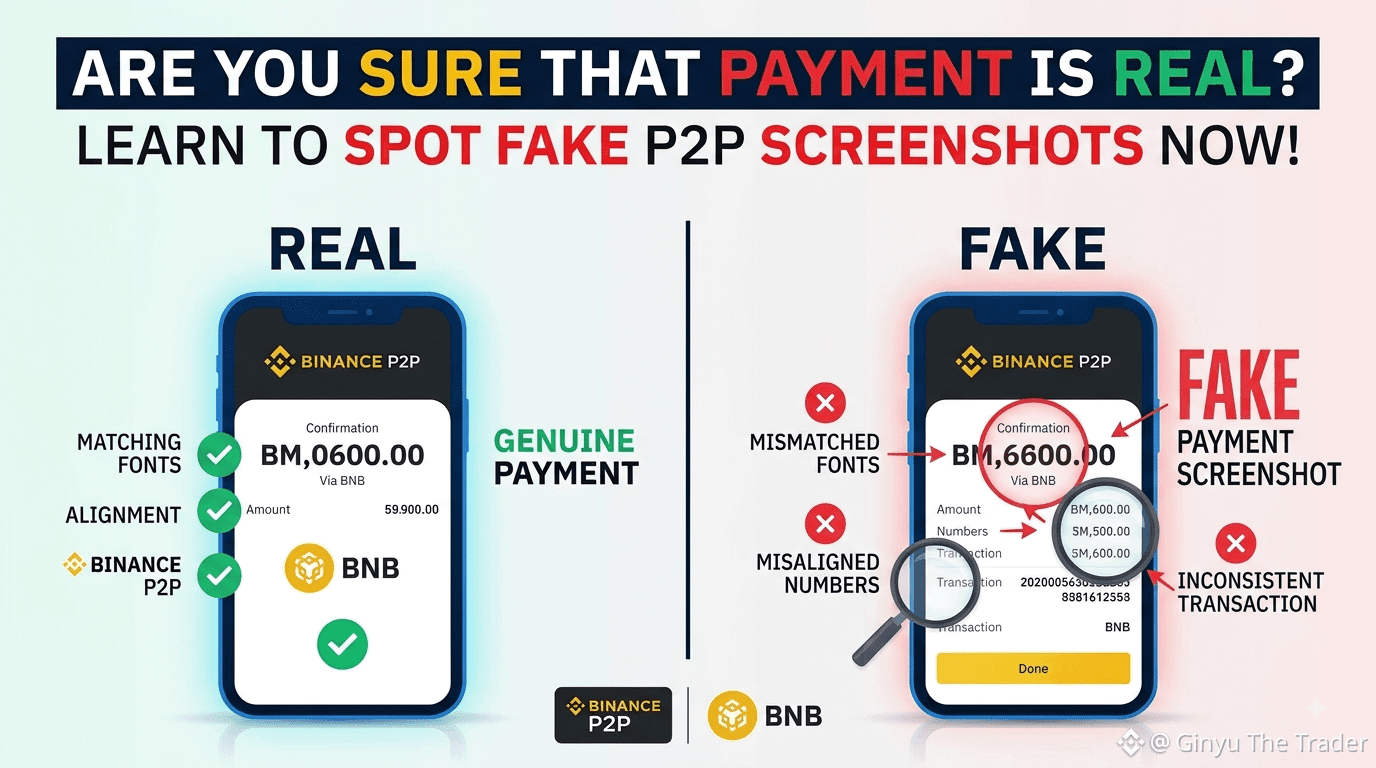
Two payment screenshots I received on Binance P2P looked nearly identical at a glance, except one was real and one had been edited. It took me longer than I'd like to admit to notice the difference, which is exactly why I stopped trusting screenshots as proof of anything at all.
Binance P2P's escrow exists precisely because payment claims made in chat aren't the same as payment actually confirmed. The signs of an edited screenshot aren't always obvious: fonts that don't quite match the rest of the interface, alignment that's slightly off, or numbers that don't add up when you check the math on fees and totals. Sometimes the giveaway is simpler, a transaction reference number that looks recycled from a template rather than something unique to your trade.
None of that matters as much as the one rule I follow now: I check my own banking app directly, every single time, before treating any payment as confirmed. A screenshot might match perfectly and still not reflect reality, so it was never reliable evidence to begin with, real or fake. If a buyer pushes back when I explain I need to verify independently, framing it as distrust or an insult, I treat that reaction itself as a red flag on Binance P2P.
I've also started asking a counterparty to send a fresh screenshot taken in the moment rather than accepting one that could have been saved earlier, since a live screenshot is much harder to fake convincingly on short notice. It's a small ask, but a genuine trader will do it without hesitation, and hesitation itself tells you something. Combined with checking my own bank app directly, that's been enough to catch every attempt so far before any crypto actually moved.
Since every account is KYC verified and the crypto stays locked in escrow until I actually confirm, there's no rush to trust an image over my own account. If I'm ever unsure whether something looks altered, I forward it to Binance support and let them review it properly instead of deciding alone.
#binancep2pantoan @Binance Vietnam
Two payment screenshots I received on Binance P2P looked nearly identical at a glance, except one was real and one had been edited. It took me longer than I'd like to admit to notice the difference, which is exactly why I stopped trusting screenshots as proof of anything at all.
Binance P2P's escrow exists precisely because payment claims made in chat aren't the same as payment actually confirmed. The signs of an edited screenshot aren't always obvious: fonts that don't quite match the rest of the interface, alignment that's slightly off, or numbers that don't add up when you check the math on fees and totals. Sometimes the giveaway is simpler, a transaction reference number that looks recycled from a template rather than something unique to your trade.
None of that matters as much as the one rule I follow now: I check my own banking app directly, every single time, before treating any payment as confirmed. A screenshot might match perfectly and still not reflect reality, so it was never reliable evidence to begin with, real or fake. If a buyer pushes back when I explain I need to verify independently, framing it as distrust or an insult, I treat that reaction itself as a red flag on Binance P2P.
I've also started asking a counterparty to send a fresh screenshot taken in the moment rather than accepting one that could have been saved earlier, since a live screenshot is much harder to fake convincingly on short notice. It's a small ask, but a genuine trader will do it without hesitation, and hesitation itself tells you something. Combined with checking my own bank app directly, that's been enough to catch every attempt so far before any crypto actually moved.
Since every account is KYC verified and the crypto stays locked in escrow until I actually confirm, there's no rush to trust an image over my own account. If I'm ever unsure whether something looks altered, I forward it to Binance support and let them review it properly instead of deciding alone.
Two payment screenshots I received on Binance P2P looked nearly identical at a glance, except one was real and one had been edited. It took me longer than I'd like to admit to notice the difference, which is exactly why I stopped trusting screenshots as proof of anything at all.
Binance P2P's escrow exists precisely because payment claims made in chat aren't the same as payment actually confirmed. The signs of an edited screenshot aren't always obvious: fonts that don't quite match the rest of the interface, alignment that's slightly off, or numbers that don't add up when you check the math on fees and totals. Sometimes the giveaway is simpler, a transaction reference number that looks recycled from a template rather than something unique to your trade.
None of that matters as much as the one rule I follow now: I check my own banking app directly, every single time, before treating any payment as confirmed. A screenshot might match perfectly and still not reflect reality, so it was never reliable evidence to begin with, real or fake. If a buyer pushes back when I explain I need to verify independently, framing it as distrust or an insult, I treat that reaction itself as a red flag on Binance P2P.
I've also started asking a counterparty to send a fresh screenshot taken in the moment rather than accepting one that could have been saved earlier, since a live screenshot is much harder to fake convincingly on short notice. It's a small ask, but a genuine trader will do it without hesitation, and hesitation itself tells you something. Combined with checking my own bank app directly, that's been enough to catch every attempt so far before any crypto actually moved.
Since every account is KYC verified and the crypto stays locked in escrow until I actually confirm, there's no rush to trust an image over my own account. If I'm ever unsure whether something looks altered, I forward it to Binance support and let them review it properly instead of deciding alone.
64
確認済み
翻訳参照
#dusk $DUSK @Dusk_Foundation
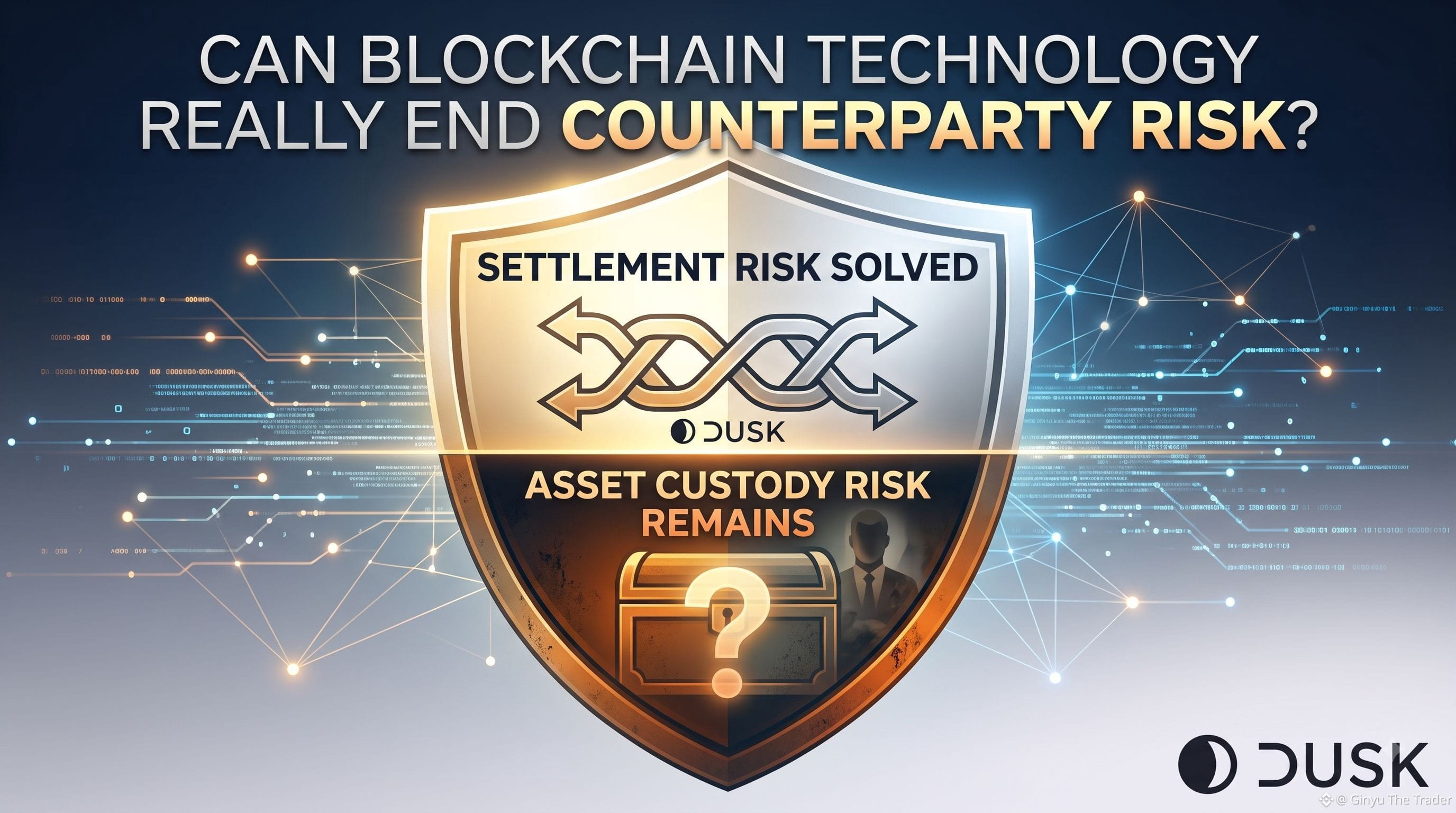
"Deterministic settlement eliminates counterparty risk" is a claim I keep seeing attached to Dusk Network. I understand why the line is attractive, and I think it is true in a narrower sense than it is usually presented, so let me separate the part that holds from the part that does not hold up.
Within the settlement transaction itself, the claim mostly holds up. Delivery-versus-payment-style atomicity, where the asset leg and the payment leg move together or not at all, genuinely removes the specific risk that one party delivers and the other fails to reciprocate, the exact exposure that forces traditional markets to hold margin during a multi-day settlement window, collateral requirements the industry reportedly spends something like $12.4 billion a year maintaining across clearing and settlement technology alone. Dusk Network's deterministic finality through Succinct Attestation makes that atomic pairing possible and immediate rather than probabilistic.
What it does not touch is a different layer of risk entirely: whether the tokenized asset genuinely, legally represents the real security it claims to. If an issuer misrepresents backing, a custodian mismanages the underlying asset, or the legal wrapper connecting the token to real-world ownership turns out to be weaker than assumed, no amount of settlement-layer determinism protects against that failure, because the token settled perfectly while representing something that was never quite what it claimed to be. Counterparty risk in the traditional sense is broader than settlement risk, and treating deterministic finality as a cure for all of it overstates what a consensus mechanism, no matter how well designed, can actually guarantee on its own. Traditional securities markets manage that exact custody risk through regulation, segregation requirements, and insurance schemes built up over decades, infrastructure a tokenized security still needs in some form even after the settlement layer itself stops being the bottleneck.
#dusk $DUSK @Dusk
"Deterministic settlement eliminates counterparty risk" is a claim I keep seeing attached to Dusk Network. I understand why the line is attractive, and I think it is true in a narrower sense than it is usually presented, so let me separate the part that holds from the part that does not hold up.
Within the settlement transaction itself, the claim mostly holds up. Delivery-versus-payment-style atomicity, where the asset leg and the payment leg move together or not at all, genuinely removes the specific risk that one party delivers and the other fails to reciprocate, the exact exposure that forces traditional markets to hold margin during a multi-day settlement window, collateral requirements the industry reportedly spends something like $12.4 billion a year maintaining across clearing and settlement technology alone. Dusk Network's deterministic finality through Succinct Attestation makes that atomic pairing possible and immediate rather than probabilistic.
What it does not touch is a different layer of risk entirely: whether the tokenized asset genuinely, legally represents the real security it claims to. If an issuer misrepresents backing, a custodian mismanages the underlying asset, or the legal wrapper connecting the token to real-world ownership turns out to be weaker than assumed, no amount of settlement-layer determinism protects against that failure, because the token settled perfectly while representing something that was never quite what it claimed to be. Counterparty risk in the traditional sense is broader than settlement risk, and treating deterministic finality as a cure for all of it overstates what a consensus mechanism, no matter how well designed, can actually guarantee on its own. Traditional securities markets manage that exact custody risk through regulation, segregation requirements, and insurance schemes built up over decades, infrastructure a tokenized security still needs in some form even after the settlement layer itself stops being the bottleneck.
"Deterministic settlement eliminates counterparty risk" is a claim I keep seeing attached to Dusk Network. I understand why the line is attractive, and I think it is true in a narrower sense than it is usually presented, so let me separate the part that holds from the part that does not hold up.
Within the settlement transaction itself, the claim mostly holds up. Delivery-versus-payment-style atomicity, where the asset leg and the payment leg move together or not at all, genuinely removes the specific risk that one party delivers and the other fails to reciprocate, the exact exposure that forces traditional markets to hold margin during a multi-day settlement window, collateral requirements the industry reportedly spends something like $12.4 billion a year maintaining across clearing and settlement technology alone. Dusk Network's deterministic finality through Succinct Attestation makes that atomic pairing possible and immediate rather than probabilistic.
What it does not touch is a different layer of risk entirely: whether the tokenized asset genuinely, legally represents the real security it claims to. If an issuer misrepresents backing, a custodian mismanages the underlying asset, or the legal wrapper connecting the token to real-world ownership turns out to be weaker than assumed, no amount of settlement-layer determinism protects against that failure, because the token settled perfectly while representing something that was never quite what it claimed to be. Counterparty risk in the traditional sense is broader than settlement risk, and treating deterministic finality as a cure for all of it overstates what a consensus mechanism, no matter how well designed, can actually guarantee on its own. Traditional securities markets manage that exact custody risk through regulation, segregation requirements, and insurance schemes built up over decades, infrastructure a tokenized security still needs in some form even after the settlement layer itself stops being the bottleneck.
81
#binancep2pantoan @Binance_Vietnam
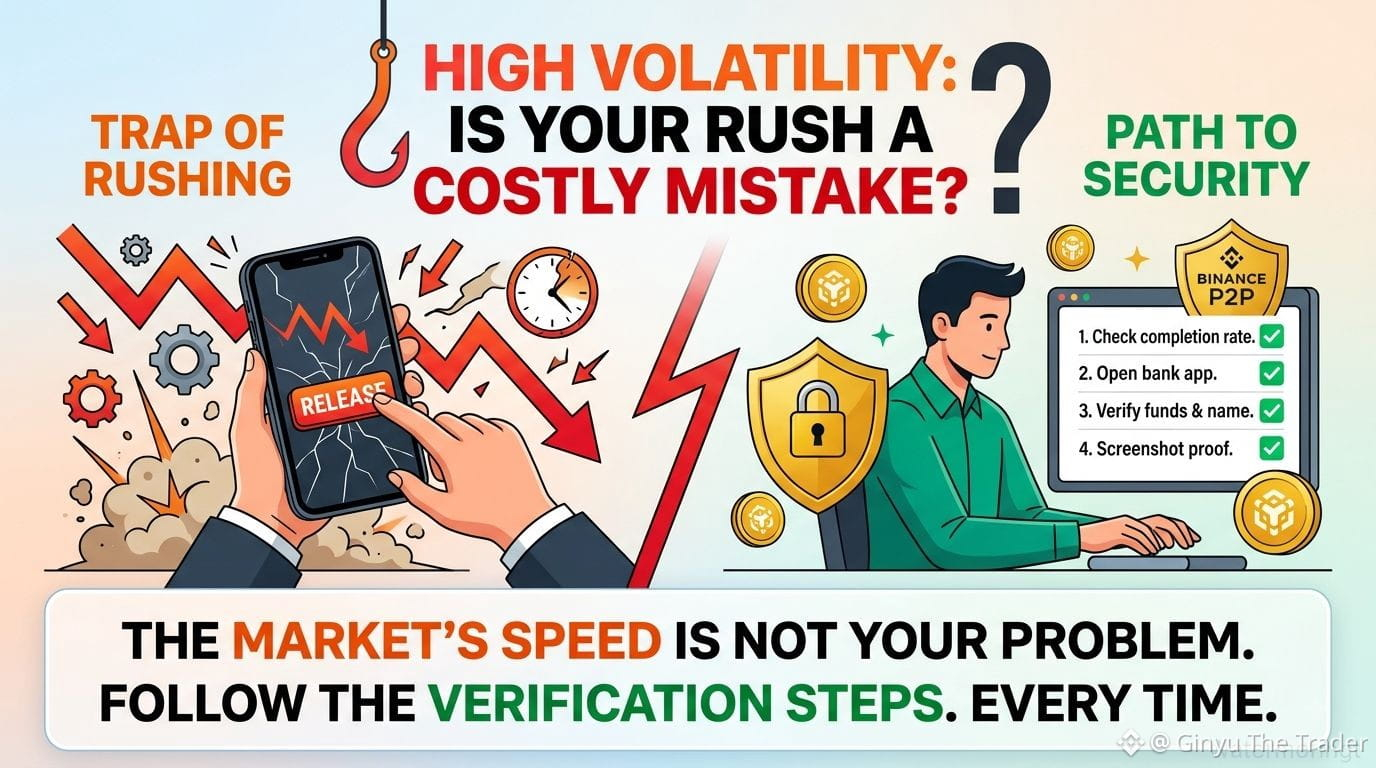
Binance P2Pにおける高ボラティリティ(変動の大きい)な日は、本人確認の手順を飛ばしたくなる誘惑が最も強くなるタイミングで、昨年の急激な価格変動のときにそのことを痛いほど学びました。Binance P2Pはエスクロー(取引代行保管)によって取引を保護し、買い手の入金が確認されるまで売り手の暗号資産を保持します。さらに、必須のKYC(本人確認)、取引ごとの専用チャット、そしてもしBinanceが介入して両者間の食い違いを確認する必要が生じた場合の異議申し立て(ディスピュート)にも対応しています。ですが、この保護が有効なのは取引が完全にBinance P2Pの枠内に収まっている場合のみです。理由が何であれ、誰もが(あなたも含めて)いつもより早く進めたくなる日こそ、そのことを正確に覚えておく価値があります。私は受け入れる前に完了率と注文数を確認します。そして、こうした変動の大きい日は、手順を飛ばしてしまうこと、あるいは「急いでいる感じがする」という理由で赤信号を見逃してしまうことが、まさに最も起こりやすく、また損失も最も大きくなります。
価格があまりにも急に動いたため、注文が数秒で成立していく状態でした。そこで、送金が反映されたことを確認するために実際に銀行アプリを開く前に、「リリース(資金の解放)してよい」というリクエストを受け入れそうになりました。レートは動いていましたが、支払いの食い違い、または偽のスクリーンショットは、結局のところ「価格の動きを逃したかもしれない」という程度の損失よりはるかに高くつきます。私は自分にブレーキをかけました。名前を確認し、自分のアプリで残高を確認し、証拠をスクリーンショットしてから解放する――これは、どんな落ち着いた火曜の午後と同じ手順です。価格の動きが1分程度奪われたかもしれませんが、それ以外ならその場では気づけなかったであろうミスから救われました。今の私の「変動の大きい日」のルールはこうです。市場のスピードは自分の問題ではない、チェックリストは他のみんなが急いでいるからといって短くはしない、そして「価格が動いているから」という理由で相手が手順を省くよう圧をかけてくるなら、それは逆にさらに落ち着いて進めるべき理由です。私は注文を閉じる前にも、変動日かどうかに関係なく、チャットと支払い確認のスクリーンショットを必ず撮ります。忙しい市場のときこそ、万が一後でディスピュートになった場合に記録をすぐ出せる状態にしておきたいからです。
#binancep2pantoan @Binance Vietnam
Binance P2Pにおける高ボラティリティ(変動の大きい)な日は、本人確認の手順を飛ばしたくなる誘惑が最も強くなるタイミングで、昨年の急激な価格変動のときにそのことを痛いほど学びました。Binance P2Pはエスクロー(取引代行保管)によって取引を保護し、買い手の入金が確認されるまで売り手の暗号資産を保持します。さらに、必須のKYC(本人確認)、取引ごとの専用チャット、そしてもしBinanceが介入して両者間の食い違いを確認する必要が生じた場合の異議申し立て(ディスピュート)にも対応しています。ですが、この保護が有効なのは取引が完全にBinance P2Pの枠内に収まっている場合のみです。理由が何であれ、誰もが(あなたも含めて)いつもより早く進めたくなる日こそ、そのことを正確に覚えておく価値があります。私は受け入れる前に完了率と注文数を確認します。そして、こうした変動の大きい日は、手順を飛ばしてしまうこと、あるいは「急いでいる感じがする」という理由で赤信号を見逃してしまうことが、まさに最も起こりやすく、また損失も最も大きくなります。
価格があまりにも急に動いたため、注文が数秒で成立していく状態でした。そこで、送金が反映されたことを確認するために実際に銀行アプリを開く前に、「リリース(資金の解放)してよい」というリクエストを受け入れそうになりました。レートは動いていましたが、支払いの食い違い、または偽のスクリーンショットは、結局のところ「価格の動きを逃したかもしれない」という程度の損失よりはるかに高くつきます。私は自分にブレーキをかけました。名前を確認し、自分のアプリで残高を確認し、証拠をスクリーンショットしてから解放する――これは、どんな落ち着いた火曜の午後と同じ手順です。価格の動きが1分程度奪われたかもしれませんが、それ以外ならその場では気づけなかったであろうミスから救われました。今の私の「変動の大きい日」のルールはこうです。市場のスピードは自分の問題ではない、チェックリストは他のみんなが急いでいるからといって短くはしない、そして「価格が動いているから」という理由で相手が手順を省くよう圧をかけてくるなら、それは逆にさらに落ち着いて進めるべき理由です。私は注文を閉じる前にも、変動日かどうかに関係なく、チャットと支払い確認のスクリーンショットを必ず撮ります。忙しい市場のときこそ、万が一後でディスピュートになった場合に記録をすぐ出せる状態にしておきたいからです。
Binance P2Pにおける高ボラティリティ(変動の大きい)な日は、本人確認の手順を飛ばしたくなる誘惑が最も強くなるタイミングで、昨年の急激な価格変動のときにそのことを痛いほど学びました。Binance P2Pはエスクロー(取引代行保管)によって取引を保護し、買い手の入金が確認されるまで売り手の暗号資産を保持します。さらに、必須のKYC(本人確認)、取引ごとの専用チャット、そしてもしBinanceが介入して両者間の食い違いを確認する必要が生じた場合の異議申し立て(ディスピュート)にも対応しています。ですが、この保護が有効なのは取引が完全にBinance P2Pの枠内に収まっている場合のみです。理由が何であれ、誰もが(あなたも含めて)いつもより早く進めたくなる日こそ、そのことを正確に覚えておく価値があります。私は受け入れる前に完了率と注文数を確認します。そして、こうした変動の大きい日は、手順を飛ばしてしまうこと、あるいは「急いでいる感じがする」という理由で赤信号を見逃してしまうことが、まさに最も起こりやすく、また損失も最も大きくなります。
価格があまりにも急に動いたため、注文が数秒で成立していく状態でした。そこで、送金が反映されたことを確認するために実際に銀行アプリを開く前に、「リリース(資金の解放)してよい」というリクエストを受け入れそうになりました。レートは動いていましたが、支払いの食い違い、または偽のスクリーンショットは、結局のところ「価格の動きを逃したかもしれない」という程度の損失よりはるかに高くつきます。私は自分にブレーキをかけました。名前を確認し、自分のアプリで残高を確認し、証拠をスクリーンショットしてから解放する――これは、どんな落ち着いた火曜の午後と同じ手順です。価格の動きが1分程度奪われたかもしれませんが、それ以外ならその場では気づけなかったであろうミスから救われました。今の私の「変動の大きい日」のルールはこうです。市場のスピードは自分の問題ではない、チェックリストは他のみんなが急いでいるからといって短くはしない、そして「価格が動いているから」という理由で相手が手順を省くよう圧をかけてくるなら、それは逆にさらに落ち着いて進めるべき理由です。私は注文を閉じる前にも、変動日かどうかに関係なく、チャットと支払い確認のスクリーンショットを必ず撮ります。忙しい市場のときこそ、万が一後でディスピュートになった場合に記録をすぐ出せる状態にしておきたいからです。
60
翻訳参照
#dusk $DUSK @Dusk_Foundation
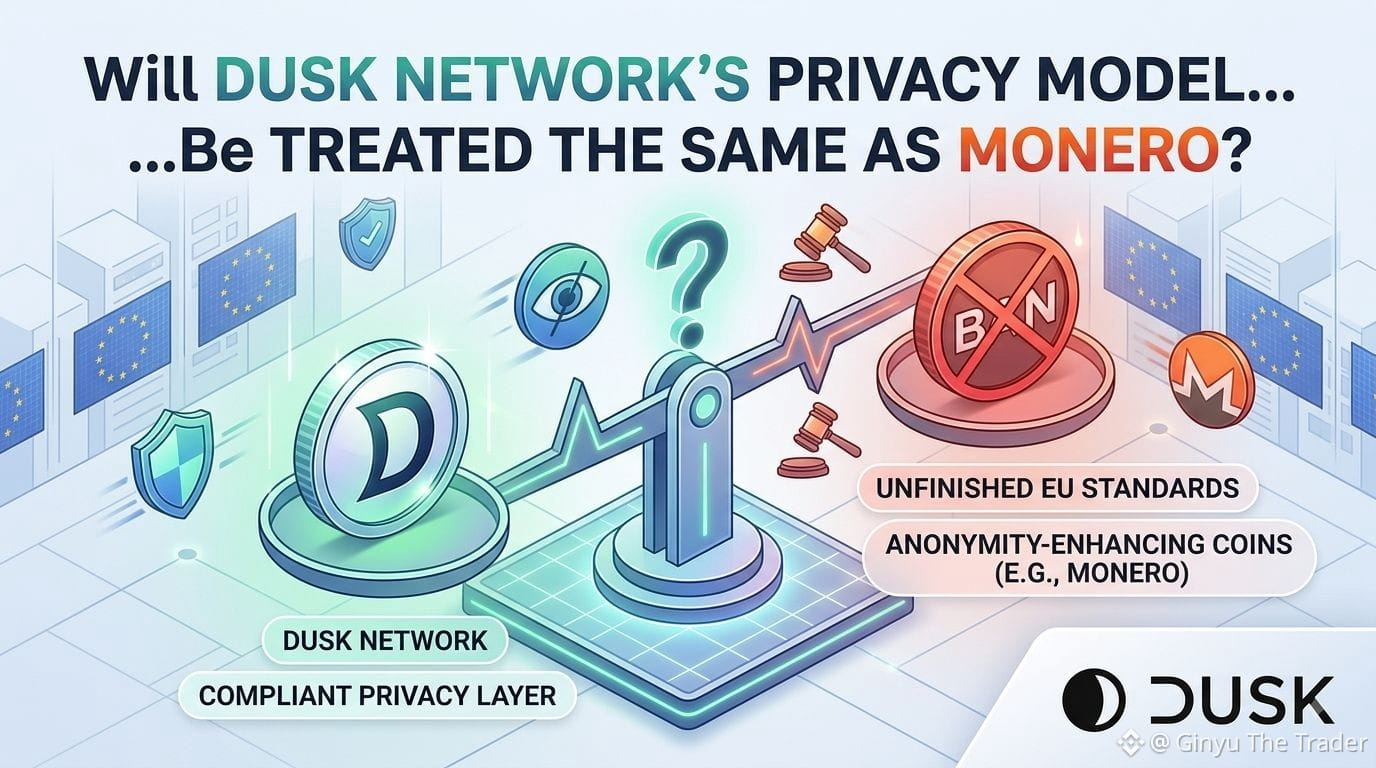
Will Dusk Network's privacy model get treated the same way regulators are about to treat Monero? I don't think anyone can honestly answer that yet, and I'd be skeptical of anyone claiming otherwise with full confidence in either direction.
The EU's Anti-Money Laundering Regulation takes full effect on July 10, 2027, and Article 79 targets what the law calls "anonymity-enhancing coins" as a category, deliberately without naming specific tickers, leaving asset-by-asset classification to technical standards the European Banking Authority hasn't finished writing yet. The optimistic read for Dusk Network: its model pairs shielded transactions with selective disclosure to authorized regulators, plus a self-sovereign identity layer in Citadel built for exactly this kind of compliance workflow, structurally closer to compliance-friendly, optional-privacy designs than to Monero's default, no-exceptions anonymity. That distinction has already mattered in how markets and institutions treat those approaches differently elsewhere.
The less comfortable read: the regulation's language covers coins that obscure transaction information by default, and Dusk Network's Phoenix transactions are shielded by default, with disclosure sitting as an added layer on top rather than the baseline state. Whether regulators end up focused on the default state of a transaction, or on whether a genuine disclosure mechanism exists at all, is exactly the kind of edge case the EBA's still-unfinished technical standards are supposed to resolve.
I don't think Dusk Network's outcome here is guaranteed either way, and I'd trust the project less, not more, if its own messaging claimed certainty it doesn't have. This is a real open question, not a footnote, worth watching through actual technical standards rather than assumption.
#dusk $DUSK @Dusk
Will Dusk Network's privacy model get treated the same way regulators are about to treat Monero? I don't think anyone can honestly answer that yet, and I'd be skeptical of anyone claiming otherwise with full confidence in either direction.
The EU's Anti-Money Laundering Regulation takes full effect on July 10, 2027, and Article 79 targets what the law calls "anonymity-enhancing coins" as a category, deliberately without naming specific tickers, leaving asset-by-asset classification to technical standards the European Banking Authority hasn't finished writing yet. The optimistic read for Dusk Network: its model pairs shielded transactions with selective disclosure to authorized regulators, plus a self-sovereign identity layer in Citadel built for exactly this kind of compliance workflow, structurally closer to compliance-friendly, optional-privacy designs than to Monero's default, no-exceptions anonymity. That distinction has already mattered in how markets and institutions treat those approaches differently elsewhere.
The less comfortable read: the regulation's language covers coins that obscure transaction information by default, and Dusk Network's Phoenix transactions are shielded by default, with disclosure sitting as an added layer on top rather than the baseline state. Whether regulators end up focused on the default state of a transaction, or on whether a genuine disclosure mechanism exists at all, is exactly the kind of edge case the EBA's still-unfinished technical standards are supposed to resolve.
I don't think Dusk Network's outcome here is guaranteed either way, and I'd trust the project less, not more, if its own messaging claimed certainty it doesn't have. This is a real open question, not a footnote, worth watching through actual technical standards rather than assumption.
Will Dusk Network's privacy model get treated the same way regulators are about to treat Monero? I don't think anyone can honestly answer that yet, and I'd be skeptical of anyone claiming otherwise with full confidence in either direction.
The EU's Anti-Money Laundering Regulation takes full effect on July 10, 2027, and Article 79 targets what the law calls "anonymity-enhancing coins" as a category, deliberately without naming specific tickers, leaving asset-by-asset classification to technical standards the European Banking Authority hasn't finished writing yet. The optimistic read for Dusk Network: its model pairs shielded transactions with selective disclosure to authorized regulators, plus a self-sovereign identity layer in Citadel built for exactly this kind of compliance workflow, structurally closer to compliance-friendly, optional-privacy designs than to Monero's default, no-exceptions anonymity. That distinction has already mattered in how markets and institutions treat those approaches differently elsewhere.
The less comfortable read: the regulation's language covers coins that obscure transaction information by default, and Dusk Network's Phoenix transactions are shielded by default, with disclosure sitting as an added layer on top rather than the baseline state. Whether regulators end up focused on the default state of a transaction, or on whether a genuine disclosure mechanism exists at all, is exactly the kind of edge case the EBA's still-unfinished technical standards are supposed to resolve.
I don't think Dusk Network's outcome here is guaranteed either way, and I'd trust the project less, not more, if its own messaging claimed certainty it doesn't have. This is a real open question, not a footnote, worth watching through actual technical standards rather than assumption.
72
確認済み
翻訳参照
#dusk $DUSK @Dusk_Foundation
I assumed staking on Dusk Network belonged only to wallets and node operators.
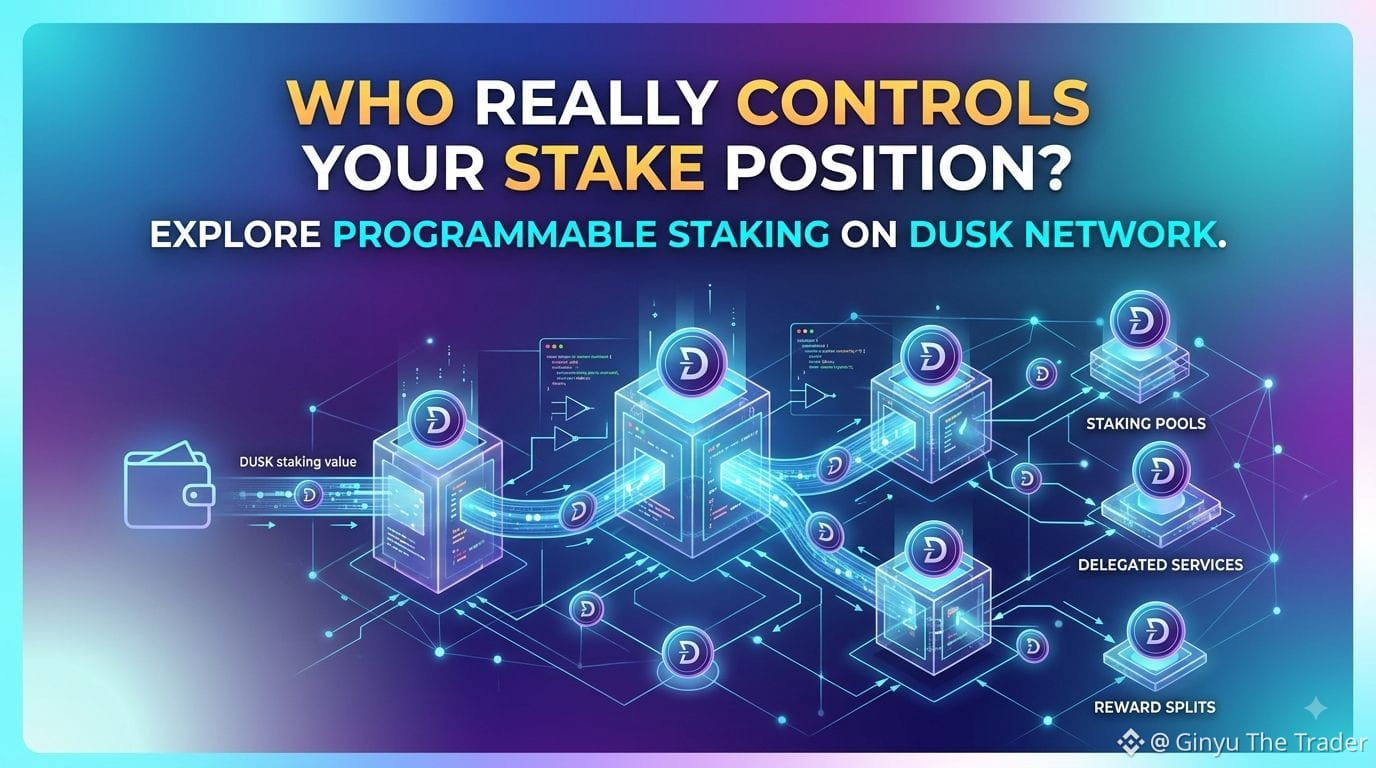
Stake Abstraction changes the owner of the position.
A Dusk smart contract can accept deposits, create stake, receive rewards, and distribute or reinvest them under its own rules. That enables staking pools, delegated services, reward splits, and derivatives without keeping every decision in an offchain operator account.
The stake becomes programmable. So does the risk.
Users are no longer evaluating only a provisioner's consensus performance. They also depend on the contract's accounting, withdrawal logic, reward allocation, upgrade controls, and recovery path. A perfectly performing validator cannot protect a depositor from a pool contract that calculates shares incorrectly.
Dusk keeps some protocol boundaries explicit. Contracts still face the 1,000 DUSK minimum stake. Activation occurs at an epoch boundary after the next one, usually between 1 and 2 epochs after submission. A contract cannot call the staking function as if it were a wallet. Funds move through the Transfer Contract and trigger the Stake Contract through a contract-to-contract transfer.
That last detail matters to me. It binds the staking action to actual value movement rather than letting contract logic announce a stake without the corresponding funds.
I would watch how applications expose the delay between deposit and active stake. A pool token issued immediately can look productive while the underlying DUSK is still waiting for activation. Reward claims and unstaking callbacks also need to remain synchronized with user balances.
Stake Abstraction expands DUSK utility beyond direct staking. It could also concentrate deposits inside a small number of contracts if convenience wins over diversification.
Dusk has made the consensus position composable. The next proof is that pool contracts preserve solvency, clear ownership, and fair exits across every staking state.
Programmability can remove manual distribution. It cannot remove the need to audit who controls the program.
#dusk $DUSK @Dusk
I assumed staking on Dusk Network belonged only to wallets and node operators.
Stake Abstraction changes the owner of the position.
A Dusk smart contract can accept deposits, create stake, receive rewards, and distribute or reinvest them under its own rules. That enables staking pools, delegated services, reward splits, and derivatives without keeping every decision in an offchain operator account.
The stake becomes programmable. So does the risk.
Users are no longer evaluating only a provisioner's consensus performance. They also depend on the contract's accounting, withdrawal logic, reward allocation, upgrade controls, and recovery path. A perfectly performing validator cannot protect a depositor from a pool contract that calculates shares incorrectly.
Dusk keeps some protocol boundaries explicit. Contracts still face the 1,000 DUSK minimum stake. Activation occurs at an epoch boundary after the next one, usually between 1 and 2 epochs after submission. A contract cannot call the staking function as if it were a wallet. Funds move through the Transfer Contract and trigger the Stake Contract through a contract-to-contract transfer.
That last detail matters to me. It binds the staking action to actual value movement rather than letting contract logic announce a stake without the corresponding funds.
I would watch how applications expose the delay between deposit and active stake. A pool token issued immediately can look productive while the underlying DUSK is still waiting for activation. Reward claims and unstaking callbacks also need to remain synchronized with user balances.
Stake Abstraction expands DUSK utility beyond direct staking. It could also concentrate deposits inside a small number of contracts if convenience wins over diversification.
Dusk has made the consensus position composable. The next proof is that pool contracts preserve solvency, clear ownership, and fair exits across every staking state.
Programmability can remove manual distribution. It cannot remove the need to audit who controls the program.
I assumed staking on Dusk Network belonged only to wallets and node operators.
Stake Abstraction changes the owner of the position.
A Dusk smart contract can accept deposits, create stake, receive rewards, and distribute or reinvest them under its own rules. That enables staking pools, delegated services, reward splits, and derivatives without keeping every decision in an offchain operator account.
The stake becomes programmable. So does the risk.
Users are no longer evaluating only a provisioner's consensus performance. They also depend on the contract's accounting, withdrawal logic, reward allocation, upgrade controls, and recovery path. A perfectly performing validator cannot protect a depositor from a pool contract that calculates shares incorrectly.
Dusk keeps some protocol boundaries explicit. Contracts still face the 1,000 DUSK minimum stake. Activation occurs at an epoch boundary after the next one, usually between 1 and 2 epochs after submission. A contract cannot call the staking function as if it were a wallet. Funds move through the Transfer Contract and trigger the Stake Contract through a contract-to-contract transfer.
That last detail matters to me. It binds the staking action to actual value movement rather than letting contract logic announce a stake without the corresponding funds.
I would watch how applications expose the delay between deposit and active stake. A pool token issued immediately can look productive while the underlying DUSK is still waiting for activation. Reward claims and unstaking callbacks also need to remain synchronized with user balances.
Stake Abstraction expands DUSK utility beyond direct staking. It could also concentrate deposits inside a small number of contracts if convenience wins over diversification.
Dusk has made the consensus position composable. The next proof is that pool contracts preserve solvency, clear ownership, and fair exits across every staking state.
Programmability can remove manual distribution. It cannot remove the need to audit who controls the program.
1
52
翻訳参照
#binancep2pantoan @Binance_Vietnam
New traders often assume Binance P2P protects them automatically from every kind of loss, and that single assumption can end up being costly.
The protections are real, but they work with the trader, not instead of the trader. KYC verification means every account belongs to an identity Binance can trace, which discourages a lot of bad behavior but does not physically stop someone from trying to scam another user through the chat. Escrow holds a seller's crypto until payment is confirmed, which is one of the strongest protections on the platform, but confirming that payment is still the seller's own responsibility, not something that happens automatically in the background. Checking a counterparty's profile matters for exactly this reason: account age, completion rate, and order history together give a much clearer picture than KYC status alone, since a verified identity can still belong to someone acting in bad faith. Support and the dispute process exist as a backstop, not a replacement for basic caution during the trade itself.
I have talked to newer traders who released crypto based purely on a payment notification, assuming that because Binance P2P is a protected system, nothing could really go wrong on their end. That is not how it works in practice. The platform structures the trade safely, but each side still has to do their part: verify the profile, confirm real payment before releasing, keep everything inside the chat, and archive proof of what happened. If a step ever feels uncertain, Binance support is there to help, and reaching out early is always better than assuming the system alone will catch a problem after the fact. Protection on Binance P2P is a partnership, not an autopilot. Understanding that distinction early would have saved me some uneasy moments as a newer trader, and it is the single idea I try hardest to pass along to anyone just getting started on the platform now.
#binancep2pantoan @Binance Vietnam
New traders often assume Binance P2P protects them automatically from every kind of loss, and that single assumption can end up being costly.
The protections are real, but they work with the trader, not instead of the trader. KYC verification means every account belongs to an identity Binance can trace, which discourages a lot of bad behavior but does not physically stop someone from trying to scam another user through the chat. Escrow holds a seller's crypto until payment is confirmed, which is one of the strongest protections on the platform, but confirming that payment is still the seller's own responsibility, not something that happens automatically in the background. Checking a counterparty's profile matters for exactly this reason: account age, completion rate, and order history together give a much clearer picture than KYC status alone, since a verified identity can still belong to someone acting in bad faith. Support and the dispute process exist as a backstop, not a replacement for basic caution during the trade itself.
I have talked to newer traders who released crypto based purely on a payment notification, assuming that because Binance P2P is a protected system, nothing could really go wrong on their end. That is not how it works in practice. The platform structures the trade safely, but each side still has to do their part: verify the profile, confirm real payment before releasing, keep everything inside the chat, and archive proof of what happened. If a step ever feels uncertain, Binance support is there to help, and reaching out early is always better than assuming the system alone will catch a problem after the fact. Protection on Binance P2P is a partnership, not an autopilot. Understanding that distinction early would have saved me some uneasy moments as a newer trader, and it is the single idea I try hardest to pass along to anyone just getting started on the platform now.
New traders often assume Binance P2P protects them automatically from every kind of loss, and that single assumption can end up being costly.
The protections are real, but they work with the trader, not instead of the trader. KYC verification means every account belongs to an identity Binance can trace, which discourages a lot of bad behavior but does not physically stop someone from trying to scam another user through the chat. Escrow holds a seller's crypto until payment is confirmed, which is one of the strongest protections on the platform, but confirming that payment is still the seller's own responsibility, not something that happens automatically in the background. Checking a counterparty's profile matters for exactly this reason: account age, completion rate, and order history together give a much clearer picture than KYC status alone, since a verified identity can still belong to someone acting in bad faith. Support and the dispute process exist as a backstop, not a replacement for basic caution during the trade itself.
I have talked to newer traders who released crypto based purely on a payment notification, assuming that because Binance P2P is a protected system, nothing could really go wrong on their end. That is not how it works in practice. The platform structures the trade safely, but each side still has to do their part: verify the profile, confirm real payment before releasing, keep everything inside the chat, and archive proof of what happened. If a step ever feels uncertain, Binance support is there to help, and reaching out early is always better than assuming the system alone will catch a problem after the fact. Protection on Binance P2P is a partnership, not an autopilot. Understanding that distinction early would have saved me some uneasy moments as a newer trader, and it is the single idea I try hardest to pass along to anyone just getting started on the platform now.
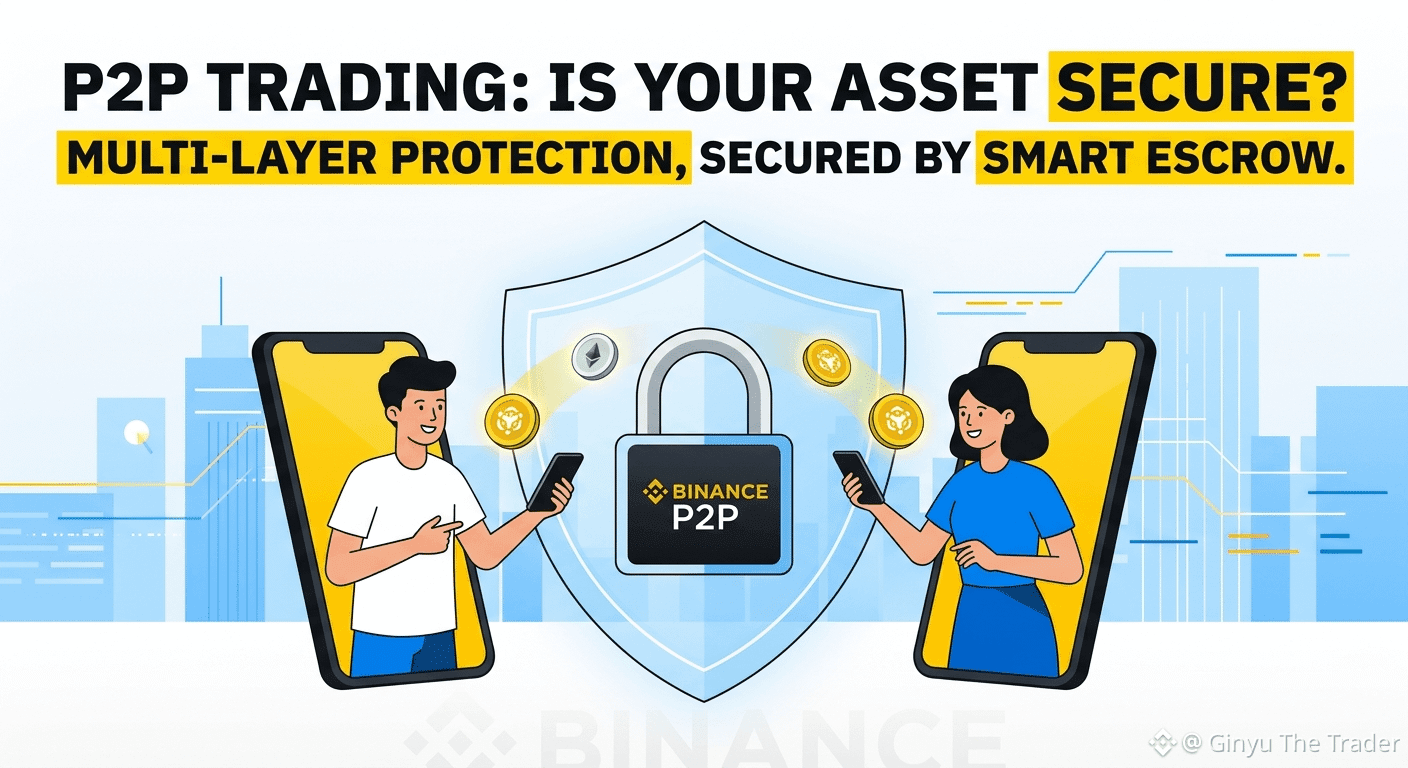
74
確認済み
翻訳参照
I found the most revealing AEGIS issue outside the zero-knowledge proof itself. A value beside it was not fully controlled.
In Dusk Network's Phoenix transaction path, a user could commit to a legitimate max_fee while execution still consumed fee fields that were not bound into the same security story. Hostile gas parameters could drive refund inflation or overflow. A mutable refund address could redirect value.
The proof was valid. The transaction semantics were not fully connected to it.
A fee is not harmless metadata when the refund path can create or redirect value.
That is a useful warning for any privacy protocol. Proving one statement perfectly does not secure adjacent fields that execution later trusts. The system must bind the proof, signature, fee calculation, destination, and refund path into one invariant.
AEGIS added checked multiplication for gas_limit times gas_price and required the result to equal the proven max_fee. Dusk enforced that check twice: at mempool admission and again inside VM execution. It also bound the refund stealth address so tampering would invalidate the transaction.
The second check is the detail I care about. A malicious block proposer does not have to respect the assumptions of an honest mempool. If the invariant exists only at the network edge, consensus can still execute a transaction that bypassed that edge.
I would now watch for the same defense pattern across Dusk: cheap rejection before admission, authoritative validation at execution, and regression tests that mutate every field surrounding a proof.
AEGIS closed the known critical paths. The larger question is whether other Dusk contracts contain values that are "checked" in one layer and merely trusted in the next.
Cryptography can prove exactly what it is asked to prove. Security depends on Dusk asking for the complete statement.
#dusk $DUSK @Dusk_Foundation
I found the most revealing AEGIS issue outside the zero-knowledge proof itself. A value beside it was not fully controlled.
In Dusk Network's Phoenix transaction path, a user could commit to a legitimate max_fee while execution still consumed fee fields that were not bound into the same security story. Hostile gas parameters could drive refund inflation or overflow. A mutable refund address could redirect value.
The proof was valid. The transaction semantics were not fully connected to it.
A fee is not harmless metadata when the refund path can create or redirect value.
That is a useful warning for any privacy protocol. Proving one statement perfectly does not secure adjacent fields that execution later trusts. The system must bind the proof, signature, fee calculation, destination, and refund path into one invariant.
AEGIS added checked multiplication for gas_limit times gas_price and required the result to equal the proven max_fee. Dusk enforced that check twice: at mempool admission and again inside VM execution. It also bound the refund stealth address so tampering would invalidate the transaction.
The second check is the detail I care about. A malicious block proposer does not have to respect the assumptions of an honest mempool. If the invariant exists only at the network edge, consensus can still execute a transaction that bypassed that edge.
I would now watch for the same defense pattern across Dusk: cheap rejection before admission, authoritative validation at execution, and regression tests that mutate every field surrounding a proof.
AEGIS closed the known critical paths. The larger question is whether other Dusk contracts contain values that are "checked" in one layer and merely trusted in the next.
Cryptography can prove exactly what it is asked to prove. Security depends on Dusk asking for the complete statement.
#dusk $DUSK @Dusk
In Dusk Network's Phoenix transaction path, a user could commit to a legitimate max_fee while execution still consumed fee fields that were not bound into the same security story. Hostile gas parameters could drive refund inflation or overflow. A mutable refund address could redirect value.
The proof was valid. The transaction semantics were not fully connected to it.
A fee is not harmless metadata when the refund path can create or redirect value.
That is a useful warning for any privacy protocol. Proving one statement perfectly does not secure adjacent fields that execution later trusts. The system must bind the proof, signature, fee calculation, destination, and refund path into one invariant.
AEGIS added checked multiplication for gas_limit times gas_price and required the result to equal the proven max_fee. Dusk enforced that check twice: at mempool admission and again inside VM execution. It also bound the refund stealth address so tampering would invalidate the transaction.
The second check is the detail I care about. A malicious block proposer does not have to respect the assumptions of an honest mempool. If the invariant exists only at the network edge, consensus can still execute a transaction that bypassed that edge.
I would now watch for the same defense pattern across Dusk: cheap rejection before admission, authoritative validation at execution, and regression tests that mutate every field surrounding a proof.
AEGIS closed the known critical paths. The larger question is whether other Dusk contracts contain values that are "checked" in one layer and merely trusted in the next.
Cryptography can prove exactly what it is asked to prove. Security depends on Dusk asking for the complete statement.
#dusk $DUSK @Dusk
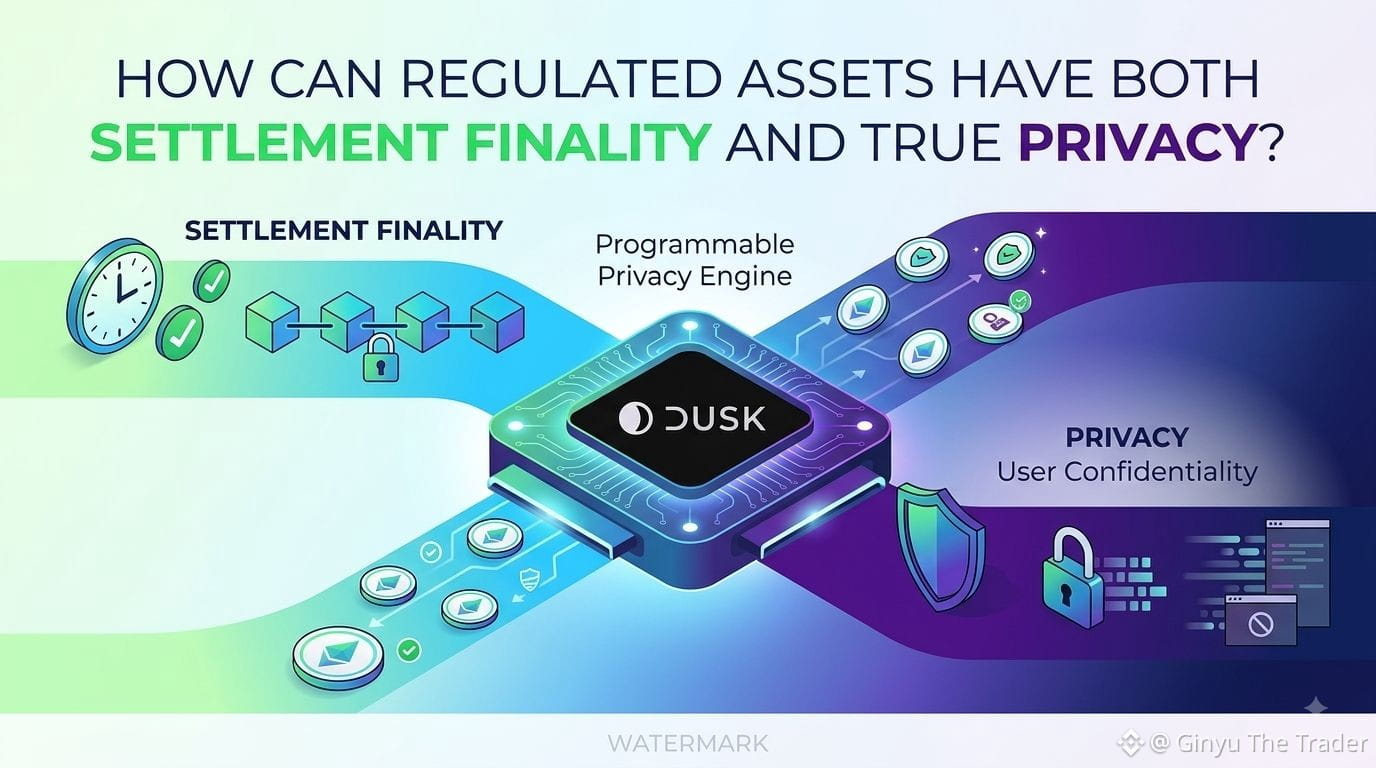
1
63
翻訳参照
#binancep2pantoan @Binance_Vietnam
Six months into trading on Binance P2P, I noticed something I hadn't expected when I started: a solid trading history doesn't just make offers get accepted faster, it actively lowers your risk with every completed trade. Binance P2P's foundation stays the same for every user, KYC verified identity, escrow protecting funds mid transaction, chat preserving every conversation, and appeals available if something breaks down, but a strong completion rate and order count layer real world trust on top of that baseline. Counterparties treat established accounts differently. They ask fewer unnecessary questions, they're less likely to attempt scams that depend on catching someone off guard, and other traders can see your track record the same way you check theirs before accepting an offer. None of this replaces the underlying protections, though. Even with hundreds of completed orders, I still confirm every payment myself before releasing crypto and I still keep the trade entirely inside Binance P2P rather than trusting reputation enough to cut corners.
Building that history took patience early on. I started with smaller trade amounts while I learned to read profiles and recognize red flags like rushed requests or mismatched payment names, and I only increased my typical order size as my own comfort and my counterparty screening habits improved. I kept every screenshot and chat log from those early trades the same way I do now, since good habits formed early don't need to be relearned later. I also learned to spot the same red flags experienced traders talk about, mismatched payment names, sudden urgency, and requests to move off Binance P2P, and a growing reputation never gave me a reason to stop checking for them. If a dispute ever came up in those first months, I knew Binance support was one appeal away, and knowing that made the learning curve far less intimidating than it could have been.
#binancep2pantoan @Binance Vietnam
Six months into trading on Binance P2P, I noticed something I hadn't expected when I started: a solid trading history doesn't just make offers get accepted faster, it actively lowers your risk with every completed trade. Binance P2P's foundation stays the same for every user, KYC verified identity, escrow protecting funds mid transaction, chat preserving every conversation, and appeals available if something breaks down, but a strong completion rate and order count layer real world trust on top of that baseline. Counterparties treat established accounts differently. They ask fewer unnecessary questions, they're less likely to attempt scams that depend on catching someone off guard, and other traders can see your track record the same way you check theirs before accepting an offer. None of this replaces the underlying protections, though. Even with hundreds of completed orders, I still confirm every payment myself before releasing crypto and I still keep the trade entirely inside Binance P2P rather than trusting reputation enough to cut corners.
Building that history took patience early on. I started with smaller trade amounts while I learned to read profiles and recognize red flags like rushed requests or mismatched payment names, and I only increased my typical order size as my own comfort and my counterparty screening habits improved. I kept every screenshot and chat log from those early trades the same way I do now, since good habits formed early don't need to be relearned later. I also learned to spot the same red flags experienced traders talk about, mismatched payment names, sudden urgency, and requests to move off Binance P2P, and a growing reputation never gave me a reason to stop checking for them. If a dispute ever came up in those first months, I knew Binance support was one appeal away, and knowing that made the learning curve far less intimidating than it could have been.
Six months into trading on Binance P2P, I noticed something I hadn't expected when I started: a solid trading history doesn't just make offers get accepted faster, it actively lowers your risk with every completed trade. Binance P2P's foundation stays the same for every user, KYC verified identity, escrow protecting funds mid transaction, chat preserving every conversation, and appeals available if something breaks down, but a strong completion rate and order count layer real world trust on top of that baseline. Counterparties treat established accounts differently. They ask fewer unnecessary questions, they're less likely to attempt scams that depend on catching someone off guard, and other traders can see your track record the same way you check theirs before accepting an offer. None of this replaces the underlying protections, though. Even with hundreds of completed orders, I still confirm every payment myself before releasing crypto and I still keep the trade entirely inside Binance P2P rather than trusting reputation enough to cut corners.
Building that history took patience early on. I started with smaller trade amounts while I learned to read profiles and recognize red flags like rushed requests or mismatched payment names, and I only increased my typical order size as my own comfort and my counterparty screening habits improved. I kept every screenshot and chat log from those early trades the same way I do now, since good habits formed early don't need to be relearned later. I also learned to spot the same red flags experienced traders talk about, mismatched payment names, sudden urgency, and requests to move off Binance P2P, and a growing reputation never gave me a reason to stop checking for them. If a dispute ever came up in those first months, I knew Binance support was one appeal away, and knowing that made the learning curve far less intimidating than it could have been.
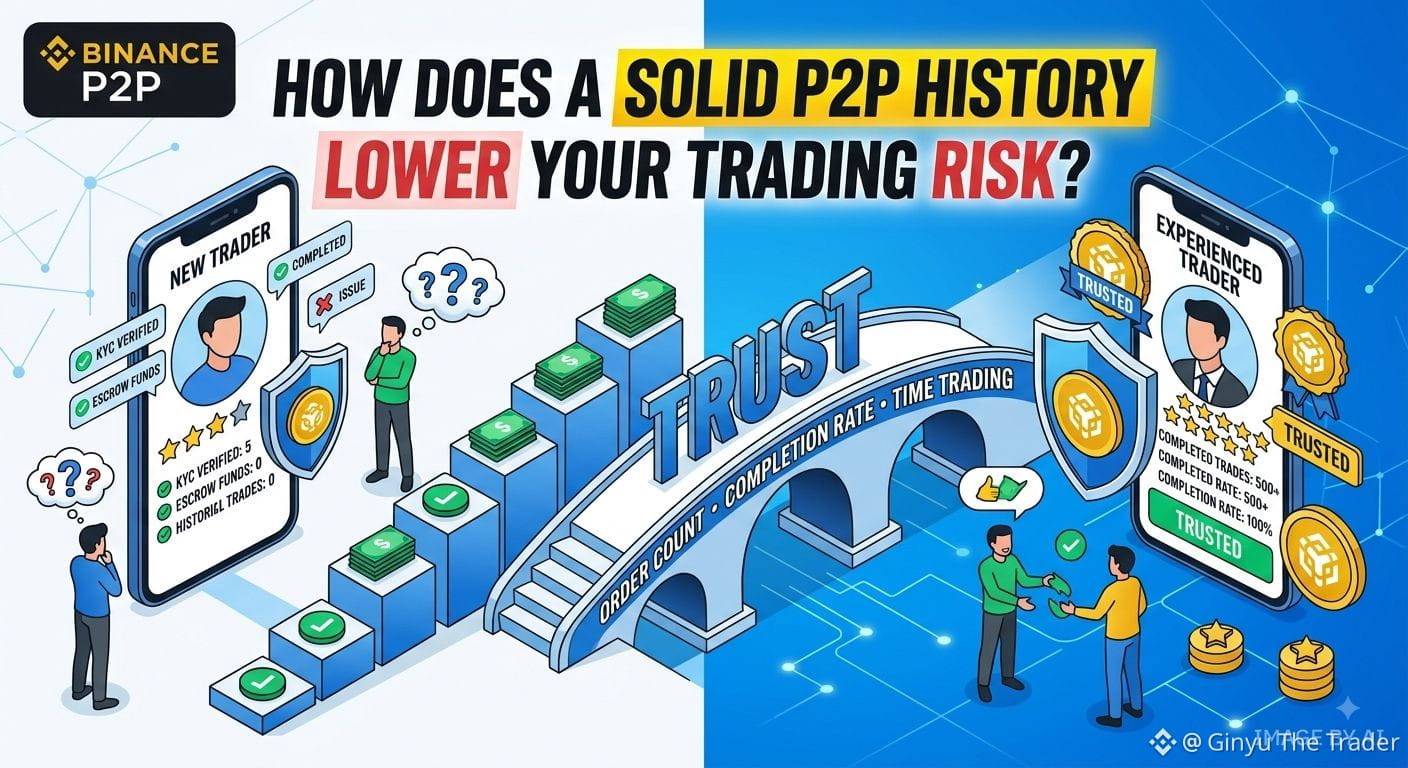
66
確認済み
翻訳参照
#dusk $DUSK @Dusk_Foundation
A lot of crypto's early identity was built on staying out of reach of regulators. Dusk is making the opposite bet. Dusk is a Layer 1 blockchain built for regulated financial markets, combining programmable privacy with compliance rather than treating them as enemies, enabling privacy where needed, transparency where useful, selective disclosure for authorized review, and deterministic settlement for tokenized RWAs and regulated securities. That philosophy carries into Dusk Trade, structured to operate as a regulated MTF and investment platform compliant with applicable EU regulations, and into Dusk's partnerships with EU licensed institutions like NPEX, an AFM regulated exchange planning to bring 300M+ EUR in assets onchain via Dusk.
This is a genuine bet, not a marketing line. If you believe crypto's long term value comes from operating outside traditional financial oversight, Dusk's entire model reads as a compromise, or even a retreat. If you believe regulated capital, pension funds, MMFs, institutional bond desks, is the larger and stickier pool of money, then compliance native infrastructure is the only door that actually opens.
I don't think this bet is naive, either, even though it runs against crypto's founding instincts. Regulated capital has always dwarfed the retail speculative pool that most of the industry chases, and if even a modest fraction of pension funds, MMFs, and institutional bond desks find a compliant onchain venue credible enough to actually use, that's a larger addressable market than most chains will ever meaningfully touch. Modest fraction is still doing a lot of quiet work in that sentence, though.
I don't think that question has a settled answer yet, and Dusk hasn't proven which side of it is right. What Dusk has done is commit fully to one side, build the architecture around it, and let the results, once DuskEVM mainnet and Dusk Trade are both live, make the argument instead of a whitepaper.
#dusk $DUSK @Dusk
A lot of crypto's early identity was built on staying out of reach of regulators. Dusk is making the opposite bet. Dusk is a Layer 1 blockchain built for regulated financial markets, combining programmable privacy with compliance rather than treating them as enemies, enabling privacy where needed, transparency where useful, selective disclosure for authorized review, and deterministic settlement for tokenized RWAs and regulated securities. That philosophy carries into Dusk Trade, structured to operate as a regulated MTF and investment platform compliant with applicable EU regulations, and into Dusk's partnerships with EU licensed institutions like NPEX, an AFM regulated exchange planning to bring 300M+ EUR in assets onchain via Dusk.
This is a genuine bet, not a marketing line. If you believe crypto's long term value comes from operating outside traditional financial oversight, Dusk's entire model reads as a compromise, or even a retreat. If you believe regulated capital, pension funds, MMFs, institutional bond desks, is the larger and stickier pool of money, then compliance native infrastructure is the only door that actually opens.
I don't think this bet is naive, either, even though it runs against crypto's founding instincts. Regulated capital has always dwarfed the retail speculative pool that most of the industry chases, and if even a modest fraction of pension funds, MMFs, and institutional bond desks find a compliant onchain venue credible enough to actually use, that's a larger addressable market than most chains will ever meaningfully touch. Modest fraction is still doing a lot of quiet work in that sentence, though.
I don't think that question has a settled answer yet, and Dusk hasn't proven which side of it is right. What Dusk has done is commit fully to one side, build the architecture around it, and let the results, once DuskEVM mainnet and Dusk Trade are both live, make the argument instead of a whitepaper.
A lot of crypto's early identity was built on staying out of reach of regulators. Dusk is making the opposite bet. Dusk is a Layer 1 blockchain built for regulated financial markets, combining programmable privacy with compliance rather than treating them as enemies, enabling privacy where needed, transparency where useful, selective disclosure for authorized review, and deterministic settlement for tokenized RWAs and regulated securities. That philosophy carries into Dusk Trade, structured to operate as a regulated MTF and investment platform compliant with applicable EU regulations, and into Dusk's partnerships with EU licensed institutions like NPEX, an AFM regulated exchange planning to bring 300M+ EUR in assets onchain via Dusk.
This is a genuine bet, not a marketing line. If you believe crypto's long term value comes from operating outside traditional financial oversight, Dusk's entire model reads as a compromise, or even a retreat. If you believe regulated capital, pension funds, MMFs, institutional bond desks, is the larger and stickier pool of money, then compliance native infrastructure is the only door that actually opens.
I don't think this bet is naive, either, even though it runs against crypto's founding instincts. Regulated capital has always dwarfed the retail speculative pool that most of the industry chases, and if even a modest fraction of pension funds, MMFs, and institutional bond desks find a compliant onchain venue credible enough to actually use, that's a larger addressable market than most chains will ever meaningfully touch. Modest fraction is still doing a lot of quiet work in that sentence, though.
I don't think that question has a settled answer yet, and Dusk hasn't proven which side of it is right. What Dusk has done is commit fully to one side, build the architecture around it, and let the results, once DuskEVM mainnet and Dusk Trade are both live, make the argument instead of a whitepaper.
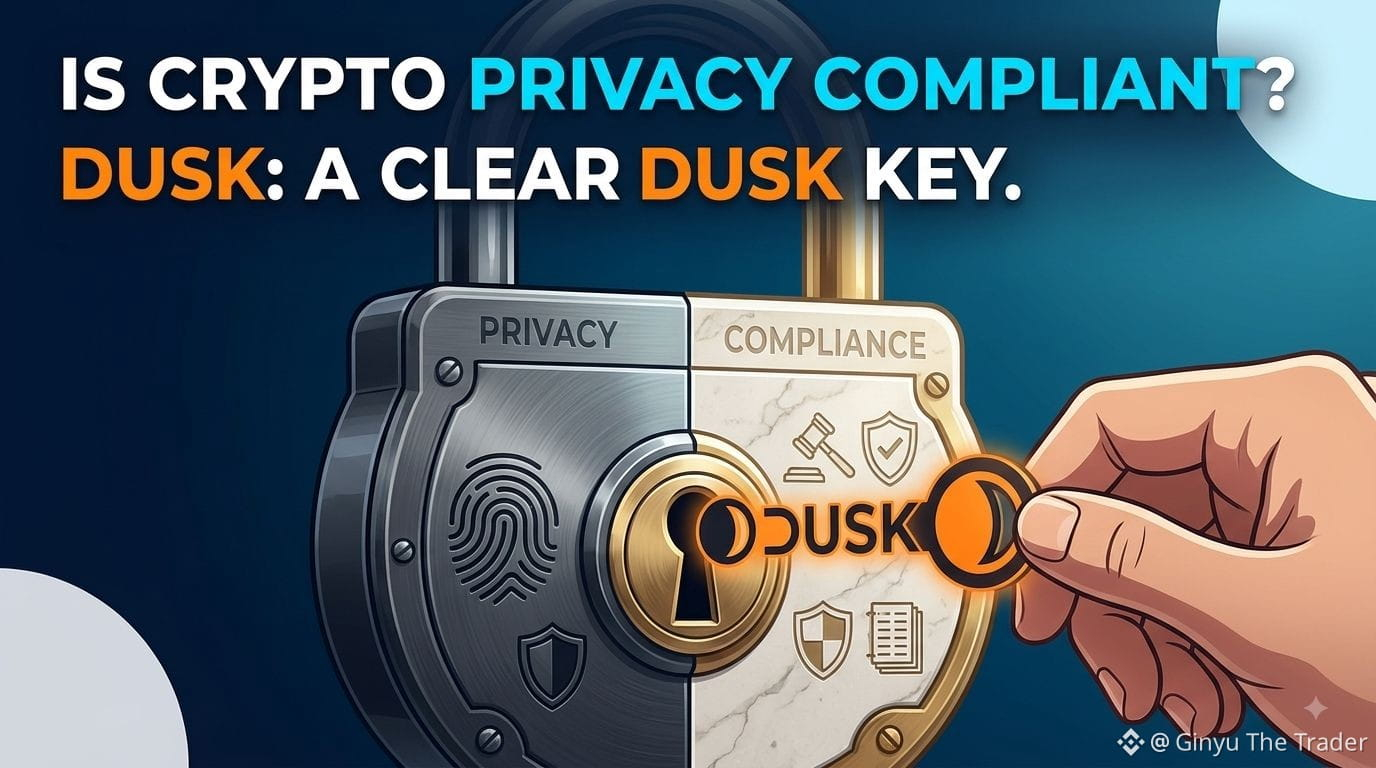
1
58
翻訳参照
#binancep2pantoan @Binance_Vietnam
Every word exchanged in a Binance P2P order chat becomes part of the record if a dispute ever happens, and once I understood that, it completely changed how I communicate during trades.
Binance P2P protects trades through KYC verification, an escrow system holding the crypto asset, and this built in chat, which exists specifically to keep every relevant detail documented in one place that both Binance support and either party can reference later during an appeal. I treat it accordingly. I state things plainly rather than assuming context, confirm details in writing even when they seem obvious, and avoid vague language that could be interpreted multiple ways if an agent ever has to read the conversation cold during a dispute.
A few habits that have served me well. When a counterparty agrees to something verbally, like confirming a detail in a voice note or a quick reply, I ask them to also type a short confirmation in text, since that is what actually gets reviewed later, and if anyone claims a payment has already gone through, I still confirm it directly in my own bank before relying on the chat message alone. I still verify the counterparty's completion rate and registered name early in the conversation rather than assuming good faith, and I avoid discussing anything unrelated to the trade itself, since a long, meandering conversation makes it harder for anyone, including future me, to find the relevant details quickly.
If a counterparty ever asks to continue the conversation somewhere outside the order chat, I treat that request itself as worth declining, regardless of the reason given. Legitimate trades have no need to leave a system built specifically to protect both sides with a timestamped, reviewable record.
Clear, complete, on platform communication is one of the simplest habits that makes Binance P2P safer, and it costs nothing extra to practice.
#binancep2pantoan @Binance Vietnam
Every word exchanged in a Binance P2P order chat becomes part of the record if a dispute ever happens, and once I understood that, it completely changed how I communicate during trades.
Binance P2P protects trades through KYC verification, an escrow system holding the crypto asset, and this built in chat, which exists specifically to keep every relevant detail documented in one place that both Binance support and either party can reference later during an appeal. I treat it accordingly. I state things plainly rather than assuming context, confirm details in writing even when they seem obvious, and avoid vague language that could be interpreted multiple ways if an agent ever has to read the conversation cold during a dispute.
A few habits that have served me well. When a counterparty agrees to something verbally, like confirming a detail in a voice note or a quick reply, I ask them to also type a short confirmation in text, since that is what actually gets reviewed later, and if anyone claims a payment has already gone through, I still confirm it directly in my own bank before relying on the chat message alone. I still verify the counterparty's completion rate and registered name early in the conversation rather than assuming good faith, and I avoid discussing anything unrelated to the trade itself, since a long, meandering conversation makes it harder for anyone, including future me, to find the relevant details quickly.
If a counterparty ever asks to continue the conversation somewhere outside the order chat, I treat that request itself as worth declining, regardless of the reason given. Legitimate trades have no need to leave a system built specifically to protect both sides with a timestamped, reviewable record.
Clear, complete, on platform communication is one of the simplest habits that makes Binance P2P safer, and it costs nothing extra to practice.
Every word exchanged in a Binance P2P order chat becomes part of the record if a dispute ever happens, and once I understood that, it completely changed how I communicate during trades.
Binance P2P protects trades through KYC verification, an escrow system holding the crypto asset, and this built in chat, which exists specifically to keep every relevant detail documented in one place that both Binance support and either party can reference later during an appeal. I treat it accordingly. I state things plainly rather than assuming context, confirm details in writing even when they seem obvious, and avoid vague language that could be interpreted multiple ways if an agent ever has to read the conversation cold during a dispute.
A few habits that have served me well. When a counterparty agrees to something verbally, like confirming a detail in a voice note or a quick reply, I ask them to also type a short confirmation in text, since that is what actually gets reviewed later, and if anyone claims a payment has already gone through, I still confirm it directly in my own bank before relying on the chat message alone. I still verify the counterparty's completion rate and registered name early in the conversation rather than assuming good faith, and I avoid discussing anything unrelated to the trade itself, since a long, meandering conversation makes it harder for anyone, including future me, to find the relevant details quickly.
If a counterparty ever asks to continue the conversation somewhere outside the order chat, I treat that request itself as worth declining, regardless of the reason given. Legitimate trades have no need to leave a system built specifically to protect both sides with a timestamped, reviewable record.
Clear, complete, on platform communication is one of the simplest habits that makes Binance P2P safer, and it costs nothing extra to practice.
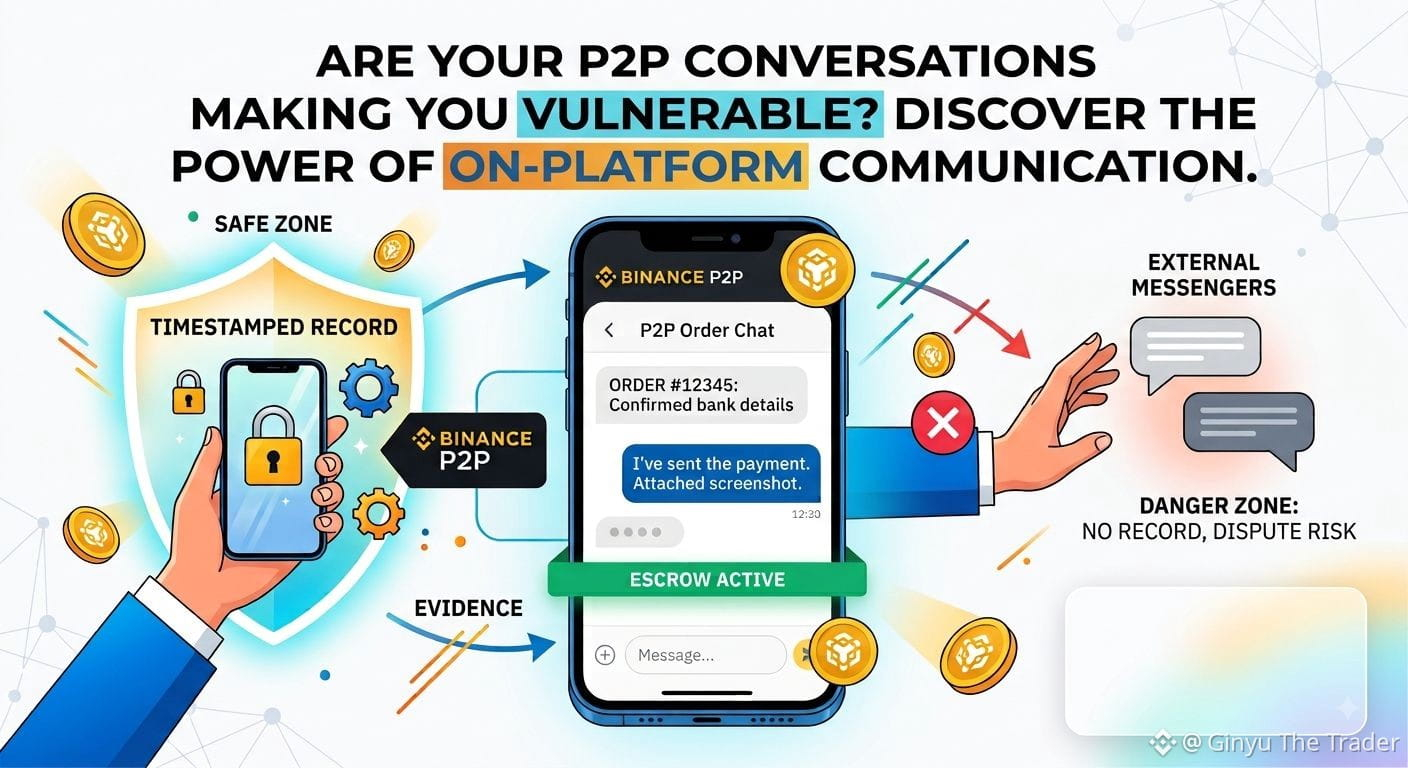
73
ログインして、さらにコンテンツを読む
厳選トピックで世界の暗号資産トレーダーの仲間入り
⚡️ 暗号資産に関する最新かつ有益な情報が見つかります。
💬 世界最大の暗号資産取引所から信頼されています。
👍 認証を受けたクリエイターから、有益なインサイトを得られます。
メール / 電話番号
トレンドトピック
HKMAPlansWholesaleCBDCByYearEnd
閲覧回数 2,290
141人が討論中
#HKMAPlansWholesaleCBDCByYearEnd
🔥🇭🇰 HKMA CBDC — トレード・レーダー稼働中!
#HKMAPlansWholesaleCBDCByYearEnd
香港は、ホールセールCBDCの決済を2026年末に向けて推進しています。⚡
🏦 24/7のデジタル決済
💰 トークン化された資産 + 預金
🌐 RWA導入のストーリー
🚀 伝統的金融がさらにオンチェーンへ
👀 RWA + トークン化 + 決済インフラ――これらのテーマは、新たな市場の注目を集める可能性があります。
🎯 トレード設定:ブレイクアウト → リテスト → 出来高(ボリューム)確認
❌ 最初の上昇(最初の緑のローソク)を追いかけない。
🛡️ リスク管理 + DYOR/NFA
どのストーリーが先に動く?👇
🔥 RWA | 💰 トークン化 | ⚡ CBDC
$IO $ONE $ARB
#HKMA #HongKong #Binance #trading
Shourov Saha-01
·いいね:2件
·閲覧回数 169
NEARSurges26%Past$3.45
閲覧回数 7,321
83人が討論中
BOJHikesRatesTo31YearHigh
閲覧回数 18,928
529人が討論中