

#smartcontracts
smartcontracts
514,730 vues
2,664 mentions
Populaire
Récents

·
--
The user wants a safety awareness post about verifying smart contracts before approving them. Constraints: no markdown, 150-200 words, warning-style tone (serious but not panic-inducing), 3 clear actionable steps, end with specific sentence, final line with hashtags. Must output only the final post text, no extra commentary.
We need to count words roughly 150-200. Let's craft ~170 words.
We need to avoid markdown (no bold, italics, bullet points? Probably plain text lines). Use plain text lines. Provide three steps numbered or bullet-like but plain text.
End with "Share this with someone new to crypto — it could save them!" then newline then hashtags line.
Make sure total words count. Let's draft.
Count words manually.
Draft:
"Warning: Approving a malicious smart contract can drain your wallet in seconds. Before you click “Approve,” follow these three checks.
1. Verify the contract address on a trusted explorer. Copy the address from the official project site, then paste it into Etherscan, BscScan, or the relevant block explorer. Confirm the contract name, creator, and transaction history match the project’s announcements.
2. Review the contract source code. If the code is not verified, treat it as high risk. Look for functions like “transferFrom,” “approve,” or hidden “owner” privileges that can move tokens without your consent. Use tools such as Solidity Visual Auditor or open‑source analyzers for a quick scan.
3. Limit the allowance. Instead of unlimited approval, set a custom amount that matches the exact transaction you intend. Most wallets let you edit the spend limit before confirming.
Share this with someone new to crypto — it could save them!
#DeFiProtocol #SmartContracts #CryptoSecurity #StaySafe"
Now count words.
Count manually:
Warning: (1) Approving (
The user wants a safety awareness post about verifying smart contracts before approving them. Constraints: no markdown, 150-200 words, warning-style tone (serious but not panic-inducing), 3 clear actionable steps, end with specific sentence, final line with hashtags. Must output only the final post text, no extra commentary.
We need to count words roughly 150-200. Let's craft ~170 words.
We need to avoid markdown (no bold, italics, bullet points? Probably plain text lines). Use plain text lines. Provide three steps numbered or bullet-like but plain text.
End with "Share this with someone new to crypto — it could save them!" then newline then hashtags line.
Make sure total words count. Let's draft.
Count words manually.
Draft:
"Warning: Approving a malicious smart contract can drain your wallet in seconds. Before you click “Approve,” follow these three checks.
1. Verify the contract address on a trusted explorer. Copy the address from the official project site, then paste it into Etherscan, BscScan, or the relevant block explorer. Confirm the contract name, creator, and transaction history match the project’s announcements.
2. Review the contract source code. If the code is not verified, treat it as high risk. Look for functions like “transferFrom,” “approve,” or hidden “owner” privileges that can move tokens without your consent. Use tools such as Solidity Visual Auditor or open‑source analyzers for a quick scan.
3. Limit the allowance. Instead of unlimited approval, set a custom amount that matches the exact transaction you intend. Most wallets let you edit the spend limit before confirming.
Share this with someone new to crypto — it could save them!
#DeFiProtocol #SmartContracts #CryptoSecurity #StaySafe"
Now count words.
Count manually:
Warning: (1) Approving (
We need to count words roughly 150-200. Let's craft ~170 words.
We need to avoid markdown (no bold, italics, bullet points? Probably plain text lines). Use plain text lines. Provide three steps numbered or bullet-like but plain text.
End with "Share this with someone new to crypto — it could save them!" then newline then hashtags line.
Make sure total words count. Let's draft.
Count words manually.
Draft:
"Warning: Approving a malicious smart contract can drain your wallet in seconds. Before you click “Approve,” follow these three checks.
1. Verify the contract address on a trusted explorer. Copy the address from the official project site, then paste it into Etherscan, BscScan, or the relevant block explorer. Confirm the contract name, creator, and transaction history match the project’s announcements.
2. Review the contract source code. If the code is not verified, treat it as high risk. Look for functions like “transferFrom,” “approve,” or hidden “owner” privileges that can move tokens without your consent. Use tools such as Solidity Visual Auditor or open‑source analyzers for a quick scan.
3. Limit the allowance. Instead of unlimited approval, set a custom amount that matches the exact transaction you intend. Most wallets let you edit the spend limit before confirming.
Share this with someone new to crypto — it could save them!
#DeFiProtocol #SmartContracts #CryptoSecurity #StaySafe"
Now count words.
Count manually:
Warning: (1) Approving (
3

**¿Por qué #SmartContracts está en tendencia hoy?**
Los contratos inteligentes vuelven a ser tema de conversación, y no es casualidad. Nasdaq-100 acaba de llegar on-chain: Janus Henderson y Centrifuge lanzaron el primer fondo licenciado del índice en blockchain. Además, CF Benchmarks (la misma data que usa BlackRock) llevó su infraestructura de pricing a blockchain pública.
Esto no es DeFi experimental. Es Wall Street usando smart contracts como backend.
**¿Qué es un smart contract?** Un programa que se ejecuta automáticamente cuando se cumplen condiciones predefinidas, sin intermediarios. Si X sucede, entonces Y se ejecuta. No hay banco, no hay notario, no hay demora.
Lo importante: los contratos inteligentes dejaron de ser solo para tokens meme o NFTs. Ahora son infraestructura financiera seria. Fondos indexados, precios institucionales, liquidación de activos tradicionales… todo migrando a blockchain porque es más eficiente y auditable.
Mientras tanto, Bitcoin cotiza en **$80,411** con **+0.19%** en 24 horas y un índice Fear & Greed en **48 (neutral)**. El precio se mueve poco, pero la infraestructura cripto avanza a toda velocidad por detrás.
**¿Creés que los smart contracts van a reemplazar contratos legales tradicionales, o van a convivir?** Dejá tu opinión en los comentarios.
**¿Por qué #SmartContracts está en tendencia hoy?**
Los contratos inteligentes vuelven a ser tema de conversación, y no es casualidad. Nasdaq-100 acaba de llegar on-chain: Janus Henderson y Centrifuge lanzaron el primer fondo licenciado del índice en blockchain. Además, CF Benchmarks (la misma data que usa BlackRock) llevó su infraestructura de pricing a blockchain pública.
Esto no es DeFi experimental. Es Wall Street usando smart contracts como backend.
**¿Qué es un smart contract?** Un programa que se ejecuta automáticamente cuando se cumplen condiciones predefinidas, sin intermediarios. Si X sucede, entonces Y se ejecuta. No hay banco, no hay notario, no hay demora.
Lo importante: los contratos inteligentes dejaron de ser solo para tokens meme o NFTs. Ahora son infraestructura financiera seria. Fondos indexados, precios institucionales, liquidación de activos tradicionales… todo migrando a blockchain porque es más eficiente y auditable.
Mientras tanto, Bitcoin cotiza en **$80,411** con **+0.19%** en 24 horas y un índice Fear & Greed en **48 (neutral)**. El precio se mueve poco, pero la infraestructura cripto avanza a toda velocidad por detrás.
**¿Creés que los smart contracts van a reemplazar contratos legales tradicionales, o van a convivir?** Dejá tu opinión en los comentarios.
Los contratos inteligentes vuelven a ser tema de conversación, y no es casualidad. Nasdaq-100 acaba de llegar on-chain: Janus Henderson y Centrifuge lanzaron el primer fondo licenciado del índice en blockchain. Además, CF Benchmarks (la misma data que usa BlackRock) llevó su infraestructura de pricing a blockchain pública.
Esto no es DeFi experimental. Es Wall Street usando smart contracts como backend.
**¿Qué es un smart contract?** Un programa que se ejecuta automáticamente cuando se cumplen condiciones predefinidas, sin intermediarios. Si X sucede, entonces Y se ejecuta. No hay banco, no hay notario, no hay demora.
Lo importante: los contratos inteligentes dejaron de ser solo para tokens meme o NFTs. Ahora son infraestructura financiera seria. Fondos indexados, precios institucionales, liquidación de activos tradicionales… todo migrando a blockchain porque es más eficiente y auditable.
Mientras tanto, Bitcoin cotiza en **$80,411** con **+0.19%** en 24 horas y un índice Fear & Greed en **48 (neutral)**. El precio se mueve poco, pero la infraestructura cripto avanza a toda velocidad por detrás.
**¿Creés que los smart contracts van a reemplazar contratos legales tradicionales, o van a convivir?** Dejá tu opinión en los comentarios.
3

·
--
智能合约部署之后,真的永远不能修改吗?🔍
答案取决于它的架构。
有些合约无法直接升级,有些则通过代理合约切换底层实现。关键不只是代码是否公开,还包括:
🔹 谁拥有升级权限?
🔹 是否需要多重签名?
🔹 有没有时间锁和治理约束?
🔹 管理员能否暂停交易或修改关键参数?
经过审计不代表永久安全,开源也不代表权限合理。
理解一个 Web3 项目,不仅要看它的代码,还要看谁有权改变规则。
你认为,可升级性是协议的必要能力,还是需要重点防范的风险?
#ONEANetwork #Web3 #SmartContracts
智能合约部署之后,真的永远不能修改吗?🔍
答案取决于它的架构。
有些合约无法直接升级,有些则通过代理合约切换底层实现。关键不只是代码是否公开,还包括:
🔹 谁拥有升级权限?
🔹 是否需要多重签名?
🔹 有没有时间锁和治理约束?
🔹 管理员能否暂停交易或修改关键参数?
经过审计不代表永久安全,开源也不代表权限合理。
理解一个 Web3 项目,不仅要看它的代码,还要看谁有权改变规则。
你认为,可升级性是协议的必要能力,还是需要重点防范的风险?
#ONEANetwork #Web3 #SmartContracts
答案取决于它的架构。
有些合约无法直接升级,有些则通过代理合约切换底层实现。关键不只是代码是否公开,还包括:
🔹 谁拥有升级权限?
🔹 是否需要多重签名?
🔹 有没有时间锁和治理约束?
🔹 管理员能否暂停交易或修改关键参数?
经过审计不代表永久安全,开源也不代表权限合理。
理解一个 Web3 项目,不仅要看它的代码,还要看谁有权改变规则。
你认为,可升级性是协议的必要能力,还是需要重点防范的风险?
#ONEANetwork #Web3 #SmartContracts
3
6

·
--
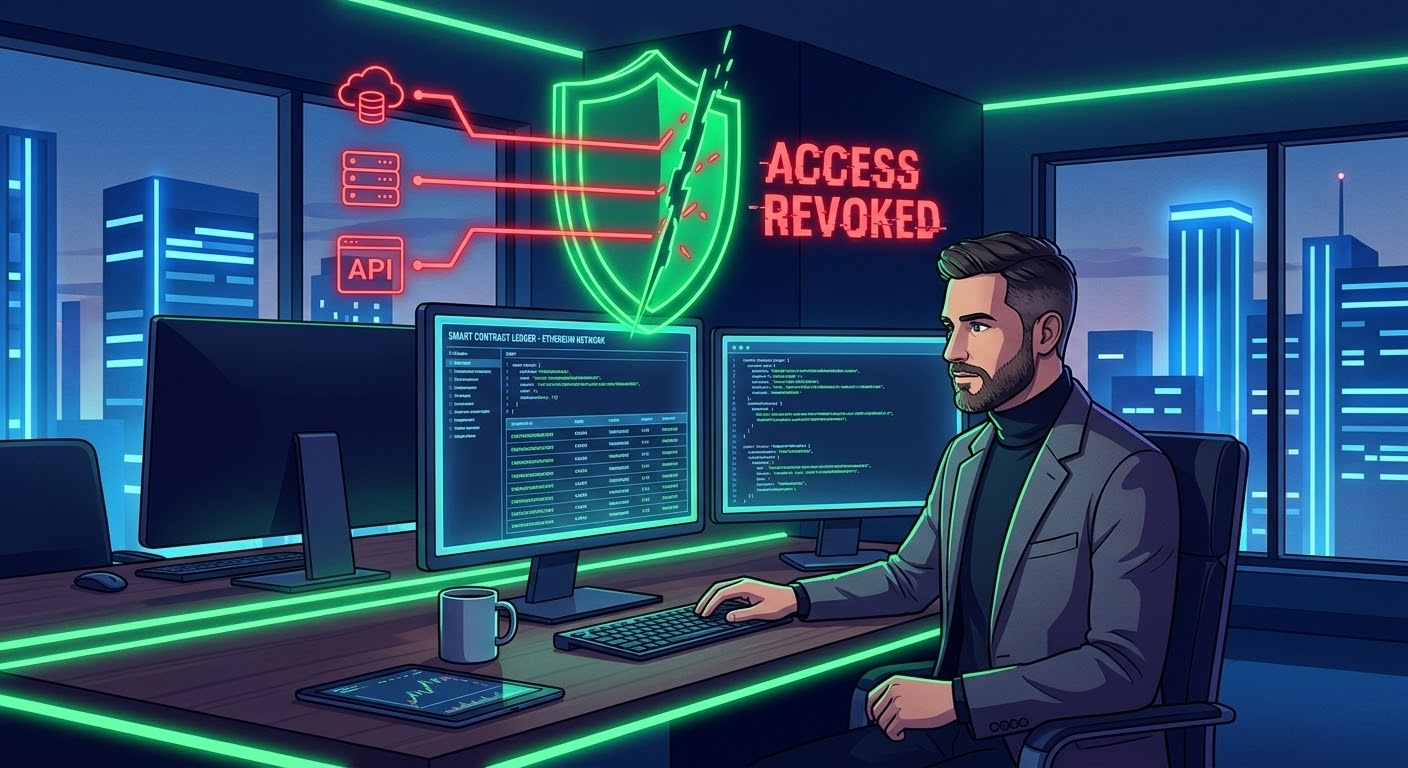
My Crypto Safety Roadmap (Part 8): How I Manage and Revoke Risky Smart Contract Permissions🎈🎈
🔴Interacting with Decentralized Applications (DApps) and DeFi platforms is a major part of my crypto execution, but it introduces a hidden risk that many overlook. In my journey, I discovered that granting "unlimited token approval" to a platform allows its smart contracts to access my assets at any time. If that protocol gets exploited or turns out to be a scam, my connected wallet can be drained instantly. To secure my treasury, I established a strict inspection and cleanup routine.🚀
🔴Today, I never leave permanent or unlimited spending permissions active on my Web3 wallets. I routinely use blockchain scanners and revocation tools like Revoke.cash to audit every single smart contract connection I have made. Whenever I finish a transaction or interact with a new platform, I immediately revoke or minimize the allowed token allowance. Controlling exactly who and what can interact with my digital assets is my ultimate shield against smart contract exploits.🚀
#CryptoSafety #SmartContracts #Web3Security #DeFiSecurity $XAUT $BTC $BNB
💥Not Financial Advice
{spot}(XAUTUSDT)
My Crypto Safety Roadmap (Part 8): How I Manage and Revoke Risky Smart Contract Permissions🎈🎈
🔴Interacting with Decentralized Applications (DApps) and DeFi platforms is a major part of my crypto execution, but it introduces a hidden risk that many overlook. In my journey, I discovered that granting "unlimited token approval" to a platform allows its smart contracts to access my assets at any time. If that protocol gets exploited or turns out to be a scam, my connected wallet can be drained instantly. To secure my treasury, I established a strict inspection and cleanup routine.🚀
🔴Today, I never leave permanent or unlimited spending permissions active on my Web3 wallets. I routinely use blockchain scanners and revocation tools like Revoke.cash to audit every single smart contract connection I have made. Whenever I finish a transaction or interact with a new platform, I immediately revoke or minimize the allowed token allowance. Controlling exactly who and what can interact with my digital assets is my ultimate shield against smart contract exploits.🚀
#CryptoSafety #SmartContracts #Web3Security #DeFiSecurity $XAUT $BTC $BNB
💥Not Financial Advice
🔴Interacting with Decentralized Applications (DApps) and DeFi platforms is a major part of my crypto execution, but it introduces a hidden risk that many overlook. In my journey, I discovered that granting "unlimited token approval" to a platform allows its smart contracts to access my assets at any time. If that protocol gets exploited or turns out to be a scam, my connected wallet can be drained instantly. To secure my treasury, I established a strict inspection and cleanup routine.🚀
🔴Today, I never leave permanent or unlimited spending permissions active on my Web3 wallets. I routinely use blockchain scanners and revocation tools like Revoke.cash to audit every single smart contract connection I have made. Whenever I finish a transaction or interact with a new platform, I immediately revoke or minimize the allowed token allowance. Controlling exactly who and what can interact with my digital assets is my ultimate shield against smart contract exploits.🚀
#CryptoSafety #SmartContracts #Web3Security #DeFiSecurity $XAUT $BTC $BNB
💥Not Financial Advice
232

·
--
Ethereum canceled Monday’s Hoodi activation over a risk to existing contracts. That gets my attention. 😬
Researchers showed how new gas rules could let smart contracts permanently record failed operations, prompting developers to delay the Glamsterdam test.
With $ETH upgrades, I care about more than what gets added. I want to know what changes for contracts already in use. 🔍
What would you want developers to verify before rescheduling?
#Ethereum #SmartContracts #CryptoSecurity
Ethereum canceled Monday’s Hoodi activation over a risk to existing contracts. That gets my attention. 😬
Researchers showed how new gas rules could let smart contracts permanently record failed operations, prompting developers to delay the Glamsterdam test.
With $ETH upgrades, I care about more than what gets added. I want to know what changes for contracts already in use. 🔍
What would you want developers to verify before rescheduling?
#Ethereum #SmartContracts #CryptoSecurity
Researchers showed how new gas rules could let smart contracts permanently record failed operations, prompting developers to delay the Glamsterdam test.
With $ETH upgrades, I care about more than what gets added. I want to know what changes for contracts already in use. 🔍
What would you want developers to verify before rescheduling?
#Ethereum #SmartContracts #CryptoSecurity

99
🛠 $ETH: Glamsterdam Testnet Fork Postponed Over Smart Contract Gas Risks
$ETH: Core developers delayed the Glamsterdam upgrade on the Hoodi testnet past its planned Oct. 26 date. The pause follows warnings that EIP-8037 and EIP-8038 could return gas after failed operations, potentially enabling insufficient gas griefing across existing smart contracts. ChainSecurity discovered 13 real-world contract vulnerabilities under the proposed rules. However, developers have not yet finalized revised timelines for testnet activation or the target December mainnet rollout.
#ETH #SmartContracts
🛠 $ETH : Glamsterdam Testnet Fork Postponed Over Smart Contract Gas Risks
$ETH : Core developers delayed the Glamsterdam upgrade on the Hoodi testnet past its planned Oct. 26 date. The pause follows warnings that EIP-8037 and EIP-8038 could return gas after failed operations, potentially enabling insufficient gas griefing across existing smart contracts. ChainSecurity discovered 13 real-world contract vulnerabilities under the proposed rules. However, developers have not yet finalized revised timelines for testnet activation or the target December mainnet rollout.
#ETH #SmartContracts
$ETH : Core developers delayed the Glamsterdam upgrade on the Hoodi testnet past its planned Oct. 26 date. The pause follows warnings that EIP-8037 and EIP-8038 could return gas after failed operations, potentially enabling insufficient gas griefing across existing smart contracts. ChainSecurity discovered 13 real-world contract vulnerabilities under the proposed rules. However, developers have not yet finalized revised timelines for testnet activation or the target December mainnet rollout.
#ETH #SmartContracts

89
Article
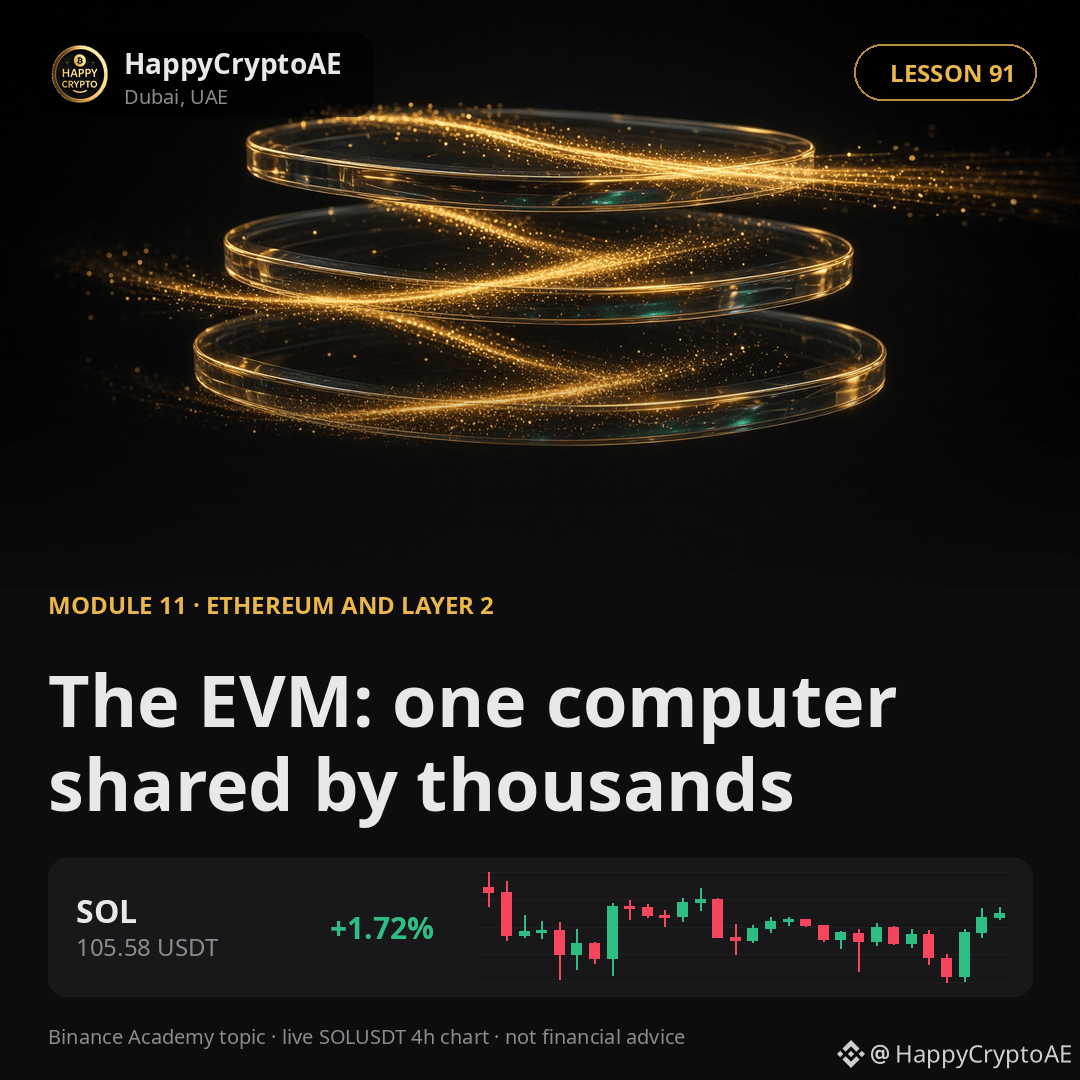
The EVM: one computer shared by thousandsThe Ethereum Virtual Machine is the environment that runs smart contracts. Every node executes the same instructions and must reach the same result, so a contract behaves identically wherever it runs - like one global computer that nobody owns and nobody can switch off.
Its influence reaches well beyond Ethereum. Many other networks, BNB Chain included, are EVM-compatible: the same contracts, wallets and developer tools work on them. That is why the same address format shows up across chains, and why apps can launch on several networks at once. It is also why a flaw in a popular contract can be copied across chains just as easily.
💬 How many EVM chains do you use without really thinking about it?
Binance Academy covers this in more depth: https://www.binance.com/en/academy/glossary/ethereum-virtual-machine-evm
Next lesson: Gwei: how Ethereum prices your transaction
Trading crypto from Dubai since 2019.
$ETH $BNB $SOL
#Ethereum #EVM #SmartContracts
The EVM: one computer shared by thousands
The Ethereum Virtual Machine is the environment that runs smart contracts. Every node executes the same instructions and must reach the same result, so a contract behaves identically wherever it runs - like one global computer that nobody owns and nobody can switch off.
Its influence reaches well beyond Ethereum. Many other networks, BNB Chain included, are EVM-compatible: the same contracts, wallets and developer tools work on them. That is why the same address format shows up across chains, and why apps can launch on several networks at once. It is also why a flaw in a popular contract can be copied across chains just as easily.
💬 How many EVM chains do you use without really thinking about it?
Binance Academy covers this in more depth: https://www.binance.com/en/academy/glossary/ethereum-virtual-machine-evm
Next lesson: Gwei: how Ethereum prices your transaction
Trading crypto from Dubai since 2019.
$ETH $BNB $SOL
#Ethereum #EVM #SmartContracts
Its influence reaches well beyond Ethereum. Many other networks, BNB Chain included, are EVM-compatible: the same contracts, wallets and developer tools work on them. That is why the same address format shows up across chains, and why apps can launch on several networks at once. It is also why a flaw in a popular contract can be copied across chains just as easily.
💬 How many EVM chains do you use without really thinking about it?
Binance Academy covers this in more depth: https://www.binance.com/en/academy/glossary/ethereum-virtual-machine-evm
Next lesson: Gwei: how Ethereum prices your transaction
Trading crypto from Dubai since 2019.
$ETH $BNB $SOL
#Ethereum #EVM #SmartContracts
108
¿Qué es un smart contract?
Es código que vive en una blockchain y se ejecuta solo cuando se cumplen las condiciones que programaste. Sin intermediarios, sin permisos, sin posibilidad de frenarlo.
Ejemplo simple: depositás fondos en un contrato que dice "si BTC sube a X, enviá todo a la wallet A; si baja, a la B". Llega el momento, el contrato consulta el precio (vía oráculo), y ejecuta. Nadie supervisa, la blockchain valida.
La inmensa mayoría de lo que usás en DeFi son smart contracts: Uniswap, Aave, GMX, todos. El contrato ES el protocolo.
¿El riesgo? Bugs en el código. Si hay un error y ya está desplegado, no hay vuelta atrás (salvo que el diseño permita actualizaciones, lo cual introduce centralización).
Por eso los proyectos serios auditan antes de lanzar. Revisar auditorías antes de meter capital es tu primera línea de defensa.
Seguinos para más guías que te explican cómo funciona lo que usás todos los días.
#SmartContracts
¿Qué es un smart contract?
Es código que vive en una blockchain y se ejecuta solo cuando se cumplen las condiciones que programaste. Sin intermediarios, sin permisos, sin posibilidad de frenarlo.
Ejemplo simple: depositás fondos en un contrato que dice "si BTC sube a X, enviá todo a la wallet A; si baja, a la B". Llega el momento, el contrato consulta el precio (vía oráculo), y ejecuta. Nadie supervisa, la blockchain valida.
La inmensa mayoría de lo que usás en DeFi son smart contracts: Uniswap, Aave, GMX, todos. El contrato ES el protocolo.
¿El riesgo? Bugs en el código. Si hay un error y ya está desplegado, no hay vuelta atrás (salvo que el diseño permita actualizaciones, lo cual introduce centralización).
Por eso los proyectos serios auditan antes de lanzar. Revisar auditorías antes de meter capital es tu primera línea de defensa.
Seguinos para más guías que te explican cómo funciona lo que usás todos los días.
#SmartContracts
Es código que vive en una blockchain y se ejecuta solo cuando se cumplen las condiciones que programaste. Sin intermediarios, sin permisos, sin posibilidad de frenarlo.
Ejemplo simple: depositás fondos en un contrato que dice "si BTC sube a X, enviá todo a la wallet A; si baja, a la B". Llega el momento, el contrato consulta el precio (vía oráculo), y ejecuta. Nadie supervisa, la blockchain valida.
La inmensa mayoría de lo que usás en DeFi son smart contracts: Uniswap, Aave, GMX, todos. El contrato ES el protocolo.
¿El riesgo? Bugs en el código. Si hay un error y ya está desplegado, no hay vuelta atrás (salvo que el diseño permita actualizaciones, lo cual introduce centralización).
Por eso los proyectos serios auditan antes de lanzar. Revisar auditorías antes de meter capital es tu primera línea de defensa.
Seguinos para más guías que te explican cómo funciona lo que usás todos los días.
#SmartContracts
77

⚡ $DOGE EVOLVES BEYOND MEMES AS DOGEOS PUBLIC TESTNET UNLOCKS SMART CONTRACTS! 🚀
DogeOS has officially opened its public testnet, bringing full Ethereum-style smart contracts directly to the $DOGE ecosystem. 💡 From decentralized trading and lending to stablecoins and gaming, $DOGE now serves as the native gas token while the base layer remains rock solid.
Security currently relies on a dedicated validator set while a miner-verification upgrade proposal awaits execution. 📊 This fundamental utility shift could completely redefine $DOGE value accrual alongside giants like $ETH and $BTC . 💬 Will smart contract utility finally push $DOGE into a permanent structural re-rating? 👇
⚠️ Not financial advice. Always manage your risk. 🛡️
🏷️ #DOGE #Altcoins #SmartContracts #Crypto
⚡ 💎
⚡ $DOGE EVOLVES BEYOND MEMES AS DOGEOS PUBLIC TESTNET UNLOCKS SMART CONTRACTS! 🚀
DogeOS has officially opened its public testnet, bringing full Ethereum-style smart contracts directly to the $DOGE ecosystem. 💡 From decentralized trading and lending to stablecoins and gaming, $DOGE now serves as the native gas token while the base layer remains rock solid.
Security currently relies on a dedicated validator set while a miner-verification upgrade proposal awaits execution. 📊 This fundamental utility shift could completely redefine $DOGE value accrual alongside giants like $ETH and $BTC . 💬 Will smart contract utility finally push $DOGE into a permanent structural re-rating? 👇
⚠️ Not financial advice. Always manage your risk. 🛡️
🏷️ #DOGE #Altcoins #SmartContracts #Crypto
⚡ 💎
DogeOS has officially opened its public testnet, bringing full Ethereum-style smart contracts directly to the $DOGE ecosystem. 💡 From decentralized trading and lending to stablecoins and gaming, $DOGE now serves as the native gas token while the base layer remains rock solid.
Security currently relies on a dedicated validator set while a miner-verification upgrade proposal awaits execution. 📊 This fundamental utility shift could completely redefine $DOGE value accrual alongside giants like $ETH and $BTC . 💬 Will smart contract utility finally push $DOGE into a permanent structural re-rating? 👇
⚠️ Not financial advice. Always manage your risk. 🛡️
🏷️ #DOGE #Altcoins #SmartContracts #Crypto
⚡ 💎
11
·
--
Haussier
Smart contracts can use more than current state 🤝
Historical activity can become an input for how an application behaves.
A DeFi protocol could use proven historical-data queries to determine whether a wallet qualifies for a reward.
A trading application could use previous activity to calculate a loyalty discount.
Other applications could build customized experiences around verified historical behavior.
Space and Time makes this possible by allowing supported SQL queries to run against committed data and generating cryptographic proofs that the computation was executed correctly.
Those results can then be verified before an application acts on them.
Space and Time's Uniswap hooks materials already provide customizable templates demonstrating how this infrastructure can be applied.
These examples demonstrate how developers can use the data infrastructure supported by the $SXT network to build more sophisticated DeFi applications.
The important distinction is that these examples show what developers can build. They should not automatically be treated as confirmed live deployments.
#DeFi #SmartContracts
Smart contracts can use more than current state 🤝
Historical activity can become an input for how an application behaves.
A DeFi protocol could use proven historical-data queries to determine whether a wallet qualifies for a reward.
A trading application could use previous activity to calculate a loyalty discount.
Other applications could build customized experiences around verified historical behavior.
Space and Time makes this possible by allowing supported SQL queries to run against committed data and generating cryptographic proofs that the computation was executed correctly.
Those results can then be verified before an application acts on them.
Space and Time's Uniswap hooks materials already provide customizable templates demonstrating how this infrastructure can be applied.
These examples demonstrate how developers can use the data infrastructure supported by the $SXT network to build more sophisticated DeFi applications.
The important distinction is that these examples show what developers can build. They should not automatically be treated as confirmed live deployments.
#DeFi #SmartContracts
Historical activity can become an input for how an application behaves.
A DeFi protocol could use proven historical-data queries to determine whether a wallet qualifies for a reward.
A trading application could use previous activity to calculate a loyalty discount.
Other applications could build customized experiences around verified historical behavior.
Space and Time makes this possible by allowing supported SQL queries to run against committed data and generating cryptographic proofs that the computation was executed correctly.
Those results can then be verified before an application acts on them.
Space and Time's Uniswap hooks materials already provide customizable templates demonstrating how this infrastructure can be applied.
These examples demonstrate how developers can use the data infrastructure supported by the $SXT network to build more sophisticated DeFi applications.
The important distinction is that these examples show what developers can build. They should not automatically be treated as confirmed live deployments.
#DeFi #SmartContracts
1
142

·
--
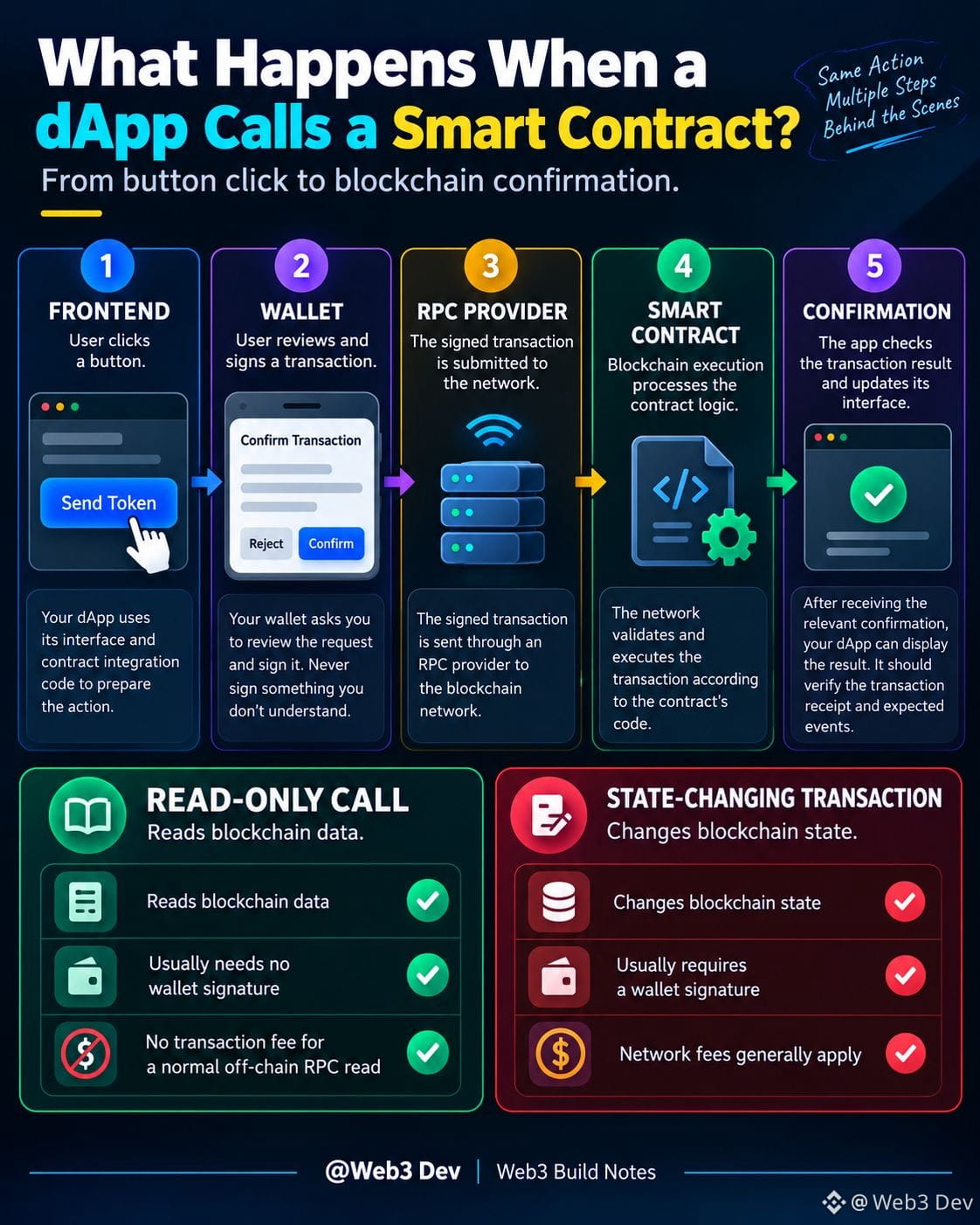
What actually happens when you click a button in a dApp? 👇
Let's say you're using a decentralized app and click “Send Token.”
It looks like one simple action. Under the hood, several things happen.
1√ The frontend prepares the request
Your dApp uses its interface and contract integration code to prepare the action you want to perform.
2√ Your wallet asks for approval
For a transaction that changes blockchain state, your wallet lets you review the request and sign it. Never sign something you don't understand.
3️⃣ The transaction goes to the network
The signed transaction is submitted through an RPC provider to the blockchain network.
4️⃣ The smart contract executes
The network processes the transaction according to the contract's code. If the transaction succeeds, the contract's state can change.
5√ Your app checks the result
Your dApp can track the transaction status and display a result after receiving the relevant confirmation. For important actions, it should verify the transaction receipt and expected events rather than trusting a frontend success message.
Here's one detail beginners often miss:
Reading blockchain data is different from changing it.
- "balanceOf()" can usually read a token balance through a read-only call without paying a transaction fee.
- "transfer()" changes blockchain state and generally requires a signed transaction and a network fee.
The exact process depends on the blockchain, wallet, and contract you're using.
As developers, understanding this flow helps us build better interfaces, handle errors properly, and give users clearer transaction status.
I'm exploring these concepts from a full-stack and Web3 engineering perspective and sharing what I learn along the way.
Question for fellow builders: Which part should I break down next: wallet integration, RPC providers, or transaction receipts?
#Web3Dev #SmartContracts #BinanceSquare
What actually happens when you click a button in a dApp? 👇
Let's say you're using a decentralized app and click “Send Token.”
It looks like one simple action. Under the hood, several things happen.
1√ The frontend prepares the request
Your dApp uses its interface and contract integration code to prepare the action you want to perform.
2√ Your wallet asks for approval
For a transaction that changes blockchain state, your wallet lets you review the request and sign it. Never sign something you don't understand.
3️⃣ The transaction goes to the network
The signed transaction is submitted through an RPC provider to the blockchain network.
4️⃣ The smart contract executes
The network processes the transaction according to the contract's code. If the transaction succeeds, the contract's state can change.
5√ Your app checks the result
Your dApp can track the transaction status and display a result after receiving the relevant confirmation. For important actions, it should verify the transaction receipt and expected events rather than trusting a frontend success message.
Here's one detail beginners often miss:
Reading blockchain data is different from changing it.
- "balanceOf()" can usually read a token balance through a read-only call without paying a transaction fee.
- "transfer()" changes blockchain state and generally requires a signed transaction and a network fee.
The exact process depends on the blockchain, wallet, and contract you're using.
As developers, understanding this flow helps us build better interfaces, handle errors properly, and give users clearer transaction status.
I'm exploring these concepts from a full-stack and Web3 engineering perspective and sharing what I learn along the way.
Question for fellow builders: Which part should I break down next: wallet integration, RPC providers, or transaction receipts?
#Web3Dev #SmartContracts #BinanceSquare
Let's say you're using a decentralized app and click “Send Token.”
It looks like one simple action. Under the hood, several things happen.
1√ The frontend prepares the request
Your dApp uses its interface and contract integration code to prepare the action you want to perform.
2√ Your wallet asks for approval
For a transaction that changes blockchain state, your wallet lets you review the request and sign it. Never sign something you don't understand.
3️⃣ The transaction goes to the network
The signed transaction is submitted through an RPC provider to the blockchain network.
4️⃣ The smart contract executes
The network processes the transaction according to the contract's code. If the transaction succeeds, the contract's state can change.
5√ Your app checks the result
Your dApp can track the transaction status and display a result after receiving the relevant confirmation. For important actions, it should verify the transaction receipt and expected events rather than trusting a frontend success message.
Here's one detail beginners often miss:
Reading blockchain data is different from changing it.
- "balanceOf()" can usually read a token balance through a read-only call without paying a transaction fee.
- "transfer()" changes blockchain state and generally requires a signed transaction and a network fee.
The exact process depends on the blockchain, wallet, and contract you're using.
As developers, understanding this flow helps us build better interfaces, handle errors properly, and give users clearer transaction status.
I'm exploring these concepts from a full-stack and Web3 engineering perspective and sharing what I learn along the way.
Question for fellow builders: Which part should I break down next: wallet integration, RPC providers, or transaction receipts?
#Web3Dev #SmartContracts #BinanceSquare
19
Article
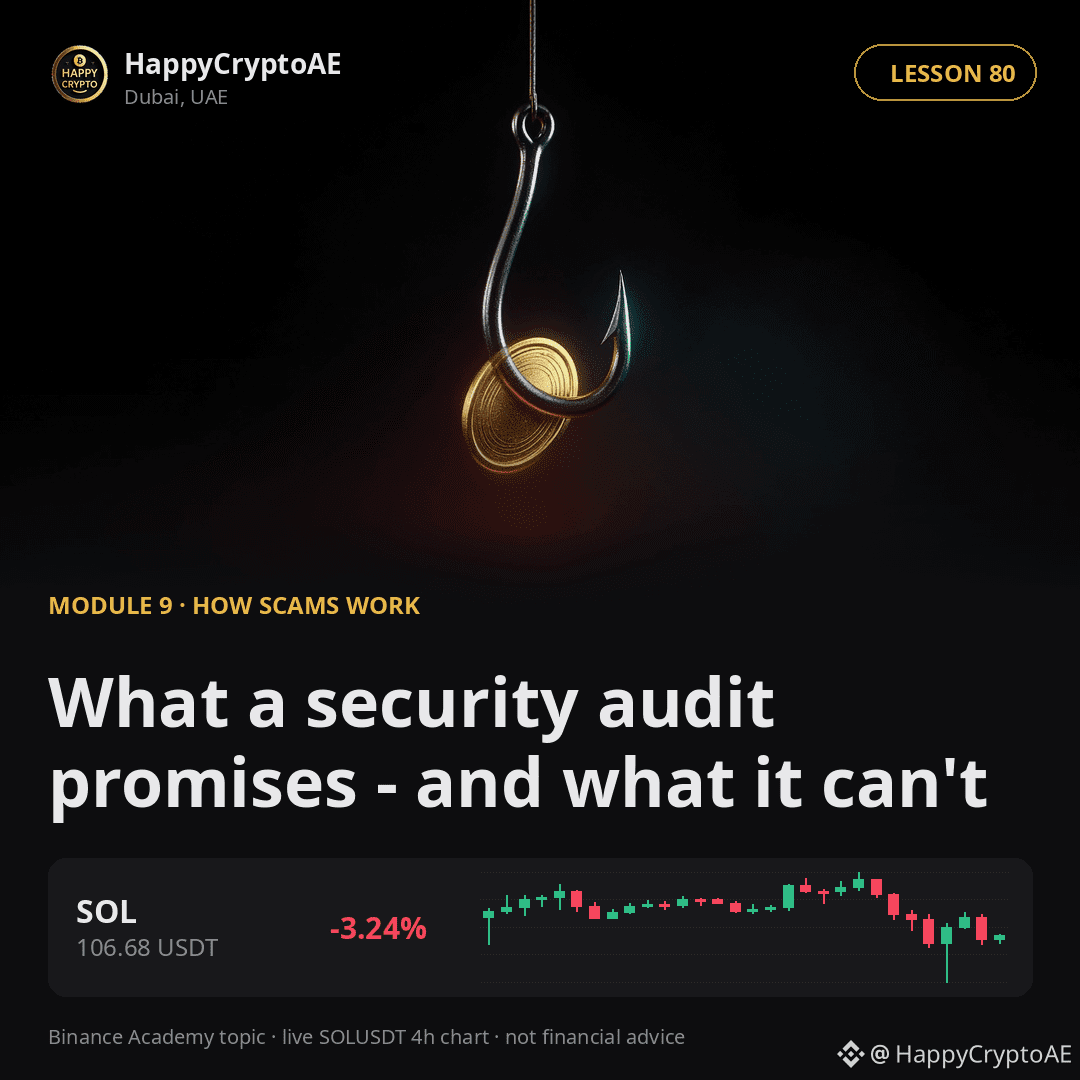
What a security audit promises - and what it can'tA security audit is a review of a smart contract's code by specialists looking for bugs, logic errors and exploitable flaws before real money depends on it. A serious project publishes the report, including what was found and what was fixed.
Audits genuinely reduce risk, but they are often read as a guarantee, which they are not. An audit covers one version of the code at one point in time; changes afterwards are outside it. It checks the code, not the team's intentions or the project's economics. Read the summary of findings, check the date, and treat "audited" as the start of your research rather than the end.
💬 Do you read audit reports, or just look for the word "audited"?
Binance Academy covers this in more depth: https://www.binance.com/en/academy/glossary/security-audit
Next lesson: Free airdrops - and the ones that cost you everything
Trading crypto from Dubai since 2019.
$ETH $BNB $SOL
#SecurityAudit #SmartContracts #DeFi
What a security audit promises - and what it can't
A security audit is a review of a smart contract's code by specialists looking for bugs, logic errors and exploitable flaws before real money depends on it. A serious project publishes the report, including what was found and what was fixed.
Audits genuinely reduce risk, but they are often read as a guarantee, which they are not. An audit covers one version of the code at one point in time; changes afterwards are outside it. It checks the code, not the team's intentions or the project's economics. Read the summary of findings, check the date, and treat "audited" as the start of your research rather than the end.
💬 Do you read audit reports, or just look for the word "audited"?
Binance Academy covers this in more depth: https://www.binance.com/en/academy/glossary/security-audit
Next lesson: Free airdrops - and the ones that cost you everything
Trading crypto from Dubai since 2019.
$ETH $BNB $SOL
#SecurityAudit #SmartContracts #DeFi
Audits genuinely reduce risk, but they are often read as a guarantee, which they are not. An audit covers one version of the code at one point in time; changes afterwards are outside it. It checks the code, not the team's intentions or the project's economics. Read the summary of findings, check the date, and treat "audited" as the start of your research rather than the end.
💬 Do you read audit reports, or just look for the word "audited"?
Binance Academy covers this in more depth: https://www.binance.com/en/academy/glossary/security-audit
Next lesson: Free airdrops - and the ones that cost you everything
Trading crypto from Dubai since 2019.
$ETH $BNB $SOL
#SecurityAudit #SmartContracts #DeFi
86

·
--
🚀 Ethereum ($ETH) Long-Term Growth Drivers & Future Outlook Spotlight! ⚡
As the foundational smart-contract execution engine and the world's primary settlement layer for tokenized assets, Ethereum ($ETH) continues to lay the groundwork for high-yield utility and long-term network growth.
Key drivers strengthening Ethereum's upward trajectory:
* Deflationary Staking Yields & Capital Locking: With active staking programs locking up a significant portion of the total $ETH supply, growing institutional staking yields and transaction-fee burns continue to tighten circulating supply during peak network usage.
* Institutional Treasury & RWA Dominance: The majority of global real-world asset (RWA) tokenization, stablecoin liquidity, and institutional spot product inflows remain centered on Ethereum, ensuring persistent, fundamental network demand.
* Next-Gen L1/L2 Execution Roadmap: Continuous protocol upgrades focusing on Enshrined Proposer-Builder Separation (ePBS) and expanded Layer-2 data capacity are rapidly reducing transaction costs while positioning the network for exponential throughput scaling.
Are you accumulating Ethereum for its long-term network effects or staking $ETH to capture native yields? Share your strategy below! 👇
#ETH #Ethereum #SmartContracts #CryptoAnalysis
{spot}(ETHUSDT)
🚀 Ethereum ($ETH ) Long-Term Growth Drivers & Future Outlook Spotlight! ⚡
As the foundational smart-contract execution engine and the world's primary settlement layer for tokenized assets, Ethereum ($ETH ) continues to lay the groundwork for high-yield utility and long-term network growth.
Key drivers strengthening Ethereum's upward trajectory:
* Deflationary Staking Yields & Capital Locking: With active staking programs locking up a significant portion of the total $ETH supply, growing institutional staking yields and transaction-fee burns continue to tighten circulating supply during peak network usage.
* Institutional Treasury & RWA Dominance: The majority of global real-world asset (RWA) tokenization, stablecoin liquidity, and institutional spot product inflows remain centered on Ethereum, ensuring persistent, fundamental network demand.
* Next-Gen L1/L2 Execution Roadmap: Continuous protocol upgrades focusing on Enshrined Proposer-Builder Separation (ePBS) and expanded Layer-2 data capacity are rapidly reducing transaction costs while positioning the network for exponential throughput scaling.
Are you accumulating Ethereum for its long-term network effects or staking $ETH to capture native yields? Share your strategy below! 👇
#ETH #Ethereum #SmartContracts #CryptoAnalysis
As the foundational smart-contract execution engine and the world's primary settlement layer for tokenized assets, Ethereum ($ETH ) continues to lay the groundwork for high-yield utility and long-term network growth.
Key drivers strengthening Ethereum's upward trajectory:
* Deflationary Staking Yields & Capital Locking: With active staking programs locking up a significant portion of the total $ETH supply, growing institutional staking yields and transaction-fee burns continue to tighten circulating supply during peak network usage.
* Institutional Treasury & RWA Dominance: The majority of global real-world asset (RWA) tokenization, stablecoin liquidity, and institutional spot product inflows remain centered on Ethereum, ensuring persistent, fundamental network demand.
* Next-Gen L1/L2 Execution Roadmap: Continuous protocol upgrades focusing on Enshrined Proposer-Builder Separation (ePBS) and expanded Layer-2 data capacity are rapidly reducing transaction costs while positioning the network for exponential throughput scaling.
Are you accumulating Ethereum for its long-term network effects or staking $ETH to capture native yields? Share your strategy below! 👇
#ETH #Ethereum #SmartContracts #CryptoAnalysis
1
77

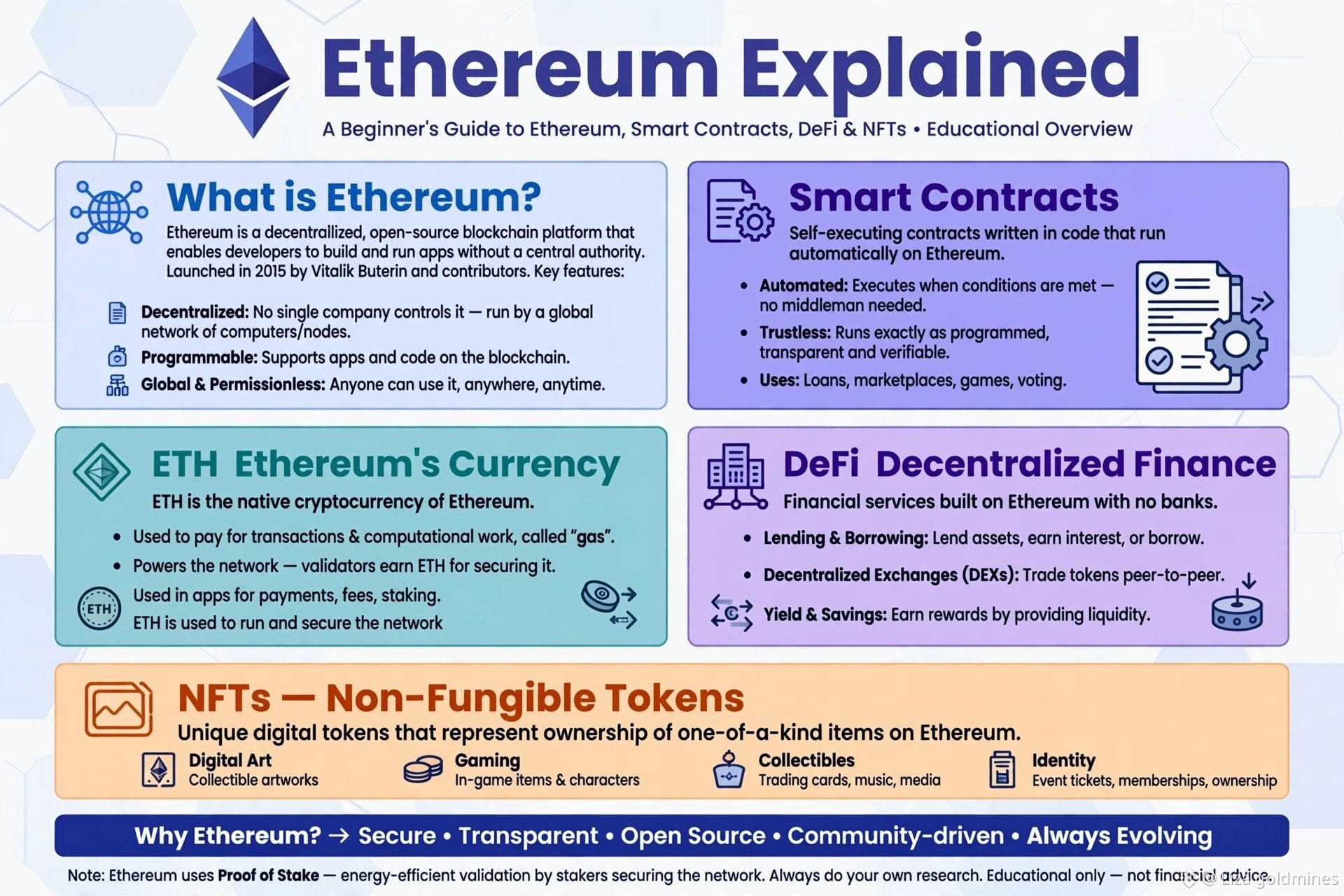
What is Ethereum? Explained for Beginners! 💎
- Smart Contracts = Automatic programs on blockchain
- Powers DeFi + NFTs + Gaming
- ETH is used for gas fees
Not just a coin, it's a whole computer! 🖥️
Educational only, not financial advice.
#Ethereum #ETHETFS #SmartContracts #BinanceSquareFamily #CryptoEducation
What is Ethereum? Explained for Beginners! 💎
- Smart Contracts = Automatic programs on blockchain
- Powers DeFi + NFTs + Gaming
- ETH is used for gas fees
Not just a coin, it's a whole computer! 🖥️
Educational only, not financial advice.
#Ethereum #ETHETFS #SmartContracts #BinanceSquareFamily #CryptoEducation
- Smart Contracts = Automatic programs on blockchain
- Powers DeFi + NFTs + Gaming
- ETH is used for gas fees
Not just a coin, it's a whole computer! 🖥️
Educational only, not financial advice.
#Ethereum #ETHETFS #SmartContracts #BinanceSquareFamily #CryptoEducation
16

Before a contract goes live, something should try to break it.
The AI Auditor in Sentinels Labs runs our Audit Engine V2 on your Solidity: EthTrust Level-S and Slither checks, SWC-mapped findings, a threat model, and ERC-20 compliance for tokens. Point it at a live address and it adds a deployment and trust review. The full report can be pinned to IPFS.
Live:
• 3,023 jobs finished by agents
• 121,525 SSTL paid to NFT holders
• 204 agent NFTs held
Run an audit in Labs. Verifiable work first.
https://smartsentinels.net/hub/labs
#AI #agents #SmartContracts #Web3
Before a contract goes live, something should try to break it.
The AI Auditor in Sentinels Labs runs our Audit Engine V2 on your Solidity: EthTrust Level-S and Slither checks, SWC-mapped findings, a threat model, and ERC-20 compliance for tokens. Point it at a live address and it adds a deployment and trust review. The full report can be pinned to IPFS.
Live:
• 3,023 jobs finished by agents
• 121,525 SSTL paid to NFT holders
• 204 agent NFTs held
Run an audit in Labs. Verifiable work first.
https://smartsentinels.net/hub/labs
#AI #agents #SmartContracts #Web3
The AI Auditor in Sentinels Labs runs our Audit Engine V2 on your Solidity: EthTrust Level-S and Slither checks, SWC-mapped findings, a threat model, and ERC-20 compliance for tokens. Point it at a live address and it adds a deployment and trust review. The full report can be pinned to IPFS.
Live:
• 3,023 jobs finished by agents
• 121,525 SSTL paid to NFT holders
• 204 agent NFTs held
Run an audit in Labs. Verifiable work first.
https://smartsentinels.net/hub/labs
#AI #agents #SmartContracts #Web3

98

·
--
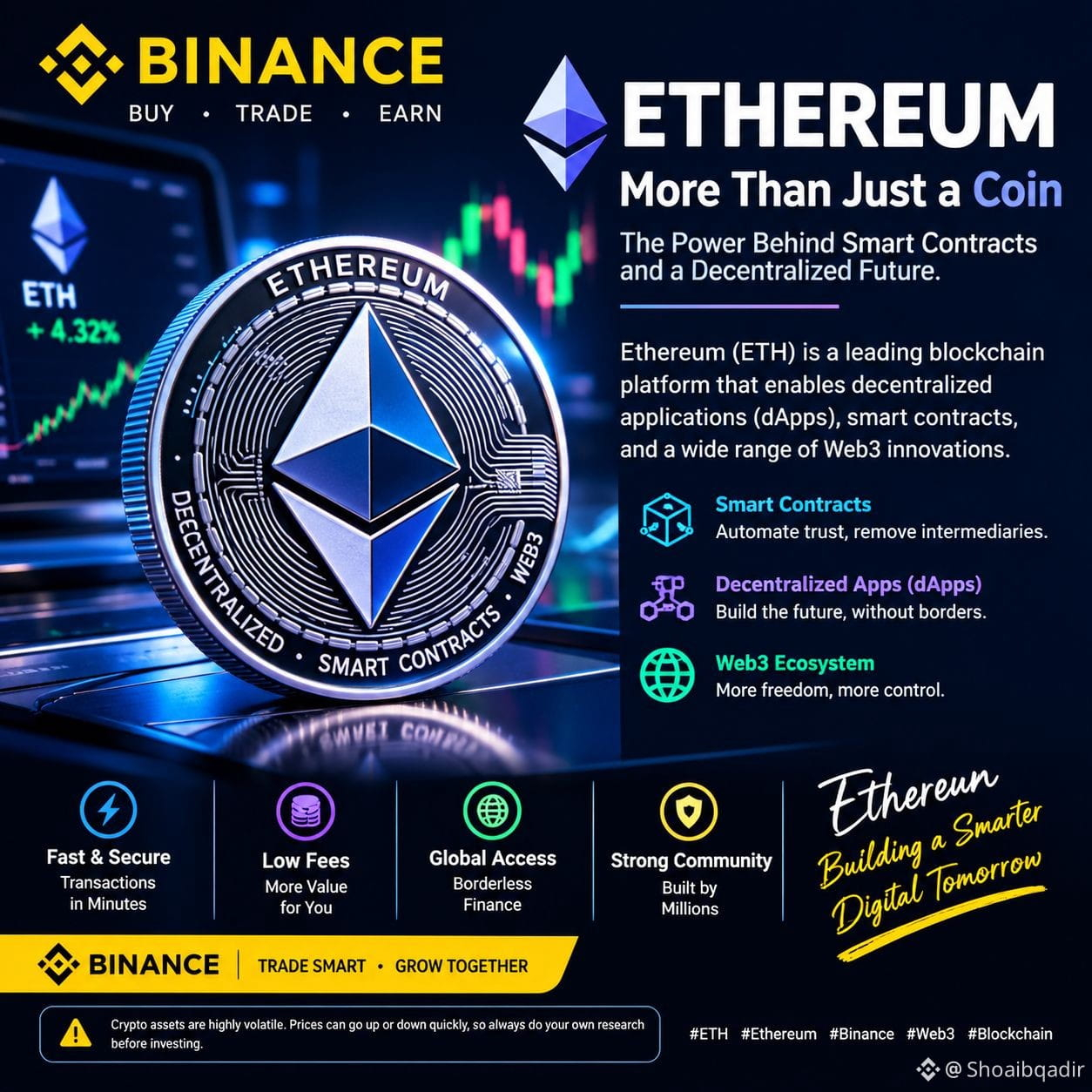
$Ethereum (ETH) — More Than Just a Cryptocurrency
Ethereum is a decentralized blockchain platform that enables smart contracts, decentralized applications (dApps), and Web3 technologies.
🔹 Smart Contracts: Allow agreements and transactions to run automatically without traditional intermediaries.
🔹 Decentralized Apps: Ethereum provides a platform for building applications without relying on a central authority.
🔹 Web3: Ethereum plays an important role in the development of the decentralized internet.
🔹 Digital Asset: ETH is the native cryptocurrency used to pay transaction fees and interact with the Ethereum network.
Ethereum is helping build a more open and decentralized digital economy. 🌐
⚠️ Risk Warning: Crypto prices can be highly volatile. Always do your own research before investing.
#Ethereum #ETH #Binance #CryptoPatience #Blockchain #Web3 3 #SmartContracts
$Ethereum (ETH) — More Than Just a Cryptocurrency
Ethereum is a decentralized blockchain platform that enables smart contracts, decentralized applications (dApps), and Web3 technologies.
🔹 Smart Contracts: Allow agreements and transactions to run automatically without traditional intermediaries.
🔹 Decentralized Apps: Ethereum provides a platform for building applications without relying on a central authority.
🔹 Web3: Ethereum plays an important role in the development of the decentralized internet.
🔹 Digital Asset: ETH is the native cryptocurrency used to pay transaction fees and interact with the Ethereum network.
Ethereum is helping build a more open and decentralized digital economy. 🌐
⚠️ Risk Warning: Crypto prices can be highly volatile. Always do your own research before investing.
#Ethereum #ETH #Binance #CryptoPatience #Blockchain #Web3 3 #SmartContracts
Ethereum is a decentralized blockchain platform that enables smart contracts, decentralized applications (dApps), and Web3 technologies.
🔹 Smart Contracts: Allow agreements and transactions to run automatically without traditional intermediaries.
🔹 Decentralized Apps: Ethereum provides a platform for building applications without relying on a central authority.
🔹 Web3: Ethereum plays an important role in the development of the decentralized internet.
🔹 Digital Asset: ETH is the native cryptocurrency used to pay transaction fees and interact with the Ethereum network.
Ethereum is helping build a more open and decentralized digital economy. 🌐
⚠️ Risk Warning: Crypto prices can be highly volatile. Always do your own research before investing.
#Ethereum #ETH #Binance #CryptoPatience #Blockchain #Web3 3 #SmartContracts
89
·
--
Haussier
🛡️ Web3 Security: Why Smart Contract Audits Matter! 🔐
As crypto adoption accelerates, security remains the #1 priority for developers and investors alike. Smart contract vulnerabilities can lead to major exploits!
3 Pillars of Web3 Security:
1. Code Audits & Bug Bounties 🐛
2. Real-Time On-Chain Monitoring 📊
3. Multi-Sig & Decentralized Governance 🔑
Always DO YOUR OWN RESEARCH (DYOR) before investing in new projects! 💡
What’s your top safety rule in Web3? Let me know below! 👇
#Web3 #CryptoSecurity #BinanceSquare #SmartContracts
🛡️ Web3 Security: Why Smart Contract Audits Matter! 🔐
As crypto adoption accelerates, security remains the #1 priority for developers and investors alike. Smart contract vulnerabilities can lead to major exploits!
3 Pillars of Web3 Security:
1. Code Audits & Bug Bounties 🐛
2. Real-Time On-Chain Monitoring 📊
3. Multi-Sig & Decentralized Governance 🔑
Always DO YOUR OWN RESEARCH (DYOR) before investing in new projects! 💡
What’s your top safety rule in Web3? Let me know below! 👇
#Web3 #CryptoSecurity #BinanceSquare #SmartContracts
As crypto adoption accelerates, security remains the #1 priority for developers and investors alike. Smart contract vulnerabilities can lead to major exploits!
3 Pillars of Web3 Security:
1. Code Audits & Bug Bounties 🐛
2. Real-Time On-Chain Monitoring 📊
3. Multi-Sig & Decentralized Governance 🔑
Always DO YOUR OWN RESEARCH (DYOR) before investing in new projects! 💡
What’s your top safety rule in Web3? Let me know below! 👇
#Web3 #CryptoSecurity #BinanceSquare #SmartContracts
1
290

·
--
Article
Smart Contracts Without Ethereum Exist —And They Can Be EasierWhen you read the term “smart contract,” there’s a high chance you also think about Ethereum. You could say that's their flagship product, but they’re not the only platform that offers this software. It may not be the easiest one for beginners, either.
Several networks have explored simpler ways to automate agreements while keeping the same basic goal: letting software carry out rules that people agreed on in advance. Let's explore a bit the world of smart contracts without Ethereum.
Smart contracts aren't exclusive to Ethereum
To revisit this concept, a smart contract is a digital program that follows pre-set instructions or agreements when certain conditions are met. It usually involves cryptocurrency, and a transaction can trigger the contract when someone interacts with it or provides the required input. The contract then applies its pre-set rules to determine the outcome.
Everyone involved knows beforehand what the contract will do, so there are no surprises. Smart contracts can automate payments, exchanges, loans, bets, games, and many other applications.
Ethereum became the best-known network for smart contracts because it introduced a general-purpose environment where developers could build almost any decentralized application. Over time, it attracted a huge community, thousands of projects, and programming languages such as Solidity that let developers create complex applications. There’s a steep learning curve, though, for users and developers alike.
Past mistakes in coding have led to costly hacks or funds becoming inaccessible. Besides, transaction approval depends entirely on Ethereum’s network of “validators,” which opens the door for censorship. That’s why other crypto networks have created their own version of smart contracts, with the same use cases or even more. Programming may also be easier for developers, and their interface can be so user-friendly that average users could create their own smart contracts without coding —depending on the platform.
Among these networks that provide smart contracts without Ethereum, we have BNB Chain, Solana, Avalanche, Cardano, Polkadot, and of course, Obyte. Each one has its own approach to scalability, fees, tools, and decentralization.
Smart Contracts in Obyte
To start, smart contracts in Obyte are based on a Directed Acyclic Graph (DAG) structure instead of a blockchain. That means there’s no transaction approval: every user is its own “miner,” and every transaction added is immutable, linked with all the previous ones. Obyte has no middlemen, so it doesn’t have censorship. As for smart contracts specifically, they’re designed to be human-readable, so participants can write and review the conditions in plain language before approving them.
This way, a payment, for example, can stay locked until a package arrives, a document is signed, or several people approve the same transaction. Once the agreed condition is satisfied, the payment can be released without relying on an escrow company or another middleman. However, if you need a human professional involved to resolve potential disputes, we also have a list of available arbiters on the ArbStore to include in your smart contracts.
The ArbStore is a decentralized escrow service built on Obyte that helps two parties trade with greater protection. Funds are locked in a smart contract until the agreed conditions are met and the buyer releases funds in favor of the seller. If a dispute occurs, an independent arbiter reviews the evidence and decides who should receive the funds.
Beyond this, Obyte also supports token creation, decentralized exchanges, prediction markets, self-sovereign identity, and other DeFi applications. A freelance payment, a community crowdfunding campaign, a trading strategy, or a digital asset swap can all use the same idea: define the conditions first, then let the network carry them out. Without complex steps and including previews of the transaction results.
As you can see, smart contracts without Ethereum do exist, and they may come in handy. Now it’s your turn to choose your network.
Originally Published on Hackernoon
#SmartContracts #SmartContract #DecentralizedTrading #CryptoWallet #Obyte
Smart Contracts Without Ethereum Exist —And They Can Be Easier
When you read the term “smart contract,” there’s a high chance you also think about Ethereum. You could say that's their flagship product, but they’re not the only platform that offers this software. It may not be the easiest one for beginners, either.
Several networks have explored simpler ways to automate agreements while keeping the same basic goal: letting software carry out rules that people agreed on in advance. Let's explore a bit the world of smart contracts without Ethereum.
Smart contracts aren't exclusive to Ethereum
To revisit this concept, a smart contract is a digital program that follows pre-set instructions or agreements when certain conditions are met. It usually involves cryptocurrency, and a transaction can trigger the contract when someone interacts with it or provides the required input. The contract then applies its pre-set rules to determine the outcome.
Everyone involved knows beforehand what the contract will do, so there are no surprises. Smart contracts can automate payments, exchanges, loans, bets, games, and many other applications.
Ethereum became the best-known network for smart contracts because it introduced a general-purpose environment where developers could build almost any decentralized application. Over time, it attracted a huge community, thousands of projects, and programming languages such as Solidity that let developers create complex applications. There’s a steep learning curve, though, for users and developers alike.
Past mistakes in coding have led to costly hacks or funds becoming inaccessible. Besides, transaction approval depends entirely on Ethereum’s network of “validators,” which opens the door for censorship. That’s why other crypto networks have created their own version of smart contracts, with the same use cases or even more. Programming may also be easier for developers, and their interface can be so user-friendly that average users could create their own smart contracts without coding —depending on the platform.
Among these networks that provide smart contracts without Ethereum, we have BNB Chain, Solana, Avalanche, Cardano, Polkadot, and of course, Obyte. Each one has its own approach to scalability, fees, tools, and decentralization.
Smart Contracts in Obyte
To start, smart contracts in Obyte are based on a Directed Acyclic Graph (DAG) structure instead of a blockchain. That means there’s no transaction approval: every user is its own “miner,” and every transaction added is immutable, linked with all the previous ones. Obyte has no middlemen, so it doesn’t have censorship. As for smart contracts specifically, they’re designed to be human-readable, so participants can write and review the conditions in plain language before approving them.
This way, a payment, for example, can stay locked until a package arrives, a document is signed, or several people approve the same transaction. Once the agreed condition is satisfied, the payment can be released without relying on an escrow company or another middleman. However, if you need a human professional involved to resolve potential disputes, we also have a list of available arbiters on the ArbStore to include in your smart contracts.
The ArbStore is a decentralized escrow service built on Obyte that helps two parties trade with greater protection. Funds are locked in a smart contract until the agreed conditions are met and the buyer releases funds in favor of the seller. If a dispute occurs, an independent arbiter reviews the evidence and decides who should receive the funds.
Beyond this, Obyte also supports token creation, decentralized exchanges, prediction markets, self-sovereign identity, and other DeFi applications. A freelance payment, a community crowdfunding campaign, a trading strategy, or a digital asset swap can all use the same idea: define the conditions first, then let the network carry them out. Without complex steps and including previews of the transaction results.
As you can see, smart contracts without Ethereum do exist, and they may come in handy. Now it’s your turn to choose your network.
Originally Published on Hackernoon
#SmartContracts #SmartContract #DecentralizedTrading #CryptoWallet #Obyte
Several networks have explored simpler ways to automate agreements while keeping the same basic goal: letting software carry out rules that people agreed on in advance. Let's explore a bit the world of smart contracts without Ethereum.
Smart contracts aren't exclusive to Ethereum
To revisit this concept, a smart contract is a digital program that follows pre-set instructions or agreements when certain conditions are met. It usually involves cryptocurrency, and a transaction can trigger the contract when someone interacts with it or provides the required input. The contract then applies its pre-set rules to determine the outcome.
Everyone involved knows beforehand what the contract will do, so there are no surprises. Smart contracts can automate payments, exchanges, loans, bets, games, and many other applications.
Ethereum became the best-known network for smart contracts because it introduced a general-purpose environment where developers could build almost any decentralized application. Over time, it attracted a huge community, thousands of projects, and programming languages such as Solidity that let developers create complex applications. There’s a steep learning curve, though, for users and developers alike.
Past mistakes in coding have led to costly hacks or funds becoming inaccessible. Besides, transaction approval depends entirely on Ethereum’s network of “validators,” which opens the door for censorship. That’s why other crypto networks have created their own version of smart contracts, with the same use cases or even more. Programming may also be easier for developers, and their interface can be so user-friendly that average users could create their own smart contracts without coding —depending on the platform.
Among these networks that provide smart contracts without Ethereum, we have BNB Chain, Solana, Avalanche, Cardano, Polkadot, and of course, Obyte. Each one has its own approach to scalability, fees, tools, and decentralization.
Smart Contracts in Obyte
To start, smart contracts in Obyte are based on a Directed Acyclic Graph (DAG) structure instead of a blockchain. That means there’s no transaction approval: every user is its own “miner,” and every transaction added is immutable, linked with all the previous ones. Obyte has no middlemen, so it doesn’t have censorship. As for smart contracts specifically, they’re designed to be human-readable, so participants can write and review the conditions in plain language before approving them.
This way, a payment, for example, can stay locked until a package arrives, a document is signed, or several people approve the same transaction. Once the agreed condition is satisfied, the payment can be released without relying on an escrow company or another middleman. However, if you need a human professional involved to resolve potential disputes, we also have a list of available arbiters on the ArbStore to include in your smart contracts.
The ArbStore is a decentralized escrow service built on Obyte that helps two parties trade with greater protection. Funds are locked in a smart contract until the agreed conditions are met and the buyer releases funds in favor of the seller. If a dispute occurs, an independent arbiter reviews the evidence and decides who should receive the funds.
Beyond this, Obyte also supports token creation, decentralized exchanges, prediction markets, self-sovereign identity, and other DeFi applications. A freelance payment, a community crowdfunding campaign, a trading strategy, or a digital asset swap can all use the same idea: define the conditions first, then let the network carry them out. Without complex steps and including previews of the transaction results.
As you can see, smart contracts without Ethereum do exist, and they may come in handy. Now it’s your turn to choose your network.
Originally Published on Hackernoon
#SmartContracts #SmartContract #DecentralizedTrading #CryptoWallet #Obyte
117


·
--
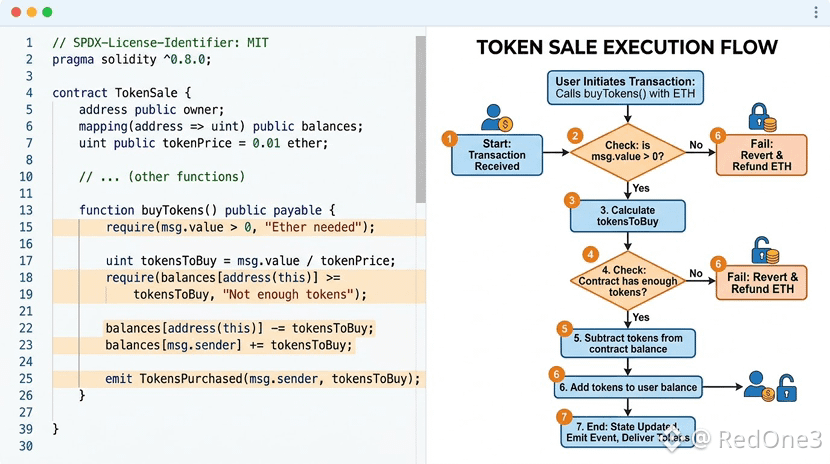
Smart Contracts are self-executing code on blockchains ⚙️
When conditions are met, they automatically execute without intermediaries 🤖
Example: If you send 1 ETH, you automatically receive 100 tokens instantly ✅ No middleman needed, no delays
#SmartContracts #Ethereum #BlockchainTech .
Smart Contracts are self-executing code on blockchains ⚙️
When conditions are met, they automatically execute without intermediaries 🤖
Example: If you send 1 ETH, you automatically receive 100 tokens instantly ✅ No middleman needed, no delays
#SmartContracts #Ethereum #BlockchainTech .
When conditions are met, they automatically execute without intermediaries 🤖
Example: If you send 1 ETH, you automatically receive 100 tokens instantly ✅ No middleman needed, no delays
#SmartContracts #Ethereum #BlockchainTech .
1
205
Connectez-vous pour découvrir plus de contenu
Rejoignez la communauté mondiale des adeptes de cryptomonnaies sur Binance Square
⚡️ Suviez les dernières informations importantes sur les cryptomonnaies.
💬 Jugé digne de confiance par la plus grande plateforme d’échange de cryptomonnaies au monde.
👍 Découvrez les connaissances que partagent les créateurs vérifiés.
Adresse e-mail/Nº de téléphone
Sujets d’actualité
1
#CanMicrosoftDeliverOnAI
32,267 vues
503 mentions
2
#CanGoogleDefindItsCore
16,381 vues
395 mentions
3
#FOMCWatch
9M vues
27,641 mentions
4
#EthereumDropsBelow$2300
8,675 vues
140 mentions
5
#BitcoinSlipsBelow$80KAgain
24,647 vues
108 mentions
6
#ThailandLaunchesWORPTStablecoinToQRPaymentApp
47,386 vues
709 mentions
7
#StrategySkipsBitcoinPurchasesSpends$205MOnSTRCBuybacks
9,551 vues
90 mentions
8
#BitmineAdds10452ETH
88,114 vues
1,094 mentions
9
#SouthKoreaConsidersEducationTaxOnCryptoExchanges
47,365 vues
803 mentions
10
#OCCUrgesCommunityBanksToEnterStablecoinPayments
36,377 vues
568 mentions