

#defi
defi
57.6M vues
305,261 mentions
Populaire
Récents

·
--
Article
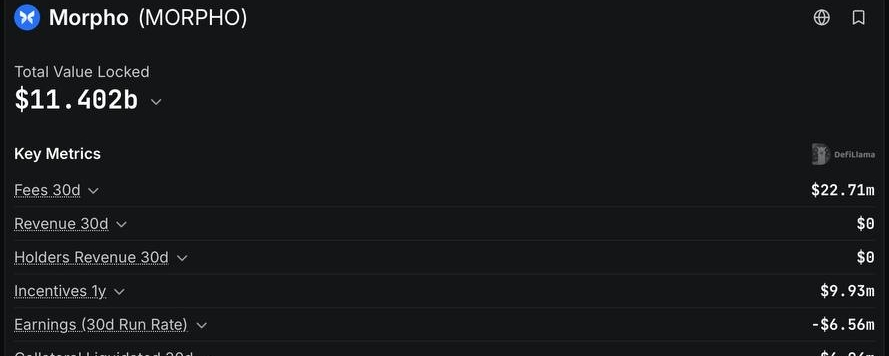
Morpho Generated $22.71M in Fees. So Why Is Its Revenue $0?Morpho has billions in locked assets, millions in fees, and one number that deserves investors’ attention: $0 in recorded protocol revenue.
According to the DeFiLlama
• TVL: $11.402B
• Active loans: $5.819B
• 30-day fees: $22.71M
• 30-day protocol revenue: $0
• MORPHO price: $2.01
• Market cap: $1.416B
• FDV: $2.014B
So, what’s happening?
Fees and revenue are not the same thing. Morpho Blue’s fee configuration allows the protocol to facilitate lending activity without currently recording protocol revenue under the displayed metric.
That doesn’t mean Morpho generates no fees. It means investors must understand who captures the economic value.
Is MORPHO undervalued?
Its market cap is approximately 12.4% of TVL, but that ratio alone proves nothing. TVL is not profit, and gross fees do not automatically belong to token holders.
MORPHO is a governance token. Any potential benefit from protocol fees depends on actual governance decisions and implemented mechanisms, not assumptions.
My take: Morpho’s adoption is impressive, but its token valuation needs more than a TVL comparison. Watch fee-switch decisions, sustainable lending demand, and token unlocks before drawing conclusions.
Because a successful protocol and a valuable token are two different investment theses.
$MORPHO #Morpho #DeFi
Morpho Generated $22.71M in Fees. So Why Is Its Revenue $0?
Morpho has billions in locked assets, millions in fees, and one number that deserves investors’ attention: $0 in recorded protocol revenue.
According to the DeFiLlama
• TVL: $11.402B
• Active loans: $5.819B
• 30-day fees: $22.71M
• 30-day protocol revenue: $0
• MORPHO price: $2.01
• Market cap: $1.416B
• FDV: $2.014B
So, what’s happening?
Fees and revenue are not the same thing. Morpho Blue’s fee configuration allows the protocol to facilitate lending activity without currently recording protocol revenue under the displayed metric.
That doesn’t mean Morpho generates no fees. It means investors must understand who captures the economic value.
Is MORPHO undervalued?
Its market cap is approximately 12.4% of TVL, but that ratio alone proves nothing. TVL is not profit, and gross fees do not automatically belong to token holders.
MORPHO is a governance token. Any potential benefit from protocol fees depends on actual governance decisions and implemented mechanisms, not assumptions.
My take: Morpho’s adoption is impressive, but its token valuation needs more than a TVL comparison. Watch fee-switch decisions, sustainable lending demand, and token unlocks before drawing conclusions.
Because a successful protocol and a valuable token are two different investment theses.
$MORPHO #Morpho #DeFi
According to the DeFiLlama
• TVL: $11.402B
• Active loans: $5.819B
• 30-day fees: $22.71M
• 30-day protocol revenue: $0
• MORPHO price: $2.01
• Market cap: $1.416B
• FDV: $2.014B
So, what’s happening?
Fees and revenue are not the same thing. Morpho Blue’s fee configuration allows the protocol to facilitate lending activity without currently recording protocol revenue under the displayed metric.
That doesn’t mean Morpho generates no fees. It means investors must understand who captures the economic value.
Is MORPHO undervalued?
Its market cap is approximately 12.4% of TVL, but that ratio alone proves nothing. TVL is not profit, and gross fees do not automatically belong to token holders.
MORPHO is a governance token. Any potential benefit from protocol fees depends on actual governance decisions and implemented mechanisms, not assumptions.
My take: Morpho’s adoption is impressive, but its token valuation needs more than a TVL comparison. Watch fee-switch decisions, sustainable lending demand, and token unlocks before drawing conclusions.
Because a successful protocol and a valuable token are two different investment theses.
$MORPHO #Morpho #DeFi
2
566

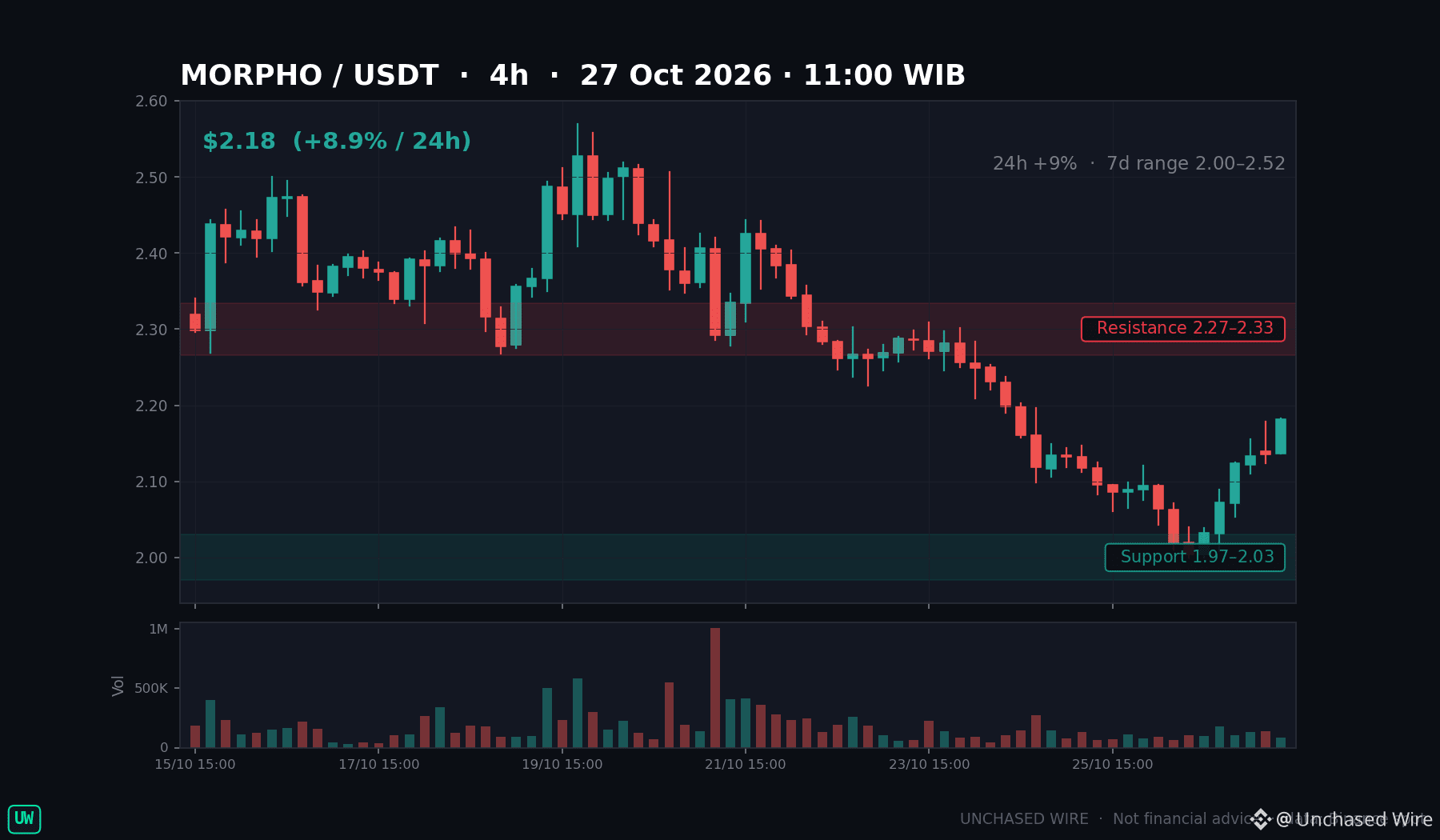
$MORPHO's protocol keeps growing while its token keeps falling — and this week the two stories met at $2.00.
I keep coming back to that gap. Morpho added roughly $304 million in total value locked over the past week, to about $11.4 billion, while DeFi overall shrank. Its dollar-stablecoin market on Arbitrum hit $115 million in 18 days, and tokenized-stock collateral went live on October 22.
The token tells the other half. It slid from $2.57 on October 19 to $2.00, tapped that floor twice on Monday, then climbed on rising closes — $2.03, $2.07, $2.12, $2.13, $2.14 — to $2.18 this morning.
Support is the $2.00 floor. Resistance is $2.30, the shelf from October 22–23. A 4-hour close under $2.00 breaks the floor story; above $2.30, $2.50 comes back into view.
The doubt is plain: this is still a bounce inside a slide, and protocol usage is not token demand.
These are the levels I'll check back on — does $MORPHO hold $2.00 from here, or does $2.30 come first?
Not financial advice. Do your own research.
$MORPHO #DeFi #Morpho #Lending #CryptoTrading
$MORPHO 's protocol keeps growing while its token keeps falling — and this week the two stories met at $2.00.
I keep coming back to that gap. Morpho added roughly $304 million in total value locked over the past week, to about $11.4 billion, while DeFi overall shrank. Its dollar-stablecoin market on Arbitrum hit $115 million in 18 days, and tokenized-stock collateral went live on October 22.
The token tells the other half. It slid from $2.57 on October 19 to $2.00, tapped that floor twice on Monday, then climbed on rising closes — $2.03, $2.07, $2.12, $2.13, $2.14 — to $2.18 this morning.
Support is the $2.00 floor. Resistance is $2.30, the shelf from October 22–23. A 4-hour close under $2.00 breaks the floor story; above $2.30, $2.50 comes back into view.
The doubt is plain: this is still a bounce inside a slide, and protocol usage is not token demand.
These are the levels I'll check back on — does $MORPHO hold $2.00 from here, or does $2.30 come first?
Not financial advice. Do your own research.
$MORPHO #DeFi #Morpho #Lending #CryptoTrading
I keep coming back to that gap. Morpho added roughly $304 million in total value locked over the past week, to about $11.4 billion, while DeFi overall shrank. Its dollar-stablecoin market on Arbitrum hit $115 million in 18 days, and tokenized-stock collateral went live on October 22.
The token tells the other half. It slid from $2.57 on October 19 to $2.00, tapped that floor twice on Monday, then climbed on rising closes — $2.03, $2.07, $2.12, $2.13, $2.14 — to $2.18 this morning.
Support is the $2.00 floor. Resistance is $2.30, the shelf from October 22–23. A 4-hour close under $2.00 breaks the floor story; above $2.30, $2.50 comes back into view.
The doubt is plain: this is still a bounce inside a slide, and protocol usage is not token demand.
These are the levels I'll check back on — does $MORPHO hold $2.00 from here, or does $2.30 come first?
Not financial advice. Do your own research.
$MORPHO #DeFi #Morpho #Lending #CryptoTrading
8


·
--
Babylon Labs' proposed native Bitcoin market on Aave V4 aims to bring real BTC collateral to DeFi, but liquidations still rely heavily on Wrapped Bitcoin (WBTC) mechanics.
According to a risk assessment by LlamaRisk, liquidations under the proposed integration rely on three core payment rules: debt repayment, application fees, and borrower surplus compensation. While Babylon’s "direct route" allows authorized keepers to bypass Aave’s central liquidity pool funding constraints by directly redeeming collateral on Bitcoin, it does not completely eliminate token dependencies.
If a borrower’s debt is denominated in WBTC, the keeper must still supply WBTC to clear the debt. Furthermore, any application liquidation fees or fairness payouts owed back to the borrower are also denominated in WBTC. This creates a vulnerability: if WBTC token transfers fail or liquidity stalls, liquidations on the native Bitcoin lending market could still freeze despite bypassing the core protocol pool. Additionally, contract audits confirm the integration is currently deployed only on the Sepolia testnet and has yet to launch on Ethereum mainnet.
This dynamic highlights that while protocols can move collateral off wrapped tokens, underlying settlement risks often persist through debt routing and fee mechanisms.
Do you think protocols relying on wrapped assets for liquidation mechanics undermines the goal of true native Bitcoin lending?
#bitcoin.” #Aave #DeFi #CryptoNews🔒📰🚫
$CHIP $SYN $PARTI
Babylon Labs' proposed native Bitcoin market on Aave V4 aims to bring real BTC collateral to DeFi, but liquidations still rely heavily on Wrapped Bitcoin (WBTC) mechanics.
According to a risk assessment by LlamaRisk, liquidations under the proposed integration rely on three core payment rules: debt repayment, application fees, and borrower surplus compensation. While Babylon’s "direct route" allows authorized keepers to bypass Aave’s central liquidity pool funding constraints by directly redeeming collateral on Bitcoin, it does not completely eliminate token dependencies.
If a borrower’s debt is denominated in WBTC, the keeper must still supply WBTC to clear the debt. Furthermore, any application liquidation fees or fairness payouts owed back to the borrower are also denominated in WBTC. This creates a vulnerability: if WBTC token transfers fail or liquidity stalls, liquidations on the native Bitcoin lending market could still freeze despite bypassing the core protocol pool. Additionally, contract audits confirm the integration is currently deployed only on the Sepolia testnet and has yet to launch on Ethereum mainnet.
This dynamic highlights that while protocols can move collateral off wrapped tokens, underlying settlement risks often persist through debt routing and fee mechanisms.
Do you think protocols relying on wrapped assets for liquidation mechanics undermines the goal of true native Bitcoin lending?
#bitcoin.” #Aave #DeFi #CryptoNews🔒📰🚫
$CHIP $SYN $PARTI
According to a risk assessment by LlamaRisk, liquidations under the proposed integration rely on three core payment rules: debt repayment, application fees, and borrower surplus compensation. While Babylon’s "direct route" allows authorized keepers to bypass Aave’s central liquidity pool funding constraints by directly redeeming collateral on Bitcoin, it does not completely eliminate token dependencies.
If a borrower’s debt is denominated in WBTC, the keeper must still supply WBTC to clear the debt. Furthermore, any application liquidation fees or fairness payouts owed back to the borrower are also denominated in WBTC. This creates a vulnerability: if WBTC token transfers fail or liquidity stalls, liquidations on the native Bitcoin lending market could still freeze despite bypassing the core protocol pool. Additionally, contract audits confirm the integration is currently deployed only on the Sepolia testnet and has yet to launch on Ethereum mainnet.
This dynamic highlights that while protocols can move collateral off wrapped tokens, underlying settlement risks often persist through debt routing and fee mechanisms.
Do you think protocols relying on wrapped assets for liquidation mechanics undermines the goal of true native Bitcoin lending?
#bitcoin.” #Aave #DeFi #CryptoNews🔒📰🚫
$CHIP $SYN $PARTI
1
385

FULL RECOVERY CONFIRMED AFTER $ETH VAULT EXPLOIT AS CORE DEFI CONTRACTS HOLD STRONG 🛡️
Smart money moves fast when crisis strikes, but full asset recovery is a rare victory in DeFi security battles. 🏦 Term Labs just finalized the complete retrieval of affected vault positions following a sophisticated governance delay exploit on their ETH and USDC strategies. 📊
Crucially, core direct lending contracts, V1/V2 protocols, and liquidation engines held up without a scratch, showing true structural resilience. 🔍 With contracts upgraded, affected vaults closed, and security firms tracking the attacker's Tornado Cash trail, confidence is rotating back into the ecosystem.
💬 Does a successful 100% fund recovery restore your appetite for fixed-rate DeFi yields, or are you waiting for full audits before moving capital? 👇
⚠️ Not financial advice. Always manage your risk. 🛡️
🏷️ #ETH #DeFi #CryptoSecurity #Crypto
🛡️ 🔍
FULL RECOVERY CONFIRMED AFTER $ETH VAULT EXPLOIT AS CORE DEFI CONTRACTS HOLD STRONG 🛡️
Smart money moves fast when crisis strikes, but full asset recovery is a rare victory in DeFi security battles. 🏦 Term Labs just finalized the complete retrieval of affected vault positions following a sophisticated governance delay exploit on their ETH and USDC strategies. 📊
Crucially, core direct lending contracts, V1/V2 protocols, and liquidation engines held up without a scratch, showing true structural resilience. 🔍 With contracts upgraded, affected vaults closed, and security firms tracking the attacker's Tornado Cash trail, confidence is rotating back into the ecosystem.
💬 Does a successful 100% fund recovery restore your appetite for fixed-rate DeFi yields, or are you waiting for full audits before moving capital? 👇
⚠️ Not financial advice. Always manage your risk. 🛡️
🏷️ #ETH #DeFi #CryptoSecurity #Crypto
🛡️ 🔍
Smart money moves fast when crisis strikes, but full asset recovery is a rare victory in DeFi security battles. 🏦 Term Labs just finalized the complete retrieval of affected vault positions following a sophisticated governance delay exploit on their ETH and USDC strategies. 📊
Crucially, core direct lending contracts, V1/V2 protocols, and liquidation engines held up without a scratch, showing true structural resilience. 🔍 With contracts upgraded, affected vaults closed, and security firms tracking the attacker's Tornado Cash trail, confidence is rotating back into the ecosystem.
💬 Does a successful 100% fund recovery restore your appetite for fixed-rate DeFi yields, or are you waiting for full audits before moving capital? 👇
⚠️ Not financial advice. Always manage your risk. 🛡️
🏷️ #ETH #DeFi #CryptoSecurity #Crypto
🛡️ 🔍
31


·
--
Baissier
🔗 $BTW — BITWAY
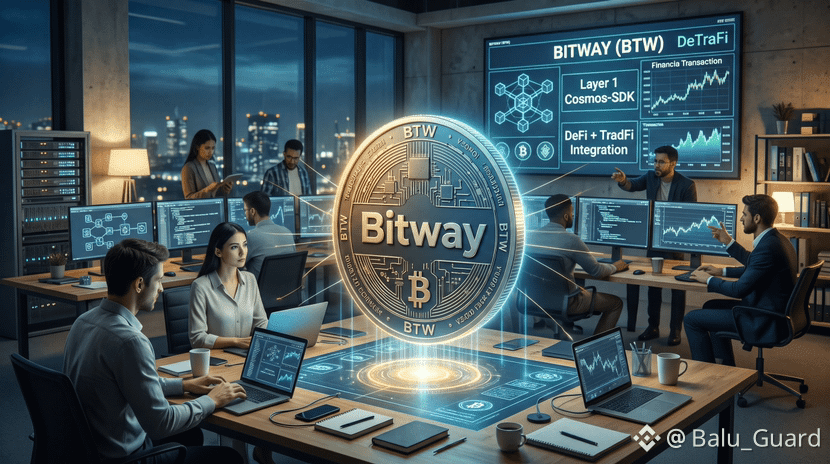
Bitway is a Bitcoin-compatible Layer 1 blockchain combining DeFi with traditional finance (TradFi). Built on Cosmos-SDK and CometBFT, it supports Bitcoin wallet technologies and uses DLCs for lending. 🚀
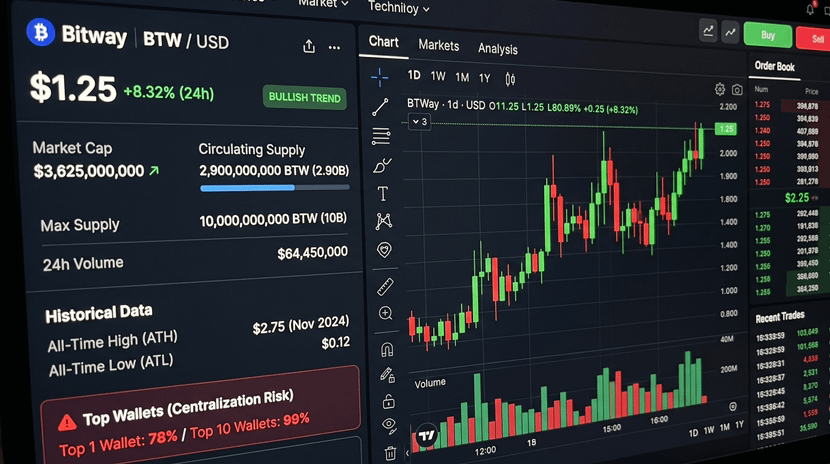
⚠️ Risk alert: On-chain data reportedly shows extreme token concentration, with major unlocks potentially adding selling pressure.
$BTC $ETH
#BTW #Bitway #bitcoin #defi #Crypto
{future}(ETHUSDT)
{future}(BTCUSDT)
{future}(BTWUSDT)
🔗 $BTW — BITWAY
Bitway is a Bitcoin-compatible Layer 1 blockchain combining DeFi with traditional finance (TradFi). Built on Cosmos-SDK and CometBFT, it supports Bitcoin wallet technologies and uses DLCs for lending. 🚀
⚠️ Risk alert: On-chain data reportedly shows extreme token concentration, with major unlocks potentially adding selling pressure.
$BTC $ETH
#BTW #Bitway #bitcoin #defi #Crypto
Bitway is a Bitcoin-compatible Layer 1 blockchain combining DeFi with traditional finance (TradFi). Built on Cosmos-SDK and CometBFT, it supports Bitcoin wallet technologies and uses DLCs for lending. 🚀
⚠️ Risk alert: On-chain data reportedly shows extreme token concentration, with major unlocks potentially adding selling pressure.
$BTC $ETH
#BTW #Bitway #bitcoin #defi #Crypto
15
·
--
Why Liquidity Matters for the TON EcosystemWhen people discuss decentralized finance, the conversation often focuses on token prices, new launches, and market movements. But underneath all that activity is something equally important: liquidity.
Without sufficient liquidity, swapping digital assets can become more expensive and less efficient. This is why decentralized exchanges play an important role in helping blockchain ecosystems function.
One project worth examining in this space is @ston_fi, a decentralized exchange built on The Open Network (TON).
STON.fi gives users a way to swap supported tokens directly onchain. Its role extends beyond the simple act of exchanging one asset for another; it also highlights the importance of liquidity providers in supporting decentralized trading.
Liquidity provision, however, comes with risks. Token prices can change, and liquidity providers may experience impermanent loss depending on market conditions. Understanding these trade-offs is essential before committing assets to any pool.
Another interesting aspect of TON is its connection to a large community of users already familiar with Telegram. This creates opportunities for blockchain applications to reach people through experiences that feel more accessible than traditional crypto interfaces.
Still, accessibility alone does not guarantee long-term success. Sustainable growth requires security, useful applications, active liquidity, and an ecosystem that gives users reasons to return.
For STON.fi, the broader opportunity is to contribute to an environment where decentralized trading becomes more practical and where users can better understand the tools available to them.
I believe the most meaningful DeFi progress will come from infrastructure that solves real problems rather than simply following short-term trends.
As TON develops, liquidity and user experience will remain important factors to watch.
#stonfi #TON #defi
Why Liquidity Matters for the TON Ecosystem
When people discuss decentralized finance, the conversation often focuses on token prices, new launches, and market movements. But underneath all that activity is something equally important: liquidity.
Without sufficient liquidity, swapping digital assets can become more expensive and less efficient. This is why decentralized exchanges play an important role in helping blockchain ecosystems function.
One project worth examining in this space is @ston_fi, a decentralized exchange built on The Open Network (TON).
STON.fi gives users a way to swap supported tokens directly onchain. Its role extends beyond the simple act of exchanging one asset for another; it also highlights the importance of liquidity providers in supporting decentralized trading.
Liquidity provision, however, comes with risks. Token prices can change, and liquidity providers may experience impermanent loss depending on market conditions. Understanding these trade-offs is essential before committing assets to any pool.
Another interesting aspect of TON is its connection to a large community of users already familiar with Telegram. This creates opportunities for blockchain applications to reach people through experiences that feel more accessible than traditional crypto interfaces.
Still, accessibility alone does not guarantee long-term success. Sustainable growth requires security, useful applications, active liquidity, and an ecosystem that gives users reasons to return.
For STON.fi, the broader opportunity is to contribute to an environment where decentralized trading becomes more practical and where users can better understand the tools available to them.
I believe the most meaningful DeFi progress will come from infrastructure that solves real problems rather than simply following short-term trends.
As TON develops, liquidity and user experience will remain important factors to watch.
#stonfi #TON #defi
Without sufficient liquidity, swapping digital assets can become more expensive and less efficient. This is why decentralized exchanges play an important role in helping blockchain ecosystems function.
One project worth examining in this space is @ston_fi, a decentralized exchange built on The Open Network (TON).
STON.fi gives users a way to swap supported tokens directly onchain. Its role extends beyond the simple act of exchanging one asset for another; it also highlights the importance of liquidity providers in supporting decentralized trading.
Liquidity provision, however, comes with risks. Token prices can change, and liquidity providers may experience impermanent loss depending on market conditions. Understanding these trade-offs is essential before committing assets to any pool.
Another interesting aspect of TON is its connection to a large community of users already familiar with Telegram. This creates opportunities for blockchain applications to reach people through experiences that feel more accessible than traditional crypto interfaces.
Still, accessibility alone does not guarantee long-term success. Sustainable growth requires security, useful applications, active liquidity, and an ecosystem that gives users reasons to return.
For STON.fi, the broader opportunity is to contribute to an environment where decentralized trading becomes more practical and where users can better understand the tools available to them.
I believe the most meaningful DeFi progress will come from infrastructure that solves real problems rather than simply following short-term trends.
As TON develops, liquidity and user experience will remain important factors to watch.
#stonfi #TON #defi
45
·
--
STON.fi and the Future of Accessible DeFi on TONDecentralized finance is not only about creating new financial products. It is also about making blockchain technology easier to understand and use in everyday situations. This is one area where @ston_fi deserves attention.
Built on The Open Network (TON), STON.fi is a decentralized exchange designed to make token swaps more accessible within the TON ecosystem. Its role highlights an important part of DeFi infrastructure: helping users exchange digital assets without relying on a traditional centralized intermediary to execute every transaction.
However, swapping tokens is only one part of the bigger picture. Liquidity is another essential element. Decentralized exchanges depend on liquidity providers to support trading activity, while users need to understand the potential risks and rewards before participating. These include price volatility, impermanent loss, transaction costs, and smart contract risks.
What makes the evolution of TON DeFi interesting is the opportunity to connect decentralized applications with a growing community of users. A simple interface can help people get started, but long-term adoption also depends on reliable infrastructure, transparent information, security, and a useful range of onchain applications.
Another development worth watching is cross-chain interoperability. Moving value and interacting across different blockchain ecosystems could expand the opportunities available to users, although security and implementation remain important considerations.
For me, the bigger question is not simply how many transactions a protocol can process. It is whether decentralized finance can become more understandable, practical, and sustainable for the people using it.
STON.fi is part of this wider conversation around the development of DeFi on TON. Its progress will be interesting to follow as the ecosystem continues to evolve.
The next stage of decentralized finance should focus on usability, security, and meaningful utility rather than attention alone.
#STONfi #Toncoin #defi
STON.fi and the Future of Accessible DeFi on TON
Decentralized finance is not only about creating new financial products. It is also about making blockchain technology easier to understand and use in everyday situations. This is one area where @ston_fi deserves attention.
Built on The Open Network (TON), STON.fi is a decentralized exchange designed to make token swaps more accessible within the TON ecosystem. Its role highlights an important part of DeFi infrastructure: helping users exchange digital assets without relying on a traditional centralized intermediary to execute every transaction.
However, swapping tokens is only one part of the bigger picture. Liquidity is another essential element. Decentralized exchanges depend on liquidity providers to support trading activity, while users need to understand the potential risks and rewards before participating. These include price volatility, impermanent loss, transaction costs, and smart contract risks.
What makes the evolution of TON DeFi interesting is the opportunity to connect decentralized applications with a growing community of users. A simple interface can help people get started, but long-term adoption also depends on reliable infrastructure, transparent information, security, and a useful range of onchain applications.
Another development worth watching is cross-chain interoperability. Moving value and interacting across different blockchain ecosystems could expand the opportunities available to users, although security and implementation remain important considerations.
For me, the bigger question is not simply how many transactions a protocol can process. It is whether decentralized finance can become more understandable, practical, and sustainable for the people using it.
STON.fi is part of this wider conversation around the development of DeFi on TON. Its progress will be interesting to follow as the ecosystem continues to evolve.
The next stage of decentralized finance should focus on usability, security, and meaningful utility rather than attention alone.
#STONfi #Toncoin #defi
Built on The Open Network (TON), STON.fi is a decentralized exchange designed to make token swaps more accessible within the TON ecosystem. Its role highlights an important part of DeFi infrastructure: helping users exchange digital assets without relying on a traditional centralized intermediary to execute every transaction.
However, swapping tokens is only one part of the bigger picture. Liquidity is another essential element. Decentralized exchanges depend on liquidity providers to support trading activity, while users need to understand the potential risks and rewards before participating. These include price volatility, impermanent loss, transaction costs, and smart contract risks.
What makes the evolution of TON DeFi interesting is the opportunity to connect decentralized applications with a growing community of users. A simple interface can help people get started, but long-term adoption also depends on reliable infrastructure, transparent information, security, and a useful range of onchain applications.
Another development worth watching is cross-chain interoperability. Moving value and interacting across different blockchain ecosystems could expand the opportunities available to users, although security and implementation remain important considerations.
For me, the bigger question is not simply how many transactions a protocol can process. It is whether decentralized finance can become more understandable, practical, and sustainable for the people using it.
STON.fi is part of this wider conversation around the development of DeFi on TON. Its progress will be interesting to follow as the ecosystem continues to evolve.
The next stage of decentralized finance should focus on usability, security, and meaningful utility rather than attention alone.
#STONfi #Toncoin #defi
65

·
--
The Silent DeFi Rotation: Why Tokenized Commodity Yields Are Winning the Capital War
It is 2 AM and while most traders are glued to short-term order book noise on speculative altcoins, something much more fundamental is brewing across on-chain commodity markets. We are seeing a distinct capital migration away from hyper-inflationary reward structures toward hard asset liquidity pools, with $SILVER standing out as a primary beneficiary.
With the Gold/Silver ratio hovering near 68.5 and spot silver sitting around 60.27 USD alongside spot gold at 4,140 USD, macro sentiment is rapidly favoring metal-backed assets to offset DXY swings. On-chain, this macro shift is displaying incredible TVL efficiency. Instead of sitting idle in static vaults, liquidity backing SILVER is increasingly flowing into yield-bearing restaking and liquid staking protocols. Whale wallet movements indicate that institutional capital is rebalancing into fully backed, yield-generating commodity primitives rather than taking on pure price delta risk.
DEX volume for these commodity pairs has surged over recent sessions. Traders are actively swapping out of inflationary reward tokens into protocol-backed liquidity pools that operate with the same transparent 1:1 physical bullion backing model popularized by PAXG. With a spot reference trading near 53.789 and a disciplined circulating float that avoids aggressive unlock dumps, the tokenomics provide a clean defensive architecture during broader market consolidation. Central banks continue their steady reserve accumulation, and permissionless protocols are finally giving DeFi participants a direct bridge into these real-world asset flows.
Smart money seems content locking in real yield backed by physical value rather than chasing unbacked emissions. Are you allocating any portion of your portfolio toward tokenized commodities this cycle, or are you still holding pure speculative altcoins?
#DeFi #TVL
The Silent DeFi Rotation: Why Tokenized Commodity Yields Are Winning the Capital War
It is 2 AM and while most traders are glued to short-term order book noise on speculative altcoins, something much more fundamental is brewing across on-chain commodity markets. We are seeing a distinct capital migration away from hyper-inflationary reward structures toward hard asset liquidity pools, with $SILVER standing out as a primary beneficiary.
With the Gold/Silver ratio hovering near 68.5 and spot silver sitting around 60.27 USD alongside spot gold at 4,140 USD, macro sentiment is rapidly favoring metal-backed assets to offset DXY swings. On-chain, this macro shift is displaying incredible TVL efficiency. Instead of sitting idle in static vaults, liquidity backing SILVER is increasingly flowing into yield-bearing restaking and liquid staking protocols. Whale wallet movements indicate that institutional capital is rebalancing into fully backed, yield-generating commodity primitives rather than taking on pure price delta risk.
DEX volume for these commodity pairs has surged over recent sessions. Traders are actively swapping out of inflationary reward tokens into protocol-backed liquidity pools that operate with the same transparent 1:1 physical bullion backing model popularized by PAXG. With a spot reference trading near 53.789 and a disciplined circulating float that avoids aggressive unlock dumps, the tokenomics provide a clean defensive architecture during broader market consolidation. Central banks continue their steady reserve accumulation, and permissionless protocols are finally giving DeFi participants a direct bridge into these real-world asset flows.
Smart money seems content locking in real yield backed by physical value rather than chasing unbacked emissions. Are you allocating any portion of your portfolio toward tokenized commodities this cycle, or are you still holding pure speculative altcoins?
#DeFi #TVL
It is 2 AM and while most traders are glued to short-term order book noise on speculative altcoins, something much more fundamental is brewing across on-chain commodity markets. We are seeing a distinct capital migration away from hyper-inflationary reward structures toward hard asset liquidity pools, with $SILVER standing out as a primary beneficiary.
With the Gold/Silver ratio hovering near 68.5 and spot silver sitting around 60.27 USD alongside spot gold at 4,140 USD, macro sentiment is rapidly favoring metal-backed assets to offset DXY swings. On-chain, this macro shift is displaying incredible TVL efficiency. Instead of sitting idle in static vaults, liquidity backing SILVER is increasingly flowing into yield-bearing restaking and liquid staking protocols. Whale wallet movements indicate that institutional capital is rebalancing into fully backed, yield-generating commodity primitives rather than taking on pure price delta risk.
DEX volume for these commodity pairs has surged over recent sessions. Traders are actively swapping out of inflationary reward tokens into protocol-backed liquidity pools that operate with the same transparent 1:1 physical bullion backing model popularized by PAXG. With a spot reference trading near 53.789 and a disciplined circulating float that avoids aggressive unlock dumps, the tokenomics provide a clean defensive architecture during broader market consolidation. Central banks continue their steady reserve accumulation, and permissionless protocols are finally giving DeFi participants a direct bridge into these real-world asset flows.
Smart money seems content locking in real yield backed by physical value rather than chasing unbacked emissions. Are you allocating any portion of your portfolio toward tokenized commodities this cycle, or are you still holding pure speculative altcoins?
#DeFi #TVL
1
3

·
--
Solflare just rolled USDC yield into the wallet itself — deposits route to Kamino with no Solflare fee.
On October 26, 2026, Solflare launched Earn on mobile, web, and its browser extension. The feature lets users supply USDC to Kamino Finance’s lending market without leaving the app; Kamino confirmed the integration the same day. Solflare says it charges no management fee on top of Kamino’s variable rate, which it pegged historically around 3.5–5.5% and warned can change with borrower demand.
Deposits move into Kamino’s smart contracts and stay non-custodial — only the user can withdraw, subject to available liquidity. There are no lockups, though busy markets can slow exits. Solflare flagged the product as not intended for the UK market. The move pulls another DeFi flow into a mainstream $SOL wallet screen, after Solana Mobile’s Seed Vault already offered a fee-bearing Kamino USDC path in August 2026.
#Solana #USDC #DeFi #Kamino
DYOR. Not financial advice.
Solflare just rolled USDC yield into the wallet itself — deposits route to Kamino with no Solflare fee.
On October 26, 2026, Solflare launched Earn on mobile, web, and its browser extension. The feature lets users supply USDC to Kamino Finance’s lending market without leaving the app; Kamino confirmed the integration the same day. Solflare says it charges no management fee on top of Kamino’s variable rate, which it pegged historically around 3.5–5.5% and warned can change with borrower demand.
Deposits move into Kamino’s smart contracts and stay non-custodial — only the user can withdraw, subject to available liquidity. There are no lockups, though busy markets can slow exits. Solflare flagged the product as not intended for the UK market. The move pulls another DeFi flow into a mainstream $SOL wallet screen, after Solana Mobile’s Seed Vault already offered a fee-bearing Kamino USDC path in August 2026.
#Solana #USDC #DeFi #Kamino
DYOR. Not financial advice.
On October 26, 2026, Solflare launched Earn on mobile, web, and its browser extension. The feature lets users supply USDC to Kamino Finance’s lending market without leaving the app; Kamino confirmed the integration the same day. Solflare says it charges no management fee on top of Kamino’s variable rate, which it pegged historically around 3.5–5.5% and warned can change with borrower demand.
Deposits move into Kamino’s smart contracts and stay non-custodial — only the user can withdraw, subject to available liquidity. There are no lockups, though busy markets can slow exits. Solflare flagged the product as not intended for the UK market. The move pulls another DeFi flow into a mainstream $SOL wallet screen, after Solana Mobile’s Seed Vault already offered a fee-bearing Kamino USDC path in August 2026.
#Solana #USDC #DeFi #Kamino
DYOR. Not financial advice.

43

·
--
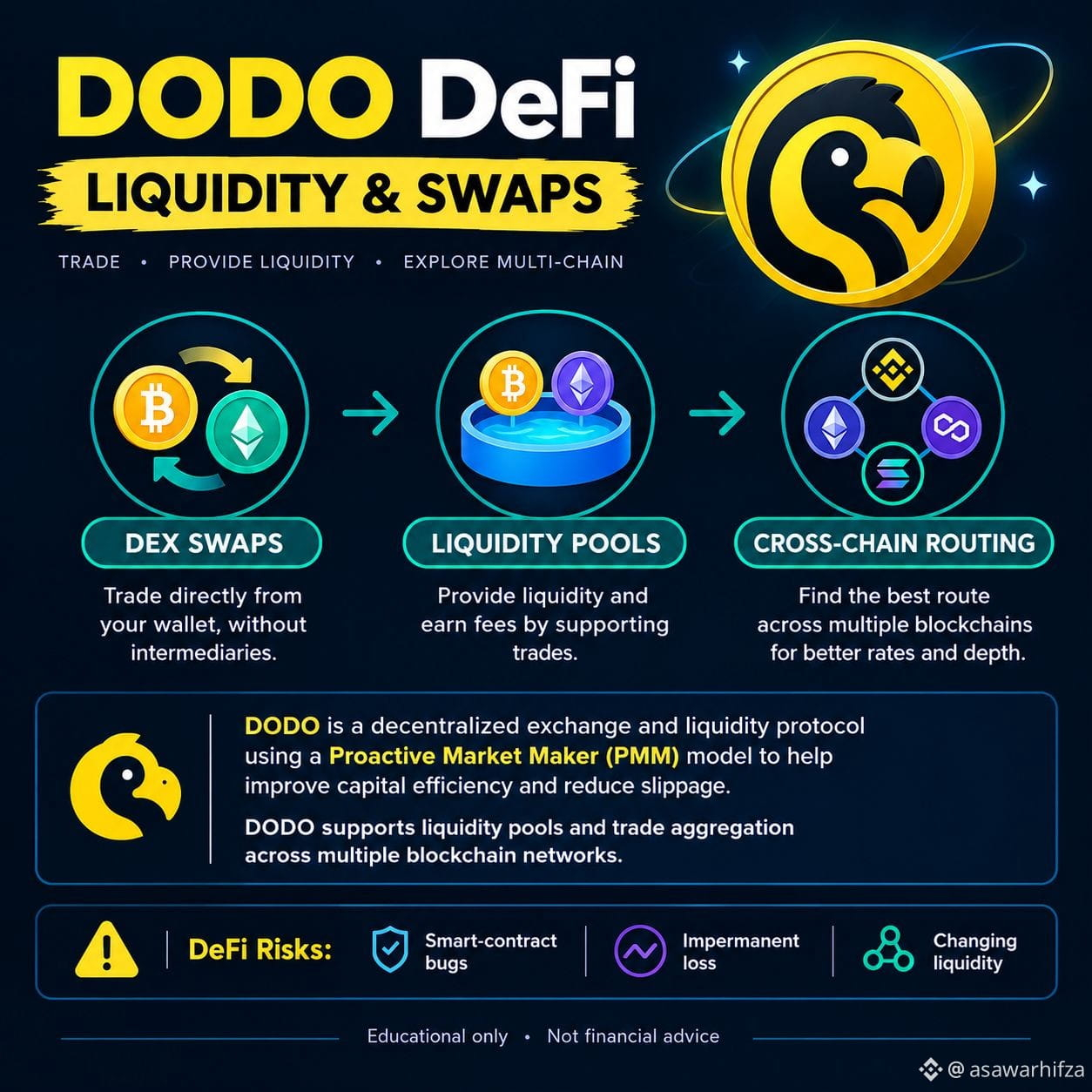
$DODO DODO uses its Proactive Market Maker (PMM) algorithm to support decentralized swaps, liquidity pools, and trade aggregation across multiple blockchains. Strong liquidity and efficient routing are key to its DeFi growth.
⚠️ DeFi carries smart-contract, liquidity, and impermanent-loss risks.
#DODO #DeFi #Crypto #BinanceSquare #USDT $DODO
{spot}(DODOUSDT)
$DODO DODO uses its Proactive Market Maker (PMM) algorithm to support decentralized swaps, liquidity pools, and trade aggregation across multiple blockchains. Strong liquidity and efficient routing are key to its DeFi growth.
⚠️ DeFi carries smart-contract, liquidity, and impermanent-loss risks.
#DODO #DeFi #Crypto #BinanceSquare #USDT $DODO
⚠️ DeFi carries smart-contract, liquidity, and impermanent-loss risks.
#DODO #DeFi #Crypto #BinanceSquare #USDT $DODO
1
66

·
--
🚀 STON.fi Weekly Recap: Farming APRs, Stablecoins & Final Rewards
Stonfiers, here’s what’s happening across the ecosystem!
🎁 Mystery Cargo — final day
Complete all partner missions and claim a free Mystery Cargo containing up to 100 STON. No miles are required to claim, but supplies are limited. Deadline: October 26, 23:59 UTC.
📊 Farm APR snapshot
- USD₮/JETTON: 68%
- GRAM/JETTON: 60%
- STON/USD₮: 13% (Boost Farm APR: 27%)
📈 Weekly stats
- Swap volume: $13.0M
- TVL: $22.8M
- Liquidity providers received approximately $21,000 this week.
💡 Why stablecoins matter: USDT and USDC can help users move value across networks to fund apps and make payments.
Check active farms and explore the stablecoin explainer. APRs can change, and providing liquidity carries risk. DYOR.
#STONfi #TON #defi
🚀 STON.fi Weekly Recap: Farming APRs, Stablecoins & Final Rewards
Stonfiers, here’s what’s happening across the ecosystem!
🎁 Mystery Cargo — final day
Complete all partner missions and claim a free Mystery Cargo containing up to 100 STON. No miles are required to claim, but supplies are limited. Deadline: October 26, 23:59 UTC.
📊 Farm APR snapshot
- USD₮/JETTON: 68%
- GRAM/JETTON: 60%
- STON/USD₮: 13% (Boost Farm APR: 27%)
📈 Weekly stats
- Swap volume: $13.0M
- TVL: $22.8M
- Liquidity providers received approximately $21,000 this week.
💡 Why stablecoins matter: USDT and USDC can help users move value across networks to fund apps and make payments.
Check active farms and explore the stablecoin explainer. APRs can change, and providing liquidity carries risk. DYOR.
#STONfi #TON #defi
Stonfiers, here’s what’s happening across the ecosystem!
🎁 Mystery Cargo — final day
Complete all partner missions and claim a free Mystery Cargo containing up to 100 STON. No miles are required to claim, but supplies are limited. Deadline: October 26, 23:59 UTC.
📊 Farm APR snapshot
- USD₮/JETTON: 68%
- GRAM/JETTON: 60%
- STON/USD₮: 13% (Boost Farm APR: 27%)
📈 Weekly stats
- Swap volume: $13.0M
- TVL: $22.8M
- Liquidity providers received approximately $21,000 this week.
💡 Why stablecoins matter: USDT and USDC can help users move value across networks to fund apps and make payments.
Check active farms and explore the stablecoin explainer. APRs can change, and providing liquidity carries risk. DYOR.
#STONfi #TON #defi

114

·
--
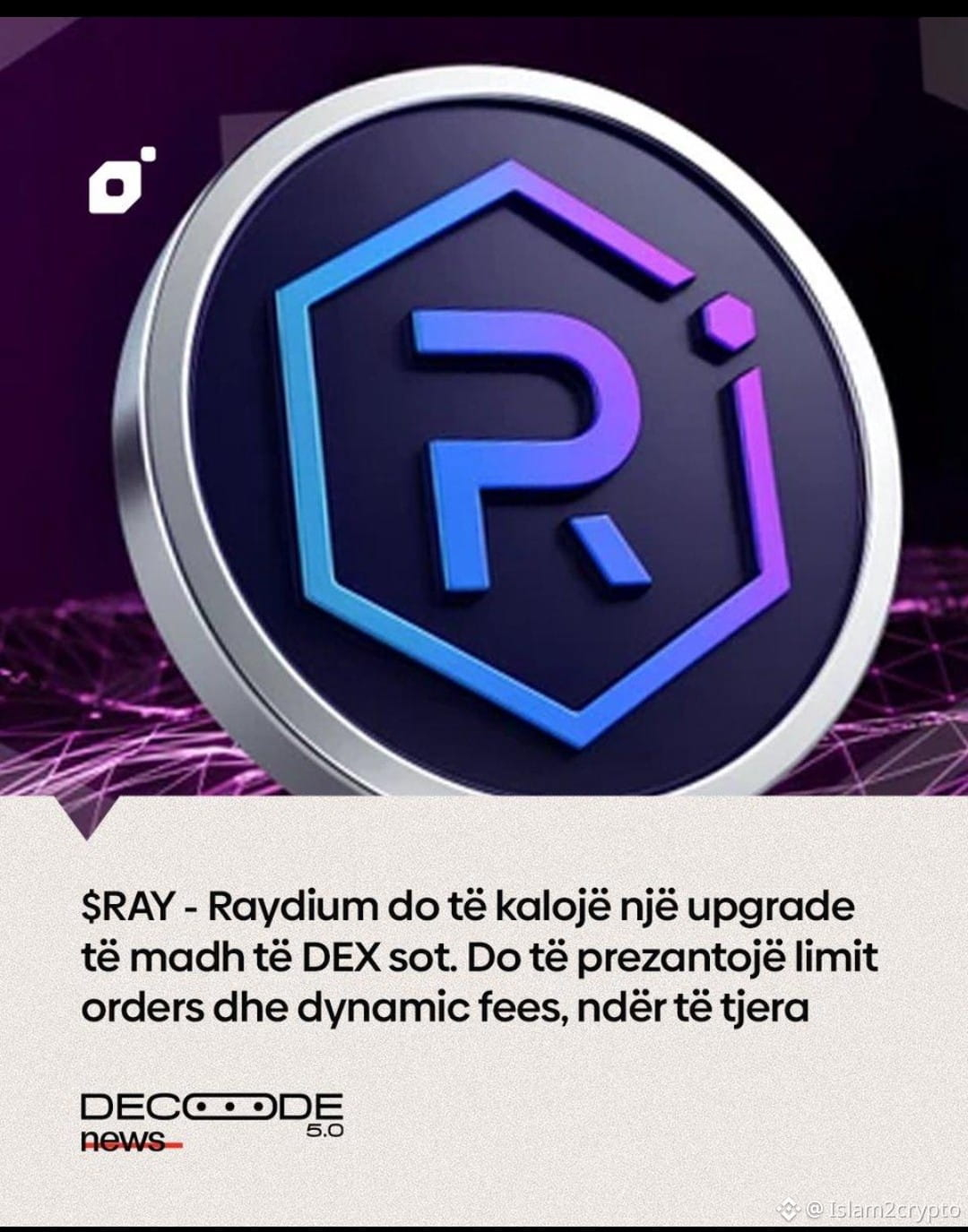
🚀 $RAY dium (RAY): A Project to Watch in the Solana Ecosystem!
$RAY dium is a decentralized exchange (DEX) and liquidity protocol built on the Solana blockchain. It helps users swap tokens, provide liquidity, and participate in DeFi.
🔹 Key Highlights:
- ⚡ Built on the Solana blockchain
- 🔄 Decentralized token swapping
- 💧 Liquidity pools for DeFi users
- 🌐 Staking and ecosystem participation opportunities
📊 What’s Next for RAY?
$RAY
{spot}(RAYUSDT)
dium’s future performance will depend on market conditions, trading activity, adoption, and the overall growth of the Solana ecosystem.
👀 Keep watching the charts, volume, and key support and resistance levels before making any trading decisions.
💬 Discussion: Are you bullish or bearish on RAY? Share your analysis below!
⚠️ Disclaimer: This post is for educational purposes only, not financial advice. Always do your own research (DYOR) before investing. Crypto markets are highly volatile.
#Raydium #RAY #Solana #cryptouniverseofficial #EarningsSeason #FranklinTempletonFilesForTwoDividendToBitcoinETFs #BinanceSquare #DeFi #CryptoAnalysis
🚀 $RAY dium (RAY): A Project to Watch in the Solana Ecosystem!
$RAY dium is a decentralized exchange (DEX) and liquidity protocol built on the Solana blockchain. It helps users swap tokens, provide liquidity, and participate in DeFi.
🔹 Key Highlights:
- ⚡ Built on the Solana blockchain
- 🔄 Decentralized token swapping
- 💧 Liquidity pools for DeFi users
- 🌐 Staking and ecosystem participation opportunities
📊 What’s Next for RAY?
$RAY
dium’s future performance will depend on market conditions, trading activity, adoption, and the overall growth of the Solana ecosystem.
👀 Keep watching the charts, volume, and key support and resistance levels before making any trading decisions.
💬 Discussion: Are you bullish or bearish on RAY? Share your analysis below!
⚠️ Disclaimer: This post is for educational purposes only, not financial advice. Always do your own research (DYOR) before investing. Crypto markets are highly volatile.
#Raydium #RAY #Solana #cryptouniverseofficial #EarningsSeason #FranklinTempletonFilesForTwoDividendToBitcoinETFs #BinanceSquare #DeFi #CryptoAnalysis
$RAY dium is a decentralized exchange (DEX) and liquidity protocol built on the Solana blockchain. It helps users swap tokens, provide liquidity, and participate in DeFi.
🔹 Key Highlights:
- ⚡ Built on the Solana blockchain
- 🔄 Decentralized token swapping
- 💧 Liquidity pools for DeFi users
- 🌐 Staking and ecosystem participation opportunities
📊 What’s Next for RAY?
$RAY
dium’s future performance will depend on market conditions, trading activity, adoption, and the overall growth of the Solana ecosystem.
👀 Keep watching the charts, volume, and key support and resistance levels before making any trading decisions.
💬 Discussion: Are you bullish or bearish on RAY? Share your analysis below!
⚠️ Disclaimer: This post is for educational purposes only, not financial advice. Always do your own research (DYOR) before investing. Crypto markets are highly volatile.
#Raydium #RAY #Solana #cryptouniverseofficial #EarningsSeason #FranklinTempletonFilesForTwoDividendToBitcoinETFs #BinanceSquare #DeFi #CryptoAnalysis
120

·
--
💰 DEFI WATCHLIST: THREE DIFFERENT ROLES
🦄 $UNI — A major decentralized exchange protocol.
🏦 $AAVE — A decentralized lending and borrowing protocol.
🔧 $MKR — Historically associated with Maker's decentralized stablecoin ecosystem; check current token and governance arrangements.
Before considering any DeFi token, investigate protocol revenue, token utility, governance, and smart-contract risk.
Which DeFi model interests you most?
#DeFi #Uniswap #Aave
💰 DEFI WATCHLIST: THREE DIFFERENT ROLES
🦄 $UNI — A major decentralized exchange protocol.
🏦 $AAVE — A decentralized lending and borrowing protocol.
🔧 $MKR — Historically associated with Maker's decentralized stablecoin ecosystem; check current token and governance arrangements.
Before considering any DeFi token, investigate protocol revenue, token utility, governance, and smart-contract risk.
Which DeFi model interests you most?
#DeFi #Uniswap #Aave
🦄 $UNI — A major decentralized exchange protocol.
🏦 $AAVE — A decentralized lending and borrowing protocol.
🔧 $MKR — Historically associated with Maker's decentralized stablecoin ecosystem; check current token and governance arrangements.
Before considering any DeFi token, investigate protocol revenue, token utility, governance, and smart-contract risk.
Which DeFi model interests you most?
#DeFi #Uniswap #Aave
1
5

·
--
$HYPE
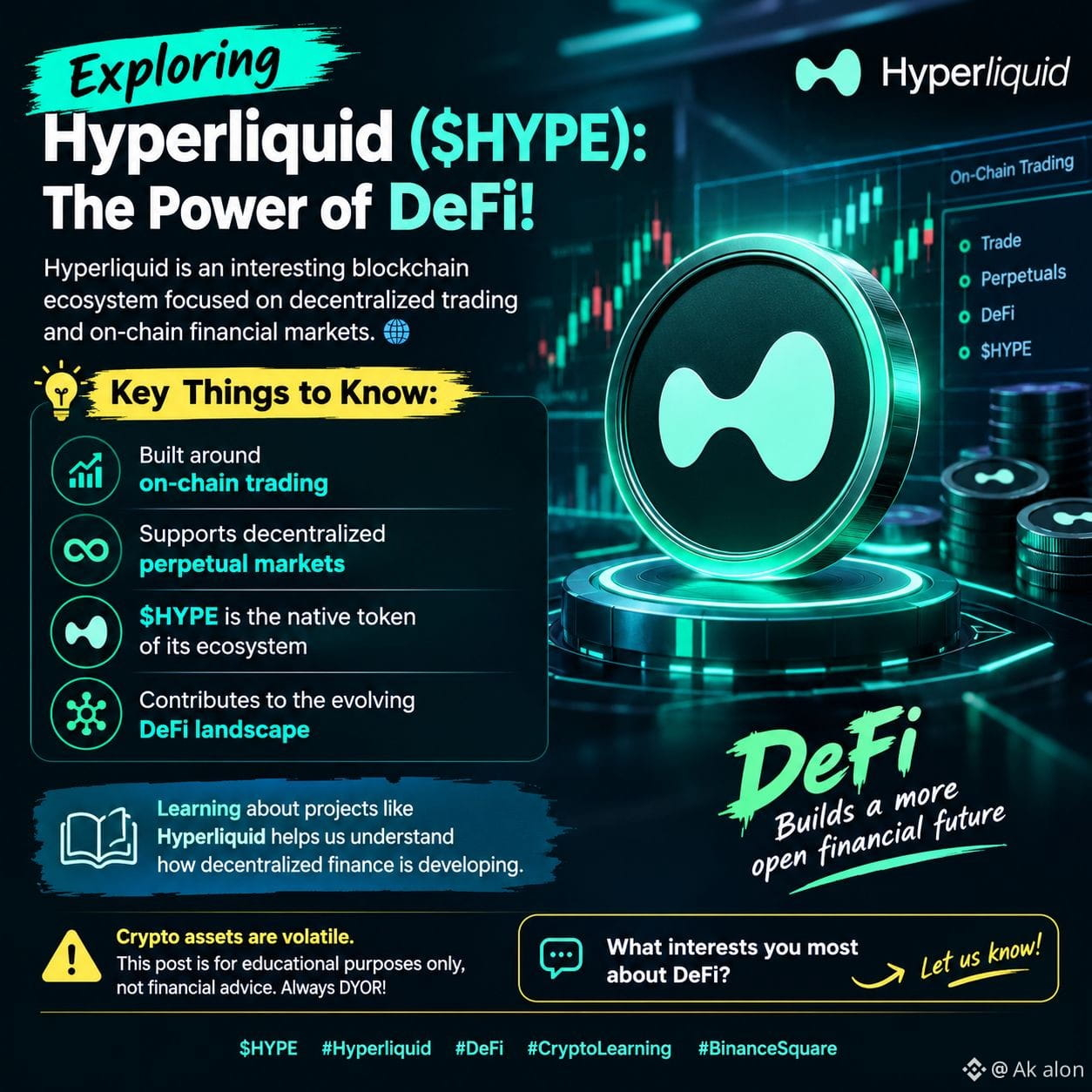
🚀 Exploring Hyperliquid (HYPE): The Power of DeFi!
Hyperliquid is an interesting blockchain ecosystem focused on decentralized trading and on-chain financial markets. 🌐
💡 Key Things to Know:
🔹 Built around on-chain trading
🔹 Supports decentralized perpetual markets
🔹 $HYPE is the native token of its ecosystem
🔹 Contributes to the evolving DeFi landscape
📚 Learning about projects like Hyperliquid helps us understand how decentralized finance is developing.
⚠️ Crypto assets are volatile. This post is for educational purposes only, not financial advice. Always DYOR!
What interests you most about DeFi? 👇
$HYPE #DeFi #CryptoLearning #BinanceSquare
$HYPE
🚀 Exploring Hyperliquid (HYPE): The Power of DeFi!
Hyperliquid is an interesting blockchain ecosystem focused on decentralized trading and on-chain financial markets. 🌐
💡 Key Things to Know:
🔹 Built around on-chain trading
🔹 Supports decentralized perpetual markets
🔹 $HYPE is the native token of its ecosystem
🔹 Contributes to the evolving DeFi landscape
📚 Learning about projects like Hyperliquid helps us understand how decentralized finance is developing.
⚠️ Crypto assets are volatile. This post is for educational purposes only, not financial advice. Always DYOR!
What interests you most about DeFi? 👇
$HYPE #DeFi #CryptoLearning #BinanceSquare
🚀 Exploring Hyperliquid (HYPE): The Power of DeFi!
Hyperliquid is an interesting blockchain ecosystem focused on decentralized trading and on-chain financial markets. 🌐
💡 Key Things to Know:
🔹 Built around on-chain trading
🔹 Supports decentralized perpetual markets
🔹 $HYPE is the native token of its ecosystem
🔹 Contributes to the evolving DeFi landscape
📚 Learning about projects like Hyperliquid helps us understand how decentralized finance is developing.
⚠️ Crypto assets are volatile. This post is for educational purposes only, not financial advice. Always DYOR!
What interests you most about DeFi? 👇
$HYPE #DeFi #CryptoLearning #BinanceSquare
99

Article
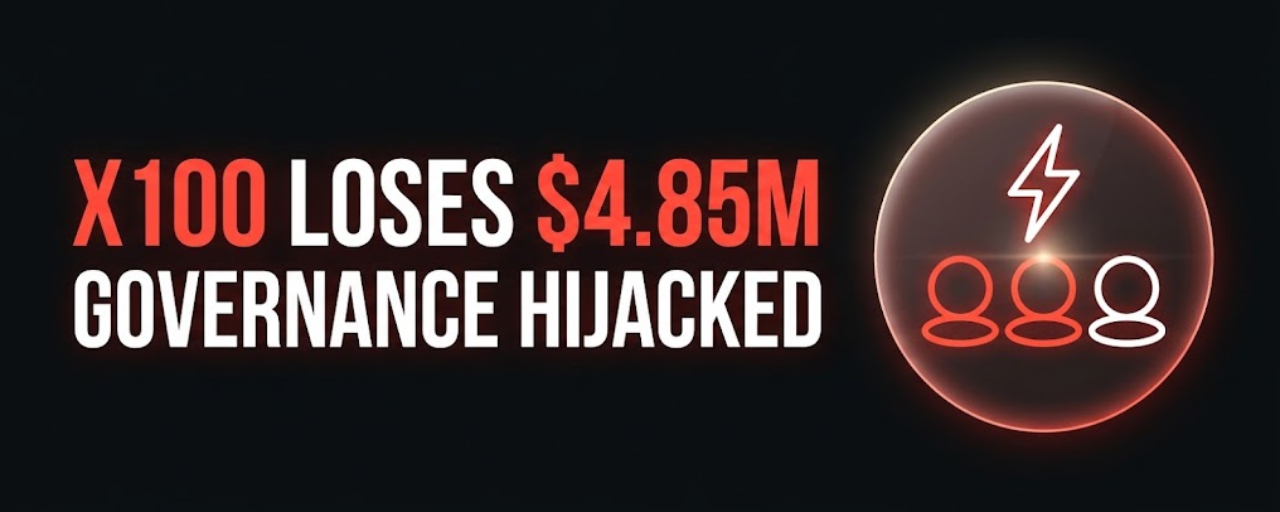
Can a DAO Be Hijacked in Minutes? What the X100 Exploit Teaches Every DeFi UserA flash loan bought enough votes to drain $4.85M with no governance delay. Here's the attack step by step, and three red flags to look for before you deposit.
🏛️ On Saturday, an attacker borrowed money, bought a controlling vote in a DeFi project, and drained its treasury, all inside one transaction.
X100, a project on Ethereum, lost about $4.75M to $4.85M on October 24. Its token fell more than 96% as liquidity disappeared. The scary part isn't a coding bug. The contracts did exactly what they were built to do.
🔍 How the attack worked, step by step.
The attacker borrowed about 1.94M USDT through an Aave flash loan, a loan that must be repaid within the same transaction.They bought X tokens and split them across two contracts they controlled.Each contract staked slightly more than 19,000 X into X100's Freezer, which gave them two of the project's three "Senate" seats.With a majority, they passed a proposal forcing the treasury to sell 400,000 X into a pool they had created, accepting a payout of about 36 USDT.They pulled the liquidity back out, sold the tokens, repaid the loan and kept roughly $4.75M. A second attacker repeated the trick about 24 minutes later.
🧠 Why it worked.
New Senate members could approve and execute proposals immediately, with no waiting period. A delay of even a few hours would have broken the attack, because a flash loan has to be repaid in the same transaction. Voting power was also something anyone could rent for a few cents of fees.
🚩 Three red flags to check before you deposit.
No delay. Can governance changes execute instantly, or is there a timelock?Votes you can borrow. If voting power comes from tokens that can be bought or borrowed in seconds, it can be attacked.A tiny council. When two or three seats control a treasury, taking the majority is cheap.
✅ What this means for you
If you use DeFi, read the governance section of a project's docs before you deposit, and look for timelocks, audits and the number of signers.
If you're on the sidelines, this is a reminder that "audited" doesn't always cover how governance is designed.
If you hold X100 tokens, the project hadn't published an incident report or recovery plan in the first hours, so watch its official channels and be careful with anyone offering "recovery" links.
🟢 Bullish scenario
The team publishes a clear report, adds a timelock and redesigns governance, and the incident becomes a case study that other projects learn from.
🔴 Risk scenario
Copycats target similar designs, stolen funds are mixed and moved out, and holders get no recovery.
👀 Three things to watch
1️⃣ An official incident report from X100
2️⃣ Where the stolen funds, reportedly converted to about 2,022 ETH, move next
3️⃣ Similar governance designs getting audited or patched
💡 The key takeaway
X100 wasn't hacked through a typo in the code. It was hacked through its own rules, which let anyone buy a majority and act on it instantly.
The real question isn't whether the code is audited. It's whether governance can be rented for a minute.
That is the part worth watching.
This post is for informational and educational purposes only and is not financial advice. Crypto markets are volatile. Always conduct your own research before making financial decisions.
#BinanceSquare #DeFi #Ethereum #CryptoSecurity #FlashLoan
{spot}(AAVEUSDT)
{spot}(ETHUSDT)
Can a DAO Be Hijacked in Minutes? What the X100 Exploit Teaches Every DeFi User
A flash loan bought enough votes to drain $4.85M with no governance delay. Here's the attack step by step, and three red flags to look for before you deposit.
🏛️ On Saturday, an attacker borrowed money, bought a controlling vote in a DeFi project, and drained its treasury, all inside one transaction.
X100, a project on Ethereum, lost about $4.75M to $4.85M on October 24. Its token fell more than 96% as liquidity disappeared. The scary part isn't a coding bug. The contracts did exactly what they were built to do.
🔍 How the attack worked, step by step.
The attacker borrowed about 1.94M USDT through an Aave flash loan, a loan that must be repaid within the same transaction.They bought X tokens and split them across two contracts they controlled.Each contract staked slightly more than 19,000 X into X100's Freezer, which gave them two of the project's three "Senate" seats.With a majority, they passed a proposal forcing the treasury to sell 400,000 X into a pool they had created, accepting a payout of about 36 USDT.They pulled the liquidity back out, sold the tokens, repaid the loan and kept roughly $4.75M. A second attacker repeated the trick about 24 minutes later.
🧠 Why it worked.
New Senate members could approve and execute proposals immediately, with no waiting period. A delay of even a few hours would have broken the attack, because a flash loan has to be repaid in the same transaction. Voting power was also something anyone could rent for a few cents of fees.
🚩 Three red flags to check before you deposit.
No delay. Can governance changes execute instantly, or is there a timelock?Votes you can borrow. If voting power comes from tokens that can be bought or borrowed in seconds, it can be attacked.A tiny council. When two or three seats control a treasury, taking the majority is cheap.
✅ What this means for you
If you use DeFi, read the governance section of a project's docs before you deposit, and look for timelocks, audits and the number of signers.
If you're on the sidelines, this is a reminder that "audited" doesn't always cover how governance is designed.
If you hold X100 tokens, the project hadn't published an incident report or recovery plan in the first hours, so watch its official channels and be careful with anyone offering "recovery" links.
🟢 Bullish scenario
The team publishes a clear report, adds a timelock and redesigns governance, and the incident becomes a case study that other projects learn from.
🔴 Risk scenario
Copycats target similar designs, stolen funds are mixed and moved out, and holders get no recovery.
👀 Three things to watch
1️⃣ An official incident report from X100
2️⃣ Where the stolen funds, reportedly converted to about 2,022 ETH, move next
3️⃣ Similar governance designs getting audited or patched
💡 The key takeaway
X100 wasn't hacked through a typo in the code. It was hacked through its own rules, which let anyone buy a majority and act on it instantly.
The real question isn't whether the code is audited. It's whether governance can be rented for a minute.
That is the part worth watching.
This post is for informational and educational purposes only and is not financial advice. Crypto markets are volatile. Always conduct your own research before making financial decisions.
#BinanceSquare #DeFi #Ethereum #CryptoSecurity #FlashLoan
🏛️ On Saturday, an attacker borrowed money, bought a controlling vote in a DeFi project, and drained its treasury, all inside one transaction.
X100, a project on Ethereum, lost about $4.75M to $4.85M on October 24. Its token fell more than 96% as liquidity disappeared. The scary part isn't a coding bug. The contracts did exactly what they were built to do.
🔍 How the attack worked, step by step.
The attacker borrowed about 1.94M USDT through an Aave flash loan, a loan that must be repaid within the same transaction.They bought X tokens and split them across two contracts they controlled.Each contract staked slightly more than 19,000 X into X100's Freezer, which gave them two of the project's three "Senate" seats.With a majority, they passed a proposal forcing the treasury to sell 400,000 X into a pool they had created, accepting a payout of about 36 USDT.They pulled the liquidity back out, sold the tokens, repaid the loan and kept roughly $4.75M. A second attacker repeated the trick about 24 minutes later.
🧠 Why it worked.
New Senate members could approve and execute proposals immediately, with no waiting period. A delay of even a few hours would have broken the attack, because a flash loan has to be repaid in the same transaction. Voting power was also something anyone could rent for a few cents of fees.
🚩 Three red flags to check before you deposit.
No delay. Can governance changes execute instantly, or is there a timelock?Votes you can borrow. If voting power comes from tokens that can be bought or borrowed in seconds, it can be attacked.A tiny council. When two or three seats control a treasury, taking the majority is cheap.
✅ What this means for you
If you use DeFi, read the governance section of a project's docs before you deposit, and look for timelocks, audits and the number of signers.
If you're on the sidelines, this is a reminder that "audited" doesn't always cover how governance is designed.
If you hold X100 tokens, the project hadn't published an incident report or recovery plan in the first hours, so watch its official channels and be careful with anyone offering "recovery" links.
🟢 Bullish scenario
The team publishes a clear report, adds a timelock and redesigns governance, and the incident becomes a case study that other projects learn from.
🔴 Risk scenario
Copycats target similar designs, stolen funds are mixed and moved out, and holders get no recovery.
👀 Three things to watch
1️⃣ An official incident report from X100
2️⃣ Where the stolen funds, reportedly converted to about 2,022 ETH, move next
3️⃣ Similar governance designs getting audited or patched
💡 The key takeaway
X100 wasn't hacked through a typo in the code. It was hacked through its own rules, which let anyone buy a majority and act on it instantly.
The real question isn't whether the code is audited. It's whether governance can be rented for a minute.
That is the part worth watching.
This post is for informational and educational purposes only and is not financial advice. Crypto markets are volatile. Always conduct your own research before making financial decisions.
#BinanceSquare #DeFi #Ethereum #CryptoSecurity #FlashLoan
1
1
172

·
--
🚀 JUPITER (JUP): THE SOLANA TOKEN I WOULDN’T IGNORE
Why did we put JUP on our radar before — and why could it still be worth watching?
Most traders chase coins after they pump. I prefer looking at projects that are building something people actually use.
1. What is Jupiter?
Jupiter is one of the major DeFi platforms in the Solana ecosystem.
It started as a DEX aggregator — a technology that searches across different exchanges to find efficient swap routes and competitive prices.
Instead of manually checking multiple platforms, users can swap tokens through one interface.
But Jupiter has expanded beyond simple swaps into a broader on-chain finance ecosystem, including perpetual trading, lending and other products.
2. What makes the technology interesting?
⚙️ Smart trade routing: Jupiter can compare liquidity across multiple venues and route trades to improve execution.
🌐 Solana infrastructure: Fast transactions and relatively low network fees make Solana attractive for active on-chain trading.
📈 A growing product ecosystem: More products can mean more opportunities to attract users, trading activity and liquidity.
The key is adoption. Technology alone doesn’t make a token valuable — real usage matters.
3. Why look at JUP as a potential investment?
The investment thesis has three parts:
• Ecosystem growth: If Solana DeFi expands, Jupiter could benefit from increased activity.
• Governance and staking: JUP gives holders a role in protocol governance, while active staking participants may qualify for rewards under the applicable program rules.
• Market sentiment: If capital rotates back into Solana ecosystem tokens, JUP could attract renewed attention.
That creates a potential opportunity — not a guarantee.
A strong project does not automatically mean a good entry price.
My takeaway:
JUP is worth researching because it sits at the intersection of Solana, DeFi trading and on-chain financial products.
The opportunity is in the thesis — but the entry price and risk management still matter.
#JUP #DeFi
🚀 JUPITER (JUP): THE SOLANA TOKEN I WOULDN’T IGNORE
Why did we put JUP on our radar before — and why could it still be worth watching?
Most traders chase coins after they pump. I prefer looking at projects that are building something people actually use.
1. What is Jupiter?
Jupiter is one of the major DeFi platforms in the Solana ecosystem.
It started as a DEX aggregator — a technology that searches across different exchanges to find efficient swap routes and competitive prices.
Instead of manually checking multiple platforms, users can swap tokens through one interface.
But Jupiter has expanded beyond simple swaps into a broader on-chain finance ecosystem, including perpetual trading, lending and other products.
2. What makes the technology interesting?
⚙️ Smart trade routing: Jupiter can compare liquidity across multiple venues and route trades to improve execution.
🌐 Solana infrastructure: Fast transactions and relatively low network fees make Solana attractive for active on-chain trading.
📈 A growing product ecosystem: More products can mean more opportunities to attract users, trading activity and liquidity.
The key is adoption. Technology alone doesn’t make a token valuable — real usage matters.
3. Why look at JUP as a potential investment?
The investment thesis has three parts:
• Ecosystem growth: If Solana DeFi expands, Jupiter could benefit from increased activity.
• Governance and staking: JUP gives holders a role in protocol governance, while active staking participants may qualify for rewards under the applicable program rules.
• Market sentiment: If capital rotates back into Solana ecosystem tokens, JUP could attract renewed attention.
That creates a potential opportunity — not a guarantee.
A strong project does not automatically mean a good entry price.
My takeaway:
JUP is worth researching because it sits at the intersection of Solana, DeFi trading and on-chain financial products.
The opportunity is in the thesis — but the entry price and risk management still matter.
#JUP #DeFi
Why did we put JUP on our radar before — and why could it still be worth watching?
Most traders chase coins after they pump. I prefer looking at projects that are building something people actually use.
1. What is Jupiter?
Jupiter is one of the major DeFi platforms in the Solana ecosystem.
It started as a DEX aggregator — a technology that searches across different exchanges to find efficient swap routes and competitive prices.
Instead of manually checking multiple platforms, users can swap tokens through one interface.
But Jupiter has expanded beyond simple swaps into a broader on-chain finance ecosystem, including perpetual trading, lending and other products.
2. What makes the technology interesting?
⚙️ Smart trade routing: Jupiter can compare liquidity across multiple venues and route trades to improve execution.
🌐 Solana infrastructure: Fast transactions and relatively low network fees make Solana attractive for active on-chain trading.
📈 A growing product ecosystem: More products can mean more opportunities to attract users, trading activity and liquidity.
The key is adoption. Technology alone doesn’t make a token valuable — real usage matters.
3. Why look at JUP as a potential investment?
The investment thesis has three parts:
• Ecosystem growth: If Solana DeFi expands, Jupiter could benefit from increased activity.
• Governance and staking: JUP gives holders a role in protocol governance, while active staking participants may qualify for rewards under the applicable program rules.
• Market sentiment: If capital rotates back into Solana ecosystem tokens, JUP could attract renewed attention.
That creates a potential opportunity — not a guarantee.
A strong project does not automatically mean a good entry price.
My takeaway:
JUP is worth researching because it sits at the intersection of Solana, DeFi trading and on-chain financial products.
The opportunity is in the thesis — but the entry price and risk management still matter.
#JUP #DeFi

1
120

·
--
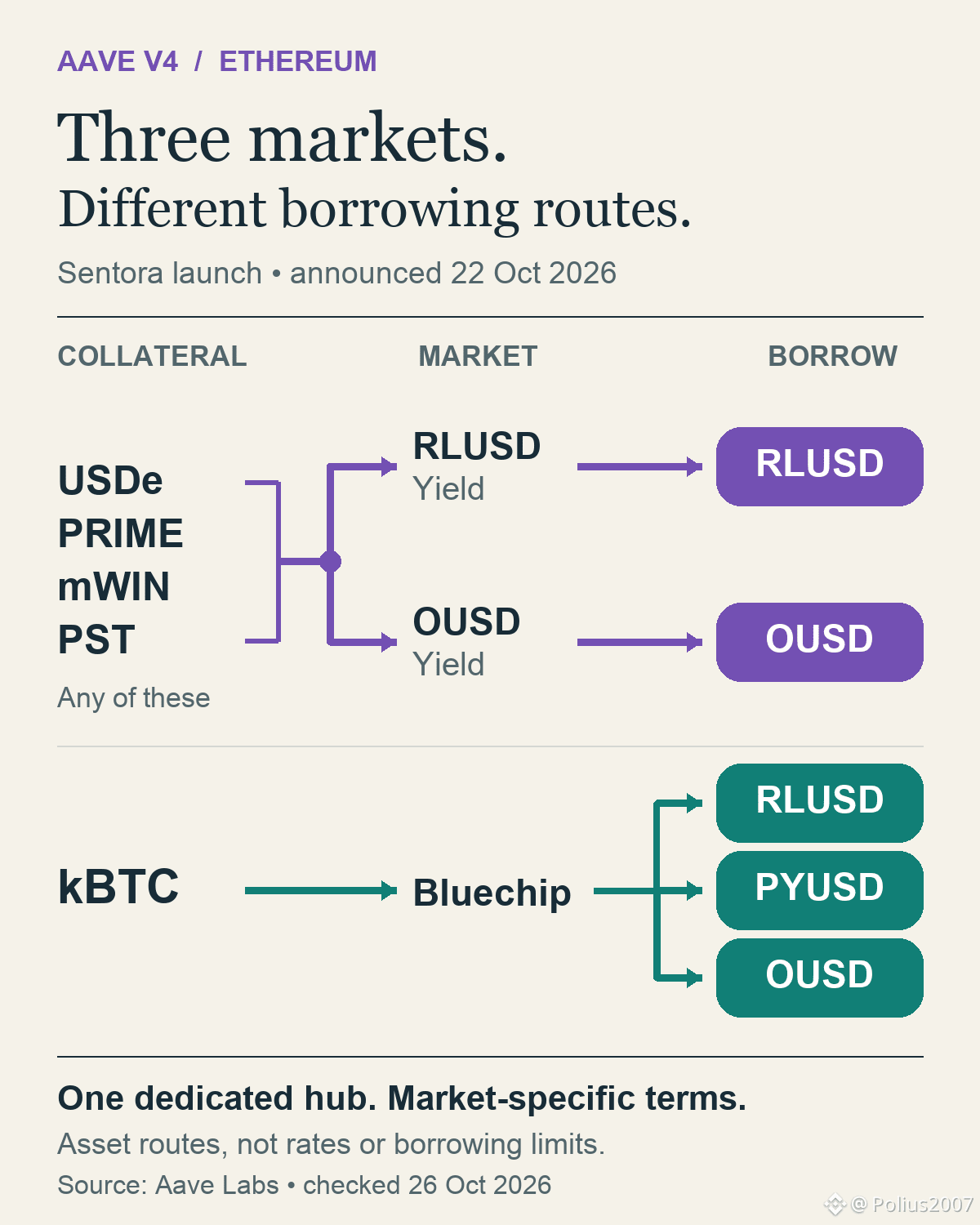
Aave's new Sentora markets give the same collateral two different borrowing routes: USDe, PRIME, mWIN or PST can back an RLUSD loan or an OUSD loan, depending on the market chosen.
Aave Labs' October 22 announcement describes three externally curated markets on Ethereum. The two Yield markets accept those four assets. The third, Bluechip, accepts kBTC as collateral and lets users borrow RLUSD, PYUSD or OUSD.
The distinction matters before depositing: the list of assets supported by the launch is not a menu of interchangeable collateral and loan combinations. The illustration maps which collateral opens which route.
Sentora runs a dedicated liquidity hub and chooses collateral and risk parameters for its markets. Aave supplies the V4 infrastructure and retains governance safeguards. According to the announcement, the Aave DAO owns the contracts, risk-increasing changes face a 48-hour timelock, and new assets need Aave governance review.
For borrowers, the useful change is more ways to borrow against these holdings without selling them. The next comparison is market-specific: the borrowing rate, how much the collateral lets you borrow, and when liquidation can begin. A shared codebase doesn't make those terms identical.
Source: Aave Labs, October 22, 2026; checked October 26. Availability is as announced, not a live transaction test.
https://aave.com/blog/sentora-aave-launch
#Aave #DeFi
Aave's new Sentora markets give the same collateral two different borrowing routes: USDe, PRIME, mWIN or PST can back an RLUSD loan or an OUSD loan, depending on the market chosen.
Aave Labs' October 22 announcement describes three externally curated markets on Ethereum. The two Yield markets accept those four assets. The third, Bluechip, accepts kBTC as collateral and lets users borrow RLUSD, PYUSD or OUSD.
The distinction matters before depositing: the list of assets supported by the launch is not a menu of interchangeable collateral and loan combinations. The illustration maps which collateral opens which route.
Sentora runs a dedicated liquidity hub and chooses collateral and risk parameters for its markets. Aave supplies the V4 infrastructure and retains governance safeguards. According to the announcement, the Aave DAO owns the contracts, risk-increasing changes face a 48-hour timelock, and new assets need Aave governance review.
For borrowers, the useful change is more ways to borrow against these holdings without selling them. The next comparison is market-specific: the borrowing rate, how much the collateral lets you borrow, and when liquidation can begin. A shared codebase doesn't make those terms identical.
Source: Aave Labs, October 22, 2026; checked October 26. Availability is as announced, not a live transaction test.
https://aave.com/blog/sentora-aave-launch
#Aave #DeFi
Aave Labs' October 22 announcement describes three externally curated markets on Ethereum. The two Yield markets accept those four assets. The third, Bluechip, accepts kBTC as collateral and lets users borrow RLUSD, PYUSD or OUSD.
The distinction matters before depositing: the list of assets supported by the launch is not a menu of interchangeable collateral and loan combinations. The illustration maps which collateral opens which route.
Sentora runs a dedicated liquidity hub and chooses collateral and risk parameters for its markets. Aave supplies the V4 infrastructure and retains governance safeguards. According to the announcement, the Aave DAO owns the contracts, risk-increasing changes face a 48-hour timelock, and new assets need Aave governance review.
For borrowers, the useful change is more ways to borrow against these holdings without selling them. The next comparison is market-specific: the borrowing rate, how much the collateral lets you borrow, and when liquidation can begin. A shared codebase doesn't make those terms identical.
Source: Aave Labs, October 22, 2026; checked October 26. Availability is as announced, not a live transaction test.
https://aave.com/blog/sentora-aave-launch
#Aave #DeFi
128

·
--
Have you noticed how most traders ignore DeFi setups until it's too late to get in?
The pain of missing a clean surge like this one on $CAP is real. You sit on the sidelines waiting for confirmation, then FOMO at the highs and have no idea when to exit before the token event dumps it.
$CAP just surged 39.33% on strong DeFi momentum heading into a key token event. The crowd still thinks DeFi is dead, but price action like this tells a different story. Utility tokens with upcoming catalysts don't wait for your permission to move.
Look at how $UNI and $AAVE reacted around similar events. The approach that works is to map the date, enter with a defined size, and set your take profit before the news cycle peaks. Waiting for the tweet is how accounts get rekt.
Where do you think this $CAP momentum heads after the token event?
#DeFi #Altcoins #CryptoTrading
Have you noticed how most traders ignore DeFi setups until it's too late to get in?
The pain of missing a clean surge like this one on $CAP is real. You sit on the sidelines waiting for confirmation, then FOMO at the highs and have no idea when to exit before the token event dumps it.
$CAP just surged 39.33% on strong DeFi momentum heading into a key token event. The crowd still thinks DeFi is dead, but price action like this tells a different story. Utility tokens with upcoming catalysts don't wait for your permission to move.
Look at how $UNI and $AAVE reacted around similar events. The approach that works is to map the date, enter with a defined size, and set your take profit before the news cycle peaks. Waiting for the tweet is how accounts get rekt.
Where do you think this $CAP momentum heads after the token event?
#DeFi #Altcoins #CryptoTrading
The pain of missing a clean surge like this one on $CAP is real. You sit on the sidelines waiting for confirmation, then FOMO at the highs and have no idea when to exit before the token event dumps it.
$CAP just surged 39.33% on strong DeFi momentum heading into a key token event. The crowd still thinks DeFi is dead, but price action like this tells a different story. Utility tokens with upcoming catalysts don't wait for your permission to move.
Look at how $UNI and $AAVE reacted around similar events. The approach that works is to map the date, enter with a defined size, and set your take profit before the news cycle peaks. Waiting for the tweet is how accounts get rekt.
Where do you think this $CAP momentum heads after the token event?
#DeFi #Altcoins #CryptoTrading
6

·
--
One Price For Everyone Who Bid 💰
A sealed auction clears at one price for every winning bidder, which is the mechanism that stops the people who bid earliest from paying the most.
$JUP made buying into a new token on $SOL a matter of one swap, and that convenience is also the problem, because a queue of visible buys means the price moves as the queue grows and the last buyer pays for the enthusiasm of the first.
Sealed bidding works the other way. Everyone submits what they think it is worth, nobody reacts to anyone else, and the clearing price is what the market actually believed rather than what the queue produced.
Crafts runs that on Arcium as a sealed-bid launchpad. No bid is readable anywhere until the auction closes, not by the other bidders and not by whoever is running the sale, and the clearing price still comes out correct.
That price posts to Solana like any other transaction, so anyone can check what cleared and at what level once it is done.
Token launches have rewarded speed over judgement, and Arcium is what lets a Solana sale reward the judgement instead.
#altcoins #defi
One Price For Everyone Who Bid 💰
A sealed auction clears at one price for every winning bidder, which is the mechanism that stops the people who bid earliest from paying the most.
$JUP made buying into a new token on $SOL a matter of one swap, and that convenience is also the problem, because a queue of visible buys means the price moves as the queue grows and the last buyer pays for the enthusiasm of the first.
Sealed bidding works the other way. Everyone submits what they think it is worth, nobody reacts to anyone else, and the clearing price is what the market actually believed rather than what the queue produced.
Crafts runs that on Arcium as a sealed-bid launchpad. No bid is readable anywhere until the auction closes, not by the other bidders and not by whoever is running the sale, and the clearing price still comes out correct.
That price posts to Solana like any other transaction, so anyone can check what cleared and at what level once it is done.
Token launches have rewarded speed over judgement, and Arcium is what lets a Solana sale reward the judgement instead.
#altcoins #defi
A sealed auction clears at one price for every winning bidder, which is the mechanism that stops the people who bid earliest from paying the most.
$JUP made buying into a new token on $SOL a matter of one swap, and that convenience is also the problem, because a queue of visible buys means the price moves as the queue grows and the last buyer pays for the enthusiasm of the first.
Sealed bidding works the other way. Everyone submits what they think it is worth, nobody reacts to anyone else, and the clearing price is what the market actually believed rather than what the queue produced.
Crafts runs that on Arcium as a sealed-bid launchpad. No bid is readable anywhere until the auction closes, not by the other bidders and not by whoever is running the sale, and the clearing price still comes out correct.
That price posts to Solana like any other transaction, so anyone can check what cleared and at what level once it is done.
Token launches have rewarded speed over judgement, and Arcium is what lets a Solana sale reward the judgement instead.
#altcoins #defi
1
185
Connectez-vous pour découvrir plus de contenu
Rejoignez la communauté mondiale des adeptes de cryptomonnaies sur Binance Square
⚡️ Suviez les dernières informations importantes sur les cryptomonnaies.
💬 Jugé digne de confiance par la plus grande plateforme d’échange de cryptomonnaies au monde.
👍 Découvrez les connaissances que partagent les créateurs vérifiés.
Adresse e-mail/Nº de téléphone
Sujets d’actualité
1
#BinancePick
3.4M vues
165,811 mentions
2
#EarningsSeason
5.5M vues
27,011 mentions
3
#StrategySkipsBitcoinPurchasesSpends$205MOnSTRCBuybacks
1,130 vues
38 mentions
4
#BitmineAdds10452ETH
13,174 vues
296 mentions
5
#SouthKoreaConsidersEducationTaxOnCryptoExchanges
10,670 vues
263 mentions
6
#OCCUrgesCommunityBanksToEnterStablecoinPayments
9,700 vues
163 mentions
7
#RippleWinsFullApprovalAsNationalTrustBank
8,456 vues
168 mentions
8
#AkashSelectsSolanaAsMigrationTarget
6,476 vues
88 mentions
9
#OndoToOpenSubscriptionsForOpenAIPreIPOTokenizedNotes
399 vues
19 mentions
10
#AnthropicTTMRevenueGrewAbout1200%
62,326 vues
611 mentions