
Seema BNB
1k Posts

Seema BNB
Report
Block User
102 Following
2.6K+ Followers
1.1K+ Liked
Posts
PINNED
·
--
I stopped at two numbers while checking Kite’s supply documents. Its MiCA filing projected 27% circulating at launch. An October tracker reports 2.39 billion $KITE , or 23.91%. Different dates and definitions, yes. But which wallets explain the difference? @GoKiteAI
The 10 billion cap contains 4.8 billion ecosystem tokens, 2 billion for modules, 2 billion for contributors and 1.2 billion for investors. Team and investor allocations have a one-year cliff. Allocated isn't unlocked. Unlocked isn't liquid. Staked isn't spendable. And 32% allocated to insiders matters for governance.
Kite’s disclosed thresholds 30 million Kite per module owner, 1 million per validator, 166,667 per delegator create commitment, but also entry costs. Grants need to produce returning customers, not subsidized activity.
Take a hypothetical $10 million in monthly agent payments. At 0.1%, 0.5% and 1% commissions, that's $10,000, $50,000 and $100,000 in gross fees. Not merchant revenue. Not guaranteed token demand.
Agents paying stablecoins don't necessarily buy Kite. Actual commission conversions would create that link.
Even a $1 million annual validator budget requires $200 million in service volume at 0.5%, assuming every fee dollar funds security.
I'd watch verified conversions, module retention, unlocks and validator costs together.
Because payment activity alone doesn't prove economic sustainability.
$KITE #KiteBBW
I stopped at two numbers while checking Kite’s supply documents. Its MiCA filing projected 27% circulating at launch. An October tracker reports 2.39 billion $KITE , or 23.91%. Different dates and definitions, yes. But which wallets explain the difference? @KITE AI 中文
The 10 billion cap contains 4.8 billion ecosystem tokens, 2 billion for modules, 2 billion for contributors and 1.2 billion for investors. Team and investor allocations have a one-year cliff. Allocated isn't unlocked. Unlocked isn't liquid. Staked isn't spendable. And 32% allocated to insiders matters for governance.
Kite’s disclosed thresholds 30 million Kite per module owner, 1 million per validator, 166,667 per delegator create commitment, but also entry costs. Grants need to produce returning customers, not subsidized activity.
Take a hypothetical $10 million in monthly agent payments. At 0.1%, 0.5% and 1% commissions, that's $10,000, $50,000 and $100,000 in gross fees. Not merchant revenue. Not guaranteed token demand.
Agents paying stablecoins don't necessarily buy Kite. Actual commission conversions would create that link.
Even a $1 million annual validator budget requires $200 million in service volume at 0.5%, assuming every fee dollar funds security.
I'd watch verified conversions, module retention, unlocks and validator costs together.
Because payment activity alone doesn't prove economic sustainability.
$KITE #KiteBBW
The 10 billion cap contains 4.8 billion ecosystem tokens, 2 billion for modules, 2 billion for contributors and 1.2 billion for investors. Team and investor allocations have a one-year cliff. Allocated isn't unlocked. Unlocked isn't liquid. Staked isn't spendable. And 32% allocated to insiders matters for governance.
Kite’s disclosed thresholds 30 million Kite per module owner, 1 million per validator, 166,667 per delegator create commitment, but also entry costs. Grants need to produce returning customers, not subsidized activity.
Take a hypothetical $10 million in monthly agent payments. At 0.1%, 0.5% and 1% commissions, that's $10,000, $50,000 and $100,000 in gross fees. Not merchant revenue. Not guaranteed token demand.
Agents paying stablecoins don't necessarily buy Kite. Actual commission conversions would create that link.
Even a $1 million annual validator budget requires $200 million in service volume at 0.5%, assuming every fee dollar funds security.
I'd watch verified conversions, module retention, unlocks and validator costs together.
Because payment activity alone doesn't prove economic sustainability.
$KITE #KiteBBW
2
635
·
--
Bullish
Verified
The Fed can make money more expensive. It can’t make oil shipments safer.
Disruption around Middle Eastern shipping routes and energy facilities can keep fuel expensive. That squeezes household budgets and raises costs for businesses. Some oil producers may benefit, while airlines face bigger fuel bills.
August’s data adds to the problem: 162,000 new jobs, unemployment at 4.1%, and CPI up 0.4% monthly and 3.4% annually. Core CPI rose 0.3% for the month. Gasoline prices jumped 3.9%.
I still expect a 0.25 percentage-point Fed hike in September. Employment is holding up, and monthly inflation has picked up again. The decision hasn’t been announced.
For gold, I’m watching how those pressures play out. A stronger dollar could hurt, but worries about the conflict could also bring in buyers looking for protection.
My XAUT/USDT position remains open. I’m cautiously bullish for the next week, though continued selling and a stronger dollar would make me rethink the rebound.
What happens to oil next matters. Safer shipping and cheaper crude could ease inflation pressure. More disruption could leave the Fed considering further hikes after September.
#CPIWatch
The Fed can make money more expensive. It can’t make oil shipments safer.
Disruption around Middle Eastern shipping routes and energy facilities can keep fuel expensive. That squeezes household budgets and raises costs for businesses. Some oil producers may benefit, while airlines face bigger fuel bills.
August’s data adds to the problem: 162,000 new jobs, unemployment at 4.1%, and CPI up 0.4% monthly and 3.4% annually. Core CPI rose 0.3% for the month. Gasoline prices jumped 3.9%.
I still expect a 0.25 percentage-point Fed hike in September. Employment is holding up, and monthly inflation has picked up again. The decision hasn’t been announced.
For gold, I’m watching how those pressures play out. A stronger dollar could hurt, but worries about the conflict could also bring in buyers looking for protection.
My XAUT/USDT position remains open. I’m cautiously bullish for the next week, though continued selling and a stronger dollar would make me rethink the rebound.
What happens to oil next matters. Safer shipping and cheaper crude could ease inflation pressure. More disruption could leave the Fed considering further hikes after September.
#CPIWatch
Disruption around Middle Eastern shipping routes and energy facilities can keep fuel expensive. That squeezes household budgets and raises costs for businesses. Some oil producers may benefit, while airlines face bigger fuel bills.
August’s data adds to the problem: 162,000 new jobs, unemployment at 4.1%, and CPI up 0.4% monthly and 3.4% annually. Core CPI rose 0.3% for the month. Gasoline prices jumped 3.9%.
I still expect a 0.25 percentage-point Fed hike in September. Employment is holding up, and monthly inflation has picked up again. The decision hasn’t been announced.
For gold, I’m watching how those pressures play out. A stronger dollar could hurt, but worries about the conflict could also bring in buyers looking for protection.
My XAUT/USDT position remains open. I’m cautiously bullish for the next week, though continued selling and a stronger dollar would make me rethink the rebound.
What happens to oil next matters. Safer shipping and cheaper crude could ease inflation pressure. More disruption could leave the Fed considering further hikes after September.
#CPIWatch

3
5
4.3k
·
--
Verified
I stopped treating DUSK’s speed as the settlement answer after modelling a €100 million trade whose payment leg arrived 30 seconds late.
The obvious number is time. The real number is exposure.
For 30 seconds, the principal at risk is still €100 million. At a 5% annual funding rate, the time cost is about €4.76. Yet a one-basis-point replacement loss is €10,000. That contrast matters: faster settlement cuts the exposure window, but not the loss if the asset executes and payment fails.
DUSK can coordinate delivery-versus-payment, but end-to-end speed belongs to the slower leg asset transfer, stablecoin, custodian, or bank rail. Faster deadlines can also force participants to prefund earlier, trading counterparty exposure for liquidity pressure. Some friction is normal.
The test I want is not seconds to finality. It is successful paired settlements per 100,000 trades. Even 99.999% accuracy leaves one mismatch. Who pauses the asset? Who funds reversal or replacement? What data can be disclosed, and by whom, when participants dispute it?
DUSK succeeds if atomic coordination survives those ugly cases. €1 billion of tokenized assets alone says little about DUSK demand; completed settlements, fees, and failure handling say more. I’m watching that gap.
#dusk $DUSK @Dusk_Foundation
I stopped treating DUSK’s speed as the settlement answer after modelling a €100 million trade whose payment leg arrived 30 seconds late.
The obvious number is time. The real number is exposure.
For 30 seconds, the principal at risk is still €100 million. At a 5% annual funding rate, the time cost is about €4.76. Yet a one-basis-point replacement loss is €10,000. That contrast matters: faster settlement cuts the exposure window, but not the loss if the asset executes and payment fails.
DUSK can coordinate delivery-versus-payment, but end-to-end speed belongs to the slower leg asset transfer, stablecoin, custodian, or bank rail. Faster deadlines can also force participants to prefund earlier, trading counterparty exposure for liquidity pressure. Some friction is normal.
The test I want is not seconds to finality. It is successful paired settlements per 100,000 trades. Even 99.999% accuracy leaves one mismatch. Who pauses the asset? Who funds reversal or replacement? What data can be disclosed, and by whom, when participants dispute it?
DUSK succeeds if atomic coordination survives those ugly cases. €1 billion of tokenized assets alone says little about DUSK demand; completed settlements, fees, and failure handling say more. I’m watching that gap.
#dusk $DUSK @Dusk
The obvious number is time. The real number is exposure.
For 30 seconds, the principal at risk is still €100 million. At a 5% annual funding rate, the time cost is about €4.76. Yet a one-basis-point replacement loss is €10,000. That contrast matters: faster settlement cuts the exposure window, but not the loss if the asset executes and payment fails.
DUSK can coordinate delivery-versus-payment, but end-to-end speed belongs to the slower leg asset transfer, stablecoin, custodian, or bank rail. Faster deadlines can also force participants to prefund earlier, trading counterparty exposure for liquidity pressure. Some friction is normal.
The test I want is not seconds to finality. It is successful paired settlements per 100,000 trades. Even 99.999% accuracy leaves one mismatch. Who pauses the asset? Who funds reversal or replacement? What data can be disclosed, and by whom, when participants dispute it?
DUSK succeeds if atomic coordination survives those ugly cases. €1 billion of tokenized assets alone says little about DUSK demand; completed settlements, fees, and failure handling say more. I’m watching that gap.
#dusk $DUSK @Dusk
6
7
3.4k
·
--
Verified
I no longer read Dusk’s bridge pause as a simple downtime story when I saw an 8.91 million DUSK transfer fail 15m55s after shutdown, while DuskDS kept producing blocks.
The easy metric is zero protocol downtime. Useful, but incomplete. Four theft transactions removed 10.91 million DUSK only 1.919 million, or 17.6%, successfully crossed to BSC. The bridge circuit breaker limited exit, not the original wallet compromise.
That separation matters. DuskDS could still settle native transactions while external liquidity routes were closed. Base-layer availability and ecosystem availability are not the same thing. If wallets, RPCs, explorers, or every major bridge are unavailable, is DUSK operational for users or merely alive for validators?
I’d want Dusk to publish five separate clocks chain, RPC, explorer, wallet and bridge uptime, plus blocks produced, median finality, throughput, new accounts and native versus bridge-dependent activity during the pause. Without those series, unaffected describes consensus, not demand.
No user funds and no protocol failure is meaningful. Still, the harder test is behavioral did native activity hold when inflows stopped, and what opportunity cost accumulated each offline day?
The incident showed the chain could survive the gateway. It did not yet show the ecosystem could ignore it.
#dusk $DUSK @Dusk_Foundation
I no longer read Dusk’s bridge pause as a simple downtime story when I saw an 8.91 million DUSK transfer fail 15m55s after shutdown, while DuskDS kept producing blocks.
The easy metric is zero protocol downtime. Useful, but incomplete. Four theft transactions removed 10.91 million DUSK only 1.919 million, or 17.6%, successfully crossed to BSC. The bridge circuit breaker limited exit, not the original wallet compromise.
That separation matters. DuskDS could still settle native transactions while external liquidity routes were closed. Base-layer availability and ecosystem availability are not the same thing. If wallets, RPCs, explorers, or every major bridge are unavailable, is DUSK operational for users or merely alive for validators?
I’d want Dusk to publish five separate clocks chain, RPC, explorer, wallet and bridge uptime, plus blocks produced, median finality, throughput, new accounts and native versus bridge-dependent activity during the pause. Without those series, unaffected describes consensus, not demand.
No user funds and no protocol failure is meaningful. Still, the harder test is behavioral did native activity hold when inflows stopped, and what opportunity cost accumulated each offline day?
The incident showed the chain could survive the gateway. It did not yet show the ecosystem could ignore it.
#dusk $DUSK @Dusk
The easy metric is zero protocol downtime. Useful, but incomplete. Four theft transactions removed 10.91 million DUSK only 1.919 million, or 17.6%, successfully crossed to BSC. The bridge circuit breaker limited exit, not the original wallet compromise.
That separation matters. DuskDS could still settle native transactions while external liquidity routes were closed. Base-layer availability and ecosystem availability are not the same thing. If wallets, RPCs, explorers, or every major bridge are unavailable, is DUSK operational for users or merely alive for validators?
I’d want Dusk to publish five separate clocks chain, RPC, explorer, wallet and bridge uptime, plus blocks produced, median finality, throughput, new accounts and native versus bridge-dependent activity during the pause. Without those series, unaffected describes consensus, not demand.
No user funds and no protocol failure is meaningful. Still, the harder test is behavioral did native activity hold when inflows stopped, and what opportunity cost accumulated each offline day?
The incident showed the chain could survive the gateway. It did not yet show the ecosystem could ignore it.
#dusk $DUSK @Dusk
2
6
11.3k
·
--
I stopped trusting DUSK’s market-volume number the moment I placed it beside the native explorer. One measures exposure changing hands; the other shows whether capital actually enters the system.
The obvious metric is exchange turnover. But traded DUSK can remain inside pooled custody, circulate off-chain, or move through OTC books without creating a native transaction, paying gas, or strengthening settlement liquidity.
The real conversion test is harsher: how many active traders withdraw natively, return within 30 days, self-custody, stake with provisioners, or use an application? A million dollars of reported volume and a thousand dollars of adjusted on-chain movement are not the same demand. Not close.
Some gap is normal. Fast trading belongs off-chain, while legal ownership transfer can remain slower than blockchain finality because registrars and compliance checks still exist.
But where is the boundary? How many listings support native DUSK rather than custodial exposure? How much OTC liquidity can actually settle on-chain without slippage or delay? Do provisioner rewards cover off-chain operating costs?
DUSK succeeds when external attention repeatedly converts into gas demand, self-custody and useful settlement. I’m still watching whether that bridge is growing or whether visible liquidity lives somewhere the network cannot feel.
#dusk $DUSK @Dusk_Foundation
I stopped trusting DUSK’s market-volume number the moment I placed it beside the native explorer. One measures exposure changing hands; the other shows whether capital actually enters the system.
The obvious metric is exchange turnover. But traded DUSK can remain inside pooled custody, circulate off-chain, or move through OTC books without creating a native transaction, paying gas, or strengthening settlement liquidity.
The real conversion test is harsher: how many active traders withdraw natively, return within 30 days, self-custody, stake with provisioners, or use an application? A million dollars of reported volume and a thousand dollars of adjusted on-chain movement are not the same demand. Not close.
Some gap is normal. Fast trading belongs off-chain, while legal ownership transfer can remain slower than blockchain finality because registrars and compliance checks still exist.
But where is the boundary? How many listings support native DUSK rather than custodial exposure? How much OTC liquidity can actually settle on-chain without slippage or delay? Do provisioner rewards cover off-chain operating costs?
DUSK succeeds when external attention repeatedly converts into gas demand, self-custody and useful settlement. I’m still watching whether that bridge is growing or whether visible liquidity lives somewhere the network cannot feel.
#dusk $DUSK @Dusk
The obvious metric is exchange turnover. But traded DUSK can remain inside pooled custody, circulate off-chain, or move through OTC books without creating a native transaction, paying gas, or strengthening settlement liquidity.
The real conversion test is harsher: how many active traders withdraw natively, return within 30 days, self-custody, stake with provisioners, or use an application? A million dollars of reported volume and a thousand dollars of adjusted on-chain movement are not the same demand. Not close.
Some gap is normal. Fast trading belongs off-chain, while legal ownership transfer can remain slower than blockchain finality because registrars and compliance checks still exist.
But where is the boundary? How many listings support native DUSK rather than custodial exposure? How much OTC liquidity can actually settle on-chain without slippage or delay? Do provisioner rewards cover off-chain operating costs?
DUSK succeeds when external attention repeatedly converts into gas demand, self-custody and useful settlement. I’m still watching whether that bridge is growing or whether visible liquidity lives somewhere the network cannot feel.
#dusk $DUSK @Dusk
6
12
7.5k
·
--
#dusk $DUSK @Dusk_Foundation I kept circling back to one uneasy conclusion while reading DUSK’s cross-chain design a chain can be technically reachable and still be economically dead.
That is why I would not count 77 supported destinations as adoption by itself. Infrastructure is only the first gate. The real funnel is enabled → funded → traded → settled.
If one regulated DUSK asset can reach 20 chains, but only five attract capital and two develop real liquidity, then the system has distribution capacity, not 20-chain adoption. That difference is small in wording, huge in economics.
What matters next is behavior. Are investors actually moving assets outward? Is fresh external capital arriving, or is DUSK-originated liquidity simply being fragmented across more venues? Does settlement repeat, or does activity disappear after the first transfer?
Some concentration is normal. Liquidity rarely spreads evenly, and forcing it to would be worse.
But this creates the real test for DUSK can cross-chain reach expand without average liquidity per active chain collapsing?
The legal issuance record can remain on Dusk while trading reaches elsewhere. Fine. I’m still watching whether connectivity creates new demand, or merely gives the same capital more places to sit.
#dusk $DUSK @Dusk I kept circling back to one uneasy conclusion while reading DUSK’s cross-chain design a chain can be technically reachable and still be economically dead.
That is why I would not count 77 supported destinations as adoption by itself. Infrastructure is only the first gate. The real funnel is enabled → funded → traded → settled.
If one regulated DUSK asset can reach 20 chains, but only five attract capital and two develop real liquidity, then the system has distribution capacity, not 20-chain adoption. That difference is small in wording, huge in economics.
What matters next is behavior. Are investors actually moving assets outward? Is fresh external capital arriving, or is DUSK-originated liquidity simply being fragmented across more venues? Does settlement repeat, or does activity disappear after the first transfer?
Some concentration is normal. Liquidity rarely spreads evenly, and forcing it to would be worse.
But this creates the real test for DUSK can cross-chain reach expand without average liquidity per active chain collapsing?
The legal issuance record can remain on Dusk while trading reaches elsewhere. Fine. I’m still watching whether connectivity creates new demand, or merely gives the same capital more places to sit.
That is why I would not count 77 supported destinations as adoption by itself. Infrastructure is only the first gate. The real funnel is enabled → funded → traded → settled.
If one regulated DUSK asset can reach 20 chains, but only five attract capital and two develop real liquidity, then the system has distribution capacity, not 20-chain adoption. That difference is small in wording, huge in economics.
What matters next is behavior. Are investors actually moving assets outward? Is fresh external capital arriving, or is DUSK-originated liquidity simply being fragmented across more venues? Does settlement repeat, or does activity disappear after the first transfer?
Some concentration is normal. Liquidity rarely spreads evenly, and forcing it to would be worse.
But this creates the real test for DUSK can cross-chain reach expand without average liquidity per active chain collapsing?
The legal issuance record can remain on Dusk while trading reaches elsewhere. Fine. I’m still watching whether connectivity creates new demand, or merely gives the same capital more places to sit.
9
14
11.3k
·
--
I kept coming back to one uncomfortable thought while looking at DUSK: building a sovereign financial L1 may have given the network more control, but also made distribution harder.
The obvious metric is technical readiness. Privacy, compliant settlement, custom infrastructure, validator security. Fine. That tells me what DUSK can do, not who will actually use it.
The hidden behavior is elsewhere. Institutions already sit near liquidity, stablecoins, bridges, developers and existing users. Better privacy does not automatically pull that capital away. Sometimes liquidity is the stronger product.
So the real test is not whether DUSK has cleaner architecture. It is whether users accept thinner markets, fewer integrations and more ecosystem friction in exchange for confidentiality and control.
Some weakness here is normal. New financial infrastructure rarely starts with deep liquidity. Validator subsidies can buy time while demand develops.
But how long can security be paid for before fees and settlement activity start carrying more of the load? And if RWA issuance grows, does secondary trading grow with it?
I still think DUSK has a serious design advantage. I am less sure that architecture alone can manufacture network effects.
The deeper test is whether sovereignty becomes distribution, not isolation.
#dusk $DUSK @Dusk_Foundation
I kept coming back to one uncomfortable thought while looking at DUSK: building a sovereign financial L1 may have given the network more control, but also made distribution harder.
The obvious metric is technical readiness. Privacy, compliant settlement, custom infrastructure, validator security. Fine. That tells me what DUSK can do, not who will actually use it.
The hidden behavior is elsewhere. Institutions already sit near liquidity, stablecoins, bridges, developers and existing users. Better privacy does not automatically pull that capital away. Sometimes liquidity is the stronger product.
So the real test is not whether DUSK has cleaner architecture. It is whether users accept thinner markets, fewer integrations and more ecosystem friction in exchange for confidentiality and control.
Some weakness here is normal. New financial infrastructure rarely starts with deep liquidity. Validator subsidies can buy time while demand develops.
But how long can security be paid for before fees and settlement activity start carrying more of the load? And if RWA issuance grows, does secondary trading grow with it?
I still think DUSK has a serious design advantage. I am less sure that architecture alone can manufacture network effects.
The deeper test is whether sovereignty becomes distribution, not isolation.
#dusk $DUSK @Dusk
The obvious metric is technical readiness. Privacy, compliant settlement, custom infrastructure, validator security. Fine. That tells me what DUSK can do, not who will actually use it.
The hidden behavior is elsewhere. Institutions already sit near liquidity, stablecoins, bridges, developers and existing users. Better privacy does not automatically pull that capital away. Sometimes liquidity is the stronger product.
So the real test is not whether DUSK has cleaner architecture. It is whether users accept thinner markets, fewer integrations and more ecosystem friction in exchange for confidentiality and control.
Some weakness here is normal. New financial infrastructure rarely starts with deep liquidity. Validator subsidies can buy time while demand develops.
But how long can security be paid for before fees and settlement activity start carrying more of the load? And if RWA issuance grows, does secondary trading grow with it?
I still think DUSK has a serious design advantage. I am less sure that architecture alone can manufacture network effects.
The deeper test is whether sovereignty becomes distribution, not isolation.
#dusk $DUSK @Dusk
14
15
5.6k
·
--
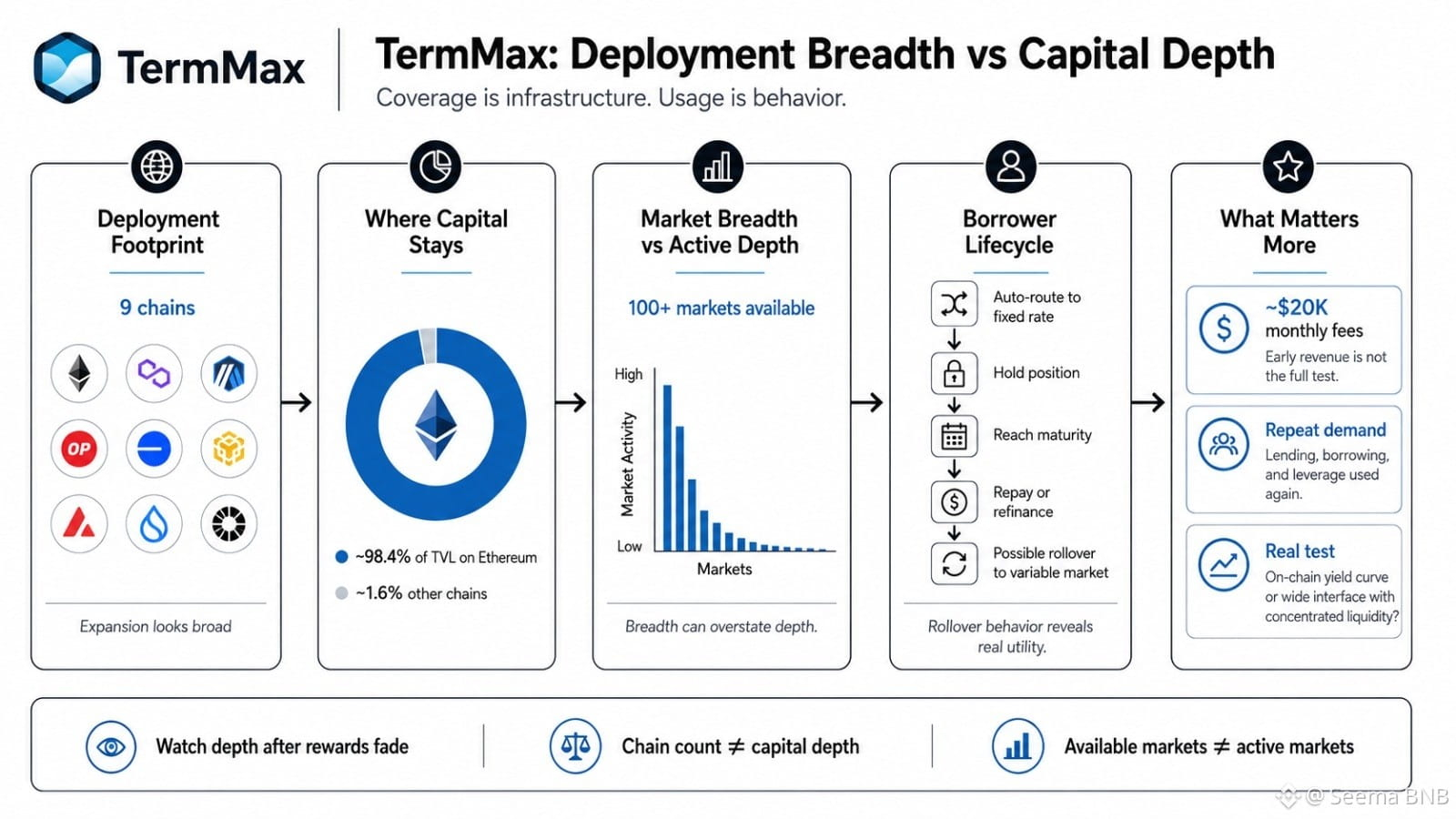
I was looking at TermMax from the chain count first, and the number felt stronger than the usage underneath it.
Nine chains sounds like expansion. But if roughly 98.4% of TVL still sits on Ethereum, the better question is not where TermMax is deployed, but where capital stays. Coverage is infrastructure. Usage is behavior.
The same issue appears inside 100+ markets. How many generate meaningful borrowing volume in 30 days, and how many are just available? A long tail of near-zero activity can make breadth look healthier than depth.
Auto-routing matters because waiting for a fixed-rate order has an opportunity cost. If borrowers can route efficiently, hold the position, then reach maturity and either repay or refinance, the lifecycle becomes measurable. What percentage roll into variable markets instead of repaying? What did that rollover actually save versus the original refinancing alternative?
That is more useful to me than deployment count.
Even roughly $20K in monthly fees is not automatically weak. Early revenue can be modest. I care more about whether it comes from repeat lending, borrowing and leverage demand.
My doubt is simple does TMX eventually build a real on-chain yield curve, or just a wide fixed-income interface with concentrated liquidity?
TermMax still has to prove depth after rewards fade.
#termmax @termmax
I was looking at TermMax from the chain count first, and the number felt stronger than the usage underneath it.
Nine chains sounds like expansion. But if roughly 98.4% of TVL still sits on Ethereum, the better question is not where TermMax is deployed, but where capital stays. Coverage is infrastructure. Usage is behavior.
The same issue appears inside 100+ markets. How many generate meaningful borrowing volume in 30 days, and how many are just available? A long tail of near-zero activity can make breadth look healthier than depth.
Auto-routing matters because waiting for a fixed-rate order has an opportunity cost. If borrowers can route efficiently, hold the position, then reach maturity and either repay or refinance, the lifecycle becomes measurable. What percentage roll into variable markets instead of repaying? What did that rollover actually save versus the original refinancing alternative?
That is more useful to me than deployment count.
Even roughly $20K in monthly fees is not automatically weak. Early revenue can be modest. I care more about whether it comes from repeat lending, borrowing and leverage demand.
My doubt is simple does TMX eventually build a real on-chain yield curve, or just a wide fixed-income interface with concentrated liquidity?
TermMax still has to prove depth after rewards fade.
#termmax @TermMax
Nine chains sounds like expansion. But if roughly 98.4% of TVL still sits on Ethereum, the better question is not where TermMax is deployed, but where capital stays. Coverage is infrastructure. Usage is behavior.
The same issue appears inside 100+ markets. How many generate meaningful borrowing volume in 30 days, and how many are just available? A long tail of near-zero activity can make breadth look healthier than depth.
Auto-routing matters because waiting for a fixed-rate order has an opportunity cost. If borrowers can route efficiently, hold the position, then reach maturity and either repay or refinance, the lifecycle becomes measurable. What percentage roll into variable markets instead of repaying? What did that rollover actually save versus the original refinancing alternative?
That is more useful to me than deployment count.
Even roughly $20K in monthly fees is not automatically weak. Early revenue can be modest. I care more about whether it comes from repeat lending, borrowing and leverage demand.
My doubt is simple does TMX eventually build a real on-chain yield curve, or just a wide fixed-income interface with concentrated liquidity?
TermMax still has to prove depth after rewards fade.
#termmax @TermMax
7
10
9.4k
·
--
I spent more time examining DUSK’s privacy model at DUSK’s privacy model and the bridge response changed my view more than the cryptography did.
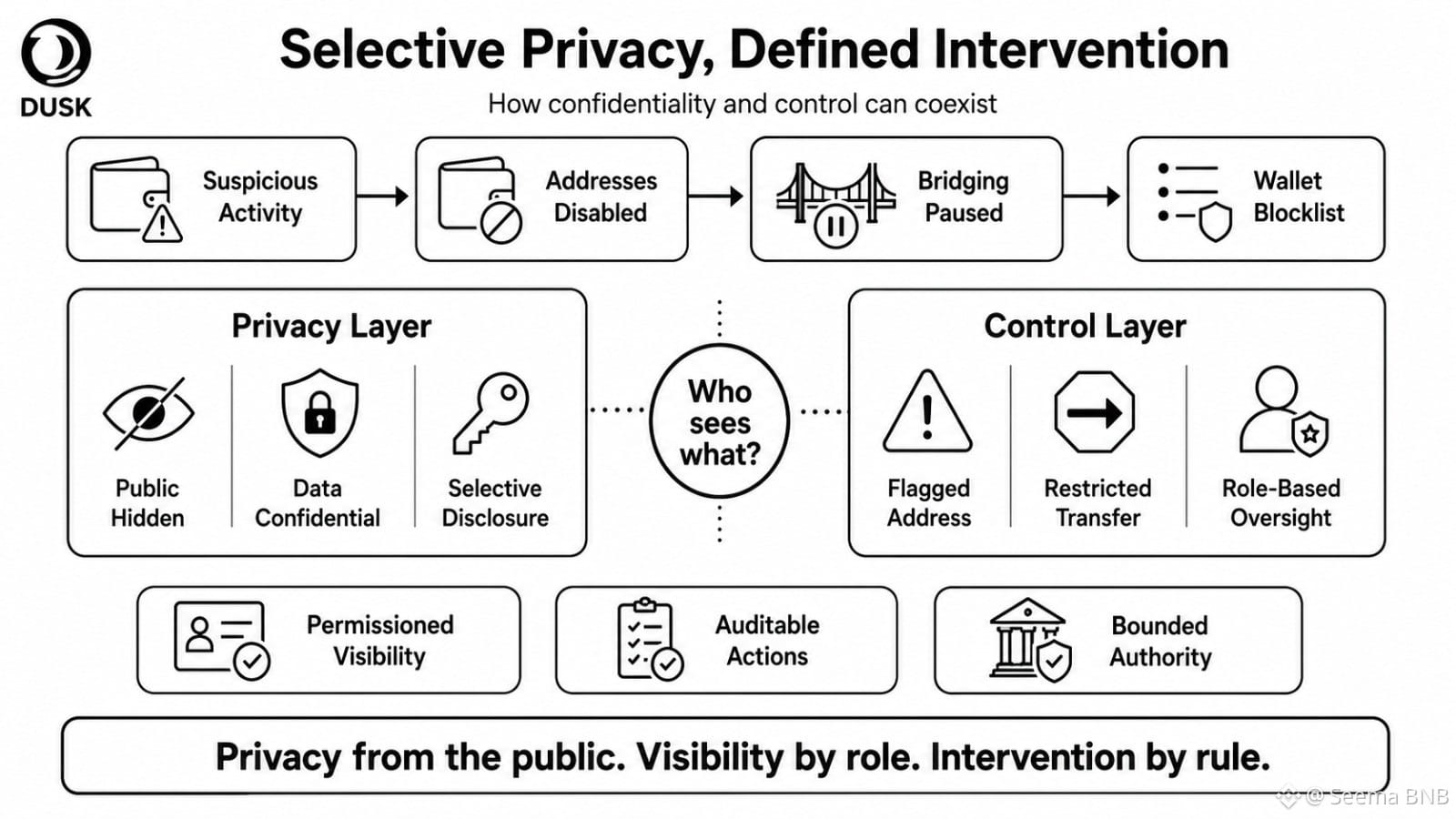
The obvious claim is “confidential transactions.” That is not the interesting part. What matters is what happens when something goes wrong.
Suspicious wallet activity was detected, bridge addresses were disabled, bridging was paused, and a Web Wallet blocklist was introduced. That does not make DUSK less private by itself. But it does expose the real design question: privacy from whom, and control for whom?
For regulated finance, absolute anonymity may actually be the weaker model. Institutions need confidentiality from the public, while auditors, venues or supervisors may still need defined visibility. Privacy by default, visibility by permission sounds practical.
But permission is where governance pressure starts.
If one authorized party can see 80% of a private workflow, how private is it operationally? If a flagged address can be restricted, who decides the flag, how quickly, and what appeal exists?
DUSK may succeed if selective disclosure stays narrow, auditable and role-bound.
I am less interested in whether DUSK can hide data now. I want to know whether it can control visibility without quietly centralizing intervention power.
#dusk $DUSK @Dusk_Foundation
I spent more time examining DUSK’s privacy model at DUSK’s privacy model and the bridge response changed my view more than the cryptography did.
The obvious claim is “confidential transactions.” That is not the interesting part. What matters is what happens when something goes wrong.
Suspicious wallet activity was detected, bridge addresses were disabled, bridging was paused, and a Web Wallet blocklist was introduced. That does not make DUSK less private by itself. But it does expose the real design question: privacy from whom, and control for whom?
For regulated finance, absolute anonymity may actually be the weaker model. Institutions need confidentiality from the public, while auditors, venues or supervisors may still need defined visibility. Privacy by default, visibility by permission sounds practical.
But permission is where governance pressure starts.
If one authorized party can see 80% of a private workflow, how private is it operationally? If a flagged address can be restricted, who decides the flag, how quickly, and what appeal exists?
DUSK may succeed if selective disclosure stays narrow, auditable and role-bound.
I am less interested in whether DUSK can hide data now. I want to know whether it can control visibility without quietly centralizing intervention power.
#dusk $DUSK @Dusk
The obvious claim is “confidential transactions.” That is not the interesting part. What matters is what happens when something goes wrong.
Suspicious wallet activity was detected, bridge addresses were disabled, bridging was paused, and a Web Wallet blocklist was introduced. That does not make DUSK less private by itself. But it does expose the real design question: privacy from whom, and control for whom?
For regulated finance, absolute anonymity may actually be the weaker model. Institutions need confidentiality from the public, while auditors, venues or supervisors may still need defined visibility. Privacy by default, visibility by permission sounds practical.
But permission is where governance pressure starts.
If one authorized party can see 80% of a private workflow, how private is it operationally? If a flagged address can be restricted, who decides the flag, how quickly, and what appeal exists?
DUSK may succeed if selective disclosure stays narrow, auditable and role-bound.
I am less interested in whether DUSK can hide data now. I want to know whether it can control visibility without quietly centralizing intervention power.
#dusk $DUSK @Dusk
20
18
348
·
--
Verified
I ceased counting DUSK provisioners when I noticed the number itself was telling me very little.
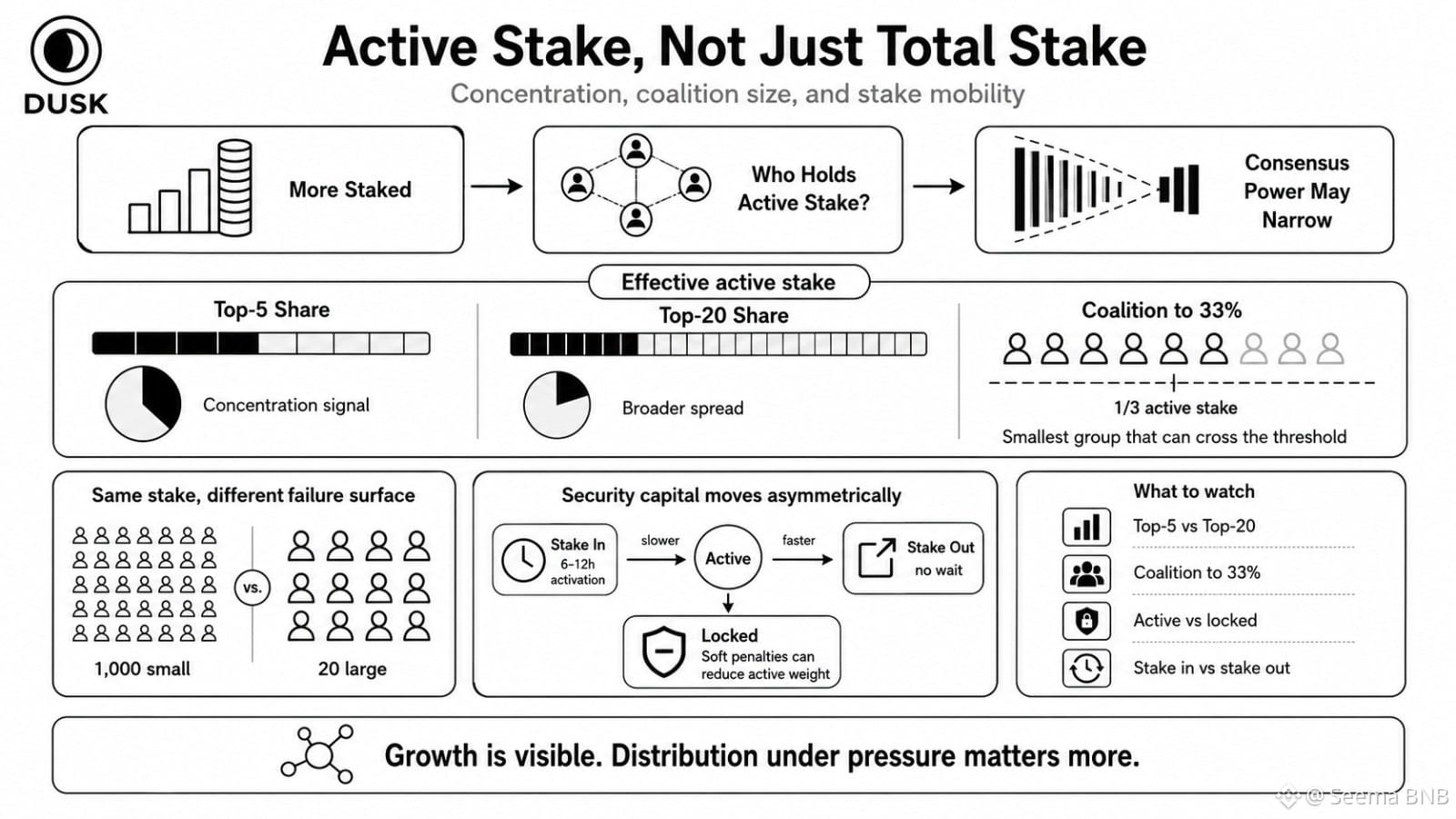
A network can add stake and still become more concentrated. If the top five provisioners absorb most new active weight, more staked looks healthy while consensus power quietly narrows.
That is the DUSK metric I want now top-5 share versus top-20 share, then the smallest coalition needed to cross one-third of active stake. Not wallet balances. Effective active stake.
The uncomfortable part is mobility. DUSK stake normally takes roughly 6–12 hours to become active, while unstaking has no protocol waiting period. So under stress, security capital can leave faster than replacement stake can enter. Soft penalties can also move stake from active to locked, reducing consensus weight even when tokens still appear staked.
1,000 small provisioners and 20 large ones can secure the same nominal amount. They do not create the same failure surface.
How many independent operators actually reach one-third? How many reach majority weight during emergency recovery?
Growth is easy to display. Distribution under pressure is harder.
I’m watching whether DUSK decentralization survives when active stake starts moving, not when the staking total goes up.
#dusk $DUSK @Dusk_Foundation
I ceased counting DUSK provisioners when I noticed the number itself was telling me very little.
A network can add stake and still become more concentrated. If the top five provisioners absorb most new active weight, more staked looks healthy while consensus power quietly narrows.
That is the DUSK metric I want now top-5 share versus top-20 share, then the smallest coalition needed to cross one-third of active stake. Not wallet balances. Effective active stake.
The uncomfortable part is mobility. DUSK stake normally takes roughly 6–12 hours to become active, while unstaking has no protocol waiting period. So under stress, security capital can leave faster than replacement stake can enter. Soft penalties can also move stake from active to locked, reducing consensus weight even when tokens still appear staked.
1,000 small provisioners and 20 large ones can secure the same nominal amount. They do not create the same failure surface.
How many independent operators actually reach one-third? How many reach majority weight during emergency recovery?
Growth is easy to display. Distribution under pressure is harder.
I’m watching whether DUSK decentralization survives when active stake starts moving, not when the staking total goes up.
#dusk $DUSK @Dusk
A network can add stake and still become more concentrated. If the top five provisioners absorb most new active weight, more staked looks healthy while consensus power quietly narrows.
That is the DUSK metric I want now top-5 share versus top-20 share, then the smallest coalition needed to cross one-third of active stake. Not wallet balances. Effective active stake.
The uncomfortable part is mobility. DUSK stake normally takes roughly 6–12 hours to become active, while unstaking has no protocol waiting period. So under stress, security capital can leave faster than replacement stake can enter. Soft penalties can also move stake from active to locked, reducing consensus weight even when tokens still appear staked.
1,000 small provisioners and 20 large ones can secure the same nominal amount. They do not create the same failure surface.
How many independent operators actually reach one-third? How many reach majority weight during emergency recovery?
Growth is easy to display. Distribution under pressure is harder.
I’m watching whether DUSK decentralization survives when active stake starts moving, not when the staking total goes up.
#dusk $DUSK @Dusk
46
35
4.6k
·
--
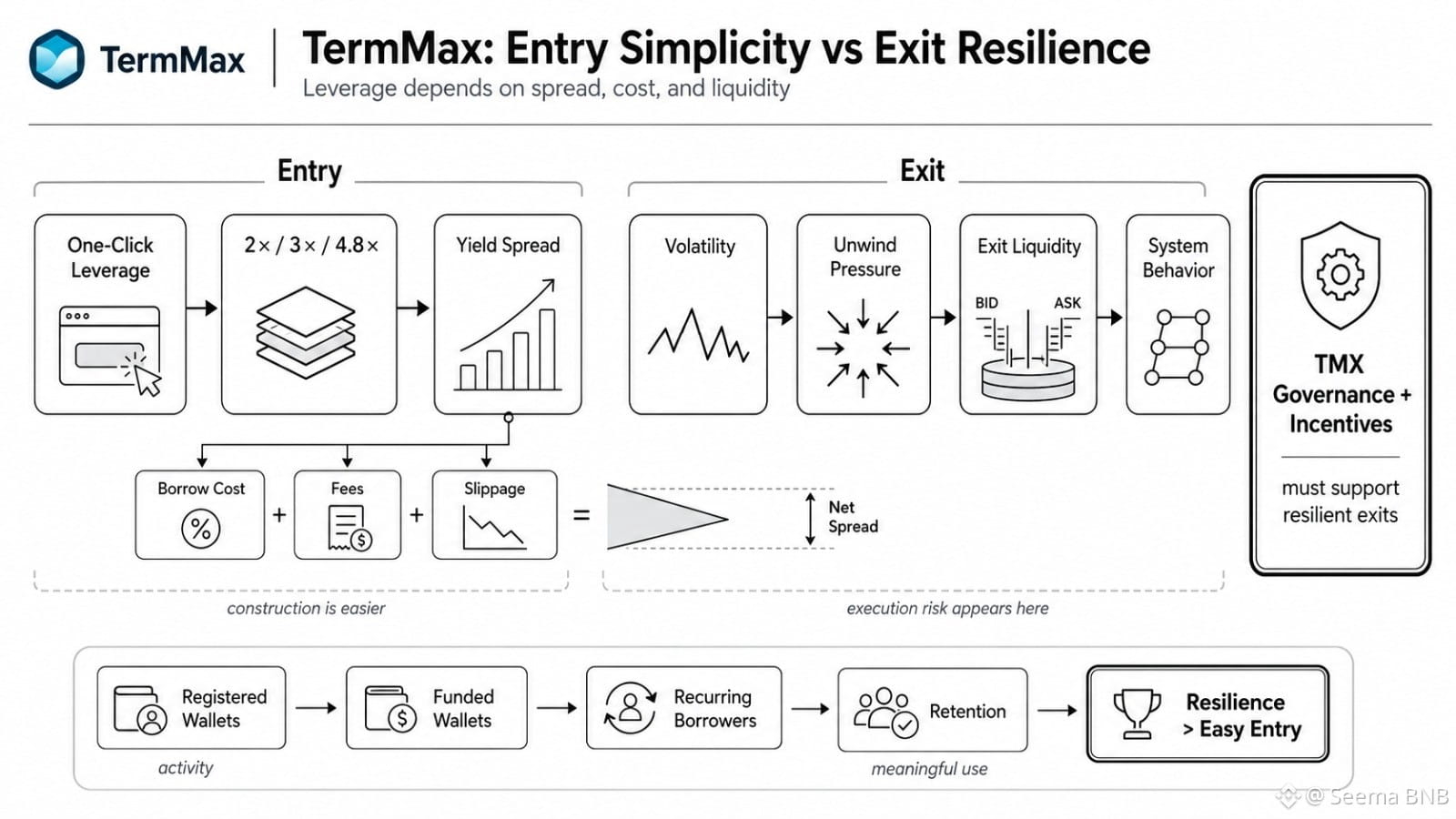
I moved away from TermMax leverage on the entry screen once I noticed something uncomfortable 2×, 3× and 4.8× all look clean before borrowing cost starts eating the spread.
That is the surface trick. One-click DeFi leverage makes construction simpler, not the position safer.
With PT or other yield-bearing collateral, the real bet is not just more exposure. It is whether the extra yield created by leverage stays above borrowing cost after slippage, fees and liquidity pressure. At 2×, a thin spread may survive. At 4.8×, even a small funding mismatch gets amplified fast.
And entry is probably the easy side.
What happens when volatility hits and many TermMax users try to unwind together? Flash-loan atomicity can compress several steps into one transaction, but it cannot manufacture exit liquidity. That is where execution risk turns into system behavior.
The same distinction matters for adoption. Registered wallets are activity. Funded wallets, recurring borrowers and post-incentive retention are meaningful DeFi use.
I like the capital-efficiency idea behind TermMax, but I keep watching the exit path. If leverage works only when liquidity is calm, then TMX governance and incentives eventually have to prove they support resilience, not just easier entry.
#termmax @termmax
I moved away from TermMax leverage on the entry screen once I noticed something uncomfortable 2×, 3× and 4.8× all look clean before borrowing cost starts eating the spread.
That is the surface trick. One-click DeFi leverage makes construction simpler, not the position safer.
With PT or other yield-bearing collateral, the real bet is not just more exposure. It is whether the extra yield created by leverage stays above borrowing cost after slippage, fees and liquidity pressure. At 2×, a thin spread may survive. At 4.8×, even a small funding mismatch gets amplified fast.
And entry is probably the easy side.
What happens when volatility hits and many TermMax users try to unwind together? Flash-loan atomicity can compress several steps into one transaction, but it cannot manufacture exit liquidity. That is where execution risk turns into system behavior.
The same distinction matters for adoption. Registered wallets are activity. Funded wallets, recurring borrowers and post-incentive retention are meaningful DeFi use.
I like the capital-efficiency idea behind TermMax, but I keep watching the exit path. If leverage works only when liquidity is calm, then TMX governance and incentives eventually have to prove they support resilience, not just easier entry.
#termmax @TermMax
That is the surface trick. One-click DeFi leverage makes construction simpler, not the position safer.
With PT or other yield-bearing collateral, the real bet is not just more exposure. It is whether the extra yield created by leverage stays above borrowing cost after slippage, fees and liquidity pressure. At 2×, a thin spread may survive. At 4.8×, even a small funding mismatch gets amplified fast.
And entry is probably the easy side.
What happens when volatility hits and many TermMax users try to unwind together? Flash-loan atomicity can compress several steps into one transaction, but it cannot manufacture exit liquidity. That is where execution risk turns into system behavior.
The same distinction matters for adoption. Registered wallets are activity. Funded wallets, recurring borrowers and post-incentive retention are meaningful DeFi use.
I like the capital-efficiency idea behind TermMax, but I keep watching the exit path. If leverage works only when liquidity is calm, then TMX governance and incentives eventually have to prove they support resilience, not just easier entry.
#termmax @TermMax
44
33
4.6k
·
--
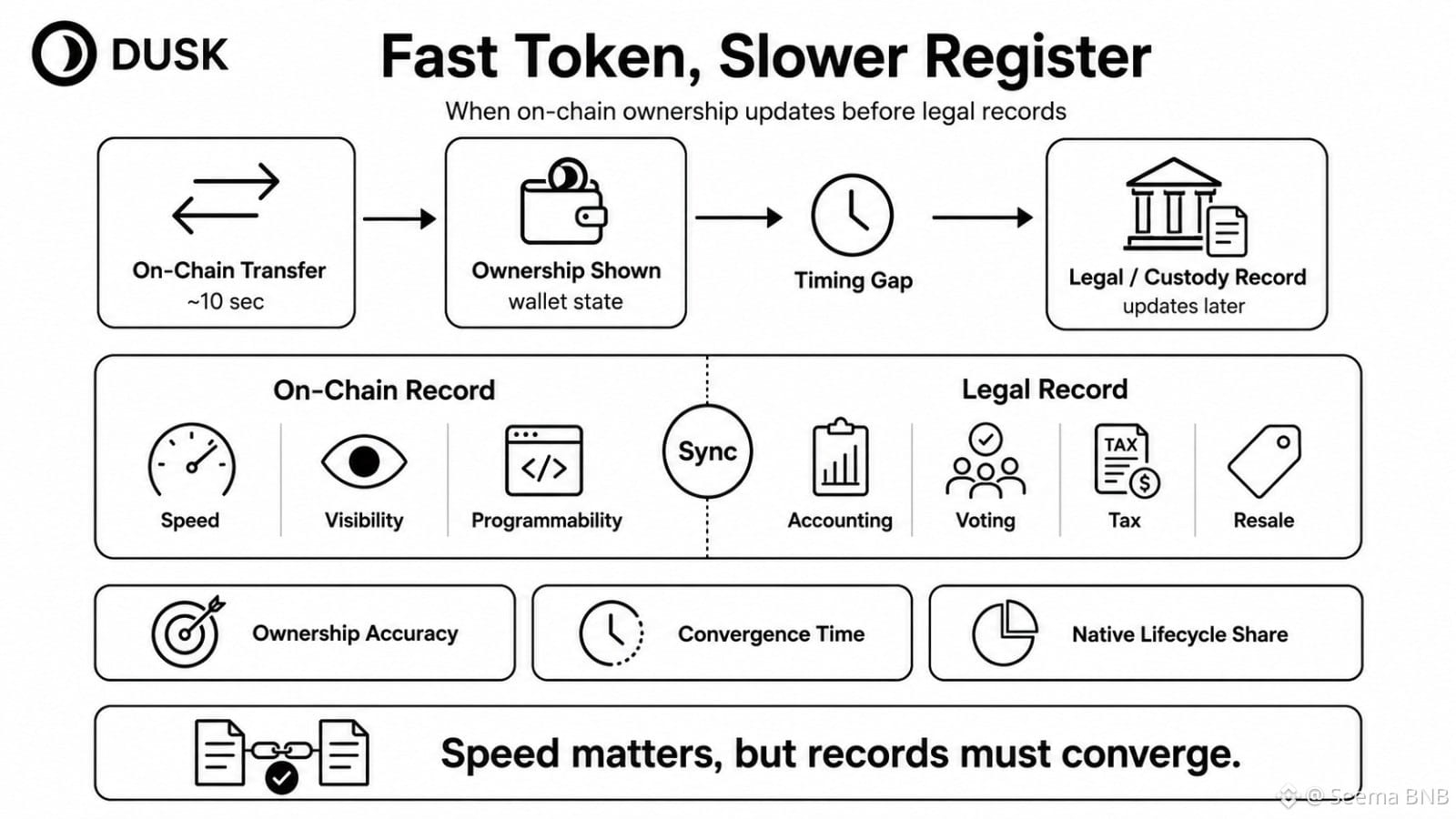
The part that bothers me most about DUSK is not whether a token can move fast. It is what happens when the token moves in 10 seconds and the legal register catches up tomorrow.
The obvious metric is settlement speed. I think that is incomplete.
If DUSK shows ownership on-chain at 23:59, but the custody or legal record updates at 00:01, which record controls accounting, voting, tax, or resale during that gap? Thirty minutes of disagreement may sound small. In regulated assets, small timing gaps create real exceptions.
That is why I would track something harder: on-chain ownership accuracy versus legal ownership accuracy, plus the share of lifecycle steps that are actually blockchain-native.
Minting can be instant while 90% of structuring happens before the first block. A 60% on-chain approval also does not mean every corporate action executes automatically. Some weakness here is normal; law will not disappear because settlement improves.
The real test for DUSK is reconciliation discipline. How quickly do both records converge, and who resolves conflicts?
My doubt is that faster tokens matter, but if legal truth still moves slower, then RWA speed is only partly on-chain.
#dusk $DUSK @Dusk_Foundation
The part that bothers me most about DUSK is not whether a token can move fast. It is what happens when the token moves in 10 seconds and the legal register catches up tomorrow.
The obvious metric is settlement speed. I think that is incomplete.
If DUSK shows ownership on-chain at 23:59, but the custody or legal record updates at 00:01, which record controls accounting, voting, tax, or resale during that gap? Thirty minutes of disagreement may sound small. In regulated assets, small timing gaps create real exceptions.
That is why I would track something harder: on-chain ownership accuracy versus legal ownership accuracy, plus the share of lifecycle steps that are actually blockchain-native.
Minting can be instant while 90% of structuring happens before the first block. A 60% on-chain approval also does not mean every corporate action executes automatically. Some weakness here is normal; law will not disappear because settlement improves.
The real test for DUSK is reconciliation discipline. How quickly do both records converge, and who resolves conflicts?
My doubt is that faster tokens matter, but if legal truth still moves slower, then RWA speed is only partly on-chain.
#dusk $DUSK @Dusk
The obvious metric is settlement speed. I think that is incomplete.
If DUSK shows ownership on-chain at 23:59, but the custody or legal record updates at 00:01, which record controls accounting, voting, tax, or resale during that gap? Thirty minutes of disagreement may sound small. In regulated assets, small timing gaps create real exceptions.
That is why I would track something harder: on-chain ownership accuracy versus legal ownership accuracy, plus the share of lifecycle steps that are actually blockchain-native.
Minting can be instant while 90% of structuring happens before the first block. A 60% on-chain approval also does not mean every corporate action executes automatically. Some weakness here is normal; law will not disappear because settlement improves.
The real test for DUSK is reconciliation discipline. How quickly do both records converge, and who resolves conflicts?
My doubt is that faster tokens matter, but if legal truth still moves slower, then RWA speed is only partly on-chain.
#dusk $DUSK @Dusk
21
17
3.5k
·
--
One thing I keep noticing is TermMax behavior that looks more useful than raw wallet growth what happens after a lender gets paid back and has to decide where that capital goes next.
The obvious metric is new users. I think that is too shallow.
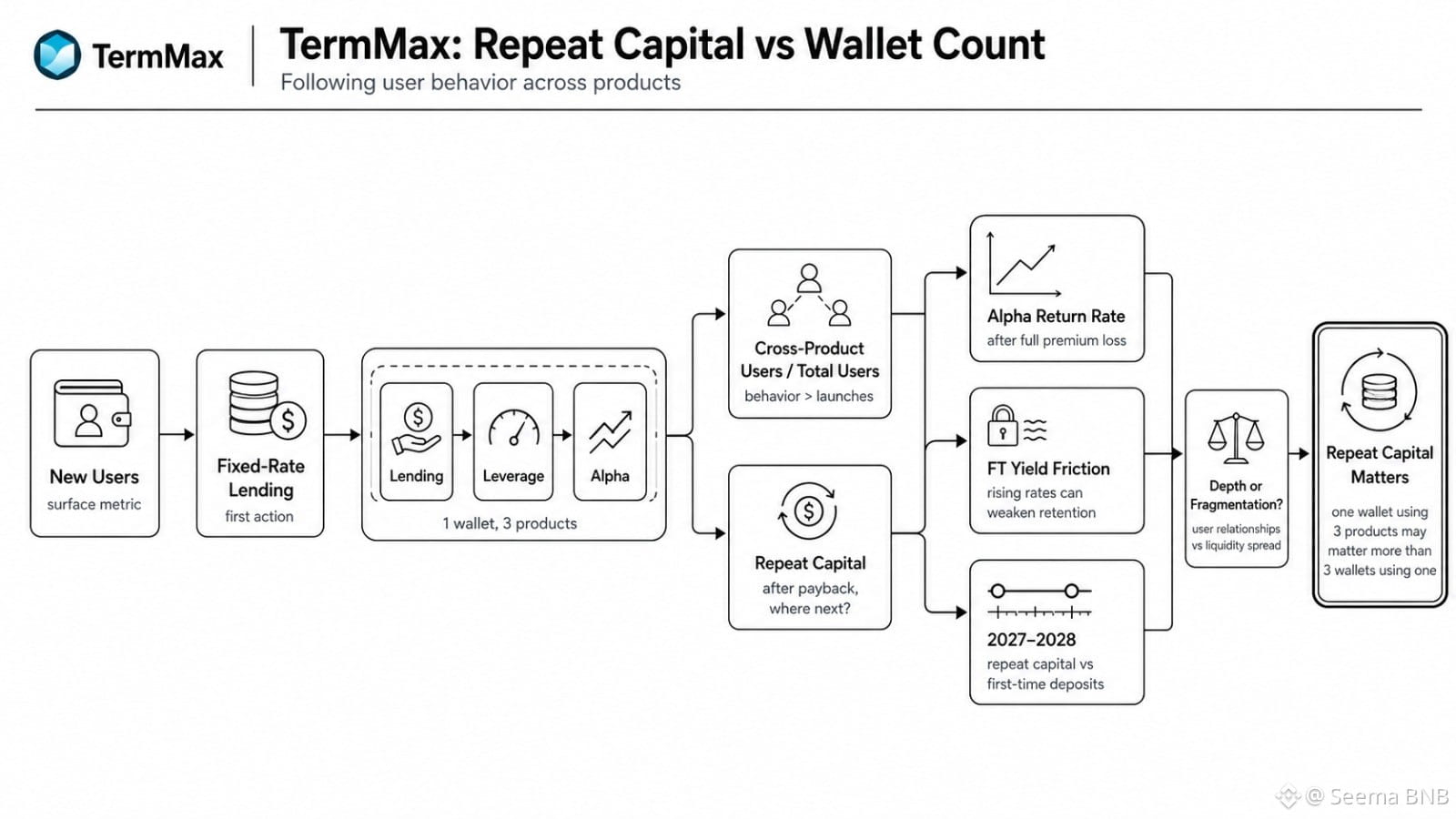
If a wallet starts with fixed-rate Lending, later uses Leverage then tries Alpha TermMax has not just added activity. It has converted trust in one product into willingness to take a second risk. That is harder.
What I want to see is the path after the first action. How many Lending users enter Alpha? How many Alpha users return after losing the full premium? Does repeat capital grow faster than first-time deposits in 2027 and 2028?
Some churn is normal. Options will naturally retain a different user profile than fixed-rate lending, and rising market rates can make locked FT yields feel less attractive.
The uncomfortable question is whether product expansion deepens user relationships or spreads liquidity across too many surfaces.
For TMX one wallet using three products may matter more than three wallets touching one product once.
I am watching repeat capital not just wallet count.
#termmax @termmax
One thing I keep noticing is TermMax behavior that looks more useful than raw wallet growth what happens after a lender gets paid back and has to decide where that capital goes next.
The obvious metric is new users. I think that is too shallow.
If a wallet starts with fixed-rate Lending, later uses Leverage then tries Alpha TermMax has not just added activity. It has converted trust in one product into willingness to take a second risk. That is harder.
What I want to see is the path after the first action. How many Lending users enter Alpha? How many Alpha users return after losing the full premium? Does repeat capital grow faster than first-time deposits in 2027 and 2028?
Some churn is normal. Options will naturally retain a different user profile than fixed-rate lending, and rising market rates can make locked FT yields feel less attractive.
The uncomfortable question is whether product expansion deepens user relationships or spreads liquidity across too many surfaces.
For TMX one wallet using three products may matter more than three wallets touching one product once.
I am watching repeat capital not just wallet count.
#termmax @TermMax
The obvious metric is new users. I think that is too shallow.
If a wallet starts with fixed-rate Lending, later uses Leverage then tries Alpha TermMax has not just added activity. It has converted trust in one product into willingness to take a second risk. That is harder.
What I want to see is the path after the first action. How many Lending users enter Alpha? How many Alpha users return after losing the full premium? Does repeat capital grow faster than first-time deposits in 2027 and 2028?
Some churn is normal. Options will naturally retain a different user profile than fixed-rate lending, and rising market rates can make locked FT yields feel less attractive.
The uncomfortable question is whether product expansion deepens user relationships or spreads liquidity across too many surfaces.
For TMX one wallet using three products may matter more than three wallets touching one product once.
I am watching repeat capital not just wallet count.
#termmax @TermMax
39
24
6.5k
·
--
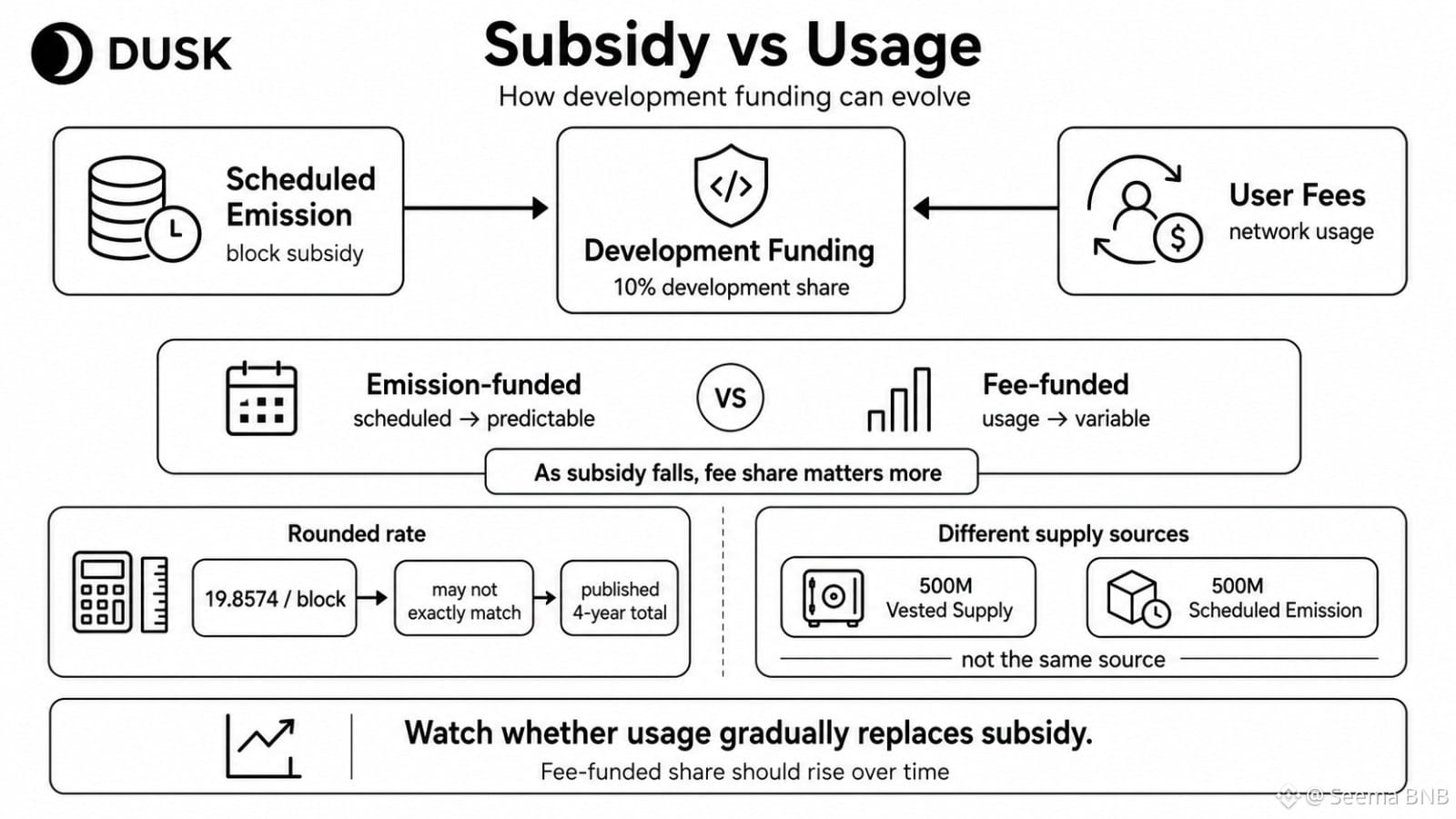
I was watching to a single DUSK detail that looks small on paper user fees do not just pay for network activity, part of that flow also feeds the 10% development share.
At first I treated block emission as the obvious metric. That is too shallow.
DUSK can fund development from two behaviors: scheduled issuance and actual usage. One is subsidy. The other is users creating enough economic activity to help fund the system themselves.
That is the real test for me. As emission falls, does fee-funded development become a larger share of total development revenue? Does fee revenue per DUSK emitted rise because settlement activity is genuinely growing, or simply because subsidy is shrinking?
The 19.8574 DUSK block figure also looks cleaner than the underlying schedule probably is. If multiplying that rounded rate does not exactly reproduce the published four-year total, that is not a scandal. Still, precision matters when people model supply.
There is another split people miss 500M vested supply and 500M scheduled emission are completely different sources of DUSK.
What I am watching now is whether usage gradually replaces subsidy. If it does not, development funding stays more dependent on issuance than the surface story suggests.
@Dusk_Foundation #dusk $DUSK #dusk $DUSK @Dusk_Foundation
I was watching to a single DUSK detail that looks small on paper user fees do not just pay for network activity, part of that flow also feeds the 10% development share.
At first I treated block emission as the obvious metric. That is too shallow.
DUSK can fund development from two behaviors: scheduled issuance and actual usage. One is subsidy. The other is users creating enough economic activity to help fund the system themselves.
That is the real test for me. As emission falls, does fee-funded development become a larger share of total development revenue? Does fee revenue per DUSK emitted rise because settlement activity is genuinely growing, or simply because subsidy is shrinking?
The 19.8574 DUSK block figure also looks cleaner than the underlying schedule probably is. If multiplying that rounded rate does not exactly reproduce the published four-year total, that is not a scandal. Still, precision matters when people model supply.
There is another split people miss 500M vested supply and 500M scheduled emission are completely different sources of DUSK.
What I am watching now is whether usage gradually replaces subsidy. If it does not, development funding stays more dependent on issuance than the surface story suggests.
@Dusk #dusk $DUSK #dusk $DUSK @Dusk
At first I treated block emission as the obvious metric. That is too shallow.
DUSK can fund development from two behaviors: scheduled issuance and actual usage. One is subsidy. The other is users creating enough economic activity to help fund the system themselves.
That is the real test for me. As emission falls, does fee-funded development become a larger share of total development revenue? Does fee revenue per DUSK emitted rise because settlement activity is genuinely growing, or simply because subsidy is shrinking?
The 19.8574 DUSK block figure also looks cleaner than the underlying schedule probably is. If multiplying that rounded rate does not exactly reproduce the published four-year total, that is not a scandal. Still, precision matters when people model supply.
There is another split people miss 500M vested supply and 500M scheduled emission are completely different sources of DUSK.
What I am watching now is whether usage gradually replaces subsidy. If it does not, development funding stays more dependent on issuance than the surface story suggests.
@Dusk #dusk $DUSK #dusk $DUSK @Dusk
44
30
5k
·
--
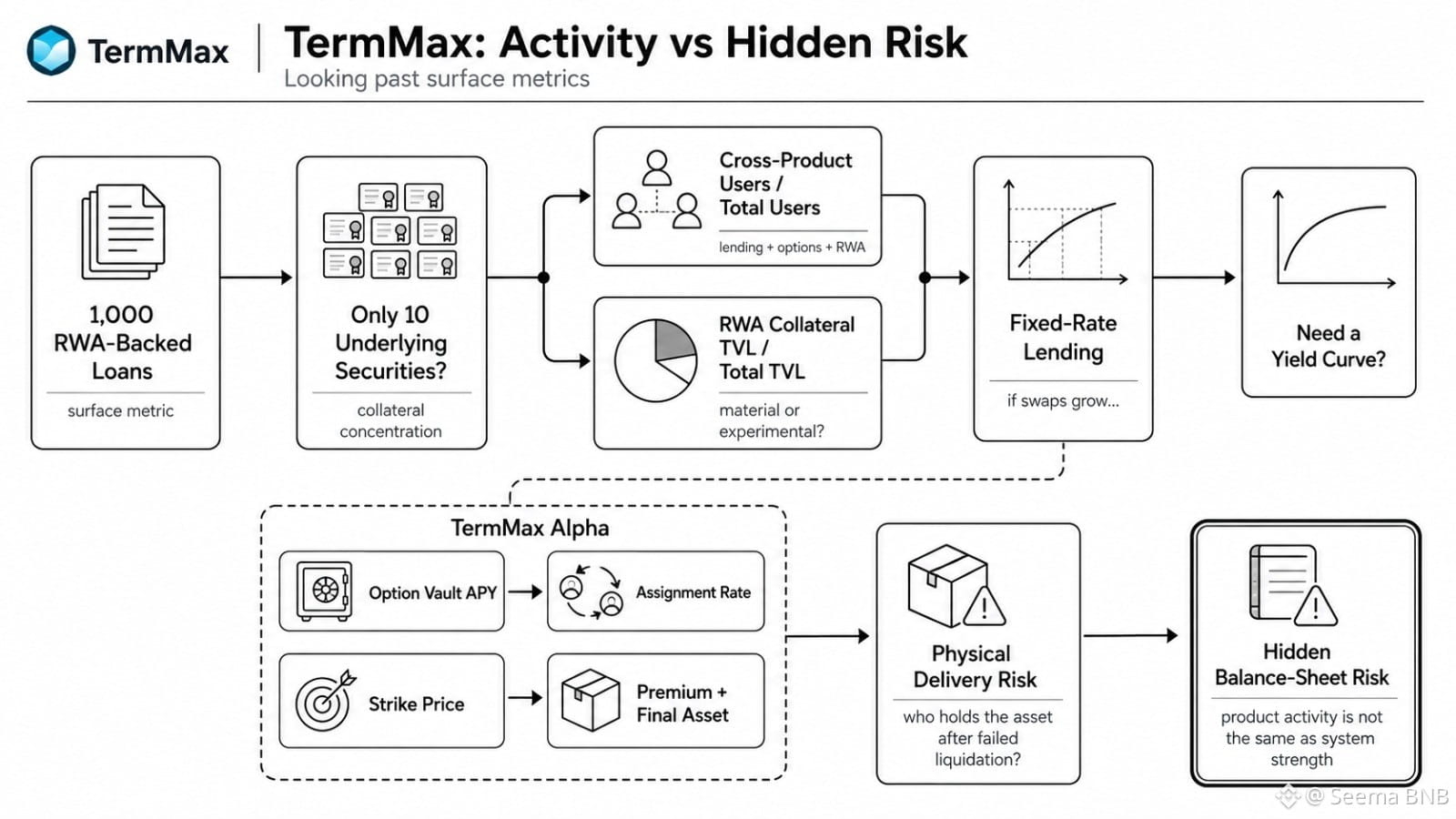
I find myself returning to a troubling TermMax number in my notes 1,000 RWA-backed loans would still tell me very little if they all depended on just 10 underlying securities.
The obvious metric is loan count. I think that is weak. What matters is how concentrated the collateral really is, and whether users are actually moving across lending, options and RWA products instead of touching each product once.
That is where TermMax gets harder to judge. RWA collateral TVL can rise, but does it become material versus total TVL? Do cross-product users grow? Does fixed-rate lending eventually need something closer to a yield curve, especially if interest-rate swaps become part of the system?
TermMax Alpha has the same issue. A high option-vault APY looks clean until assignment changes the depositor’s asset. Strike price affects premium, yes, but also what you may end up holding.
Some assignment is normal. The real test is frequency, drawdown after delivery, and whether physical settlement leaves users with assets they actually wanted.
I am still watching one thing does TermMax measure product activity, or the hidden balance-sheet risk created when those products overlap?
#termmax @termmax
I find myself returning to a troubling TermMax number in my notes 1,000 RWA-backed loans would still tell me very little if they all depended on just 10 underlying securities.
The obvious metric is loan count. I think that is weak. What matters is how concentrated the collateral really is, and whether users are actually moving across lending, options and RWA products instead of touching each product once.
That is where TermMax gets harder to judge. RWA collateral TVL can rise, but does it become material versus total TVL? Do cross-product users grow? Does fixed-rate lending eventually need something closer to a yield curve, especially if interest-rate swaps become part of the system?
TermMax Alpha has the same issue. A high option-vault APY looks clean until assignment changes the depositor’s asset. Strike price affects premium, yes, but also what you may end up holding.
Some assignment is normal. The real test is frequency, drawdown after delivery, and whether physical settlement leaves users with assets they actually wanted.
I am still watching one thing does TermMax measure product activity, or the hidden balance-sheet risk created when those products overlap?
#termmax @TermMax
The obvious metric is loan count. I think that is weak. What matters is how concentrated the collateral really is, and whether users are actually moving across lending, options and RWA products instead of touching each product once.
That is where TermMax gets harder to judge. RWA collateral TVL can rise, but does it become material versus total TVL? Do cross-product users grow? Does fixed-rate lending eventually need something closer to a yield curve, especially if interest-rate swaps become part of the system?
TermMax Alpha has the same issue. A high option-vault APY looks clean until assignment changes the depositor’s asset. Strike price affects premium, yes, but also what you may end up holding.
Some assignment is normal. The real test is frequency, drawdown after delivery, and whether physical settlement leaves users with assets they actually wanted.
I am still watching one thing does TermMax measure product activity, or the hidden balance-sheet risk created when those products overlap?
#termmax @TermMax
31
21
8.6k
·
--
Verified
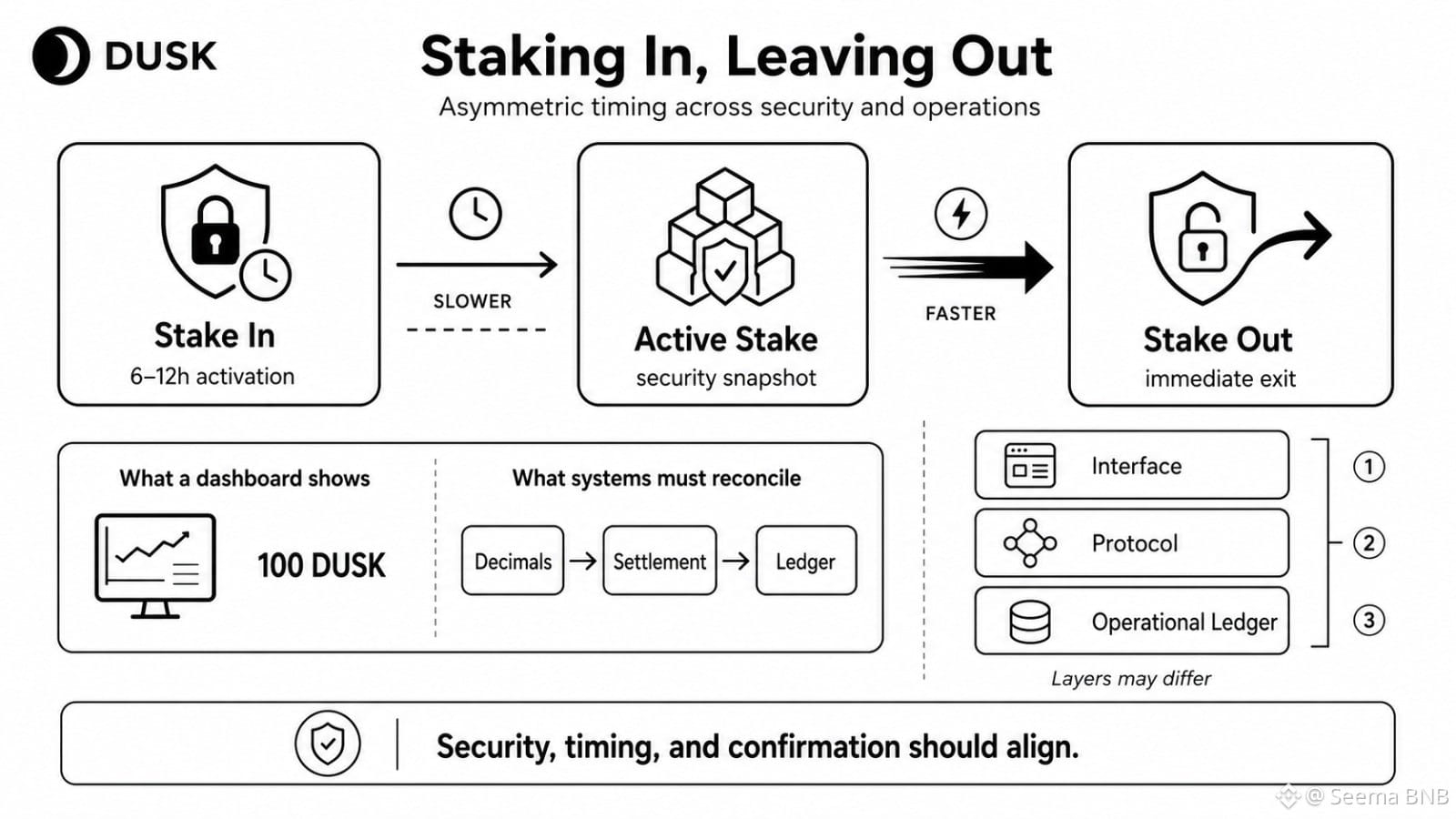
I kept returning to one awkward DUSK detail staking capital can take hours to enter, yet it can leave without the same protocol waiting period.
The obvious metric is active stake. I think that is too shallow. What matters is how quickly security can disappear compared with how quickly it can rebuild.
That asymmetry changes behavior. If confidence drops, outflow can be immediate while replacement stake is still waiting 6–12 hours to activate. Some weakness here is normal; systems need operational windows. But the real test is whether DUSK can absorb sudden exits without turning a temporary mood shift into a security concentration problem.
The same pattern appears elsewhere. A dashboard can show 100 DUSK correctly while the underlying decimal mapping is wrong. A transaction can be included quickly while DuskDS settlement is not yet what an exchange should call confirmed.
So which layer is the truth: interface, protocol, or operational ledger?
DUSK does not fail because these layers differ. It fails if users assume they are identical.
I am watching whether the network standardizes not just cryptography, but timing, accounting and confirmation semantics around it.
@Dusk_Foundation #dusk $DUSK
I kept returning to one awkward DUSK detail staking capital can take hours to enter, yet it can leave without the same protocol waiting period.
The obvious metric is active stake. I think that is too shallow. What matters is how quickly security can disappear compared with how quickly it can rebuild.
That asymmetry changes behavior. If confidence drops, outflow can be immediate while replacement stake is still waiting 6–12 hours to activate. Some weakness here is normal; systems need operational windows. But the real test is whether DUSK can absorb sudden exits without turning a temporary mood shift into a security concentration problem.
The same pattern appears elsewhere. A dashboard can show 100 DUSK correctly while the underlying decimal mapping is wrong. A transaction can be included quickly while DuskDS settlement is not yet what an exchange should call confirmed.
So which layer is the truth: interface, protocol, or operational ledger?
DUSK does not fail because these layers differ. It fails if users assume they are identical.
I am watching whether the network standardizes not just cryptography, but timing, accounting and confirmation semantics around it.
@Dusk #dusk $DUSK
The obvious metric is active stake. I think that is too shallow. What matters is how quickly security can disappear compared with how quickly it can rebuild.
That asymmetry changes behavior. If confidence drops, outflow can be immediate while replacement stake is still waiting 6–12 hours to activate. Some weakness here is normal; systems need operational windows. But the real test is whether DUSK can absorb sudden exits without turning a temporary mood shift into a security concentration problem.
The same pattern appears elsewhere. A dashboard can show 100 DUSK correctly while the underlying decimal mapping is wrong. A transaction can be included quickly while DuskDS settlement is not yet what an exchange should call confirmed.
So which layer is the truth: interface, protocol, or operational ledger?
DUSK does not fail because these layers differ. It fails if users assume they are identical.
I am watching whether the network standardizes not just cryptography, but timing, accounting and confirmation semantics around it.
@Dusk #dusk $DUSK
30
18
6k
·
--
Verified
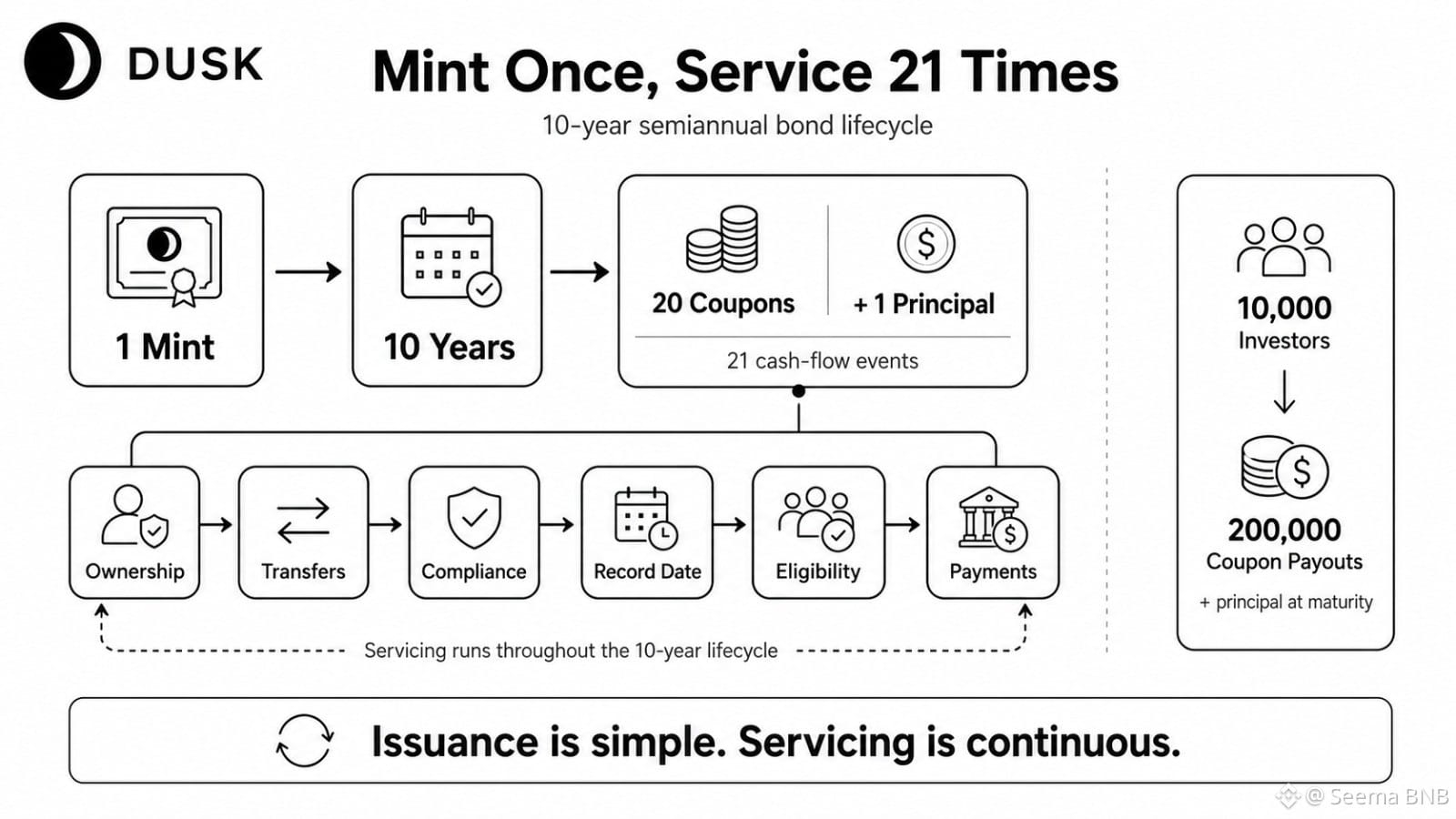
My initial view was at a tokenized bond on DUSK as a minting problem. That now feels like the least interesting part.
A 10-year bond with semiannual coupons is minted once, but it creates 20 coupon events plus one principal redemption. Twenty-one major cash-flow checkpoints across 120 months.
The hidden problem is ownership between those dates. Who holds the token at each record point? What happens after transfers, wallet changes, compliance updates, or restricted ownership? A contract can survive for a decade, but servicing has to stay correct every time.
Some complexity is normal. Traditional bonds already have registrars, payment agents and reconciliation. Moving that state on-chain does not remove the lifecycle, it makes the lifecycle visible.
That is the real test for DUSK. Not issuance vs adoption, but issuance vs persistent servicing discipline.
If 10,000 investors are involved, 20 coupon rounds can become 200,000 investor-level distributions before principal is even repaid. Can DUSK keep ownership, eligibility and payment state synchronized without creating new operational friction?
I keep coming back to this tokenization succeeds only if the twentieth coupon is as reliable as the first mint.
@Dusk_Foundation #dusk $DUSK
My initial view was at a tokenized bond on DUSK as a minting problem. That now feels like the least interesting part.
A 10-year bond with semiannual coupons is minted once, but it creates 20 coupon events plus one principal redemption. Twenty-one major cash-flow checkpoints across 120 months.
The hidden problem is ownership between those dates. Who holds the token at each record point? What happens after transfers, wallet changes, compliance updates, or restricted ownership? A contract can survive for a decade, but servicing has to stay correct every time.
Some complexity is normal. Traditional bonds already have registrars, payment agents and reconciliation. Moving that state on-chain does not remove the lifecycle, it makes the lifecycle visible.
That is the real test for DUSK. Not issuance vs adoption, but issuance vs persistent servicing discipline.
If 10,000 investors are involved, 20 coupon rounds can become 200,000 investor-level distributions before principal is even repaid. Can DUSK keep ownership, eligibility and payment state synchronized without creating new operational friction?
I keep coming back to this tokenization succeeds only if the twentieth coupon is as reliable as the first mint.
@Dusk #dusk $DUSK
A 10-year bond with semiannual coupons is minted once, but it creates 20 coupon events plus one principal redemption. Twenty-one major cash-flow checkpoints across 120 months.
The hidden problem is ownership between those dates. Who holds the token at each record point? What happens after transfers, wallet changes, compliance updates, or restricted ownership? A contract can survive for a decade, but servicing has to stay correct every time.
Some complexity is normal. Traditional bonds already have registrars, payment agents and reconciliation. Moving that state on-chain does not remove the lifecycle, it makes the lifecycle visible.
That is the real test for DUSK. Not issuance vs adoption, but issuance vs persistent servicing discipline.
If 10,000 investors are involved, 20 coupon rounds can become 200,000 investor-level distributions before principal is even repaid. Can DUSK keep ownership, eligibility and payment state synchronized without creating new operational friction?
I keep coming back to this tokenization succeeds only if the twentieth coupon is as reliable as the first mint.
@Dusk #dusk $DUSK
44
31
11.8k
·
--
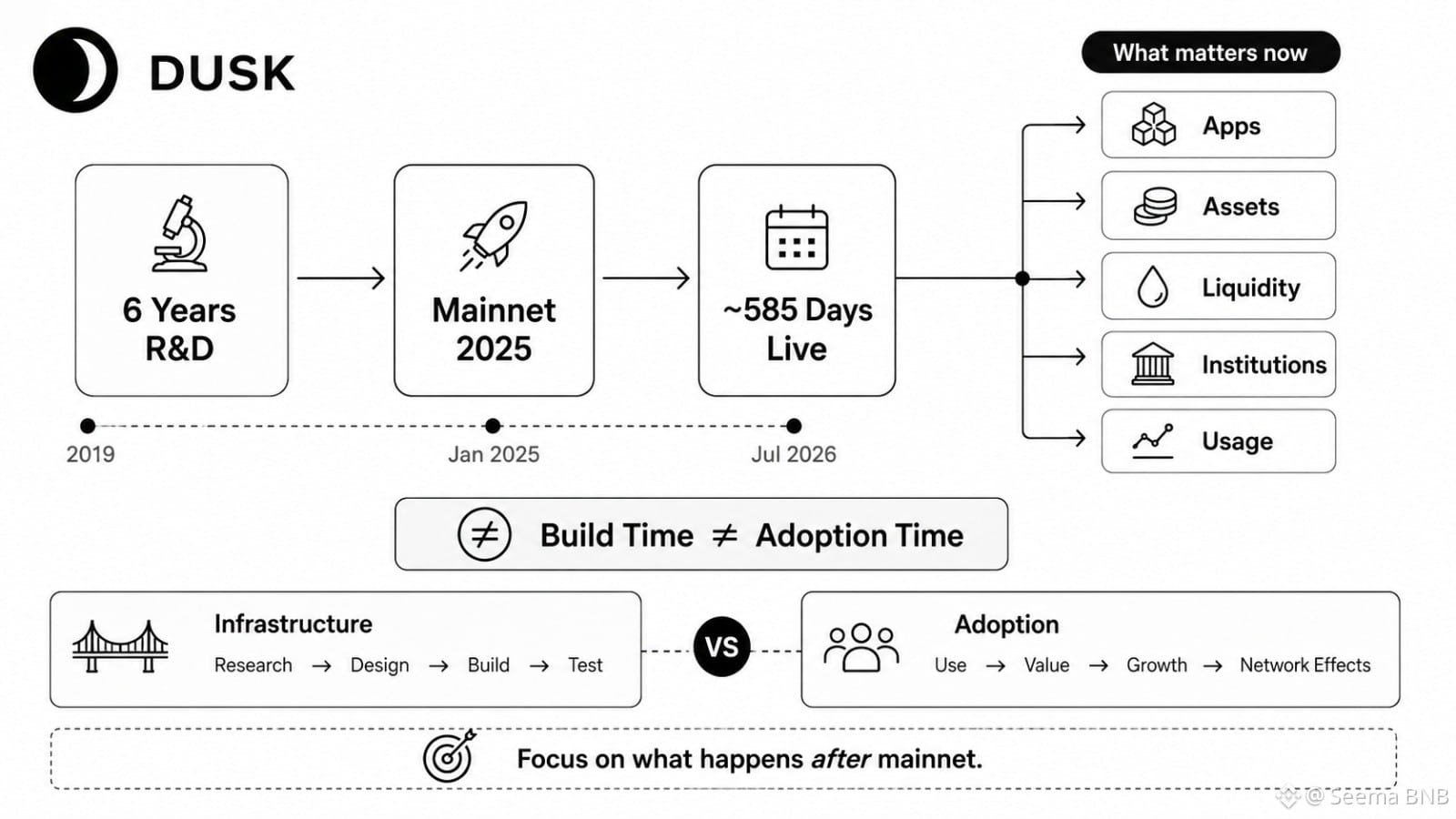
I first looked at DUSK from the six-year build cycle, and I think that is the wrong clock to use now.
Six years of R&D tells me something about technical discipline. It does not tell me whether developers, institutions, assets, and users will actually stay once the infrastructure is live.
What matters more is the roughly 585 days of mainnet behavior.
Are applications moving beyond deployment? Are regulated assets reaching real on-chain use? Is liquidity forming around actual demand, or are we still mostly measuring infrastructure readiness?
Some weakness here is normal. DUSK spent years solving a difficult stack, so I would not expect the market layer to mature at the same speed as the base layer.
But that balance cuts both ways. A long build cycle may reduce technical uncertainty while raising expectations for post-launch execution.
That is the part I keep watching with DUSK: infrastructure power versus real accessibility.
Nineteen months is probably too short to dismiss the thesis, but long enough to ask harder questions about conversion from technology to usage.
For DUSK, the next test is not whether the system works. It is whether working infrastructure becomes something people repeatedly need.
@Dusk_Foundation #dusk $DUSK
I first looked at DUSK from the six-year build cycle, and I think that is the wrong clock to use now.
Six years of R&D tells me something about technical discipline. It does not tell me whether developers, institutions, assets, and users will actually stay once the infrastructure is live.
What matters more is the roughly 585 days of mainnet behavior.
Are applications moving beyond deployment? Are regulated assets reaching real on-chain use? Is liquidity forming around actual demand, or are we still mostly measuring infrastructure readiness?
Some weakness here is normal. DUSK spent years solving a difficult stack, so I would not expect the market layer to mature at the same speed as the base layer.
But that balance cuts both ways. A long build cycle may reduce technical uncertainty while raising expectations for post-launch execution.
That is the part I keep watching with DUSK: infrastructure power versus real accessibility.
Nineteen months is probably too short to dismiss the thesis, but long enough to ask harder questions about conversion from technology to usage.
For DUSK, the next test is not whether the system works. It is whether working infrastructure becomes something people repeatedly need.
@Dusk #dusk $DUSK
Six years of R&D tells me something about technical discipline. It does not tell me whether developers, institutions, assets, and users will actually stay once the infrastructure is live.
What matters more is the roughly 585 days of mainnet behavior.
Are applications moving beyond deployment? Are regulated assets reaching real on-chain use? Is liquidity forming around actual demand, or are we still mostly measuring infrastructure readiness?
Some weakness here is normal. DUSK spent years solving a difficult stack, so I would not expect the market layer to mature at the same speed as the base layer.
But that balance cuts both ways. A long build cycle may reduce technical uncertainty while raising expectations for post-launch execution.
That is the part I keep watching with DUSK: infrastructure power versus real accessibility.
Nineteen months is probably too short to dismiss the thesis, but long enough to ask harder questions about conversion from technology to usage.
For DUSK, the next test is not whether the system works. It is whether working infrastructure becomes something people repeatedly need.
@Dusk #dusk $DUSK
30
21
8.7k
·
--
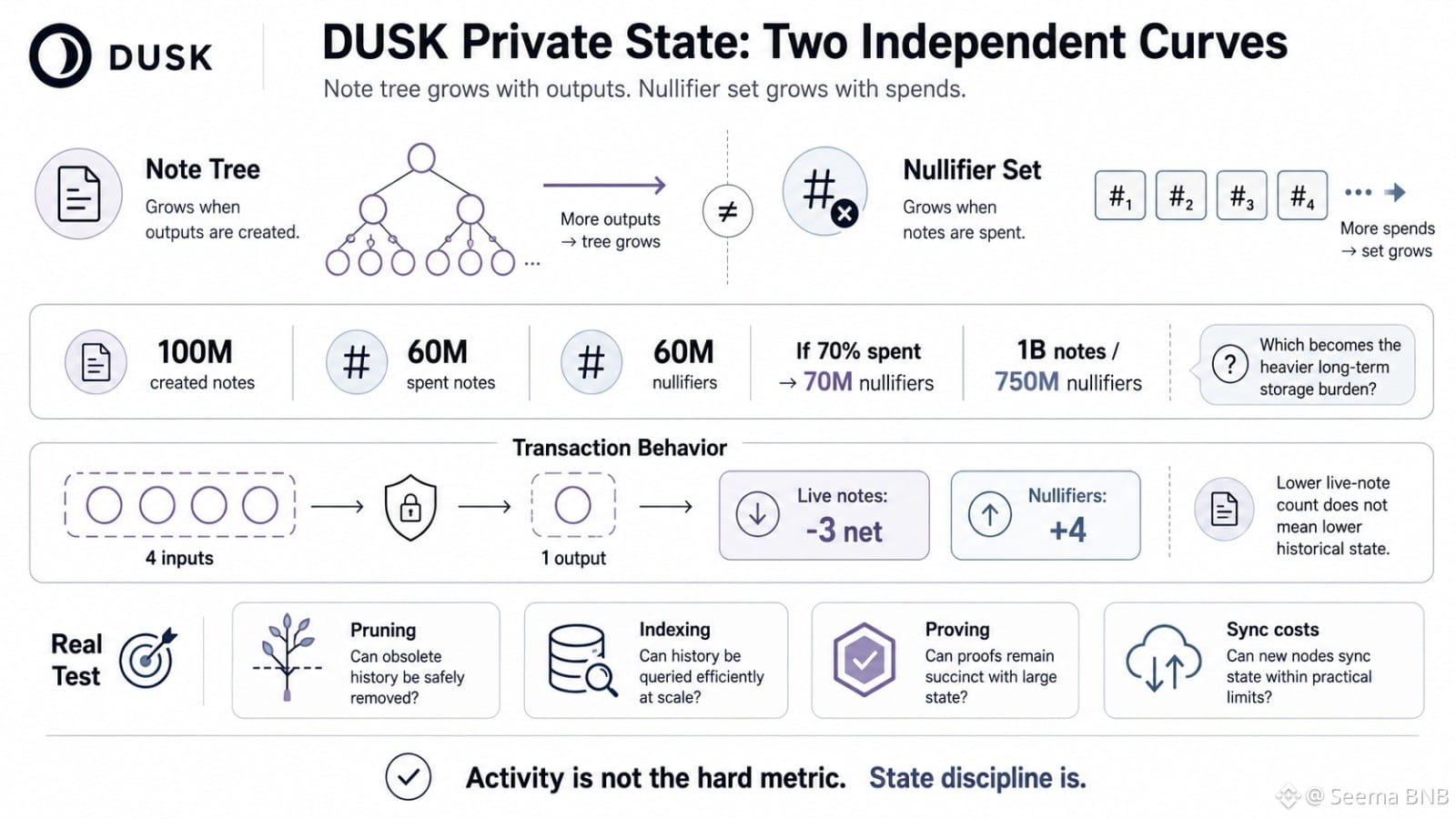
I started looking at DUSK’s private state from the wrong metric first total notes created. It sounds like the obvious storage story, but it only shows one curve. @Dusk_Foundation
The note tree grows when outputs are created. The nullifier set grows when notes are spent. Those are related, but not the same behavior.
Take 100M Phoenix notes with 60M already spent. DUSK still carries the history of created notes, while the nullifier side has already reached 60M entries. If 70% are eventually spent, that becomes 70M nullifiers. At 1B notes and 750M nullifiers, the question gets less comfortable: which structure becomes the heavier long-term state burden?
A 4-in/1-out transaction makes this clearer. Live notes fall by three net, yet four new nullifiers are added. Lower live-note count does not mean lower historical state.
Some growth is normal. Private systems need commitments and spent-note protection.
The real test is whether DUSK can keep both curves efficient as usage compounds. Can pruning, indexing, proving and sync costs stay manageable? Or does privacy slowly become an infrastructure tax?
For DUSK activity is not the hard metric. State discipline is.
#dusk $DUSK
I started looking at DUSK’s private state from the wrong metric first total notes created. It sounds like the obvious storage story, but it only shows one curve. @Dusk
The note tree grows when outputs are created. The nullifier set grows when notes are spent. Those are related, but not the same behavior.
Take 100M Phoenix notes with 60M already spent. DUSK still carries the history of created notes, while the nullifier side has already reached 60M entries. If 70% are eventually spent, that becomes 70M nullifiers. At 1B notes and 750M nullifiers, the question gets less comfortable: which structure becomes the heavier long-term state burden?
A 4-in/1-out transaction makes this clearer. Live notes fall by three net, yet four new nullifiers are added. Lower live-note count does not mean lower historical state.
Some growth is normal. Private systems need commitments and spent-note protection.
The real test is whether DUSK can keep both curves efficient as usage compounds. Can pruning, indexing, proving and sync costs stay manageable? Or does privacy slowly become an infrastructure tax?
For DUSK activity is not the hard metric. State discipline is.
#dusk $DUSK
The note tree grows when outputs are created. The nullifier set grows when notes are spent. Those are related, but not the same behavior.
Take 100M Phoenix notes with 60M already spent. DUSK still carries the history of created notes, while the nullifier side has already reached 60M entries. If 70% are eventually spent, that becomes 70M nullifiers. At 1B notes and 750M nullifiers, the question gets less comfortable: which structure becomes the heavier long-term state burden?
A 4-in/1-out transaction makes this clearer. Live notes fall by three net, yet four new nullifiers are added. Lower live-note count does not mean lower historical state.
Some growth is normal. Private systems need commitments and spent-note protection.
The real test is whether DUSK can keep both curves efficient as usage compounds. Can pruning, indexing, proving and sync costs stay manageable? Or does privacy slowly become an infrastructure tax?
For DUSK activity is not the hard metric. State discipline is.
#dusk $DUSK
32
28
10.8k
·
--
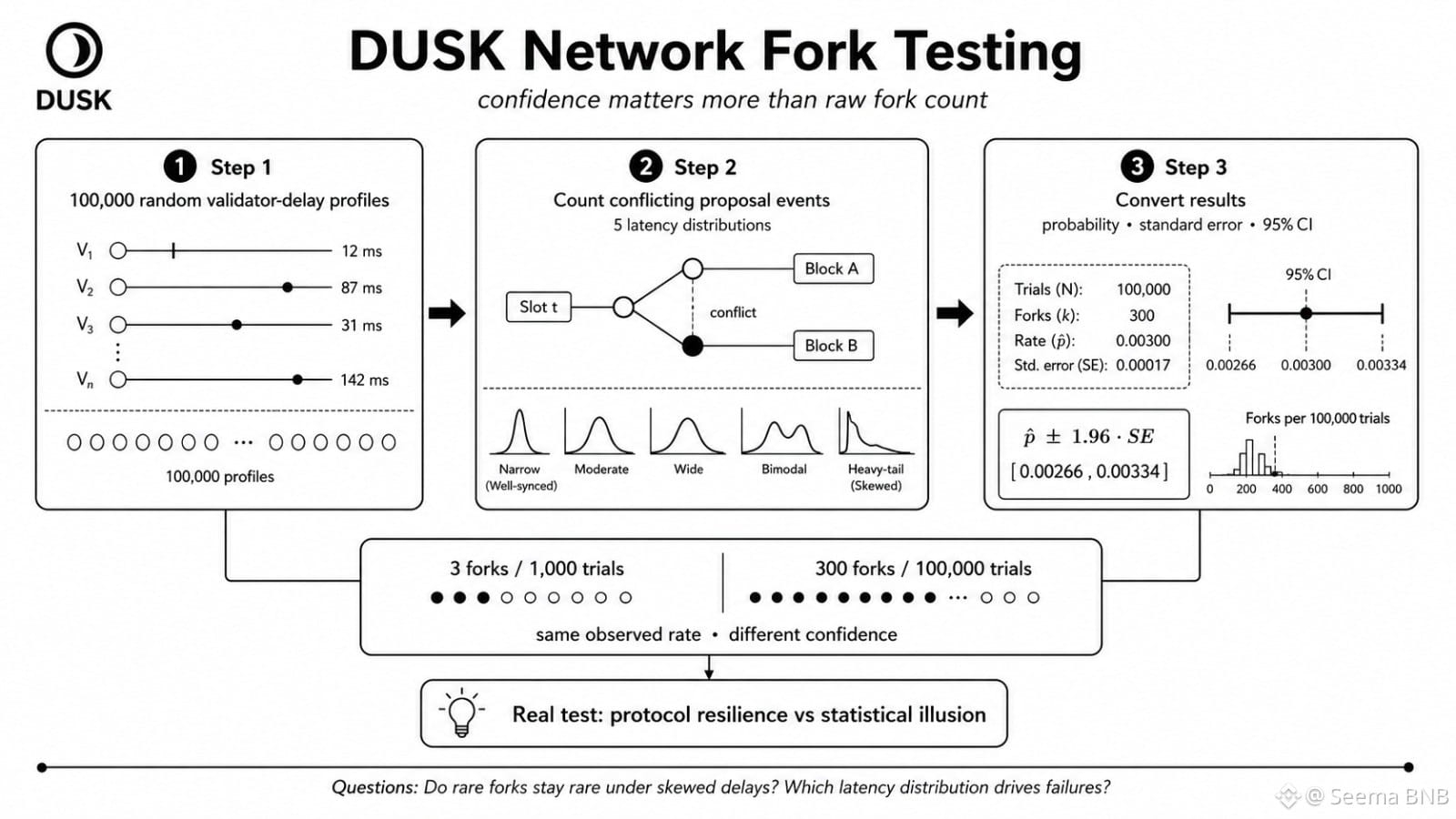
I kept coming back to one thing while testing DUSK Network fork behavior: the fork count itself tells me less than the confidence behind that count. @Dusk_Foundation
Three forks in 1,000 trials looks similar to 300 forks in 100,000 trials. Same observed rate. Very different evidence.
That is why I would not stop at a single simulation result.
For DUSK Network, Step 1 should generate 100,000 random validator-delay profiles. Step 2 should replay conflicting proposal conditions across several latency distributions, not one convenient network model. Then Step 3 converts those fork counts into probability, standard error, and 95% confidence intervals.
The hidden issue is not activity vs inactivity. It is protocol resilience vs statistical illusion.
Do rare forks stay rare when validator delays become skewed? Does one latency distribution dominate the failures? Does the confidence interval shrink enough to trust the estimate, or are we still looking at noise?
Some weakness is normal. Distributed systems are messy, networks stall, packets arrive late.
My doubt is whether DUSK Network remains stable when the delay model stops being friendly.
A low fork rate matters. Knowing how uncertain that rate is matters more.
#dusk $DUSK
I kept coming back to one thing while testing DUSK Network fork behavior: the fork count itself tells me less than the confidence behind that count. @Dusk
Three forks in 1,000 trials looks similar to 300 forks in 100,000 trials. Same observed rate. Very different evidence.
That is why I would not stop at a single simulation result.
For DUSK Network, Step 1 should generate 100,000 random validator-delay profiles. Step 2 should replay conflicting proposal conditions across several latency distributions, not one convenient network model. Then Step 3 converts those fork counts into probability, standard error, and 95% confidence intervals.
The hidden issue is not activity vs inactivity. It is protocol resilience vs statistical illusion.
Do rare forks stay rare when validator delays become skewed? Does one latency distribution dominate the failures? Does the confidence interval shrink enough to trust the estimate, or are we still looking at noise?
Some weakness is normal. Distributed systems are messy, networks stall, packets arrive late.
My doubt is whether DUSK Network remains stable when the delay model stops being friendly.
A low fork rate matters. Knowing how uncertain that rate is matters more.
#dusk $DUSK
Three forks in 1,000 trials looks similar to 300 forks in 100,000 trials. Same observed rate. Very different evidence.
That is why I would not stop at a single simulation result.
For DUSK Network, Step 1 should generate 100,000 random validator-delay profiles. Step 2 should replay conflicting proposal conditions across several latency distributions, not one convenient network model. Then Step 3 converts those fork counts into probability, standard error, and 95% confidence intervals.
The hidden issue is not activity vs inactivity. It is protocol resilience vs statistical illusion.
Do rare forks stay rare when validator delays become skewed? Does one latency distribution dominate the failures? Does the confidence interval shrink enough to trust the estimate, or are we still looking at noise?
Some weakness is normal. Distributed systems are messy, networks stall, packets arrive late.
My doubt is whether DUSK Network remains stable when the delay model stops being friendly.
A low fork rate matters. Knowing how uncertain that rate is matters more.
#dusk $DUSK
45
24
2k
Log in to explore more content
Join global crypto users on Binance Square
⚡️ Get latest and useful information about crypto.
💬 Trusted by the world’s largest crypto exchange.
👍 Discover real insights from verified creators.
Email / Phone number
Trending Topics
HotCPIDecemberHikePriced
6,390 views
301 Discussing
CPI Market Watch | US CPI Rises 0.4% in October, Hotter Than 0.3% Forecast
Binance News
·11 Likes
·16.3k views
AnthropicRejectsIPODelayValuationinQuestion
136,537 views
1,305 Discussing
NvidiaInvestigatesAfterHuang’sAffairApology
383,451 views
2,776 Discussing