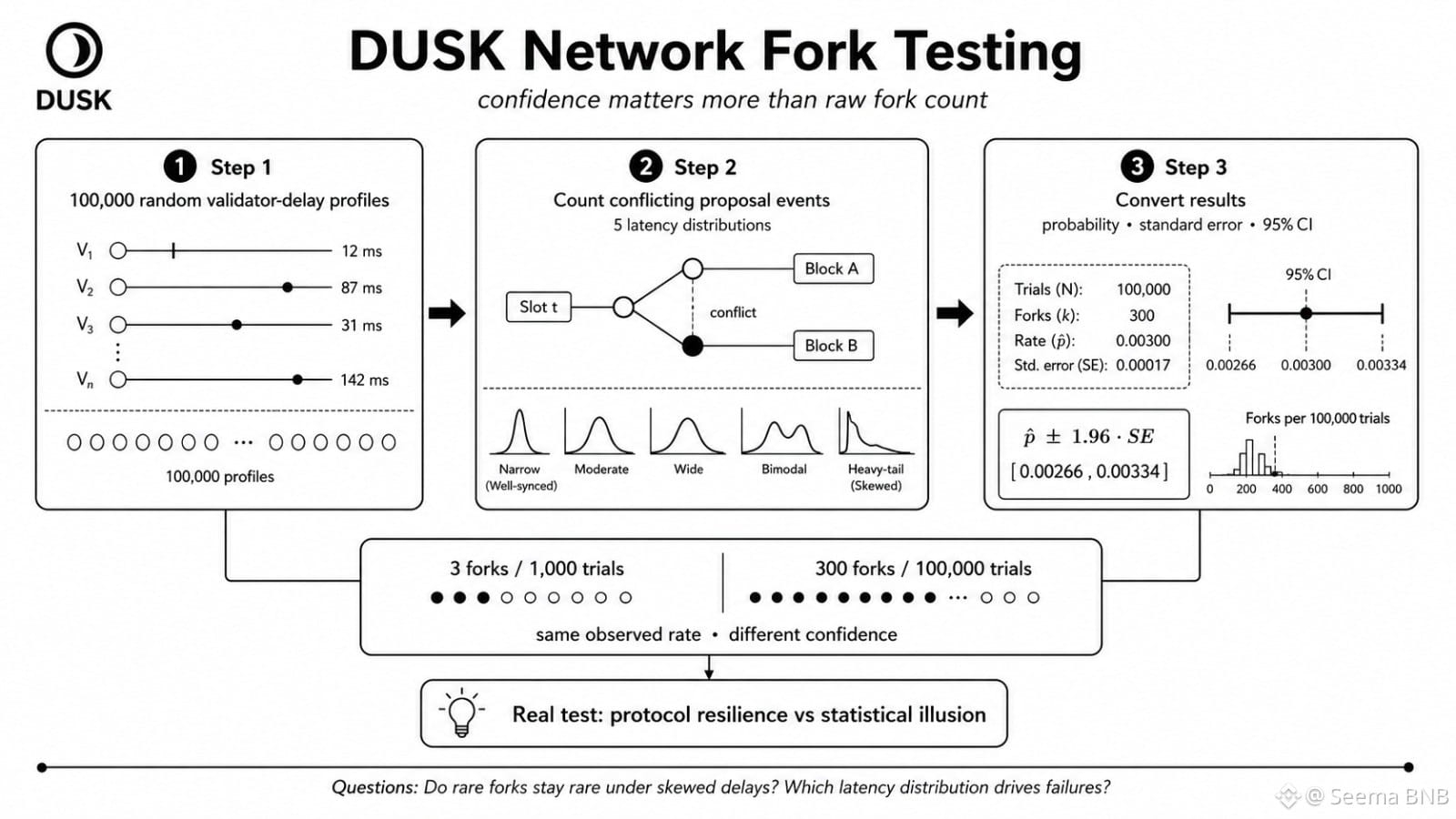
I kept coming back to one thing while testing DUSK Network fork behavior: the fork count itself tells me less than the confidence behind that count. @Dusk
Three forks in 1,000 trials looks similar to 300 forks in 100,000 trials. Same observed rate. Very different evidence.
That is why I would not stop at a single simulation result.
For DUSK Network, Step 1 should generate 100,000 random validator-delay profiles. Step 2 should replay conflicting proposal conditions across several latency distributions, not one convenient network model. Then Step 3 converts those fork counts into probability, standard error, and 95% confidence intervals.
The hidden issue is not activity vs inactivity. It is protocol resilience vs statistical illusion.
Do rare forks stay rare when validator delays become skewed? Does one latency distribution dominate the failures? Does the confidence interval shrink enough to trust the estimate, or are we still looking at noise?
Some weakness is normal. Distributed systems are messy, networks stall, packets arrive late.
My doubt is whether DUSK Network remains stable when the delay model stops being friendly.
A low fork rate matters. Knowing how uncertain that rate is matters more.
#dusk $DUSK