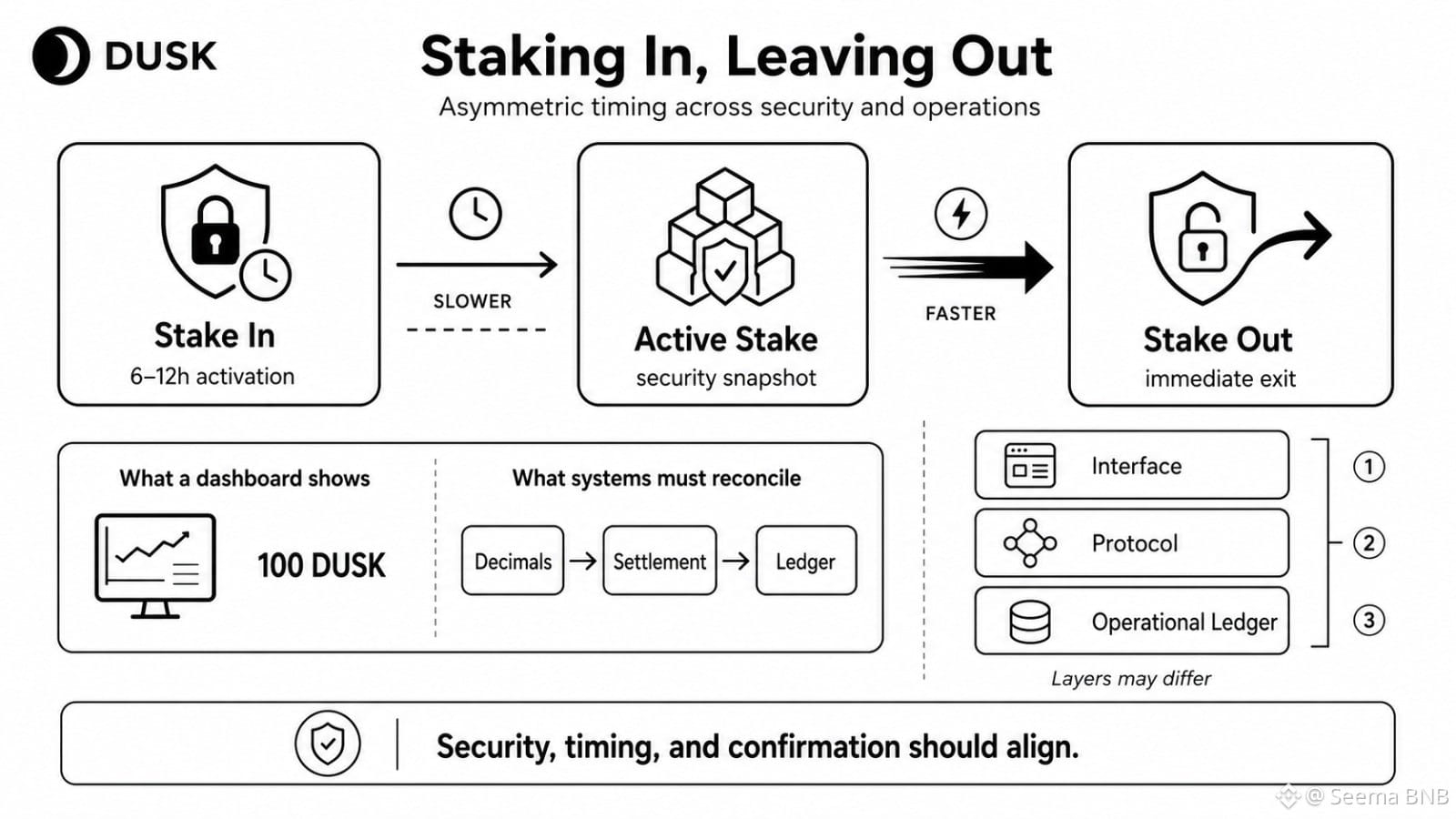
I kept returning to one awkward DUSK detail staking capital can take hours to enter, yet it can leave without the same protocol waiting period.
The obvious metric is active stake. I think that is too shallow. What matters is how quickly security can disappear compared with how quickly it can rebuild.
That asymmetry changes behavior. If confidence drops, outflow can be immediate while replacement stake is still waiting 6–12 hours to activate. Some weakness here is normal; systems need operational windows. But the real test is whether DUSK can absorb sudden exits without turning a temporary mood shift into a security concentration problem.
The same pattern appears elsewhere. A dashboard can show 100 DUSK correctly while the underlying decimal mapping is wrong. A transaction can be included quickly while DuskDS settlement is not yet what an exchange should call confirmed.
So which layer is the truth: interface, protocol, or operational ledger?
DUSK does not fail because these layers differ. It fails if users assume they are identical.
I am watching whether the network standardizes not just cryptography, but timing, accounting and confirmation semantics around it.
@Dusk #dusk $DUSK