
3D VN
414 Posts
3D VN
Report
Block User
Since2020||HolderBTC
257 Following
142 Followers
574 Liked
Posts
All
Quotes
·
--
A payments layer for agents does not have to own the road. It has to make sure the agent arrives.
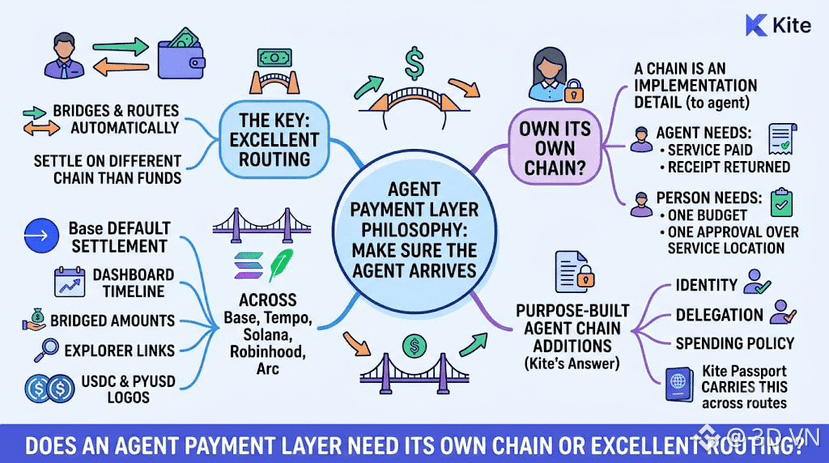
Kite Passport's release notes show that philosophy at work. Since July 2026, an x402 payment can settle on a different chain than the one holding your funds: Passport bridges and routes automatically across Base, Tempo and Solana, and Base is now the default settlement chain. The dashboard draws a route timeline for each routed payment, with bridged amounts, explorer links and token logos for USDC and PYUSD. Later releases added Robinhood Chain support and Arc mainnet.
To an agent, a chain is an implementation detail. It needs a service paid and a receipt returned. To the person behind it, one budget and one approval should cover wherever the service happens to live.
If settlement happens on the most liquid networks, what does a purpose-built agent chain add? Kite's answer centers on identity, delegation and spending policy, the layer Passport carries across every route it takes.
Does an agent payment layer need its own chain, or just excellent routing?
#KiteBBW $KITE
A payments layer for agents does not have to own the road. It has to make sure the agent arrives.
Kite Passport's release notes show that philosophy at work. Since July 2026, an x402 payment can settle on a different chain than the one holding your funds: Passport bridges and routes automatically across Base, Tempo and Solana, and Base is now the default settlement chain. The dashboard draws a route timeline for each routed payment, with bridged amounts, explorer links and token logos for USDC and PYUSD. Later releases added Robinhood Chain support and Arc mainnet.
To an agent, a chain is an implementation detail. It needs a service paid and a receipt returned. To the person behind it, one budget and one approval should cover wherever the service happens to live.
If settlement happens on the most liquid networks, what does a purpose-built agent chain add? Kite's answer centers on identity, delegation and spending policy, the layer Passport carries across every route it takes.
Does an agent payment layer need its own chain, or just excellent routing?
#KiteBBW $KITE
Kite Passport's release notes show that philosophy at work. Since July 2026, an x402 payment can settle on a different chain than the one holding your funds: Passport bridges and routes automatically across Base, Tempo and Solana, and Base is now the default settlement chain. The dashboard draws a route timeline for each routed payment, with bridged amounts, explorer links and token logos for USDC and PYUSD. Later releases added Robinhood Chain support and Arc mainnet.
To an agent, a chain is an implementation detail. It needs a service paid and a receipt returned. To the person behind it, one budget and one approval should cover wherever the service happens to live.
If settlement happens on the most liquid networks, what does a purpose-built agent chain add? Kite's answer centers on identity, delegation and spending policy, the layer Passport carries across every route it takes.
Does an agent payment layer need its own chain, or just excellent routing?
#KiteBBW $KITE
1
149
·
--
I keep thinking about Dusk's use of native host functions for expensive operations.
On paper, the logic is straightforward. Move heavy computation out of WebAssembly, execute it more efficiently in the host environment, and reduce some of the overhead along the way.
But making one part of the execution path faster does not automatically make the whole workload faster by the same amount. That matters as Dusk pushes to bring financial markets onchain with EU-licensed institutions, where the architecture eventually has to perform under real workloads, not just look efficient on paper. What I don't know yet is whether Dusk's host-function design removes a bottleneck that actually dominates real workloads, or mainly speeds up work that turns out to be a smaller part of total execution.
The details worth watching are which operations move out of WASM, how much faster they become, and how much of a representative Dusk workload those operations account for.
The architecture gives a good reason to expect an improvement. That is weaker evidence than seeing the same kind of workload produce a material, repeatable gain in practice.
I'd care less about the theoretical speedup of one primitive than about how much it changes the performance of the workload Dusk actually runs.
The question is whether Dusk has removed a real system bottleneck, or simply accelerated one part of the path without moving overall performance very far.
I am watching for Dusk-specific benchmarks that isolate the host-function gain and show how much it matters at workload level.
#dusk $DUSK @Dusk_Foundation
I keep thinking about Dusk's use of native host functions for expensive operations.
On paper, the logic is straightforward. Move heavy computation out of WebAssembly, execute it more efficiently in the host environment, and reduce some of the overhead along the way.
But making one part of the execution path faster does not automatically make the whole workload faster by the same amount. That matters as Dusk pushes to bring financial markets onchain with EU-licensed institutions, where the architecture eventually has to perform under real workloads, not just look efficient on paper. What I don't know yet is whether Dusk's host-function design removes a bottleneck that actually dominates real workloads, or mainly speeds up work that turns out to be a smaller part of total execution.
The details worth watching are which operations move out of WASM, how much faster they become, and how much of a representative Dusk workload those operations account for.
The architecture gives a good reason to expect an improvement. That is weaker evidence than seeing the same kind of workload produce a material, repeatable gain in practice.
I'd care less about the theoretical speedup of one primitive than about how much it changes the performance of the workload Dusk actually runs.
The question is whether Dusk has removed a real system bottleneck, or simply accelerated one part of the path without moving overall performance very far.
I am watching for Dusk-specific benchmarks that isolate the host-function gain and show how much it matters at workload level.
#dusk $DUSK @Dusk
On paper, the logic is straightforward. Move heavy computation out of WebAssembly, execute it more efficiently in the host environment, and reduce some of the overhead along the way.
But making one part of the execution path faster does not automatically make the whole workload faster by the same amount. That matters as Dusk pushes to bring financial markets onchain with EU-licensed institutions, where the architecture eventually has to perform under real workloads, not just look efficient on paper. What I don't know yet is whether Dusk's host-function design removes a bottleneck that actually dominates real workloads, or mainly speeds up work that turns out to be a smaller part of total execution.
The details worth watching are which operations move out of WASM, how much faster they become, and how much of a representative Dusk workload those operations account for.
The architecture gives a good reason to expect an improvement. That is weaker evidence than seeing the same kind of workload produce a material, repeatable gain in practice.
I'd care less about the theoretical speedup of one primitive than about how much it changes the performance of the workload Dusk actually runs.
The question is whether Dusk has removed a real system bottleneck, or simply accelerated one part of the path without moving overall performance very far.
I am watching for Dusk-specific benchmarks that isolate the host-function gain and show how much it matters at workload level.
#dusk $DUSK @Dusk
2
114
·
--
Verified
I keep thinking about two transaction types Dusk introduced in Rusk: CanonicalTransaction and LedgerTransaction.
They represent different layers of the same transaction. CanonicalTransaction is the form Rusk works with logically, while LedgerTransaction wraps that transaction in the ledger representation required by a particular protocol version. The tension is that Dusk wants those storage formats to evolve without forcing the meaning of a transaction to evolve with them, an important property as it pushes to bring financial markets onchain with EU-licensed institutions. What I don't know yet is whether that separation will actually keep version changes contained inside Rusk, or whether format changes will still spill into wallets, applications and historical replay.
The details worth watching are how Dusk normalizes incoming transactions, selects the correct ledger representation, and interprets older transactions after protocol upgrades.
A wallet continuing to submit transactions after an upgrade is useful evidence of compatibility. The stronger test is whether Dusk can change the representation underneath while preserving the same transaction semantics above it.
I'd judge that abstraction by how little of the versioning complexity applications need to know about.
The question is whether Dusk has truly separated what a transaction means from how the ledger stores it, or simply moved the version-handling burden somewhere else in the stack.
I am watching how that boundary holds up through future format changes and historical replay.
#dusk $DUSK @Dusk_Foundation
I keep thinking about two transaction types Dusk introduced in Rusk: CanonicalTransaction and LedgerTransaction.
They represent different layers of the same transaction. CanonicalTransaction is the form Rusk works with logically, while LedgerTransaction wraps that transaction in the ledger representation required by a particular protocol version. The tension is that Dusk wants those storage formats to evolve without forcing the meaning of a transaction to evolve with them, an important property as it pushes to bring financial markets onchain with EU-licensed institutions. What I don't know yet is whether that separation will actually keep version changes contained inside Rusk, or whether format changes will still spill into wallets, applications and historical replay.
The details worth watching are how Dusk normalizes incoming transactions, selects the correct ledger representation, and interprets older transactions after protocol upgrades.
A wallet continuing to submit transactions after an upgrade is useful evidence of compatibility. The stronger test is whether Dusk can change the representation underneath while preserving the same transaction semantics above it.
I'd judge that abstraction by how little of the versioning complexity applications need to know about.
The question is whether Dusk has truly separated what a transaction means from how the ledger stores it, or simply moved the version-handling burden somewhere else in the stack.
I am watching how that boundary holds up through future format changes and historical replay.
#dusk $DUSK @Dusk
They represent different layers of the same transaction. CanonicalTransaction is the form Rusk works with logically, while LedgerTransaction wraps that transaction in the ledger representation required by a particular protocol version. The tension is that Dusk wants those storage formats to evolve without forcing the meaning of a transaction to evolve with them, an important property as it pushes to bring financial markets onchain with EU-licensed institutions. What I don't know yet is whether that separation will actually keep version changes contained inside Rusk, or whether format changes will still spill into wallets, applications and historical replay.
The details worth watching are how Dusk normalizes incoming transactions, selects the correct ledger representation, and interprets older transactions after protocol upgrades.
A wallet continuing to submit transactions after an upgrade is useful evidence of compatibility. The stronger test is whether Dusk can change the representation underneath while preserving the same transaction semantics above it.
I'd judge that abstraction by how little of the versioning complexity applications need to know about.
The question is whether Dusk has truly separated what a transaction means from how the ledger stores it, or simply moved the version-handling burden somewhere else in the stack.
I am watching how that boundary holds up through future format changes and historical replay.
#dusk $DUSK @Dusk
74
·
--
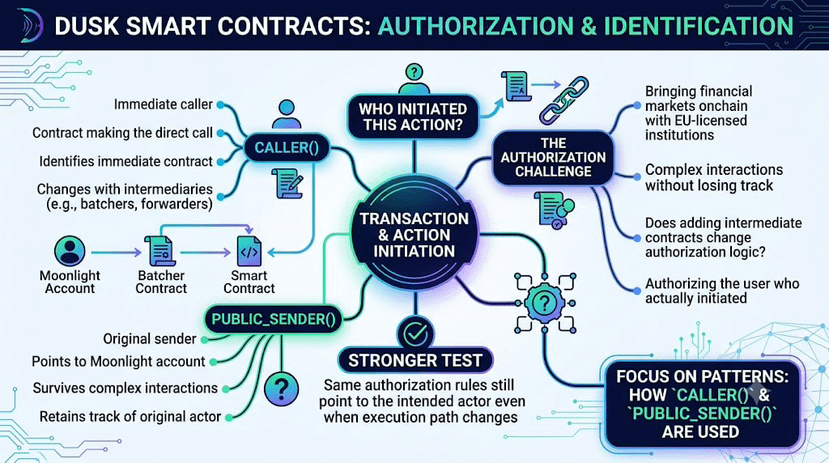
Two sender functions in Dusk smart contracts caught my attention: caller() and public_sender().
They sound like two ways to answer the same question, who initiated this action, but they can point to different actors. That distinction matters as Dusk pushes to bring financial markets onchain with EU-licensed institutions, where authorization has to survive more complex contract interactions without losing track of the original actor. caller() identifies the contract making the immediate call, while public_sender() can still point back to the Moonlight account that started the transaction.
What I don't know yet is whether Dusk contracts will consistently authorize the user who actually initiated an action, or whether adding intermediate contracts can quietly change which identity the authorization logic sees. The mechanics worth watching are straightforward: when contracts rely on caller(), when they rely on public_sender(), and what happens once batchers or forwarders sit in the middle.
A transaction executing successfully is not enough to answer that. The stronger test is whether the same authorization rules still point back to the intended actor even when the execution path changes.
I'd care less about how many intermediate contracts an action passes through than whether authorization still resolves to the actor who actually initiated it.
That matters because adding an intermediary can change who a contract sees without changing who actually authorized the action.
The question is whether Dusk can add more composable execution paths without making authorization depend on whichever contract happens to sit in the middle.
I am watching how caller() and public_sender() are used as those patterns develop.
@Dusk_Foundation $DUSK #dusk
Two sender functions in Dusk smart contracts caught my attention: caller() and public_sender().
They sound like two ways to answer the same question, who initiated this action, but they can point to different actors. That distinction matters as Dusk pushes to bring financial markets onchain with EU-licensed institutions, where authorization has to survive more complex contract interactions without losing track of the original actor. caller() identifies the contract making the immediate call, while public_sender() can still point back to the Moonlight account that started the transaction.
What I don't know yet is whether Dusk contracts will consistently authorize the user who actually initiated an action, or whether adding intermediate contracts can quietly change which identity the authorization logic sees. The mechanics worth watching are straightforward: when contracts rely on caller(), when they rely on public_sender(), and what happens once batchers or forwarders sit in the middle.
A transaction executing successfully is not enough to answer that. The stronger test is whether the same authorization rules still point back to the intended actor even when the execution path changes.
I'd care less about how many intermediate contracts an action passes through than whether authorization still resolves to the actor who actually initiated it.
That matters because adding an intermediary can change who a contract sees without changing who actually authorized the action.
The question is whether Dusk can add more composable execution paths without making authorization depend on whichever contract happens to sit in the middle.
I am watching how caller() and public_sender() are used as those patterns develop.
@Dusk $DUSK #dusk
They sound like two ways to answer the same question, who initiated this action, but they can point to different actors. That distinction matters as Dusk pushes to bring financial markets onchain with EU-licensed institutions, where authorization has to survive more complex contract interactions without losing track of the original actor. caller() identifies the contract making the immediate call, while public_sender() can still point back to the Moonlight account that started the transaction.
What I don't know yet is whether Dusk contracts will consistently authorize the user who actually initiated an action, or whether adding intermediate contracts can quietly change which identity the authorization logic sees. The mechanics worth watching are straightforward: when contracts rely on caller(), when they rely on public_sender(), and what happens once batchers or forwarders sit in the middle.
A transaction executing successfully is not enough to answer that. The stronger test is whether the same authorization rules still point back to the intended actor even when the execution path changes.
I'd care less about how many intermediate contracts an action passes through than whether authorization still resolves to the actor who actually initiated it.
That matters because adding an intermediary can change who a contract sees without changing who actually authorized the action.
The question is whether Dusk can add more composable execution paths without making authorization depend on whichever contract happens to sit in the middle.
I am watching how caller() and public_sender() are used as those patterns develop.
@Dusk $DUSK #dusk
87
·
--
There is a quiet decision buried in how Dusk Network describes itself that is easy to miss if you are only skimming the roadmap. Dusk is not positioning itself as the issuer of tokenized securities. It is positioning itself as the rail underneath whoever the issuer turns out to be. That is a narrower, humbler role, and I think it is the right one. Plenty of competitors chase both roles at once and end up mediocre at each, satisfying neither the due diligence institutions expect nor the composability developers actually want.
The clearest example is NPEX, which plans to bring more than €300M in assets onto Dusk. Dusk did not become a broker-dealer or a licensed venue to make that happen. It built infrastructure capable of carrying native issuance workflows for regulated securities, and left the actual issuing to institutions and venues once they have the authorization and product setup their jurisdictions require. NPEX brings the license and the assets. Dusk brings settlement, privacy, and the technical rails those assets move on.
This separation of roles is a deliberate constraint, not a missing feature. A blockchain trying to be both the infrastructure and the regulated issuer would need a banking license in every market it touched, a slower and more fragile strategy than partnering with entities that already hold one. By staying in the infrastructure lane, Dusk can plug into NPEX today and, in principle, a different licensed venue in another jurisdiction tomorrow, without re-architecting anything.
The tradeoff is that Dusk's growth becomes dependent on how many NPEX-shaped partners it can find, and how quickly each one moves through its own regulatory process. Infrastructure providers do not control their own adoption curve. They wait on someone else's paperwork, and that dependency is the real risk sitting underneath an otherwise sound decision.
@Dusk_Foundation $DUSK #dusk
There is a quiet decision buried in how Dusk Network describes itself that is easy to miss if you are only skimming the roadmap. Dusk is not positioning itself as the issuer of tokenized securities. It is positioning itself as the rail underneath whoever the issuer turns out to be. That is a narrower, humbler role, and I think it is the right one. Plenty of competitors chase both roles at once and end up mediocre at each, satisfying neither the due diligence institutions expect nor the composability developers actually want.
The clearest example is NPEX, which plans to bring more than €300M in assets onto Dusk. Dusk did not become a broker-dealer or a licensed venue to make that happen. It built infrastructure capable of carrying native issuance workflows for regulated securities, and left the actual issuing to institutions and venues once they have the authorization and product setup their jurisdictions require. NPEX brings the license and the assets. Dusk brings settlement, privacy, and the technical rails those assets move on.
This separation of roles is a deliberate constraint, not a missing feature. A blockchain trying to be both the infrastructure and the regulated issuer would need a banking license in every market it touched, a slower and more fragile strategy than partnering with entities that already hold one. By staying in the infrastructure lane, Dusk can plug into NPEX today and, in principle, a different licensed venue in another jurisdiction tomorrow, without re-architecting anything.
The tradeoff is that Dusk's growth becomes dependent on how many NPEX-shaped partners it can find, and how quickly each one moves through its own regulatory process. Infrastructure providers do not control their own adoption curve. They wait on someone else's paperwork, and that dependency is the real risk sitting underneath an otherwise sound decision.
@Dusk $DUSK #dusk
The clearest example is NPEX, which plans to bring more than €300M in assets onto Dusk. Dusk did not become a broker-dealer or a licensed venue to make that happen. It built infrastructure capable of carrying native issuance workflows for regulated securities, and left the actual issuing to institutions and venues once they have the authorization and product setup their jurisdictions require. NPEX brings the license and the assets. Dusk brings settlement, privacy, and the technical rails those assets move on.
This separation of roles is a deliberate constraint, not a missing feature. A blockchain trying to be both the infrastructure and the regulated issuer would need a banking license in every market it touched, a slower and more fragile strategy than partnering with entities that already hold one. By staying in the infrastructure lane, Dusk can plug into NPEX today and, in principle, a different licensed venue in another jurisdiction tomorrow, without re-architecting anything.
The tradeoff is that Dusk's growth becomes dependent on how many NPEX-shaped partners it can find, and how quickly each one moves through its own regulatory process. Infrastructure providers do not control their own adoption curve. They wait on someone else's paperwork, and that dependency is the real risk sitting underneath an otherwise sound decision.
@Dusk $DUSK #dusk
2
1
81
·
--
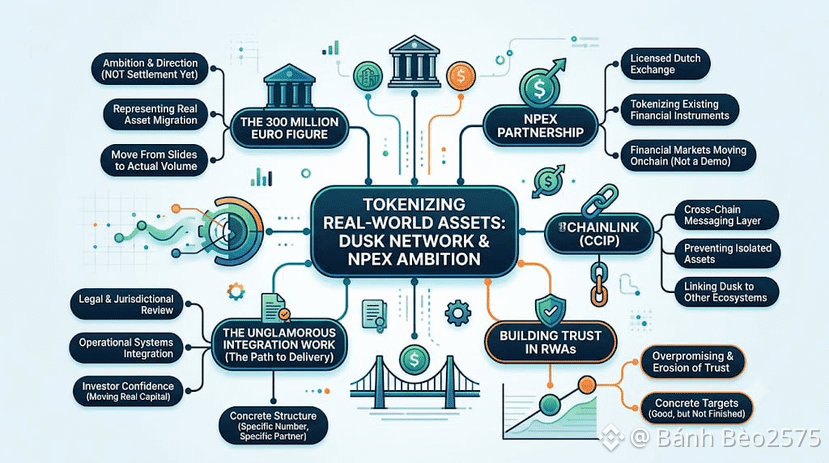
Numbers get thrown around constantly in this industry, most forgettable within a week. The 300 million euro figure tied to Dusk Network's partnership with NPEX is one I keep coming back to, because of what it represents rather than the digit itself.
NPEX, a licensed exchange in the Netherlands, is the partner behind that number. By its own stated plans, more than 300 million euros in assets are meant to move onto Dusk over time, tokenizing instruments that currently exist entirely within traditional financial infrastructure. That's the ambition: financial markets, actually moved onchain, not a demo, not a pilot running on fake volume.
Chainlink's cross-chain infrastructure sits somewhere in this picture too, providing the messaging layer that would let assets and data move between Dusk and other ecosystems rather than staying trapped in a single chain. That's the kind of unglamorous integration work that has to happen quietly in the background before a figure like 300 million euros stops being a slide in a deck and starts being actual settled volume.
Here's where I want to be blunt instead of promotional. Plans aren't delivery. A stated target of 300 million euros is a commitment and a direction, not a balance sheet entry that already exists. Between announcing an ambition like this and fully realizing it sits a long list of unglamorous work: legal review across jurisdictions, operational integration between NPEX's existing systems and Dusk's settlement layer, and enough investor confidence to actually move real capital rather than just talk about moving it.
I bring this up because overpromising is exactly what erodes trust in tokenized RWAs generally, and this sector doesn't need more of that. Dusk naming a specific number, from a specific licensed partner, with a specific structure behind it, is already more concrete than most of what circulates under the RWA label. Concrete is good. It just isn't finished yet.
@Dusk_Foundation $DUSK #dusk
Numbers get thrown around constantly in this industry, most forgettable within a week. The 300 million euro figure tied to Dusk Network's partnership with NPEX is one I keep coming back to, because of what it represents rather than the digit itself.
NPEX, a licensed exchange in the Netherlands, is the partner behind that number. By its own stated plans, more than 300 million euros in assets are meant to move onto Dusk over time, tokenizing instruments that currently exist entirely within traditional financial infrastructure. That's the ambition: financial markets, actually moved onchain, not a demo, not a pilot running on fake volume.
Chainlink's cross-chain infrastructure sits somewhere in this picture too, providing the messaging layer that would let assets and data move between Dusk and other ecosystems rather than staying trapped in a single chain. That's the kind of unglamorous integration work that has to happen quietly in the background before a figure like 300 million euros stops being a slide in a deck and starts being actual settled volume.
Here's where I want to be blunt instead of promotional. Plans aren't delivery. A stated target of 300 million euros is a commitment and a direction, not a balance sheet entry that already exists. Between announcing an ambition like this and fully realizing it sits a long list of unglamorous work: legal review across jurisdictions, operational integration between NPEX's existing systems and Dusk's settlement layer, and enough investor confidence to actually move real capital rather than just talk about moving it.
I bring this up because overpromising is exactly what erodes trust in tokenized RWAs generally, and this sector doesn't need more of that. Dusk naming a specific number, from a specific licensed partner, with a specific structure behind it, is already more concrete than most of what circulates under the RWA label. Concrete is good. It just isn't finished yet.
@Dusk $DUSK #dusk
NPEX, a licensed exchange in the Netherlands, is the partner behind that number. By its own stated plans, more than 300 million euros in assets are meant to move onto Dusk over time, tokenizing instruments that currently exist entirely within traditional financial infrastructure. That's the ambition: financial markets, actually moved onchain, not a demo, not a pilot running on fake volume.
Chainlink's cross-chain infrastructure sits somewhere in this picture too, providing the messaging layer that would let assets and data move between Dusk and other ecosystems rather than staying trapped in a single chain. That's the kind of unglamorous integration work that has to happen quietly in the background before a figure like 300 million euros stops being a slide in a deck and starts being actual settled volume.
Here's where I want to be blunt instead of promotional. Plans aren't delivery. A stated target of 300 million euros is a commitment and a direction, not a balance sheet entry that already exists. Between announcing an ambition like this and fully realizing it sits a long list of unglamorous work: legal review across jurisdictions, operational integration between NPEX's existing systems and Dusk's settlement layer, and enough investor confidence to actually move real capital rather than just talk about moving it.
I bring this up because overpromising is exactly what erodes trust in tokenized RWAs generally, and this sector doesn't need more of that. Dusk naming a specific number, from a specific licensed partner, with a specific structure behind it, is already more concrete than most of what circulates under the RWA label. Concrete is good. It just isn't finished yet.
@Dusk $DUSK #dusk
2
3
143
·
--
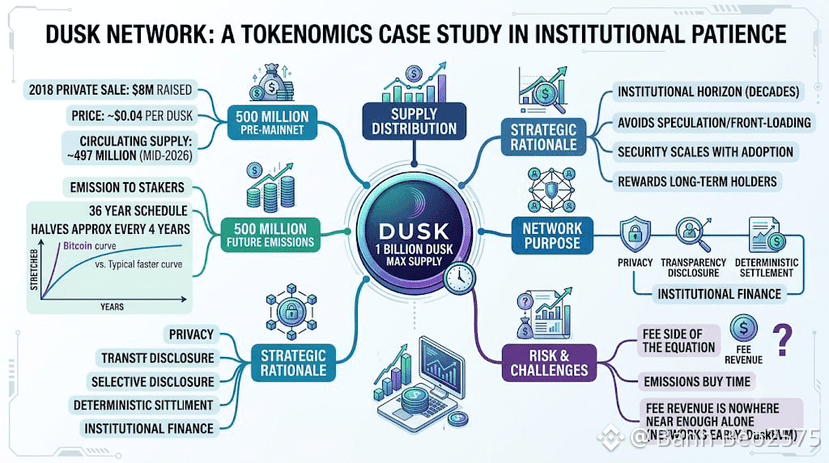
I like reading tokenomics documents nobody else bothers to open, and Dusk Network's is a useful example of a design built for patience rather than speculation. The maximum supply caps at 1 billion DUSK. Half of that, 500 million, existed before mainnet through the 2018 token sale, which raised 8 million dollars at a price near 4 cents per token. The other 500 million is not dumped onto the market at once, it emits to stakers over a 36 year schedule that halves roughly every four years, similar in shape to Bitcoin's issuance curve but stretched across securing a very different kind of network. Circulating supply sits close to 497 million DUSK as of mid-2026, meaning roughly half the eventual maximum is already accounted for through the pre-mainnet allocation, well before the 36 year emission tail starts compounding in any meaningful way. All of that security budget exists to underwrite one goal, keeping privacy, transparency, selective disclosure and deterministic settlement working together reliably for markets that cannot tolerate downtime.
The logic is that security budget should scale with the decades long horizon institutional finance actually operates on, not the multi month attention span crypto markets usually reward. A fast emission schedule front loads incentives for early stakers and risks diluting long term holders just as adoption might be starting to compound, the wrong moment for a security budget to get thinner.
I think the design is coherent, but coherent is not the same as risk free. A 36 year tail means the overwhelming majority of theoretical supply will not exist for a very long time, which is good for scarcity but puts real weight on transaction fees eventually covering more of the security budget than emissions do. Right now, with the network still early and DuskEVM barely a year old, fee revenue is nowhere near large enough to carry that weight alone. The emission schedule buys time. It does not by itself guarantee the fee side of that equation shows up on schedule.
@Dusk_Foundation $DUSK #dusk
I like reading tokenomics documents nobody else bothers to open, and Dusk Network's is a useful example of a design built for patience rather than speculation. The maximum supply caps at 1 billion DUSK. Half of that, 500 million, existed before mainnet through the 2018 token sale, which raised 8 million dollars at a price near 4 cents per token. The other 500 million is not dumped onto the market at once, it emits to stakers over a 36 year schedule that halves roughly every four years, similar in shape to Bitcoin's issuance curve but stretched across securing a very different kind of network. Circulating supply sits close to 497 million DUSK as of mid-2026, meaning roughly half the eventual maximum is already accounted for through the pre-mainnet allocation, well before the 36 year emission tail starts compounding in any meaningful way. All of that security budget exists to underwrite one goal, keeping privacy, transparency, selective disclosure and deterministic settlement working together reliably for markets that cannot tolerate downtime.
The logic is that security budget should scale with the decades long horizon institutional finance actually operates on, not the multi month attention span crypto markets usually reward. A fast emission schedule front loads incentives for early stakers and risks diluting long term holders just as adoption might be starting to compound, the wrong moment for a security budget to get thinner.
I think the design is coherent, but coherent is not the same as risk free. A 36 year tail means the overwhelming majority of theoretical supply will not exist for a very long time, which is good for scarcity but puts real weight on transaction fees eventually covering more of the security budget than emissions do. Right now, with the network still early and DuskEVM barely a year old, fee revenue is nowhere near large enough to carry that weight alone. The emission schedule buys time. It does not by itself guarantee the fee side of that equation shows up on schedule.
@Dusk $DUSK #dusk
The logic is that security budget should scale with the decades long horizon institutional finance actually operates on, not the multi month attention span crypto markets usually reward. A fast emission schedule front loads incentives for early stakers and risks diluting long term holders just as adoption might be starting to compound, the wrong moment for a security budget to get thinner.
I think the design is coherent, but coherent is not the same as risk free. A 36 year tail means the overwhelming majority of theoretical supply will not exist for a very long time, which is good for scarcity but puts real weight on transaction fees eventually covering more of the security budget than emissions do. Right now, with the network still early and DuskEVM barely a year old, fee revenue is nowhere near large enough to carry that weight alone. The emission schedule buys time. It does not by itself guarantee the fee side of that equation shows up on schedule.
@Dusk $DUSK #dusk
61
·
--
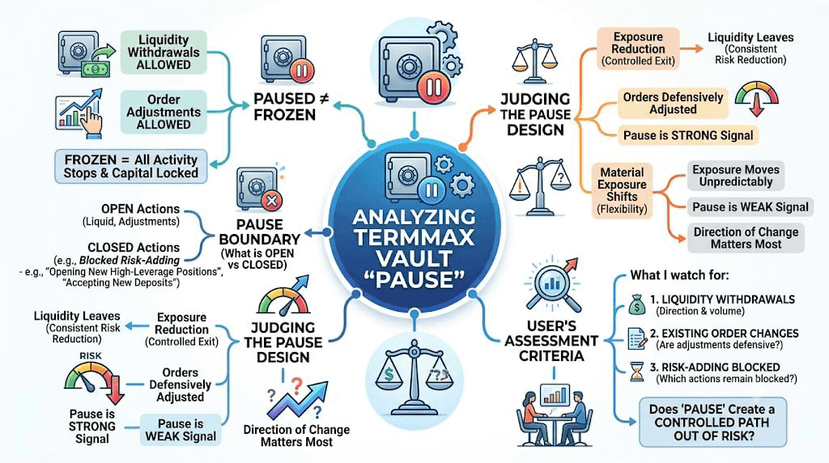
A paused TermMax vault is not the same thing as a frozen vault.
Even after a vault is paused, TermMax still allows liquidity to be withdrawn and existing orders in its fixed-rate lending markets to be adjusted. In other words, normal activity can stop without locking every part of the vault's balance sheet in place.
That makes the pause boundary more interesting than the label itself.
What I don't know yet is whether the actions TermMax leaves open during a pause consistently reduce exposure, or can also materially reshape it in ways that are not obviously defensive.
Keeping withdrawals open makes sense because capital may need a way out. Adjusting existing orders is more nuanced, since those changes can still affect where the vault's liquidity sits and how exposed it remains to the market.
The pause flag tells me the operating mode. The more useful evidence is what happens to exposure after that mode is activated.
If liquidity leaves and outstanding orders are adjusted in ways that consistently reduce risk, the pause is doing more than changing a label. If exposure can still shift materially in either direction, “paused” becomes a weaker signal than it first appears.
That is how I would judge TermMax's pause design: by the direction of the changes it still allows, not simply by whether the vault reports itself as paused.
The question is whether pause mode creates a controlled path out of risk, or still leaves enough flexibility for the vault's exposure to move in ways users may not expect.
I am watching liquidity withdrawals, changes to existing orders, and which risk-adding actions remain blocked during a pause.
@termmax #TermMax
$PIEVERSE
A paused TermMax vault is not the same thing as a frozen vault.
Even after a vault is paused, TermMax still allows liquidity to be withdrawn and existing orders in its fixed-rate lending markets to be adjusted. In other words, normal activity can stop without locking every part of the vault's balance sheet in place.
That makes the pause boundary more interesting than the label itself.
What I don't know yet is whether the actions TermMax leaves open during a pause consistently reduce exposure, or can also materially reshape it in ways that are not obviously defensive.
Keeping withdrawals open makes sense because capital may need a way out. Adjusting existing orders is more nuanced, since those changes can still affect where the vault's liquidity sits and how exposed it remains to the market.
The pause flag tells me the operating mode. The more useful evidence is what happens to exposure after that mode is activated.
If liquidity leaves and outstanding orders are adjusted in ways that consistently reduce risk, the pause is doing more than changing a label. If exposure can still shift materially in either direction, “paused” becomes a weaker signal than it first appears.
That is how I would judge TermMax's pause design: by the direction of the changes it still allows, not simply by whether the vault reports itself as paused.
The question is whether pause mode creates a controlled path out of risk, or still leaves enough flexibility for the vault's exposure to move in ways users may not expect.
I am watching liquidity withdrawals, changes to existing orders, and which risk-adding actions remain blocked during a pause.
@TermMax #TermMax
$PIEVERSE
Even after a vault is paused, TermMax still allows liquidity to be withdrawn and existing orders in its fixed-rate lending markets to be adjusted. In other words, normal activity can stop without locking every part of the vault's balance sheet in place.
That makes the pause boundary more interesting than the label itself.
What I don't know yet is whether the actions TermMax leaves open during a pause consistently reduce exposure, or can also materially reshape it in ways that are not obviously defensive.
Keeping withdrawals open makes sense because capital may need a way out. Adjusting existing orders is more nuanced, since those changes can still affect where the vault's liquidity sits and how exposed it remains to the market.
The pause flag tells me the operating mode. The more useful evidence is what happens to exposure after that mode is activated.
If liquidity leaves and outstanding orders are adjusted in ways that consistently reduce risk, the pause is doing more than changing a label. If exposure can still shift materially in either direction, “paused” becomes a weaker signal than it first appears.
That is how I would judge TermMax's pause design: by the direction of the changes it still allows, not simply by whether the vault reports itself as paused.
The question is whether pause mode creates a controlled path out of risk, or still leaves enough flexibility for the vault's exposure to move in ways users may not expect.
I am watching liquidity withdrawals, changes to existing orders, and which risk-adding actions remain blocked during a pause.
@TermMax #TermMax
$PIEVERSE
149
·
--
Tokenizing a security is the easy part. Getting that security to move safely between chains, and getting reliable exchange data on-chain without a single point of failure, is where most RWA projects quietly stall. That's the gap Dusk Network just addressed by integrating Chainlink's infrastructure.
The partnership brings two Chainlink products into Dusk Network's stack. CCIP, the Cross-Chain Interoperability Protocol, becomes the canonical bridge for tokenized NPEX assets, letting securities issued on DuskEVM move and remain composable across other DeFi ecosystems without relying on custom, unaudited bridge code. DataLink becomes the exclusive on-chain oracle for NPEX exchange data, delivering low-latency, institutional-grade feeds directly to smart contracts. On top of that, DUSK itself gains native cross-chain transfer capability between Ethereum and Solana through Chainlink's Cross-Chain Token standard, rather than relying on wrapped representations.
Why does this matter more than a typical oracle integration announcement? Because NPEX already represents over €200 million in real securities. Data integrity and safe cross-chain movement aren't optional for that kind of asset base, they're baseline requirements before any institution treats on-chain settlement as equivalent to traditional rails. Those same DuskEVM-issued assets can also route through Hedger for confidential transaction flows when an institution wants that layer of privacy alongside the cross-chain reach.
My honest reservation: interoperability infrastructure is only as valuable as the liquidity flowing through it. Plenty of chains have announced Chainlink integrations that mostly sit idle from thin cross-chain demand. Dusk Network has a real anchor asset base behind this one, which gives it better odds than most, but odds aren't outcomes.
I'll be watching CCIP transaction volume on Dusk Network's tokenized assets, not the announcement, to see if this integration earns its keep.
@Dusk_Foundation $DUSK #dusk
Tokenizing a security is the easy part. Getting that security to move safely between chains, and getting reliable exchange data on-chain without a single point of failure, is where most RWA projects quietly stall. That's the gap Dusk Network just addressed by integrating Chainlink's infrastructure.
The partnership brings two Chainlink products into Dusk Network's stack. CCIP, the Cross-Chain Interoperability Protocol, becomes the canonical bridge for tokenized NPEX assets, letting securities issued on DuskEVM move and remain composable across other DeFi ecosystems without relying on custom, unaudited bridge code. DataLink becomes the exclusive on-chain oracle for NPEX exchange data, delivering low-latency, institutional-grade feeds directly to smart contracts. On top of that, DUSK itself gains native cross-chain transfer capability between Ethereum and Solana through Chainlink's Cross-Chain Token standard, rather than relying on wrapped representations.
Why does this matter more than a typical oracle integration announcement? Because NPEX already represents over €200 million in real securities. Data integrity and safe cross-chain movement aren't optional for that kind of asset base, they're baseline requirements before any institution treats on-chain settlement as equivalent to traditional rails. Those same DuskEVM-issued assets can also route through Hedger for confidential transaction flows when an institution wants that layer of privacy alongside the cross-chain reach.
My honest reservation: interoperability infrastructure is only as valuable as the liquidity flowing through it. Plenty of chains have announced Chainlink integrations that mostly sit idle from thin cross-chain demand. Dusk Network has a real anchor asset base behind this one, which gives it better odds than most, but odds aren't outcomes.
I'll be watching CCIP transaction volume on Dusk Network's tokenized assets, not the announcement, to see if this integration earns its keep.
@Dusk $DUSK #dusk
The partnership brings two Chainlink products into Dusk Network's stack. CCIP, the Cross-Chain Interoperability Protocol, becomes the canonical bridge for tokenized NPEX assets, letting securities issued on DuskEVM move and remain composable across other DeFi ecosystems without relying on custom, unaudited bridge code. DataLink becomes the exclusive on-chain oracle for NPEX exchange data, delivering low-latency, institutional-grade feeds directly to smart contracts. On top of that, DUSK itself gains native cross-chain transfer capability between Ethereum and Solana through Chainlink's Cross-Chain Token standard, rather than relying on wrapped representations.
Why does this matter more than a typical oracle integration announcement? Because NPEX already represents over €200 million in real securities. Data integrity and safe cross-chain movement aren't optional for that kind of asset base, they're baseline requirements before any institution treats on-chain settlement as equivalent to traditional rails. Those same DuskEVM-issued assets can also route through Hedger for confidential transaction flows when an institution wants that layer of privacy alongside the cross-chain reach.
My honest reservation: interoperability infrastructure is only as valuable as the liquidity flowing through it. Plenty of chains have announced Chainlink integrations that mostly sit idle from thin cross-chain demand. Dusk Network has a real anchor asset base behind this one, which gives it better odds than most, but odds aren't outcomes.
I'll be watching CCIP transaction volume on Dusk Network's tokenized assets, not the announcement, to see if this integration earns its keep.
@Dusk $DUSK #dusk
52
·
--
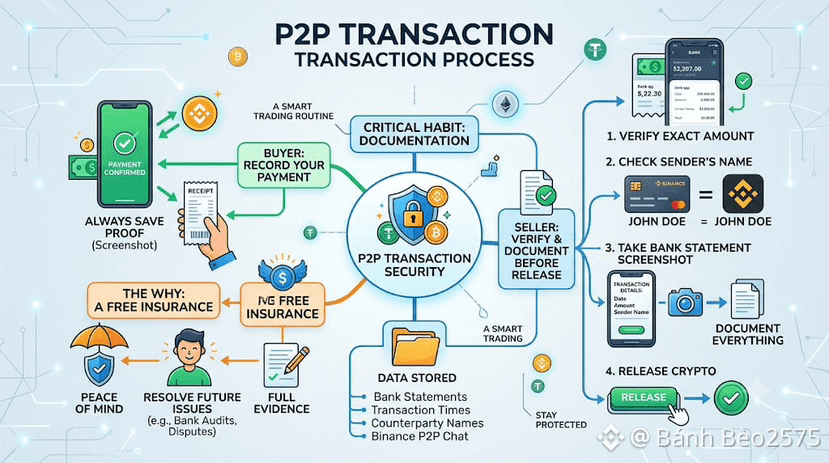
After many P2P trades on Binance, I formed a small but—at least to me—very important habit: before I press “release crypto,” I always take a photo of the bank statement clearly showing the exact amount I just received, the transaction time, and the name of the sender.
This habit started when I received a payment for the exact amount, but a few days later my bank sent a review notice because they suspected unusual activity related to the sender’s account. I was quite worried because I wasn’t sure whether I needed to provide any additional information. Luckily, I had already saved photos of the entire statement along with the confirmation chat from the Binance P2P platform, so when I needed to cross-check, I had all the data to explain everything clearly.
From then on, I always follow the same three-step process before releasing: first, check whether the amount matches exactly; second, check whether the sender’s name matches the partner name registered on the platform; and finally, save the bank statement photo as evidence before completing the transaction.
Many people might think that saving these records is unnecessary if the transaction goes smoothly, but I see it as a form of free insurance. It doesn’t take much additional time, yet it helps me feel far more at ease in case something comes up later—whether from the bank side or from the Binance P2P transaction itself.
When I act as the buyer, I apply a similar habit: I always save my own transfer confirmation right after I make the payment. Having complete data from both sides helps me feel more confident if, at any point, I need to cross-check again.
@Binance_Vietnam #BinanceP2PAnToan
$BOME $PNUT
After many P2P trades on Binance, I formed a small but—at least to me—very important habit: before I press “release crypto,” I always take a photo of the bank statement clearly showing the exact amount I just received, the transaction time, and the name of the sender.
This habit started when I received a payment for the exact amount, but a few days later my bank sent a review notice because they suspected unusual activity related to the sender’s account. I was quite worried because I wasn’t sure whether I needed to provide any additional information. Luckily, I had already saved photos of the entire statement along with the confirmation chat from the Binance P2P platform, so when I needed to cross-check, I had all the data to explain everything clearly.
From then on, I always follow the same three-step process before releasing: first, check whether the amount matches exactly; second, check whether the sender’s name matches the partner name registered on the platform; and finally, save the bank statement photo as evidence before completing the transaction.
Many people might think that saving these records is unnecessary if the transaction goes smoothly, but I see it as a form of free insurance. It doesn’t take much additional time, yet it helps me feel far more at ease in case something comes up later—whether from the bank side or from the Binance P2P transaction itself.
When I act as the buyer, I apply a similar habit: I always save my own transfer confirmation right after I make the payment. Having complete data from both sides helps me feel more confident if, at any point, I need to cross-check again.
@Binance Vietnam #BinanceP2PAnToan
$BOME $PNUT
This habit started when I received a payment for the exact amount, but a few days later my bank sent a review notice because they suspected unusual activity related to the sender’s account. I was quite worried because I wasn’t sure whether I needed to provide any additional information. Luckily, I had already saved photos of the entire statement along with the confirmation chat from the Binance P2P platform, so when I needed to cross-check, I had all the data to explain everything clearly.
From then on, I always follow the same three-step process before releasing: first, check whether the amount matches exactly; second, check whether the sender’s name matches the partner name registered on the platform; and finally, save the bank statement photo as evidence before completing the transaction.
Many people might think that saving these records is unnecessary if the transaction goes smoothly, but I see it as a form of free insurance. It doesn’t take much additional time, yet it helps me feel far more at ease in case something comes up later—whether from the bank side or from the Binance P2P transaction itself.
When I act as the buyer, I apply a similar habit: I always save my own transfer confirmation right after I make the payment. Having complete data from both sides helps me feel more confident if, at any point, I need to cross-check again.
@Binance Vietnam #BinanceP2PAnToan
$BOME $PNUT
220
·
--
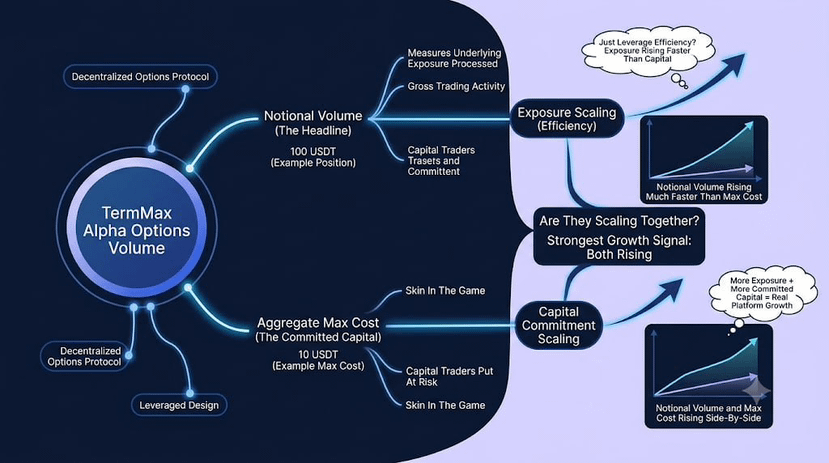
One TermMax Alpha example keeps standing out to me: a 100 USDT notional option position can have an actual Max Cost of just 10 USDT.
For TermMax, a decentralized options trading protocol, that makes the headline trading volume more interesting than it first appears.
Notional volume tells me how much underlying exposure TermMax is processing. It does not tell me how much capital traders are actually putting at risk to create that exposure. In Alpha, leverage is part of the design, so the two can diverge quite naturally.
TermMax's own example makes the gap clearer. A trader can open 100 USDT of notional exposure with 10 USDT of Max Cost, then add another 100 USDT to cumulative volume when that same position is closed.
What I don't know yet is whether growth in Alpha's notional volume is being matched by growth in the capital traders are willing to commit, or whether exposure is scaling much faster than the risk capital behind it.
That is not necessarily a weakness. Generating more exposure from each unit of capital is part of what leveraged options are designed to do.
The stronger signal would be whether rising notional is accompanied by rising aggregate Max Cost. That would show TermMax is not only creating more exposure per unit of capital, but also attracting more capital into Alpha itself.
I'd learn more from notional volume rising alongside aggregate Max Cost than from a much larger notional figure on its own.
The question is whether TermMax Alpha is scaling only the amount of exposure it can generate, or also the amount of capital traders are willing to put behind it.
I am watching notional volume, aggregate Max Cost and how the relationship between the two changes as Alpha grows.
@termmax #TermMax
$BOME
One TermMax Alpha example keeps standing out to me: a 100 USDT notional option position can have an actual Max Cost of just 10 USDT.
For TermMax, a decentralized options trading protocol, that makes the headline trading volume more interesting than it first appears.
Notional volume tells me how much underlying exposure TermMax is processing. It does not tell me how much capital traders are actually putting at risk to create that exposure. In Alpha, leverage is part of the design, so the two can diverge quite naturally.
TermMax's own example makes the gap clearer. A trader can open 100 USDT of notional exposure with 10 USDT of Max Cost, then add another 100 USDT to cumulative volume when that same position is closed.
What I don't know yet is whether growth in Alpha's notional volume is being matched by growth in the capital traders are willing to commit, or whether exposure is scaling much faster than the risk capital behind it.
That is not necessarily a weakness. Generating more exposure from each unit of capital is part of what leveraged options are designed to do.
The stronger signal would be whether rising notional is accompanied by rising aggregate Max Cost. That would show TermMax is not only creating more exposure per unit of capital, but also attracting more capital into Alpha itself.
I'd learn more from notional volume rising alongside aggregate Max Cost than from a much larger notional figure on its own.
The question is whether TermMax Alpha is scaling only the amount of exposure it can generate, or also the amount of capital traders are willing to put behind it.
I am watching notional volume, aggregate Max Cost and how the relationship between the two changes as Alpha grows.
@TermMax #TermMax
$BOME
For TermMax, a decentralized options trading protocol, that makes the headline trading volume more interesting than it first appears.
Notional volume tells me how much underlying exposure TermMax is processing. It does not tell me how much capital traders are actually putting at risk to create that exposure. In Alpha, leverage is part of the design, so the two can diverge quite naturally.
TermMax's own example makes the gap clearer. A trader can open 100 USDT of notional exposure with 10 USDT of Max Cost, then add another 100 USDT to cumulative volume when that same position is closed.
What I don't know yet is whether growth in Alpha's notional volume is being matched by growth in the capital traders are willing to commit, or whether exposure is scaling much faster than the risk capital behind it.
That is not necessarily a weakness. Generating more exposure from each unit of capital is part of what leveraged options are designed to do.
The stronger signal would be whether rising notional is accompanied by rising aggregate Max Cost. That would show TermMax is not only creating more exposure per unit of capital, but also attracting more capital into Alpha itself.
I'd learn more from notional volume rising alongside aggregate Max Cost than from a much larger notional figure on its own.
The question is whether TermMax Alpha is scaling only the amount of exposure it can generate, or also the amount of capital traders are willing to put behind it.
I am watching notional volume, aggregate Max Cost and how the relationship between the two changes as Alpha grows.
@TermMax #TermMax
$BOME
175
·
--
Nobody wants to publish a document listing every serious flaw an auditor found in their own protocol. Dusk Network did exactly that with AEGIS, its largest hard fork since mainnet launch, and I think the decision to be this transparent is worth more attention than the bugs themselves.
AEGIS shipped fixes for 39 findings, 7 of them classified as critical, tracing back to 4 root causes: unsound memory ownership in the Piecrust virtual machine sandbox that could let two honest nodes silently compute different results from the same code, unsafe deserialization of untrusted data on the host side, a Phoenix fee and refund binding gap that could have enabled supply inflation or halted the chain outright, and a BLS signature construction that could have permitted forgery from a single observed signature. Dusk stated plainly it found no evidence any of these were exploited before the fix shipped, and the fixes went further than patching symptoms, reworking ownership models, enforcing checks at both mempool admission and VM execution instead of one layer alone, and migrating to a proper RFC 9380 style hash to curve construction for BLS with explicit domain separation.
What stands out to me is the framing throughout the writeup. Dusk repeatedly separates mitigation from root cause removal and treats both as necessary, a level of engineering discipline you don't see described publicly very often.
I won't pretend this is only good news. A cluster of critical, chain level vulnerabilities existing at all on a live financial protocol is a serious finding, audit or not. Coordinating a hard fork of this size across a live validator set, without tipping off anyone who might exploit the findings first, is its own quiet engineering achievement that rarely gets credit.
DUSK secures a protocol that just got meaningfully harder to break.
@Dusk_Foundation $DUSK #dusk
$BTW
Nobody wants to publish a document listing every serious flaw an auditor found in their own protocol. Dusk Network did exactly that with AEGIS, its largest hard fork since mainnet launch, and I think the decision to be this transparent is worth more attention than the bugs themselves.
AEGIS shipped fixes for 39 findings, 7 of them classified as critical, tracing back to 4 root causes: unsound memory ownership in the Piecrust virtual machine sandbox that could let two honest nodes silently compute different results from the same code, unsafe deserialization of untrusted data on the host side, a Phoenix fee and refund binding gap that could have enabled supply inflation or halted the chain outright, and a BLS signature construction that could have permitted forgery from a single observed signature. Dusk stated plainly it found no evidence any of these were exploited before the fix shipped, and the fixes went further than patching symptoms, reworking ownership models, enforcing checks at both mempool admission and VM execution instead of one layer alone, and migrating to a proper RFC 9380 style hash to curve construction for BLS with explicit domain separation.
What stands out to me is the framing throughout the writeup. Dusk repeatedly separates mitigation from root cause removal and treats both as necessary, a level of engineering discipline you don't see described publicly very often.
I won't pretend this is only good news. A cluster of critical, chain level vulnerabilities existing at all on a live financial protocol is a serious finding, audit or not. Coordinating a hard fork of this size across a live validator set, without tipping off anyone who might exploit the findings first, is its own quiet engineering achievement that rarely gets credit.
DUSK secures a protocol that just got meaningfully harder to break.
@Dusk $DUSK #dusk
$BTW
AEGIS shipped fixes for 39 findings, 7 of them classified as critical, tracing back to 4 root causes: unsound memory ownership in the Piecrust virtual machine sandbox that could let two honest nodes silently compute different results from the same code, unsafe deserialization of untrusted data on the host side, a Phoenix fee and refund binding gap that could have enabled supply inflation or halted the chain outright, and a BLS signature construction that could have permitted forgery from a single observed signature. Dusk stated plainly it found no evidence any of these were exploited before the fix shipped, and the fixes went further than patching symptoms, reworking ownership models, enforcing checks at both mempool admission and VM execution instead of one layer alone, and migrating to a proper RFC 9380 style hash to curve construction for BLS with explicit domain separation.
What stands out to me is the framing throughout the writeup. Dusk repeatedly separates mitigation from root cause removal and treats both as necessary, a level of engineering discipline you don't see described publicly very often.
I won't pretend this is only good news. A cluster of critical, chain level vulnerabilities existing at all on a live financial protocol is a serious finding, audit or not. Coordinating a hard fork of this size across a live validator set, without tipping off anyone who might exploit the findings first, is its own quiet engineering achievement that rarely gets credit.
DUSK secures a protocol that just got meaningfully harder to break.
@Dusk $DUSK #dusk
$BTW
59
·
--
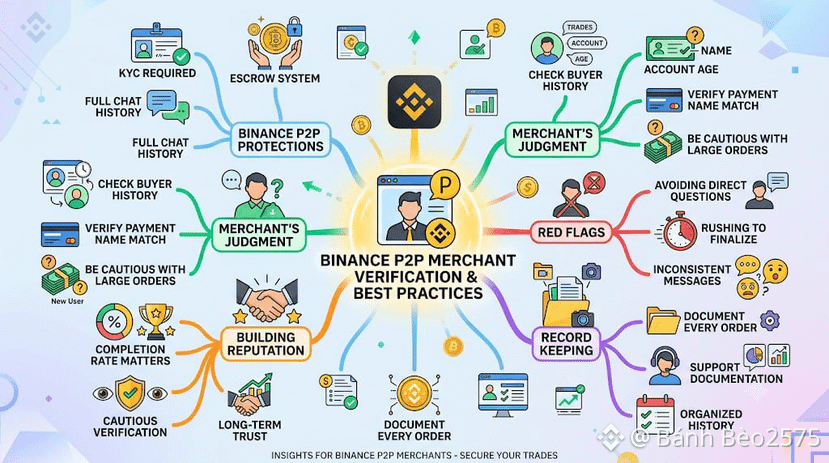
Running a merchant account on Binance P2P changed how I think about verification, mostly because the responsibility works in both directions. Binance P2P protects merchants too, through KYC on every account, escrow that holds the crypto asset until an order is confirmed, and a full chat record that becomes useful if a dispute ever needs review. But those protections work best alongside a merchant's own judgment, especially when a buyer places a larger order than usual.
Before accepting any sizable order, I check the buyer's account history: how many trades they have completed, how long the account has existed, and whether their payment method name matches what shows on their profile. A first time buyer placing an unusually large order is not automatically suspicious, but it does mean I slow down and pay closer attention to every message that follows, rather than treating it the same as a routine small trade.
The clearest red flag I watch for is a buyer who avoids answering direct questions in chat or pushes to finalize the trade unusually fast. When that happens, I ask specific, simple questions, like confirming the exact amount and the name on their transfer, and a genuine buyer answers without hesitation. I also keep detailed records of every completed order as a merchant, since Binance support has asked for exactly that kind of documentation before, and having it organized has made every one of those conversations faster to resolve.
Running a merchant account also means my own reputation is on the line with every order I accept, so being cautious is not just about protecting one transaction, it protects every future buyer who looks at my history before deciding to trade with me. A completion rate built on careful verification, even if it occasionally means walking away from an order, matters more to me than closing every single trade that comes through Binance P2P.
@Binance_Vietnam #BinanceP2PAnToan
$BTW $ACE
Running a merchant account on Binance P2P changed how I think about verification, mostly because the responsibility works in both directions. Binance P2P protects merchants too, through KYC on every account, escrow that holds the crypto asset until an order is confirmed, and a full chat record that becomes useful if a dispute ever needs review. But those protections work best alongside a merchant's own judgment, especially when a buyer places a larger order than usual.
Before accepting any sizable order, I check the buyer's account history: how many trades they have completed, how long the account has existed, and whether their payment method name matches what shows on their profile. A first time buyer placing an unusually large order is not automatically suspicious, but it does mean I slow down and pay closer attention to every message that follows, rather than treating it the same as a routine small trade.
The clearest red flag I watch for is a buyer who avoids answering direct questions in chat or pushes to finalize the trade unusually fast. When that happens, I ask specific, simple questions, like confirming the exact amount and the name on their transfer, and a genuine buyer answers without hesitation. I also keep detailed records of every completed order as a merchant, since Binance support has asked for exactly that kind of documentation before, and having it organized has made every one of those conversations faster to resolve.
Running a merchant account also means my own reputation is on the line with every order I accept, so being cautious is not just about protecting one transaction, it protects every future buyer who looks at my history before deciding to trade with me. A completion rate built on careful verification, even if it occasionally means walking away from an order, matters more to me than closing every single trade that comes through Binance P2P.
@Binance Vietnam #BinanceP2PAnToan
$BTW $ACE
Before accepting any sizable order, I check the buyer's account history: how many trades they have completed, how long the account has existed, and whether their payment method name matches what shows on their profile. A first time buyer placing an unusually large order is not automatically suspicious, but it does mean I slow down and pay closer attention to every message that follows, rather than treating it the same as a routine small trade.
The clearest red flag I watch for is a buyer who avoids answering direct questions in chat or pushes to finalize the trade unusually fast. When that happens, I ask specific, simple questions, like confirming the exact amount and the name on their transfer, and a genuine buyer answers without hesitation. I also keep detailed records of every completed order as a merchant, since Binance support has asked for exactly that kind of documentation before, and having it organized has made every one of those conversations faster to resolve.
Running a merchant account also means my own reputation is on the line with every order I accept, so being cautious is not just about protecting one transaction, it protects every future buyer who looks at my history before deciding to trade with me. A completion rate built on careful verification, even if it occasionally means walking away from an order, matters more to me than closing every single trade that comes through Binance P2P.
@Binance Vietnam #BinanceP2PAnToan
$BTW $ACE
53
·
--
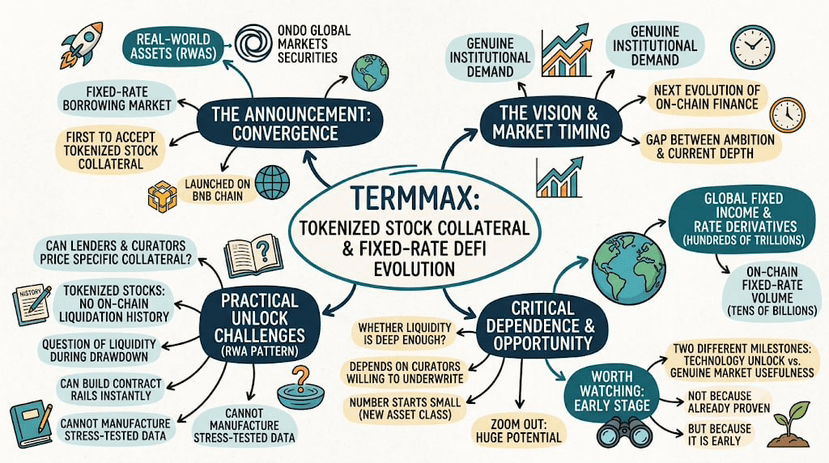
TermMax announced the first fixed-rate borrowing market accepting tokenized stock collateral, built on Ondo's Global Markets tokenized securities and launched on BNB Chain. The framing was big: the convergence of real-world assets and fixed-rate DeFi as the next evolution of on-chain finance. I do not doubt the ambition, and the timing lines up with genuine institutional demand for fixed-rate products after two months of unusual market volatility. I do question how much of that unlock exists yet in practice.
A fixed-rate borrowing market against tokenized equities only functions if lenders and curators actually show up to price that specific collateral type. Tokenized stocks have almost no on-chain liquidation history. No one has watched how deep the market actually is when a tokenized equity needs to be sold fast during a drawdown, because that scenario has barely happened on-chain yet. TermMax can build the smart contract rails for this instantly. It cannot manufacture years of stress-tested liquidity data the same way, no matter how well-engineered the market itself is.
This is the general pattern with every new RWA integration, not a TermMax-specific flaw. The announcement unlocks the possibility of fixed-rate liquidity against tokenized securities. Whether that liquidity is deep enough to matter for a meaningful loan size depends entirely on how many curators are willing to underwrite an asset class this new, and that number starts small no matter how good the integration is. Zoom out and the opportunity is real: global fixed income and rate derivatives markets run into the hundreds of trillions of dollars, while on-chain fixed-rate volume is still measured in the tens of billions at most, so the gap between ambition and current depth is the gap this whole category is trying to close.
I think this market is worth watching specifically because it is early, not because it is already proven. The technology unlocking tokenized stock collateral and the market depth needed to make it genuinely useful are two different milestones.
@termmax #TermMax
$BTW $ACE
TermMax announced the first fixed-rate borrowing market accepting tokenized stock collateral, built on Ondo's Global Markets tokenized securities and launched on BNB Chain. The framing was big: the convergence of real-world assets and fixed-rate DeFi as the next evolution of on-chain finance. I do not doubt the ambition, and the timing lines up with genuine institutional demand for fixed-rate products after two months of unusual market volatility. I do question how much of that unlock exists yet in practice.
A fixed-rate borrowing market against tokenized equities only functions if lenders and curators actually show up to price that specific collateral type. Tokenized stocks have almost no on-chain liquidation history. No one has watched how deep the market actually is when a tokenized equity needs to be sold fast during a drawdown, because that scenario has barely happened on-chain yet. TermMax can build the smart contract rails for this instantly. It cannot manufacture years of stress-tested liquidity data the same way, no matter how well-engineered the market itself is.
This is the general pattern with every new RWA integration, not a TermMax-specific flaw. The announcement unlocks the possibility of fixed-rate liquidity against tokenized securities. Whether that liquidity is deep enough to matter for a meaningful loan size depends entirely on how many curators are willing to underwrite an asset class this new, and that number starts small no matter how good the integration is. Zoom out and the opportunity is real: global fixed income and rate derivatives markets run into the hundreds of trillions of dollars, while on-chain fixed-rate volume is still measured in the tens of billions at most, so the gap between ambition and current depth is the gap this whole category is trying to close.
I think this market is worth watching specifically because it is early, not because it is already proven. The technology unlocking tokenized stock collateral and the market depth needed to make it genuinely useful are two different milestones.
@TermMax #TermMax
$BTW $ACE
A fixed-rate borrowing market against tokenized equities only functions if lenders and curators actually show up to price that specific collateral type. Tokenized stocks have almost no on-chain liquidation history. No one has watched how deep the market actually is when a tokenized equity needs to be sold fast during a drawdown, because that scenario has barely happened on-chain yet. TermMax can build the smart contract rails for this instantly. It cannot manufacture years of stress-tested liquidity data the same way, no matter how well-engineered the market itself is.
This is the general pattern with every new RWA integration, not a TermMax-specific flaw. The announcement unlocks the possibility of fixed-rate liquidity against tokenized securities. Whether that liquidity is deep enough to matter for a meaningful loan size depends entirely on how many curators are willing to underwrite an asset class this new, and that number starts small no matter how good the integration is. Zoom out and the opportunity is real: global fixed income and rate derivatives markets run into the hundreds of trillions of dollars, while on-chain fixed-rate volume is still measured in the tens of billions at most, so the gap between ambition and current depth is the gap this whole category is trying to close.
I think this market is worth watching specifically because it is early, not because it is already proven. The technology unlocking tokenized stock collateral and the market depth needed to make it genuinely useful are two different milestones.
@TermMax #TermMax
$BTW $ACE
208
·
--
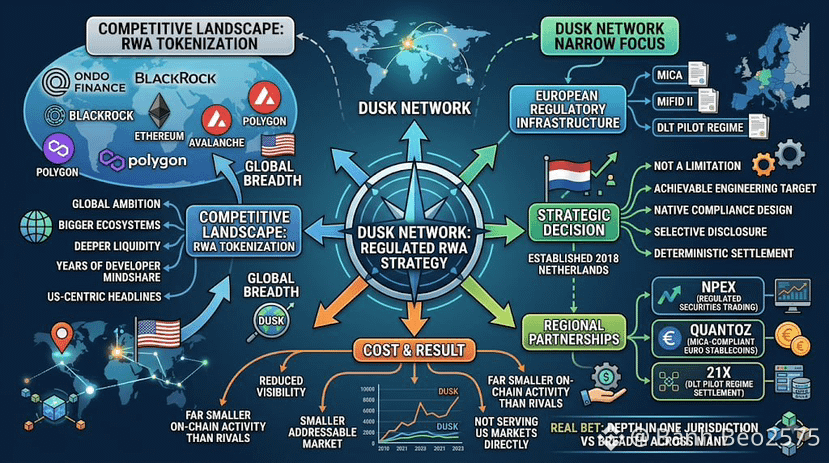
Dusk Network is chasing real-world-asset tokenization in a field where Ondo Finance gets the BlackRock headlines and Ethereum, Avalanche, and Polygon all bring bigger ecosystems, deeper liquidity, and years of developer mindshare to the fight. Against that backdrop, it made a decision that looks almost stubborn from the outside: stay narrowly focused on regulated European financial infrastructure, specifically MiCA, MiFID II, and the DLT Pilot Regime, instead of positioning itself as a general home for RWA tokenization worldwide the way its larger rivals do. Dusk Network was founded in 2018 out of the Netherlands, the same country NPEX and its regulator operate in, and that regional starting point shows up directly in which frameworks the protocol was actually designed around from day one rather than added later as a marketing angle.
I think that narrowness is the actual strategy rather than a limitation the team has not gotten around to fixing yet. Building compliance logic, selective disclosure, and deterministic settlement around one well-defined regulatory framework is a smaller, more achievable engineering target than trying to satisfy US, EU, and Asian securities regulators all at once from a single protocol. The partnerships that resulted, NPEX for regulated securities trading, Quantoz for MiCA-compliant euro stablecoins, 21X for DLT Pilot Regime settlement, all sit inside that one region's rulebook rather than spanning several different legal systems simultaneously.
The cost of that focus is visibility and addressable market size. Dusk Network's total on-chain activity remains far smaller than Ondo's or Ethereum's RWA volume, and every headline about US tokenization frameworks moving forward is, for now, a market Dusk Network's current architecture is not built to serve directly. Depth in one jurisdiction instead of breadth across many is a real bet, and it has not paid off in visible market share yet.
@Dusk_Foundation $DUSK #dusk
Dusk Network is chasing real-world-asset tokenization in a field where Ondo Finance gets the BlackRock headlines and Ethereum, Avalanche, and Polygon all bring bigger ecosystems, deeper liquidity, and years of developer mindshare to the fight. Against that backdrop, it made a decision that looks almost stubborn from the outside: stay narrowly focused on regulated European financial infrastructure, specifically MiCA, MiFID II, and the DLT Pilot Regime, instead of positioning itself as a general home for RWA tokenization worldwide the way its larger rivals do. Dusk Network was founded in 2018 out of the Netherlands, the same country NPEX and its regulator operate in, and that regional starting point shows up directly in which frameworks the protocol was actually designed around from day one rather than added later as a marketing angle.
I think that narrowness is the actual strategy rather than a limitation the team has not gotten around to fixing yet. Building compliance logic, selective disclosure, and deterministic settlement around one well-defined regulatory framework is a smaller, more achievable engineering target than trying to satisfy US, EU, and Asian securities regulators all at once from a single protocol. The partnerships that resulted, NPEX for regulated securities trading, Quantoz for MiCA-compliant euro stablecoins, 21X for DLT Pilot Regime settlement, all sit inside that one region's rulebook rather than spanning several different legal systems simultaneously.
The cost of that focus is visibility and addressable market size. Dusk Network's total on-chain activity remains far smaller than Ondo's or Ethereum's RWA volume, and every headline about US tokenization frameworks moving forward is, for now, a market Dusk Network's current architecture is not built to serve directly. Depth in one jurisdiction instead of breadth across many is a real bet, and it has not paid off in visible market share yet.
@Dusk $DUSK #dusk
I think that narrowness is the actual strategy rather than a limitation the team has not gotten around to fixing yet. Building compliance logic, selective disclosure, and deterministic settlement around one well-defined regulatory framework is a smaller, more achievable engineering target than trying to satisfy US, EU, and Asian securities regulators all at once from a single protocol. The partnerships that resulted, NPEX for regulated securities trading, Quantoz for MiCA-compliant euro stablecoins, 21X for DLT Pilot Regime settlement, all sit inside that one region's rulebook rather than spanning several different legal systems simultaneously.
The cost of that focus is visibility and addressable market size. Dusk Network's total on-chain activity remains far smaller than Ondo's or Ethereum's RWA volume, and every headline about US tokenization frameworks moving forward is, for now, a market Dusk Network's current architecture is not built to serve directly. Depth in one jurisdiction instead of breadth across many is a real bet, and it has not paid off in visible market share yet.
@Dusk $DUSK #dusk
7
58
·
--
I didn't think much about KYC levels on Binance P2P until I tried to complete a larger trade and hit a limit I didn't know existed. Turns out verification isn't just a one time checkbox, it's tiered, and each level unlocks higher trading limits along with, I'd argue, more reliable trading partners overall.
Binance P2P requires every account to pass identity verification before it can trade at all, which already filters out a huge amount of anonymous risk compared to trading crypto informally elsewhere. Moving to a higher verification tier adds more checks on the account, and in my experience, counterparties with fully completed higher tier verification tend to have more consistent trading histories, though that's never a substitute for checking their actual profile stats yourself.
Since upgrading my own verification, a few things changed in how I trade. I can access larger order sizes without the transaction getting flagged or delayed. I still check completion rate and total orders on any counterparty regardless of their verification tier, since KYC confirms identity, not trustworthiness in every single trade. I confirm payment in my own bank account before releasing crypto every time, no matter how verified the other side appears. And if anything about an order feels inconsistent with what a well established, verified account should look like, I contact Binance support rather than assuming higher verification means zero risk.
What surprised me most was how much smoother the support process felt too, once my own account carried a higher verification tier. Questions that used to take a day to resolve started getting answered within a few hours, which I suspect comes down to how much identity information was already on file. It's a small side benefit worth mentioning.
KYC is the foundation Binance P2P is built on, but it's one layer among several. Pairing it with your own verification habits is what actually keeps every trade safe.
@Binance_Vietnam #BinanceP2PAnToan
$TUT $BTW
I didn't think much about KYC levels on Binance P2P until I tried to complete a larger trade and hit a limit I didn't know existed. Turns out verification isn't just a one time checkbox, it's tiered, and each level unlocks higher trading limits along with, I'd argue, more reliable trading partners overall.
Binance P2P requires every account to pass identity verification before it can trade at all, which already filters out a huge amount of anonymous risk compared to trading crypto informally elsewhere. Moving to a higher verification tier adds more checks on the account, and in my experience, counterparties with fully completed higher tier verification tend to have more consistent trading histories, though that's never a substitute for checking their actual profile stats yourself.
Since upgrading my own verification, a few things changed in how I trade. I can access larger order sizes without the transaction getting flagged or delayed. I still check completion rate and total orders on any counterparty regardless of their verification tier, since KYC confirms identity, not trustworthiness in every single trade. I confirm payment in my own bank account before releasing crypto every time, no matter how verified the other side appears. And if anything about an order feels inconsistent with what a well established, verified account should look like, I contact Binance support rather than assuming higher verification means zero risk.
What surprised me most was how much smoother the support process felt too, once my own account carried a higher verification tier. Questions that used to take a day to resolve started getting answered within a few hours, which I suspect comes down to how much identity information was already on file. It's a small side benefit worth mentioning.
KYC is the foundation Binance P2P is built on, but it's one layer among several. Pairing it with your own verification habits is what actually keeps every trade safe.
@Binance Vietnam #BinanceP2PAnToan
$TUT $BTW
Binance P2P requires every account to pass identity verification before it can trade at all, which already filters out a huge amount of anonymous risk compared to trading crypto informally elsewhere. Moving to a higher verification tier adds more checks on the account, and in my experience, counterparties with fully completed higher tier verification tend to have more consistent trading histories, though that's never a substitute for checking their actual profile stats yourself.
Since upgrading my own verification, a few things changed in how I trade. I can access larger order sizes without the transaction getting flagged or delayed. I still check completion rate and total orders on any counterparty regardless of their verification tier, since KYC confirms identity, not trustworthiness in every single trade. I confirm payment in my own bank account before releasing crypto every time, no matter how verified the other side appears. And if anything about an order feels inconsistent with what a well established, verified account should look like, I contact Binance support rather than assuming higher verification means zero risk.
What surprised me most was how much smoother the support process felt too, once my own account carried a higher verification tier. Questions that used to take a day to resolve started getting answered within a few hours, which I suspect comes down to how much identity information was already on file. It's a small side benefit worth mentioning.
KYC is the foundation Binance P2P is built on, but it's one layer among several. Pairing it with your own verification habits is what actually keeps every trade safe.
@Binance Vietnam #BinanceP2PAnToan
$TUT $BTW
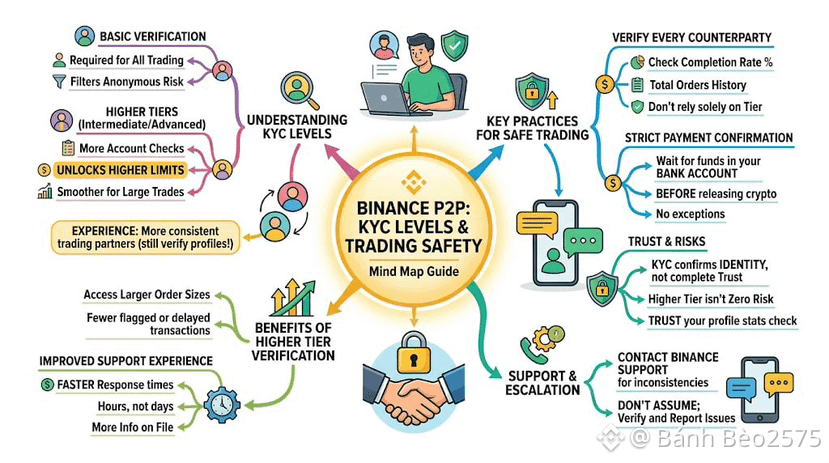
281
·
--
TermMax likes to open its pitch with a number that's hard to argue against: global fixed income markets run past $100 trillion, rate derivatives add another $600 trillion on top of that, and the entire on-chain fixed-rate category sits under $20 billion. On paper that's not a competitive market yet, it's an almost empty one relative to its offline counterpart, and TermMax positions itself as an early mover in that gap.
I don't dispute the macro numbers. What I want to sit with is the distance between that framing and where TermMax actually stands today. Total value locked has moved in a range roughly between the mid-30 millions and the high-40 millions of dollars across its history so far, spread across eight chains, with Ethereum still holding the large majority of that liquidity. Against a $20 billion on-chain fixed-rate category, TermMax is a meaningful but still small participant. Against $100 trillion in global fixed income, the current numbers round to statistically nothing.
That's not a criticism of the protocol's engineering, it's a statement about where any early-stage fixed-rate DeFi project sits relative to the market it's ultimately trying to address. Citing the total addressable market is fair context. Treating that number as evidence of current traction would be a mistake I don't think careful readers should make.
What actually matters for TermMax closing any part of that gap is whether daily active usage, currently in the range of tens of thousands of users, keeps compounding once incentive programs taper, and whether institutional integrations like the tokenized stock collateral markets bring in capital that behaves differently than incentive-driven retail deposits. The addressable market is real. Whether TermMax captures a meaningful slice of it is still an open question, not a settled one.
@termmax #TermMax
$TUT $BTW $PRL
TermMax likes to open its pitch with a number that's hard to argue against: global fixed income markets run past $100 trillion, rate derivatives add another $600 trillion on top of that, and the entire on-chain fixed-rate category sits under $20 billion. On paper that's not a competitive market yet, it's an almost empty one relative to its offline counterpart, and TermMax positions itself as an early mover in that gap.
I don't dispute the macro numbers. What I want to sit with is the distance between that framing and where TermMax actually stands today. Total value locked has moved in a range roughly between the mid-30 millions and the high-40 millions of dollars across its history so far, spread across eight chains, with Ethereum still holding the large majority of that liquidity. Against a $20 billion on-chain fixed-rate category, TermMax is a meaningful but still small participant. Against $100 trillion in global fixed income, the current numbers round to statistically nothing.
That's not a criticism of the protocol's engineering, it's a statement about where any early-stage fixed-rate DeFi project sits relative to the market it's ultimately trying to address. Citing the total addressable market is fair context. Treating that number as evidence of current traction would be a mistake I don't think careful readers should make.
What actually matters for TermMax closing any part of that gap is whether daily active usage, currently in the range of tens of thousands of users, keeps compounding once incentive programs taper, and whether institutional integrations like the tokenized stock collateral markets bring in capital that behaves differently than incentive-driven retail deposits. The addressable market is real. Whether TermMax captures a meaningful slice of it is still an open question, not a settled one.
@TermMax #TermMax
$TUT $BTW $PRL
I don't dispute the macro numbers. What I want to sit with is the distance between that framing and where TermMax actually stands today. Total value locked has moved in a range roughly between the mid-30 millions and the high-40 millions of dollars across its history so far, spread across eight chains, with Ethereum still holding the large majority of that liquidity. Against a $20 billion on-chain fixed-rate category, TermMax is a meaningful but still small participant. Against $100 trillion in global fixed income, the current numbers round to statistically nothing.
That's not a criticism of the protocol's engineering, it's a statement about where any early-stage fixed-rate DeFi project sits relative to the market it's ultimately trying to address. Citing the total addressable market is fair context. Treating that number as evidence of current traction would be a mistake I don't think careful readers should make.
What actually matters for TermMax closing any part of that gap is whether daily active usage, currently in the range of tens of thousands of users, keeps compounding once incentive programs taper, and whether institutional integrations like the tokenized stock collateral markets bring in capital that behaves differently than incentive-driven retail deposits. The addressable market is real. Whether TermMax captures a meaningful slice of it is still an open question, not a settled one.
@TermMax #TermMax
$TUT $BTW $PRL
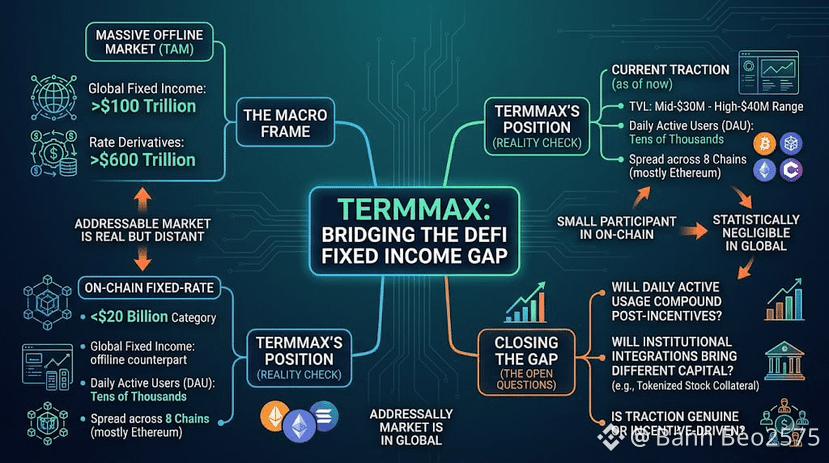
1
1
260
·
--
New DeFi protocol, small team, big claims: that combination has earned a specific and mostly deserved stereotype, one audit rushed out before launch, a bug bounty page that exists mostly for show, and a headline exploit within the first year that nobody saw coming because nobody was really looking. It's a pattern repeated often enough that skepticism toward any new lending protocol is a reasonable default position.
TermMax sits awkwardly inside that stereotype, mostly because it doesn't match the pattern on the specifics that actually matter. The protocol runs multiple rounds of audits through Spearbit's Cantina competitions rather than a single pre-launch review, keeps an active Immunefi bug bounty with critical vulnerability rewards reaching up to $50,000, and layers Hypernative's continuous on-chain monitoring on top of both, watching for suspicious activity in real time rather than relying purely on point in time reviews. TermMax reports a DeFiSafety PQR score of 93%, a figure the team explicitly compares to Aave V3, a protocol most of the industry treats as the security benchmark.
Governance security gets similar treatment: a 4 of 6 multi-signature wallet for critical admin functions, isolated markets so a problem in one collateral pair can't cascade into every other market on the protocol, asymmetric timelocks on risky parameter changes. None of that is unusual for the most established names in DeFi lending. It's genuinely uncommon for a protocol that only launched in April 2025.
Stacked audits and a high safety score reduce the odds of a specific class of failure without eliminating risk entirely, and TermMax's own risk disclosures say as much. What they do is put TermMax outside the "new and under scrutinized" bucket the stereotype assumes by default, a distinction worth making before writing off a young protocol on age alone.
@termmax #TermMax
$BTW $STBL $STAR
New DeFi protocol, small team, big claims: that combination has earned a specific and mostly deserved stereotype, one audit rushed out before launch, a bug bounty page that exists mostly for show, and a headline exploit within the first year that nobody saw coming because nobody was really looking. It's a pattern repeated often enough that skepticism toward any new lending protocol is a reasonable default position.
TermMax sits awkwardly inside that stereotype, mostly because it doesn't match the pattern on the specifics that actually matter. The protocol runs multiple rounds of audits through Spearbit's Cantina competitions rather than a single pre-launch review, keeps an active Immunefi bug bounty with critical vulnerability rewards reaching up to $50,000, and layers Hypernative's continuous on-chain monitoring on top of both, watching for suspicious activity in real time rather than relying purely on point in time reviews. TermMax reports a DeFiSafety PQR score of 93%, a figure the team explicitly compares to Aave V3, a protocol most of the industry treats as the security benchmark.
Governance security gets similar treatment: a 4 of 6 multi-signature wallet for critical admin functions, isolated markets so a problem in one collateral pair can't cascade into every other market on the protocol, asymmetric timelocks on risky parameter changes. None of that is unusual for the most established names in DeFi lending. It's genuinely uncommon for a protocol that only launched in April 2025.
Stacked audits and a high safety score reduce the odds of a specific class of failure without eliminating risk entirely, and TermMax's own risk disclosures say as much. What they do is put TermMax outside the "new and under scrutinized" bucket the stereotype assumes by default, a distinction worth making before writing off a young protocol on age alone.
@TermMax #TermMax
$BTW $STBL $STAR
TermMax sits awkwardly inside that stereotype, mostly because it doesn't match the pattern on the specifics that actually matter. The protocol runs multiple rounds of audits through Spearbit's Cantina competitions rather than a single pre-launch review, keeps an active Immunefi bug bounty with critical vulnerability rewards reaching up to $50,000, and layers Hypernative's continuous on-chain monitoring on top of both, watching for suspicious activity in real time rather than relying purely on point in time reviews. TermMax reports a DeFiSafety PQR score of 93%, a figure the team explicitly compares to Aave V3, a protocol most of the industry treats as the security benchmark.
Governance security gets similar treatment: a 4 of 6 multi-signature wallet for critical admin functions, isolated markets so a problem in one collateral pair can't cascade into every other market on the protocol, asymmetric timelocks on risky parameter changes. None of that is unusual for the most established names in DeFi lending. It's genuinely uncommon for a protocol that only launched in April 2025.
Stacked audits and a high safety score reduce the odds of a specific class of failure without eliminating risk entirely, and TermMax's own risk disclosures say as much. What they do is put TermMax outside the "new and under scrutinized" bucket the stereotype assumes by default, a distinction worth making before writing off a young protocol on age alone.
@TermMax #TermMax
$BTW $STBL $STAR
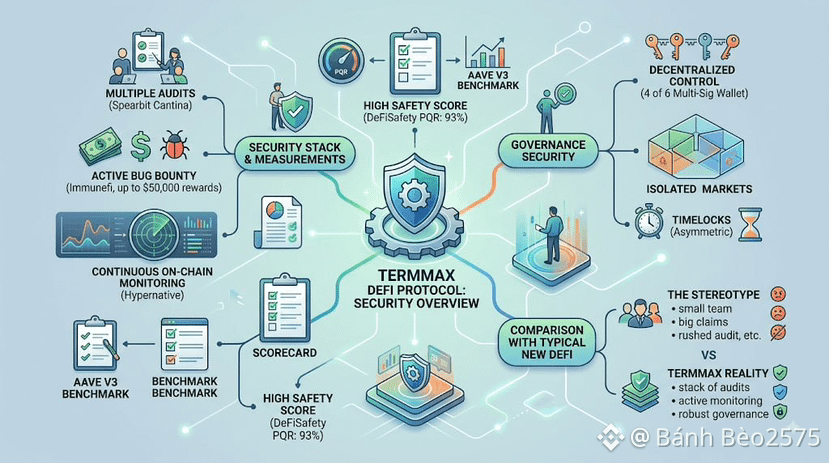
320
·
--
There's a familiar pattern in crypto: a small Layer-1 team announces a "partnership" that turns out to be a logo swap, a joint press release, and not much else once you look for actual on-chain activity behind it. That pattern has trained a lot of people, reasonably, to discount institutional partnership announcements from smaller projects almost on reflex. I understand the reflex. I don't think it holds up once I look closely at what Dusk Network actually built with NPEX.
This isn't a logo-swap arrangement. NPEX is a real, operating Dutch exchange licensed as a Multilateral Trading Facility, supervised by the Netherlands Authority for the Financial Markets, with a pre-existing business: over 200 million euros in financing facilitated for more than 100 companies before Dusk Network technology was ever involved. The 2 organizations are moving listed equities and bonds onto Dusk Network's infrastructure, not just discussing the idea, and have layered in Chainlink's CCIP for cross-chain interoperability and DataLink for verified market data on top of that relationship. Chainlink doesn't typically attach its infrastructure to partnerships that are announcement-only. That kind of technical layering takes real integration work on both sides, the sort of commitment a purely symbolic partnership rarely bothers to make.
So the stereotype doesn't hold here the way it holds for a lot of smaller chains chasing headlines. What I won't do is pretend landing a real partnership equals proving real usage at scale. NPEX brought genuine existing volume and a genuine license; Dusk Network still has to show meaningful transaction volume actually migrates onto its rails rather than staying on NPEX's traditional systems with Dusk Network as a technical layer underneath that most end investors never directly interact with. Real partnership, still-unproven scale. Both things are true right now, at the same time.
@Dusk_Foundation $DUSK #dusk
$ACE $BTW
There's a familiar pattern in crypto: a small Layer-1 team announces a "partnership" that turns out to be a logo swap, a joint press release, and not much else once you look for actual on-chain activity behind it. That pattern has trained a lot of people, reasonably, to discount institutional partnership announcements from smaller projects almost on reflex. I understand the reflex. I don't think it holds up once I look closely at what Dusk Network actually built with NPEX.
This isn't a logo-swap arrangement. NPEX is a real, operating Dutch exchange licensed as a Multilateral Trading Facility, supervised by the Netherlands Authority for the Financial Markets, with a pre-existing business: over 200 million euros in financing facilitated for more than 100 companies before Dusk Network technology was ever involved. The 2 organizations are moving listed equities and bonds onto Dusk Network's infrastructure, not just discussing the idea, and have layered in Chainlink's CCIP for cross-chain interoperability and DataLink for verified market data on top of that relationship. Chainlink doesn't typically attach its infrastructure to partnerships that are announcement-only. That kind of technical layering takes real integration work on both sides, the sort of commitment a purely symbolic partnership rarely bothers to make.
So the stereotype doesn't hold here the way it holds for a lot of smaller chains chasing headlines. What I won't do is pretend landing a real partnership equals proving real usage at scale. NPEX brought genuine existing volume and a genuine license; Dusk Network still has to show meaningful transaction volume actually migrates onto its rails rather than staying on NPEX's traditional systems with Dusk Network as a technical layer underneath that most end investors never directly interact with. Real partnership, still-unproven scale. Both things are true right now, at the same time.
@Dusk $DUSK #dusk
$ACE $BTW
This isn't a logo-swap arrangement. NPEX is a real, operating Dutch exchange licensed as a Multilateral Trading Facility, supervised by the Netherlands Authority for the Financial Markets, with a pre-existing business: over 200 million euros in financing facilitated for more than 100 companies before Dusk Network technology was ever involved. The 2 organizations are moving listed equities and bonds onto Dusk Network's infrastructure, not just discussing the idea, and have layered in Chainlink's CCIP for cross-chain interoperability and DataLink for verified market data on top of that relationship. Chainlink doesn't typically attach its infrastructure to partnerships that are announcement-only. That kind of technical layering takes real integration work on both sides, the sort of commitment a purely symbolic partnership rarely bothers to make.
So the stereotype doesn't hold here the way it holds for a lot of smaller chains chasing headlines. What I won't do is pretend landing a real partnership equals proving real usage at scale. NPEX brought genuine existing volume and a genuine license; Dusk Network still has to show meaningful transaction volume actually migrates onto its rails rather than staying on NPEX's traditional systems with Dusk Network as a technical layer underneath that most end investors never directly interact with. Real partnership, still-unproven scale. Both things are true right now, at the same time.
@Dusk $DUSK #dusk
$ACE $BTW
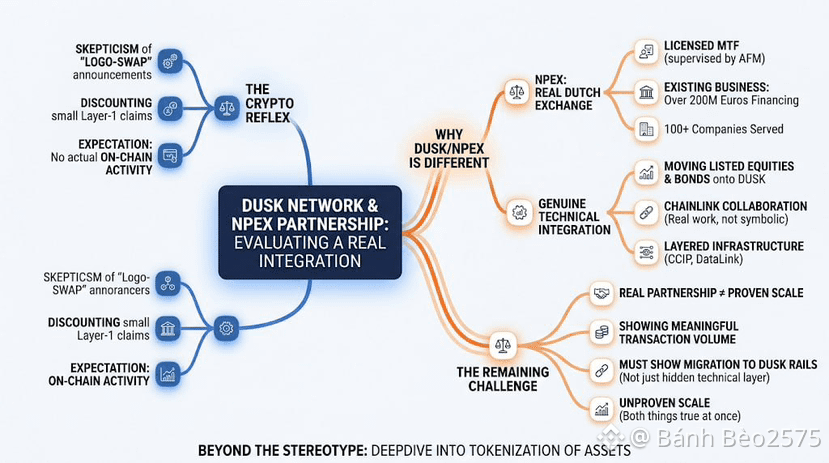
82
·
--
A rate that looked too good to be true on Binance P2P turned out to be exactly that, and walking away from it taught me more than any smooth trade ever has. Binance P2P protects both sides of a deal through escrow, holding a seller's crypto until payment is verified, backed by required KYC, an order level chat, and a dispute appeal system for when Binance needs to review a disagreement. That protection only applies to trades completed fully inside Binance P2P, so any offer that depends on leaving the app should be treated as a warning sign all by itself. I check a counterparty's completed trades, completion rate, and account age before accepting anything, and I've learned that an unusually attractive rate combined with a request to confirm things outside the normal order flow is one of the clearest red flags in P2P trading. I confirm payment myself and keep records of every trade afterward.
The offer was priced noticeably better than everyone else on the list, and the account had decent numbers, which almost convinced me it was legitimate at first glance. Then the buyer messaged asking me to confirm the trade in chat before formally accepting the order, which isn't how the process is supposed to work and immediately felt wrong to me. I declined and moved to a normal priced offer instead, and later saw comments referencing similar attempts from accounts using the exact same tactic on other traders. My rule now: an unusually good rate is a reason to slow down, not speed up, and any deviation from the standard order flow, confirming outside the system, changing payment methods mid trade, is a red flag regardless of how attractive the numbers look on the surface. I still verify payment in my own banking app before releasing anything, keep screenshots of every step, and remind myself that a slightly worse rate from a normal flow beats a great rate from an irregular one every time.
@Binance_Vietnam #BinanceP2PAnToan
$ACE $PORTAL
A rate that looked too good to be true on Binance P2P turned out to be exactly that, and walking away from it taught me more than any smooth trade ever has. Binance P2P protects both sides of a deal through escrow, holding a seller's crypto until payment is verified, backed by required KYC, an order level chat, and a dispute appeal system for when Binance needs to review a disagreement. That protection only applies to trades completed fully inside Binance P2P, so any offer that depends on leaving the app should be treated as a warning sign all by itself. I check a counterparty's completed trades, completion rate, and account age before accepting anything, and I've learned that an unusually attractive rate combined with a request to confirm things outside the normal order flow is one of the clearest red flags in P2P trading. I confirm payment myself and keep records of every trade afterward.
The offer was priced noticeably better than everyone else on the list, and the account had decent numbers, which almost convinced me it was legitimate at first glance. Then the buyer messaged asking me to confirm the trade in chat before formally accepting the order, which isn't how the process is supposed to work and immediately felt wrong to me. I declined and moved to a normal priced offer instead, and later saw comments referencing similar attempts from accounts using the exact same tactic on other traders. My rule now: an unusually good rate is a reason to slow down, not speed up, and any deviation from the standard order flow, confirming outside the system, changing payment methods mid trade, is a red flag regardless of how attractive the numbers look on the surface. I still verify payment in my own banking app before releasing anything, keep screenshots of every step, and remind myself that a slightly worse rate from a normal flow beats a great rate from an irregular one every time.
@Binance Vietnam #BinanceP2PAnToan
$ACE $PORTAL
The offer was priced noticeably better than everyone else on the list, and the account had decent numbers, which almost convinced me it was legitimate at first glance. Then the buyer messaged asking me to confirm the trade in chat before formally accepting the order, which isn't how the process is supposed to work and immediately felt wrong to me. I declined and moved to a normal priced offer instead, and later saw comments referencing similar attempts from accounts using the exact same tactic on other traders. My rule now: an unusually good rate is a reason to slow down, not speed up, and any deviation from the standard order flow, confirming outside the system, changing payment methods mid trade, is a red flag regardless of how attractive the numbers look on the surface. I still verify payment in my own banking app before releasing anything, keep screenshots of every step, and remind myself that a slightly worse rate from a normal flow beats a great rate from an irregular one every time.
@Binance Vietnam #BinanceP2PAnToan
$ACE $PORTAL
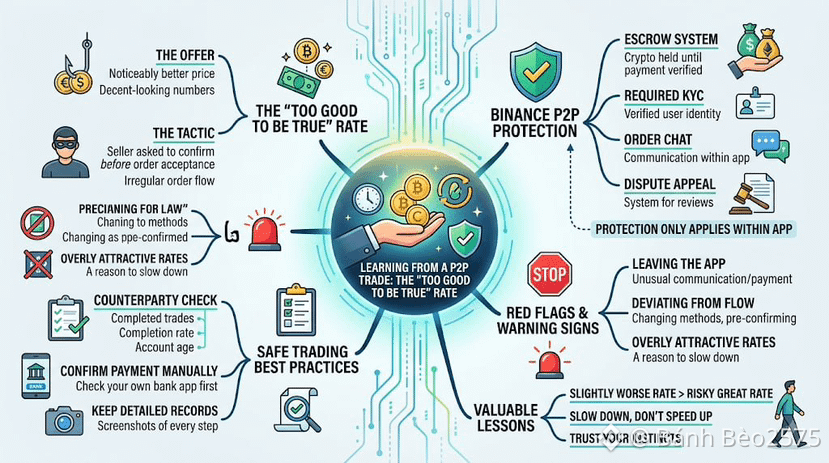
91
Log in to explore more content
Join global crypto users on Binance Square
⚡️ Get latest and useful information about crypto.
💬 Trusted by the world’s largest crypto exchange.
👍 Discover real insights from verified creators.
Email / Phone number
Trending Topics
BTCRebounds80K
35,010 views
572 Discussing
BITCOIN UPDATE I’M STILL BEARISH, AND HERE’S WHY! 🚨⚠️
As you all witnessed, BTC bounced back from the $75,700 area and touched $81K. First, the market trapped long traders, and then it trapped short traders.
I’m still bearish. First of all, as everyone knows, Democrats won today’s US midterm elections, and in my view, this outcome is bearish for the market.
The market can remain volatile in the short term and trap as many traders as it wants, but that doesn’t change the overall market outlook.
There are several important upcoming events, including US Non Farm Payrolls (November 6), US CPI Inflation (November 10), US PPI (November 13), US Retail Sales (November 17), FOMC Meeting Minutes (November 18), US PCE Inflation (November 25), Federal Reserve interest rate expectations, the US Dollar Index (DXY), Treasury Yields, Nasdaq performance, Bitcoin ETF flows, and ongoing( Iran ) Israel geopolitical developments. All of these could have a significant impact on Bitcoin and the overall crypto market.
But don’t get too carried away by Bitcoin’s recent movement. Technically speaking, there hasn’t been any major bullish move yet. Yesterday, BTC was trading between $80K and $82K, and even today, it’s still around the same range.
If you want to turn bullish, that’s entirely your choice.
In my previous post, I clearly explained that BTC had technical support in the $75K / $76K zone, and the price bounced from that support and made its way back towards $80K. But this wasn’t something I had failed to mention before. In fact, I repeatedly mentioned in my posts that BTC could move towards $80K, $81K, or even $82K.
Despite that, I’m still bearish.
And I don’t have just one reason to support my bearish outlook. I have several reasons, which I’ve already explained in my previous posts.
For now, I’ll continue to wait for BTC to drop below $74K, which I believe could happen very soon. In my view, such a correction is also necessary for the market.
Anyone looking for crypto guidance just let me know.
#BTCRebounds80K
Strategic Adviser
·13 Likes
·7k views
Binance98PercentReplenished
28,926 views
494 Discussing
USMidterms-WhatAreMarketsExpecting?
309,193 views
1,989 Discussing