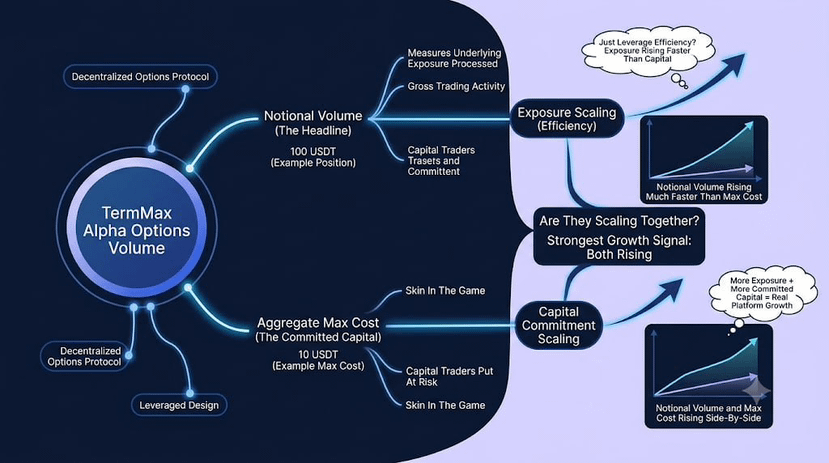
One TermMax Alpha example keeps standing out to me: a 100 USDT notional option position can have an actual Max Cost of just 10 USDT.
For TermMax, a decentralized options trading protocol, that makes the headline trading volume more interesting than it first appears.
Notional volume tells me how much underlying exposure TermMax is processing. It does not tell me how much capital traders are actually putting at risk to create that exposure. In Alpha, leverage is part of the design, so the two can diverge quite naturally.
TermMax's own example makes the gap clearer. A trader can open 100 USDT of notional exposure with 10 USDT of Max Cost, then add another 100 USDT to cumulative volume when that same position is closed.
What I don't know yet is whether growth in Alpha's notional volume is being matched by growth in the capital traders are willing to commit, or whether exposure is scaling much faster than the risk capital behind it.
That is not necessarily a weakness. Generating more exposure from each unit of capital is part of what leveraged options are designed to do.
The stronger signal would be whether rising notional is accompanied by rising aggregate Max Cost. That would show TermMax is not only creating more exposure per unit of capital, but also attracting more capital into Alpha itself.
I'd learn more from notional volume rising alongside aggregate Max Cost than from a much larger notional figure on its own.
The question is whether TermMax Alpha is scaling only the amount of exposure it can generate, or also the amount of capital traders are willing to put behind it.
I am watching notional volume, aggregate Max Cost and how the relationship between the two changes as Alpha grows.
@TermMax #TermMax
$BOME