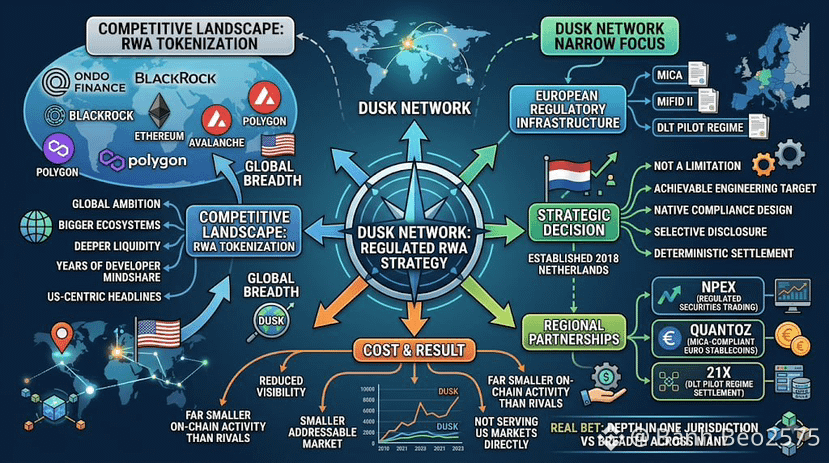
Dusk Network is chasing real-world-asset tokenization in a field where Ondo Finance gets the BlackRock headlines and Ethereum, Avalanche, and Polygon all bring bigger ecosystems, deeper liquidity, and years of developer mindshare to the fight. Against that backdrop, it made a decision that looks almost stubborn from the outside: stay narrowly focused on regulated European financial infrastructure, specifically MiCA, MiFID II, and the DLT Pilot Regime, instead of positioning itself as a general home for RWA tokenization worldwide the way its larger rivals do. Dusk Network was founded in 2018 out of the Netherlands, the same country NPEX and its regulator operate in, and that regional starting point shows up directly in which frameworks the protocol was actually designed around from day one rather than added later as a marketing angle.
I think that narrowness is the actual strategy rather than a limitation the team has not gotten around to fixing yet. Building compliance logic, selective disclosure, and deterministic settlement around one well-defined regulatory framework is a smaller, more achievable engineering target than trying to satisfy US, EU, and Asian securities regulators all at once from a single protocol. The partnerships that resulted, NPEX for regulated securities trading, Quantoz for MiCA-compliant euro stablecoins, 21X for DLT Pilot Regime settlement, all sit inside that one region's rulebook rather than spanning several different legal systems simultaneously.
The cost of that focus is visibility and addressable market size. Dusk Network's total on-chain activity remains far smaller than Ondo's or Ethereum's RWA volume, and every headline about US tokenization frameworks moving forward is, for now, a market Dusk Network's current architecture is not built to serve directly. Depth in one jurisdiction instead of breadth across many is a real bet, and it has not paid off in visible market share yet.
@Dusk $DUSK #dusk